

警哥不吹牛
7 Posts

警哥不吹牛
Report
Block User
树叶的离去是风的追求还是树的不挽留。 如果你认为我的观点对你有用关注点一点
0 Following
0 Followers
3 Liked
Posts
·
--
Today I’m going to go over this batch of coins I mentioned earlier with everyone.
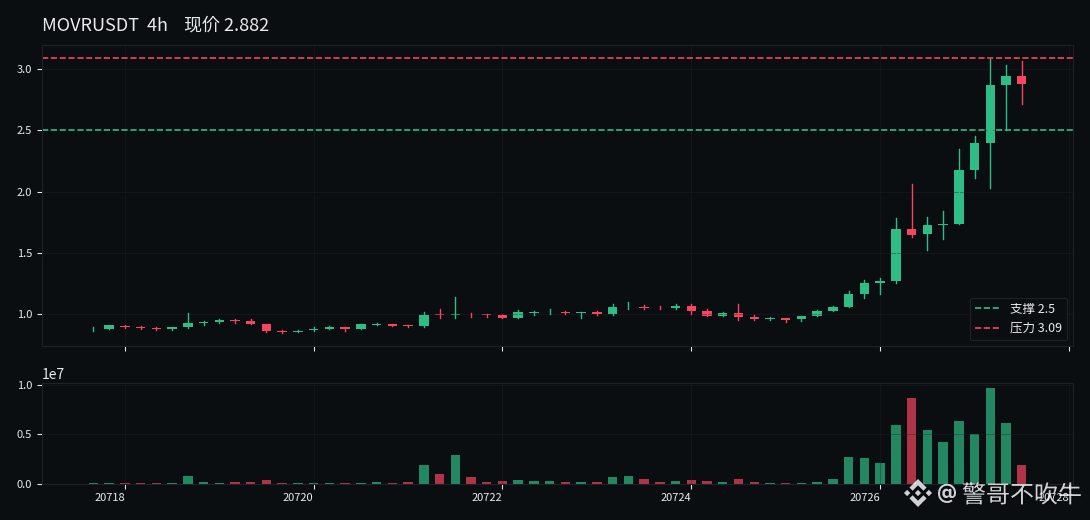
$MOVR is the strongest: in a week it went from 0.89 up to a high of 3.09—an actual 3x gain. Today it surged again and is now consolidating around 2.85. This kind of move is both thrilling and dangerous—this afternoon I said I would wait for a pullback; it just kept rallying upward, and I didn’t chase. The rule for “staying in your lane”: never chase a stock/coin that’s gone crazy upward. Just wait for it to pull back and stabilize around the 2.5 area, then look again. Set the stop-loss below 2.4.
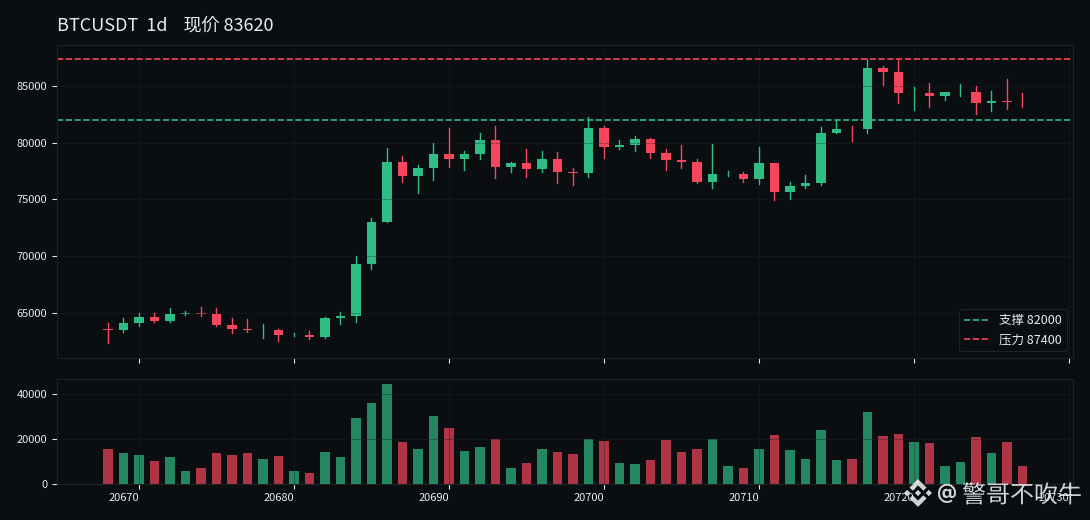
In the same batch, other coins started diverging today: some rallied 3x within a week, then pulled back to around 273 to do an overbought repair; some tried to spike to 5.57 but failed and fell back to 4.75; and some have a slow bull trend, up 8.9%, touching 0.37. The rhythm is very clear: don’t chase the ones that surge wildly; wait for the pullbacks to stabilize. If you’re holding, move your stop-loss upward. If you didn’t get in, don’t rush. $BTC is still grinding around 83k—before the bigger direction is clear, being fully loaded is basically just handing money to the market.
#山寨币 #复盘 #Cryptocurrency
Risk warning: The above is only a personal trading review and does not constitute investment advice. For contracts, please make sure to set a proper stop-loss.
Today I’m going to go over this batch of coins I mentioned earlier with everyone.
$MOVR is the strongest: in a week it went from 0.89 up to a high of 3.09—an actual 3x gain. Today it surged again and is now consolidating around 2.85. This kind of move is both thrilling and dangerous—this afternoon I said I would wait for a pullback; it just kept rallying upward, and I didn’t chase. The rule for “staying in your lane”: never chase a stock/coin that’s gone crazy upward. Just wait for it to pull back and stabilize around the 2.5 area, then look again. Set the stop-loss below 2.4.
In the same batch, other coins started diverging today: some rallied 3x within a week, then pulled back to around 273 to do an overbought repair; some tried to spike to 5.57 but failed and fell back to 4.75; and some have a slow bull trend, up 8.9%, touching 0.37. The rhythm is very clear: don’t chase the ones that surge wildly; wait for the pullbacks to stabilize. If you’re holding, move your stop-loss upward. If you didn’t get in, don’t rush. $BTC is still grinding around 83k—before the bigger direction is clear, being fully loaded is basically just handing money to the market.
#山寨币 #复盘 #Cryptocurrency
Risk warning: The above is only a personal trading review and does not constitute investment advice. For contracts, please make sure to set a proper stop-loss.
$MOVR is the strongest: in a week it went from 0.89 up to a high of 3.09—an actual 3x gain. Today it surged again and is now consolidating around 2.85. This kind of move is both thrilling and dangerous—this afternoon I said I would wait for a pullback; it just kept rallying upward, and I didn’t chase. The rule for “staying in your lane”: never chase a stock/coin that’s gone crazy upward. Just wait for it to pull back and stabilize around the 2.5 area, then look again. Set the stop-loss below 2.4.
In the same batch, other coins started diverging today: some rallied 3x within a week, then pulled back to around 273 to do an overbought repair; some tried to spike to 5.57 but failed and fell back to 4.75; and some have a slow bull trend, up 8.9%, touching 0.37. The rhythm is very clear: don’t chase the ones that surge wildly; wait for the pullbacks to stabilize. If you’re holding, move your stop-loss upward. If you didn’t get in, don’t rush. $BTC is still grinding around 83k—before the bigger direction is clear, being fully loaded is basically just handing money to the market.
#山寨币 #复盘 #Cryptocurrency
Risk warning: The above is only a personal trading review and does not constitute investment advice. For contracts, please make sure to set a proper stop-loss.
340
·
--
$BTC Tonight, it’s standing near 83,950; after several days of grinding in the 83,000–84,500 range, the 4H timeframe is moving sideways with choppy oscillations, and volume has noticeably shrunk—this is a classic pre-breakout setup.
Liquidity is actually not bad: in the week of Sep 25, U.S. spot Bitcoin ETF inflows totaled $2.4 billion (a new high since Oct 2025). There were net inflows for 9 straight trading days, accumulating roughly $3.1 billion. Big whales added more than 40,000 BTC in 10 days, and Strategy swept 1,665 BTC at an average price of 85,681. However, marginal buying momentum is weakening. The latest single-day net inflow is only $66.2 million. Bitfinex’s estimate of the ETF absorption multiple for newly issued miner supply has crashed from 25.6x to 1.8x—buying is there, but it can’t push price.
Above, 84,000–86,500 is a heavy trapped zone: 1.39 million BTC are stacked there. The true line in the sand isn’t until the prior high at 87,395. Downside-wise, first look at 83,000; if that breaks, then the support zone at 81,500–83,000.
Leverage has already come down—good news, because it removes the bomb of cascading liquidations.
Trading idea: around 83,000–83,500, you can take a small long position; place a stop-loss below 81,500. If it holds above 85,000, add in the trend; targets are 86,500–87,395. If it breaks below 81,500, exit immediately and wait for a pullback to stabilize before considering again. In terms of catalysts, watch the 10-year U.S. Treasury yield and the ETFs’ daily net inflows—these two are the real steering wheels.
The above is only personal thinking and does not constitute investment advice. Crypto markets are highly volatile—please manage risk.
#BTC #比特币 #交易策略
$BTC Tonight, it’s standing near 83,950; after several days of grinding in the 83,000–84,500 range, the 4H timeframe is moving sideways with choppy oscillations, and volume has noticeably shrunk—this is a classic pre-breakout setup.
Liquidity is actually not bad: in the week of Sep 25, U.S. spot Bitcoin ETF inflows totaled $2.4 billion (a new high since Oct 2025). There were net inflows for 9 straight trading days, accumulating roughly $3.1 billion. Big whales added more than 40,000 BTC in 10 days, and Strategy swept 1,665 BTC at an average price of 85,681. However, marginal buying momentum is weakening. The latest single-day net inflow is only $66.2 million. Bitfinex’s estimate of the ETF absorption multiple for newly issued miner supply has crashed from 25.6x to 1.8x—buying is there, but it can’t push price.
Above, 84,000–86,500 is a heavy trapped zone: 1.39 million BTC are stacked there. The true line in the sand isn’t until the prior high at 87,395. Downside-wise, first look at 83,000; if that breaks, then the support zone at 81,500–83,000.
Leverage has already come down—good news, because it removes the bomb of cascading liquidations.
Trading idea: around 83,000–83,500, you can take a small long position; place a stop-loss below 81,500. If it holds above 85,000, add in the trend; targets are 86,500–87,395. If it breaks below 81,500, exit immediately and wait for a pullback to stabilize before considering again. In terms of catalysts, watch the 10-year U.S. Treasury yield and the ETFs’ daily net inflows—these two are the real steering wheels.
The above is only personal thinking and does not constitute investment advice. Crypto markets are highly volatile—please manage risk.
#BTC #比特币 #交易策略
Liquidity is actually not bad: in the week of Sep 25, U.S. spot Bitcoin ETF inflows totaled $2.4 billion (a new high since Oct 2025). There were net inflows for 9 straight trading days, accumulating roughly $3.1 billion. Big whales added more than 40,000 BTC in 10 days, and Strategy swept 1,665 BTC at an average price of 85,681. However, marginal buying momentum is weakening. The latest single-day net inflow is only $66.2 million. Bitfinex’s estimate of the ETF absorption multiple for newly issued miner supply has crashed from 25.6x to 1.8x—buying is there, but it can’t push price.
Above, 84,000–86,500 is a heavy trapped zone: 1.39 million BTC are stacked there. The true line in the sand isn’t until the prior high at 87,395. Downside-wise, first look at 83,000; if that breaks, then the support zone at 81,500–83,000.
Leverage has already come down—good news, because it removes the bomb of cascading liquidations.
Trading idea: around 83,000–83,500, you can take a small long position; place a stop-loss below 81,500. If it holds above 85,000, add in the trend; targets are 86,500–87,395. If it breaks below 81,500, exit immediately and wait for a pullback to stabilize before considering again. In terms of catalysts, watch the 10-year U.S. Treasury yield and the ETFs’ daily net inflows—these two are the real steering wheels.
The above is only personal thinking and does not constitute investment advice. Crypto markets are highly volatile—please manage risk.
#BTC #比特币 #交易策略
1
1
·
--
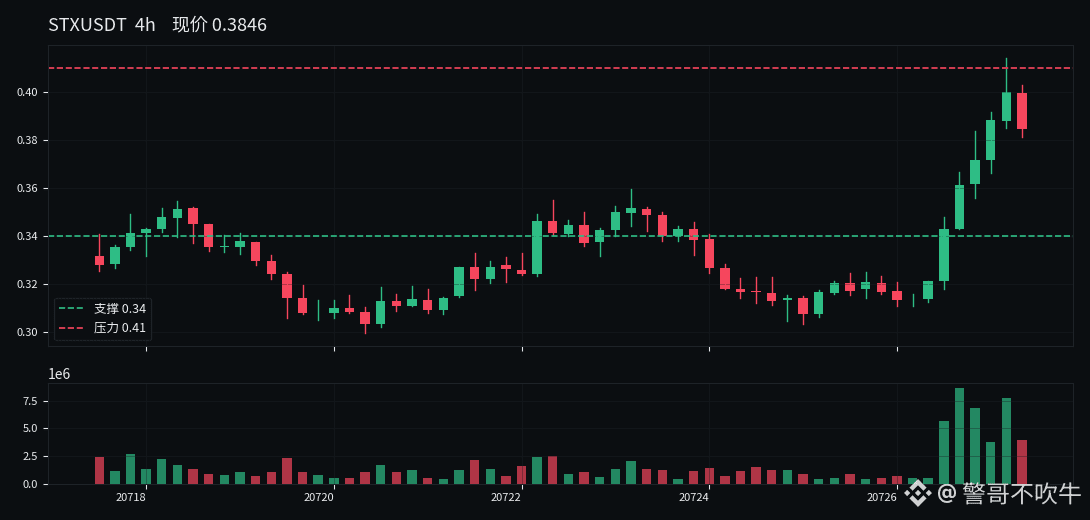
$STX today +21%, the Bitcoin ecosystem leader is alive again. In the 4h timeframe, it successfully broke above $0.34— the long side structure hasn’t broken. But don’t chase it; the short-term is severely overbought. Wait for a pullback to around $0.35 before considering a buy. Set the stop loss below $0.33. If $BTC holds steady, it can still push toward $0.40. Trade with a small position and keep your stop loss in place #STX #BTC生态 #Bitcoin
$STX today +21%, the Bitcoin ecosystem leader is alive again. In the 4h timeframe, it successfully broke above $0.34— the long side structure hasn’t broken. But don’t chase it; the short-term is severely overbought. Wait for a pullback to around $0.35 before considering a buy. Set the stop loss below $0.33. If $BTC holds steady, it can still push toward $0.40. Trade with a small position and keep your stop loss in place #STX #BTC生态 #Bitcoin
154
·
--
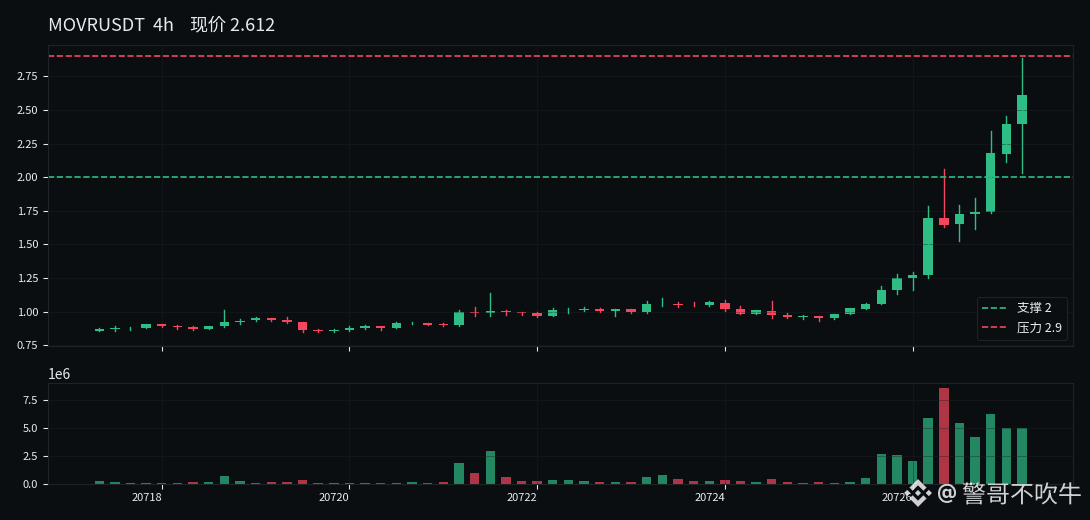
$MOVR surged day trading and surged nearly 60%; from $1 it directly went to around $2.9, with massive trading volume—liquidity ignited and sentiment was fully fueled.
The short-term uptrend is still intact, but with this kind of steep slope, don’t chase at all—it's very easy to get wicked by a spike. Wait for a pullback to 2.0–2.1 support to stabilize, then take another look. Place the stop-loss below 2.0.
Play with a light position and make sure to set your stop-loss #MOVR #山寨季 #cryptocurrency
$MOVR surged day trading and surged nearly 60%; from $1 it directly went to around $2.9, with massive trading volume—liquidity ignited and sentiment was fully fueled.
The short-term uptrend is still intact, but with this kind of steep slope, don’t chase at all—it's very easy to get wicked by a spike. Wait for a pullback to 2.0–2.1 support to stabilize, then take another look. Place the stop-loss below 2.0.
Play with a light position and make sure to set your stop-loss #MOVR #山寨季 #cryptocurrency
The short-term uptrend is still intact, but with this kind of steep slope, don’t chase at all—it's very easy to get wicked by a spike. Wait for a pullback to 2.0–2.1 support to stabilize, then take another look. Place the stop-loss below 2.0.
Play with a light position and make sure to set your stop-loss #MOVR #山寨季 #cryptocurrency
167
·
--
Whole margin and cross margin—here’s the full picture in one sentence.
Cross margin is a shared room: when it blows up, at most you lose the margin in that one position.
Whole margin is a dorm-style setup: if one position goes bad, all the money in your account has to cover the loss.
For beginners, using whole margin is like staking your savings on a single poker table.
The tragedy of making money on one side and getting liquidated on the other—all of it comes from playing with whole margin.
Old hands’ rules are simple:
Short-term try-and-error, if the direction isn’t clear—use cross margin; if you lose, at least you know the limit.
If the trend is clear and you need to ride out a pullback—use whole margin, but the position must be light.
Remember: a “better” model isn’t necessarily the more advanced one—it’s the one that matches your position size.
Beginners should default to cross margin: learn to afford losses first, then talk about making more.
#合约 #逐仓 #Whole margin
Futures trading carries high risk—use a light position and set a stop-loss.
Whole margin and cross margin—here’s the full picture in one sentence.
Cross margin is a shared room: when it blows up, at most you lose the margin in that one position.
Whole margin is a dorm-style setup: if one position goes bad, all the money in your account has to cover the loss.
For beginners, using whole margin is like staking your savings on a single poker table.
The tragedy of making money on one side and getting liquidated on the other—all of it comes from playing with whole margin.
Old hands’ rules are simple:
Short-term try-and-error, if the direction isn’t clear—use cross margin; if you lose, at least you know the limit.
If the trend is clear and you need to ride out a pullback—use whole margin, but the position must be light.
Remember: a “better” model isn’t necessarily the more advanced one—it’s the one that matches your position size.
Beginners should default to cross margin: learn to afford losses first, then talk about making more.
#合约 #逐仓 #Whole margin
Futures trading carries high risk—use a light position and set a stop-loss.
Cross margin is a shared room: when it blows up, at most you lose the margin in that one position.
Whole margin is a dorm-style setup: if one position goes bad, all the money in your account has to cover the loss.
For beginners, using whole margin is like staking your savings on a single poker table.
The tragedy of making money on one side and getting liquidated on the other—all of it comes from playing with whole margin.
Old hands’ rules are simple:
Short-term try-and-error, if the direction isn’t clear—use cross margin; if you lose, at least you know the limit.
If the trend is clear and you need to ride out a pullback—use whole margin, but the position must be light.
Remember: a “better” model isn’t necessarily the more advanced one—it’s the one that matches your position size.
Beginners should default to cross margin: learn to afford losses first, then talk about making more.
#合约 #逐仓 #Whole margin
Futures trading carries high risk—use a light position and set a stop-loss.
77
·
--
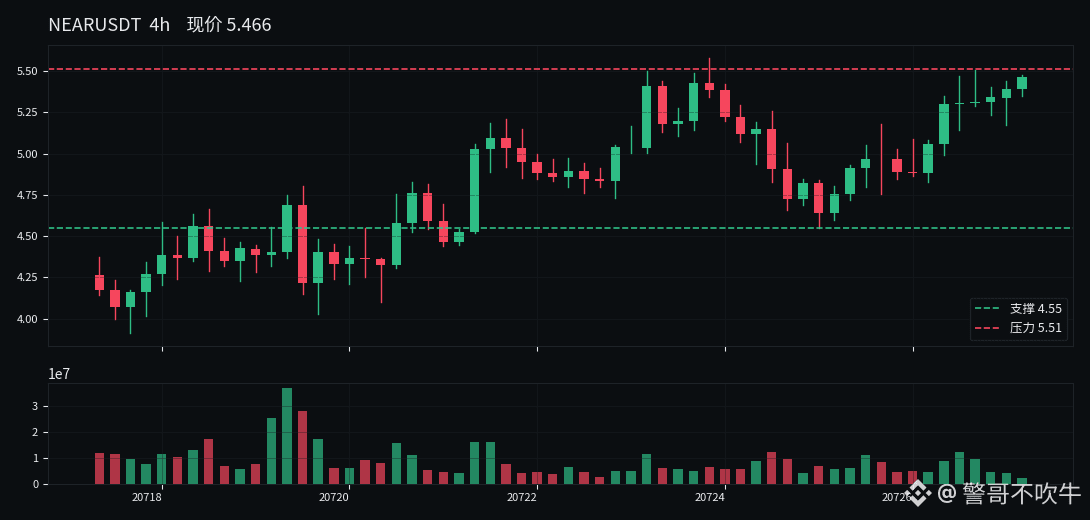
$NEAR AI narrative returns in full force, 24 hours to volume up by $1.5B, 7 days to surge 30%—funds clearly accumulating. Current price $5.46. Go long in the trend; resistance $5.51 (previous high), support $4.55. If it breaks support, exit. #NEAR #AI概念 # trading strategy
Risk warning: The market is risky; investing requires caution; this does not constitute investment advice.
$NEAR AI narrative returns in full force, 24 hours to volume up by $1.5B, 7 days to surge 30%—funds clearly accumulating. Current price $5.46. Go long in the trend; resistance $5.51 (previous high), support $4.55. If it breaks support, exit. #NEAR #AI概念 # trading strategy
Risk warning: The market is risky; investing requires caution; this does not constitute investment advice.
Risk warning: The market is risky; investing requires caution; this does not constitute investment advice.
1
1
304
·
--
$QNT Massive whale orders set a record—645 trades of $100k+ each came in on a single day. The Clearing House officially announced that it will use it for on-chain banking transfers. Current price $293.2, with institutions stepping in to accumulate aggressively, then riding the momentum to go long. Resistance $373.0 (previous high), support $273.7. If it breaks below support, get out. #QNT #altcoins #trading strategy
Risk warning: The market is risky—invest carefully and this does not constitute investment advice.
$QNT Massive whale orders set a record—645 trades of $100k+ each came in on a single day. The Clearing House officially announced that it will use it for on-chain banking transfers. Current price $293.2, with institutions stepping in to accumulate aggressively, then riding the momentum to go long. Resistance $373.0 (previous high), support $273.7. If it breaks below support, get out. #QNT #altcoins #trading strategy
Risk warning: The market is risky—invest carefully and this does not constitute investment advice.
Risk warning: The market is risky—invest carefully and this does not constitute investment advice.
1
348
Log in to explore more content
Join global crypto users on Binance Square
⚡️ Get latest and useful information about crypto.
💬 Trusted by the world’s largest crypto exchange.
👍 Discover real insights from verified creators.
Email / Phone number
Trending Topics
EtherGains70.9%InQ3
169,948 views
1,176 Discussing
One of the best third quarters in history 💰
September closed out last night, and with it, the quarter. For the quarter, BTC is up 42%—the second-best Q3 on record. ETH had a record-breaking Q3 overall, up 70%.
Looking at the chart, things are still looking good: we’re holding support, but we’re testing it more and more often. Plus, ETF momentum is weakening — inflows are gradually declining, and yesterday saw outflows for the first time in a long while.
Yes, historically, October has been a good month for crypto — it’s not called “Uptober” for nothing. But it’s also one of the most volatile months. Last year, for example, we managed to hit a new all-time high (ATH) and experience a flash crash.
🚀 High Accuracy Trades.
$BTC
$ETH
$SOL
#EtherGains70.9%InQ3 #DollarIndexHitsHighestSinceMay2025 #CFTCSubmitsTwoEventContractRulesToWhiteHouse #MicronBeatsEarningsLiftsGuidance
Knowledge is Power
·0 Likes
·250 views
TreasuryLetsStatesFileStablecoinCertificationsEarly
10,793 views
91 Discussing
US10YearYieldNears5.3%
157,318 views
1,157 Discussing