
Crypto Inertia
626 Posts
Crypto Inertia
Report
Block User
High-Frequency Trader
3.5 Years
123 Following
126 Followers
247 Liked
Posts
All
Quotes
PINNED
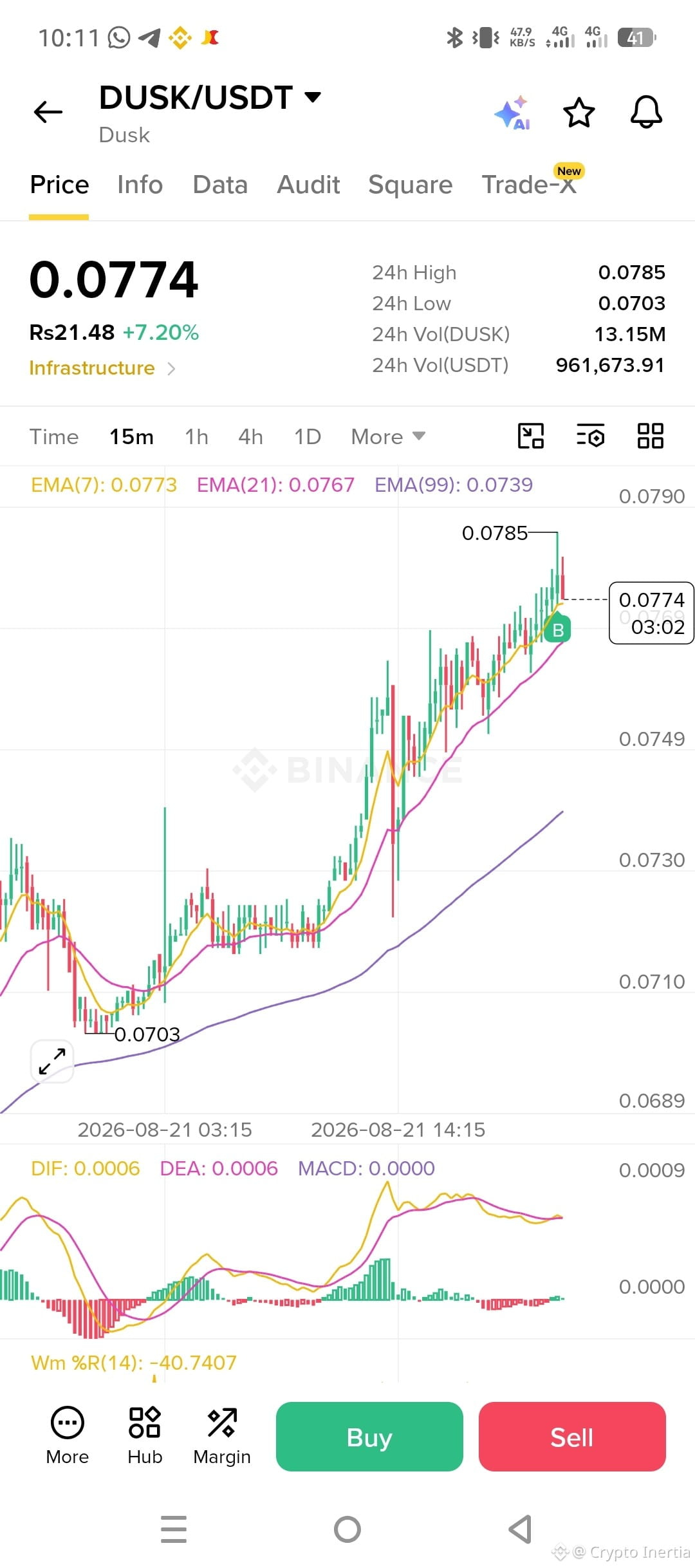
#dusk $DUSK @Dusk_Foundation I've been sitting with my DUSK trade and one number keeps nagging me.
Entered at 0.0630. Current price 0.0779. That's roughly 23% up. Solid on paper. But Williams %R is sitting at -3.97. Deep overbought. The MACD is still positive and the EMA stack is bullish — 7 above 21 above 99. Everything says uptrend. Except that overbought signal.
What does that tell me? Either momentum is strong enough to push through 0.0785 resistance and keep running, or the easy move is done and a rejection sends it back toward the EMAs. Probably both if I'm honest — a test of resistance, then consolidation.
Then I looked at the volume. 13.14M DUSK traded in 24 hours. That's real activity. Not a dead chart. Buy average at 0.0630, sell average at 0.0623. The market is balanced but slightly leaning buy. My entry sits right where buyers stepped in.
What I genuinely don't know is whether this pump is campaign-driven or something deeper in the ecosystem. The partnerships are real. NPEX. Chainlink. EURQ. But the chart doesn't care about announcements. It cares about liquidity and momentum.
The question I keep coming back to — when I research a chain for a campaign and trade it at the same time, am I reading the project or just reading the chart? $DUSK #dusk
#dusk $DUSK @Dusk I've been sitting with my DUSK trade and one number keeps nagging me.
Entered at 0.0630. Current price 0.0779. That's roughly 23% up. Solid on paper. But Williams %R is sitting at -3.97. Deep overbought. The MACD is still positive and the EMA stack is bullish — 7 above 21 above 99. Everything says uptrend. Except that overbought signal.
What does that tell me? Either momentum is strong enough to push through 0.0785 resistance and keep running, or the easy move is done and a rejection sends it back toward the EMAs. Probably both if I'm honest — a test of resistance, then consolidation.
Then I looked at the volume. 13.14M DUSK traded in 24 hours. That's real activity. Not a dead chart. Buy average at 0.0630, sell average at 0.0623. The market is balanced but slightly leaning buy. My entry sits right where buyers stepped in.
What I genuinely don't know is whether this pump is campaign-driven or something deeper in the ecosystem. The partnerships are real. NPEX. Chainlink. EURQ. But the chart doesn't care about announcements. It cares about liquidity and momentum.
The question I keep coming back to — when I research a chain for a campaign and trade it at the same time, am I reading the project or just reading the chart? $DUSK #dusk
Entered at 0.0630. Current price 0.0779. That's roughly 23% up. Solid on paper. But Williams %R is sitting at -3.97. Deep overbought. The MACD is still positive and the EMA stack is bullish — 7 above 21 above 99. Everything says uptrend. Except that overbought signal.
What does that tell me? Either momentum is strong enough to push through 0.0785 resistance and keep running, or the easy move is done and a rejection sends it back toward the EMAs. Probably both if I'm honest — a test of resistance, then consolidation.
Then I looked at the volume. 13.14M DUSK traded in 24 hours. That's real activity. Not a dead chart. Buy average at 0.0630, sell average at 0.0623. The market is balanced but slightly leaning buy. My entry sits right where buyers stepped in.
What I genuinely don't know is whether this pump is campaign-driven or something deeper in the ecosystem. The partnerships are real. NPEX. Chainlink. EURQ. But the chart doesn't care about announcements. It cares about liquidity and momentum.
The question I keep coming back to — when I research a chain for a campaign and trade it at the same time, am I reading the project or just reading the chart? $DUSK #dusk
70
#dusk $DUSK @Dusk_Foundation ---
Dusk says regulated finance onchain. NPEX partnership. 21X with DLT-TSS license. Quantoz with EURQ. Everything looks solid.
But then I checked actual deployment. Dusk Trade still building. DuskEVM testnet. Hedger testnet. DLT-TSS license in progress. Partnerships signed but products not ready.
On-chain same story. 206 provisioners. Concentrated stake. Pending stake almost zero. Institutional pitch but actual shape looks like validator club right now.
Don't know if this is normal or if the gap is too wide. When institutions open the explorer, what do they see — settlement infrastructure or an assembly line?
$DUSK #dusk
---
#dusk $DUSK @Dusk ---
Dusk says regulated finance onchain. NPEX partnership. 21X with DLT-TSS license. Quantoz with EURQ. Everything looks solid.
But then I checked actual deployment. Dusk Trade still building. DuskEVM testnet. Hedger testnet. DLT-TSS license in progress. Partnerships signed but products not ready.
On-chain same story. 206 provisioners. Concentrated stake. Pending stake almost zero. Institutional pitch but actual shape looks like validator club right now.
Don't know if this is normal or if the gap is too wide. When institutions open the explorer, what do they see — settlement infrastructure or an assembly line?
$DUSK #dusk
---
Dusk says regulated finance onchain. NPEX partnership. 21X with DLT-TSS license. Quantoz with EURQ. Everything looks solid.
But then I checked actual deployment. Dusk Trade still building. DuskEVM testnet. Hedger testnet. DLT-TSS license in progress. Partnerships signed but products not ready.
On-chain same story. 206 provisioners. Concentrated stake. Pending stake almost zero. Institutional pitch but actual shape looks like validator club right now.
Don't know if this is normal or if the gap is too wide. When institutions open the explorer, what do they see — settlement infrastructure or an assembly line?
$DUSK #dusk
---
174
#dusk $DUSK @Dusk_Foundation I've been sitting with the DUSK ecosystem and one pattern keeps nagging me.
Dusk has assembled regulated partners like no other chain. NPEX with MTF, Broker, and ECSP licenses. 21X with Europe's first DLT-TSS. Quantoz with MiCA-compliant EURQ. Chainlink for infrastructure. Cordial for custody. Each partnership brings something real. Solid.
But when I traced where these partners actually plug into Dusk right now, the connections are thinner than the announcements suggest. 21X is "planning" to integrate DuskEVM. NPEX's native issuance needs a license still in progress. Dusk Trade is building. The partnerships are signed. The integration points are mostly ahead.
Either the sequence is deliberate — regulatory groundwork before technical rollout — or the product layer is lagging the partnership layer. Probably both if I'm honest.
Then there's the other side. On-chain, the network runs on 206 provisioners with concentrated stake. On paper, it's institutional infrastructure. On-chain, it's a bootstrap phase. The two realities don't match yet.
What I genuinely don't know is whether institutions evaluate Dusk on the partnership list or the deployment status. Those tell different stories right now.
The question I keep coming back to — if the partnerships are the strongest thing about Dusk and the products are still catching up, what does that mean for the next six months? $DUSK #dusk
#dusk $DUSK @Dusk I've been sitting with the DUSK ecosystem and one pattern keeps nagging me.
Dusk has assembled regulated partners like no other chain. NPEX with MTF, Broker, and ECSP licenses. 21X with Europe's first DLT-TSS. Quantoz with MiCA-compliant EURQ. Chainlink for infrastructure. Cordial for custody. Each partnership brings something real. Solid.
But when I traced where these partners actually plug into Dusk right now, the connections are thinner than the announcements suggest. 21X is "planning" to integrate DuskEVM. NPEX's native issuance needs a license still in progress. Dusk Trade is building. The partnerships are signed. The integration points are mostly ahead.
Either the sequence is deliberate — regulatory groundwork before technical rollout — or the product layer is lagging the partnership layer. Probably both if I'm honest.
Then there's the other side. On-chain, the network runs on 206 provisioners with concentrated stake. On paper, it's institutional infrastructure. On-chain, it's a bootstrap phase. The two realities don't match yet.
What I genuinely don't know is whether institutions evaluate Dusk on the partnership list or the deployment status. Those tell different stories right now.
The question I keep coming back to — if the partnerships are the strongest thing about Dusk and the products are still catching up, what does that mean for the next six months? $DUSK #dusk
Dusk has assembled regulated partners like no other chain. NPEX with MTF, Broker, and ECSP licenses. 21X with Europe's first DLT-TSS. Quantoz with MiCA-compliant EURQ. Chainlink for infrastructure. Cordial for custody. Each partnership brings something real. Solid.
But when I traced where these partners actually plug into Dusk right now, the connections are thinner than the announcements suggest. 21X is "planning" to integrate DuskEVM. NPEX's native issuance needs a license still in progress. Dusk Trade is building. The partnerships are signed. The integration points are mostly ahead.
Either the sequence is deliberate — regulatory groundwork before technical rollout — or the product layer is lagging the partnership layer. Probably both if I'm honest.
Then there's the other side. On-chain, the network runs on 206 provisioners with concentrated stake. On paper, it's institutional infrastructure. On-chain, it's a bootstrap phase. The two realities don't match yet.
What I genuinely don't know is whether institutions evaluate Dusk on the partnership list or the deployment status. Those tell different stories right now.
The question I keep coming back to — if the partnerships are the strongest thing about Dusk and the products are still catching up, what does that mean for the next six months? $DUSK #dusk
1
1
92
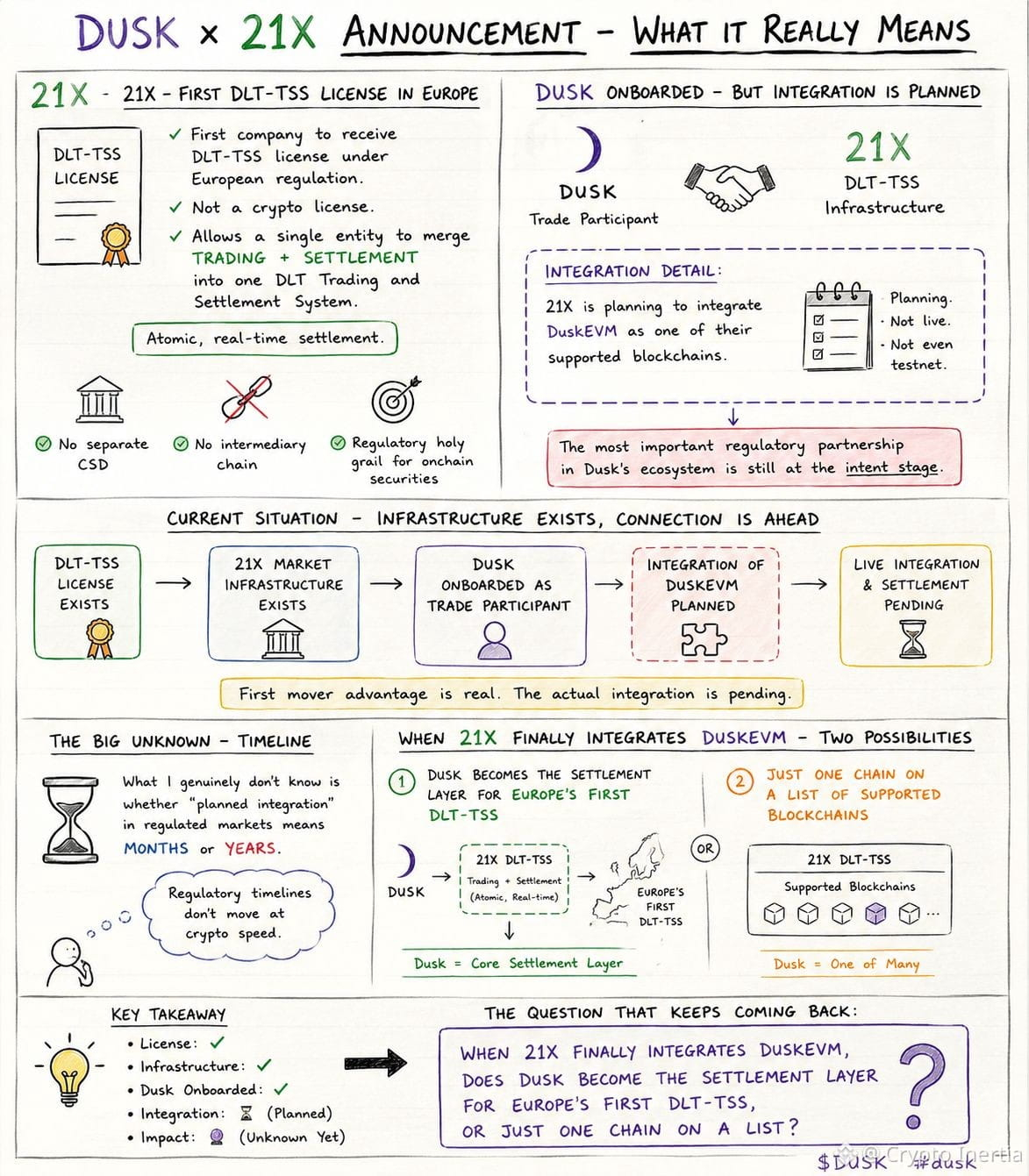
#dusk $DUSK @Dusk_Foundation I've been sitting with the DUSK and 21X announcement and one detail keeps nagging me.
21X is the first company to receive the DLT-TSS license under European$DUSK
{spot}(DUSKUSDT)
regulation. That's not a crypto license. It allows a single entity to merge trading and settlement — traditionally separate functions — into one DLT Trading and Settlement System. Atomic, real-time settlement. No separate CSD. No intermediary chain. This is the regulatory holy grail for onchain securities.
Dusk is onboarded as a trade participant. Solid. But then I read the integration detail. 21X "planning to integrate DuskEVM" as one of their supported blockchains. Planning. Not live. Not even testnet. The most important regulatory partnership in Dusk's ecosystem is still at the intent stage. Either the regulatory onboarding takes longer than the announcement suggests, or the technical integration is waiting on DuskEVM to mature first. Probably both.
Then there's the broader pattern. NPEX has confirmed €200M+ in financing but DLT-TSS is in progress. Dusk Trade is building. Hedger is testnet. The partnership list is real, but the deployment stack behind it is still assembling. The regulatory narrative says "Europe's first blockchain-powered security exchange." The docs say "building" and "testnet."
What I genuinely don't know is whether "planned integration" in regulated markets means months or years. Regulatory timelines don't move at crypto speed.
The question I keep coming back to — when 21X finally integrates DuskEVM, does Dusk become the settlement layer for Europe's first DLT-TSS, or just one chain on a list?
#dusk $DUSK @Dusk I've been sitting with the DUSK and 21X announcement and one detail keeps nagging me.
21X is the first company to receive the DLT-TSS license under European$DUSK
regulation. That's not a crypto license. It allows a single entity to merge trading and settlement — traditionally separate functions — into one DLT Trading and Settlement System. Atomic, real-time settlement. No separate CSD. No intermediary chain. This is the regulatory holy grail for onchain securities.
Dusk is onboarded as a trade participant. Solid. But then I read the integration detail. 21X "planning to integrate DuskEVM" as one of their supported blockchains. Planning. Not live. Not even testnet. The most important regulatory partnership in Dusk's ecosystem is still at the intent stage. Either the regulatory onboarding takes longer than the announcement suggests, or the technical integration is waiting on DuskEVM to mature first. Probably both.
Then there's the broader pattern. NPEX has confirmed €200M+ in financing but DLT-TSS is in progress. Dusk Trade is building. Hedger is testnet. The partnership list is real, but the deployment stack behind it is still assembling. The regulatory narrative says "Europe's first blockchain-powered security exchange." The docs say "building" and "testnet."
What I genuinely don't know is whether "planned integration" in regulated markets means months or years. Regulatory timelines don't move at crypto speed.
The question I keep coming back to — when 21X finally integrates DuskEVM, does Dusk become the settlement layer for Europe's first DLT-TSS, or just one chain on a list?
21X is the first company to receive the DLT-TSS license under European$DUSK
regulation. That's not a crypto license. It allows a single entity to merge trading and settlement — traditionally separate functions — into one DLT Trading and Settlement System. Atomic, real-time settlement. No separate CSD. No intermediary chain. This is the regulatory holy grail for onchain securities.
Dusk is onboarded as a trade participant. Solid. But then I read the integration detail. 21X "planning to integrate DuskEVM" as one of their supported blockchains. Planning. Not live. Not even testnet. The most important regulatory partnership in Dusk's ecosystem is still at the intent stage. Either the regulatory onboarding takes longer than the announcement suggests, or the technical integration is waiting on DuskEVM to mature first. Probably both.
Then there's the broader pattern. NPEX has confirmed €200M+ in financing but DLT-TSS is in progress. Dusk Trade is building. Hedger is testnet. The partnership list is real, but the deployment stack behind it is still assembling. The regulatory narrative says "Europe's first blockchain-powered security exchange." The docs say "building" and "testnet."
What I genuinely don't know is whether "planned integration" in regulated markets means months or years. Regulatory timelines don't move at crypto speed.
The question I keep coming back to — when 21X finally integrates DuskEVM, does Dusk become the settlement layer for Europe's first DLT-TSS, or just one chain on a list?
81
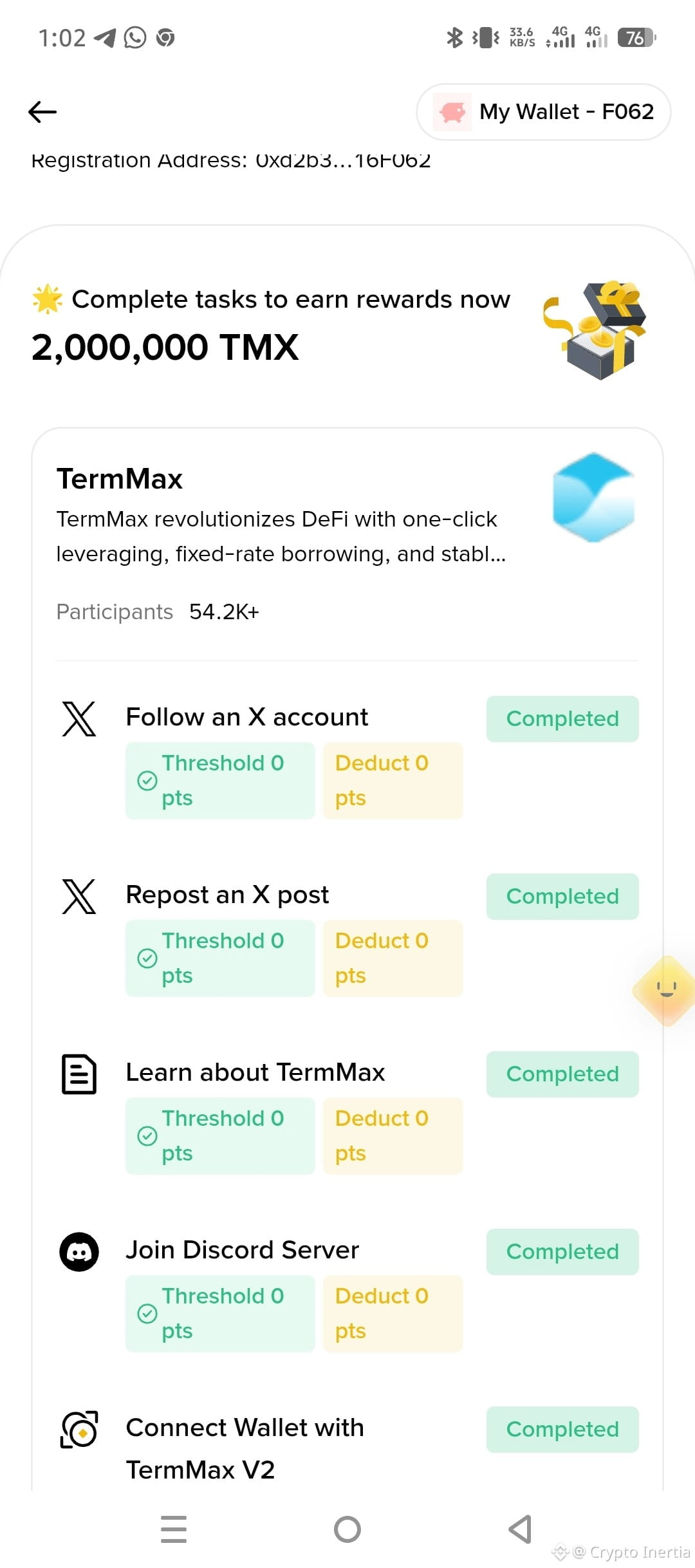
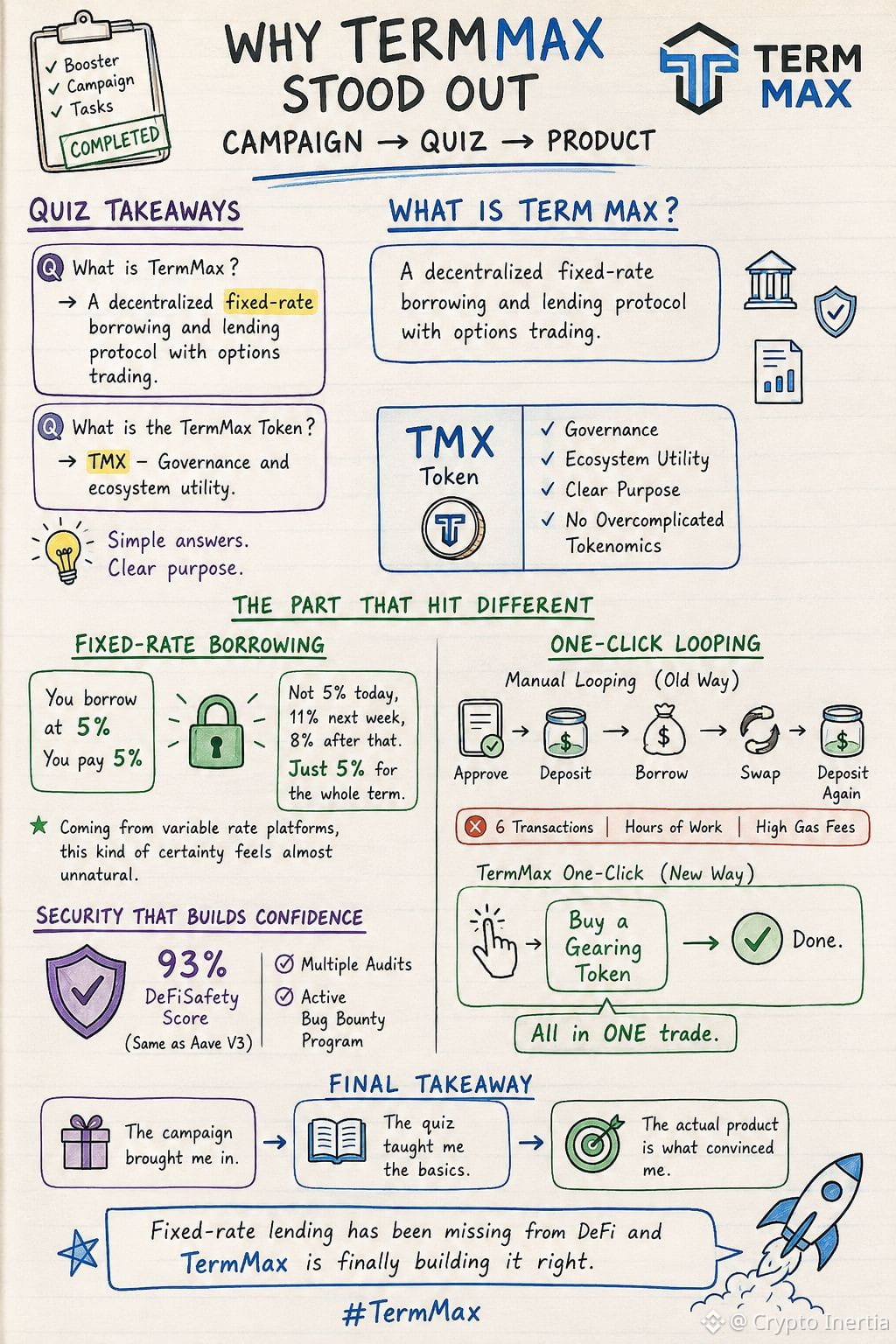
#termmax @termmax Finished the TermMax booster campaign tasks today and something from the quiz actually stuck with me.
The learning section asked what TermMax is. The answer was simple. A decentralized fixed-rate borrowing and lending protocol with options trading. Fixed rates. Fixed terms. Not the variable rate chaos we're all used to.Then it asked about the token. TMX. Governance and ecosystem utility. No overcomplicated tokenomics. Just a clear purpose.
That's what got me digging deeper into @TermMax docs.
The fixed-rate borrowing is the part I keep thinking about. You borrow at 5%. You pay 5%. Not 5% today, 11% next week, 8% after that. Just 5% for the whole term. Coming from platforms where rates swing constantly, that kind of certainty feels almost unnatural.The one-click looping is smart too. I remember manual looping taking me six transactions and a full afternoon. Approve, deposit, borrow, swap, deposit again. Gas fees at every step. TermMax wraps all that into one trade. Buy a Gearing Token and done.
Security wise they're solid. 93% DeFiSafety score. Same as Aave V3. Multiple audits and an active bug bounty.The campaign brought me in. The quiz taught me the basics. The actual product is what convinced me. Fixed-rate lending has been missing from DeFi and TermMax is finally building it right.
#termmax @TermMax Finished the TermMax booster campaign tasks today and something from the quiz actually stuck with me.
The learning section asked what TermMax is. The answer was simple. A decentralized fixed-rate borrowing and lending protocol with options trading. Fixed rates. Fixed terms. Not the variable rate chaos we're all used to.Then it asked about the token. TMX. Governance and ecosystem utility. No overcomplicated tokenomics. Just a clear purpose.
That's what got me digging deeper into @TermMax docs.
The fixed-rate borrowing is the part I keep thinking about. You borrow at 5%. You pay 5%. Not 5% today, 11% next week, 8% after that. Just 5% for the whole term. Coming from platforms where rates swing constantly, that kind of certainty feels almost unnatural.The one-click looping is smart too. I remember manual looping taking me six transactions and a full afternoon. Approve, deposit, borrow, swap, deposit again. Gas fees at every step. TermMax wraps all that into one trade. Buy a Gearing Token and done.
Security wise they're solid. 93% DeFiSafety score. Same as Aave V3. Multiple audits and an active bug bounty.The campaign brought me in. The quiz taught me the basics. The actual product is what convinced me. Fixed-rate lending has been missing from DeFi and TermMax is finally building it right.
The learning section asked what TermMax is. The answer was simple. A decentralized fixed-rate borrowing and lending protocol with options trading. Fixed rates. Fixed terms. Not the variable rate chaos we're all used to.Then it asked about the token. TMX. Governance and ecosystem utility. No overcomplicated tokenomics. Just a clear purpose.
That's what got me digging deeper into @TermMax docs.
The fixed-rate borrowing is the part I keep thinking about. You borrow at 5%. You pay 5%. Not 5% today, 11% next week, 8% after that. Just 5% for the whole term. Coming from platforms where rates swing constantly, that kind of certainty feels almost unnatural.The one-click looping is smart too. I remember manual looping taking me six transactions and a full afternoon. Approve, deposit, borrow, swap, deposit again. Gas fees at every step. TermMax wraps all that into one trade. Buy a Gearing Token and done.
Security wise they're solid. 93% DeFiSafety score. Same as Aave V3. Multiple audits and an active bug bounty.The campaign brought me in. The quiz taught me the basics. The actual product is what convinced me. Fixed-rate lending has been missing from DeFi and TermMax is finally building it right.
2
86
#dusk $DUSK @Dusk_Foundation
I've been sitting with the DUSK partnership announcements and one thing keeps nagging me.
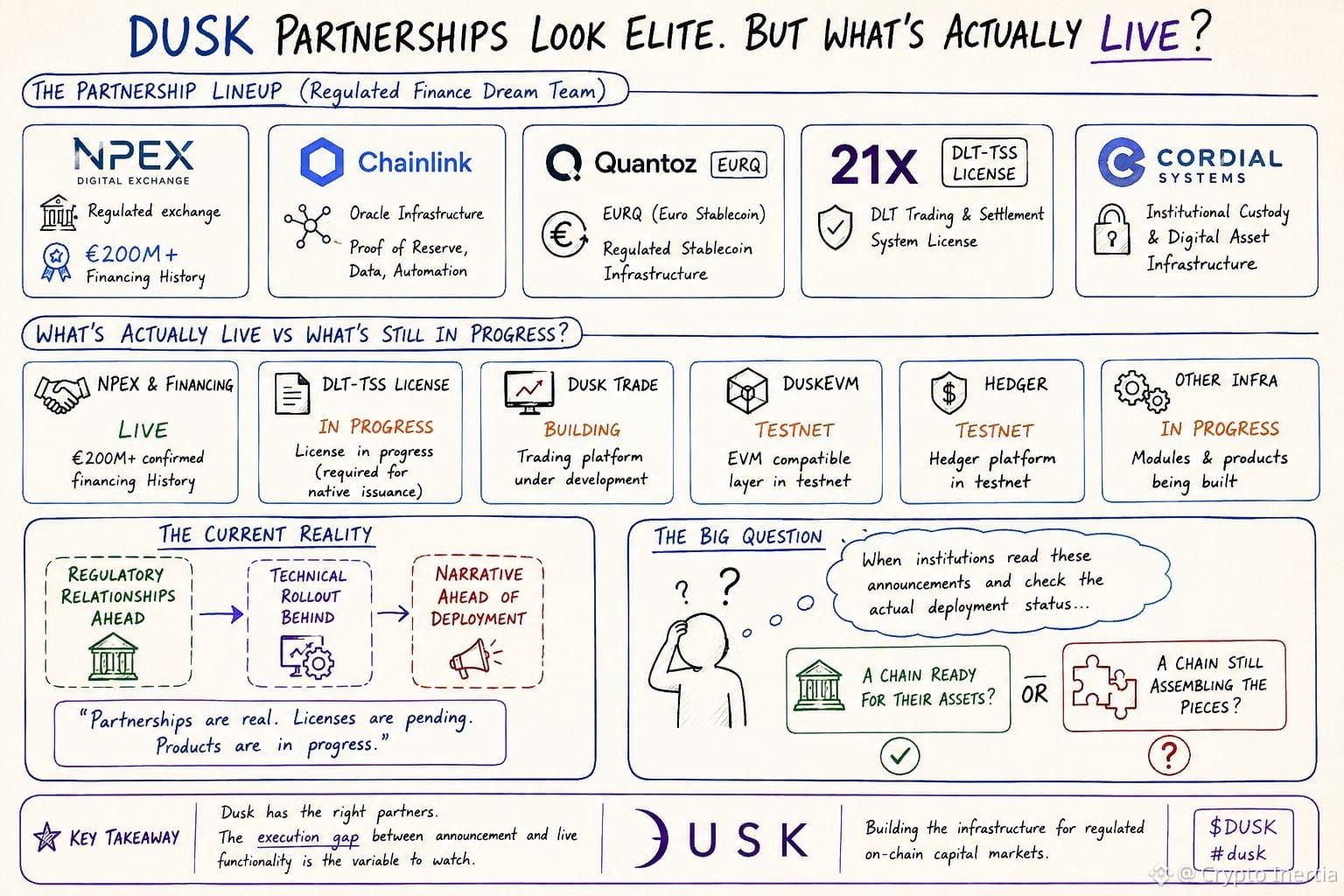
Dusk has NPEX. Chainlink. Quantoz with EURQ. 21X with the DLT-TSS license. Cordial Systems for custody. The partnership list reads like a regulated finance dream team. Each one brings licenses, infrastructure, or institutional reach. Solid.
But then I checked what's actually live versus what's announced. NPEX has confirmed €200M+ in financing history, but the DLT-TSS license needed for native issuance is still in progress. Dusk Trade is still building. DuskEVM is testnet. Hedger is testnet. The partnership announcements are real. The production status of the products those partnerships depend on is another story.so you have a situation where the regulatory relationships are ahead of the technical rollout. Institutions are named. Licenses are pending. Products are in progress. The narrative says "Europe's first blockchain-powered security exchange." The docs say "building" and "testnet."
What I genuinely don't know is whether this is normal sequencing for regulated infrastructure — partnerships first, products second — or if the gap between announcement and live functionality is wider than the headlines suggest.
The question I keep coming back to — when institutions read these announcements and then check the actual deployment status, do they see a chain ready for their assets, or a chain still assembling the pieces?
#dusk $DUSK @Dusk
I've been sitting with the DUSK partnership announcements and one thing keeps nagging me.
Dusk has NPEX. Chainlink. Quantoz with EURQ. 21X with the DLT-TSS license. Cordial Systems for custody. The partnership list reads like a regulated finance dream team. Each one brings licenses, infrastructure, or institutional reach. Solid.
But then I checked what's actually live versus what's announced. NPEX has confirmed €200M+ in financing history, but the DLT-TSS license needed for native issuance is still in progress. Dusk Trade is still building. DuskEVM is testnet. Hedger is testnet. The partnership announcements are real. The production status of the products those partnerships depend on is another story.so you have a situation where the regulatory relationships are ahead of the technical rollout. Institutions are named. Licenses are pending. Products are in progress. The narrative says "Europe's first blockchain-powered security exchange." The docs say "building" and "testnet."
What I genuinely don't know is whether this is normal sequencing for regulated infrastructure — partnerships first, products second — or if the gap between announcement and live functionality is wider than the headlines suggest.
The question I keep coming back to — when institutions read these announcements and then check the actual deployment status, do they see a chain ready for their assets, or a chain still assembling the pieces?
I've been sitting with the DUSK partnership announcements and one thing keeps nagging me.
Dusk has NPEX. Chainlink. Quantoz with EURQ. 21X with the DLT-TSS license. Cordial Systems for custody. The partnership list reads like a regulated finance dream team. Each one brings licenses, infrastructure, or institutional reach. Solid.
But then I checked what's actually live versus what's announced. NPEX has confirmed €200M+ in financing history, but the DLT-TSS license needed for native issuance is still in progress. Dusk Trade is still building. DuskEVM is testnet. Hedger is testnet. The partnership announcements are real. The production status of the products those partnerships depend on is another story.so you have a situation where the regulatory relationships are ahead of the technical rollout. Institutions are named. Licenses are pending. Products are in progress. The narrative says "Europe's first blockchain-powered security exchange." The docs say "building" and "testnet."
What I genuinely don't know is whether this is normal sequencing for regulated infrastructure — partnerships first, products second — or if the gap between announcement and live functionality is wider than the headlines suggest.
The question I keep coming back to — when institutions read these announcements and then check the actual deployment status, do they see a chain ready for their assets, or a chain still assembling the pieces?
1
1
74
#termmax @termmax
I've been using DeFi lending platforms for two years and TermMax is the first one that actually surprised me.
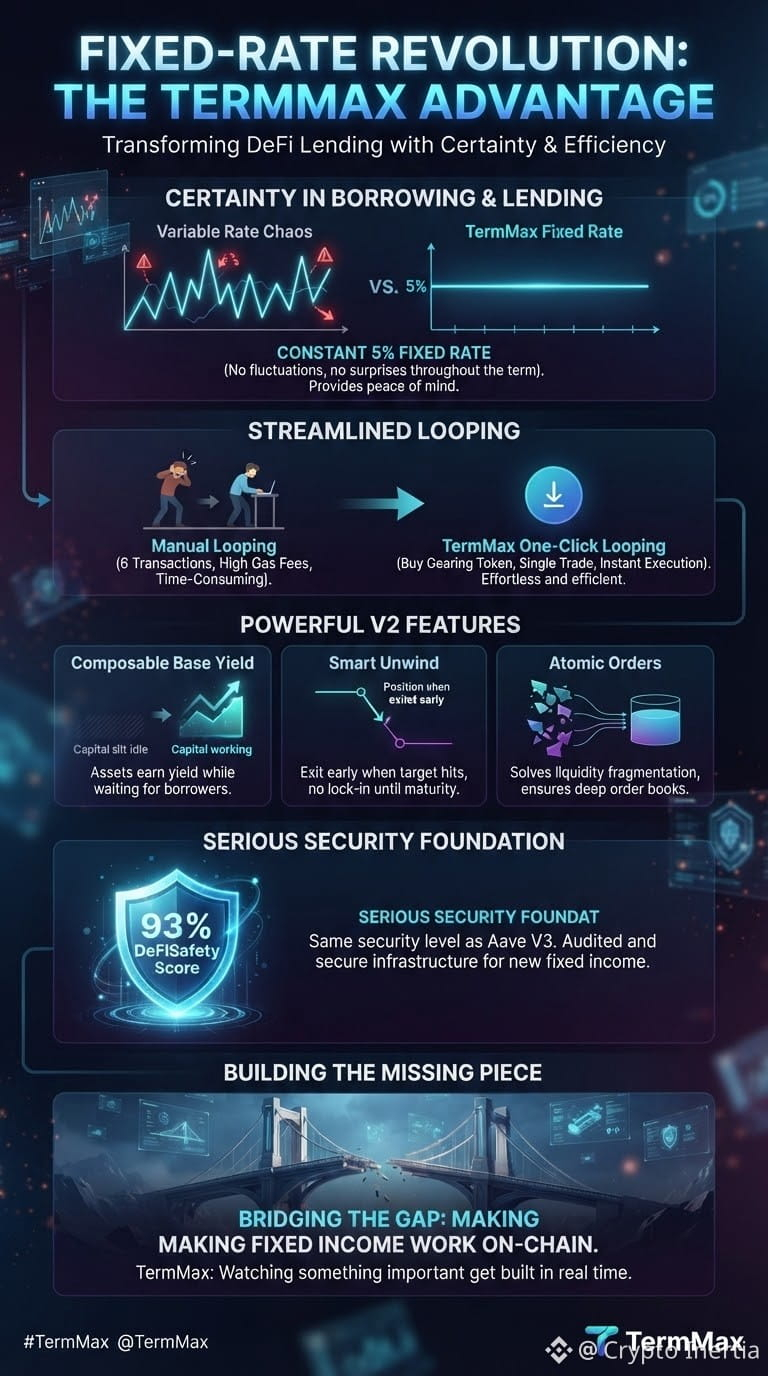
the fixed-rate thing sounds simple until you experience it. You borrow at 5%. You pay 5%. Not 5% today, 8% tomorrow, 12% next week when utilization spikes. Just 5%. For the entire term. That kind of certainty doesn't exist anywhere else in DeFi right now.Then there's the one-click looping. I remember spending an entire afternoon doing manual looping on another platform. Six transactions. Gas fees eating into my position. Constantly checking if I did it right. TermMax does all of that in a single trade. Buy the Gearing Token and you're done. It's almost too easy.
The V2 features are what really got my attention though. Composable Base Yield means your assets earn while waiting for borrowers. No idle capital. Smart Unwind lets you exit early when your target hits instead of being locked until maturity. Atomic Orders solve the liquidity fragmentation that killed earlier fixed-rate platforms. These aren't small improvements. They're solving the exact problems that made fixed-rate DeFi fail before.And the security is genuinely serious. 93% DeFiSafety score. Same as Aave V3. That's rare for a protocol this young.Fixed-rate lending has been the missing piece in DeFi. Variable rates are unpredictable. TermMax is building the infrastructure that actually makes fixed income work on-chain.
This feels like watching something important get built in real time.
$BOME
{spot}(BOMEUSDT)
$BIO
{spot}(BIOUSDT)
$RE
{spot}(REUSDT)
#termmax @TermMax
I've been using DeFi lending platforms for two years and TermMax is the first one that actually surprised me.
the fixed-rate thing sounds simple until you experience it. You borrow at 5%. You pay 5%. Not 5% today, 8% tomorrow, 12% next week when utilization spikes. Just 5%. For the entire term. That kind of certainty doesn't exist anywhere else in DeFi right now.Then there's the one-click looping. I remember spending an entire afternoon doing manual looping on another platform. Six transactions. Gas fees eating into my position. Constantly checking if I did it right. TermMax does all of that in a single trade. Buy the Gearing Token and you're done. It's almost too easy.
The V2 features are what really got my attention though. Composable Base Yield means your assets earn while waiting for borrowers. No idle capital. Smart Unwind lets you exit early when your target hits instead of being locked until maturity. Atomic Orders solve the liquidity fragmentation that killed earlier fixed-rate platforms. These aren't small improvements. They're solving the exact problems that made fixed-rate DeFi fail before.And the security is genuinely serious. 93% DeFiSafety score. Same as Aave V3. That's rare for a protocol this young.Fixed-rate lending has been the missing piece in DeFi. Variable rates are unpredictable. TermMax is building the infrastructure that actually makes fixed income work on-chain.
This feels like watching something important get built in real time.
$BOME
$BIO
$RE
I've been using DeFi lending platforms for two years and TermMax is the first one that actually surprised me.
the fixed-rate thing sounds simple until you experience it. You borrow at 5%. You pay 5%. Not 5% today, 8% tomorrow, 12% next week when utilization spikes. Just 5%. For the entire term. That kind of certainty doesn't exist anywhere else in DeFi right now.Then there's the one-click looping. I remember spending an entire afternoon doing manual looping on another platform. Six transactions. Gas fees eating into my position. Constantly checking if I did it right. TermMax does all of that in a single trade. Buy the Gearing Token and you're done. It's almost too easy.
The V2 features are what really got my attention though. Composable Base Yield means your assets earn while waiting for borrowers. No idle capital. Smart Unwind lets you exit early when your target hits instead of being locked until maturity. Atomic Orders solve the liquidity fragmentation that killed earlier fixed-rate platforms. These aren't small improvements. They're solving the exact problems that made fixed-rate DeFi fail before.And the security is genuinely serious. 93% DeFiSafety score. Same as Aave V3. That's rare for a protocol this young.Fixed-rate lending has been the missing piece in DeFi. Variable rates are unpredictable. TermMax is building the infrastructure that actually makes fixed income work on-chain.
This feels like watching something important get built in real time.
$BOME
$BIO
$RE
197
#dusk $DUSK @Dusk_Foundation I've been sitting with the unofficial DUDE explorer again and one thing keeps sitting with me.
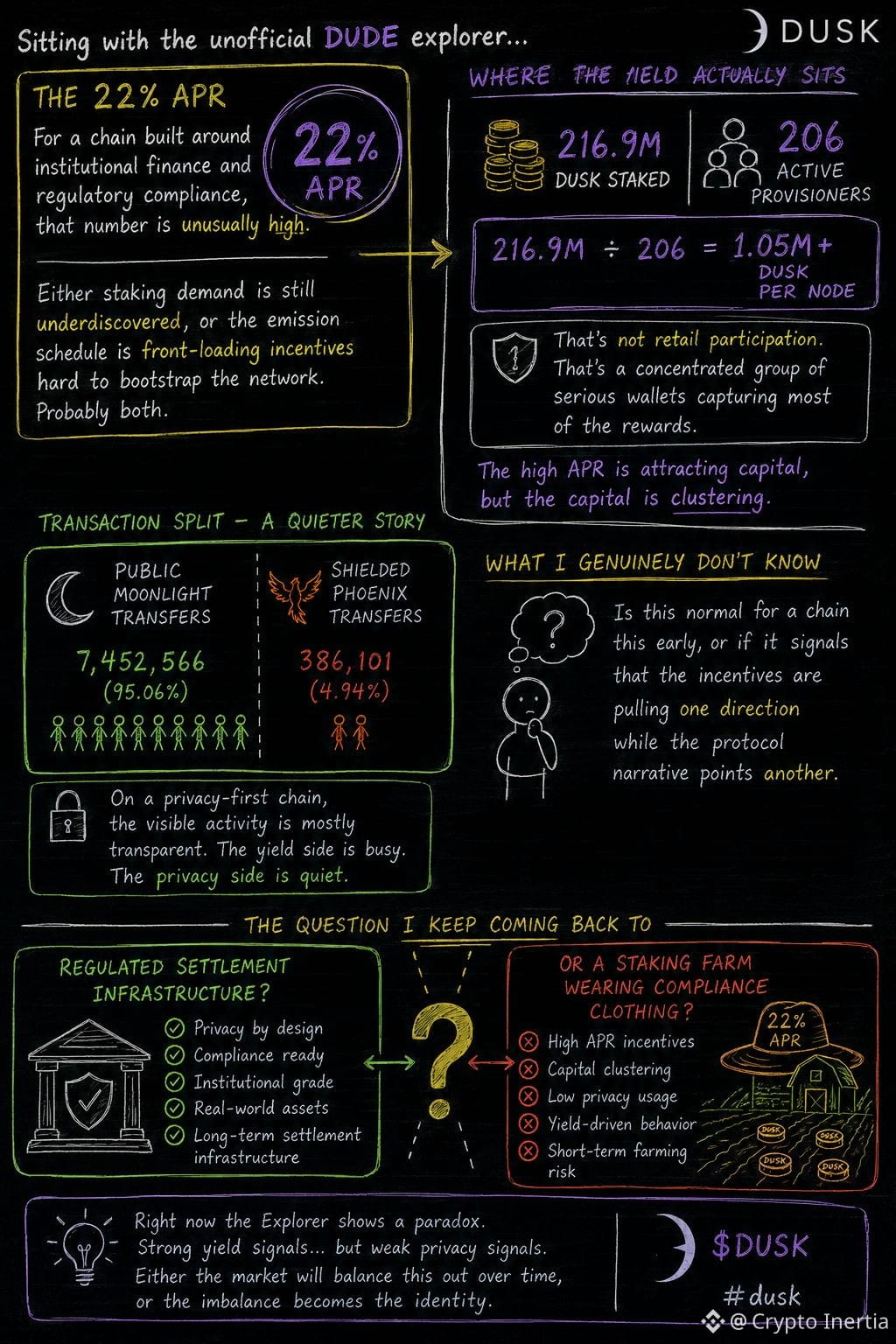
The 22% APR. For a chain built around institutional finance and regulatory compliance, that number is unusually high. Either staking demand is still underdiscovered, or the emission schedule is front-loading incentives hard to bootstrap the network. Probably both.
Then I looked at where that yield actually sits. 216.9M @Dusk staked. 206 active provisioners. The math gives an average of over a million DUSK per node. That's not retail participation. That's a concentrated group of serious wallets capturing most of the rewards. The high APR is attracting capital, but the capital is clustering.
Meanwhile the transaction split tells a quieter story. Public Moonlight transfers running far ahead of shielded Phoenix transactions. On a privacy-first chain, the visible activity is mostly transparent. The yield side is busy. The privacy side is quiet.
What I genuinely don't know is whether this is normal for a chain this early, or if it signals that the incentives are pulling one direction while the protocol narrative points another.
The question I keep coming back to — when institutions look at this explorer, do they see regulated settlement infrastructure, or a staking farm wearing compliance clothing? $DUSK #dusk
#dusk $DUSK @Dusk I've been sitting with the unofficial DUDE explorer again and one thing keeps sitting with me.
The 22% APR. For a chain built around institutional finance and regulatory compliance, that number is unusually high. Either staking demand is still underdiscovered, or the emission schedule is front-loading incentives hard to bootstrap the network. Probably both.
Then I looked at where that yield actually sits. 216.9M @Dusk staked. 206 active provisioners. The math gives an average of over a million DUSK per node. That's not retail participation. That's a concentrated group of serious wallets capturing most of the rewards. The high APR is attracting capital, but the capital is clustering.
Meanwhile the transaction split tells a quieter story. Public Moonlight transfers running far ahead of shielded Phoenix transactions. On a privacy-first chain, the visible activity is mostly transparent. The yield side is busy. The privacy side is quiet.
What I genuinely don't know is whether this is normal for a chain this early, or if it signals that the incentives are pulling one direction while the protocol narrative points another.
The question I keep coming back to — when institutions look at this explorer, do they see regulated settlement infrastructure, or a staking farm wearing compliance clothing? $DUSK #dusk
The 22% APR. For a chain built around institutional finance and regulatory compliance, that number is unusually high. Either staking demand is still underdiscovered, or the emission schedule is front-loading incentives hard to bootstrap the network. Probably both.
Then I looked at where that yield actually sits. 216.9M @Dusk staked. 206 active provisioners. The math gives an average of over a million DUSK per node. That's not retail participation. That's a concentrated group of serious wallets capturing most of the rewards. The high APR is attracting capital, but the capital is clustering.
Meanwhile the transaction split tells a quieter story. Public Moonlight transfers running far ahead of shielded Phoenix transactions. On a privacy-first chain, the visible activity is mostly transparent. The yield side is busy. The privacy side is quiet.
What I genuinely don't know is whether this is normal for a chain this early, or if it signals that the incentives are pulling one direction while the protocol narrative points another.
The question I keep coming back to — when institutions look at this explorer, do they see regulated settlement infrastructure, or a staking farm wearing compliance clothing? $DUSK #dusk
2
72
#termmax @termmax
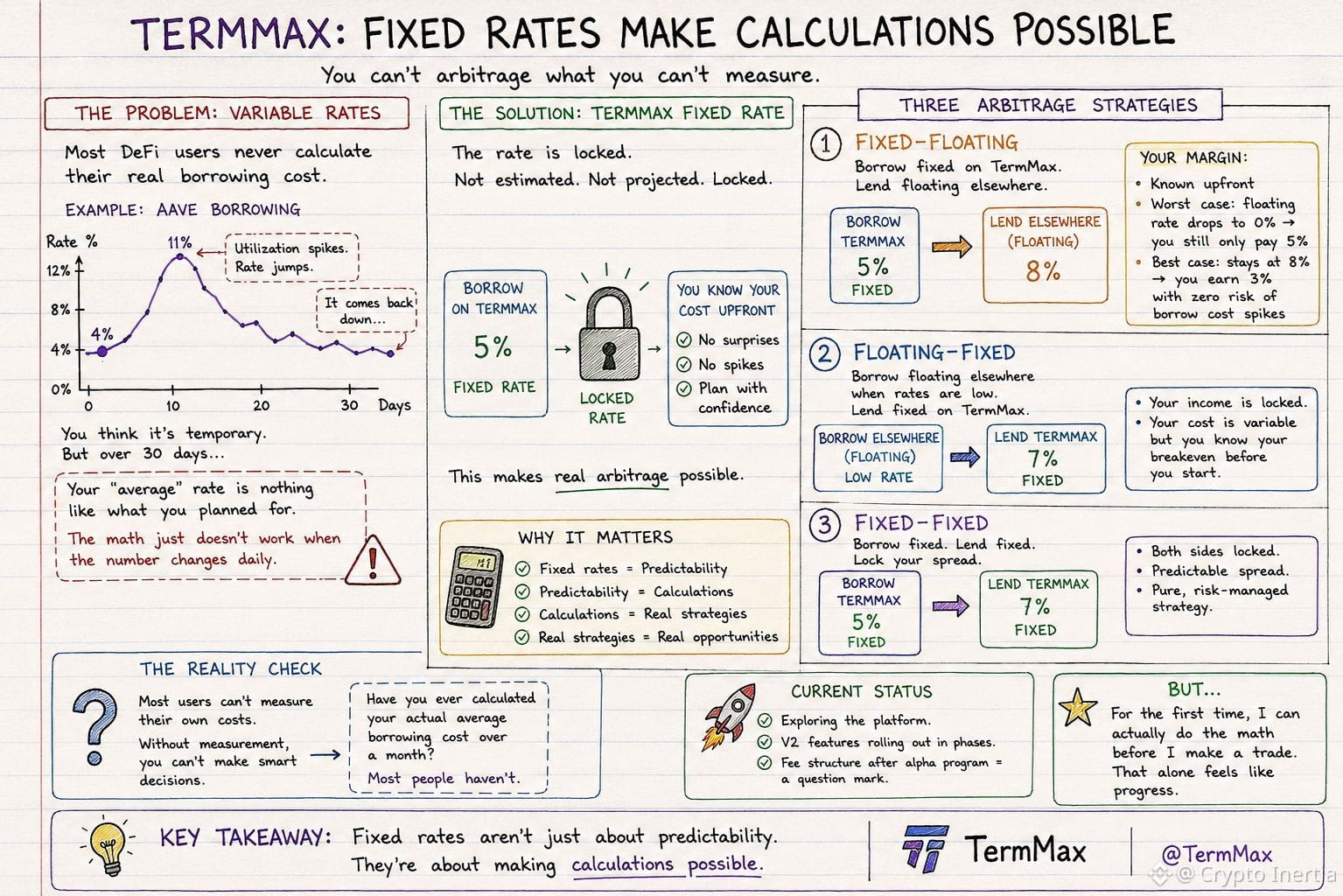
Most DeFi users have never actually calculated their real borrowing cost. I know because I didn't for months.You borrow on Aave at 4%. Feels fine. Then utilization spikes and suddenly it's 11%. You tell yourself it's temporary. It comes back down. But when you actually track it over 30 days, your "average" rate is nothing like what you planned for. The math just doesn't work when the number changes daily.
termMax fixes this in a way that sounds boring until you think about it. The rate is locked. Not estimated. Not projected. Locked.
That means you can finally do proper rate arbitrage. Borrow fixed on TermMax at 5%. Lend floating elsewhere at 8%. Your margin is known upfront. Worst case the floating rate drops to zero and you still only lose 5%. Best case it stays at 8% and you pocket 3% with zero risk of your borrow cost blowing up.Or flip it. Borrow floating elsewhere when rates are low. Lend fixed on TermMax at 7%. Your income is locked. Your cost is variable but you know your breakeven before you even start.The docs actually spell this out. Three strategies. Fixed-floating. Floating-fixed. Fixed-fixed. It reads like a bond trader's playbook, not a DeFi whitepaper. And that's exactly what makes it interesting.
Fixed rates aren't just about predictability. They're about making calculations possible. You can't arbitrage what you can't measure. And in DeFi right now, most users can't measure their own costs.I'm still exploring the platform. Not everything is clear yet. The V2 features are rolling out in phases and the fee structure after the alpha program is a question mark. But for the first time, I can actually do the math before I make a trade. That alone feels like progress.
What about you? Have you ever calculated your actual average borrowing cost over a month? Most people haven't. And maybe that's the real problem TermMax is solving.
#termmax @TermMax
Most DeFi users have never actually calculated their real borrowing cost. I know because I didn't for months.You borrow on Aave at 4%. Feels fine. Then utilization spikes and suddenly it's 11%. You tell yourself it's temporary. It comes back down. But when you actually track it over 30 days, your "average" rate is nothing like what you planned for. The math just doesn't work when the number changes daily.
termMax fixes this in a way that sounds boring until you think about it. The rate is locked. Not estimated. Not projected. Locked.
That means you can finally do proper rate arbitrage. Borrow fixed on TermMax at 5%. Lend floating elsewhere at 8%. Your margin is known upfront. Worst case the floating rate drops to zero and you still only lose 5%. Best case it stays at 8% and you pocket 3% with zero risk of your borrow cost blowing up.Or flip it. Borrow floating elsewhere when rates are low. Lend fixed on TermMax at 7%. Your income is locked. Your cost is variable but you know your breakeven before you even start.The docs actually spell this out. Three strategies. Fixed-floating. Floating-fixed. Fixed-fixed. It reads like a bond trader's playbook, not a DeFi whitepaper. And that's exactly what makes it interesting.
Fixed rates aren't just about predictability. They're about making calculations possible. You can't arbitrage what you can't measure. And in DeFi right now, most users can't measure their own costs.I'm still exploring the platform. Not everything is clear yet. The V2 features are rolling out in phases and the fee structure after the alpha program is a question mark. But for the first time, I can actually do the math before I make a trade. That alone feels like progress.
What about you? Have you ever calculated your actual average borrowing cost over a month? Most people haven't. And maybe that's the real problem TermMax is solving.
Most DeFi users have never actually calculated their real borrowing cost. I know because I didn't for months.You borrow on Aave at 4%. Feels fine. Then utilization spikes and suddenly it's 11%. You tell yourself it's temporary. It comes back down. But when you actually track it over 30 days, your "average" rate is nothing like what you planned for. The math just doesn't work when the number changes daily.
termMax fixes this in a way that sounds boring until you think about it. The rate is locked. Not estimated. Not projected. Locked.
That means you can finally do proper rate arbitrage. Borrow fixed on TermMax at 5%. Lend floating elsewhere at 8%. Your margin is known upfront. Worst case the floating rate drops to zero and you still only lose 5%. Best case it stays at 8% and you pocket 3% with zero risk of your borrow cost blowing up.Or flip it. Borrow floating elsewhere when rates are low. Lend fixed on TermMax at 7%. Your income is locked. Your cost is variable but you know your breakeven before you even start.The docs actually spell this out. Three strategies. Fixed-floating. Floating-fixed. Fixed-fixed. It reads like a bond trader's playbook, not a DeFi whitepaper. And that's exactly what makes it interesting.
Fixed rates aren't just about predictability. They're about making calculations possible. You can't arbitrage what you can't measure. And in DeFi right now, most users can't measure their own costs.I'm still exploring the platform. Not everything is clear yet. The V2 features are rolling out in phases and the fee structure after the alpha program is a question mark. But for the first time, I can actually do the math before I make a trade. That alone feels like progress.
What about you? Have you ever calculated your actual average borrowing cost over a month? Most people haven't. And maybe that's the real problem TermMax is solving.
1
2
88
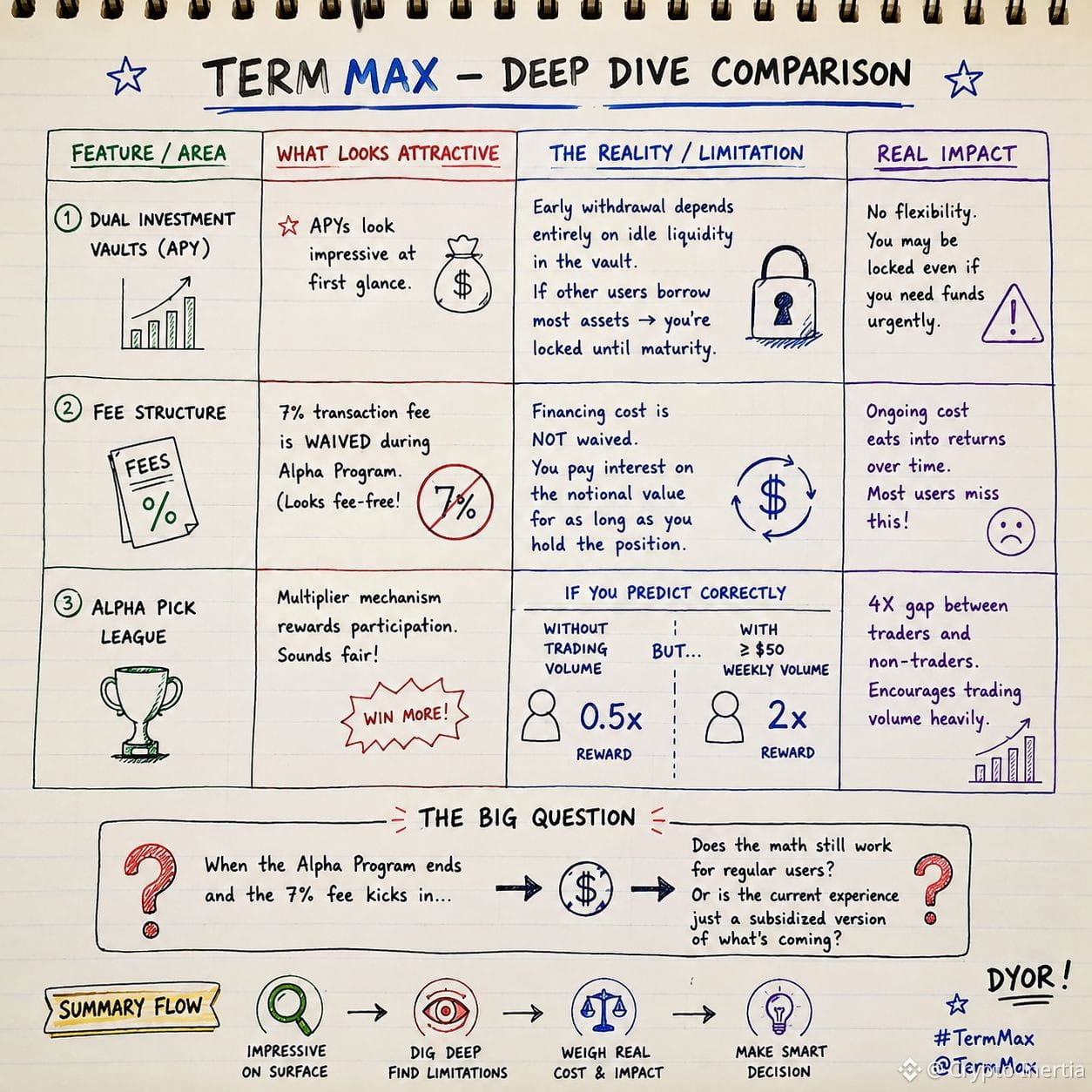
#termmax @termmax I've been poking around TermMax and one thing keeps bothering me.The Dual Investment vaults are offering APYs that look impressive at first glance. But when you actually dig into the withdrawal mechanics, the flexibility just isn't there. Early withdrawal depends entirely on how much idle liquidity is sitting in the vault. If other users have borrowed most of the assets, you're locked until maturity. No way around it.
Then I looked at the fee structure. The 7% transaction fee is currently waived during the alpha program. But the financing cost isn't waived. You pay interest on the notional value for as long as you hold the position. The docs are transparent about it. But most people see "fee-free alpha program" and miss the ongoing cost entirely.The Alpha Pick League is clever though. The multiplier mechanism basically punishes you for not trading. Predict correctly without trading volume and you get 0.5x reward. Hit $50 weekly volume and suddenly it's 2x. That fourfold gap between traders and non-traders isn't subtle.What I keep thinking about — when the alpha program ends and the 7% fee kicks in, does the math still work for regular users? Or is the current experience just a subsidized version of what's coming?
#termmax @TermMax I've been poking around TermMax and one thing keeps bothering me.The Dual Investment vaults are offering APYs that look impressive at first glance. But when you actually dig into the withdrawal mechanics, the flexibility just isn't there. Early withdrawal depends entirely on how much idle liquidity is sitting in the vault. If other users have borrowed most of the assets, you're locked until maturity. No way around it.
Then I looked at the fee structure. The 7% transaction fee is currently waived during the alpha program. But the financing cost isn't waived. You pay interest on the notional value for as long as you hold the position. The docs are transparent about it. But most people see "fee-free alpha program" and miss the ongoing cost entirely.The Alpha Pick League is clever though. The multiplier mechanism basically punishes you for not trading. Predict correctly without trading volume and you get 0.5x reward. Hit $50 weekly volume and suddenly it's 2x. That fourfold gap between traders and non-traders isn't subtle.What I keep thinking about — when the alpha program ends and the 7% fee kicks in, does the math still work for regular users? Or is the current experience just a subsidized version of what's coming?
Then I looked at the fee structure. The 7% transaction fee is currently waived during the alpha program. But the financing cost isn't waived. You pay interest on the notional value for as long as you hold the position. The docs are transparent about it. But most people see "fee-free alpha program" and miss the ongoing cost entirely.The Alpha Pick League is clever though. The multiplier mechanism basically punishes you for not trading. Predict correctly without trading volume and you get 0.5x reward. Hit $50 weekly volume and suddenly it's 2x. That fourfold gap between traders and non-traders isn't subtle.What I keep thinking about — when the alpha program ends and the 7% fee kicks in, does the math still work for regular users? Or is the current experience just a subsidized version of what's coming?
4
1
84
·
--
Bearish
#dusk @Dusk_Foundation
I've been sitting with the official DUSK announcements and one comparison keeps nagging me.
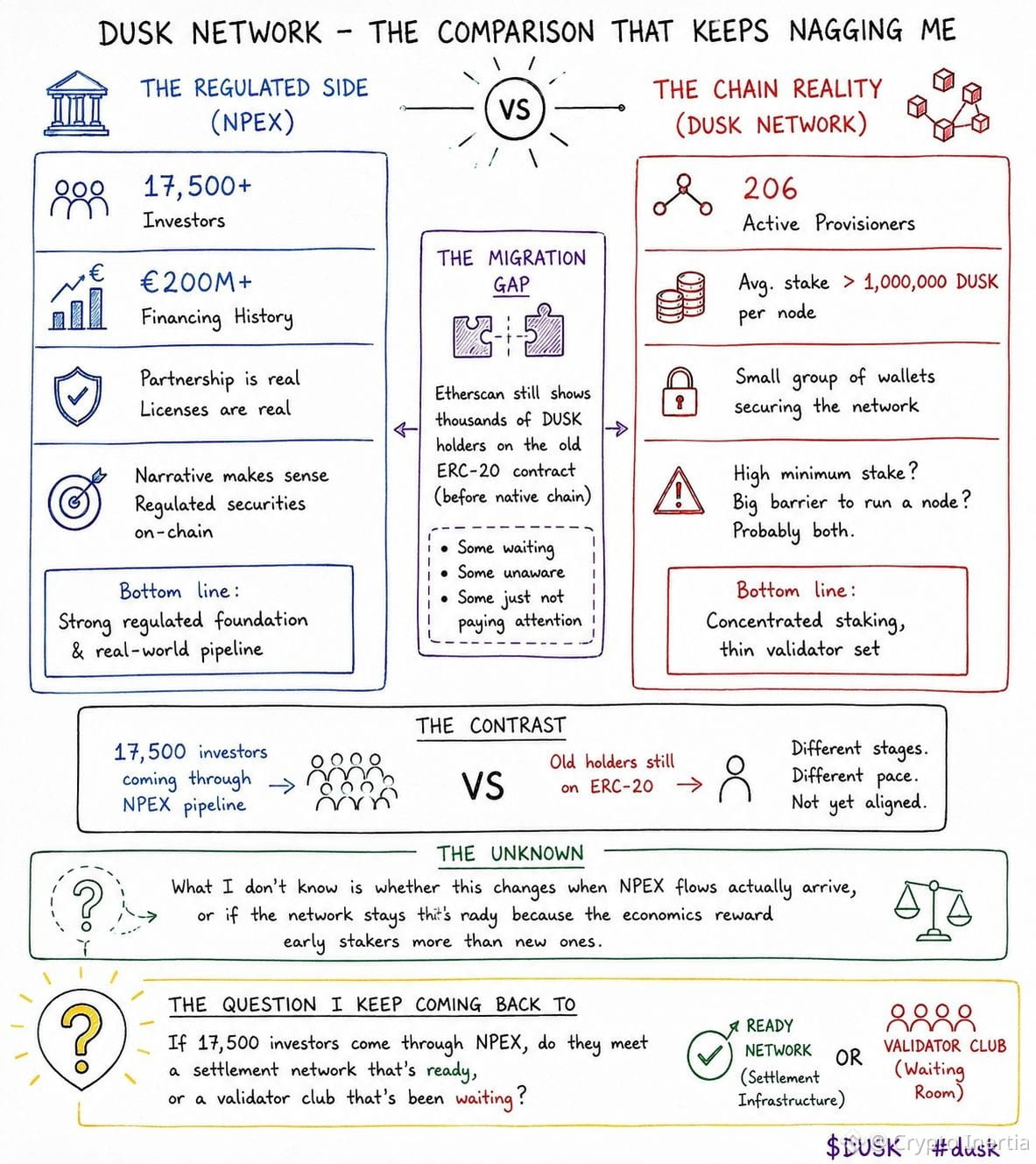
NPEX brings 17,500+ investors and €200M+ in financing history. That's the regulated side. Solid numbers. The partnership is real, the licenses are real, the narrative makes sense.But then you look at the chain itself. 206 active provisioners securing the network. Average stake over a million DUSK per node. For a chain that wants to settle regulated securities for thousands of investors, the infrastructure doing the actual consensus work sits with a small group of wallets. Either the minimum stake is filtering too hard, or running a node is a bigger barrier than the docs admit. Probably both.
Then there's the migration gap. Etherscan still shows thousands of DUSK holders on the old ERC-20 contract from before the native chain. Some waiting. Some unaware. Some just not paying attention. The regulated side has 17,500 investors in the pipeline. The chain side still has old holders who haven't moved.
The pitch is institutional settlement. The on-chain shape right now is concentrated staking and a thin entry queue. What I genuinely don't know is whether this changes when NPEX flows actually arrive, or if the network stays this way because the economics reward early stakers more than new ones.
The question I keep coming back to — if 17,500 investors come through NPEX, do they meet a settlement network that's ready, or a validator club that's been waiting?$DUSK
{spot}(DUSKUSDT)
#dusk @Dusk
I've been sitting with the official DUSK announcements and one comparison keeps nagging me.
NPEX brings 17,500+ investors and €200M+ in financing history. That's the regulated side. Solid numbers. The partnership is real, the licenses are real, the narrative makes sense.But then you look at the chain itself. 206 active provisioners securing the network. Average stake over a million DUSK per node. For a chain that wants to settle regulated securities for thousands of investors, the infrastructure doing the actual consensus work sits with a small group of wallets. Either the minimum stake is filtering too hard, or running a node is a bigger barrier than the docs admit. Probably both.
Then there's the migration gap. Etherscan still shows thousands of DUSK holders on the old ERC-20 contract from before the native chain. Some waiting. Some unaware. Some just not paying attention. The regulated side has 17,500 investors in the pipeline. The chain side still has old holders who haven't moved.
The pitch is institutional settlement. The on-chain shape right now is concentrated staking and a thin entry queue. What I genuinely don't know is whether this changes when NPEX flows actually arrive, or if the network stays this way because the economics reward early stakers more than new ones.
The question I keep coming back to — if 17,500 investors come through NPEX, do they meet a settlement network that's ready, or a validator club that's been waiting?$DUSK
I've been sitting with the official DUSK announcements and one comparison keeps nagging me.
NPEX brings 17,500+ investors and €200M+ in financing history. That's the regulated side. Solid numbers. The partnership is real, the licenses are real, the narrative makes sense.But then you look at the chain itself. 206 active provisioners securing the network. Average stake over a million DUSK per node. For a chain that wants to settle regulated securities for thousands of investors, the infrastructure doing the actual consensus work sits with a small group of wallets. Either the minimum stake is filtering too hard, or running a node is a bigger barrier than the docs admit. Probably both.
Then there's the migration gap. Etherscan still shows thousands of DUSK holders on the old ERC-20 contract from before the native chain. Some waiting. Some unaware. Some just not paying attention. The regulated side has 17,500 investors in the pipeline. The chain side still has old holders who haven't moved.
The pitch is institutional settlement. The on-chain shape right now is concentrated staking and a thin entry queue. What I genuinely don't know is whether this changes when NPEX flows actually arrive, or if the network stays this way because the economics reward early stakers more than new ones.
The question I keep coming back to — if 17,500 investors come through NPEX, do they meet a settlement network that's ready, or a validator club that's been waiting?$DUSK
5
2
100
#dusk $DUSK @Dusk_Foundation
I've been comparing @dusk to how regulated financial markets handle privacy right now. Not the theory. The actual options institutions have.
Here's the problem. Public blockchains expose everything. Every position. Every counterparty. Every balance. That works for DeFi. It doesn't work when you're settling securities where disclosure is selective and scrutiny is legally defined. Institutions can't operate on a chain where their cap table is public and their trades are visible to competitors.
So what do they do today? They stay on private databases. Closed systems. Legacy rails. Settlement takes days. Systems don't talk to each other. Every integration needs lawyers. They get privacy but lose efficiency. It's a tradeoff nobody questions anymore because it's just how things have always worked.
Dusk removes that tradeoff. Phoenix transactions are confidential by default. Zero-knowledge proofs verify correctness without exposing the data underneath. Selective disclosure means a regulator can see exactly what they're entitled to see and nothing more. And it all settles in about 10 seconds. Not T+2. Not business days. Seconds.
That's the difference. Privacy isn't bolted on top of a general chain. Compliance isn't a wrapper around DeFi. The base layer is built for this from the start. NPEX, an AFM-regulated Dutch exchange, already confirmed €200M+ in issuance with Dusk. Chainlink is involved at the infrastructure level. These aren't crypto-native experiments. They're regulated institutions moving real workflows.
I'm not saying it's perfect. Legal acceptance of ZK proofs still needs to catch up. But the gap between what public chains offer and what regulated markets need has existed for years. Dusk is the first infrastructure I've seen that actually closes it.
What's the bigger blocker for regulated assets onchain — privacy, compliance, or just settlement speed?
$GPS
{spot}(GPSUSDT)
$TUT
{spot}(TUTUSDT)
#dusk $DUSK @Dusk
I've been comparing @dusk to how regulated financial markets handle privacy right now. Not the theory. The actual options institutions have.
Here's the problem. Public blockchains expose everything. Every position. Every counterparty. Every balance. That works for DeFi. It doesn't work when you're settling securities where disclosure is selective and scrutiny is legally defined. Institutions can't operate on a chain where their cap table is public and their trades are visible to competitors.
So what do they do today? They stay on private databases. Closed systems. Legacy rails. Settlement takes days. Systems don't talk to each other. Every integration needs lawyers. They get privacy but lose efficiency. It's a tradeoff nobody questions anymore because it's just how things have always worked.
Dusk removes that tradeoff. Phoenix transactions are confidential by default. Zero-knowledge proofs verify correctness without exposing the data underneath. Selective disclosure means a regulator can see exactly what they're entitled to see and nothing more. And it all settles in about 10 seconds. Not T+2. Not business days. Seconds.
That's the difference. Privacy isn't bolted on top of a general chain. Compliance isn't a wrapper around DeFi. The base layer is built for this from the start. NPEX, an AFM-regulated Dutch exchange, already confirmed €200M+ in issuance with Dusk. Chainlink is involved at the infrastructure level. These aren't crypto-native experiments. They're regulated institutions moving real workflows.
I'm not saying it's perfect. Legal acceptance of ZK proofs still needs to catch up. But the gap between what public chains offer and what regulated markets need has existed for years. Dusk is the first infrastructure I've seen that actually closes it.
What's the bigger blocker for regulated assets onchain — privacy, compliance, or just settlement speed?
$GPS
$TUT
I've been comparing @dusk to how regulated financial markets handle privacy right now. Not the theory. The actual options institutions have.
Here's the problem. Public blockchains expose everything. Every position. Every counterparty. Every balance. That works for DeFi. It doesn't work when you're settling securities where disclosure is selective and scrutiny is legally defined. Institutions can't operate on a chain where their cap table is public and their trades are visible to competitors.
So what do they do today? They stay on private databases. Closed systems. Legacy rails. Settlement takes days. Systems don't talk to each other. Every integration needs lawyers. They get privacy but lose efficiency. It's a tradeoff nobody questions anymore because it's just how things have always worked.
Dusk removes that tradeoff. Phoenix transactions are confidential by default. Zero-knowledge proofs verify correctness without exposing the data underneath. Selective disclosure means a regulator can see exactly what they're entitled to see and nothing more. And it all settles in about 10 seconds. Not T+2. Not business days. Seconds.
That's the difference. Privacy isn't bolted on top of a general chain. Compliance isn't a wrapper around DeFi. The base layer is built for this from the start. NPEX, an AFM-regulated Dutch exchange, already confirmed €200M+ in issuance with Dusk. Chainlink is involved at the infrastructure level. These aren't crypto-native experiments. They're regulated institutions moving real workflows.
I'm not saying it's perfect. Legal acceptance of ZK proofs still needs to catch up. But the gap between what public chains offer and what regulated markets need has existed for years. Dusk is the first infrastructure I've seen that actually closes it.
What's the bigger blocker for regulated assets onchain — privacy, compliance, or just settlement speed?
$GPS
$TUT
205
#termmax @termmax
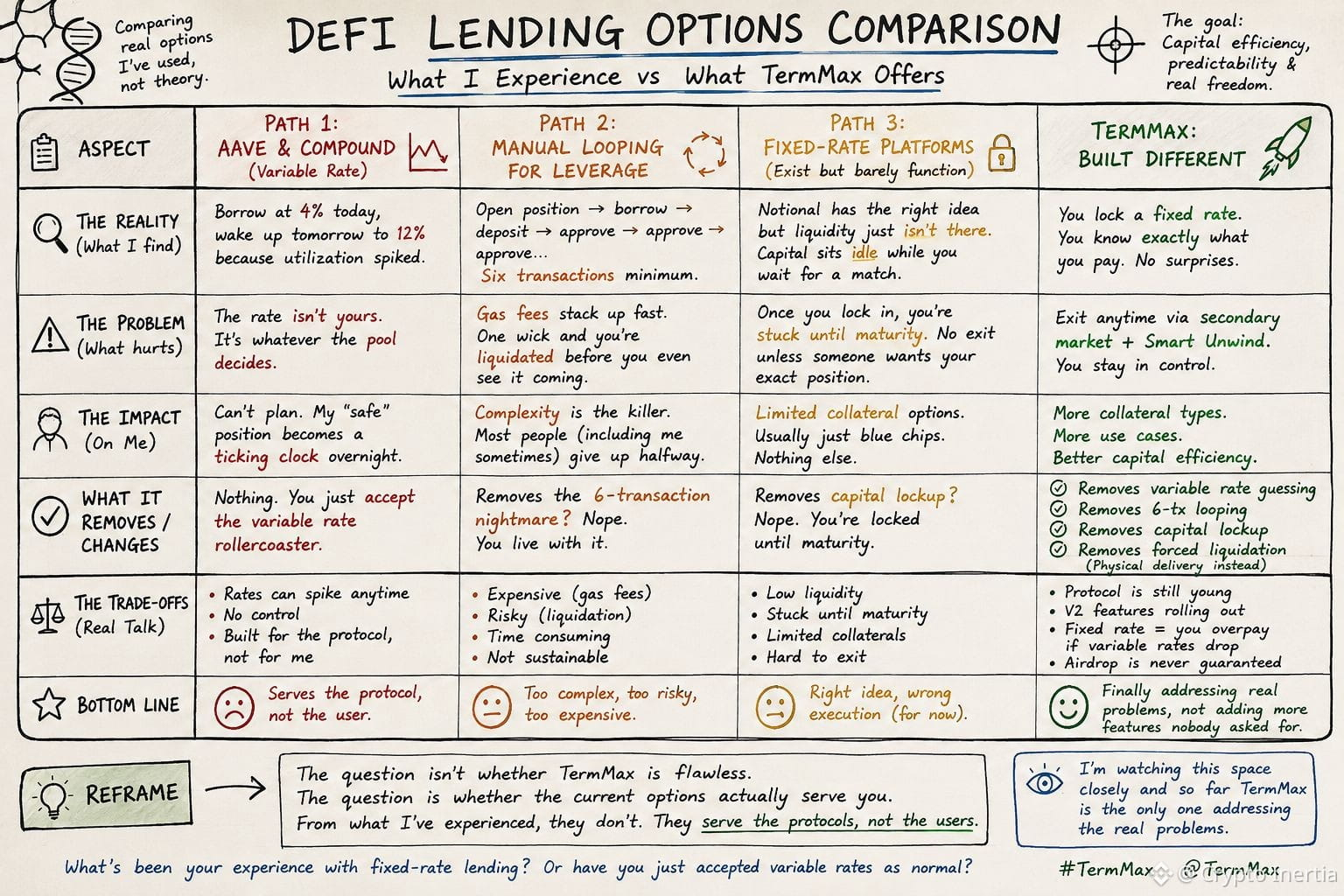
I've been comparing TermMax to how DeFi lending works right now. Not theory. Actual options I've used.
Here's what I find. Three paths. All broken in their own way.
Path 1: Aave and Compound. The variable rate problem is real. You borow at 4% today, wake up tomorow to 12% because utilization spiked. You can't plan around that. Your "safe" position becomes a ticking clock overnight. The rate isn't yours. It's whatever the pool decides.
Path 2: Manual loping for leverage. This one hurts the most because I've done it. Open position on one protocol, borrow on another, deposit somewhere else, approve, approve, approve. Six transactions minimum. Gas fees stack up fast. And you better monitor it because one wick and you're liquidated before you even see it coming. The complexity is the killer. .
Path 3: Fixed-rate platforms that exist but barely function. Notional has the right idea but the liquidity just isn't there. Capital sits idle while you wait for a match. Once you lock in, you're stuck until maturity. No exit unless someone happens to want your exact position. .
TermMax is built differently. It removes the variable rate guessing game. Removes the six-transaction looping nightmare. Removes the capital lockup with secondary market exits and Smart Unwind. Removes the forced liquidation model with physical delivery instead.
I'm not saying it's perfect. The protocol is still young. V2 features are rolling out in phases. Fixed rates mean you overpay if variable rates drop. And the airdrop thing is never guaranted.
But here's the reframe. The question isn't whether TermMax is flawles. The question is whether the curent options actually serve you. From what I've experienced, they don't. They serve the protocols, not the users.
I'm watching this space closely and so far TermMax is the one adresing the real problems instead of ading more fetures nobody asked for.
What's been your experience with fixed-rate lending? Or have you just acepted variable rates as normal?
$GPS
{spot}(GPSUSDT)
$PORTAL
{spot}(PORTALUSDT)
#termmax @TermMax
I've been comparing TermMax to how DeFi lending works right now. Not theory. Actual options I've used.
Here's what I find. Three paths. All broken in their own way.
Path 1: Aave and Compound. The variable rate problem is real. You borow at 4% today, wake up tomorow to 12% because utilization spiked. You can't plan around that. Your "safe" position becomes a ticking clock overnight. The rate isn't yours. It's whatever the pool decides.
Path 2: Manual loping for leverage. This one hurts the most because I've done it. Open position on one protocol, borrow on another, deposit somewhere else, approve, approve, approve. Six transactions minimum. Gas fees stack up fast. And you better monitor it because one wick and you're liquidated before you even see it coming. The complexity is the killer. .
Path 3: Fixed-rate platforms that exist but barely function. Notional has the right idea but the liquidity just isn't there. Capital sits idle while you wait for a match. Once you lock in, you're stuck until maturity. No exit unless someone happens to want your exact position. .
TermMax is built differently. It removes the variable rate guessing game. Removes the six-transaction looping nightmare. Removes the capital lockup with secondary market exits and Smart Unwind. Removes the forced liquidation model with physical delivery instead.
I'm not saying it's perfect. The protocol is still young. V2 features are rolling out in phases. Fixed rates mean you overpay if variable rates drop. And the airdrop thing is never guaranted.
But here's the reframe. The question isn't whether TermMax is flawles. The question is whether the curent options actually serve you. From what I've experienced, they don't. They serve the protocols, not the users.
I'm watching this space closely and so far TermMax is the one adresing the real problems instead of ading more fetures nobody asked for.
What's been your experience with fixed-rate lending? Or have you just acepted variable rates as normal?
$GPS
$PORTAL
I've been comparing TermMax to how DeFi lending works right now. Not theory. Actual options I've used.
Here's what I find. Three paths. All broken in their own way.
Path 1: Aave and Compound. The variable rate problem is real. You borow at 4% today, wake up tomorow to 12% because utilization spiked. You can't plan around that. Your "safe" position becomes a ticking clock overnight. The rate isn't yours. It's whatever the pool decides.
Path 2: Manual loping for leverage. This one hurts the most because I've done it. Open position on one protocol, borrow on another, deposit somewhere else, approve, approve, approve. Six transactions minimum. Gas fees stack up fast. And you better monitor it because one wick and you're liquidated before you even see it coming. The complexity is the killer. .
Path 3: Fixed-rate platforms that exist but barely function. Notional has the right idea but the liquidity just isn't there. Capital sits idle while you wait for a match. Once you lock in, you're stuck until maturity. No exit unless someone happens to want your exact position. .
TermMax is built differently. It removes the variable rate guessing game. Removes the six-transaction looping nightmare. Removes the capital lockup with secondary market exits and Smart Unwind. Removes the forced liquidation model with physical delivery instead.
I'm not saying it's perfect. The protocol is still young. V2 features are rolling out in phases. Fixed rates mean you overpay if variable rates drop. And the airdrop thing is never guaranted.
But here's the reframe. The question isn't whether TermMax is flawles. The question is whether the curent options actually serve you. From what I've experienced, they don't. They serve the protocols, not the users.
I'm watching this space closely and so far TermMax is the one adresing the real problems instead of ading more fetures nobody asked for.
What's been your experience with fixed-rate lending? Or have you just acepted variable rates as normal?
$GPS
$PORTAL
1
237
30D trade $DUSK 229.8 USDT
#dusk $DUSK
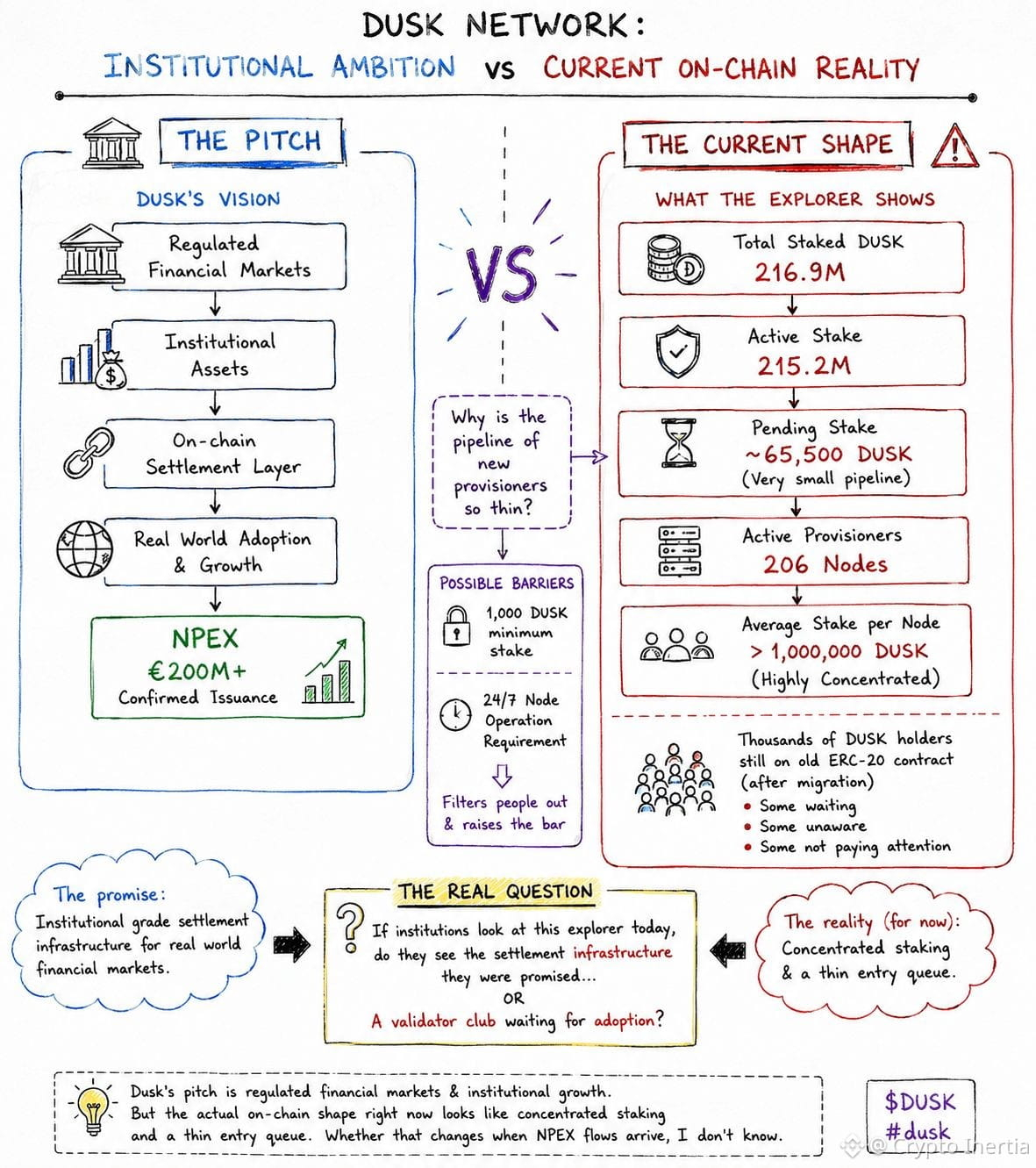
I've been sitting with the unofficial DUDE explorer and one number keeps nagging me.
Right now 216.9M @Dusk_Foundation
{spot}(DUSKUSDT)
k is staked with 215.2M active. Solid. But the pending stake is only around 65,500 DUSK. That ratio is almost nonexistent. For a network that talks about institutional growth, the pipeline of new provisioners looks flat. Either the 1,000 DUSK minimum is doing its job filtering people out, or running a node 24/7 is a bigger barrier than the docs admit. Probably both.
Then I looked at active provisioner count — 206 nodes. Average stake over a million DUSK each. That's not decentralization. That's a few serious wallets running the network. Meanwhile Etherscan still shows thousands of DUSK holders sitting on the old ERC-20 contract from before migration. Some waiting. Some unaware. Some just not paying attention.
Dusk's pitch is regulated financial markets. But the actual on-chain shape right now looks like concentrated staking and a thin entry queue. Whether that changes when NPEX flows arrive, I genuinely don't know.
What I keep coming back to — if institutions look at this explorer, do they see the settlement infrastructure they were promised, or a validator club waiting for adoption? $DUSK #dusk
#dusk $DUSK
I've been sitting with the unofficial DUDE explorer and one number keeps nagging me.
Right now 216.9M @Dusk
k is staked with 215.2M active. Solid. But the pending stake is only around 65,500 DUSK. That ratio is almost nonexistent. For a network that talks about institutional growth, the pipeline of new provisioners looks flat. Either the 1,000 DUSK minimum is doing its job filtering people out, or running a node 24/7 is a bigger barrier than the docs admit. Probably both.
Then I looked at active provisioner count — 206 nodes. Average stake over a million DUSK each. That's not decentralization. That's a few serious wallets running the network. Meanwhile Etherscan still shows thousands of DUSK holders sitting on the old ERC-20 contract from before migration. Some waiting. Some unaware. Some just not paying attention.
Dusk's pitch is regulated financial markets. But the actual on-chain shape right now looks like concentrated staking and a thin entry queue. Whether that changes when NPEX flows arrive, I genuinely don't know.
What I keep coming back to — if institutions look at this explorer, do they see the settlement infrastructure they were promised, or a validator club waiting for adoption? $DUSK #dusk
I've been sitting with the unofficial DUDE explorer and one number keeps nagging me.
Right now 216.9M @Dusk
k is staked with 215.2M active. Solid. But the pending stake is only around 65,500 DUSK. That ratio is almost nonexistent. For a network that talks about institutional growth, the pipeline of new provisioners looks flat. Either the 1,000 DUSK minimum is doing its job filtering people out, or running a node 24/7 is a bigger barrier than the docs admit. Probably both.
Then I looked at active provisioner count — 206 nodes. Average stake over a million DUSK each. That's not decentralization. That's a few serious wallets running the network. Meanwhile Etherscan still shows thousands of DUSK holders sitting on the old ERC-20 contract from before migration. Some waiting. Some unaware. Some just not paying attention.
Dusk's pitch is regulated financial markets. But the actual on-chain shape right now looks like concentrated staking and a thin entry queue. Whether that changes when NPEX flows arrive, I genuinely don't know.
What I keep coming back to — if institutions look at this explorer, do they see the settlement infrastructure they were promised, or a validator club waiting for adoption? $DUSK #dusk
2
1
94
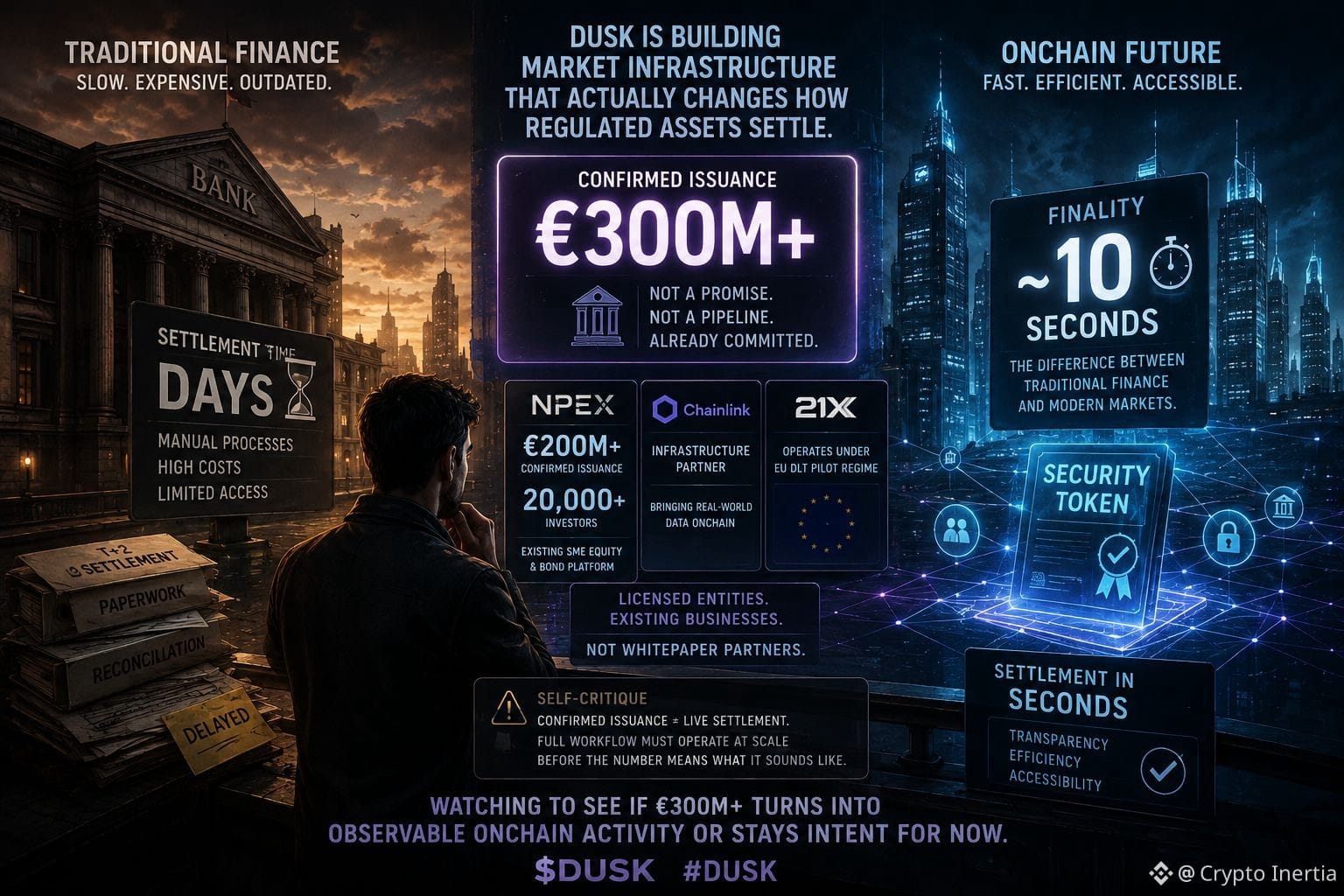
#dusk $DUSK I see a difference most people don't make when looking at Dusk's numbers: €300M+ confirmed issuance sounds like a promise, but it actually reflects something more immediate.
That figure isn't a fundraising target. It's assets that regulated institutions have already committed to move onchain. NPEX alone accounts for €200M+ in confirmed issuance, backed by an investor base of over 20,000. Chainlink is involved at the infrastructure level. 21X operates under the EU DLT Pilot Regime. These aren't whitepaper partners. They're licensed entities with existing businesses.
What most RWA projects do is announce a pipeline. A bunch of logos. A roadmap slide with assets "coming soon." Then you wait and nothing settles. Dusk's different approach is that the issuance figure is tied to existing regulated workflows, not future hopes. NPEX already handles SME equity and bonds. The move onchain is a structural shift, not a cold start.
The number that actually stopped me though is the finality. Around 10 seconds. For regulated securities, that's not a nice-to-have. It's the difference between settlement that looks like a modern market and settlement that still feels like traditional finance. If NPEX brings existing instruments onchain and they settle in seconds instead of days, that's not a story about blockchain being faster. It's a story about market infrastructure actually changing.
Self-critique: confirmed issuance isn't the same as live settlement. The assets may be committed, but the full workflow still needs to operate at scale before the number means what it sounds like.
I'm waiting to see whether the €300M figure turns into observable onchain activity, or whether it stays as confirmed intent for now. @Dusk_Foundation
$COW
{spot}(COWUSDT)
$WAL
{spot}(WALUSDT)
#dusk $DUSK I see a difference most people don't make when looking at Dusk's numbers: €300M+ confirmed issuance sounds like a promise, but it actually reflects something more immediate.
That figure isn't a fundraising target. It's assets that regulated institutions have already committed to move onchain. NPEX alone accounts for €200M+ in confirmed issuance, backed by an investor base of over 20,000. Chainlink is involved at the infrastructure level. 21X operates under the EU DLT Pilot Regime. These aren't whitepaper partners. They're licensed entities with existing businesses.
What most RWA projects do is announce a pipeline. A bunch of logos. A roadmap slide with assets "coming soon." Then you wait and nothing settles. Dusk's different approach is that the issuance figure is tied to existing regulated workflows, not future hopes. NPEX already handles SME equity and bonds. The move onchain is a structural shift, not a cold start.
The number that actually stopped me though is the finality. Around 10 seconds. For regulated securities, that's not a nice-to-have. It's the difference between settlement that looks like a modern market and settlement that still feels like traditional finance. If NPEX brings existing instruments onchain and they settle in seconds instead of days, that's not a story about blockchain being faster. It's a story about market infrastructure actually changing.
Self-critique: confirmed issuance isn't the same as live settlement. The assets may be committed, but the full workflow still needs to operate at scale before the number means what it sounds like.
I'm waiting to see whether the €300M figure turns into observable onchain activity, or whether it stays as confirmed intent for now. @Dusk
$COW
$WAL
That figure isn't a fundraising target. It's assets that regulated institutions have already committed to move onchain. NPEX alone accounts for €200M+ in confirmed issuance, backed by an investor base of over 20,000. Chainlink is involved at the infrastructure level. 21X operates under the EU DLT Pilot Regime. These aren't whitepaper partners. They're licensed entities with existing businesses.
What most RWA projects do is announce a pipeline. A bunch of logos. A roadmap slide with assets "coming soon." Then you wait and nothing settles. Dusk's different approach is that the issuance figure is tied to existing regulated workflows, not future hopes. NPEX already handles SME equity and bonds. The move onchain is a structural shift, not a cold start.
The number that actually stopped me though is the finality. Around 10 seconds. For regulated securities, that's not a nice-to-have. It's the difference between settlement that looks like a modern market and settlement that still feels like traditional finance. If NPEX brings existing instruments onchain and they settle in seconds instead of days, that's not a story about blockchain being faster. It's a story about market infrastructure actually changing.
Self-critique: confirmed issuance isn't the same as live settlement. The assets may be committed, but the full workflow still needs to operate at scale before the number means what it sounds like.
I'm waiting to see whether the €300M figure turns into observable onchain activity, or whether it stays as confirmed intent for now. @Dusk
$COW
$WAL
1
1
245
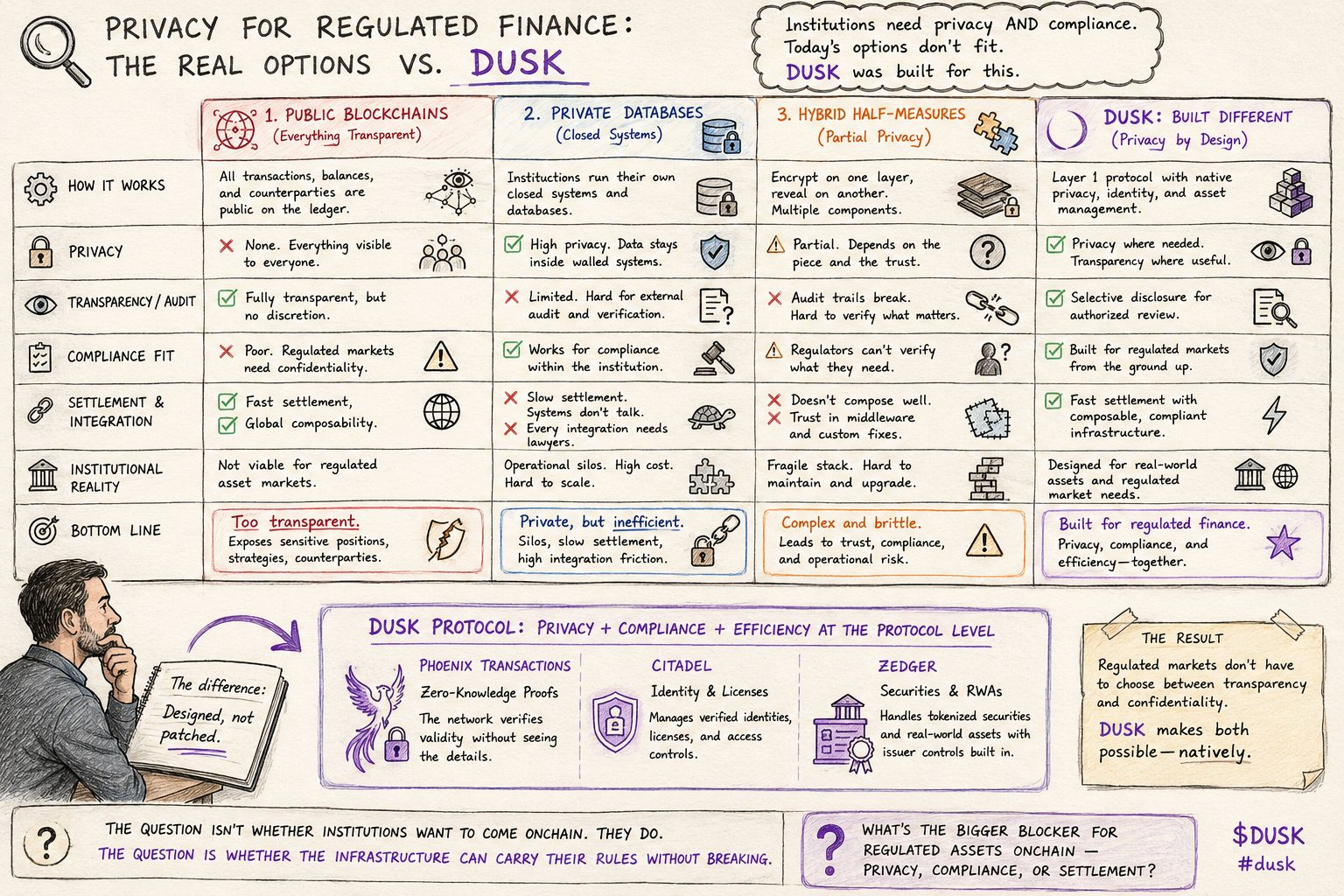
.I see a distinction most people miss when discussing regulated assets onchain: public blockchains treat privacy as a feature, but @Dusk_Foundation treats it as a requirement.
On Ethereum or Solana, privacy is something you add later. A mixer here, a confidential transfer tool there. The chain itself is transparent by default. Every position, every counterparty, every balance visible to anyone who looks. That works for permissionless DeFi. It doesn't work when you're settling regulated securities where disclosure is selective and scrutiny is legally defined.
Dusk inverts that. Phoenix transactions are confidential by default. Zero-knowledge proofs verify correctness without exposing the underlying data. Selective disclosure means an auditor or regulator can see exactly what they're entitled to see and nothing more. Not a privacy tool bolted on top. The base layer itself is built around it.
What caught my attention is how this connects to NPEX. An AFM-regulated exchange in the Netherlands handling SME equity and bonds. A venue like that can't operate on a transparent chain. Traders don't want their positions public. Issuers don't want their cap tables open to competitors. Regulators want auditability without public exposure. Dusk's architecture aligns with what regulated venues actually need, not what crypto assumes they should accept.
Self-critique: privacy technology only matters if regulators accept it. Zero-knowledge proofs don't help if a regulator demands raw data in a format they recognize. Legal acceptance lags technical capability.
I'm waiting to see whether Dusk's privacy model gets treated as compliant infrastructure by European regulators, or just as clever cryptography that institutions remain cautious about. $DUSK #dusk
.I see a distinction most people miss when discussing regulated assets onchain: public blockchains treat privacy as a feature, but @Dusk treats it as a requirement.
On Ethereum or Solana, privacy is something you add later. A mixer here, a confidential transfer tool there. The chain itself is transparent by default. Every position, every counterparty, every balance visible to anyone who looks. That works for permissionless DeFi. It doesn't work when you're settling regulated securities where disclosure is selective and scrutiny is legally defined.
Dusk inverts that. Phoenix transactions are confidential by default. Zero-knowledge proofs verify correctness without exposing the underlying data. Selective disclosure means an auditor or regulator can see exactly what they're entitled to see and nothing more. Not a privacy tool bolted on top. The base layer itself is built around it.
What caught my attention is how this connects to NPEX. An AFM-regulated exchange in the Netherlands handling SME equity and bonds. A venue like that can't operate on a transparent chain. Traders don't want their positions public. Issuers don't want their cap tables open to competitors. Regulators want auditability without public exposure. Dusk's architecture aligns with what regulated venues actually need, not what crypto assumes they should accept.
Self-critique: privacy technology only matters if regulators accept it. Zero-knowledge proofs don't help if a regulator demands raw data in a format they recognize. Legal acceptance lags technical capability.
I'm waiting to see whether Dusk's privacy model gets treated as compliant infrastructure by European regulators, or just as clever cryptography that institutions remain cautious about. $DUSK #dusk
On Ethereum or Solana, privacy is something you add later. A mixer here, a confidential transfer tool there. The chain itself is transparent by default. Every position, every counterparty, every balance visible to anyone who looks. That works for permissionless DeFi. It doesn't work when you're settling regulated securities where disclosure is selective and scrutiny is legally defined.
Dusk inverts that. Phoenix transactions are confidential by default. Zero-knowledge proofs verify correctness without exposing the underlying data. Selective disclosure means an auditor or regulator can see exactly what they're entitled to see and nothing more. Not a privacy tool bolted on top. The base layer itself is built around it.
What caught my attention is how this connects to NPEX. An AFM-regulated exchange in the Netherlands handling SME equity and bonds. A venue like that can't operate on a transparent chain. Traders don't want their positions public. Issuers don't want their cap tables open to competitors. Regulators want auditability without public exposure. Dusk's architecture aligns with what regulated venues actually need, not what crypto assumes they should accept.
Self-critique: privacy technology only matters if regulators accept it. Zero-knowledge proofs don't help if a regulator demands raw data in a format they recognize. Legal acceptance lags technical capability.
I'm waiting to see whether Dusk's privacy model gets treated as compliant infrastructure by European regulators, or just as clever cryptography that institutions remain cautious about. $DUSK #dusk
2
1
337
#TradebStocks #BinanceAfricaChallenge
participate in the following campaign trade on favourite coin and have a chance to win prize
#TradebStocks #BinanceAfricaChallenge
participate in the following campaign trade on favourite coin and have a chance to win prize
participate in the following campaign trade on favourite coin and have a chance to win prize
66
participate and win prizes #Binance #BinanceSquareTalks
participate and win prizes #Binance #BinanceSquareTalks


Binance Africa
·
--
🚀 Flash Quest: Stocks Are Moving Fast on Binance! The markets are on the move. 📈
Trade your favourite stocks on Binance, then share your trade on Binance Square for a chance to win rewards from our $ 1,000 USDC Prize pool
How to Participate:
🔸 Follow @Binance Africa
🔸 Like this post and repost
🔸 Share your bStocks trades on Square using the tradingcard with hashtag #TradebStocks #BinanceAfrica
🔸 Fill in this survey 👉🏾 Click on the Link to Participate Prizes: A total of 200 winners will receive 5 USDC each.
🔸 📆 Period: Aug 13, 2026 10:00 UTC – Aug 23, 2026 23:59 UTC
$TSLAB
Trade your favourite stocks on Binance, then share your trade on Binance Square for a chance to win rewards from our $ 1,000 USDC Prize pool
How to Participate:
🔸 Follow @Binance Africa
🔸 Like this post and repost
🔸 Share your bStocks trades on Square using the tradingcard with hashtag #TradebStocks #BinanceAfrica
🔸 Fill in this survey 👉🏾 Click on the Link to Participate Prizes: A total of 200 winners will receive 5 USDC each.
🔸 📆 Period: Aug 13, 2026 10:00 UTC – Aug 23, 2026 23:59 UTC
$TSLAB

137
#dusk $DUSK I've been comparing @Dusk_Foundation k to how regulated financial assets actually settle today. Not the pitch decks. The real experience.
Here's what I found. If you want exposure to regulated financial assets onchain, you're choosing between three paths. All of them broken somewhere.
Traditional finance rails. You buy MMFs, ETFs, bonds through brokers. Settlement takes days. Markets close. Your ownership is a line in someone else's database. It works because it's old, not because it's good. T+2 settlement is still standard in most markets. Two days to own something you already paid for.
Tokenized wrappers. Projects take an existing asset, wrap it, put it onchain. You get a token representing a share. But the underlying asset still lives in legacy rails. So you get blockchain speed on top of slow settlement. Best case, it's a faster view of a slow system. Worst case, the wrapper breaks and you're arguing with a legal team.
Unregulated DeFi. You can trade crypto-backed versions of real assets right now. But they're synthetic. They mimic prices without actual ownership. If the protocol fails, your claim is only as good as a smart contract nobody regulates. Fine for speculation. Useless for real wealth.
Dusk is built differently. Layer 1 for regulated financial markets. Native issuance, not wrapping. Real ownership, not synthetic exposure. NPEX, an AFM-regulated exchange, has confirmed €200M+ in issuance with Dusk. Chainlink partnership. Dusk Trade structured as a regulated MTF. And finality is around 10 seconds. Not T+2. Not "business days." Seconds.
I'm not saying regulation is exciting. But there's a difference between DeFi pretending compliance doesn't exist and a chain built with compliance as a feature. The first gets headlines. The second gets institutions.
What's kept you away from regulated assets onchain — the old rails, the fake wrappers, or just never finding the right option?
$AVNT $SNXXB
#dusk $DUSK I've been comparing @Dusk k to how regulated financial assets actually settle today. Not the pitch decks. The real experience.
Here's what I found. If you want exposure to regulated financial assets onchain, you're choosing between three paths. All of them broken somewhere.
Traditional finance rails. You buy MMFs, ETFs, bonds through brokers. Settlement takes days. Markets close. Your ownership is a line in someone else's database. It works because it's old, not because it's good. T+2 settlement is still standard in most markets. Two days to own something you already paid for.
Tokenized wrappers. Projects take an existing asset, wrap it, put it onchain. You get a token representing a share. But the underlying asset still lives in legacy rails. So you get blockchain speed on top of slow settlement. Best case, it's a faster view of a slow system. Worst case, the wrapper breaks and you're arguing with a legal team.
Unregulated DeFi. You can trade crypto-backed versions of real assets right now. But they're synthetic. They mimic prices without actual ownership. If the protocol fails, your claim is only as good as a smart contract nobody regulates. Fine for speculation. Useless for real wealth.
Dusk is built differently. Layer 1 for regulated financial markets. Native issuance, not wrapping. Real ownership, not synthetic exposure. NPEX, an AFM-regulated exchange, has confirmed €200M+ in issuance with Dusk. Chainlink partnership. Dusk Trade structured as a regulated MTF. And finality is around 10 seconds. Not T+2. Not "business days." Seconds.
I'm not saying regulation is exciting. But there's a difference between DeFi pretending compliance doesn't exist and a chain built with compliance as a feature. The first gets headlines. The second gets institutions.
What's kept you away from regulated assets onchain — the old rails, the fake wrappers, or just never finding the right option?
$AVNT $SNXXB
Here's what I found. If you want exposure to regulated financial assets onchain, you're choosing between three paths. All of them broken somewhere.
Traditional finance rails. You buy MMFs, ETFs, bonds through brokers. Settlement takes days. Markets close. Your ownership is a line in someone else's database. It works because it's old, not because it's good. T+2 settlement is still standard in most markets. Two days to own something you already paid for.
Tokenized wrappers. Projects take an existing asset, wrap it, put it onchain. You get a token representing a share. But the underlying asset still lives in legacy rails. So you get blockchain speed on top of slow settlement. Best case, it's a faster view of a slow system. Worst case, the wrapper breaks and you're arguing with a legal team.
Unregulated DeFi. You can trade crypto-backed versions of real assets right now. But they're synthetic. They mimic prices without actual ownership. If the protocol fails, your claim is only as good as a smart contract nobody regulates. Fine for speculation. Useless for real wealth.
Dusk is built differently. Layer 1 for regulated financial markets. Native issuance, not wrapping. Real ownership, not synthetic exposure. NPEX, an AFM-regulated exchange, has confirmed €200M+ in issuance with Dusk. Chainlink partnership. Dusk Trade structured as a regulated MTF. And finality is around 10 seconds. Not T+2. Not "business days." Seconds.
I'm not saying regulation is exciting. But there's a difference between DeFi pretending compliance doesn't exist and a chain built with compliance as a feature. The first gets headlines. The second gets institutions.
What's kept you away from regulated assets onchain — the old rails, the fake wrappers, or just never finding the right option?
$AVNT $SNXXB
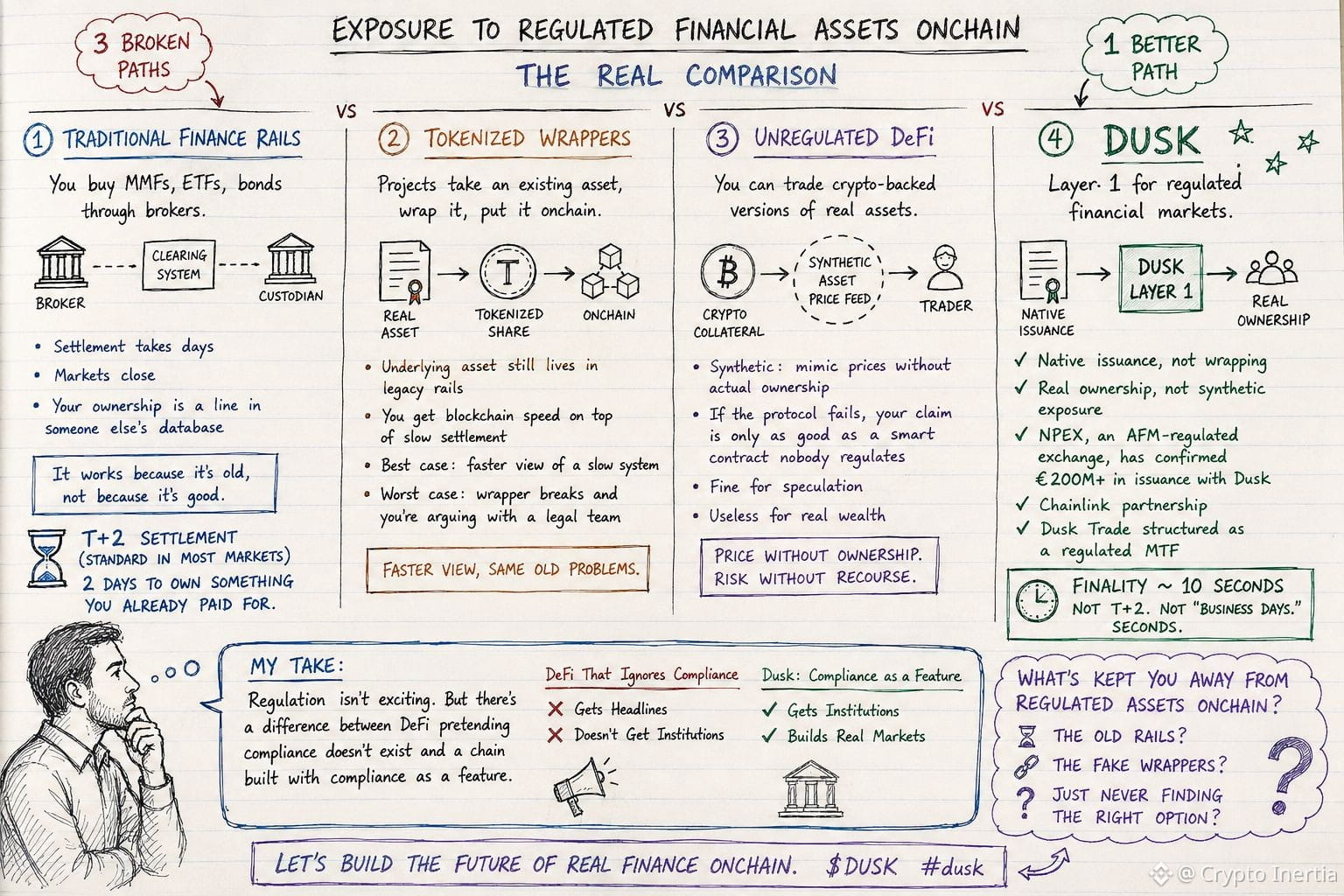
3
2
86
·
--
Bullish
#baby $BABY
I've been comparing @babylonlabs_io Trustless Bitcoin Vaults (TBV) to how Bitcoin actually moves between holding and working today. Not the roadmap. The reality right now.
Here's what stands out after weeks of looking at this. Bitcoin is the best asset in crypto for storing value. And the worst for putting it to use. The moment you want your BTC to do something, you hit a wall.
Right now there are three walls every BTC holder faces.
The custody wall. You want to use BTC somewhere. First decision — who holds it. Hand it over to a platform and you've traded Bitcoin's security for convenience. Keep it yourself and most DeFi can't touch it. Either way, something is lost before you even start.
The complexity wall. You decide to keep control. Now you're bridging, wrapping, approving contracts, managing multiple wallets, tracking gas across chains. Each step is a decision. Each decision is a chance to make a mistake. Most people just give up somewhere in the middle.
The liquidity wall. You get through the first two walls. Your BTC is finally earning or collateralized. Then an opportunity shows up or an emergency hits and you need it back. Now you're waiting for unbonding periods, bridge confirmations, withdrawal approvals. Your Bitcoin is yours but you can't touch it when it matters.
TBV is the first thing I've seen that addresses all three at once. No custody tradeoff because the vault lives on Bitcoin. No complexity spiral because it's native BTC to Aave directly. No liquidity trap because the same balance works as collateral without locking you out.
I'm not saying it's perfect. Smart contract risk is real. Oracle risk is real. The whole thing is still early. But the walls every BTC holder keeps hitting — custody, complexity, liquidity — those are the actual barriers. And this is the first time I've seen one product take on all three.
What's been the biggest wall between your Bitcoin and actually using it?
{spot}(BABYUSDT)
#baby $BABY
I've been comparing @BabylonLabs_io Trustless Bitcoin Vaults (TBV) to how Bitcoin actually moves between holding and working today. Not the roadmap. The reality right now.
Here's what stands out after weeks of looking at this. Bitcoin is the best asset in crypto for storing value. And the worst for putting it to use. The moment you want your BTC to do something, you hit a wall.
Right now there are three walls every BTC holder faces.
The custody wall. You want to use BTC somewhere. First decision — who holds it. Hand it over to a platform and you've traded Bitcoin's security for convenience. Keep it yourself and most DeFi can't touch it. Either way, something is lost before you even start.
The complexity wall. You decide to keep control. Now you're bridging, wrapping, approving contracts, managing multiple wallets, tracking gas across chains. Each step is a decision. Each decision is a chance to make a mistake. Most people just give up somewhere in the middle.
The liquidity wall. You get through the first two walls. Your BTC is finally earning or collateralized. Then an opportunity shows up or an emergency hits and you need it back. Now you're waiting for unbonding periods, bridge confirmations, withdrawal approvals. Your Bitcoin is yours but you can't touch it when it matters.
TBV is the first thing I've seen that addresses all three at once. No custody tradeoff because the vault lives on Bitcoin. No complexity spiral because it's native BTC to Aave directly. No liquidity trap because the same balance works as collateral without locking you out.
I'm not saying it's perfect. Smart contract risk is real. Oracle risk is real. The whole thing is still early. But the walls every BTC holder keeps hitting — custody, complexity, liquidity — those are the actual barriers. And this is the first time I've seen one product take on all three.
What's been the biggest wall between your Bitcoin and actually using it?
I've been comparing @BabylonLabs_io Trustless Bitcoin Vaults (TBV) to how Bitcoin actually moves between holding and working today. Not the roadmap. The reality right now.
Here's what stands out after weeks of looking at this. Bitcoin is the best asset in crypto for storing value. And the worst for putting it to use. The moment you want your BTC to do something, you hit a wall.
Right now there are three walls every BTC holder faces.
The custody wall. You want to use BTC somewhere. First decision — who holds it. Hand it over to a platform and you've traded Bitcoin's security for convenience. Keep it yourself and most DeFi can't touch it. Either way, something is lost before you even start.
The complexity wall. You decide to keep control. Now you're bridging, wrapping, approving contracts, managing multiple wallets, tracking gas across chains. Each step is a decision. Each decision is a chance to make a mistake. Most people just give up somewhere in the middle.
The liquidity wall. You get through the first two walls. Your BTC is finally earning or collateralized. Then an opportunity shows up or an emergency hits and you need it back. Now you're waiting for unbonding periods, bridge confirmations, withdrawal approvals. Your Bitcoin is yours but you can't touch it when it matters.
TBV is the first thing I've seen that addresses all three at once. No custody tradeoff because the vault lives on Bitcoin. No complexity spiral because it's native BTC to Aave directly. No liquidity trap because the same balance works as collateral without locking you out.
I'm not saying it's perfect. Smart contract risk is real. Oracle risk is real. The whole thing is still early. But the walls every BTC holder keeps hitting — custody, complexity, liquidity — those are the actual barriers. And this is the first time I've seen one product take on all three.
What's been the biggest wall between your Bitcoin and actually using it?
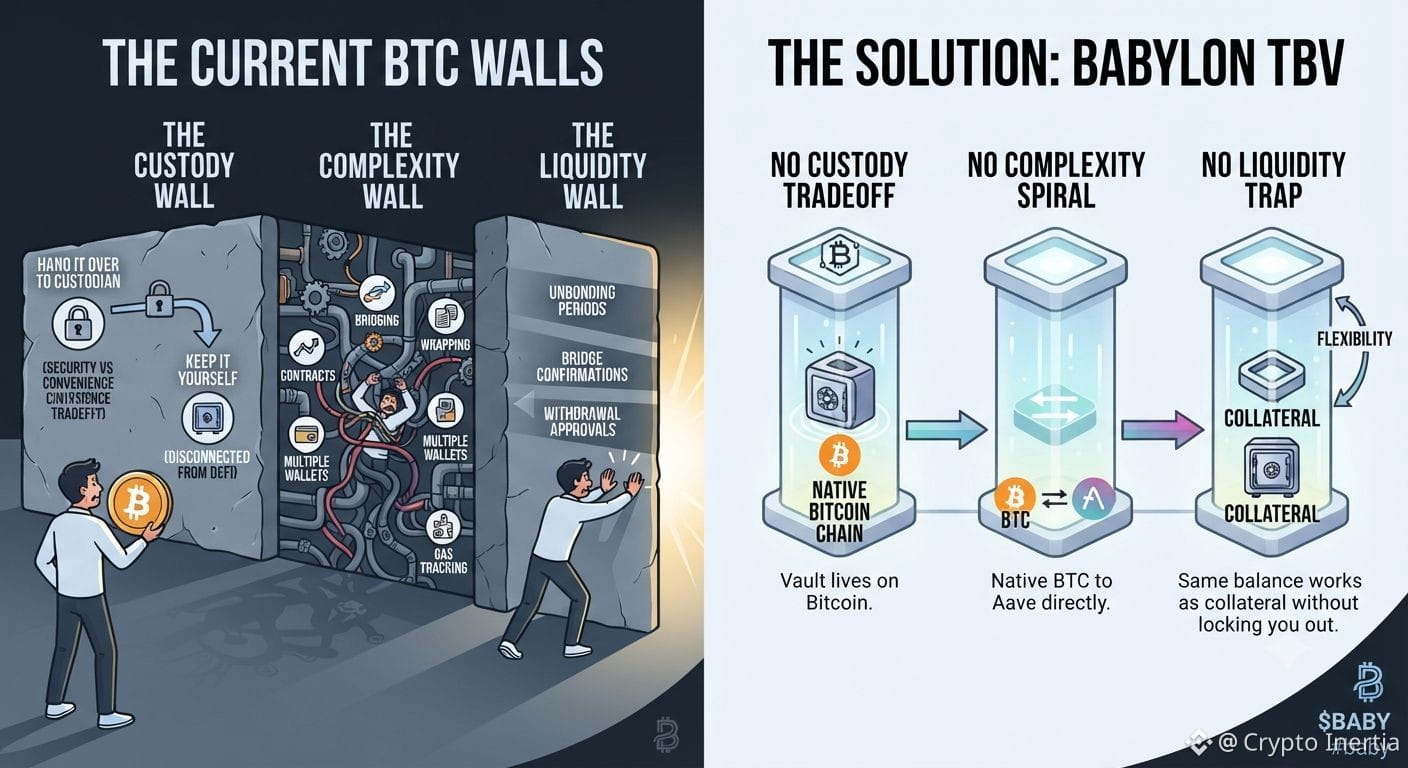
2
2
95
Log in to explore more content
Join global crypto users on Binance Square
⚡️ Get latest and useful information about crypto.
💬 Trusted by the world’s largest crypto exchange.
👍 Discover real insights from verified creators.
Email / Phone number
Trending Topics
AIStocksWhatNext
78,556 views
896 Discussing
Share & Win Traffic Reward in our Trending Hashtag Campaign
✨Topic: What Other Investment Opportunities Remain as AI Stocks Keep Rising?
👉How to Join:
Publish a short post or article with hashtag #AIStocksWhatNext
Share whether you’re bullish or bearish, and post your AI stock holdings or trade — using the trade widget may improve your eligibility.
You can also strengthen your post by sharing data or charts, and avoiding AI-generated images.
✍️Create content based on the below angles:
- Nvidia says chip sales will double next year, and top AI companies keep hitting record revenue, the compute spend behind it is just as staggering. Is AI demand really taking off? And how long can it last? AI stocks are up across the board. Is this a real breakout, or just a short-term bounce?
- Industry leaders are calling to slow down AI development, while Trump plans to build an “AI Force”, claiming AI could account for 25% of U.S. GDP in the future. Whose side are you on? Will state-level backing be a long-term win for AI stocks?
- Are you buying AI stocks? Share your AI-related trade/holdings with our trade sharing widget.
⏰Campaign Period:
- 2026-09-22 7:00 - 2026-09-24 4:00 UTC
🎁Reward:
- Qualified posts that comply with the above guidelines and contain more than 100 words will be reviewed and may receive a random traffic boost of 500 to 3,000 views. You will receive a notification from your feed secretary if your post is selected.
- Get a chance to have your article featured on Binance Square Official
Need ideas for your post? Visit the topic page #AIStocksWhatNext or the Square Guide on How to Post for Better Reach.
Binance Square Official
·182 Likes
·258.9k views
BitcoinBreaksAboveMayHighNears$86K
209 views
11 Discussing
DogecoinRises15%
1,078 views
70 Discussing