

Internet Computer
2.4k Posts

Internet Computer
 Square Verified+
Report
Block User
互联网计算机由数学上安全的网络协议创建,是一个面向应用程序和 AI Agents 的防篡改前沿云平台,它将独立运行的计算节点组合在一起,由总部位于瑞士的 DFINITY 基金会开发维护。
5 Following
3.9K+ Followers
25.0K+ Liked
Posts
All
Videos
The significance of DFINITY's cooperation with Pakistan is profound, far beyond most people's expectations
The significance of DFINITY's cooperation with Pakistan is profound, far beyond most people's expectations
335

Article
Bad news hits, but coins rise: the most awkward part of this wave is the analysts—while the ones doing the lifting are the busiestIn our trading group, three days ago it was still called “Full Exit and Quit the Circle Group.”
Today it was changed to “Let’s go!”
The one who changed the name was a guy who, last week, posted a hardware wallet on Xianyu. He hadn’t even managed to sell it yet when the market turned first. He immediately took the listing down overnight and told the buyer it was a collectible and wouldn’t be sold. The buyer replied with three words: “I get you.”
In this round of market action, a lot of things got carried out. The first person carried out was the one whose understanding of the market was put to the test.
First, let’s see what happened: last week had two things—both, according to the script, should have sent the coins crashing lower. First, in the east—there was a bill out of the west that would lay down rules for the crypto circle; the vote didn’t pass, missing by only a few votes. Second, they announced a rate hike, the first one in more than three years. In textbook terms, risk assets dropped to their knees on the spot.
Bad news hits, but coins rise: the most awkward part of this wave is the analysts—while the ones doing the lifting are the busiest
In our trading group, three days ago it was still called “Full Exit and Quit the Circle Group.”
Today it was changed to “Let’s go!”
The one who changed the name was a guy who, last week, posted a hardware wallet on Xianyu. He hadn’t even managed to sell it yet when the market turned first. He immediately took the listing down overnight and told the buyer it was a collectible and wouldn’t be sold. The buyer replied with three words: “I get you.”
In this round of market action, a lot of things got carried out. The first person carried out was the one whose understanding of the market was put to the test.
First, let’s see what happened: last week had two things—both, according to the script, should have sent the coins crashing lower. First, in the east—there was a bill out of the west that would lay down rules for the crypto circle; the vote didn’t pass, missing by only a few votes. Second, they announced a rate hike, the first one in more than three years. In textbook terms, risk assets dropped to their knees on the spot.
Today it was changed to “Let’s go!”
The one who changed the name was a guy who, last week, posted a hardware wallet on Xianyu. He hadn’t even managed to sell it yet when the market turned first. He immediately took the listing down overnight and told the buyer it was a collectible and wouldn’t be sold. The buyer replied with three words: “I get you.”
In this round of market action, a lot of things got carried out. The first person carried out was the one whose understanding of the market was put to the test.
First, let’s see what happened: last week had two things—both, according to the script, should have sent the coins crashing lower. First, in the east—there was a bill out of the west that would lay down rules for the crypto circle; the vote didn’t pass, missing by only a few votes. Second, they announced a rate hike, the first one in more than three years. In textbook terms, risk assets dropped to their knees on the spot.
959
Partly True
Sovereign Cloud Goes Live: The First Nation Appears
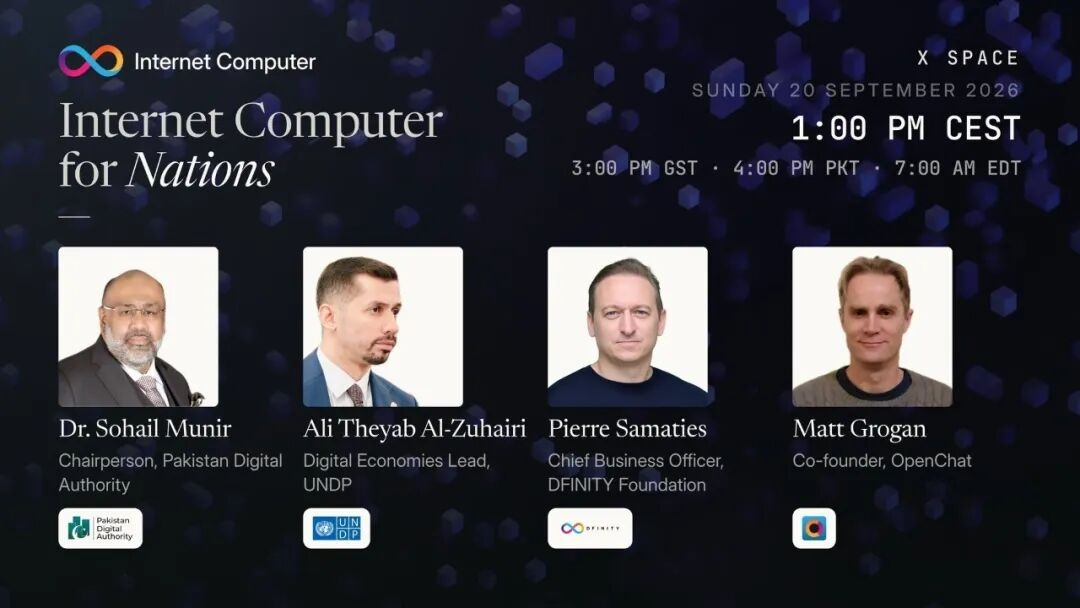
On September 20, the DFINITY Foundation held an X Space online event themed “Internet Computer for Nations.” It lasted about an hour, with around 2,000 people online at the same time.
The guest lineup covered all the key roles in this space: Dr. Sohail Munir, Chairman of Pakistan’s National Digital Management Agency; Ali Theyab Al-Zuhairi, Head of Digital Economy at the United Nations Development Programme (UNDP); Pierre Samaties, Chief Business Officer of the DFINITY Foundation; and Matt Grogan, Co-founder of OpenChat.
The core breakthrough in one sentence: Pakistan has become the first country in the world to run a Sovereign Cloud Engine. Data remains entirely in local data centers, and government applications are built and deployed directly on this proprietary infrastructure via Caffeine.ai.
What’s already up and running is a nationwide public opinion complaint platform built with Caffeine, which is now expanding to more government departments.
Another highlight is the sovereign messaging app: built by the OpenChat team, iOS and Android test versions are already live. Chairman Munir uses it every day. Technically, a single container can support million-level users. In the next phase, plans include a full suite of national services such as digital identity (PakID), payments, super apps, and more—gradually shifting toward delivering public services through chat and AI agents.
The bigger picture is the UNDP–DFINITY collaboration—exporting this sovereign digital technology to more countries and organizations. Pakistan’s experience will be open-sourced and shared, and UNDP’s engine is already under testing.
With a first national-level example, the key data and applications of a country are now running on infrastructure that is fully sovereign. If you missed the live stream, you can replay the audio recording on X.
Sovereign Cloud Goes Live: The First Nation Appears
On September 20, the DFINITY Foundation held an X Space online event themed “Internet Computer for Nations.” It lasted about an hour, with around 2,000 people online at the same time.
The guest lineup covered all the key roles in this space: Dr. Sohail Munir, Chairman of Pakistan’s National Digital Management Agency; Ali Theyab Al-Zuhairi, Head of Digital Economy at the United Nations Development Programme (UNDP); Pierre Samaties, Chief Business Officer of the DFINITY Foundation; and Matt Grogan, Co-founder of OpenChat.
The core breakthrough in one sentence: Pakistan has become the first country in the world to run a Sovereign Cloud Engine. Data remains entirely in local data centers, and government applications are built and deployed directly on this proprietary infrastructure via Caffeine.ai.
What’s already up and running is a nationwide public opinion complaint platform built with Caffeine, which is now expanding to more government departments.
Another highlight is the sovereign messaging app: built by the OpenChat team, iOS and Android test versions are already live. Chairman Munir uses it every day. Technically, a single container can support million-level users. In the next phase, plans include a full suite of national services such as digital identity (PakID), payments, super apps, and more—gradually shifting toward delivering public services through chat and AI agents.
The bigger picture is the UNDP–DFINITY collaboration—exporting this sovereign digital technology to more countries and organizations. Pakistan’s experience will be open-sourced and shared, and UNDP’s engine is already under testing.
With a first national-level example, the key data and applications of a country are now running on infrastructure that is fully sovereign. If you missed the live stream, you can replay the audio recording on X.
On September 20, the DFINITY Foundation held an X Space online event themed “Internet Computer for Nations.” It lasted about an hour, with around 2,000 people online at the same time.
The guest lineup covered all the key roles in this space: Dr. Sohail Munir, Chairman of Pakistan’s National Digital Management Agency; Ali Theyab Al-Zuhairi, Head of Digital Economy at the United Nations Development Programme (UNDP); Pierre Samaties, Chief Business Officer of the DFINITY Foundation; and Matt Grogan, Co-founder of OpenChat.
The core breakthrough in one sentence: Pakistan has become the first country in the world to run a Sovereign Cloud Engine. Data remains entirely in local data centers, and government applications are built and deployed directly on this proprietary infrastructure via Caffeine.ai.
What’s already up and running is a nationwide public opinion complaint platform built with Caffeine, which is now expanding to more government departments.
Another highlight is the sovereign messaging app: built by the OpenChat team, iOS and Android test versions are already live. Chairman Munir uses it every day. Technically, a single container can support million-level users. In the next phase, plans include a full suite of national services such as digital identity (PakID), payments, super apps, and more—gradually shifting toward delivering public services through chat and AI agents.
The bigger picture is the UNDP–DFINITY collaboration—exporting this sovereign digital technology to more countries and organizations. Pakistan’s experience will be open-sourced and shared, and UNDP’s engine is already under testing.
With a first national-level example, the key data and applications of a country are now running on infrastructure that is fully sovereign. If you missed the live stream, you can replay the audio recording on X.


3
1
9
2.7k
Invite your team to build together with you
Invite your team to build together with you
2
793
Reduce the cost of running artificial intelligence tools
Reduce the cost of running artificial intelligence tools
5
886

Article
Liquidium vs Ledn: Bitcoin Collateral Loans Comparison (2026)Liquidium offers wallet-based Bitcoin collateral loans with a floating interest rate, flexible repayment options, and no fixed maturity date.
Ledn offers fiat or stablecoin loans with a fixed interest rate, centralized custody, identity verification, and a standard term of 12 months.
Liquidium is suited for borrowers who prioritize on-chain flexibility first; Ledn is suited for those who want bank-style payments and a more traditional lending experience.
Both Liquidium and Ledn allow users to borrow without selling Bitcoin in advance. Liquidium provides stablecoin lending through an on-chain lending pool, with a floating interest rate and no fixed maturity date. Ledn offers a centralized lending service that supports fiat or stablecoin repayments, with a standard term of 12 months.
Liquidium vs Ledn: Bitcoin Collateral Loans Comparison (2026)
Liquidium offers wallet-based Bitcoin collateral loans with a floating interest rate, flexible repayment options, and no fixed maturity date.
Ledn offers fiat or stablecoin loans with a fixed interest rate, centralized custody, identity verification, and a standard term of 12 months.
Liquidium is suited for borrowers who prioritize on-chain flexibility first; Ledn is suited for those who want bank-style payments and a more traditional lending experience.
Both Liquidium and Ledn allow users to borrow without selling Bitcoin in advance. Liquidium provides stablecoin lending through an on-chain lending pool, with a floating interest rate and no fixed maturity date. Ledn offers a centralized lending service that supports fiat or stablecoin repayments, with a standard term of 12 months.
Ledn offers fiat or stablecoin loans with a fixed interest rate, centralized custody, identity verification, and a standard term of 12 months.
Liquidium is suited for borrowers who prioritize on-chain flexibility first; Ledn is suited for those who want bank-style payments and a more traditional lending experience.
Both Liquidium and Ledn allow users to borrow without selling Bitcoin in advance. Liquidium provides stablecoin lending through an on-chain lending pool, with a floating interest rate and no fixed maturity date. Ledn offers a centralized lending service that supports fiat or stablecoin repayments, with a standard term of 12 months.
3
1.3k
Wu Shuo learned that Slow Mist’s Chief Information Security Officer, 23pds, issued a security alert urging iOS users to upgrade their systems as soon as possible. He noted that black-and-gray industries have already achieved end-to-end exploitation, stealing private keys and mnemonic phrases from iOS devices.
The full attack chain includes: using social engineering or watering-hole attacks to lure users into visiting malicious web pages in Safari; exploiting WebKit/JavaScriptCore (JSC) memory corruption to obtain read/write permissions at the JS layer; then bypassing Pointer Authentication Codes (PAC) defenses to gain native calling capabilities; escaping the WebContent sandbox and escalating privileges to obtain root access; thereby stealing Keychain (keychain) data and encrypted wallet app data.
The attack stems from the previously leaked “DarkSword” iOS end-to-end exploit toolkit. Since the materials have been leaked, it has been reused by black-and-gray industries, posing a serious threat to the security of self-custody mobile wallets.
0xFrancis (@xiao_zcloak):
ICP should be the only public chain in the entire Web3 industry that is completely immune to this type of attack. The immutable front end in smart contracts and the Passkey wallet play a big role.
Also, with Near’s recent surge driven by privacy narratives and “chain signatures,” multi-chain assets have exploded in value—yet only a few people know that this is a small trick ICP has been producing and implementing years ago.
So the technology is just too advanced—it’s really not useful…
Wu Shuo learned that Slow Mist’s Chief Information Security Officer, 23pds, issued a security alert urging iOS users to upgrade their systems as soon as possible. He noted that black-and-gray industries have already achieved end-to-end exploitation, stealing private keys and mnemonic phrases from iOS devices.
The full attack chain includes: using social engineering or watering-hole attacks to lure users into visiting malicious web pages in Safari; exploiting WebKit/JavaScriptCore (JSC) memory corruption to obtain read/write permissions at the JS layer; then bypassing Pointer Authentication Codes (PAC) defenses to gain native calling capabilities; escaping the WebContent sandbox and escalating privileges to obtain root access; thereby stealing Keychain (keychain) data and encrypted wallet app data.
The attack stems from the previously leaked “DarkSword” iOS end-to-end exploit toolkit. Since the materials have been leaked, it has been reused by black-and-gray industries, posing a serious threat to the security of self-custody mobile wallets.
0xFrancis (@xiao_zcloak):
ICP should be the only public chain in the entire Web3 industry that is completely immune to this type of attack. The immutable front end in smart contracts and the Passkey wallet play a big role.
Also, with Near’s recent surge driven by privacy narratives and “chain signatures,” multi-chain assets have exploded in value—yet only a few people know that this is a small trick ICP has been producing and implementing years ago.
So the technology is just too advanced—it’s really not useful…
The full attack chain includes: using social engineering or watering-hole attacks to lure users into visiting malicious web pages in Safari; exploiting WebKit/JavaScriptCore (JSC) memory corruption to obtain read/write permissions at the JS layer; then bypassing Pointer Authentication Codes (PAC) defenses to gain native calling capabilities; escaping the WebContent sandbox and escalating privileges to obtain root access; thereby stealing Keychain (keychain) data and encrypted wallet app data.
The attack stems from the previously leaked “DarkSword” iOS end-to-end exploit toolkit. Since the materials have been leaked, it has been reused by black-and-gray industries, posing a serious threat to the security of self-custody mobile wallets.
0xFrancis (@xiao_zcloak):
ICP should be the only public chain in the entire Web3 industry that is completely immune to this type of attack. The immutable front end in smart contracts and the Passkey wallet play a big role.
Also, with Near’s recent surge driven by privacy narratives and “chain signatures,” multi-chain assets have exploded in value—yet only a few people know that this is a small trick ICP has been producing and implementing years ago.
So the technology is just too advanced—it’s really not useful…

1
5
2.4k
Why Is ICP Skyrocketing?
Why Is ICP Skyrocketing?
4
2
1
1.4k
3 signals we focus on before locking ICP profit
3 signals we focus on before locking ICP profit
1
2
1.5k

Article
Memoir of DFINITY Foundation founder Dominic Williams: A tale of early, painful experienceThe reason I so deeply understand the true importance of implementing fully decentralized computation is that there’s a rather special experience behind it—one that’s worth telling. So please, let me take you through it slowly.
As early as 2015, I was already involved in the early days of the cryptocurrency space, but I continued to run my previously founded “Fight My Monster”—a venture-backed MMO (massively multiplayer online) game and social networking platform with 3 million users that is financially self-sustaining.
Although I’ve found a long-term career home in the field of decentralized computing, I can’t fail to live up to the player community that has continued to support this game.
Memoir of DFINITY Foundation founder Dominic Williams: A tale of early, painful experience
The reason I so deeply understand the true importance of implementing fully decentralized computation is that there’s a rather special experience behind it—one that’s worth telling. So please, let me take you through it slowly.
As early as 2015, I was already involved in the early days of the cryptocurrency space, but I continued to run my previously founded “Fight My Monster”—a venture-backed MMO (massively multiplayer online) game and social networking platform with 3 million users that is financially self-sustaining.
Although I’ve found a long-term career home in the field of decentralized computing, I can’t fail to live up to the player community that has continued to support this game.
As early as 2015, I was already involved in the early days of the cryptocurrency space, but I continued to run my previously founded “Fight My Monster”—a venture-backed MMO (massively multiplayer online) game and social networking platform with 3 million users that is financially self-sustaining.
Although I’ve found a long-term career home in the field of decentralized computing, I can’t fail to live up to the player community that has continued to support this game.
1
2
1.1k

Article
The Market’s Back—But You’re NotEssay Customization Workshop · September 15, 2026
The crypto market has been lively again these past few days.
Bitcoin back above 78,000; altcoins start acting up, memes begin pumping again, and people in the group start sharing screenshots. You know what’s in the screenshots: an upward-curving line paired with “I told you so.”
But if you look closely, you’ll notice a pattern—the people posting screenshots never screenshot their total assets.
First, let’s address the most unflattering thing about this latest rally.
It’s not that “many people want to buy” drove it higher—it's that “some people have no choice but to buy.” What the on-chain post-analyses call it is short-squeeze: those who bet on the drop get forced to close their positions, and closing means buying back—so the price goes up.
The Market’s Back—But You’re Not
Essay Customization Workshop · September 15, 2026
The crypto market has been lively again these past few days.
Bitcoin back above 78,000; altcoins start acting up, memes begin pumping again, and people in the group start sharing screenshots. You know what’s in the screenshots: an upward-curving line paired with “I told you so.”
But if you look closely, you’ll notice a pattern—the people posting screenshots never screenshot their total assets.
First, let’s address the most unflattering thing about this latest rally.
It’s not that “many people want to buy” drove it higher—it's that “some people have no choice but to buy.” What the on-chain post-analyses call it is short-squeeze: those who bet on the drop get forced to close their positions, and closing means buying back—so the price goes up.
The crypto market has been lively again these past few days.
Bitcoin back above 78,000; altcoins start acting up, memes begin pumping again, and people in the group start sharing screenshots. You know what’s in the screenshots: an upward-curving line paired with “I told you so.”
But if you look closely, you’ll notice a pattern—the people posting screenshots never screenshot their total assets.
First, let’s address the most unflattering thing about this latest rally.
It’s not that “many people want to buy” drove it higher—it's that “some people have no choice but to buy.” What the on-chain post-analyses call it is short-squeeze: those who bet on the drop get forced to close their positions, and closing means buying back—so the price goes up.
2
1.2k
Respond to discussions about ICP creators over the past few weeks
Respond to discussions about ICP creators over the past few weeks
2
1.2k
How to Get Started with Caffeine Inference:
1. Open Inference in the Caffeine workspace.
2. Choose your existing tools—supports Claude Code, Cursor, and tools compatible with the OpenAI standard.
3. Create an API key, then paste the configuration commands provided by Caffeine.
4. Run a test to see the result returned by your first request.
You don’t need to leave the tools you’re already familiar with—Caffeine runs the model in the background.
How to Get Started with Caffeine Inference:
1. Open Inference in the Caffeine workspace.
2. Choose your existing tools—supports Claude Code, Cursor, and tools compatible with the OpenAI standard.
3. Create an API key, then paste the configuration commands provided by Caffeine.
4. Run a test to see the result returned by your first request.
You don’t need to leave the tools you’re already familiar with—Caffeine runs the model in the background.
1. Open Inference in the Caffeine workspace.
2. Choose your existing tools—supports Claude Code, Cursor, and tools compatible with the OpenAI standard.
3. Create an API key, then paste the configuration commands provided by Caffeine.
4. Run a test to see the result returned by your first request.
You don’t need to leave the tools you’re already familiar with—Caffeine runs the model in the background.

3
826
Manage your encrypted currency, stocks, gold, cash, and real estate in a private control panel using an internet identity login secured by vetKeys.
Manage your encrypted currency, stocks, gold, cash, and real estate in a private control panel using an internet identity login secured by vetKeys.
3
1.1k
We Proudly Present OpenSaaS
Say goodbye to SaaS services.
We proudly present OpenSaaS—an end-to-end enterprise software suite that’s as easy to install as a mobile app.
Forever free. No per-user seat fees. Fully customizable: just describe the changes to the AI and you can modify any application.
AIware: AI agents run inside every app and are powered by your real-time business data.
Ownership: Your company owns the software and encryption keys.
Runs on a Cloud Engine: secure, reliable, and always online network.
Apply for early access:
https://opencloud.org/
We Proudly Present OpenSaaS
Say goodbye to SaaS services.
We proudly present OpenSaaS—an end-to-end enterprise software suite that’s as easy to install as a mobile app.
Forever free. No per-user seat fees. Fully customizable: just describe the changes to the AI and you can modify any application.
AIware: AI agents run inside every app and are powered by your real-time business data.
Ownership: Your company owns the software and encryption keys.
Runs on a Cloud Engine: secure, reliable, and always online network.
Apply for early access:
https://opencloud.org/
Say goodbye to SaaS services.
We proudly present OpenSaaS—an end-to-end enterprise software suite that’s as easy to install as a mobile app.
Forever free. No per-user seat fees. Fully customizable: just describe the changes to the AI and you can modify any application.
AIware: AI agents run inside every app and are powered by your real-time business data.
Ownership: Your company owns the software and encryption keys.
Runs on a Cloud Engine: secure, reliable, and always online network.
Apply for early access:
https://opencloud.org/


1
9
1.9k

Article
Three years on, and I’m still that same community that gives you an 85% discount “smuggling in” to the top blockchain scene!Hey handsome and beautiful Web3 people, the big-shot masters of “dual training” in AI and blockchain, and those wealthy folks who are still watching from the sidelines but are itching to get in—:
Attention! Attention! This is not a drill! The - 2026 Shanghai International Week of Blockchain · The 12th Blockchain Global Summit, scheduled as reliably as your birthday (even more dependable than your idol’s concert), will make a glorious return this golden autumn September (specifically on the 23rd)!
Why do I say “again”?
Because, as your long-time “sweetheart” — the IC Chinese Community — this is already our third year in a row clinging onto the mighty support of the Wanxiang Blockchain Lab, becoming an officially partnered community partner!
Three years on, and I’m still that same community that gives you an 85% discount “smuggling in” to the top blockchain scene!
Hey handsome and beautiful Web3 people, the big-shot masters of “dual training” in AI and blockchain, and those wealthy folks who are still watching from the sidelines but are itching to get in—:
Attention! Attention! This is not a drill! The - 2026 Shanghai International Week of Blockchain · The 12th Blockchain Global Summit, scheduled as reliably as your birthday (even more dependable than your idol’s concert), will make a glorious return this golden autumn September (specifically on the 23rd)!
Why do I say “again”?
Because, as your long-time “sweetheart” — the IC Chinese Community — this is already our third year in a row clinging onto the mighty support of the Wanxiang Blockchain Lab, becoming an officially partnered community partner!
Attention! Attention! This is not a drill! The - 2026 Shanghai International Week of Blockchain · The 12th Blockchain Global Summit, scheduled as reliably as your birthday (even more dependable than your idol’s concert), will make a glorious return this golden autumn September (specifically on the 23rd)!
Why do I say “again”?
Because, as your long-time “sweetheart” — the IC Chinese Community — this is already our third year in a row clinging onto the mighty support of the Wanxiang Blockchain Lab, becoming an officially partnered community partner!
3
1.4k
How to get started with Caffeine inference
How to get started with Caffeine inference
2
1.6k
Log in to explore more content
Join global crypto users on Binance Square
⚡️ Get latest and useful information about crypto.
💬 Trusted by the world’s largest crypto exchange.
👍 Discover real insights from verified creators.
Email / Phone number
Trending Topics
StrategyStriveAdd2305BitcoinThisWeek
8,882 views
384 Discussing
#strategystriveadd2305bitcointhisweek 🚨 2,305 BTC just moved into treasuries
While most traders were focused on the Bitcoin price rebound two public companies quietly made big moves. 👀
Strategy and Strive together bought 2,305 BTC for 182.7 million Dollar.
🔹 Strategy bought 950 BTC for 75.7 million dollar
🔹 Strive bought 1,355 BTC for around 107.7 million dollar
This brings their total holdings to:
📊 Strategy. 846,000 BTC
📊 Strive. 26,355 BTC
But the real story isn't the amount of Bitcoin they bought.
It's how they paid for it.
Strategy used cash it already had.
Strive used its stock financing model to fund the purchase. Meaning it’s growing its Bitcoin treasury without relying only on cash flow.
This difference matters.
For traders and investors it adds a layer of analysis: how much Bitcoin is being added, how it’s being funded and what it means for long-term value, per share.
The cost of capital BTC accumulation and share value. These factors are starting to shape the market in ways.
Corporate treasury demand is no longer a side note.
It’s becoming a part of the Bitcoin ecosystem.
💬 What do you think?
Will more companies start buying Bitcoin the way?
Will this trend grow?
#bitcoin #Khan62 #BTC #trading
$MSTR
$MARA $BMNR
Khan 62
·3 Likes
·1.9k views
TrumpRejectsIranHormuzReopening
14,456 views
407 Discussing
TokenizedStockDEXVolumeHits$20.9B
56 views
4 Discussing