

鸿福商行 HY8678666
293 Posts

鸿福商行 HY8678666
Report
Block User
已有五年大A韭菜经验,公众号“鸿福大社团”,使用币安手续费75折(100油手续费返25油)现货合约策略以及撸毛活动分享。邀请码BNB001,轻松开启优惠交易
Open Trade

BNB Holder
Frequent Trader
2.6 Years
113 Following
1.3K+ Followers
1.0K+ Liked
Posts
Portfolio
All
Quotes
Videos
PINNED
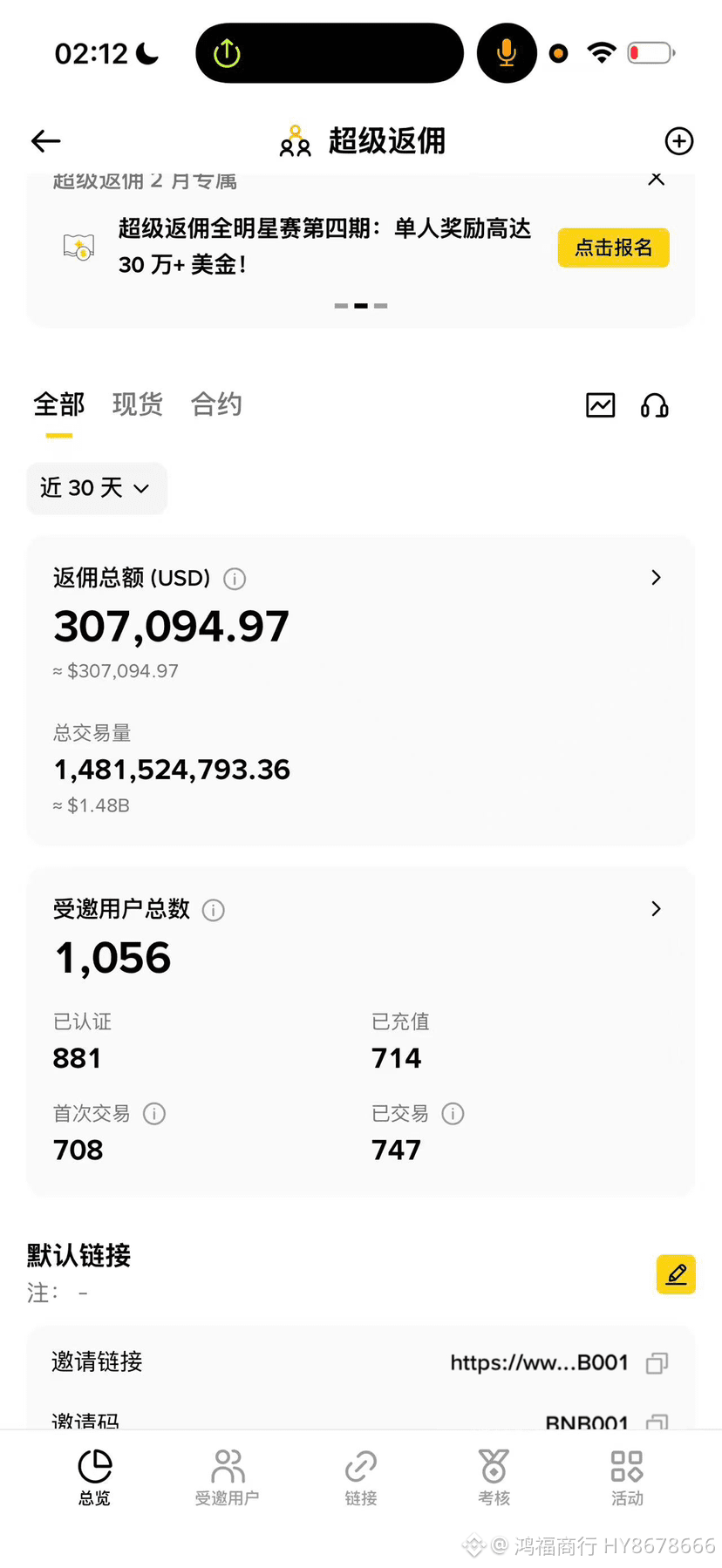
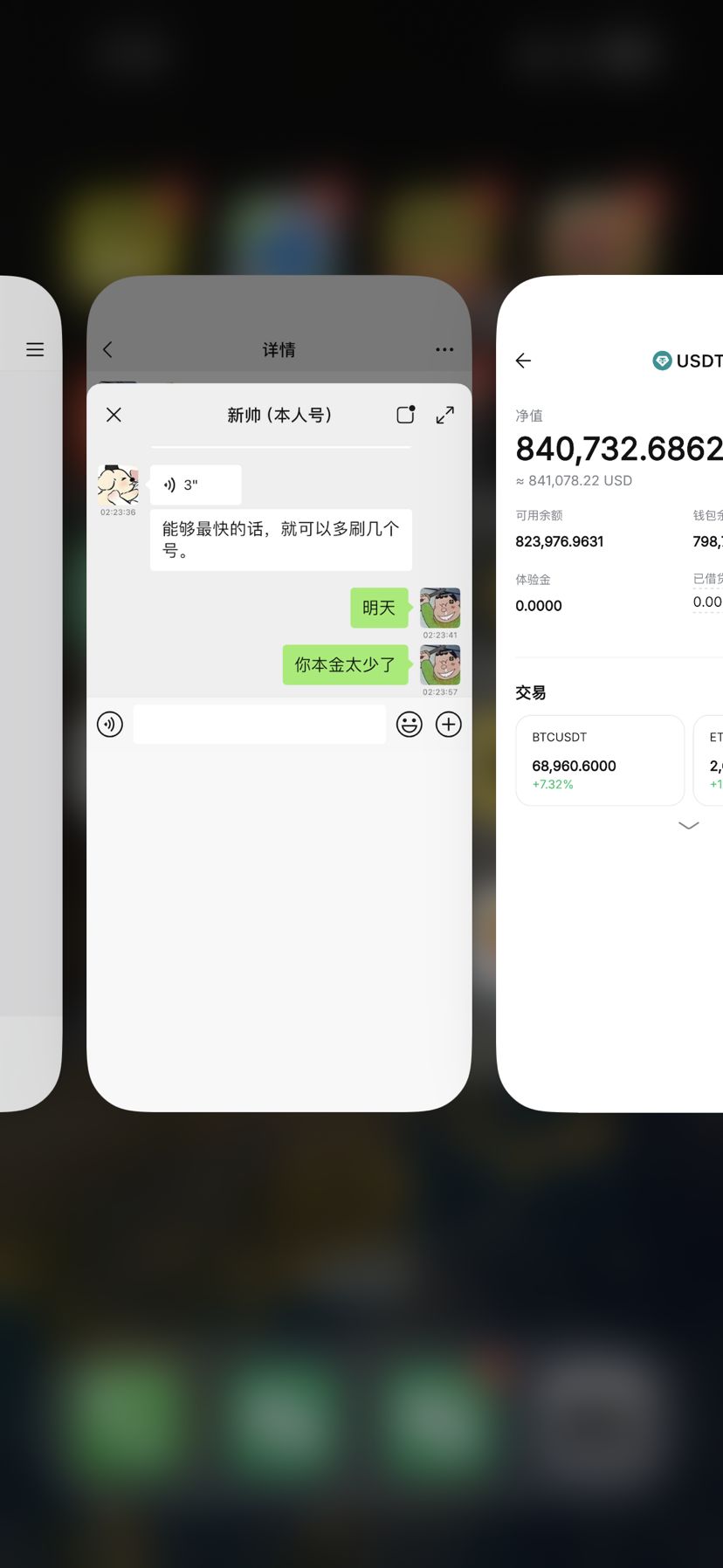
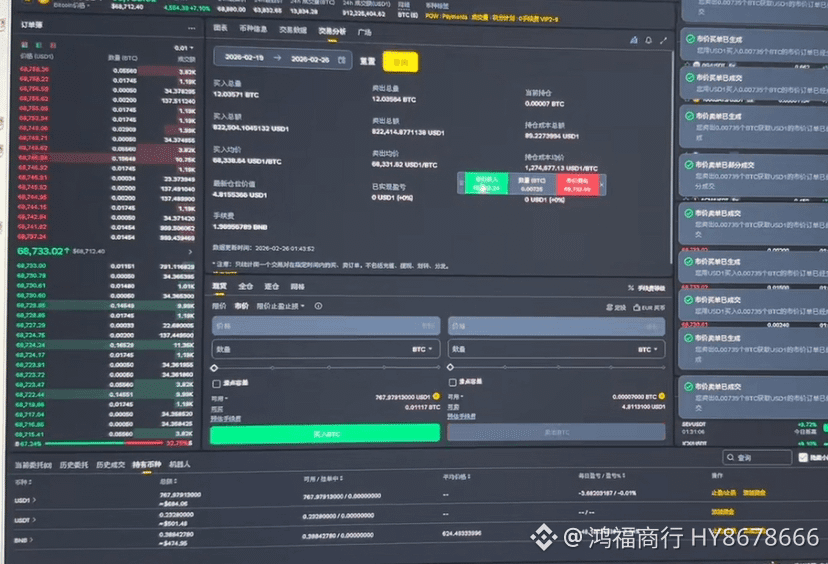
Countdown for the printing machine: 1 day
2500u principal exhausted, remaining 1900u
200u-300u profit
Countdown for the printing machine: 1 day
2500u principal exhausted, remaining 1900u
200u-300u profit
2500u principal exhausted, remaining 1900u
200u-300u profit
2
1
241
PINNED
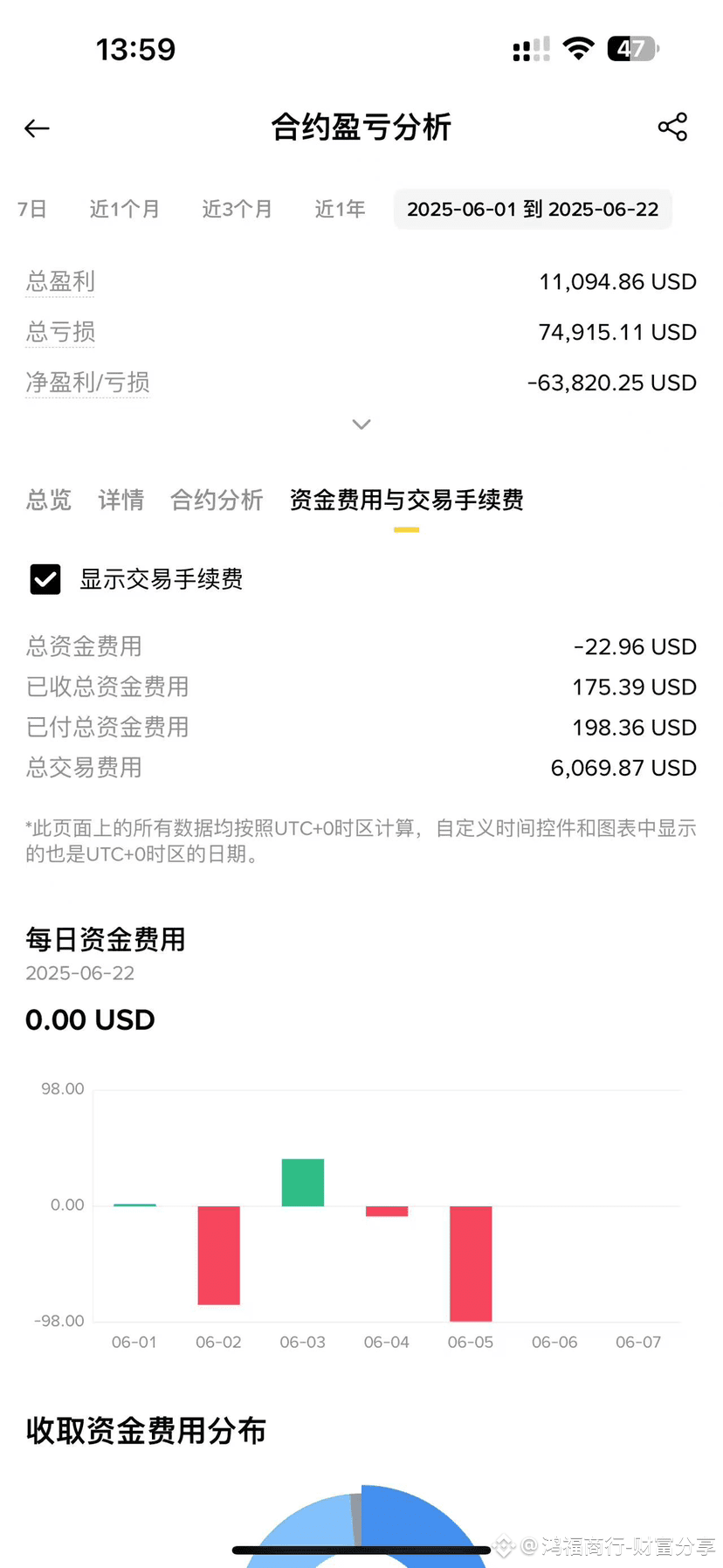
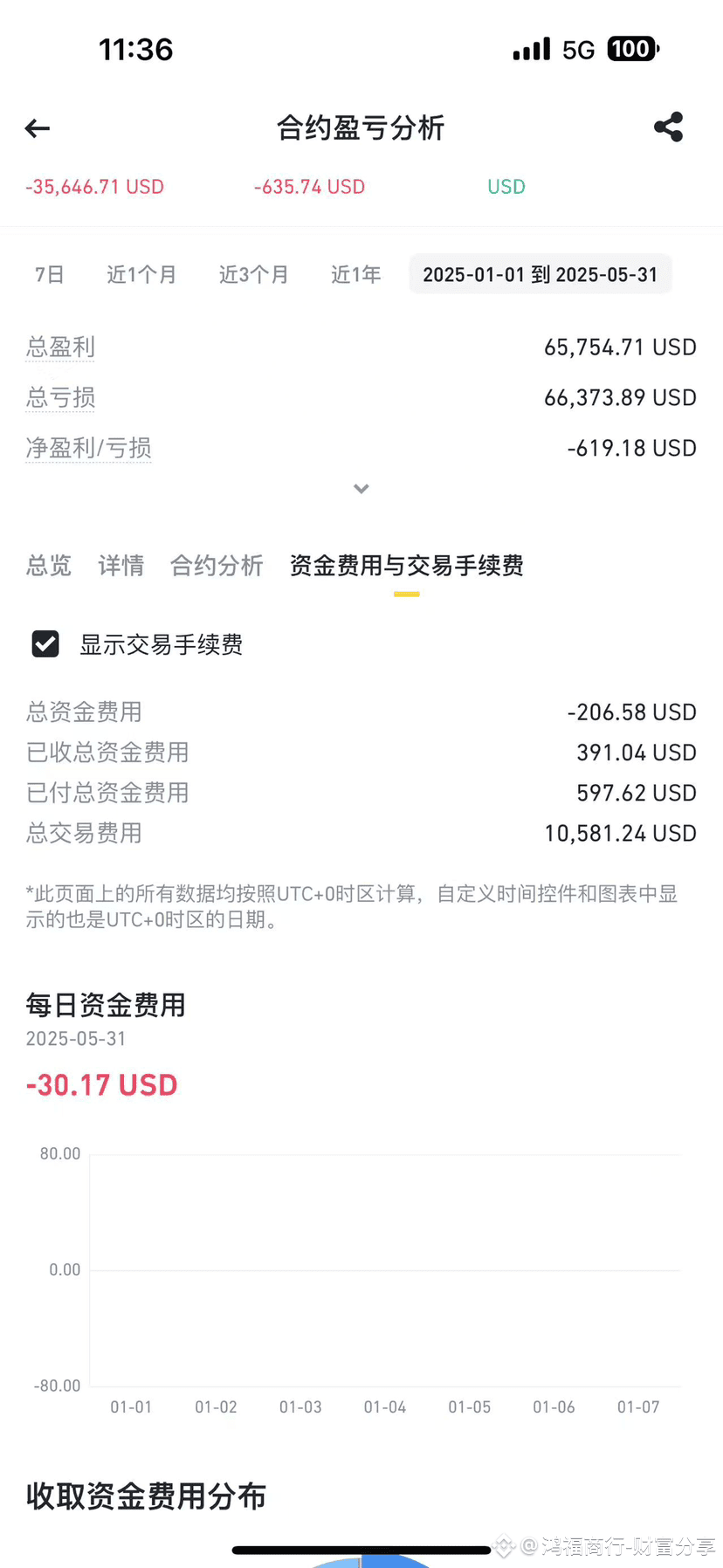
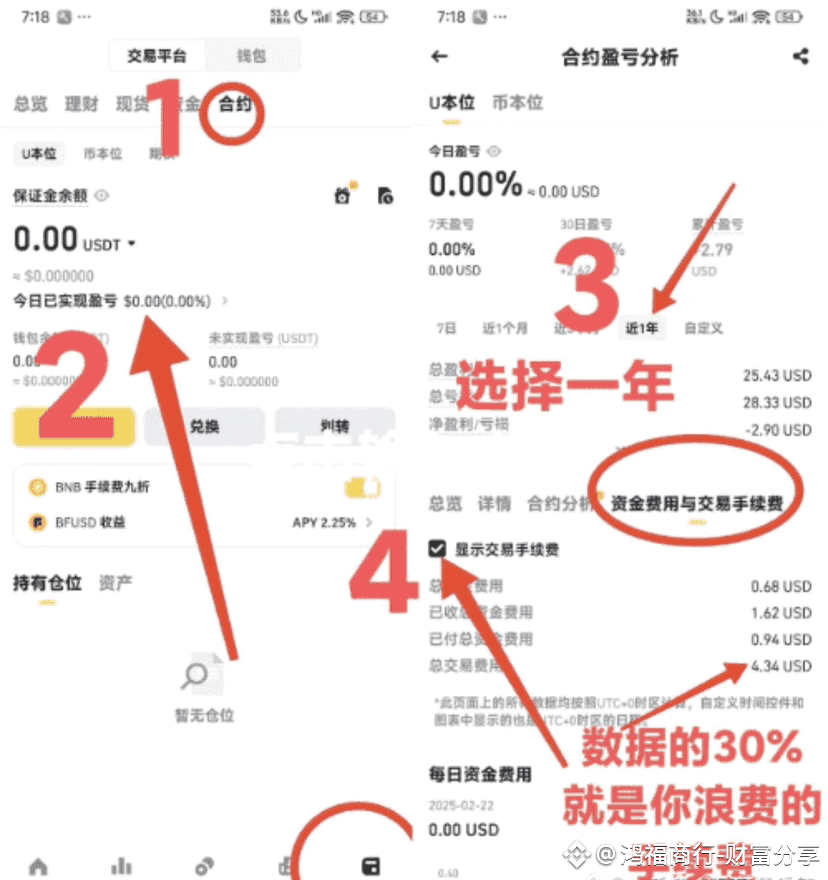
Yesterday's market was so bad, how many big brothers are holding on? You can check how much your fees are. If you haven't opened the fee reduction, you can come and consult us oh
[手续费减免链接](https://www.marketwebb.net/join?ref=BNB001)
Yesterday's market was so bad, how many big brothers are holding on? You can check how much your fees are. If you haven't opened the fee reduction, you can come and consult us oh
手续费减免链接
手续费减免链接

4
2
264
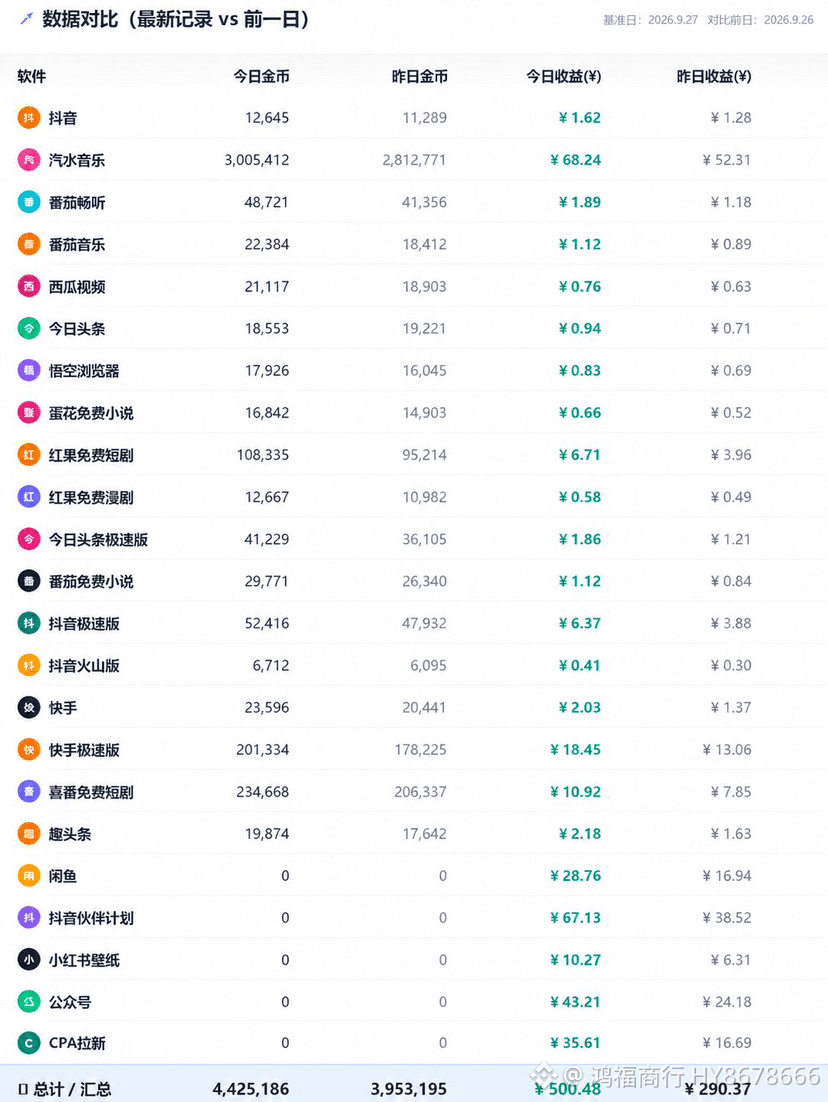
How do you do this kind of “scam the sheep,” setting up a few hundred accounts—what, and you’re still playing the crypto scene? 😂
How do you do this kind of “scam the sheep,” setting up a few hundred accounts—what, and you’re still playing the crypto scene? 😂
3
1k
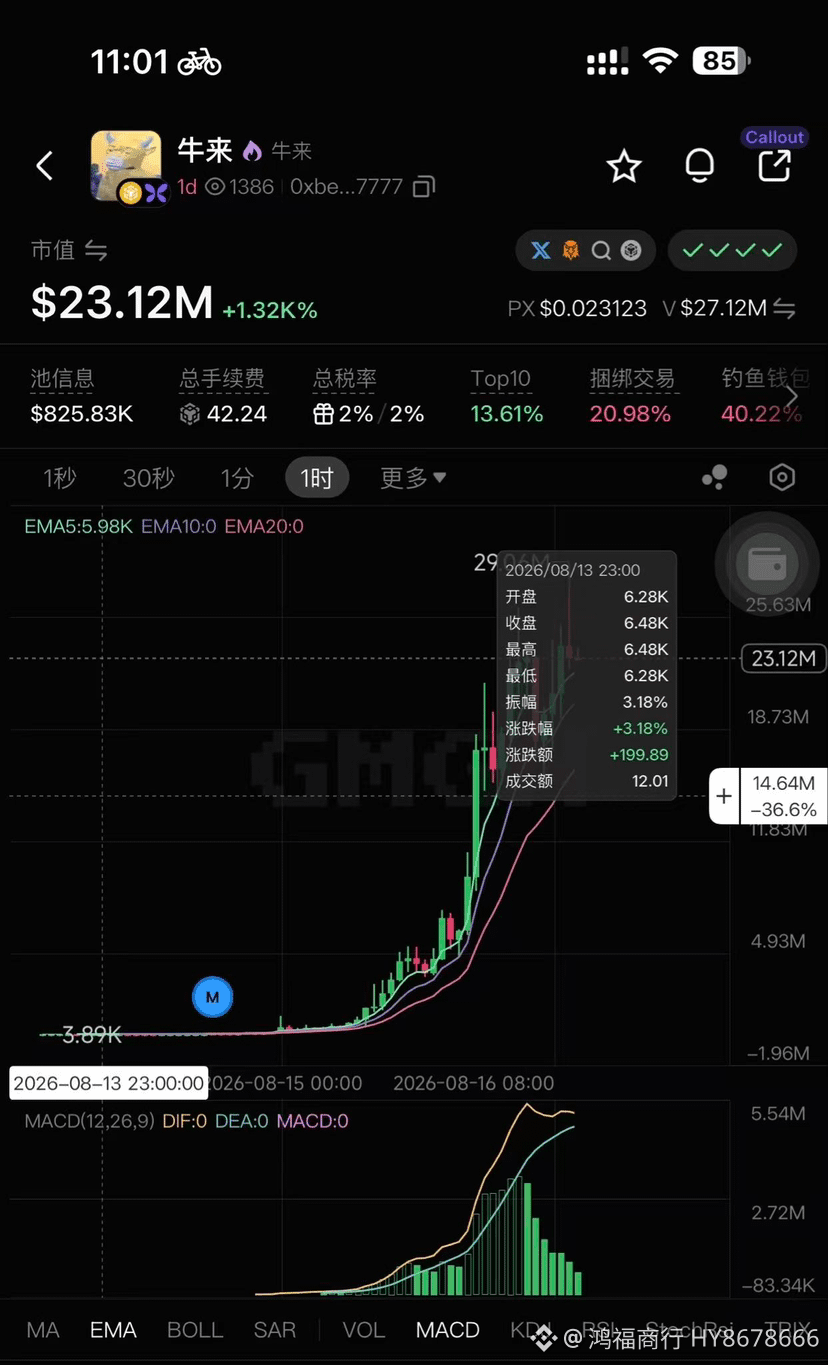
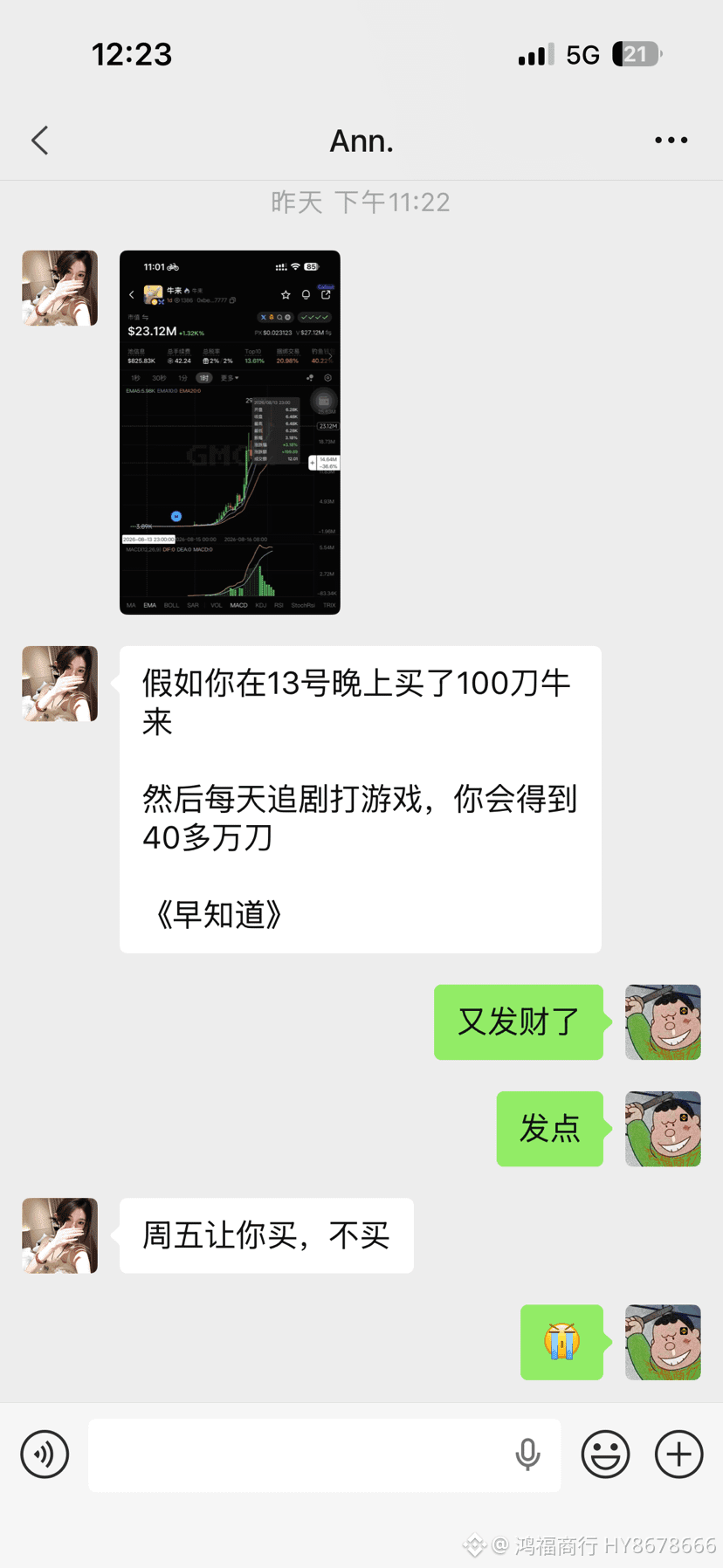
If you bought 100 dollars worth of stocks on the 13th night
Then you kept binge-watching TV shows and playing games every day, you would end up with more than 400,000 dollars
《Better Off Knowing Earlier》
If you bought 100 dollars worth of stocks on the 13th night
Then you kept binge-watching TV shows and playing games every day, you would end up with more than 400,000 dollars
《Better Off Knowing Earlier》
Then you kept binge-watching TV shows and playing games every day, you would end up with more than 400,000 dollars
《Better Off Knowing Earlier》

2
318
July 23 Midday Market Quick Report
As of 15:00 Beijing time, today’s core story is not “crypto markets strengthening on their own,” but rather that BTC continues to hold up, oil prices are lifting risk appetite, and the AI/chip-sector chain is still propping the market. In the afternoon, watch the ECB and U.S. stock earnings for direction.
1. BTC is still consolidating around $65,600. Binance saw a slight 24-hour drop of about 0.3%, but trading volume remains the highest across the board.
Importance: This suggests funds are still staying in the main pool, with no clear spillover into smaller-cap altcoins. What to watch today: If BTC can keep steady during the Europe and pre-U.S.-open sessions, the broader market still has room to keep trading sideways to digest.
2. ETH outperformed BTC slightly in the early session. SOL, BNB, SUI, and ADA also saw small scattered rebounds, but overall the market is still choosing selective rotation rather than launching a full offensive.
Importance: Altcoins have not formed a unified risk-on rebound yet. What to watch today: As long as BTC holds steady but ETH/mainstream altcoins can’t catch up, the market looks more like defensive-style repair.
3. In Binance spot markets, BTC, ETH, SOL, and XRP remain the most core high-liquidity USDT main pools; there’s no obvious shift of funds into low-liquidity instruments.
Importance: This often means traders are more willing to start with certainty. What to watch today: If volume surges in the afternoon but remains concentrated in the main pools, it indicates a shrinking supply/demand game (limited participation). Only if it starts spreading to more mainstream altcoins can we say risk appetite has genuinely expanded.
4. In the Asia session, South Korea and Japan chip stocks continue to lean strong. The market is still trading an AI/semiconductor repair theme.
Importance: The crypto market has been tightly linked with technology risk appetite these days. When chips are strong, BTC usually holds up better. What to watch today: In the afternoon, see whether Nasdaq futures and semiconductor sentiment can continue—this will determine whether crypto can lift in tandem.
5. Oil prices continue to rise, and the market is still digesting the supply and inflation pressures stemming from Middle East tensions.
Importance: Rising oil prices will weigh on the valuation of risk assets, and they can also push the U.S. dollar and yields back up. What to watch today: If oil prices keep surging and the dollar stays strong, high-volatility assets other than BTC are more likely to be pressured.
6. Tonight, at 20:15 Beijing time, watch the ECB decision; at 20:45, watch the press conference.
Importance: This will directly affect euro, dollar, and global rate-expectation pricing, and thereby influence how risk assets are priced. What to watch today: If the wording is more hawkish, the end of the European session and around the start of U.S. trading could initially pressure risk appetite.
7. Alphabet and Tesla report earnings tonight. What the market cares about most is not the results themselves, but AI capex and the outlook/guidance.
Importance: These two earnings reports will directly influence sentiment around chips, cloud services, and Nasdaq-linked stocks. Crypto typically follows tech stocks when choosing direction. What to watch today: If tech stocks rise first after the close, BTC is more likely to hold on to its strength. If tech stocks turn weaker after earnings, crypto will also be hard-pressed to strengthen independently.
8. BTC ETF inflows are still returning, indicating that institutional short-term buying has not stopped.
Importance: This provides BTC with support that’s harder than pure sentiment. What to watch today: If ETF inflows continue, and oil prices and the dollar don’t spiral out of control, BTC is more like high-level consolidation rather than a trend reversal.
One-sentence takeaway for today’s market: BTC is holding, technology is testing, oil prices are pressuring. Tonight, we’ll see whether the ECB and Alphabet/Tesla can give the market a clearer direction.
#BTC #AI #宏观
July 23 Midday Market Quick Report
As of 15:00 Beijing time, today’s core story is not “crypto markets strengthening on their own,” but rather that BTC continues to hold up, oil prices are lifting risk appetite, and the AI/chip-sector chain is still propping the market. In the afternoon, watch the ECB and U.S. stock earnings for direction.
1. BTC is still consolidating around $65,600. Binance saw a slight 24-hour drop of about 0.3%, but trading volume remains the highest across the board.
Importance: This suggests funds are still staying in the main pool, with no clear spillover into smaller-cap altcoins. What to watch today: If BTC can keep steady during the Europe and pre-U.S.-open sessions, the broader market still has room to keep trading sideways to digest.
2. ETH outperformed BTC slightly in the early session. SOL, BNB, SUI, and ADA also saw small scattered rebounds, but overall the market is still choosing selective rotation rather than launching a full offensive.
Importance: Altcoins have not formed a unified risk-on rebound yet. What to watch today: As long as BTC holds steady but ETH/mainstream altcoins can’t catch up, the market looks more like defensive-style repair.
3. In Binance spot markets, BTC, ETH, SOL, and XRP remain the most core high-liquidity USDT main pools; there’s no obvious shift of funds into low-liquidity instruments.
Importance: This often means traders are more willing to start with certainty. What to watch today: If volume surges in the afternoon but remains concentrated in the main pools, it indicates a shrinking supply/demand game (limited participation). Only if it starts spreading to more mainstream altcoins can we say risk appetite has genuinely expanded.
4. In the Asia session, South Korea and Japan chip stocks continue to lean strong. The market is still trading an AI/semiconductor repair theme.
Importance: The crypto market has been tightly linked with technology risk appetite these days. When chips are strong, BTC usually holds up better. What to watch today: In the afternoon, see whether Nasdaq futures and semiconductor sentiment can continue—this will determine whether crypto can lift in tandem.
5. Oil prices continue to rise, and the market is still digesting the supply and inflation pressures stemming from Middle East tensions.
Importance: Rising oil prices will weigh on the valuation of risk assets, and they can also push the U.S. dollar and yields back up. What to watch today: If oil prices keep surging and the dollar stays strong, high-volatility assets other than BTC are more likely to be pressured.
6. Tonight, at 20:15 Beijing time, watch the ECB decision; at 20:45, watch the press conference.
Importance: This will directly affect euro, dollar, and global rate-expectation pricing, and thereby influence how risk assets are priced. What to watch today: If the wording is more hawkish, the end of the European session and around the start of U.S. trading could initially pressure risk appetite.
7. Alphabet and Tesla report earnings tonight. What the market cares about most is not the results themselves, but AI capex and the outlook/guidance.
Importance: These two earnings reports will directly influence sentiment around chips, cloud services, and Nasdaq-linked stocks. Crypto typically follows tech stocks when choosing direction. What to watch today: If tech stocks rise first after the close, BTC is more likely to hold on to its strength. If tech stocks turn weaker after earnings, crypto will also be hard-pressed to strengthen independently.
8. BTC ETF inflows are still returning, indicating that institutional short-term buying has not stopped.
Importance: This provides BTC with support that’s harder than pure sentiment. What to watch today: If ETF inflows continue, and oil prices and the dollar don’t spiral out of control, BTC is more like high-level consolidation rather than a trend reversal.
One-sentence takeaway for today’s market: BTC is holding, technology is testing, oil prices are pressuring. Tonight, we’ll see whether the ECB and Alphabet/Tesla can give the market a clearer direction.
#BTC #AI #宏观
As of 15:00 Beijing time, today’s core story is not “crypto markets strengthening on their own,” but rather that BTC continues to hold up, oil prices are lifting risk appetite, and the AI/chip-sector chain is still propping the market. In the afternoon, watch the ECB and U.S. stock earnings for direction.
1. BTC is still consolidating around $65,600. Binance saw a slight 24-hour drop of about 0.3%, but trading volume remains the highest across the board.
Importance: This suggests funds are still staying in the main pool, with no clear spillover into smaller-cap altcoins. What to watch today: If BTC can keep steady during the Europe and pre-U.S.-open sessions, the broader market still has room to keep trading sideways to digest.
2. ETH outperformed BTC slightly in the early session. SOL, BNB, SUI, and ADA also saw small scattered rebounds, but overall the market is still choosing selective rotation rather than launching a full offensive.
Importance: Altcoins have not formed a unified risk-on rebound yet. What to watch today: As long as BTC holds steady but ETH/mainstream altcoins can’t catch up, the market looks more like defensive-style repair.
3. In Binance spot markets, BTC, ETH, SOL, and XRP remain the most core high-liquidity USDT main pools; there’s no obvious shift of funds into low-liquidity instruments.
Importance: This often means traders are more willing to start with certainty. What to watch today: If volume surges in the afternoon but remains concentrated in the main pools, it indicates a shrinking supply/demand game (limited participation). Only if it starts spreading to more mainstream altcoins can we say risk appetite has genuinely expanded.
4. In the Asia session, South Korea and Japan chip stocks continue to lean strong. The market is still trading an AI/semiconductor repair theme.
Importance: The crypto market has been tightly linked with technology risk appetite these days. When chips are strong, BTC usually holds up better. What to watch today: In the afternoon, see whether Nasdaq futures and semiconductor sentiment can continue—this will determine whether crypto can lift in tandem.
5. Oil prices continue to rise, and the market is still digesting the supply and inflation pressures stemming from Middle East tensions.
Importance: Rising oil prices will weigh on the valuation of risk assets, and they can also push the U.S. dollar and yields back up. What to watch today: If oil prices keep surging and the dollar stays strong, high-volatility assets other than BTC are more likely to be pressured.
6. Tonight, at 20:15 Beijing time, watch the ECB decision; at 20:45, watch the press conference.
Importance: This will directly affect euro, dollar, and global rate-expectation pricing, and thereby influence how risk assets are priced. What to watch today: If the wording is more hawkish, the end of the European session and around the start of U.S. trading could initially pressure risk appetite.
7. Alphabet and Tesla report earnings tonight. What the market cares about most is not the results themselves, but AI capex and the outlook/guidance.
Importance: These two earnings reports will directly influence sentiment around chips, cloud services, and Nasdaq-linked stocks. Crypto typically follows tech stocks when choosing direction. What to watch today: If tech stocks rise first after the close, BTC is more likely to hold on to its strength. If tech stocks turn weaker after earnings, crypto will also be hard-pressed to strengthen independently.
8. BTC ETF inflows are still returning, indicating that institutional short-term buying has not stopped.
Importance: This provides BTC with support that’s harder than pure sentiment. What to watch today: If ETF inflows continue, and oil prices and the dollar don’t spiral out of control, BTC is more like high-level consolidation rather than a trend reversal.
One-sentence takeaway for today’s market: BTC is holding, technology is testing, oil prices are pressuring. Tonight, we’ll see whether the ECB and Alphabet/Tesla can give the market a clearer direction.
#BTC #AI #宏观
336
July 22 Morning Market Brief
As of 07:30 Beijing time, the most important overnight takeaway is not that “the crypto market is strengthening on its own,” but rather that “ETF inflows are flowing back to provide support + renewed risk appetite from a rebound in U.S. stocks’ AI/chips + oil prices are still surging, pressing the valuation upper end.” So in today’s Asian session, you should focus on the structure, not just up/down moves.
1. BTC is still holding in the strong zone from overnight. ETH is relatively steadier, and major coins haven’t shown uncontrolled drawdowns. Among Binance’s high-liquidity trading pairs, BTCUSDT, ETHUSDT, SOLUSDT, and XRPUSDT remain the trading core, suggesting funds are still active in the main pool. The key point is that this looks more like “getting back to the leader first,” not an aggressive push that fully spreads into altcoins. What to watch today: If, during the Asian session, ETH and SOL can continue to keep up with BTC, that would indicate risk appetite is broadening; if only BTC can resist selling while others lag, the market remains more defensive.
2. This spot-ETF theme line is back to being useful. CoinDesk notes that U.S. spot Bitcoin ETFs have posted net inflows for five straight trading days, totaling about $727 million, while Ethereum ETFs saw about $38 million in net inflows over the same period. Why it matters: What the market lacked earlier was institutional buy-side demand. This round of inflows at least gives BTC/ETH a firmer base. Potential impact: Preferentially bullish for BTC, ETH, and other high-liquidity assets tied to mainstream capital. What to watch today: If net inflows continue, mainstream coins are likely to stabilize more easily than smaller coins; if inflows pause, the market could revert to a “bounce driven by sentiment only” mode.
3. Overnight U.S. stock risk appetite is being repaired, with AI/chips as the main driver. AP reports that on July 21, the Nasdaq rose 1.3%, Micron jumped 12.2%, and Nvidia climbed 2%, indicating that the AI-valuation panic that weighed on the market last week has been eased a notch. Why it matters: Crypto and U.S. tech risk appetite have been closely linked recently. When chip stocks recover, BTC is more likely to hold steady, and ETH, SOL, and AI-narrative coins are also more likely to get a sentiment boost. What to watch today: Whether the semiconductor chain in the Asia and Europe sessions can take over and trade stably; if chip stocks give back gains, the sustainability of crypto’s rebound will be discounted.
4. Oil prices are still adding pressure to the market—this line can’t be ignored. AP shows that Brent crude has risen above $91. The core drivers remain the Iran-related situation and supply-risk concerns around the Strait of Hormuz. Why it matters: Higher oil prices will likely lift concerns about inflation and interest rates again, directly weighing on high-valuation growth stocks, and dragging down crypto risk appetite. Potential impact: First pressure tech stocks and high-beta altcoins, then indirectly affect BTC/ETH through U.S. Treasury yields and the U.S. dollar. What to watch today: If oil prices continue to spike higher, crypto is more likely to see “rally then pull back” during the day; if oil stabilizes, there will be more room for risk assets to recover.
5. The current capital style is still “defend liquidity first, then talk about broadening.” Looking at Binance’s high-liquidity USDT pairs, trading is still concentrated in BTC, ETH, SOL, and XRP, suggesting the market hasn’t entered a full rotation phase into smaller coins. Why it matters: This structure indicates traders are more willing to stay in the most liquid assets, with limited willingness to chase. Potential impact: Mainstream coins will likely outperform the tail-end altcoins; if there’s a pullback during the day, smaller coins typically feel the pressure more clearly. What to watch today: Whether trading volume starts to spread from BTC/ETH to more mainstream altcoins—this is a key signal for judging whether risk appetite is upgrading or if funds are still clustering around the leaders.
6. Tonight’s after-hours U.S. stock earnings reports will be one of the most critical external variables for today. The market is watching results and guidance from companies such as Alphabet, Tesla, IBM, and Texas Instruments. Why it matters: Global risk assets are once again pricing whether “AI investment can continue to support valuations.” Potential impact: If tech leaders continue to deliver strong revenue or capital expenditure signals, AI/chip-chain and crypto risk appetite are likely to get a boost; if results disappoint or capex raises concerns, both the Nasdaq and crypto could cool at the same time. What to watch today: Don’t gamble on the earnings direction during the day—observe whether the market keeps adding tech risk ahead of the reports, or reduces exposure to avoid volatility.
7. The macro calendar isn’t that important today, but the real volatility window is in the next two days. Kiplinger’s economic calendar for this week shows that on July 22 there’s almost no key U.S. data; on July 23, watch initial jobless claims; on July 24, watch PMIs for Japan, Europe, and the U.S. Meanwhile, the Fed’s rate decision meeting on July 28–29 is getting closer. Why it matters: The market will trade ahead on whether “oil price strength” pushes the rate-cut expectations further back. Potential impact: Rate-sensitive tech stocks, Bitcoin, and high-beta altcoins will all be sensitive to changes in these expectations. What to watch today: Don’t just stare at the coin price—also look at U.S. Treasury yields, the U.S. dollar, and oil prices together to judge whether the rebound has macro tailwinds.
8. The most practical order of observation for today’s Asia session should be: first, check whether oil prices and U.S. Treasury yields keep moving higher; then see whether BTC/ETH can hold the overnight strength; finally, watch whether volume can spread from the leaders to mainstream altcoins. The reason is simple: this determines whether today is “a day when risk appetite continues to recover” or “a day when only the leaders hold up the show while small coins keep falling behind.” The market impact is also direct: the former is more supportive for ETH, SOL, and high-volatility sectors, while the latter is more favorable for BTC’s outperformance or mainstream “group trading” only. What really deserves attention during the day isn’t who is rising the fastest, but who can maintain capital pickup under external pressure.
#比特币 #加密市场 #U.S. stocks
July 22 Morning Market Brief
As of 07:30 Beijing time, the most important overnight takeaway is not that “the crypto market is strengthening on its own,” but rather that “ETF inflows are flowing back to provide support + renewed risk appetite from a rebound in U.S. stocks’ AI/chips + oil prices are still surging, pressing the valuation upper end.” So in today’s Asian session, you should focus on the structure, not just up/down moves.
1. BTC is still holding in the strong zone from overnight. ETH is relatively steadier, and major coins haven’t shown uncontrolled drawdowns. Among Binance’s high-liquidity trading pairs, BTCUSDT, ETHUSDT, SOLUSDT, and XRPUSDT remain the trading core, suggesting funds are still active in the main pool. The key point is that this looks more like “getting back to the leader first,” not an aggressive push that fully spreads into altcoins. What to watch today: If, during the Asian session, ETH and SOL can continue to keep up with BTC, that would indicate risk appetite is broadening; if only BTC can resist selling while others lag, the market remains more defensive.
2. This spot-ETF theme line is back to being useful. CoinDesk notes that U.S. spot Bitcoin ETFs have posted net inflows for five straight trading days, totaling about $727 million, while Ethereum ETFs saw about $38 million in net inflows over the same period. Why it matters: What the market lacked earlier was institutional buy-side demand. This round of inflows at least gives BTC/ETH a firmer base. Potential impact: Preferentially bullish for BTC, ETH, and other high-liquidity assets tied to mainstream capital. What to watch today: If net inflows continue, mainstream coins are likely to stabilize more easily than smaller coins; if inflows pause, the market could revert to a “bounce driven by sentiment only” mode.
3. Overnight U.S. stock risk appetite is being repaired, with AI/chips as the main driver. AP reports that on July 21, the Nasdaq rose 1.3%, Micron jumped 12.2%, and Nvidia climbed 2%, indicating that the AI-valuation panic that weighed on the market last week has been eased a notch. Why it matters: Crypto and U.S. tech risk appetite have been closely linked recently. When chip stocks recover, BTC is more likely to hold steady, and ETH, SOL, and AI-narrative coins are also more likely to get a sentiment boost. What to watch today: Whether the semiconductor chain in the Asia and Europe sessions can take over and trade stably; if chip stocks give back gains, the sustainability of crypto’s rebound will be discounted.
4. Oil prices are still adding pressure to the market—this line can’t be ignored. AP shows that Brent crude has risen above $91. The core drivers remain the Iran-related situation and supply-risk concerns around the Strait of Hormuz. Why it matters: Higher oil prices will likely lift concerns about inflation and interest rates again, directly weighing on high-valuation growth stocks, and dragging down crypto risk appetite. Potential impact: First pressure tech stocks and high-beta altcoins, then indirectly affect BTC/ETH through U.S. Treasury yields and the U.S. dollar. What to watch today: If oil prices continue to spike higher, crypto is more likely to see “rally then pull back” during the day; if oil stabilizes, there will be more room for risk assets to recover.
5. The current capital style is still “defend liquidity first, then talk about broadening.” Looking at Binance’s high-liquidity USDT pairs, trading is still concentrated in BTC, ETH, SOL, and XRP, suggesting the market hasn’t entered a full rotation phase into smaller coins. Why it matters: This structure indicates traders are more willing to stay in the most liquid assets, with limited willingness to chase. Potential impact: Mainstream coins will likely outperform the tail-end altcoins; if there’s a pullback during the day, smaller coins typically feel the pressure more clearly. What to watch today: Whether trading volume starts to spread from BTC/ETH to more mainstream altcoins—this is a key signal for judging whether risk appetite is upgrading or if funds are still clustering around the leaders.
6. Tonight’s after-hours U.S. stock earnings reports will be one of the most critical external variables for today. The market is watching results and guidance from companies such as Alphabet, Tesla, IBM, and Texas Instruments. Why it matters: Global risk assets are once again pricing whether “AI investment can continue to support valuations.” Potential impact: If tech leaders continue to deliver strong revenue or capital expenditure signals, AI/chip-chain and crypto risk appetite are likely to get a boost; if results disappoint or capex raises concerns, both the Nasdaq and crypto could cool at the same time. What to watch today: Don’t gamble on the earnings direction during the day—observe whether the market keeps adding tech risk ahead of the reports, or reduces exposure to avoid volatility.
7. The macro calendar isn’t that important today, but the real volatility window is in the next two days. Kiplinger’s economic calendar for this week shows that on July 22 there’s almost no key U.S. data; on July 23, watch initial jobless claims; on July 24, watch PMIs for Japan, Europe, and the U.S. Meanwhile, the Fed’s rate decision meeting on July 28–29 is getting closer. Why it matters: The market will trade ahead on whether “oil price strength” pushes the rate-cut expectations further back. Potential impact: Rate-sensitive tech stocks, Bitcoin, and high-beta altcoins will all be sensitive to changes in these expectations. What to watch today: Don’t just stare at the coin price—also look at U.S. Treasury yields, the U.S. dollar, and oil prices together to judge whether the rebound has macro tailwinds.
8. The most practical order of observation for today’s Asia session should be: first, check whether oil prices and U.S. Treasury yields keep moving higher; then see whether BTC/ETH can hold the overnight strength; finally, watch whether volume can spread from the leaders to mainstream altcoins. The reason is simple: this determines whether today is “a day when risk appetite continues to recover” or “a day when only the leaders hold up the show while small coins keep falling behind.” The market impact is also direct: the former is more supportive for ETH, SOL, and high-volatility sectors, while the latter is more favorable for BTC’s outperformance or mainstream “group trading” only. What really deserves attention during the day isn’t who is rising the fastest, but who can maintain capital pickup under external pressure.
#比特币 #加密市场 #U.S. stocks
As of 07:30 Beijing time, the most important overnight takeaway is not that “the crypto market is strengthening on its own,” but rather that “ETF inflows are flowing back to provide support + renewed risk appetite from a rebound in U.S. stocks’ AI/chips + oil prices are still surging, pressing the valuation upper end.” So in today’s Asian session, you should focus on the structure, not just up/down moves.
1. BTC is still holding in the strong zone from overnight. ETH is relatively steadier, and major coins haven’t shown uncontrolled drawdowns. Among Binance’s high-liquidity trading pairs, BTCUSDT, ETHUSDT, SOLUSDT, and XRPUSDT remain the trading core, suggesting funds are still active in the main pool. The key point is that this looks more like “getting back to the leader first,” not an aggressive push that fully spreads into altcoins. What to watch today: If, during the Asian session, ETH and SOL can continue to keep up with BTC, that would indicate risk appetite is broadening; if only BTC can resist selling while others lag, the market remains more defensive.
2. This spot-ETF theme line is back to being useful. CoinDesk notes that U.S. spot Bitcoin ETFs have posted net inflows for five straight trading days, totaling about $727 million, while Ethereum ETFs saw about $38 million in net inflows over the same period. Why it matters: What the market lacked earlier was institutional buy-side demand. This round of inflows at least gives BTC/ETH a firmer base. Potential impact: Preferentially bullish for BTC, ETH, and other high-liquidity assets tied to mainstream capital. What to watch today: If net inflows continue, mainstream coins are likely to stabilize more easily than smaller coins; if inflows pause, the market could revert to a “bounce driven by sentiment only” mode.
3. Overnight U.S. stock risk appetite is being repaired, with AI/chips as the main driver. AP reports that on July 21, the Nasdaq rose 1.3%, Micron jumped 12.2%, and Nvidia climbed 2%, indicating that the AI-valuation panic that weighed on the market last week has been eased a notch. Why it matters: Crypto and U.S. tech risk appetite have been closely linked recently. When chip stocks recover, BTC is more likely to hold steady, and ETH, SOL, and AI-narrative coins are also more likely to get a sentiment boost. What to watch today: Whether the semiconductor chain in the Asia and Europe sessions can take over and trade stably; if chip stocks give back gains, the sustainability of crypto’s rebound will be discounted.
4. Oil prices are still adding pressure to the market—this line can’t be ignored. AP shows that Brent crude has risen above $91. The core drivers remain the Iran-related situation and supply-risk concerns around the Strait of Hormuz. Why it matters: Higher oil prices will likely lift concerns about inflation and interest rates again, directly weighing on high-valuation growth stocks, and dragging down crypto risk appetite. Potential impact: First pressure tech stocks and high-beta altcoins, then indirectly affect BTC/ETH through U.S. Treasury yields and the U.S. dollar. What to watch today: If oil prices continue to spike higher, crypto is more likely to see “rally then pull back” during the day; if oil stabilizes, there will be more room for risk assets to recover.
5. The current capital style is still “defend liquidity first, then talk about broadening.” Looking at Binance’s high-liquidity USDT pairs, trading is still concentrated in BTC, ETH, SOL, and XRP, suggesting the market hasn’t entered a full rotation phase into smaller coins. Why it matters: This structure indicates traders are more willing to stay in the most liquid assets, with limited willingness to chase. Potential impact: Mainstream coins will likely outperform the tail-end altcoins; if there’s a pullback during the day, smaller coins typically feel the pressure more clearly. What to watch today: Whether trading volume starts to spread from BTC/ETH to more mainstream altcoins—this is a key signal for judging whether risk appetite is upgrading or if funds are still clustering around the leaders.
6. Tonight’s after-hours U.S. stock earnings reports will be one of the most critical external variables for today. The market is watching results and guidance from companies such as Alphabet, Tesla, IBM, and Texas Instruments. Why it matters: Global risk assets are once again pricing whether “AI investment can continue to support valuations.” Potential impact: If tech leaders continue to deliver strong revenue or capital expenditure signals, AI/chip-chain and crypto risk appetite are likely to get a boost; if results disappoint or capex raises concerns, both the Nasdaq and crypto could cool at the same time. What to watch today: Don’t gamble on the earnings direction during the day—observe whether the market keeps adding tech risk ahead of the reports, or reduces exposure to avoid volatility.
7. The macro calendar isn’t that important today, but the real volatility window is in the next two days. Kiplinger’s economic calendar for this week shows that on July 22 there’s almost no key U.S. data; on July 23, watch initial jobless claims; on July 24, watch PMIs for Japan, Europe, and the U.S. Meanwhile, the Fed’s rate decision meeting on July 28–29 is getting closer. Why it matters: The market will trade ahead on whether “oil price strength” pushes the rate-cut expectations further back. Potential impact: Rate-sensitive tech stocks, Bitcoin, and high-beta altcoins will all be sensitive to changes in these expectations. What to watch today: Don’t just stare at the coin price—also look at U.S. Treasury yields, the U.S. dollar, and oil prices together to judge whether the rebound has macro tailwinds.
8. The most practical order of observation for today’s Asia session should be: first, check whether oil prices and U.S. Treasury yields keep moving higher; then see whether BTC/ETH can hold the overnight strength; finally, watch whether volume can spread from the leaders to mainstream altcoins. The reason is simple: this determines whether today is “a day when risk appetite continues to recover” or “a day when only the leaders hold up the show while small coins keep falling behind.” The market impact is also direct: the former is more supportive for ETH, SOL, and high-volatility sectors, while the latter is more favorable for BTC’s outperformance or mainstream “group trading” only. What really deserves attention during the day isn’t who is rising the fastest, but who can maintain capital pickup under external pressure.
#比特币 #加密市场 #U.S. stocks
1
343
July 22 evening market news flash
As of 21:00 Beijing time, tonight’s action is not simply a crypto market move. It’s more like a combination of “oil prices surging + US stock futures trade weak in the premarket + majors recovering while altcoins diverge.”
1. BTC and ETH remain the core of the tape. According to Binance’s 24-hour data, BTCUSDT is around $65,630, down about 1.4% over 24 hours; ETHUSDT is around $1,919, down about 1.2%. This suggests today’s pullback is mainly pressure from external variables on risk appetite, but the major coins have not spiraled out of control. Next, the focus is whether BTC continues to follow the mood swings of US stocks during the night session, and whether ETH can hold relatively stronger.
2. Altcoins didn’t catch up to the majors’ recovery. High-liquidity names like SOL, DOGE, SUI, PEPE, and LINK remain generally weak, with PEPE showing the largest drop. Only a few coins like AAVE have managed to break out with independent strength. The key point is that the market hasn’t entered a “full rotation” phase yet; capital is still more tilted toward majors and a small number of strong narrative themes. Next, first check whether the majors are stable, then see if altcoins have any catch-up rally.
3. Funds are still concentrated in the deeper liquidity pools. BTCUSDT and ETHUSDT remain the most active trading pairs on Binance, and USDCUSDT volume is also high—indicating today is more about defense and re-positioning rather than pure chasing. The implication for the market is that traders are waiting for clearer direction signals. Next, watch whether成交 keeps concentrating in BTC/ETH or starts spilling over into higher-beta altcoins.
4. Risk appetite in the US premarket is cautious. AP reports that, driven by an escalation in the Iran–Iraq conflict and oil prices surging, US stock index futures are weaker; both the S&P 500 and Nasdaq are under pressure. The impact chain is fairly direct: higher oil lifts inflation expectations, which suppresses growth-stock valuations and also drags down crypto risk appetite. Next, watch whether tech stocks and the Nasdaq can absorb the premarket pressure once the regular session opens.
5. Oil price is the most important external variable tonight. AP and multiple market media outlets emphasize that Brent crude continues to push higher, and the market worries about supply risks from the Strait of Hormuz. For crypto, this isn’t “an energy news story”—it’s an input to how risk assets are priced. The stronger the oil price, the harder it is for inflation and interest-rate expectations to ease, and the more BTC and high-beta altcoins are likely to be weighed down. Next, watch whether oil continues to refresh highs.
6. Tech earnings tonight will directly affect risk-asset pricing. WSJ and other reports are watching the earnings from Alphabet, Tesla, IBM, Texas Instruments, and more tonight; Super Micro rose sharply premarket on AI server profit-margin guidance. The importance is that once the AI/chip-chain moves higher, it often brings a sentiment boost to ETH, SOL, and related AI tokens. Next, focus on the tone of Alphabet and Tesla’s earnings, and whether chip stocks can continue the premarket strength/weakness divergence.
7. Interest rates and the US dollar are still adding pressure. WSJ reports that US Treasury yields remain elevated. The dollar is slightly weaker, but overall the interest-rate environment is still not comfortable. For crypto assets, this means capital won’t easily rotate into high-volatility positions. Next, monitor whether long-term Treasury yields and the US Dollar Index can continue to hold.
8. The central bank window is also ahead. The Federal Reserve will meet July 28–29, and tonight is more like a pre-meeting re-positioning period rather than data-driven trading alone. The importance is that oil prices and inflation expectations will directly influence how the market prices the next meeting. Next, watch tonight into tomorrow morning whether the market keeps pushing the “higher for longer” rate expectations back into the price.
Tonight, there are truly only three lines to watch: whether BTC/ETH can continue to hold up against downside pressure, which—oil or US tech stocks—is driving risk appetite, and whether altcoins move from divergence to broader expansion.
#BTC #ETH #US stocks
July 22 evening market news flash
As of 21:00 Beijing time, tonight’s action is not simply a crypto market move. It’s more like a combination of “oil prices surging + US stock futures trade weak in the premarket + majors recovering while altcoins diverge.”
1. BTC and ETH remain the core of the tape. According to Binance’s 24-hour data, BTCUSDT is around $65,630, down about 1.4% over 24 hours; ETHUSDT is around $1,919, down about 1.2%. This suggests today’s pullback is mainly pressure from external variables on risk appetite, but the major coins have not spiraled out of control. Next, the focus is whether BTC continues to follow the mood swings of US stocks during the night session, and whether ETH can hold relatively stronger.
2. Altcoins didn’t catch up to the majors’ recovery. High-liquidity names like SOL, DOGE, SUI, PEPE, and LINK remain generally weak, with PEPE showing the largest drop. Only a few coins like AAVE have managed to break out with independent strength. The key point is that the market hasn’t entered a “full rotation” phase yet; capital is still more tilted toward majors and a small number of strong narrative themes. Next, first check whether the majors are stable, then see if altcoins have any catch-up rally.
3. Funds are still concentrated in the deeper liquidity pools. BTCUSDT and ETHUSDT remain the most active trading pairs on Binance, and USDCUSDT volume is also high—indicating today is more about defense and re-positioning rather than pure chasing. The implication for the market is that traders are waiting for clearer direction signals. Next, watch whether成交 keeps concentrating in BTC/ETH or starts spilling over into higher-beta altcoins.
4. Risk appetite in the US premarket is cautious. AP reports that, driven by an escalation in the Iran–Iraq conflict and oil prices surging, US stock index futures are weaker; both the S&P 500 and Nasdaq are under pressure. The impact chain is fairly direct: higher oil lifts inflation expectations, which suppresses growth-stock valuations and also drags down crypto risk appetite. Next, watch whether tech stocks and the Nasdaq can absorb the premarket pressure once the regular session opens.
5. Oil price is the most important external variable tonight. AP and multiple market media outlets emphasize that Brent crude continues to push higher, and the market worries about supply risks from the Strait of Hormuz. For crypto, this isn’t “an energy news story”—it’s an input to how risk assets are priced. The stronger the oil price, the harder it is for inflation and interest-rate expectations to ease, and the more BTC and high-beta altcoins are likely to be weighed down. Next, watch whether oil continues to refresh highs.
6. Tech earnings tonight will directly affect risk-asset pricing. WSJ and other reports are watching the earnings from Alphabet, Tesla, IBM, Texas Instruments, and more tonight; Super Micro rose sharply premarket on AI server profit-margin guidance. The importance is that once the AI/chip-chain moves higher, it often brings a sentiment boost to ETH, SOL, and related AI tokens. Next, focus on the tone of Alphabet and Tesla’s earnings, and whether chip stocks can continue the premarket strength/weakness divergence.
7. Interest rates and the US dollar are still adding pressure. WSJ reports that US Treasury yields remain elevated. The dollar is slightly weaker, but overall the interest-rate environment is still not comfortable. For crypto assets, this means capital won’t easily rotate into high-volatility positions. Next, monitor whether long-term Treasury yields and the US Dollar Index can continue to hold.
8. The central bank window is also ahead. The Federal Reserve will meet July 28–29, and tonight is more like a pre-meeting re-positioning period rather than data-driven trading alone. The importance is that oil prices and inflation expectations will directly influence how the market prices the next meeting. Next, watch tonight into tomorrow morning whether the market keeps pushing the “higher for longer” rate expectations back into the price.
Tonight, there are truly only three lines to watch: whether BTC/ETH can continue to hold up against downside pressure, which—oil or US tech stocks—is driving risk appetite, and whether altcoins move from divergence to broader expansion.
#BTC #ETH #US stocks
As of 21:00 Beijing time, tonight’s action is not simply a crypto market move. It’s more like a combination of “oil prices surging + US stock futures trade weak in the premarket + majors recovering while altcoins diverge.”
1. BTC and ETH remain the core of the tape. According to Binance’s 24-hour data, BTCUSDT is around $65,630, down about 1.4% over 24 hours; ETHUSDT is around $1,919, down about 1.2%. This suggests today’s pullback is mainly pressure from external variables on risk appetite, but the major coins have not spiraled out of control. Next, the focus is whether BTC continues to follow the mood swings of US stocks during the night session, and whether ETH can hold relatively stronger.
2. Altcoins didn’t catch up to the majors’ recovery. High-liquidity names like SOL, DOGE, SUI, PEPE, and LINK remain generally weak, with PEPE showing the largest drop. Only a few coins like AAVE have managed to break out with independent strength. The key point is that the market hasn’t entered a “full rotation” phase yet; capital is still more tilted toward majors and a small number of strong narrative themes. Next, first check whether the majors are stable, then see if altcoins have any catch-up rally.
3. Funds are still concentrated in the deeper liquidity pools. BTCUSDT and ETHUSDT remain the most active trading pairs on Binance, and USDCUSDT volume is also high—indicating today is more about defense and re-positioning rather than pure chasing. The implication for the market is that traders are waiting for clearer direction signals. Next, watch whether成交 keeps concentrating in BTC/ETH or starts spilling over into higher-beta altcoins.
4. Risk appetite in the US premarket is cautious. AP reports that, driven by an escalation in the Iran–Iraq conflict and oil prices surging, US stock index futures are weaker; both the S&P 500 and Nasdaq are under pressure. The impact chain is fairly direct: higher oil lifts inflation expectations, which suppresses growth-stock valuations and also drags down crypto risk appetite. Next, watch whether tech stocks and the Nasdaq can absorb the premarket pressure once the regular session opens.
5. Oil price is the most important external variable tonight. AP and multiple market media outlets emphasize that Brent crude continues to push higher, and the market worries about supply risks from the Strait of Hormuz. For crypto, this isn’t “an energy news story”—it’s an input to how risk assets are priced. The stronger the oil price, the harder it is for inflation and interest-rate expectations to ease, and the more BTC and high-beta altcoins are likely to be weighed down. Next, watch whether oil continues to refresh highs.
6. Tech earnings tonight will directly affect risk-asset pricing. WSJ and other reports are watching the earnings from Alphabet, Tesla, IBM, Texas Instruments, and more tonight; Super Micro rose sharply premarket on AI server profit-margin guidance. The importance is that once the AI/chip-chain moves higher, it often brings a sentiment boost to ETH, SOL, and related AI tokens. Next, focus on the tone of Alphabet and Tesla’s earnings, and whether chip stocks can continue the premarket strength/weakness divergence.
7. Interest rates and the US dollar are still adding pressure. WSJ reports that US Treasury yields remain elevated. The dollar is slightly weaker, but overall the interest-rate environment is still not comfortable. For crypto assets, this means capital won’t easily rotate into high-volatility positions. Next, monitor whether long-term Treasury yields and the US Dollar Index can continue to hold.
8. The central bank window is also ahead. The Federal Reserve will meet July 28–29, and tonight is more like a pre-meeting re-positioning period rather than data-driven trading alone. The importance is that oil prices and inflation expectations will directly influence how the market prices the next meeting. Next, watch tonight into tomorrow morning whether the market keeps pushing the “higher for longer” rate expectations back into the price.
Tonight, there are truly only three lines to watch: whether BTC/ETH can continue to hold up against downside pressure, which—oil or US tech stocks—is driving risk appetite, and whether altcoins move from divergence to broader expansion.
#BTC #ETH #US stocks
479
July 22 Midday Market Brief
As of 15:00 Beijing time, the most important midday takeaway is not that “the crypto market is strengthening on its own,” but rather that global risk assets are being pulled in different directions across three fronts: a rebound in AI/chip stocks, a recovery in oil prices, and fluctuations in FX rates—so the crypto market is, for now, acting more like a follower.
1. BTC is still holding around $65,900, but major coins aren’t catching up with strength. On Binance, the BTCUSDT contract is roughly flat over the past 24 hours, while ETH, SOL, BNB, and ADA generally pull back—showing that the resilience of the midday session is mainly concentrated in BTC. In essence, it’s “resisting downside” rather than launching a broad “offense.” Why it matters: This implies capital is more cautious and prioritizes assets with the best liquidity and the hardest narratives. What to watch this afternoon: If, after the European session begins, ETH and SOL remain weaker than BTC, it indicates the market is still operating with a defensive mindset and the rebound breadth isn’t wide enough.
2. Among Binance’s high-liquidity USDT trading pairs, transaction activity continues to concentrate in BTC, ETH, SOL, and XRP, with BTC clearly leading by trading value. Why it matters: Money is still staying in the main pool, with no obvious spillover into smaller-cap altcoins. Market tolerance for chasing is limited. What to watch this afternoon: If subsequent volume spikes occur only in BTC—not in ETH and other high-beta majors—then this move looks more like capital rotating back to the leaders rather than a new, broad recovery in overall risk appetite.
3. The spot BTC ETF has recorded net inflows for the fifth consecutive trading day. Over these five days combined, totals are about $727 million. The ETH ETF also saw incremental inflows during the same period. Why it matters: This provides BTC with a more solid “backstop” than a pure sentiment rebound, indicating that institutional buying has at least returned in the short term. What to watch this afternoon: If BTC can still hold in the European session and into the U.S. stock market pre-open tonight, the market will likely continue to treat ETF flows as the base support for this rebound.
4. The most critical external variable for the Asian session is still the semiconductor (chip) line. After U.S. stocks rallied hard overnight in semiconductors, Asian chip stocks continue to take the relay. The Korean market in particular rebounds especially quickly, suggesting that the AI/chip panic that suppressed risk assets last week is continuing to repair. Why it matters: Over the past stretch of time, crypto and AI/chip risk appetite have been moving in tandem. When tech stocks repair, BTC is more likely to hold steady, and major coins are more likely to stop falling. What to watch this afternoon: Around the European session, can Nasdaq futures and the semiconductor supply-chain sustain their strength? If chips pull back, crypto will likely cool off as well.
5. Another line that can’t be ignored is oil prices and the Middle East situation. Oil prices are strengthening again, and the market is still pricing in Iran-related risks and disruption expectations for the Strait of Hormuz. Why it matters: If oil keeps pushing higher, it will raise concerns about inflation, put upward pressure on U.S. Treasury yields and the U.S. dollar. That’s bad news for crypto and growth-stock valuations. What to watch this afternoon: First, check whether European energy and oil futures continue to push higher. If oil rises while the dollar strengthens too, it will be difficult for crypto to deliver an independent, sustained rally.
6. The Japanese yen continues to weaken and at one point fell to its weakest range since 1986, indicating that pressure in Asian FX markets hasn’t eased. Why it matters: This will reinforce the macro backdrop of a “stronger dollar and pressure on Asian currencies,” which is unfavorable for high-volatility risk assets in the short run. But in the medium-to-long-term narrative, it may also strengthen discussions about BTC as a fixed-supply asset for allocation. What to watch this afternoon: Keep an eye on the U.S. Dollar Index and the yen’s trend—if FX pressure continues to spill over in Asia, the market will be more inclined to hold cash and leader assets.
7. The macro calendar isn’t the key today, but the real risk window is in the following two days. Tomorrow: the ECB will release its rate decision; in the U.S., initial jobless claims. On Friday, there are also PMI releases across Europe and the U.S. Next week, it’s the Fed meeting on July 28–29. Why it matters: Many assets are currently front-running the question of whether “oil-price upside will again push up expectations for rate hikes.” What to watch this afternoon: Don’t just look at crypto prices in the European session—also check whether U.S. Treasury yields and the dollar continue to rise. That will directly determine whether the rebound can extend into the evening.
8. After the U.S. stock market closes tonight, Alphabet and Tesla will release their results. Tomorrow night, Intel also reports. These earnings will directly determine whether the AI capital expenditure story can still support the semiconductor complex. Why it matters: Recently, crypto hasn’t been driven by independent fundamentals; it has clearly been pulled by tech risk appetite. What to watch this afternoon: If the market chooses to lift tech-stock expectations ahead of earnings, BTC is still likely to remain relatively steady. If investors de-risk and reduce positions before the earnings, major coins will likely come under pressure earlier than BTC.
Midday summary in one sentence: Today’s signal from the Asian session is that “BTC is holding up, chip stocks are repairing, and oil prices are exerting pressure” all at the same time. So the real trading focus isn’t chasing prices, but whether the European session this afternoon can confirm that risk appetite is continuing—or whether oil, the dollar, and yields will push the market back down again.
#BTC #ETF #U.S. stocks
July 22 Midday Market Brief
As of 15:00 Beijing time, the most important midday takeaway is not that “the crypto market is strengthening on its own,” but rather that global risk assets are being pulled in different directions across three fronts: a rebound in AI/chip stocks, a recovery in oil prices, and fluctuations in FX rates—so the crypto market is, for now, acting more like a follower.
1. BTC is still holding around $65,900, but major coins aren’t catching up with strength. On Binance, the BTCUSDT contract is roughly flat over the past 24 hours, while ETH, SOL, BNB, and ADA generally pull back—showing that the resilience of the midday session is mainly concentrated in BTC. In essence, it’s “resisting downside” rather than launching a broad “offense.” Why it matters: This implies capital is more cautious and prioritizes assets with the best liquidity and the hardest narratives. What to watch this afternoon: If, after the European session begins, ETH and SOL remain weaker than BTC, it indicates the market is still operating with a defensive mindset and the rebound breadth isn’t wide enough.
2. Among Binance’s high-liquidity USDT trading pairs, transaction activity continues to concentrate in BTC, ETH, SOL, and XRP, with BTC clearly leading by trading value. Why it matters: Money is still staying in the main pool, with no obvious spillover into smaller-cap altcoins. Market tolerance for chasing is limited. What to watch this afternoon: If subsequent volume spikes occur only in BTC—not in ETH and other high-beta majors—then this move looks more like capital rotating back to the leaders rather than a new, broad recovery in overall risk appetite.
3. The spot BTC ETF has recorded net inflows for the fifth consecutive trading day. Over these five days combined, totals are about $727 million. The ETH ETF also saw incremental inflows during the same period. Why it matters: This provides BTC with a more solid “backstop” than a pure sentiment rebound, indicating that institutional buying has at least returned in the short term. What to watch this afternoon: If BTC can still hold in the European session and into the U.S. stock market pre-open tonight, the market will likely continue to treat ETF flows as the base support for this rebound.
4. The most critical external variable for the Asian session is still the semiconductor (chip) line. After U.S. stocks rallied hard overnight in semiconductors, Asian chip stocks continue to take the relay. The Korean market in particular rebounds especially quickly, suggesting that the AI/chip panic that suppressed risk assets last week is continuing to repair. Why it matters: Over the past stretch of time, crypto and AI/chip risk appetite have been moving in tandem. When tech stocks repair, BTC is more likely to hold steady, and major coins are more likely to stop falling. What to watch this afternoon: Around the European session, can Nasdaq futures and the semiconductor supply-chain sustain their strength? If chips pull back, crypto will likely cool off as well.
5. Another line that can’t be ignored is oil prices and the Middle East situation. Oil prices are strengthening again, and the market is still pricing in Iran-related risks and disruption expectations for the Strait of Hormuz. Why it matters: If oil keeps pushing higher, it will raise concerns about inflation, put upward pressure on U.S. Treasury yields and the U.S. dollar. That’s bad news for crypto and growth-stock valuations. What to watch this afternoon: First, check whether European energy and oil futures continue to push higher. If oil rises while the dollar strengthens too, it will be difficult for crypto to deliver an independent, sustained rally.
6. The Japanese yen continues to weaken and at one point fell to its weakest range since 1986, indicating that pressure in Asian FX markets hasn’t eased. Why it matters: This will reinforce the macro backdrop of a “stronger dollar and pressure on Asian currencies,” which is unfavorable for high-volatility risk assets in the short run. But in the medium-to-long-term narrative, it may also strengthen discussions about BTC as a fixed-supply asset for allocation. What to watch this afternoon: Keep an eye on the U.S. Dollar Index and the yen’s trend—if FX pressure continues to spill over in Asia, the market will be more inclined to hold cash and leader assets.
7. The macro calendar isn’t the key today, but the real risk window is in the following two days. Tomorrow: the ECB will release its rate decision; in the U.S., initial jobless claims. On Friday, there are also PMI releases across Europe and the U.S. Next week, it’s the Fed meeting on July 28–29. Why it matters: Many assets are currently front-running the question of whether “oil-price upside will again push up expectations for rate hikes.” What to watch this afternoon: Don’t just look at crypto prices in the European session—also check whether U.S. Treasury yields and the dollar continue to rise. That will directly determine whether the rebound can extend into the evening.
8. After the U.S. stock market closes tonight, Alphabet and Tesla will release their results. Tomorrow night, Intel also reports. These earnings will directly determine whether the AI capital expenditure story can still support the semiconductor complex. Why it matters: Recently, crypto hasn’t been driven by independent fundamentals; it has clearly been pulled by tech risk appetite. What to watch this afternoon: If the market chooses to lift tech-stock expectations ahead of earnings, BTC is still likely to remain relatively steady. If investors de-risk and reduce positions before the earnings, major coins will likely come under pressure earlier than BTC.
Midday summary in one sentence: Today’s signal from the Asian session is that “BTC is holding up, chip stocks are repairing, and oil prices are exerting pressure” all at the same time. So the real trading focus isn’t chasing prices, but whether the European session this afternoon can confirm that risk appetite is continuing—or whether oil, the dollar, and yields will push the market back down again.
#BTC #ETF #U.S. stocks
As of 15:00 Beijing time, the most important midday takeaway is not that “the crypto market is strengthening on its own,” but rather that global risk assets are being pulled in different directions across three fronts: a rebound in AI/chip stocks, a recovery in oil prices, and fluctuations in FX rates—so the crypto market is, for now, acting more like a follower.
1. BTC is still holding around $65,900, but major coins aren’t catching up with strength. On Binance, the BTCUSDT contract is roughly flat over the past 24 hours, while ETH, SOL, BNB, and ADA generally pull back—showing that the resilience of the midday session is mainly concentrated in BTC. In essence, it’s “resisting downside” rather than launching a broad “offense.” Why it matters: This implies capital is more cautious and prioritizes assets with the best liquidity and the hardest narratives. What to watch this afternoon: If, after the European session begins, ETH and SOL remain weaker than BTC, it indicates the market is still operating with a defensive mindset and the rebound breadth isn’t wide enough.
2. Among Binance’s high-liquidity USDT trading pairs, transaction activity continues to concentrate in BTC, ETH, SOL, and XRP, with BTC clearly leading by trading value. Why it matters: Money is still staying in the main pool, with no obvious spillover into smaller-cap altcoins. Market tolerance for chasing is limited. What to watch this afternoon: If subsequent volume spikes occur only in BTC—not in ETH and other high-beta majors—then this move looks more like capital rotating back to the leaders rather than a new, broad recovery in overall risk appetite.
3. The spot BTC ETF has recorded net inflows for the fifth consecutive trading day. Over these five days combined, totals are about $727 million. The ETH ETF also saw incremental inflows during the same period. Why it matters: This provides BTC with a more solid “backstop” than a pure sentiment rebound, indicating that institutional buying has at least returned in the short term. What to watch this afternoon: If BTC can still hold in the European session and into the U.S. stock market pre-open tonight, the market will likely continue to treat ETF flows as the base support for this rebound.
4. The most critical external variable for the Asian session is still the semiconductor (chip) line. After U.S. stocks rallied hard overnight in semiconductors, Asian chip stocks continue to take the relay. The Korean market in particular rebounds especially quickly, suggesting that the AI/chip panic that suppressed risk assets last week is continuing to repair. Why it matters: Over the past stretch of time, crypto and AI/chip risk appetite have been moving in tandem. When tech stocks repair, BTC is more likely to hold steady, and major coins are more likely to stop falling. What to watch this afternoon: Around the European session, can Nasdaq futures and the semiconductor supply-chain sustain their strength? If chips pull back, crypto will likely cool off as well.
5. Another line that can’t be ignored is oil prices and the Middle East situation. Oil prices are strengthening again, and the market is still pricing in Iran-related risks and disruption expectations for the Strait of Hormuz. Why it matters: If oil keeps pushing higher, it will raise concerns about inflation, put upward pressure on U.S. Treasury yields and the U.S. dollar. That’s bad news for crypto and growth-stock valuations. What to watch this afternoon: First, check whether European energy and oil futures continue to push higher. If oil rises while the dollar strengthens too, it will be difficult for crypto to deliver an independent, sustained rally.
6. The Japanese yen continues to weaken and at one point fell to its weakest range since 1986, indicating that pressure in Asian FX markets hasn’t eased. Why it matters: This will reinforce the macro backdrop of a “stronger dollar and pressure on Asian currencies,” which is unfavorable for high-volatility risk assets in the short run. But in the medium-to-long-term narrative, it may also strengthen discussions about BTC as a fixed-supply asset for allocation. What to watch this afternoon: Keep an eye on the U.S. Dollar Index and the yen’s trend—if FX pressure continues to spill over in Asia, the market will be more inclined to hold cash and leader assets.
7. The macro calendar isn’t the key today, but the real risk window is in the following two days. Tomorrow: the ECB will release its rate decision; in the U.S., initial jobless claims. On Friday, there are also PMI releases across Europe and the U.S. Next week, it’s the Fed meeting on July 28–29. Why it matters: Many assets are currently front-running the question of whether “oil-price upside will again push up expectations for rate hikes.” What to watch this afternoon: Don’t just look at crypto prices in the European session—also check whether U.S. Treasury yields and the dollar continue to rise. That will directly determine whether the rebound can extend into the evening.
8. After the U.S. stock market closes tonight, Alphabet and Tesla will release their results. Tomorrow night, Intel also reports. These earnings will directly determine whether the AI capital expenditure story can still support the semiconductor complex. Why it matters: Recently, crypto hasn’t been driven by independent fundamentals; it has clearly been pulled by tech risk appetite. What to watch this afternoon: If the market chooses to lift tech-stock expectations ahead of earnings, BTC is still likely to remain relatively steady. If investors de-risk and reduce positions before the earnings, major coins will likely come under pressure earlier than BTC.
Midday summary in one sentence: Today’s signal from the Asian session is that “BTC is holding up, chip stocks are repairing, and oil prices are exerting pressure” all at the same time. So the real trading focus isn’t chasing prices, but whether the European session this afternoon can confirm that risk appetite is continuing—or whether oil, the dollar, and yields will push the market back down again.
#BTC #ETF #U.S. stocks
1
282
Market Brief for the Evening of July 21
As of 21:00 Beijing time, tonight’s main market theme is not a single coin, but rather “mainstream coin intraday repairs + a rebound in pre-U.S.-stock-market risk appetite + oil prices and Middle East geopolitical variables continuing to weigh on upside elasticity.”
1. Mainstream coins stay strong throughout the day. What happened: Binance data shows BTC rose about 2.9% over the past 24 hours to $66,538; ETH gained about 3.7% to $1,942; SOL rose about 2.2%; XRP rose about 3.7%; and BNB also returned above $577. Why it matters: This indicates it’s not just a single-point surge in BTC, but a broader repair across mainstream risk assets. Possible impact: Highly liquid assets like BTC, ETH, SOL, and XRP are more likely to continue absorbing capital. What to watch next: After the U.S. stock market opens tonight, whether BTC can hold steady near $66,000 and whether ETH can stay above $1,900.
2. Funds remain concentrated in the high-liquidity core pool. What happened: BTCUSDT, ETHUSDT, SOLUSDT, XRPUSDT, and BNBUSDT are still among the most active USDT trading pairs on Binance, suggesting that trading volume has mainly returned to mainstream coins rather than broadly spreading into low-liquidity altcoins. Why it matters: This kind of repair is usually more stable, but it also means the market hasn’t entered a “chasing higher across the board” phase yet. Possible impact: Strong-beta altcoins that want to keep outperforming still need mainstream coins to first establish the trend. What to watch next: If in the late-session trading the volume continues to stay with BTC and ETH rather than suddenly shifting to tail coins, it suggests the rebound has higher quality.
3. ETF flows are still propping up the base. What happened: In the past two weeks, U.S. spot Bitcoin ETFs have resumed net inflows, and institutional marginal buying has returned to the market. Why it matters: Ongoing net inflows from spot ETFs make BTC more likely to find follow-through support during pullbacks, rather than relying purely on short-term sentiment-driven rebounds. Possible impact: Most directly for BTC, and secondarily for improving overall risk appetite across the crypto market. What to watch next: Tonight into tomorrow, if ETF funds continue to maintain net inflows, the rebound’s persistence for BTC should be stronger.
4. Pre-market chip and tech sentiment is improving in the U.S. What happened: In today’s overseas trading, the market is again pricing in a repaired risk appetite for AI and chips, and S&P 500 futures are also attempting to hold key levels. Why it matters: The crypto market is not trading independently; correlations with U.S. tech stocks—especially high-beta risk assets—have become noticeably stronger. Possible impact: ETH, SOL, AI-themed tokens, and other high-volatility altcoins typically respond more sensitively to U.S. tech sentiment. What to watch next: After the U.S. market officially opens tonight, whether chip stocks and the Nasdaq can extend their pre-market strength into the first hour after the open.
5. Oil prices and Middle East geopolitics are still the biggest external disturbance for late-session trading. What happened: International oil prices remain supported by tight geopolitics and supply-disruption expectations, with no obvious pullback. Why it matters: Oil staying strong can raise inflation concerns and suppress upside expansion in risk-asset valuations. Possible impact: U.S. growth stocks, crypto high-beta sectors, and altcoins that are more sensitive to liquidity are all more likely to face pressure. What to watch next: If oil prices keep climbing tonight, while U.S. Treasury yields and the U.S. dollar rise in sync, the upside room for crypto during the late session will be clearly compressed.
6. Tonight’s macro isn’t about “data actually landing,” but about “position adjustments ahead of data.” What happened: There wasn’t any particularly major U.S. macro data released today; the market has already been preparing in advance for data and interest-rate expectations later this week. Why it matters: No big data doesn’t mean no volatility. Often, the real pullbacks and rallies happen in the portfolio rebalancing phase before large data releases. Possible impact: The dollar, Treasury yields, the Nasdaq, and BTC could all be driven by the same interest-rate expectation trades. What to watch next: Focus on the U.S. dollar index and Treasury yields; if both decline together later tonight, risk assets are more likely to continue the rebound.
7. At the altcoin level, it’s still “following the rise,” not “switching into a new leading leg.” What happened: Mainstream second-tier assets like LINK and AAVE are moving up today, but trading volume and strength are still not enough to prove the market has fully shifted into an all-altcoin rally. Why it matters: This means the current strategy is more like monitoring whether the mainstream coins can hold first, rather than rushing to bet on tail-end coins catching up. Possible impact: DeFi, AI, MEME, and other sectors may get short-term boosts from sentiment, but durability still depends on BTC and ETH continuing to hold their ground. What to watch next: If during the late session ETH continues to be stronger than BTC, and SOL, LINK, and AAVE expand volume in follow-through, the market will look more like it has entered the second phase of broader diffusion.
8. There are really only three lines worth watching tonight. What happened: First, whether BTC/ETH can hold their intraday gains; second, after the U.S. stock market opens, whether chips and the Nasdaq can pick up and hold the pre-market sentiment; third, whether oil prices, the dollar, and Treasury yields start pressuring risk assets again. Why it matters: These three lines determine whether tonight becomes “continued intraday repair” or “looks good pre-market, gives back after the open.” Possible impact: Mainstream coins, altcoins, and even U.S. tech directions will all be affected together. What to watch next: If around 23:00 these three lines align at the same time, there may still be room to push higher during the late session; if only the coin prices are stubbornly holding on their own, you should guard against a sellback/giveback.
#BTC #ETH #U.S. stocks
Market Brief for the Evening of July 21
As of 21:00 Beijing time, tonight’s main market theme is not a single coin, but rather “mainstream coin intraday repairs + a rebound in pre-U.S.-stock-market risk appetite + oil prices and Middle East geopolitical variables continuing to weigh on upside elasticity.”
1. Mainstream coins stay strong throughout the day. What happened: Binance data shows BTC rose about 2.9% over the past 24 hours to $66,538; ETH gained about 3.7% to $1,942; SOL rose about 2.2%; XRP rose about 3.7%; and BNB also returned above $577. Why it matters: This indicates it’s not just a single-point surge in BTC, but a broader repair across mainstream risk assets. Possible impact: Highly liquid assets like BTC, ETH, SOL, and XRP are more likely to continue absorbing capital. What to watch next: After the U.S. stock market opens tonight, whether BTC can hold steady near $66,000 and whether ETH can stay above $1,900.
2. Funds remain concentrated in the high-liquidity core pool. What happened: BTCUSDT, ETHUSDT, SOLUSDT, XRPUSDT, and BNBUSDT are still among the most active USDT trading pairs on Binance, suggesting that trading volume has mainly returned to mainstream coins rather than broadly spreading into low-liquidity altcoins. Why it matters: This kind of repair is usually more stable, but it also means the market hasn’t entered a “chasing higher across the board” phase yet. Possible impact: Strong-beta altcoins that want to keep outperforming still need mainstream coins to first establish the trend. What to watch next: If in the late-session trading the volume continues to stay with BTC and ETH rather than suddenly shifting to tail coins, it suggests the rebound has higher quality.
3. ETF flows are still propping up the base. What happened: In the past two weeks, U.S. spot Bitcoin ETFs have resumed net inflows, and institutional marginal buying has returned to the market. Why it matters: Ongoing net inflows from spot ETFs make BTC more likely to find follow-through support during pullbacks, rather than relying purely on short-term sentiment-driven rebounds. Possible impact: Most directly for BTC, and secondarily for improving overall risk appetite across the crypto market. What to watch next: Tonight into tomorrow, if ETF funds continue to maintain net inflows, the rebound’s persistence for BTC should be stronger.
4. Pre-market chip and tech sentiment is improving in the U.S. What happened: In today’s overseas trading, the market is again pricing in a repaired risk appetite for AI and chips, and S&P 500 futures are also attempting to hold key levels. Why it matters: The crypto market is not trading independently; correlations with U.S. tech stocks—especially high-beta risk assets—have become noticeably stronger. Possible impact: ETH, SOL, AI-themed tokens, and other high-volatility altcoins typically respond more sensitively to U.S. tech sentiment. What to watch next: After the U.S. market officially opens tonight, whether chip stocks and the Nasdaq can extend their pre-market strength into the first hour after the open.
5. Oil prices and Middle East geopolitics are still the biggest external disturbance for late-session trading. What happened: International oil prices remain supported by tight geopolitics and supply-disruption expectations, with no obvious pullback. Why it matters: Oil staying strong can raise inflation concerns and suppress upside expansion in risk-asset valuations. Possible impact: U.S. growth stocks, crypto high-beta sectors, and altcoins that are more sensitive to liquidity are all more likely to face pressure. What to watch next: If oil prices keep climbing tonight, while U.S. Treasury yields and the U.S. dollar rise in sync, the upside room for crypto during the late session will be clearly compressed.
6. Tonight’s macro isn’t about “data actually landing,” but about “position adjustments ahead of data.” What happened: There wasn’t any particularly major U.S. macro data released today; the market has already been preparing in advance for data and interest-rate expectations later this week. Why it matters: No big data doesn’t mean no volatility. Often, the real pullbacks and rallies happen in the portfolio rebalancing phase before large data releases. Possible impact: The dollar, Treasury yields, the Nasdaq, and BTC could all be driven by the same interest-rate expectation trades. What to watch next: Focus on the U.S. dollar index and Treasury yields; if both decline together later tonight, risk assets are more likely to continue the rebound.
7. At the altcoin level, it’s still “following the rise,” not “switching into a new leading leg.” What happened: Mainstream second-tier assets like LINK and AAVE are moving up today, but trading volume and strength are still not enough to prove the market has fully shifted into an all-altcoin rally. Why it matters: This means the current strategy is more like monitoring whether the mainstream coins can hold first, rather than rushing to bet on tail-end coins catching up. Possible impact: DeFi, AI, MEME, and other sectors may get short-term boosts from sentiment, but durability still depends on BTC and ETH continuing to hold their ground. What to watch next: If during the late session ETH continues to be stronger than BTC, and SOL, LINK, and AAVE expand volume in follow-through, the market will look more like it has entered the second phase of broader diffusion.
8. There are really only three lines worth watching tonight. What happened: First, whether BTC/ETH can hold their intraday gains; second, after the U.S. stock market opens, whether chips and the Nasdaq can pick up and hold the pre-market sentiment; third, whether oil prices, the dollar, and Treasury yields start pressuring risk assets again. Why it matters: These three lines determine whether tonight becomes “continued intraday repair” or “looks good pre-market, gives back after the open.” Possible impact: Mainstream coins, altcoins, and even U.S. tech directions will all be affected together. What to watch next: If around 23:00 these three lines align at the same time, there may still be room to push higher during the late session; if only the coin prices are stubbornly holding on their own, you should guard against a sellback/giveback.
#BTC #ETH #U.S. stocks
As of 21:00 Beijing time, tonight’s main market theme is not a single coin, but rather “mainstream coin intraday repairs + a rebound in pre-U.S.-stock-market risk appetite + oil prices and Middle East geopolitical variables continuing to weigh on upside elasticity.”
1. Mainstream coins stay strong throughout the day. What happened: Binance data shows BTC rose about 2.9% over the past 24 hours to $66,538; ETH gained about 3.7% to $1,942; SOL rose about 2.2%; XRP rose about 3.7%; and BNB also returned above $577. Why it matters: This indicates it’s not just a single-point surge in BTC, but a broader repair across mainstream risk assets. Possible impact: Highly liquid assets like BTC, ETH, SOL, and XRP are more likely to continue absorbing capital. What to watch next: After the U.S. stock market opens tonight, whether BTC can hold steady near $66,000 and whether ETH can stay above $1,900.
2. Funds remain concentrated in the high-liquidity core pool. What happened: BTCUSDT, ETHUSDT, SOLUSDT, XRPUSDT, and BNBUSDT are still among the most active USDT trading pairs on Binance, suggesting that trading volume has mainly returned to mainstream coins rather than broadly spreading into low-liquidity altcoins. Why it matters: This kind of repair is usually more stable, but it also means the market hasn’t entered a “chasing higher across the board” phase yet. Possible impact: Strong-beta altcoins that want to keep outperforming still need mainstream coins to first establish the trend. What to watch next: If in the late-session trading the volume continues to stay with BTC and ETH rather than suddenly shifting to tail coins, it suggests the rebound has higher quality.
3. ETF flows are still propping up the base. What happened: In the past two weeks, U.S. spot Bitcoin ETFs have resumed net inflows, and institutional marginal buying has returned to the market. Why it matters: Ongoing net inflows from spot ETFs make BTC more likely to find follow-through support during pullbacks, rather than relying purely on short-term sentiment-driven rebounds. Possible impact: Most directly for BTC, and secondarily for improving overall risk appetite across the crypto market. What to watch next: Tonight into tomorrow, if ETF funds continue to maintain net inflows, the rebound’s persistence for BTC should be stronger.
4. Pre-market chip and tech sentiment is improving in the U.S. What happened: In today’s overseas trading, the market is again pricing in a repaired risk appetite for AI and chips, and S&P 500 futures are also attempting to hold key levels. Why it matters: The crypto market is not trading independently; correlations with U.S. tech stocks—especially high-beta risk assets—have become noticeably stronger. Possible impact: ETH, SOL, AI-themed tokens, and other high-volatility altcoins typically respond more sensitively to U.S. tech sentiment. What to watch next: After the U.S. market officially opens tonight, whether chip stocks and the Nasdaq can extend their pre-market strength into the first hour after the open.
5. Oil prices and Middle East geopolitics are still the biggest external disturbance for late-session trading. What happened: International oil prices remain supported by tight geopolitics and supply-disruption expectations, with no obvious pullback. Why it matters: Oil staying strong can raise inflation concerns and suppress upside expansion in risk-asset valuations. Possible impact: U.S. growth stocks, crypto high-beta sectors, and altcoins that are more sensitive to liquidity are all more likely to face pressure. What to watch next: If oil prices keep climbing tonight, while U.S. Treasury yields and the U.S. dollar rise in sync, the upside room for crypto during the late session will be clearly compressed.
6. Tonight’s macro isn’t about “data actually landing,” but about “position adjustments ahead of data.” What happened: There wasn’t any particularly major U.S. macro data released today; the market has already been preparing in advance for data and interest-rate expectations later this week. Why it matters: No big data doesn’t mean no volatility. Often, the real pullbacks and rallies happen in the portfolio rebalancing phase before large data releases. Possible impact: The dollar, Treasury yields, the Nasdaq, and BTC could all be driven by the same interest-rate expectation trades. What to watch next: Focus on the U.S. dollar index and Treasury yields; if both decline together later tonight, risk assets are more likely to continue the rebound.
7. At the altcoin level, it’s still “following the rise,” not “switching into a new leading leg.” What happened: Mainstream second-tier assets like LINK and AAVE are moving up today, but trading volume and strength are still not enough to prove the market has fully shifted into an all-altcoin rally. Why it matters: This means the current strategy is more like monitoring whether the mainstream coins can hold first, rather than rushing to bet on tail-end coins catching up. Possible impact: DeFi, AI, MEME, and other sectors may get short-term boosts from sentiment, but durability still depends on BTC and ETH continuing to hold their ground. What to watch next: If during the late session ETH continues to be stronger than BTC, and SOL, LINK, and AAVE expand volume in follow-through, the market will look more like it has entered the second phase of broader diffusion.
8. There are really only three lines worth watching tonight. What happened: First, whether BTC/ETH can hold their intraday gains; second, after the U.S. stock market opens, whether chips and the Nasdaq can pick up and hold the pre-market sentiment; third, whether oil prices, the dollar, and Treasury yields start pressuring risk assets again. Why it matters: These three lines determine whether tonight becomes “continued intraday repair” or “looks good pre-market, gives back after the open.” Possible impact: Mainstream coins, altcoins, and even U.S. tech directions will all be affected together. What to watch next: If around 23:00 these three lines align at the same time, there may still be room to push higher during the late session; if only the coin prices are stubbornly holding on their own, you should guard against a sellback/giveback.
#BTC #ETH #U.S. stocks
1
493
July 20 Morning Market Brief
As of 07:30 Beijing time, the overnight main theme is not a broad surge in risk appetite. Instead, it’s “oil prices pushing higher, tech stocks diverging, the crypto market following the rebound but still not fully freed from macro-driven forces.”
1. BTC is trading above the $65,000 area, with Binance up about 0.8% over the past 24 hours. This looks more like short covering and sentiment repair rather than a one-way move with strong volume. Today, watch whether it can hold above $65,000 first, then decide whether ETH and smaller coins can keep spreading higher.
2. ETH, SOL, XRP, ADA, SUI, and LINK broadly move up in tandem, suggesting last night’s strength wasn’t only BTC. The key point is that capital is starting to show willingness to return to high-beta sectors. Today, we’ll see whether altcoins continue outperforming, or whether the market once again turns to BTC-only dominance.
3. Spot ETF flows are not bad news for the crypto market. CoinDesk noted that the U.S. spot BTC ETF saw net inflows of about $273 million over the past two weeks, ending the prior streak of consecutive outflows. This means institutional capital is repairing on the margin, but the scale is still not enough to prove a full return of strong demand. Today, watch whether inflows can continue.
4. In U.S. stock markets, tech stocks were weak at first then stabilized overnight. Chip stocks rebounded, but the broader market still looks cautious overall. For crypto, the implication is straightforward: BTC and ETH are still moving in line with global tech risk appetite. Today, keep an eye on whether semiconductors can sustain the rebound.
5. Oil prices and the situation in the Middle East remain the biggest macro disruptions. Crude once surged to nearly $90. The risk is that inflation expectations and risk-off sentiment will continue to weigh on high-valuation assets. Today, if oil can’t pull back, both crypto and tech are likely to be dragged.
6. The dollar and U.S. Treasury yields have not shown any clear retreat, meaning capital has not fully shifted to an offensive stance. In other words, last night’s rebound looks more like “pressure being released,” not “the environment has fundamentally improved.” Today, watch whether the dollar, the 10-year U.S. Treasury yield, and gold continue to add pressure to risk assets.
7. In Asia trading, pay extra attention to Japan’s Marine Day holiday (海の日). Tokyo liquidity may be thinner than on regular days. On the board, smaller capital flows are more likely to amplify volatility. Today, watch out for a “false breakout, quick pullback.”
8. In the macro calendar, the truly major event is still the FOMC on July 28–29. There is no decision-type event today. The market will likely continue trading around the interest-rate path and inflation expectations. Any new remarks or data could amplify volatility.
#比特币 #加密市场 #U.S. Stocks
July 20 Morning Market Brief
As of 07:30 Beijing time, the overnight main theme is not a broad surge in risk appetite. Instead, it’s “oil prices pushing higher, tech stocks diverging, the crypto market following the rebound but still not fully freed from macro-driven forces.”
1. BTC is trading above the $65,000 area, with Binance up about 0.8% over the past 24 hours. This looks more like short covering and sentiment repair rather than a one-way move with strong volume. Today, watch whether it can hold above $65,000 first, then decide whether ETH and smaller coins can keep spreading higher.
2. ETH, SOL, XRP, ADA, SUI, and LINK broadly move up in tandem, suggesting last night’s strength wasn’t only BTC. The key point is that capital is starting to show willingness to return to high-beta sectors. Today, we’ll see whether altcoins continue outperforming, or whether the market once again turns to BTC-only dominance.
3. Spot ETF flows are not bad news for the crypto market. CoinDesk noted that the U.S. spot BTC ETF saw net inflows of about $273 million over the past two weeks, ending the prior streak of consecutive outflows. This means institutional capital is repairing on the margin, but the scale is still not enough to prove a full return of strong demand. Today, watch whether inflows can continue.
4. In U.S. stock markets, tech stocks were weak at first then stabilized overnight. Chip stocks rebounded, but the broader market still looks cautious overall. For crypto, the implication is straightforward: BTC and ETH are still moving in line with global tech risk appetite. Today, keep an eye on whether semiconductors can sustain the rebound.
5. Oil prices and the situation in the Middle East remain the biggest macro disruptions. Crude once surged to nearly $90. The risk is that inflation expectations and risk-off sentiment will continue to weigh on high-valuation assets. Today, if oil can’t pull back, both crypto and tech are likely to be dragged.
6. The dollar and U.S. Treasury yields have not shown any clear retreat, meaning capital has not fully shifted to an offensive stance. In other words, last night’s rebound looks more like “pressure being released,” not “the environment has fundamentally improved.” Today, watch whether the dollar, the 10-year U.S. Treasury yield, and gold continue to add pressure to risk assets.
7. In Asia trading, pay extra attention to Japan’s Marine Day holiday (海の日). Tokyo liquidity may be thinner than on regular days. On the board, smaller capital flows are more likely to amplify volatility. Today, watch out for a “false breakout, quick pullback.”
8. In the macro calendar, the truly major event is still the FOMC on July 28–29. There is no decision-type event today. The market will likely continue trading around the interest-rate path and inflation expectations. Any new remarks or data could amplify volatility.
#比特币 #加密市场 #U.S. Stocks
As of 07:30 Beijing time, the overnight main theme is not a broad surge in risk appetite. Instead, it’s “oil prices pushing higher, tech stocks diverging, the crypto market following the rebound but still not fully freed from macro-driven forces.”
1. BTC is trading above the $65,000 area, with Binance up about 0.8% over the past 24 hours. This looks more like short covering and sentiment repair rather than a one-way move with strong volume. Today, watch whether it can hold above $65,000 first, then decide whether ETH and smaller coins can keep spreading higher.
2. ETH, SOL, XRP, ADA, SUI, and LINK broadly move up in tandem, suggesting last night’s strength wasn’t only BTC. The key point is that capital is starting to show willingness to return to high-beta sectors. Today, we’ll see whether altcoins continue outperforming, or whether the market once again turns to BTC-only dominance.
3. Spot ETF flows are not bad news for the crypto market. CoinDesk noted that the U.S. spot BTC ETF saw net inflows of about $273 million over the past two weeks, ending the prior streak of consecutive outflows. This means institutional capital is repairing on the margin, but the scale is still not enough to prove a full return of strong demand. Today, watch whether inflows can continue.
4. In U.S. stock markets, tech stocks were weak at first then stabilized overnight. Chip stocks rebounded, but the broader market still looks cautious overall. For crypto, the implication is straightforward: BTC and ETH are still moving in line with global tech risk appetite. Today, keep an eye on whether semiconductors can sustain the rebound.
5. Oil prices and the situation in the Middle East remain the biggest macro disruptions. Crude once surged to nearly $90. The risk is that inflation expectations and risk-off sentiment will continue to weigh on high-valuation assets. Today, if oil can’t pull back, both crypto and tech are likely to be dragged.
6. The dollar and U.S. Treasury yields have not shown any clear retreat, meaning capital has not fully shifted to an offensive stance. In other words, last night’s rebound looks more like “pressure being released,” not “the environment has fundamentally improved.” Today, watch whether the dollar, the 10-year U.S. Treasury yield, and gold continue to add pressure to risk assets.
7. In Asia trading, pay extra attention to Japan’s Marine Day holiday (海の日). Tokyo liquidity may be thinner than on regular days. On the board, smaller capital flows are more likely to amplify volatility. Today, watch out for a “false breakout, quick pullback.”
8. In the macro calendar, the truly major event is still the FOMC on July 28–29. There is no decision-type event today. The market will likely continue trading around the interest-rate path and inflation expectations. Any new remarks or data could amplify volatility.
#比特币 #加密市场 #U.S. Stocks
366
July 14 Midday Market Quick Report
As of 15:00 Beijing time, through the Asian session to midday today, the market’s main storyline is clear: risk assets are still simultaneously digesting three lines—(1) a rebound in rate-hike expectations, (2) firmer oil prices, and (3) a pullback in AI/chips. The crypto market has not shown independent strength; it feels more like it’s waiting for the European session and tonight’s pre-US-stock-market hours to give direction.
1. Midday for mainstream coins still looks defensive in structure. What happened: Binance spot data shows BTC is currently around $62,600, roughly flat on the day with a slight weakness over the past 24 hours; ETH is around $1,782 and has edged back into positive territory; SOL’s drop is clearly larger than BTC’s, and XRP is also on the weak side. Why it matters: This indicates funds have not returned to a broad, chase-the-high-beta state; more money remains in comparatively steadier mainstream assets. What to watch today: If the European session still shows BTC holding up relatively better while SOL/XRP continue to lag, it suggests a structural divergence at night rather than a full “risk-on” turn.
2. In the high-liquidity USDT pairs, a strength/weakness split has already emerged. What happened: Among the actively traded coins today, ETH and BNB are barely holding near the flat line, but BTC, XRP, and SOL are overall weak. There hasn’t been a surge in volume where a group of high-liquidity altcoins simultaneously breaks out. Why it matters: This type of order-book action most directly reflects real risk appetite. If you don’t see broad diffusion, it means funds are still contracting exposures. What to watch today: In the afternoon, if trading volume continues to concentrate in BTC and ETH and high-beta rotation doesn’t get a chance, then in the short term you should interpret the move as “weak repair.”
3. Asia equities and the crypto market are riding the same risk line today. What happened: Around midday, Asia markets continue to be pressured by chips and geopolitical risk. Korean and Japan/Korea tech supply-chain names and regional equity indexes are broadly under pressure. The market is continuing to transmit yesterday night’s selloff in US tech stocks and the escalation of the Middle East situation forward. Why it matters: Right now, the crypto market isn’t trading its own separate story—it’s swinging in line with global risk appetite. What to watch today: After the European session opens, first see whether equity index futures and the semiconductor chain can stop the decline; that will directly affect tonight’s crypto sentiment.
4. Oil prices are ticking back up—this is the external variable that can’t be ignored today. What happened: The Middle East situation has again pushed up crude oil. Brent and WTI prices remain at high levels. The market is concerned that disturbances related to the Strait of Hormuz could lift energy and transportation costs again. Why it matters: Rising oil would support a “reflation” trade, compressing the market’s expectations for Fed easing within the year, which is not good news for US growth stocks and crypto assets. What to watch today: If in the European session the phase oil prices keep surging upward, while the US dollar and Treasury yields also strengthen in tandem, then tonight mainstream coins are likely to face pressure again.
5. The market is already pricing tonight’s US CPI and Fed signals in advance. What happened: The most important macro events today are US inflation data and testimony from the Fed chair to Congress. The market has been raising short-term rate-hike expectations, and CoinDesk also noted that this is one of the reasons early today’s rally suppressed Bitcoin and mainstream coins. Why it matters: This isn’t just noise—it’s the master switch that determines whether the US dollar, yields, tech stocks, and crypto assets will experience another round of synchronized moves tonight. What to watch today: Don’t focus only on coin prices first tonight. After CPI is released, look at how the US dollar index and the 2-year and 10-year Treasury yields move, then decide whether risk assets have room to rebound.
6. The global main theme of AI/chips is cooling, so it’s hard for crypto to completely ignore it. What happened: From last night to today’s Asian session, chip stocks and the AI chain continue to be under pressure. The selloff in Korean chip stocks also dragged down sentiment for US tech stocks and Asian risk assets. Why it matters: For a period, global risk appetite has depended heavily on the AI theme. Once that line pulls back, the first things to get hurt are usually high-valuation tech and high-volatility crypto assets. What to watch today: If in the pre-US session Nasdaq futures and the semiconductor sector can’t stop falling, then the rebound quality in crypto usually won’t be high.
7. Tonight, bank earnings are also worth a quick look from the crypto crowd. What happened: The US big banks’ earnings season kicks off, and the market will reassess corporate financing, trading business, and the credit environment. Why it matters: If earnings and management guidance are cautious, the market may interpret it as financial conditions still being tight—which is unfavorable for risk assets. If results beat expectations, there may be a chance to ease today’s daytime defensive sentiment. What to watch today: In the pre-US session, first look at how bank stocks perform, then see whether it helps stabilize overall risk appetite in US equities.
8. The most practical midday conclusion is not guessing direction, but setting the correct order of observation. What to look at first: After the European session opens, start with oil prices, the US dollar, and equity index futures; then look at tonight’s CPI and Fed signals; and only last, check whether BTC and ETH can hold the day’s lows after the events. Why this order: Because today’s crypto is clearly being driven by external macro factors and cross-market risk appetite—whatever changes first, coin prices will likely follow.
Midday conclusion: From the Asian session to midday today, the signals the market is giving remain “mainstream coins stay defensive, high beta lags behind, and external macro matters more.” In the afternoon European session,重点 watch whether oil prices and technology-stock futures can stop falling; in tonight’s pre-US session,重点 watch CPI, Fed signals, and whether bank earnings continue to suppress risk appetite. As long as these three external lines don’t ease, crypto looks more like weak repair than a sustained, trend-strengthening move.
#BTC #美股 #宏观
July 14 Midday Market Quick Report
As of 15:00 Beijing time, through the Asian session to midday today, the market’s main storyline is clear: risk assets are still simultaneously digesting three lines—(1) a rebound in rate-hike expectations, (2) firmer oil prices, and (3) a pullback in AI/chips. The crypto market has not shown independent strength; it feels more like it’s waiting for the European session and tonight’s pre-US-stock-market hours to give direction.
1. Midday for mainstream coins still looks defensive in structure. What happened: Binance spot data shows BTC is currently around $62,600, roughly flat on the day with a slight weakness over the past 24 hours; ETH is around $1,782 and has edged back into positive territory; SOL’s drop is clearly larger than BTC’s, and XRP is also on the weak side. Why it matters: This indicates funds have not returned to a broad, chase-the-high-beta state; more money remains in comparatively steadier mainstream assets. What to watch today: If the European session still shows BTC holding up relatively better while SOL/XRP continue to lag, it suggests a structural divergence at night rather than a full “risk-on” turn.
2. In the high-liquidity USDT pairs, a strength/weakness split has already emerged. What happened: Among the actively traded coins today, ETH and BNB are barely holding near the flat line, but BTC, XRP, and SOL are overall weak. There hasn’t been a surge in volume where a group of high-liquidity altcoins simultaneously breaks out. Why it matters: This type of order-book action most directly reflects real risk appetite. If you don’t see broad diffusion, it means funds are still contracting exposures. What to watch today: In the afternoon, if trading volume continues to concentrate in BTC and ETH and high-beta rotation doesn’t get a chance, then in the short term you should interpret the move as “weak repair.”
3. Asia equities and the crypto market are riding the same risk line today. What happened: Around midday, Asia markets continue to be pressured by chips and geopolitical risk. Korean and Japan/Korea tech supply-chain names and regional equity indexes are broadly under pressure. The market is continuing to transmit yesterday night’s selloff in US tech stocks and the escalation of the Middle East situation forward. Why it matters: Right now, the crypto market isn’t trading its own separate story—it’s swinging in line with global risk appetite. What to watch today: After the European session opens, first see whether equity index futures and the semiconductor chain can stop the decline; that will directly affect tonight’s crypto sentiment.
4. Oil prices are ticking back up—this is the external variable that can’t be ignored today. What happened: The Middle East situation has again pushed up crude oil. Brent and WTI prices remain at high levels. The market is concerned that disturbances related to the Strait of Hormuz could lift energy and transportation costs again. Why it matters: Rising oil would support a “reflation” trade, compressing the market’s expectations for Fed easing within the year, which is not good news for US growth stocks and crypto assets. What to watch today: If in the European session the phase oil prices keep surging upward, while the US dollar and Treasury yields also strengthen in tandem, then tonight mainstream coins are likely to face pressure again.
5. The market is already pricing tonight’s US CPI and Fed signals in advance. What happened: The most important macro events today are US inflation data and testimony from the Fed chair to Congress. The market has been raising short-term rate-hike expectations, and CoinDesk also noted that this is one of the reasons early today’s rally suppressed Bitcoin and mainstream coins. Why it matters: This isn’t just noise—it’s the master switch that determines whether the US dollar, yields, tech stocks, and crypto assets will experience another round of synchronized moves tonight. What to watch today: Don’t focus only on coin prices first tonight. After CPI is released, look at how the US dollar index and the 2-year and 10-year Treasury yields move, then decide whether risk assets have room to rebound.
6. The global main theme of AI/chips is cooling, so it’s hard for crypto to completely ignore it. What happened: From last night to today’s Asian session, chip stocks and the AI chain continue to be under pressure. The selloff in Korean chip stocks also dragged down sentiment for US tech stocks and Asian risk assets. Why it matters: For a period, global risk appetite has depended heavily on the AI theme. Once that line pulls back, the first things to get hurt are usually high-valuation tech and high-volatility crypto assets. What to watch today: If in the pre-US session Nasdaq futures and the semiconductor sector can’t stop falling, then the rebound quality in crypto usually won’t be high.
7. Tonight, bank earnings are also worth a quick look from the crypto crowd. What happened: The US big banks’ earnings season kicks off, and the market will reassess corporate financing, trading business, and the credit environment. Why it matters: If earnings and management guidance are cautious, the market may interpret it as financial conditions still being tight—which is unfavorable for risk assets. If results beat expectations, there may be a chance to ease today’s daytime defensive sentiment. What to watch today: In the pre-US session, first look at how bank stocks perform, then see whether it helps stabilize overall risk appetite in US equities.
8. The most practical midday conclusion is not guessing direction, but setting the correct order of observation. What to look at first: After the European session opens, start with oil prices, the US dollar, and equity index futures; then look at tonight’s CPI and Fed signals; and only last, check whether BTC and ETH can hold the day’s lows after the events. Why this order: Because today’s crypto is clearly being driven by external macro factors and cross-market risk appetite—whatever changes first, coin prices will likely follow.
Midday conclusion: From the Asian session to midday today, the signals the market is giving remain “mainstream coins stay defensive, high beta lags behind, and external macro matters more.” In the afternoon European session,重点 watch whether oil prices and technology-stock futures can stop falling; in tonight’s pre-US session,重点 watch CPI, Fed signals, and whether bank earnings continue to suppress risk appetite. As long as these three external lines don’t ease, crypto looks more like weak repair than a sustained, trend-strengthening move.
#BTC #美股 #宏观
As of 15:00 Beijing time, through the Asian session to midday today, the market’s main storyline is clear: risk assets are still simultaneously digesting three lines—(1) a rebound in rate-hike expectations, (2) firmer oil prices, and (3) a pullback in AI/chips. The crypto market has not shown independent strength; it feels more like it’s waiting for the European session and tonight’s pre-US-stock-market hours to give direction.
1. Midday for mainstream coins still looks defensive in structure. What happened: Binance spot data shows BTC is currently around $62,600, roughly flat on the day with a slight weakness over the past 24 hours; ETH is around $1,782 and has edged back into positive territory; SOL’s drop is clearly larger than BTC’s, and XRP is also on the weak side. Why it matters: This indicates funds have not returned to a broad, chase-the-high-beta state; more money remains in comparatively steadier mainstream assets. What to watch today: If the European session still shows BTC holding up relatively better while SOL/XRP continue to lag, it suggests a structural divergence at night rather than a full “risk-on” turn.
2. In the high-liquidity USDT pairs, a strength/weakness split has already emerged. What happened: Among the actively traded coins today, ETH and BNB are barely holding near the flat line, but BTC, XRP, and SOL are overall weak. There hasn’t been a surge in volume where a group of high-liquidity altcoins simultaneously breaks out. Why it matters: This type of order-book action most directly reflects real risk appetite. If you don’t see broad diffusion, it means funds are still contracting exposures. What to watch today: In the afternoon, if trading volume continues to concentrate in BTC and ETH and high-beta rotation doesn’t get a chance, then in the short term you should interpret the move as “weak repair.”
3. Asia equities and the crypto market are riding the same risk line today. What happened: Around midday, Asia markets continue to be pressured by chips and geopolitical risk. Korean and Japan/Korea tech supply-chain names and regional equity indexes are broadly under pressure. The market is continuing to transmit yesterday night’s selloff in US tech stocks and the escalation of the Middle East situation forward. Why it matters: Right now, the crypto market isn’t trading its own separate story—it’s swinging in line with global risk appetite. What to watch today: After the European session opens, first see whether equity index futures and the semiconductor chain can stop the decline; that will directly affect tonight’s crypto sentiment.
4. Oil prices are ticking back up—this is the external variable that can’t be ignored today. What happened: The Middle East situation has again pushed up crude oil. Brent and WTI prices remain at high levels. The market is concerned that disturbances related to the Strait of Hormuz could lift energy and transportation costs again. Why it matters: Rising oil would support a “reflation” trade, compressing the market’s expectations for Fed easing within the year, which is not good news for US growth stocks and crypto assets. What to watch today: If in the European session the phase oil prices keep surging upward, while the US dollar and Treasury yields also strengthen in tandem, then tonight mainstream coins are likely to face pressure again.
5. The market is already pricing tonight’s US CPI and Fed signals in advance. What happened: The most important macro events today are US inflation data and testimony from the Fed chair to Congress. The market has been raising short-term rate-hike expectations, and CoinDesk also noted that this is one of the reasons early today’s rally suppressed Bitcoin and mainstream coins. Why it matters: This isn’t just noise—it’s the master switch that determines whether the US dollar, yields, tech stocks, and crypto assets will experience another round of synchronized moves tonight. What to watch today: Don’t focus only on coin prices first tonight. After CPI is released, look at how the US dollar index and the 2-year and 10-year Treasury yields move, then decide whether risk assets have room to rebound.
6. The global main theme of AI/chips is cooling, so it’s hard for crypto to completely ignore it. What happened: From last night to today’s Asian session, chip stocks and the AI chain continue to be under pressure. The selloff in Korean chip stocks also dragged down sentiment for US tech stocks and Asian risk assets. Why it matters: For a period, global risk appetite has depended heavily on the AI theme. Once that line pulls back, the first things to get hurt are usually high-valuation tech and high-volatility crypto assets. What to watch today: If in the pre-US session Nasdaq futures and the semiconductor sector can’t stop falling, then the rebound quality in crypto usually won’t be high.
7. Tonight, bank earnings are also worth a quick look from the crypto crowd. What happened: The US big banks’ earnings season kicks off, and the market will reassess corporate financing, trading business, and the credit environment. Why it matters: If earnings and management guidance are cautious, the market may interpret it as financial conditions still being tight—which is unfavorable for risk assets. If results beat expectations, there may be a chance to ease today’s daytime defensive sentiment. What to watch today: In the pre-US session, first look at how bank stocks perform, then see whether it helps stabilize overall risk appetite in US equities.
8. The most practical midday conclusion is not guessing direction, but setting the correct order of observation. What to look at first: After the European session opens, start with oil prices, the US dollar, and equity index futures; then look at tonight’s CPI and Fed signals; and only last, check whether BTC and ETH can hold the day’s lows after the events. Why this order: Because today’s crypto is clearly being driven by external macro factors and cross-market risk appetite—whatever changes first, coin prices will likely follow.
Midday conclusion: From the Asian session to midday today, the signals the market is giving remain “mainstream coins stay defensive, high beta lags behind, and external macro matters more.” In the afternoon European session,重点 watch whether oil prices and technology-stock futures can stop falling; in tonight’s pre-US session,重点 watch CPI, Fed signals, and whether bank earnings continue to suppress risk appetite. As long as these three external lines don’t ease, crypto looks more like weak repair than a sustained, trend-strengthening move.
#BTC #美股 #宏观
1
226
July 10 Morning Market Brief
As of Beijing time July 10 at 07:36, the overnight market’s main storyline is not a complete release of risk, but rather “BTC remains relatively strong, altcoins follow with divergence, and macro pressure is temporarily easing.”
1. BTC has reclaimed the $63,000 mark overnight. According to Binance’s 24-hour data, BTCUSDT is up by about 1.6%, outperforming ETH and most other major coins. The key point is that the market is still treating BTC as the top-priority risk asset, rather than immediately rotating into a broad altcoin-led move. During the day, watch whether BTC can continue to hold near $63,000; if it pulls back but trading volume doesn’t noticeably expand, it suggests this repair move hasn’t turned sour.
2. In highly liquid USDT trading pairs, ETH, SOL, and XRP are generally following higher, but their strength is clearly weaker than BTC. ETHUSDT is only marginally green, while ADA remains relatively weak. This indicates that capital is willing to return to the market, but it hasn’t reached the stage of “broadly chasing high-beta.” For the intraday order book, the takeaway is: if BTC stays sideways while ETH lags, the market is more likely to maintain structural rotation rather than switching directly into a universal rally.
3. A key overnight change is the divergence in ETF flows. US spot Bitcoin ETFs turned back to slightly net outflows, while Ethereum ETFs continued to record consecutive net inflows. Why this matters: it suggests institutions are not taking a synchronized “long all crypto assets” approach, but still making selective allocations. What to watch today is whether this divergence—“BTC more cautious, ETH funds steadier”—expands further during the Asian session.
4. From a trading-structure perspective, this BTC rebound still looks more like short covering and a restoration of risk appetite, not indiscriminate new capital entering across the board. After BTC pushed toward $64,500 a few days ago, it failed to hold; that implies supply overhead is still present. This assessment is important because it determines what to observe today: focus more on whether support can be sustained rather than expecting a straight-line surge. If the price spikes intraday but volume and price diverge, short-term sentiment is likely to cool again.
5. The geopolitical line is not yet pushing the market back into a full “risk-off” mode. The overnight public market reaction to tensions in the Middle East was milder than earlier, and related risk assets such as BTC and the Nasdaq did not experience an uncontrolled selloff. Why this matters: it means the market’s current focus is temporarily back on interest rates, tech stocks, and flows—not purely panic-driven geopolitics. During the day, keep watching whether gold, oil, and the U.S. dollar re-emerge with synchronized safe-haven strength.
6. The Fed’s June meeting minutes were released at 14:00 U.S. Eastern time on July 8. The official calendar shows the next FOMC meeting is scheduled for July 28–29. The market remains sensitive to the rate-cut path; since the minutes didn’t provide sufficiently clear easing signals, risk-asset rebounds are more likely to see repeated ups and downs. The most useful intraday indicators are the U.S. dollar and U.S. Treasury yields—if they rise again, the probability of pressure on crypto and tech in the evening session increases noticeably.
7. Oil prices clearly pulled back overnight. USO fell nearly 2.9% in a single day, suggesting the energy-price channel is not currently adding to inflation-pressure further. This change matters for the crypto market not because oil directly determines coin prices, but because a drop in oil typically helps ease the “re-acceleration of reflation” trade, giving tech and crypto some breathing room. Today in Asia through the evening, watch whether oil can extend its decline; if it reverses and rallies again, macro pressure will likely return.
8. Overnight, U.S. stock tech risk appetite repaired overall. QQQ rebounded sharply, and the semiconductor ETF SMH also closed higher. However, Nvidia still fell slightly on the day. This indicates that money is flowing back into the tech sector, but it’s not as blindly chasing the most crowded AI leaders. Its link to the crypto space is very direct: global risk appetite is still tightly coupled with the tech-led theme. During the day into tonight, what to watch is whether chip stocks continue to diverge in the pre-market; in that case, BTC is likely to trade in a strong sideways range rather than accelerate one-directionally.
Today, the most important things to monitor during the day are not the specific price levels of any single coin, but three items: First, whether BTC can hold near $63,000 and continue to outperform ETH; second, whether oil and the U.S. dollar strengthen again and bring macro pressure back; third, whether U.S. tech—especially the chip chain—can continue the overnight rebound. If at least two of these three turn weaker, the intraday picture is better interpreted as “divergence within the rebound,” rather than presuming that a broad risk-on cycle is already starting.
#比特币 #加密市场 #U.S. stocks
July 10 Morning Market Brief
As of Beijing time July 10 at 07:36, the overnight market’s main storyline is not a complete release of risk, but rather “BTC remains relatively strong, altcoins follow with divergence, and macro pressure is temporarily easing.”
1. BTC has reclaimed the $63,000 mark overnight. According to Binance’s 24-hour data, BTCUSDT is up by about 1.6%, outperforming ETH and most other major coins. The key point is that the market is still treating BTC as the top-priority risk asset, rather than immediately rotating into a broad altcoin-led move. During the day, watch whether BTC can continue to hold near $63,000; if it pulls back but trading volume doesn’t noticeably expand, it suggests this repair move hasn’t turned sour.
2. In highly liquid USDT trading pairs, ETH, SOL, and XRP are generally following higher, but their strength is clearly weaker than BTC. ETHUSDT is only marginally green, while ADA remains relatively weak. This indicates that capital is willing to return to the market, but it hasn’t reached the stage of “broadly chasing high-beta.” For the intraday order book, the takeaway is: if BTC stays sideways while ETH lags, the market is more likely to maintain structural rotation rather than switching directly into a universal rally.
3. A key overnight change is the divergence in ETF flows. US spot Bitcoin ETFs turned back to slightly net outflows, while Ethereum ETFs continued to record consecutive net inflows. Why this matters: it suggests institutions are not taking a synchronized “long all crypto assets” approach, but still making selective allocations. What to watch today is whether this divergence—“BTC more cautious, ETH funds steadier”—expands further during the Asian session.
4. From a trading-structure perspective, this BTC rebound still looks more like short covering and a restoration of risk appetite, not indiscriminate new capital entering across the board. After BTC pushed toward $64,500 a few days ago, it failed to hold; that implies supply overhead is still present. This assessment is important because it determines what to observe today: focus more on whether support can be sustained rather than expecting a straight-line surge. If the price spikes intraday but volume and price diverge, short-term sentiment is likely to cool again.
5. The geopolitical line is not yet pushing the market back into a full “risk-off” mode. The overnight public market reaction to tensions in the Middle East was milder than earlier, and related risk assets such as BTC and the Nasdaq did not experience an uncontrolled selloff. Why this matters: it means the market’s current focus is temporarily back on interest rates, tech stocks, and flows—not purely panic-driven geopolitics. During the day, keep watching whether gold, oil, and the U.S. dollar re-emerge with synchronized safe-haven strength.
6. The Fed’s June meeting minutes were released at 14:00 U.S. Eastern time on July 8. The official calendar shows the next FOMC meeting is scheduled for July 28–29. The market remains sensitive to the rate-cut path; since the minutes didn’t provide sufficiently clear easing signals, risk-asset rebounds are more likely to see repeated ups and downs. The most useful intraday indicators are the U.S. dollar and U.S. Treasury yields—if they rise again, the probability of pressure on crypto and tech in the evening session increases noticeably.
7. Oil prices clearly pulled back overnight. USO fell nearly 2.9% in a single day, suggesting the energy-price channel is not currently adding to inflation-pressure further. This change matters for the crypto market not because oil directly determines coin prices, but because a drop in oil typically helps ease the “re-acceleration of reflation” trade, giving tech and crypto some breathing room. Today in Asia through the evening, watch whether oil can extend its decline; if it reverses and rallies again, macro pressure will likely return.
8. Overnight, U.S. stock tech risk appetite repaired overall. QQQ rebounded sharply, and the semiconductor ETF SMH also closed higher. However, Nvidia still fell slightly on the day. This indicates that money is flowing back into the tech sector, but it’s not as blindly chasing the most crowded AI leaders. Its link to the crypto space is very direct: global risk appetite is still tightly coupled with the tech-led theme. During the day into tonight, what to watch is whether chip stocks continue to diverge in the pre-market; in that case, BTC is likely to trade in a strong sideways range rather than accelerate one-directionally.
Today, the most important things to monitor during the day are not the specific price levels of any single coin, but three items: First, whether BTC can hold near $63,000 and continue to outperform ETH; second, whether oil and the U.S. dollar strengthen again and bring macro pressure back; third, whether U.S. tech—especially the chip chain—can continue the overnight rebound. If at least two of these three turn weaker, the intraday picture is better interpreted as “divergence within the rebound,” rather than presuming that a broad risk-on cycle is already starting.
#比特币 #加密市场 #U.S. stocks
As of Beijing time July 10 at 07:36, the overnight market’s main storyline is not a complete release of risk, but rather “BTC remains relatively strong, altcoins follow with divergence, and macro pressure is temporarily easing.”
1. BTC has reclaimed the $63,000 mark overnight. According to Binance’s 24-hour data, BTCUSDT is up by about 1.6%, outperforming ETH and most other major coins. The key point is that the market is still treating BTC as the top-priority risk asset, rather than immediately rotating into a broad altcoin-led move. During the day, watch whether BTC can continue to hold near $63,000; if it pulls back but trading volume doesn’t noticeably expand, it suggests this repair move hasn’t turned sour.
2. In highly liquid USDT trading pairs, ETH, SOL, and XRP are generally following higher, but their strength is clearly weaker than BTC. ETHUSDT is only marginally green, while ADA remains relatively weak. This indicates that capital is willing to return to the market, but it hasn’t reached the stage of “broadly chasing high-beta.” For the intraday order book, the takeaway is: if BTC stays sideways while ETH lags, the market is more likely to maintain structural rotation rather than switching directly into a universal rally.
3. A key overnight change is the divergence in ETF flows. US spot Bitcoin ETFs turned back to slightly net outflows, while Ethereum ETFs continued to record consecutive net inflows. Why this matters: it suggests institutions are not taking a synchronized “long all crypto assets” approach, but still making selective allocations. What to watch today is whether this divergence—“BTC more cautious, ETH funds steadier”—expands further during the Asian session.
4. From a trading-structure perspective, this BTC rebound still looks more like short covering and a restoration of risk appetite, not indiscriminate new capital entering across the board. After BTC pushed toward $64,500 a few days ago, it failed to hold; that implies supply overhead is still present. This assessment is important because it determines what to observe today: focus more on whether support can be sustained rather than expecting a straight-line surge. If the price spikes intraday but volume and price diverge, short-term sentiment is likely to cool again.
5. The geopolitical line is not yet pushing the market back into a full “risk-off” mode. The overnight public market reaction to tensions in the Middle East was milder than earlier, and related risk assets such as BTC and the Nasdaq did not experience an uncontrolled selloff. Why this matters: it means the market’s current focus is temporarily back on interest rates, tech stocks, and flows—not purely panic-driven geopolitics. During the day, keep watching whether gold, oil, and the U.S. dollar re-emerge with synchronized safe-haven strength.
6. The Fed’s June meeting minutes were released at 14:00 U.S. Eastern time on July 8. The official calendar shows the next FOMC meeting is scheduled for July 28–29. The market remains sensitive to the rate-cut path; since the minutes didn’t provide sufficiently clear easing signals, risk-asset rebounds are more likely to see repeated ups and downs. The most useful intraday indicators are the U.S. dollar and U.S. Treasury yields—if they rise again, the probability of pressure on crypto and tech in the evening session increases noticeably.
7. Oil prices clearly pulled back overnight. USO fell nearly 2.9% in a single day, suggesting the energy-price channel is not currently adding to inflation-pressure further. This change matters for the crypto market not because oil directly determines coin prices, but because a drop in oil typically helps ease the “re-acceleration of reflation” trade, giving tech and crypto some breathing room. Today in Asia through the evening, watch whether oil can extend its decline; if it reverses and rallies again, macro pressure will likely return.
8. Overnight, U.S. stock tech risk appetite repaired overall. QQQ rebounded sharply, and the semiconductor ETF SMH also closed higher. However, Nvidia still fell slightly on the day. This indicates that money is flowing back into the tech sector, but it’s not as blindly chasing the most crowded AI leaders. Its link to the crypto space is very direct: global risk appetite is still tightly coupled with the tech-led theme. During the day into tonight, what to watch is whether chip stocks continue to diverge in the pre-market; in that case, BTC is likely to trade in a strong sideways range rather than accelerate one-directionally.
Today, the most important things to monitor during the day are not the specific price levels of any single coin, but three items: First, whether BTC can hold near $63,000 and continue to outperform ETH; second, whether oil and the U.S. dollar strengthen again and bring macro pressure back; third, whether U.S. tech—especially the chip chain—can continue the overnight rebound. If at least two of these three turn weaker, the intraday picture is better interpreted as “divergence within the rebound,” rather than presuming that a broad risk-on cycle is already starting.
#比特币 #加密市场 #U.S. stocks
409
July 8 evening market news report
As of 18:30 Beijing time on July 8, tonight’s market main theme is not a single cryptocurrency, but rather “risk appetite cooling down all at once.” In the daytime, crypto prices gave back earlier gains; chip stocks’ sentiment weakened; and oil prices were pushed higher again by geopolitics. In the evening, we’ll need to see whether the US stock market and macro factors can further amplify this pressure.
1. During the day, the overall crypto market is on the weak side, and major coins failed to hold up the rebound from the start of the week. BTC has returned to around $62,000 and is down more than 2% over 24 hours; ETH is down more than 2%; SOL is down close to 5%; and XRP, DOGE, SUI, and PEPE are seeing even deeper declines. What’s important is that this shows the market is not experiencing healthy rotation today—it’s more like an overall round of pressure on risk assets. The impact on the market is that, in the short term, funds are more willing to stay in the most liquid assets and are less inclined to chase rallies in smaller coins’ higher volatility. In the evening, first watch around the time of the US market open: can major coins stabilize and stop the slide? Only then can we talk about whether altcoins will broaden out.
2. Within the highly liquid USDT trading pairs, the ones truly bearing the trading volume are BTCUSDT and ETHUSDT. This indicates that capital hasn’t left, but that risk is being repriced again. The significance of this signal is that the market is still trading, but the center of gravity has shifted back to “protect liquidity first, then look for offensiveness.” It typically affects altcoin and meme sectors first, and then transmits to exchange platform tokens and high-beta narrative trades. Next, what matters isn’t who pumps first, but who can keep volume steady in the European and US session without trading volume falling apart or declines continuing to widen.
3. Spot ETF fund flows have marginally improved, but they haven’t immediately turned into a spot-buying chase. On Monday, US spot Bitcoin ETFs saw net inflows of about $266 million, while Ethereum ETFs also had about $20.66 million in net inflows. This suggests that mid-term allocation funds have not continued to withdraw significantly. Why this matters: it provides a “buyers are ready below” background for BTC and ETH, but it doesn’t mean a one-sided strength move will happen tonight. More likely, it will first help stabilize large-cap coins, and then determine whether altcoins have the credentials to catch up. In the evening, when watching US market hours, we’ll see whether capital continues to accumulate on reflow—or whether macro factors and risk events interrupt it again.
4. This rebound was built on relatively thin summer liquidity, so the daytime pullback can’t simply be interpreted as a trend reversal—but it also can’t be dismissed as nothing happened. The market was able to rise quickly earlier largely because of the thin order books after US holidays and short-covering. Once external markets start applying pressure again, crypto prices can easily give back the gains made earlier in the day. This context is crucial for short-term traders, because it determines that tonight’s volatility is more likely to be driven by the US stock market and oil prices—rather than just by narratives on-chain. Next, the key is whether the European and US session can continue to see selling pressure with increased volume. If it does, it would indicate that the foundation of this rebound remains relatively fragile.
5. In the US premarket, the most worth watching is sentiment in the chip chain and AI. Today, global chip stocks continue to face pressure. The market’s tolerance for AI optimism has decreased, and even strong Samsung earnings were not enough to lift sentiment. Instead, concerns were amplified about “after high expectations are priced in, there isn’t enough surprise.” Why this matters for crypto: recently, US tech stocks and crypto risk appetite have had a high correlation—especially BTC, which is a high-liquidity risk asset. BTC often feels the impact first from the Nasdaq and semiconductor sentiment. The most affected are usually tech growth stocks, the chip chain, and in crypto, high-beta public chains and AI-related concepts. Tonight, watch to see if, after US markets open, chip stocks continue to be sold off—then whether crypto will follow with another “sentiment leg” down.
6. Oil prices and geopolitical risks are adding pressure to all risk assets. After the US re-tightened licenses for Iranian crude oil sales and carried out new military actions, the market began to reprice the supply risk in the Middle East. Oil has clearly been trending higher over the past few days. Why this matters: when oil rises, inflation expectations and long-end interest rate expectations are likely to rise together—and that combination is exactly what technology stocks and crypto assets dislike most. Directly affected are airlines, growth stocks, and Nasdaq sentiment; it will also indirectly weigh on crypto’s risk appetite during the night session. Tonight, keep an eye on two things: whether oil prices will continue to surge higher, and whether US Treasury yields will rise by another notch.
7. From tonight into early tomorrow morning, the most critical macro item is the Federal Reserve’s release of the June meeting minutes at 02:00 Beijing time on July 9. The market will look for two types of information: first, officials’ assessment of inflation and upside risks from oil prices; second, how hesitant they are about the pace of subsequent rate cuts. Why this is worth watching in crypto: as long as the minutes lean hawkish, the US dollar, yields, and tech stocks will react first, and BTC and ETH often experience downside pressure as a result. If the wording isn’t as hard as the market fears, it can at least provide some breathing room. Then, at 20:30 Beijing time on July 9, we’ll also need to watch the US Initial Jobless Claims data, which will further influence rate expectations for the week.
8. Tonight, continue to watch three lines. First, can BTC and ETH stabilize during the European and US session before deciding whether altcoins have room to repair? Second, after the US market opens, will the chip chain stop falling or continue to drag down the Nasdaq? This will directly determine crypto’s night-session sentiment. Third, do oil prices, yields, and the Fed meeting minutes form pressure in the same direction? If all three lines are bearish, the night session will look more like continued deleveraging. If at least two of them ease, then crypto will have a chance to switch back from “daytime giveback” to “high-liquidity assets first repair.”
#BTC #ETH #US stocks
July 8 evening market news report
As of 18:30 Beijing time on July 8, tonight’s market main theme is not a single cryptocurrency, but rather “risk appetite cooling down all at once.” In the daytime, crypto prices gave back earlier gains; chip stocks’ sentiment weakened; and oil prices were pushed higher again by geopolitics. In the evening, we’ll need to see whether the US stock market and macro factors can further amplify this pressure.
1. During the day, the overall crypto market is on the weak side, and major coins failed to hold up the rebound from the start of the week. BTC has returned to around $62,000 and is down more than 2% over 24 hours; ETH is down more than 2%; SOL is down close to 5%; and XRP, DOGE, SUI, and PEPE are seeing even deeper declines. What’s important is that this shows the market is not experiencing healthy rotation today—it’s more like an overall round of pressure on risk assets. The impact on the market is that, in the short term, funds are more willing to stay in the most liquid assets and are less inclined to chase rallies in smaller coins’ higher volatility. In the evening, first watch around the time of the US market open: can major coins stabilize and stop the slide? Only then can we talk about whether altcoins will broaden out.
2. Within the highly liquid USDT trading pairs, the ones truly bearing the trading volume are BTCUSDT and ETHUSDT. This indicates that capital hasn’t left, but that risk is being repriced again. The significance of this signal is that the market is still trading, but the center of gravity has shifted back to “protect liquidity first, then look for offensiveness.” It typically affects altcoin and meme sectors first, and then transmits to exchange platform tokens and high-beta narrative trades. Next, what matters isn’t who pumps first, but who can keep volume steady in the European and US session without trading volume falling apart or declines continuing to widen.
3. Spot ETF fund flows have marginally improved, but they haven’t immediately turned into a spot-buying chase. On Monday, US spot Bitcoin ETFs saw net inflows of about $266 million, while Ethereum ETFs also had about $20.66 million in net inflows. This suggests that mid-term allocation funds have not continued to withdraw significantly. Why this matters: it provides a “buyers are ready below” background for BTC and ETH, but it doesn’t mean a one-sided strength move will happen tonight. More likely, it will first help stabilize large-cap coins, and then determine whether altcoins have the credentials to catch up. In the evening, when watching US market hours, we’ll see whether capital continues to accumulate on reflow—or whether macro factors and risk events interrupt it again.
4. This rebound was built on relatively thin summer liquidity, so the daytime pullback can’t simply be interpreted as a trend reversal—but it also can’t be dismissed as nothing happened. The market was able to rise quickly earlier largely because of the thin order books after US holidays and short-covering. Once external markets start applying pressure again, crypto prices can easily give back the gains made earlier in the day. This context is crucial for short-term traders, because it determines that tonight’s volatility is more likely to be driven by the US stock market and oil prices—rather than just by narratives on-chain. Next, the key is whether the European and US session can continue to see selling pressure with increased volume. If it does, it would indicate that the foundation of this rebound remains relatively fragile.
5. In the US premarket, the most worth watching is sentiment in the chip chain and AI. Today, global chip stocks continue to face pressure. The market’s tolerance for AI optimism has decreased, and even strong Samsung earnings were not enough to lift sentiment. Instead, concerns were amplified about “after high expectations are priced in, there isn’t enough surprise.” Why this matters for crypto: recently, US tech stocks and crypto risk appetite have had a high correlation—especially BTC, which is a high-liquidity risk asset. BTC often feels the impact first from the Nasdaq and semiconductor sentiment. The most affected are usually tech growth stocks, the chip chain, and in crypto, high-beta public chains and AI-related concepts. Tonight, watch to see if, after US markets open, chip stocks continue to be sold off—then whether crypto will follow with another “sentiment leg” down.
6. Oil prices and geopolitical risks are adding pressure to all risk assets. After the US re-tightened licenses for Iranian crude oil sales and carried out new military actions, the market began to reprice the supply risk in the Middle East. Oil has clearly been trending higher over the past few days. Why this matters: when oil rises, inflation expectations and long-end interest rate expectations are likely to rise together—and that combination is exactly what technology stocks and crypto assets dislike most. Directly affected are airlines, growth stocks, and Nasdaq sentiment; it will also indirectly weigh on crypto’s risk appetite during the night session. Tonight, keep an eye on two things: whether oil prices will continue to surge higher, and whether US Treasury yields will rise by another notch.
7. From tonight into early tomorrow morning, the most critical macro item is the Federal Reserve’s release of the June meeting minutes at 02:00 Beijing time on July 9. The market will look for two types of information: first, officials’ assessment of inflation and upside risks from oil prices; second, how hesitant they are about the pace of subsequent rate cuts. Why this is worth watching in crypto: as long as the minutes lean hawkish, the US dollar, yields, and tech stocks will react first, and BTC and ETH often experience downside pressure as a result. If the wording isn’t as hard as the market fears, it can at least provide some breathing room. Then, at 20:30 Beijing time on July 9, we’ll also need to watch the US Initial Jobless Claims data, which will further influence rate expectations for the week.
8. Tonight, continue to watch three lines. First, can BTC and ETH stabilize during the European and US session before deciding whether altcoins have room to repair? Second, after the US market opens, will the chip chain stop falling or continue to drag down the Nasdaq? This will directly determine crypto’s night-session sentiment. Third, do oil prices, yields, and the Fed meeting minutes form pressure in the same direction? If all three lines are bearish, the night session will look more like continued deleveraging. If at least two of them ease, then crypto will have a chance to switch back from “daytime giveback” to “high-liquidity assets first repair.”
#BTC #ETH #US stocks
As of 18:30 Beijing time on July 8, tonight’s market main theme is not a single cryptocurrency, but rather “risk appetite cooling down all at once.” In the daytime, crypto prices gave back earlier gains; chip stocks’ sentiment weakened; and oil prices were pushed higher again by geopolitics. In the evening, we’ll need to see whether the US stock market and macro factors can further amplify this pressure.
1. During the day, the overall crypto market is on the weak side, and major coins failed to hold up the rebound from the start of the week. BTC has returned to around $62,000 and is down more than 2% over 24 hours; ETH is down more than 2%; SOL is down close to 5%; and XRP, DOGE, SUI, and PEPE are seeing even deeper declines. What’s important is that this shows the market is not experiencing healthy rotation today—it’s more like an overall round of pressure on risk assets. The impact on the market is that, in the short term, funds are more willing to stay in the most liquid assets and are less inclined to chase rallies in smaller coins’ higher volatility. In the evening, first watch around the time of the US market open: can major coins stabilize and stop the slide? Only then can we talk about whether altcoins will broaden out.
2. Within the highly liquid USDT trading pairs, the ones truly bearing the trading volume are BTCUSDT and ETHUSDT. This indicates that capital hasn’t left, but that risk is being repriced again. The significance of this signal is that the market is still trading, but the center of gravity has shifted back to “protect liquidity first, then look for offensiveness.” It typically affects altcoin and meme sectors first, and then transmits to exchange platform tokens and high-beta narrative trades. Next, what matters isn’t who pumps first, but who can keep volume steady in the European and US session without trading volume falling apart or declines continuing to widen.
3. Spot ETF fund flows have marginally improved, but they haven’t immediately turned into a spot-buying chase. On Monday, US spot Bitcoin ETFs saw net inflows of about $266 million, while Ethereum ETFs also had about $20.66 million in net inflows. This suggests that mid-term allocation funds have not continued to withdraw significantly. Why this matters: it provides a “buyers are ready below” background for BTC and ETH, but it doesn’t mean a one-sided strength move will happen tonight. More likely, it will first help stabilize large-cap coins, and then determine whether altcoins have the credentials to catch up. In the evening, when watching US market hours, we’ll see whether capital continues to accumulate on reflow—or whether macro factors and risk events interrupt it again.
4. This rebound was built on relatively thin summer liquidity, so the daytime pullback can’t simply be interpreted as a trend reversal—but it also can’t be dismissed as nothing happened. The market was able to rise quickly earlier largely because of the thin order books after US holidays and short-covering. Once external markets start applying pressure again, crypto prices can easily give back the gains made earlier in the day. This context is crucial for short-term traders, because it determines that tonight’s volatility is more likely to be driven by the US stock market and oil prices—rather than just by narratives on-chain. Next, the key is whether the European and US session can continue to see selling pressure with increased volume. If it does, it would indicate that the foundation of this rebound remains relatively fragile.
5. In the US premarket, the most worth watching is sentiment in the chip chain and AI. Today, global chip stocks continue to face pressure. The market’s tolerance for AI optimism has decreased, and even strong Samsung earnings were not enough to lift sentiment. Instead, concerns were amplified about “after high expectations are priced in, there isn’t enough surprise.” Why this matters for crypto: recently, US tech stocks and crypto risk appetite have had a high correlation—especially BTC, which is a high-liquidity risk asset. BTC often feels the impact first from the Nasdaq and semiconductor sentiment. The most affected are usually tech growth stocks, the chip chain, and in crypto, high-beta public chains and AI-related concepts. Tonight, watch to see if, after US markets open, chip stocks continue to be sold off—then whether crypto will follow with another “sentiment leg” down.
6. Oil prices and geopolitical risks are adding pressure to all risk assets. After the US re-tightened licenses for Iranian crude oil sales and carried out new military actions, the market began to reprice the supply risk in the Middle East. Oil has clearly been trending higher over the past few days. Why this matters: when oil rises, inflation expectations and long-end interest rate expectations are likely to rise together—and that combination is exactly what technology stocks and crypto assets dislike most. Directly affected are airlines, growth stocks, and Nasdaq sentiment; it will also indirectly weigh on crypto’s risk appetite during the night session. Tonight, keep an eye on two things: whether oil prices will continue to surge higher, and whether US Treasury yields will rise by another notch.
7. From tonight into early tomorrow morning, the most critical macro item is the Federal Reserve’s release of the June meeting minutes at 02:00 Beijing time on July 9. The market will look for two types of information: first, officials’ assessment of inflation and upside risks from oil prices; second, how hesitant they are about the pace of subsequent rate cuts. Why this is worth watching in crypto: as long as the minutes lean hawkish, the US dollar, yields, and tech stocks will react first, and BTC and ETH often experience downside pressure as a result. If the wording isn’t as hard as the market fears, it can at least provide some breathing room. Then, at 20:30 Beijing time on July 9, we’ll also need to watch the US Initial Jobless Claims data, which will further influence rate expectations for the week.
8. Tonight, continue to watch three lines. First, can BTC and ETH stabilize during the European and US session before deciding whether altcoins have room to repair? Second, after the US market opens, will the chip chain stop falling or continue to drag down the Nasdaq? This will directly determine crypto’s night-session sentiment. Third, do oil prices, yields, and the Fed meeting minutes form pressure in the same direction? If all three lines are bearish, the night session will look more like continued deleveraging. If at least two of them ease, then crypto will have a chance to switch back from “daytime giveback” to “high-liquidity assets first repair.”
#BTC #ETH #US stocks
329
July 5 Evening Market Brief
As of Beijing time 21:05 on July 5, what the market is offering first is “a repair,” not a full-on strengthening.
1. BTC is back around the $62,700 mark. Over the past 24 hours it’s slightly back in the green, and intraday it touched around $63,500. The significance is that it has essentially clawed back part of the panic-driven drop from the end of June. But this rebound happened in the relatively thin-liquidity environment after the July 4 holiday, which suggests that price can be pushed up—but confirmation is still not enough. Next, watch whether it can continue to hold above $63,000 during the U.S. and Europe trading sessions.
2. ETH is largely flat for now, consolidating around $1,760, and it’s clearly weaker than BNB. The takeaway for the market is this: among major coins, there has not yet been a structure where “ETH leads and then spreads.” For altcoins to take over broadly, they still need a clearer capital anchor. Tonight, keep an eye on whether ETH can reclaim the vicinity of $1,800; otherwise, it looks more like differentiation within a rebound.
3. BNB’s 24-hour gain is above 2%, making it the stronger bucket among tonight’s major coins. However, SOL and XRP remain relatively weak, indicating that capital is not flowing back indiscriminately—it’s selectively going toward directions with better liquidity and higher certainty. This structure matters for the short term, because it usually means the win rate for chasing low-liquidity coins is not high.
4. Binance’s net outflows this week have risen to $1.23 billion, and the number of Ethereum daily withdrawal transactions has hit a three-year high. Its importance is not that it’s immediately bearish; it’s that two meanings exist at the same time: first, capital is more sensitive to exchange risk and regulatory variables; second, if funds are withdrawn and then move into self-custody or on-chain allocation, it may actually reduce the number of sellable coins/capital available. Next, we need to see whether these outflows keep expanding across the whole industry rather than staying confined to Binance.
5. Vitalik has redirected the focus for Ethereum over the next 3 to 4 years toward quantum security, scalability, and privacy. The practical impact on the market is that ETH’s long-term narrative hasn’t stopped, but in the short term, the price won’t be repriced immediately just because of the roadmap. What’s more worth watching is whether, going forward, developers and institutional funds will shift their attention back to Ethereum’s main ecosystem storyline.
6. Kraken has started allowing some tokenized stocks and ETFs to be used as futures and margin trading collateral. This change is useful for the market because it brings the “U.S. stock assets” and the “crypto leverage liquidity pool” one step closer again. It’s positive for sentiment spreading along the RWA, exchanges, and tokenized assets theme. Next, watch whether other platforms will follow suit and whether related concept tokens respond with higher volume.
7. Revolut has notified some users that USDT will be delisted in late August, citing regulatory and risk considerations. This signal is very direct for the crypto space: stablecoin liquidity is continuing to segment, and compliant channels will increasingly favor assets that can pass regulatory screening. If, afterward, European channels further tighten, it won’t only affect USDT itself, but also the depth of certain trading pairs and the efficiency of fiat on-ramps.
8. On the macro and external market front, tonight’s most critical factor isn’t U.S. stock spot markets that have already closed for the day, but how weekend risk appetite carries over into Monday. The NYSE official calendar shows that U.S. markets will be closed on July 3, 2026 due to Independence Day observed, and resume normal trading on July 6; on July 5, OPEC+ also confirmed an 188,000 barrels/day increase in production for August. The former means tonight the market will care more about the “expectation gap” than the closing price, while the latter is tied to oil prices, inflation expectations, and global risk-asset sentiment. If oil prices keep getting suppressed, that’s a marginal positive for risk appetite in tech stocks and crypto. If geopolitical or transportation issues disrupt oil prices again, the market will quickly revert to defense.
Tonight, watch three things: first, whether BTC can turn the $63,000 area—currently a rebound high—into a new support; second, whether ETH plays catch-up, driving the spread across major coins and altcoins; third, before U.S. stocks reopen on Monday, whether the AI/chip supply-chain theme and oil-price expectations will again take the lead in driving global risk appetite.
#BTC #ETH #BinanceSquare
July 5 Evening Market Brief
As of Beijing time 21:05 on July 5, what the market is offering first is “a repair,” not a full-on strengthening.
1. BTC is back around the $62,700 mark. Over the past 24 hours it’s slightly back in the green, and intraday it touched around $63,500. The significance is that it has essentially clawed back part of the panic-driven drop from the end of June. But this rebound happened in the relatively thin-liquidity environment after the July 4 holiday, which suggests that price can be pushed up—but confirmation is still not enough. Next, watch whether it can continue to hold above $63,000 during the U.S. and Europe trading sessions.
2. ETH is largely flat for now, consolidating around $1,760, and it’s clearly weaker than BNB. The takeaway for the market is this: among major coins, there has not yet been a structure where “ETH leads and then spreads.” For altcoins to take over broadly, they still need a clearer capital anchor. Tonight, keep an eye on whether ETH can reclaim the vicinity of $1,800; otherwise, it looks more like differentiation within a rebound.
3. BNB’s 24-hour gain is above 2%, making it the stronger bucket among tonight’s major coins. However, SOL and XRP remain relatively weak, indicating that capital is not flowing back indiscriminately—it’s selectively going toward directions with better liquidity and higher certainty. This structure matters for the short term, because it usually means the win rate for chasing low-liquidity coins is not high.
4. Binance’s net outflows this week have risen to $1.23 billion, and the number of Ethereum daily withdrawal transactions has hit a three-year high. Its importance is not that it’s immediately bearish; it’s that two meanings exist at the same time: first, capital is more sensitive to exchange risk and regulatory variables; second, if funds are withdrawn and then move into self-custody or on-chain allocation, it may actually reduce the number of sellable coins/capital available. Next, we need to see whether these outflows keep expanding across the whole industry rather than staying confined to Binance.
5. Vitalik has redirected the focus for Ethereum over the next 3 to 4 years toward quantum security, scalability, and privacy. The practical impact on the market is that ETH’s long-term narrative hasn’t stopped, but in the short term, the price won’t be repriced immediately just because of the roadmap. What’s more worth watching is whether, going forward, developers and institutional funds will shift their attention back to Ethereum’s main ecosystem storyline.
6. Kraken has started allowing some tokenized stocks and ETFs to be used as futures and margin trading collateral. This change is useful for the market because it brings the “U.S. stock assets” and the “crypto leverage liquidity pool” one step closer again. It’s positive for sentiment spreading along the RWA, exchanges, and tokenized assets theme. Next, watch whether other platforms will follow suit and whether related concept tokens respond with higher volume.
7. Revolut has notified some users that USDT will be delisted in late August, citing regulatory and risk considerations. This signal is very direct for the crypto space: stablecoin liquidity is continuing to segment, and compliant channels will increasingly favor assets that can pass regulatory screening. If, afterward, European channels further tighten, it won’t only affect USDT itself, but also the depth of certain trading pairs and the efficiency of fiat on-ramps.
8. On the macro and external market front, tonight’s most critical factor isn’t U.S. stock spot markets that have already closed for the day, but how weekend risk appetite carries over into Monday. The NYSE official calendar shows that U.S. markets will be closed on July 3, 2026 due to Independence Day observed, and resume normal trading on July 6; on July 5, OPEC+ also confirmed an 188,000 barrels/day increase in production for August. The former means tonight the market will care more about the “expectation gap” than the closing price, while the latter is tied to oil prices, inflation expectations, and global risk-asset sentiment. If oil prices keep getting suppressed, that’s a marginal positive for risk appetite in tech stocks and crypto. If geopolitical or transportation issues disrupt oil prices again, the market will quickly revert to defense.
Tonight, watch three things: first, whether BTC can turn the $63,000 area—currently a rebound high—into a new support; second, whether ETH plays catch-up, driving the spread across major coins and altcoins; third, before U.S. stocks reopen on Monday, whether the AI/chip supply-chain theme and oil-price expectations will again take the lead in driving global risk appetite.
#BTC #ETH #BinanceSquare
As of Beijing time 21:05 on July 5, what the market is offering first is “a repair,” not a full-on strengthening.
1. BTC is back around the $62,700 mark. Over the past 24 hours it’s slightly back in the green, and intraday it touched around $63,500. The significance is that it has essentially clawed back part of the panic-driven drop from the end of June. But this rebound happened in the relatively thin-liquidity environment after the July 4 holiday, which suggests that price can be pushed up—but confirmation is still not enough. Next, watch whether it can continue to hold above $63,000 during the U.S. and Europe trading sessions.
2. ETH is largely flat for now, consolidating around $1,760, and it’s clearly weaker than BNB. The takeaway for the market is this: among major coins, there has not yet been a structure where “ETH leads and then spreads.” For altcoins to take over broadly, they still need a clearer capital anchor. Tonight, keep an eye on whether ETH can reclaim the vicinity of $1,800; otherwise, it looks more like differentiation within a rebound.
3. BNB’s 24-hour gain is above 2%, making it the stronger bucket among tonight’s major coins. However, SOL and XRP remain relatively weak, indicating that capital is not flowing back indiscriminately—it’s selectively going toward directions with better liquidity and higher certainty. This structure matters for the short term, because it usually means the win rate for chasing low-liquidity coins is not high.
4. Binance’s net outflows this week have risen to $1.23 billion, and the number of Ethereum daily withdrawal transactions has hit a three-year high. Its importance is not that it’s immediately bearish; it’s that two meanings exist at the same time: first, capital is more sensitive to exchange risk and regulatory variables; second, if funds are withdrawn and then move into self-custody or on-chain allocation, it may actually reduce the number of sellable coins/capital available. Next, we need to see whether these outflows keep expanding across the whole industry rather than staying confined to Binance.
5. Vitalik has redirected the focus for Ethereum over the next 3 to 4 years toward quantum security, scalability, and privacy. The practical impact on the market is that ETH’s long-term narrative hasn’t stopped, but in the short term, the price won’t be repriced immediately just because of the roadmap. What’s more worth watching is whether, going forward, developers and institutional funds will shift their attention back to Ethereum’s main ecosystem storyline.
6. Kraken has started allowing some tokenized stocks and ETFs to be used as futures and margin trading collateral. This change is useful for the market because it brings the “U.S. stock assets” and the “crypto leverage liquidity pool” one step closer again. It’s positive for sentiment spreading along the RWA, exchanges, and tokenized assets theme. Next, watch whether other platforms will follow suit and whether related concept tokens respond with higher volume.
7. Revolut has notified some users that USDT will be delisted in late August, citing regulatory and risk considerations. This signal is very direct for the crypto space: stablecoin liquidity is continuing to segment, and compliant channels will increasingly favor assets that can pass regulatory screening. If, afterward, European channels further tighten, it won’t only affect USDT itself, but also the depth of certain trading pairs and the efficiency of fiat on-ramps.
8. On the macro and external market front, tonight’s most critical factor isn’t U.S. stock spot markets that have already closed for the day, but how weekend risk appetite carries over into Monday. The NYSE official calendar shows that U.S. markets will be closed on July 3, 2026 due to Independence Day observed, and resume normal trading on July 6; on July 5, OPEC+ also confirmed an 188,000 barrels/day increase in production for August. The former means tonight the market will care more about the “expectation gap” than the closing price, while the latter is tied to oil prices, inflation expectations, and global risk-asset sentiment. If oil prices keep getting suppressed, that’s a marginal positive for risk appetite in tech stocks and crypto. If geopolitical or transportation issues disrupt oil prices again, the market will quickly revert to defense.
Tonight, watch three things: first, whether BTC can turn the $63,000 area—currently a rebound high—into a new support; second, whether ETH plays catch-up, driving the spread across major coins and altcoins; third, before U.S. stocks reopen on Monday, whether the AI/chip supply-chain theme and oil-price expectations will again take the lead in driving global risk appetite.
#BTC #ETH #BinanceSquare
1
567
June 22 Market Update | As of 17:30 Beijing Time
1. BTC is still in a consolidation phase. BTCUSDT is at 64,103.52, with only +0.06% in the last 24 hours, and it has only gained about 0.3% from 08:00 today, indicating that the Asian session is primarily digesting at high levels rather than kicking off a new trend.
Why it matters: Without significant volume expansion in BTC, altcoins will struggle to see a widespread rally.
What to watch today: During the European session leading up to the US market open, will BTC remain stagnant, or can it generate more definitive volume?
2. ETH and BNB are clearly outperforming BTC, while XRP is relatively weaker. ETHUSDT is up +0.99% in 24 hours, BNBUSDT +0.65%, and XRPUSDT down -1.04%.
Why it matters: Funds are more inclined to stay within mainstream and platform chains rather than chasing after small caps.
What to watch today: If risk appetite continues to warm up this evening, strong capital is more likely to flow back into high liquidity assets like ETH, BNB, and SOL.
3. There's a clear divergence in the strength of high liquidity USDT trading pairs. Among the top traded coins, ENA, WLD, and TRX are performing well, while NEAR, TAO, and XRP are lagging.
Why it matters: This resembles a localized rotation rather than a full-blown risk-on scenario; today, choosing the right sector is more important than direction.
What to watch today: Will the European session continue in the AI/high beta direction, or revert back to defensive assets like BTC and ETH?
4. Falling oil prices are easing pressure on risk assets. Reuters reports that US-Iran talks are signaling a reduction in supply risks, leading to a continued decline in oil prices.
Why it matters: A drop in oil prices may alleviate inflation concerns, benefiting US stocks, crypto, and growth sectors marginally.
What to watch today: If oil prices rebound this evening, risk asset sentiment could also cool down.
5. US stock futures are leaning cautious. Reuters reports that investors are still watching the US-Iran negotiation progress, with Wall Street futures remaining flat overall.
Why it matters: The crypto market this afternoon into the evening will likely trade in line with US stock futures, oil prices, and US Treasury yields.
What to watch today: NASDAQ futures, semiconductor pre-market sentiment, and whether oil prices and US Treasury yields move in the same direction.
6. Tonight at 21:00, we need to pay attention to Fed Governor Waller's speech. The Fed's website calendar shows he will speak at 21:00 Beijing time tonight.
Why it matters: After last week’s FOMC, the market is highly sensitive to whether there will be a hawkish tilt later this year; if his speech suppresses rate cut expectations, the crypto market may face short-term pressure.
What to watch today: Look for whether the dollar index and US Treasury yields strengthen in tandem around the speech.
7. The true direction setter will be tomorrow’s global Flash PMI. S&P Global's calendar indicates that data will be released at 07:00 for Australia, 08:30 for Japan, 16:00 for the Eurozone, and 21:45 for the US on June 23.
Why it matters: This will determine the growth/inflation expectations for the European session and the US market open tomorrow night, directly impacting risk appetite and the dollar.
What to watch today: Don’t chase the emotions tonight; prepare positions and rhythm for potential cross-market volatility brought by tomorrow’s PMI.
8. The crypto news front is polarized. The Block reported this morning that Taiko has paused block production due to an exploit and advised users to withdraw funds; on the same day, another report stated that a Japanese corporate pension plan intends to allocate 1% of its assets to crypto.
Why it matters: The former highlights ongoing security risks in the market, while the latter shows that institutional adoption narratives are still progressing.
What to watch today: In the short term, monitor whether security events spill over into L2/DeFi sentiment, and in the medium term, observe if traditional capital continues to favor mainstream coins.
Afternoon conclusion: The Asian session hasn’t seen any real trend expansion; it feels more like a period of waiting for external variables to dictate direction. First watch oil prices and US stock futures, then Waller at 21:00, and finally prepare for tomorrow's PMI. #比特币 #以太坊 #USStocks
June 22 Market Update | As of 17:30 Beijing Time
1. BTC is still in a consolidation phase. BTCUSDT is at 64,103.52, with only +0.06% in the last 24 hours, and it has only gained about 0.3% from 08:00 today, indicating that the Asian session is primarily digesting at high levels rather than kicking off a new trend.
Why it matters: Without significant volume expansion in BTC, altcoins will struggle to see a widespread rally.
What to watch today: During the European session leading up to the US market open, will BTC remain stagnant, or can it generate more definitive volume?
2. ETH and BNB are clearly outperforming BTC, while XRP is relatively weaker. ETHUSDT is up +0.99% in 24 hours, BNBUSDT +0.65%, and XRPUSDT down -1.04%.
Why it matters: Funds are more inclined to stay within mainstream and platform chains rather than chasing after small caps.
What to watch today: If risk appetite continues to warm up this evening, strong capital is more likely to flow back into high liquidity assets like ETH, BNB, and SOL.
3. There's a clear divergence in the strength of high liquidity USDT trading pairs. Among the top traded coins, ENA, WLD, and TRX are performing well, while NEAR, TAO, and XRP are lagging.
Why it matters: This resembles a localized rotation rather than a full-blown risk-on scenario; today, choosing the right sector is more important than direction.
What to watch today: Will the European session continue in the AI/high beta direction, or revert back to defensive assets like BTC and ETH?
4. Falling oil prices are easing pressure on risk assets. Reuters reports that US-Iran talks are signaling a reduction in supply risks, leading to a continued decline in oil prices.
Why it matters: A drop in oil prices may alleviate inflation concerns, benefiting US stocks, crypto, and growth sectors marginally.
What to watch today: If oil prices rebound this evening, risk asset sentiment could also cool down.
5. US stock futures are leaning cautious. Reuters reports that investors are still watching the US-Iran negotiation progress, with Wall Street futures remaining flat overall.
Why it matters: The crypto market this afternoon into the evening will likely trade in line with US stock futures, oil prices, and US Treasury yields.
What to watch today: NASDAQ futures, semiconductor pre-market sentiment, and whether oil prices and US Treasury yields move in the same direction.
6. Tonight at 21:00, we need to pay attention to Fed Governor Waller's speech. The Fed's website calendar shows he will speak at 21:00 Beijing time tonight.
Why it matters: After last week’s FOMC, the market is highly sensitive to whether there will be a hawkish tilt later this year; if his speech suppresses rate cut expectations, the crypto market may face short-term pressure.
What to watch today: Look for whether the dollar index and US Treasury yields strengthen in tandem around the speech.
7. The true direction setter will be tomorrow’s global Flash PMI. S&P Global's calendar indicates that data will be released at 07:00 for Australia, 08:30 for Japan, 16:00 for the Eurozone, and 21:45 for the US on June 23.
Why it matters: This will determine the growth/inflation expectations for the European session and the US market open tomorrow night, directly impacting risk appetite and the dollar.
What to watch today: Don’t chase the emotions tonight; prepare positions and rhythm for potential cross-market volatility brought by tomorrow’s PMI.
8. The crypto news front is polarized. The Block reported this morning that Taiko has paused block production due to an exploit and advised users to withdraw funds; on the same day, another report stated that a Japanese corporate pension plan intends to allocate 1% of its assets to crypto.
Why it matters: The former highlights ongoing security risks in the market, while the latter shows that institutional adoption narratives are still progressing.
What to watch today: In the short term, monitor whether security events spill over into L2/DeFi sentiment, and in the medium term, observe if traditional capital continues to favor mainstream coins.
Afternoon conclusion: The Asian session hasn’t seen any real trend expansion; it feels more like a period of waiting for external variables to dictate direction. First watch oil prices and US stock futures, then Waller at 21:00, and finally prepare for tomorrow's PMI. #比特币 #以太坊 #USStocks
1. BTC is still in a consolidation phase. BTCUSDT is at 64,103.52, with only +0.06% in the last 24 hours, and it has only gained about 0.3% from 08:00 today, indicating that the Asian session is primarily digesting at high levels rather than kicking off a new trend.
Why it matters: Without significant volume expansion in BTC, altcoins will struggle to see a widespread rally.
What to watch today: During the European session leading up to the US market open, will BTC remain stagnant, or can it generate more definitive volume?
2. ETH and BNB are clearly outperforming BTC, while XRP is relatively weaker. ETHUSDT is up +0.99% in 24 hours, BNBUSDT +0.65%, and XRPUSDT down -1.04%.
Why it matters: Funds are more inclined to stay within mainstream and platform chains rather than chasing after small caps.
What to watch today: If risk appetite continues to warm up this evening, strong capital is more likely to flow back into high liquidity assets like ETH, BNB, and SOL.
3. There's a clear divergence in the strength of high liquidity USDT trading pairs. Among the top traded coins, ENA, WLD, and TRX are performing well, while NEAR, TAO, and XRP are lagging.
Why it matters: This resembles a localized rotation rather than a full-blown risk-on scenario; today, choosing the right sector is more important than direction.
What to watch today: Will the European session continue in the AI/high beta direction, or revert back to defensive assets like BTC and ETH?
4. Falling oil prices are easing pressure on risk assets. Reuters reports that US-Iran talks are signaling a reduction in supply risks, leading to a continued decline in oil prices.
Why it matters: A drop in oil prices may alleviate inflation concerns, benefiting US stocks, crypto, and growth sectors marginally.
What to watch today: If oil prices rebound this evening, risk asset sentiment could also cool down.
5. US stock futures are leaning cautious. Reuters reports that investors are still watching the US-Iran negotiation progress, with Wall Street futures remaining flat overall.
Why it matters: The crypto market this afternoon into the evening will likely trade in line with US stock futures, oil prices, and US Treasury yields.
What to watch today: NASDAQ futures, semiconductor pre-market sentiment, and whether oil prices and US Treasury yields move in the same direction.
6. Tonight at 21:00, we need to pay attention to Fed Governor Waller's speech. The Fed's website calendar shows he will speak at 21:00 Beijing time tonight.
Why it matters: After last week’s FOMC, the market is highly sensitive to whether there will be a hawkish tilt later this year; if his speech suppresses rate cut expectations, the crypto market may face short-term pressure.
What to watch today: Look for whether the dollar index and US Treasury yields strengthen in tandem around the speech.
7. The true direction setter will be tomorrow’s global Flash PMI. S&P Global's calendar indicates that data will be released at 07:00 for Australia, 08:30 for Japan, 16:00 for the Eurozone, and 21:45 for the US on June 23.
Why it matters: This will determine the growth/inflation expectations for the European session and the US market open tomorrow night, directly impacting risk appetite and the dollar.
What to watch today: Don’t chase the emotions tonight; prepare positions and rhythm for potential cross-market volatility brought by tomorrow’s PMI.
8. The crypto news front is polarized. The Block reported this morning that Taiko has paused block production due to an exploit and advised users to withdraw funds; on the same day, another report stated that a Japanese corporate pension plan intends to allocate 1% of its assets to crypto.
Why it matters: The former highlights ongoing security risks in the market, while the latter shows that institutional adoption narratives are still progressing.
What to watch today: In the short term, monitor whether security events spill over into L2/DeFi sentiment, and in the medium term, observe if traditional capital continues to favor mainstream coins.
Afternoon conclusion: The Asian session hasn’t seen any real trend expansion; it feels more like a period of waiting for external variables to dictate direction. First watch oil prices and US stock futures, then Waller at 21:00, and finally prepare for tomorrow's PMI. #比特币 #以太坊 #USStocks
343
June 22 Market Update (Revised)
As of 14:13 Beijing Time
Today's keywords: US stock market opening, Middle East risk, on-chain security, AI divergence, BTC at 64k.
1. BTC back above 64k
BTC is currently around 64,240, basically flat over the last 24 hours. This level is still today's market sentiment thermometer: if it holds, altcoins may see some local rotations; if it doesn't, many small caps could easily turn a rebound into a one-day wonder.
2. Focus on US stocks tonight, not just crypto
The US stock market hasn't opened yet, but tonight's performance of the Nasdaq, AI stocks, and chip stocks is crucial. If US stocks show risk appetite warming up, crypto sectors like AI, DePIN, and computing power may follow suit; if US stocks weaken, altcoin rebounds may get crushed.
3. Middle East and oil price news will still affect risk appetite
News related to Hormuz and Iran continues to impact market sentiment. If tensions ease, oil prices and risk aversion may cool down, making risk assets more comfortable; if news fluctuates, BTC and altcoins may experience amplified short-term volatility.
4. On-chain security is a key focus today
The Secret Network cross-chain bridge exposed a vulnerability of around $4.7 million, and there was also an incident involving MEV bots being attacked in the ETH ecosystem. This isn't just about individual project price movements but serves as a reminder to the market: risks related to cross-chain bridges, DEXs, wallet authorizations, and MEV are back on the table.
5. Japanese pension funds allocating to crypto assets is a long-term signal
Japanese corporate pension plans are allocating to crypto assets. This kind of news won't pump the market immediately but indicates that traditional funds are slowly accepting assets like BTC/ETH. In the short term, don't chase this as good news; long-term, it signals the regulatory acceptance of crypto assets.
6. AI sector is still showing divergence today
WLD is moving against the trend, while TAO, FET, and NEAR remain weak. This indicates that today isn't about a full-scale AI launch, but rather that funds are selectively picking targets. If US stocks in AI/chip sectors perform strongly tonight, we’ll see if crypto AI can expand further.
7. The easiest place to misjudge today
Seeing individual small coins rise doesn't mean the market is strengthening. It's more like news-driven + local rotations rather than a full-blown bull market.
Today's summary:
Today, let's first see if BTC can hold above 64k, then watch for risk appetite after the US market opens. The truly valuable opportunities should be those sectors where both news and capital can connect, not just a single coin suddenly pumping.
#BTC #美股 #AI
Personal market record, not investment advice.
June 22 Market Update (Revised)
As of 14:13 Beijing Time
Today's keywords: US stock market opening, Middle East risk, on-chain security, AI divergence, BTC at 64k.
1. BTC back above 64k
BTC is currently around 64,240, basically flat over the last 24 hours. This level is still today's market sentiment thermometer: if it holds, altcoins may see some local rotations; if it doesn't, many small caps could easily turn a rebound into a one-day wonder.
2. Focus on US stocks tonight, not just crypto
The US stock market hasn't opened yet, but tonight's performance of the Nasdaq, AI stocks, and chip stocks is crucial. If US stocks show risk appetite warming up, crypto sectors like AI, DePIN, and computing power may follow suit; if US stocks weaken, altcoin rebounds may get crushed.
3. Middle East and oil price news will still affect risk appetite
News related to Hormuz and Iran continues to impact market sentiment. If tensions ease, oil prices and risk aversion may cool down, making risk assets more comfortable; if news fluctuates, BTC and altcoins may experience amplified short-term volatility.
4. On-chain security is a key focus today
The Secret Network cross-chain bridge exposed a vulnerability of around $4.7 million, and there was also an incident involving MEV bots being attacked in the ETH ecosystem. This isn't just about individual project price movements but serves as a reminder to the market: risks related to cross-chain bridges, DEXs, wallet authorizations, and MEV are back on the table.
5. Japanese pension funds allocating to crypto assets is a long-term signal
Japanese corporate pension plans are allocating to crypto assets. This kind of news won't pump the market immediately but indicates that traditional funds are slowly accepting assets like BTC/ETH. In the short term, don't chase this as good news; long-term, it signals the regulatory acceptance of crypto assets.
6. AI sector is still showing divergence today
WLD is moving against the trend, while TAO, FET, and NEAR remain weak. This indicates that today isn't about a full-scale AI launch, but rather that funds are selectively picking targets. If US stocks in AI/chip sectors perform strongly tonight, we’ll see if crypto AI can expand further.
7. The easiest place to misjudge today
Seeing individual small coins rise doesn't mean the market is strengthening. It's more like news-driven + local rotations rather than a full-blown bull market.
Today's summary:
Today, let's first see if BTC can hold above 64k, then watch for risk appetite after the US market opens. The truly valuable opportunities should be those sectors where both news and capital can connect, not just a single coin suddenly pumping.
#BTC #美股 #AI
Personal market record, not investment advice.
As of 14:13 Beijing Time
Today's keywords: US stock market opening, Middle East risk, on-chain security, AI divergence, BTC at 64k.
1. BTC back above 64k
BTC is currently around 64,240, basically flat over the last 24 hours. This level is still today's market sentiment thermometer: if it holds, altcoins may see some local rotations; if it doesn't, many small caps could easily turn a rebound into a one-day wonder.
2. Focus on US stocks tonight, not just crypto
The US stock market hasn't opened yet, but tonight's performance of the Nasdaq, AI stocks, and chip stocks is crucial. If US stocks show risk appetite warming up, crypto sectors like AI, DePIN, and computing power may follow suit; if US stocks weaken, altcoin rebounds may get crushed.
3. Middle East and oil price news will still affect risk appetite
News related to Hormuz and Iran continues to impact market sentiment. If tensions ease, oil prices and risk aversion may cool down, making risk assets more comfortable; if news fluctuates, BTC and altcoins may experience amplified short-term volatility.
4. On-chain security is a key focus today
The Secret Network cross-chain bridge exposed a vulnerability of around $4.7 million, and there was also an incident involving MEV bots being attacked in the ETH ecosystem. This isn't just about individual project price movements but serves as a reminder to the market: risks related to cross-chain bridges, DEXs, wallet authorizations, and MEV are back on the table.
5. Japanese pension funds allocating to crypto assets is a long-term signal
Japanese corporate pension plans are allocating to crypto assets. This kind of news won't pump the market immediately but indicates that traditional funds are slowly accepting assets like BTC/ETH. In the short term, don't chase this as good news; long-term, it signals the regulatory acceptance of crypto assets.
6. AI sector is still showing divergence today
WLD is moving against the trend, while TAO, FET, and NEAR remain weak. This indicates that today isn't about a full-scale AI launch, but rather that funds are selectively picking targets. If US stocks in AI/chip sectors perform strongly tonight, we’ll see if crypto AI can expand further.
7. The easiest place to misjudge today
Seeing individual small coins rise doesn't mean the market is strengthening. It's more like news-driven + local rotations rather than a full-blown bull market.
Today's summary:
Today, let's first see if BTC can hold above 64k, then watch for risk appetite after the US market opens. The truly valuable opportunities should be those sectors where both news and capital can connect, not just a single coin suddenly pumping.
#BTC #美股 #AI
Personal market record, not investment advice.
263
Morning plan, based on candlesticks for key levels.
News: ETH-related topics are hot, let's wait for BTC to give the direction before looking for a follow-up.
BTC: 62,922, consolidating, don’t chase, play the upper and lower edges.
Short: 63,050-63,150
Take Profit: 62,850 / 62,700
Stop Loss: 63,250
Long: 62,650-62,750
Take Profit: 63,000 / 63,100
Stop Loss: 62,550
ETH:
Short 1,718-1,722, Take Profit 1,708 / 1,702, Stop Loss 1,726
Long 1,700-1,704, Take Profit 1,714 / 1,720, Stop Loss 1,696
BNB: Let's observe its resilience.
Looking down to 579.0, looking up to 583.0, don’t load up too heavily.
Avoid placing limit orders on whole numbers, keep it light, scale in, if wrong, pull out.
#BTC #ETH #BNB
Personal trading plan, not investment advice.
Morning plan, based on candlesticks for key levels.
News: ETH-related topics are hot, let's wait for BTC to give the direction before looking for a follow-up.
BTC: 62,922, consolidating, don’t chase, play the upper and lower edges.
Short: 63,050-63,150
Take Profit: 62,850 / 62,700
Stop Loss: 63,250
Long: 62,650-62,750
Take Profit: 63,000 / 63,100
Stop Loss: 62,550
ETH:
Short 1,718-1,722, Take Profit 1,708 / 1,702, Stop Loss 1,726
Long 1,700-1,704, Take Profit 1,714 / 1,720, Stop Loss 1,696
BNB: Let's observe its resilience.
Looking down to 579.0, looking up to 583.0, don’t load up too heavily.
Avoid placing limit orders on whole numbers, keep it light, scale in, if wrong, pull out.
#BTC #ETH #BNB
Personal trading plan, not investment advice.
News: ETH-related topics are hot, let's wait for BTC to give the direction before looking for a follow-up.
BTC: 62,922, consolidating, don’t chase, play the upper and lower edges.
Short: 63,050-63,150
Take Profit: 62,850 / 62,700
Stop Loss: 63,250
Long: 62,650-62,750
Take Profit: 63,000 / 63,100
Stop Loss: 62,550
ETH:
Short 1,718-1,722, Take Profit 1,708 / 1,702, Stop Loss 1,726
Long 1,700-1,704, Take Profit 1,714 / 1,720, Stop Loss 1,696
BNB: Let's observe its resilience.
Looking down to 579.0, looking up to 583.0, don’t load up too heavily.
Avoid placing limit orders on whole numbers, keep it light, scale in, if wrong, pull out.
#BTC #ETH #BNB
Personal trading plan, not investment advice.
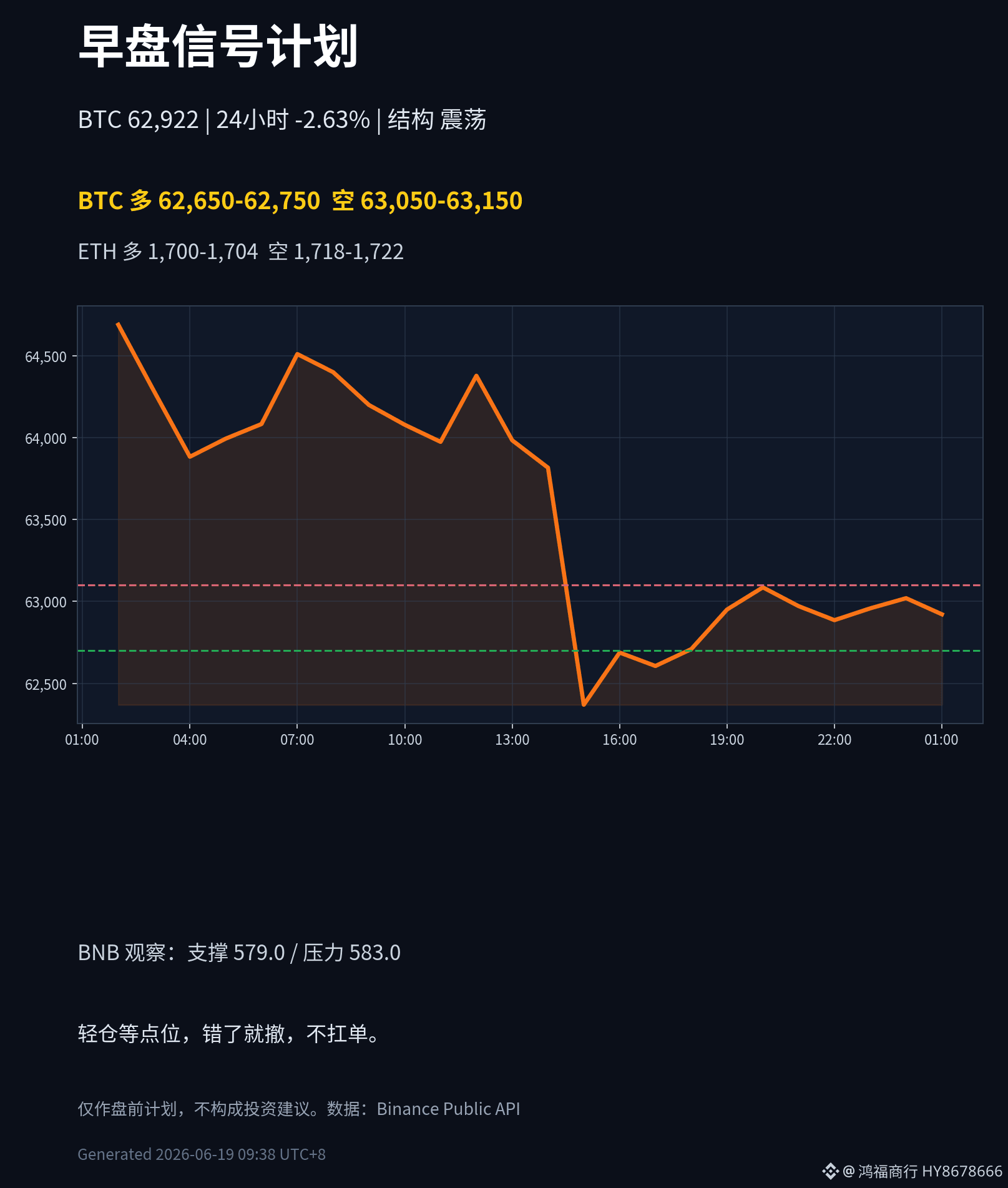
449
The event is lit, and our group mate hit the jackpot!
The event is lit, and our group mate hit the jackpot!

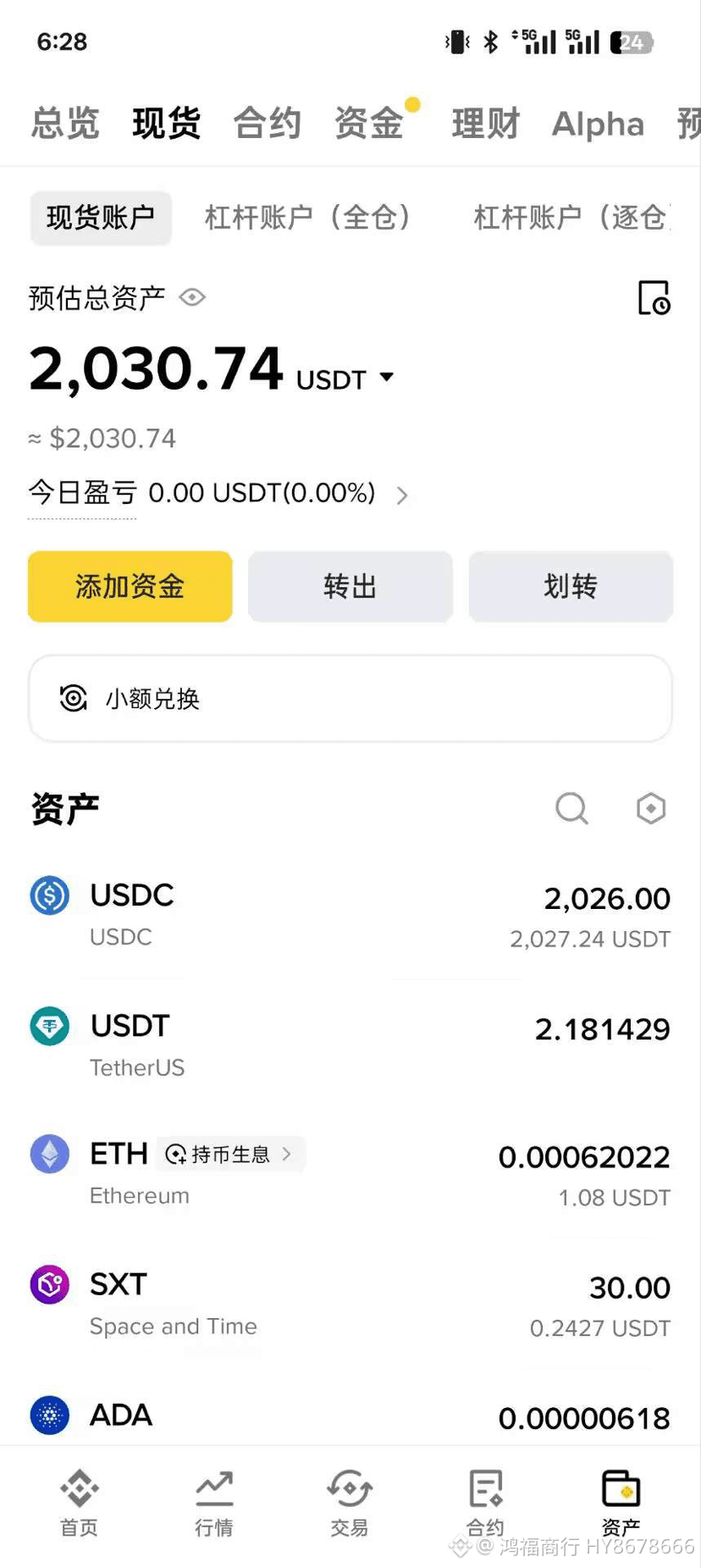

16
6
5.3k
Midday strategy, based on candlestick levels.
News: The overseas market continues to monitor interest rates and liquidity expectations; avoid heavy positions in the short term.
BTC: 64,361, showing weakness; for a bounce, look to short first, low longs only at key levels.
Short range: 64,550-64,650
Take profit: 64,250 / 64,050
Stop loss: 64,800
Long range: 64,000-64,100
Take profit: 64,450 / 64,600
Stop loss: 63,850
ETH:
Short 1,754-1,758, take profit 1,744 / 1,740, stop loss 1,762
Long 1,738-1,742, take profit 1,750 / 1,756, stop loss 1,734
BNB: Observe for resistance to downside.
Look down to 595.0, up to 599.0; do not heavily chase alone.
Avoid placing orders at whole numbers, go light, scale in, and pull back if wrong.
#BTC #ETH #BNB
This is a personal trading plan and does not constitute investment advice.
Midday strategy, based on candlestick levels.
News: The overseas market continues to monitor interest rates and liquidity expectations; avoid heavy positions in the short term.
BTC: 64,361, showing weakness; for a bounce, look to short first, low longs only at key levels.
Short range: 64,550-64,650
Take profit: 64,250 / 64,050
Stop loss: 64,800
Long range: 64,000-64,100
Take profit: 64,450 / 64,600
Stop loss: 63,850
ETH:
Short 1,754-1,758, take profit 1,744 / 1,740, stop loss 1,762
Long 1,738-1,742, take profit 1,750 / 1,756, stop loss 1,734
BNB: Observe for resistance to downside.
Look down to 595.0, up to 599.0; do not heavily chase alone.
Avoid placing orders at whole numbers, go light, scale in, and pull back if wrong.
#BTC #ETH #BNB
This is a personal trading plan and does not constitute investment advice.
News: The overseas market continues to monitor interest rates and liquidity expectations; avoid heavy positions in the short term.
BTC: 64,361, showing weakness; for a bounce, look to short first, low longs only at key levels.
Short range: 64,550-64,650
Take profit: 64,250 / 64,050
Stop loss: 64,800
Long range: 64,000-64,100
Take profit: 64,450 / 64,600
Stop loss: 63,850
ETH:
Short 1,754-1,758, take profit 1,744 / 1,740, stop loss 1,762
Long 1,738-1,742, take profit 1,750 / 1,756, stop loss 1,734
BNB: Observe for resistance to downside.
Look down to 595.0, up to 599.0; do not heavily chase alone.
Avoid placing orders at whole numbers, go light, scale in, and pull back if wrong.
#BTC #ETH #BNB
This is a personal trading plan and does not constitute investment advice.
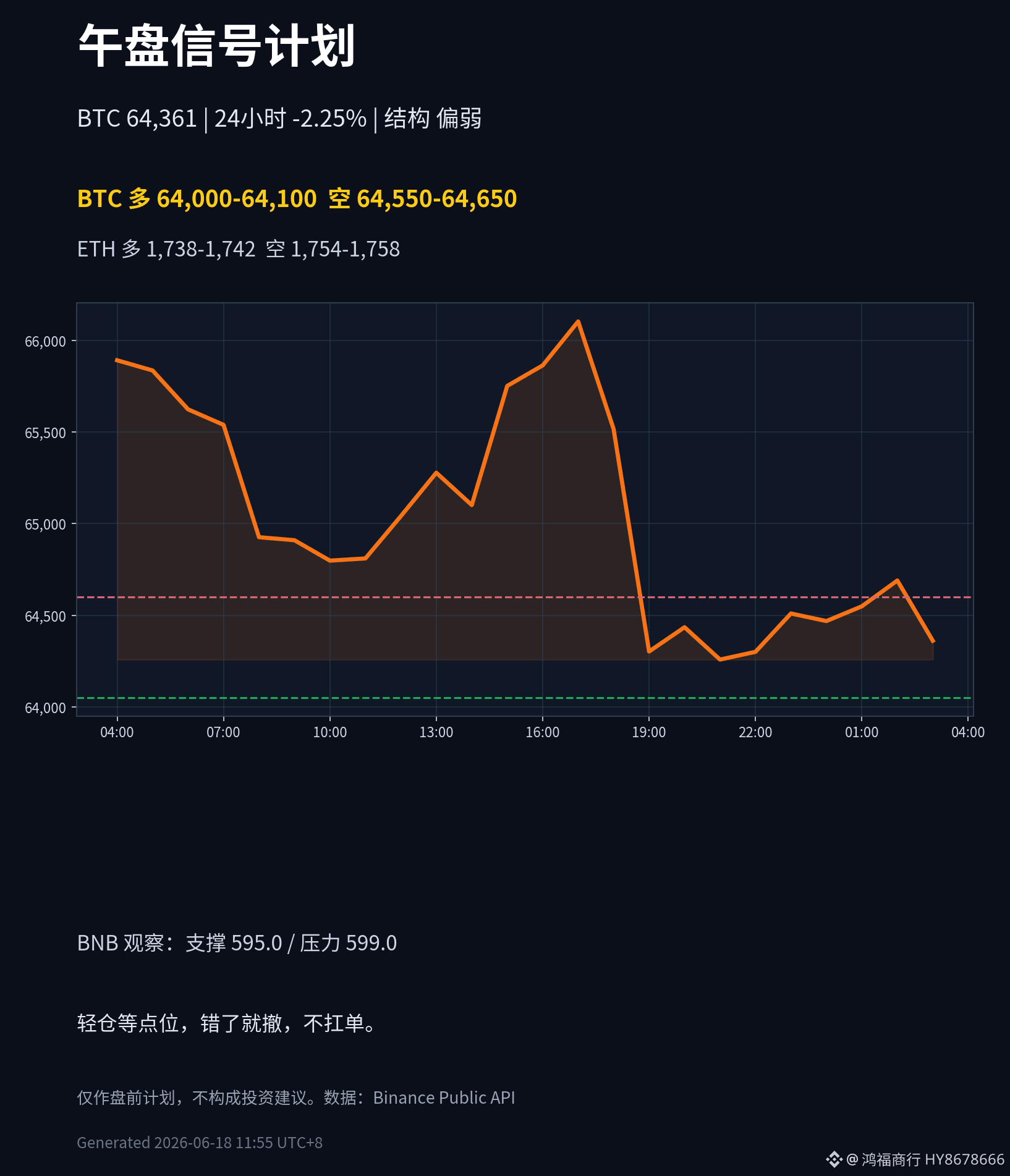
322
Log in to explore more content
Join global crypto users on Binance Square
⚡️ Get latest and useful information about crypto.
💬 Trusted by the world’s largest crypto exchange.
👍 Discover real insights from verified creators.
Email / Phone number
Trending Topics
ZcashETFPostsFirstWeeklyOutflow$93.6M
47,102 views
143 Discussing
#ZcashETFPostsFirstWeeklyOutflow$93.6M
Zcash ETF’s first weekly outflow of $93.6 million signals weakening investor demand and possible profit-booking. This could put short-term pressure on ZEC’s price and hurt sentiment across privacy-focused cryptocurrencies. Traders should watch support levels and further fund flows before taking positions.
Eram Trading Lab
·1 Likes
·215 views
GreekPoliceBustCryptoScamRingArrest17
123,786 views
893 Discussing
BitcoinRejectedAt$87K
143,201 views
199 Discussing