
胡杨杨
461 Posts

胡杨杨
Report
Block User
多交流,多思考。落子无悔
High-Frequency Trader
10.4 Months
294 Following
1.3K+ Followers
606 Liked
Posts
All
Quotes
Videos
Live
PINNED
·
--
Personal Rambling About Trading
First of all, personally, I’m really into trading.
My favorite part is the focus you get when you trade.
In previous years, when doing anything else, I never felt that adrenaline rush and that euphoric sense of being highly mentally concentrated.
From the three theoretical pieces by the trading master
I learned a lot.
I suggest you just bookmark this page and open it whenever you’re free.
Now, tokenized US stocks are, in essence, no different from the crypto world.
Besides, when we buy contracts, what we’re really doing is trading a token symbol.
TradFi is, at its core, just something that absorbs liquidity.
It’s not that grand—only the emotional swings are bigger.
The most basic thing, and the simplest thing:
Buy high and sell low?
No—
Sell high and buy low.
That runs through the entire trading process.
As for the so-called things that may branch out from it—
playing a game against some “big shot” whale traders,
playing a game against market policies,
taking profit and cutting losses...
All of those matter only to a small extent.
And that’s all tied to just one thing: your principal and your patience.
We need to learn to demystify those big shots.
When they show you positions worth hundreds of thousands,
what does that have to do with you?
What use is it for you?
What we need to learn is trading,
not being a clueless idiot who just keeps shouting “so awesome!”
There’s no such thing as always-profiting.
Only by finding opportunities amid endless cycles of profit and loss—
and an opportunity that’s big enough for you to make a lot.
For normal trading,
like mainstream coins or US stocks,
my positions are larger,
and I don’t trade back and forth frequently.
In the end, it’s only a few trades a month, and the principal doubles.
To restrain my own impulses,
I chose a release valve: altcoins.
With 10U in capital, I trade frequently.
Result: I’ve just been hovering around 10U as the principal.
Of course, this is just my personal habit.
I’m not asking everyone to do the same.
Everyone needs their own trading style, trading habits, and trading cognition.
If you don’t even have that,
then I suggest you go find a class to take.
Because if you earn by luck, you will definitely lose it all back through skill.
You must have patience.
Learn to tolerate being in cash with no position.
In trading, opportunities are never lacking.
What’s missing is when the moment comes—you need the decisiveness to act and the funds.
The most fascinating and also most坑 (pitfall-filled) thing about the crypto world:
perpetual futures contracts,
playing small to beat big,
the myths of 100x and 1000x,
the tragedy of getting liquidated,
and the misery of being back to broke overnight.
Since you’ve entered this circle,
and you’ve chosen to trade,
please take it seriously.
After all, how many times can you encounter something this fair?
26.8.9
Personal Rambling About Trading
First of all, personally, I’m really into trading.
My favorite part is the focus you get when you trade.
In previous years, when doing anything else, I never felt that adrenaline rush and that euphoric sense of being highly mentally concentrated.
From the three theoretical pieces by the trading master
I learned a lot.
I suggest you just bookmark this page and open it whenever you’re free.
Now, tokenized US stocks are, in essence, no different from the crypto world.
Besides, when we buy contracts, what we’re really doing is trading a token symbol.
TradFi is, at its core, just something that absorbs liquidity.
It’s not that grand—only the emotional swings are bigger.
The most basic thing, and the simplest thing:
Buy high and sell low?
No—
Sell high and buy low.
That runs through the entire trading process.
As for the so-called things that may branch out from it—
playing a game against some “big shot” whale traders,
playing a game against market policies,
taking profit and cutting losses...
All of those matter only to a small extent.
And that’s all tied to just one thing: your principal and your patience.
We need to learn to demystify those big shots.
When they show you positions worth hundreds of thousands,
what does that have to do with you?
What use is it for you?
What we need to learn is trading,
not being a clueless idiot who just keeps shouting “so awesome!”
There’s no such thing as always-profiting.
Only by finding opportunities amid endless cycles of profit and loss—
and an opportunity that’s big enough for you to make a lot.
For normal trading,
like mainstream coins or US stocks,
my positions are larger,
and I don’t trade back and forth frequently.
In the end, it’s only a few trades a month, and the principal doubles.
To restrain my own impulses,
I chose a release valve: altcoins.
With 10U in capital, I trade frequently.
Result: I’ve just been hovering around 10U as the principal.
Of course, this is just my personal habit.
I’m not asking everyone to do the same.
Everyone needs their own trading style, trading habits, and trading cognition.
If you don’t even have that,
then I suggest you go find a class to take.
Because if you earn by luck, you will definitely lose it all back through skill.
You must have patience.
Learn to tolerate being in cash with no position.
In trading, opportunities are never lacking.
What’s missing is when the moment comes—you need the decisiveness to act and the funds.
The most fascinating and also most坑 (pitfall-filled) thing about the crypto world:
perpetual futures contracts,
playing small to beat big,
the myths of 100x and 1000x,
the tragedy of getting liquidated,
and the misery of being back to broke overnight.
Since you’ve entered this circle,
and you’ve chosen to trade,
please take it seriously.
After all, how many times can you encounter something this fair?
26.8.9
First of all, personally, I’m really into trading.
My favorite part is the focus you get when you trade.
In previous years, when doing anything else, I never felt that adrenaline rush and that euphoric sense of being highly mentally concentrated.
From the three theoretical pieces by the trading master
I learned a lot.
I suggest you just bookmark this page and open it whenever you’re free.
Now, tokenized US stocks are, in essence, no different from the crypto world.
Besides, when we buy contracts, what we’re really doing is trading a token symbol.
TradFi is, at its core, just something that absorbs liquidity.
It’s not that grand—only the emotional swings are bigger.
The most basic thing, and the simplest thing:
Buy high and sell low?
No—
Sell high and buy low.
That runs through the entire trading process.
As for the so-called things that may branch out from it—
playing a game against some “big shot” whale traders,
playing a game against market policies,
taking profit and cutting losses...
All of those matter only to a small extent.
And that’s all tied to just one thing: your principal and your patience.
We need to learn to demystify those big shots.
When they show you positions worth hundreds of thousands,
what does that have to do with you?
What use is it for you?
What we need to learn is trading,
not being a clueless idiot who just keeps shouting “so awesome!”
There’s no such thing as always-profiting.
Only by finding opportunities amid endless cycles of profit and loss—
and an opportunity that’s big enough for you to make a lot.
For normal trading,
like mainstream coins or US stocks,
my positions are larger,
and I don’t trade back and forth frequently.
In the end, it’s only a few trades a month, and the principal doubles.
To restrain my own impulses,
I chose a release valve: altcoins.
With 10U in capital, I trade frequently.
Result: I’ve just been hovering around 10U as the principal.
Of course, this is just my personal habit.
I’m not asking everyone to do the same.
Everyone needs their own trading style, trading habits, and trading cognition.
If you don’t even have that,
then I suggest you go find a class to take.
Because if you earn by luck, you will definitely lose it all back through skill.
You must have patience.
Learn to tolerate being in cash with no position.
In trading, opportunities are never lacking.
What’s missing is when the moment comes—you need the decisiveness to act and the funds.
The most fascinating and also most坑 (pitfall-filled) thing about the crypto world:
perpetual futures contracts,
playing small to beat big,
the myths of 100x and 1000x,
the tragedy of getting liquidated,
and the misery of being back to broke overnight.
Since you’ve entered this circle,
and you’ve chosen to trade,
please take it seriously.
After all, how many times can you encounter something this fair?
26.8.9
1
1
12
4.2k
·
--
Alright, it's time for the wide-range consolidation period. $BTC $ETH
Alright, it's time for the wide-range consolidation period. $BTC $ETH
212
·
--
Can it still drop today? Give us a chance, please $BTC $ETH
Can it still drop today? Give us a chance, please $BTC $ETH
246
·
--
Good thing I wasn’t greedy; however, 7.92 and 7.88 are indeed the key levels $BTC
Good thing I wasn’t greedy; however, 7.92 and 7.88 are indeed the key levels $BTC
1
697
·
--
Seeing $ZEC suddenly reminded me that there’s still a $ZAMA ?
They’re both private matters. Zama got a lot of criticism back then, and I even criticized it too. The coins were all sold, and now you’ve climbed back up again???
Seeing $ZEC suddenly reminded me that there’s still a $ZAMA ?
They’re both private matters. Zama got a lot of criticism back then, and I even criticized it too. The coins were all sold, and now you’ve climbed back up again???
They’re both private matters. Zama got a lot of criticism back then, and I even criticized it too. The coins were all sold, and now you’ve climbed back up again???
2
2.8k
·
--
Partly True

Article
A weekend look at the relationship between the midterm elections and the stock marketFirst, a disclaimer: this is all based on past statistics and institutional retrospectives, not this year’s script, and certainly not investment advice.
The 2026 midterm election day is November 3.
What has truly stood out historically is not who wins Congress, but a timeline.
Volatility is relatively high before the election; once the result becomes clearer, pricing begins, and the highest win rate is in the 6–12 months after the election.
Four-stage path
Stage 1: 3–4 weeks before the vote
After polls converge, the market starts trading the roughly known outcome in advance. BlackRock statistics show that since 1970, the rally has typically started about 22 trading days before the election. So the real turning point is often in October, not on the morning of November 4. In midterm years, October averages about +3%, with a positive return probability of around 71%, making it one of the strongest months of the year.
A weekend look at the relationship between the midterm elections and the stock market
First, a disclaimer: this is all based on past statistics and institutional retrospectives, not this year’s script, and certainly not investment advice.
The 2026 midterm election day is November 3.
What has truly stood out historically is not who wins Congress, but a timeline.
Volatility is relatively high before the election; once the result becomes clearer, pricing begins, and the highest win rate is in the 6–12 months after the election.
Four-stage path
Stage 1: 3–4 weeks before the vote
After polls converge, the market starts trading the roughly known outcome in advance. BlackRock statistics show that since 1970, the rally has typically started about 22 trading days before the election. So the real turning point is often in October, not on the morning of November 4. In midterm years, October averages about +3%, with a positive return probability of around 71%, making it one of the strongest months of the year.
The 2026 midterm election day is November 3.
What has truly stood out historically is not who wins Congress, but a timeline.
Volatility is relatively high before the election; once the result becomes clearer, pricing begins, and the highest win rate is in the 6–12 months after the election.
Four-stage path
Stage 1: 3–4 weeks before the vote
After polls converge, the market starts trading the roughly known outcome in advance. BlackRock statistics show that since 1970, the rally has typically started about 22 trading days before the election. So the real turning point is often in October, not on the morning of November 4. In midterm years, October averages about +3%, with a positive return probability of around 71%, making it one of the strongest months of the year.
1
1.6k
·
--
Meme season? I f***ing don't know how to play meme啊$MARSCOIN
Meme season? I f***ing don't know how to play meme啊$MARSCOIN
380
·
--
Big Brother Bing, this pressure level is broken—can you go up for me? $BTC
{future}(BTCUSDT)
Big Brother Bing, this pressure level is broken—can you go up for me? $BTC
382
·
--
Verified
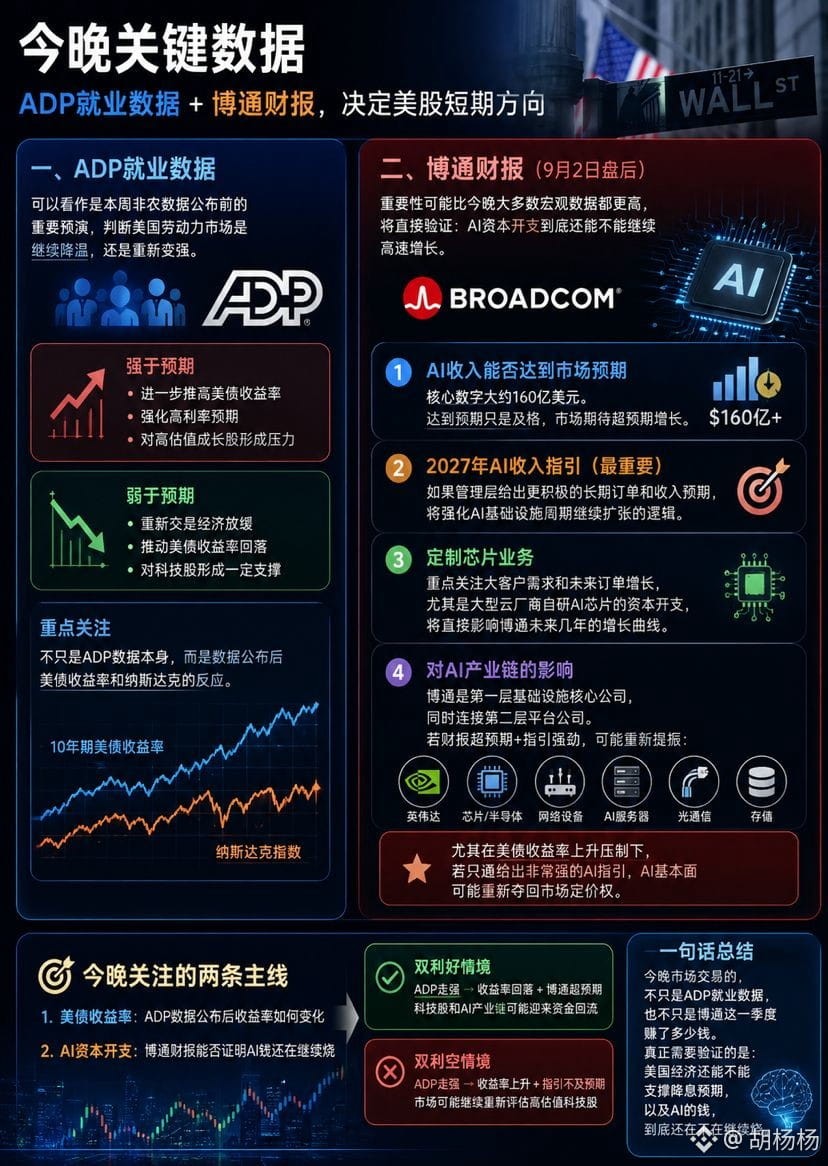
Tonight’s key data
Focus on two areas
Labor market
AI
1: ADP employment data
You can think of it as a rehearsal ahead of this week’s Non-Farm Payrolls.
It can help us see whether the U.S. labor market is continuing to cool down, or whether it’s regaining strength.
If employment is clearly stronger than expected, it may further push up yields, reinforce expectations of high interest rates, and put pressure on growth stocks.
If employment is clearly weaker, the market may shift again toward trading a slowdown in the economy, which could lower yields and provide some support for tech stocks.
2: Broadcom earnings report
Its importance may be higher than most of tonight’s macro data.
After the close on September 2, it will be released.
It will directly confirm whether AI capital expenditures can continue their rapid growth.
Key points to watch:
1) Whether AI revenue can meet market expectations; the core figure is around $16 billion.
2) The AI revenue guidance for 2027—this is very important. If management can provide more proactive long-term order and revenue expectations, it would directly reinforce the logic that the entire AI infrastructure cycle can continue expanding.
3) The custom chip business. One of Broadcom’s key highlights is custom AI chips. Pay close attention to the needs of several major customers, and whether future custom chip orders continue to grow. In particular, large cloud providers’ capital expenditures on in-house AI chips may directly affect Broadcom’s growth trajectory over the next few years.
4) The earnings report’s impact on the entire AI industry chain. Broadcom is a core company in the first layer of infrastructure, but it also connects to second-layer platform companies. If the report is clearly above expectations, it could revive sentiment across:
Nvidia, the chip and semiconductor sector, networking equipment, AI servers, optical communications, and the storage supply chain.
Especially now, when the market is being pressured by rising U.S. Treasury yields. If Broadcom provides very strong AI guidance, then AI fundamentals may regain control of market pricing power.
$AVGO
{future}(AVGOUSDT)
Tonight’s key data
Focus on two areas
Labor market
AI
1: ADP employment data
You can think of it as a rehearsal ahead of this week’s Non-Farm Payrolls.
It can help us see whether the U.S. labor market is continuing to cool down, or whether it’s regaining strength.
If employment is clearly stronger than expected, it may further push up yields, reinforce expectations of high interest rates, and put pressure on growth stocks.
If employment is clearly weaker, the market may shift again toward trading a slowdown in the economy, which could lower yields and provide some support for tech stocks.
2: Broadcom earnings report
Its importance may be higher than most of tonight’s macro data.
After the close on September 2, it will be released.
It will directly confirm whether AI capital expenditures can continue their rapid growth.
Key points to watch:
1) Whether AI revenue can meet market expectations; the core figure is around $16 billion.
2) The AI revenue guidance for 2027—this is very important. If management can provide more proactive long-term order and revenue expectations, it would directly reinforce the logic that the entire AI infrastructure cycle can continue expanding.
3) The custom chip business. One of Broadcom’s key highlights is custom AI chips. Pay close attention to the needs of several major customers, and whether future custom chip orders continue to grow. In particular, large cloud providers’ capital expenditures on in-house AI chips may directly affect Broadcom’s growth trajectory over the next few years.
4) The earnings report’s impact on the entire AI industry chain. Broadcom is a core company in the first layer of infrastructure, but it also connects to second-layer platform companies. If the report is clearly above expectations, it could revive sentiment across:
Nvidia, the chip and semiconductor sector, networking equipment, AI servers, optical communications, and the storage supply chain.
Especially now, when the market is being pressured by rising U.S. Treasury yields. If Broadcom provides very strong AI guidance, then AI fundamentals may regain control of market pricing power.
$AVGO
Focus on two areas
Labor market
AI
1: ADP employment data
You can think of it as a rehearsal ahead of this week’s Non-Farm Payrolls.
It can help us see whether the U.S. labor market is continuing to cool down, or whether it’s regaining strength.
If employment is clearly stronger than expected, it may further push up yields, reinforce expectations of high interest rates, and put pressure on growth stocks.
If employment is clearly weaker, the market may shift again toward trading a slowdown in the economy, which could lower yields and provide some support for tech stocks.
2: Broadcom earnings report
Its importance may be higher than most of tonight’s macro data.
After the close on September 2, it will be released.
It will directly confirm whether AI capital expenditures can continue their rapid growth.
Key points to watch:
1) Whether AI revenue can meet market expectations; the core figure is around $16 billion.
2) The AI revenue guidance for 2027—this is very important. If management can provide more proactive long-term order and revenue expectations, it would directly reinforce the logic that the entire AI infrastructure cycle can continue expanding.
3) The custom chip business. One of Broadcom’s key highlights is custom AI chips. Pay close attention to the needs of several major customers, and whether future custom chip orders continue to grow. In particular, large cloud providers’ capital expenditures on in-house AI chips may directly affect Broadcom’s growth trajectory over the next few years.
4) The earnings report’s impact on the entire AI industry chain. Broadcom is a core company in the first layer of infrastructure, but it also connects to second-layer platform companies. If the report is clearly above expectations, it could revive sentiment across:
Nvidia, the chip and semiconductor sector, networking equipment, AI servers, optical communications, and the storage supply chain.
Especially now, when the market is being pressured by rising U.S. Treasury yields. If Broadcom provides very strong AI guidance, then AI fundamentals may regain control of market pricing power.
$AVGO
968
·
--
Ready to open too much $ETH
{future}(ETHUSDT)
$BTC
{future}(BTCUSDT)
Ready to open too much $ETH
$BTC
$BTC
22
·
--
Woke up, had too much to drink. When I opened my eyes, I had it hanging there—like I forgot to set a take-profit. I took a quick look and it’s $ETH .
Woke up, had too much to drink. When I opened my eyes, I had it hanging there—like I forgot to set a take-profit. I took a quick look and it’s $ETH .
249
·
--
No big deal, brothers
Want to make a move at $ZEC ?
No big deal, brothers
Want to make a move at $ZEC ?
Want to make a move at $ZEC ?
335
·
--
Two $BTC short strategies. Look at it the opposite way and it’s going long.
1.
78,600–79,200 is the first short zone. If the pullback volume is weak and it can’t be reclaimed on the 15m/30m, you can try shorting in batches.
Stop loss: Above 79,600; for aggressive traders, 80,050.
Targets: 77,300 / 76,850 / 76,200; extreme case: 75,500.
2.
If after falling from 77,000–77,300 it fails to reclaim on the 15m or 1h, it indicates that the downside liquidity continues to be swept.
Entry: Do not enter if it breaks down and then retests 77,000–77,300 without holding.
Stop loss: Above 77,800.
Targets: 76,200 and 75,500.
{future}(BTCUSDT)
Two $BTC short strategies. Look at it the opposite way and it’s going long.
1.
78,600–79,200 is the first short zone. If the pullback volume is weak and it can’t be reclaimed on the 15m/30m, you can try shorting in batches.
Stop loss: Above 79,600; for aggressive traders, 80,050.
Targets: 77,300 / 76,850 / 76,200; extreme case: 75,500.
2.
If after falling from 77,000–77,300 it fails to reclaim on the 15m or 1h, it indicates that the downside liquidity continues to be swept.
Entry: Do not enter if it breaks down and then retests 77,000–77,300 without holding.
Stop loss: Above 77,800.
Targets: 76,200 and 75,500.
1.
78,600–79,200 is the first short zone. If the pullback volume is weak and it can’t be reclaimed on the 15m/30m, you can try shorting in batches.
Stop loss: Above 79,600; for aggressive traders, 80,050.
Targets: 77,300 / 76,850 / 76,200; extreme case: 75,500.
2.
If after falling from 77,000–77,300 it fails to reclaim on the 15m or 1h, it indicates that the downside liquidity continues to be swept.
Entry: Do not enter if it breaks down and then retests 77,000–77,300 without holding.
Stop loss: Above 77,800.
Targets: 76,200 and 75,500.
1.7k
·
--
Actually I hope today’s $BTC can drop a bit more—so I can enter at a better time, max 😂
Actually I hope today’s $BTC can drop a bit more—so I can enter at a better time, max 😂
127
·
--
Verified
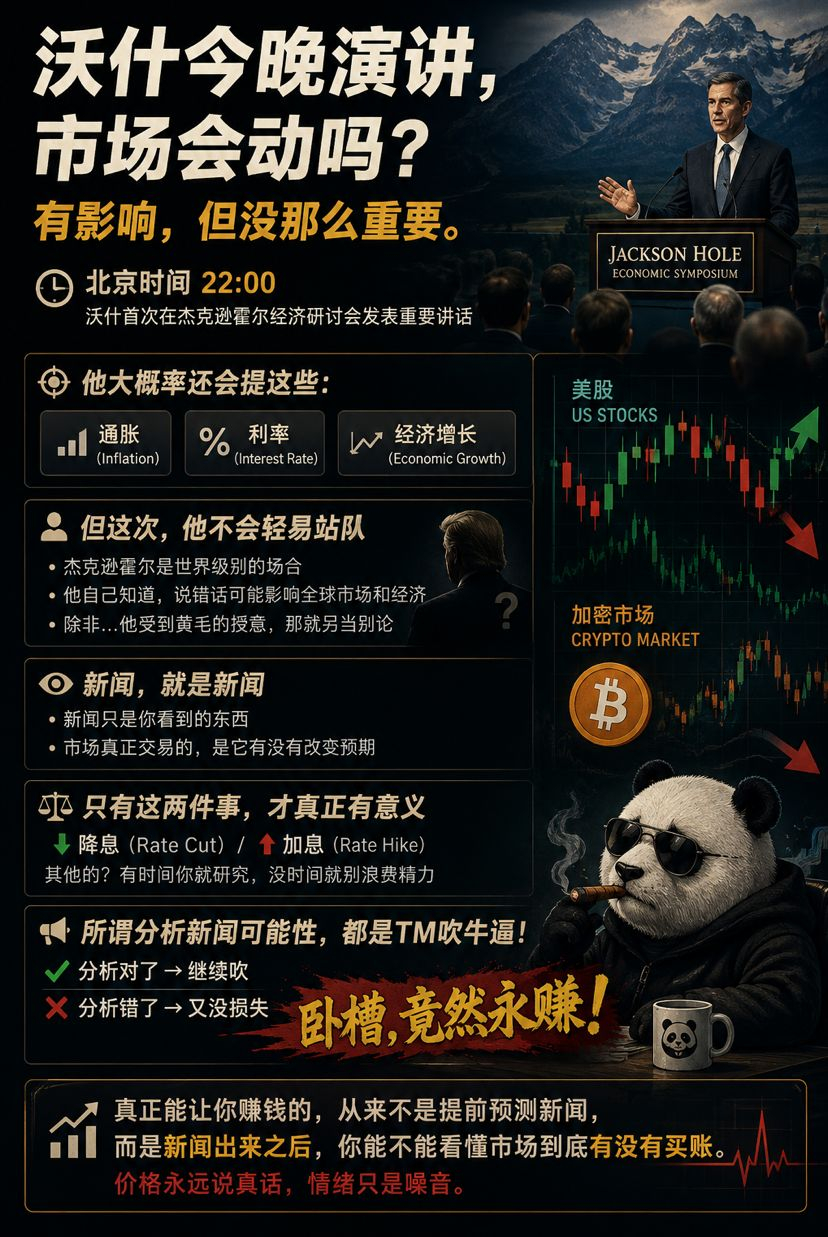
Holy crap, it actually makes money every time!
Tonight, Wosh will deliver his first important speech at the Jackson Hole Economic Symposium
Does it have any impact on the stock market or crypto?
Yes
But… it’s not that important, right?
Anyway, I’m not a news trader
Based on the previous summaries of Wosh’s multiple meetings with the Fed
For things like inflation, interest rates, and economic growth
he will most likely still mention them
But this is a world-class venue; by itself that means he won’t just say whatever
Personally, I think he will most likely be more neutral, not especially leaning to either side
Because he knows that if he says the wrong thing, it can have an adverse OR beneficial effect on the economy
Of course
If he was instructed by the “yellow-haired guy,” then it’s a different story
It’s precisely because of all these uncertainties
Including conspiracy theories (people with ulterior motives—don’t assume some people are as noble as you think)
So news is just news—it just shows you what you’re seeing
Back to the market itself: as long as it’s not something truly meaningful, like
rate cuts OR rate hikes
the rest—if you have the time, go research it
In the end
As for the so-called “analyzing news possibilities,” you all—TM—blow it way out of proportion
Keep blowing; if you’re right, fine. If you’re wrong, you don’t lose anything
And then, the “always profitable”—doesn’t it show up?
DYOR
$BTC $SNDK
{future}(SNDKUSDT)
{future}(BTCUSDT)
Holy crap, it actually makes money every time!
Tonight, Wosh will deliver his first important speech at the Jackson Hole Economic Symposium
Does it have any impact on the stock market or crypto?
Yes
But… it’s not that important, right?
Anyway, I’m not a news trader
Based on the previous summaries of Wosh’s multiple meetings with the Fed
For things like inflation, interest rates, and economic growth
he will most likely still mention them
But this is a world-class venue; by itself that means he won’t just say whatever
Personally, I think he will most likely be more neutral, not especially leaning to either side
Because he knows that if he says the wrong thing, it can have an adverse OR beneficial effect on the economy
Of course
If he was instructed by the “yellow-haired guy,” then it’s a different story
It’s precisely because of all these uncertainties
Including conspiracy theories (people with ulterior motives—don’t assume some people are as noble as you think)
So news is just news—it just shows you what you’re seeing
Back to the market itself: as long as it’s not something truly meaningful, like
rate cuts OR rate hikes
the rest—if you have the time, go research it
In the end
As for the so-called “analyzing news possibilities,” you all—TM—blow it way out of proportion
Keep blowing; if you’re right, fine. If you’re wrong, you don’t lose anything
And then, the “always profitable”—doesn’t it show up?
DYOR
$BTC $SNDK
Tonight, Wosh will deliver his first important speech at the Jackson Hole Economic Symposium
Does it have any impact on the stock market or crypto?
Yes
But… it’s not that important, right?
Anyway, I’m not a news trader
Based on the previous summaries of Wosh’s multiple meetings with the Fed
For things like inflation, interest rates, and economic growth
he will most likely still mention them
But this is a world-class venue; by itself that means he won’t just say whatever
Personally, I think he will most likely be more neutral, not especially leaning to either side
Because he knows that if he says the wrong thing, it can have an adverse OR beneficial effect on the economy
Of course
If he was instructed by the “yellow-haired guy,” then it’s a different story
It’s precisely because of all these uncertainties
Including conspiracy theories (people with ulterior motives—don’t assume some people are as noble as you think)
So news is just news—it just shows you what you’re seeing
Back to the market itself: as long as it’s not something truly meaningful, like
rate cuts OR rate hikes
the rest—if you have the time, go research it
In the end
As for the so-called “analyzing news possibilities,” you all—TM—blow it way out of proportion
Keep blowing; if you’re right, fine. If you’re wrong, you don’t lose anything
And then, the “always profitable”—doesn’t it show up?
DYOR
$BTC $SNDK
1
1.9k
Log in to explore more content
Join global crypto users on Binance Square
⚡️ Get latest and useful information about crypto.
💬 Trusted by the world’s largest crypto exchange.
👍 Discover real insights from verified creators.
Email / Phone number