

套利小王子
7 Posts

套利小王子
Report
Block User
顶级交易员不是在猜对方向,是在别人必须交割的地方收钱。
我只做一件事:找出"谁在被迫付钱",然后站在收钱那一侧
不做方向判断。收益来自三类结构性错配:跨所同资产价差、资金费率期限结构、机制崩溃后的清算残留......
确定性来自机制失败,不来自情绪
(非投资建议)
11 Following
55 Followers
2 Liked
Posts
·
--
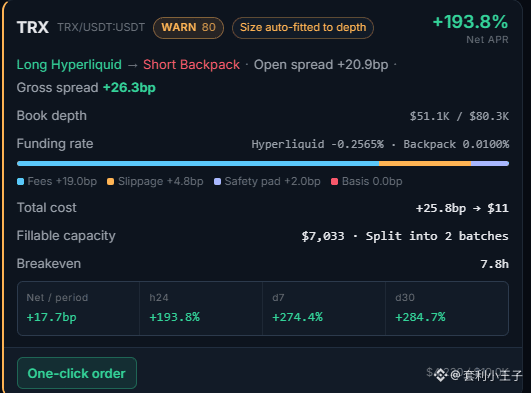
One coin, 14 exchanges, 13 paying the shorts.
TRX is down 6% in 24 hours, while BTC is down 3%. I pulled the perpetual funding rates across all 14 exchanges: OKX −248%, Lighter −205%, Binance −117%, Hyperliquid −295%… Only one is positive: +11%.
But that’s not the part worth paying attention to.
It’s the only asset I’ve seen today with “spot trading at a 78 bp discount on one exchange, while the entire perp market is uniformly bearish.”
A spot discount suggests someone is in a hurry to swap into USDT and get out; negative perp funding means nobody dares to go long. It’s the two things happening at once that tell the full story. See only one of them, and you’ll think it’s an arbitrage opportunity.
One coin, 14 exchanges, 13 paying the shorts.
TRX is down 6% in 24 hours, while BTC is down 3%. I pulled the perpetual funding rates across all 14 exchanges: OKX −248%, Lighter −205%, Binance −117%, Hyperliquid −295%… Only one is positive: +11%.
But that’s not the part worth paying attention to.
It’s the only asset I’ve seen today with “spot trading at a 78 bp discount on one exchange, while the entire perp market is uniformly bearish.”
A spot discount suggests someone is in a hurry to swap into USDT and get out; negative perp funding means nobody dares to go long. It’s the two things happening at once that tell the full story. See only one of them, and you’ll think it’s an arbitrage opportunity.
TRX is down 6% in 24 hours, while BTC is down 3%. I pulled the perpetual funding rates across all 14 exchanges: OKX −248%, Lighter −205%, Binance −117%, Hyperliquid −295%… Only one is positive: +11%.
But that’s not the part worth paying attention to.
It’s the only asset I’ve seen today with “spot trading at a 78 bp discount on one exchange, while the entire perp market is uniformly bearish.”
A spot discount suggests someone is in a hurry to swap into USDT and get out; negative perp funding means nobody dares to go long. It’s the two things happening at once that tell the full story. See only one of them, and you’ll think it’s an arbitrage opportunity.
1
900
·
--
See translation
今天全市场 7,105 个永续合约,只有 166 个卡在 0.0000125 这个费率上。
全部在两个所:一个 92 个合约里占 35 个,另一个 235 个里占 131 个。剩下 15 个所,一个都没有。
0.0000125 每小时,折年化 10.95%。
巧的是,这正好是它们的费率下限,即费率的下限值。
所以当某个标的的永续在贴水、做空的人挤成一团、费率按理该是负数的时候,它还是给你 0.0000125。
市场不会白送你钱,但交易所的规则会。
这种位置不适合重仓,容量小、对手方小。但它是真实的现金流,不是统计幻觉。
今天全市场 7,105 个永续合约,只有 166 个卡在 0.0000125 这个费率上。
全部在两个所:一个 92 个合约里占 35 个,另一个 235 个里占 131 个。剩下 15 个所,一个都没有。
0.0000125 每小时,折年化 10.95%。
巧的是,这正好是它们的费率下限,即费率的下限值。
所以当某个标的的永续在贴水、做空的人挤成一团、费率按理该是负数的时候,它还是给你 0.0000125。
市场不会白送你钱,但交易所的规则会。
这种位置不适合重仓,容量小、对手方小。但它是真实的现金流,不是统计幻觉。
全部在两个所:一个 92 个合约里占 35 个,另一个 235 个里占 131 个。剩下 15 个所,一个都没有。
0.0000125 每小时,折年化 10.95%。
巧的是,这正好是它们的费率下限,即费率的下限值。
所以当某个标的的永续在贴水、做空的人挤成一团、费率按理该是负数的时候,它还是给你 0.0000125。
市场不会白送你钱,但交易所的规则会。
这种位置不适合重仓,容量小、对手方小。但它是真实的现金流,不是统计幻觉。
27
·
--
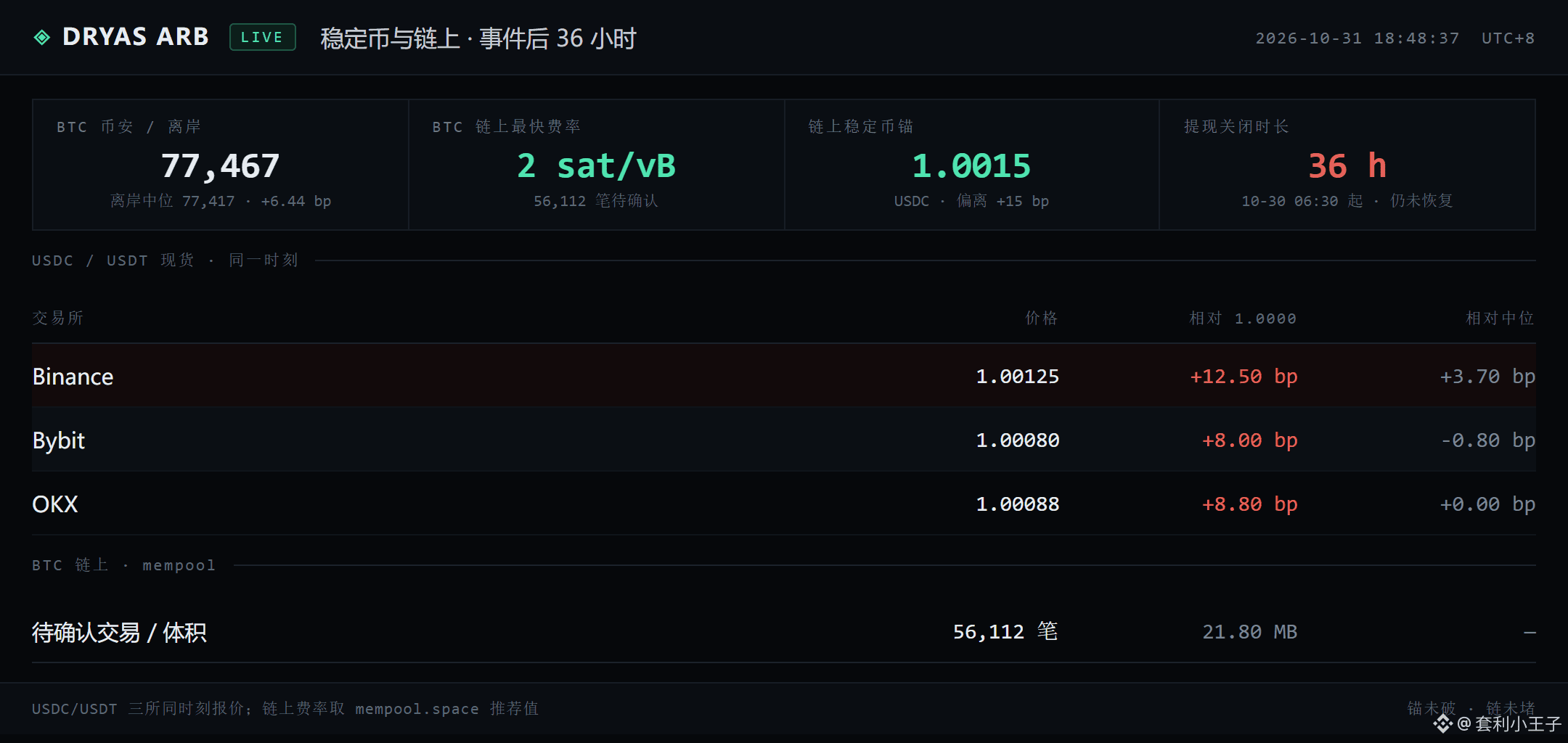
A $6.3 billion theft, with the fastest fee on the BTC chain at 2 sat/vB, 56,000 transactions awaiting confirmation, and a 21.8 MB backlog.
An unprecedented theft, yet not a hint of congestion on-chain—because the coins can’t be withdrawn and no one is dumping, so 18,270 BTC are just sitting there. What’s actually moving is stablecoins: USDC/USDT are trading at premiums of 8–12.5 bp across all three venues, with Binance the most expensive. Tether froze $1.567 billion and Circle froze $823 million; the cost of freezing is that trust is starting to become tiered. In the biggest hack ever, the market is pricing stablecoins first, then exchanges.
A $6.3 billion theft, with the fastest fee on the BTC chain at 2 sat/vB, 56,000 transactions awaiting confirmation, and a 21.8 MB backlog.
An unprecedented theft, yet not a hint of congestion on-chain—because the coins can’t be withdrawn and no one is dumping, so 18,270 BTC are just sitting there. What’s actually moving is stablecoins: USDC/USDT are trading at premiums of 8–12.5 bp across all three venues, with Binance the most expensive. Tether froze $1.567 billion and Circle froze $823 million; the cost of freezing is that trust is starting to become tiered. In the biggest hack ever, the market is pricing stablecoins first, then exchanges.
An unprecedented theft, yet not a hint of congestion on-chain—because the coins can’t be withdrawn and no one is dumping, so 18,270 BTC are just sitting there. What’s actually moving is stablecoins: USDC/USDT are trading at premiums of 8–12.5 bp across all three venues, with Binance the most expensive. Tether froze $1.567 billion and Circle froze $823 million; the cost of freezing is that trust is starting to become tiered. In the biggest hack ever, the market is pricing stablecoins first, then exchanges.
156
·
--
Partly True
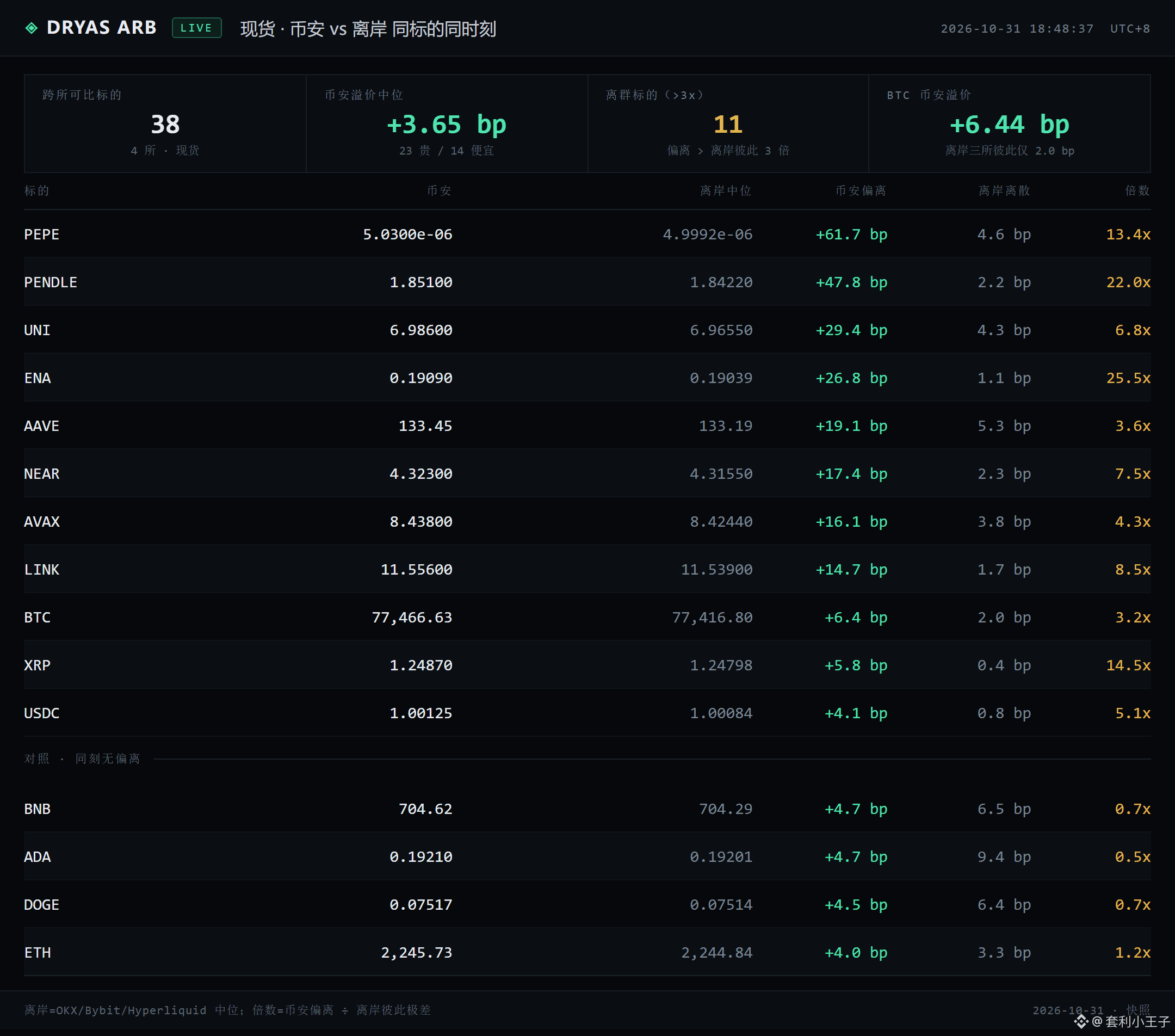
Binance was hacked, and many people used this as a reason to aggressively open short positions. Based on past cases where exchanges suspended withdrawals, assets on the exchange should trade at a discount—the coins can’t get out, so liquidity dries up.
The reality: 36 hours later, Binance’s offshore premium was +3.65bp, with 23 of 38 assets more expensive. But the premium was entirely in the long tail:
PEPE +61.7bp,
PENDLE +47.8,
ENA +26.8;
ETH +4.0,
BNB +4.7,
DOGE +4.5,
Those are no different from the usual price spreads versus offshore markets. This isn’t a trust premium; it’s a dammed-up lake. People who can’t withdraw can only switch positions on the exchange, bidding up long-tail assets.
Binance was hacked, and many people used this as a reason to aggressively open short positions. Based on past cases where exchanges suspended withdrawals, assets on the exchange should trade at a discount—the coins can’t get out, so liquidity dries up.
The reality: 36 hours later, Binance’s offshore premium was +3.65bp, with 23 of 38 assets more expensive. But the premium was entirely in the long tail:
PEPE +61.7bp,
PENDLE +47.8,
ENA +26.8;
ETH +4.0,
BNB +4.7,
DOGE +4.5,
Those are no different from the usual price spreads versus offshore markets. This isn’t a trust premium; it’s a dammed-up lake. People who can’t withdraw can only switch positions on the exchange, bidding up long-tail assets.
The reality: 36 hours later, Binance’s offshore premium was +3.65bp, with 23 of 38 assets more expensive. But the premium was entirely in the long tail:
PEPE +61.7bp,
PENDLE +47.8,
ENA +26.8;
ETH +4.0,
BNB +4.7,
DOGE +4.5,
Those are no different from the usual price spreads versus offshore markets. This isn’t a trust premium; it’s a dammed-up lake. People who can’t withdraw can only switch positions on the exchange, bidding up long-tail assets.
981
·
--
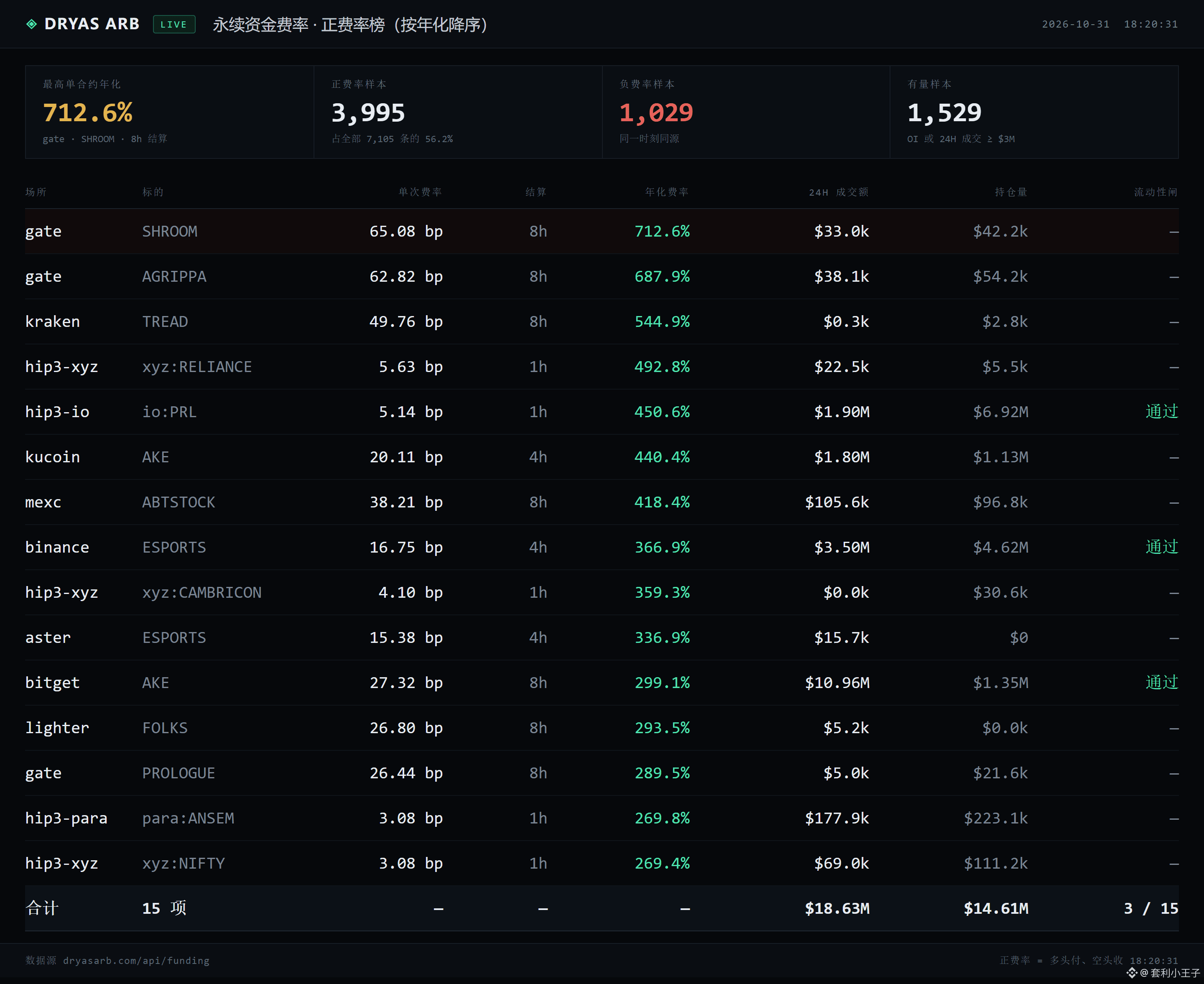
Today: 7,105 perpetual funding rates. 3,995 are positive (56.2%),
but only 1,529 have any volume (OI or trading volume ≥ $3 million).
Of the top 15 positive funding rates, only 3 pass the liquidity test:
· io:PRL (hip3-io) 450.6%, settles hourly
· ESPORTS (binance) 366.9%, settles every 4 hours
· AKE (bitget) 299.1%, settles every 8 hours
At the top is SHROOM on gate, at 712.6% annualized.
Its 24-hour trading volume is $33,000, with $42,000 in open interest.
That number isn’t an opportunity—it’s proof that nobody’s trading it.
If you go short, what you earn is that one settlement of 65 bp;
what you’re betting on is whether you can get out of a $30,000 pool.
At the same time, AKE is at 440.4% on kucoin and 299.1% on bitget.
A 141-point gap doesn’t mean the two sides see AKE differently; it means hardly anyone on either side is paying attention.
Not investment advice.
Today: 7,105 perpetual funding rates. 3,995 are positive (56.2%),
but only 1,529 have any volume (OI or trading volume ≥ $3 million).
Of the top 15 positive funding rates, only 3 pass the liquidity test:
· io:PRL (hip3-io) 450.6%, settles hourly
· ESPORTS (binance) 366.9%, settles every 4 hours
· AKE (bitget) 299.1%, settles every 8 hours
At the top is SHROOM on gate, at 712.6% annualized.
Its 24-hour trading volume is $33,000, with $42,000 in open interest.
That number isn’t an opportunity—it’s proof that nobody’s trading it.
If you go short, what you earn is that one settlement of 65 bp;
what you’re betting on is whether you can get out of a $30,000 pool.
At the same time, AKE is at 440.4% on kucoin and 299.1% on bitget.
A 141-point gap doesn’t mean the two sides see AKE differently; it means hardly anyone on either side is paying attention.
Not investment advice.
but only 1,529 have any volume (OI or trading volume ≥ $3 million).
Of the top 15 positive funding rates, only 3 pass the liquidity test:
· io:PRL (hip3-io) 450.6%, settles hourly
· ESPORTS (binance) 366.9%, settles every 4 hours
· AKE (bitget) 299.1%, settles every 8 hours
At the top is SHROOM on gate, at 712.6% annualized.
Its 24-hour trading volume is $33,000, with $42,000 in open interest.
That number isn’t an opportunity—it’s proof that nobody’s trading it.
If you go short, what you earn is that one settlement of 65 bp;
what you’re betting on is whether you can get out of a $30,000 pool.
At the same time, AKE is at 440.4% on kucoin and 299.1% on bitget.
A 141-point gap doesn’t mean the two sides see AKE differently; it means hardly anyone on either side is paying attention.
Not investment advice.
664
·
--
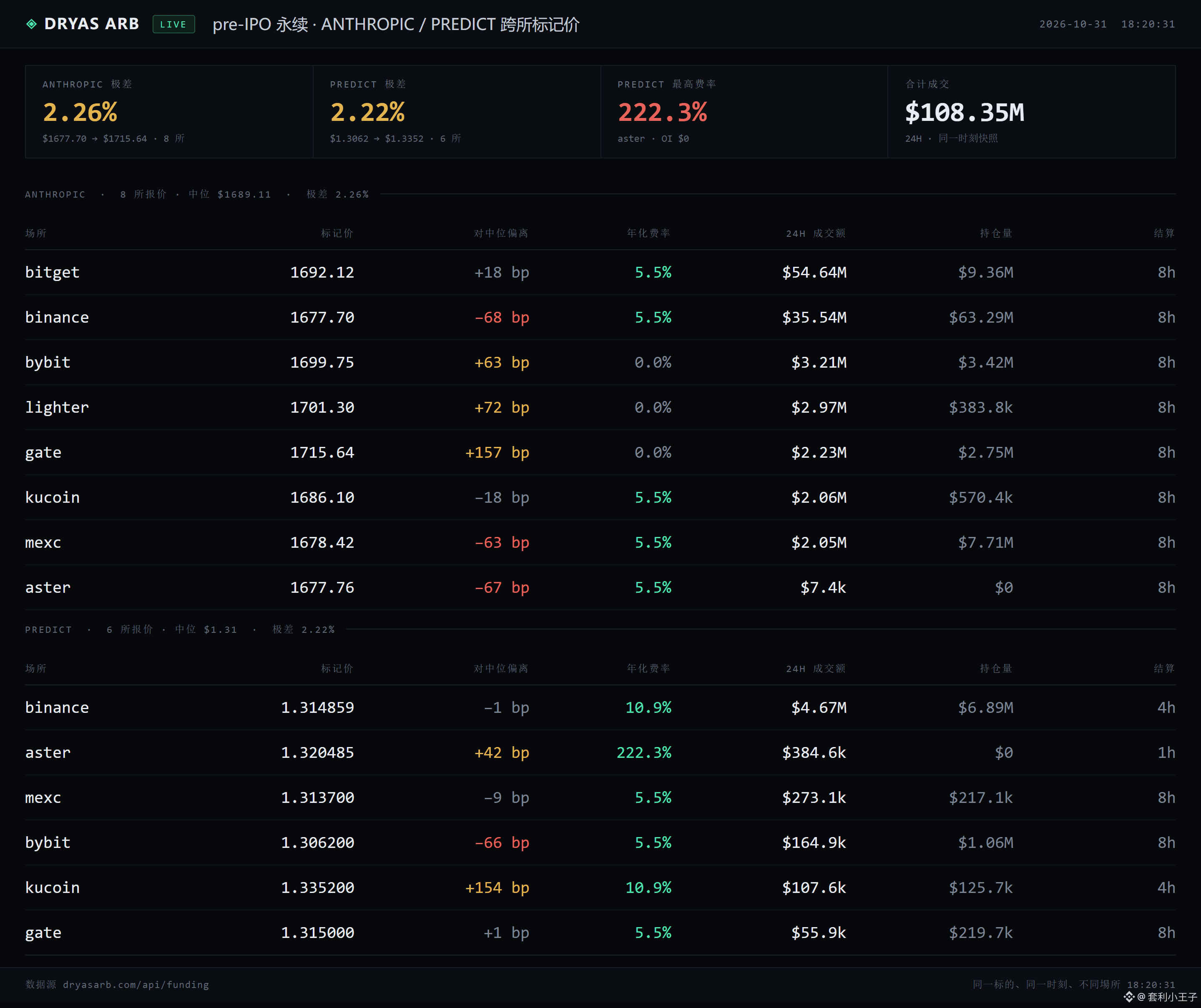
An unlisted company, quoted on 8 venues. ANTHROPIC, today:
gate 1,715.64
lighter 1,701.30
bybit 1,699.75
bitget 1,692.12
kucoin 1,686.10
mexc 1,678.42
aster 1,677.76
binance 1,677.70
The high-to-low spread is 2.26%, about $38. The highest trading volume was on bitget, at $54.64 million.
PREDICT is quoted on six venues, with a spread of 2.22%. The highest funding rate is on aster: 222.3% annualized,
with open interest at 0.
Private companies have no earnings reports, no secondary market, and no mandatory disclosures.
The fact that 8 venues price it with a 2.26% spread means people are pricing it,
and also that nobody really knows what it's worth.
By the way: that 222.3% doesn't mean "the market is extremely bullish"—it means nobody has any positions in that contract.
Not investment advice.
An unlisted company, quoted on 8 venues. ANTHROPIC, today:
gate 1,715.64
lighter 1,701.30
bybit 1,699.75
bitget 1,692.12
kucoin 1,686.10
mexc 1,678.42
aster 1,677.76
binance 1,677.70
The high-to-low spread is 2.26%, about $38. The highest trading volume was on bitget, at $54.64 million.
PREDICT is quoted on six venues, with a spread of 2.22%. The highest funding rate is on aster: 222.3% annualized,
with open interest at 0.
Private companies have no earnings reports, no secondary market, and no mandatory disclosures.
The fact that 8 venues price it with a 2.26% spread means people are pricing it,
and also that nobody really knows what it's worth.
By the way: that 222.3% doesn't mean "the market is extremely bullish"—it means nobody has any positions in that contract.
Not investment advice.
gate 1,715.64
lighter 1,701.30
bybit 1,699.75
bitget 1,692.12
kucoin 1,686.10
mexc 1,678.42
aster 1,677.76
binance 1,677.70
The high-to-low spread is 2.26%, about $38. The highest trading volume was on bitget, at $54.64 million.
PREDICT is quoted on six venues, with a spread of 2.22%. The highest funding rate is on aster: 222.3% annualized,
with open interest at 0.
Private companies have no earnings reports, no secondary market, and no mandatory disclosures.
The fact that 8 venues price it with a 2.26% spread means people are pricing it,
and also that nobody really knows what it's worth.
By the way: that 222.3% doesn't mean "the market is extremely bullish"—it means nobody has any positions in that contract.
Not investment advice.
1.5k
·
--
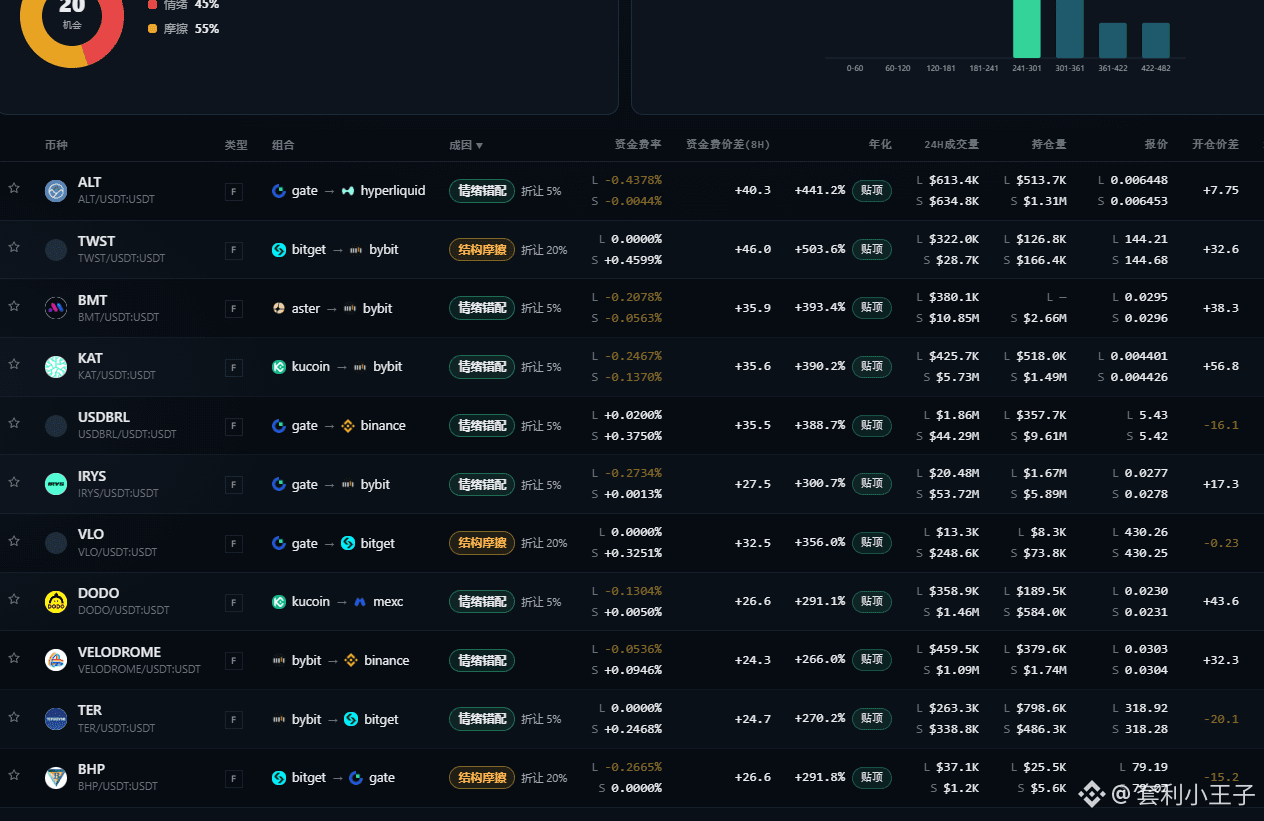
Many beginners see a monitoring chart like this and immediately think, “Holy crap, it’s a money printer.” But as a seasoned trader, all I see are “hidden hazards.” Today, I’ll use this chart to explain why:
You think you’re earning interest, but you’re getting wrecked by slippage: Those altcoins in the chart with 300%–500% annualized yields (KAT, IRYS) have extremely poor liquidity. The moment you place an order, slippage could wipe out half a month of returns.
What does “at the cap” mean? The many green “at the cap” labels on the chart mean the exchange’s funding rate has hit its maximum and can’t go any higher. If sentiment reverses and the rate turns negative, you’ll not only have to pay an extremely high funding fee, but also face the risk of the prices on both sides depegging.
A few days ago with IRYS, even traders running delta-neutral arbitrage were drawn in by the high 8-hour funding rate—and ended up instantly holding an unhedged short.
A word of advice for beginners: Start small and work through the entire process—deposits and withdrawals, transfers between accounts, and opening and closing hedged positions. Don’t focus only on the “theoretical annualized yield.”
Many beginners see a monitoring chart like this and immediately think, “Holy crap, it’s a money printer.” But as a seasoned trader, all I see are “hidden hazards.” Today, I’ll use this chart to explain why:
You think you’re earning interest, but you’re getting wrecked by slippage: Those altcoins in the chart with 300%–500% annualized yields (KAT, IRYS) have extremely poor liquidity. The moment you place an order, slippage could wipe out half a month of returns.
What does “at the cap” mean? The many green “at the cap” labels on the chart mean the exchange’s funding rate has hit its maximum and can’t go any higher. If sentiment reverses and the rate turns negative, you’ll not only have to pay an extremely high funding fee, but also face the risk of the prices on both sides depegging.
A few days ago with IRYS, even traders running delta-neutral arbitrage were drawn in by the high 8-hour funding rate—and ended up instantly holding an unhedged short.
A word of advice for beginners: Start small and work through the entire process—deposits and withdrawals, transfers between accounts, and opening and closing hedged positions. Don’t focus only on the “theoretical annualized yield.”
You think you’re earning interest, but you’re getting wrecked by slippage: Those altcoins in the chart with 300%–500% annualized yields (KAT, IRYS) have extremely poor liquidity. The moment you place an order, slippage could wipe out half a month of returns.
What does “at the cap” mean? The many green “at the cap” labels on the chart mean the exchange’s funding rate has hit its maximum and can’t go any higher. If sentiment reverses and the rate turns negative, you’ll not only have to pay an extremely high funding fee, but also face the risk of the prices on both sides depegging.
A few days ago with IRYS, even traders running delta-neutral arbitrage were drawn in by the high 8-hour funding rate—and ended up instantly holding an unhedged short.
A word of advice for beginners: Start small and work through the entire process—deposits and withdrawals, transfers between accounts, and opening and closing hedged positions. Don’t focus only on the “theoretical annualized yield.”
1
1.8k
Log in to explore more content
Join global crypto users on Binance Square
⚡️ Get latest and useful information about crypto.
💬 Trusted by the world’s largest crypto exchange.
👍 Discover real insights from verified creators.
Email / Phone number
Trending Topics
BinanceSAFUFundTransferCompleted7499BTC
5,248 views
254 Discussing
BREAKING: Binance Recovers 90% of $6.3B - My Take
Guys, biggest recovery in crypto history just happened.
Binance just confirmed in its 3rd security update on Oct 31:
90% of the stolen assets have been replenished - up from 80% yesterday.
What happened?
Total breach: ∼$6.3B on Oct 29 (hot wallets)Binance set aside $6.34B from company funds to cover itSources used: Corporate Treasury + SAFU Fund ($1B fund) + Futures Insurance FundResult: 10 major tokens now 100% backed: $BTC, $ETH, $USDT, $BNB, $SOL, $USDC, $XRP, $USD1, $RLUSD, $ZECRemaining 10% are less liquid tokens, will take more time to sourceWithdrawals expected to resume Nov 1
My analysis: This is why Binance is still #1. No other exchange could cover $6.3B from its own pocket in 2 days. This shows SAFU actually works.
Is this enough to bring back trust? Or you are still worried?
Drop your opinion below - I will read all comments.
Binance #SAFU #CryptoRecovery #BinanceSecurity #BTC#binancesafufundtransfercompleted7499btc
True News
·14 Likes
·6.3k views
BinanceRecovery90% of stolen assets
41,618 views
94 Discussing
YiHe:ProofOfReserves:10TokensAt100%Backing
76,490 views
422 Discussing