
MR L E O
2.8k Posts

MR L E O
Report
Block User
MR L E O CRYPTO KING 👑
Open Trade
Frequent Trader
1.1 Years
87 Following
10.4K+ Followers
3.1K+ Liked
Posts
Portfolio
All
Quotes
Live
·
--
Article
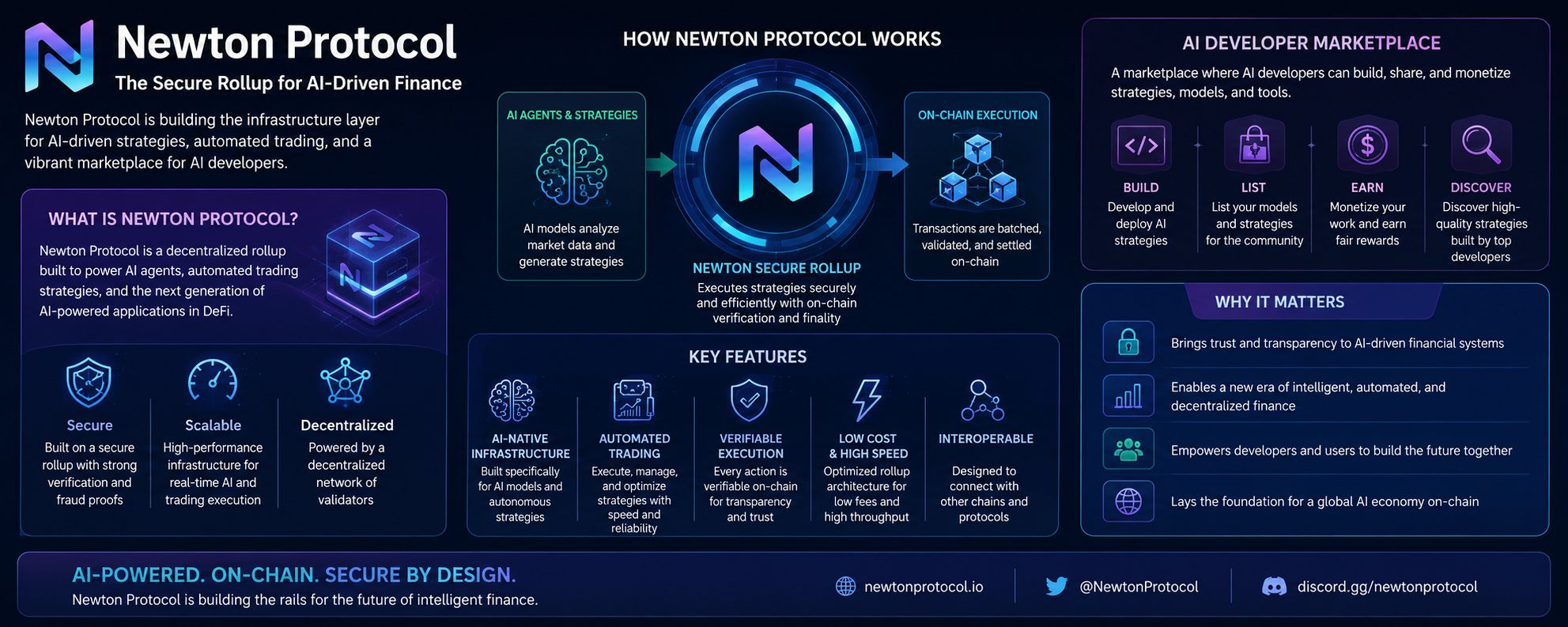
What Makes Newton Protocol Different From Other AI Crypto ProjectsNewton Protocol is one of those projects I didn’t pay much attention to at first, but the more I looked into it, the more it started to make sense. I’ve been following the way AI is slowly moving into crypto infrastructure, and Newton Protocol caught my interest because it is not only talking about AI tools. It is trying to build a secure rollup where AI-driven strategies, automated trading systems, and developer-built applications can actually operate.
What made me stop and think was the problem Newton Protocol is trying to solve. AI can process data quickly and make decisions much faster than a person, but speed is not the same as trust. When an AI system is managing a strategy or interacting with financial applications, users need to know how those actions are being carried out. They should not have to rely completely on a black-box model and hope everything works as expected.
That is where Newton Protocol becomes interesting to me. Its focus on secure and verifiable execution feels more practical than simply adding AI features to a blockchain product. The project seems to understand that if autonomous systems are going to manage real assets or perform complex transactions, the infrastructure behind them needs to be reliable.
I also like the idea of building a marketplace for AI developers. A project like this cannot grow through one team alone. It needs developers who are willing to create strategies, tools, and applications that people actually find useful. A healthy marketplace could give those builders a place to share their work while allowing users to discover different AI-powered solutions in one ecosystem.
At the same time, this is probably one of the hardest parts of the project. A marketplace only becomes valuable when both sides are active. Developers need enough incentives to keep building, and users need strong reasons to try what is being created. Without that balance, even good technology can struggle to gain traction.
I’m also curious about how Newton Protocol will handle the risks that come with automated trading. Markets are unpredictable, and AI models are not perfect. A strategy may work well under normal conditions and fail when volatility rises or market behaviour suddenly changes. Secure infrastructure can reduce some risks, but it cannot remove bad assumptions, weak data, or poor strategy design.
That does not make the idea less valuable. It simply means expectations should remain realistic. Newton Protocol can provide the rails, but the quality of what runs on those rails will still matter. Users will need transparency, proper risk controls, and a clear understanding of what each AI strategy is designed to do.
Another reason I’m watching the project is that it sits at a useful point between AI development and blockchain execution. Many AI projects focus heavily on intelligence, while many blockchain projects focus mainly on decentralization. Newton Protocol is trying to connect those two areas by giving AI systems a more secure environment for on-chain activity.
I think that direction could matter if AI agents become more active in decentralized finance. As these systems start making decisions, moving assets, and interacting with protocols, verification will become increasingly important. People may be comfortable letting AI assist them, but trusting it with full financial control is a much bigger step.
For me, Newton Protocol is still a project that needs to prove itself through usage. The concept is interesting, and the focus on secure AI execution gives it a clear identity, but the real test will come from developers, users, and live applications. Strong adoption, reliable performance, and meaningful activity will matter far more than early attention.
I’m not looking at Newton Protocol as a guaranteed success. I see it as an attempt to solve a real problem that could become more important over time. The project has chosen a difficult area, but also one with genuine potential. Whether it succeeds will depend on execution, developer participation, user trust, and how well the protocol performs when real money and real strategies are involved.
@NewtonProtocol #newt $NEWT
{spot}(NEWTUSDT)
What Makes Newton Protocol Different From Other AI Crypto Projects
Newton Protocol is one of those projects I didn’t pay much attention to at first, but the more I looked into it, the more it started to make sense. I’ve been following the way AI is slowly moving into crypto infrastructure, and Newton Protocol caught my interest because it is not only talking about AI tools. It is trying to build a secure rollup where AI-driven strategies, automated trading systems, and developer-built applications can actually operate.
What made me stop and think was the problem Newton Protocol is trying to solve. AI can process data quickly and make decisions much faster than a person, but speed is not the same as trust. When an AI system is managing a strategy or interacting with financial applications, users need to know how those actions are being carried out. They should not have to rely completely on a black-box model and hope everything works as expected.
That is where Newton Protocol becomes interesting to me. Its focus on secure and verifiable execution feels more practical than simply adding AI features to a blockchain product. The project seems to understand that if autonomous systems are going to manage real assets or perform complex transactions, the infrastructure behind them needs to be reliable.
I also like the idea of building a marketplace for AI developers. A project like this cannot grow through one team alone. It needs developers who are willing to create strategies, tools, and applications that people actually find useful. A healthy marketplace could give those builders a place to share their work while allowing users to discover different AI-powered solutions in one ecosystem.
At the same time, this is probably one of the hardest parts of the project. A marketplace only becomes valuable when both sides are active. Developers need enough incentives to keep building, and users need strong reasons to try what is being created. Without that balance, even good technology can struggle to gain traction.
I’m also curious about how Newton Protocol will handle the risks that come with automated trading. Markets are unpredictable, and AI models are not perfect. A strategy may work well under normal conditions and fail when volatility rises or market behaviour suddenly changes. Secure infrastructure can reduce some risks, but it cannot remove bad assumptions, weak data, or poor strategy design.
That does not make the idea less valuable. It simply means expectations should remain realistic. Newton Protocol can provide the rails, but the quality of what runs on those rails will still matter. Users will need transparency, proper risk controls, and a clear understanding of what each AI strategy is designed to do.
Another reason I’m watching the project is that it sits at a useful point between AI development and blockchain execution. Many AI projects focus heavily on intelligence, while many blockchain projects focus mainly on decentralization. Newton Protocol is trying to connect those two areas by giving AI systems a more secure environment for on-chain activity.
I think that direction could matter if AI agents become more active in decentralized finance. As these systems start making decisions, moving assets, and interacting with protocols, verification will become increasingly important. People may be comfortable letting AI assist them, but trusting it with full financial control is a much bigger step.
For me, Newton Protocol is still a project that needs to prove itself through usage. The concept is interesting, and the focus on secure AI execution gives it a clear identity, but the real test will come from developers, users, and live applications. Strong adoption, reliable performance, and meaningful activity will matter far more than early attention.
I’m not looking at Newton Protocol as a guaranteed success. I see it as an attempt to solve a real problem that could become more important over time. The project has chosen a difficult area, but also one with genuine potential. Whether it succeeds will depend on execution, developer participation, user trust, and how well the protocol performs when real money and real strategies are involved.
@NewtonProtocol #newt $NEWT
What made me stop and think was the problem Newton Protocol is trying to solve. AI can process data quickly and make decisions much faster than a person, but speed is not the same as trust. When an AI system is managing a strategy or interacting with financial applications, users need to know how those actions are being carried out. They should not have to rely completely on a black-box model and hope everything works as expected.
That is where Newton Protocol becomes interesting to me. Its focus on secure and verifiable execution feels more practical than simply adding AI features to a blockchain product. The project seems to understand that if autonomous systems are going to manage real assets or perform complex transactions, the infrastructure behind them needs to be reliable.
I also like the idea of building a marketplace for AI developers. A project like this cannot grow through one team alone. It needs developers who are willing to create strategies, tools, and applications that people actually find useful. A healthy marketplace could give those builders a place to share their work while allowing users to discover different AI-powered solutions in one ecosystem.
At the same time, this is probably one of the hardest parts of the project. A marketplace only becomes valuable when both sides are active. Developers need enough incentives to keep building, and users need strong reasons to try what is being created. Without that balance, even good technology can struggle to gain traction.
I’m also curious about how Newton Protocol will handle the risks that come with automated trading. Markets are unpredictable, and AI models are not perfect. A strategy may work well under normal conditions and fail when volatility rises or market behaviour suddenly changes. Secure infrastructure can reduce some risks, but it cannot remove bad assumptions, weak data, or poor strategy design.
That does not make the idea less valuable. It simply means expectations should remain realistic. Newton Protocol can provide the rails, but the quality of what runs on those rails will still matter. Users will need transparency, proper risk controls, and a clear understanding of what each AI strategy is designed to do.
Another reason I’m watching the project is that it sits at a useful point between AI development and blockchain execution. Many AI projects focus heavily on intelligence, while many blockchain projects focus mainly on decentralization. Newton Protocol is trying to connect those two areas by giving AI systems a more secure environment for on-chain activity.
I think that direction could matter if AI agents become more active in decentralized finance. As these systems start making decisions, moving assets, and interacting with protocols, verification will become increasingly important. People may be comfortable letting AI assist them, but trusting it with full financial control is a much bigger step.
For me, Newton Protocol is still a project that needs to prove itself through usage. The concept is interesting, and the focus on secure AI execution gives it a clear identity, but the real test will come from developers, users, and live applications. Strong adoption, reliable performance, and meaningful activity will matter far more than early attention.
I’m not looking at Newton Protocol as a guaranteed success. I see it as an attempt to solve a real problem that could become more important over time. The project has chosen a difficult area, but also one with genuine potential. Whether it succeeds will depend on execution, developer participation, user trust, and how well the protocol performs when real money and real strategies are involved.
@NewtonProtocol #newt $NEWT
14
11
150
·
--
$HEI is approaching a critical decision zone. Watching for a confirmed breakout above resistance with strong volume for a long setup. If momentum fades at resistance, patience is key until confirmation. Tight risk management, defined stop-loss below support, and profit targets at the next resistance levels. Stay disciplined—the best trades come from waiting for confirmation, not chasing candles.
{spot}(HEIUSDT)
#BinanceTurns9
#JuneCPIFedHike20%
#US2YearYieldFalls14bpsBiggestDropSinceFebruary
#SilverDown52%FromJanuaryRecordHigh
#KospiStagesVShapedIntradayRebound
$HEI is approaching a critical decision zone. Watching for a confirmed breakout above resistance with strong volume for a long setup. If momentum fades at resistance, patience is key until confirmation. Tight risk management, defined stop-loss below support, and profit targets at the next resistance levels. Stay disciplined—the best trades come from waiting for confirmation, not chasing candles.
#BinanceTurns9
#JuneCPIFedHike20%
#US2YearYieldFalls14bpsBiggestDropSinceFebruary
#SilverDown52%FromJanuaryRecordHigh
#KospiStagesVShapedIntradayRebound
#BinanceTurns9
#JuneCPIFedHike20%
#US2YearYieldFalls14bpsBiggestDropSinceFebruary
#SilverDown52%FromJanuaryRecordHigh
#KospiStagesVShapedIntradayRebound
89
·
--
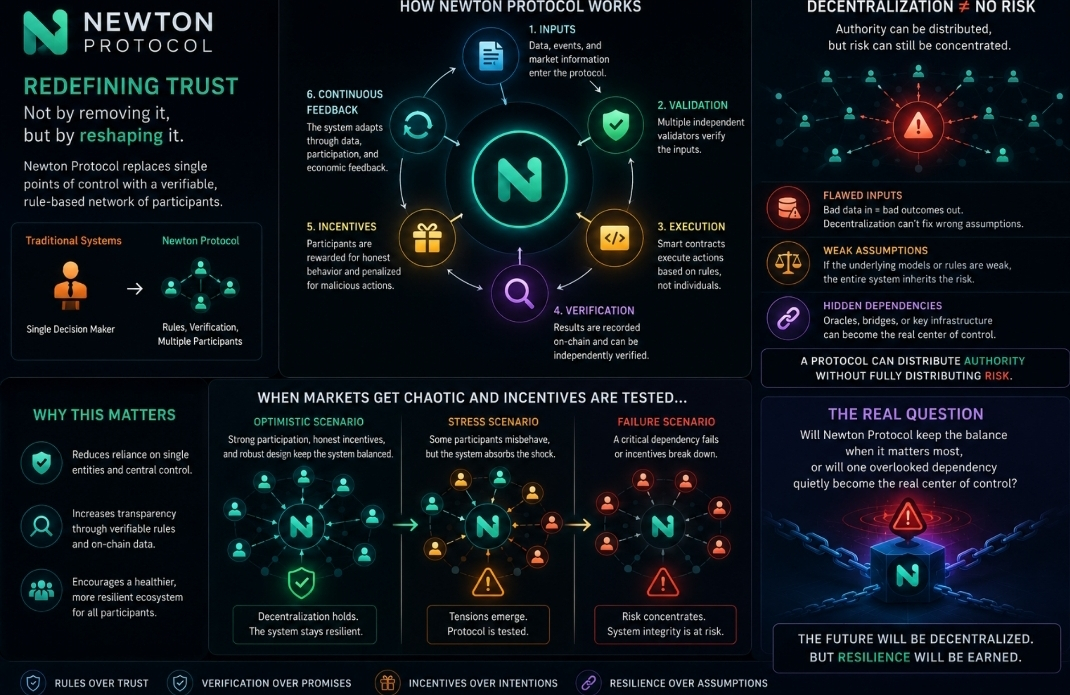
I've been researching @NewtonProtocol , and what keeps pulling my attention isn't whether it removes trust but how it tries to reshape it. Replacing a single decision-maker with rules, verification, and multiple participants feels like a healthier direction, yet it doesn't eliminate the possibility of failure. If the inputs are flawed or the assumptions behind the system are weak, decentralization alone can't guarantee the right outcome. That's the part I find most interesting. A protocol can distribute authority without fully distributing risk. When markets get chaotic and incentives are tested, will Newton Protocol keep that balance, or will one overlooked dependency quietly become the real center of control?
@NewtonProtocol #newt $NEWT
{spot}(NEWTUSDT)
I've been researching @NewtonProtocol , and what keeps pulling my attention isn't whether it removes trust but how it tries to reshape it. Replacing a single decision-maker with rules, verification, and multiple participants feels like a healthier direction, yet it doesn't eliminate the possibility of failure. If the inputs are flawed or the assumptions behind the system are weak, decentralization alone can't guarantee the right outcome. That's the part I find most interesting. A protocol can distribute authority without fully distributing risk. When markets get chaotic and incentives are tested, will Newton Protocol keep that balance, or will one overlooked dependency quietly become the real center of control?
@NewtonProtocol #newt $NEWT
@NewtonProtocol #newt $NEWT
23
12
695
·
--
$GRT looks like it's building pressure beneath resistance. I'm watching for a clean breakout above the local range before entering.
Trade setup:
Entry: On confirmed breakout
Target 1: +8%
Target 2: +15%
Stop-loss: Below the recent swing low
{spot}(GRTUSDT)
#BinanceTurns9
#TechSharesDragWallStreetLower
#TrumpReblocksStraitOfHormuz
#KoreaLeveragedChipETFFalls45%
#IranShips57MBarrelsBetweenUSBlockades
$GRT looks like it's building pressure beneath resistance. I'm watching for a clean breakout above the local range before entering.
Trade setup:
Entry: On confirmed breakout
Target 1: +8%
Target 2: +15%
Stop-loss: Below the recent swing low
#BinanceTurns9
#TechSharesDragWallStreetLower
#TrumpReblocksStraitOfHormuz
#KoreaLeveragedChipETFFalls45%
#IranShips57MBarrelsBetweenUSBlockades
Trade setup:
Entry: On confirmed breakout
Target 1: +8%
Target 2: +15%
Stop-loss: Below the recent swing low
#BinanceTurns9
#TechSharesDragWallStreetLower
#TrumpReblocksStraitOfHormuz
#KoreaLeveragedChipETFFalls45%
#IranShips57MBarrelsBetweenUSBlockades
133
·
--
🚨 $BILL Trade Setup
🟢 Entry: Above key breakout level / on a confirmed retest
🎯 Targets: T1 +5% | T2 +10% | T3 +15%
🛑 Stop Loss: Below the most recent swing low
Momentum is building, and a confirmed breakout could fuel the next leg higher. Stay patient for confirmation, manage your risk, and let the setup play out.
Not financial advice.
{future}(BILLUSDT)
#BinanceTurns9
#MarketsPriceInOneFedHikeBeforeSeptember
#JuneCPIWarshTestimonyBankEarningsSameWeek
#BoliviaEvaluatesUSDTForNationalPayments
#USMegaCapTechStocksFallPremarket
🚨 $BILL Trade Setup
🟢 Entry: Above key breakout level / on a confirmed retest
🎯 Targets: T1 +5% | T2 +10% | T3 +15%
🛑 Stop Loss: Below the most recent swing low
Momentum is building, and a confirmed breakout could fuel the next leg higher. Stay patient for confirmation, manage your risk, and let the setup play out.
Not financial advice.
#BinanceTurns9
#MarketsPriceInOneFedHikeBeforeSeptember
#JuneCPIWarshTestimonyBankEarningsSameWeek
#BoliviaEvaluatesUSDTForNationalPayments
#USMegaCapTechStocksFallPremarket
🟢 Entry: Above key breakout level / on a confirmed retest
🎯 Targets: T1 +5% | T2 +10% | T3 +15%
🛑 Stop Loss: Below the most recent swing low
Momentum is building, and a confirmed breakout could fuel the next leg higher. Stay patient for confirmation, manage your risk, and let the setup play out.
Not financial advice.
#BinanceTurns9
#MarketsPriceInOneFedHikeBeforeSeptember
#JuneCPIWarshTestimonyBankEarningsSameWeek
#BoliviaEvaluatesUSDTForNationalPayments
#USMegaCapTechStocksFallPremarket
2
261
·
--
🚨 $ZBT Trade Setup
🟢 Entry: $0.084–0.088
🎯 Targets: $0.095 | $0.108 | $0.125
🛑 Stop Loss: $0.079 (daily close below)
Momentum is building, volume is increasing, and buyers are stepping in. A clean breakout above resistance could trigger a sharp move toward the listed targets. Manage risk and stick to your plan.
Not financial advice. Always do your own research.
{spot}(ZBTUSDT)
#BinanceTurns9
#MarketsPriceInOneFedHikeBeforeSeptember #BitcoinETFsFirstWeeklyInflowInNineWeeks
#BoliviaEvaluatesUSDTForNationalPayments
#USMegaCapTechStocksFallPremarket
🚨 $ZBT Trade Setup
🟢 Entry: $0.084–0.088
🎯 Targets: $0.095 | $0.108 | $0.125
🛑 Stop Loss: $0.079 (daily close below)
Momentum is building, volume is increasing, and buyers are stepping in. A clean breakout above resistance could trigger a sharp move toward the listed targets. Manage risk and stick to your plan.
Not financial advice. Always do your own research.
#BinanceTurns9
#MarketsPriceInOneFedHikeBeforeSeptember #BitcoinETFsFirstWeeklyInflowInNineWeeks
#BoliviaEvaluatesUSDTForNationalPayments
#USMegaCapTechStocksFallPremarket
🟢 Entry: $0.084–0.088
🎯 Targets: $0.095 | $0.108 | $0.125
🛑 Stop Loss: $0.079 (daily close below)
Momentum is building, volume is increasing, and buyers are stepping in. A clean breakout above resistance could trigger a sharp move toward the listed targets. Manage risk and stick to your plan.
Not financial advice. Always do your own research.
#BinanceTurns9
#MarketsPriceInOneFedHikeBeforeSeptember #BitcoinETFsFirstWeeklyInflowInNineWeeks
#BoliviaEvaluatesUSDTForNationalPayments
#USMegaCapTechStocksFallPremarket
186
·
--
Article
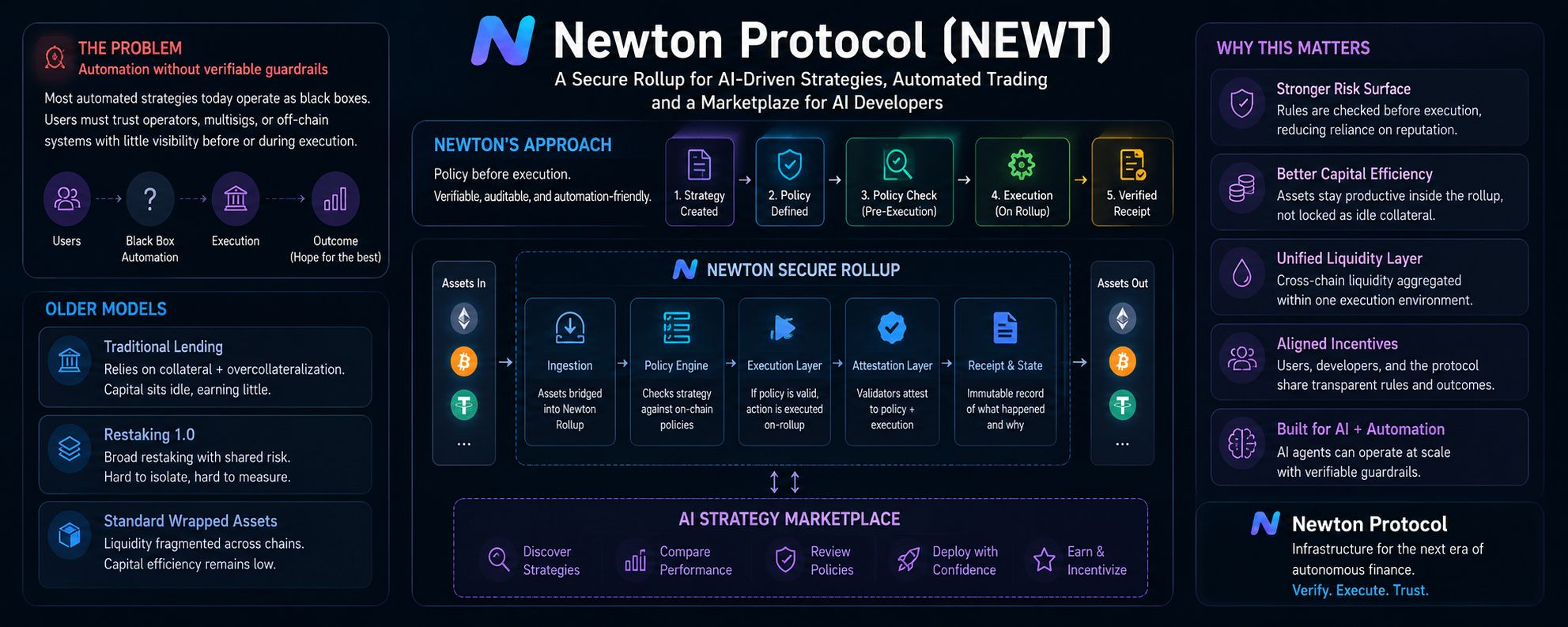
Newton Protocol Is Quietly Redefining How Automated Capital Is GovernedNewton Protocol was interesting for a lot of reasons, but the observation that stayed with me after spending time studying it wasn't the AI narrative or the marketplace for developers. What I kept returning to was the protocol's attempt to separate policy from execution through its secure rollup architecture. It is an architectural choice that feels easy to overlook because it sits beneath the more marketable parts of the project, yet it quietly changes how automated capital can be governed.
What stood out wasn't the idea of AI agents making decisions across multiple chains. The more interesting part was how every strategy can be constrained by predefined rules before execution rather than relying entirely on trust after the fact. Instead of treating automation as a black box, Newton Protocol is building an environment where execution can be verified against explicit policies. That moves part of the decision-making process into infrastructure rather than leaving it entirely with strategy creators or operators.
That changes the risk surface because capital is no longer depending only on the reputation of whoever deploys an AI strategy. Traditional automated trading systems and many earlier DeFi models often ask users to trust that managers, bots, or multisigs will behave responsibly. Newton shifts some of that trust toward transparent execution logic, creating a stronger alignment between users, developers, and the protocol itself. If the rules are visible and verifiable before assets move, the system becomes more auditable without sacrificing automation.
What I spent longer examining was how resilient this model remains under real market stress. Verified execution is valuable, but it cannot guarantee that the policies themselves are optimal. During periods of extreme volatility, liquidity fragmentation, or faulty oracle inputs, an AI strategy can still execute perfectly while following rules that produce poor economic outcomes. Secure execution and intelligent execution are not necessarily the same thing.
The open question I keep returning to is whether Newton Protocol's policy layer can evolve quickly enough to adapt to changing market conditions without introducing governance complexity that ultimately recreates the very trust assumptions it is trying to reduce.
@NewtonProtocol $NEWT #newt
{spot}(NEWTUSDT)
Newton Protocol Is Quietly Redefining How Automated Capital Is Governed
Newton Protocol was interesting for a lot of reasons, but the observation that stayed with me after spending time studying it wasn't the AI narrative or the marketplace for developers. What I kept returning to was the protocol's attempt to separate policy from execution through its secure rollup architecture. It is an architectural choice that feels easy to overlook because it sits beneath the more marketable parts of the project, yet it quietly changes how automated capital can be governed.
What stood out wasn't the idea of AI agents making decisions across multiple chains. The more interesting part was how every strategy can be constrained by predefined rules before execution rather than relying entirely on trust after the fact. Instead of treating automation as a black box, Newton Protocol is building an environment where execution can be verified against explicit policies. That moves part of the decision-making process into infrastructure rather than leaving it entirely with strategy creators or operators.
That changes the risk surface because capital is no longer depending only on the reputation of whoever deploys an AI strategy. Traditional automated trading systems and many earlier DeFi models often ask users to trust that managers, bots, or multisigs will behave responsibly. Newton shifts some of that trust toward transparent execution logic, creating a stronger alignment between users, developers, and the protocol itself. If the rules are visible and verifiable before assets move, the system becomes more auditable without sacrificing automation.
What I spent longer examining was how resilient this model remains under real market stress. Verified execution is valuable, but it cannot guarantee that the policies themselves are optimal. During periods of extreme volatility, liquidity fragmentation, or faulty oracle inputs, an AI strategy can still execute perfectly while following rules that produce poor economic outcomes. Secure execution and intelligent execution are not necessarily the same thing.
The open question I keep returning to is whether Newton Protocol's policy layer can evolve quickly enough to adapt to changing market conditions without introducing governance complexity that ultimately recreates the very trust assumptions it is trying to reduce.
@NewtonProtocol $NEWT #newt
What stood out wasn't the idea of AI agents making decisions across multiple chains. The more interesting part was how every strategy can be constrained by predefined rules before execution rather than relying entirely on trust after the fact. Instead of treating automation as a black box, Newton Protocol is building an environment where execution can be verified against explicit policies. That moves part of the decision-making process into infrastructure rather than leaving it entirely with strategy creators or operators.
That changes the risk surface because capital is no longer depending only on the reputation of whoever deploys an AI strategy. Traditional automated trading systems and many earlier DeFi models often ask users to trust that managers, bots, or multisigs will behave responsibly. Newton shifts some of that trust toward transparent execution logic, creating a stronger alignment between users, developers, and the protocol itself. If the rules are visible and verifiable before assets move, the system becomes more auditable without sacrificing automation.
What I spent longer examining was how resilient this model remains under real market stress. Verified execution is valuable, but it cannot guarantee that the policies themselves are optimal. During periods of extreme volatility, liquidity fragmentation, or faulty oracle inputs, an AI strategy can still execute perfectly while following rules that produce poor economic outcomes. Secure execution and intelligent execution are not necessarily the same thing.
The open question I keep returning to is whether Newton Protocol's policy layer can evolve quickly enough to adapt to changing market conditions without introducing governance complexity that ultimately recreates the very trust assumptions it is trying to reduce.
@NewtonProtocol $NEWT #newt
2
2
52
·
--
$EPT is quietly building the foundation that could power what's next. Every upgrade, every integration, every milestone adds another layer of conviction.
The loudest moves often begin in silence.
Eyes on $EPT. The story is just getting started. ⚡🚀
{alpha}(560x3dc8e2d80b6215a1bccae4d38715c3520581e77c)
#BinanceTurns9 #TSMCJuneRevenueUp67.9%YoY #SKHynixADRFalls10.4%PreMarket #SKHynixSinksRecord15% #BitcoinETFsSnapEightWeekOutflowStreak
$EPT is quietly building the foundation that could power what's next. Every upgrade, every integration, every milestone adds another layer of conviction.
The loudest moves often begin in silence.
Eyes on $EPT . The story is just getting started. ⚡🚀
#BinanceTurns9 #TSMCJuneRevenueUp67.9%YoY #SKHynixADRFalls10.4%PreMarket #SKHynixSinksRecord15% #BitcoinETFsSnapEightWeekOutflowStreak
The loudest moves often begin in silence.
Eyes on $EPT . The story is just getting started. ⚡🚀
#BinanceTurns9 #TSMCJuneRevenueUp67.9%YoY #SKHynixADRFalls10.4%PreMarket #SKHynixSinksRecord15% #BitcoinETFsSnapEightWeekOutflowStreak
205
·
--
Partly True
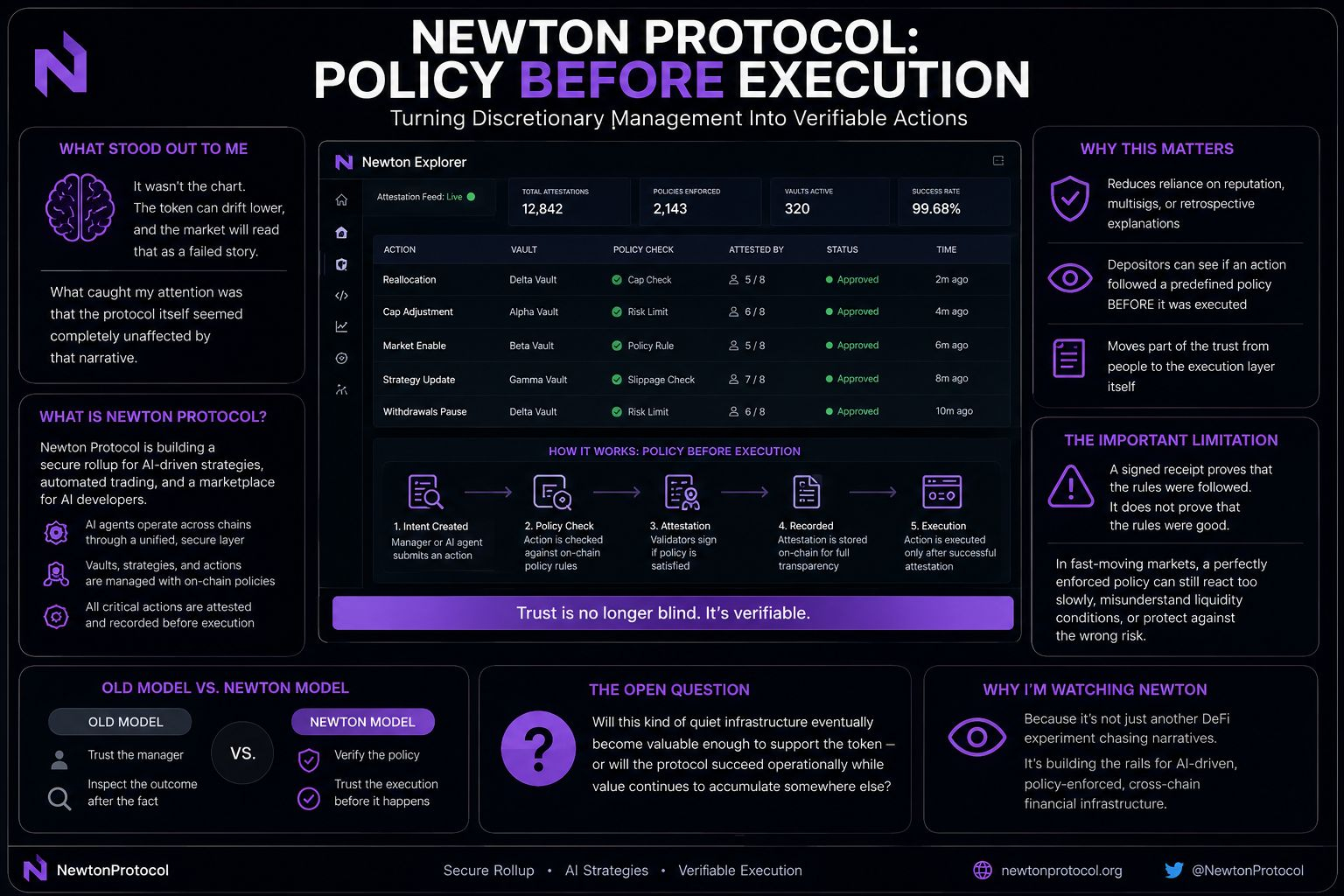
What stayed with me after looking through NewtonProtocol wasn’t the chart. The token can keep drifting lower, and the market will read that as a failed story. What caught my attention was that the protocol itself seemed completely unaffected by that narrative.
Inside Newton Explorer, the attestation feed kept moving. VaultKit actions were still being checked, signed, and recorded before execution. A reallocation, a cap adjustment, a new market being enabled — each action passed through a visible policy layer before touching user capital.
What stood out wasn’t the idea of AI agents operating across chains. That is still the larger ambition, but it is not the part doing the most practical work today. The more interesting part was how Newton is being used by vault curators to make discretionary management more auditable.
That changes the risk surface because depositors are no longer relying entirely on reputation, multisigs, or retrospective explanations. They can see whether an action followed a predefined policy before it was executed.
Older lending and vault models often ask users to trust the manager first and inspect the outcome later. Newton is trying to move part of that trust into the execution layer itself.
There is still an important limitation. A signed receipt proves that the rules were followed. It does not prove that the rules were good. In a fast-moving market, a perfectly enforced policy can still react too slowly, misunderstand liquidity conditions, or protect against the wrong risk.
The open question I keep returning to is whether this kind of quiet infrastructure eventually becomes valuable enough to support the token — or whether the protocol can succeed operationally while value continues to accumulate somewhere else.
@NewtonProtocol #newt $NEWT
{spot}(NEWTUSDT)
What stayed with me after looking through NewtonProtocol wasn’t the chart. The token can keep drifting lower, and the market will read that as a failed story. What caught my attention was that the protocol itself seemed completely unaffected by that narrative.
Inside Newton Explorer, the attestation feed kept moving. VaultKit actions were still being checked, signed, and recorded before execution. A reallocation, a cap adjustment, a new market being enabled — each action passed through a visible policy layer before touching user capital.
What stood out wasn’t the idea of AI agents operating across chains. That is still the larger ambition, but it is not the part doing the most practical work today. The more interesting part was how Newton is being used by vault curators to make discretionary management more auditable.
That changes the risk surface because depositors are no longer relying entirely on reputation, multisigs, or retrospective explanations. They can see whether an action followed a predefined policy before it was executed.
Older lending and vault models often ask users to trust the manager first and inspect the outcome later. Newton is trying to move part of that trust into the execution layer itself.
There is still an important limitation. A signed receipt proves that the rules were followed. It does not prove that the rules were good. In a fast-moving market, a perfectly enforced policy can still react too slowly, misunderstand liquidity conditions, or protect against the wrong risk.
The open question I keep returning to is whether this kind of quiet infrastructure eventually becomes valuable enough to support the token — or whether the protocol can succeed operationally while value continues to accumulate somewhere else.
@NewtonProtocol #newt $NEWT
Inside Newton Explorer, the attestation feed kept moving. VaultKit actions were still being checked, signed, and recorded before execution. A reallocation, a cap adjustment, a new market being enabled — each action passed through a visible policy layer before touching user capital.
What stood out wasn’t the idea of AI agents operating across chains. That is still the larger ambition, but it is not the part doing the most practical work today. The more interesting part was how Newton is being used by vault curators to make discretionary management more auditable.
That changes the risk surface because depositors are no longer relying entirely on reputation, multisigs, or retrospective explanations. They can see whether an action followed a predefined policy before it was executed.
Older lending and vault models often ask users to trust the manager first and inspect the outcome later. Newton is trying to move part of that trust into the execution layer itself.
There is still an important limitation. A signed receipt proves that the rules were followed. It does not prove that the rules were good. In a fast-moving market, a perfectly enforced policy can still react too slowly, misunderstand liquidity conditions, or protect against the wrong risk.
The open question I keep returning to is whether this kind of quiet infrastructure eventually becomes valuable enough to support the token — or whether the protocol can succeed operationally while value continues to accumulate somewhere else.
@NewtonProtocol #newt $NEWT
47
28
7.3k
·
--
$KAT Trade SetupEyes on a confirmed breakout before taking the trade.
Entry: On breakout confirmation above resistance
Targets: TP1 +10% | TP2 +20% | TP3 +35%
Stop Loss: Below the nearest key support
The setup looks promising, but confirmation and volume are essential. Stay disciplined, stick to your plan, and always protect your capital.
{spot}(KATUSDT)
#AMDSharesSlideNearly10%
#SpaceXAnthropicOpenAIIPOsMayTopVCExitsSince2000
#USStrikesIranAfterHormuzShipAttack
#MorganStanleyAdds1000BTC
#GOPSeeksSenateVoteOnCLARITYActWeekOfJuly20
$KAT Trade SetupEyes on a confirmed breakout before taking the trade.
Entry: On breakout confirmation above resistance
Targets: TP1 +10% | TP2 +20% | TP3 +35%
Stop Loss: Below the nearest key support
The setup looks promising, but confirmation and volume are essential. Stay disciplined, stick to your plan, and always protect your capital.
#AMDSharesSlideNearly10%
#SpaceXAnthropicOpenAIIPOsMayTopVCExitsSince2000
#USStrikesIranAfterHormuzShipAttack
#MorganStanleyAdds1000BTC
#GOPSeeksSenateVoteOnCLARITYActWeekOfJuly20
Entry: On breakout confirmation above resistance
Targets: TP1 +10% | TP2 +20% | TP3 +35%
Stop Loss: Below the nearest key support
The setup looks promising, but confirmation and volume are essential. Stay disciplined, stick to your plan, and always protect your capital.
#AMDSharesSlideNearly10%
#SpaceXAnthropicOpenAIIPOsMayTopVCExitsSince2000
#USStrikesIranAfterHormuzShipAttack
#MorganStanleyAdds1000BTC
#GOPSeeksSenateVoteOnCLARITYActWeekOfJuly20
220
·
--
$TLM Trade SetupWatching for a clean breakout above resistance before entering.
Entry: Above confirmation breakout
Targets: TP1 +8% | TP2 +15% | TP3 +25%
Stop Loss: Below the latest support (risk only what you can afford to lose)
Momentum is building, volume is the key confirmation. Stay patient, wait for the trigger, and let the market come to you. Manage risk and don't chase green candles.
{spot}(TLMUSDT)
#AMDSharesSlideNearly10%
#SpaceXAnthropicOpenAIIPOsMayTopVCExitsSince2000
#USStrikesIranAfterHormuzShipAttack
#MorganStanleyAdds1000BTC
#GOPSeeksSenateVoteOnCLARITYActWeekOfJuly20
$TLM Trade SetupWatching for a clean breakout above resistance before entering.
Entry: Above confirmation breakout
Targets: TP1 +8% | TP2 +15% | TP3 +25%
Stop Loss: Below the latest support (risk only what you can afford to lose)
Momentum is building, volume is the key confirmation. Stay patient, wait for the trigger, and let the market come to you. Manage risk and don't chase green candles.
#AMDSharesSlideNearly10%
#SpaceXAnthropicOpenAIIPOsMayTopVCExitsSince2000
#USStrikesIranAfterHormuzShipAttack
#MorganStanleyAdds1000BTC
#GOPSeeksSenateVoteOnCLARITYActWeekOfJuly20
Entry: Above confirmation breakout
Targets: TP1 +8% | TP2 +15% | TP3 +25%
Stop Loss: Below the latest support (risk only what you can afford to lose)
Momentum is building, volume is the key confirmation. Stay patient, wait for the trigger, and let the market come to you. Manage risk and don't chase green candles.
#AMDSharesSlideNearly10%
#SpaceXAnthropicOpenAIIPOsMayTopVCExitsSince2000
#USStrikesIranAfterHormuzShipAttack
#MorganStanleyAdds1000BTC
#GOPSeeksSenateVoteOnCLARITYActWeekOfJuly20
196
·
--
Article
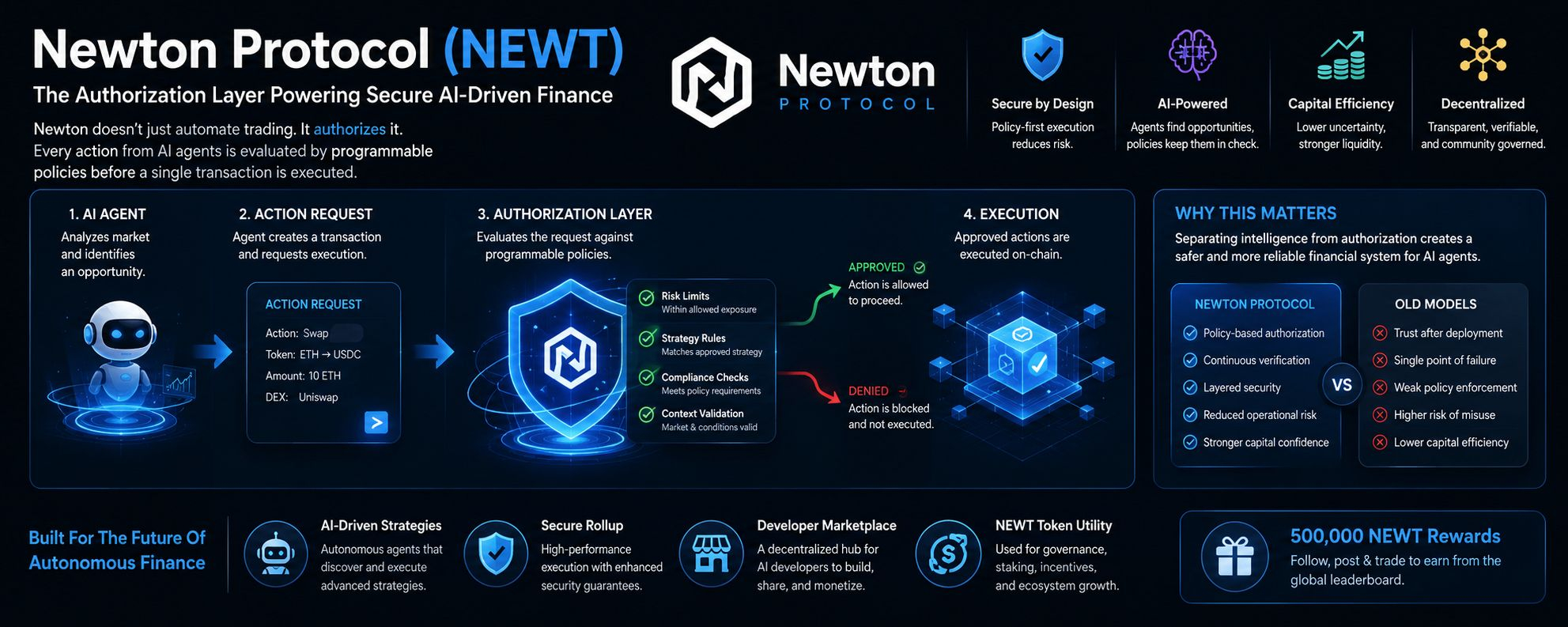
The Real Innovation in Newton Protocol Isn't AI Trading It's the Authorization Layer That Quietly ReWhat stayed with me while studying Newton Protocol wasn't the idea of AI agents managing capital. That narrative is already familiar across crypto. What kept pulling my attention back was something much quieter: the authorization layer that sits between an agent's decision and the execution of that decision. It's an architectural detail that doesn't generate headlines, yet it may have a bigger impact on how autonomous finance evolves than the AI models themselves.
The more interesting part was realizing that Newton doesn't ask users to blindly trust an intelligent agent. Instead, it attempts to make every action pass through programmable policies before capital actually moves. That distinction feels important. Intelligence can generate opportunities, but authorization determines whether those opportunities should be allowed to reach execution. Those are two very different responsibilities, and separating them creates a cleaner security model.
Compared with earlier automation frameworks, where permission was often granted once and then relied heavily on the quality of the strategy or smart contract, Newton introduces a continuous layer of verification. Rather than assuming good behavior after deployment, the protocol treats authorization as an active process that exists throughout an agent's lifecycle. That subtle shift changes the relationship between users, capital, and autonomous systems.
From a structural perspective, this has implications beyond security. If policy-based authorization consistently reduces operational mistakes, unexpected transactions, or unauthorized execution, participants may become more comfortable allocating larger pools of capital to autonomous strategies. Capital efficiency isn't only a function of returns; it's also shaped by confidence in the infrastructure protecting those returns. Lower uncertainty can become just as valuable as higher performance.
What I also found interesting is that this architecture separates decision-making from control. Even a highly capable AI agent cannot automatically execute every action it proposes. Policies remain the final checkpoint. That creates multiple layers of defense instead of concentrating trust in a single model, operator, or contract. In a market where automation is expanding rapidly, that layered approach feels more resilient than relying solely on increasingly powerful AI systems.
Of course, this introduces its own challenge. Authorization policies are only as effective as the people designing and maintaining them. Rules that are too restrictive may prevent legitimate actions during periods of high volatility, while overly permissive policies could weaken the very safeguards they were meant to provide. As autonomous systems become more adaptive, keeping policy frameworks equally adaptive without sacrificing security becomes a difficult balancing act.
The open question I keep returning to is whether the next generation of on-chain AI will ultimately be judged by the intelligence of its agents—or by the quality of the authorization infrastructure that determines which actions those agents are actually allowed to perform.
@NewtonProtocol #newt $NEWT
{spot}(NEWTUSDT)
The Real Innovation in Newton Protocol Isn't AI Trading It's the Authorization Layer That Quietly Re
What stayed with me while studying Newton Protocol wasn't the idea of AI agents managing capital. That narrative is already familiar across crypto. What kept pulling my attention back was something much quieter: the authorization layer that sits between an agent's decision and the execution of that decision. It's an architectural detail that doesn't generate headlines, yet it may have a bigger impact on how autonomous finance evolves than the AI models themselves.
The more interesting part was realizing that Newton doesn't ask users to blindly trust an intelligent agent. Instead, it attempts to make every action pass through programmable policies before capital actually moves. That distinction feels important. Intelligence can generate opportunities, but authorization determines whether those opportunities should be allowed to reach execution. Those are two very different responsibilities, and separating them creates a cleaner security model.
Compared with earlier automation frameworks, where permission was often granted once and then relied heavily on the quality of the strategy or smart contract, Newton introduces a continuous layer of verification. Rather than assuming good behavior after deployment, the protocol treats authorization as an active process that exists throughout an agent's lifecycle. That subtle shift changes the relationship between users, capital, and autonomous systems.
From a structural perspective, this has implications beyond security. If policy-based authorization consistently reduces operational mistakes, unexpected transactions, or unauthorized execution, participants may become more comfortable allocating larger pools of capital to autonomous strategies. Capital efficiency isn't only a function of returns; it's also shaped by confidence in the infrastructure protecting those returns. Lower uncertainty can become just as valuable as higher performance.
What I also found interesting is that this architecture separates decision-making from control. Even a highly capable AI agent cannot automatically execute every action it proposes. Policies remain the final checkpoint. That creates multiple layers of defense instead of concentrating trust in a single model, operator, or contract. In a market where automation is expanding rapidly, that layered approach feels more resilient than relying solely on increasingly powerful AI systems.
Of course, this introduces its own challenge. Authorization policies are only as effective as the people designing and maintaining them. Rules that are too restrictive may prevent legitimate actions during periods of high volatility, while overly permissive policies could weaken the very safeguards they were meant to provide. As autonomous systems become more adaptive, keeping policy frameworks equally adaptive without sacrificing security becomes a difficult balancing act.
The open question I keep returning to is whether the next generation of on-chain AI will ultimately be judged by the intelligence of its agents—or by the quality of the authorization infrastructure that determines which actions those agents are actually allowed to perform.
@NewtonProtocol #newt $NEWT
The more interesting part was realizing that Newton doesn't ask users to blindly trust an intelligent agent. Instead, it attempts to make every action pass through programmable policies before capital actually moves. That distinction feels important. Intelligence can generate opportunities, but authorization determines whether those opportunities should be allowed to reach execution. Those are two very different responsibilities, and separating them creates a cleaner security model.
Compared with earlier automation frameworks, where permission was often granted once and then relied heavily on the quality of the strategy or smart contract, Newton introduces a continuous layer of verification. Rather than assuming good behavior after deployment, the protocol treats authorization as an active process that exists throughout an agent's lifecycle. That subtle shift changes the relationship between users, capital, and autonomous systems.
From a structural perspective, this has implications beyond security. If policy-based authorization consistently reduces operational mistakes, unexpected transactions, or unauthorized execution, participants may become more comfortable allocating larger pools of capital to autonomous strategies. Capital efficiency isn't only a function of returns; it's also shaped by confidence in the infrastructure protecting those returns. Lower uncertainty can become just as valuable as higher performance.
What I also found interesting is that this architecture separates decision-making from control. Even a highly capable AI agent cannot automatically execute every action it proposes. Policies remain the final checkpoint. That creates multiple layers of defense instead of concentrating trust in a single model, operator, or contract. In a market where automation is expanding rapidly, that layered approach feels more resilient than relying solely on increasingly powerful AI systems.
Of course, this introduces its own challenge. Authorization policies are only as effective as the people designing and maintaining them. Rules that are too restrictive may prevent legitimate actions during periods of high volatility, while overly permissive policies could weaken the very safeguards they were meant to provide. As autonomous systems become more adaptive, keeping policy frameworks equally adaptive without sacrificing security becomes a difficult balancing act.
The open question I keep returning to is whether the next generation of on-chain AI will ultimately be judged by the intelligence of its agents—or by the quality of the authorization infrastructure that determines which actions those agents are actually allowed to perform.
@NewtonProtocol #newt $NEWT
10
6
172
·
--
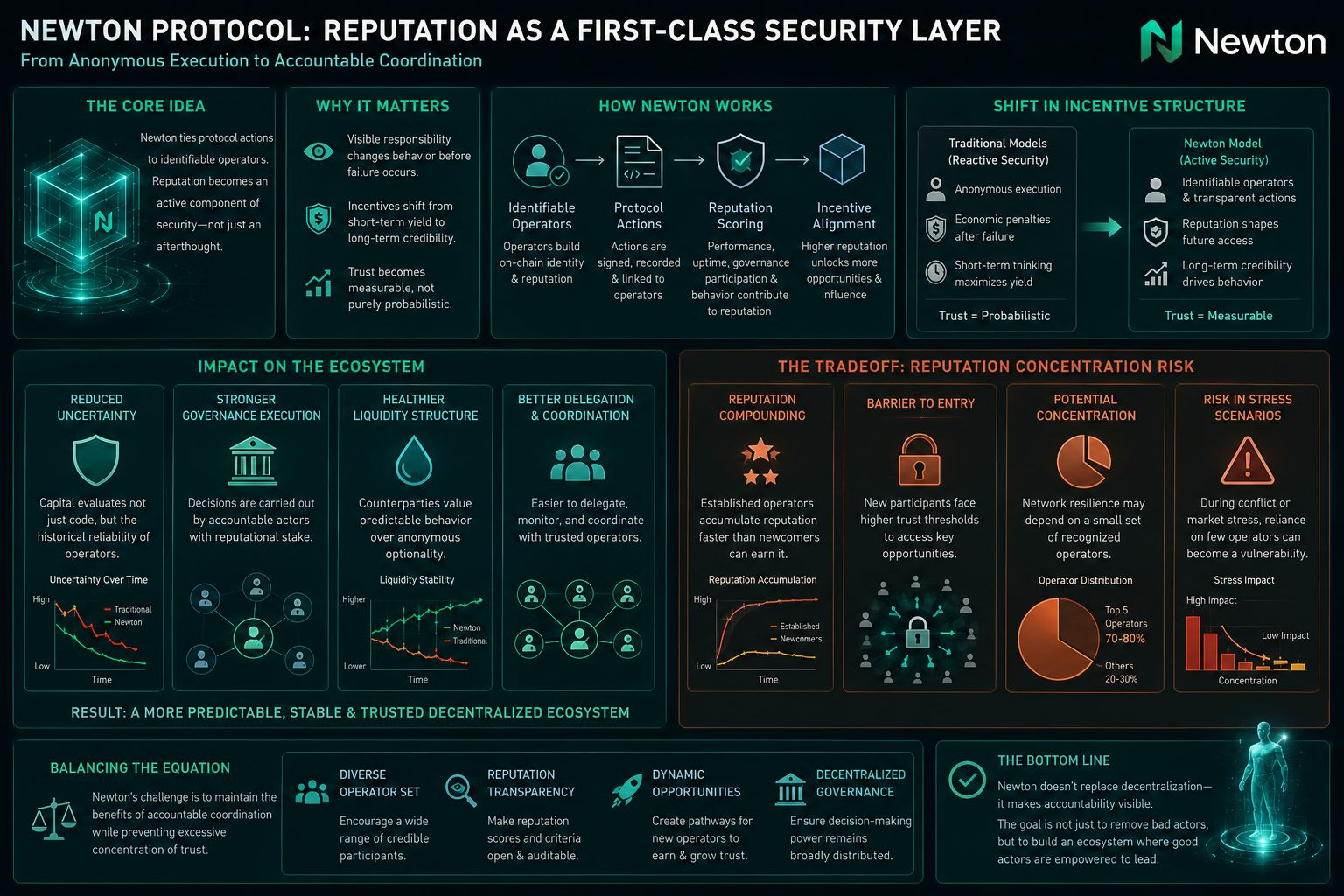
What stayed with me while studying Newton wasn’t the identity layer itself, but the way known operators reshape accountability inside decentralized coordination. Most discussions focus on transparency as a governance feature. The more interesting part was how visible responsibility changes participant behavior long before a dispute or failure ever occurs.
What I spent longer examining was the mechanism that ties protocol actions to identifiable operators rather than anonymous execution alone. Unlike systems that rely almost entirely on economic penalties after something goes wrong, Newton introduces reputation as an active component of the security model. That shifts incentives from simply maximizing short-term yield toward preserving long-term credibility. Compared with earlier permissionless coordination models, the architecture attempts to make trust measurable instead of purely probabilistic.
That changes the risk surface because capital is no longer evaluating code in isolation. It is also evaluating the historical reliability of the entities interacting with that code. In theory, this can reduce uncertainty around governance execution, delegated operations, and ecosystem participation. The resulting liquidity structure may become more stable if counterparties place greater value on predictable behavior than on anonymous optionality.
At the same time, the design introduces a different tradeoff. Reputation systems can strengthen incentive alignment, but they also create the possibility of concentration. If established operators accumulate trust faster than newcomers can earn it, network resilience could gradually depend on a relatively small set of recognized participants. During periods of governance conflict or market stress, that concentration may become more significant than the protocol initially intended.
@NewtonProtocol #newt $NEWT
{spot}(NEWTUSDT)
What stayed with me while studying Newton wasn’t the identity layer itself, but the way known operators reshape accountability inside decentralized coordination. Most discussions focus on transparency as a governance feature. The more interesting part was how visible responsibility changes participant behavior long before a dispute or failure ever occurs.
What I spent longer examining was the mechanism that ties protocol actions to identifiable operators rather than anonymous execution alone. Unlike systems that rely almost entirely on economic penalties after something goes wrong, Newton introduces reputation as an active component of the security model. That shifts incentives from simply maximizing short-term yield toward preserving long-term credibility. Compared with earlier permissionless coordination models, the architecture attempts to make trust measurable instead of purely probabilistic.
That changes the risk surface because capital is no longer evaluating code in isolation. It is also evaluating the historical reliability of the entities interacting with that code. In theory, this can reduce uncertainty around governance execution, delegated operations, and ecosystem participation. The resulting liquidity structure may become more stable if counterparties place greater value on predictable behavior than on anonymous optionality.
At the same time, the design introduces a different tradeoff. Reputation systems can strengthen incentive alignment, but they also create the possibility of concentration. If established operators accumulate trust faster than newcomers can earn it, network resilience could gradually depend on a relatively small set of recognized participants. During periods of governance conflict or market stress, that concentration may become more significant than the protocol initially intended.
@NewtonProtocol #newt $NEWT
What I spent longer examining was the mechanism that ties protocol actions to identifiable operators rather than anonymous execution alone. Unlike systems that rely almost entirely on economic penalties after something goes wrong, Newton introduces reputation as an active component of the security model. That shifts incentives from simply maximizing short-term yield toward preserving long-term credibility. Compared with earlier permissionless coordination models, the architecture attempts to make trust measurable instead of purely probabilistic.
That changes the risk surface because capital is no longer evaluating code in isolation. It is also evaluating the historical reliability of the entities interacting with that code. In theory, this can reduce uncertainty around governance execution, delegated operations, and ecosystem participation. The resulting liquidity structure may become more stable if counterparties place greater value on predictable behavior than on anonymous optionality.
At the same time, the design introduces a different tradeoff. Reputation systems can strengthen incentive alignment, but they also create the possibility of concentration. If established operators accumulate trust faster than newcomers can earn it, network resilience could gradually depend on a relatively small set of recognized participants. During periods of governance conflict or market stress, that concentration may become more significant than the protocol initially intended.
@NewtonProtocol #newt $NEWT
32
21
2.2k
·
--
⚡ $ARX isn't making noise—it’s building pressure.
The biggest moves happen before the crowd notices. Eyes on $ARX. 🚀🔥
{future}(ARXUSDT)
#BitcoinPlansECashHardFork
#AMDSharesSlideNearly10%
#SpaceXAnthropicOpenAIIPOsMayTopVCExitsSince2000
#MorganStanleyAdds1000BTC
#USStrikesIranAfterHormuzShipAttack
⚡ $ARX isn't making noise—it’s building pressure.
The biggest moves happen before the crowd notices. Eyes on $ARX . 🚀🔥
#BitcoinPlansECashHardFork
#AMDSharesSlideNearly10%
#SpaceXAnthropicOpenAIIPOsMayTopVCExitsSince2000
#MorganStanleyAdds1000BTC
#USStrikesIranAfterHormuzShipAttack
The biggest moves happen before the crowd notices. Eyes on $ARX . 🚀🔥
#BitcoinPlansECashHardFork
#AMDSharesSlideNearly10%
#SpaceXAnthropicOpenAIIPOsMayTopVCExitsSince2000
#MorganStanleyAdds1000BTC
#USStrikesIranAfterHormuzShipAttack
253
·
--
$SLX is approaching a key breakout zone and momentum is starting to build.
Entry: Buy on a confirmed breakout with strong volume.
Target 1: +20%
Target 2: +40%
Stop Loss: Below the nearest support.
A clean breakout could spark a sharp move. Stay disciplined, manage risk, and wait for confirmation.
{future}(SLXUSDT)
#BitcoinPlansECashHardFork
#EthereumFoundationAIAgentsFindNodeCrashBug
#BitcoinUp9.5%InJulyBestInFourYears
#XRPActiveWalletsHitSecondLowestOf2026
#IranRulesOutTalksUntilUSWithdraws
$SLX is approaching a key breakout zone and momentum is starting to build.
Entry: Buy on a confirmed breakout with strong volume.
Target 1: +20%
Target 2: +40%
Stop Loss: Below the nearest support.
A clean breakout could spark a sharp move. Stay disciplined, manage risk, and wait for confirmation.
#BitcoinPlansECashHardFork
#EthereumFoundationAIAgentsFindNodeCrashBug
#BitcoinUp9.5%InJulyBestInFourYears
#XRPActiveWalletsHitSecondLowestOf2026
#IranRulesOutTalksUntilUSWithdraws
Entry: Buy on a confirmed breakout with strong volume.
Target 1: +20%
Target 2: +40%
Stop Loss: Below the nearest support.
A clean breakout could spark a sharp move. Stay disciplined, manage risk, and wait for confirmation.
#BitcoinPlansECashHardFork
#EthereumFoundationAIAgentsFindNodeCrashBug
#BitcoinUp9.5%InJulyBestInFourYears
#XRPActiveWalletsHitSecondLowestOf2026
#IranRulesOutTalksUntilUSWithdraws
376
·
--
$CLO is tightening after a clean base and looks ready for expansion.
Entry: Break above resistance with strong volume.
Target 1: +15%
Target 2: +30%
Stop Loss: Below the latest support.
Momentum is building, liquidity is improving, and a confirmed breakout could trigger a fast move. Manage risk and let the trend do the work.
{future}(CLOUSDT)
#BitcoinUp9.5%InJulyBestInFourYears
#XRPActiveWalletsHitSecondLowestOf2026
#SP500EndsJustBelowRecord
#IranRulesOutTalksUntilUSWithdraws
#RetailStockBuyingLowestSince2020
$CLO is tightening after a clean base and looks ready for expansion.
Entry: Break above resistance with strong volume.
Target 1: +15%
Target 2: +30%
Stop Loss: Below the latest support.
Momentum is building, liquidity is improving, and a confirmed breakout could trigger a fast move. Manage risk and let the trend do the work.
#BitcoinUp9.5%InJulyBestInFourYears
#XRPActiveWalletsHitSecondLowestOf2026
#SP500EndsJustBelowRecord
#IranRulesOutTalksUntilUSWithdraws
#RetailStockBuyingLowestSince2020
Entry: Break above resistance with strong volume.
Target 1: +15%
Target 2: +30%
Stop Loss: Below the latest support.
Momentum is building, liquidity is improving, and a confirmed breakout could trigger a fast move. Manage risk and let the trend do the work.
#BitcoinUp9.5%InJulyBestInFourYears
#XRPActiveWalletsHitSecondLowestOf2026
#SP500EndsJustBelowRecord
#IranRulesOutTalksUntilUSWithdraws
#RetailStockBuyingLowestSince2020
166
·
--
Article
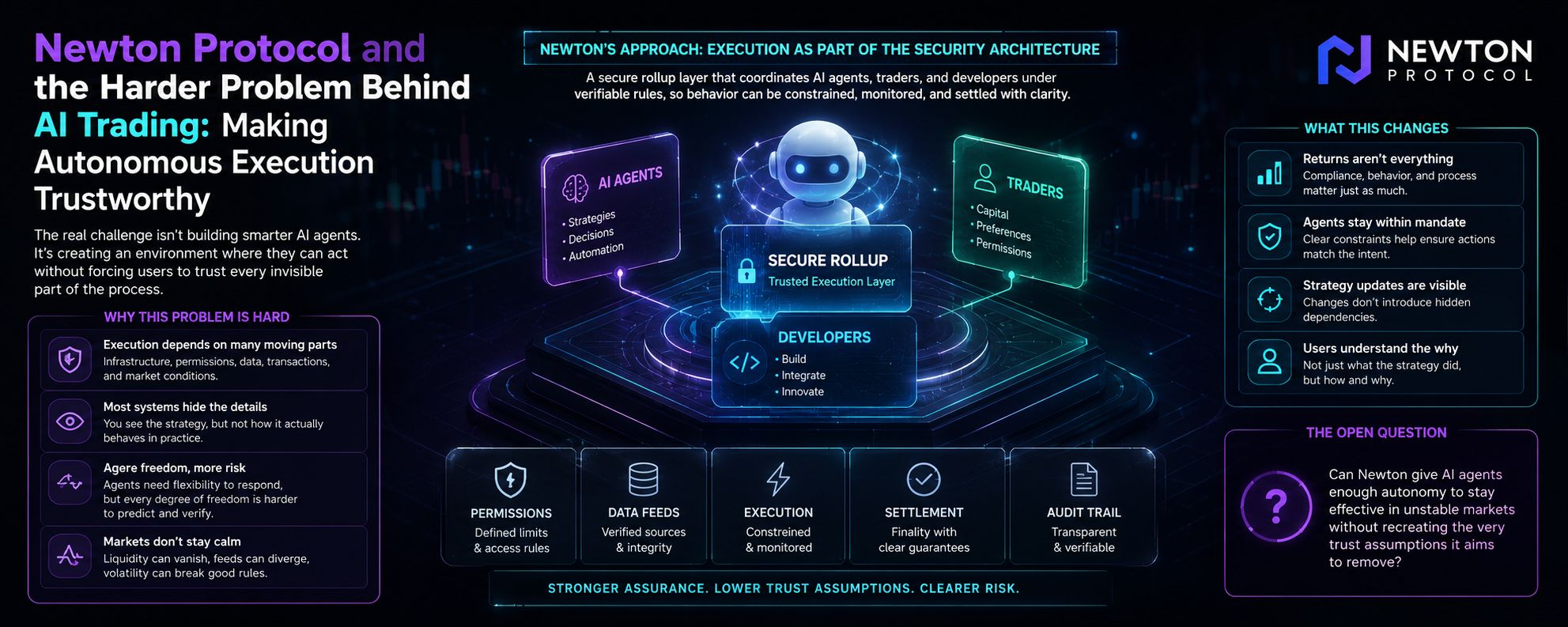
Newton Protocol and the Harder Problem Behind AI Trading Making Autonomous Execution TrustworthyOne thing kept coming back to me while studying Newton Protocol: the real challenge may not be building smarter AI agents. It may be creating an environment where those agents can act without forcing users to trust every invisible part of the process.
Most conversations around AI-driven trading focus on performance. Better signals, faster execution, stronger models, and more autonomy. What stood out wasn’t any of those things. It was Newton’s decision to treat execution itself as part of the security architecture.
That matters because an automated strategy is never just a strategy. It also depends on the infrastructure running it, the permissions given to it, the data it receives, the way transactions are submitted, and the conditions under which it can move capital. In many older automated trading systems, users can understand the strategy at a high level while still having very little visibility into how the system behaves in practice.
The more interesting part of Newton’s design is the use of a secure rollup as a coordination and execution layer for AI agents, traders, and developers. The goal appears to be creating a controlled environment where agent behavior can be constrained, verified, and settled under clearer rules.
That changes the risk surface because returns are no longer the only relevant metric. Users also need to ask whether an agent stayed within its mandate, whether execution followed the expected logic, and whether strategy updates introduced new hidden dependencies.
What I spent longer examining was the tension between flexibility and control. Markets are rarely clean. Liquidity can disappear, price feeds can diverge, and volatility can make previously sensible rules ineffective. An agent needs enough freedom to respond, but every additional degree of freedom makes its behavior harder to predict and verify.
The open question I keep returning to is whether Newton can give AI agents enough autonomy to remain useful in unstable markets without recreating the same trust assumptions its architecture is designed to remove.
@NewtonProtocol #newt $NEWT
{spot}(NEWTUSDT)
Newton Protocol and the Harder Problem Behind AI Trading Making Autonomous Execution Trustworthy
One thing kept coming back to me while studying Newton Protocol: the real challenge may not be building smarter AI agents. It may be creating an environment where those agents can act without forcing users to trust every invisible part of the process.
Most conversations around AI-driven trading focus on performance. Better signals, faster execution, stronger models, and more autonomy. What stood out wasn’t any of those things. It was Newton’s decision to treat execution itself as part of the security architecture.
That matters because an automated strategy is never just a strategy. It also depends on the infrastructure running it, the permissions given to it, the data it receives, the way transactions are submitted, and the conditions under which it can move capital. In many older automated trading systems, users can understand the strategy at a high level while still having very little visibility into how the system behaves in practice.
The more interesting part of Newton’s design is the use of a secure rollup as a coordination and execution layer for AI agents, traders, and developers. The goal appears to be creating a controlled environment where agent behavior can be constrained, verified, and settled under clearer rules.
That changes the risk surface because returns are no longer the only relevant metric. Users also need to ask whether an agent stayed within its mandate, whether execution followed the expected logic, and whether strategy updates introduced new hidden dependencies.
What I spent longer examining was the tension between flexibility and control. Markets are rarely clean. Liquidity can disappear, price feeds can diverge, and volatility can make previously sensible rules ineffective. An agent needs enough freedom to respond, but every additional degree of freedom makes its behavior harder to predict and verify.
The open question I keep returning to is whether Newton can give AI agents enough autonomy to remain useful in unstable markets without recreating the same trust assumptions its architecture is designed to remove.
@NewtonProtocol #newt $NEWT
Most conversations around AI-driven trading focus on performance. Better signals, faster execution, stronger models, and more autonomy. What stood out wasn’t any of those things. It was Newton’s decision to treat execution itself as part of the security architecture.
That matters because an automated strategy is never just a strategy. It also depends on the infrastructure running it, the permissions given to it, the data it receives, the way transactions are submitted, and the conditions under which it can move capital. In many older automated trading systems, users can understand the strategy at a high level while still having very little visibility into how the system behaves in practice.
The more interesting part of Newton’s design is the use of a secure rollup as a coordination and execution layer for AI agents, traders, and developers. The goal appears to be creating a controlled environment where agent behavior can be constrained, verified, and settled under clearer rules.
That changes the risk surface because returns are no longer the only relevant metric. Users also need to ask whether an agent stayed within its mandate, whether execution followed the expected logic, and whether strategy updates introduced new hidden dependencies.
What I spent longer examining was the tension between flexibility and control. Markets are rarely clean. Liquidity can disappear, price feeds can diverge, and volatility can make previously sensible rules ineffective. An agent needs enough freedom to respond, but every additional degree of freedom makes its behavior harder to predict and verify.
The open question I keep returning to is whether Newton can give AI agents enough autonomy to remain useful in unstable markets without recreating the same trust assumptions its architecture is designed to remove.
@NewtonProtocol #newt $NEWT
9
4
247
·
--
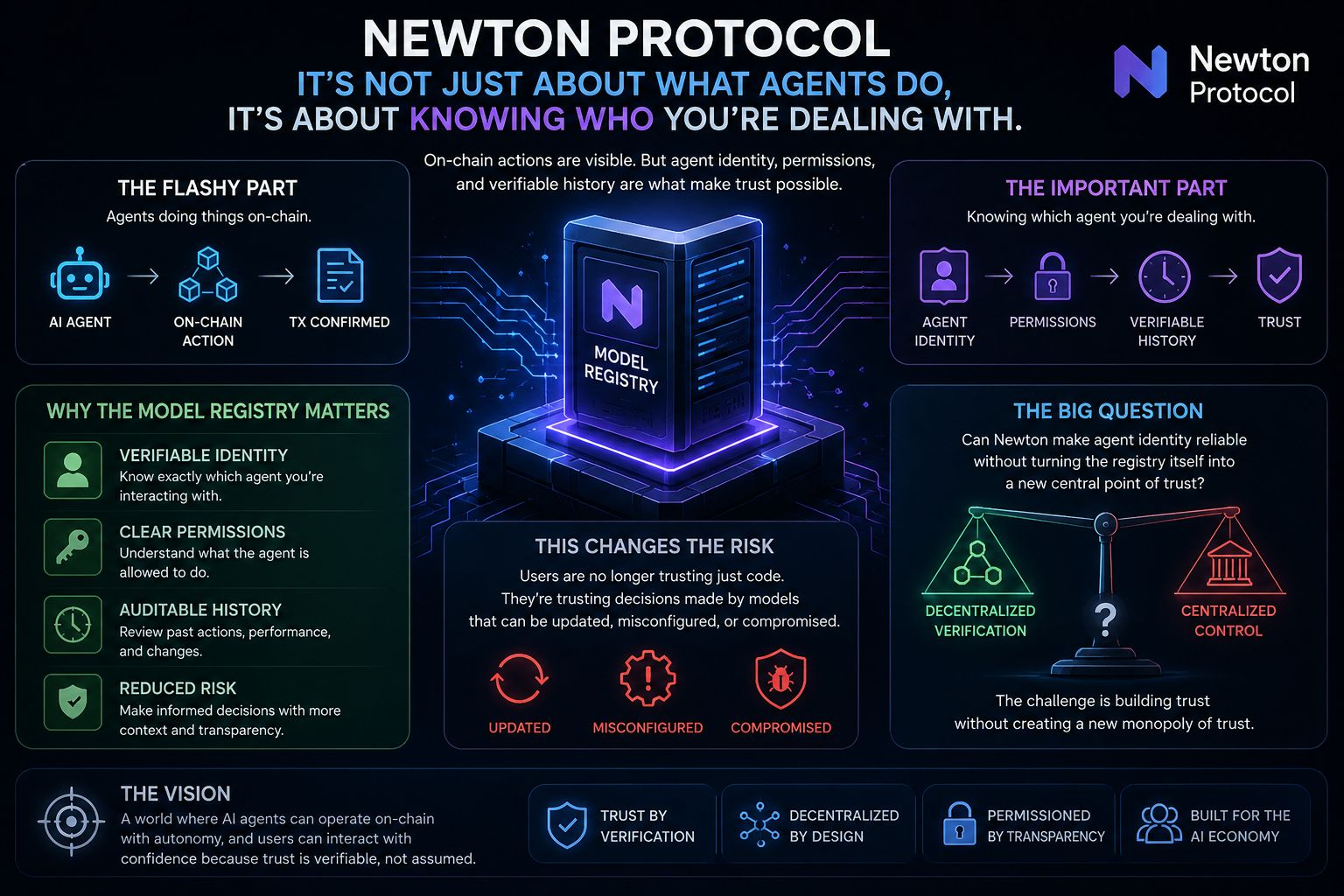
One thing that stuck with me while looking at Newton Protocol was the model registry.
The flashy part is agents doing things on-chain. The more important part may be knowing which agent you’re dealing with, what permissions it has, and whether its history can be verified.
That changes the risk because users are no longer trusting just code. They’re trusting decisions made by models that can be updated, misconfigured, or compromised.
The big question is whether Newton can make agent identity reliable without turning the registry itself into a new central point of trust.
@NewtonProtocol #newt $NEWT
One thing that stuck with me while looking at Newton Protocol was the model registry.
The flashy part is agents doing things on-chain. The more important part may be knowing which agent you’re dealing with, what permissions it has, and whether its history can be verified.
That changes the risk because users are no longer trusting just code. They’re trusting decisions made by models that can be updated, misconfigured, or compromised.
The big question is whether Newton can make agent identity reliable without turning the registry itself into a new central point of trust.
@NewtonProtocol #newt $NEWT
The flashy part is agents doing things on-chain. The more important part may be knowing which agent you’re dealing with, what permissions it has, and whether its history can be verified.
That changes the risk because users are no longer trusting just code. They’re trusting decisions made by models that can be updated, misconfigured, or compromised.
The big question is whether Newton can make agent identity reliable without turning the registry itself into a new central point of trust.
@NewtonProtocol #newt $NEWT
27
12
506
·
--
$BEE is approaching a pivotal level where volatility could increase. If buyers reclaim resistance with convincing volume, momentum may accelerate. If not, a retest of support could create a stronger entry opportunity.
Trade Setup
• Entry: Confirmed breakout above resistance or bullish bounce from support
• Stop Loss: Below the latest swing low
• Targets: Secure partial profits at the next resistance and trail the remaining position as long as the trend stays intact
Discipline wins over excitement. Wait for confirmation, manage risk, and let the market do the work.
{alpha}(560xdb6f1f098b55e36b036603c8e54663a8d907d6e1)
#BitcoinUp9.5%InJulyBestInFourYears
#XRPActiveWalletsHitSecondLowestOf2026
#IranRulesOutTalksUntilUSWithdraws
#RetailStockBuyingLowestSince2020
#JapanUrgesGPIFToBoostDomesticAssets
$BEE is approaching a pivotal level where volatility could increase. If buyers reclaim resistance with convincing volume, momentum may accelerate. If not, a retest of support could create a stronger entry opportunity.
Trade Setup
• Entry: Confirmed breakout above resistance or bullish bounce from support
• Stop Loss: Below the latest swing low
• Targets: Secure partial profits at the next resistance and trail the remaining position as long as the trend stays intact
Discipline wins over excitement. Wait for confirmation, manage risk, and let the market do the work.
#BitcoinUp9.5%InJulyBestInFourYears
#XRPActiveWalletsHitSecondLowestOf2026
#IranRulesOutTalksUntilUSWithdraws
#RetailStockBuyingLowestSince2020
#JapanUrgesGPIFToBoostDomesticAssets
Trade Setup
• Entry: Confirmed breakout above resistance or bullish bounce from support
• Stop Loss: Below the latest swing low
• Targets: Secure partial profits at the next resistance and trail the remaining position as long as the trend stays intact
Discipline wins over excitement. Wait for confirmation, manage risk, and let the market do the work.
#BitcoinUp9.5%InJulyBestInFourYears
#XRPActiveWalletsHitSecondLowestOf2026
#IranRulesOutTalksUntilUSWithdraws
#RetailStockBuyingLowestSince2020
#JapanUrgesGPIFToBoostDomesticAssets
118
Log in to explore more content
Join global crypto users on Binance Square
⚡️ Get latest and useful information about crypto.
💬 Trusted by the world’s largest crypto exchange.
👍 Discover real insights from verified creators.
Email / Phone number
Trending Topics
FedRateWatch
1.4M views
6,469 Discussing
Share & Win Traffic Reward in our Trending Hashtag Campaign
✨Topic: FOMC September, What's The Fed's Next Move?
👉How to Join:
Publish a short post or article with hashtag #FedRateWatch
Create content based on the below angles:
- August core CPI rose 0.3% month-over-month, and the odds of a 25bp hike this week are now close to 90%. Do you anticipate a rate hike this week? Is it a one-off, or the start of a longer hiking cycle?
- If the hike lands, how does it play out for BTC, tech stocks, and gold? Bullish or bearish?
- How are you planning to trade next? Share your BTC, stocks or gold trade/holdings with our trade sharing widget.
⏰Campaign Period:
- 2026-09-15 11:00 - 2026-09-17 3:00 UTC
🎁Reward:
- Qualified posts that comply with the above guidelines and contain more than 100 words will be reviewed and may receive a random traffic boost of 500 to 3,000 views. You will receive a notification from your feed secretary if your post is selected.
- Get a chance to have your article featured on Binance Square Official
Need ideas for your post? Visit the topic page #FedRateWatch or the Square Guide on How to Post for Better Reach.
Binance Square Official
·636 Likes
·1.6M views
ZcashRises6%
35,341 views
536 Discussing
XRPSinks10%
23,249 views
353 Discussing