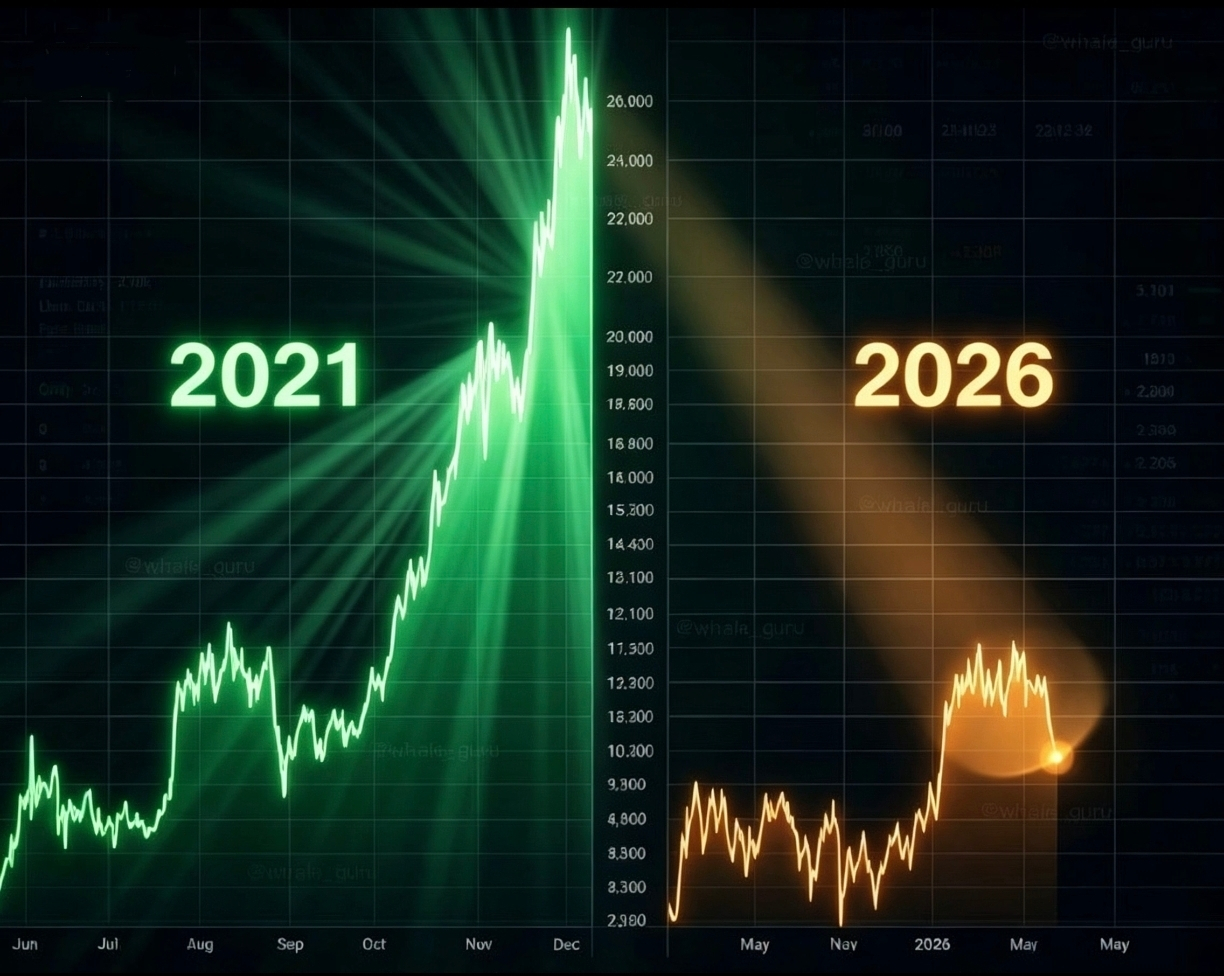
Let’s talk about what is latest news about markets. US President Donald Trump claimed responsibility for the unprecedented attack on the Ghadir Bridge, Iran's largest bridge. Ongoing geopolitical tensions continue to put pressure on the crypto markets. Trump today shared a video showing the collapse of part of the newly built 136-meter-high cable-supported bridge between Tehran and Karaj. In a statement on Truth Social, Trump said, "The biggest bridge in Iran has been destroyed, it will never be used again," warned that if Iran does not negotiate, "more" will happen. In a later post, Trump said, "Our soldiers, the largest and most powerful army in the world, have not yet started to destroy what is left in Iran. Next are bridges, then power plants! The new regime leadership knows what needs to be done and has to do it quickly!” He said. This latest attack came just a day after Trump promised to hit Iran "extremely hard" for the next two to three weeks. Trump also reiterated the threat of destroying Iran's power plants. Trump reiterated this threat after the last attack, saying, "We will hit all power plants that generate electricity very hard and probably simultaneously." In addition, Trump stated that a new nuclear deal is "about to be completed". However, Iranian officials announced that the official talks have not started and that they will start a "destructive" retaliation. Stocks Are Rising, Crypto Markets Are Declining Japan's Nikkei 225 index increased by 1.28%, while South Korea's Kospi index increased by 2.91%. S&P 500, on the other hand, closed the day in 0.11% with the news that Iranian senior diplomat Kazem Gharibabadi prepared a protocol to supervise the transit crossings in the Strait of Hormuz with Oman, compensating for the loss of -1.1% during the day. Bitcoin was also recovering from the bottom of around $65,000 in the recent period. However, following the news of the attack, the leading cryptocurrency fell from $67,376 to $66,345 within a few hours after the Truth Social share. 📍If an agreement cannot be reached between the two countries, the leading cryptocurrency will face the risk of falling below $65,000, which has been working as a significant support level in recent months. So we should consider this and The loss of this level could confirm a bear-oriented structural break and put pressure on the overall market. I definitely pray for this war to be ended very soon! $BTC $ETH $USDC #Binance #btc
I think the line between reality and illusion wouldn't disappear—it would actually sharpen, but in a radically personal way. Yes, I will directly mention about the “SIGN” seal we are referring to evokes the core idea behind projects like Sign Protocol (S.I.G.N.—Sovereign Infrastructure for Global Nations). It's not some ancient wax stamp or mystical sigil. It's a cryptographic, portable evidence layer: a digital mechanism where individuals (or even nations) control and carry their own verifiable credentials, attestations, and records. Just think self-sovereign identity on steroids—our history, ownership, credentials, and proofs travel with us, cryptographically sealed by our own keys, not locked in some central database that can be wiped, altered, or gatekept. Than I think about this question ; What changes if everyone carries their own SIGN seal? - Reality gets portable and resilient. Right now, much of what we call “reality” (our identity, financial history, qualifications, even existence in a system) lives in institutional silos. Governments, banks, platforms—they hold the master copy. Lose access, get deplatformed, or watch a database vanish in conflict or bureaucracy, and suddenly your “proof” evaporates. It is real... until the system says otherwise. A universal SIGN seal flips this: you become the sovereign source. Our sealed attestations prove “I was here, I own this, I am this” without begging a third party. The X post you might be riffing on nails it—records stop being what institutions remember about you and become what you carry. No more starting from zero when the system forgets. - Illusion gets harder to sustain at scale. Deepfakes, forged docs, fabricated identities, or “official” narratives that crumble under scrutiny? A proper SIGN seal lets anyone check the math instantly. Unsigned claims or broken seals scream “illusion.” It's the digital equivalent of everyone carrying a tamper-proof signet ring whose imprint only matches their public key. Forgery doesn't vanish, but verifiable trust becomes the default. Central authorities lose their monopoly on “truth,” which is exactly why this threatens “digital colonialism.” But could it blur the line instead? Only if misused or half-implemented. If “seals” become purely subjective (no shared verification standards, no anchoring to real-world issuers, or everyone just rubber-stamping their own fantasies), then yes—we risk a hyper-personalized multiverse where every person's sealed “reality” is equally valid and none are cross-checkable. That's not sovereignty; that's solipsism. Or worse: a new arms race of sealed propaganda. But the architecture of something like S.I.G.N. is explicitly designed against that—it's sovereign infrastructure, not anarchy. It unifies evidence layers for money, identity, and capital while preserving auditability and privacy. Philosophically, this echoes older ideas: signet rings historically authenticated the powerful; hanko seals in Japan made bureaucracy personal; sigils in magic tried to turn will into manifested reality. The SIGN seal democratizes that power. Reality doesn't dissolve—it decentralizes. The illusion that fades is the old one: the comforting (or oppressive) myth that some central oracle defines what's real for all of us. Let’s say everyone carrying their own SIGN seal wouldn't erase the boundary between real and fake. It would make the boundary yours to prove, defend, and carry anywhere. The dream or nightmare of total subjective truth stays in the realm of lucid dreaming or pure simulation. This tech anchors it back to something verifiable, portable, and human-scaled. It feels absolutely disorienting at first but when everyone can prove their slice of reality without asking permission, the old shared illusions crack. But the line itself? It holds. It just belongs to you now. Best wishes @SignOfficial #SignDigitalSovereignInfra $SIGN
E-signature legality around the globe As large swaths of the business world recognize and embrace the convenience and flexibility of electronic signatures, one critical problem to consider is the legality and validity of e-signature across different jurisdictions and in specific scenarios.
Electronic signatures (e-signatures) are legally valid and enforceable in most countries around the world for the vast majority of commercial, consumer, and business transactions. They generally carry the same legal weight as handwritten ("wet ink") signatures, provided they demonstrate the signer's intent, consent to electronic form, and an auditable record. This has been the case for over two decades in many jurisdictions, with broad global adoption accelerated by digital transformation and events like the COVID-19 pandemic. However, legality is not universal—it depends on the jurisdiction, the type of document, and sometimes the specific technology or platform used. Certain documents (e.g., wills, real estate deeds, family law matters, or notarized instruments) are often excluded and may still require traditional signatures. Cross-border contracts require attention to the governing law. Always consult local legal counsel for high-value or regulated matters, as laws can have nuances or exceptions. Three Main Types of E-Signature Laws Worldwide Laws generally fall into one of these categories (with some overlap or hybrids): - Minimalist (or Permissive): Technology-neutral. Any electronic method showing intent is broadly enforceable with few restrictions. Common in common-law countries. - Two-Tier (or Tiered): Basic e-signatures are accepted for private agreements, but higher-assurance "advanced" or "qualified" signatures (often with cryptography, certificates, or accreditation) are required or given stronger presumption of validity for certain high-stakes uses. - Prescriptive: Strict technical requirements (e.g., specific digital certificates from government-approved authorities). Rarer but common in some emerging or regulated markets. Key Regions and Countries (as of 2025–2026) Here's a high-level breakdown by major areas, based on primary laws and status: North America - United States: Minimalist. Governed by the federal ESIGN Act (2000) and UETA (adopted in most states). E-signatures are equivalent to handwritten ones in interstate commerce and most transactions. Exclusions include wills, certain court documents, and some real estate/family law matters (varies by state).<grok:render card_id="064058" card_type="citation_card" type="render_inline_citation"><argument name="citation_id">15</argument></grok:render><grok:render card_id="2db35a" card_type="citation_card" type="render_inline_citation"><argument name="citation_id">32</argument></grok:render> - Canada: Minimalist. PIPEDA (federal) and provincial Uniform Electronic Commerce Acts. Equivalent for most uses; exclusions for some family law and real estate. Europe - European Union (EU): Two-tier via the eIDAS Regulation (910/2014). - Simple Electronic Signature (SES): Sufficient for everyday contracts (e.g., NDAs). - Advanced (AES): Unique link to signer, sole control, tamper-evident. - Qualified (QES): Highest level; legally equivalent to handwritten across all member states when using accredited providers. Mutual recognition applies EU-wide.<grok:render card_id="f6561c" card_type="citation_card" type="render_inline_citation"><argument name="citation_id">32</argument></grok:render> - United Kingdom (post-Brexit): Minimalist. Electronic Communications Act 2000 and UK-adapted eIDAS rules. Broad acceptance for commercial contracts (confirmed by Law Commission); QES not automatically recognized in EU (and vice versa).<grok:render card_id="26e2b0" card_type="citation_card" type="render_inline_citation"><argument name="citation_id">15</argument></grok:render> Asia-Pacific - Australia and New Zealand: Minimalist. Electronic Transactions Acts. Equivalent in most cases; some exclusions (e.g., certain real estate or government docs). - China: Two-tier. Electronic Signature Law (amended 2019). Reliable signatures (with verification/timestamps) are valid; higher standards often preferred for government or disputes. - India: Prescriptive. Information Technology Act (2000). Accepts e-signatures but often requires "digital signatures" using licensed certification authorities and cryptography for full validity. Exclusions: immovable property, negotiable instruments, trusts. - Japan and South Korea: Two-tier. Broad acceptance with certification options for higher assurance; traditional methods (e.g., seals/hanko in Japan) are still used in some contexts but e-signatures are increasingly standard. - Hong Kong and Singapore: Minimalist/permissive. Strong equivalence for commercial use. Latin America - Argentina: Minimalist. Digital Signature Law. Valid with party agreement. - Brazil: Prescriptive. ICP-Brasil framework. Simple e-signatures allowed with consent, but advanced/certified versions presumed valid for many official uses. - Mexico: Two-tier. Federal Commerce Code. Tiered signatures with advanced options for stronger enforceability. - Middle East (e.g., UAE, Saudi Arabia): Generally permissive for commercial contracts under recent electronic transactions laws; exclusions for personal status, title deeds, or certain instruments. - Africa (e.g., South Africa): Legally binding under electronic transactions frameworks, with growing adoption. - Many other countries (over 60–180+ depending on source) have enacted similar laws based on UNCITRAL Model Law on Electronic Commerce, making e-signatures admissible in principle. Common Exclusions and Best Practices Across jurisdictions, e-signatures are typically not valid (or require extra steps) for: - Wills, trusts, and testamentary documents - Real estate transfers or certain property deeds - Family law (divorce, adoption) - Court filings or official government/notarized documents - Negotiable instruments in some places For compliance and enforceability globally: - Use a reputable platform that logs intent, consent, IP/timestamps, and tamper-evident records. - For cross-border deals, specify the governing law in the contract and choose a signature level that meets the strictest applicable standard. - Digital signatures often provide stronger evidence. - Platforms compliant with ESIGN/UETA, eIDAS, or local equivalents (e.g., DocuSign, Adobe Sign, PandaDoc) are widely accepted. Yes, e-signatures are legal and practical "around the globe" for routine business in nearly every industrialized nation—and increasingly in developing ones. The trend is toward broader acceptance, but specifics matter by country and document type. $SIGN @SignOfficial #SignDigitalSovereignInfra
Sign has fallen 42.56% over the past seven days, and the 24h decline continues this trend and down 2.95% to $0.0322 in 24h, underperforming a broader crypto market that gained 1.1%. I think this move appears driven by extended downtrend and absence of positive catalysts, as the coin continues to shed value after a 42.56% drop over the past week.
The asset is struggling to find a bid without a fresh, substantive catalyst to change its momentum.
The other reason could be the weak altcoin sentiment, with the market in "Fear" (index 25) and no clear risk-on rotation to support infrastructure narratives. The broader market context is not supportive for altcoins. The CMC Fear & Greed Index sits at 25 ("Fear"), and the Altcoin Season Index is neutral at 49, indicating capital is not aggressively rotating into higher-risk assets. Bitcoin remains elevated near 58%, favoring a defensive market posture. In a fearful market with high BTC dominance, narrative-driven altcoins like Sign often face headwinds as liquidity remains cautious.
If selling pressure persists, a test of the $0.030 support is likely; a reclaim of $0.035 is needed to signal potential stabilization.
We should definitely watch for: Any official project announcements regarding adoption, partnerships, or protocol upgrades that could rebuild investor confidence.
The immediate structure is bearish following the multi-day breakdown. Key resistance now lies in the $0.035–0.036 zone. If selling continues, the next major support to watch is the psychological $0.030 level.
This means the trend is down, and the burden of proof is on the bulls to reclaim higher levels.
Let’s Monitor whether the $0.030 support holds on a daily closing basis, as a break could accelerate the decline.
The Double Top is a technical analysis return pattern similar to the letter "M", indicating that the price will make two peaks close to each other and not break the resistance after a long uptrend. It indicates that the rise is over and the selling pressure is increasing.
Current Price: About $0.03187.
24 Hours Change: There was a decrease of 0.85%.
Market Cap: It is approximately 52.26 million dollars.
Transaction Volume (24h): Approximately $34.66 million.
Technical Outlook: Short-term moving averages (MA50 and EMA50) are above the current price, with technical indicators generally signaling "Sell".
Critical Activity: The next major token unlock of the project is expected to take place on April 28, 2026. This situation can create selling pressure in the market
Russia plans to ban gasoline exports from April 1 in order to prioritize supply in the domestic market against fluctuations in oil markets due to ongoing tensions in the Middle East.
The government announced this decision after the meeting chaired by Deputy Prime Minister Alexander Novak. At the meeting, Novak instructed the Ministry of Energy to prepare a decree for the implementation of the ban. The state news agency TASS reported that the ban could last until July 31. #OilPricesDrop
that's a fair point—**incremental, parallel development** through real-world testing in specific jurisdictions often serves as a more practical path than abrupt, top-down replacement of legacy systems. These examples highlight how some developing countries are actively experimenting with digital sovereign infrastructure, particularly in identity and money, to build resilience, inclusion, and greater control over digital flows without immediately dismantling existing setups. In Sierra Leone, the national digital ID system (centered on the National Identification Number, or NIN) has made substantial progress. Over 6 million people have been enrolled in the digital civil register, often with the help of local intermediaries ("brokers of citizenship") who assist remote or undocumented populations in gaining legal recognition. Coverage stands at around 80-93% of the population having a digital ID number (though physical card uptake remains lower due to costs and access barriers). It's positioned as the foundation of the country's broader Digital Public Infrastructure (DPI), linking to services like banking, healthcare, elections, social protection, and more. Early pilots show strong results in expanding access, and there's ongoing work to integrate it with interoperable payments and even explore blockchain enhancements for security and scalability. This acts as a sovereign layer that can run parallel to traditional processes, gradually enabling more efficient, inclusive service delivery. In Kyrgyzstan, the focus is on the digital som (a retail CBDC issued by the National Bank). The country has legally recognized it as legal tender and is advancing through structured pilots. Plans call for the pilot to begin in phases—starting with inter-bank transfers, then expanding to government/social payments, and testing offline/low-connectivity use cases—scheduled to launch in late 2026 (Q4) through mid-2027, with a potential full rollout targeted around 2027. This is separate from (but complementary to) other initiatives like the KGST stablecoin (pegged to the som and launched on platforms like BNB Chain). It's framed as a way to modernize payments, improve financial inclusion, and assert monetary sovereignty in a parallel digital track alongside the physical currency. These cases illustrate exactly the kind of "backup/parallel sovereign layer" you're describing: not an overnight overhaul, but tested pilots that build real capabilities (e.g., better inclusion for the unbanked in Sierra Leone, or more efficient/resilient payments in Kyrgyzstan). They allow governments to experiment with control, privacy, interoperability, and resilience while legacy systems continue operating. If scaled thoughtfully, they could provide models for other nations seeking similar autonomy in the digital era—though challenges like infrastructure gaps, costs, privacy safeguards, and adoption remain key hurdles. @SignOfficial #SignDigitalSovereignInfra #Sign $SIGN
I read most of the articles my friends of our strong community(#BinanceSquareTalks ), written so far, I think they did it very well, so Shall we see why it is a "digital lifeboat" for nations and governments.
This metaphor has gained strong traction, especially amid geopolitical tensions, market volatility, and real-world pilots in regions like the Middle East, Kyrgyzstan, and Sierra Leone.
If the "ship" sinks or gets isolated, Sign acts as the lifeboat — decentralized enough to be resilient, but designed so governments retain full control, compliance, and audit rights.
It's not about replacing everything overnight but providing a backup/parallel sovereign layer that's already being tested in real pilots (e.g., digital ID in Sierra Leone, CBDC-like experiments in Kyrgyzstan).
Summary
- Rising global risks (conflicts, cyber threats, de-globalization pressures) make "digital sovereignty" a hot topic.
- Governments want blockchain benefits without losing control
— Sign's design (government-retainable keys, on-chain but auditable proofs) fits this perfectly
Of course, like any crypto project, this is forward-looking and carries execution risk — not every nation will adopt it, and volatility remains high. But the "digital lifeboat" framing is currently one of the strongest, most repeated narratives driving interest in $SIGN and the broader Sign ecosystem right now. @SignOfficial
📍I would like to go over and explain about SIGN coin is the native token of the Sign Protocol ecosystem — an omni-chain attestation protocol + programmable token distribution platform. It works across chains like Ethereum, Solana, Base, TON, etc., and focuses on verifiable credentials, on-chain proofs, digital identity infrastructure, and even tools aimed at governments/institutions for things like secure registries or sovereign-grade blockchain use. Let’s look at its Current status ; - Price ≈ $0.046 – $0.052 USD (down about 8–12%) - Market cap ≈ $73–77 million - Circulating supply ≈ 1.64 billion SIGN - Total / max supply = 10 billion - 24h trading volume ≈ $42–65 million (very high relative to market cap — shows decent liquidity/speculative interest) - All-time high ≈ $0.128–0.130
I must say that nobody can predict crypto prices accurately (especially not me — I'm not a financial advisor, and this is not investment advice). What I can say based on available data is that: - Short-term: Volatile. It's been choppy lately with double-digit daily swings in both directions. High volume suggests traders are active, but sentiment looks somewhat bearish right now on community polls - Some optimistic point of view is to see potential for $0.10+ by end of 2026 or into 2027 if adoption grows - Others are more conservative/neutral (or even slightly bearish), projecting $0.03–$0.07 range in the next couple years. - I see very bullish outlier views exist (some talk $0.30–$1+ by 2030–2040 in moon-case scenarios), but those assume massive success in the attestation / digital identity niche. Real drivers that could move it: - Actual usage growth in Sign Protocol (attestations issued, TVL in TokenTable distributions) - Partnerships (especially institutional/sovereign ones they seem to be targeting) - Overall crypto market cycles (bull run continuation or reversal) - Competition in attestation/credential space (e.g. other identity or RWA projects) do your own research please ! Crypto remains extremely speculative. #Sign @SignOfficial #SignDigitalSovereignInfra $SIGN
From Horse Academy to the newly evolved SOL Black Horse Academy , our journey has been nothing short of legendary. Today, we celebrate 28,000 elite traders, researchers, and Solana believers who have joined our alliance. 🌊
Why are we growing so fast? Because we deliver what matters:
✅ Alpha, Not Noise: We’ve spent countless hours scouting the Solana ecosystem to bring you the "Black Horse" projects before they trend. ✅ Deep-Dive Research: Our commitment to technical and fundamental analysis has turned complex data into actionable intelligence. ✅ Community Power: This isn't just a channel; it’s an alliance. Your insights and engagement are what drive us forward.
THANK YOU to every single one of you for your trust and support. We are just getting started.
China's insatiable silver appetite is changing the balance in the markets. As importers tended to meet the increasing industrial and investment demand, foreign purchases rose to the highest level in eight years at the beginning of 2026. According to the customs data announced on Friday, the country imported more than 790 tons of silver in the first two months of the year. About 470 tons of silver purchased in February was recorded as the highest figure of all time for this month. Strong domestic demand moved local prices well above international indicators. This situation melted the already low stock market stocks and accelerated the flow of metal from abroad to the country. Silver prices started the year with a never-before-seen fluctuation. Prices, which skycket about 70 percent with a wave of speculative buying from China and other regions, suddenly returned their earnings at the end of January. Strong import data shows that physical consumption in China continues despite changes in trade flows. Solar energy sector and investors are in operation The demand in question is basically fed through two different channels. Retail investors looking for an alternative to increasingly expensive gold are turning to silver bars. On the other hand, solar panel manufacturers highlight their production before the abolition of export tax returns on April 1. The solar industry, which consumes about a fifth of the annual supply, is overwhelmingly located in China. StoneX Group Inc. Rhona O'Connell, Head of EMEA and Asia Market Analysis, said the demand for physical ingots is very strong and solar cell manufacturers have shown outstanding performance, "At the same time, stocks on Chinese stock exchanges are gradually falling, which has its own psychological impact." Much of the metal entered the country via Hong Kong, a gateway for precious metals to mainland China. Traders tried to take advantage of an attractive arbitrage opportunity in this process. AC Precious Metals Refinery Ltd. General Manager Stanley Cheung stated that the prices of large silver bars traded by banks in the region attract a premium of up to $8 per ounce in the first two months, whereas these ingots are usually traded at a discount compared to the indicative price in London. London market resists demand shock China's high imports have not yet disrupted the London market, thanks to the record level of silver entering the global trade center after last year's historic squeeze. The decrease in the amount of silver, which was held in the funds traded on the stock exchange worldwide and fell more than 1,900 tons this year, also released more metal in the market. TD Securities Inc. Senior Commodity Strategist Daniel Ghali emphasized that the London market is doing very well despite this strong silver demand in China, "For the first time in more than a year, the market can face a demand of this scale without significant price disruptions or disruptions." The loosening of supply in London has reduced the cost of silver borrowing. However, long-term rentals still remain more expensive due to measures taken against price fluctuations and another jam. Visible stocks tracked by major exchanges from New York to Shanghai are either falling or far below their long-term average. While this table shows that metal remains scarce in the broader system, the market has reasons to worry. Simone Knobloch, Head of Operations at the large Swiss refinery Valcambi SA, stated that China is one of the most important markets in the world in terms of both industrial consumption and silver investment, and said, "The feedback we receive from the market indicates a strong interest in physical products." The search for a cheap alternative to gold tripled stocks The appetite of silver, which developed as a cheaper substitute for gold, popularised investment ingots ranging from 20 grams to 1 kilogram in the Shuibei market in Shenzhen, the centre of China's retail ingot trade. "Silver has become a hit between retail investors and sellers," said Song Jiangzhen, a researcher at the Guangdong Southern Gold Market Academy, stating that there is a change of mindset that consumers increasingly see gold as inaccessible. White metal is currently trading at about $70 per ounce, while gold is rippling around $5,000 per ounce following this year's stormy rally. Researcher Song reported that ingot sellers welcomed this change. Cheaper ingots mean reduced pressure on financing. According to Song's estimates, many sellers have tripled the total inventory in Shuibei in recent months, increasing their silver stocks to about 300 tons. But for now, the markets are breathing a little easier. Yuan Zheng, an analyst at the Shanghai-based trading arm of Henan Jinli Gold and Lead Group Co., said that with the approach of the premium date, China's silver premiums softened and solar energy demand slowed down, "In the near term, we have moved into a situation where there is more supply than demand." This situation also manifests itself in Shenzhen, where the silver bars in the window find fewer buyers. However, according to experts, this may not be the end of the story. "All that is needed is a new increase in prices," researcher Song said, stating that retail investors tend to follow rising trends instead of buying declines. #BinanceSquareTalks #Write2Earn #china $XAG
This foldable is seen as Apple's entry into a new category, potentially disrupting both smartphones and small tablets (some rumors suggest it could even impact iPad mini sales). Apple has prioritized premium execution — minimal crease, extreme thinness, and seamless software integration — over rushing to market. Apple's first foldable iPhone is one of the most anticipated devices expected later this year. It's positioned as a premium, "Ultra"-level product in Apple's lineup, launching alongside the iPhone 18 Pro and Pro Max in fall 2026 (likely September announcement), though some analysts suggest actual shipments could slip to December 2026 due to production complexities. All details below are based on consistent leaks from reliable sources like Ming-Chi Kuo, Mark Gurman (Bloomberg), MacRumors, AppleInsider, and supply-chain reports. Apple has not officially confirmed anything yet, so these are subject to change. Design and Build - Form Factor: Book-style foldable (similar to Samsung Galaxy Z Fold series), not clamshell/flip-style. It unfolds vertically like a book to reveal a larger inner screen. - Displays: - Outer (closed/folded): ~5.3–5.5 inches (functions like a standard iPhone for everyday use, with a hole-punch front camera). - Inner (unfolded): ~7.7–7.8 inches (tablet-like, close to iPad mini size but with a wider ~4:3 aspect ratio for better media/multitasking; resolution rumored around 2,713 x 1,920). - Thickness: Ultra-thin profile — ~9–9.5 mm when folded, ~4.5–4.8 mm when unfolded (potentially Apple's thinnest device ever when open). - Materials and Durability: - Titanium chassis/frame for strength despite thinness. - Advanced hinge (stainless steel + titanium alloy or liquid metal variants) designed for longevity. - Virtually crease-free inner display — Apple's key focus; using tech like laser-drilled metal plates, transparent polyimide film over ultra-thin glass, or similar to make the crease "almost invisible" (far better than current Android foldables). - Other: Likely no Face ID (to save space/thickness); instead, Touch ID in the side power button. Volume buttons possibly on top edge (iPad mini-style), with standard iPhone power button and Camera Control on right. Performance and Software - Processor: A20 Pro chip (expected 2nm process from TSMC) for top-tier performance and efficiency. - Modem: Apple's in-house C2 (or similar next-gen) cellular modem. - Software: iOS 27 (or equivalent) with major foldable-specific features: - iPad-like multitasking: Run two apps side-by-side when unfolded. - Adaptive layouts/UI that switch seamlessly between phone and tablet modes. - Enhanced productivity for media, browsing, and apps on the larger screen. Camera - Dual rear cameras (likely 48MP main + ultra-wide or telephoto; possibly simplified to prioritize thinness over triple-lens Pro setups). - Front-facing: Available in both states (hole-punch on outer; possibly under-display or additional on inner for unfolded selfies). - Some reports mention four cameras total (two rear, inner/outer front). Battery and Other Features - Battery: High-density cells, potentially 5,000–5,800 mAh (up to ~5,500 mAh rumored) — significantly larger than current iPhones for all-day use on the bigger screen. - Other: Dynamic Island support on outer display, high refresh rates (likely ProMotion 120Hz), premium build quality. Pricing and Availability🚀 - Expected Price: $2,000–$2,500+ (starting around $2,320–$2,400 for base 256GB model; higher for 512GB/1TB). This positions it as a luxury/flagship device, much pricier than standard iPhones. - Launch Timeline: - Announcement: Likely September 2026 (Apple event with iPhone 18 Pro/Pro Max). - Shipping: September or delayed to December 2026 (similar to iPhone X in 2017). - Production appears on track, with mass production expected mid-to-late 2026.
For now, it's shaping up to be one of Apple's most ambitious iPhones ever, will it beat the current foldables like Galaxy Z Fold or Galaxy Z Flip? What do you think?🤔 #Apple #AI $BTC
If you want a flexible privacy layer for building apps on a high-security chain like Cardano →MIDNIGHT
If you want bulletproof, no-compromise private cash → MONERO
Midnight is a privacy-focused sidechain/partner chain built on **Cardano**, developed by Input Output Global (IOG) and led by Charles Hoskinson. It launched its mainnet around March 2026 emphasizing "rational privacy" using zero-knowledge proofs (like ZK-SNARKs) to enable private data and applications without forcing full transparency or total anonymity by default.
It's often compared to **Monero (XMR)**, the leading privacy coin known for default, always-on anonymity in transactions via ring signatures, stealth addresses, and confidential transactions.
📍Main Differences Between Midnight and Monero
- Midnight→ Focuses on **private applications** and smart contracts (DeFi, data sharing, compliance-friendly privacy tools). It allows selective/ programmable privacy — you can build apps where some data stays hidden while still proving validity (e.g., private voting, confidential payments in dApps, or regulated finance with auditability when needed). It's not trying to replace Monero as "private money."
- Monero→ Pure private currency with mandatory, unconditional privacy for every transaction. It's rigid, maximalist privacy — ideal if you want no one (not even regulators) to trace who sent what to whom, ever.
Hoskinson has explicitly said Midnight isn't targeting Monero or Zcash users — he calls them a "different demographic" (privacy maxis who want uncompromising anonymity). Instead, Midnight aims at the billions of mainstream users/enterprises who need privacy sometimes but still want utility, compliance, scalability, and integration with Cardano's ecosystem.
Night coin is the native cryptocurrency token of the Midnight Network, a privacy-focused blockchain project. Midnight is a Layer 1 blockchain (technically a partner/side chain in the Cardano ecosystem) developed by Input Output Global (IOG), the company behind Cardano, and conceptualized by Charles Hoskinson (Cardano's founder and Ethereum co-founder). It launched its token in late 2025, with the mainnet and full features rolling out around that period into 2026. Core Purpose and Philosophy Midnight aims to bring "rational privacy" (or programmable/selective privacy) to blockchain applications. Traditional blockchains are fully public → everything is transparent but privacy is poor. Classic privacy coins (like Monero) hide almost everything → but this can create regulatory and compliance issues. Midnight uses zero-knowledge proofs (ZK) to allow selective disclosure: - You can prove something is true (e.g. "I have enough funds", "I'm over 18", "this transaction is valid") without revealing the underlying data. - This enables privacy-preserving decentralized applications (DApps) for sensitive use cases: medical records, financial compliance, corporate secrets, identity, commercial data, etc. - It protects both data (via ZK) and metadata (through clever token design). Dual-Token System (the most unique part) Midnight uses two tokens with very different properties: 1. NIGHT (the one usually called "Night coin") - Unshielded → fully public and transparent (balances, transfers visible on-chain) - Fixed total supply: 24 billion tokens - Circulating supply (as of March 2026): roughly 16–17 billion - Functions: - Governance — vote on protocol upgrades - Staking — secure the network, earn rewards - Capital asset — hold it as investment - DUST generator — the most innovative part: simply holding NIGHT automatically generates DUST over time (like a renewable staking yield, but for transaction capacity) 2. DUST - Shielded, non-transferable, decaying resource - Used to pay for transaction fees and computation on the network - You cannot buy, sell, or transfer DUST - It slowly decays if unused → discourages hoarding of fee capacity - This design protects metadata (who is using how much network capacity) while preventing spam You hold/stake NIGHT → you earn/generate DUST capacity → you use DUST to privately interact with the chain. NIGHT itself is not burned or spent on fees. Market Data - Price: around $0.042 – $0.043 USD - Market cap: roughly $700–720 million - 24h trading volume: often $500–650 million (very high relative to market cap → indicates active trading) - Rank: usually in the #65–#85 range on CoinMarketCap/CoinGecko - All-time high: around $0.12 How to Get NIGHT - Originally distributed via Glacier Drop (airdrop-like event to Cardano community, testnet participants, etc.) with vesting/redemption phases - Now freely traded on centralized exchanges (MEXC, Kraken, etc.) and Cardano DEXes (Minswap, etc.) - It's bridged between Cardano and Midnight networks In summary, NIGHT isn't a typical privacy coin like XMR or ZEC. It's the public-facing capital & governance token that powers a privacy-first smart contract platform using ZK tech and an innovative "hold-to-earn-transaction-capacity" model via DUST. $NIGHT @MidnightNetwork #night $DUSK