
Fabio Amaya
168 Posts

Fabio Amaya

Traders League Badge Expert
Open Trade

USD1 Holder
High-Frequency Trader
1.8 Years
29 Following
147 Followers
848 Liked
1 Badges
Posts
Portfolio
All
Live

BTC NEAR CRITICAL PSYCHOLOGICAL LEVELS.
The leading cryptocurrency is currently trading around 78,000, having recovered from a dip to 75,500 dollars earlier this week, triggered by geopolitical tensions in the Middle East.
Bitcoin's recovery aligns with a historical performance in U.S. stock markets, where the S&P 500 reached a new all-time high on Friday. Confidence has been further bolstered by the release of the compromise text of the "Clarity Act" in the U.S. Senate.
The anticipated legislation provides a clear framework for stablecoin issuers, banning yields purely derived from reserve holdings while protecting incentive schemes based on genuine network participation.
Global crypto markets remain anchored by significant institutional flows, including 629.8 million dollars in spot Bitcoin ETFs alone on May 1. A prominent U.S. fund contributed 284.4 million dollars to that total.
The structural shift towards institutional positioning has helped Bitcoin absorb periodic selling pressure, even as some analysts point to overall macroeconomic uncertainty and a lack of direction in Federal Reserve monetary policy as factors limiting immediate gains.
Bitcoin prices are holding strong near critical psychological levels this Sunday, as the market is driven by institutional demand and significant regulatory advancements, with the resistance level at 80,000 and liquidity accumulation at 64,000 showing potential future movements.
$BTC
The leading cryptocurrency is currently trading around 78,000, having recovered from a dip to 75,500 dollars earlier this week, triggered by geopolitical tensions in the Middle East.
Bitcoin's recovery aligns with a historical performance in U.S. stock markets, where the S&P 500 reached a new all-time high on Friday. Confidence has been further bolstered by the release of the compromise text of the "Clarity Act" in the U.S. Senate.
The anticipated legislation provides a clear framework for stablecoin issuers, banning yields purely derived from reserve holdings while protecting incentive schemes based on genuine network participation.
Global crypto markets remain anchored by significant institutional flows, including 629.8 million dollars in spot Bitcoin ETFs alone on May 1. A prominent U.S. fund contributed 284.4 million dollars to that total.
The structural shift towards institutional positioning has helped Bitcoin absorb periodic selling pressure, even as some analysts point to overall macroeconomic uncertainty and a lack of direction in Federal Reserve monetary policy as factors limiting immediate gains.
Bitcoin prices are holding strong near critical psychological levels this Sunday, as the market is driven by institutional demand and significant regulatory advancements, with the resistance level at 80,000 and liquidity accumulation at 64,000 showing potential future movements.
$BTC
$BTC Bitcoin looks increasingly like it did in 2022: Will the price of BTC avoid the level of $68,000?
Bitcoin is showing the first signs of a deeper correction, as the latest recovery stalls at $93,000. A new analysis shows that the market structure of Bitcoin is increasingly resembling the first quarter of 2022, which marked the beginning of the bear market.
The on-chain structure of Bitcoin reflects that of early 2022, with the risk of a deep bear market if key levels are lost.
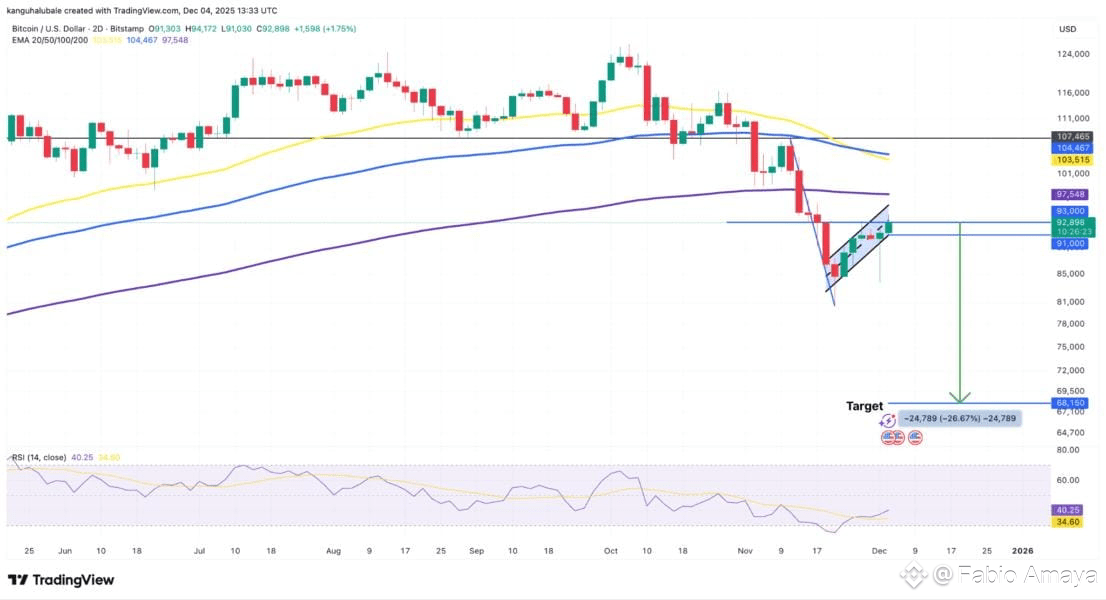
Bitcoin's bearish flag points to a price of $68,100 per BTC.
Bitcoin has fallen and found support near its real market average, which currently stands at $81,500.
The latest attempt at recovery for Bitcoin was rejected by strong resistance around $93,000, this level corresponds to the annual opening and the upper limit of a bearish flag, as shown in the two-day chart.
A break and close below the lower limit of the flag, at $91,000, will validate the bearish flag, opening the door to a new downtrend towards the measured target of the pattern at $68,150, or the previous all-time highs of 2021. Such a move would elevate total losses to 27%.
Momentum indicators, including the relative strength index (RSI), remain stagnant at 40, suggesting that market conditions continue to favor the decline.
The downtrend will be invalidated if bulls push the price above $96,000, supported by a positive Coinbase premium.
Bitcoin is showing the first signs of a deeper correction, as the latest recovery stalls at $93,000. A new analysis shows that the market structure of Bitcoin is increasingly resembling the first quarter of 2022, which marked the beginning of the bear market.
The on-chain structure of Bitcoin reflects that of early 2022, with the risk of a deep bear market if key levels are lost.
Bitcoin's bearish flag points to a price of $68,100 per BTC.
Bitcoin has fallen and found support near its real market average, which currently stands at $81,500.
The latest attempt at recovery for Bitcoin was rejected by strong resistance around $93,000, this level corresponds to the annual opening and the upper limit of a bearish flag, as shown in the two-day chart.
A break and close below the lower limit of the flag, at $91,000, will validate the bearish flag, opening the door to a new downtrend towards the measured target of the pattern at $68,150, or the previous all-time highs of 2021. Such a move would elevate total losses to 27%.
Momentum indicators, including the relative strength index (RSI), remain stagnant at 40, suggesting that market conditions continue to favor the decline.
The downtrend will be invalidated if bulls push the price above $96,000, supported by a positive Coinbase premium.
$ONDO The platform for tokenizing real-world assets, Ondo Global Markets, has expanded its offering of tokenized products to the BNB Chain, allowing access to more than 100 stocks and ETFs from Wall Street for the BNB Chain user base.
"The integration provides the BNB Chain, with its 3.4 million daily active users and its extensive DeFi ecosystem, access to over 100 tokenized stocks and ETFs from the USA, supported by leading ecosystem projects such as PancakeSwap," Ondo said in a statement on Wednesday.
PancakeSwap is the largest decentralized exchange on the BNB Chain and will be the primary platform for trading tokenized versions of US stocks and ETFs.
Part of Ondo's mission is to democratize access to US stocks and ETFs for non-US investors using blockchain technology, especially those who lack access to Wall Street through brokerage accounts in their countries in Asia and Latin America.
Almost two months ago, Ondo Global Markets tokenized US stocks and ETFs on Ethereum, securing over 350 million dollars in total value locked and driving an on-chain volume of nearly 670 million dollars.
Ondo has become one of the largest tokenization platforms for RWA since its launch in July 2021, tokenizing 1.8 billion dollars in on-chain assets, according to RWA.xyz.
"The integration provides the BNB Chain, with its 3.4 million daily active users and its extensive DeFi ecosystem, access to over 100 tokenized stocks and ETFs from the USA, supported by leading ecosystem projects such as PancakeSwap," Ondo said in a statement on Wednesday.
PancakeSwap is the largest decentralized exchange on the BNB Chain and will be the primary platform for trading tokenized versions of US stocks and ETFs.
Part of Ondo's mission is to democratize access to US stocks and ETFs for non-US investors using blockchain technology, especially those who lack access to Wall Street through brokerage accounts in their countries in Asia and Latin America.
Almost two months ago, Ondo Global Markets tokenized US stocks and ETFs on Ethereum, securing over 350 million dollars in total value locked and driving an on-chain volume of nearly 670 million dollars.
Ondo has become one of the largest tokenization platforms for RWA since its launch in July 2021, tokenizing 1.8 billion dollars in on-chain assets, according to RWA.xyz.
$ETH The on-chain data shows that investors with large capital, often called whales, are aggressively buying Ethereum. They continue to accumulate even as the asset trades sideways just below the $4,000 mark.
On October 24, a blockchain analytics platform reported that wallets controlling between 100 and 10,000 ETH had increased their holdings by more than 218,000 ETH. At current market prices, the purchases are worth more than $870 million.
The timing of these purchases is notable considering that this group had sold around 1.36 million ETH between October 5 and 16.
This period coincided with one of the most volatile stretches in the crypto industry as more than $20 billion in leveraged positions were wiped out of the market.
Considering this renewed wave of faith, the price of ETH has largely stabilized this week. It rose about 2%, reaching a peak close to $4,100 before stabilizing around $3,912 at the time of publication.
Industry experts now interpret this stability as an early sign that whales are strategically accumulating rather than speculating with short-term moves. That change in behavior has also fueled optimism among traders.
On Polymarket, several bettors predict that ETH could surpass $5,000 before the year ends.
On October 24, a blockchain analytics platform reported that wallets controlling between 100 and 10,000 ETH had increased their holdings by more than 218,000 ETH. At current market prices, the purchases are worth more than $870 million.
The timing of these purchases is notable considering that this group had sold around 1.36 million ETH between October 5 and 16.
This period coincided with one of the most volatile stretches in the crypto industry as more than $20 billion in leveraged positions were wiped out of the market.
Considering this renewed wave of faith, the price of ETH has largely stabilized this week. It rose about 2%, reaching a peak close to $4,100 before stabilizing around $3,912 at the time of publication.
Industry experts now interpret this stability as an early sign that whales are strategically accumulating rather than speculating with short-term moves. That change in behavior has also fueled optimism among traders.
On Polymarket, several bettors predict that ETH could surpass $5,000 before the year ends.
$WLD The WLD token from Worldcoin experienced an impressive increase of 50% in its price, rising from a local minimum of less than USD $1 to a peak of USD $1.39 in just 24 hours.
The price surge came after the announcement from the company Eightco Holdings, which is listed on Nasdaq, regarding a private placement of USD $250 million, along with an additional strategic investment of USD $20 million from BitMine Immersion Technologies, aimed at implementing what it calls the world’s first public treasury strategy based on Worldcoin.
Eightco Holdings, dedicated to financing solutions for e-commerce and custom packaging, announced in a statement on Monday the issuance of approximately 171,232,877 common shares at a price of USD $1.46 per share.
Additionally, BitMine acquired 13.6 million shares at the same price, adding USD $20 million to the raised capital. The transaction, led by MOZAYYX, involved participation from prominent institutional investors such as World Foundation, Discovery Capital Management, FalconX, Kraken, Pantera, and Brevan Howard, according to Eightco's official statement.
The main objective of this capital injection is to acquire WLD tokens for Eightco's treasury operations, establishing Worldcoin as its primary corporate reserve asset. Although the treasury will also hold cash and Ethereum (ETH) as secondary assets, the main focus will be on WLD, it is reported.
The price surge came after the announcement from the company Eightco Holdings, which is listed on Nasdaq, regarding a private placement of USD $250 million, along with an additional strategic investment of USD $20 million from BitMine Immersion Technologies, aimed at implementing what it calls the world’s first public treasury strategy based on Worldcoin.
Eightco Holdings, dedicated to financing solutions for e-commerce and custom packaging, announced in a statement on Monday the issuance of approximately 171,232,877 common shares at a price of USD $1.46 per share.
Additionally, BitMine acquired 13.6 million shares at the same price, adding USD $20 million to the raised capital. The transaction, led by MOZAYYX, involved participation from prominent institutional investors such as World Foundation, Discovery Capital Management, FalconX, Kraken, Pantera, and Brevan Howard, according to Eightco's official statement.
The main objective of this capital injection is to acquire WLD tokens for Eightco's treasury operations, establishing Worldcoin as its primary corporate reserve asset. Although the treasury will also hold cash and Ethereum (ETH) as secondary assets, the main focus will be on WLD, it is reported.
#CryptoIntegration The Google Play app store has issued a clarification in response to the controversy generated by an update to its policy that initially seemed to impose strict licensing requirements on all cryptocurrency wallets, including non-custodial ones.
"Non-custodial wallets are not within the scope of Google's Software Wallets and Cryptocurrency Exchanges Policy. We are updating the Help Center to make this clear," the company wrote in a response on X.
Google admitted that an update to its policy in the Play Store caused confusion by suggesting that all cryptocurrency wallets, -without distinction between custodial and non-custodial- had to comply with government licensing requirements (such as registration with FinCEN in the U.S. or as a CASP under MiCA in the European Union).
In response, Google stated that non-custodial or self-custody wallets will not be affected by its new policy, meaning they do not need to register as licensed banks or money services businesses.
"Non-custodial wallets are not within the scope of Google's Software Wallets and Cryptocurrency Exchanges Policy. We are updating the Help Center to make this clear," the company wrote in a response on X.
Google admitted that an update to its policy in the Play Store caused confusion by suggesting that all cryptocurrency wallets, -without distinction between custodial and non-custodial- had to comply with government licensing requirements (such as registration with FinCEN in the U.S. or as a CASP under MiCA in the European Union).
In response, Google stated that non-custodial or self-custody wallets will not be affected by its new policy, meaning they do not need to register as licensed banks or money services businesses.
#CreatorPad It is a tool within the Binance ecosystem designed to facilitate the launch of Web3 projects, including tokens, NFTs, and other decentralized applications. Its main function is to allow developers and creators to present their proposals to the community, accessing basic deployment and visibility tools within the platform.
Although Binance supports the infrastructure, it is important to understand that projects launched from Creator Pad do not necessarily undergo thorough auditing or guarantee success or legitimacy. The responsibility of researching each project falls on the user. Creator Pad can be useful as a technical showcase for developers, but it can also be used by actors for purely speculative purposes.
Therefore, before interacting with any initiative within these types of platforms, it is recommended to apply critical analysis criteria, review the teams behind each project, and avoid committing funds without clear and verifiable information. In an ecosystem where innovation and risk go hand in hand, staying informed and skeptical is essential.
Although Binance supports the infrastructure, it is important to understand that projects launched from Creator Pad do not necessarily undergo thorough auditing or guarantee success or legitimacy. The responsibility of researching each project falls on the user. Creator Pad can be useful as a technical showcase for developers, but it can also be used by actors for purely speculative purposes.
Therefore, before interacting with any initiative within these types of platforms, it is recommended to apply critical analysis criteria, review the teams behind each project, and avoid committing funds without clear and verifiable information. In an ecosystem where innovation and risk go hand in hand, staying informed and skeptical is essential.
#BullishIPO Bullish, operator of the eponymous cryptocurrency exchange and the media company CoinDesk, made a huge public debut on the New York Stock Exchange, with shares skyrocketing up to 218%, a clear sign of growing institutional appetite for crypto assets.
After weeks of speculation, Bullish went public on Wednesday at an IPO price of $37, above its initial target range of $32 to $33 per share.
The shares, which trade under the symbol BLSH, soared to an intraday high of $118.00, representing a gain of 218% from its IPO price, with a trading volume of approximately 38 million shares, according to data from Yahoo Finance.
At the close of the afternoon session, Bullish shares were still up 131% to approximately $86, giving the company a market capitalization of approximately $13 billion. Bullish had initially aimed for a valuation of $4.8 billion based on the expected issuance of 20.3 million shares.
However, reports on Wednesday confirmed that the company issued 30 million shares in its debut, an indication of strong and pent-up demand.
After weeks of speculation, Bullish went public on Wednesday at an IPO price of $37, above its initial target range of $32 to $33 per share.
The shares, which trade under the symbol BLSH, soared to an intraday high of $118.00, representing a gain of 218% from its IPO price, with a trading volume of approximately 38 million shares, according to data from Yahoo Finance.
At the close of the afternoon session, Bullish shares were still up 131% to approximately $86, giving the company a market capitalization of approximately $13 billion. Bullish had initially aimed for a valuation of $4.8 billion based on the expected issuance of 20.3 million shares.
However, reports on Wednesday confirmed that the company issued 30 million shares in its debut, an indication of strong and pent-up demand.
Bitcoin soared to an all-time high of over $124,000 on Thursday, fueling new optimism that the next phase of price discovery could push the cryptocurrency's market value toward Apple's $3.4 trillion.
Bitcoin reached an all-time high of $124,457, briefly taking the world's first cryptocurrency above Google's $2.45 trillion market capitalization, becoming the fifth largest global asset.
Bitcoin's new milestone has inspired a new wave of optimism, as investors now watch for the continuation of the price discovery phase, which could lead Bitcoin to surpass Apple's market capitalization next.
Bitcoin would need to exceed $175,000 to surpass Apple's current market capitalization of $3.4 trillion, which could happen before the end of August, according to cryptocurrency analyst and Taproot developer Udi Wertheimer in a post on X on Thursday.
Still, the $175,000 price estimate remains modest compared to predictions by Arthur Hayes, co-founder of BitMEX and investment director at Maelstrom, who predicted that Bitcoin could rise to $250,000 by 2025 if the U.S. Federal Reserve shifts to quantitative easing, injecting more liquidity into the financial system amid rising inflationary pressures.
#MarketGreedRising
Bitcoin reached an all-time high of $124,457, briefly taking the world's first cryptocurrency above Google's $2.45 trillion market capitalization, becoming the fifth largest global asset.
Bitcoin's new milestone has inspired a new wave of optimism, as investors now watch for the continuation of the price discovery phase, which could lead Bitcoin to surpass Apple's market capitalization next.
Bitcoin would need to exceed $175,000 to surpass Apple's current market capitalization of $3.4 trillion, which could happen before the end of August, according to cryptocurrency analyst and Taproot developer Udi Wertheimer in a post on X on Thursday.
Still, the $175,000 price estimate remains modest compared to predictions by Arthur Hayes, co-founder of BitMEX and investment director at Maelstrom, who predicted that Bitcoin could rise to $250,000 by 2025 if the U.S. Federal Reserve shifts to quantitative easing, injecting more liquidity into the financial system amid rising inflationary pressures.
#MarketGreedRising
$CFX CFX is the native token of Conflux Network, a public layer 1 blockchain that stands out for its high scalability, security, and compatibility with Ethereum. Its most notable differentiator is that Conflux is the only public blockchain authorized to operate legally in China, giving it a strategic advantage in that market, which is typically restricted for Western crypto projects.
Conflux utilizes a hybrid consensus mechanism called Tree-Graph, which combines Proof of Work (PoW) and Proof of Stake (PoS), allowing it to process transactions efficiently and on a large scale. This makes it ideal for applications in DeFi, NFTs, cross-chain bridges, and institutional solutions.
The CFX token is used to pay gas fees, stake, participate in governance, reward validating nodes, and interact with smart contracts and ecosystem services. Its utility grows as new projects and adoptions are integrated both within and outside of Asia.
Currently, CFX is trading close to $0.21 USD (July 2025), having risen from around ~$0.07 USD to a peak of ~$0.28 USD in a matter of weeks. Such rapid movements are not new to its history: it has experienced similar spikes in the past followed by corrections, so while the recent rally has drawn attention, it also invites maintaining realistic expectations.
Overall, Conflux is an interesting project due to its technical approach and unique position in the Chinese ecosystem. But like any cryptocurrency with high potential, its price movements can be volatile, and it is advisable to follow it with discretion and not get completely swept away by the excitement of the moment.
Conflux utilizes a hybrid consensus mechanism called Tree-Graph, which combines Proof of Work (PoW) and Proof of Stake (PoS), allowing it to process transactions efficiently and on a large scale. This makes it ideal for applications in DeFi, NFTs, cross-chain bridges, and institutional solutions.
The CFX token is used to pay gas fees, stake, participate in governance, reward validating nodes, and interact with smart contracts and ecosystem services. Its utility grows as new projects and adoptions are integrated both within and outside of Asia.
Currently, CFX is trading close to $0.21 USD (July 2025), having risen from around ~$0.07 USD to a peak of ~$0.28 USD in a matter of weeks. Such rapid movements are not new to its history: it has experienced similar spikes in the past followed by corrections, so while the recent rally has drawn attention, it also invites maintaining realistic expectations.
Overall, Conflux is an interesting project due to its technical approach and unique position in the Chinese ecosystem. But like any cryptocurrency with high potential, its price movements can be volatile, and it is advisable to follow it with discretion and not get completely swept away by the excitement of the moment.
The government of the United States, under the presidency of Donald Trump, remains steadfast in its intention to move forward with the creation of a strategic reserve of Bitcoin, despite the scant mention of the topic in the most recent report on crypto policy.
Robert “Bo” Hines, executive director of the Presidential Advisory Council on Digital Assets, confirmed this stance in an interview on Wednesday for Crypto in America. When asked about the initiative, Hines replied: “We believe in accumulation.” He stated that the reserve already formally exists.
The official explained that while the work in other digital ecosystems is recognized, no other specific platforms or assets will be mentioned for now. “We want to give credit to those developments, but our focus is clear,” he asserted.
Bo Hines emphasized that building the appropriate infrastructure for this policy will take time, but it is fundamental to ensure its success in the long term. “There are countless ways to accumulate,” he indicated, referring to the process of acquiring BTC.
The strategic reserve of Bitcoin (BTC) was mentioned very briefly in the report published this week by the Presidential Task Force on Digital Asset Markets. The document outlines general recommendations to “strengthen American leadership in digital financial technology.”
#BTCReserveStrategy
Robert “Bo” Hines, executive director of the Presidential Advisory Council on Digital Assets, confirmed this stance in an interview on Wednesday for Crypto in America. When asked about the initiative, Hines replied: “We believe in accumulation.” He stated that the reserve already formally exists.
The official explained that while the work in other digital ecosystems is recognized, no other specific platforms or assets will be mentioned for now. “We want to give credit to those developments, but our focus is clear,” he asserted.
Bo Hines emphasized that building the appropriate infrastructure for this policy will take time, but it is fundamental to ensure its success in the long term. “There are countless ways to accumulate,” he indicated, referring to the process of acquiring BTC.
The strategic reserve of Bitcoin (BTC) was mentioned very briefly in the report published this week by the Presidential Task Force on Digital Asset Markets. The document outlines general recommendations to “strengthen American leadership in digital financial technology.”
#BTCReserveStrategy
#CryptoScamSurge Scams Increase as XRP Reaches New Highs
Warnings have particularly focused on YouTube, where new channels impersonating Ripple or its executives emerge every day to offer supposed lucrative opportunities.
The most common type of scam involves promising users to double any amount in exchange for sending their tokens to a specific address, taking advantage of very convincing imitations. As expected, no one has recovered their money or received profits.
The rapid advancement of artificial intelligence has allowed these malicious actors to generate increasingly realistic versions of real people (known as deepfakes). Therefore, the community must be extremely vigilant when encountering these types of offers. As Garlinghouse himself stated: As always, if it sounds too good to be true, it probably is.
This warning comes at a time when the cryptocurrency market in general has surged, with multiple assets hitting new all-time highs. Ripple's cross-border payment token has been no exception: it broke its peak from January 2018 (USD 3.40) and set a new record above USD 3.60 last week.
Although its price has slightly retreated since then, XRP remains one of the most popular assets and currently ranks third by market capitalization, with over USD 200 billion.
Warnings have particularly focused on YouTube, where new channels impersonating Ripple or its executives emerge every day to offer supposed lucrative opportunities.
The most common type of scam involves promising users to double any amount in exchange for sending their tokens to a specific address, taking advantage of very convincing imitations. As expected, no one has recovered their money or received profits.
The rapid advancement of artificial intelligence has allowed these malicious actors to generate increasingly realistic versions of real people (known as deepfakes). Therefore, the community must be extremely vigilant when encountering these types of offers. As Garlinghouse himself stated: As always, if it sounds too good to be true, it probably is.
This warning comes at a time when the cryptocurrency market in general has surged, with multiple assets hitting new all-time highs. Ripple's cross-border payment token has been no exception: it broke its peak from January 2018 (USD 3.40) and set a new record above USD 3.60 last week.
Although its price has slightly retreated since then, XRP remains one of the most popular assets and currently ranks third by market capitalization, with over USD 200 billion.
$BNB In an era where cryptocurrencies are forging their place in the financial landscape, the integration of zkBNB by Binance announces a crucial transformation in low-cost digital transactions. As the tides of financial interaction change, understanding the nuances of zkBNB is essential for both investors and cryptocurrency enthusiasts alike. This editorial delves into the innovative workings of this cutting-edge layer 2 scaling solution and its influence on market mechanics, positioning Binance Coin (BNB) as a leading contender for institutional engagement.
At its core, zkBNB manifests as a formidable layer 2 rollup, utilizing zero-knowledge proofs to enhance transaction flows on the BNB Chain. This pioneering technology accelerates transaction speeds while significantly reducing gas fees. Imagine an operational capacity that can accommodate 10,000 transactions per second; that is the ambition behind zkBNB. It is destined to revolutionize sectors such as decentralized finance (DeFi) and gaming, enabling seamless transactions without the financial burden. In a realm that thrives on efficiency, zkBNB injects new vigor into these areas, promising a more accessible and affordable digital economy.
At its core, zkBNB manifests as a formidable layer 2 rollup, utilizing zero-knowledge proofs to enhance transaction flows on the BNB Chain. This pioneering technology accelerates transaction speeds while significantly reducing gas fees. Imagine an operational capacity that can accommodate 10,000 transactions per second; that is the ambition behind zkBNB. It is destined to revolutionize sectors such as decentralized finance (DeFi) and gaming, enabling seamless transactions without the financial burden. In a realm that thrives on efficiency, zkBNB injects new vigor into these areas, promising a more accessible and affordable digital economy.
#CryptoClarityAct Republican leaders of the Senate Banking Committee stated that the legislation "is based on" the CLARITY Act, which was passed in the House of Representatives last week.
Republican leaders of the US Senate Banking Committee have presented their version of the legislation for a digital asset market structure, suggesting that they may be combining their efforts with a bill passed in the House of Representatives.
In a notice on Tuesday, four Republican senators, including the chairman of the banking committee Tim Scott and the chairwoman of the digital assets subcommittee Cynthia Lummis, released a discussion draft on cryptocurrency market structure legislation.
According to the legislators, the Responsible Financial Innovation Act, tentatively titled, "is based on" the Digital Asset Market Clarity Act (CLARITY), which was passed in the House on July 17.
Although Republicans in the House pushed for the approval of three cryptocurrency bills with bipartisan support last week, only the Guiding and Establishing National Innovation for US Stablecoins Act (GENIUS Act) had passed through both chambers and could be signed into law by the President of the US, Donald Trump.
Scott and Lummis said in June that they planned for the market structure bill to be approved by the Senate before October.
Republican leaders of the US Senate Banking Committee have presented their version of the legislation for a digital asset market structure, suggesting that they may be combining their efforts with a bill passed in the House of Representatives.
In a notice on Tuesday, four Republican senators, including the chairman of the banking committee Tim Scott and the chairwoman of the digital assets subcommittee Cynthia Lummis, released a discussion draft on cryptocurrency market structure legislation.
According to the legislators, the Responsible Financial Innovation Act, tentatively titled, "is based on" the Digital Asset Market Clarity Act (CLARITY), which was passed in the House on July 17.
Although Republicans in the House pushed for the approval of three cryptocurrency bills with bipartisan support last week, only the Guiding and Establishing National Innovation for US Stablecoins Act (GENIUS Act) had passed through both chambers and could be signed into law by the President of the US, Donald Trump.
Scott and Lummis said in June that they planned for the market structure bill to be approved by the Senate before October.
$BNB The Web 3.0 infrastructure provider Nano Labs Ltd, which is listed on NASDAQ, currently shows a remarkable performance of 102% over the last year according to data from InvestingPro. It has increased its holdings of BNB cryptocurrency to 120,000 tokens, valued at approximately 90 million dollars, the company announced on Tuesday.
The company recently acquired an additional 45,684.99 BNB through over-the-counter transactions at an average price of 764 dollars per token. With these purchases, Nano Labs' total BNB holdings now represent an average acquisition cost of 707 dollars per token. The company's market capitalization stands at 131.79 million dollars, with a revenue decline of 48% over the past twelve months.
According to the announcement, this expansion marks progress in what the company describes as a "large-scale upgrade" of its strategic BNB reserve plan. Nano Labs indicated that it plans to further strengthen its position in BNB through ongoing accumulation, acquiring stakes in BNB-focused reserve entities, and investing in companies that hold BNB as a primary reserve asset.
Nano Labs, which describes itself as a provider of high-performance and high-processing computing chips in China, has adopted BNB as its primary reserve asset along with other cryptocurrencies, including Bitcoin.
The company recently acquired an additional 45,684.99 BNB through over-the-counter transactions at an average price of 764 dollars per token. With these purchases, Nano Labs' total BNB holdings now represent an average acquisition cost of 707 dollars per token. The company's market capitalization stands at 131.79 million dollars, with a revenue decline of 48% over the past twelve months.
According to the announcement, this expansion marks progress in what the company describes as a "large-scale upgrade" of its strategic BNB reserve plan. Nano Labs indicated that it plans to further strengthen its position in BNB through ongoing accumulation, acquiring stakes in BNB-focused reserve entities, and investing in companies that hold BNB as a primary reserve asset.
Nano Labs, which describes itself as a provider of high-performance and high-processing computing chips in China, has adopted BNB as its primary reserve asset along with other cryptocurrencies, including Bitcoin.
#TrumpBitcoinEmpire The new purchase of Bitcoin for 2 billion dollars shows that cryptocurrencies are replacing real estate at the heart of Trump's business empire.
President Donald Trump's media company has just acquired a reserve of the world's largest cryptocurrency. On Monday morning, Trump Media and Technology announced the acquisition of 2 billion dollars in Bitcoin and Bitcoin-related securities. It also reserved 300 million dollars to buy options on Bitcoin.
The market seemed to approve of the move, as shares of Trump's firm rose 7.2% on Monday morning from the previous close. They have risen 9%, to nearly 20 dollars, over the past week. Approximately two-thirds of the nearly 3 billion dollars in liquid assets of the company are allocated to Bitcoin.
Trump owned most of the shares of Trump Media and transferred them in December to a revocable trust before taking office. The issuance of shares to buy Bitcoin has diluted Trump's ownership percentage.
The massive cryptocurrency purchase comes almost two months after the company announced the issuance of 2.5 billion dollars in new shares and debt to finance a Bitcoin treasury. This move also reinforces how cryptocurrencies, and not real estate, are increasingly driving the Trump family's business empire.
President Donald Trump's media company has just acquired a reserve of the world's largest cryptocurrency. On Monday morning, Trump Media and Technology announced the acquisition of 2 billion dollars in Bitcoin and Bitcoin-related securities. It also reserved 300 million dollars to buy options on Bitcoin.
The market seemed to approve of the move, as shares of Trump's firm rose 7.2% on Monday morning from the previous close. They have risen 9%, to nearly 20 dollars, over the past week. Approximately two-thirds of the nearly 3 billion dollars in liquid assets of the company are allocated to Bitcoin.
Trump owned most of the shares of Trump Media and transferred them in December to a revocable trust before taking office. The issuance of shares to buy Bitcoin has diluted Trump's ownership percentage.
The massive cryptocurrency purchase comes almost two months after the company announced the issuance of 2.5 billion dollars in new shares and debt to finance a Bitcoin treasury. This move also reinforces how cryptocurrencies, and not real estate, are increasingly driving the Trump family's business empire.
#BTCvsETH The altcoin season, a period marked by a significantly superior performance of ether (ETH) and other alternative cryptocurrencies compared to bitcoin, may finally be upon us. That is the message from CoinMarketCap's Altcoin Season Index, which has surpassed the 50 level for the first time since December.
Ether and other layer 1 coins could be the top performers as a result of the passage of the GENIUS Act in the United States. The Act provides a regulatory framework for the issuance of stablecoins that could attract institutional demand towards Ethereum and other layer 1 blockchains that host tokens worth billions of dollars.
The trend is likely to accelerate if U.S. regulators approve BlackRock's plan to add staking for its spot ether ETF. Staking could enhance ether's appeal as an internet bond, leading some funds to shift from bitcoin ETFs to ether ETFs. Technical charts linked to cross pairs, such as ETH/BTC and XRP/BTC, are already hinting at significant upcoming rebounds.
The decline in Bitcoin's dominance is an important technical and psychological shift, suggesting that a structural rotation towards altcoins is underway.
Ether and other layer 1 coins could be the top performers as a result of the passage of the GENIUS Act in the United States. The Act provides a regulatory framework for the issuance of stablecoins that could attract institutional demand towards Ethereum and other layer 1 blockchains that host tokens worth billions of dollars.
The trend is likely to accelerate if U.S. regulators approve BlackRock's plan to add staking for its spot ether ETF. Staking could enhance ether's appeal as an internet bond, leading some funds to shift from bitcoin ETFs to ether ETFs. Technical charts linked to cross pairs, such as ETH/BTC and XRP/BTC, are already hinting at significant upcoming rebounds.
The decline in Bitcoin's dominance is an important technical and psychological shift, suggesting that a structural rotation towards altcoins is underway.
#StablecoinLaw As of July 18, 2025, the GENIUS Act is not just a set of rules; it is a crucial step towards illuminating the murky waters of stablecoin regulation. The law establishes explicit compliance obligations for Permitted Payment Stablecoin Issuers, providing a much-needed sigh of relief to stakeholders in this volatile market. As U.S. Treasury Secretary Scott Bessent aptly pointed out, this law marks a historic turning point, fostering an environment conducive to innovation while prioritizing consumer safety. With an increasing number of users gravitating towards digital assets, the GENIUS Act aims to inject a sense of stability into markets characterized by dramatic fluctuations.
In these fractured political times, the strong bipartisan support for the GENIUS Act is nothing short of remarkable. Advocates, including Senator Cynthia Lummis, have rallied behind the legislation, recognizing the urgent need for clarity in the realm of digital currencies. This cross-party agreement highlights a shared commitment to balancing the need for innovation with the necessity of a solid legal framework aimed at protecting consumers and investors.
In these fractured political times, the strong bipartisan support for the GENIUS Act is nothing short of remarkable. Advocates, including Senator Cynthia Lummis, have rallied behind the legislation, recognizing the urgent need for clarity in the realm of digital currencies. This cross-party agreement highlights a shared commitment to balancing the need for innovation with the necessity of a solid legal framework aimed at protecting consumers and investors.
#CryptoMarket4T The global cryptocurrency market has surpassed a market capitalization of $4 trillion for the first time, establishing itself as an asset class that leaves its niche stage on the Internet in the past.
Data from CoinGecko shows that the cryptocurrency market capitalization reached an all-time high of USD $4.003 trillion on Friday in the early hours (New York) before a slight reversal.
Bitcoin (BTC) currently dominates with nearly 60% of the total cryptocurrency market, with a capitalization of $2.36 trillion. Together with Ethereum (ETH), they represent just over 70% of the total market value.
The milestone comes amid a broader rally across the cryptocurrency market, where some major altcoins surged at double-digit percentages in 24 hours. Bitcoin, which reached a historic price peak of USD $123,000 on Monday.
The second-largest cryptocurrency, ETH, with a market capitalization of USD $436 billion, changes hands at a peak of USD $3,600, last seen at the beginning of the year, with a gain of 4.54% on the day and just over 20% for the week.
Data from CoinGecko shows that the cryptocurrency market capitalization reached an all-time high of USD $4.003 trillion on Friday in the early hours (New York) before a slight reversal.
Bitcoin (BTC) currently dominates with nearly 60% of the total cryptocurrency market, with a capitalization of $2.36 trillion. Together with Ethereum (ETH), they represent just over 70% of the total market value.
The milestone comes amid a broader rally across the cryptocurrency market, where some major altcoins surged at double-digit percentages in 24 hours. Bitcoin, which reached a historic price peak of USD $123,000 on Monday.
The second-largest cryptocurrency, ETH, with a market capitalization of USD $436 billion, changes hands at a peak of USD $3,600, last seen at the beginning of the year, with a gain of 4.54% on the day and just over 20% for the week.
Log in to explore more content