
Market Clearly
55 Posts

Market Clearly
Report
Block User
I break down the forces shaping global markets, from economics and geopolitics to stocks, ETFs and crypto. Clear explainers and news analysis.

Binance Square Angels

BNB Holder
Occasional Trader
7 Years
20 Following
42 Followers
93 Liked
1 Badges
Posts
All
Quotes
Videos
7 years on Binance.
Bull runs, bear markets, and one rough week.
What kept me here was never the charts.
It was you, the Binancians. 💛
The people who answered questions at 2 AM.
The ones who stayed calm when the timeline panicked.
The ones who waited, checked the updates, and kept trusting.
Binance is saying thank you too, with the Community Appreciation Campaign (Nov 2 to Nov 21, 2026, UTC).
@Binance_Angels
7 years on Binance.
Bull runs, bear markets, and one rough week.
What kept me here was never the charts.
It was you, the Binancians. 💛
The people who answered questions at 2 AM.
The ones who stayed calm when the timeline panicked.
The ones who waited, checked the updates, and kept trusting.
Binance is saying thank you too, with the Community Appreciation Campaign (Nov 2 to Nov 21, 2026, UTC).
@Binance Angels
1
111
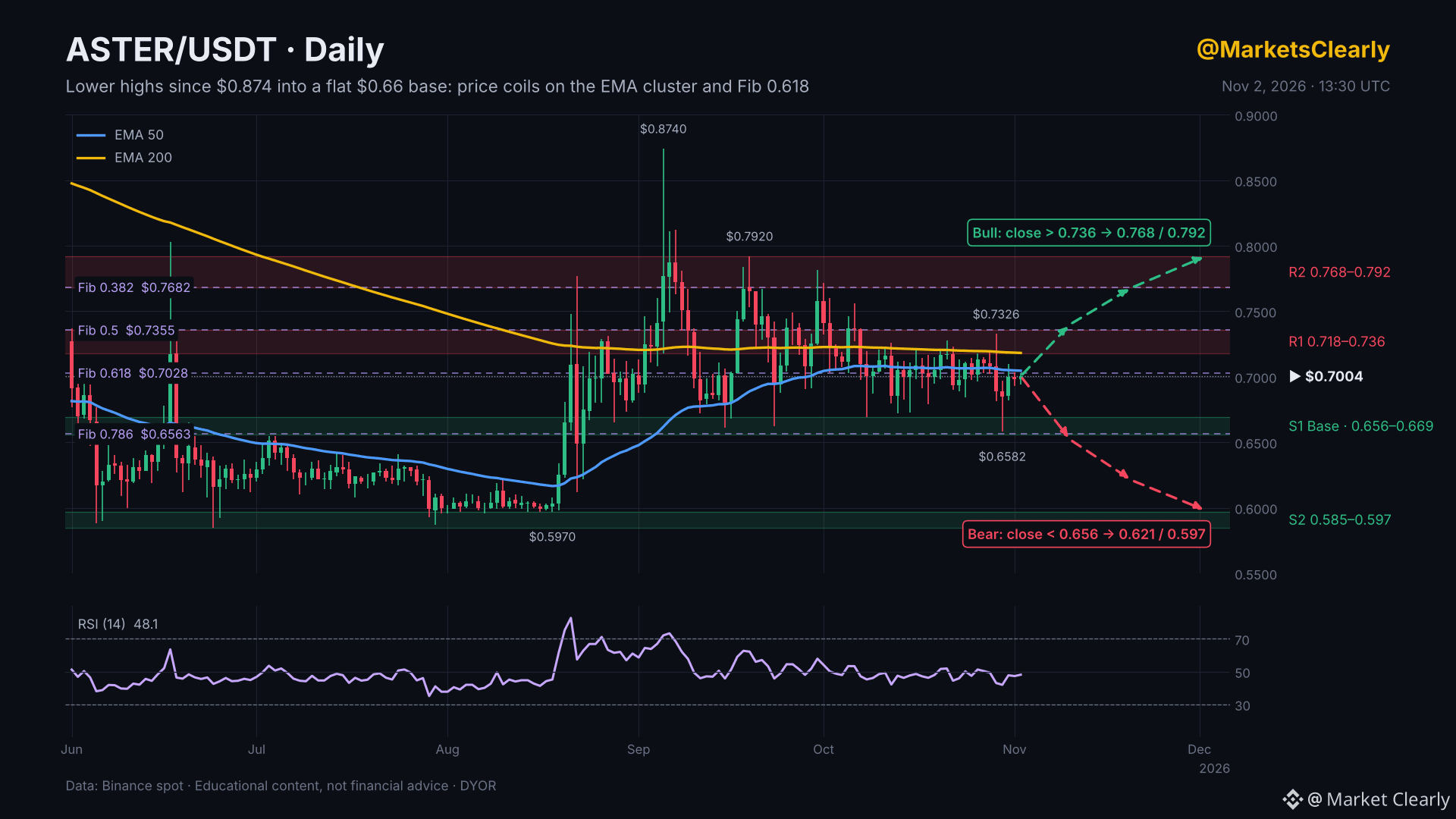
$ASTER | Daily Technical Outlook
Price: $0.7004 | RSI (14): 48
Structure
$ASTER has printed lower highs since the $0.874 September top: $0.792, $0.782, then $0.733. Lows have held flat at $0.658–0.669. The result is a descending triangle, with volume fading into the apex.
Key levels
Pivot: $0.700–0.705 (EMA 20/50 + Fib 0.618 of the $0.597–0.874 impulse). Price sits right on it.
Resistance: $0.718–0.736 (EMA 200, October highs, Fib 0.5), then $0.768–0.792.
Support: $0.656–0.669 (base tested four times + Fib 0.786), then $0.585–0.597.
Scenarios
Bullish: a daily close above $0.736 breaks the lower-high sequence and opens the way to $0.768, then $0.792.
Bearish: a daily close below $0.656 confirms the triangle breakdown and exposes $0.621, then $0.597.
View: RSI at 48 is neutral. Until one side of the $0.656–0.736 range breaks on a daily close, this is a range, not a trend.
Disclosure: I am a Binance Angel. $ASTER is a BNB Chain ecosystem token.
Not financial advice. DYOR.
#ASTER #TechnicalAnalysis #CryptoMarket
1
499
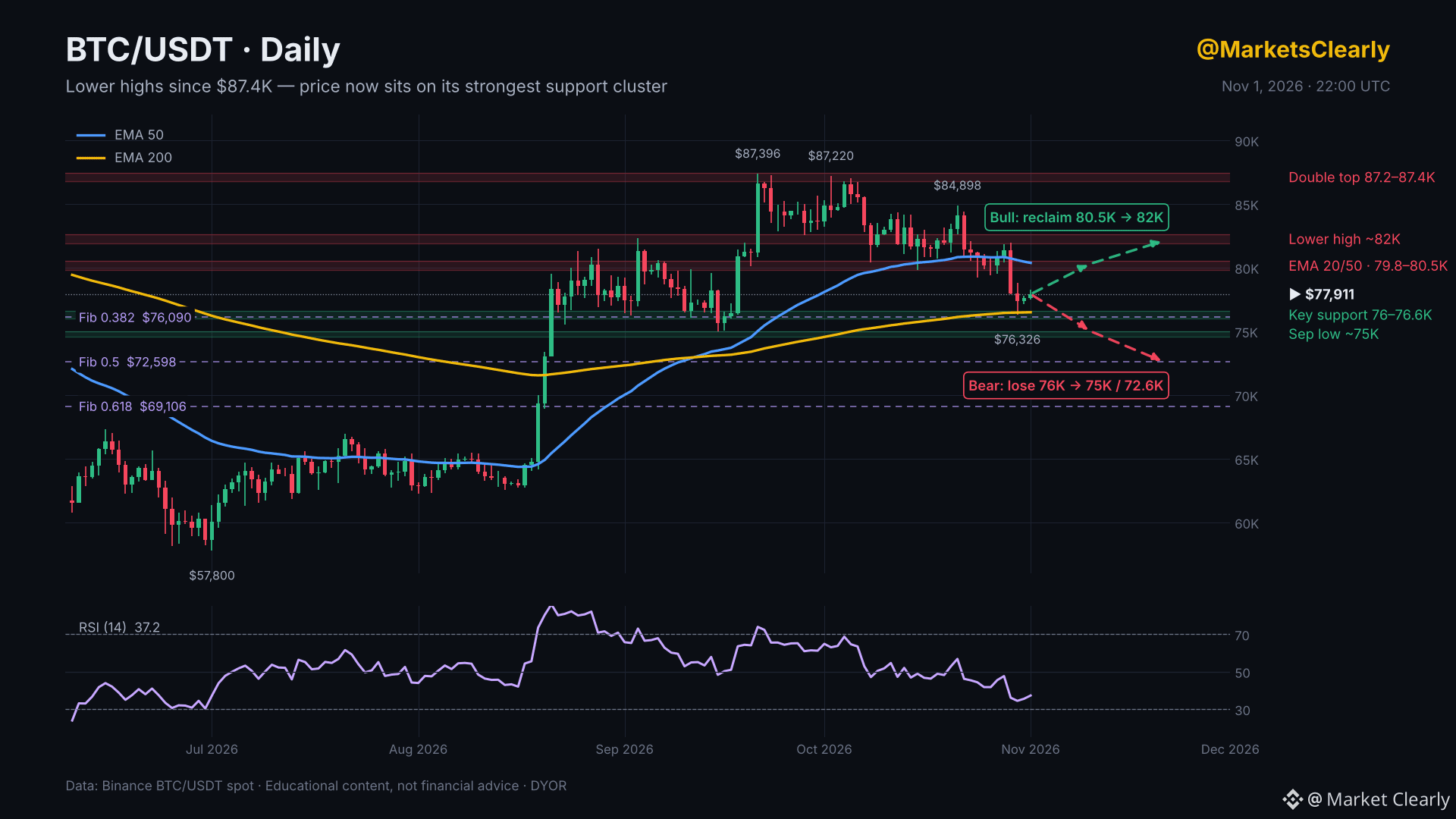
BTC | Daily Technical Outlook
Price: $77,911 | RSI (14): 37
Structure: lower highs since September ($87.4K → $84.9K → $82.0K). The short-term trend remains bearish.
Key support: $76.0K–$76.6K, where the Fib 0.382, the 200-day EMA and the Oct 30 low converge.
Bullish case: a daily close above $80.5K opens the way to $82.0K.
Bearish case: a daily close below $76.0K targets $75.0K, then $72.6K.
Not financial advice. DYOR.
98
Respect to the Binance security team working nonstop this week 🫡
The Angels have your back.
Respect to the Binance security team working nonstop this week 🫡
The Angels have your back.
The Angels have your back.
1
60
Last night, when the Binance hack was still just a rumor, I told everyone who sent me the link the same thing:
"Don't worry. Binance has got this."
That wasn't blind faith. I've been using Binance for 7 years. And in 7 years, I've watched this platform take hit after hit.
🔸 2019: 7,000 BTC stolen. Binance paid everyone back with its SAFU fund.
🔸 2022: FTX collapses and rumors start targeting Binance. Over $3.6B withdrawn in one week. Binance held strong.
🔸 2023: A record $4.3B fine in the US, and CZ steps down. No mass exodus of funds.
Every single time, Binance got back up.
That's how trust is built. Not because it's the biggest exchange, but because every time it was tested, Binance proved it could take the hit.
Nassim Taleb calls this antifragility: things that don't just survive shocks, but come out stronger. Binance is a textbook example. Every hit makes it tougher.
Today, we're looking at the biggest hack in crypto history: around $6.3B.
But Binance is already on it:
✅ Nearly $3B has already been frozen. The hacker can't touch it.
✅ Binance has promised to cover all losses.
✅ It's official: withdrawals will be back very soon.
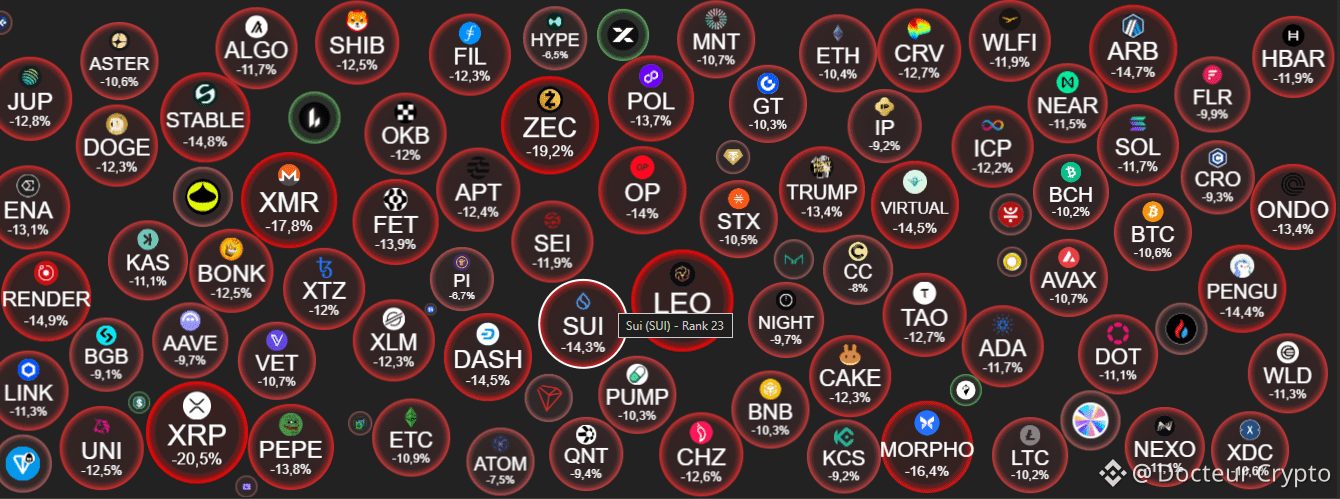
And the market? BTC dropped 3 to 5%. When FTX went down in 2022, it lost over 20% in a matter of days.
No mass panic. Because users know this will be handled. Binance earned that trust.
If there's one silver lining here: a lot of cryptos are cheaper right now. If you've been waiting to get in, this might be your window.
⚠️ This is NOT financial advice. Always do your own research (DYOR).
A Binance user for 7 years.
Build and build. 🧱
#Binance #Crypto

1
144
Oil is retreating, but markets are still watching inflation and supply.
Brent fell 1.3% to $110.23 a barrel in Asian trading on Monday, after ending the previous week at $116.72.
Asian stocks also mostly traded lower.
A pullback in oil can ease some cost pressures. It does not, by itself, remove concerns about supply or inflation.
Major technology earnings and central bank decisions could also shape markets this week.

1
493
Lula has won another term in Brazil. Markets will now focus on economic policy.
President Luiz Inácio Lula da Silva defeated Flávio Bolsonaro in Sunday’s runoff, according to official results reported by Reuters on October 26.
The result offers an initial political signal, but it does not determine how markets will move. Investors will watch the Brazilian real, local assets and the fiscal measures the government seeks to implement.
Brazil remains politically divided. The government’s ability to pass its agenda will also matter.

1
74
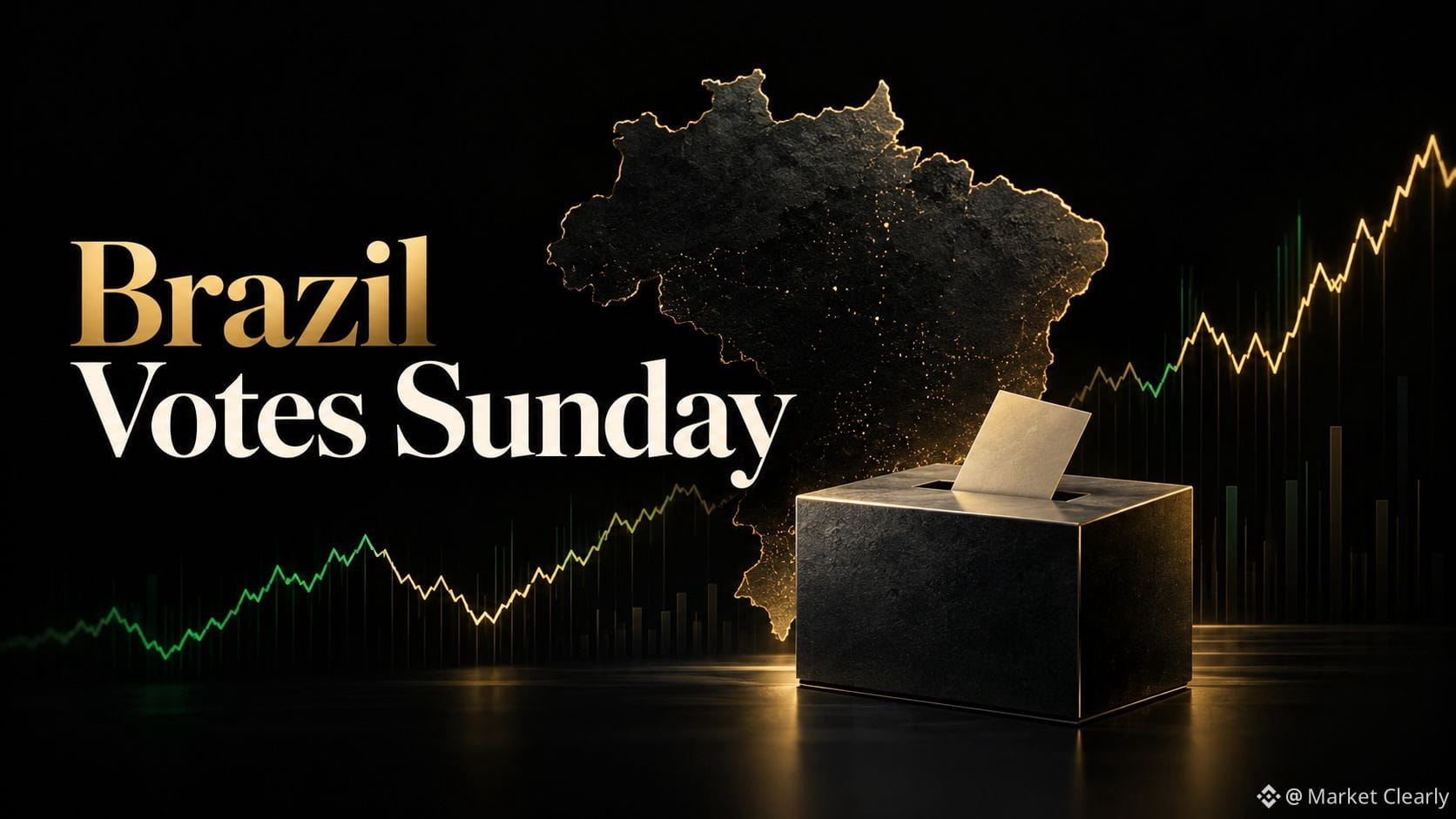
Brazil votes on Sunday. Markets’ first reactions will be worth watching on Monday.
The runoff pits President Luiz Inácio Lula da Silva against Senator Flávio Bolsonaro. In the first round, Bolsonaro received 47% of the vote, compared with 45% for Lula.
The result could shift investor expectations for Brazil’s economic policy. When markets reopen, watch the Brazilian real and local assets.
An election alone does not determine market direction. The economic decisions that follow will matter too.
2
59
Verified
Oil ended the week at its highest level since April.
Brent settled at $116.72 a barrel on Friday, up 3.14% on the day. Reuters linked the rise to concerns about potential supply disruptions in the Middle East.
Why markets care: expensive energy can raise business costs and make it harder for inflation to ease. It can also shift expectations for interest rates.
Watch actual deliveries and the security of energy routes. A price increase alone does not confirm a lasting supply disruption.

2
647
Verified
Why is oil still under pressure?
Brent rose 1.5% to $110.40 a barrel on Wednesday morning. Reuters cited shipping risks in the Gulf and Red Sea, as well as a reported drop in U.S. crude stocks based on preliminary API data.
Oil prices react to risk, but physical flows matter too. A price increase alone does not prove that deliveries have been disrupted.
Watch actual cargo flows, official U.S. inventory data and the security of shipping routes.

1
590
Investors are looking beyond AI growth. They are also asking what it costs.
Asian markets fell on Tuesday as investors awaited results from several technology companies.
They are looking for evidence that AI spending can generate enough revenue to justify the investment.
That distinction matters: strong demand for AI does not guarantee that every company will earn a return on its spending.
Watch this week’s tech earnings and companies’ investment plans.
Source: Reuters, October 20, 2026.

1
75
China’s stronger growth does not mean the recovery is evenly spread.
• GDP grew 4.5% year on year in Q3, up from 4.3% in Q2.
• Industrial production rose 5.5% in September.
• Retail sales increased 1.1% over the same period.
These indicators measure different activities. The contrast helps explain why GDP alone cannot describe conditions across businesses and households.
When following global markets, distinguish China’s production strength from consumer demand.
Watch for further measures aimed at supporting household spending.
Source: National Bureau of Statistics of China, October 19, 2026.

96

Article
Is Crypto Just Making Rich People Richer? Eleanor Terrett's Answer Will Stay With YouOne question stopped Eleanor Terrett's AMA cold:
"Is crypto just making rich people richer?"
Her answer started with Trump. And ended with a woman who had nothing.
Let's Start With The Obvious
Eleanor Terrett is one of the most respected voices in crypto journalism in the US. During her AMA on Binance Square, she didn't dodge the question.
She started with the uncomfortable truth: yes, crypto has significantly enriched those who already had capital to begin with.
The Trump family is the most striking illustration over a billion dollars generated through various crypto ventures. The more you put in, the more you get out. That's the reality of the market.
But Eleanor didn't end her analysis there. And that's where things get truly interesting.
A Story She Heard In Wyoming
At a conference, Eleanor came across a woman whose story stayed with her.
This woman was living in an abusive relationship. She wanted to leave. She needed to. But she was trapped in a situation many people don't realize exists: not a single bank account was registered in her name. Every cent in the household was under her partner's control.
No money of her own. No access. No freedom.Within the traditional financial system, she was invisible.Except she had made one quiet decision, long before any of this came to a head. She had set aside some crypto in a self-custody wallet. A wallet nobody else controlled. That nobody could block, freeze, or confiscate.That wallet allowed her to leave.
To start over.
To live.
What This Story Really Tells Us
This isn't a story about Bitcoin or Ethereum.It's a story about what financial sovereignty truly means. The ability to own something that nobody can take from you. Something that doesn't need a banker, a husband, or a government to exist.
Across francophone Africa, this reality hits particularly close to home. Millions of people women especially still don't have access to the traditional banking system. Family dependence, institutional exclusion, lack of infrastructure… The barriers are real.
Crypto doesn't solve everything. But it offers something the traditional system still denies to many: direct access, without intermediaries, without asking for permission.
But There's One Condition
Eleanor Terrett closed on a fundamental point.For crypto to truly serve everyone not just insiders, not just the wealthy, not just tech-savvy early adopters massive investment in blockchain and digital asset education is non-negotiable.
A woman who doesn't know what a self-custody wallet is can't use one to set herself free.
A young person in Côte d'Ivoire who doesn't understand the basics of Web3 can't fully benefit from it.
An uneducated community will always remain at the mercy of intermediaries.
That's exactly why crypto education isn't a bonus.
It's the foundation of everything.
Bottom Line
✅ Crypto has made the powerful richer — that's true
✅ Crypto can also liberate the most vulnerable — that's proven
✅ But this only becomes possible through education and access to information
Want to go further? Watch Eleanor Terrett's full AMA on Binance Square 👇
[replay link](https://www.binance.com/en/square/audio/replay?id=39933918288601)
DYOR :This article is for educational purposes only and does not constitute financial advice.
Is Crypto Just Making Rich People Richer? Eleanor Terrett's Answer Will Stay With You
One question stopped Eleanor Terrett's AMA cold:
"Is crypto just making rich people richer?"
Her answer started with Trump. And ended with a woman who had nothing.
Let's Start With The Obvious
Eleanor Terrett is one of the most respected voices in crypto journalism in the US. During her AMA on Binance Square, she didn't dodge the question.
She started with the uncomfortable truth: yes, crypto has significantly enriched those who already had capital to begin with.
The Trump family is the most striking illustration over a billion dollars generated through various crypto ventures. The more you put in, the more you get out. That's the reality of the market.
But Eleanor didn't end her analysis there. And that's where things get truly interesting.
A Story She Heard In Wyoming
At a conference, Eleanor came across a woman whose story stayed with her.
This woman was living in an abusive relationship. She wanted to leave. She needed to. But she was trapped in a situation many people don't realize exists: not a single bank account was registered in her name. Every cent in the household was under her partner's control.
No money of her own. No access. No freedom.Within the traditional financial system, she was invisible.Except she had made one quiet decision, long before any of this came to a head. She had set aside some crypto in a self-custody wallet. A wallet nobody else controlled. That nobody could block, freeze, or confiscate.That wallet allowed her to leave.
To start over.
To live.
What This Story Really Tells Us
This isn't a story about Bitcoin or Ethereum.It's a story about what financial sovereignty truly means. The ability to own something that nobody can take from you. Something that doesn't need a banker, a husband, or a government to exist.
Across francophone Africa, this reality hits particularly close to home. Millions of people women especially still don't have access to the traditional banking system. Family dependence, institutional exclusion, lack of infrastructure… The barriers are real.
Crypto doesn't solve everything. But it offers something the traditional system still denies to many: direct access, without intermediaries, without asking for permission.
But There's One Condition
Eleanor Terrett closed on a fundamental point.For crypto to truly serve everyone not just insiders, not just the wealthy, not just tech-savvy early adopters massive investment in blockchain and digital asset education is non-negotiable.
A woman who doesn't know what a self-custody wallet is can't use one to set herself free.
A young person in Côte d'Ivoire who doesn't understand the basics of Web3 can't fully benefit from it.
An uneducated community will always remain at the mercy of intermediaries.
That's exactly why crypto education isn't a bonus.
It's the foundation of everything.
Bottom Line
✅ Crypto has made the powerful richer — that's true
✅ Crypto can also liberate the most vulnerable — that's proven
✅ But this only becomes possible through education and access to information
Want to go further? Watch Eleanor Terrett's full AMA on Binance Square 👇
replay link
DYOR :This article is for educational purposes only and does not constitute financial advice.
1
72

Article
Binance strengthens trust: stablecoin reserves soar by 31% in one yearIn a volatile market context, Binance stands out more than ever as the central pillar of global liquidity. While investors prioritize security, data from CryptoQuant and CoinMarketCap (February 2026) confirm a clear trend: capital is not leaving the ecosystem, it is concentrating on Binance.
An unmatched dominance over liquidity
Binance is not just the leader, it is the main liquidity "hub" for digital assets. Today, the platform holds 65% of the total reserves of stablecoins (USDT and USDC) among centralized exchange platforms (CEX).
Binance strengthens trust: stablecoin reserves soar by 31% in one year
In a volatile market context, Binance stands out more than ever as the central pillar of global liquidity. While investors prioritize security, data from CryptoQuant and CoinMarketCap (February 2026) confirm a clear trend: capital is not leaving the ecosystem, it is concentrating on Binance.
An unmatched dominance over liquidity
Binance is not just the leader, it is the main liquidity "hub" for digital assets. Today, the platform holds 65% of the total reserves of stablecoins (USDT and USDC) among centralized exchange platforms (CEX).
An unmatched dominance over liquidity
Binance is not just the leader, it is the main liquidity "hub" for digital assets. Today, the platform holds 65% of the total reserves of stablecoins (USDT and USDC) among centralized exchange platforms (CEX).
1
104

Article
If patience were the secret to succeeding in crypto?In the frantic universe of cryptocurrencies, where the sparkling promises of quick enrichment ignite desires, a virtue often overlooked emerges as the true catalyst for success: patience. Against the backdrop of high-frequency trading and short-term strategies, savvy investors have understood: temperance is the keystone of any fruitful crypto journey.
I. The illusion of instant wealth
The crypto market is characterized by extreme volatility that defies imagination. Bitcoin, born in 2009, has gone through dizzying cycles: from a few cents, it reached $69,000 in 2021, only to collapse to $15,500 in 2022, before heading towards new heights. These brutal oscillations, while appealing to day-trading enthusiasts, prove psychologically devastating for the novice investor.
If patience were the secret to succeeding in crypto?
In the frantic universe of cryptocurrencies, where the sparkling promises of quick enrichment ignite desires, a virtue often overlooked emerges as the true catalyst for success: patience. Against the backdrop of high-frequency trading and short-term strategies, savvy investors have understood: temperance is the keystone of any fruitful crypto journey.
I. The illusion of instant wealth
The crypto market is characterized by extreme volatility that defies imagination. Bitcoin, born in 2009, has gone through dizzying cycles: from a few cents, it reached $69,000 in 2021, only to collapse to $15,500 in 2022, before heading towards new heights. These brutal oscillations, while appealing to day-trading enthusiasts, prove psychologically devastating for the novice investor.
1
133

Article
Crypto in "Extreme Fear": What to Do Now? 5 Tips to Survive the CrashThe cryptocurrency market has just experienced a震动. On February 6, 2026, the Fear & Greed index plunged to 5/100, a level of panic we haven't seen since the collapse of FTX. With a Bitcoin testing the critical support of $60,000, the air is becoming unbreathable for many.
Yet, history teaches us that it is precisely in this emotional fog that the greatest successes are forged. Here’s what is really happening and how you should react.
Crypto in "Extreme Fear": What to Do Now? 5 Tips to Survive the Crash
The cryptocurrency market has just experienced a震动. On February 6, 2026, the Fear & Greed index plunged to 5/100, a level of panic we haven't seen since the collapse of FTX. With a Bitcoin testing the critical support of $60,000, the air is becoming unbreathable for many.
Yet, history teaches us that it is precisely in this emotional fog that the greatest successes are forged. Here’s what is really happening and how you should react.
Yet, history teaches us that it is precisely in this emotional fog that the greatest successes are forged. Here’s what is really happening and how you should react.
1
1
3
442
Exactly. In the long run, it’s always interesting to buy the dip.
Bitcoin is simply the King 👑
Exactly. In the long run, it’s always interesting to buy the dip.
Bitcoin is simply the King 👑
Bitcoin is simply the King 👑

Hermes-T-06
·
--
Very good analysis 👍. It's promotion time. -50% on BTC. Small wallets must absolutely take advantage of it.
1
39
@BiBi what do you think about it
@Binance BiBi what do you think about it
Market Clearly
·
--
Bitcoin Crash 2026: Why the "Season 2" of COVID is a once-in-a-lifetime opportunity.
Bitcoin has just broken the major support of $70,000, testing $66,675 today, February 5, 2026. For the crowd, it's panic. For those who survived the "Black Thursday" of March 2020, it's a déjà vu that smells of accumulation.
Let's analyze why this chaos is a liquidity anomaly and how the data proves we are at the final capitulation point.
1. "Black Thursday" 2.0: A leverage purge, no conviction
In March 2020, BTC fell by 50% not due to a technical flaw, but due to a global liquidity crisis. Today, the mechanics are the same:

31

Article
Kevin Warsh: The "Regime Change" Rattling Wall StreetAs the prospect of Kevin Warsh taking the helm of the Federal Reserve in May 2026 becomes a central theme for the markets, investors are grappling with a profound shift in monetary philosophy. While markets generally dislike uncertainty, they are even more wary of "structural ruptures." Warsh does not represent a status quo transition; he signals a doctrinal revolution at the world’s most powerful central bank.
1. The Warsh Doctrine: Moving Beyond "Data Dependency"
Kevin Warsh’s primary critique of the current Federal Reserve is that it has become an overly bureaucratic institution, too predictable, and dangerously tethered to backward-looking indicators.
Against "Rearview Mirror" Policy: Warsh criticizes Jerome Powell’s tendency to wait for every tenth of a percentage point of inflation to be confirmed before acting. In Warsh’s view, the Fed should be proactive and anticipatory rather than reactive.The AI-Driven Productivity Thesis: Unlike traditional models that fear growth inherently fuels inflation, Warsh argues that Artificial Intelligence is driving a massive productivity boom. He believes this allows for aggressive rate cuts without reigniting price spirals.Balance Sheet Normalization: This is the most contentious point for Wall Street. Warsh advocates for a drastic reduction of the Fed's balance sheet (Quantitative Tightening). He believes the central bank should no longer act as the "buyer of last resort" for U.S. debt.
2. Why This Week’s Correction is Directly Linked to Him
The recent market turmoil—marked by a sharp sell-off in precious metals and bonds—is the result of the market attempting to "price in" the Warsh enigma.
The Commodities Shock: Silver recently suffered its worst trading session in decades. This is largely because Warsh is perceived as a "Strong Dollar" advocate. A resurgent USD mechanically exerts downward pressure on dollar-denominated commodities.The Long-End Rate Paradox: While he may favor lower policy rates to satisfy pro-growth mandates, his desire to shrink the Fed’s balance sheet pushes long-term bond yields higher. This creates a volatile environment: lower short-term rates but surging long-term borrowing costs.The End of the "Fed Put": Investors fear that Warsh will abandon the practice of bailing out the market at the first sign of a 5% dip. He represents a move away from the systematic "support doctrine" of the Powell era.
3. Why the Downward Pressure May Persist
The market has entered a "repricing" phase that is unlikely to resolve quickly for three key reasons:
The Hawk-Dove Hybrid: Warsh is difficult to categorize. Historically an inflation hawk, he now advocates for rate cuts to stimulate the "supply side." This ambiguity creates extreme volatility as the market struggles to forecast his true policy path.Institutional Overhaul: Warsh supports a fundamental review of Fed governance. The prospect of reduced institutional independence—or at least a shift in its relationship with the Treasury—is prompting institutional investors to reduce risk exposure.Liquidity Extraction: If Warsh follows through on reducing the Fed's liquidity injections, sectors that flourished under "easy money"—specifically Big Tech and Cryptocurrencies—will have to adjust their valuations to a much leaner economic reality.
The Bottom Line: This week's correction is more than just profit-taking; it is the financial world adjusting to the end of an era. Kevin Warsh represents the transition from a "Protective Fed" to a "Reformist Fed."
Kevin Warsh: The "Regime Change" Rattling Wall Street
As the prospect of Kevin Warsh taking the helm of the Federal Reserve in May 2026 becomes a central theme for the markets, investors are grappling with a profound shift in monetary philosophy. While markets generally dislike uncertainty, they are even more wary of "structural ruptures." Warsh does not represent a status quo transition; he signals a doctrinal revolution at the world’s most powerful central bank.
1. The Warsh Doctrine: Moving Beyond "Data Dependency"
Kevin Warsh’s primary critique of the current Federal Reserve is that it has become an overly bureaucratic institution, too predictable, and dangerously tethered to backward-looking indicators.
Against "Rearview Mirror" Policy: Warsh criticizes Jerome Powell’s tendency to wait for every tenth of a percentage point of inflation to be confirmed before acting. In Warsh’s view, the Fed should be proactive and anticipatory rather than reactive.The AI-Driven Productivity Thesis: Unlike traditional models that fear growth inherently fuels inflation, Warsh argues that Artificial Intelligence is driving a massive productivity boom. He believes this allows for aggressive rate cuts without reigniting price spirals.Balance Sheet Normalization: This is the most contentious point for Wall Street. Warsh advocates for a drastic reduction of the Fed's balance sheet (Quantitative Tightening). He believes the central bank should no longer act as the "buyer of last resort" for U.S. debt.
2. Why This Week’s Correction is Directly Linked to Him
The recent market turmoil—marked by a sharp sell-off in precious metals and bonds—is the result of the market attempting to "price in" the Warsh enigma.
The Commodities Shock: Silver recently suffered its worst trading session in decades. This is largely because Warsh is perceived as a "Strong Dollar" advocate. A resurgent USD mechanically exerts downward pressure on dollar-denominated commodities.The Long-End Rate Paradox: While he may favor lower policy rates to satisfy pro-growth mandates, his desire to shrink the Fed’s balance sheet pushes long-term bond yields higher. This creates a volatile environment: lower short-term rates but surging long-term borrowing costs.The End of the "Fed Put": Investors fear that Warsh will abandon the practice of bailing out the market at the first sign of a 5% dip. He represents a move away from the systematic "support doctrine" of the Powell era.
3. Why the Downward Pressure May Persist
The market has entered a "repricing" phase that is unlikely to resolve quickly for three key reasons:
The Hawk-Dove Hybrid: Warsh is difficult to categorize. Historically an inflation hawk, he now advocates for rate cuts to stimulate the "supply side." This ambiguity creates extreme volatility as the market struggles to forecast his true policy path.Institutional Overhaul: Warsh supports a fundamental review of Fed governance. The prospect of reduced institutional independence—or at least a shift in its relationship with the Treasury—is prompting institutional investors to reduce risk exposure.Liquidity Extraction: If Warsh follows through on reducing the Fed's liquidity injections, sectors that flourished under "easy money"—specifically Big Tech and Cryptocurrencies—will have to adjust their valuations to a much leaner economic reality.
The Bottom Line: This week's correction is more than just profit-taking; it is the financial world adjusting to the end of an era. Kevin Warsh represents the transition from a "Protective Fed" to a "Reformist Fed."
1
274
Log in to explore more content
Join global crypto users on Binance Square
⚡️ Get latest and useful information about crypto.
💬 Trusted by the world’s largest crypto exchange.
👍 Discover real insights from verified creators.
Email / Phone number
Trending Topics
BTCRebounds80K
18,160 views
468 Discussing
$BTC LONG SETUP ... NEXT TARGET 81,923.14
Upper Range Breakout Observed Alongside Balanced Momentum Signals
Entry: 78,610.70 - 78,959.38 (Long)
TP1: 79,831.07
TP2: 80,877.11
Final TP: 81,923.14
SL: 77,739.01
Price expanded upward over the past twenty-four hours to trade above the peak of the last twenty four-hour candles. As the relative strength index remains neutral on the four-hour chart, traders monitor whether this level transitions into support.
As long as 78,610.70 holds, structure stays constructive
Must use stop loss while trading
Trade $BTC
Not financial advice. Always DYOR.
Like & Follow for Daily Trade Analytics & Insider News. @SarwatAK
#HotTrends #TechnicalAnalysis #BTCRebounds80K
SarwatAK
·0 Likes
·227 views
Binance98PercentReplenished
17,861 views
430 Discussing
USMidterms-WhatAreMarketsExpecting?
273,245 views
1,910 Discussing