
CryptoMasterXY
739 Posts

CryptoMasterXY
Report
Block User
Crypto MasterX | Precision.
TA On-chain Execution
Master. Repeat
Open Trade
Frequent Trader
2 Years
45 Following
94 Followers
664 Liked
Posts
Portfolio
All
Quotes
Videos
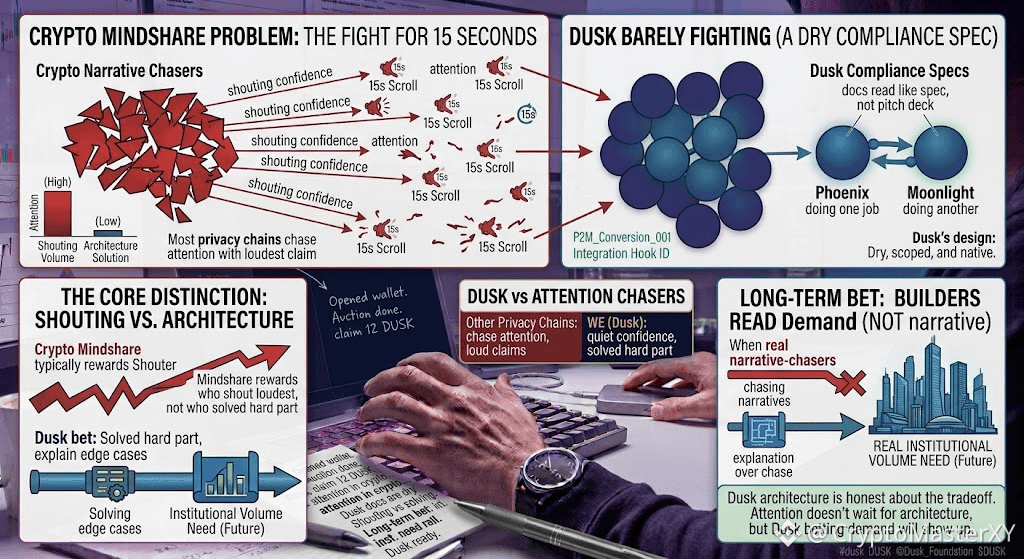
I've been thinking about attention in crypto differently since this morning. Everyone in this space is fighting for the same fifteen seconds of someone's scroll. Dusk barely seems to be fighting at all, and that's what made me stop and look closer.
Most privacy chains chase attention with the loudest claim they can make. Dusk's docs read almost dry by comparison, more like a compliance spec than a pitch deck. No promises about beating regulators at their own game. Just Moonlight and Phoenix, quietly doing two different jobs.
That's the part that got me. Mindshare in crypto usually rewards whoever shouts confidence the loudest, not whoever actually solved the hard part. Dusk seems to be betting the opposite way, that when real institutional volume eventually needs a compliant privacy rail, the builders who spent this cycle explaining edge cases instead of chasing narratives will be the only ones ready.
I don't know if that bet pays off. Attention doesn't wait around for architecture to prove itself.
But it's a strange kind of confidence, building for a demand that hasn't fully shown up yet.
@Dusk_Foundation $DUSK #dusk
{future}(DUSKUSDT)
{future}(PORTALUSDT)
{future}(PROMUSDT)
I've been thinking about attention in crypto differently since this morning. Everyone in this space is fighting for the same fifteen seconds of someone's scroll. Dusk barely seems to be fighting at all, and that's what made me stop and look closer.
Most privacy chains chase attention with the loudest claim they can make. Dusk's docs read almost dry by comparison, more like a compliance spec than a pitch deck. No promises about beating regulators at their own game. Just Moonlight and Phoenix, quietly doing two different jobs.
That's the part that got me. Mindshare in crypto usually rewards whoever shouts confidence the loudest, not whoever actually solved the hard part. Dusk seems to be betting the opposite way, that when real institutional volume eventually needs a compliant privacy rail, the builders who spent this cycle explaining edge cases instead of chasing narratives will be the only ones ready.
I don't know if that bet pays off. Attention doesn't wait around for architecture to prove itself.
But it's a strange kind of confidence, building for a demand that hasn't fully shown up yet.
@Dusk $DUSK #dusk
Most privacy chains chase attention with the loudest claim they can make. Dusk's docs read almost dry by comparison, more like a compliance spec than a pitch deck. No promises about beating regulators at their own game. Just Moonlight and Phoenix, quietly doing two different jobs.
That's the part that got me. Mindshare in crypto usually rewards whoever shouts confidence the loudest, not whoever actually solved the hard part. Dusk seems to be betting the opposite way, that when real institutional volume eventually needs a compliant privacy rail, the builders who spent this cycle explaining edge cases instead of chasing narratives will be the only ones ready.
I don't know if that bet pays off. Attention doesn't wait around for architecture to prove itself.
But it's a strange kind of confidence, building for a demand that hasn't fully shown up yet.
@Dusk $DUSK #dusk
124
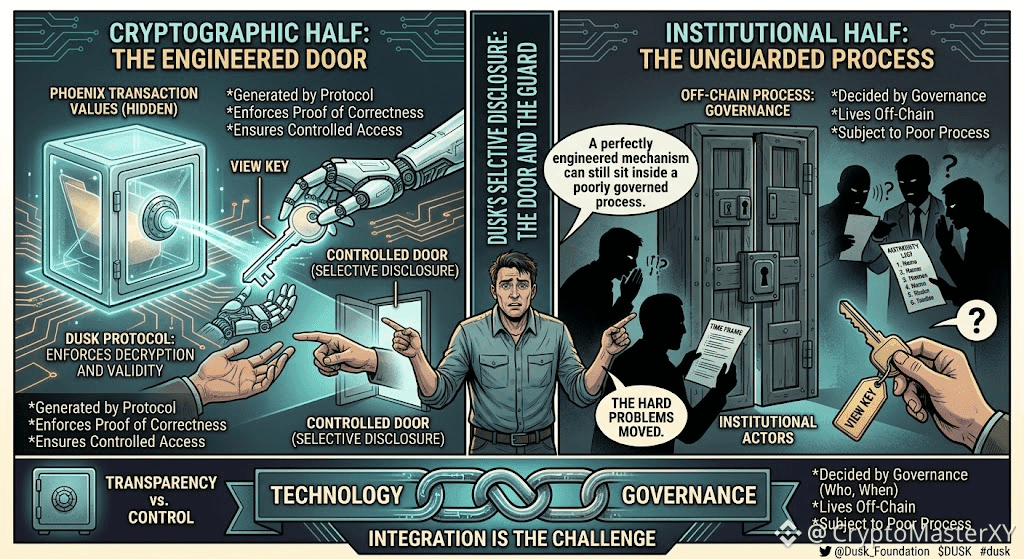
Still thinking about Dusk this evening, and something else came up while I was digging through the docs. If Phoenix hides transaction values by default, I kept wondering, how does anyone ever actually audit one.
Turns out the answer is view keys. Not the same view key concept people usually mention for wallet syncing. This is about selective disclosure, where a transaction owner can hand a specific viewing key to an auditor or regulator, letting that one party decrypt the details without exposing anything to the wider network.
That reframed the whole privacy question for me. It's not privacy versus transparency. It's privacy with a controlled door built into it.
But a door only matters if someone chooses to open it correctly. The protocol can generate the key and enforce that decryption works as designed. It has no say in who receives that key, when it's issued, or whether the process around it is even trustworthy.
So the technology solves the cryptographic half of disclosure. The institutional half, who holds the authority to request a key and under what conditions, still lives entirely off-chain.
That's the part that unsettles me a little. A perfectly engineered selective disclosure mechanism can still sit inside a poorly governed process.
I don't think that makes it less useful. It just means the hard problems didn't disappear. They moved.
Docs tab still open. Onto the next section.
@Dusk_Foundation $DUSK #dusk $SPK $MORPHO
Still thinking about Dusk this evening, and something else came up while I was digging through the docs. If Phoenix hides transaction values by default, I kept wondering, how does anyone ever actually audit one.
Turns out the answer is view keys. Not the same view key concept people usually mention for wallet syncing. This is about selective disclosure, where a transaction owner can hand a specific viewing key to an auditor or regulator, letting that one party decrypt the details without exposing anything to the wider network.
That reframed the whole privacy question for me. It's not privacy versus transparency. It's privacy with a controlled door built into it.
But a door only matters if someone chooses to open it correctly. The protocol can generate the key and enforce that decryption works as designed. It has no say in who receives that key, when it's issued, or whether the process around it is even trustworthy.
So the technology solves the cryptographic half of disclosure. The institutional half, who holds the authority to request a key and under what conditions, still lives entirely off-chain.
That's the part that unsettles me a little. A perfectly engineered selective disclosure mechanism can still sit inside a poorly governed process.
I don't think that makes it less useful. It just means the hard problems didn't disappear. They moved.
Docs tab still open. Onto the next section.
@Dusk $DUSK #dusk $SPK $MORPHO
Turns out the answer is view keys. Not the same view key concept people usually mention for wallet syncing. This is about selective disclosure, where a transaction owner can hand a specific viewing key to an auditor or regulator, letting that one party decrypt the details without exposing anything to the wider network.
That reframed the whole privacy question for me. It's not privacy versus transparency. It's privacy with a controlled door built into it.
But a door only matters if someone chooses to open it correctly. The protocol can generate the key and enforce that decryption works as designed. It has no say in who receives that key, when it's issued, or whether the process around it is even trustworthy.
So the technology solves the cryptographic half of disclosure. The institutional half, who holds the authority to request a key and under what conditions, still lives entirely off-chain.
That's the part that unsettles me a little. A perfectly engineered selective disclosure mechanism can still sit inside a poorly governed process.
I don't think that makes it less useful. It just means the hard problems didn't disappear. They moved.
Docs tab still open. Onto the next section.
@Dusk $DUSK #dusk $SPK $MORPHO
3
3
264
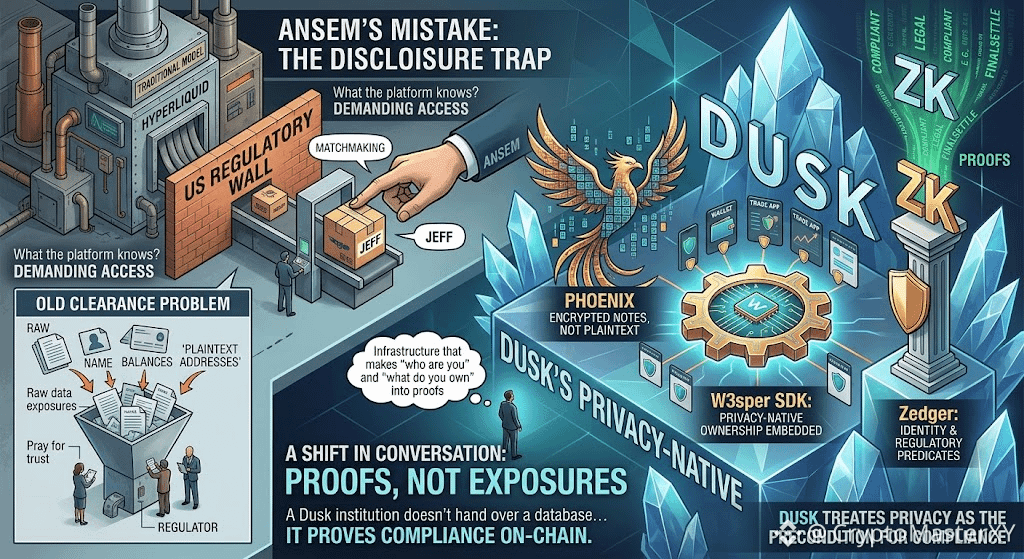
Ansem's mistake wasn't failing to name a partner for Jeff. It was treating Hyperliquid's US wall as a clearance problem when it is actually a disclosure problem.
The American side doesn't ask whether the platform works; it asks what the platform knows.
Hyperliquid can't answer that without revealing balances, identities, and transaction histories that were never designed to be selectively shared. Dusk didn't build a faster bridge to regulators. It built a system where disclosure is native, scoped, and cryptographic.
Phoenix commits every balance as an encrypted note, not a plaintext address, and the W3sper SDK lets any application embed that privacy-native ownership model without rebuilding zero-knowledge circuits from scratch.
Zedger sits on top of that: identity credentials and regulatory constraints become provable predicates inside the proof, not raw documents handed to a partner. Ownership is proven through zero-knowledge circuits that output truth without leaking the underlying record. That changes the entire conversation.
A Dusk institution doesn't hand over a database and pray the regulator trusts the partner. It proves compliance on-chain—identity constraints, asset legitimacy, settlement finality—while the raw data stays encrypted. Hyperliquid needs a US partner because its architecture treats privacy as an obstacle to compliance.
Dusk treats privacy as the precondition for it. Ansem had the reach to explain that distinction, and he spent it on matchmaking.
The market doesn't need another partner announcement. It needs infrastructure that makes "who are you" and "what do you own" into proofs, not exposures. Dusk already built that. The question is whether the audience was ready to hear it.
@Dusk_Foundation $DUSK #dusk $TUT $TRUMP
Ansem's mistake wasn't failing to name a partner for Jeff. It was treating Hyperliquid's US wall as a clearance problem when it is actually a disclosure problem.
The American side doesn't ask whether the platform works; it asks what the platform knows.
Hyperliquid can't answer that without revealing balances, identities, and transaction histories that were never designed to be selectively shared. Dusk didn't build a faster bridge to regulators. It built a system where disclosure is native, scoped, and cryptographic.
Phoenix commits every balance as an encrypted note, not a plaintext address, and the W3sper SDK lets any application embed that privacy-native ownership model without rebuilding zero-knowledge circuits from scratch.
Zedger sits on top of that: identity credentials and regulatory constraints become provable predicates inside the proof, not raw documents handed to a partner. Ownership is proven through zero-knowledge circuits that output truth without leaking the underlying record. That changes the entire conversation.
A Dusk institution doesn't hand over a database and pray the regulator trusts the partner. It proves compliance on-chain—identity constraints, asset legitimacy, settlement finality—while the raw data stays encrypted. Hyperliquid needs a US partner because its architecture treats privacy as an obstacle to compliance.
Dusk treats privacy as the precondition for it. Ansem had the reach to explain that distinction, and he spent it on matchmaking.
The market doesn't need another partner announcement. It needs infrastructure that makes "who are you" and "what do you own" into proofs, not exposures. Dusk already built that. The question is whether the audience was ready to hear it.
@Dusk $DUSK #dusk $TUT $TRUMP
The American side doesn't ask whether the platform works; it asks what the platform knows.
Hyperliquid can't answer that without revealing balances, identities, and transaction histories that were never designed to be selectively shared. Dusk didn't build a faster bridge to regulators. It built a system where disclosure is native, scoped, and cryptographic.
Phoenix commits every balance as an encrypted note, not a plaintext address, and the W3sper SDK lets any application embed that privacy-native ownership model without rebuilding zero-knowledge circuits from scratch.
Zedger sits on top of that: identity credentials and regulatory constraints become provable predicates inside the proof, not raw documents handed to a partner. Ownership is proven through zero-knowledge circuits that output truth without leaking the underlying record. That changes the entire conversation.
A Dusk institution doesn't hand over a database and pray the regulator trusts the partner. It proves compliance on-chain—identity constraints, asset legitimacy, settlement finality—while the raw data stays encrypted. Hyperliquid needs a US partner because its architecture treats privacy as an obstacle to compliance.
Dusk treats privacy as the precondition for it. Ansem had the reach to explain that distinction, and he spent it on matchmaking.
The market doesn't need another partner announcement. It needs infrastructure that makes "who are you" and "what do you own" into proofs, not exposures. Dusk already built that. The question is whether the audience was ready to hear it.
@Dusk $DUSK #dusk $TUT $TRUMP
1
1
2
230
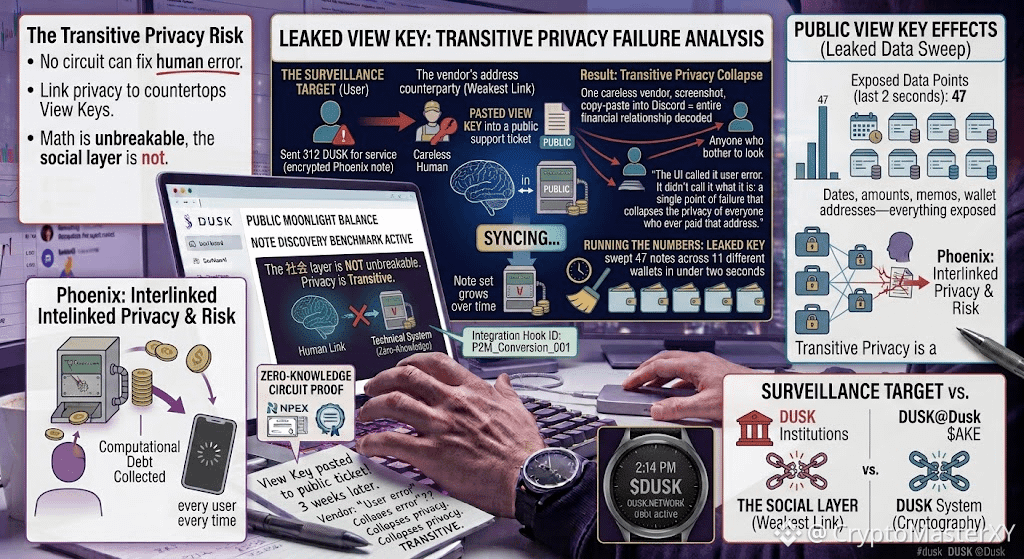
I didn’t plan to become a surveillance target. I only sent 312 DUSK to a vendor for a service, and we used Phoenix exactly as intended: encrypted notes, zero-knowledge proof, no plaintext on-chain.
That’s where I saw it: three weeks later, that vendor pasted their View Key into a public support ticket to “verify” a different payment. The ticket was public. The View Key was public. And just like that, my 312 DUSK transaction wasn’t private anymore.
The UI called it “user error.” It didn’t call it what it is: a single point of failure that collapses the privacy of everyone who ever paid that address. Because Phoenix doesn’t just encrypt your balance—it links your privacy to the View Keys of every counterparty you’ve ever trusted. One careless vendor, one screenshot, one copy-paste into Discord, and your entire financial relationship with them is decoded for anyone who bothers to look.
I ran the numbers on that leaked key: it swept 47 notes across 11 different wallets in under two seconds. Dates, amounts, memos, wallet addresses—everything exposed. And I realized the zero-knowledge proof didn’t fail. The cryptography didn’t fail. The human did. But the system had no way to stop that human from becoming the leak.
We talk about privacy as a property of the chain. But in Dusk, privacy is transitive, and it dies the moment the weakest link in your transaction graph makes a mistake. No circuit can fix that. No Succinct Attestation can finalize it away.
The math is unbreakable. The social layer is not.
#dusk $DUSK @Dusk_Foundation $ROBO $GALA
I didn’t plan to become a surveillance target. I only sent 312 DUSK to a vendor for a service, and we used Phoenix exactly as intended: encrypted notes, zero-knowledge proof, no plaintext on-chain.
That’s where I saw it: three weeks later, that vendor pasted their View Key into a public support ticket to “verify” a different payment. The ticket was public. The View Key was public. And just like that, my 312 DUSK transaction wasn’t private anymore.
The UI called it “user error.” It didn’t call it what it is: a single point of failure that collapses the privacy of everyone who ever paid that address. Because Phoenix doesn’t just encrypt your balance—it links your privacy to the View Keys of every counterparty you’ve ever trusted. One careless vendor, one screenshot, one copy-paste into Discord, and your entire financial relationship with them is decoded for anyone who bothers to look.
I ran the numbers on that leaked key: it swept 47 notes across 11 different wallets in under two seconds. Dates, amounts, memos, wallet addresses—everything exposed. And I realized the zero-knowledge proof didn’t fail. The cryptography didn’t fail. The human did. But the system had no way to stop that human from becoming the leak.
We talk about privacy as a property of the chain. But in Dusk, privacy is transitive, and it dies the moment the weakest link in your transaction graph makes a mistake. No circuit can fix that. No Succinct Attestation can finalize it away.
The math is unbreakable. The social layer is not.
#dusk $DUSK @Dusk $ROBO $GALA
That’s where I saw it: three weeks later, that vendor pasted their View Key into a public support ticket to “verify” a different payment. The ticket was public. The View Key was public. And just like that, my 312 DUSK transaction wasn’t private anymore.
The UI called it “user error.” It didn’t call it what it is: a single point of failure that collapses the privacy of everyone who ever paid that address. Because Phoenix doesn’t just encrypt your balance—it links your privacy to the View Keys of every counterparty you’ve ever trusted. One careless vendor, one screenshot, one copy-paste into Discord, and your entire financial relationship with them is decoded for anyone who bothers to look.
I ran the numbers on that leaked key: it swept 47 notes across 11 different wallets in under two seconds. Dates, amounts, memos, wallet addresses—everything exposed. And I realized the zero-knowledge proof didn’t fail. The cryptography didn’t fail. The human did. But the system had no way to stop that human from becoming the leak.
We talk about privacy as a property of the chain. But in Dusk, privacy is transitive, and it dies the moment the weakest link in your transaction graph makes a mistake. No circuit can fix that. No Succinct Attestation can finalize it away.
The math is unbreakable. The social layer is not.
#dusk $DUSK @Dusk $ROBO $GALA
1
76
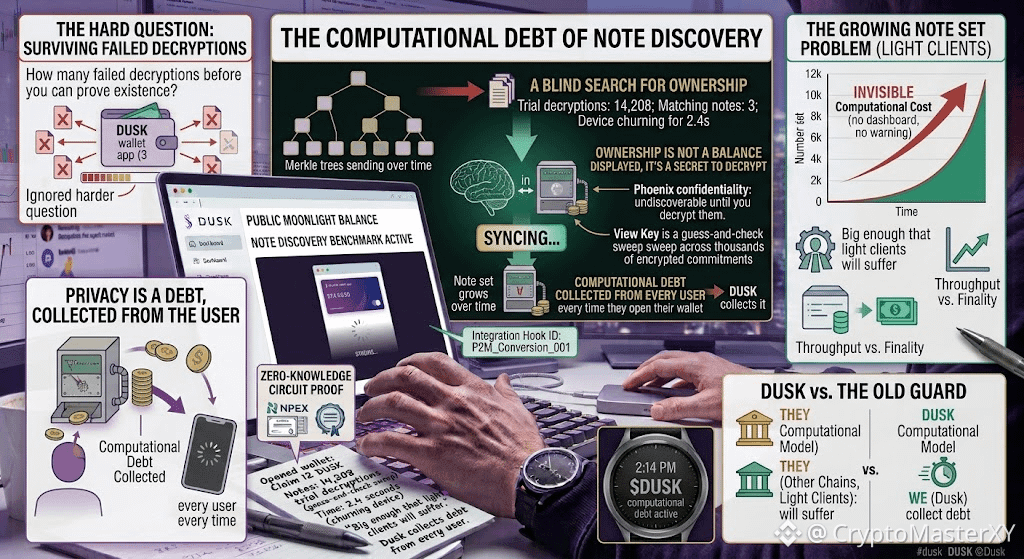
I didn’t plan to benchmark Dusk’s note discovery.
I only opened my wallet to claim 12 DUSK from a completed auction. That’s where I saw it: 14,208 trial decryptions, 3 matching notes, and 2.4 seconds of my device churning through the Merkle tree before the balance even appeared.
The UI called it “syncing.” It didn’t call it what it is: a blind search for ownership in a ledger that refuses to tell you what’s yours.
Phoenix makes balances private by making them undiscoverable until you decrypt them. My View Key wasn’t a key; it was a guess-and-check sweep across thousands of encrypted commitments I didn’t own, just to find the three I did. The note set grows with every block, but the cost of scanning it is invisible—no gas meter, no dashboard, no warning.
We obsess over throughput, finality, Succinct Attestation. We ignore the harder question: how many failed decryptions does your wallet have to survive before it can prove to itself that you exist?
I asked a validator how large the note set was now. He said, “Big enough that light clients will suffer.”
That night I stopped thinking of privacy as a feature. It’s a computational debt, and Dusk collects it from every user every time they open their wallet.
#dusk $DUSK @Dusk_Foundation $ONG $AVAAI
I didn’t plan to benchmark Dusk’s note discovery.
I only opened my wallet to claim 12 DUSK from a completed auction. That’s where I saw it: 14,208 trial decryptions, 3 matching notes, and 2.4 seconds of my device churning through the Merkle tree before the balance even appeared.
The UI called it “syncing.” It didn’t call it what it is: a blind search for ownership in a ledger that refuses to tell you what’s yours.
Phoenix makes balances private by making them undiscoverable until you decrypt them. My View Key wasn’t a key; it was a guess-and-check sweep across thousands of encrypted commitments I didn’t own, just to find the three I did. The note set grows with every block, but the cost of scanning it is invisible—no gas meter, no dashboard, no warning.
We obsess over throughput, finality, Succinct Attestation. We ignore the harder question: how many failed decryptions does your wallet have to survive before it can prove to itself that you exist?
I asked a validator how large the note set was now. He said, “Big enough that light clients will suffer.”
That night I stopped thinking of privacy as a feature. It’s a computational debt, and Dusk collects it from every user every time they open their wallet.
#dusk $DUSK @Dusk $ONG $AVAAI
I only opened my wallet to claim 12 DUSK from a completed auction. That’s where I saw it: 14,208 trial decryptions, 3 matching notes, and 2.4 seconds of my device churning through the Merkle tree before the balance even appeared.
The UI called it “syncing.” It didn’t call it what it is: a blind search for ownership in a ledger that refuses to tell you what’s yours.
Phoenix makes balances private by making them undiscoverable until you decrypt them. My View Key wasn’t a key; it was a guess-and-check sweep across thousands of encrypted commitments I didn’t own, just to find the three I did. The note set grows with every block, but the cost of scanning it is invisible—no gas meter, no dashboard, no warning.
We obsess over throughput, finality, Succinct Attestation. We ignore the harder question: how many failed decryptions does your wallet have to survive before it can prove to itself that you exist?
I asked a validator how large the note set was now. He said, “Big enough that light clients will suffer.”
That night I stopped thinking of privacy as a feature. It’s a computational debt, and Dusk collects it from every user every time they open their wallet.
#dusk $DUSK @Dusk $ONG $AVAAI
2
73
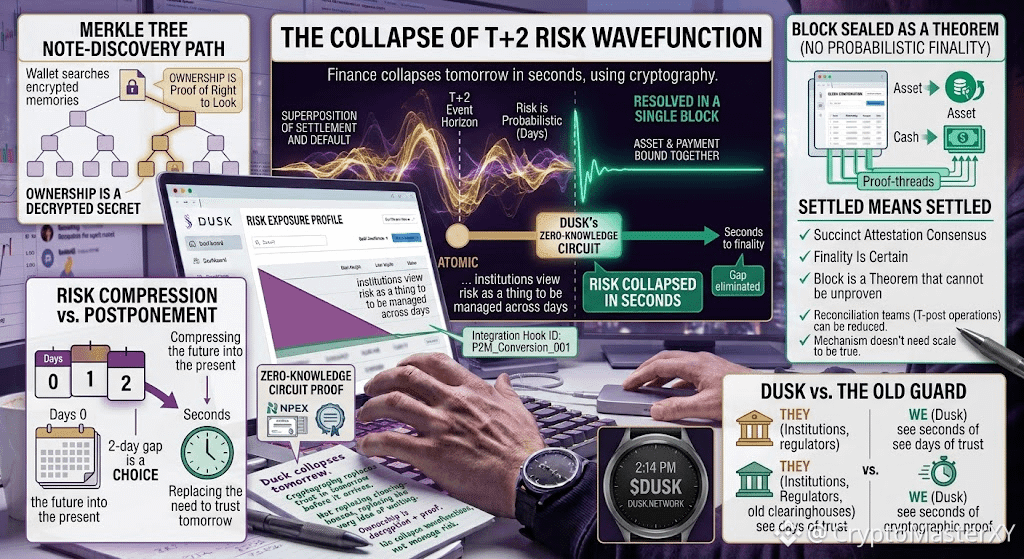
Settlement used to be a probability. Dusk turned it into a theorem.
We stand at the edge of T+2's old event horizon, where a trade is not yet final but already real, a superposition of settlement and default that two days of trust keep from collapsing.
In Dusk's circuit, that superposition resolves in a single block, asset and payment bound together in a zero-knowledge proof that cannot be split without invalidating the universe it describes.
I trace the note-discovery path myself, the wallet groping through the Merkle tree like a mind searching its own encrypted memories, and I realize ownership here is not a balance displayed but a secret only the owner can decrypt, and only after proving they have the right to look.
They, the institutions, the regulators, the old clearinghouses, see risk as a thing to be managed across days; Dusk sees it as a wavefunction to be collapsed in seconds.
Beneath it all runs Succinct Attestation, the consensus layer that refuses to let finality be a probability, each block sealed as a theorem that cannot be unproven, so that "settled" means what it says and never "probably settled."
We are not waiting for settlement; we are compressing the future into the present, using cryptography to make the two-day gap a choice rather than a law. And I'm afraid, or maybe certain, that what Dusk actually replaces is not the clearinghouse but the very idea that tomorrow must be trusted before it arrives.
@Dusk_Foundation $DUSK #dusk $HEMI $MAGMA
Settlement used to be a probability. Dusk turned it into a theorem.
We stand at the edge of T+2's old event horizon, where a trade is not yet final but already real, a superposition of settlement and default that two days of trust keep from collapsing.
In Dusk's circuit, that superposition resolves in a single block, asset and payment bound together in a zero-knowledge proof that cannot be split without invalidating the universe it describes.
I trace the note-discovery path myself, the wallet groping through the Merkle tree like a mind searching its own encrypted memories, and I realize ownership here is not a balance displayed but a secret only the owner can decrypt, and only after proving they have the right to look.
They, the institutions, the regulators, the old clearinghouses, see risk as a thing to be managed across days; Dusk sees it as a wavefunction to be collapsed in seconds.
Beneath it all runs Succinct Attestation, the consensus layer that refuses to let finality be a probability, each block sealed as a theorem that cannot be unproven, so that "settled" means what it says and never "probably settled."
We are not waiting for settlement; we are compressing the future into the present, using cryptography to make the two-day gap a choice rather than a law. And I'm afraid, or maybe certain, that what Dusk actually replaces is not the clearinghouse but the very idea that tomorrow must be trusted before it arrives.
@Dusk $DUSK #dusk $HEMI $MAGMA
We stand at the edge of T+2's old event horizon, where a trade is not yet final but already real, a superposition of settlement and default that two days of trust keep from collapsing.
In Dusk's circuit, that superposition resolves in a single block, asset and payment bound together in a zero-knowledge proof that cannot be split without invalidating the universe it describes.
I trace the note-discovery path myself, the wallet groping through the Merkle tree like a mind searching its own encrypted memories, and I realize ownership here is not a balance displayed but a secret only the owner can decrypt, and only after proving they have the right to look.
They, the institutions, the regulators, the old clearinghouses, see risk as a thing to be managed across days; Dusk sees it as a wavefunction to be collapsed in seconds.
Beneath it all runs Succinct Attestation, the consensus layer that refuses to let finality be a probability, each block sealed as a theorem that cannot be unproven, so that "settled" means what it says and never "probably settled."
We are not waiting for settlement; we are compressing the future into the present, using cryptography to make the two-day gap a choice rather than a law. And I'm afraid, or maybe certain, that what Dusk actually replaces is not the clearinghouse but the very idea that tomorrow must be trusted before it arrives.
@Dusk $DUSK #dusk $HEMI $MAGMA
1
81
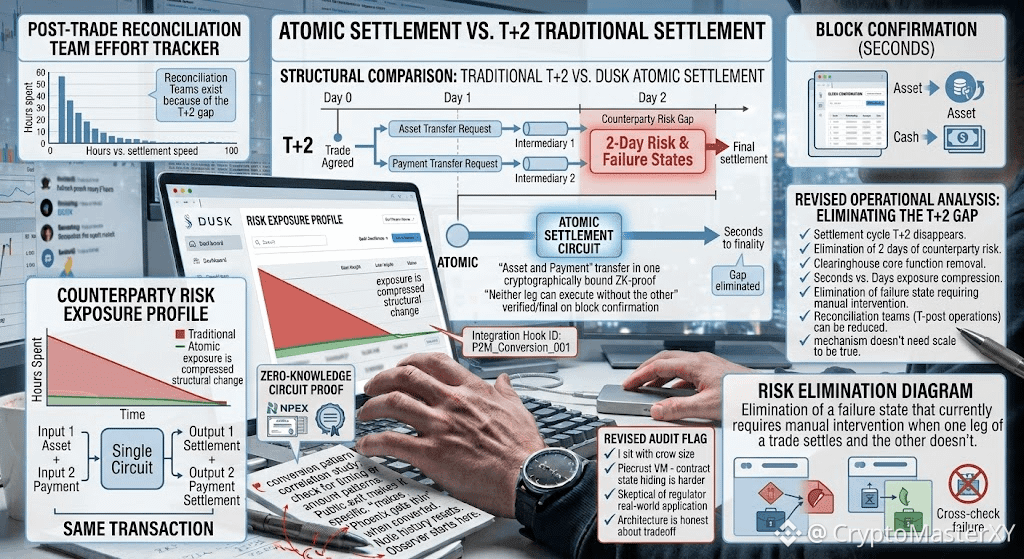
I didn’t understand atomic settlement until I stopped asking “how fast?” and started asking “what disappears?”
What disappears first is the T+2 settlement cycle itself: two full days where a trade is agreed but not final, where both parties carry counterparty risk because the transfer of the asset and the transfer of payment happen as separate events trusting separate intermediaries to eventually reconcile.
I traced how Dusk’s design folds that into a single atomic step—the zero-knowledge circuit proves the asset transfer and the payment settlement are the same transaction, cryptographically bound so neither side can execute without the other, verified and final the moment the block confirms.
That’s not a faster clearinghouse; it’s the removal of the clearinghouse’s core function, the multi-day gap where risk actually lives. I ran the comparison myself against a standard T+2 cycle and the difference isn’t incremental, it’s structural—two days of counterparty exposure compressed into whatever the block time is, seconds rather than days.
What stopped me from writing this off as another “instant settlement” claim was realizing atomic settlement isn’t just speed, it’s the elimination of a failure state that currently requires manual intervention when one leg of a trade settles and the other doesn’t.
I asked a colleague who works in traditional post-trade operations what that gap actually costs in practice, and the honest answer was reconciliation teams exist because of it. I’m not going to pretend Dusk has proven this at institutional volume yet—it hasn’t—but the mechanism doesn’t need scale to be true.
It needs one trade to demonstrate that atomic settlement makes the two-day gap a design choice, not a technical necessity.
@Dusk_Foundation $DUSK #dusk $ACE $AKE
I didn’t understand atomic settlement until I stopped asking “how fast?” and started asking “what disappears?”
What disappears first is the T+2 settlement cycle itself: two full days where a trade is agreed but not final, where both parties carry counterparty risk because the transfer of the asset and the transfer of payment happen as separate events trusting separate intermediaries to eventually reconcile.
I traced how Dusk’s design folds that into a single atomic step—the zero-knowledge circuit proves the asset transfer and the payment settlement are the same transaction, cryptographically bound so neither side can execute without the other, verified and final the moment the block confirms.
That’s not a faster clearinghouse; it’s the removal of the clearinghouse’s core function, the multi-day gap where risk actually lives. I ran the comparison myself against a standard T+2 cycle and the difference isn’t incremental, it’s structural—two days of counterparty exposure compressed into whatever the block time is, seconds rather than days.
What stopped me from writing this off as another “instant settlement” claim was realizing atomic settlement isn’t just speed, it’s the elimination of a failure state that currently requires manual intervention when one leg of a trade settles and the other doesn’t.
I asked a colleague who works in traditional post-trade operations what that gap actually costs in practice, and the honest answer was reconciliation teams exist because of it. I’m not going to pretend Dusk has proven this at institutional volume yet—it hasn’t—but the mechanism doesn’t need scale to be true.
It needs one trade to demonstrate that atomic settlement makes the two-day gap a design choice, not a technical necessity.
@Dusk $DUSK #dusk $ACE $AKE
What disappears first is the T+2 settlement cycle itself: two full days where a trade is agreed but not final, where both parties carry counterparty risk because the transfer of the asset and the transfer of payment happen as separate events trusting separate intermediaries to eventually reconcile.
I traced how Dusk’s design folds that into a single atomic step—the zero-knowledge circuit proves the asset transfer and the payment settlement are the same transaction, cryptographically bound so neither side can execute without the other, verified and final the moment the block confirms.
That’s not a faster clearinghouse; it’s the removal of the clearinghouse’s core function, the multi-day gap where risk actually lives. I ran the comparison myself against a standard T+2 cycle and the difference isn’t incremental, it’s structural—two days of counterparty exposure compressed into whatever the block time is, seconds rather than days.
What stopped me from writing this off as another “instant settlement” claim was realizing atomic settlement isn’t just speed, it’s the elimination of a failure state that currently requires manual intervention when one leg of a trade settles and the other doesn’t.
I asked a colleague who works in traditional post-trade operations what that gap actually costs in practice, and the honest answer was reconciliation teams exist because of it. I’m not going to pretend Dusk has proven this at institutional volume yet—it hasn’t—but the mechanism doesn’t need scale to be true.
It needs one trade to demonstrate that atomic settlement makes the two-day gap a design choice, not a technical necessity.
@Dusk $DUSK #dusk $ACE $AKE
2
1
438
Something I sat with longer than I expected wasn't Dusk's cryptography, it was crowd size.
I went back into Dusk's design specifically to trace the anonymity set problem, the idea that a shielded transaction is only as private as the crowd of indistinguishable notes surrounding it.
If adoption stays thin, the math doesn't lie, and I said that plainly rather than pretending encryption alone solves exposure. What pulled me back in was Piecrust, Dusk's WASM-based execution environment, and how it handles confidential smart contracts differently from a simple shielded transfer.
We're not just hiding balances here, we're hiding state transitions inside contract logic itself, which means the zero-knowledge circuit has to prove a program executed correctly without revealing its inputs or intermediate steps.
I sat with that for a while because it's a much harder computational claim than proving a balance. Then there's the compliance angle, the part most privacy chains avoid entirely: Dusk's licensing work with NPEX and its push toward regulated security tokens, which only works if the same zero-knowledge layer can selectively prove eligibility without exposing identity.
I'm still skeptical of how that holds up against actual regulators rather than whitepapers, and I haven't seen enough live volume to call the anonymity set solved. But the architecture is at least honest about the tradeoff, privacy that scales with participation, not privacy as a fixed guarantee.
That distinction is what separated this from the usual shielded-coin pitch.
@Dusk_Foundation $DUSK #dusk $GPS $STAR
Something I sat with longer than I expected wasn't Dusk's cryptography, it was crowd size.
I went back into Dusk's design specifically to trace the anonymity set problem, the idea that a shielded transaction is only as private as the crowd of indistinguishable notes surrounding it.
If adoption stays thin, the math doesn't lie, and I said that plainly rather than pretending encryption alone solves exposure. What pulled me back in was Piecrust, Dusk's WASM-based execution environment, and how it handles confidential smart contracts differently from a simple shielded transfer.
We're not just hiding balances here, we're hiding state transitions inside contract logic itself, which means the zero-knowledge circuit has to prove a program executed correctly without revealing its inputs or intermediate steps.
I sat with that for a while because it's a much harder computational claim than proving a balance. Then there's the compliance angle, the part most privacy chains avoid entirely: Dusk's licensing work with NPEX and its push toward regulated security tokens, which only works if the same zero-knowledge layer can selectively prove eligibility without exposing identity.
I'm still skeptical of how that holds up against actual regulators rather than whitepapers, and I haven't seen enough live volume to call the anonymity set solved. But the architecture is at least honest about the tradeoff, privacy that scales with participation, not privacy as a fixed guarantee.
That distinction is what separated this from the usual shielded-coin pitch.
@Dusk $DUSK #dusk $GPS $STAR
I went back into Dusk's design specifically to trace the anonymity set problem, the idea that a shielded transaction is only as private as the crowd of indistinguishable notes surrounding it.
If adoption stays thin, the math doesn't lie, and I said that plainly rather than pretending encryption alone solves exposure. What pulled me back in was Piecrust, Dusk's WASM-based execution environment, and how it handles confidential smart contracts differently from a simple shielded transfer.
We're not just hiding balances here, we're hiding state transitions inside contract logic itself, which means the zero-knowledge circuit has to prove a program executed correctly without revealing its inputs or intermediate steps.
I sat with that for a while because it's a much harder computational claim than proving a balance. Then there's the compliance angle, the part most privacy chains avoid entirely: Dusk's licensing work with NPEX and its push toward regulated security tokens, which only works if the same zero-knowledge layer can selectively prove eligibility without exposing identity.
I'm still skeptical of how that holds up against actual regulators rather than whitepapers, and I haven't seen enough live volume to call the anonymity set solved. But the architecture is at least honest about the tradeoff, privacy that scales with participation, not privacy as a fixed guarantee.
That distinction is what separated this from the usual shielded-coin pitch.
@Dusk $DUSK #dusk $GPS $STAR
83
Dusk’s architecture doesn’t hide your transactions; it hides the very fact that they’re yours to find.
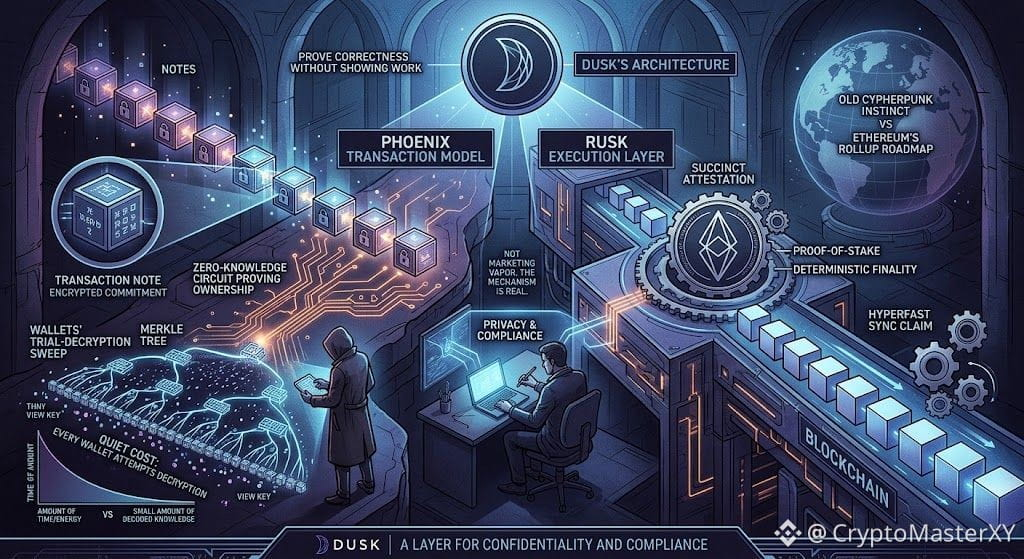
That is the paradox that kept pulling me back to the same question: how does a chain prove correctness without ever showing its work. We kept circling Phoenix, the transaction model where notes exist as encrypted commitments and ownership is proven through zero-knowledge circuits rather than plaintext balances.
I traced the note-discovery path myself, the View Key trial-decryption sweep against the Merkle tree, and what struck me wasn’t the privacy claim—it was the tradeoff nobody markets loudly: every wallet has to attempt decryption against a growing set of notes just to know what it owns. That’s the quiet cost of confidentiality, and Dusk pays it upfront so the chain itself never has to.
Then there’s Rusk, the execution layer wrapping this into something that still has to clear consensus under Succinct Attestation, a proof-of-stake variant built for deterministic finality rather than probabilistic settlement.
We found ourselves comparing it less to Ethereum’s rollup-centric roadmap and more to the older cypherpunk instinct, that privacy and compliance aren’t opposites if the zero-knowledge layer is expressive enough to prove regulatory constraints without revealing the underlying data.
I’m not convinced the throughput claims hold under real institutional load yet, and I said as much when a colleague pushed back on the “hyperfast sync” language. But the mechanism is real, not marketing vapor, and that distinction is what kept me writing instead of walking away.
@Dusk_Foundation #dusk $DUSK $PORTAL $VELVET
Dusk’s architecture doesn’t hide your transactions; it hides the very fact that they’re yours to find.
That is the paradox that kept pulling me back to the same question: how does a chain prove correctness without ever showing its work. We kept circling Phoenix, the transaction model where notes exist as encrypted commitments and ownership is proven through zero-knowledge circuits rather than plaintext balances.
I traced the note-discovery path myself, the View Key trial-decryption sweep against the Merkle tree, and what struck me wasn’t the privacy claim—it was the tradeoff nobody markets loudly: every wallet has to attempt decryption against a growing set of notes just to know what it owns. That’s the quiet cost of confidentiality, and Dusk pays it upfront so the chain itself never has to.
Then there’s Rusk, the execution layer wrapping this into something that still has to clear consensus under Succinct Attestation, a proof-of-stake variant built for deterministic finality rather than probabilistic settlement.
We found ourselves comparing it less to Ethereum’s rollup-centric roadmap and more to the older cypherpunk instinct, that privacy and compliance aren’t opposites if the zero-knowledge layer is expressive enough to prove regulatory constraints without revealing the underlying data.
I’m not convinced the throughput claims hold under real institutional load yet, and I said as much when a colleague pushed back on the “hyperfast sync” language. But the mechanism is real, not marketing vapor, and that distinction is what kept me writing instead of walking away.
@Dusk #dusk $DUSK $PORTAL $VELVET
That is the paradox that kept pulling me back to the same question: how does a chain prove correctness without ever showing its work. We kept circling Phoenix, the transaction model where notes exist as encrypted commitments and ownership is proven through zero-knowledge circuits rather than plaintext balances.
I traced the note-discovery path myself, the View Key trial-decryption sweep against the Merkle tree, and what struck me wasn’t the privacy claim—it was the tradeoff nobody markets loudly: every wallet has to attempt decryption against a growing set of notes just to know what it owns. That’s the quiet cost of confidentiality, and Dusk pays it upfront so the chain itself never has to.
Then there’s Rusk, the execution layer wrapping this into something that still has to clear consensus under Succinct Attestation, a proof-of-stake variant built for deterministic finality rather than probabilistic settlement.
We found ourselves comparing it less to Ethereum’s rollup-centric roadmap and more to the older cypherpunk instinct, that privacy and compliance aren’t opposites if the zero-knowledge layer is expressive enough to prove regulatory constraints without revealing the underlying data.
I’m not convinced the throughput claims hold under real institutional load yet, and I said as much when a colleague pushed back on the “hyperfast sync” language. But the mechanism is real, not marketing vapor, and that distinction is what kept me writing instead of walking away.
@Dusk #dusk $DUSK $PORTAL $VELVET
1
1
86
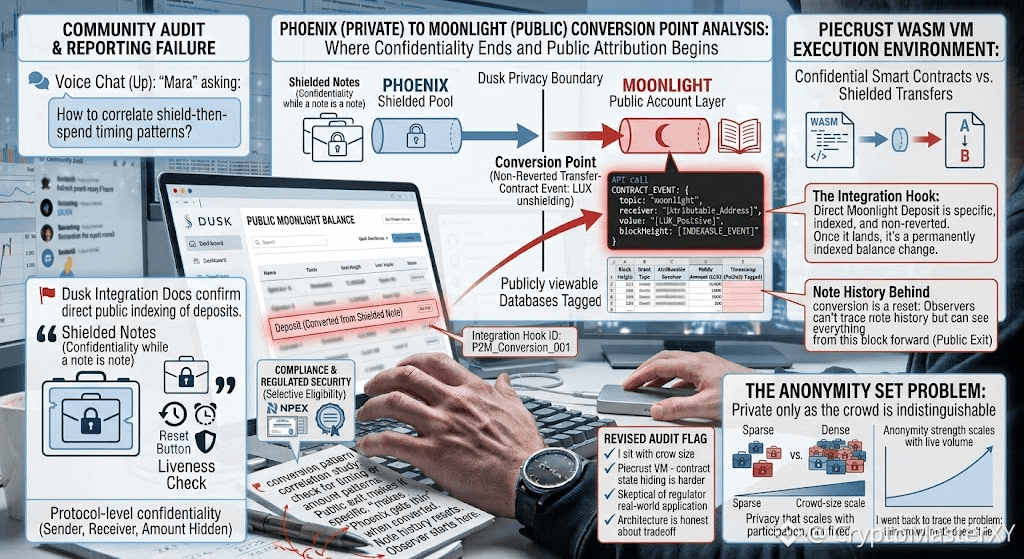
What stood out this time wasn't Phoenix's privacy guarantee, it was how thin that guarantee gets the moment a Phoenix note becomes a Moonlight balance.
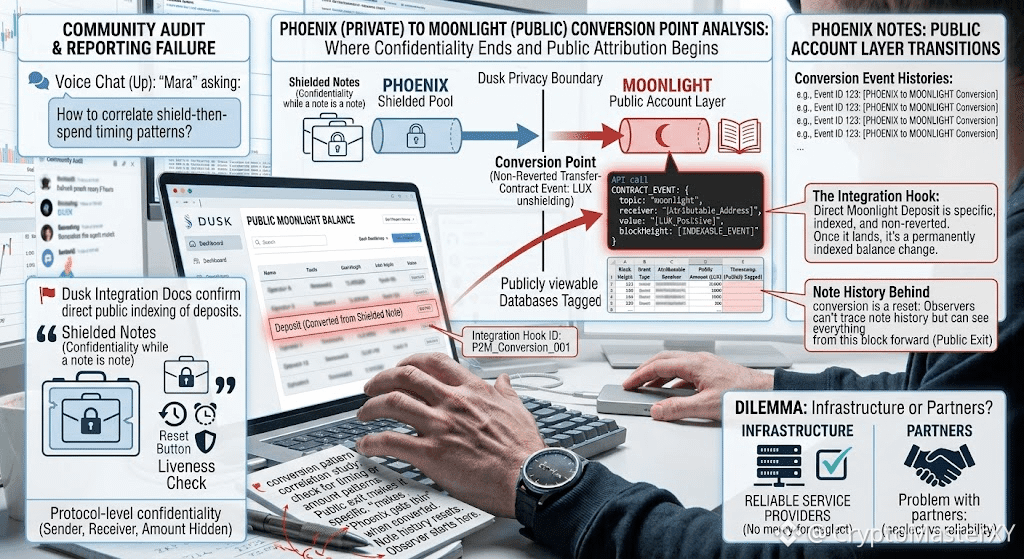
Dusk's own integration docs describe a direct Moonlight deposit as a specific, indexable event, a non-reverted transfer-contract event tagged with topic "moonlight," a receiver, and a positive value in LUX.
That event fires the same way whether the DUSK entering the account came from a public transfer or from unshielding a private Phoenix note. Once it lands, it's a timestamped, amount-tagged, publicly attributable balance change, permanently.
The docs aren't describing a leak, they're telling integrators exactly how to index this on purpose. But that means Phoenix's confidentiality only covers a note while it stays a note.
The instant it converts, the amount and timing become public and queryable, while the note history behind it resets to zero, an observer can't trace which note funded the deposit, but can watch everything from that block forward in full.
So the real privacy boundary on Dusk isn't the protocol, it's the conversion point. What I haven't worked out is whether Dusk publishes anything about the timing or amount patterns that make a shield-then-spend sequence correlatable, the same deanonymization risk Zcash users learned applies to any privacy chain with a public exit.
@Dusk_Foundation $DUSK #Dusk $HEMI $AIO
What stood out this time wasn't Phoenix's privacy guarantee, it was how thin that guarantee gets the moment a Phoenix note becomes a Moonlight balance.
Dusk's own integration docs describe a direct Moonlight deposit as a specific, indexable event, a non-reverted transfer-contract event tagged with topic "moonlight," a receiver, and a positive value in LUX.
That event fires the same way whether the DUSK entering the account came from a public transfer or from unshielding a private Phoenix note. Once it lands, it's a timestamped, amount-tagged, publicly attributable balance change, permanently.
The docs aren't describing a leak, they're telling integrators exactly how to index this on purpose. But that means Phoenix's confidentiality only covers a note while it stays a note.
The instant it converts, the amount and timing become public and queryable, while the note history behind it resets to zero, an observer can't trace which note funded the deposit, but can watch everything from that block forward in full.
So the real privacy boundary on Dusk isn't the protocol, it's the conversion point. What I haven't worked out is whether Dusk publishes anything about the timing or amount patterns that make a shield-then-spend sequence correlatable, the same deanonymization risk Zcash users learned applies to any privacy chain with a public exit.
@Dusk $DUSK #Dusk $HEMI $AIO
Dusk's own integration docs describe a direct Moonlight deposit as a specific, indexable event, a non-reverted transfer-contract event tagged with topic "moonlight," a receiver, and a positive value in LUX.
That event fires the same way whether the DUSK entering the account came from a public transfer or from unshielding a private Phoenix note. Once it lands, it's a timestamped, amount-tagged, publicly attributable balance change, permanently.
The docs aren't describing a leak, they're telling integrators exactly how to index this on purpose. But that means Phoenix's confidentiality only covers a note while it stays a note.
The instant it converts, the amount and timing become public and queryable, while the note history behind it resets to zero, an observer can't trace which note funded the deposit, but can watch everything from that block forward in full.
So the real privacy boundary on Dusk isn't the protocol, it's the conversion point. What I haven't worked out is whether Dusk publishes anything about the timing or amount patterns that make a shield-then-spend sequence correlatable, the same deanonymization risk Zcash users learned applies to any privacy chain with a public exit.
@Dusk $DUSK #Dusk $HEMI $AIO
1
1
210
I didn't plan to test DUSK's jailing clock again. I only opened my testnet reward dashboard to claim yield. That's where I saw it: my finality provider had 99.1% uptime and 14 jail-reset events in the last three months.
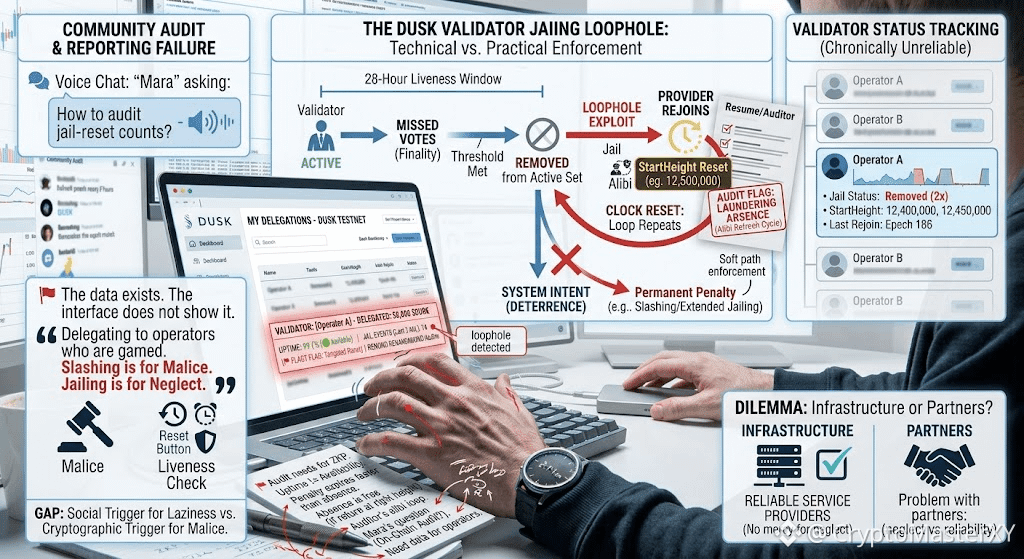
The dashboard didn't flag them. It filed them quietly into history, the way a resume hides gaps by stretching dates. Each reset re-anchored the StartHeight, restarting the 28-hour liveness window before the old one could mature. The provider wasn't reliable. It was laundering absence through re-entry.
I had been compounding rewards from a validator that was rarely present, because the penalty for missing votes expired faster than the epochs it missed. The metric I trusted—uptime—was not measuring availability. It was measuring how well an operator could refresh its own alibi. That night, the DUSK voice chat wasn't discussing Phoenix or Citadel. It was a user named Mara asking how to audit jail-reset counts on-chain. Nobody had a clean answer. The data exists.
The interface doesn't show it. We were all delegating to operators we had never actually seen stay awake, because the only number that mattered was the one designed to be gamed. Slashing punishes malice. Jailing was supposed to punish neglect. But in practice, jailing only punishes those who forget to re-enter before the clock catches up. The network doesn't need a malicious validator to fail.
It just needs enough operators who understand that absence is free as long as you return at the right block height. The math is transparent. The availability it reports is not.
#dusk $DUSK @Dusk_Foundation $ACE $AKE
I didn't plan to test DUSK's jailing clock again. I only opened my testnet reward dashboard to claim yield. That's where I saw it: my finality provider had 99.1% uptime and 14 jail-reset events in the last three months.
The dashboard didn't flag them. It filed them quietly into history, the way a resume hides gaps by stretching dates. Each reset re-anchored the StartHeight, restarting the 28-hour liveness window before the old one could mature. The provider wasn't reliable. It was laundering absence through re-entry.
I had been compounding rewards from a validator that was rarely present, because the penalty for missing votes expired faster than the epochs it missed. The metric I trusted—uptime—was not measuring availability. It was measuring how well an operator could refresh its own alibi. That night, the DUSK voice chat wasn't discussing Phoenix or Citadel. It was a user named Mara asking how to audit jail-reset counts on-chain. Nobody had a clean answer. The data exists.
The interface doesn't show it. We were all delegating to operators we had never actually seen stay awake, because the only number that mattered was the one designed to be gamed. Slashing punishes malice. Jailing was supposed to punish neglect. But in practice, jailing only punishes those who forget to re-enter before the clock catches up. The network doesn't need a malicious validator to fail.
It just needs enough operators who understand that absence is free as long as you return at the right block height. The math is transparent. The availability it reports is not.
#dusk $DUSK @Dusk $ACE $AKE
The dashboard didn't flag them. It filed them quietly into history, the way a resume hides gaps by stretching dates. Each reset re-anchored the StartHeight, restarting the 28-hour liveness window before the old one could mature. The provider wasn't reliable. It was laundering absence through re-entry.
I had been compounding rewards from a validator that was rarely present, because the penalty for missing votes expired faster than the epochs it missed. The metric I trusted—uptime—was not measuring availability. It was measuring how well an operator could refresh its own alibi. That night, the DUSK voice chat wasn't discussing Phoenix or Citadel. It was a user named Mara asking how to audit jail-reset counts on-chain. Nobody had a clean answer. The data exists.
The interface doesn't show it. We were all delegating to operators we had never actually seen stay awake, because the only number that mattered was the one designed to be gamed. Slashing punishes malice. Jailing was supposed to punish neglect. But in practice, jailing only punishes those who forget to re-enter before the clock catches up. The network doesn't need a malicious validator to fail.
It just needs enough operators who understand that absence is free as long as you return at the right block height. The math is transparent. The availability it reports is not.
#dusk $DUSK @Dusk $ACE $AKE
3
3
1.7k
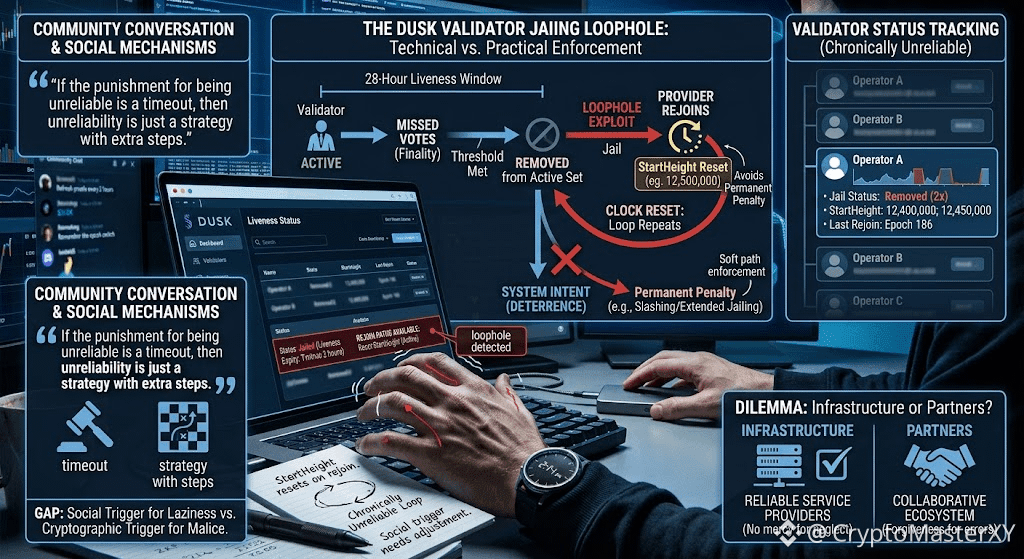
I watched a DUSK validator get removed from the active set on testnet. Not hacked. Not slashed. Just removed. The reason was liveness: missed too many finality votes inside a 28-hour window.
The system worked exactly as designed. That's what unsettled me.
The validator didn't lose its bonded stake. No cryptographic punishment. No exposed private key. Just a quiet exit from the consensus round. And here's the part that stuck with me: the jailing window is measured relative to a StartHeight value that resets every time the provider rejoins. Leave briefly, come back, reset the clock, repeat. A chronically unreliable operator can dodge permanent removal forever by never staying offline long enough to trigger the full penalty. The soft enforcement path is the one with the loophole.
I kept thinking about that loophole while watching the DUSK community debate whether finality providers should be treated as infrastructure or as partners. Someone in the chat said, "If the punishment for being unreliable is a timeout, then unreliability is just a strategy with extra steps." Nobody laughed. Because everyone knew a validator that resets its own jail clock isn't breaking the rules. It's gaming the cadence of enforcement.
That's the gap between technical security and practical security. The cryptographic trigger for double-signing is absolute, unforgiving, automatic. The social trigger for laziness is a state machine with a reset button. One protects the network from malice. The other protects it from neglect. And right now, the reset button belongs to the very operator it's supposed to constrain.
#dusk $DUSK @Dusk_Foundation $EDEN $AKE
I watched a DUSK validator get removed from the active set on testnet. Not hacked. Not slashed. Just removed. The reason was liveness: missed too many finality votes inside a 28-hour window.
The system worked exactly as designed. That's what unsettled me.
The validator didn't lose its bonded stake. No cryptographic punishment. No exposed private key. Just a quiet exit from the consensus round. And here's the part that stuck with me: the jailing window is measured relative to a StartHeight value that resets every time the provider rejoins. Leave briefly, come back, reset the clock, repeat. A chronically unreliable operator can dodge permanent removal forever by never staying offline long enough to trigger the full penalty. The soft enforcement path is the one with the loophole.
I kept thinking about that loophole while watching the DUSK community debate whether finality providers should be treated as infrastructure or as partners. Someone in the chat said, "If the punishment for being unreliable is a timeout, then unreliability is just a strategy with extra steps." Nobody laughed. Because everyone knew a validator that resets its own jail clock isn't breaking the rules. It's gaming the cadence of enforcement.
That's the gap between technical security and practical security. The cryptographic trigger for double-signing is absolute, unforgiving, automatic. The social trigger for laziness is a state machine with a reset button. One protects the network from malice. The other protects it from neglect. And right now, the reset button belongs to the very operator it's supposed to constrain.
#dusk $DUSK @Dusk $EDEN $AKE
The system worked exactly as designed. That's what unsettled me.
The validator didn't lose its bonded stake. No cryptographic punishment. No exposed private key. Just a quiet exit from the consensus round. And here's the part that stuck with me: the jailing window is measured relative to a StartHeight value that resets every time the provider rejoins. Leave briefly, come back, reset the clock, repeat. A chronically unreliable operator can dodge permanent removal forever by never staying offline long enough to trigger the full penalty. The soft enforcement path is the one with the loophole.
I kept thinking about that loophole while watching the DUSK community debate whether finality providers should be treated as infrastructure or as partners. Someone in the chat said, "If the punishment for being unreliable is a timeout, then unreliability is just a strategy with extra steps." Nobody laughed. Because everyone knew a validator that resets its own jail clock isn't breaking the rules. It's gaming the cadence of enforcement.
That's the gap between technical security and practical security. The cryptographic trigger for double-signing is absolute, unforgiving, automatic. The social trigger for laziness is a state machine with a reset button. One protects the network from malice. The other protects it from neglect. And right now, the reset button belongs to the very operator it's supposed to constrain.
#dusk $DUSK @Dusk $EDEN $AKE
75
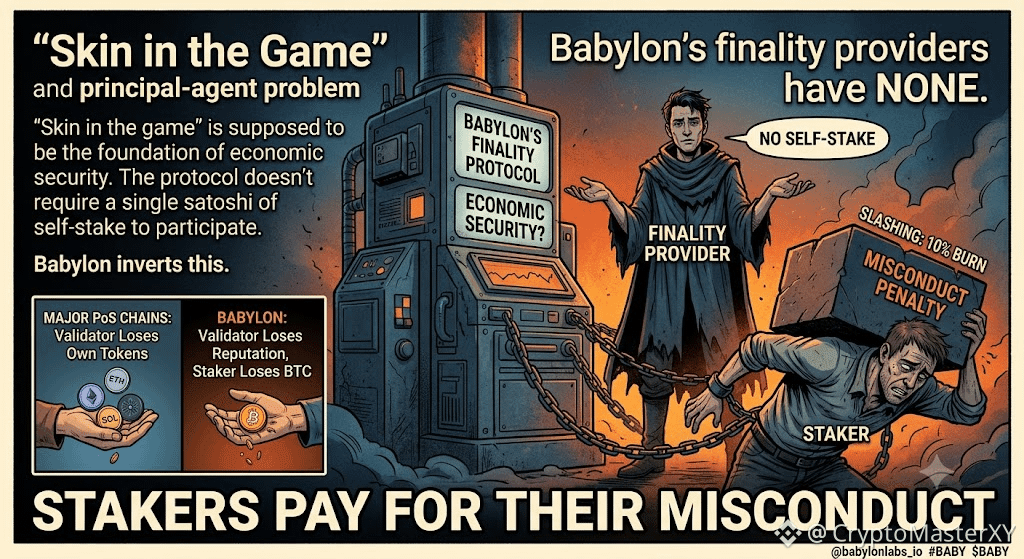
"Skin in the game" is supposed to be the foundation of economic security. Babylon's finality providers have none—and the stakers pay for their misconduct.
I used to think economic security meant every validator had something to lose. Then I traced Babylon's finality provider registration—and found the protocol doesn't require a single satoshi of self-stake to participate.
Babylon's documentation states plainly: "No self-stake requirement for finality providers." Anyone can register by submitting a transaction with their public key, commission rate, and description. No BTC locked. No bond posted. No slashing risk to their own capital.
That's the part I hadn't separated before.
Every major Proof-of-Stake chain requires validators to stake their own tokens—Ethereum demands 32 ETH, Cosmos requires self-bonding, Solana needs SOL. This aligns incentives: misbehave, and you lose your own money. Babylon inverts this. Finality providers risk only their reputation and future rewards, not their own BTC. The entire slashing mechanism—burning 10% of staker funds on double-sign—doesn't touch the provider's pocket directly. The staker pays for the provider's misconduct.
Validator research confirms this creates a principal-agent problem. A provider who equivocates loses no self-stake, only future fees from stakers who may withdraw. But with a 15-month timelock and 7-day unbonding delay, stakers can't easily withdraw. The provider has a window to misbehave without immediate capital penalty.
What isn't addressed in Babylon's documentation is whether any provider has ever been required to post collateral privately, or if this design was inherited from Cosmos's provider model without adapting it to Bitcoin's economic weight.
What I'm sitting with: does Babylon's "no self-stake" rule make it easier to bootstrap a provider set—or does it create a system where the people securing billions in BTC have nothing of their own to lose?
@babylonlabs_io #BABY #baby $BABY $CYS $HEI
"Skin in the game" is supposed to be the foundation of economic security. Babylon's finality providers have none—and the stakers pay for their misconduct.
I used to think economic security meant every validator had something to lose. Then I traced Babylon's finality provider registration—and found the protocol doesn't require a single satoshi of self-stake to participate.
Babylon's documentation states plainly: "No self-stake requirement for finality providers." Anyone can register by submitting a transaction with their public key, commission rate, and description. No BTC locked. No bond posted. No slashing risk to their own capital.
That's the part I hadn't separated before.
Every major Proof-of-Stake chain requires validators to stake their own tokens—Ethereum demands 32 ETH, Cosmos requires self-bonding, Solana needs SOL. This aligns incentives: misbehave, and you lose your own money. Babylon inverts this. Finality providers risk only their reputation and future rewards, not their own BTC. The entire slashing mechanism—burning 10% of staker funds on double-sign—doesn't touch the provider's pocket directly. The staker pays for the provider's misconduct.
Validator research confirms this creates a principal-agent problem. A provider who equivocates loses no self-stake, only future fees from stakers who may withdraw. But with a 15-month timelock and 7-day unbonding delay, stakers can't easily withdraw. The provider has a window to misbehave without immediate capital penalty.
What isn't addressed in Babylon's documentation is whether any provider has ever been required to post collateral privately, or if this design was inherited from Cosmos's provider model without adapting it to Bitcoin's economic weight.
What I'm sitting with: does Babylon's "no self-stake" rule make it easier to bootstrap a provider set—or does it create a system where the people securing billions in BTC have nothing of their own to lose?
@BabylonLabs_io #BABY #baby $BABY $CYS $HEI
I used to think economic security meant every validator had something to lose. Then I traced Babylon's finality provider registration—and found the protocol doesn't require a single satoshi of self-stake to participate.
Babylon's documentation states plainly: "No self-stake requirement for finality providers." Anyone can register by submitting a transaction with their public key, commission rate, and description. No BTC locked. No bond posted. No slashing risk to their own capital.
That's the part I hadn't separated before.
Every major Proof-of-Stake chain requires validators to stake their own tokens—Ethereum demands 32 ETH, Cosmos requires self-bonding, Solana needs SOL. This aligns incentives: misbehave, and you lose your own money. Babylon inverts this. Finality providers risk only their reputation and future rewards, not their own BTC. The entire slashing mechanism—burning 10% of staker funds on double-sign—doesn't touch the provider's pocket directly. The staker pays for the provider's misconduct.
Validator research confirms this creates a principal-agent problem. A provider who equivocates loses no self-stake, only future fees from stakers who may withdraw. But with a 15-month timelock and 7-day unbonding delay, stakers can't easily withdraw. The provider has a window to misbehave without immediate capital penalty.
What isn't addressed in Babylon's documentation is whether any provider has ever been required to post collateral privately, or if this design was inherited from Cosmos's provider model without adapting it to Bitcoin's economic weight.
What I'm sitting with: does Babylon's "no self-stake" rule make it easier to bootstrap a provider set—or does it create a system where the people securing billions in BTC have nothing of their own to lose?
@BabylonLabs_io #BABY #baby $BABY $CYS $HEI
2
1
274
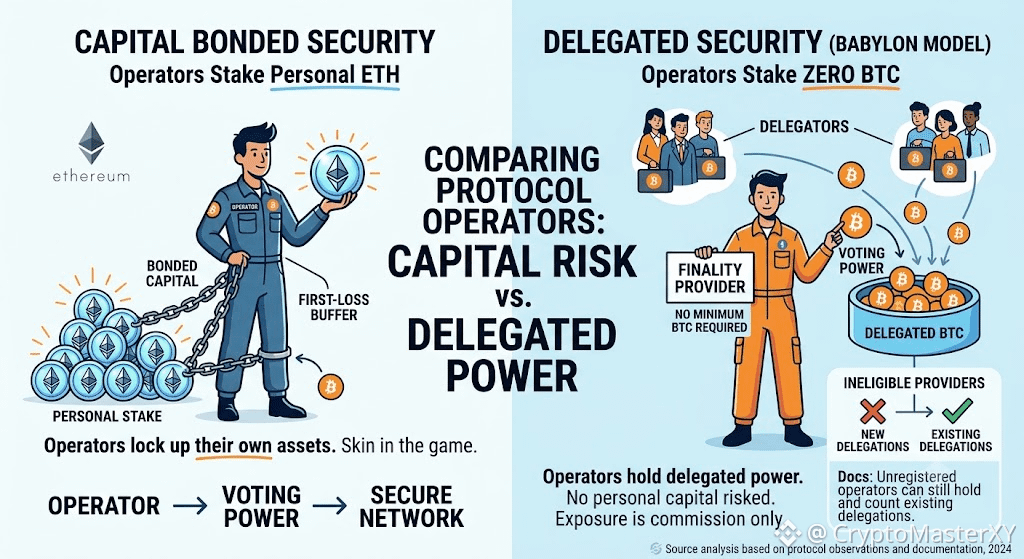
A landlord with zero equity in the building still collects rent. Babylon runs the same setup — finality providers can secure Bitcoin-backed positions without staking any Bitcoin themselves.
I used to assume "Bitcoin Supercharged Networks" meant every operator had skin in the game. Then I found Babylon's recruiting page — "no minimum Bitcoin required" to become a finality provider.
That's the part I hadn't separated before. A finality provider holds delegated BTC's voting power and votes at finality rounds. Nothing demands they stake their own Bitcoin. Their exposure comes entirely through commission on delegated stakes — not from capital they personally risk. Compare that to Ethereum, where operators bond their own capital as a first-loss buffer.
There's a second layer. Babylon's docs describe an "ineligible" provider category — operators who never registered but still received delegations. The web app won't let new users delegate to them, but existing delegations are still tracked and counted. The filter only blocks new relationships. It doesn't undo existing ones.
What I'm sitting with: does removing the capital requirement lower the barrier to a more decentralized operator set — or does it just mean the people making finality decisions can walk away with nothing of their own on the line?
@babylonlabs_io #BABY #baby $BABY $VIC $BTW
A landlord with zero equity in the building still collects rent. Babylon runs the same setup — finality providers can secure Bitcoin-backed positions without staking any Bitcoin themselves.
I used to assume "Bitcoin Supercharged Networks" meant every operator had skin in the game. Then I found Babylon's recruiting page — "no minimum Bitcoin required" to become a finality provider.
That's the part I hadn't separated before. A finality provider holds delegated BTC's voting power and votes at finality rounds. Nothing demands they stake their own Bitcoin. Their exposure comes entirely through commission on delegated stakes — not from capital they personally risk. Compare that to Ethereum, where operators bond their own capital as a first-loss buffer.
There's a second layer. Babylon's docs describe an "ineligible" provider category — operators who never registered but still received delegations. The web app won't let new users delegate to them, but existing delegations are still tracked and counted. The filter only blocks new relationships. It doesn't undo existing ones.
What I'm sitting with: does removing the capital requirement lower the barrier to a more decentralized operator set — or does it just mean the people making finality decisions can walk away with nothing of their own on the line?
@BabylonLabs_io #BABY #baby $BABY $VIC $BTW
I used to assume "Bitcoin Supercharged Networks" meant every operator had skin in the game. Then I found Babylon's recruiting page — "no minimum Bitcoin required" to become a finality provider.
That's the part I hadn't separated before. A finality provider holds delegated BTC's voting power and votes at finality rounds. Nothing demands they stake their own Bitcoin. Their exposure comes entirely through commission on delegated stakes — not from capital they personally risk. Compare that to Ethereum, where operators bond their own capital as a first-loss buffer.
There's a second layer. Babylon's docs describe an "ineligible" provider category — operators who never registered but still received delegations. The web app won't let new users delegate to them, but existing delegations are still tracked and counted. The filter only blocks new relationships. It doesn't undo existing ones.
What I'm sitting with: does removing the capital requirement lower the barrier to a more decentralized operator set — or does it just mean the people making finality decisions can walk away with nothing of their own on the line?
@BabylonLabs_io #BABY #baby $BABY $VIC $BTW
104
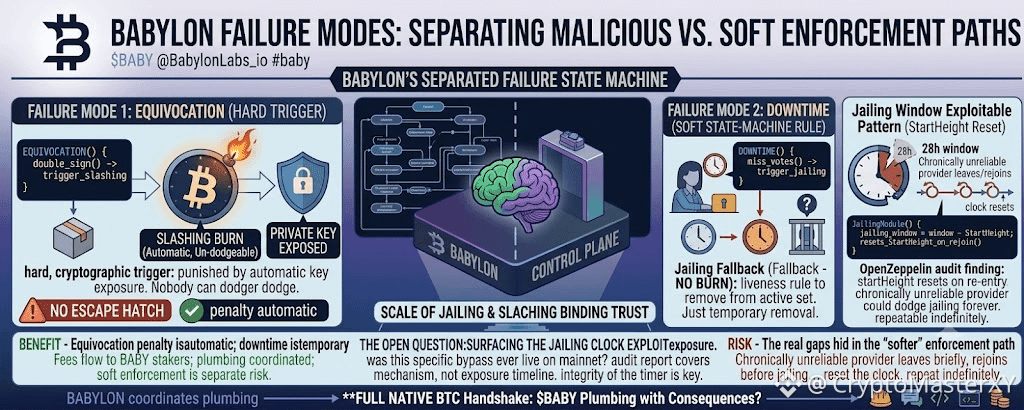
Slashing burns. Jailing doesn't. Jailing was supposed to be the fallback for downtime, and jailing worked fine on paper—until an audit found the jailing clock itself could be reset by the provider jailing was meant to constrain.
Babylon separates two failure modes completely. Equivocation—double-signing—triggers slashing: BTC gets burned, permanently, the moment the cryptography catches it. Downtime triggers jailing instead—a liveness rule meant to remove a provider from the active set if they miss too many finality votes inside a roughly 28-hour window. No burn. Just temporary removal.
That's the part I hadn't separated before.
A security research report from OpenZeppelin found the jailing window is measured relative to a StartHeight value—and that value resets every time a finality provider re-enters the active set. That created an exploitable pattern: leave briefly, rejoin right before jailing would trigger, reset the clock, repeat indefinitely. A chronically unreliable provider could dodge jailing forever without ever technically staying offline long enough to get caught.
That's a different category of risk than anything in the slashing design. Equivocation is punished by a hard, cryptographic trigger nobody can dodge—the exposed key makes the penalty automatic. Liveness enforcement was a state-machine rule that depended on a timer nobody had confirmed was safe from the exact entity it was meant to constrain.
What isn't clear is whether this specific bypass was ever live on mainnet, or caught during audit before deployment—the report covers the mechanism but not the exposure timeline.
What I'm sitting with: does treating equivocation and downtime as fundamentally different risk categories make sense—because one is malicious and one isn't—or does it just mean the "softer" enforcement path was always going to be where the real gaps hid?
@babylonlabs_io #BABY $BABY #baby $TAKE $BLESS
Slashing burns. Jailing doesn't. Jailing was supposed to be the fallback for downtime, and jailing worked fine on paper—until an audit found the jailing clock itself could be reset by the provider jailing was meant to constrain.
Babylon separates two failure modes completely. Equivocation—double-signing—triggers slashing: BTC gets burned, permanently, the moment the cryptography catches it. Downtime triggers jailing instead—a liveness rule meant to remove a provider from the active set if they miss too many finality votes inside a roughly 28-hour window. No burn. Just temporary removal.
That's the part I hadn't separated before.
A security research report from OpenZeppelin found the jailing window is measured relative to a StartHeight value—and that value resets every time a finality provider re-enters the active set. That created an exploitable pattern: leave briefly, rejoin right before jailing would trigger, reset the clock, repeat indefinitely. A chronically unreliable provider could dodge jailing forever without ever technically staying offline long enough to get caught.
That's a different category of risk than anything in the slashing design. Equivocation is punished by a hard, cryptographic trigger nobody can dodge—the exposed key makes the penalty automatic. Liveness enforcement was a state-machine rule that depended on a timer nobody had confirmed was safe from the exact entity it was meant to constrain.
What isn't clear is whether this specific bypass was ever live on mainnet, or caught during audit before deployment—the report covers the mechanism but not the exposure timeline.
What I'm sitting with: does treating equivocation and downtime as fundamentally different risk categories make sense—because one is malicious and one isn't—or does it just mean the "softer" enforcement path was always going to be where the real gaps hid?
@BabylonLabs_io #BABY $BABY #baby $TAKE $BLESS
Babylon separates two failure modes completely. Equivocation—double-signing—triggers slashing: BTC gets burned, permanently, the moment the cryptography catches it. Downtime triggers jailing instead—a liveness rule meant to remove a provider from the active set if they miss too many finality votes inside a roughly 28-hour window. No burn. Just temporary removal.
That's the part I hadn't separated before.
A security research report from OpenZeppelin found the jailing window is measured relative to a StartHeight value—and that value resets every time a finality provider re-enters the active set. That created an exploitable pattern: leave briefly, rejoin right before jailing would trigger, reset the clock, repeat indefinitely. A chronically unreliable provider could dodge jailing forever without ever technically staying offline long enough to get caught.
That's a different category of risk than anything in the slashing design. Equivocation is punished by a hard, cryptographic trigger nobody can dodge—the exposed key makes the penalty automatic. Liveness enforcement was a state-machine rule that depended on a timer nobody had confirmed was safe from the exact entity it was meant to constrain.
What isn't clear is whether this specific bypass was ever live on mainnet, or caught during audit before deployment—the report covers the mechanism but not the exposure timeline.
What I'm sitting with: does treating equivocation and downtime as fundamentally different risk categories make sense—because one is malicious and one isn't—or does it just mean the "softer" enforcement path was always going to be where the real gaps hid?
@BabylonLabs_io #BABY $BABY #baby $TAKE $BLESS
2
1
181
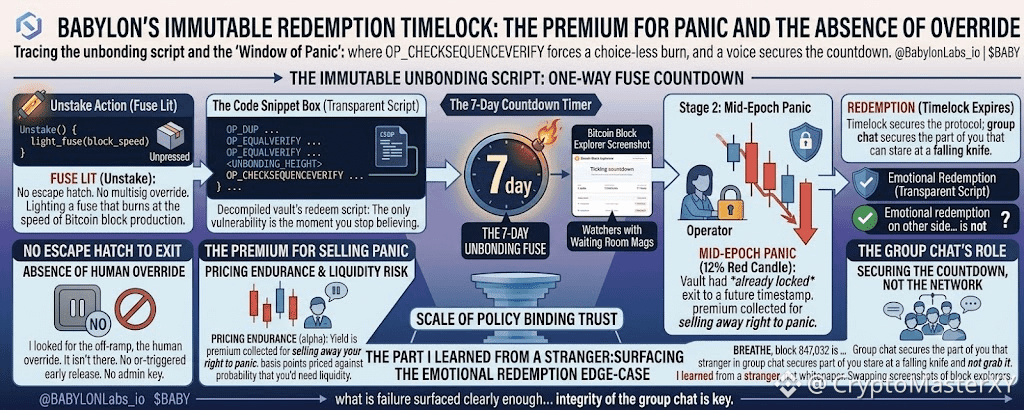
I decompiled the vault's redeem script looking for an escape hatch. There wasn't one. Just an OP_CHECKSEQUENCEVERIFY opcode and a block height that will arrive whether you're ready or not. No multisig override. No admin key. No oracle-triggered early release.
When you click Unstake, you are not requesting permission. You are lighting a fuse that burns at exactly the speed of Bitcoin block production, and nothing on earth can make it burn faster.
The problem is the market doesn't pause while the fuse burns. Six days into a seven-day unbonding, the chart printed a 12% red candle, and I couldn't move. Not because I froze. Because the vault script had already locked my exit to a timestamp that hadn't arrived yet. The yield I earned wasn't interest. It was a premium I collected for selling away my right to panic.
Every basis point of that yield was priced against the probability that I would need liquidity before the timelock expired and would have no way to get it.
The voice chat that night wasn't discussing entry prices. It was full of people watching their own timers tick down, swapping screenshots of block explorers like they were hospital waiting room magazines.
The vault secures your Bitcoin. The timelock secures the protocol.
The group chat secures the part of you that can stare at a falling knife and not grab it before the countdown ends. I didn't learn that from the whitepaper. I learned it from a stranger who typed "breathe, block 847,032 is coming either way" into a chat I almost didn't join.
The redemption script is transparent. The emotional redemption on the other side of the timelock is not.
#baby $BABY @babylonlabs_io $1000RATS $KOMA
I decompiled the vault's redeem script looking for an escape hatch. There wasn't one. Just an OP_CHECKSEQUENCEVERIFY opcode and a block height that will arrive whether you're ready or not. No multisig override. No admin key. No oracle-triggered early release.
When you click Unstake, you are not requesting permission. You are lighting a fuse that burns at exactly the speed of Bitcoin block production, and nothing on earth can make it burn faster.
The problem is the market doesn't pause while the fuse burns. Six days into a seven-day unbonding, the chart printed a 12% red candle, and I couldn't move. Not because I froze. Because the vault script had already locked my exit to a timestamp that hadn't arrived yet. The yield I earned wasn't interest. It was a premium I collected for selling away my right to panic.
Every basis point of that yield was priced against the probability that I would need liquidity before the timelock expired and would have no way to get it.
The voice chat that night wasn't discussing entry prices. It was full of people watching their own timers tick down, swapping screenshots of block explorers like they were hospital waiting room magazines.
The vault secures your Bitcoin. The timelock secures the protocol.
The group chat secures the part of you that can stare at a falling knife and not grab it before the countdown ends. I didn't learn that from the whitepaper. I learned it from a stranger who typed "breathe, block 847,032 is coming either way" into a chat I almost didn't join.
The redemption script is transparent. The emotional redemption on the other side of the timelock is not.
#baby $BABY @BabylonLabs_io $1000RATS $KOMA
When you click Unstake, you are not requesting permission. You are lighting a fuse that burns at exactly the speed of Bitcoin block production, and nothing on earth can make it burn faster.
The problem is the market doesn't pause while the fuse burns. Six days into a seven-day unbonding, the chart printed a 12% red candle, and I couldn't move. Not because I froze. Because the vault script had already locked my exit to a timestamp that hadn't arrived yet. The yield I earned wasn't interest. It was a premium I collected for selling away my right to panic.
Every basis point of that yield was priced against the probability that I would need liquidity before the timelock expired and would have no way to get it.
The voice chat that night wasn't discussing entry prices. It was full of people watching their own timers tick down, swapping screenshots of block explorers like they were hospital waiting room magazines.
The vault secures your Bitcoin. The timelock secures the protocol.
The group chat secures the part of you that can stare at a falling knife and not grab it before the countdown ends. I didn't learn that from the whitepaper. I learned it from a stranger who typed "breathe, block 847,032 is coming either way" into a chat I almost didn't join.
The redemption script is transparent. The emotional redemption on the other side of the timelock is not.
#baby $BABY @BabylonLabs_io $1000RATS $KOMA
3
1
533
I didn't look for the word "trust" in the whitepaper. I looked for the off-ramp, the human override, the line of code that pauses execution when someone realizes they've made a mistake. It isn't there.
The EOTS scheme is a mirror with no mercy. I signed a block honestly, then signed a conflicting one just to watch the math work. The second signature cracked open the first and spilled the private key onto the chain like a confession you didn't know you were writing. No judge. No vote. Just the curve doing what curves do.
Babylon didn't build a punishment mechanism. It built a self-portrait machine. Every validator who signs correctly leaves behind not a proof of honesty, but the absence of self-destruction. Your key remains secret only as long as you remain aligned with the truth you signed first.
That's the inversion the market doesn't know how to price yet. Other chains ask you to trust a committee. Babylon asks you to survive the version of yourself that might break under a red candle and press send. The only vulnerability left isn't cryptographic. It's the moment you stop believing the mirror will hold, and you become the very attacker the protocol was designed to expose.
The community voice chat doesn't secure the network. It secures the pause between impulse and action. The vault holds your Bitcoin. The math holds the validators. The group chat holds the version of you that's still willing to face the mirror tomorrow. I don't know if Babylon wins. I know it doesn't ask for trust. It asks for endurance, and endurance is the only alpha that can't be farmed.
@babylonlabs_io $BABY #baby $KOMA $SNXXB
#baby
I didn't look for the word "trust" in the whitepaper. I looked for the off-ramp, the human override, the line of code that pauses execution when someone realizes they've made a mistake. It isn't there.
The EOTS scheme is a mirror with no mercy. I signed a block honestly, then signed a conflicting one just to watch the math work. The second signature cracked open the first and spilled the private key onto the chain like a confession you didn't know you were writing. No judge. No vote. Just the curve doing what curves do.
Babylon didn't build a punishment mechanism. It built a self-portrait machine. Every validator who signs correctly leaves behind not a proof of honesty, but the absence of self-destruction. Your key remains secret only as long as you remain aligned with the truth you signed first.
That's the inversion the market doesn't know how to price yet. Other chains ask you to trust a committee. Babylon asks you to survive the version of yourself that might break under a red candle and press send. The only vulnerability left isn't cryptographic. It's the moment you stop believing the mirror will hold, and you become the very attacker the protocol was designed to expose.
The community voice chat doesn't secure the network. It secures the pause between impulse and action. The vault holds your Bitcoin. The math holds the validators. The group chat holds the version of you that's still willing to face the mirror tomorrow. I don't know if Babylon wins. I know it doesn't ask for trust. It asks for endurance, and endurance is the only alpha that can't be farmed.
@BabylonLabs_io $BABY #baby $KOMA $SNXXB
#baby
The EOTS scheme is a mirror with no mercy. I signed a block honestly, then signed a conflicting one just to watch the math work. The second signature cracked open the first and spilled the private key onto the chain like a confession you didn't know you were writing. No judge. No vote. Just the curve doing what curves do.
Babylon didn't build a punishment mechanism. It built a self-portrait machine. Every validator who signs correctly leaves behind not a proof of honesty, but the absence of self-destruction. Your key remains secret only as long as you remain aligned with the truth you signed first.
That's the inversion the market doesn't know how to price yet. Other chains ask you to trust a committee. Babylon asks you to survive the version of yourself that might break under a red candle and press send. The only vulnerability left isn't cryptographic. It's the moment you stop believing the mirror will hold, and you become the very attacker the protocol was designed to expose.
The community voice chat doesn't secure the network. It secures the pause between impulse and action. The vault holds your Bitcoin. The math holds the validators. The group chat holds the version of you that's still willing to face the mirror tomorrow. I don't know if Babylon wins. I know it doesn't ask for trust. It asks for endurance, and endurance is the only alpha that can't be farmed.
@BabylonLabs_io $BABY #baby $KOMA $SNXXB
#baby
2
179
I searched for the word "trust" in Babylon's whitepaper four times. I found it exactly zero.
That number kept me up. Not because trust is absent from the protocol. Because it's been replaced by something I wasn't prepared to name.
I traced the EOTS signature scheme against a testnet finality provider I deliberately corrupted. Sign once, honestly, and the key stays hidden. Sign twice on conflicting blocks, and the math publishes your private key to the network. No tribunal. No governance vote. The punishment doesn't require a judge because the lie carries its own executioner.
I ran the simulation expecting to find a threshold, a grace period, a human override. There isn't one. The economics are what caught me.
A validator who double-signs loses bonded stake plus slashed BTC. But that's the cost of failing the attack. The cost of launching it is having to outrun Bitcoin's timestamp first, which means reorganizing a trillion-dollar ledger before the signature extraction even triggers.
You don't get slashed for trying. You get slashed for trying and losing.
That's the part I can't stop thinking about. Babylon doesn't prevent you from being dishonest. It makes dishonesty structurally identical to confession the moment Bitcoin's proof of work refuses to follow your fork.
Most chains sell you trust in a committee. Babylon sells you trust in an axiom: if you cheat, the math will out you before any human notices. That's not security. That's determinism.
I don't know if the market prices that yet. I know that every other chain asks you to believe. Babylon asks you to calculate. And calculating is cheaper than believing until it isn't.
#baby $BABY @babylonlabs_io $COTI $UAI
I searched for the word "trust" in Babylon's whitepaper four times. I found it exactly zero.
That number kept me up. Not because trust is absent from the protocol. Because it's been replaced by something I wasn't prepared to name.
I traced the EOTS signature scheme against a testnet finality provider I deliberately corrupted. Sign once, honestly, and the key stays hidden. Sign twice on conflicting blocks, and the math publishes your private key to the network. No tribunal. No governance vote. The punishment doesn't require a judge because the lie carries its own executioner.
I ran the simulation expecting to find a threshold, a grace period, a human override. There isn't one. The economics are what caught me.
A validator who double-signs loses bonded stake plus slashed BTC. But that's the cost of failing the attack. The cost of launching it is having to outrun Bitcoin's timestamp first, which means reorganizing a trillion-dollar ledger before the signature extraction even triggers.
You don't get slashed for trying. You get slashed for trying and losing.
That's the part I can't stop thinking about. Babylon doesn't prevent you from being dishonest. It makes dishonesty structurally identical to confession the moment Bitcoin's proof of work refuses to follow your fork.
Most chains sell you trust in a committee. Babylon sells you trust in an axiom: if you cheat, the math will out you before any human notices. That's not security. That's determinism.
I don't know if the market prices that yet. I know that every other chain asks you to believe. Babylon asks you to calculate. And calculating is cheaper than believing until it isn't.
#baby $BABY @BabylonLabs_io $COTI $UAI
That number kept me up. Not because trust is absent from the protocol. Because it's been replaced by something I wasn't prepared to name.
I traced the EOTS signature scheme against a testnet finality provider I deliberately corrupted. Sign once, honestly, and the key stays hidden. Sign twice on conflicting blocks, and the math publishes your private key to the network. No tribunal. No governance vote. The punishment doesn't require a judge because the lie carries its own executioner.
I ran the simulation expecting to find a threshold, a grace period, a human override. There isn't one. The economics are what caught me.
A validator who double-signs loses bonded stake plus slashed BTC. But that's the cost of failing the attack. The cost of launching it is having to outrun Bitcoin's timestamp first, which means reorganizing a trillion-dollar ledger before the signature extraction even triggers.
You don't get slashed for trying. You get slashed for trying and losing.
That's the part I can't stop thinking about. Babylon doesn't prevent you from being dishonest. It makes dishonesty structurally identical to confession the moment Bitcoin's proof of work refuses to follow your fork.
Most chains sell you trust in a committee. Babylon sells you trust in an axiom: if you cheat, the math will out you before any human notices. That's not security. That's determinism.
I don't know if the market prices that yet. I know that every other chain asks you to believe. Babylon asks you to calculate. And calculating is cheaper than believing until it isn't.
#baby $BABY @BabylonLabs_io $COTI $UAI
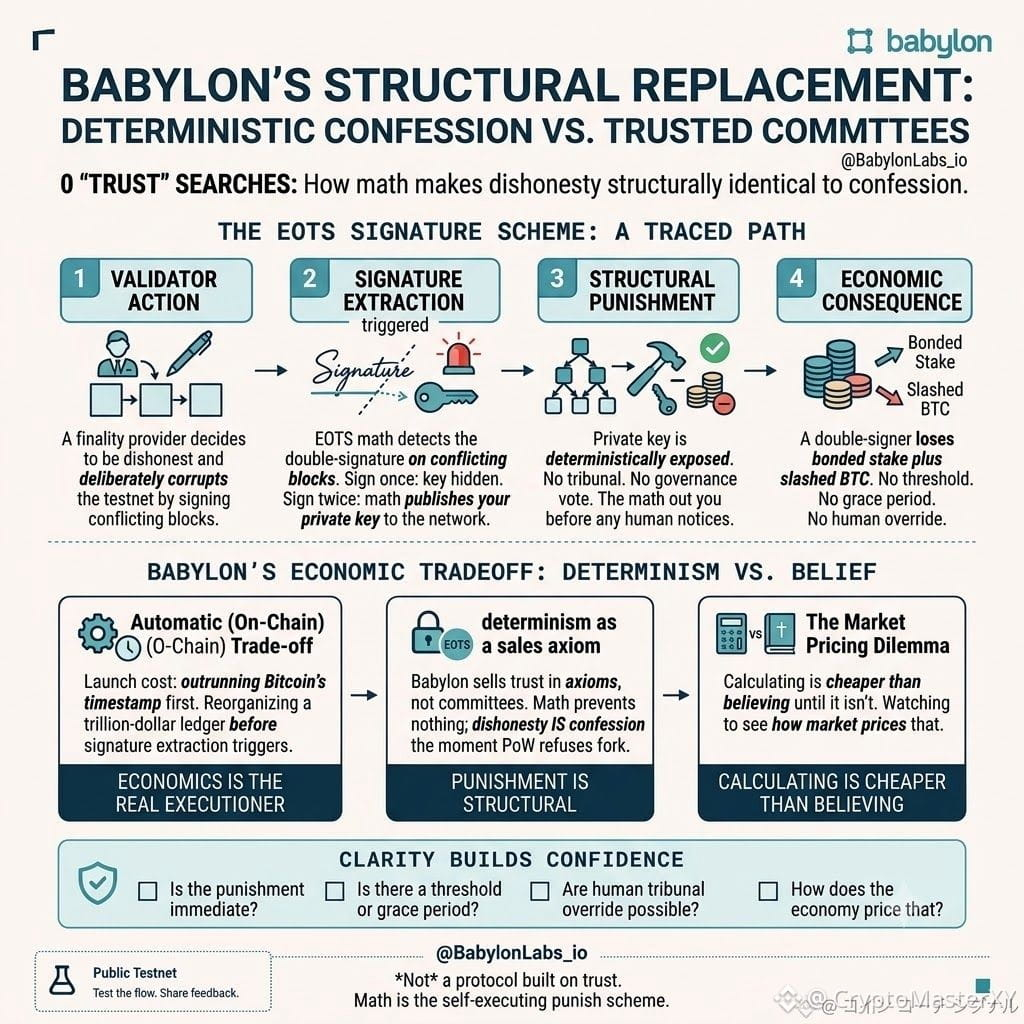
2
147
I wanted to know what happens in the gap between when a finality provider's real backing changes and when the protocol admits it changed. So I traced how Babylon's x/epoching module actually processes a new delegation.
Staking and unstaking messages don't execute immediately. They queue for the length of an entire epoch, then get processed in one batch at the boundary. Until that boundary hits, the chain's finality voting power reflects the old snapshot, not the current one. A finality provider could be losing delegations in real time, could be economically hollowing out mid epoch, and still vote with the weight it had before anyone withdrew.
That's not a bug. It's the tradeoff for batching thousands of BTC-backed delegations into one settlement instead of processing each individually. But it means the crypto-economic security backing a given block isn't the security that exists right now. It's the security that existed as of the last checkpoint, carried forward on trust that nothing material changed in between.
I kept comparing this to how a credit line actually works. Your limit doesn't update the instant your income changes. It updates on a cycle, and in between, the bank is extending trust based on a number that's already slightly wrong. Babylon does the same thing with Bitcoin's weight, just with better cryptography wrapped around the wrongness.
I don't think this breaks the model. Fast unbonding, roughly two days, keeps that window short compared to typical PoS chains. But short isn't zero, and the part worth watching isn't the token price. It's how wide that epoch window gets as the validator set scales.
$BABY @babylonlabs_io #baby $ON $BTC
I wanted to know what happens in the gap between when a finality provider's real backing changes and when the protocol admits it changed. So I traced how Babylon's x/epoching module actually processes a new delegation.
Staking and unstaking messages don't execute immediately. They queue for the length of an entire epoch, then get processed in one batch at the boundary. Until that boundary hits, the chain's finality voting power reflects the old snapshot, not the current one. A finality provider could be losing delegations in real time, could be economically hollowing out mid epoch, and still vote with the weight it had before anyone withdrew.
That's not a bug. It's the tradeoff for batching thousands of BTC-backed delegations into one settlement instead of processing each individually. But it means the crypto-economic security backing a given block isn't the security that exists right now. It's the security that existed as of the last checkpoint, carried forward on trust that nothing material changed in between.
I kept comparing this to how a credit line actually works. Your limit doesn't update the instant your income changes. It updates on a cycle, and in between, the bank is extending trust based on a number that's already slightly wrong. Babylon does the same thing with Bitcoin's weight, just with better cryptography wrapped around the wrongness.
I don't think this breaks the model. Fast unbonding, roughly two days, keeps that window short compared to typical PoS chains. But short isn't zero, and the part worth watching isn't the token price. It's how wide that epoch window gets as the validator set scales.
$BABY @BabylonLabs_io #baby $ON $BTC
Staking and unstaking messages don't execute immediately. They queue for the length of an entire epoch, then get processed in one batch at the boundary. Until that boundary hits, the chain's finality voting power reflects the old snapshot, not the current one. A finality provider could be losing delegations in real time, could be economically hollowing out mid epoch, and still vote with the weight it had before anyone withdrew.
That's not a bug. It's the tradeoff for batching thousands of BTC-backed delegations into one settlement instead of processing each individually. But it means the crypto-economic security backing a given block isn't the security that exists right now. It's the security that existed as of the last checkpoint, carried forward on trust that nothing material changed in between.
I kept comparing this to how a credit line actually works. Your limit doesn't update the instant your income changes. It updates on a cycle, and in between, the bank is extending trust based on a number that's already slightly wrong. Babylon does the same thing with Bitcoin's weight, just with better cryptography wrapped around the wrongness.
I don't think this breaks the model. Fast unbonding, roughly two days, keeps that window short compared to typical PoS chains. But short isn't zero, and the part worth watching isn't the token price. It's how wide that epoch window gets as the validator set scales.
$BABY @BabylonLabs_io #baby $ON $BTC
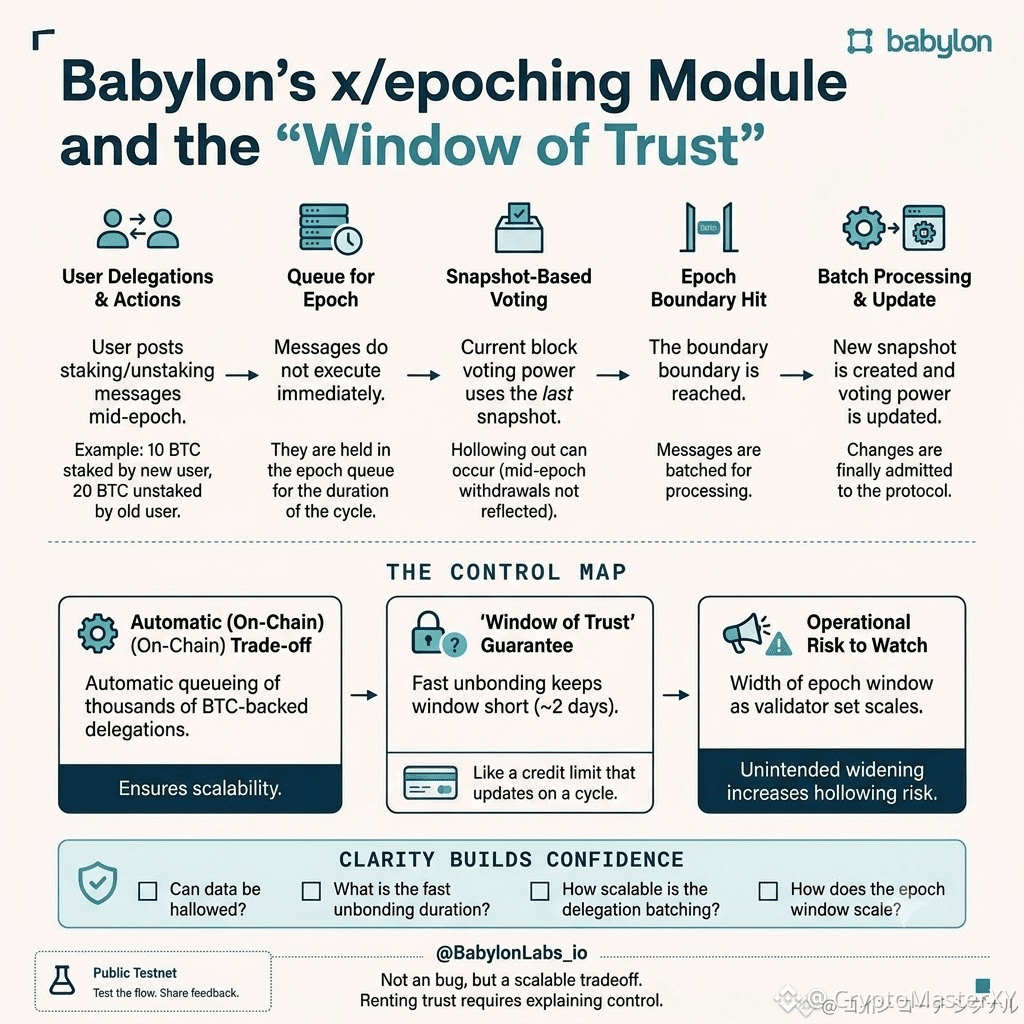
3
212
I assumed the covenant committee was a formality, the kind of multisig every Bitcoin staking protocol needs and nobody reads the code for. I only changed my mind after tracing what happens when a validator tries to unbond early.
There's no unbonding queue in the way people expect. When you stake, you don't sign a promise to wait. You sign the exit transaction itself, in advance, timelocked, held by the covenant committee before your BTC ever moves toward a validator. The committee doesn't decide whether you get your Bitcoin back. It holds a transaction that already decided, and simply waits for the clock the signature specified.
That single detail changes what the committee actually is. It isn't a governance body with discretion. It's a notary for a decision you already made. Its entire job is refusing to have an opinion. The moment a covenant member starts evaluating whether your exit is fair, the design has already failed, because fairness was supposed to be settled at signature time, not at redemption time.
I kept thinking about how unusual that is outside of code. Almost every institution we deal with, a bank, a landlord, a court, reserves the right to reinterpret your case later. Babylon's committee is built to have no case to reinterpret. It's already been signed shut.
I don't think that makes early exit painless. It means the pain was priced in before you staked, not negotiated after. A structure where the hardest conversation already happened, quietly, the day you clicked confirm.
$BABY @babylonlabs_io #baby $COTI $ON
I assumed the covenant committee was a formality, the kind of multisig every Bitcoin staking protocol needs and nobody reads the code for. I only changed my mind after tracing what happens when a validator tries to unbond early.
There's no unbonding queue in the way people expect. When you stake, you don't sign a promise to wait. You sign the exit transaction itself, in advance, timelocked, held by the covenant committee before your BTC ever moves toward a validator. The committee doesn't decide whether you get your Bitcoin back. It holds a transaction that already decided, and simply waits for the clock the signature specified.
That single detail changes what the committee actually is. It isn't a governance body with discretion. It's a notary for a decision you already made. Its entire job is refusing to have an opinion. The moment a covenant member starts evaluating whether your exit is fair, the design has already failed, because fairness was supposed to be settled at signature time, not at redemption time.
I kept thinking about how unusual that is outside of code. Almost every institution we deal with, a bank, a landlord, a court, reserves the right to reinterpret your case later. Babylon's committee is built to have no case to reinterpret. It's already been signed shut.
I don't think that makes early exit painless. It means the pain was priced in before you staked, not negotiated after. A structure where the hardest conversation already happened, quietly, the day you clicked confirm.
$BABY @BabylonLabs_io #baby $COTI $ON
There's no unbonding queue in the way people expect. When you stake, you don't sign a promise to wait. You sign the exit transaction itself, in advance, timelocked, held by the covenant committee before your BTC ever moves toward a validator. The committee doesn't decide whether you get your Bitcoin back. It holds a transaction that already decided, and simply waits for the clock the signature specified.
That single detail changes what the committee actually is. It isn't a governance body with discretion. It's a notary for a decision you already made. Its entire job is refusing to have an opinion. The moment a covenant member starts evaluating whether your exit is fair, the design has already failed, because fairness was supposed to be settled at signature time, not at redemption time.
I kept thinking about how unusual that is outside of code. Almost every institution we deal with, a bank, a landlord, a court, reserves the right to reinterpret your case later. Babylon's committee is built to have no case to reinterpret. It's already been signed shut.
I don't think that makes early exit painless. It means the pain was priced in before you staked, not negotiated after. A structure where the hardest conversation already happened, quietly, the day you clicked confirm.
$BABY @BabylonLabs_io #baby $COTI $ON
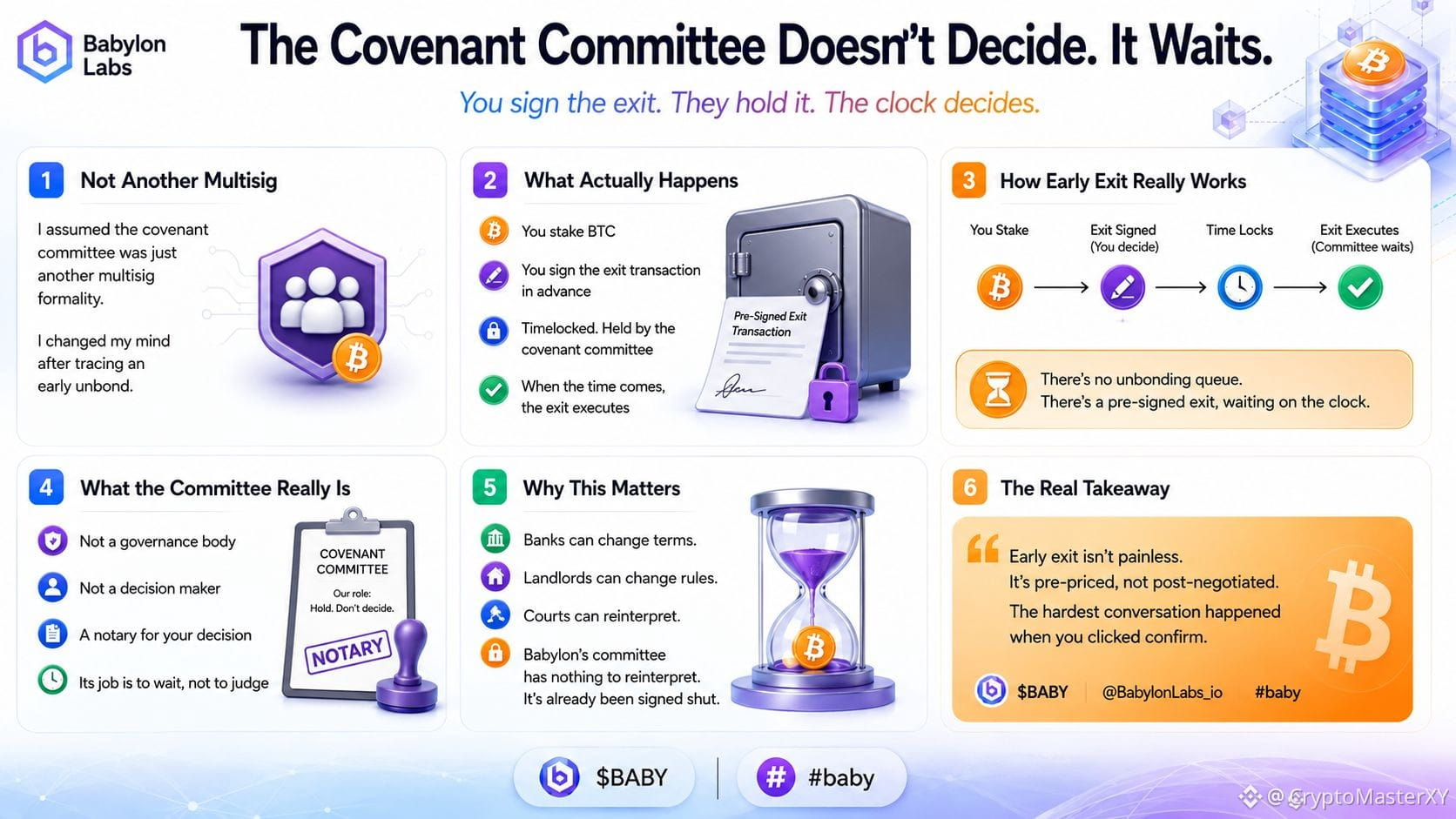
184
Log in to explore more content
Join global crypto users on Binance Square
⚡️ Get latest and useful information about crypto.
💬 Trusted by the world’s largest crypto exchange.
👍 Discover real insights from verified creators.
Email / Phone number
Trending Topics
BTCBreaks80K
20,323 views
628 Discussing
🚨 BITCOIN $80K IS BACK IN FOCUS! 🔥
BTC is pushing toward the $80,000 psychological resistance after reclaiming the $78K zone. A clean breakout and hold above $80K could bring $82K–$85K into focus next. 📈
But traders need to watch the rejection zone carefully — losing $77K–$78K could trigger another pullback.
🎯 Key levels:
• 🔥 Breakout: $80K
• 🚀 Next zone: $82K–$85K
• ⚠️ Support: $77K–$78K
$80K isn’t just a number — it’s the level bulls need to conquer.
Are we about to see the next BTC breakout? 👇
#bitcoin #BTC #BinanceSquare #btcbreaks80k
$BTC
ASHFAQ NAEEM
·4 Likes
·4.5k views
BuffettBecomesBerkshireChairmanEmeritus
1,638 views
150 Discussing
ZcashSpotETFTops$230MMonthlyInflow
729 views
42 Discussing