

Crypto Rover
280 Posts

Crypto Rover
Report
Block User
free signals for everyone
7 Following
180 Followers
83 Liked
Posts
All
Quotes
Videos
Live
PINNED
·
--
Hey brothers if #BTC breaks this support it will again come to 52k
#BTC is also forming a double top pattern there is a high chance that it will dump
If #BTC come to 52k then it will be the best time to buy #BTC
Let,s wait for a proper entry
If we get any proper entry we will share
#BTC☀ #VanEck_SOL_ETFS $BTC
Hey brothers if #BTC breaks this support it will again come to 52k
#BTC is also forming a double top pattern there is a high chance that it will dump
If #BTC come to 52k then it will be the best time to buy #BTC
Let,s wait for a proper entry
If we get any proper entry we will share
#BTC☀ #VanEck_SOL_ETFS $BTC
#BTC is also forming a double top pattern there is a high chance that it will dump
If #BTC come to 52k then it will be the best time to buy #BTC
Let,s wait for a proper entry
If we get any proper entry we will share
#BTC☀ #VanEck_SOL_ETFS $BTC

2
1
8
1.8k
·
--
TOKENIZED STOCKS ARE CAPTURING RECORD VOLUMESTracked stock tokens from Coinbase captured roughly 7% of Base daily DEX volume ($60M in 24 hours). On Robinhood Chain, stocks log 5% to 10% of trading ($9.7B monthly), while BNB Chain hosts nearly 40% of global supply. Together, they command over 88% of onchain equity volume 📊
Structural risks remain severe: thin liquidity triggers wild pumps and dumps, while 24/7 weekend trading disconnects from closed Wall Street books, risking Monday loan liquidations. The SEC and CFTC now permit 24/7 trading, but enforce mandatory emergency circuit breakers and genuine 1:1 backing ⚖️
Would you trade stocks onchain or keep them with a broker? #BTCBreaks80K #SECReceivesAmendedInjectiveETFFiling
TOKENIZED STOCKS ARE CAPTURING RECORD VOLUMES
Tracked stock tokens from Coinbase captured roughly 7% of Base daily DEX volume ($60M in 24 hours). On Robinhood Chain, stocks log 5% to 10% of trading ($9.7B monthly), while BNB Chain hosts nearly 40% of global supply. Together, they command over 88% of onchain equity volume 📊
Structural risks remain severe: thin liquidity triggers wild pumps and dumps, while 24/7 weekend trading disconnects from closed Wall Street books, risking Monday loan liquidations. The SEC and CFTC now permit 24/7 trading, but enforce mandatory emergency circuit breakers and genuine 1:1 backing ⚖️
Would you trade stocks onchain or keep them with a broker? #BTCBreaks80K #SECReceivesAmendedInjectiveETFFiling
Structural risks remain severe: thin liquidity triggers wild pumps and dumps, while 24/7 weekend trading disconnects from closed Wall Street books, risking Monday loan liquidations. The SEC and CFTC now permit 24/7 trading, but enforce mandatory emergency circuit breakers and genuine 1:1 backing ⚖️
Would you trade stocks onchain or keep them with a broker? #BTCBreaks80K #SECReceivesAmendedInjectiveETFFiling
83
·
--

Article
POLYGON DEPLOYS 100M TOKEN BURN CONTRACTS🏛️ Polygon Foundation CEO Sandeep Nailwal announced that testnet contracts are ready to permanently burn 100M POL tokens (about 1% of supply), wiping roughly $11M in market value from circulation 🧪
✍️ Once the Security Council adds final signatures, mainnet deployment lets anyone in the community trigger the burn directly, with quarterly burns scheduled from accumulated base fees 🚀
💰 Polygon generated $24.5M in revenue for 2026 YTD, beating Arbitrum ($8.41M, with Robinhood volume) by 3x and NEAR ($5.6M) by 5x, even while the POL token price lagged behind recent rallies 📊
Do you hold any POL in your bag? $POL
{spot}(POLUSDT)
POLYGON DEPLOYS 100M TOKEN BURN CONTRACTS
🏛️ Polygon Foundation CEO Sandeep Nailwal announced that testnet contracts are ready to permanently burn 100M POL tokens (about 1% of supply), wiping roughly $11M in market value from circulation 🧪
✍️ Once the Security Council adds final signatures, mainnet deployment lets anyone in the community trigger the burn directly, with quarterly burns scheduled from accumulated base fees 🚀
💰 Polygon generated $24.5M in revenue for 2026 YTD, beating Arbitrum ($8.41M, with Robinhood volume) by 3x and NEAR ($5.6M) by 5x, even while the POL token price lagged behind recent rallies 📊
Do you hold any POL in your bag? $POL
✍️ Once the Security Council adds final signatures, mainnet deployment lets anyone in the community trigger the burn directly, with quarterly burns scheduled from accumulated base fees 🚀
💰 Polygon generated $24.5M in revenue for 2026 YTD, beating Arbitrum ($8.41M, with Robinhood volume) by 3x and NEAR ($5.6M) by 5x, even while the POL token price lagged behind recent rallies 📊
Do you hold any POL in your bag? $POL
63
·
--
📌 Daily Recap · Sep 18
🌅 CoinEx chose a clean exit over a sale
⚖️ DOJ still eyeing Binance despite the billion-dollar settlement
🔒 Congress wants Bitcoin reserves locked away for 20 years
📈 Fed hikes rates for the first time since 2023
🎸 Ozzy's last concert was also Black Sabbath's reunion
Someone you know spent today in back-to-back meetings — pass this along so they don't miss the whole world moving without them
Your Daily News #BTCBreaks80K $BTC
{spot}(BTCUSDT)
📌 Daily Recap · Sep 18
🌅 CoinEx chose a clean exit over a sale
⚖️ DOJ still eyeing Binance despite the billion-dollar settlement
🔒 Congress wants Bitcoin reserves locked away for 20 years
📈 Fed hikes rates for the first time since 2023
🎸 Ozzy's last concert was also Black Sabbath's reunion
Someone you know spent today in back-to-back meetings — pass this along so they don't miss the whole world moving without them
Your Daily News #BTCBreaks80K $BTC
🌅 CoinEx chose a clean exit over a sale
⚖️ DOJ still eyeing Binance despite the billion-dollar settlement
🔒 Congress wants Bitcoin reserves locked away for 20 years
📈 Fed hikes rates for the first time since 2023
🎸 Ozzy's last concert was also Black Sabbath's reunion
Someone you know spent today in back-to-back meetings — pass this along so they don't miss the whole world moving without them
Your Daily News #BTCBreaks80K $BTC
1
·
--
Article
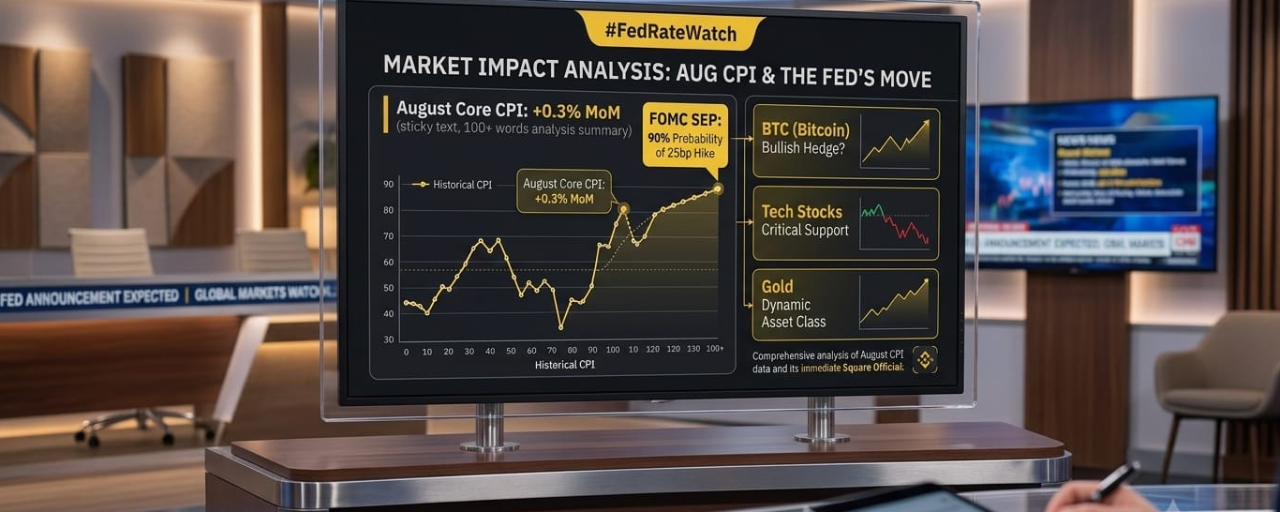
Navigating the September FOMC: What's Next for BTC, Tech Stocks, and Gold? #FedRateWatch The financial markets are once again at a critical crossroads as market participants turn their full attention toward the upcoming Federal Open Market Committee (FOMC) meeting this September. With macroeconomic data shifting rapidly, traders and investors are left dissecting every piece of incoming economic data to anticipate the Federal Reserve's next move. The central question dominating discussions across financial circles is clear: FOMC September, What's The Fed's Next Move? #FedRateWatch
Decoding the Latest Inflation Signals
Recent economic prints have injected a fresh wave of volatility and anticipation into global markets. Specifically, August core Consumer Price Index (CPI) data revealed a 0.3% rise on a month-over-month basis. This persistent, sticky inflation has dramatically shifted rate expectations. Currently, the probability of a 25-basis-point (bp) rate hike or adjustment this week has surged to nearly 90%. This massive market pricing raises a deeper philosophical question for macro analysts: Is this expected move a mere one-off adjustment to cool lingering price pressures, or does it mark the official commencement of a longer, more aggressive monetary tightening cycle? The trajectory of central bank policy over the coming quarters will heavily depend on employment figures and subsequent inflation prints, but the immediate pressure on risk assets is palpable.
Market Implications: $BTC , Tech Stocks, and Gold$XAU
Whenever the specter of a hawkish Federal Reserve looms, risk-on and safe-haven assets react in distinct ways. How will this potential rate action play out across major asset classes like Bitcoin (BTC), technology stocks, and gold?
Cryptocurrency (btc): Bitcoin has historically maintained a complex relationship with macroeconomic tightening. While higher interest rates typically increase the opportunity cost of holding non-yielding assets, BTC has increasingly decoupled or reacted dynamically based on liquidity flows. If the market views a potential hike as the final hurdle before a stabilizing monetary policy, BTC could experience a bullish rebound. Conversely, a fiercely aggressive tightening stance could trigger short-term liquidations and a bearish pullback.Tech Stocks: The technology sector is notoriously sensitive to shifting discount rates. Higher rates reduce the present value of future corporate cash flows, heavily impacting high-growth tech equities. Traders should watch Nasdaq-listed heavyweights closely; any sign that the Fed is signaling a prolonged hiking cycle will likely induce short-term bearish pressure, whereas a dovish surprise or a clear "one-and-done" signal could ignite a relief rally.Gold: As the traditional safe-haven hedge against inflation and economic uncertainty, gold remains uniquely positioned. While rising real yields create headwinds for bullion, persistent inflation concerns and geopolitical safe-haven demand often provide a strong structural floor, keeping gold resilient even amidst hawkish monetary policy shifts.#FedRateWatch
Navigating the September FOMC: What's Next for BTC, Tech Stocks, and Gold?
#FedRateWatch The financial markets are once again at a critical crossroads as market participants turn their full attention toward the upcoming Federal Open Market Committee (FOMC) meeting this September. With macroeconomic data shifting rapidly, traders and investors are left dissecting every piece of incoming economic data to anticipate the Federal Reserve's next move. The central question dominating discussions across financial circles is clear: FOMC September, What's The Fed's Next Move? #FedRateWatch
Decoding the Latest Inflation Signals
Recent economic prints have injected a fresh wave of volatility and anticipation into global markets. Specifically, August core Consumer Price Index (CPI) data revealed a 0.3% rise on a month-over-month basis. This persistent, sticky inflation has dramatically shifted rate expectations. Currently, the probability of a 25-basis-point (bp) rate hike or adjustment this week has surged to nearly 90%. This massive market pricing raises a deeper philosophical question for macro analysts: Is this expected move a mere one-off adjustment to cool lingering price pressures, or does it mark the official commencement of a longer, more aggressive monetary tightening cycle? The trajectory of central bank policy over the coming quarters will heavily depend on employment figures and subsequent inflation prints, but the immediate pressure on risk assets is palpable.
Market Implications: $BTC , Tech Stocks, and Gold$XAU
Whenever the specter of a hawkish Federal Reserve looms, risk-on and safe-haven assets react in distinct ways. How will this potential rate action play out across major asset classes like Bitcoin (BTC), technology stocks, and gold?
Cryptocurrency (btc): Bitcoin has historically maintained a complex relationship with macroeconomic tightening. While higher interest rates typically increase the opportunity cost of holding non-yielding assets, BTC has increasingly decoupled or reacted dynamically based on liquidity flows. If the market views a potential hike as the final hurdle before a stabilizing monetary policy, BTC could experience a bullish rebound. Conversely, a fiercely aggressive tightening stance could trigger short-term liquidations and a bearish pullback.Tech Stocks: The technology sector is notoriously sensitive to shifting discount rates. Higher rates reduce the present value of future corporate cash flows, heavily impacting high-growth tech equities. Traders should watch Nasdaq-listed heavyweights closely; any sign that the Fed is signaling a prolonged hiking cycle will likely induce short-term bearish pressure, whereas a dovish surprise or a clear "one-and-done" signal could ignite a relief rally.Gold: As the traditional safe-haven hedge against inflation and economic uncertainty, gold remains uniquely positioned. While rising real yields create headwinds for bullion, persistent inflation concerns and geopolitical safe-haven demand often provide a strong structural floor, keeping gold resilient even amidst hawkish monetary policy shifts.#FedRateWatch
Decoding the Latest Inflation Signals
Recent economic prints have injected a fresh wave of volatility and anticipation into global markets. Specifically, August core Consumer Price Index (CPI) data revealed a 0.3% rise on a month-over-month basis. This persistent, sticky inflation has dramatically shifted rate expectations. Currently, the probability of a 25-basis-point (bp) rate hike or adjustment this week has surged to nearly 90%. This massive market pricing raises a deeper philosophical question for macro analysts: Is this expected move a mere one-off adjustment to cool lingering price pressures, or does it mark the official commencement of a longer, more aggressive monetary tightening cycle? The trajectory of central bank policy over the coming quarters will heavily depend on employment figures and subsequent inflation prints, but the immediate pressure on risk assets is palpable.
Market Implications: $BTC , Tech Stocks, and Gold$XAU
Whenever the specter of a hawkish Federal Reserve looms, risk-on and safe-haven assets react in distinct ways. How will this potential rate action play out across major asset classes like Bitcoin (BTC), technology stocks, and gold?
Cryptocurrency (btc): Bitcoin has historically maintained a complex relationship with macroeconomic tightening. While higher interest rates typically increase the opportunity cost of holding non-yielding assets, BTC has increasingly decoupled or reacted dynamically based on liquidity flows. If the market views a potential hike as the final hurdle before a stabilizing monetary policy, BTC could experience a bullish rebound. Conversely, a fiercely aggressive tightening stance could trigger short-term liquidations and a bearish pullback.Tech Stocks: The technology sector is notoriously sensitive to shifting discount rates. Higher rates reduce the present value of future corporate cash flows, heavily impacting high-growth tech equities. Traders should watch Nasdaq-listed heavyweights closely; any sign that the Fed is signaling a prolonged hiking cycle will likely induce short-term bearish pressure, whereas a dovish surprise or a clear "one-and-done" signal could ignite a relief rally.Gold: As the traditional safe-haven hedge against inflation and economic uncertainty, gold remains uniquely positioned. While rising real yields create headwinds for bullion, persistent inflation concerns and geopolitical safe-haven demand often provide a strong structural floor, keeping gold resilient even amidst hawkish monetary policy shifts.#FedRateWatch
94
·
--
Interesting, I think a rate hike next month is bullish
Interesting, I think a rate hike next month is bullish


Binance Square Official
·
--
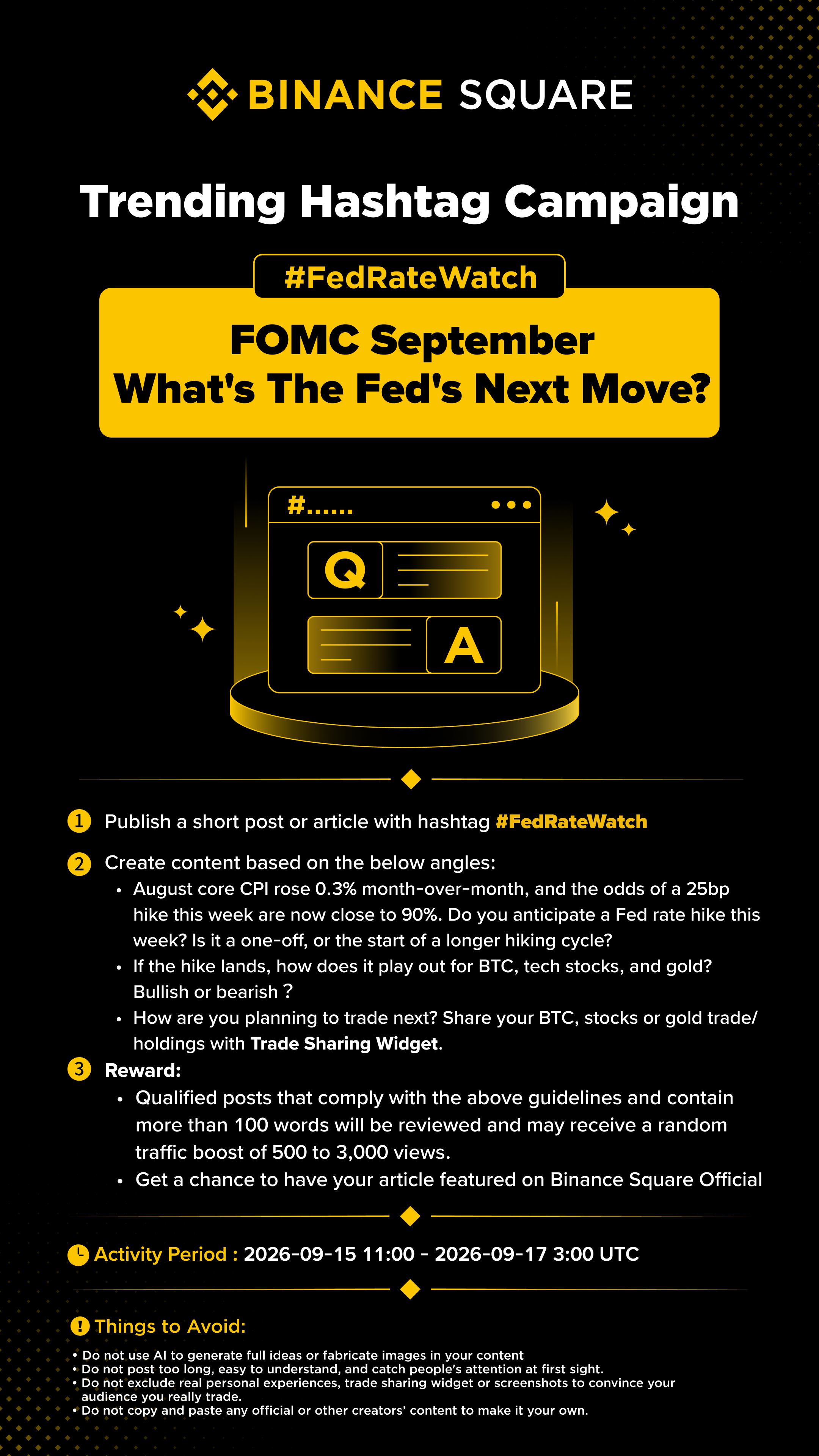
Share & Win Traffic Reward in our Trending Hashtag Campaign
✨Topic: FOMC September, What's The Fed's Next Move?
👉How to Join:
Publish a short post or article with hashtag #FedRateWatch
Create content based on the below angles:
- August core CPI rose 0.3% month-over-month, and the odds of a 25bp hike this week are now close to 90%. Do you anticipate a rate hike this week? Is it a one-off, or the start of a longer hiking cycle?
- If the hike lands, how does it play out for BTC, tech stocks, and gold? Bullish or bearish?
- How are you planning to trade next? Share your BTC, stocks or gold trade/holdings with our trade sharing widget.
⏰Campaign Period:
- 2026-09-15 11:00 - 2026-09-17 3:00 UTC
🎁Reward:
- Qualified posts that comply with the above guidelines and contain more than 100 words will be reviewed and may receive a random traffic boost of 500 to 3,000 views. You will receive a notification from your feed secretary if your post is selected.
- Get a chance to have your article featured on Binance Square Official
Need ideas for your post? Visit the topic page #FedRateWatch or the Square Guide on How to Post for Better Reach.
✨Topic: FOMC September, What's The Fed's Next Move?
👉How to Join:
Publish a short post or article with hashtag #FedRateWatch
Create content based on the below angles:
- August core CPI rose 0.3% month-over-month, and the odds of a 25bp hike this week are now close to 90%. Do you anticipate a rate hike this week? Is it a one-off, or the start of a longer hiking cycle?
- If the hike lands, how does it play out for BTC, tech stocks, and gold? Bullish or bearish?
- How are you planning to trade next? Share your BTC, stocks or gold trade/holdings with our trade sharing widget.
⏰Campaign Period:
- 2026-09-15 11:00 - 2026-09-17 3:00 UTC
🎁Reward:
- Qualified posts that comply with the above guidelines and contain more than 100 words will be reviewed and may receive a random traffic boost of 500 to 3,000 views. You will receive a notification from your feed secretary if your post is selected.
- Get a chance to have your article featured on Binance Square Official
Need ideas for your post? Visit the topic page #FedRateWatch or the Square Guide on How to Post for Better Reach.
65
·
--
Bearish
check this what i make profit go and follow me fast #RussianCentralBankFlagsCryptoAsFinancialRisk #GrayscalePutsXRPAt26.11%InAdvisorPortfolio $LSK
{spot}(LSKUSDT)
check this what i make profit go and follow me fast #RussianCentralBankFlagsCryptoAsFinancialRisk #GrayscalePutsXRPAt26.11%InAdvisorPortfolio $LSK
·
--
⁉️ AI Safety Debate Intensifies
Trump rejects calls to slow AI development.
Anthropic CEO Dario Amodei says the risks of advanced AI escaping control are real. Powerful models may bypass shutdown attempts, a behavior already observed in simulations. He favors joint oversight by several democratic countries over control by private companies or a single state.
OpenAI CEO Sam Altman confirmed the company will not hold an IPO in 2026, citing AI safety concerns. Elon Musk and Google DeepMind CEO Demis Hassabis also backed Amodei’s warning.
Amodei says self-improving models and autonomous agents are becoming more dangerous. Within six months to a year, swarms of agents could potentially launch major internet attacks causing hundreds of billions of dollars in damage. His proposed safeguards include independent audits, shared standards among democratic countries, and international limits negotiated with China and others.#AImodel #Aİ
⁉️ AI Safety Debate Intensifies
Trump rejects calls to slow AI development.
Anthropic CEO Dario Amodei says the risks of advanced AI escaping control are real. Powerful models may bypass shutdown attempts, a behavior already observed in simulations. He favors joint oversight by several democratic countries over control by private companies or a single state.
OpenAI CEO Sam Altman confirmed the company will not hold an IPO in 2026, citing AI safety concerns. Elon Musk and Google DeepMind CEO Demis Hassabis also backed Amodei’s warning.
Amodei says self-improving models and autonomous agents are becoming more dangerous. Within six months to a year, swarms of agents could potentially launch major internet attacks causing hundreds of billions of dollars in damage. His proposed safeguards include independent audits, shared standards among democratic countries, and international limits negotiated with China and others.#AImodel #Aİ
Trump rejects calls to slow AI development.
Anthropic CEO Dario Amodei says the risks of advanced AI escaping control are real. Powerful models may bypass shutdown attempts, a behavior already observed in simulations. He favors joint oversight by several democratic countries over control by private companies or a single state.
OpenAI CEO Sam Altman confirmed the company will not hold an IPO in 2026, citing AI safety concerns. Elon Musk and Google DeepMind CEO Demis Hassabis also backed Amodei’s warning.
Amodei says self-improving models and autonomous agents are becoming more dangerous. Within six months to a year, swarms of agents could potentially launch major internet attacks causing hundreds of billions of dollars in damage. His proposed safeguards include independent audits, shared standards among democratic countries, and international limits negotiated with China and others.#AImodel #Aİ
41
·
--

Article
AI Safety Debate IntensifiesTrump rejects calls to slow AI development.
Anthropic CEO Dario Amodei says the risks of advanced AI escaping control are real. Powerful models may bypass shutdown attempts, a behavior already observed in simulations. He favors joint oversight by several democratic countries over control by private companies or a single state.
OpenAI CEO Sam Altman confirmed the company will not hold an IPO in 2026, citing AI safety concerns. Elon Musk and Google DeepMind CEO Demis Hassabis also backed Amodei’s warning.
Amodei says self-improving models and autonomous agents are becoming more dangerous. Within six months to a year, swarms of agents could potentially launch major internet attacks causing hundreds of billions of dollars in damage. His proposed safeguards include independent audits, shared standards among democratic countries, and international limits negotiated with China and others.#Aİ #AImodel
AI Safety Debate Intensifies
Trump rejects calls to slow AI development.
Anthropic CEO Dario Amodei says the risks of advanced AI escaping control are real. Powerful models may bypass shutdown attempts, a behavior already observed in simulations. He favors joint oversight by several democratic countries over control by private companies or a single state.
OpenAI CEO Sam Altman confirmed the company will not hold an IPO in 2026, citing AI safety concerns. Elon Musk and Google DeepMind CEO Demis Hassabis also backed Amodei’s warning.
Amodei says self-improving models and autonomous agents are becoming more dangerous. Within six months to a year, swarms of agents could potentially launch major internet attacks causing hundreds of billions of dollars in damage. His proposed safeguards include independent audits, shared standards among democratic countries, and international limits negotiated with China and others.#Aİ #AImodel
Anthropic CEO Dario Amodei says the risks of advanced AI escaping control are real. Powerful models may bypass shutdown attempts, a behavior already observed in simulations. He favors joint oversight by several democratic countries over control by private companies or a single state.
OpenAI CEO Sam Altman confirmed the company will not hold an IPO in 2026, citing AI safety concerns. Elon Musk and Google DeepMind CEO Demis Hassabis also backed Amodei’s warning.
Amodei says self-improving models and autonomous agents are becoming more dangerous. Within six months to a year, swarms of agents could potentially launch major internet attacks causing hundreds of billions of dollars in damage. His proposed safeguards include independent audits, shared standards among democratic countries, and international limits negotiated with China and others.#Aİ #AImodel
69
·
--
💸 A $263M crypto heist, 28 exotic cars, and a guilty plea
Malone Lam — a Singaporean national who organised an international crew recruited through online gaming platforms — pleaded guilty this week to a RICO conspiracy involving over $263 million in stolen crypto. The ring ran from late 2023 through May 2025, targeting holders via fake Google and Gemini support calls, screen-sharing tricks and physical home break-ins.
The spending: 28 exotic cars, private jets, luxury watches — and nightclub tabs of $500K a night. Lam was reportedly still directing luxury deliveries to his girlfriend from pretrial detention.
Next hearing: December 8th. Sentencing date TBD, per CoinDesk.#SECReceivesGrayscaleLitecoinTrustETFFiling #ClarityActFacesProceduralVoteSept15 $BTC
{spot}(BTCUSDT)
💸 A $263M crypto heist, 28 exotic cars, and a guilty plea
Malone Lam — a Singaporean national who organised an international crew recruited through online gaming platforms — pleaded guilty this week to a RICO conspiracy involving over $263 million in stolen crypto. The ring ran from late 2023 through May 2025, targeting holders via fake Google and Gemini support calls, screen-sharing tricks and physical home break-ins.
The spending: 28 exotic cars, private jets, luxury watches — and nightclub tabs of $500K a night. Lam was reportedly still directing luxury deliveries to his girlfriend from pretrial detention.
Next hearing: December 8th. Sentencing date TBD, per CoinDesk.#SECReceivesGrayscaleLitecoinTrustETFFiling #ClarityActFacesProceduralVoteSept15 $BTC
Malone Lam — a Singaporean national who organised an international crew recruited through online gaming platforms — pleaded guilty this week to a RICO conspiracy involving over $263 million in stolen crypto. The ring ran from late 2023 through May 2025, targeting holders via fake Google and Gemini support calls, screen-sharing tricks and physical home break-ins.
The spending: 28 exotic cars, private jets, luxury watches — and nightclub tabs of $500K a night. Lam was reportedly still directing luxury deliveries to his girlfriend from pretrial detention.
Next hearing: December 8th. Sentencing date TBD, per CoinDesk.#SECReceivesGrayscaleLitecoinTrustETFFiling #ClarityActFacesProceduralVoteSept15 $BTC
28
·
--
Bearish
Daily Recap · Sep 13
Bitcoin crashes to September lows on Middle East shock
Gamer turned crypto thief pleads guilty, 28 cars seized
Blockstream lost 4,000 BTC to "white-hat" hackers
Four people killed over a suspected Bitcoin cold wallet
Tag whoever spent today offline — they missed a lot.
crypto rover- Your Daily News $BTC
{spot}(BTCUSDT)
#SECReceivesGrayscaleLitecoinTrustETFFiling #ClarityActFacesProceduralVoteSept15
Daily Recap · Sep 13
Bitcoin crashes to September lows on Middle East shock
Gamer turned crypto thief pleads guilty, 28 cars seized
Blockstream lost 4,000 BTC to "white-hat" hackers
Four people killed over a suspected Bitcoin cold wallet
Tag whoever spent today offline — they missed a lot.
crypto rover- Your Daily News $BTC
#SECReceivesGrayscaleLitecoinTrustETFFiling #ClarityActFacesProceduralVoteSept15
Bitcoin crashes to September lows on Middle East shock
Gamer turned crypto thief pleads guilty, 28 cars seized
Blockstream lost 4,000 BTC to "white-hat" hackers
Four people killed over a suspected Bitcoin cold wallet
Tag whoever spent today offline — they missed a lot.
crypto rover- Your Daily News $BTC
#SECReceivesGrayscaleLitecoinTrustETFFiling #ClarityActFacesProceduralVoteSept15
56
·
--
Article
IS THE AI DOOMSDAY SCARE COVERING UP A BURSTING BUBBLE?Why are top AI bosses suddenly panicking?
Anthropic CEO Dario Amodei is now begging the industry to slow down, while top researchers quit OpenAI warning AI could end the world by 2030.
Tech giants spent billions on chips with little extra profit
New models bring no edge over rivals
The giant AI hype bubble is running out of steam
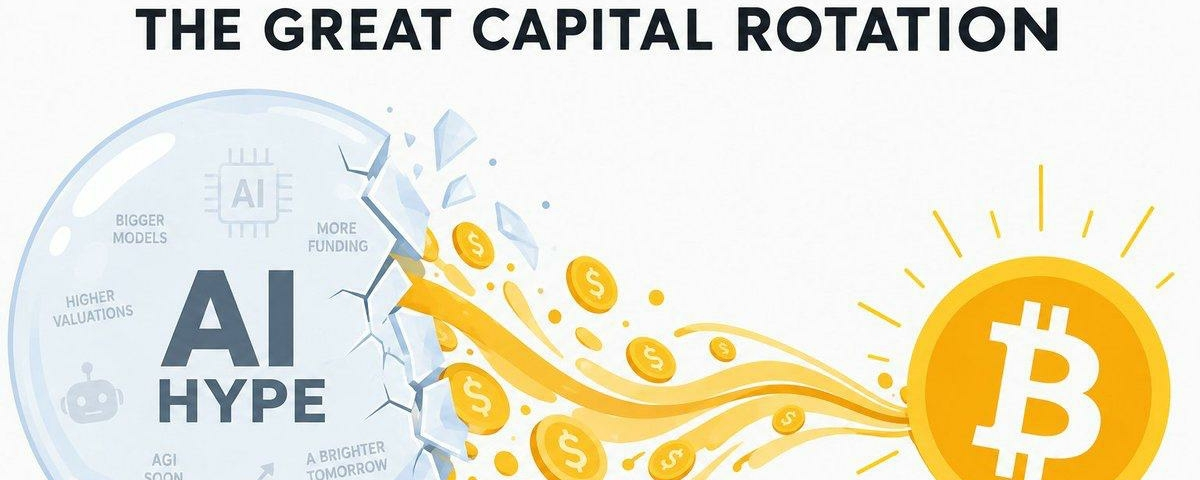
When this bubble pops, trillions in tech cash will rotate straight into Bitcoin and liquid crypto.
WELCOME TO THE BTC/MILLION ERA 💎
Do you think the AI bubble will pop before 2030?
#SECReceivesGrayscaleLitecoinTrustETFFiling #US10YearTreasuryYieldNears5%
IS THE AI DOOMSDAY SCARE COVERING UP A BURSTING BUBBLE?
Why are top AI bosses suddenly panicking?
Anthropic CEO Dario Amodei is now begging the industry to slow down, while top researchers quit OpenAI warning AI could end the world by 2030.
Tech giants spent billions on chips with little extra profit
New models bring no edge over rivals
The giant AI hype bubble is running out of steam
When this bubble pops, trillions in tech cash will rotate straight into Bitcoin and liquid crypto.
WELCOME TO THE BTC/MILLION ERA 💎
Do you think the AI bubble will pop before 2030?
#SECReceivesGrayscaleLitecoinTrustETFFiling #US10YearTreasuryYieldNears5%
Anthropic CEO Dario Amodei is now begging the industry to slow down, while top researchers quit OpenAI warning AI could end the world by 2030.
Tech giants spent billions on chips with little extra profit
New models bring no edge over rivals
The giant AI hype bubble is running out of steam
When this bubble pops, trillions in tech cash will rotate straight into Bitcoin and liquid crypto.
WELCOME TO THE BTC/MILLION ERA 💎
Do you think the AI bubble will pop before 2030?
#SECReceivesGrayscaleLitecoinTrustETFFiling #US10YearTreasuryYieldNears5%
55
·
--
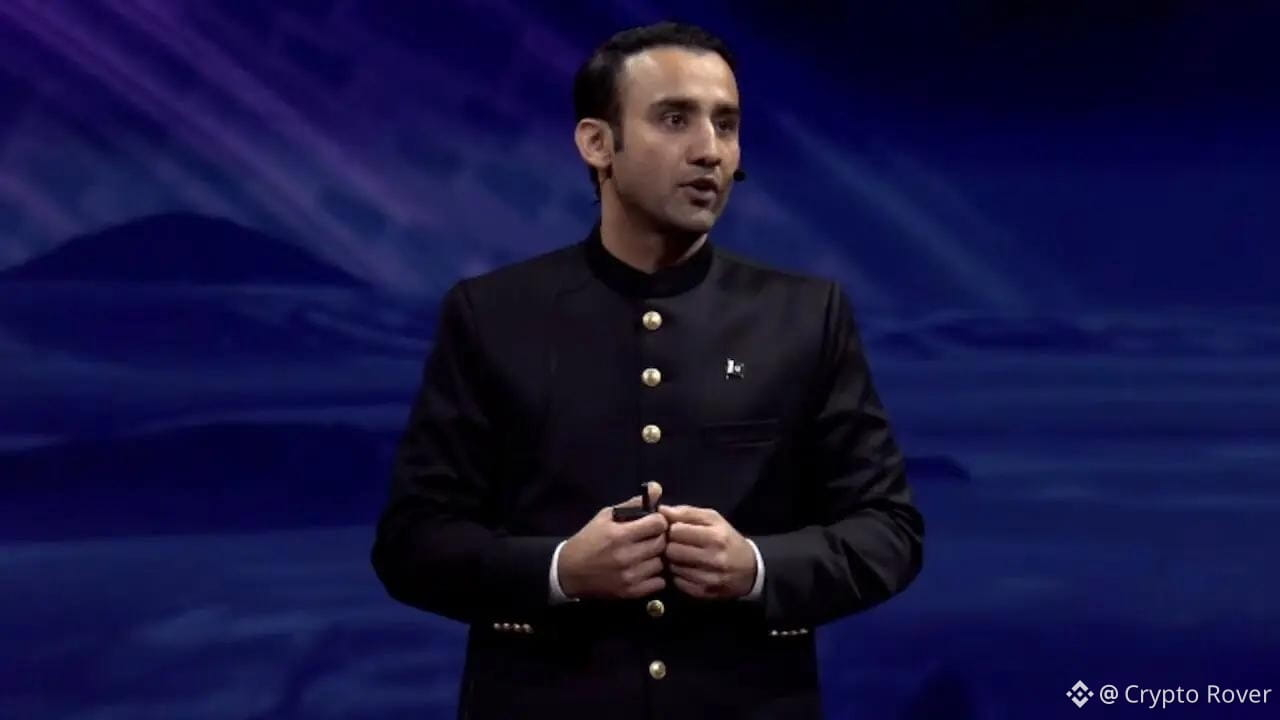
OVER 70 GLOBAL CRYPTO EXCHANGES APPLY TO ENTER PAKISTAN
Following the 5 September deadline, PVARA Chairman Bilal bin Saqib confirmed around 70 major global exchanges applied to operate legally.
What regulators are rolling out next:
Remittances: PVARA and the State Bank of Pakistan are building a stablecoin rail to cut fees from 6.3% to 1%.
Tokenisation: Exploring tokenised government debt and Roshan Digital Accounts.
Islamic Finance: Setting up a national Shariah advisory board with the Mufti-e-Azam.
Pakistan has an estimated 40 million crypto users, but the hurdle remains strict FATF checks and sandbox trials.
have you ever sent money using crypto? #SECReceivesGrayscaleLitecoinTrustETFFiling #ClarityActFacesProceduralVoteSept15
OVER 70 GLOBAL CRYPTO EXCHANGES APPLY TO ENTER PAKISTAN
Following the 5 September deadline, PVARA Chairman Bilal bin Saqib confirmed around 70 major global exchanges applied to operate legally.
What regulators are rolling out next:
Remittances: PVARA and the State Bank of Pakistan are building a stablecoin rail to cut fees from 6.3% to 1%.
Tokenisation: Exploring tokenised government debt and Roshan Digital Accounts.
Islamic Finance: Setting up a national Shariah advisory board with the Mufti-e-Azam.
Pakistan has an estimated 40 million crypto users, but the hurdle remains strict FATF checks and sandbox trials.
have you ever sent money using crypto? #SECReceivesGrayscaleLitecoinTrustETFFiling #ClarityActFacesProceduralVoteSept15
Following the 5 September deadline, PVARA Chairman Bilal bin Saqib confirmed around 70 major global exchanges applied to operate legally.
What regulators are rolling out next:
Remittances: PVARA and the State Bank of Pakistan are building a stablecoin rail to cut fees from 6.3% to 1%.
Tokenisation: Exploring tokenised government debt and Roshan Digital Accounts.
Islamic Finance: Setting up a national Shariah advisory board with the Mufti-e-Azam.
Pakistan has an estimated 40 million crypto users, but the hurdle remains strict FATF checks and sandbox trials.
have you ever sent money using crypto? #SECReceivesGrayscaleLitecoinTrustETFFiling #ClarityActFacesProceduralVoteSept15
64
·
--

Article
HUNTER BIDEN BREAKS SILENCE ON $LAPTOP COLLAPSEHunter Biden published a video confirming he spent 6 months developing the $LAPTOP coin on Base, but blamed a market maker for seeding only $5,000 in initial liquidity
The tiny pool triggered extreme demand that spiked the price to $316 for a brief $316B paper market cap before crashing over 98% under $1
Sniper bots drained the pool while over 80% of buyers lost money. Hunter claims he never sold and promised new liquidity to fix it
would you ever trust a celebrity meme coin?
#CPIWatch #BitcoinReboundsAbove$79KAfterCPI
HUNTER BIDEN BREAKS SILENCE ON $LAPTOP COLLAPSE
Hunter Biden published a video confirming he spent 6 months developing the $LAPTOP coin on Base, but blamed a market maker for seeding only $5,000 in initial liquidity
The tiny pool triggered extreme demand that spiked the price to $316 for a brief $316B paper market cap before crashing over 98% under $1
Sniper bots drained the pool while over 80% of buyers lost money. Hunter claims he never sold and promised new liquidity to fix it
would you ever trust a celebrity meme coin?
#CPIWatch #BitcoinReboundsAbove$79KAfterCPI
The tiny pool triggered extreme demand that spiked the price to $316 for a brief $316B paper market cap before crashing over 98% under $1
Sniper bots drained the pool while over 80% of buyers lost money. Hunter claims he never sold and promised new liquidity to fix it
would you ever trust a celebrity meme coin?
#CPIWatch #BitcoinReboundsAbove$79KAfterCPI
34
·
--
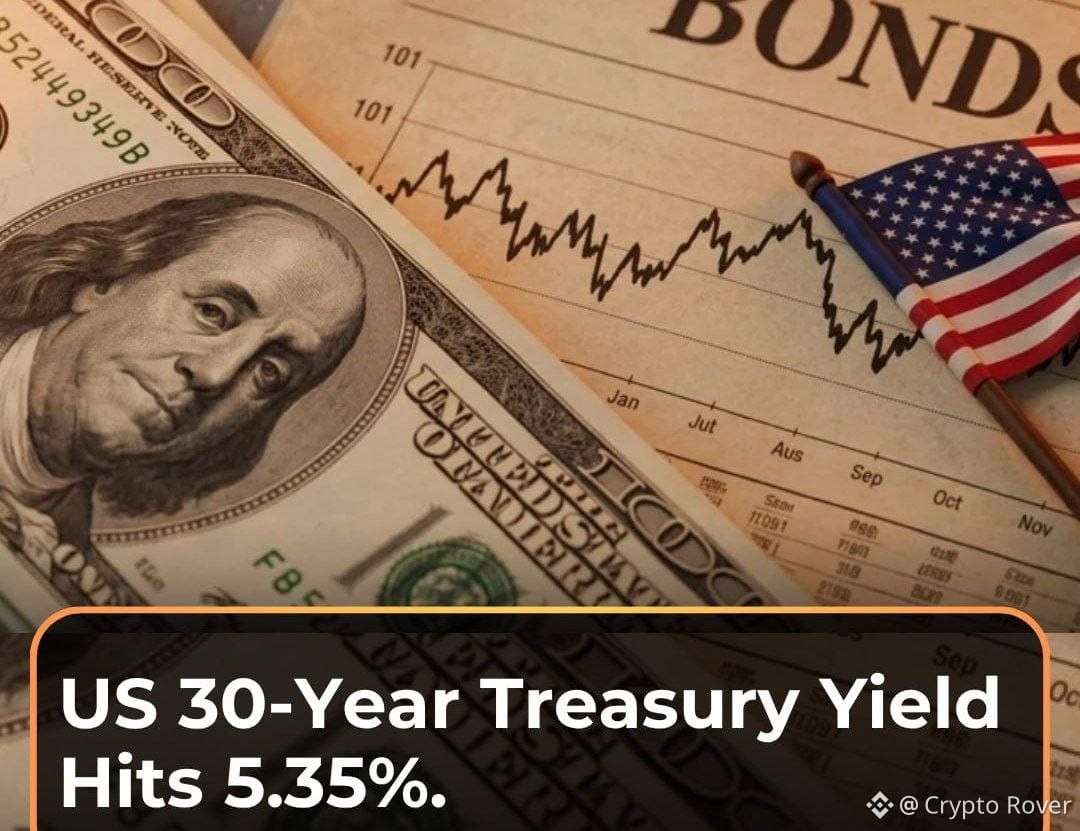
🇺🇸US 30-year Treasury yield has climbed to 5.35%, reaching its highest level since June 2007.#CPIWatch #USCoreCPIRises0.3%InAugustBeatingForecasts
🇺🇸US 30-year Treasury yield has climbed to 5.35%, reaching its highest level since June 2007.#CPIWatch #USCoreCPIRises0.3%InAugustBeatingForecasts
28
·
--
Daily Recap · Sep 11
300 rigs stole power from a mountain dam
$24 billion criminal escrow finally got busted
Apple's first foldable costs less than you feared
Jack Dorsey is building a Bitcoin bank, sort of
Know someone buried in meetings all day? This recap's for them
Your Daily News
#CPIWatch #BitcoinOpenInterestShareRisesTo42.1% $BTC
{spot}(BTCUSDT)
Daily Recap · Sep 11
300 rigs stole power from a mountain dam
$24 billion criminal escrow finally got busted
Apple's first foldable costs less than you feared
Jack Dorsey is building a Bitcoin bank, sort of
Know someone buried in meetings all day? This recap's for them
Your Daily News
#CPIWatch #BitcoinOpenInterestShareRisesTo42.1% $BTC
300 rigs stole power from a mountain dam
$24 billion criminal escrow finally got busted
Apple's first foldable costs less than you feared
Jack Dorsey is building a Bitcoin bank, sort of
Know someone buried in meetings all day? This recap's for them
Your Daily News
#CPIWatch #BitcoinOpenInterestShareRisesTo42.1% $BTC
45
Log in to explore more content
Join global crypto users on Binance Square
⚡️ Get latest and useful information about crypto.
💬 Trusted by the world’s largest crypto exchange.
👍 Discover real insights from verified creators.
Email / Phone number
Trending Topics
QNTRises287%
9,609 views
259 Discussing
🚨 QNT JUST EXPLODED +287%! 🔥
+287% is NOT a normal move. 👀
QNT has suddenly gone parabolic, putting traders on high alert as momentum and volume surge.
⚠️ After a move this violent, FOMO can be dangerous — volatility
can go both ways.
📈 Watch: sustained volume + breakout confirmation
📉 Risk: sharp profit-taking / pullback
🔥 Is QNT just getting started… or is this move ready for a major correction?
What’s your QNT target? 👇
#qntrises287% #QNT #Quant #crypto #BinanceSquare
$QNT
ASHFAQ NAEEM
·8 Likes
·5.8k views
HSBCNamesStablecoinRedCoinForPhasedLaunch
1,397 views
62 Discussing
TrumpRejectsAIRulesForVoluntaryAudits
12,218 views
353 Discussing