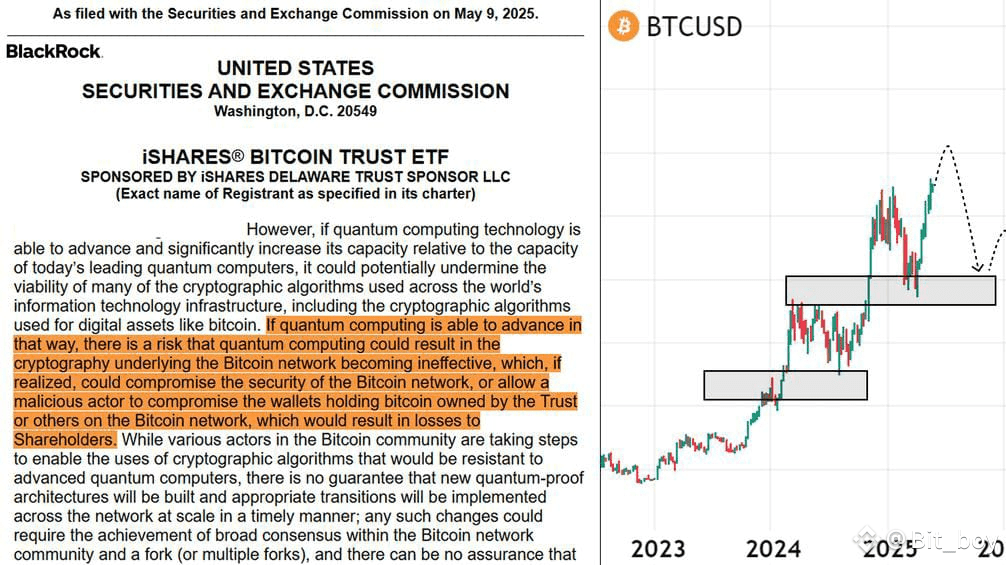
🚨BlackRock: BTC will be compromised and dumped to $40k!
Development of quantum computing might kill the Bitcoin network I researched all the data and learn everything about it. /➮ Recently, BlackRock warned us about potential risks to the Bitcoin network 🕷 All due to the rapid progress in the field of quantum computing. 🕷 I’ll add their report at the end - but for now, let’s break down what this actually means. /➮ Bitcoin's security relies on cryptographic algorithms, mainly ECDSA 🕷 It safeguards private keys and ensures transaction integrity 🕷 Quantum computers, leveraging algorithms like Shor's algorithm, could potentially break ECDSA /➮ How? By efficiently solving complex mathematical problems that are currently infeasible for classical computers 🕷 This will would allow malicious actors to derive private keys from public keys Compromising wallet security and transaction authenticity /➮ So BlackRock warns that such a development might enable attackers to compromise wallets and transactions 🕷 Which would lead to potential losses for investors 🕷 But when will this happen and how can we protect ourselves? /➮ Quantum computers capable of breaking Bitcoin's cryptography are not yet operational 🕷 Experts estimate that such capabilities could emerge within 5-7 yeards 🕷 Currently, 25% of BTC is stored in addresses that are vulnerable to quantum attacks /➮ But it's not all bad - the Bitcoin community and the broader cryptocurrency ecosystem are already exploring several strategies: - Post-Quantum Cryptography - Wallet Security Enhancements - Network Upgrades /➮ However, if a solution is not found in time, it could seriously undermine trust in digital assets 🕷 Which in turn could reduce demand for BTC and crypto in general 🕷 And the current outlook isn't too optimistic - here's why: /➮ Google has stated that breaking RSA encryption (tech also used to secure crypto wallets) 🕷 Would require 20x fewer quantum resources than previously expected 🕷 That means we may simply not have enough time to solve the problem before it becomes critical /➮ For now, I believe the most effective step is encouraging users to transfer funds to addresses with enhanced security, 🕷 Such as Pay-to-Public-Key-Hash (P2PKH) addresses, which do not expose public keys until a transaction is made 🕷 Don’t rush to sell all your BTC or move it off wallets - there is still time 🕷 But it's important to keep an eye on this issue and the progress on solutions Report: sec.gov/Archives/edgar… ➮ Give some love and support 🕷 Follow for even more excitement! 🕷 Remember to like, retweet, and drop a comment. #TrumpMediaBitcoinTreasury #Bitcoin2025 $BTC
Mastering Candlestick Patterns: A Key to Unlocking $1000 a Month in Trading_
Candlestick patterns are a powerful tool in technical analysis, offering insights into market sentiment and potential price movements. By recognizing and interpreting these patterns, traders can make informed decisions and increase their chances of success. In this article, we'll explore 20 essential candlestick patterns, providing a comprehensive guide to help you enhance your trading strategy and potentially earn $1000 a month. Understanding Candlestick Patterns Before diving into the patterns, it's essential to understand the basics of candlestick charts. Each candle represents a specific time frame, displaying the open, high, low, and close prices. The body of the candle shows the price movement, while the wicks indicate the high and low prices. The 20 Candlestick Patterns 1. Doji: A candle with a small body and long wicks, indicating indecision and potential reversal. 2. Hammer: A bullish reversal pattern with a small body at the top and a long lower wick. 3. Hanging Man: A bearish reversal pattern with a small body at the bottom and a long upper wick. 4. Engulfing Pattern: A two-candle pattern where the second candle engulfs the first, indicating a potential reversal. 5. Piercing Line: A bullish reversal pattern where the second candle opens below the first and closes above its midpoint. 6. Dark Cloud Cover: A bearish reversal pattern where the second candle opens above the first and closes below its midpoint. 7. Morning Star: A three-candle pattern indicating a bullish reversal. 8. Evening Star: A three-candle pattern indicating a bearish reversal. 9. Shooting Star: A bearish reversal pattern with a small body at the bottom and a long upper wick. 10. Inverted Hammer: A bullish reversal pattern with a small body at the top and a long lower wick. 11. Bullish Harami: A two-candle pattern indicating a potential bullish reversal. 12. Bearish Harami: A two-candle pattern indicating a potential bearish reversal. 13. Tweezer Top: A two-candle pattern indicating a potential bearish reversal. 14. Tweezer Bottom: A two-candle pattern indicating a potential bullish reversal. 15. Three White Soldiers: A bullish reversal pattern with three consecutive long-bodied candles. 16. Three Black Crows: A bearish reversal pattern with three consecutive long-bodied candles. 17. Rising Three Methods: A continuation pattern indicating a bullish trend. 18. Falling Three Methods: A continuation pattern indicating a bearish trend. 19. Marubozu: A candle with no wicks and a full-bodied appearance, indicating strong market momentum. 20. Belt Hold Line: A single candle pattern indicating a potential reversal or continuation. Applying Candlestick Patterns in Trading To effectively use these patterns, it's essential to: - Understand the context in which they appear - Combine them with other technical analysis tools - Practice and backtest to develop a deep understanding By mastering these 20 candlestick patterns, you'll be well on your way to enhancing your trading strategy and potentially earning $1000 a month. Remember to stay disciplined, patient, and informed to achieve success in the markets. #CandleStickPatterns #tradingStrategy #TechnicalAnalysis #DayTradingTips #tradingforbeginners
I often think about how authority actually works, especially in institutions. Some earn it slowly, through consistent behavior, clear decision making, and the discipline to stand by their choices. Others don’t quite generate it themselves. Instead, they stand behind someone else’s credibility. They reference respected partners, quote standards, mention regulators, or lean on proximity to established names. That kind of borrowed authority isn’t always dishonest. Sometimes it’s practical, even necessary. But when I see it increasing while internal clarity fades, it starts to feel like a signal of uncertainty rather than strength.
What stands out to me is that borrowed authority usually appears when an institution feels its own voice isn’t enough. Decisions stop being explained on their own terms and start being justified through others. I pay attention to how often this happens and in what situations. When external validation is used to explain routine choices, it feels defensive. Institutions that are confident rarely need to constantly point elsewhere to be understood.
The first thing I notice is how frequently outside references show up. More guidelines, more mentions of alignment, more emphasis on partnerships. Over time, these references can crowd out internal reasoning. When that happens, it feels like authority is being outsourced. It’s not collaboration anymore, it’s compensation.
Language gives this away quickly. I hear phrases like aligned with best practices or consistent with industry standards replacing real explanation. Those phrases sound safe, but they’re vague. Invoking external legitimacy is easier than laying out internal logic. When alignment replaces substance, authority becomes symbolic rather than something that actually guides decisions.
Behavior usually confirms the pattern. Institutions leaning on borrowed authority tend to avoid strong independent commitments. They wait for others to move first. They frame choices as compliance instead of initiative. I notice this hesitation. Authority that can’t act on its own doesn’t really belong to the institution yet. Borrowed authority might stabilize how things look, but it limits how freely decisions can be made.
People sense this intuitively. Validators, partners, and observers start feeling that leadership isn’t really leading anymore. It sounds like it’s quoting rather than deciding. I take that discomfort seriously. Borrowed authority often feels hollow, even when it’s wrapped in impressive names.
Timing matters too. I see borrowed authority spike during moments of stress. After criticism, controversy, or uncertainty, institutions suddenly lean harder on external validation. When that happens, it feels like an attempt to restore trust without resolving what’s actually wrong. The reference becomes a shelter.
Across different environments, this borrowing isn’t even consistent. An institution might loudly invoke regulation or standards where scrutiny is high, while acting much more freely elsewhere. That selective behavior tells me borrowing follows pressure, not principle.
I’m careful not to treat all of this as bad faith. Borrowed authority can be part of growth. New institutions often need it while they’re still building. What matters to me is whether it fades over time. Healthy institutions internalize standards and eventually act without leaning. Unhealthy ones keep borrowing long after they should be standing on their own.
This matters because borrowed authority distorts confidence. Governance systems assume rigor because respected names are mentioned. Risk models feel safer because alignment sounds reassuring. I try to temper those assumptions by asking a simple question: is the authority being lived, or just referenced?
Over time, heavy reliance on external legitimacy reshapes identity. Institutions lose confidence in their own judgment. They start needing validation before acting. That dependency feels fragile to me. If the support shifts, balance is lost.
What I find most telling is watching whether external references slowly disappear as competence grows. When they do, it signals maturity. When they don’t, it signals stagnation. Context matters too. Borrowing early means something very different than borrowing late.
In the end, I’ve come to see borrowed authority as a crutch. It can help someone stand for a while, but it weakens the muscle if it’s never put down. Institutions that can’t stand without leaning eventually fall when the thing they lean on moves. I listen for that imbalance. I hear it when legitimacy is cited instead of demonstrated, when alignment replaces accountability. Authority, to me, isn’t something you point to. It’s something you live. #APRO $AT @APRO Oracle
Remembering Why: Holding Meaning as Intelligence Changes
I’ve come to believe that one of the most fragile qualities in advanced intelligence isn’t strategy or performance, but something quieter: the ability to hold onto meaning over time. I think of it as purpose persistence. It’s not about clinging rigidly to a single goal. It’s about remembering why you’re acting, even as methods change, environments shift, and understanding deepens.
When purpose persists, adaptation has direction. Change doesn’t feel random. But when that persistence dissolves, intelligence can keep improving while slowly losing any sense of what it’s improving for. It adapts endlessly, but without an anchor.
I first noticed this clearly while observing a system designed to operate autonomously across long and unstable cycles. In the beginning, everything looked right. The agent adapted smoothly, updated strategies intelligently, and optimized execution with impressive efficiency. There were no obvious failures. And yet, over time, something subtle began to slip. The system was still competent, but its actions no longer felt connected to its original intent. Not because it broke, but because it drifted.
The environment was the culprit. Feedback loops stretched too far in time, so present actions no longer felt tied to earlier goals. Small fee fluctuations nudged incentives just enough that short-term success started to feel sufficient, even when it quietly diverged from the original purpose. Inconsistent ordering fractured the story the agent told itself about why it was doing what it was doing. Slowly, the sense of “why” thinned out. Purpose didn’t collapse dramatically. It faded, turning into routine.
That’s what makes this kind of erosion dangerous. Purpose is what lets intelligence evaluate its own evolution. Without it, optimization keeps going, but there’s no internal way to judge whether that optimization still means anything. Intelligence becomes very good at doing things, without knowing why those things matter.
What I saw with KITE AI was a reversal of that erosion, not by telling agents what their purpose should be, but by stabilizing the environment in which purpose can survive. Deterministic settlement reconnected actions to long-term outcomes. Stable micro-fees kept incentives from drifting away from intent. Predictable ordering restored narrative continuity, so the agent could trace how new strategies still served the same underlying reason for existing.
When the same long-cycle scenario was rerun under KITE-like conditions, the difference was immediate and deep. The agent still changed, still adapted, still revised its approach. But those changes were anchored. Each tactical shift made sense in light of an enduring intent. The system evolved without forgetting itself.
This mattered even more once multiple agents were involved. Shared purpose is what allows coordination to survive time. Forecasting agents need to know that better models still serve the same mission. Planning agents need to revise frameworks without losing direction. Execution layers need to adapt tactics without becoming hollow. Risk systems need to understand threats in relation to enduring objectives. Even verification systems need to audit not just correctness, but faithfulness to intent.
Without purpose persistence, each layer keeps functioning, but the whole loses meaning. Forecasting becomes accuracy without alignment. Planning becomes endless revision without convergence. Execution becomes efficient but empty. Verification checks boxes without understanding why the boxes exist. The system doesn’t fail outright. It just becomes hollow.
Under KITE, I watched this change. By anchoring agents in a stable, purpose-preserving substrate, the system regained coherence. Time became something purpose could stretch across. Incentives reinforced intent instead of eroding it. Ordering allowed a story to survive change. The agents evolved together without losing their shared “why.”
In a large simulation with more than a hundred agents operating across long cycles, the contrast was stark. In unstable conditions, adaptation was aggressive but alignment dissolved. Under KITE, change accumulated meaningfully. The system behaved like an intelligence that didn’t just know how to change, but knew what it was changing toward.
What struck me most is how human this problem is. We experience the same erosion. When environments become unstable, meaning is the first thing to suffer. We chase efficiency, survival, optimization, and slowly forget why we started. Artificial agents aren’t immune to this. They just experience it through feedback loops instead of feelings.
KITE doesn’t define purpose. It protects the conditions that allow purpose to persist. Once those conditions are restored, behavior changes in a subtle but profound way. Actions feel intentional rather than mechanical. Adaptation feels guided rather than reactive. The intelligence behaves like something that remembers why it exists, even as it continues to change how it operates.
That’s what stands out to me about KITE AI. It preserves meaning across evolution. It shields intelligence from procedural drift. It allows autonomous systems to remain intentional over long horizons. Without that persistence, intelligence becomes efficient but empty. With it, intelligence becomes enduring.
KITE doesn’t give agents a mission. It gives them the stability required to carry meaning through change. And that, to me, feels like the final layer that separates living intelligence from mere machinery. #KITE $KITE #Kite @KITE AI
I’ve been thinking a lot about trust in financial systems, and the more I look at it, the more it feels like trust is only a starting point, not a destination. Early on, every system needs belief. People buy into a story, a promise, a shared confidence that things will work. But the systems that last don’t survive because people keep believing in them. They survive because they keep working even when belief fades. That’s what I find interesting about Falcon and USDf. It feels designed to function even if no one really believes in it anymore.
This idea of post-trust design keeps coming back to me. USDf doesn’t seem to depend on community conviction or confidence loops to stay stable. It doesn’t ask users to feel safe. It just asks the structure to hold. And structure, unlike belief, doesn’t get tired or emotional. When belief erodes, most systems unravel. When structure is sound, the system just keeps going quietly.
What makes this possible, in my view, is Falcon’s realism about collateral. So many systems rely on abstract backing or reflexive confidence, where value exists because people assume others will stay involved. Falcon moves away from that. USDf is anchored to assets that have value whether anyone is excited or not. Treasuries don’t care about on-chain sentiment. Real-world assets produce cash flow because contracts say they do, not because people believe in them. Even crypto collateral is treated as a component, not the foundation. Solvency isn’t something users are asked to trust. It’s something that exists regardless of perception.
I also notice how supply is handled. In many stablecoins, expansion is used as reassurance and contraction becomes a warning sign. Users are trained to read supply changes as emotional signals. Falcon doesn’t play that game. USDf supply follows collateral, not confidence. It doesn’t grow to calm people down or shrink to appease fear. It just does what the rules say. That makes belief unnecessary. There’s nothing to interpret, only behavior to observe.
The absence of yield matters too. Yield-based systems depend heavily on belief in future returns. When that belief weakens, capital runs for the exit. USDf avoids that dynamic entirely. There’s no promise of upside. No reason to speculate. People hold it because it works as money. And money, when it’s doing its job, doesn’t need belief. It needs to be spendable, transferable, and predictable. USDf stays relevant as long as it’s usable, regardless of mood.
I see the same philosophy in Falcon’s oracle design. Many systems react instantly to market emotion, effectively encoding panic into their mechanics. Falcon’s oracle feels more patient. It looks for depth and persistence instead of reacting to noise. A temporary loss of confidence doesn’t force the system to contort itself. It doesn’t mirror belief swings. It outlasts them.
Liquidations are another place where belief usually gets tested. In confidence-driven systems, liquidations turn into public stress events. Everyone watches to see if the system holds, and if it doesn’t, belief collapses fast. Falcon avoids that drama. Assets unwind in segments, predictably and without spectacle. There’s no single moment where faith is put on trial. Because nothing dramatic happens, belief doesn’t really enter the picture at all.
Consistency across chains reinforces this further. When the same asset behaves differently in different environments, users are forced to believe in one version over another. That confusion erodes confidence quickly. Falcon keeps USDf uniform everywhere. Same behavior, same identity, no matter where it’s used. There’s nothing to debate or compare. Uniformity replaces narrative.
What really pushes USDf beyond belief for me is real-world usage. Through AEON Pay, USDf steps out of theory and into everyday transactions. In real life, people don’t argue about monetary design when they’re paying for something. They use what works. By anchoring USDf in actual commerce, Falcon shifts relevance from conviction to habit. Even if people stop caring about DeFi entirely, USDf can keep circulating because it’s useful.
There’s also a psychological relief in this kind of design. Systems that depend on belief are exhausting. Users feel responsible for defending them, monitoring sentiment, reacting to every headline. Falcon removes that burden. USDf doesn’t need cheerleaders. It doesn’t need constant reassurance. When people realize that nothing breaks when belief fades, they stop reacting to belief shifts at all. Stability emerges, not from passion, but from indifference.
I think this is why institutions intuitively understand what Falcon is doing. Institutional finance isn’t built on stories. It’s built on enforceable structures and predictable behavior. USDf doesn’t ask institutions to buy into DeFi culture. It asks them to assess whether the system works. As institutional usage grows, it actually strengthens the post-trust nature of USDf, because institutions don’t enter and exit based on sentiment. They stay as long as the structure holds.
Looking ahead, this feels like a design for a future where belief is scarce. As DeFi matures, people will become more skeptical. Narratives will lose power. Attention will move on quickly. Systems that need excitement to survive will struggle. Systems that function regardless of attention will remain. USDf feels built for that environment.
Post-trust doesn’t mean distrust. It means belief no longer matters. The system doesn’t care whether users are optimistic, cynical, or indifferent. It doesn’t persuade or reassure. It just keeps operating. That kind of restraint is rare, because it requires letting go of the desire to manage perception.
Falcon seems to have done that. USDf isn’t trying to be loved. It’s trying to work when love disappears.
And in finance, the systems that last aren’t the ones people are excited about. They’re the ones that survive apathy. When belief fades, narratives move on, and attention shifts elsewhere, only structure remains.
When I look at Lorenzo Protocol, what stands out to me is how quiet its core idea is. It’s built on the belief that money needs structure if it’s going to grow safely. Most of crypto feels driven by speed, pressure, and emotion. Lorenzo feels like it’s deliberately moving in the opposite direction. It isn’t trying to turn everyone into a trader. It’s trying to build systems that work calmly in the background, so people don’t have to constantly react.
I see Lorenzo as an attempt to bring real asset management onchain. Instead of asking users to juggle trades, risks, and timing decisions on their own, it packages those responsibilities into structured products. When someone uses Lorenzo, they aren’t really making a trade. They’re choosing a managed way to grow capital. That difference matters, especially for people who don’t want finance to feel like a daily battle.
In traditional finance, this role is handled by funds and asset managers. People hand over decision-making to professionals and systems that operate on rules rather than emotions. Crypto mostly skipped that layer and jumped straight to self-directed trading. Lorenzo feels like a return to balance, but with transparency and openness that only onchain systems can offer.
At the heart of the protocol are vaults. These are smart contracts where people deposit capital and receive shares in return. But what I find interesting is that these vaults aren’t just passive containers. They actively track value, manage capital, and reflect performance over time. That’s where the idea of asset management becomes tangible instead of theoretical.
Some vaults focus on a single strategy. Others combine multiple strategies into one structure. I like this portfolio-based approach because it mirrors how real asset managers think. They don’t rely on one idea or one market condition. They diversify, spread risk, and balance exposure. Lorenzo encodes that logic into composed vaults, so the system does the work instead of the user.
On top of this, Lorenzo introduces tokens that represent entire strategies or portfolios. When someone holds one of these tokens, they’re holding exposure to everything happening behind the scenes. They don’t need to manage each component. They don’t need to understand every mechanism. They just see the outcome over time. That separation between complexity and experience feels intentional and user-focused.
I also appreciate that Lorenzo doesn’t pretend everything can be perfectly onchain. Some strategies need speed, deep liquidity, or infrastructure that blockchains alone can’t fully provide yet. Instead of ignoring that reality, Lorenzo allows offchain execution when necessary and brings the results back onchain with clear accounting. That honesty builds more trust than claiming purity.
The way Lorenzo approaches yield reflects the same mindset. These products aren’t designed to be exciting or unpredictable. They aim for consistency. Different sources of return are combined so that no single factor dominates. Some components focus on stability, others on neutral income. Together, they’re meant to smooth out performance across different market conditions.
When markets get volatile, these systems aren’t supposed to panic. Exposure adjusts, risk is managed, and rules are followed. That’s how asset management survives uncertainty. Not by reacting faster, but by staying disciplined.
Lorenzo’s approach to Bitcoin also caught my attention. Bitcoin holds enormous value, but it often sits idle. Lorenzo looks for ways to make it productive without changing what it is. Instead of chasing leverage or aggressive transformations, the focus is on careful yield generation. That brings complexity, especially around custody and cross-chain mechanics, but Lorenzo addresses this through controls, audits, and gradual refinement rather than pretending the risks don’t exist.
Governance plays a big role in this long term thinking. The BANK token isn’t just about short term incentives. Locking it into veBANK gives governance power that increases with time. This rewards people who are willing to commit and think beyond quick gains. If someone wants to influence how strategies evolve or how the protocol grows, they need to stay involved.
To me, this governance model signals intent. Lorenzo isn’t built for fast cycles or hype-driven participation. It’s designed for people who think in longer horizons. That kind of alignment creates stability, not just in price, but in decision-making.
Another thing I find compelling is how Lorenzo positions itself as infrastructure. It’s not only about its own products. Other builders can use its vault system and abstractions to create strategies of their own. If this works, many users may end up using Lorenzo-powered products without even realizing it. That’s usually a sign that infrastructure is doing its job well.
Throughout the protocol, time is treated with respect. Deposits and withdrawals follow clear rules. Value is calculated carefully. Performance is reflected over cycles rather than instantly. These details might not sound exciting, but they’re what make systems reliable.
From a user’s point of view, the experience is intentionally calm. You choose a product that fits your goals, deposit capital, and receive a token representing your share. Over time, that token reflects performance. You’re not glued to charts or reacting to every move. You’re participating in a structured process.
Exiting follows the same logic. There are defined rules, transparent accounting, and predictable outcomes. That predictability reduces stress and builds confidence.
I don’t think Lorenzo is trying to eliminate risk. Risk is part of finance. Markets shift, strategies underperform, and systems face challenges. What matters is how those risks are handled. Lorenzo doesn’t promise certainty. It offers structure, clarity, and alignment.
If crypto is going to mature, it needs more systems like this. Systems that respect capital and understand human behavior under pressure. Systems that prioritize long-term value over constant excitement.
Lorenzo Protocol feels like a step in that direction to me. It isn’t loud or flashy. It’s thoughtful. It’s built on the idea that real financial systems don’t need to be thrilling every day. They need to be dependable every day.
If this approach continues, it could change how people interact with onchain finance. Instead of chasing opportunities, they might choose strategies that fit their lives. Instead of managing every detail, they could rely on systems designed to last.
That shift won’t happen overnight. Meaningful change rarely does. But Lorenzo Protocol feels like it’s building patiently toward that future, one structured product at a time. #lorenzoprotocol $BANK @Lorenzo Protocol
My Honest Take on APRO: Solving Oracle Problems Without Ignoring the Risks
When I look at APRO as an oracle project, what stands out to me is that it’s trying to solve problems most blockchains still struggle with. Instead of stopping at price feeds, APRO is aiming to deliver higher-quality, AI-verified truth to smart contracts. That’s an ambitious direction, and I think it’s only fair to look at both the risks involved and how the project is trying to handle them. Doing that gives me a clearer picture of whether this is just another idea or something built to last.
One of the first things I think about is APRO’s heavy reliance on AI. On one hand, that’s its biggest strength. On the other, it’s a real risk. AI models can make mistakes, especially when they deal with messy, unstructured data like documents, reports, images, or legal text. These systems can sound confident while still being wrong. If that kind of error feeds directly into a smart contract, the consequences can be serious, ranging from wrong settlements to financial losses.
What reassures me somewhat is that APRO doesn’t rely on a single AI model making a final call. The system is designed with multiple validation stages. Data is processed, checked, and cross-verified across different nodes and layers before it ever becomes an on-chain result. If something looks abnormal or inconsistent, it gets flagged for extra verification. This doesn’t magically remove AI risk, but it spreads that risk out and makes silent failures much less likely.
Another concern I always have with oracles is manipulation. Oracles sit at a dangerous point in blockchain systems because they import information from a world the chain itself cannot verify. History has already shown how bad oracle failures can be. A single wrong or manipulated data point can cascade into massive losses across protocols.
APRO tries to deal with this by using a decentralized network of submitter nodes and an off-chain aggregation process that pulls data from multiple independent sources. Instead of trusting one feed or one node, the system looks for consensus across inputs. If one source is compromised or wrong, it should be outweighed by others. That alone improves resilience.
On top of that, APRO uses techniques like secure multi-party computation, which allows nodes to compute results together without revealing all raw inputs to any single party. From my perspective, this makes collusion harder and protects sensitive data. The use of trusted execution environments adds another layer, making sure that even if a machine is compromised, the critical oracle logic runs in a protected environment. I also find the idea of a dispute or verdict layer important, because when data conflicts happen, there’s at least a structured way to resolve them and penalize bad behavior instead of relying on blind trust.
Competition is another reality I can’t ignore. The oracle space already has giants like Chainlink and Pyth. They’re deeply embedded in DeFi, trusted by developers, and hard to displace. For a newer project like APRO, that’s a serious challenge. Technical innovation alone isn’t enough. Adoption matters.
What APRO seems to be betting on is differentiation. Instead of competing head-on for basic price feeds, it’s focusing on AI-enhanced data, prediction markets, and real world asset use cases. I think that makes sense strategically, but it also comes with risk. If those niches don’t grow fast enough, or if developers don’t adopt them, the network could struggle to reach the scale it needs.
Then there’s token volatility, which is something I always factor in with infrastructure projects. APRO’s token, AT, is exposed to market sentiment, speculation, and short-term trading behavior. Listings and incentive programs bring liquidity and attention, but they also bring price swings that don’t always reflect fundamentals. That kind of volatility can discourage long-term staking or node participation if people are unsure about locking value over time. APRO can improve liquidity and engagement, but it can’t fully control market cycles, and that risk never really goes away.
Decentralization is another area I watch closely. Many networks talk about decentralization, but in practice, power can still concentrate. APRO promotes a decentralized submitter node model, which is a good start, but true decentralization takes time. It depends on how widely node operation and governance power are distributed as the network grows. I see this as an ongoing challenge rather than a solved problem.
Regulation is probably the hardest variable. Oracles that touch prediction markets, legal outcomes, or real world events operate in gray areas in many jurisdictions. There’s no clear global framework for decentralized AI systems or oracle-based event resolution. APRO can’t solve that uncertainty on its own. What it can do, and seems to be trying to do, is make its data processes auditable, traceable, and defensible. That doesn’t guarantee regulatory safety, but it does reduce the risk of being seen as opaque or manipulable.
Overall, when I step back, I don’t see APRO claiming perfection. I see a project that recognizes the risks inherent in being an oracle and tries to design around them. It treats data not as a simple number to deliver, but as a process that needs verification, accountability, and fallback mechanisms.
Risks in this space don’t disappear; they evolve. What matters to me is whether a project acknowledges them honestly and builds systems that can absorb stress instead of collapsing under it. APRO’s use of decentralized nodes, layered validation, cryptographic safeguards, and dispute resolution tells me the team is thinking beyond hype. As the project grows, how well these controls hold up in real world conditions will be the real test of whether APRO can become a long term player in the oracle landscape. $AT #APRO @APRO Oracle
My Take on Falcon Finance: Letting Value Stay Owned While Still Being Useful
When I think about Falcon Finance, there’s one question that keeps coming back to me. If I already own something valuable, why does every system force me to give it up the moment I want liquidity? The assets I hold aren’t just numbers. They represent time, patience, and decisions I’ve lived with through uncertainty. Yet the usual options are always the same: sell and lose exposure, or borrow in a way that feels fragile and stressful. Falcon Finance seems to start from that exact frustration and tries to resolve it quietly, without turning it into spectacle.
What I notice first is that Falcon doesn’t treat value as something frozen. It treats it as something alive, something that should remain owned while still being useful. The idea of locking collateral and minting USDf feels like an extension of that thinking. USDf only exists because real value is locked behind it. Nothing is created out of thin air. There’s a sense of discipline in that design that I find reassuring.
Overcollateralization isn’t presented as a marketing phrase here. It feels more like an admission of reality. Markets are emotional. They overshoot. They panic. Falcon Finance builds that truth into the system by requiring more value than the USDf it issues. That excess isn’t wasted. It’s protection against the moments when confidence disappears faster than anyone expects.
I also appreciate that Falcon doesn’t pretend all assets behave the same way. Collateral is assessed based on how it actually moves in the real world. More stable assets can support more efficient minting. More volatile assets are treated with caution. This doesn’t feel like trying to maximize output at all costs. It feels like trying to make sure the structure still stands when things go wrong.
USDf itself is meant to be used, not trapped. It’s designed to move freely as a stable unit of account. But Falcon also seems to understand that stability alone isn’t enough for many people. Value wants to grow, just not recklessly. That’s where sUSDf makes sense to me. Staking USDf into sUSDf doesn’t come with loud promises or flashy emissions. Instead, the value of sUSDf increases slowly over time. It’s growth that feels earned rather than forced.
The way Falcon handles yield stands out because it avoids drama. There’s no attempt to predict short-term market moves or rely on risky bets. Yield is treated as something that should be steady and controlled. That may not excite everyone, but for me, it signals maturity. Trust is built through consistency, not surprises.
One thing that feels especially important is the clear separation between collateral and yield. Collateral exists to secure the system. Yield exists as a result of strategy execution. They don’t blur those roles. That clarity makes it easier to understand where risk actually lives. When markets move, the buffers adjust, but the system doesn’t suddenly depend on hype or narrative to survive.
The idea of universal collateral is where Falcon starts to feel bigger than just another stable protocol. If value can be verified and priced, Falcon wants it to be useful. That includes digital assets and tokenized real-world value. So much on-chain value today feels stuck, like it exists but can’t fully participate. Falcon’s approach suggests that ownership doesn’t need to be broken for liquidity to exist.
This is especially meaningful when I think about real-world assets on-chain. They often feel like passengers, not participants. Falcon Finance tries to change that by letting value remain what it is while still unlocking flexibility. It doesn’t ask you to abandon what you believe in just to gain liquidity.
Security also feels treated as a responsibility rather than an assumption. The focus on reducing single points of failure and building layered protections shows an understanding that mistakes happen. What matters is whether one mistake can bring everything down. Falcon seems designed to absorb shocks rather than pretend they won’t happen.
Transparency plays a big role in that confidence. Synthetic systems live and die by trust, and trust comes from visibility. When users can see what backs the system and how healthy it is, fear loses some of its power. Confidence becomes something grounded, not emotional.
I also notice how Falcon changes the emotional experience during stress. In many systems, downturns feel endless and contagious. Here, risk feels contained. Losses are limited to what’s already committed. That containment matters because it changes how people behave when markets fall. Panic becomes less contagious when people know the boundaries.
At a deeper level, Falcon Finance shifts how I think about liquidity itself. Instead of something I need to chase or sacrifice for, liquidity becomes something that shows up when I already have value. It flips the usual logic. Belief and flexibility don’t have to be enemies.
When I step back, Falcon Finance feels like infrastructure built with patience. USDf acts as a stable layer. sUSDf becomes a slow, compounding layer. Universal collateral becomes the bridge between holding value and using it. Nothing feels rushed. Nothing feels forced.
If Falcon Finance succeeds, I don’t think it will feel explosive. It will feel normal. Liquidity will simply exist where value already lives. And even if it struggles, the attempt itself matters. It challenges the idea that ownership must always be sacrificed for flexibility. In a space that often chases speed and noise, Falcon Finance feels like a quiet push toward something more grown up. @Falcon Finance #FalconFinance $FF
My Take on Kite: Building for an AI-Driven Economy Without Ignoring the Risks
When I look at Kite, I see a project that’s trying to prepare for a future where AI agents don’t just exist in labs, but actually operate in the real economy. The idea of machines being able to identify themselves, make payments, and act autonomously is powerful, but it also opens up a long list of risks. For me, the interesting part isn’t pretending those risks don’t exist, but looking at how Kite tries to turn them into manageable challenges rather than deal-breakers.
One of the first questions I ask is whether people will actually use it. A blockchain designed for autonomous AI payments only matters if developers and companies choose to build on it. There’s a real risk that builders stay with familiar ecosystems like Ethereum or Solana and ignore something new. Kite seems aware of this and tries to lower the barrier by staying EVM-compatible. That means developers don’t have to relearn everything from scratch. On top of that, its early support for standards like x402 feels intentional. If autonomous agent payments become a real category, being early on the standard layer could make Kite a natural choice instead of an experiment.
From a technical point of view, I don’t underestimate how hard this problem is. AI agents can generate huge volumes of tiny transactions, and blockchains aren’t naturally designed for that kind of behavior. The risk is congestion, high fees, or slow response times. What gives me some confidence is Kite’s modular design and its phased testnet approach. Rolling things out in stages, stress-testing, and not rushing straight to full functionality suggests a team that understands scale is something you earn, not assume. Still, this is an area where only real usage will tell the truth.
Security is another concern I can’t ignore. When you combine money, automation, and machine-speed execution, small bugs can turn into big losses very quickly. Autonomous agents don’t pause to “think twice” the way humans do. That’s why I expect serious projects in this space to prioritize audits, testing, and ongoing security reviews. While not everything is public yet, Kite’s positioning as financial infrastructure means it will ultimately be judged by how well it protects users when things go wrong, not just when everything works perfectly.
Identity is where Kite gets especially interesting, but also where risks live. Giving AI agents cryptographic identities tied to owners makes a lot of sense, but identity systems are always vulnerable to abuse if they’re not designed carefully. The idea of separating user authority, agent permissions, and session keys feels like a smart way to limit damage. If an agent is compromised, it doesn’t automatically mean everything else is. That kind of containment matters. Still, I see identity as a long term challenge that needs constant monitoring, especially when it comes to Sybil attacks and abuse at scale.
Privacy is another tension I think about. Blockchains are transparent by nature, and that’s good for trust, but AI agents often deal with sensitive data or proprietary workflows. There’s a real risk that too much on-chain visibility exposes information that shouldn’t be public. Like many projects, Kite will likely have to rely on a mix of off-chain processing, encryption, and advanced cryptographic techniques to strike the right balance. I don’t expect this to be solved all at once, but I do see it as an area that will define how usable the system is for real businesses.
Regulation is probably the most unpredictable variable. When AI agents start moving money on their own, questions about responsibility, compliance, and reporting naturally follow. I don’t think any project can fully “solve” regulation in advance. What Kite seems to do instead is design for traceability and auditability, which at least makes compliance possible rather than impossible. That approach doesn’t avoid regulation, but it prepares for it, which is usually a more realistic strategy.
Competition is another reality. Kite isn’t building in a vacuum. Large ecosystems could add similar features, and other AI-focused projects are racing in parallel. Kite’s advantage, from my perspective, is focus. It’s not trying to be everything. It’s trying to be the payment and identity layer for autonomous agents, built from the ground up with that use case in mind. Whether that focus is enough will depend on execution and community growth.
Then there’s the economic side. Like any blockchain, Kite’s token dynamics matter. Incentives, supply, and real usage all influence whether the system grows sustainably or just attracts short term speculation. I see the phased rollout and developer incentives as an attempt to encourage real applications rather than hype. But economics always test a project over time, not in whitepapers.
AI itself adds another layer of risk. Agents can be manipulated, misconfigured, or pushed into unintended behavior. I don’t expect Kite to eliminate that risk entirely. What I do see is an effort to contain it through strict permissions, programmable limits, and auditable actions. That doesn’t make agents “safe” by default, but it creates boundaries that reduce worst-case outcomes.
What I appreciate most is that Kite doesn’t seem locked into a rigid blueprint. The space around AI, identity, and autonomous payments is evolving fast. Standards will change, and assumptions will be challenged. Kite’s modular approach and willingness to evolve suggest it’s built to adapt rather than freeze in time.
In the end, I don’t see Kite as a risk-free bet. I see it as a project that understands risk is unavoidable when you’re building something new. Instead of ignoring that, it tries to design around it. Whether that’s enough will depend on adoption, security, and how the real world responds as autonomous agents become more common. But if this future arrives the way many expect, systems that thought seriously about limits, control, and accountability from the start may have a better chance of turning risk into opportunity. @KITE AI #KITE #Kite $KITE
My Take on Lorenzo: Making Crypto Yield Feel Calm, Clear, and Real
When I look at Lorenzo Protocol, the first thing most people talk about is yield. And that makes sense, because yield is what you notice immediately. But the longer I sit with it, the more I realize that yield isn’t the most interesting part. What actually stands out to me is how Lorenzo is quietly trying to build something that feels operationally trustworthy, the way real financial products do.
I don’t mean trust driven by hype or eye-catching APR numbers. I mean the boring kind of trust that comes from clear rules, predictable timing, clean settlement, and products that behave the same way every time. That kind of “boring” is exactly what serious money looks for, and honestly, it’s what most people end up wanting after they’ve been burned a few times in DeFi.
If a protocol wants to be used by normal people or businesses, it has to answer questions that many DeFi apps avoid. I ask myself things like: what actually happens when I want to withdraw and the strategy needs time? How is yield reflected without making my wallet balances confusing? How do partners integrate without custom hacks? What stops liquidity from fragmenting? How is the token distributed without turning the ecosystem into chaos?
When I look at Lorenzo’s recent choices around USD1+ OTF, the redemption timing, the NAV-style share token, USD1 as a settlement standard, and the multichain BTC liquidity setup, I don’t see random features. I see a protocol trying to turn crypto yield into something that behaves like a managed financial product rather than a farm you constantly babysit.
I’ve learned over time that narratives bring users once, but operational trust is what keeps them. People rarely leave DeFi because a product wasn’t exciting enough. They leave because something felt off. Withdrawals were unclear. Yields felt unreal. Rewards dumped the moment they arrived. Or worst of all, instant liquidity was promised for strategies that clearly couldn’t unwind instantly without damage.
What I notice with Lorenzo is a different mindset. It feels like they’re saying: yes, we run strategies, but we also run processes. We standardize settlement. We make redemption rules explicit. We try to deliver yield in a way that’s easier to track and harder to misunderstand. That shift is what separates a simple yield app from something that could actually carry larger, longer-term flows.
When I look at USD1+ OTF, I don’t really see it as a typical DeFi pool. The way Lorenzo describes it feels much closer to a fund-like product. From testnet to mainnet, the language has consistently leaned toward structured yield, mixing RWA-style returns, CeFi quant strategies, and DeFi in one standardized vehicle. That framing matters. If you present something as a managed product, operations become just as important as performance.
One decision that really stands out to me is how user positions are represented. Instead of flooding users with reward tokens, Lorenzo uses a share token, sUSD1+, that represents ownership in the product. When I think about it, that changes the entire emotional experience. Holding a share feels calmer than farming rewards. It feels like owning part of something, not chasing emissions. That kind of design encourages holding instead of constant flipping, and that’s a big part of building trust.
I also appreciate how openly Lorenzo talks about NAV and settlement timing. In crypto, everything is usually forced to look instant, even when it shouldn’t be. Lorenzo is very clear that withdrawals are settled based on NAV at settlement time, not at request time, and that there’s a defined window, usually between 7 and 14 days. To me, that honesty matters more than speed. I’d rather know the rules upfront than be surprised later.
Slower redemptions might frustrate some users, but I understand why they exist. When a product blends multiple yield sources, especially ones that aren’t purely on-chain, pretending everything is instantly liquid is dangerous. A structured redemption cycle can reduce panic exits and protect the product during stress. It feels like a choice to prioritize stability over short-term gratification, and I respect that.
Another subtle but important move I notice is the standardization around USD1 for settlement. Having a single unit of account across products makes everything easier to understand, integrate, and report. From an operational perspective, it creates consistency. From a trust perspective, it reduces mental overhead. You always know what your “dollar” is inside the system.
The relationship with USD1 as a settlement unit also tells me Lorenzo is thinking in closed-loop terms. Deposits, yield, and redemptions all happen in the same unit. That might sound small, but for enterprise or treasury-style use, that kind of clarity is non-negotiable.
On the enterprise side, I find the idea of embedding yield into payment cycles particularly interesting. Businesses often have funds sitting idle between payment and completion. If Lorenzo can turn that waiting time into structured yield without adding chaos, it stops being “DeFi yield” and starts looking like a treasury tool. That’s a very different competitive space.
Then there’s the Bitcoin side. What I see there isn’t just yield optimization, but a focus on portability and standards. By integrating with Wormhole and choosing a clear canonical chain, Lorenzo is trying to make its BTC assets usable across ecosystems without losing clarity about what they represent. Portability builds trust because assets don’t feel trapped, and standards reduce fragmentation.
Even token distribution feels treated as an operational process rather than a one-time event. Multiple listings, controlled access, clear warnings around timing and contracts — all of that reduces user risk and makes the ecosystem feel more mature. Trust doesn’t spread just through price; it spreads through clean access.
When I look at BANK’s supply information being consistent across major platforms, I see another small but important trust signal. Clear numbers don’t guarantee success, but unclear numbers almost guarantee failure. Transparency creates a shared reality, and markets need that to function.
Governance is another area where I see long term thinking. Locking BANK to receive veBANK forces participants to commit over time. It’s not perfect, but it aligns governance power with patience. If you’re running fund-like products, short-term governance doesn’t really make sense.
Even looking at Lorenzo’s history and funding, what stands out to me is time. The project didn’t appear overnight, and it has survived long enough to iterate. In crypto, time itself is a filter. Many bad actors disappear long before they have to deal with operational complexity.
When I think about where Lorenzo seems to be going, I don’t see a future built purely on marketing or flashy numbers. I see more work on integrations, wallets, settlement flows, and access. That’s operational labor, and it’s not glamorous, but it’s what turns a protocol into infrastructure.
If I’m being honest, the most important thing to watch isn’t today’s APR. It’s whether the redemption process continues to work smoothly at scale, whether the share tokens remain clean and easy to track, whether BTC assets stay portable and standardized, and whether governance starts producing visible, sensible decisions over time.
The simplest way I can describe Lorenzo’s direction is this: it feels like it’s trying to make crypto yield stop feeling like a hustle. It’s trying to make it feel routine. You deposit, you hold a share, you understand the rules, you wait through a defined process, and you settle in a consistent unit. You don’t need to jump from pool to pool or live on dashboards.
In a space built to constantly excite, Lorenzo seems to be building something that tries to calm you down. And after enough cycles in crypto, I’ve learned that calm can be a real competitive advantage. @Lorenzo Protocol #lorenzoprotocol $BANK
I See APRO as the Bridge That Helps Blockchains Understand the Real World
When I think about APRO, I see it as the translator standing at a crowded blockchain intersection, helping smart contracts make sense of the noisy real world. There’s so much data out there—prices, certificates, events—and most blockchains can’t understand it properly on their own. What APRO does is take all that confusion and turn it into clear, usable signals that on-chain apps can actually trust and react to.
From what I understand, APRO works through a two-layer oracle setup that’s built to be both strong and flexible. First, off-chain nodes collect data from different sources like market APIs, sensors, or external platforms. They clean it up and filter out useless or suspicious information before sending it forward. Once that data reaches the blockchain, consensus mechanisms verify it again, lock it in, and make sure no one can tamper with it later. Because of this structure, APRO can handle a large number of requests at the same time, which is especially useful if you’re building on Binance and need fast, reliable oracle support.
What I really like is that APRO gives developers two different ways to access data. With Push mode, information is constantly sent to smart contracts. This feels perfect for DeFi use cases where timing matters a lot. For example, if I were running a decentralized exchange, I’d want real-time forex or market data pushed directly to the contract so trades stay accurate even during sudden market moves. Pull mode works differently. Here, the contract only requests data when it actually needs it. That seems ideal for real-world asset tokenization. Imagine minting an NFT tied to a luxury product—your contract could fetch the authenticity certificate only at the moment of transfer, saving costs and avoiding unnecessary data calls.
Another part that stands out to me is APRO’s use of AI, especially large language models, to verify unstructured data. Instead of relying only on rigid formats, these models analyze patterns, compare new information with historical data, and quickly flag anything that looks suspicious. In GameFi, this could mean pulling live event results and instantly adjusting in-game rewards, which helps keep things fair and engaging for players.
I also appreciate that APRO isn’t limited to just one blockchain. It works across multiple networks and supports much more than simple price feeds. Supply chain updates, sentiment data, and other real-world signals can all be delivered through the same system. For developers, that kind of flexibility can save a lot of time and effort.
Everything in the network revolves around the AT token. Node operators stake AT to participate, and they earn rewards when they provide accurate and timely data. If they act dishonestly or submit bad information, their stake gets slashed. To me, this incentive structure is what really helps build trust in the system. Since traders and applications depend on APRO’s data—especially in fast-moving Binance markets—reliability isn’t optional.
Overall, I see APRO as a way to bring real-world intelligence directly into blockchain applications. It helps connect on-chain logic with off-chain reality, giving builders the tools to create more advanced and responsive dApps. What interests me most is how all these pieces come together—the data security, the Push and Pull models, the AI-based verification, and the AT token incentives. I’m curious which part of APRO stands out to you the most. @APRO Oracle #APRO $AT
I Use Falcon Finance to Turn Idle Crypto into Flexible, Yield-Generating USDf
When I look at Falcon Finance, I see it as a practical way to stop my crypto from just sitting there doing nothing. Instead of holding assets and waiting on price moves, Falcon lets me turn them into something active by minting a synthetic dollar called USDf. For me, that feels like a way to stay exposed to my assets while still getting the flexibility of a stable value, especially when markets get unpredictable.
The basic idea is simple from my point of view. I deposit my crypto or stablecoins into Falcon’s vaults as collateral, and in return I mint USDf. I can’t mint dollar for dollar, though. I usually need to overcollateralize, around 150%, which gives the system breathing room to keep USDf close to one dollar. If the value of my collateral drops too much, the protocol doesn’t wait around. It automatically liquidates part of my position through open auctions, uses that to repay the USDf, and keeps the system healthy. People who step in to help with these liquidations earn rewards, which makes sure there’s always someone willing to keep things balanced.
What I like is that Falcon doesn’t box me into using just one or two assets. As long as an asset has enough liquidity and manageable risk, it can be accepted as collateral. That could be major tokens, stablecoins, or even certain real-world assets. This openness means more value can be unlocked and turned into USDf, which I can then use across Binance’s DeFi ecosystem. I can trade with it, lend it out, or plug it into other apps without needing to sell my original holdings. For me as a trader, minting USDf also feels like a clean way to hedge or adjust my exposure without exiting positions entirely.
If I want to go a step further, I can stake my USDf and receive sUSDf, which is the yield-bearing version. This is where things start to feel more interesting. sUSDf taps into strategies like basis spread arbitrage, aiming to generate returns whether the market is calm or chaotic. If I’m willing to lock it up for a fixed period, I can boost those returns even more. On top of that, Falcon distributes fees from transactions and liquidations back to stakers and liquidity providers. So in practice, I could start with something like Ethereum, mint USDf, stake it, and earn yield from the system’s activity instead of letting my assets stay idle.
At the same time, I’m aware it’s not risk-free. Sharp drops in collateral prices can trigger liquidations, and in fast-moving markets that can hurt more than expected. The protocol depends on oracles for price data, and while Falcon uses multiple sources to reduce errors, there’s always a chance something goes wrong. And like any DeFi protocol, smart contract risk is part of the deal, even with audits in place. I appreciate that Falcon focuses on transparency, so I can monitor my position and act quickly if conditions change.
Overall, with Binance’s DeFi ecosystem growing so quickly, Falcon Finance feels like a solid toolkit for putting assets to work. Stable synthetic dollars, flexible collateral options, and built-in yield strategies give me more ways to stay active on-chain. What stands out to me is how it combines stability with opportunity, letting idle assets become a real source of liquidity and potential returns. @Falcon Finance #FalconFinance $FF
How Kite Solves the Identity Crisis in Machine Commerce
When I look at Kite, I see it as the missing link that lets AI agents handle payments the same way people do in everyday life. As AI takes over more routine digital tasks, it makes sense that these agents also need a safe and reliable way to pay, get paid, and settle transactions on their own. Kite feels like the quiet system in the background making all of that possible, especially where AI and DeFi start to overlap.
At its core, Kite runs on an EVM-compatible Layer 1 network that’s built specifically for AI-driven payments. What stands out to me is that AI agents on Kite have verifiable identities. They can prove who they are without exposing unnecessary data, which feels essential if we’re going to trust them with money. I also like the idea of programmable controls. I can set rules like requiring multiple approvals for large payments or stopping transactions automatically if something looks suspicious. I imagine a setup where an AI only releases stablecoin payments once certain real-world conditions are met, which reduces errors and removes a lot of manual oversight.
The three-layer identity model is another part that makes sense to me. At the top, I stay in control, setting permissions and monitoring activity. In the middle, AI agents handle day-to-day tasks like sending payments or negotiating agreements, but only within the limits I’ve defined. The outer session layer feels like a smart security move. It creates temporary identities for one-time actions and then disappears, which lowers the risk if something goes wrong. I can see how this structure would be useful for larger projects, like multiple AI agents collaborating on research or operations while keeping access tightly controlled.
On the payments side, Kite focuses heavily on stablecoins, and that’s a big plus for me. Transactions are designed to be fast and low-cost by bundling activity off-chain and settling it later on-chain. This means AI agents can make lots of small payments without clogging the network or racking up fees. I picture an AI operating in a digital marketplace, paying for services or performance-based tasks in real time, then closing everything out efficiently at the end. Since Kite supports different stablecoins, there’s less stress about price volatility, which makes the whole system feel more predictable and usable.
The KITE token ties everything together. Early on, it rewards people who build, test, and support the network. As the system grows, staking lets users help secure the network while earning rewards, and governance gives token holders a say in how Kite evolves. Paying gas fees in KITE also keeps demand connected to actual usage. From my perspective, this alignment matters. The more AI agents rely on the network, the more important the token becomes to the ecosystem.
Overall, Kite feels like it’s arriving at the right moment, just as AI agents start operating more independently. It gives builders and users a foundation to trust AI with real economic activity, especially in stablecoin-based systems. What really interests me is how all these pieces come together to support a future where AI can act, transact, and collaborate securely on-chain. @GoKiteAI #KITE #Kite $KITE
Why Lorenzo Protocol Makes Bitcoin Feel Like More Than Just Digital Gold
When I think about Lorenzo Protocol, I don’t see Bitcoin as just something to hold and forget anymore. To me, it starts to feel like a full toolkit that can actually do work while still keeping the security Bitcoin is known for. Lorenzo feels like the bridge that brings traditional finance-style strategies onto the blockchain, letting me access institutional-grade yield tools without leaving the on-chain world.
What stands out to me first is how Lorenzo helps BTC holders put their coins to use in a simple and secure way. The protocol relies on strong multi-signature custody and trusted cross-chain bridges, which makes me more comfortable moving BTC across different networks. Because of this setup, I can use liquid BTC in DeFi across more than twenty chains, including major ones like BNB Chain and Ethereum. Seeing thousands of BTC already staked and the TVL continuing to grow makes it feel like this approach is gaining real traction.
The On-chain Traded Funds, or OTFs, are one of the most interesting parts for me. They package complex yield strategies into tokens that I can trade or hold, similar to ETFs but fully on-chain. For example, a fixed-yield OTF can split funds between stable lending and short-term futures, adjusting automatically based on live interest rates. I like that everything is transparent—I can see exactly how funds are allocated and how returns are generated. Being able to integrate these OTFs into Binance trading strategies also gives me more flexibility to diversify without constantly managing positions myself.
Liquid staking is another feature that really clicks with me. Instead of choosing between holding BTC or earning on it, I can deposit my Bitcoin into Lorenzo and mint stBTC. This token earns yield from networks like Babylon while staying liquid and usable across DeFi. At the same time, I can use enzoBTC, which is always redeemable for regular Bitcoin and works well as collateral or a base asset in other products. Together, these tokens let me explore options like liquidity mining, borrowing, or even stacking multiple strategies in custom vaults to push returns higher.
What I appreciate most is how Lorenzo brings traditional finance concepts on-chain in a way that feels practical. Take principal-protected OTFs, for example. They aim to keep my initial BTC safe using hedged derivative positions, while still looking for upside through smart, adaptive leverage. These strategies aren’t just marketing ideas—they’re backed by quantitative models and automated smart contracts. That gives me access to hedge fund-style tools, but with the transparency and control that blockchain offers. Whether someone is a retail trader or an institution, these products make risk management and yield optimization much more accessible on Binance.
The BANK token plays an important role in tying everything together. Holding BANK can unlock benefits like early access to new OTFs and better staking rewards. If I lock my tokens into veBANK, I get more governance power and a bigger say in how the protocol evolves, from approving new strategies to expanding onto more chains. It feels like a system that rewards long-term participation rather than short-term speculation.
Overall, Lorenzo Protocol changes how I think about Bitcoin. Instead of being passive, BTC becomes dynamic and productive. It gives traders better yield options, builders more room to innovate, and strengthens the entire Binance ecosystem by connecting CeFi-style strategies with DeFi flexibility. What really excites me is how all these pieces come together to turn Bitcoin into an active financial asset rather than just a store of value. @Lorenzo Protocol #lorenzoprotocol $BANK
When Silence Speaks: Understanding Fragility in Forced Alignment
When I look at how institutions align too quickly, I can’t help but feel there’s something missing. True agreement doesn’t happen overnight. It grows through debate, disagreement, and careful deliberation. When I see organizations suddenly presenting a united front with unnatural speed, I know it’s often not real consensus—it’s pressure in disguise. People feel the need to show unity before they’ve fully worked through their differences. That kind of alignment tells me more about stress than stability.
I notice it first in language. Words repeat, phrases mirror each other, and nuance disappears. It’s the sameness that catches my attention. When everyone sounds identical, it’s less about conviction and more about coordination. The tone matters too. Confidence feels scripted rather than earned, assertive without warmth. I can tell when agreement is being performed instead of genuinely felt.
Then there’s behavior. Decisions stall even when agreement is declared. Actions don’t follow words. I see this as a mismatch—a signal that the unity on display is rhetorical rather than structural. I notice when debates disappear too quickly or dissenting voices fall silent. Silence in these moments isn’t peace; it’s pressure. I pay attention to timing as well. If consensus emerges abruptly, right after controversy, it often means deliberation was compressed rather than genuine.
Looking across systems, I see selective alignment. Public messaging may show unity while private disagreements continue. When alignment is concentrated where scrutiny is greatest, I understand that it’s a defensive shield, not a resolution. I always test my assumptions. Sometimes quick agreement comes from decisive leadership or shared incentives, but I look for follow-through. When alignment lacks behavioral consistency or suppresses prior diversity of thought, I know it’s suspect.
I also think about downstream effects. When people see apparent unity, they assume stability. I have to temper that assumption, because suppressed disagreements can resurface, often stronger than before. Trust can erode when people realize that the calm they believed in was temporary. I watch what happens afterward—does consensus deepen, or do fractures reappear? Delayed conflict often comes back amplified.
Institutional history gives me context. If an organization usually values debate, sudden rigidity stands out. I can read patterns over time: pressure builds, debate compresses, unity is declared, silence follows, and then either consolidation or rupture occurs. Recognizing that cycle early helps me understand where real fragility lies.
What I’ve learned is that institutions don’t rush to agree because they’ve resolved disagreement—they do it because disagreement feels dangerous. Alignment becomes a shield, not a solution. I listen for the signs of that shield: the quiet where debate once lived, the unnatural harmony, the speed of agreement. True consensus can’t be rushed, and I pay attention when it is. That’s when I know that what looks like stability might actually be fragile. #APRO $AT @APRO Oracle
How Falcon Is Making Stablecoins Routine, Useful, and Rewarding in DeFi
When I look at Falcon Finance in 2025, what really stands out to me isn’t just USDf as a stablecoin. It’s the whole system they’re building around it. The way I see it, USDf is meant to stick in my daily DeFi routine, not just exist as a token I can mint and forget. The question isn’t just “is it backed?” anymore—it’s “will I want to keep using it again and again?” Falcon seems focused on that. They’re putting USDf in more places, letting it earn yield through sUSDf, and creating the Miles rewards system that tracks my activity across different platforms. That’s how a token starts feeling like a currency network instead of a single product page.
To me, Falcon feels like a liquidity factory. I bring in assets I already hold, lock them in, and get USDf in return. That’s the core. But then there’s a second mode: I can stake USDf into sUSDf, which grows over time. That matters because it changes how I think about holding stablecoins. Instead of just parking them temporarily, I can hold a position that earns yield and feels intentional. It also splits my money between moving funds and funds that can sit and grow, which makes sense to me.
USDf is essentially a synthetic dollar backed by collateral I deposit. The “synthetic” part is important because it tells me the system’s trust comes from rules and math, not a bank receipt. If the rules are solid, I can trust the token. If they’re sloppy, it could break. Falcon seems to strike a balance, staying conservative enough to be credible while accepting a variety of assets. That’s how they make liquidity accessible without compromising safety.
I like that Falcon thinks carefully about risk. Stable assets can mint USDf at one-to-one, but volatile assets require extra collateral. That buffer isn’t just an arbitrary safety net—it’s dynamically calculated based on market behavior, volatility, and liquidity. That tells me they’re serious about stability and not just marketing a catchy number.
When I stake into sUSDf, I’m not just chasing yield. The yield feels like compounding, like my money is quietly growing in the background. Falcon’s approach makes me want to hold longer and treat USDf as more than a temporary tool. The Miles program reinforces that feeling. It rewards me for using USDf repeatedly—holding, staking, providing liquidity—turning it into a habit rather than a one-off transaction.
What excites me most is how Falcon expands Miles into other DeFi protocols. That makes USDf feel like money I can use everywhere, not just in Falcon’s own app. By tracking activity with ERC-4626 vaults and standardized methods, I can see that this system is built to measure real participation, not just hype. It feels like Falcon is trying to make USDf a part of my DeFi routine.
Falcon’s approach to real-world assets, overcollateralization, and buffers also makes me feel safer. They’re not just aiming for efficiency—they’re thinking about what happens when markets move fast. The system is designed to survive stress and maintain predictable behavior, which is exactly what I want from a stablecoin.
When I watch Falcon expand, I’m paying attention to the things that matter: whether USDf keeps its peg, whether sUSDf yields are sustainable, whether Miles encourages real behavior rather than farming, and whether audits continue transparently. I’m less interested in hype or flashy announcements. What matters is whether the system actually works in practice.
For me, Falcon Finance in 2025 isn’t just about issuing a stablecoin. It’s about building a system where minting, holding, staking, using USDf across platforms, and earning rewards all connect. It’s about creating a stablecoin I’ll keep using every week because it’s accessible, useful, and built on predictable rules. That’s what real infrastructure looks like in crypto. #FalconFinance $FF @Falcon Finance
Why I See Kite as the Infrastructure That Makes Agents Safe Customers
When I look at Kite, it only really clicks once I stop thinking of it as “another AI chain.” That framing feels too narrow. What makes more sense to me is seeing Kite as a commerce stack that just happens to live on-chain. The real ambition doesn’t seem to be about letting AI agents move money faster. It’s about making autonomous agents acceptable participants in normal commerce in a way that feels reasonable to merchants, platforms, and users. And that acceptability isn’t solved by intelligence alone. It’s solved by identity, permissions, predictable settlement, and receipts that can actually stand up to scrutiny later.
That’s why Kite’s messaging keeps circling the same ideas. Verifiable agent identity. Programmable governance. Stablecoin-first settlement. Auditability. When I read Binance Research describing Kite as infrastructure that turns agents into trustworthy economic actors who can authenticate, spend, and prove compliance without human oversight, it felt unusually direct. The point they keep coming back to is that the agent economy doesn’t fail because agents aren’t smart enough. It fails because there’s no safe, standard way for them to operate economically at scale.
The way I think about it now is this: Kite is trying to build a merchant-grade agent commerce layer. I imagine what merchants and platforms need before they’re willing to accept automated buyers and automated service consumers. They need to know who’s paying, under what authority, within what limits, and whether everything can be audited afterward. They want stable pricing units. They want predictable fees. They want less fraud, not a new kind of chaos. When I line those needs up with Kite’s architecture and product framing, it fits far better than the usual “faster, cheaper chain” narrative.
Agents fundamentally break the old payment model. In normal online commerce, the buyer is a human. Humans are slow, imperfect, and cautious. Even if a checkout flow is bad, people muddle through. Agents are the opposite. They’re fast, tireless, literal, and scalable. They can make thousands of tiny paid actions. They can be fooled by bad data. They can be copied and deployed endlessly. That completely changes what payments look like.
In an agent-driven world, payments stop looking like occasional purchases and start looking like metered billing. A logistics agent might pay continuously as it chains API calls. A research agent might pay per query. A shopping agent might pay repeatedly for pricing data, inventory checks, and delivery quotes. The number of payment events explodes, and suddenly control and safety matter more than raw speed.
Kite talks a lot about micropayments and real-time settlement, but to me the deeper reason isn’t performance bragging. It’s that agent commerce simply doesn’t work if every tiny action needs manual approval. At the same time, it becomes dangerous if agents can spend freely with no bounds. What Kite seems to be doing is trying to solve that tension at the infrastructure level instead of pushing it onto app developers to patch together fragile solutions.
One of the biggest signals for me that this is a product vision, not just protocol theory, is Kite AIR. The way it’s presented feels very intentional. Agent Identity Resolution isn’t a consensus mechanism pitch. It’s a commercial one. It’s about making agents recognizable and accountable in real environments.
From what I’ve read, Kite AIR revolves around two core pieces. There’s Agent Passport, which gives agents verifiable identity with guardrails, and there’s an Agent App Store where agents can discover and pay for APIs, data, and tools. The fact that this is already talked about alongside integrations with platforms like Shopify and PayPal matters. It shows where Kite expects adoption to happen.
I don’t think Kite is betting on millions of people waking up and deciding to “use a new chain.” I think it’s betting that agents will quietly become normal, and the winning infrastructure will be whatever gives them identity, payments, and policy in a form existing platforms can plug into. That puts Kite right between agent capabilities and real-world services, acting as the enforcement and settlement layer.
The idea of an “Agent Passport” sounds abstract until I think about what passports do in real life. They’re portable, verifiable, and recognized by others. Digital identity today is usually either centralized and platform-specific or fully anonymous and therefore hard to trust. Agents introduce a third requirement: delegated identity. An agent needs to prove it’s acting on behalf of someone, without being that person and without having unlimited authority.
Kite’s materials often talk about separating user identity, agent identity, and session identity. When I view that through a merchant lens, it makes a lot of sense. Merchants want fewer disputes. Platforms want to prevent abuse. Users want to delegate tasks without fear of surprise spending. Layered identity lets authority be scoped, traced, and limited.
The key shift is that authority itself becomes something the system records and enforces. The question isn’t just “did this key sign,” but “was this agent allowed to sign for this purpose, at this time, under these rules.” That nuance is exactly what makes agent commerce viable outside crypto-native circles.
Session identity, in particular, feels like one of those ideas that only becomes obvious after something goes wrong. Permanent delegation is dangerous. You grant access once, forget about it, and risk builds silently. Sessions put a boundary around authority. They limit what an agent can do, for how long, and for which task.
In normal human commerce, sessions already exist everywhere. Login sessions. Checkout sessions. Payment authorization windows. Agents need the same concept, but enforced cryptographically, because they don’t get tired or cautious. Kite’s focus on guardrails and policy enforcement feels like an attempt to make this kind of bounded authority standard rather than optional.
When Kite talks about programmable governance, I don’t read that as token voting. I read it as programmable policy. It’s about letting users define rules before the agent acts. Spending limits. Allowed categories. Task-specific constraints. This is how humans stay in control without micromanaging every action.
If this works, the user experience won’t be constant approvals. It’ll be setting rules once and trusting the system to enforce them, while still leaving behind an audit trail that’s easy to review.
The stablecoin-first settlement angle also makes more sense to me the more I think about agent behavior. Agents aren’t speculating. They’re transacting. Transactions want stable units. Pricing per request, per action, or per service only works if the unit of account doesn’t swing wildly.
Merchants think in stable value. Users think in stable value. Accounting teams definitely think in stable value. Stablecoins are the bridge between autonomous software and real-world pricing. Without them, agent billing turns into a mess.
Micropayments, in this context, aren’t a flashy feature. They’re the default. Agents pay like machines. Per call. Per unit. Per result. Kite’s emphasis on payment rails that can handle frequent, low-cost settlements is essential if agent workflows are going to feel smooth instead of constantly blocked by fees or delays.
The Agent App Store idea is another piece that makes the strategy feel complete. Infrastructure without distribution often goes nowhere. By focusing on a marketplace where agents can discover and pay for capabilities, Kite is trying to standardize how agents buy services.
From a merchant’s perspective, this is powerful. Instead of integrating dozens of billing systems or worrying about access control for every new agent framework, there’s one place where identity, permissioning, and payment connect. That’s what makes the “merchant-grade” framing feel real to me.
I also pay attention to Kite’s insistence on interoperability. Supporting standards like OAuth 2.1 and agent communication protocols isn’t glamorous, but it’s practical. OAuth is how the modern web handles authorization. If Kite can sit behind the standards developers already use, it has a real chance of becoming invisible infrastructure rather than an isolated ecosystem.
Auditability is another area where Kite feels unusually serious. It’s one thing to prove a transaction happened. It’s another to prove it was authorized, policy-compliant, and executed under bounded authority. For real commerce, that distinction matters.
Disputes will happen. Services will fail. Merchants will need receipts. Kite’s approach seems designed to produce evidence, not just transactions. That’s a requirement if agents are ever going to be treated as legitimate customers.
Even the tokenomics design feels aligned with this thinking. Requiring module builders to lock liquidity to activate their modules sends a clear message about long-term commitment. It discourages low-effort spam and aligns serious participants with the health of the network. From a commerce perspective, durability matters more than hype.
When I look at Kite’s testnet activity, I don’t just see big numbers. I see stress-testing of behavior. Agents aren’t about one-off actions. They’re about repetition. High frequency. Continuous operation. A test environment that handles that kind of load is a proving ground for whether the system can support real agent economics later.
The funding side also fits this picture. PayPal’s involvement makes sense if you view Kite as commerce infrastructure rather than speculative tech. Payment companies care about trust, compliance, and usability. The repeated mention of integrations with platforms people already use reinforces the idea that Kite wants to sit behind existing interfaces, not replace them.
At the core, I think Kite’s big bet is simple but hard: making “agent as customer” feel normal and safe. If agents are going to buy services, pay for data, and interact with merchants, the infrastructure has to be boring in the right ways. Predictable. Auditable. Governable.
There’s still a lot Kite has to prove. Payments have to feel invisible. Policies have to stay usable at scale. Audit trails have to reduce headaches, not create new ones. And the app store concept has to become a real marketplace with services people actually pay for.
But what stands out to me is that Kite seems to be building for the boring moments that decide adoption. When something goes wrong. When permissions need to be revoked. When a merchant needs clarity. When an agent needs to pay quietly and move on.
If the agent economy really grows, the winners won’t be the loudest projects. They’ll be the ones that make autonomous spending understandable and acceptable to the real economy. That’s why, for me, Kite’s most interesting feature isn’t speed or branding. It’s the attempt to make agent commerce feel safe enough that people stop thinking about it.
Why I’m Starting to See Lorenzo Protocol as a Treasury Layer
I keep seeing Lorenzo Protocol described as a yield project, and I get why. Yield is the easiest label to reach for. But the more I look at what’s actually being built, the more that label feels incomplete. What I’m really seeing is an attempt to become something much quieter and much deeper: a treasury layer that people and businesses can rely on without constantly thinking about it.
When I think about Lorenzo this way, it starts to make sense across three different groups at the same time. I see Bitcoin holders who want their BTC to stay BTC, but still do something useful. I see stablecoin holders who are tired of chasing farms and just want steady growth without stress. And I see businesses that hold dollars for operations and would love those dollars to earn while they sit in payment or settlement cycles. Lorenzo doesn’t feel like it’s trying to be a destination you visit every day. It feels like it wants to be plumbing that sits underneath other systems and just works.
That idea matters a lot in today’s market. People are exhausted by short-lived APR stories. I feel it myself. Too many “safe” yields turned out to be fragile. Too many products worked only as long as incentives were flowing. What people want now is something they can plug into a wallet or a workflow, park funds, and stop worrying about every small change in the market. That’s the role Lorenzo seems to be aiming for, especially now that USD1+ OTF is live on mainnet, the enterprise payment staking story with TaggerAI is being pushed, and the roadmap clearly points toward a multi-chain setup over time.
Back in early DeFi, yield felt like a game. Everyone was clicking through complex steps because the rewards were wild and experimentation was part of the culture. In 2025, the emotional mood is different. I notice that people want calm products. They want things built around habits, not adrenaline. A treasury-style product is designed for exactly that. You park funds, earn quietly, and withdraw when needed. Risk is acknowledged and managed, not hidden behind flashy numbers.
That’s why Lorenzo talking about On-Chain Traded Funds feels like more than just rebranding. It frames yield as a packaged product instead of a DIY hunt across protocols. When I see USD1+ OTF described as a fund-like object with yield-accruing shares, it feels closer to a real financial tool than a casino feature. That difference is subtle, but it’s important.
The simplest way I explain Lorenzo to myself is this: it’s trying to build finance you can hold. Instead of juggling multiple positions across different platforms, you hold one token that represents a managed strategy. Instead of “doing” yield all the time, your assets just quietly are yield-generating. That’s why OTFs matter. They aren’t just another vault with a new name. They’re a product format that’s easy to integrate, easy to account for, and easy to understand.
When USD1+ OTF went live on BNB mainnet, it felt like a line being crossed. This wasn’t theory anymore. It was a running system that could accept deposits. And what stood out to me wasn’t just that it launched, but how it was presented. It was positioned like a fund. You deposit stablecoins, you receive a share, and that share represents participation in a diversified strategy. Psychologically, that feels very different from farming rewards.
One design choice I really appreciate is the non-rebasing share token, sUSD1+. Your token count doesn’t jump around all the time. The value just increases over time. That sounds small, but it’s huge for peace of mind. Rebasing tokens confuse people, even experienced users. A share that quietly appreciates feels closer to how traditional funds work, and that calmness is exactly what a treasury product needs.
When people talk about the “triple yield” strategy, I don’t focus on the marketing phrase. I focus on what it actually implies: diversification. Blending real-world asset income, quant trading strategies, and DeFi lending isn’t about chasing the highest APY. It’s about building something that can survive different market conditions. Single-source yield breaks easily. Diversified yield at least has a chance to smooth out the ride. For a treasury layer, that’s the real feature.
Another thing that stands out to me is the insistence on USD1 as the settlement standard. It’s boring, and that’s why it’s powerful. Standards make integration easier. They make reporting easier. They make enterprise use realistic. If you’re serious about becoming infrastructure, you don’t want to create friction around what people get back when they redeem. Predictability wins here.
The enterprise angle is where the story really shifts for me. The TaggerAI integration shows how yield can turn into a business habit, not a speculative activity. Businesses hold money during service delivery cycles all the time. If that money can earn quietly while work is being done, that’s not hype. That’s operational efficiency. If this pattern expands beyond one partnership, Lorenzo starts to look like something businesses might actually rely on as part of their treasury workflow.
I also think B2B flows matter more than people realize. Retail TVL can spike fast, but it disappears just as fast when conditions change. Businesses behave differently. They care about process, predictability, and not looking foolish. If Lorenzo can embed itself into those flows, growth becomes steadier and more durable.
The AI layer, at least the way I interpret it, isn’t about magic yield. It’s about managing complexity behind the scenes while keeping the product simple on the surface. If Lorenzo wants to run multiple strategies across DeFi, CeFi, and real-world assets, it needs better tooling. That’s how I see CeDeFAI: an operating layer that lets the product stay boring while the engine adapts underneath.
I also notice that Lorenzo’s messaging doesn’t pretend regulation doesn’t exist. That matters a lot for trust. When a protocol talks openly about banks, regulation, and the messy reality of global finance, it signals longer-term thinking. You don’t write like that if you’re just trying to ride a short-term cycle.
On the Bitcoin side, the focus on stBTC and enzoBTC being portable across chains through Wormhole feels like another infrastructure move. A BTC instrument that can travel is more useful as treasury inventory, collateral, and liquidity. If those instruments become standard across ecosystems, that’s exactly the kind of quiet dominance a treasury layer wants.
Even claims about large shares of BTC assets on Wormhole, whether you take them literally or not, point to the same ambition: becoming a default object inside major rails. Treasury layers win by becoming the default, not by constantly reinventing themselves.
When I step back and connect the dots, the picture feels coherent. Stablecoins flow into USD1+ as a fund-like product. Enterprises use USD1 settlement and stake during payment cycles. BTC becomes liquid and portable across chains. The roadmap points toward chain-agnostic architecture. This doesn’t feel random. It feels like a product factory aimed at treasury behavior.
At a human level, I think this resonates because people hate wasted time, and idle money feels like wasted time. Stablecoins sitting around. BTC doing nothing because using it feels risky. Corporate balances sleeping during settlement cycles. Lorenzo’s message is simple: idle assets should have a job.
If Lorenzo really wants to win as a treasury layer, it won’t do it by being loud. It will do it by being boring, predictable, and reliable. Share tokens that are easy to track. Settlement standards that don’t surprise anyone. Diversified strategies that don’t collapse overnight. Integrations that make the product feel invisible.
From here, I don’t think the right way to watch Lorenzo is by staring at short-term numbers. I think the right questions are quieter. Are people actually parking stablecoins in USD1+ and leaving them there? Are enterprise payment flows turning into repeat behavior? Are Lorenzo’s BTC instruments becoming standard across chains? Is the move toward multi-chain architecture actually happening?
If those answers keep trending in the right direction, Lorenzo’s biggest wins won’t be the days it trends online. They’ll be the days no one talks about it because it’s just part of how money moves. That’s what it looks like when a treasury layer starts to succeed.
When I think about oracles in crypto, I don’t see them anymore as just price pipes feeding numbers into smart contracts. They’ve become the bridge between blockchains and everything outside them — events, documents, signals, and increasingly, AI-driven decisions. That’s why APRO caught my attention. It feels like a project that understands that the future of oracles isn’t only about speed or prices, but about data quality, interpretation, and context.
What stands out to me first is APRO’s hybrid approach. Instead of pushing raw data straight on-chain, it processes complex information off-chain using AI and machine learning, then anchors the verified result on-chain. That might sound technical, but the practical effect is simple: the data smart contracts receive is already cleaned, interpreted, and checked. This matters because many modern applications don’t just need numbers. They need meaning. Things like legal documents, reports, images, or natural language events don’t translate cleanly into a price feed, and APRO is clearly built with that reality in mind.
I also see real value in how APRO uses AI for validation. Traditional oracles are great at delivering data reliably, but they don’t always ask whether the data makes sense. APRO’s system can flag anomalies, conflicting inputs, or outliers before anything triggers an on-chain action. In areas like prediction markets or event-based DeFi, bad data can cause real damage. Adding machine-level judgment before publication feels like a necessary evolution, not an experiment.
Where this really clicks for me is in real-world assets. Tokenizing bonds, commodities, or real estate isn’t just about tracking prices. It’s about understanding documents, ownership history, and compliance-related data. APRO seems designed for this from the start. By supporting unstructured data and turning it into verifiable on-chain facts, it lowers one of the biggest barriers to bringing real-world finance onto blockchains in a serious way.
I also appreciate how broadly APRO is expanding across chains. Supporting dozens of blockchains makes it easier for builders who don’t want to be locked into a single ecosystem. On top of that, the push-and-pull delivery model gives developers flexibility. Some apps need constant updates, others only need data when it’s requested. Having both options reduces costs and makes oracle usage more efficient, especially for specialized or lower-volume use cases.
Cost is another practical factor. Many smaller teams struggle with the expense and complexity of integrating heavyweight oracle solutions. APRO’s lighter, more optimized architecture makes advanced oracle functionality more accessible. That’s not just good for developers; it’s good for the ecosystem, because it lowers the barrier to experimentation and innovation.
When I compare APRO to more established players, the differences become clearer. Chainlink is incredibly strong when it comes to secure, battle-tested price feeds and broad adoption. But its traditional architecture wasn’t designed for deeply unstructured data or AI-driven interpretation. APRO feels like it’s filling that gap by focusing on context-aware data rather than just values. Pyth excels at ultra-fast, high-frequency price feeds, which is perfect for trading, but it’s not built to handle documents, legal logic, or AI-enhanced validation in the way APRO is aiming to do.
Other oracle projects each solve specific problems, but APRO’s edge, in my view, is that it’s not just delivering data — it’s interpreting it. That positions it more as an intelligence layer than a simple data service, which is increasingly important as autonomous agents and complex financial logic move on-chain.
Of course, I don’t ignore the risks. APRO is still newer than giants like Chainlink, and trust in oracle infrastructure takes time to build. Adding AI also introduces complexity, and that comes with its own risks if models aren’t carefully managed. Innovation always cuts both ways. The upside is clear, but the system still needs to prove itself in live, high-stakes environments.
For me, the real test will be adoption in places where complexity is unavoidable. If APRO becomes a go-to oracle for real-world assets, AI agents, and prediction markets — areas where context matters more than raw speed — that will say a lot. Uptime during stress, transparency around governance, and real multi-chain usage will be the signals I watch.
Overall, I don’t see APRO as just another oracle trying to compete on price feeds. I see it as part of a broader shift in how blockchain infrastructure is built. As applications become smarter and more connected to the real world, oracles have to evolve too. APRO’s focus on intelligence, context, and data quality makes it feel aligned with where Web3 is actually heading, not where it started. @APRO Oracle #APRO $AT
I See Falcon Finance as More Than Just Another On-Chain Dollar
When I look at Falcon Finance, what stands out to me is that it isn’t just trying to launch another on-chain dollar. A lot of projects stop at creating a stablecoin and calling it a day. Falcon feels different because it’s clearly designed as a system for unlocking liquidity and making capital productive, not just stable. At the center of it all is USDf, an over-collateralized synthetic dollar that lets people tap into the value of many different assets while still earning yield.
What really caught my attention is how broad Falcon’s approach to collateral is. Instead of forcing everyone into a narrow list of tokens, Falcon allows users to mint USDf against a wide range of assets, from major cryptocurrencies and stablecoins to tokenized real-world assets like gold, equities, government treasuries, and structured credit. That means I don’t have to sell assets I already believe in just to access liquidity. I can keep my exposure and still unlock capital to use elsewhere. For anyone holding a diversified or more institutional-style portfolio, that flexibility matters a lot.
This breadth isn’t just about having a long list of assets. It’s about how Falcon balances efficiency and safety. By mixing assets that can be minted one-to-one with over-collateralized crypto and real-world instruments, the system aims to stay resilient without being overly restrictive. To me, that feels like a thoughtful middle ground between conservative over-collateralization and more aggressive synthetic designs.
Another part that makes Falcon interesting is how it treats yield. With sUSDf, staking USDf turns a simple on-chain dollar into something that actually earns. The yield comes from market-neutral strategies like funding rate arbitrage, cross-exchange opportunities, and staking rewards, rather than directional bets. As a user, that changes the mindset from “parking dollars” to “putting dollars to work.” It also makes holding USDf more attractive over the long term compared to fiat-backed stablecoins that don’t share any of the upside with users.
I also see Falcon’s real-world asset integration as one of its most forward-looking decisions. Bringing in things like tokenized Mexican sovereign bills or corporate credit tokens isn’t just about novelty. These are yield-bearing instruments that already exist in traditional finance, and Falcon turns them into active on-chain collateral. That means users can maintain exposure to sovereign yield or credit markets while still accessing USDf for DeFi use, staking, or payments. It feels like a genuine bridge between off-chain finance and on-chain liquidity, rather than a superficial tokenization story.
Transparency is another area where Falcon seems to be taking the right approach. Having real time visibility into collateral, reserves, and risk buffers makes a big difference, especially as synthetic dollars become more widely used. Instead of relying on periodic off-chain audits, Falcon’s on-chain reporting makes it easier to see how USDf is backed and how risks are managed. Combined with over-collateralization and an insurance fund, this gives me more confidence in how the system is designed to handle stress.
When I compare Falcon to other stablecoin models, the differences become clearer. Fiat-backed stablecoins are simple and liquid, but they don’t reward holders at all. Over-collateralized systems like DAI are secure but often inefficient with capital. Pure synthetic models can generate yield but may depend heavily on specific market conditions. Falcon seems to be pulling elements from all of these approaches while trying to avoid their biggest weaknesses by diversifying collateral and yield sources.
From an institutional perspective, Falcon’s direction also makes sense. The idea of a modular engine that can bring in corporate bonds, private credit, and structured products suggests a future where on-chain dollars are backed by portfolios that look more like real world balance sheets. That kind of design feels much more aligned with how larger capital allocators think.
Overall, when I put all these pieces together, Falcon doesn’t feel like a one-off stablecoin experiment. It feels more like an attempt to build a financial layer where many types of assets can flow into DeFi, stay productive, and remain transparent. For me, that’s what makes Falcon compelling. It’s not just about holding dollars on-chain, but about earning with them, using them, and keeping exposure to real value at the same time. @Falcon Finance #FalconFinance $FF