
CryptoChan
1.9k Posts

CryptoChan
 Square Verified
Bitcoin on-chain & cycle analysis,比特币链上行情分析 || 不收费,无投资理财建议 || X:@0xCryptoChan

Excellence Award (OnChain)

原创之星

Level 1 Creator
15 Following
22.6K+ Followers
42.2K+ Liked
3 Badges
Posts
All
Quotes
PINNED
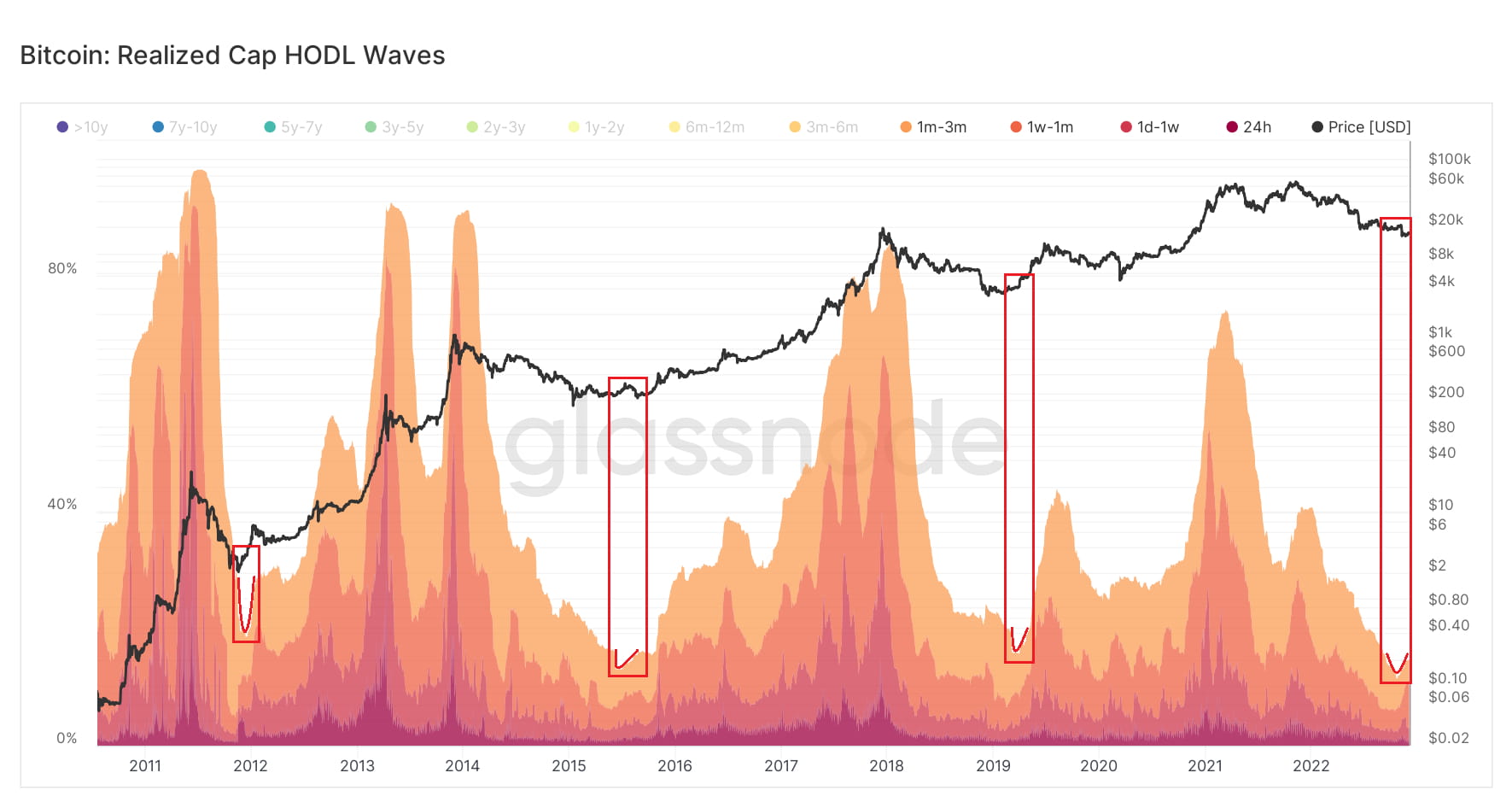
The indicator in the figure is the percentage of the number of Bitcoins that have been on the chain for less than 3 months after the weighted market capitalization of Bitcoin to the total over-the-counter circulation of Bitcoin.
This wave is stable
This wave is stable
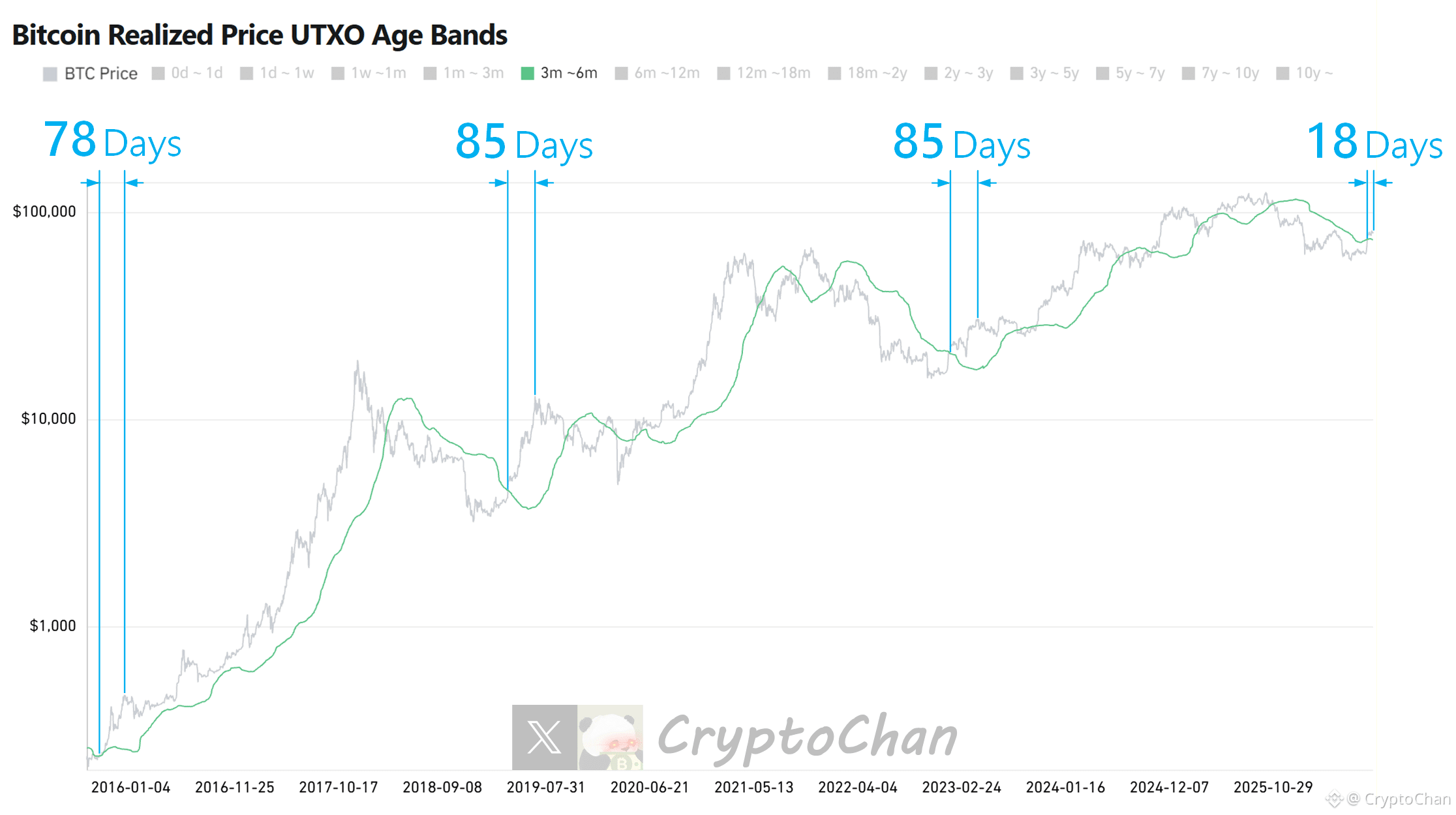
【 $BTC Four-Year Cycle Total Mark Series 60】
Sep 2015: After the price breaks the green line, 78 days to the recovery phase top
Apr 2019: After the price breaks the green line, 85 days to the recovery phase top
Jan 2023: After the price breaks the green line, 85 days to the recovery phase secondary top
Current: The price has already been above the green line for 18 days
┌─ Indicator Details ─┐
The green line is the average buy price (based on the UTXO version) of BTC whose on-chain holding duration is between 3 and 6 months.
Sep 2015: After the price breaks the green line, 78 days to the recovery phase top
Apr 2019: After the price breaks the green line, 85 days to the recovery phase top
Jan 2023: After the price breaks the green line, 85 days to the recovery phase secondary top
Current: The price has already been above the green line for 18 days
┌─ Indicator Details ─┐
The green line is the average buy price (based on the UTXO version) of BTC whose on-chain holding duration is between 3 and 6 months.
CryptoChan
·
--
【 $BTC four-year cycle total engraving series 59】
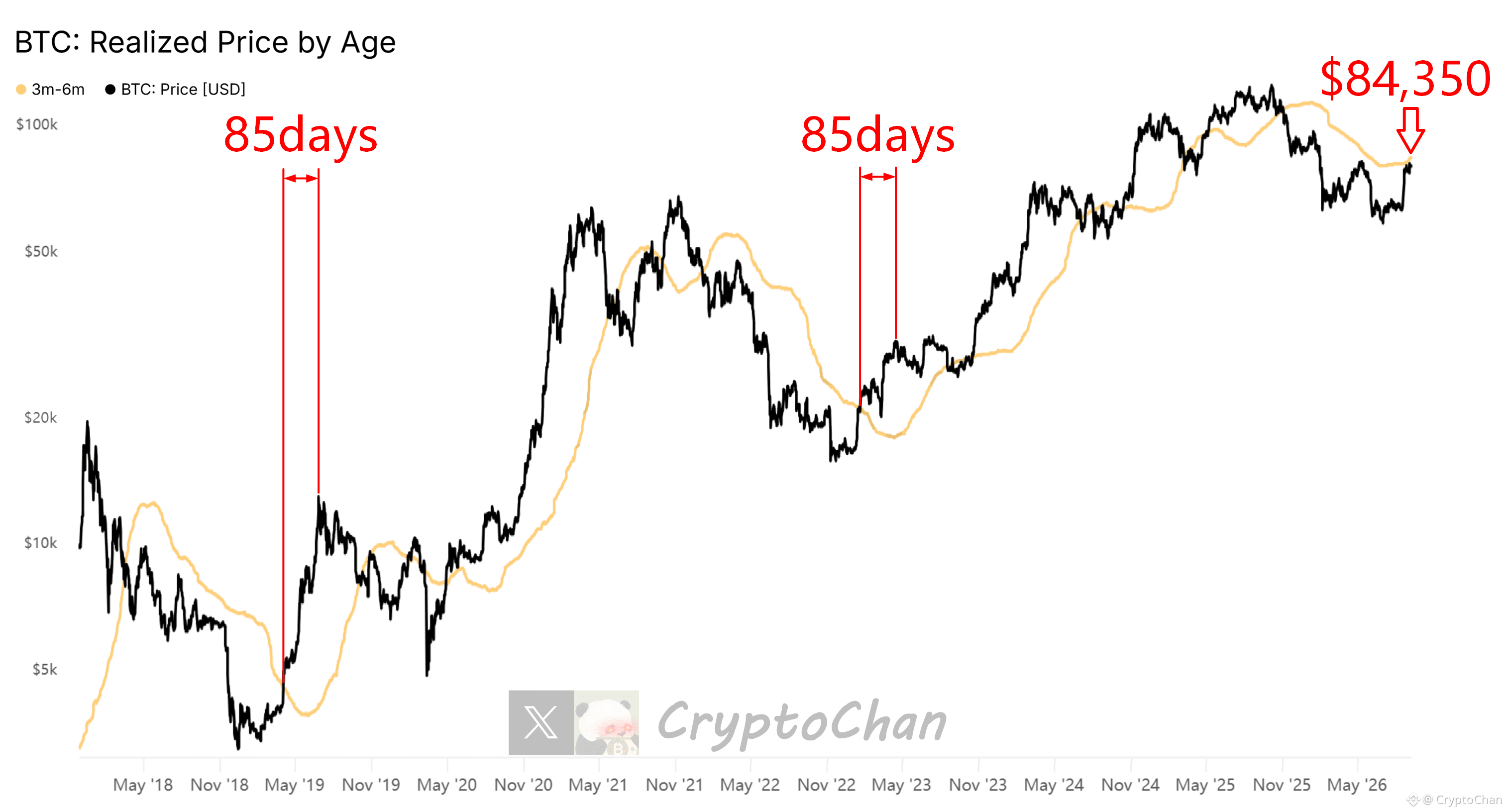
📌 April 2019: After Bitcoin broke above the orange-yellow line, 85 days to a recovery peak
📌 January 2023: After Bitcoin broke above the orange-yellow line, 85 days to a recovery secondary peak
📌 Current: Bitcoin has not yet broken above the orange-yellow line ($84,350)
┌── 🐼 On-chain data details ──┐
The black line in the chart is the Bitcoin price line; the orange-yellow line is the average entry price line of the accumulated chips when holding duration is between 3 and 6 months
📌 April 2019: After Bitcoin broke above the orange-yellow line, 85 days to a recovery peak
📌 January 2023: After Bitcoin broke above the orange-yellow line, 85 days to a recovery secondary peak
📌 Current: Bitcoin has not yet broken above the orange-yellow line ($84,350)
┌── 🐼 On-chain data details ──┐
The black line in the chart is the Bitcoin price line; the orange-yellow line is the average entry price line of the accumulated chips when holding duration is between 3 and 6 months
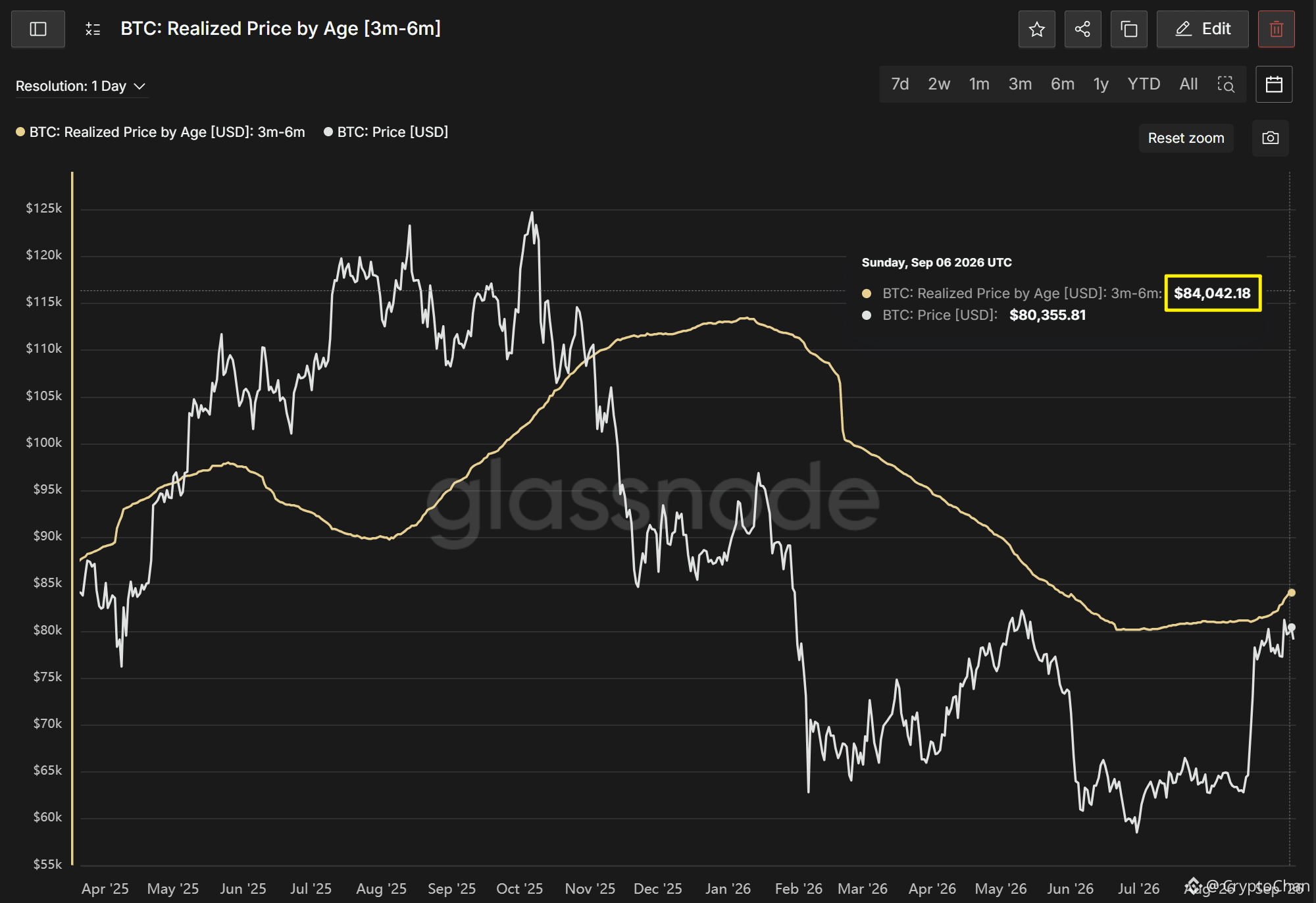
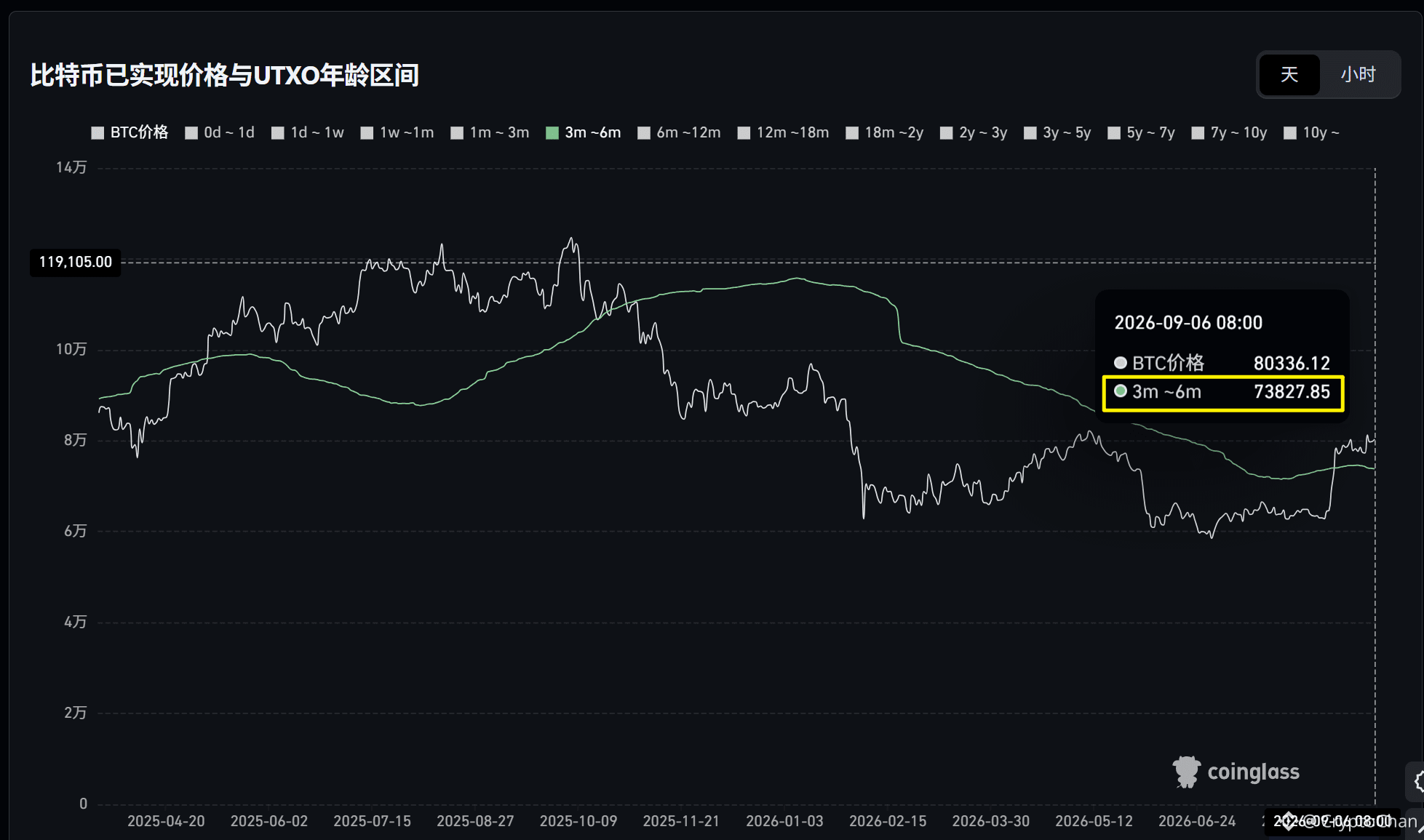
A data phenomenon that needs special clarification: when it comes to the same 【Bitcoin realized price for coin-holding lots aged 3m-6m on-chain】, different data platforms surprisingly differ by $10,000! 📊
You can compare these two screenshots:
Figure 1: Glassnode shows the average price as high as $84,042
Figure 2: Coinglass shows it as $73,827
Many friends intuitively feel that Coinglass’s 73.8k is more reasonable. Because three to six months ago (i.e., from March to June this year), spot prices mostly traded in a range of 65k - 83k, so it’s hard for any calculated average to exceed 84k.
The core reason for this huge discrepancy isn’t that someone miscalculated—it's that the underlying calculation algorithms use different dimensions:
1️⃣ Glassnode: Address-based “high-position memory”
Glassnode’s Breakdown uses an address dimension. For example: if a certain address bought a large amount of BTC at a high price above 100k in October 2025, then as long as that address had even a tiny transfer-in or interaction during this year’s March to June period, the system will categorize the whole batch into the 3m-6m age bracket based on the last active time.
This means that a large amount of older coin lots carrying high-cost memory are counted into the recently active queue, passively pushing the average price up to 84k.
2️⃣ Coinglass: Pure UTXO real movement cost (UTXO-based)
Coinglass presents a purely UTXO perspective. It doesn’t look at address history—only strictly calculates the specific tokens that actually moved on-chain within the 3-6 month window, and then weights them by the spot price on the day they moved. Since the market prices during actual turnover in March to June were relatively lower, the calculated pure movement cost comes out to 73.8k, which aligns more with our real-time feel for the market at the time.
💡 One-sentence summary:
Glassnode (84k) = the aggregated historical cost of【holders】that were active in the last 3-6 months
Coinglass (73.8k) = the actual movement cost of the【coin lots】that truly changed hands in the last 3-6 months @Glassnode @Coinglass
You can compare these two screenshots:
Figure 1: Glassnode shows the average price as high as $84,042
Figure 2: Coinglass shows it as $73,827
Many friends intuitively feel that Coinglass’s 73.8k is more reasonable. Because three to six months ago (i.e., from March to June this year), spot prices mostly traded in a range of 65k - 83k, so it’s hard for any calculated average to exceed 84k.
The core reason for this huge discrepancy isn’t that someone miscalculated—it's that the underlying calculation algorithms use different dimensions:
1️⃣ Glassnode: Address-based “high-position memory”
Glassnode’s Breakdown uses an address dimension. For example: if a certain address bought a large amount of BTC at a high price above 100k in October 2025, then as long as that address had even a tiny transfer-in or interaction during this year’s March to June period, the system will categorize the whole batch into the 3m-6m age bracket based on the last active time.
This means that a large amount of older coin lots carrying high-cost memory are counted into the recently active queue, passively pushing the average price up to 84k.
2️⃣ Coinglass: Pure UTXO real movement cost (UTXO-based)
Coinglass presents a purely UTXO perspective. It doesn’t look at address history—only strictly calculates the specific tokens that actually moved on-chain within the 3-6 month window, and then weights them by the spot price on the day they moved. Since the market prices during actual turnover in March to June were relatively lower, the calculated pure movement cost comes out to 73.8k, which aligns more with our real-time feel for the market at the time.
💡 One-sentence summary:
Glassnode (84k) = the aggregated historical cost of【holders】that were active in the last 3-6 months
Coinglass (73.8k) = the actual movement cost of the【coin lots】that truly changed hands in the last 3-6 months @Glassnode @Coinglass
CryptoChan
·
--
【 $BTC four-year cycle total engraving series 59】
📌 April 2019: After Bitcoin broke above the orange-yellow line, 85 days to a recovery peak
📌 January 2023: After Bitcoin broke above the orange-yellow line, 85 days to a recovery secondary peak
📌 Current: Bitcoin has not yet broken above the orange-yellow line ($84,350)
┌── 🐼 On-chain data details ──┐
The black line in the chart is the Bitcoin price line; the orange-yellow line is the average entry price line of the accumulated chips when holding duration is between 3 and 6 months
📌 April 2019: After Bitcoin broke above the orange-yellow line, 85 days to a recovery peak
📌 January 2023: After Bitcoin broke above the orange-yellow line, 85 days to a recovery secondary peak
📌 Current: Bitcoin has not yet broken above the orange-yellow line ($84,350)
┌── 🐼 On-chain data details ──┐
The black line in the chart is the Bitcoin price line; the orange-yellow line is the average entry price line of the accumulated chips when holding duration is between 3 and 6 months
【 $BTC four-year cycle total engraving series 59】
📌 April 2019: After Bitcoin broke above the orange-yellow line, 85 days to a recovery peak
📌 January 2023: After Bitcoin broke above the orange-yellow line, 85 days to a recovery secondary peak
📌 Current: Bitcoin has not yet broken above the orange-yellow line ($84,350)
┌── 🐼 On-chain data details ──┐
The black line in the chart is the Bitcoin price line; the orange-yellow line is the average entry price line of the accumulated chips when holding duration is between 3 and 6 months
📌 April 2019: After Bitcoin broke above the orange-yellow line, 85 days to a recovery peak
📌 January 2023: After Bitcoin broke above the orange-yellow line, 85 days to a recovery secondary peak
📌 Current: Bitcoin has not yet broken above the orange-yellow line ($84,350)
┌── 🐼 On-chain data details ──┐
The black line in the chart is the Bitcoin price line; the orange-yellow line is the average entry price line of the accumulated chips when holding duration is between 3 and 6 months
CryptoChan
·
--
【 $BTC Four-Year Cycle Total Engraving Series 58】
Engraving 2019: There are still two big waves
Engraving 2023: There is still one big wave
┌── 🐼 On-chain data details ──┐
The upper indicator in the chart is the Bitcoin price; the lower indicator in the chart is the Bitcoin on-chain short-term holder MVRV (calculated using a 4-year rolling window), as well as its 5 standard deviation lines: +2σ, +1σ, 0σ, -0.8σ, -1.6σ
Engraving 2019: There are still two big waves
Engraving 2023: There is still one big wave
┌── 🐼 On-chain data details ──┐
The upper indicator in the chart is the Bitcoin price; the lower indicator in the chart is the Bitcoin on-chain short-term holder MVRV (calculated using a 4-year rolling window), as well as its 5 standard deviation lines: +2σ, +1σ, 0σ, -0.8σ, -1.6σ
【 $BTC Bull market top-escape countdown series 03】
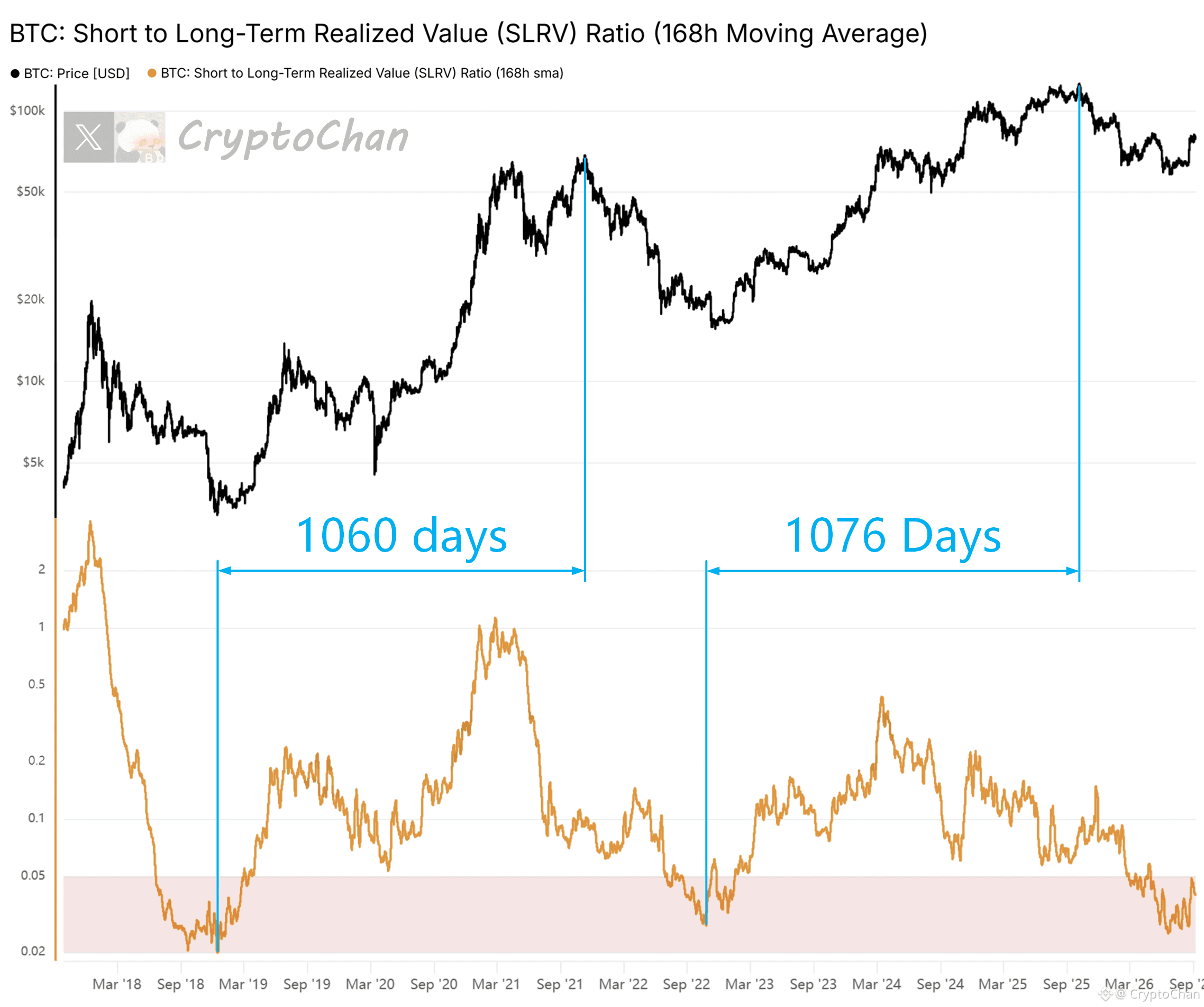
2018.12: After this indicator bottoms out, it takes 1060 days to reach the bull top
2022.10: After this indicator bottoms out, it takes 1076 days to reach the bull top
2026.06: This indicator has already bottomed out 79 days ago
┌─ Indicator details ─┐
The indicator at the bottom of the chart measures the ratio of the short-term Bitcoin circulation speed relative to the circulation speed of long-to-mid-term holders = (24-hour realized HODL wave) ÷ (realized HODL wave from 6 months to 1 year)
2018.12: After this indicator bottoms out, it takes 1060 days to reach the bull top
2022.10: After this indicator bottoms out, it takes 1076 days to reach the bull top
2026.06: This indicator has already bottomed out 79 days ago
┌─ Indicator details ─┐
The indicator at the bottom of the chart measures the ratio of the short-term Bitcoin circulation speed relative to the circulation speed of long-to-mid-term holders = (24-hour realized HODL wave) ÷ (realized HODL wave from 6 months to 1 year)
CryptoChan
·
--
【 $BTC Bull market top-calling countdown series 02】
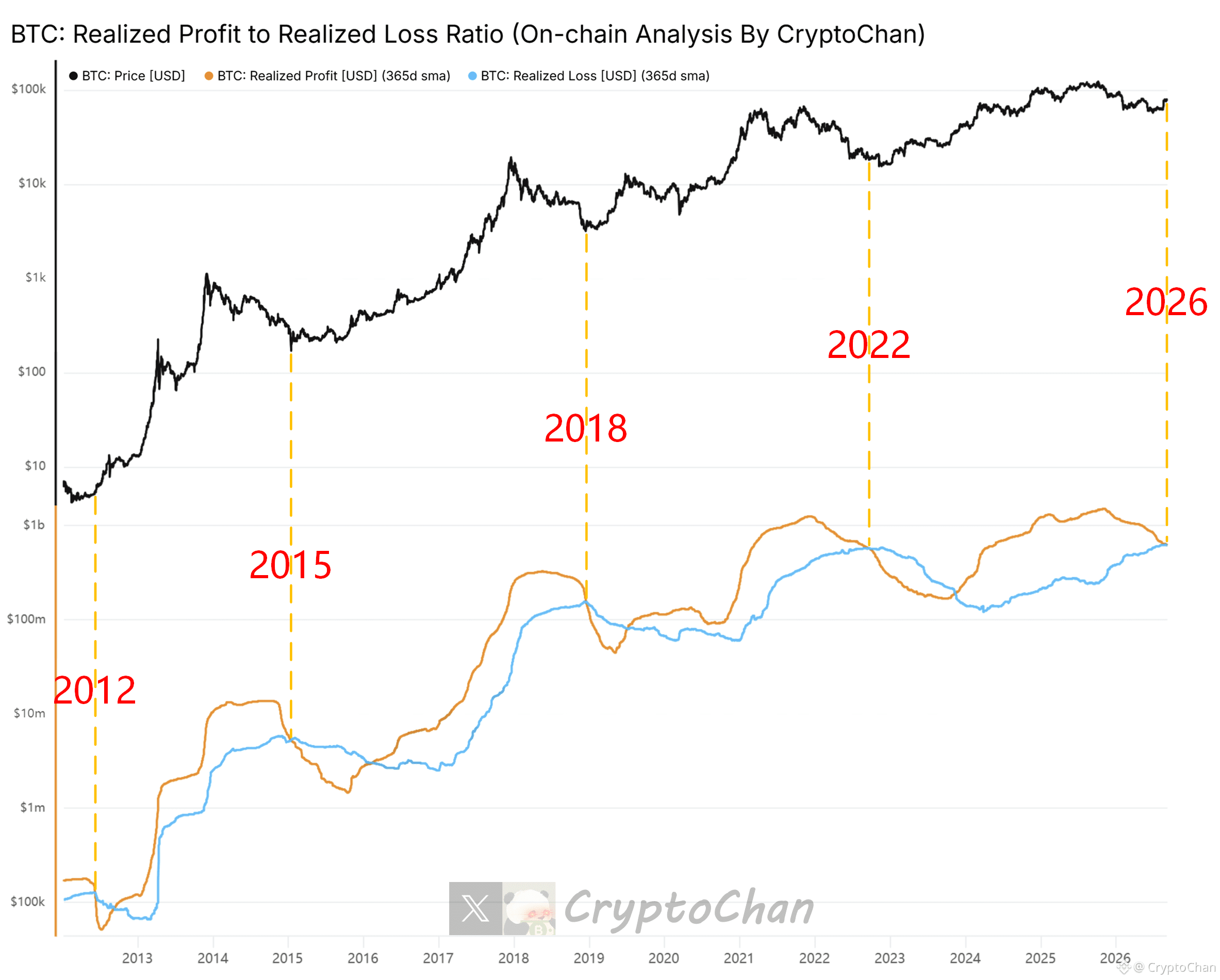
2015 red-black crossover: about one “kun” year later to the bull market top
2019 red-black crossover: about one “kun” year later to the bull market top
2023 red-black crossover: about one “kun” year later to the bull market top
2026 red-black crossover: 4 days and 5 hours have already passed
┌── 🐼 Indicator details ──┐
Gray line: Bitcoin price 30-day moving average
Red line: Bitcoin on-chain short-term holders’ average buy-in cost (average cost of holdings)
Black line: Bitcoin price 200-day moving average
2015 red-black crossover: about one “kun” year later to the bull market top
2019 red-black crossover: about one “kun” year later to the bull market top
2023 red-black crossover: about one “kun” year later to the bull market top
2026 red-black crossover: 4 days and 5 hours have already passed
┌── 🐼 Indicator details ──┐
Gray line: Bitcoin price 30-day moving average
Red line: Bitcoin on-chain short-term holders’ average buy-in cost (average cost of holdings)
Black line: Bitcoin price 200-day moving average
Already ❌
Year after year, another cycle has passed 🧘
Year after year, another cycle has passed 🧘
CryptoChan
·
--
It’s about time, huh 🧔🏻♂️
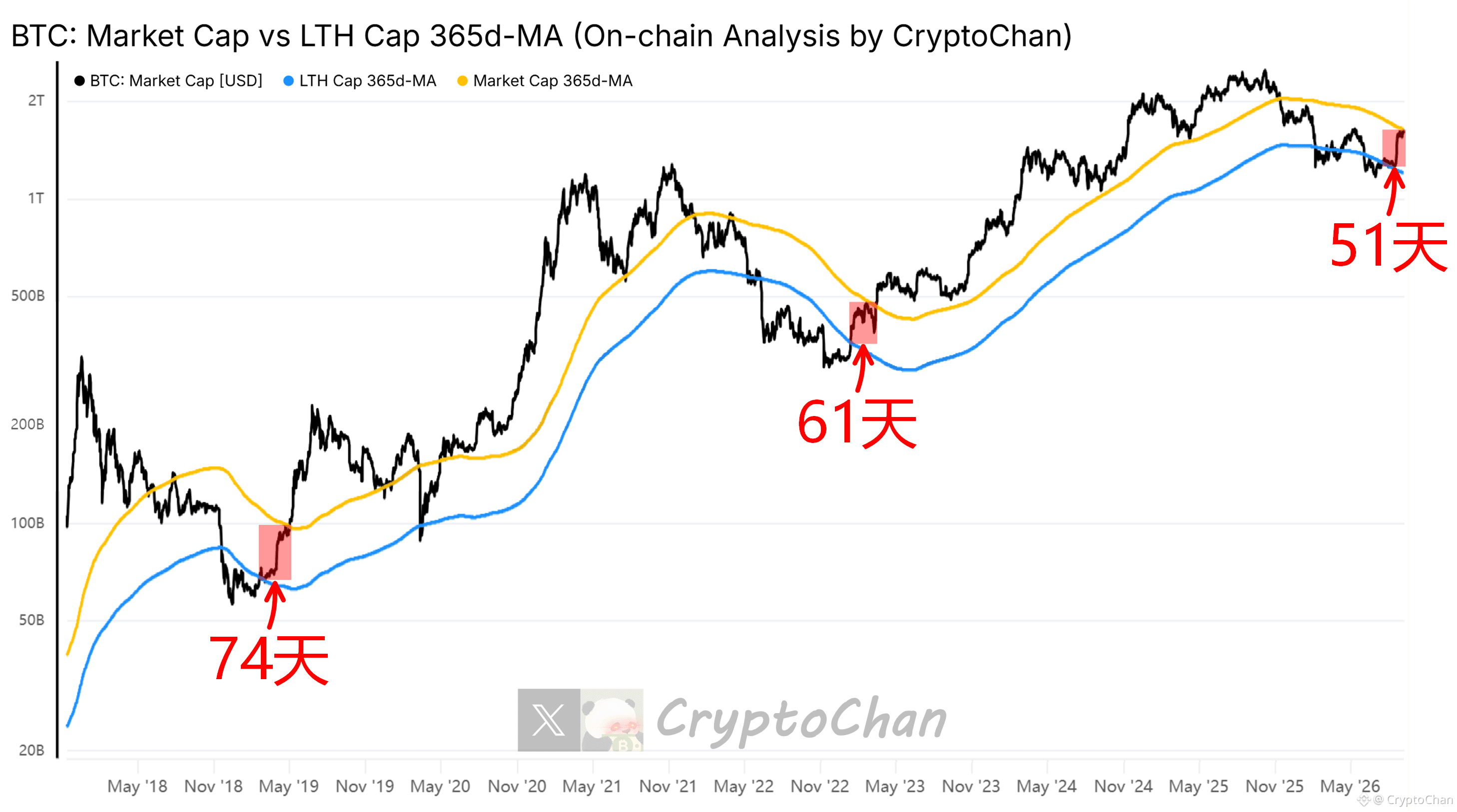
2019 $BTC Bear-to-bull initial stage: lasted 74 days
2023 $BTC Bear-to-bull initial stage: lasted 61 days
2026 $BTC Bear-to-bull initial stage: has lasted 51 days so far
2023 $BTC Bear-to-bull initial stage: lasted 61 days
2026 $BTC Bear-to-bull initial stage: has lasted 51 days so far
CryptoChan
·
--
【 $BTC four-year cycle total engraving series 50】
2019 “turn to bull” phase lasted 74 days
2023 “turn to bull” phase lasted 61 days
The current “turn to bull” phase has already lasted 39 days
┌── 🐼 KPI Details ──┐
Black line: Bitcoin market cap
Orange line: Bitcoin market cap 365-day MA
Blue line: Bitcoin on-chain long-term holder cohort total market cap 365-day MA
2019 “turn to bull” phase lasted 74 days
2023 “turn to bull” phase lasted 61 days
The current “turn to bull” phase has already lasted 39 days
┌── 🐼 KPI Details ──┐
Black line: Bitcoin market cap
Orange line: Bitcoin market cap 365-day MA
Blue line: Bitcoin on-chain long-term holder cohort total market cap 365-day MA
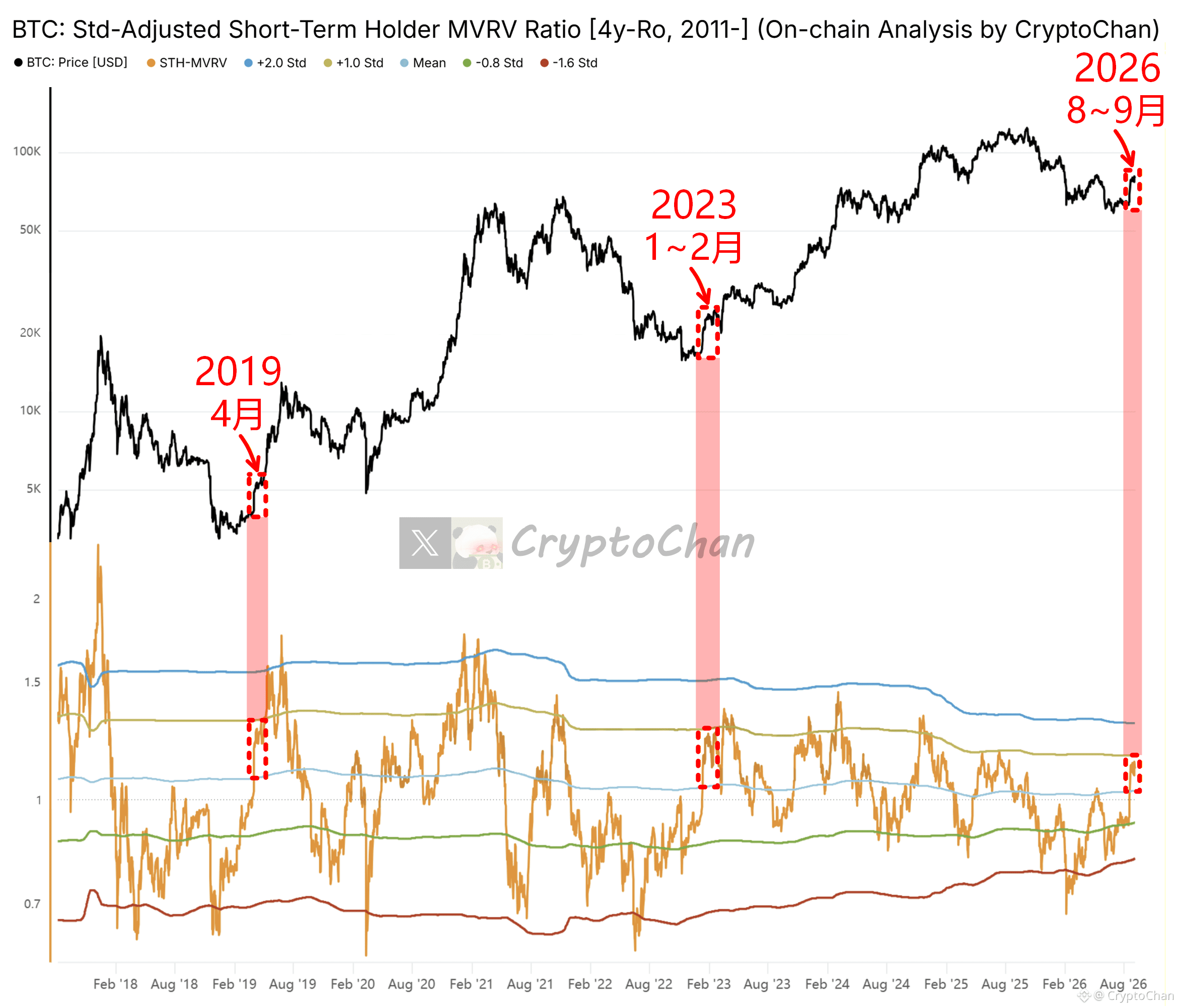
【 $BTC Four-Year Cycle Total Engraving Series 58】
Engraving 2019: There are still two big waves
Engraving 2023: There is still one big wave
┌── 🐼 On-chain data details ──┐
The upper indicator in the chart is the Bitcoin price; the lower indicator in the chart is the Bitcoin on-chain short-term holder MVRV (calculated using a 4-year rolling window), as well as its 5 standard deviation lines: +2σ, +1σ, 0σ, -0.8σ, -1.6σ
Engraving 2019: There are still two big waves
Engraving 2023: There is still one big wave
┌── 🐼 On-chain data details ──┐
The upper indicator in the chart is the Bitcoin price; the lower indicator in the chart is the Bitcoin on-chain short-term holder MVRV (calculated using a 4-year rolling window), as well as its 5 standard deviation lines: +2σ, +1σ, 0σ, -0.8σ, -1.6σ
CryptoChan
·
--
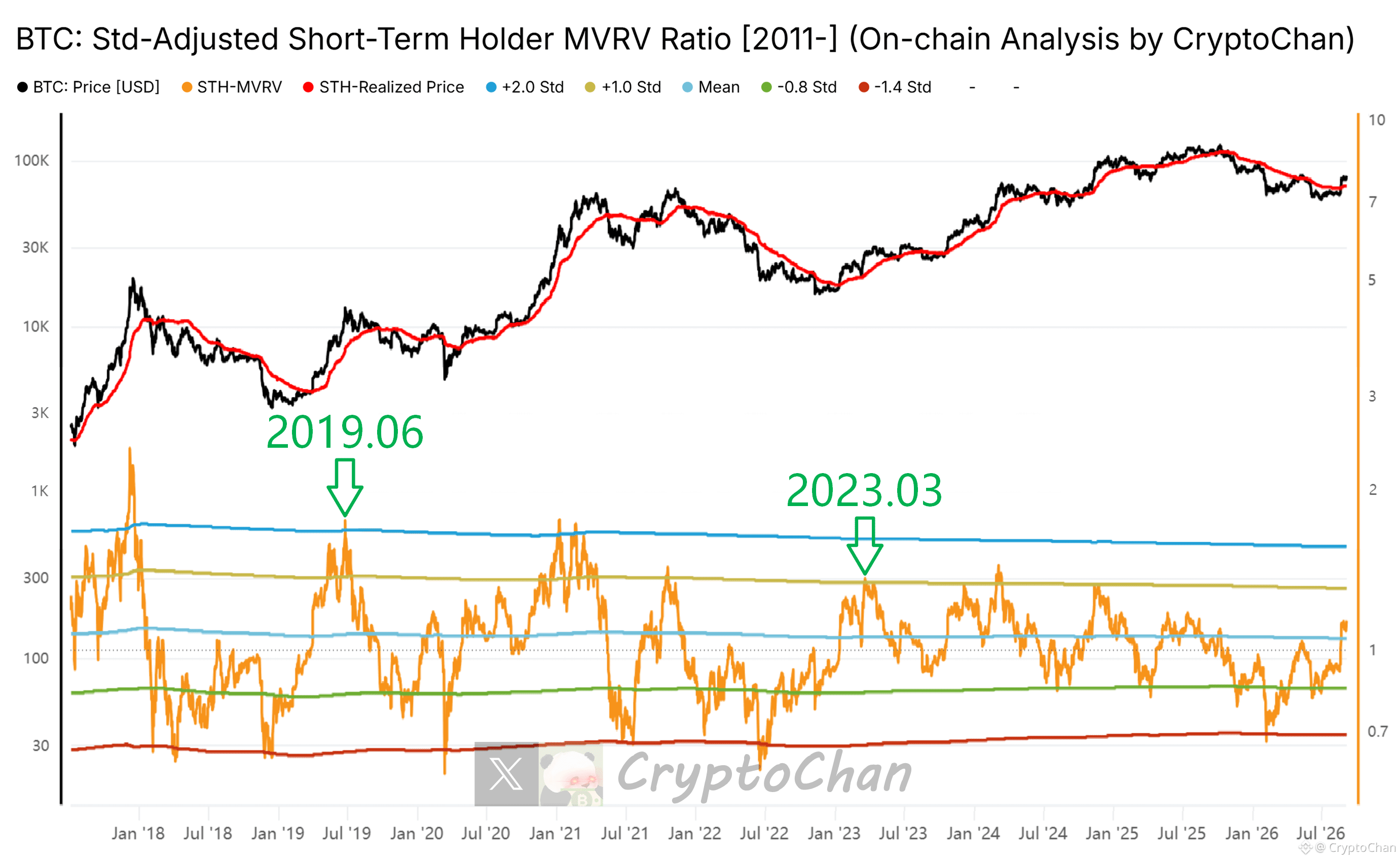
【 $BTC Four-Year Cycle Total Carve Series 57】
2019 bull market recovery period: this metric reached a peak above +2σ
2023 bull market recovery period: this metric reached a peak above +1σ
┌── 🐼 On-Chain Data Details ──┐
The indicator at the bottom of the chart is Bitcoin’s on-chain short-term holder MVRV (data begins in 2011), along with its five standard deviation lines (+2σ, +1σ, 0σ, -0.8σ, -1.4σ)
2019 bull market recovery period: this metric reached a peak above +2σ
2023 bull market recovery period: this metric reached a peak above +1σ
┌── 🐼 On-Chain Data Details ──┐
The indicator at the bottom of the chart is Bitcoin’s on-chain short-term holder MVRV (data begins in 2011), along with its five standard deviation lines (+2σ, +1σ, 0σ, -0.8σ, -1.4σ)
【 $BTC Four-Year Cycle Total Carve Series 57】
2019 bull market recovery period: this metric reached a peak above +2σ
2023 bull market recovery period: this metric reached a peak above +1σ
┌── 🐼 On-Chain Data Details ──┐
The indicator at the bottom of the chart is Bitcoin’s on-chain short-term holder MVRV (data begins in 2011), along with its five standard deviation lines (+2σ, +1σ, 0σ, -0.8σ, -1.4σ)
2019 bull market recovery period: this metric reached a peak above +2σ
2023 bull market recovery period: this metric reached a peak above +1σ
┌── 🐼 On-Chain Data Details ──┐
The indicator at the bottom of the chart is Bitcoin’s on-chain short-term holder MVRV (data begins in 2011), along with its five standard deviation lines (+2σ, +1σ, 0σ, -0.8σ, -1.4σ)
CryptoChan
·
--
【 $BTC Four-year cycle total carving series 56】
After the two previous bull-market recovery periods concluded, they both went through the classic second pullback before the main rally (ignoring the 20-year 312 black swan event)
┌── 🐼 On-chain data details ──┐
The indicator at the top of the chart is the Bitcoin price; the indicator at the bottom of the chart is the Bitcoin on-chain metric for short-term holders’ MVRV
After the two previous bull-market recovery periods concluded, they both went through the classic second pullback before the main rally (ignoring the 20-year 312 black swan event)
┌── 🐼 On-chain data details ──┐
The indicator at the top of the chart is the Bitcoin price; the indicator at the bottom of the chart is the Bitcoin on-chain metric for short-term holders’ MVRV
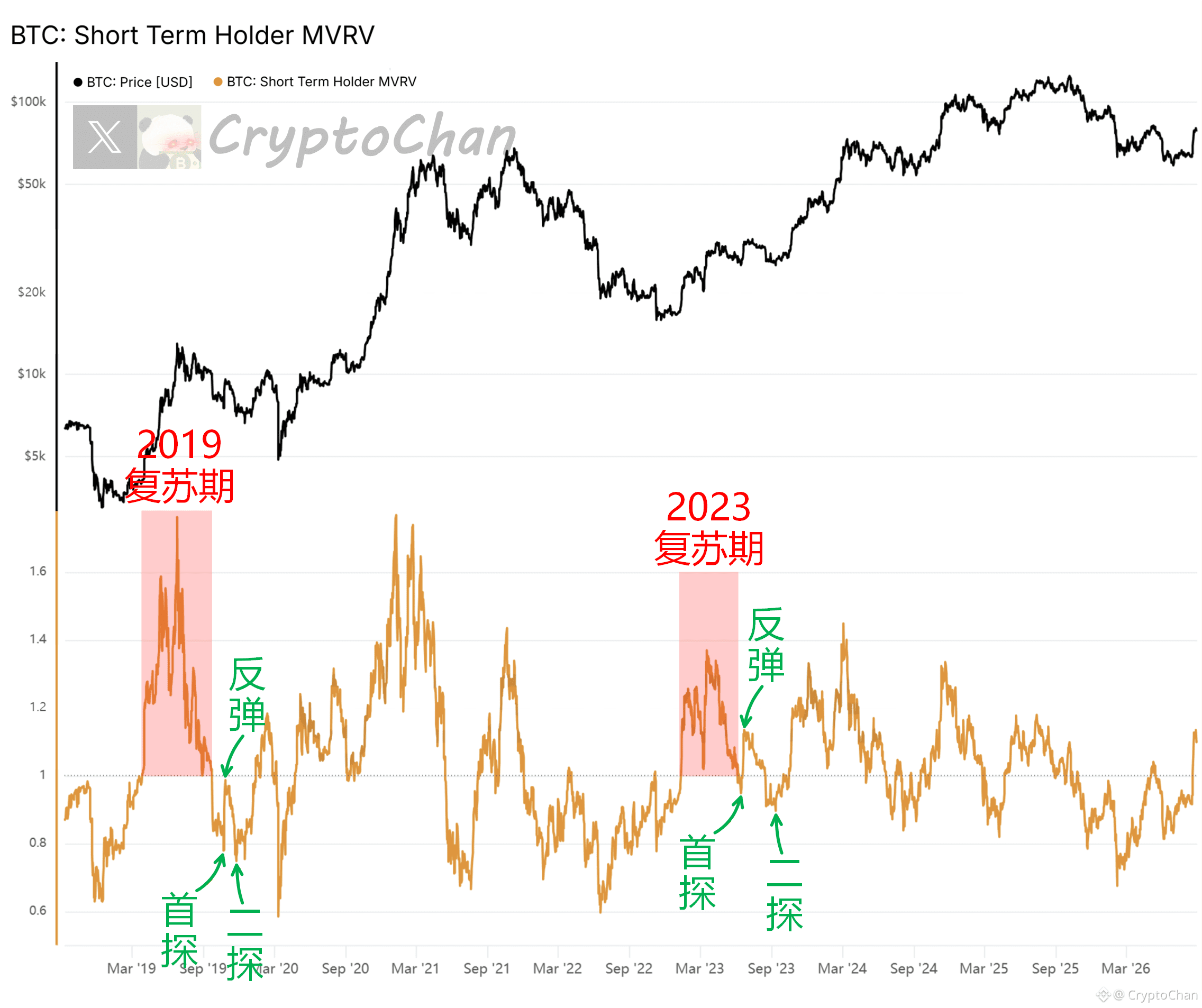
【 $BTC Four-year cycle total carving series 56】
After the two previous bull-market recovery periods concluded, they both went through the classic second pullback before the main rally (ignoring the 20-year 312 black swan event)
┌── 🐼 On-chain data details ──┐
The indicator at the top of the chart is the Bitcoin price; the indicator at the bottom of the chart is the Bitcoin on-chain metric for short-term holders’ MVRV
After the two previous bull-market recovery periods concluded, they both went through the classic second pullback before the main rally (ignoring the 20-year 312 black swan event)
┌── 🐼 On-chain data details ──┐
The indicator at the top of the chart is the Bitcoin price; the indicator at the bottom of the chart is the Bitcoin on-chain metric for short-term holders’ MVRV
CryptoChan
·
--
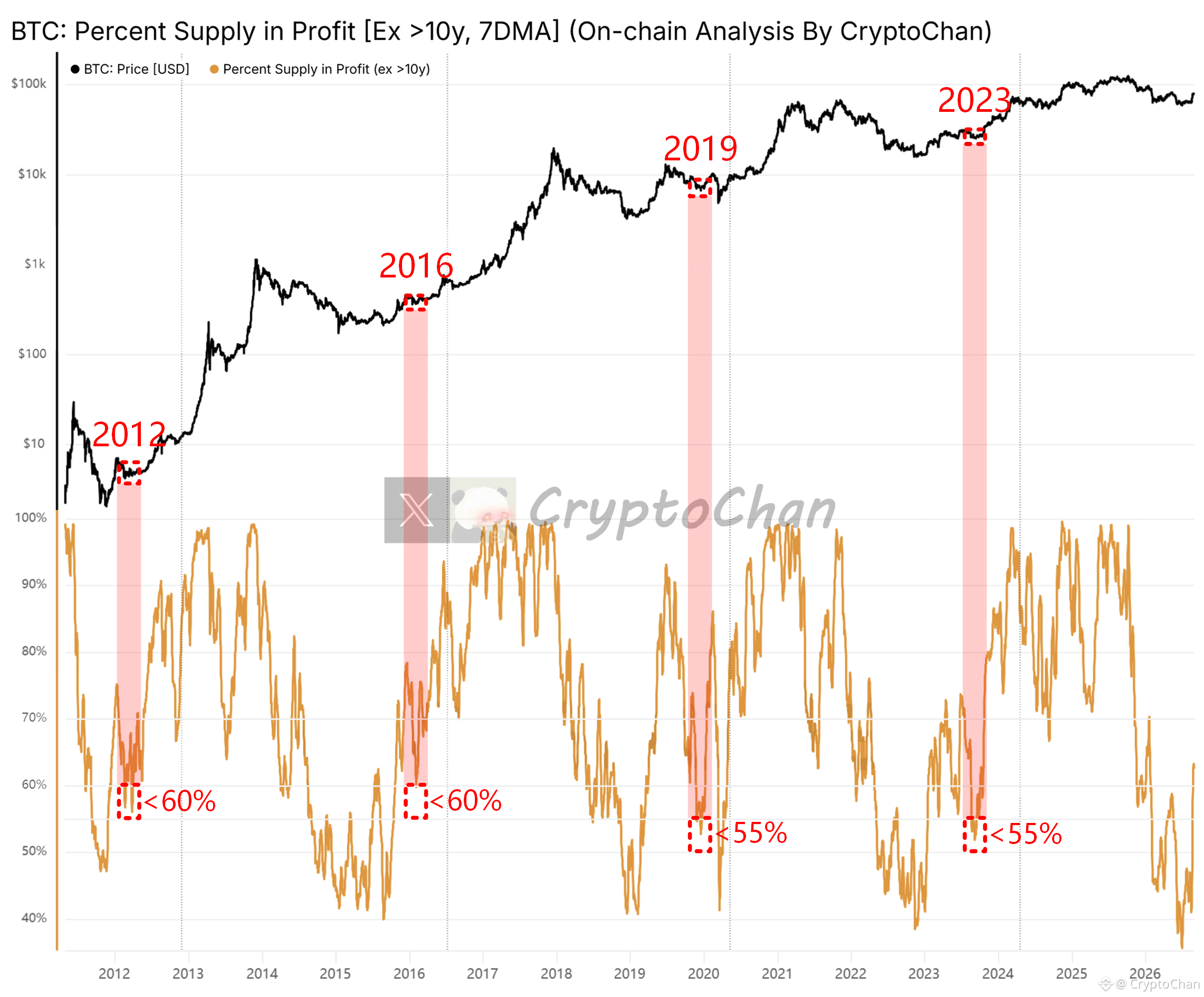
【 $BTC Four-Year Cycle Total Marking Series 55】
After the bull market recovery phase of 2012 concluded, before the main upswing: the final drop before the rally—this indicator fell to below 60% at its lowest.
After the bull market recovery phase of 2016 concluded, before the main upswing: the final drop before the rally—this indicator fell to below 60% at its lowest.
After the bull market recovery phase of 2019 concluded, before the main upswing: the final drop before the rally—this indicator fell to below 55% (ignore the subsequent 312 black swan event).
After the bull market recovery phase of 2023 concluded, before the main upswing: the final drop before the rally—this indicator fell to below 55%.
┌── 🐼 On-Chain Data Details ──┐
The black line at the top of the chart represents the Bitcoin price; the indicator at the bottom represents the percentage of supply that consists of coin holdings on the Bitcoin chain currently sitting in profit (treat coins that have not moved for more than 10 years as long-term dormant or lost, and exclude them from the calculation).
After the bull market recovery phase of 2012 concluded, before the main upswing: the final drop before the rally—this indicator fell to below 60% at its lowest.
After the bull market recovery phase of 2016 concluded, before the main upswing: the final drop before the rally—this indicator fell to below 60% at its lowest.
After the bull market recovery phase of 2019 concluded, before the main upswing: the final drop before the rally—this indicator fell to below 55% (ignore the subsequent 312 black swan event).
After the bull market recovery phase of 2023 concluded, before the main upswing: the final drop before the rally—this indicator fell to below 55%.
┌── 🐼 On-Chain Data Details ──┐
The black line at the top of the chart represents the Bitcoin price; the indicator at the bottom represents the percentage of supply that consists of coin holdings on the Bitcoin chain currently sitting in profit (treat coins that have not moved for more than 10 years as long-term dormant or lost, and exclude them from the calculation).
【 $BTC Four-Year Cycle Total Marking Series 55】
After the bull market recovery phase of 2012 concluded, before the main upswing: the final drop before the rally—this indicator fell to below 60% at its lowest.
After the bull market recovery phase of 2016 concluded, before the main upswing: the final drop before the rally—this indicator fell to below 60% at its lowest.
After the bull market recovery phase of 2019 concluded, before the main upswing: the final drop before the rally—this indicator fell to below 55% (ignore the subsequent 312 black swan event).
After the bull market recovery phase of 2023 concluded, before the main upswing: the final drop before the rally—this indicator fell to below 55%.
┌── 🐼 On-Chain Data Details ──┐
The black line at the top of the chart represents the Bitcoin price; the indicator at the bottom represents the percentage of supply that consists of coin holdings on the Bitcoin chain currently sitting in profit (treat coins that have not moved for more than 10 years as long-term dormant or lost, and exclude them from the calculation).
After the bull market recovery phase of 2012 concluded, before the main upswing: the final drop before the rally—this indicator fell to below 60% at its lowest.
After the bull market recovery phase of 2016 concluded, before the main upswing: the final drop before the rally—this indicator fell to below 60% at its lowest.
After the bull market recovery phase of 2019 concluded, before the main upswing: the final drop before the rally—this indicator fell to below 55% (ignore the subsequent 312 black swan event).
After the bull market recovery phase of 2023 concluded, before the main upswing: the final drop before the rally—this indicator fell to below 55%.
┌── 🐼 On-Chain Data Details ──┐
The black line at the top of the chart represents the Bitcoin price; the indicator at the bottom represents the percentage of supply that consists of coin holdings on the Bitcoin chain currently sitting in profit (treat coins that have not moved for more than 10 years as long-term dormant or lost, and exclude them from the calculation).
CryptoChan
·
--
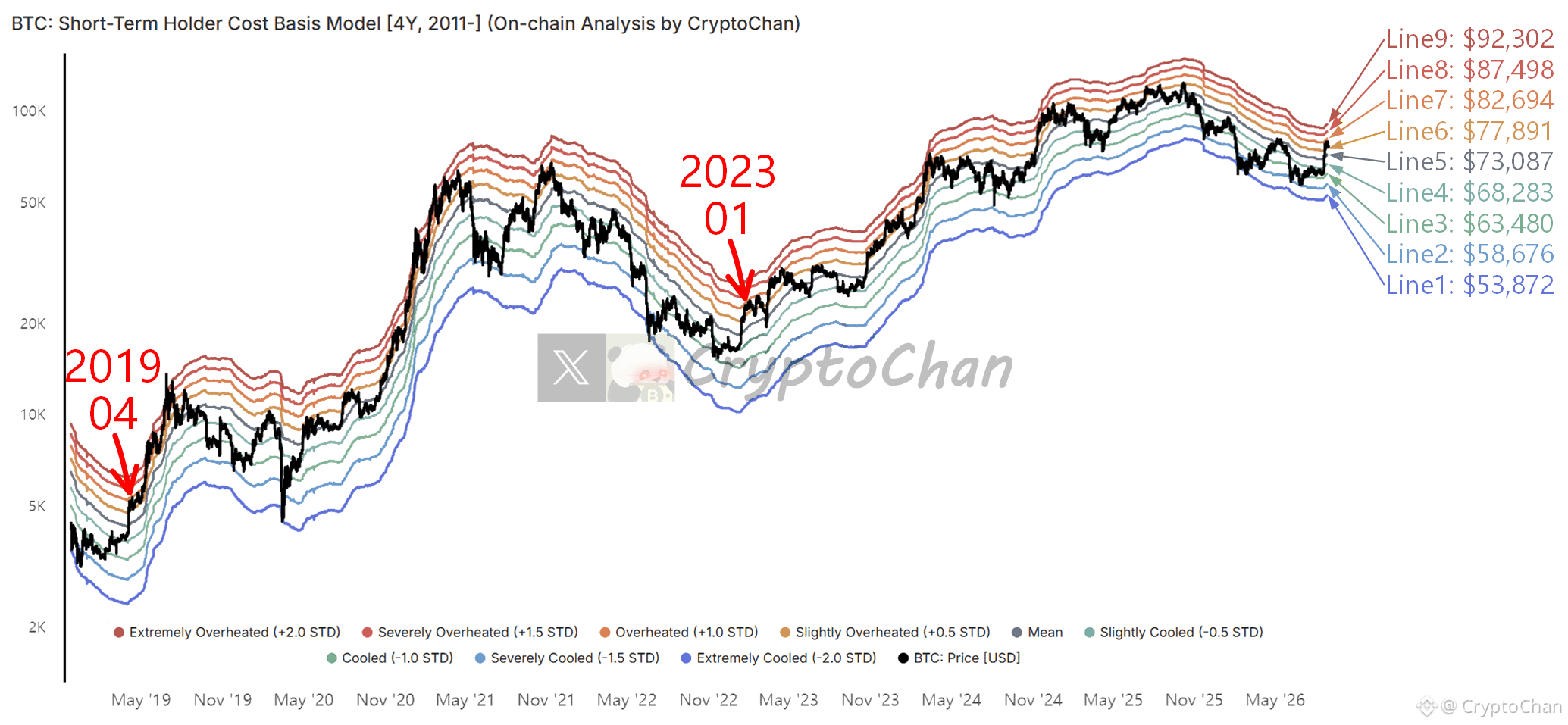
【 $BTC four-year cycle total engraving series 54】
How soon will this coin price reach Line 7? 🗡️ Down in April 2019 & January 2023
┌── 🐼 On-chain data details ──┐
The nine lines in the chart correspond to the [+2, +1.5, +1, +0.5, 0, -0.5, -1, -1.5, -2] standard deviation points for the average buy-in cost line of short-term holders’ coin holdings on the Bitcoin chain.
How soon will this coin price reach Line 7? 🗡️ Down in April 2019 & January 2023
┌── 🐼 On-chain data details ──┐
The nine lines in the chart correspond to the [+2, +1.5, +1, +0.5, 0, -0.5, -1, -1.5, -2] standard deviation points for the average buy-in cost line of short-term holders’ coin holdings on the Bitcoin chain.
【 $BTC four-year cycle total engraving series 54】
How soon will this coin price reach Line 7? 🗡️ Down in April 2019 & January 2023
┌── 🐼 On-chain data details ──┐
The nine lines in the chart correspond to the [+2, +1.5, +1, +0.5, 0, -0.5, -1, -1.5, -2] standard deviation points for the average buy-in cost line of short-term holders’ coin holdings on the Bitcoin chain.
How soon will this coin price reach Line 7? 🗡️ Down in April 2019 & January 2023
┌── 🐼 On-chain data details ──┐
The nine lines in the chart correspond to the [+2, +1.5, +1, +0.5, 0, -0.5, -1, -1.5, -2] standard deviation points for the average buy-in cost line of short-term holders’ coin holdings on the Bitcoin chain.
CryptoChan
·
--
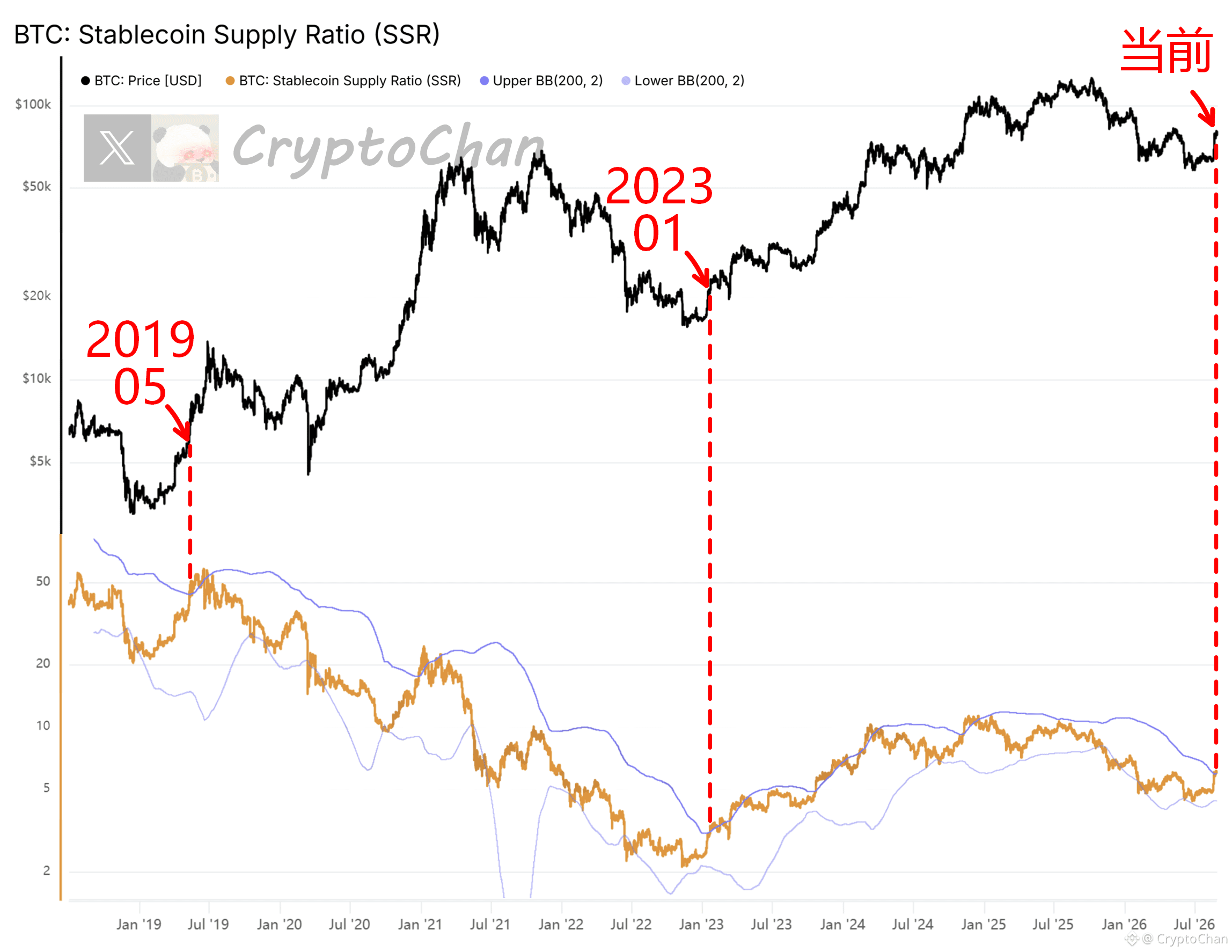
【 $BTC 4-Year Cycle Total Mark Series 53】
The current orange line has broken above the upper band. 🗡️ Below: May 2019 & January 2023
┌── 🐼 On-Chain Data Details ──┐
The orange line indicator at the bottom of the chart is SSR (Stablecoin Supply Ratio). The calculation formula is: Bitcoin total market cap ➗ total stablecoin market cap
SSR upper band = 200-day moving average + 2× standard deviation. Breaking above the upper band indicates SSR is in an extremely high range.
SSR lower band = 200-day moving average − 2× standard deviation. Dropping below the lower band indicates SSR is in an extremely low range.
The current orange line has broken above the upper band. 🗡️ Below: May 2019 & January 2023
┌── 🐼 On-Chain Data Details ──┐
The orange line indicator at the bottom of the chart is SSR (Stablecoin Supply Ratio). The calculation formula is: Bitcoin total market cap ➗ total stablecoin market cap
SSR upper band = 200-day moving average + 2× standard deviation. Breaking above the upper band indicates SSR is in an extremely high range.
SSR lower band = 200-day moving average − 2× standard deviation. Dropping below the lower band indicates SSR is in an extremely low range.
Did fellow coin friends all judge it correctly? 🤭
CryptoChan
·
--
The core of those BTC bear-bottom indicators that have perfectly triggered in the past: the price drops enough and hard enough—hard enough that long-term holders (LTH) capitulate and mass-sell to complete the final leg of the decline
But if, in a given bear market cycle, the price never breaks below the LTH cost line and no large-scale LTH capitulation event occurs, then it’s also possible to go through the bear market without triggering the relevant indicators
Q: Do you think that “a given bear market cycle” will be this one? 🤭
But if, in a given bear market cycle, the price never breaks below the LTH cost line and no large-scale LTH capitulation event occurs, then it’s also possible to go through the bear market without triggering the relevant indicators
Q: Do you think that “a given bear market cycle” will be this one? 🤭

【 $BTC 4-Year Cycle Total Mark Series 53】
The current orange line has broken above the upper band. 🗡️ Below: May 2019 & January 2023
┌── 🐼 On-Chain Data Details ──┐
The orange line indicator at the bottom of the chart is SSR (Stablecoin Supply Ratio). The calculation formula is: Bitcoin total market cap ➗ total stablecoin market cap
SSR upper band = 200-day moving average + 2× standard deviation. Breaking above the upper band indicates SSR is in an extremely high range.
SSR lower band = 200-day moving average − 2× standard deviation. Dropping below the lower band indicates SSR is in an extremely low range.
The current orange line has broken above the upper band. 🗡️ Below: May 2019 & January 2023
┌── 🐼 On-Chain Data Details ──┐
The orange line indicator at the bottom of the chart is SSR (Stablecoin Supply Ratio). The calculation formula is: Bitcoin total market cap ➗ total stablecoin market cap
SSR upper band = 200-day moving average + 2× standard deviation. Breaking above the upper band indicates SSR is in an extremely high range.
SSR lower band = 200-day moving average − 2× standard deviation. Dropping below the lower band indicates SSR is in an extremely low range.
CryptoChan
·
--
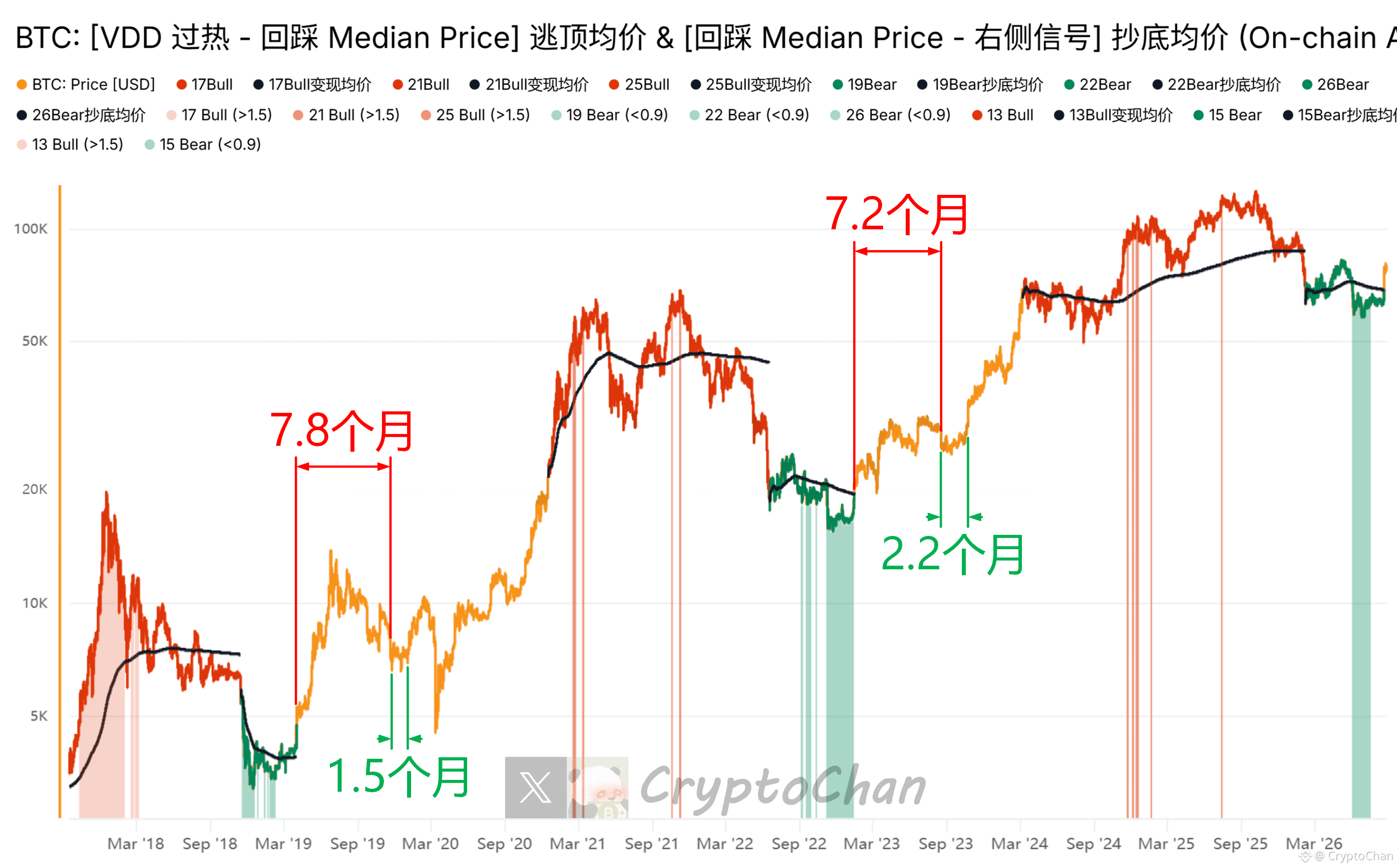
【 $BTC Four-Year Cycle Total Slice Series 52】
After breaking away from the bear base in 2019, 7.8 months later: the bull market recovery phase comes to a close. The market entered the last pullback-and-base range before the main upmove, creating an excellent 1.5-month trading window (ignore the 312 Black Swan)
After breaking away from the bear base in 2023, 7.2 months later: the bull market recovery phase comes to a close. The market entered the last pullback-and-base range before the main upmove, creating an excellent 2.2-month trading window
This round has already been 0.25 months since breaking away from the bear base
┌── 🐼 Indicator Details ──┐
The indicators shown in the chart are developed based on a bull-market top-escape & bear-market bottom-catch model built from Bitcoin VDD, Median Price, and multiple sets of confirmed indicators on the right side of bear bases
After breaking away from the bear base in 2019, 7.8 months later: the bull market recovery phase comes to a close. The market entered the last pullback-and-base range before the main upmove, creating an excellent 1.5-month trading window (ignore the 312 Black Swan)
After breaking away from the bear base in 2023, 7.2 months later: the bull market recovery phase comes to a close. The market entered the last pullback-and-base range before the main upmove, creating an excellent 2.2-month trading window
This round has already been 0.25 months since breaking away from the bear base
┌── 🐼 Indicator Details ──┐
The indicators shown in the chart are developed based on a bull-market top-escape & bear-market bottom-catch model built from Bitcoin VDD, Median Price, and multiple sets of confirmed indicators on the right side of bear bases
【 $BTC Four-Year Cycle Total Slice Series 52】
After breaking away from the bear base in 2019, 7.8 months later: the bull market recovery phase comes to a close. The market entered the last pullback-and-base range before the main upmove, creating an excellent 1.5-month trading window (ignore the 312 Black Swan)
After breaking away from the bear base in 2023, 7.2 months later: the bull market recovery phase comes to a close. The market entered the last pullback-and-base range before the main upmove, creating an excellent 2.2-month trading window
This round has already been 0.25 months since breaking away from the bear base
┌── 🐼 Indicator Details ──┐
The indicators shown in the chart are developed based on a bull-market top-escape & bear-market bottom-catch model built from Bitcoin VDD, Median Price, and multiple sets of confirmed indicators on the right side of bear bases
After breaking away from the bear base in 2019, 7.8 months later: the bull market recovery phase comes to a close. The market entered the last pullback-and-base range before the main upmove, creating an excellent 1.5-month trading window (ignore the 312 Black Swan)
After breaking away from the bear base in 2023, 7.2 months later: the bull market recovery phase comes to a close. The market entered the last pullback-and-base range before the main upmove, creating an excellent 2.2-month trading window
This round has already been 0.25 months since breaking away from the bear base
┌── 🐼 Indicator Details ──┐
The indicators shown in the chart are developed based on a bull-market top-escape & bear-market bottom-catch model built from Bitcoin VDD, Median Price, and multiple sets of confirmed indicators on the right side of bear bases
CryptoChan
·
--
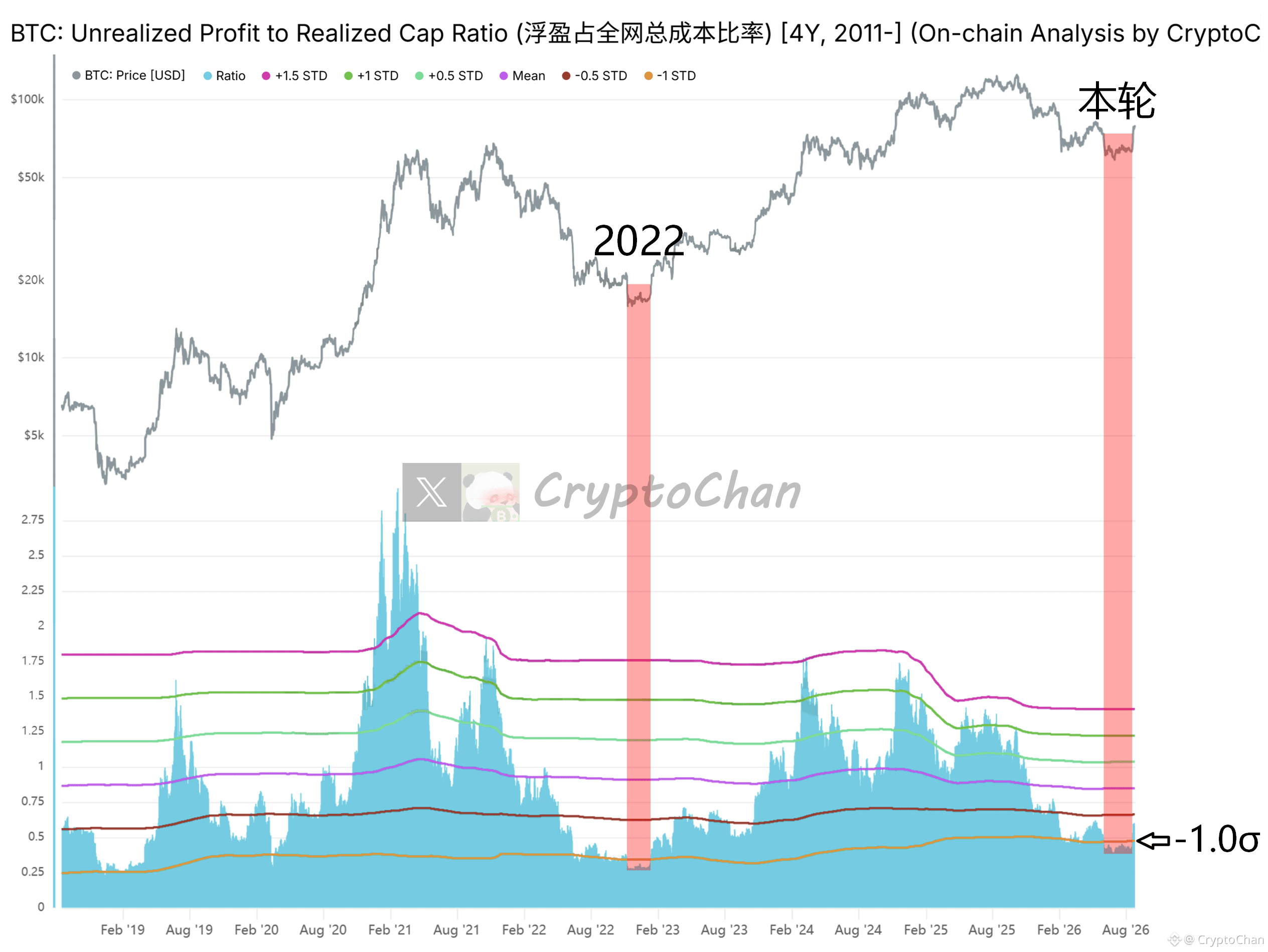
【 $BTC Four-year cycle total engraving series 51】
Bear-bottom in 2022: this indicator dropped below the orange line for 65 days
This bear-bottom: this indicator dropped below the orange line for 78 days
That is, in both of these past bear-bottom cycles, there was more than a two-month, ample bottom-picking window
┌── 🐼 On-chain data details ──┐
The indicator at the bottom of the chart is the ratio of “Bitcoin’s total net unrealized profit amount from all on-chain holdings” to “Bitcoin’s total purchase cost from all on-chain holdings.” The orange line is the “-1 standard deviation” line for this ratio
Bear-bottom in 2022: this indicator dropped below the orange line for 65 days
This bear-bottom: this indicator dropped below the orange line for 78 days
That is, in both of these past bear-bottom cycles, there was more than a two-month, ample bottom-picking window
┌── 🐼 On-chain data details ──┐
The indicator at the bottom of the chart is the ratio of “Bitcoin’s total net unrealized profit amount from all on-chain holdings” to “Bitcoin’s total purchase cost from all on-chain holdings.” The orange line is the “-1 standard deviation” line for this ratio
【 $BTC Four-year cycle total engraving series 51】
Bear-bottom in 2022: this indicator dropped below the orange line for 65 days
This bear-bottom: this indicator dropped below the orange line for 78 days
That is, in both of these past bear-bottom cycles, there was more than a two-month, ample bottom-picking window
┌── 🐼 On-chain data details ──┐
The indicator at the bottom of the chart is the ratio of “Bitcoin’s total net unrealized profit amount from all on-chain holdings” to “Bitcoin’s total purchase cost from all on-chain holdings.” The orange line is the “-1 standard deviation” line for this ratio
Bear-bottom in 2022: this indicator dropped below the orange line for 65 days
This bear-bottom: this indicator dropped below the orange line for 78 days
That is, in both of these past bear-bottom cycles, there was more than a two-month, ample bottom-picking window
┌── 🐼 On-chain data details ──┐
The indicator at the bottom of the chart is the ratio of “Bitcoin’s total net unrealized profit amount from all on-chain holdings” to “Bitcoin’s total purchase cost from all on-chain holdings.” The orange line is the “-1 standard deviation” line for this ratio
CryptoChan
·
--
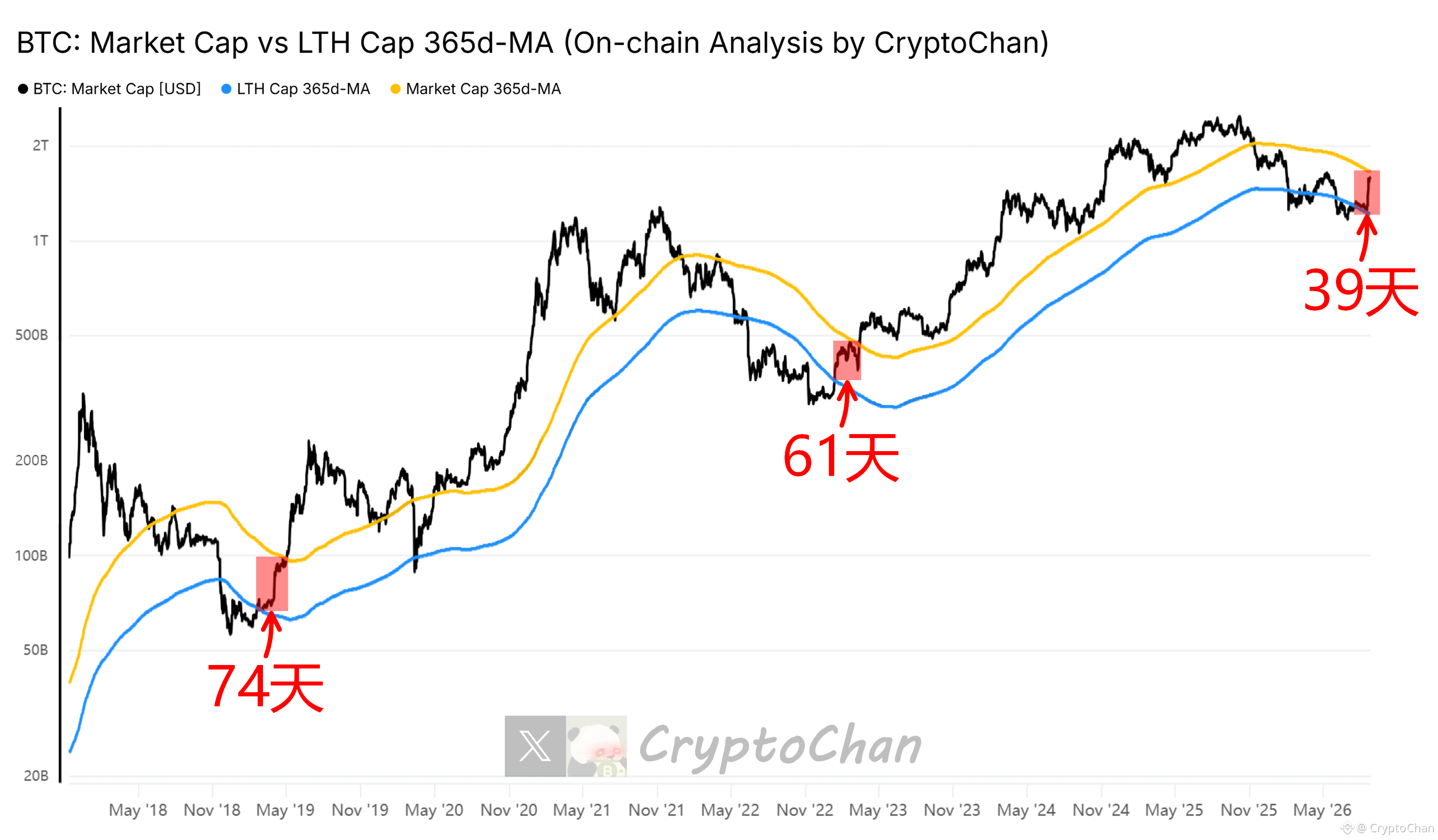
【 $BTC four-year cycle total engraving series 50】
2019 “turn to bull” phase lasted 74 days
2023 “turn to bull” phase lasted 61 days
The current “turn to bull” phase has already lasted 39 days
┌── 🐼 KPI Details ──┐
Black line: Bitcoin market cap
Orange line: Bitcoin market cap 365-day MA
Blue line: Bitcoin on-chain long-term holder cohort total market cap 365-day MA
2019 “turn to bull” phase lasted 74 days
2023 “turn to bull” phase lasted 61 days
The current “turn to bull” phase has already lasted 39 days
┌── 🐼 KPI Details ──┐
Black line: Bitcoin market cap
Orange line: Bitcoin market cap 365-day MA
Blue line: Bitcoin on-chain long-term holder cohort total market cap 365-day MA
【 $BTC four-year cycle total engraving series 50】
2019 “turn to bull” phase lasted 74 days
2023 “turn to bull” phase lasted 61 days
The current “turn to bull” phase has already lasted 39 days
┌── 🐼 KPI Details ──┐
Black line: Bitcoin market cap
Orange line: Bitcoin market cap 365-day MA
Blue line: Bitcoin on-chain long-term holder cohort total market cap 365-day MA
2019 “turn to bull” phase lasted 74 days
2023 “turn to bull” phase lasted 61 days
The current “turn to bull” phase has already lasted 39 days
┌── 🐼 KPI Details ──┐
Black line: Bitcoin market cap
Orange line: Bitcoin market cap 365-day MA
Blue line: Bitcoin on-chain long-term holder cohort total market cap 365-day MA
CryptoChan
·
--
Cow's coming!!️【$BTC four-year cycle total engraving series 49】
March 2012: Blue-Orange crossover
July 2015: Blue-Orange crossover
April 2019: Blue-Orange crossover
January 2023: Blue-Orange crossover
Current: Blue and Orange have crossed
┌─ 🐼 On-chain data details ─┐
The blue line is the ratio of “average purchase cost of long-term on-chain holders” to “average purchase cost of short-term on-chain holders”; the orange line is the blue line’s 60-day MA.
Historically, Blue-Orange crossovers often correspond to the end of a bear market and the start of a bull market
March 2012: Blue-Orange crossover
July 2015: Blue-Orange crossover
April 2019: Blue-Orange crossover
January 2023: Blue-Orange crossover
Current: Blue and Orange have crossed
┌─ 🐼 On-chain data details ─┐
The blue line is the ratio of “average purchase cost of long-term on-chain holders” to “average purchase cost of short-term on-chain holders”; the orange line is the blue line’s 60-day MA.
Historically, Blue-Orange crossovers often correspond to the end of a bear market and the start of a bull market
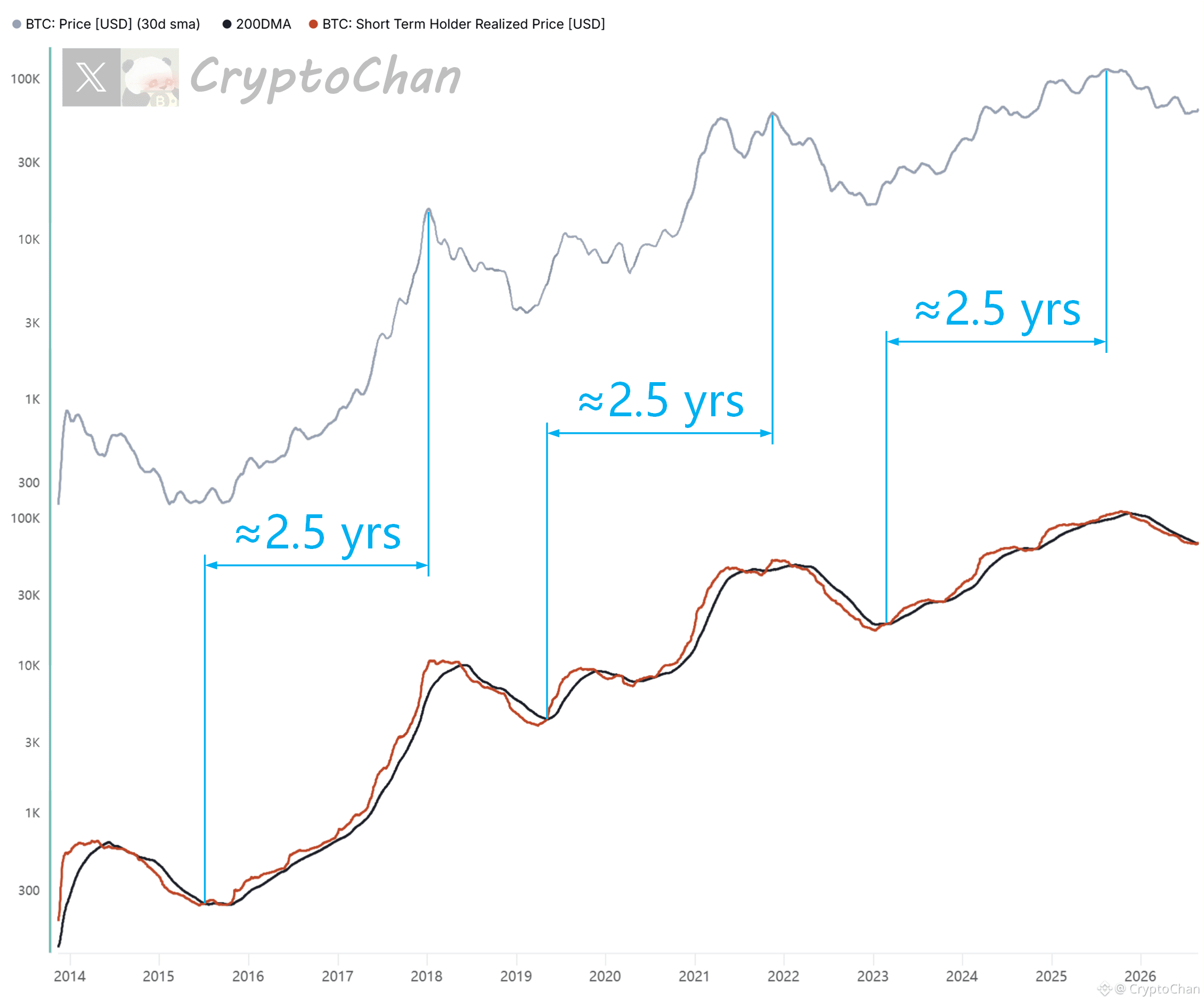
【 $BTC Bull market top-calling countdown series 02】
2015 red-black crossover: about one “kun” year later to the bull market top
2019 red-black crossover: about one “kun” year later to the bull market top
2023 red-black crossover: about one “kun” year later to the bull market top
2026 red-black crossover: 4 days and 5 hours have already passed
┌── 🐼 Indicator details ──┐
Gray line: Bitcoin price 30-day moving average
Red line: Bitcoin on-chain short-term holders’ average buy-in cost (average cost of holdings)
Black line: Bitcoin price 200-day moving average
2015 red-black crossover: about one “kun” year later to the bull market top
2019 red-black crossover: about one “kun” year later to the bull market top
2023 red-black crossover: about one “kun” year later to the bull market top
2026 red-black crossover: 4 days and 5 hours have already passed
┌── 🐼 Indicator details ──┐
Gray line: Bitcoin price 30-day moving average
Red line: Bitcoin on-chain short-term holders’ average buy-in cost (average cost of holdings)
Black line: Bitcoin price 200-day moving average
CryptoChan
·
--
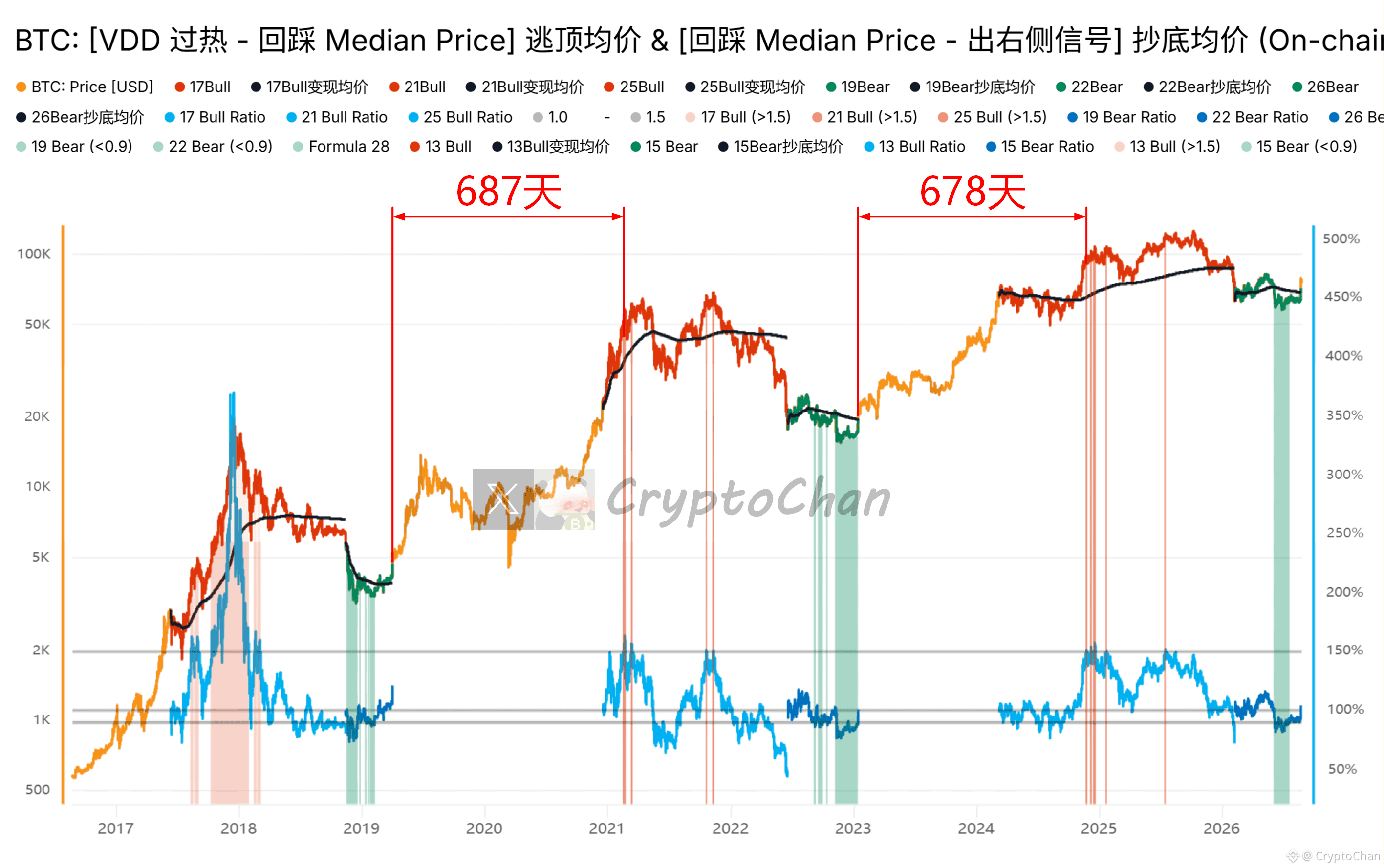
【 $BTC 2028-29 Bull Market Top-Escape Countdown Series 01】
After finishing the 2019 bear-market bottom-buy, 687 days later, the first top-escape red column appeared in 2021
After finishing the 2023 bear-market bottom-buy, 678 days later, the first top-escape red column appeared in 2024
The 2026 bear-market bottom-buy has already passed by 4 days and 2 hours
┌── 🐼 Indicator Details ──┐
The indicator shown is a bull-market top-escape & bear-market bottom-buy model developed based on Bitcoin VDD, Median Price, and multiple related indicators on the right side of bear-market bottoms
After finishing the 2019 bear-market bottom-buy, 687 days later, the first top-escape red column appeared in 2021
After finishing the 2023 bear-market bottom-buy, 678 days later, the first top-escape red column appeared in 2024
The 2026 bear-market bottom-buy has already passed by 4 days and 2 hours
┌── 🐼 Indicator Details ──┐
The indicator shown is a bull-market top-escape & bear-market bottom-buy model developed based on Bitcoin VDD, Median Price, and multiple related indicators on the right side of bear-market bottoms
【 $BTC 2028-29 Bull Market Top-Escape Countdown Series 01】
After finishing the 2019 bear-market bottom-buy, 687 days later, the first top-escape red column appeared in 2021
After finishing the 2023 bear-market bottom-buy, 678 days later, the first top-escape red column appeared in 2024
The 2026 bear-market bottom-buy has already passed by 4 days and 2 hours
┌── 🐼 Indicator Details ──┐
The indicator shown is a bull-market top-escape & bear-market bottom-buy model developed based on Bitcoin VDD, Median Price, and multiple related indicators on the right side of bear-market bottoms
After finishing the 2019 bear-market bottom-buy, 687 days later, the first top-escape red column appeared in 2021
After finishing the 2023 bear-market bottom-buy, 678 days later, the first top-escape red column appeared in 2024
The 2026 bear-market bottom-buy has already passed by 4 days and 2 hours
┌── 🐼 Indicator Details ──┐
The indicator shown is a bull-market top-escape & bear-market bottom-buy model developed based on Bitcoin VDD, Median Price, and multiple related indicators on the right side of bear-market bottoms
Log in to explore more content