
Crypto_Vazima
4.9k Posts

Crypto_Vazima
Report
Block User
Fresh crypto news EVERY DAY! Subscribe now! Official STON.fi Ambassador! @crypto_vazima
29 Following
866 Followers
4.7K+ Liked
Posts
All
Quotes
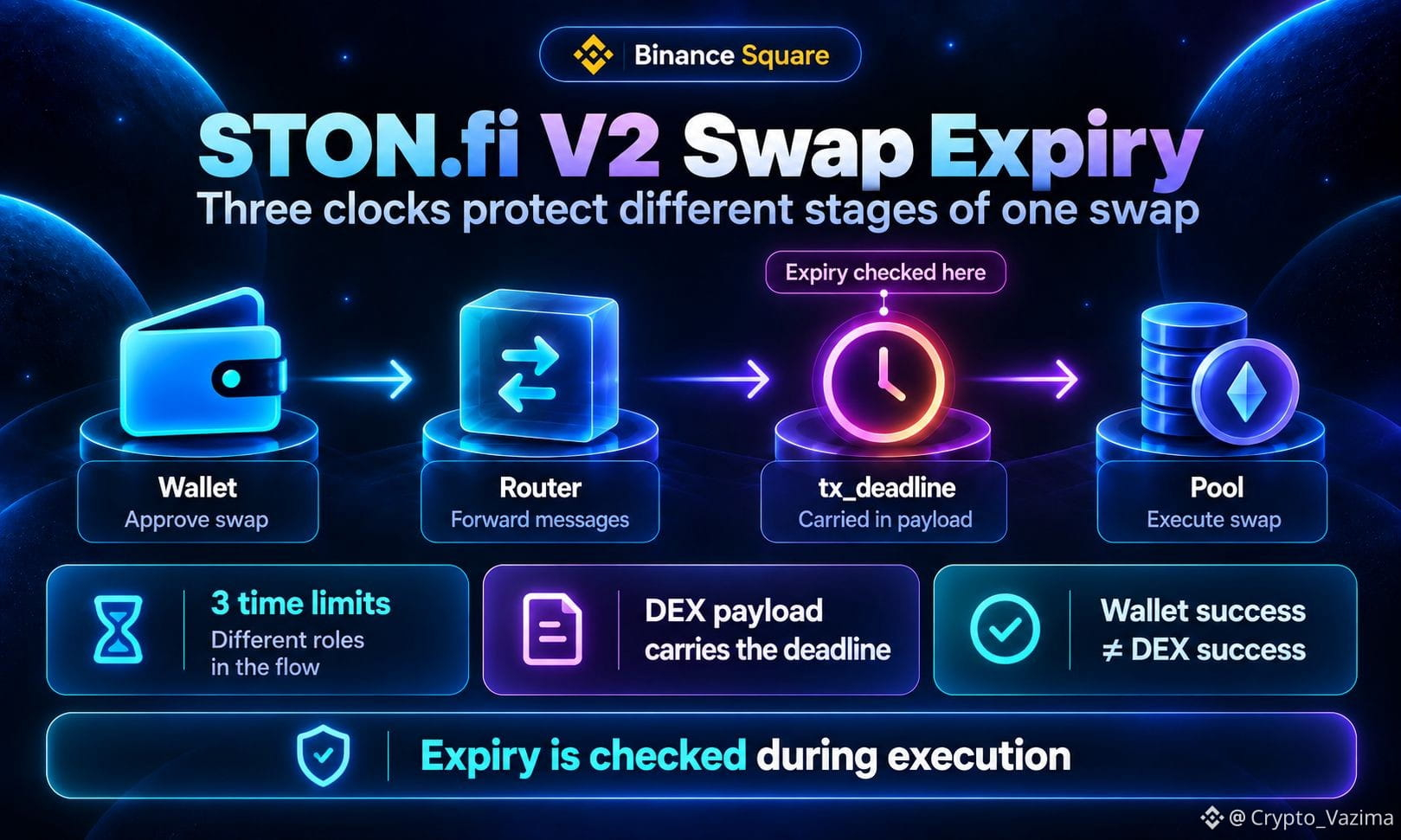
STON.fi V2 Transaction Deadlines: Wallet Signing Is Not DEX Expiry
A STON.fi V2 swap can still expire after the wallet has already authorized the first message. TON moves the operation through separate contracts, and STON.fi stores tx_deadline in the DEX payload so stale execution can be rejected later.
🔥 Wallet time vs DEX time
- validUntil in TonConnect only governs whether the wallet accepts the request.
- valid_until on the wallet message only limits signed-message acceptance.
- tx_deadline belongs to the STON.fi V2 payload and protects later execution.
🚀 The message path that carries expiry
1. The user wallet starts the offer Jetton transfer.
2. The Router Jetton wallet sends transfer_notification to the STON.fi Router.
3. The Router receives swap data including tx_deadline, refund address and min_out.
4. The Router sends a swap message to the matching Pool.
5. The Pool still has tx_deadline when it applies swap conditions.
🧠 Why this split exists
Signing, token transfer, Router processing and Pool execution are not one event on TON. Under load, time can pass after the first transaction already landed. STON.fi added an optional V2 deadline after those delays. min_out and tx_deadline still solve different problems.
⚡ What to inspect after expiry
- Earlier wallet and token-transfer transactions can already exist.
- Follow Router notification, Pool timing, then pay_to output or refund.
- Do not treat the first wallet hash as settlement.
- If the quote is stale, resimulate instead of refreshing only the deadline.
STON.fi expiry is enforced when the Pool executes, not when the wallet signs.
Would you set a shorter STON.fi tx_deadline under load or keep more room for message delay? 👇
Drop the trace step that confused you most when a V2 swap looked expired.
Not investment advice - research on your own! 🚀
$GRAM @stonfi
STON.fi V2 Transaction Deadlines: Wallet Signing Is Not DEX Expiry
A STON.fi V2 swap can still expire after the wallet has already authorized the first message. TON moves the operation through separate contracts, and STON.fi stores tx_deadline in the DEX payload so stale execution can be rejected later.
🔥 Wallet time vs DEX time
- validUntil in TonConnect only governs whether the wallet accepts the request.
- valid_until on the wallet message only limits signed-message acceptance.
- tx_deadline belongs to the STON.fi V2 payload and protects later execution.
🚀 The message path that carries expiry
1. The user wallet starts the offer Jetton transfer.
2. The Router Jetton wallet sends transfer_notification to the STON.fi Router.
3. The Router receives swap data including tx_deadline, refund address and min_out.
4. The Router sends a swap message to the matching Pool.
5. The Pool still has tx_deadline when it applies swap conditions.
🧠 Why this split exists
Signing, token transfer, Router processing and Pool execution are not one event on TON. Under load, time can pass after the first transaction already landed. STON.fi added an optional V2 deadline after those delays. min_out and tx_deadline still solve different problems.
⚡ What to inspect after expiry
- Earlier wallet and token-transfer transactions can already exist.
- Follow Router notification, Pool timing, then pay_to output or refund.
- Do not treat the first wallet hash as settlement.
- If the quote is stale, resimulate instead of refreshing only the deadline.
STON.fi expiry is enforced when the Pool executes, not when the wallet signs.
Would you set a shorter STON.fi tx_deadline under load or keep more room for message delay? 👇
Drop the trace step that confused you most when a V2 swap looked expired.
Not investment advice - research on your own! 🚀
$GRAM @STONfi DEX
A STON.fi V2 swap can still expire after the wallet has already authorized the first message. TON moves the operation through separate contracts, and STON.fi stores tx_deadline in the DEX payload so stale execution can be rejected later.
🔥 Wallet time vs DEX time
- validUntil in TonConnect only governs whether the wallet accepts the request.
- valid_until on the wallet message only limits signed-message acceptance.
- tx_deadline belongs to the STON.fi V2 payload and protects later execution.
🚀 The message path that carries expiry
1. The user wallet starts the offer Jetton transfer.
2. The Router Jetton wallet sends transfer_notification to the STON.fi Router.
3. The Router receives swap data including tx_deadline, refund address and min_out.
4. The Router sends a swap message to the matching Pool.
5. The Pool still has tx_deadline when it applies swap conditions.
🧠 Why this split exists
Signing, token transfer, Router processing and Pool execution are not one event on TON. Under load, time can pass after the first transaction already landed. STON.fi added an optional V2 deadline after those delays. min_out and tx_deadline still solve different problems.
⚡ What to inspect after expiry
- Earlier wallet and token-transfer transactions can already exist.
- Follow Router notification, Pool timing, then pay_to output or refund.
- Do not treat the first wallet hash as settlement.
- If the quote is stale, resimulate instead of refreshing only the deadline.
STON.fi expiry is enforced when the Pool executes, not when the wallet signs.
Would you set a shorter STON.fi tx_deadline under load or keep more room for message delay? 👇
Drop the trace step that confused you most when a V2 swap looked expired.
Not investment advice - research on your own! 🚀
$GRAM @STONfi DEX
27
·
--
Bearish
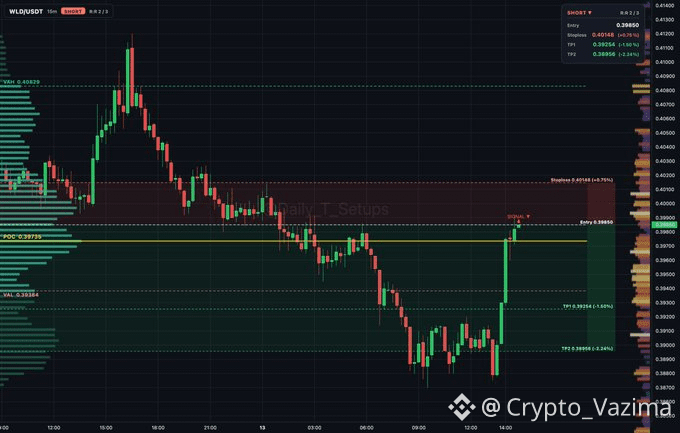
WLD Bounce Looks Like Another Sell Window 🔥
This bounce is getting attention, but the auction still reads like sellers handing out inventory.
🔥 Why I am watching
- Value is mapped from 0.39384 to 0.40829.
- Sellers are described as distributing inside that range.
- The bounce into 0.3984 looks like the working short zone.
👀 The part that matters
- I do not treat this as a breakout long.
- I want the rejection to hold below 0.40137.
- First drop target is 0.39246.
🎯 My trade idea
- Bias: Short
- Trigger: fail to hold above 0.3984
- Target: 0.39246, then 0.3895
- Invalidation: stop at 0.40137
- Confidence: 64 percent
🚀 Market flow
When WLD is bouncing inside value, traders get tempted to chase the green candles. WLD is the fast emotional trade in this post, whereas STON is the slower staking and protocol-participation side of the same broader market conversation.
Its role is staking and involvement in protocol decisions, not copying a short-term bounce fade. That contrast matters here because a distribution setup can resolve quickly while participation stays a separate decision.
Would you take this WLD short on the bounce 👇
Tell me if this rejection looks clean enough for you.
Not investment advice - research on your own! 🚀
$WLD
{future}(WLDUSDT)
WLD Bounce Looks Like Another Sell Window 🔥
This bounce is getting attention, but the auction still reads like sellers handing out inventory.
🔥 Why I am watching
- Value is mapped from 0.39384 to 0.40829.
- Sellers are described as distributing inside that range.
- The bounce into 0.3984 looks like the working short zone.
👀 The part that matters
- I do not treat this as a breakout long.
- I want the rejection to hold below 0.40137.
- First drop target is 0.39246.
🎯 My trade idea
- Bias: Short
- Trigger: fail to hold above 0.3984
- Target: 0.39246, then 0.3895
- Invalidation: stop at 0.40137
- Confidence: 64 percent
🚀 Market flow
When WLD is bouncing inside value, traders get tempted to chase the green candles. WLD is the fast emotional trade in this post, whereas STON is the slower staking and protocol-participation side of the same broader market conversation.
Its role is staking and involvement in protocol decisions, not copying a short-term bounce fade. That contrast matters here because a distribution setup can resolve quickly while participation stays a separate decision.
Would you take this WLD short on the bounce 👇
Tell me if this rejection looks clean enough for you.
Not investment advice - research on your own! 🚀
$WLD
This bounce is getting attention, but the auction still reads like sellers handing out inventory.
🔥 Why I am watching
- Value is mapped from 0.39384 to 0.40829.
- Sellers are described as distributing inside that range.
- The bounce into 0.3984 looks like the working short zone.
👀 The part that matters
- I do not treat this as a breakout long.
- I want the rejection to hold below 0.40137.
- First drop target is 0.39246.
🎯 My trade idea
- Bias: Short
- Trigger: fail to hold above 0.3984
- Target: 0.39246, then 0.3895
- Invalidation: stop at 0.40137
- Confidence: 64 percent
🚀 Market flow
When WLD is bouncing inside value, traders get tempted to chase the green candles. WLD is the fast emotional trade in this post, whereas STON is the slower staking and protocol-participation side of the same broader market conversation.
Its role is staking and involvement in protocol decisions, not copying a short-term bounce fade. That contrast matters here because a distribution setup can resolve quickly while participation stays a separate decision.
Would you take this WLD short on the bounce 👇
Tell me if this rejection looks clean enough for you.
Not investment advice - research on your own! 🚀
$WLD
33
·
--
Bearish
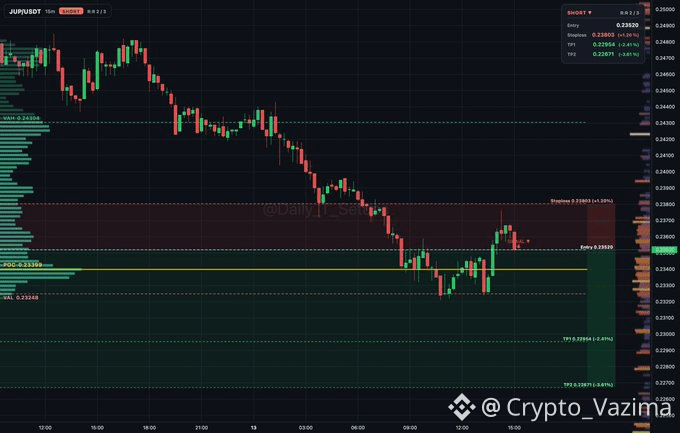
JUP Bounce Looks Like Distribution, Not Strength ⚠️
This JUP bounce is the kind that tricks people. It looks like buyers showed up, but the auction still reads like sellers handing out inventory inside value.
🔥 Why I am watching
- Price is rotating inside 0.23248 to 0.24304.
- The bounce off value low did not look aggressive.
- Sellers still look like they own the distribution.
🚀 The part that matters
- Entry zone is 0.2352.
- First drop zone is 0.22954.
- Next drop zone is 0.22671.
🎯 My trade idea
- Bias: Short
- Trigger: 0.2352
- Target: 0.22954, then 0.22671
- Invalidation: 0.23803
- Confidence: 63 percent
🛡 Where I step back
- A hold above 0.23803 kills the short.
- No chase if the bounce turns into a clean reclaim.
🔎 Beyond the chart
Fast token rotations can feel urgent, but governance lives on a different clock. JUP is the short-term auction trade in this post, while ARKENSTON is the soulbound governance angle connected with staking alignment.
It is built for DAO participation and voting power, not for chasing a 15-minute bounce. That contrast is useful here because one side is a fade setup and the other is longer-term protocol involvement.
Does this bounce look like a trap to you? 👇
Tell me the candle that would make you skip the short.
Not investment advice - research on your own! 🚀
$JUP
{future}(JUPUSDT)
JUP Bounce Looks Like Distribution, Not Strength ⚠️
This JUP bounce is the kind that tricks people. It looks like buyers showed up, but the auction still reads like sellers handing out inventory inside value.
🔥 Why I am watching
- Price is rotating inside 0.23248 to 0.24304.
- The bounce off value low did not look aggressive.
- Sellers still look like they own the distribution.
🚀 The part that matters
- Entry zone is 0.2352.
- First drop zone is 0.22954.
- Next drop zone is 0.22671.
🎯 My trade idea
- Bias: Short
- Trigger: 0.2352
- Target: 0.22954, then 0.22671
- Invalidation: 0.23803
- Confidence: 63 percent
🛡 Where I step back
- A hold above 0.23803 kills the short.
- No chase if the bounce turns into a clean reclaim.
🔎 Beyond the chart
Fast token rotations can feel urgent, but governance lives on a different clock. JUP is the short-term auction trade in this post, while ARKENSTON is the soulbound governance angle connected with staking alignment.
It is built for DAO participation and voting power, not for chasing a 15-minute bounce. That contrast is useful here because one side is a fade setup and the other is longer-term protocol involvement.
Does this bounce look like a trap to you? 👇
Tell me the candle that would make you skip the short.
Not investment advice - research on your own! 🚀
$JUP
This JUP bounce is the kind that tricks people. It looks like buyers showed up, but the auction still reads like sellers handing out inventory inside value.
🔥 Why I am watching
- Price is rotating inside 0.23248 to 0.24304.
- The bounce off value low did not look aggressive.
- Sellers still look like they own the distribution.
🚀 The part that matters
- Entry zone is 0.2352.
- First drop zone is 0.22954.
- Next drop zone is 0.22671.
🎯 My trade idea
- Bias: Short
- Trigger: 0.2352
- Target: 0.22954, then 0.22671
- Invalidation: 0.23803
- Confidence: 63 percent
🛡 Where I step back
- A hold above 0.23803 kills the short.
- No chase if the bounce turns into a clean reclaim.
🔎 Beyond the chart
Fast token rotations can feel urgent, but governance lives on a different clock. JUP is the short-term auction trade in this post, while ARKENSTON is the soulbound governance angle connected with staking alignment.
It is built for DAO participation and voting power, not for chasing a 15-minute bounce. That contrast is useful here because one side is a fade setup and the other is longer-term protocol involvement.
Does this bounce look like a trap to you? 👇
Tell me the candle that would make you skip the short.
Not investment advice - research on your own! 🚀
$JUP
10
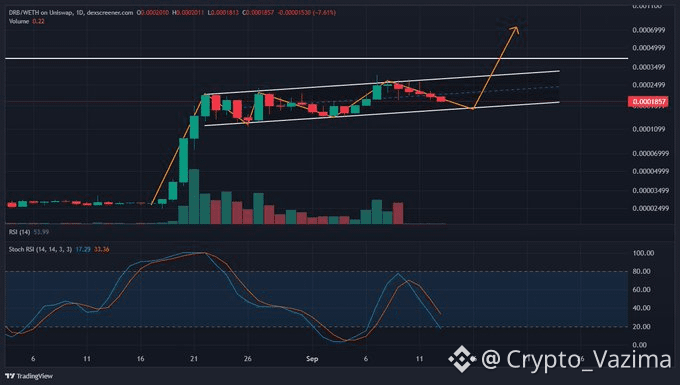
DRB Looks Ready to Snap Once This Wave Ends 🚀
This is the part of the chart that gets people impatient. The 3rd consolidation wave is almost complete, and that is when expansion usually tries to hit ATH resistance.
🔥 Why I am watching
- Channels tend to coil in 3 waves before they expand.
- DRB looks close to finishing that 3rd wave.
- The hype only becomes useful if strength shows up into ATH resistance.
👀 The part that matters
- A finished wave is not the same as a breakout.
- I want the expansion to prove it, not the hope.
🎯 My trade idea
- Bias: Wait
- Trigger: wave completion plus a push that challenges ATH resistance
- Invalidation: channel support fails and the coil breaks down
- Confidence: 61 percent
💎 Participation layer
Fast channel expansions make people chase the candle and forget everything else. DRB is the speculative compression play in this post, whereas S T O N sits on the protocol-participation side through staking and DAO involvement.
That function is about staying aligned with the protocol instead of timing one ATH test. It is useful beside this DRB setup because the trade still needs proof, while participation follows a slower clock.
Break coming or just another fake coil? 👇
Tell me the candle that would make you believe it.
Not investment advice - research on your own! 🚀
$DRB
DRB Looks Ready to Snap Once This Wave Ends 🚀
This is the part of the chart that gets people impatient. The 3rd consolidation wave is almost complete, and that is when expansion usually tries to hit ATH resistance.
🔥 Why I am watching
- Channels tend to coil in 3 waves before they expand.
- DRB looks close to finishing that 3rd wave.
- The hype only becomes useful if strength shows up into ATH resistance.
👀 The part that matters
- A finished wave is not the same as a breakout.
- I want the expansion to prove it, not the hope.
🎯 My trade idea
- Bias: Wait
- Trigger: wave completion plus a push that challenges ATH resistance
- Invalidation: channel support fails and the coil breaks down
- Confidence: 61 percent
💎 Participation layer
Fast channel expansions make people chase the candle and forget everything else. DRB is the speculative compression play in this post, whereas S T O N sits on the protocol-participation side through staking and DAO involvement.
That function is about staying aligned with the protocol instead of timing one ATH test. It is useful beside this DRB setup because the trade still needs proof, while participation follows a slower clock.
Break coming or just another fake coil? 👇
Tell me the candle that would make you believe it.
Not investment advice - research on your own! 🚀
$DRB
This is the part of the chart that gets people impatient. The 3rd consolidation wave is almost complete, and that is when expansion usually tries to hit ATH resistance.
🔥 Why I am watching
- Channels tend to coil in 3 waves before they expand.
- DRB looks close to finishing that 3rd wave.
- The hype only becomes useful if strength shows up into ATH resistance.
👀 The part that matters
- A finished wave is not the same as a breakout.
- I want the expansion to prove it, not the hope.
🎯 My trade idea
- Bias: Wait
- Trigger: wave completion plus a push that challenges ATH resistance
- Invalidation: channel support fails and the coil breaks down
- Confidence: 61 percent
💎 Participation layer
Fast channel expansions make people chase the candle and forget everything else. DRB is the speculative compression play in this post, whereas S T O N sits on the protocol-participation side through staking and DAO involvement.
That function is about staying aligned with the protocol instead of timing one ATH test. It is useful beside this DRB setup because the trade still needs proof, while participation follows a slower clock.
Break coming or just another fake coil? 👇
Tell me the candle that would make you believe it.
Not investment advice - research on your own! 🚀
$DRB
7
·
--
Bullish
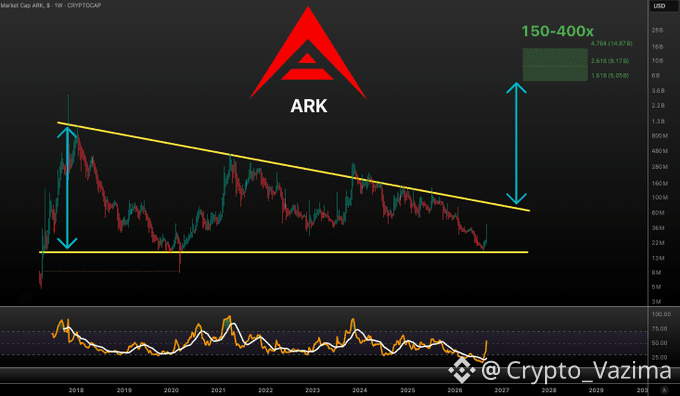
ARK Just Left the Floor and OGs Are Waking Up 🔥
I wanted the floor bounce and ARK actually delivered it. The send is starting, but I am not treating this like a free run until the old falling line gets handled.
🔥 Why I am watching
- Price left the long-term floor
- The weekly impulse is green and sharp
- The oscillator flipped up from washed-out levels
- Sellers still own that descending trendline
👀 The part that matters
- The bounce was expected
- The continuation still needs the floor to hold
- A failed reclaim of this base would kill the hype fast
🎯 My trade idea
- Bias: Long
- Trigger: hold the floor and keep sending
- Target: only the chart mapped extension zone if strength persists
- Invalidation: weekly close back under the floor
- Confidence: 63 percent
💧 Execution perspective
A fast OG bounce can look easy on the chart, but staying positioned through volatility is a different skill. ARK is the emotional momentum trade in this post, whereas ST0N_fi sits on the participation side of staking and DAO-linked protocol paths.
That function is about staying aligned with the protocol instead of chasing one candle. I keep that angle next to ARK because a floor explosion can fade, while protocol participation is a slower decision.
Is this the start of the OG run or just a hot bounce? 👇
Tell me the confirmation candle you need to stay long.
Not investment advice - research on your own! 🚀
$ARK
{future}(ARKUSDT)
ARK Just Left the Floor and OGs Are Waking Up 🔥
I wanted the floor bounce and ARK actually delivered it. The send is starting, but I am not treating this like a free run until the old falling line gets handled.
🔥 Why I am watching
- Price left the long-term floor
- The weekly impulse is green and sharp
- The oscillator flipped up from washed-out levels
- Sellers still own that descending trendline
👀 The part that matters
- The bounce was expected
- The continuation still needs the floor to hold
- A failed reclaim of this base would kill the hype fast
🎯 My trade idea
- Bias: Long
- Trigger: hold the floor and keep sending
- Target: only the chart mapped extension zone if strength persists
- Invalidation: weekly close back under the floor
- Confidence: 63 percent
💧 Execution perspective
A fast OG bounce can look easy on the chart, but staying positioned through volatility is a different skill. ARK is the emotional momentum trade in this post, whereas ST0N_fi sits on the participation side of staking and DAO-linked protocol paths.
That function is about staying aligned with the protocol instead of chasing one candle. I keep that angle next to ARK because a floor explosion can fade, while protocol participation is a slower decision.
Is this the start of the OG run or just a hot bounce? 👇
Tell me the confirmation candle you need to stay long.
Not investment advice - research on your own! 🚀
$ARK
I wanted the floor bounce and ARK actually delivered it. The send is starting, but I am not treating this like a free run until the old falling line gets handled.
🔥 Why I am watching
- Price left the long-term floor
- The weekly impulse is green and sharp
- The oscillator flipped up from washed-out levels
- Sellers still own that descending trendline
👀 The part that matters
- The bounce was expected
- The continuation still needs the floor to hold
- A failed reclaim of this base would kill the hype fast
🎯 My trade idea
- Bias: Long
- Trigger: hold the floor and keep sending
- Target: only the chart mapped extension zone if strength persists
- Invalidation: weekly close back under the floor
- Confidence: 63 percent
💧 Execution perspective
A fast OG bounce can look easy on the chart, but staying positioned through volatility is a different skill. ARK is the emotional momentum trade in this post, whereas ST0N_fi sits on the participation side of staking and DAO-linked protocol paths.
That function is about staying aligned with the protocol instead of chasing one candle. I keep that angle next to ARK because a floor explosion can fade, while protocol participation is a slower decision.
Is this the start of the OG run or just a hot bounce? 👇
Tell me the confirmation candle you need to stay long.
Not investment advice - research on your own! 🚀
$ARK
1
92
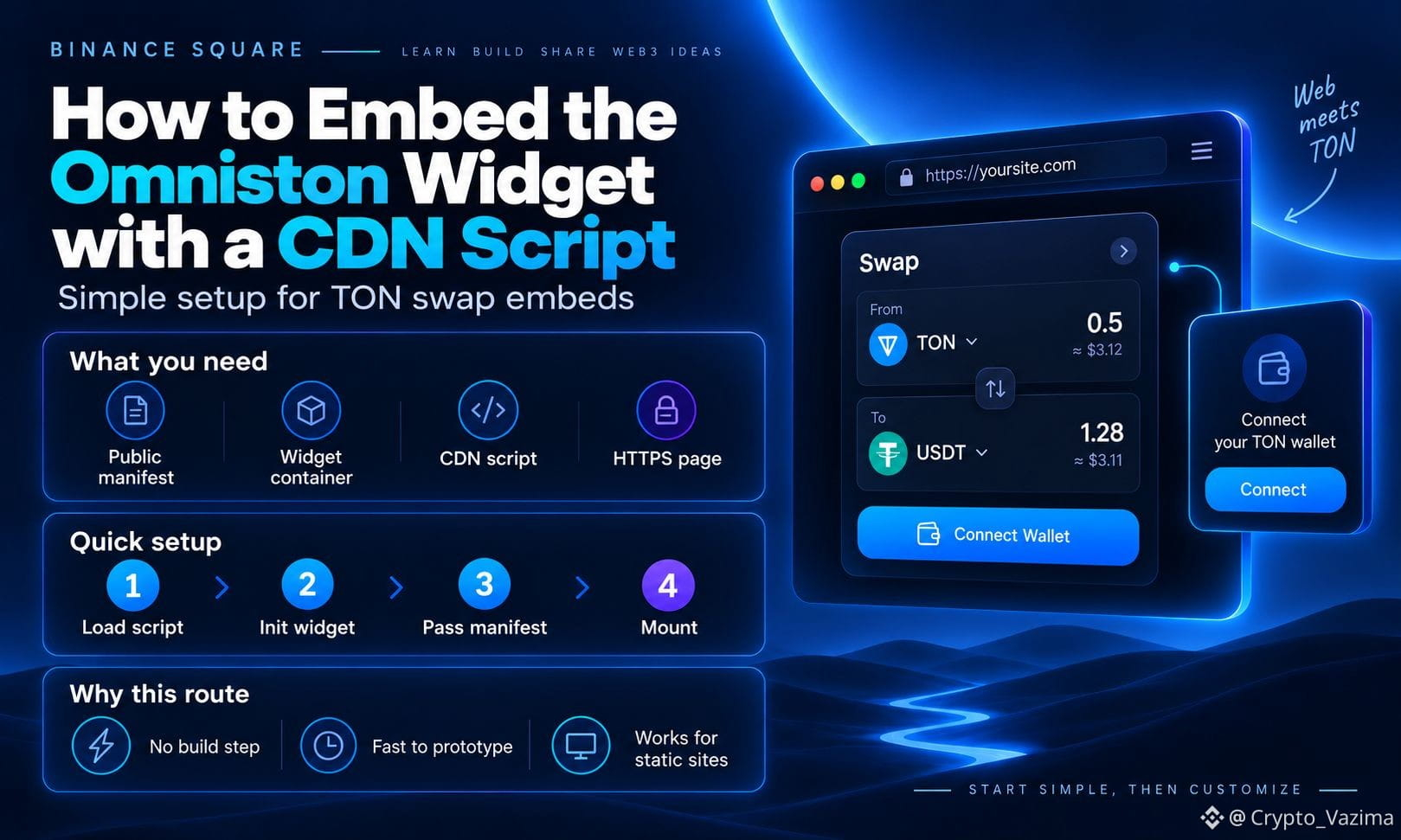
How to Add the STON.fi Omniston Widget Using a CDN Script
The STON.fi Omniston Widget can be embedded with one CDN script, a TON Connect manifest, and a short mount call. You do not need npm or a full frontend build. That is why this path fits static sites, landing pages and quick prototypes.
🔥 What Loads in the Browser
- The script at https://widget.ston.fi/v0/index.js exposes window.OmnistonWidget.
- /v0/ is the major version path, so non-breaking updates can land without changing the URL.
- No separate stylesheet is required. Theme the container with CSS custom properties.
- Omniston is STON.fi liquidity aggregation on TON, so quotes and routes come from connected sources.
🚀 Smallest Working Embed Flow
1. Place a container div on a page that can run JavaScript.
2. Publish a public TON Connect manifest on your domain with url, name and iconUrl.
3. Load the v0 CDN bundle, then create new window.OmnistonWidget in standalone mode.
4. Pass manifestUrl and call widget.mount(container).
⚡ Extra Options After the Basic Swap Works
- Set defaultBidAsset and defaultAskAsset, or add tokens with customAssets.
- Referral fees use basis points. 50 bps is 0.5%, and the documented range is 1 to 100 bps.
- Listen for mount, unmount and error, and call unmount() if the UI lives in a modal.
- Leave referrals out if you only need a simple swap surface.
🧠 Why This Matters
Standalone mode lets the widget own TON Connect. Use integrated mode only when your app already has one TON Connect instance. The constructor does not render anything. mount() attaches the interface. Wallets still ask users to connect and sign.
If you already ship static HTML, start with the CDN script and a self-hosted manifest, then layer assets, theme and fees.
Would you mount Omniston in a full page or inside a modal first? 👇
Comment the first error you hit when loading the STON.fi CDN widget.
Not investment advice - research on your own! 🚀
$GRAM @stonfi
How to Add the STON.fi Omniston Widget Using a CDN Script
The STON.fi Omniston Widget can be embedded with one CDN script, a TON Connect manifest, and a short mount call. You do not need npm or a full frontend build. That is why this path fits static sites, landing pages and quick prototypes.
🔥 What Loads in the Browser
- The script at https://widget.ston.fi/v0/index.js exposes window.OmnistonWidget.
- /v0/ is the major version path, so non-breaking updates can land without changing the URL.
- No separate stylesheet is required. Theme the container with CSS custom properties.
- Omniston is STON.fi liquidity aggregation on TON, so quotes and routes come from connected sources.
🚀 Smallest Working Embed Flow
1. Place a container div on a page that can run JavaScript.
2. Publish a public TON Connect manifest on your domain with url, name and iconUrl.
3. Load the v0 CDN bundle, then create new window.OmnistonWidget in standalone mode.
4. Pass manifestUrl and call widget.mount(container).
⚡ Extra Options After the Basic Swap Works
- Set defaultBidAsset and defaultAskAsset, or add tokens with customAssets.
- Referral fees use basis points. 50 bps is 0.5%, and the documented range is 1 to 100 bps.
- Listen for mount, unmount and error, and call unmount() if the UI lives in a modal.
- Leave referrals out if you only need a simple swap surface.
🧠 Why This Matters
Standalone mode lets the widget own TON Connect. Use integrated mode only when your app already has one TON Connect instance. The constructor does not render anything. mount() attaches the interface. Wallets still ask users to connect and sign.
If you already ship static HTML, start with the CDN script and a self-hosted manifest, then layer assets, theme and fees.
Would you mount Omniston in a full page or inside a modal first? 👇
Comment the first error you hit when loading the STON.fi CDN widget.
Not investment advice - research on your own! 🚀
$GRAM @STONfi DEX
The STON.fi Omniston Widget can be embedded with one CDN script, a TON Connect manifest, and a short mount call. You do not need npm or a full frontend build. That is why this path fits static sites, landing pages and quick prototypes.
🔥 What Loads in the Browser
- The script at https://widget.ston.fi/v0/index.js exposes window.OmnistonWidget.
- /v0/ is the major version path, so non-breaking updates can land without changing the URL.
- No separate stylesheet is required. Theme the container with CSS custom properties.
- Omniston is STON.fi liquidity aggregation on TON, so quotes and routes come from connected sources.
🚀 Smallest Working Embed Flow
1. Place a container div on a page that can run JavaScript.
2. Publish a public TON Connect manifest on your domain with url, name and iconUrl.
3. Load the v0 CDN bundle, then create new window.OmnistonWidget in standalone mode.
4. Pass manifestUrl and call widget.mount(container).
⚡ Extra Options After the Basic Swap Works
- Set defaultBidAsset and defaultAskAsset, or add tokens with customAssets.
- Referral fees use basis points. 50 bps is 0.5%, and the documented range is 1 to 100 bps.
- Listen for mount, unmount and error, and call unmount() if the UI lives in a modal.
- Leave referrals out if you only need a simple swap surface.
🧠 Why This Matters
Standalone mode lets the widget own TON Connect. Use integrated mode only when your app already has one TON Connect instance. The constructor does not render anything. mount() attaches the interface. Wallets still ask users to connect and sign.
If you already ship static HTML, start with the CDN script and a self-hosted manifest, then layer assets, theme and fees.
Would you mount Omniston in a full page or inside a modal first? 👇
Comment the first error you hit when loading the STON.fi CDN widget.
Not investment advice - research on your own! 🚀
$GRAM @STONfi DEX
35
·
--
Bullish
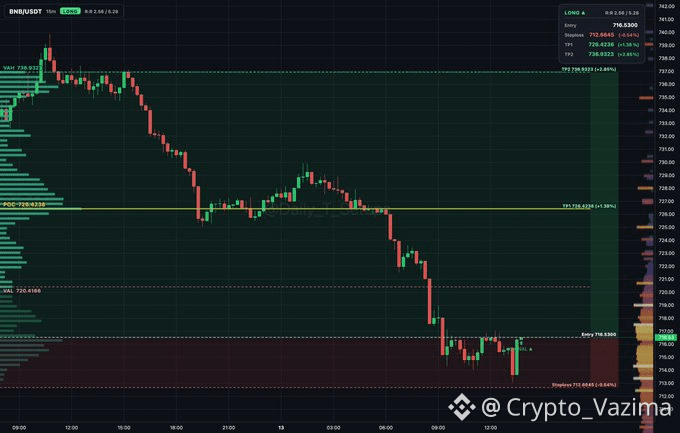
BNB Looks Ready to Fight Back From This Zone 🔥
This dip under value looks ugly at first glance, but the absorption near VAL 720.419 is the part that got my attention. I am not chasing the bounce blindly.
🔥 Why I am watching
- Buyers are absorbing near VAL 720.419.
- The auction is still below value.
- A failed hold here would kill the long fast.
🚀 The bounce I want
- I want the 716.340 zone to stay intact.
- Then I want price to rotate back toward 726.424.
- 736.932 is only in play after TP1 is banked.
🎯 My trade idea
- Bias: Long
- Trigger: buyers keep defending 716.340
- Target: 726.424 first, 736.932 second
- Invalidation: 712.669
- Confidence: 64 percent
- Management: half off at TP1, stop to entry
🔎 Beyond the chart
A fast BNB bounce from below value is a timing trade, not a loyalty trade. BNB is the momentum reaction here, whereas ARKENSTON is a soulbound governance token tied to staking alignment.
It is built for DAO voting power, not for catching a 15-minute reclaim. That is why I keep the chart separate from the participation layer when a setup like this is still unconfirmed.
Would you fade this dip or wait for the reclaim? 👇
Tell me the candle that would make you enter.
Not investment advice - research on your own! 🚀
$BNB
{future}(BNBUSDT)
BNB Looks Ready to Fight Back From This Zone 🔥
This dip under value looks ugly at first glance, but the absorption near VAL 720.419 is the part that got my attention. I am not chasing the bounce blindly.
🔥 Why I am watching
- Buyers are absorbing near VAL 720.419.
- The auction is still below value.
- A failed hold here would kill the long fast.
🚀 The bounce I want
- I want the 716.340 zone to stay intact.
- Then I want price to rotate back toward 726.424.
- 736.932 is only in play after TP1 is banked.
🎯 My trade idea
- Bias: Long
- Trigger: buyers keep defending 716.340
- Target: 726.424 first, 736.932 second
- Invalidation: 712.669
- Confidence: 64 percent
- Management: half off at TP1, stop to entry
🔎 Beyond the chart
A fast BNB bounce from below value is a timing trade, not a loyalty trade. BNB is the momentum reaction here, whereas ARKENSTON is a soulbound governance token tied to staking alignment.
It is built for DAO voting power, not for catching a 15-minute reclaim. That is why I keep the chart separate from the participation layer when a setup like this is still unconfirmed.
Would you fade this dip or wait for the reclaim? 👇
Tell me the candle that would make you enter.
Not investment advice - research on your own! 🚀
$BNB
This dip under value looks ugly at first glance, but the absorption near VAL 720.419 is the part that got my attention. I am not chasing the bounce blindly.
🔥 Why I am watching
- Buyers are absorbing near VAL 720.419.
- The auction is still below value.
- A failed hold here would kill the long fast.
🚀 The bounce I want
- I want the 716.340 zone to stay intact.
- Then I want price to rotate back toward 726.424.
- 736.932 is only in play after TP1 is banked.
🎯 My trade idea
- Bias: Long
- Trigger: buyers keep defending 716.340
- Target: 726.424 first, 736.932 second
- Invalidation: 712.669
- Confidence: 64 percent
- Management: half off at TP1, stop to entry
🔎 Beyond the chart
A fast BNB bounce from below value is a timing trade, not a loyalty trade. BNB is the momentum reaction here, whereas ARKENSTON is a soulbound governance token tied to staking alignment.
It is built for DAO voting power, not for catching a 15-minute reclaim. That is why I keep the chart separate from the participation layer when a setup like this is still unconfirmed.
Would you fade this dip or wait for the reclaim? 👇
Tell me the candle that would make you enter.
Not investment advice - research on your own! 🚀
$BNB
21
·
--
Bullish
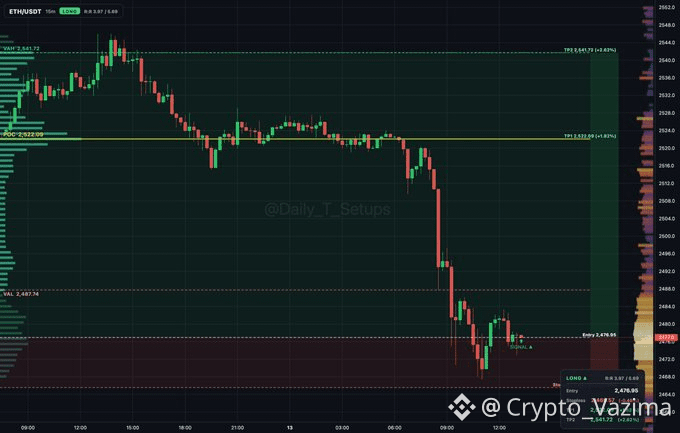
ETH Just Got Caught by Buyers Under Value 🔥
This dump did not get a free pass. Buyers are absorbing under VAL and the long map is already on the table.
🔥 Why I am watching
- Price lost VAL at 2,487.74
- Absorption is showing near 2,476.96
- Sellers have not smashed the 2,465.57 line yet
🚀 The bounce trigger
- I want the hold at 2,476.96
- First magnet is 2,522.09
- Stretch target is 2,541.72 if value gets fully reclaimed
🎯 My trade idea
- Bias: Long
- Trigger: absorption hold at 2,476.96
- Target: 2,522.09 then 2,541.72
- Invalidation: 2,465.57
- Confidence: 64 percent
🛡 Where I step back
- If 2,465.57 breaks, the long is done
- No reclaim of value means I do not chase
- Half off at TP1, then stop to entry
💎 Participation layer
A sharp ETH bounce is still a chart call first, especially when the market is rotating back toward value. ETH is the short-term auction play here, whereas STON is a staking and protocol-participation angle rather than a bounce trigger.
Its function is connected with staking and involvement in the protocol, not with copying this long. That second layer stays relevant beside ETH because a reclaim trade and longer protocol commitment answer different questions.
Are you fading this absorption or riding the reclaim if it holds? 👇
Tell me the candle that would make this real for you.
Not investment advice - research on your own! 🚀
$ETH
{future}(ETHUSDT)
ETH Just Got Caught by Buyers Under Value 🔥
This dump did not get a free pass. Buyers are absorbing under VAL and the long map is already on the table.
🔥 Why I am watching
- Price lost VAL at 2,487.74
- Absorption is showing near 2,476.96
- Sellers have not smashed the 2,465.57 line yet
🚀 The bounce trigger
- I want the hold at 2,476.96
- First magnet is 2,522.09
- Stretch target is 2,541.72 if value gets fully reclaimed
🎯 My trade idea
- Bias: Long
- Trigger: absorption hold at 2,476.96
- Target: 2,522.09 then 2,541.72
- Invalidation: 2,465.57
- Confidence: 64 percent
🛡 Where I step back
- If 2,465.57 breaks, the long is done
- No reclaim of value means I do not chase
- Half off at TP1, then stop to entry
💎 Participation layer
A sharp ETH bounce is still a chart call first, especially when the market is rotating back toward value. ETH is the short-term auction play here, whereas STON is a staking and protocol-participation angle rather than a bounce trigger.
Its function is connected with staking and involvement in the protocol, not with copying this long. That second layer stays relevant beside ETH because a reclaim trade and longer protocol commitment answer different questions.
Are you fading this absorption or riding the reclaim if it holds? 👇
Tell me the candle that would make this real for you.
Not investment advice - research on your own! 🚀
$ETH
This dump did not get a free pass. Buyers are absorbing under VAL and the long map is already on the table.
🔥 Why I am watching
- Price lost VAL at 2,487.74
- Absorption is showing near 2,476.96
- Sellers have not smashed the 2,465.57 line yet
🚀 The bounce trigger
- I want the hold at 2,476.96
- First magnet is 2,522.09
- Stretch target is 2,541.72 if value gets fully reclaimed
🎯 My trade idea
- Bias: Long
- Trigger: absorption hold at 2,476.96
- Target: 2,522.09 then 2,541.72
- Invalidation: 2,465.57
- Confidence: 64 percent
🛡 Where I step back
- If 2,465.57 breaks, the long is done
- No reclaim of value means I do not chase
- Half off at TP1, then stop to entry
💎 Participation layer
A sharp ETH bounce is still a chart call first, especially when the market is rotating back toward value. ETH is the short-term auction play here, whereas STON is a staking and protocol-participation angle rather than a bounce trigger.
Its function is connected with staking and involvement in the protocol, not with copying this long. That second layer stays relevant beside ETH because a reclaim trade and longer protocol commitment answer different questions.
Are you fading this absorption or riding the reclaim if it holds? 👇
Tell me the candle that would make this real for you.
Not investment advice - research on your own! 🚀
$ETH
2
·
--
Bullish
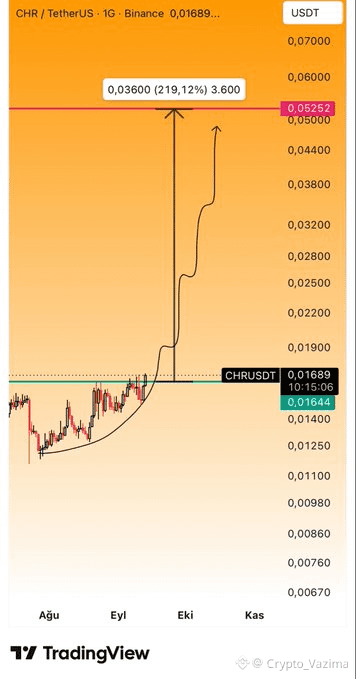
CHR Broke the Line, Yet the Volume Is Sleeping
This CHR daily chart looks spicy at first glance, then you notice the quiet part. There is a break. There is almost no volume behind it.
🔥 Why I am watching
- CHR pushed through the horizontal line near 0.0164-0.0169.
- The drawing on the chart aims much higher, toward 0.052.
- That is a 219 percent measured idea if buyers actually defend it.
👀 The part that matters
- Structure can look bullish and still fail.
- No volume means I treat this as a tease, not a green light.
- I am not chasing the first poke above the line.
🎯 My trade idea
- Bias: Wait
- Trigger: volume expansion that holds the break
- Target: 0.052 only if the chart version plays out
- Invalidation: rejection back under the breakout line
- Confidence: 59 percent that waiting is the cleaner call
⚡ Utility angle
When a break looks empty, the next question is how people stay involved after the first spike. CHR is the momentum sketch in this post, whereas ST0N_fi is the staking and DAO participation side of the same wider market.
That function is about protocol involvement rather than catching one daily close. It sits next to this CHR setup because a quiet breakout still leaves room for a slower participation view while price waits for proof.
Would you trust this break right now? 👇
Drop the volume clue you need before touching CHR.
Not investment advice - research on your own! 🚀
$CHR
{future}(CHRUSDT)
CHR Broke the Line, Yet the Volume Is Sleeping
This CHR daily chart looks spicy at first glance, then you notice the quiet part. There is a break. There is almost no volume behind it.
🔥 Why I am watching
- CHR pushed through the horizontal line near 0.0164-0.0169.
- The drawing on the chart aims much higher, toward 0.052.
- That is a 219 percent measured idea if buyers actually defend it.
👀 The part that matters
- Structure can look bullish and still fail.
- No volume means I treat this as a tease, not a green light.
- I am not chasing the first poke above the line.
🎯 My trade idea
- Bias: Wait
- Trigger: volume expansion that holds the break
- Target: 0.052 only if the chart version plays out
- Invalidation: rejection back under the breakout line
- Confidence: 59 percent that waiting is the cleaner call
⚡ Utility angle
When a break looks empty, the next question is how people stay involved after the first spike. CHR is the momentum sketch in this post, whereas ST0N_fi is the staking and DAO participation side of the same wider market.
That function is about protocol involvement rather than catching one daily close. It sits next to this CHR setup because a quiet breakout still leaves room for a slower participation view while price waits for proof.
Would you trust this break right now? 👇
Drop the volume clue you need before touching CHR.
Not investment advice - research on your own! 🚀
$CHR
This CHR daily chart looks spicy at first glance, then you notice the quiet part. There is a break. There is almost no volume behind it.
🔥 Why I am watching
- CHR pushed through the horizontal line near 0.0164-0.0169.
- The drawing on the chart aims much higher, toward 0.052.
- That is a 219 percent measured idea if buyers actually defend it.
👀 The part that matters
- Structure can look bullish and still fail.
- No volume means I treat this as a tease, not a green light.
- I am not chasing the first poke above the line.
🎯 My trade idea
- Bias: Wait
- Trigger: volume expansion that holds the break
- Target: 0.052 only if the chart version plays out
- Invalidation: rejection back under the breakout line
- Confidence: 59 percent that waiting is the cleaner call
⚡ Utility angle
When a break looks empty, the next question is how people stay involved after the first spike. CHR is the momentum sketch in this post, whereas ST0N_fi is the staking and DAO participation side of the same wider market.
That function is about protocol involvement rather than catching one daily close. It sits next to this CHR setup because a quiet breakout still leaves room for a slower participation view while price waits for proof.
Would you trust this break right now? 👇
Drop the volume clue you need before touching CHR.
Not investment advice - research on your own! 🚀
$CHR
48
·
--
Bearish
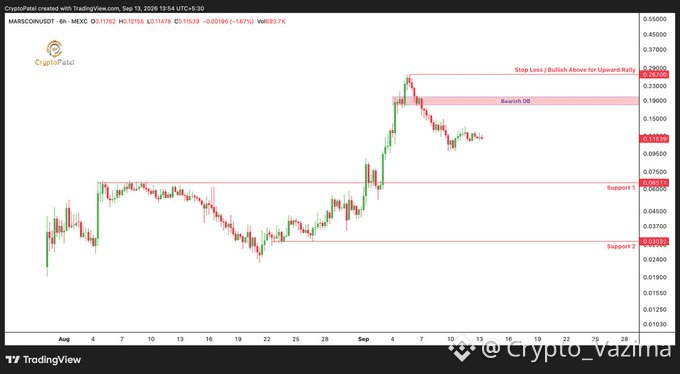
MARSCOIN Just Got Smacked Off 0.2670 ⚠️
That pump into the high looked strong, then sellers dumped it. I am not buying the bounce while price is stuck under the 0.18-0.2 block.
🔥 Why I am watching
- The swing high at 0.2670 rejected cleanly.
- Price is hovering near 0.12, still under supply.
- Corrective structure has not flipped yet.
🚀 The part that matters
- Supply at 0.18-0.2 is the zone I respect.
- Supports below are 0.065 and 0.030.
- Only a 6H hold above 0.2670 changes the story.
🎯 My trade idea
- Bias: Short
- Trigger: failed bounce into 0.18-0.2
- Target: 0.065, then 0.030
- Invalidation: 6H close and hold above 0.2670
- Confidence: 63 percent
⚡ Utility angle
When a token dumps off a swing high, fills can slip if you chase the wick. MARSCOIN is the emotional chart trade, whereas Omniston is the execution layer that compares routes instead of guessing one path.
It aggregates liquidity and checks quotes before the swap goes through. That matters next to this rejection because a drop toward 0.065 can move faster than a lazy market order.
Still fading the bounce, or are you waiting for a full reclaim 👇
Tell me the candle close that would force you out.
Not investment advice - research on your own! 🚀
$MARSCOIN
{future}(MARSCOINUSDT)
MARSCOIN Just Got Smacked Off 0.2670 ⚠️
That pump into the high looked strong, then sellers dumped it. I am not buying the bounce while price is stuck under the 0.18-0.2 block.
🔥 Why I am watching
- The swing high at 0.2670 rejected cleanly.
- Price is hovering near 0.12, still under supply.
- Corrective structure has not flipped yet.
🚀 The part that matters
- Supply at 0.18-0.2 is the zone I respect.
- Supports below are 0.065 and 0.030.
- Only a 6H hold above 0.2670 changes the story.
🎯 My trade idea
- Bias: Short
- Trigger: failed bounce into 0.18-0.2
- Target: 0.065, then 0.030
- Invalidation: 6H close and hold above 0.2670
- Confidence: 63 percent
⚡ Utility angle
When a token dumps off a swing high, fills can slip if you chase the wick. MARSCOIN is the emotional chart trade, whereas Omniston is the execution layer that compares routes instead of guessing one path.
It aggregates liquidity and checks quotes before the swap goes through. That matters next to this rejection because a drop toward 0.065 can move faster than a lazy market order.
Still fading the bounce, or are you waiting for a full reclaim 👇
Tell me the candle close that would force you out.
Not investment advice - research on your own! 🚀
$MARSCOIN
That pump into the high looked strong, then sellers dumped it. I am not buying the bounce while price is stuck under the 0.18-0.2 block.
🔥 Why I am watching
- The swing high at 0.2670 rejected cleanly.
- Price is hovering near 0.12, still under supply.
- Corrective structure has not flipped yet.
🚀 The part that matters
- Supply at 0.18-0.2 is the zone I respect.
- Supports below are 0.065 and 0.030.
- Only a 6H hold above 0.2670 changes the story.
🎯 My trade idea
- Bias: Short
- Trigger: failed bounce into 0.18-0.2
- Target: 0.065, then 0.030
- Invalidation: 6H close and hold above 0.2670
- Confidence: 63 percent
⚡ Utility angle
When a token dumps off a swing high, fills can slip if you chase the wick. MARSCOIN is the emotional chart trade, whereas Omniston is the execution layer that compares routes instead of guessing one path.
It aggregates liquidity and checks quotes before the swap goes through. That matters next to this rejection because a drop toward 0.065 can move faster than a lazy market order.
Still fading the bounce, or are you waiting for a full reclaim 👇
Tell me the candle close that would force you out.
Not investment advice - research on your own! 🚀
$MARSCOIN
104
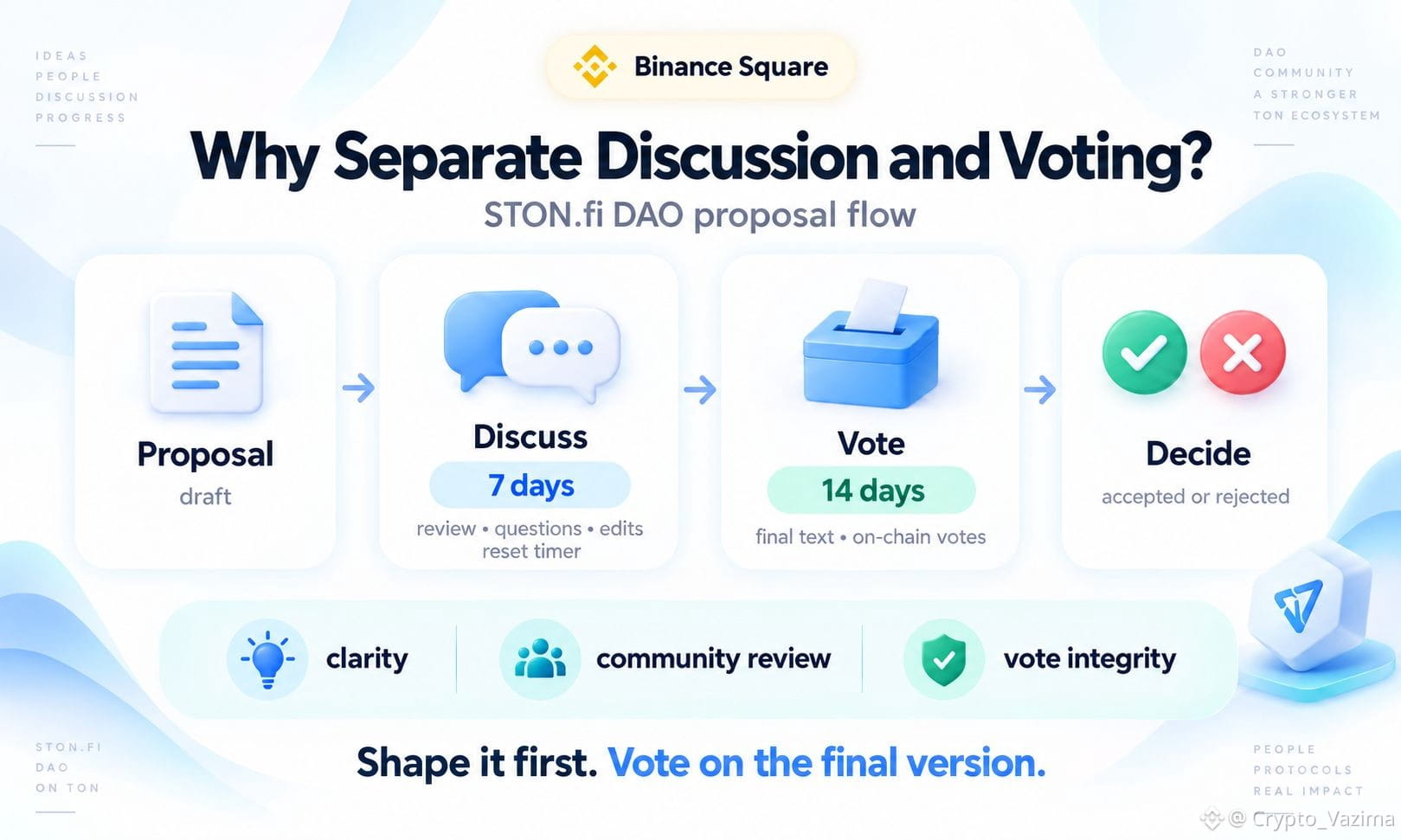
Why STON.fi DAO Uses Separate Discussion and Voting Windows
STON.fi separates DAO proposal discussion from formal voting so the community can inspect and refine a proposal before anyone commits voting power. The standard Discussion period is 7 days. The standard Voting period is 14 days, and it starts only after the text is frozen.
🔥 What changes between the stages
- Discussion makes the proposal public, but voting stays disabled.
- The author can still edit or withdraw the proposal.
- Updating the content restarts the 7-day discussion timer.
- Once Voting begins, the proposal cannot be edited.
🚀 How STON.fi voting actually works
- Eligible voting power comes from ARKENSTON created by staking STON.
- Participants vote For or Against the frozen proposal on-chain.
- A wallet cannot flip its vote direction after choosing a side.
- Extra eligible power can only reinforce the same direction.
🧠 Why the split matters
A governance vote should refer to one stable set of terms. If edits stayed open during voting, a For vote on version A could later sit on version B. STON.fi puts review on one side of the boundary and formal commitment on the other.
⚡ Benefits and limits
- The design reduces moving-target voting and last-minute amendments.
- A late quorum or result flip in the final 72 hours can extend voting by 72 hours.
- Time windows do not prove an idea is sound, and an Accepted proposal may still need Foundation implementation.
The useful part is simple: treat Discussion as a review of the final wording, then treat Voting as a decision on that frozen text.
Would you wait for the frozen STON.fi version before committing a vote? 👇
Share the proposal stage that feels most confusing to you.
Not investment advice - research on your own! 🚀
$GRAM @stonfi
Why STON.fi DAO Uses Separate Discussion and Voting Windows
STON.fi separates DAO proposal discussion from formal voting so the community can inspect and refine a proposal before anyone commits voting power. The standard Discussion period is 7 days. The standard Voting period is 14 days, and it starts only after the text is frozen.
🔥 What changes between the stages
- Discussion makes the proposal public, but voting stays disabled.
- The author can still edit or withdraw the proposal.
- Updating the content restarts the 7-day discussion timer.
- Once Voting begins, the proposal cannot be edited.
🚀 How STON.fi voting actually works
- Eligible voting power comes from ARKENSTON created by staking STON.
- Participants vote For or Against the frozen proposal on-chain.
- A wallet cannot flip its vote direction after choosing a side.
- Extra eligible power can only reinforce the same direction.
🧠 Why the split matters
A governance vote should refer to one stable set of terms. If edits stayed open during voting, a For vote on version A could later sit on version B. STON.fi puts review on one side of the boundary and formal commitment on the other.
⚡ Benefits and limits
- The design reduces moving-target voting and last-minute amendments.
- A late quorum or result flip in the final 72 hours can extend voting by 72 hours.
- Time windows do not prove an idea is sound, and an Accepted proposal may still need Foundation implementation.
The useful part is simple: treat Discussion as a review of the final wording, then treat Voting as a decision on that frozen text.
Would you wait for the frozen STON.fi version before committing a vote? 👇
Share the proposal stage that feels most confusing to you.
Not investment advice - research on your own! 🚀
$GRAM @STONfi DEX
STON.fi separates DAO proposal discussion from formal voting so the community can inspect and refine a proposal before anyone commits voting power. The standard Discussion period is 7 days. The standard Voting period is 14 days, and it starts only after the text is frozen.
🔥 What changes between the stages
- Discussion makes the proposal public, but voting stays disabled.
- The author can still edit or withdraw the proposal.
- Updating the content restarts the 7-day discussion timer.
- Once Voting begins, the proposal cannot be edited.
🚀 How STON.fi voting actually works
- Eligible voting power comes from ARKENSTON created by staking STON.
- Participants vote For or Against the frozen proposal on-chain.
- A wallet cannot flip its vote direction after choosing a side.
- Extra eligible power can only reinforce the same direction.
🧠 Why the split matters
A governance vote should refer to one stable set of terms. If edits stayed open during voting, a For vote on version A could later sit on version B. STON.fi puts review on one side of the boundary and formal commitment on the other.
⚡ Benefits and limits
- The design reduces moving-target voting and last-minute amendments.
- A late quorum or result flip in the final 72 hours can extend voting by 72 hours.
- Time windows do not prove an idea is sound, and an Accepted proposal may still need Foundation implementation.
The useful part is simple: treat Discussion as a review of the final wording, then treat Voting as a decision on that frozen text.
Would you wait for the frozen STON.fi version before committing a vote? 👇
Share the proposal stage that feels most confusing to you.
Not investment advice - research on your own! 🚀
$GRAM @STONfi DEX
152
·
--
Bearish
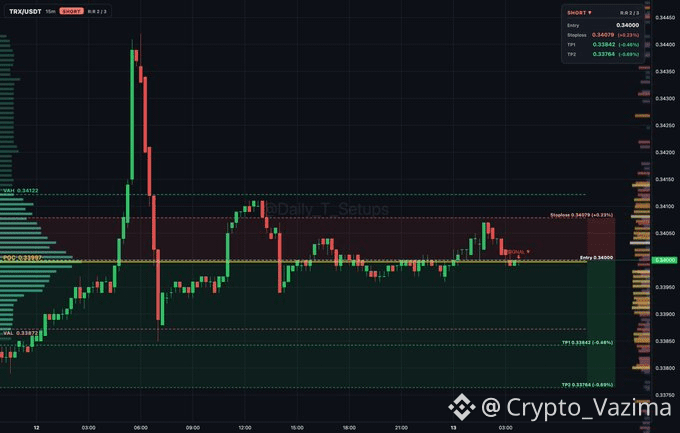
TRX Could Slip Fast If This Distribution Holds 🔻
This TRX chart is not screaming “buy the dip” to me. Sellers look active inside value and the short map is already on the table.
🔥 Why I am watching
- Value is being worked between 0.33872 and 0.34122.
- The 0.34 zone is acting like the decision point.
- Half-off at first target with stop to entry keeps the idea controlled.
🚀 The part that matters
- I want rejection around entry, not a hopeful fade.
- If buyers reclaim the stop zone, I am out.
- The lower targets only matter after the first push holds.
🎯 My trade idea
- Bias: Short
- Trigger: hold or reject near 0.34
- Target: 0.33843 / 0.33764
- Invalidation: 0.34079
- Confidence: 62 percent
⚡ Utility angle
When a token starts rotating lower inside value, the trade is about timing the fade, not about infrastructure. TRX is the momentum short in this post, while Omniston covers the routing and quote-comparison layer behind getting through available liquidity.
Its job is to compare possible paths and return an executable quote. That remains useful next to a fast TRX short because slippage and route quality show up the moment price starts moving.
Are you fading TRX here or waiting for one more failed push? 👇
Tell me the confirmation candle you actually want to see.
Not investment advice - research on your own! 🚀
$TRX
{future}(TRXUSDT)
TRX Could Slip Fast If This Distribution Holds 🔻
This TRX chart is not screaming “buy the dip” to me. Sellers look active inside value and the short map is already on the table.
🔥 Why I am watching
- Value is being worked between 0.33872 and 0.34122.
- The 0.34 zone is acting like the decision point.
- Half-off at first target with stop to entry keeps the idea controlled.
🚀 The part that matters
- I want rejection around entry, not a hopeful fade.
- If buyers reclaim the stop zone, I am out.
- The lower targets only matter after the first push holds.
🎯 My trade idea
- Bias: Short
- Trigger: hold or reject near 0.34
- Target: 0.33843 / 0.33764
- Invalidation: 0.34079
- Confidence: 62 percent
⚡ Utility angle
When a token starts rotating lower inside value, the trade is about timing the fade, not about infrastructure. TRX is the momentum short in this post, while Omniston covers the routing and quote-comparison layer behind getting through available liquidity.
Its job is to compare possible paths and return an executable quote. That remains useful next to a fast TRX short because slippage and route quality show up the moment price starts moving.
Are you fading TRX here or waiting for one more failed push? 👇
Tell me the confirmation candle you actually want to see.
Not investment advice - research on your own! 🚀
$TRX
This TRX chart is not screaming “buy the dip” to me. Sellers look active inside value and the short map is already on the table.
🔥 Why I am watching
- Value is being worked between 0.33872 and 0.34122.
- The 0.34 zone is acting like the decision point.
- Half-off at first target with stop to entry keeps the idea controlled.
🚀 The part that matters
- I want rejection around entry, not a hopeful fade.
- If buyers reclaim the stop zone, I am out.
- The lower targets only matter after the first push holds.
🎯 My trade idea
- Bias: Short
- Trigger: hold or reject near 0.34
- Target: 0.33843 / 0.33764
- Invalidation: 0.34079
- Confidence: 62 percent
⚡ Utility angle
When a token starts rotating lower inside value, the trade is about timing the fade, not about infrastructure. TRX is the momentum short in this post, while Omniston covers the routing and quote-comparison layer behind getting through available liquidity.
Its job is to compare possible paths and return an executable quote. That remains useful next to a fast TRX short because slippage and route quality show up the moment price starts moving.
Are you fading TRX here or waiting for one more failed push? 👇
Tell me the confirmation candle you actually want to see.
Not investment advice - research on your own! 🚀
$TRX
11
·
--
Bearish
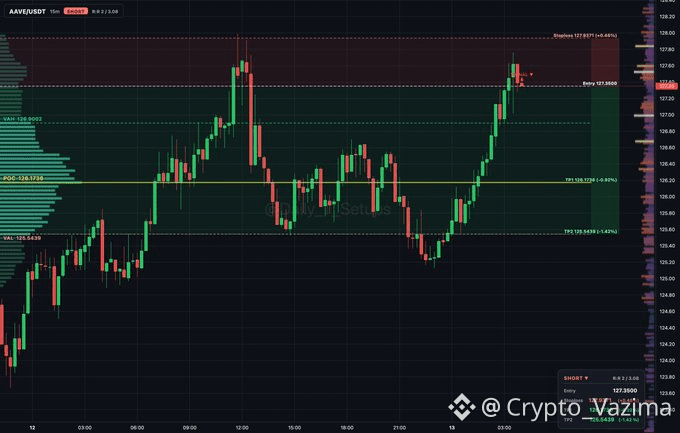
AAVE Looks Heavy After This Auction Rotation
This AAVE bounce into premium is getting interesting. Sellers are distributing near VAH at 126.900 and I am not buying the strength blindly.
🔥 Why I am watching
- Price pushed above the value area.
- Distribution is showing near 126.900.
- The reaction around 127.390 decides if the fade is real.
🚀 The part that matters
- Entry only makes sense near 127.390.
- First take sits at 126.174.
- If sellers stay in control, 125.544 is the next stop.
🎯 My trade idea
- Bias: Short
- Trigger: Failed hold at 127.390
- Target: 126.174 then 125.544
- Invalidation: 127.973
- Confidence: My current Short confidence: 64 percent.
🛡 Where I step back
- A clean accept above 127.973 kills the idea.
- I will not chase if the rejection never prints.
- If TP1 hits, half off and stop moves to entry.
💎 Participation layer
Fast auction trades can look loud, but they are still just price timing. AAVE is the short-term fade in this post, whereas ST0N_fi is the protocol-participation side tied to staking and governance paths.
That role is about staying involved in the wider protocol, not copying this short setup. It sits next to the AAVE chart because a 15-minute distribution play and longer participation are not the same decision.
Would you take the fade here or let it prove weakness first? 👇
Tell me where you would place the stop.
Not investment advice - research on your own! 🚀
$AAVE
{future}(AAVEUSDT)
AAVE Looks Heavy After This Auction Rotation
This AAVE bounce into premium is getting interesting. Sellers are distributing near VAH at 126.900 and I am not buying the strength blindly.
🔥 Why I am watching
- Price pushed above the value area.
- Distribution is showing near 126.900.
- The reaction around 127.390 decides if the fade is real.
🚀 The part that matters
- Entry only makes sense near 127.390.
- First take sits at 126.174.
- If sellers stay in control, 125.544 is the next stop.
🎯 My trade idea
- Bias: Short
- Trigger: Failed hold at 127.390
- Target: 126.174 then 125.544
- Invalidation: 127.973
- Confidence: My current Short confidence: 64 percent.
🛡 Where I step back
- A clean accept above 127.973 kills the idea.
- I will not chase if the rejection never prints.
- If TP1 hits, half off and stop moves to entry.
💎 Participation layer
Fast auction trades can look loud, but they are still just price timing. AAVE is the short-term fade in this post, whereas ST0N_fi is the protocol-participation side tied to staking and governance paths.
That role is about staying involved in the wider protocol, not copying this short setup. It sits next to the AAVE chart because a 15-minute distribution play and longer participation are not the same decision.
Would you take the fade here or let it prove weakness first? 👇
Tell me where you would place the stop.
Not investment advice - research on your own! 🚀
$AAVE
This AAVE bounce into premium is getting interesting. Sellers are distributing near VAH at 126.900 and I am not buying the strength blindly.
🔥 Why I am watching
- Price pushed above the value area.
- Distribution is showing near 126.900.
- The reaction around 127.390 decides if the fade is real.
🚀 The part that matters
- Entry only makes sense near 127.390.
- First take sits at 126.174.
- If sellers stay in control, 125.544 is the next stop.
🎯 My trade idea
- Bias: Short
- Trigger: Failed hold at 127.390
- Target: 126.174 then 125.544
- Invalidation: 127.973
- Confidence: My current Short confidence: 64 percent.
🛡 Where I step back
- A clean accept above 127.973 kills the idea.
- I will not chase if the rejection never prints.
- If TP1 hits, half off and stop moves to entry.
💎 Participation layer
Fast auction trades can look loud, but they are still just price timing. AAVE is the short-term fade in this post, whereas ST0N_fi is the protocol-participation side tied to staking and governance paths.
That role is about staying involved in the wider protocol, not copying this short setup. It sits next to the AAVE chart because a 15-minute distribution play and longer participation are not the same decision.
Would you take the fade here or let it prove weakness first? 👇
Tell me where you would place the stop.
Not investment advice - research on your own! 🚀
$AAVE
9
·
--
Bullish
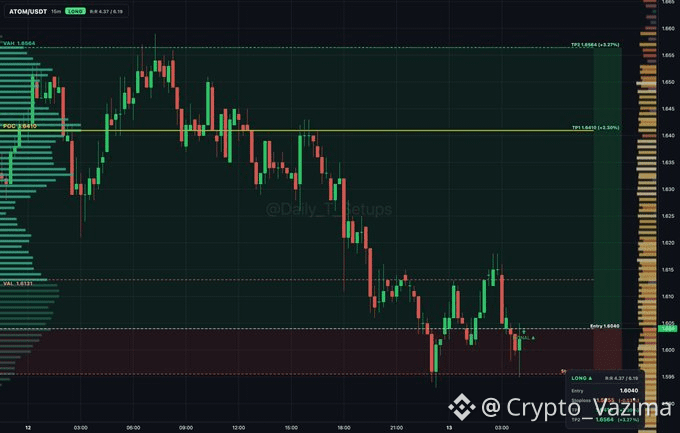
ATOM Buyers Are Fighting Under Value Right Now 🔥
This ATOM chart feels like a rotation setup. Price is still below value, but buyers keep absorbing near VAL at 1.613 and that is the part I care about.
🔥 Why I am watching
- Sellers pushed ATOM under value.
- Buyers are not disappearing near 1.613.
- The bounce idea only works if this absorption holds.
🚀 The bounce path
- Entry sits at 1.604.
- First magnet is 1.641.
- Next magnet is 1.656.
- I take half off at TP1 and move stop to entry.
🎯 My trade idea
- Bias: Long
- Trigger: absorption hold near VAL and entry at 1.604
- Target: 1.641 then 1.656
- Invalidation: 1.596
- Confidence: 64 percent
💧 Execution perspective
A fast ATOM bounce can look clean on the chart, but participation still matters when price is trying to rotate back into value. ATOM is the momentum trade in this post, while STON is the protocol-participation side rather than a short-term auction long.
Its role is connected with staking and DAO-linked involvement. That makes it a separate reason to watch the wider ecosystem next to this tight ATOM bounce, without turning the chart into a guaranteed winner.
Is this absorption enough for you, or do you want value back first? 👇
Tell me if you would take half off at 1.641.
Not investment advice - research on your own! 🚀
$ATOM
{future}(ATOMUSDT)
ATOM Buyers Are Fighting Under Value Right Now 🔥
This ATOM chart feels like a rotation setup. Price is still below value, but buyers keep absorbing near VAL at 1.613 and that is the part I care about.
🔥 Why I am watching
- Sellers pushed ATOM under value.
- Buyers are not disappearing near 1.613.
- The bounce idea only works if this absorption holds.
🚀 The bounce path
- Entry sits at 1.604.
- First magnet is 1.641.
- Next magnet is 1.656.
- I take half off at TP1 and move stop to entry.
🎯 My trade idea
- Bias: Long
- Trigger: absorption hold near VAL and entry at 1.604
- Target: 1.641 then 1.656
- Invalidation: 1.596
- Confidence: 64 percent
💧 Execution perspective
A fast ATOM bounce can look clean on the chart, but participation still matters when price is trying to rotate back into value. ATOM is the momentum trade in this post, while STON is the protocol-participation side rather than a short-term auction long.
Its role is connected with staking and DAO-linked involvement. That makes it a separate reason to watch the wider ecosystem next to this tight ATOM bounce, without turning the chart into a guaranteed winner.
Is this absorption enough for you, or do you want value back first? 👇
Tell me if you would take half off at 1.641.
Not investment advice - research on your own! 🚀
$ATOM
This ATOM chart feels like a rotation setup. Price is still below value, but buyers keep absorbing near VAL at 1.613 and that is the part I care about.
🔥 Why I am watching
- Sellers pushed ATOM under value.
- Buyers are not disappearing near 1.613.
- The bounce idea only works if this absorption holds.
🚀 The bounce path
- Entry sits at 1.604.
- First magnet is 1.641.
- Next magnet is 1.656.
- I take half off at TP1 and move stop to entry.
🎯 My trade idea
- Bias: Long
- Trigger: absorption hold near VAL and entry at 1.604
- Target: 1.641 then 1.656
- Invalidation: 1.596
- Confidence: 64 percent
💧 Execution perspective
A fast ATOM bounce can look clean on the chart, but participation still matters when price is trying to rotate back into value. ATOM is the momentum trade in this post, while STON is the protocol-participation side rather than a short-term auction long.
Its role is connected with staking and DAO-linked involvement. That makes it a separate reason to watch the wider ecosystem next to this tight ATOM bounce, without turning the chart into a guaranteed winner.
Is this absorption enough for you, or do you want value back first? 👇
Tell me if you would take half off at 1.641.
Not investment advice - research on your own! 🚀
$ATOM
59
·
--
Bullish
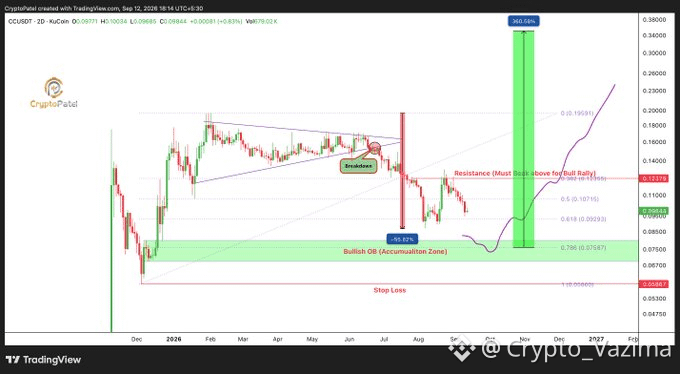
CC Looks Broken, But That 10x Zone Is Still Alive
This breakdown looks ugly at first glance, and I feel that. Price is near 0.0984 after losing the triangle, so I am not buying hope.
🔥 Why I am watching
- The chart already printed a triangle breakdown.
- HTF structure is still cautious.
- The highlighted 0.0700-0.0800 bullish order block is the accumulation idea.
- A 10x from that zone is a long-term story, not a now button.
🎯 My trade idea
- Bias: Wait
- Trigger: the 0.0700-0.0800 demand zone holds
- Extra proof: break and hold above 0.1238
- If that break comes: 0.1590 and 0.1959 come into play
- Invalidation: 0.0587
- Confidence: 60 percent on waiting first
🛡 Where I step back
- If 0.0929 fails and the order block cannot hold, I stay out.
- If 0.1238 rejects after a bounce, I do not force the long.
- No confirmation, no trade.
🧠 Longer-term context
Fast CC price action is about whether buyers defend the demand pocket after the breakdown. CC is the momentum-and-accumulation chart in this post, whereas ARKENSTON is a non-transferable voting and staking-alignment angle.
That governance function is built around DAO participation, not around catching the next candle. It sits next to the CC setup as a slower commitment layer while the chart still needs proof.
Is this demand a real base or just a pause before more pain? 👇
Tell me where you would flip from wait to long.
Not investment advice - research on your own! 🚀
$CC
{future}(CCUSDT)
CC Looks Broken, But That 10x Zone Is Still Alive
This breakdown looks ugly at first glance, and I feel that. Price is near 0.0984 after losing the triangle, so I am not buying hope.
🔥 Why I am watching
- The chart already printed a triangle breakdown.
- HTF structure is still cautious.
- The highlighted 0.0700-0.0800 bullish order block is the accumulation idea.
- A 10x from that zone is a long-term story, not a now button.
🎯 My trade idea
- Bias: Wait
- Trigger: the 0.0700-0.0800 demand zone holds
- Extra proof: break and hold above 0.1238
- If that break comes: 0.1590 and 0.1959 come into play
- Invalidation: 0.0587
- Confidence: 60 percent on waiting first
🛡 Where I step back
- If 0.0929 fails and the order block cannot hold, I stay out.
- If 0.1238 rejects after a bounce, I do not force the long.
- No confirmation, no trade.
🧠 Longer-term context
Fast CC price action is about whether buyers defend the demand pocket after the breakdown. CC is the momentum-and-accumulation chart in this post, whereas ARKENSTON is a non-transferable voting and staking-alignment angle.
That governance function is built around DAO participation, not around catching the next candle. It sits next to the CC setup as a slower commitment layer while the chart still needs proof.
Is this demand a real base or just a pause before more pain? 👇
Tell me where you would flip from wait to long.
Not investment advice - research on your own! 🚀
$CC
This breakdown looks ugly at first glance, and I feel that. Price is near 0.0984 after losing the triangle, so I am not buying hope.
🔥 Why I am watching
- The chart already printed a triangle breakdown.
- HTF structure is still cautious.
- The highlighted 0.0700-0.0800 bullish order block is the accumulation idea.
- A 10x from that zone is a long-term story, not a now button.
🎯 My trade idea
- Bias: Wait
- Trigger: the 0.0700-0.0800 demand zone holds
- Extra proof: break and hold above 0.1238
- If that break comes: 0.1590 and 0.1959 come into play
- Invalidation: 0.0587
- Confidence: 60 percent on waiting first
🛡 Where I step back
- If 0.0929 fails and the order block cannot hold, I stay out.
- If 0.1238 rejects after a bounce, I do not force the long.
- No confirmation, no trade.
🧠 Longer-term context
Fast CC price action is about whether buyers defend the demand pocket after the breakdown. CC is the momentum-and-accumulation chart in this post, whereas ARKENSTON is a non-transferable voting and staking-alignment angle.
That governance function is built around DAO participation, not around catching the next candle. It sits next to the CC setup as a slower commitment layer while the chart still needs proof.
Is this demand a real base or just a pause before more pain? 👇
Tell me where you would flip from wait to long.
Not investment advice - research on your own! 🚀
$CC
33
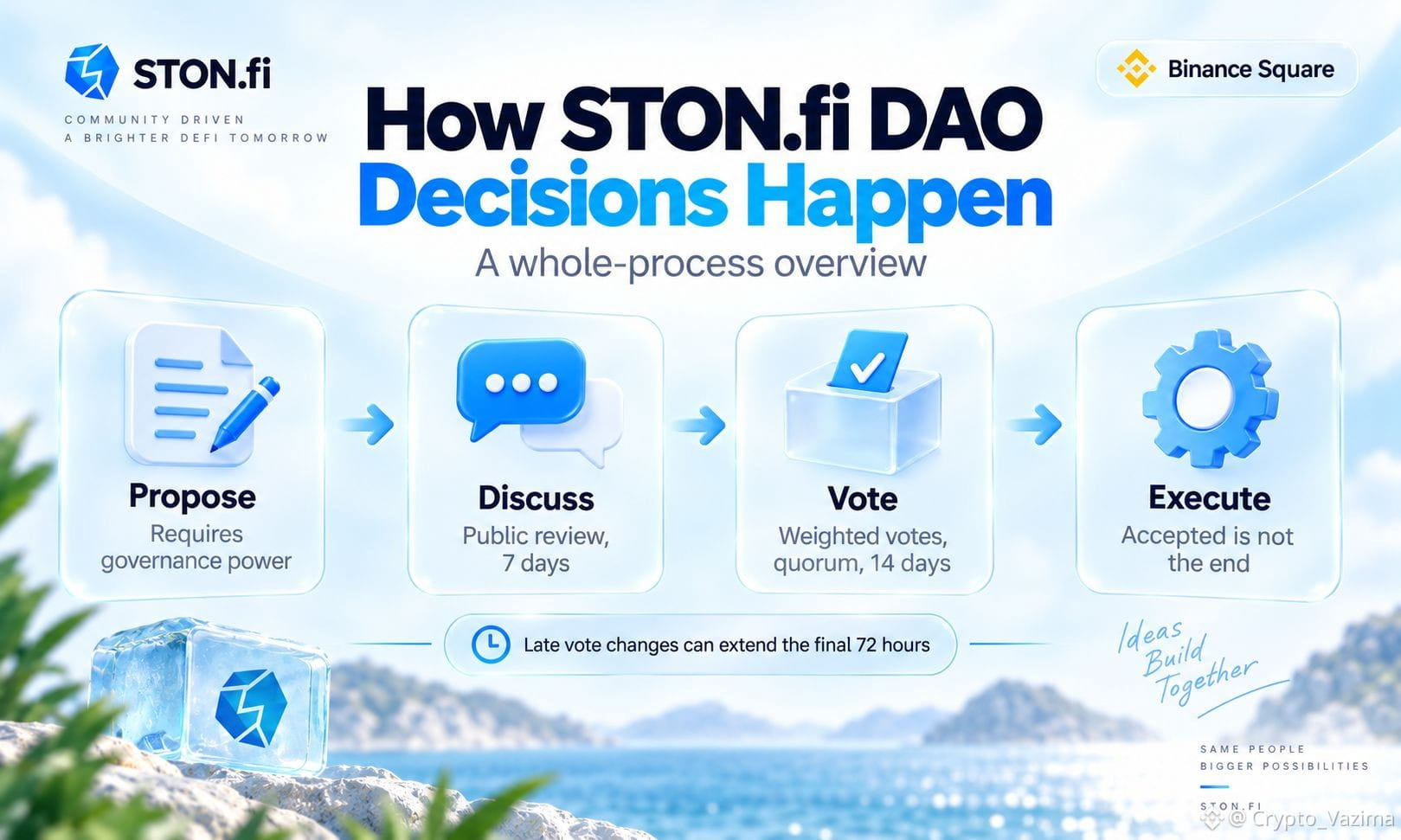
STON.fi DAO Proposal Lifecycle Explained: Discussion, Voting and Implementation
A STON.fi DAO proposal becomes a decision only after Draft, at least seven days of Discussion, and a 14-day vote. Even then, acceptance is not automatic execution. The Ston Foundation still has to implement the approved action.
🔥 The STON.fi Lifecycle in Order
1. Draft stays private while the proposer writes the problem, solution, rationale and risks.
2. Discussion makes the proposal public for seven days with comments enabled and voting locked.
3. Voting freezes the text for 14 days and records For or Against by ARKENSTON voting power.
4. An accepted proposal enters implementation, with a timelock where the rules require one.
🚀 What Changes During Discussion
- Any edit updates the on-chain content hash and restarts the seven-day clock.
- The proposer can withdraw before voting starts.
- Moderators can block a proposal that breaks DAO or compliance rules.
- Banned proposals stay visible, but they cannot move into a vote.
🧠 Why the Vote Alone Is Not the Finish Line
STON.fi records accepted or rejected on-chain. Quorum is participation from both sides, not just the winning side. A popular For tally can still fail if too little voting power shows up. After a pass, protocol work, treasury transfers, contractor payments or operational tasks may still be required.
💬 The Practical Read
Check the live DAO page for the current proposal threshold, displayed quorum and final status. Creating a proposal needs more voting power than voting. The standard threshold is the power of 1,000 STON locked for 24 months, but VP is dynamic.
Would you wait for Implemented status before treating a STON.fi vote as done? 👇
Tell the community which execution step you always verify first.
Not investment advice - research on your own! 🚀
$GRAM @stonfi
STON.fi DAO Proposal Lifecycle Explained: Discussion, Voting and Implementation
A STON.fi DAO proposal becomes a decision only after Draft, at least seven days of Discussion, and a 14-day vote. Even then, acceptance is not automatic execution. The Ston Foundation still has to implement the approved action.
🔥 The STON.fi Lifecycle in Order
1. Draft stays private while the proposer writes the problem, solution, rationale and risks.
2. Discussion makes the proposal public for seven days with comments enabled and voting locked.
3. Voting freezes the text for 14 days and records For or Against by ARKENSTON voting power.
4. An accepted proposal enters implementation, with a timelock where the rules require one.
🚀 What Changes During Discussion
- Any edit updates the on-chain content hash and restarts the seven-day clock.
- The proposer can withdraw before voting starts.
- Moderators can block a proposal that breaks DAO or compliance rules.
- Banned proposals stay visible, but they cannot move into a vote.
🧠 Why the Vote Alone Is Not the Finish Line
STON.fi records accepted or rejected on-chain. Quorum is participation from both sides, not just the winning side. A popular For tally can still fail if too little voting power shows up. After a pass, protocol work, treasury transfers, contractor payments or operational tasks may still be required.
💬 The Practical Read
Check the live DAO page for the current proposal threshold, displayed quorum and final status. Creating a proposal needs more voting power than voting. The standard threshold is the power of 1,000 STON locked for 24 months, but VP is dynamic.
Would you wait for Implemented status before treating a STON.fi vote as done? 👇
Tell the community which execution step you always verify first.
Not investment advice - research on your own! 🚀
$GRAM @STONfi DEX
A STON.fi DAO proposal becomes a decision only after Draft, at least seven days of Discussion, and a 14-day vote. Even then, acceptance is not automatic execution. The Ston Foundation still has to implement the approved action.
🔥 The STON.fi Lifecycle in Order
1. Draft stays private while the proposer writes the problem, solution, rationale and risks.
2. Discussion makes the proposal public for seven days with comments enabled and voting locked.
3. Voting freezes the text for 14 days and records For or Against by ARKENSTON voting power.
4. An accepted proposal enters implementation, with a timelock where the rules require one.
🚀 What Changes During Discussion
- Any edit updates the on-chain content hash and restarts the seven-day clock.
- The proposer can withdraw before voting starts.
- Moderators can block a proposal that breaks DAO or compliance rules.
- Banned proposals stay visible, but they cannot move into a vote.
🧠 Why the Vote Alone Is Not the Finish Line
STON.fi records accepted or rejected on-chain. Quorum is participation from both sides, not just the winning side. A popular For tally can still fail if too little voting power shows up. After a pass, protocol work, treasury transfers, contractor payments or operational tasks may still be required.
💬 The Practical Read
Check the live DAO page for the current proposal threshold, displayed quorum and final status. Creating a proposal needs more voting power than voting. The standard threshold is the power of 1,000 STON locked for 24 months, but VP is dynamic.
Would you wait for Implemented status before treating a STON.fi vote as done? 👇
Tell the community which execution step you always verify first.
Not investment advice - research on your own! 🚀
$GRAM @STONfi DEX
116
·
--
Bearish
FIL Just Tagged the High and Sellers Look Ready to Press 🔻
This bounce into the value area high feels tired to me. I am not chasing the pump on FIL.
🔥 Why I am watching
- Sellers are distributing near VAH at 0.81372
- Price printed the short signal around 0.8152
- The auction is happening above value, not through it
👀 The part that matters
- A failed hold here can send FIL back into value
- TP1 sits at 0.80545
- TP2 sits at 0.80058 if the drop extends
🎯 My trade idea
- Bias: Short
- Trigger: rejection and failure to hold 0.8152
- Target: 0.80545 first, then 0.80058
- Invalidation: stop at 0.82007
- Confidence: 63 percent
🚀 Market flow
A sharp FIL rejection can turn into a fast move, and that is when execution quality starts to matter. FIL is the momentum short in this post, whereas Omniston covers the routing job of comparing available paths through liquidity.
Its function is quote comparison and swap routing across liquidity sources. That is a separate market job from the FIL chart, but it stays relevant when a 15m distribution trade starts moving quickly.
Are you fading this high with me or waiting for a reclaim? 👇
Drop your cleanest chart read below.
Not investment advice - research on your own! 🚀
$FIL
{future}(FILUSDT)
FIL Just Tagged the High and Sellers Look Ready to Press 🔻
This bounce into the value area high feels tired to me. I am not chasing the pump on FIL.
🔥 Why I am watching
- Sellers are distributing near VAH at 0.81372
- Price printed the short signal around 0.8152
- The auction is happening above value, not through it
👀 The part that matters
- A failed hold here can send FIL back into value
- TP1 sits at 0.80545
- TP2 sits at 0.80058 if the drop extends
🎯 My trade idea
- Bias: Short
- Trigger: rejection and failure to hold 0.8152
- Target: 0.80545 first, then 0.80058
- Invalidation: stop at 0.82007
- Confidence: 63 percent
🚀 Market flow
A sharp FIL rejection can turn into a fast move, and that is when execution quality starts to matter. FIL is the momentum short in this post, whereas Omniston covers the routing job of comparing available paths through liquidity.
Its function is quote comparison and swap routing across liquidity sources. That is a separate market job from the FIL chart, but it stays relevant when a 15m distribution trade starts moving quickly.
Are you fading this high with me or waiting for a reclaim? 👇
Drop your cleanest chart read below.
Not investment advice - research on your own! 🚀
$FIL
This bounce into the value area high feels tired to me. I am not chasing the pump on FIL.
🔥 Why I am watching
- Sellers are distributing near VAH at 0.81372
- Price printed the short signal around 0.8152
- The auction is happening above value, not through it
👀 The part that matters
- A failed hold here can send FIL back into value
- TP1 sits at 0.80545
- TP2 sits at 0.80058 if the drop extends
🎯 My trade idea
- Bias: Short
- Trigger: rejection and failure to hold 0.8152
- Target: 0.80545 first, then 0.80058
- Invalidation: stop at 0.82007
- Confidence: 63 percent
🚀 Market flow
A sharp FIL rejection can turn into a fast move, and that is when execution quality starts to matter. FIL is the momentum short in this post, whereas Omniston covers the routing job of comparing available paths through liquidity.
Its function is quote comparison and swap routing across liquidity sources. That is a separate market job from the FIL chart, but it stays relevant when a 15m distribution trade starts moving quickly.
Are you fading this high with me or waiting for a reclaim? 👇
Drop your cleanest chart read below.
Not investment advice - research on your own! 🚀
$FIL
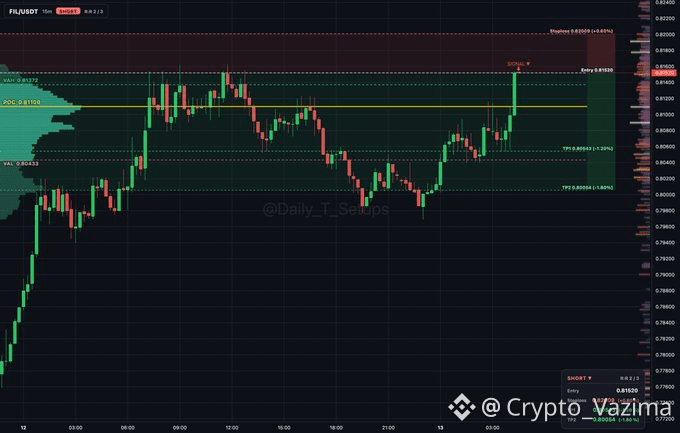
108
·
--
Bearish
PEPE Looks Heavy After This Auction Rejection
This is the kind of PEPE push that looks strong until you notice sellers dumping into the high. I am not buying the spike here.
🔥 Why I am watching
- Price tagged the VAH zone at 0.00000344.
- The reaction looks like distribution, not a clean continuation.
- Sellers already have a mapped short from 0.00000345.
🚀 The part that matters
- Stop sits tight at 0.00000348.
- First take-profit is 0.00000338.
- Second take-profit is 0.00000336.
🎯 My trade idea
- Bias: Short
- Trigger: seller distribution near VAH and entry at 0.00000345
- Target: 0.00000338, then 0.00000336
- Invalidation: a hold above 0.00000348
- Confidence: My current Short confidence: 63 percent
🛡 Where I step back
1. Wait for the rejection to stay below the stop.
2. Bank half at TP1.
3. Move stop to entry after partials.
4. Leave if 0.00000348 gets reclaimed.
💧 Execution perspective
A crowded PEPE bounce can turn into a messy fade once value rejects the auction high. PEPE is the speculative short on this chart, whereas ST0N is the slower staking and protocol-participation side of the same broader market conversation.
Its role is connected with staking and DAO-style involvement instead of meme-candle momentum. That second angle still matters next to this setup because a short-term PEPE fade and a longer participation layer answer different trader questions.
Feeling this dump or calling it a fake rejection? 👇
Drop the confirmation candle you need before shorting.
Not investment advice - research on your own! 🚀
$PEPE
{alpha}(CT_195TMacq4TDUw5q8NFBwmbY4RLXvzvG5JTkvi)
PEPE Looks Heavy After This Auction Rejection
This is the kind of PEPE push that looks strong until you notice sellers dumping into the high. I am not buying the spike here.
🔥 Why I am watching
- Price tagged the VAH zone at 0.00000344.
- The reaction looks like distribution, not a clean continuation.
- Sellers already have a mapped short from 0.00000345.
🚀 The part that matters
- Stop sits tight at 0.00000348.
- First take-profit is 0.00000338.
- Second take-profit is 0.00000336.
🎯 My trade idea
- Bias: Short
- Trigger: seller distribution near VAH and entry at 0.00000345
- Target: 0.00000338, then 0.00000336
- Invalidation: a hold above 0.00000348
- Confidence: My current Short confidence: 63 percent
🛡 Where I step back
1. Wait for the rejection to stay below the stop.
2. Bank half at TP1.
3. Move stop to entry after partials.
4. Leave if 0.00000348 gets reclaimed.
💧 Execution perspective
A crowded PEPE bounce can turn into a messy fade once value rejects the auction high. PEPE is the speculative short on this chart, whereas ST0N is the slower staking and protocol-participation side of the same broader market conversation.
Its role is connected with staking and DAO-style involvement instead of meme-candle momentum. That second angle still matters next to this setup because a short-term PEPE fade and a longer participation layer answer different trader questions.
Feeling this dump or calling it a fake rejection? 👇
Drop the confirmation candle you need before shorting.
Not investment advice - research on your own! 🚀
$PEPE
This is the kind of PEPE push that looks strong until you notice sellers dumping into the high. I am not buying the spike here.
🔥 Why I am watching
- Price tagged the VAH zone at 0.00000344.
- The reaction looks like distribution, not a clean continuation.
- Sellers already have a mapped short from 0.00000345.
🚀 The part that matters
- Stop sits tight at 0.00000348.
- First take-profit is 0.00000338.
- Second take-profit is 0.00000336.
🎯 My trade idea
- Bias: Short
- Trigger: seller distribution near VAH and entry at 0.00000345
- Target: 0.00000338, then 0.00000336
- Invalidation: a hold above 0.00000348
- Confidence: My current Short confidence: 63 percent
🛡 Where I step back
1. Wait for the rejection to stay below the stop.
2. Bank half at TP1.
3. Move stop to entry after partials.
4. Leave if 0.00000348 gets reclaimed.
💧 Execution perspective
A crowded PEPE bounce can turn into a messy fade once value rejects the auction high. PEPE is the speculative short on this chart, whereas ST0N is the slower staking and protocol-participation side of the same broader market conversation.
Its role is connected with staking and DAO-style involvement instead of meme-candle momentum. That second angle still matters next to this setup because a short-term PEPE fade and a longer participation layer answer different trader questions.
Feeling this dump or calling it a fake rejection? 👇
Drop the confirmation candle you need before shorting.
Not investment advice - research on your own! 🚀
$PEPE
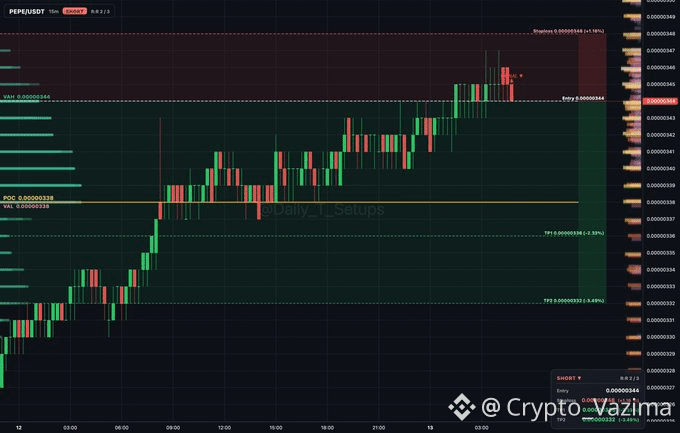
40
·
--
Bullish
SUI Looks Ready to Snap Back If Buyers Keep Absorbing ⚡
This SUI chart is getting interesting because buyers are defending the cheap side of value instead of letting it dump through.
🔥 Why I am watching
- Auction rotation shows absorption near VAL at 0.72355.
- The long trigger is sitting right around 0.723.
- It feels like a bounce attempt, not a confirmed breakout yet.
🚀 The move I want
- Hold the value area and rotate up.
- First take-profit sits at 0.72956.
- Runner zone sits at 0.73284.
🎯 My trade idea
- Bias: Long
- Trigger: buyers keep absorbing near 0.723
- Target: 0.72956, then 0.73284
- Invalidation: 0.71972
- Confidence: 64 percent
🛡 Where I step back
- No hold at value, no trade.
- If 0.71972 breaks, I cancel the long immediately.
💧 Execution perspective
Fast SUI reactions like this can look clean on the chart, but they still live in a short-term price box. ST0N_fi is not that same trade because it represents protocol participation instead of a tight auction bounce.
It is connected with staking and DAO-aligned involvement over a longer horizon. That contrast matters here because SUI is about one value-area defense, while the ecosystem angle is about staying involved beyond a single 15m signal.
Would you fade the dump or wait for the reclaim candle? 👇
Tell me if this absorption looks real to you.
Not investment advice - research on your own! 🚀
$SUI
{future}(SUIUSDT)
SUI Looks Ready to Snap Back If Buyers Keep Absorbing ⚡
This SUI chart is getting interesting because buyers are defending the cheap side of value instead of letting it dump through.
🔥 Why I am watching
- Auction rotation shows absorption near VAL at 0.72355.
- The long trigger is sitting right around 0.723.
- It feels like a bounce attempt, not a confirmed breakout yet.
🚀 The move I want
- Hold the value area and rotate up.
- First take-profit sits at 0.72956.
- Runner zone sits at 0.73284.
🎯 My trade idea
- Bias: Long
- Trigger: buyers keep absorbing near 0.723
- Target: 0.72956, then 0.73284
- Invalidation: 0.71972
- Confidence: 64 percent
🛡 Where I step back
- No hold at value, no trade.
- If 0.71972 breaks, I cancel the long immediately.
💧 Execution perspective
Fast SUI reactions like this can look clean on the chart, but they still live in a short-term price box. ST0N_fi is not that same trade because it represents protocol participation instead of a tight auction bounce.
It is connected with staking and DAO-aligned involvement over a longer horizon. That contrast matters here because SUI is about one value-area defense, while the ecosystem angle is about staying involved beyond a single 15m signal.
Would you fade the dump or wait for the reclaim candle? 👇
Tell me if this absorption looks real to you.
Not investment advice - research on your own! 🚀
$SUI
This SUI chart is getting interesting because buyers are defending the cheap side of value instead of letting it dump through.
🔥 Why I am watching
- Auction rotation shows absorption near VAL at 0.72355.
- The long trigger is sitting right around 0.723.
- It feels like a bounce attempt, not a confirmed breakout yet.
🚀 The move I want
- Hold the value area and rotate up.
- First take-profit sits at 0.72956.
- Runner zone sits at 0.73284.
🎯 My trade idea
- Bias: Long
- Trigger: buyers keep absorbing near 0.723
- Target: 0.72956, then 0.73284
- Invalidation: 0.71972
- Confidence: 64 percent
🛡 Where I step back
- No hold at value, no trade.
- If 0.71972 breaks, I cancel the long immediately.
💧 Execution perspective
Fast SUI reactions like this can look clean on the chart, but they still live in a short-term price box. ST0N_fi is not that same trade because it represents protocol participation instead of a tight auction bounce.
It is connected with staking and DAO-aligned involvement over a longer horizon. That contrast matters here because SUI is about one value-area defense, while the ecosystem angle is about staying involved beyond a single 15m signal.
Would you fade the dump or wait for the reclaim candle? 👇
Tell me if this absorption looks real to you.
Not investment advice - research on your own! 🚀
$SUI
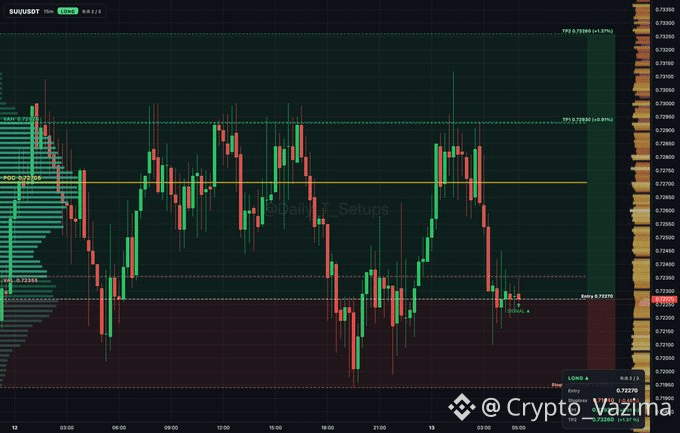
79
·
--
Bullish
XLM Bounce Looks Real Only If Value Holds 🔥
This XLM chart is starting to feel alive again. Buyers keep absorbing inside value and that is the part that has my attention.
👀 The part that matters
- Value sits between 0.17964 and 0.18118.
- Buyers are defending that zone instead of giving it back.
- The recent long signal near 0.1804 is the spark I am watching.
🚀 Why I care now
- If value holds, the next push can open toward 0.18213.
- TP2 sits at 0.18299 if the rotation keeps working.
- If 0.17954 breaks, the absorption story is done for me.
🎯 My trade idea
- Bias: Long
- Trigger: hold and build from 0.1804
- Target: 0.18213, then 0.18299
- Invalidation: close the idea below 0.17954
- Confidence: 65 percent
- Manage: half off at TP1, stop to entry
💎 Participation layer
Fast auction setups like XLM can get noisy the second momentum expands. XLM is the short-term price reaction here, whereas GEMSTON represents community engagement and transferable participation instead of a 15-minute long trigger.
That asset can be held, transferred, or swapped as a participation tool. I keep that angle next to the XLM chart because involvement and price defense are two different things to track.
Does this bounce feel confirmed to you yet? 👇
Drop the chart read you trust most on XLM.
Not investment advice - research on your own! 🚀
$XLM
{future}(XLMUSDT)
XLM Bounce Looks Real Only If Value Holds 🔥
This XLM chart is starting to feel alive again. Buyers keep absorbing inside value and that is the part that has my attention.
👀 The part that matters
- Value sits between 0.17964 and 0.18118.
- Buyers are defending that zone instead of giving it back.
- The recent long signal near 0.1804 is the spark I am watching.
🚀 Why I care now
- If value holds, the next push can open toward 0.18213.
- TP2 sits at 0.18299 if the rotation keeps working.
- If 0.17954 breaks, the absorption story is done for me.
🎯 My trade idea
- Bias: Long
- Trigger: hold and build from 0.1804
- Target: 0.18213, then 0.18299
- Invalidation: close the idea below 0.17954
- Confidence: 65 percent
- Manage: half off at TP1, stop to entry
💎 Participation layer
Fast auction setups like XLM can get noisy the second momentum expands. XLM is the short-term price reaction here, whereas GEMSTON represents community engagement and transferable participation instead of a 15-minute long trigger.
That asset can be held, transferred, or swapped as a participation tool. I keep that angle next to the XLM chart because involvement and price defense are two different things to track.
Does this bounce feel confirmed to you yet? 👇
Drop the chart read you trust most on XLM.
Not investment advice - research on your own! 🚀
$XLM
This XLM chart is starting to feel alive again. Buyers keep absorbing inside value and that is the part that has my attention.
👀 The part that matters
- Value sits between 0.17964 and 0.18118.
- Buyers are defending that zone instead of giving it back.
- The recent long signal near 0.1804 is the spark I am watching.
🚀 Why I care now
- If value holds, the next push can open toward 0.18213.
- TP2 sits at 0.18299 if the rotation keeps working.
- If 0.17954 breaks, the absorption story is done for me.
🎯 My trade idea
- Bias: Long
- Trigger: hold and build from 0.1804
- Target: 0.18213, then 0.18299
- Invalidation: close the idea below 0.17954
- Confidence: 65 percent
- Manage: half off at TP1, stop to entry
💎 Participation layer
Fast auction setups like XLM can get noisy the second momentum expands. XLM is the short-term price reaction here, whereas GEMSTON represents community engagement and transferable participation instead of a 15-minute long trigger.
That asset can be held, transferred, or swapped as a participation tool. I keep that angle next to the XLM chart because involvement and price defense are two different things to track.
Does this bounce feel confirmed to you yet? 👇
Drop the chart read you trust most on XLM.
Not investment advice - research on your own! 🚀
$XLM
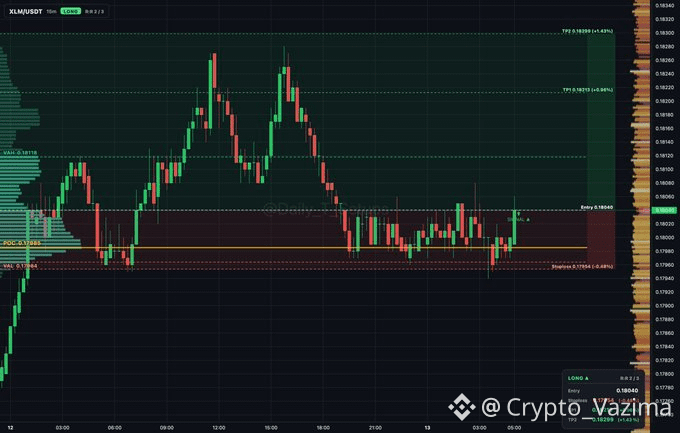
73
Log in to explore more content
Join global crypto users on Binance Square
⚡️ Get latest and useful information about crypto.
💬 Trusted by the world’s largest crypto exchange.
👍 Discover real insights from verified creators.
Email / Phone number
Trending Topics
AnthropicCEOCallsForAISlowdown
9,766 views
234 Discussing
#AnthropicCEOCallsForAISlowdown Anthropic CEO Calls for an AI Slowdown
The AI race is moving at incredible speed, but Anthropic’s CEO is calling for a more cautious approach. 🤖⚠️
The message is simple: innovation shouldn’t come at the cost of safety. As AI models become more powerful, companies may need stronger testing, safeguards, and responsible deployment before pushing the limits even further.
AI can transform industries, markets, and everyday life — but the faster it develops, the more important responsible development becomes. 🌍🧠$LSK
$VOD.US
Crypto_With_Kinza
·0 Likes
·30 views
AnthropicChoosesNasdaqForPotentialIPO
591 views
41 Discussing
SECReceivesGrayscaleLitecoinTrustETFFiling
124,664 views
1,767 Discussing