

加密野狼
384 Posts
加密野狼
 Square Verified+
Report
Block User
X:@cryptionwolf
Web3从业者|神龙社区发起人|金狗捕手|多个大社区主讲|专业承接宣发|开发|商学院,持续扎根加密圈全靠ip信誉生存,欢迎交流
Open Trade

ETH Holder
High-Frequency Trader
9.1 Years
851 Following
53.7K+ Followers
21.9K+ Liked
Posts
Portfolio
All
Quotes
Live
PINNED
·
--
Fee rebate 20%: GC20FY, can be increased to 40% for large volumes
Also, Binance Web3 wallet can make money!!!
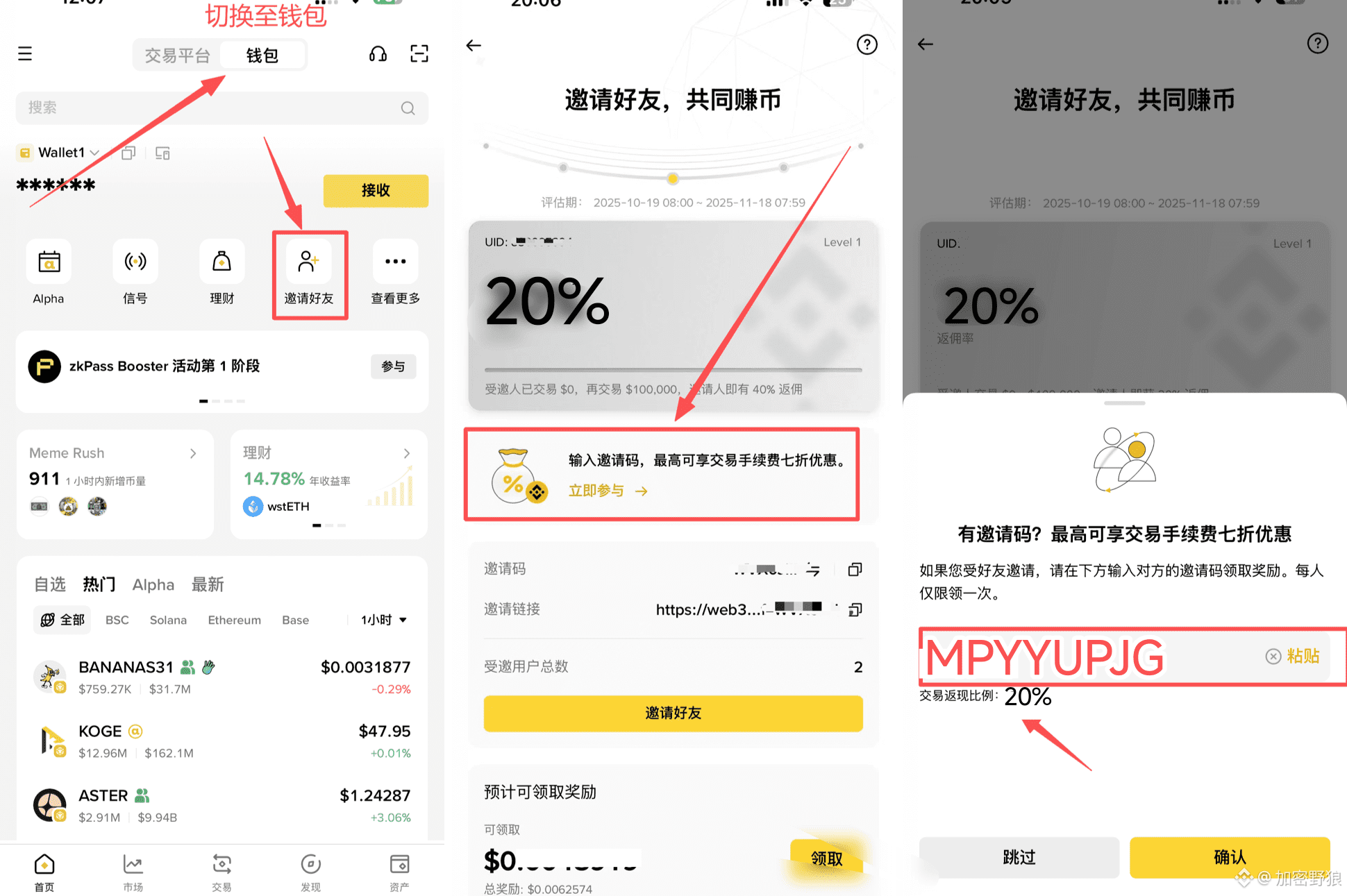
Wallet invitation code: MPYYUPJG, after binding, the fee is reduced by 30%
Why bind the invitation code? It's simple—save money in the long run.
In the future, participating in Swap/cross-chain/other operations in the Binance wallet will usually incur platform service fees/routing fees and network fees
Opening a rebate = getting back a portion of the fees you would have to pay out, the more you use, the more you save
Wallet invitation code: MPYYUPJG, after binding, the fee is reduced by 30%
Three-step binding (done in 1 minute)
1) Open Binance Wallet App → Enter [Invite Friends]
2) Select “Enter invitation code”, showing a 30% fee rate reduction
3) Enter MPYYUPJG, confirm binding
By binding through my invitation, screenshot reward of 1U (Join Binance group: Shenlong Community, send binding invitation screenshot + address to receive 1U airdrop)
[一键绑定传送门:点这里](https://web3.binance.com/referral?ref=MPYYUPJG)
Follow, retweet, like, comment: Crypto Wolf
Claim your red envelope 🧧
Fee rebate 20%: GC20FY, can be increased to 40% for large volumes
Also, Binance Web3 wallet can make money!!!
Wallet invitation code: MPYYUPJG, after binding, the fee is reduced by 30%
Why bind the invitation code? It's simple—save money in the long run.
In the future, participating in Swap/cross-chain/other operations in the Binance wallet will usually incur platform service fees/routing fees and network fees
Opening a rebate = getting back a portion of the fees you would have to pay out, the more you use, the more you save
Wallet invitation code: MPYYUPJG, after binding, the fee is reduced by 30%
Three-step binding (done in 1 minute)
1) Open Binance Wallet App → Enter [Invite Friends]
2) Select “Enter invitation code”, showing a 30% fee rate reduction
3) Enter MPYYUPJG, confirm binding
By binding through my invitation, screenshot reward of 1U (Join Binance group: Shenlong Community, send binding invitation screenshot + address to receive 1U airdrop)
一键绑定传送门:点这里
Follow, retweet, like, comment: Crypto Wolf
Claim your red envelope 🧧
Also, Binance Web3 wallet can make money!!!
Wallet invitation code: MPYYUPJG, after binding, the fee is reduced by 30%
Why bind the invitation code? It's simple—save money in the long run.
In the future, participating in Swap/cross-chain/other operations in the Binance wallet will usually incur platform service fees/routing fees and network fees
Opening a rebate = getting back a portion of the fees you would have to pay out, the more you use, the more you save
Wallet invitation code: MPYYUPJG, after binding, the fee is reduced by 30%
Three-step binding (done in 1 minute)
1) Open Binance Wallet App → Enter [Invite Friends]
2) Select “Enter invitation code”, showing a 30% fee rate reduction
3) Enter MPYYUPJG, confirm binding
By binding through my invitation, screenshot reward of 1U (Join Binance group: Shenlong Community, send binding invitation screenshot + address to receive 1U airdrop)
一键绑定传送门:点这里
Follow, retweet, like, comment: Crypto Wolf
Claim your red envelope 🧧

6.2k
2.4k
465
6.2k
PINNED
·
--
Write about my own experience in the crypto circle:
In such a complicated era, countless projects/tokens rise and fall
We’ve seen hourly settlement/daily settlement/weekly settlement
I’ve always believed that only continuous building and construction can yield great results
The core of any project is to build flow (retention). Public-chain flow is the foundation—it’s the core of expanding the project’s influence—then you convert it into private-chain flow
Of course, some communities focus on continuously building private-chain flow. In my view as Crypto Wolf (加密野狼), combining private-chain and public-chain flow is what can help you go the distance for the long term, with fast online dissemination
I’ve participated in every listed opportunity that I joined—each had high multiples, or even multi-fold returns
The earliest was joining TRX’s ICO. At that time, 1 ETH = 200,000 TRX. In 2017, it was actually because of Brother Sun’s (Wealth Freedom Revolution Road) that I truly entered the crypto circle
Later, in 2020, I also joined a lot of memes—from the earliest on TRON, to later 🔥 Biclain (碧链), then shifting to the BSC chain (PIG/dogeking/PG/FGD/FREE). I also played on the Ethereum mainnet, ARB/OP/pol/Avalanche/SUI/SOL chains, and I’ve participated in air drops (all kinds of major projects, chain-game air drops, and chain-game play-to-earn)
NFT/inscriptions (I got 85U from Audi 3–5U)/runes. Later, there were the earn-and-burn models of the Free Protocol (represented by BTOK and Doghead—automatic burn percentage in the pool; what was crazy was that at one point it could burn 200% in a day. Now pure burning is basically lukewarm, because once the pool burn is gone, it ends). There are also floor/guarantee mechanisms, only-up-not-down, LP consensus, and buy-sell trailing models (buy X, sell X, then the proceeds automatically accumulate and pull the price)
I’ve also empowered quite a few communities’ business academies. Back then, I was the dean of the business academy. For example, from Dec 2024 to May 2025, Whale Whale was being built continuously—at its peak it was nearly 10,000 BNB in the liquidity pool (the highest was about 80X).
Later, last year through Feb 2026, I also helped empower TRON’s OSK.
Everything I’ve empowered using the Crypto Wolf IP has been good projects (giving participants a chance to earn money)
Right now, I have positions in BNB/UNI/HYPE/ETH on the secondary market
You could say that all along the way, I’ve witnessed too many ups and downs, too many rise-and-fall cycles. Whether you can run fast isn’t the most important. What matters is whether you can survive for a long time—and whether you can help players earn 💰
This year I built a token: in August, it reached 5x, and the project is still developing
Now I’ve connected with a BNB coin memecoin project. The community has real strength and is willing to spend on marketing (without marketing there’s no traffic; without traffic there’s no multiples). Also, they do on-the-ground promotion. If you’re interested, you can go to my profile’s Binance chat group to exchange ideas
🧧 Forward comment: BNB
$BNB
Write about my own experience in the crypto circle:
In such a complicated era, countless projects/tokens rise and fall
We’ve seen hourly settlement/daily settlement/weekly settlement
I’ve always believed that only continuous building and construction can yield great results
The core of any project is to build flow (retention). Public-chain flow is the foundation—it’s the core of expanding the project’s influence—then you convert it into private-chain flow
Of course, some communities focus on continuously building private-chain flow. In my view as Crypto Wolf (加密野狼), combining private-chain and public-chain flow is what can help you go the distance for the long term, with fast online dissemination
I’ve participated in every listed opportunity that I joined—each had high multiples, or even multi-fold returns
The earliest was joining TRX’s ICO. At that time, 1 ETH = 200,000 TRX. In 2017, it was actually because of Brother Sun’s (Wealth Freedom Revolution Road) that I truly entered the crypto circle
Later, in 2020, I also joined a lot of memes—from the earliest on TRON, to later 🔥 Biclain (碧链), then shifting to the BSC chain (PIG/dogeking/PG/FGD/FREE). I also played on the Ethereum mainnet, ARB/OP/pol/Avalanche/SUI/SOL chains, and I’ve participated in air drops (all kinds of major projects, chain-game air drops, and chain-game play-to-earn)
NFT/inscriptions (I got 85U from Audi 3–5U)/runes. Later, there were the earn-and-burn models of the Free Protocol (represented by BTOK and Doghead—automatic burn percentage in the pool; what was crazy was that at one point it could burn 200% in a day. Now pure burning is basically lukewarm, because once the pool burn is gone, it ends). There are also floor/guarantee mechanisms, only-up-not-down, LP consensus, and buy-sell trailing models (buy X, sell X, then the proceeds automatically accumulate and pull the price)
I’ve also empowered quite a few communities’ business academies. Back then, I was the dean of the business academy. For example, from Dec 2024 to May 2025, Whale Whale was being built continuously—at its peak it was nearly 10,000 BNB in the liquidity pool (the highest was about 80X).
Later, last year through Feb 2026, I also helped empower TRON’s OSK.
Everything I’ve empowered using the Crypto Wolf IP has been good projects (giving participants a chance to earn money)
Right now, I have positions in BNB/UNI/HYPE/ETH on the secondary market
You could say that all along the way, I’ve witnessed too many ups and downs, too many rise-and-fall cycles. Whether you can run fast isn’t the most important. What matters is whether you can survive for a long time—and whether you can help players earn 💰
This year I built a token: in August, it reached 5x, and the project is still developing
Now I’ve connected with a BNB coin memecoin project. The community has real strength and is willing to spend on marketing (without marketing there’s no traffic; without traffic there’s no multiples). Also, they do on-the-ground promotion. If you’re interested, you can go to my profile’s Binance chat group to exchange ideas
🧧 Forward comment: BNB
$BNB
In such a complicated era, countless projects/tokens rise and fall
We’ve seen hourly settlement/daily settlement/weekly settlement
I’ve always believed that only continuous building and construction can yield great results
The core of any project is to build flow (retention). Public-chain flow is the foundation—it’s the core of expanding the project’s influence—then you convert it into private-chain flow
Of course, some communities focus on continuously building private-chain flow. In my view as Crypto Wolf (加密野狼), combining private-chain and public-chain flow is what can help you go the distance for the long term, with fast online dissemination
I’ve participated in every listed opportunity that I joined—each had high multiples, or even multi-fold returns
The earliest was joining TRX’s ICO. At that time, 1 ETH = 200,000 TRX. In 2017, it was actually because of Brother Sun’s (Wealth Freedom Revolution Road) that I truly entered the crypto circle
Later, in 2020, I also joined a lot of memes—from the earliest on TRON, to later 🔥 Biclain (碧链), then shifting to the BSC chain (PIG/dogeking/PG/FGD/FREE). I also played on the Ethereum mainnet, ARB/OP/pol/Avalanche/SUI/SOL chains, and I’ve participated in air drops (all kinds of major projects, chain-game air drops, and chain-game play-to-earn)
NFT/inscriptions (I got 85U from Audi 3–5U)/runes. Later, there were the earn-and-burn models of the Free Protocol (represented by BTOK and Doghead—automatic burn percentage in the pool; what was crazy was that at one point it could burn 200% in a day. Now pure burning is basically lukewarm, because once the pool burn is gone, it ends). There are also floor/guarantee mechanisms, only-up-not-down, LP consensus, and buy-sell trailing models (buy X, sell X, then the proceeds automatically accumulate and pull the price)
I’ve also empowered quite a few communities’ business academies. Back then, I was the dean of the business academy. For example, from Dec 2024 to May 2025, Whale Whale was being built continuously—at its peak it was nearly 10,000 BNB in the liquidity pool (the highest was about 80X).
Later, last year through Feb 2026, I also helped empower TRON’s OSK.
Everything I’ve empowered using the Crypto Wolf IP has been good projects (giving participants a chance to earn money)
Right now, I have positions in BNB/UNI/HYPE/ETH on the secondary market
You could say that all along the way, I’ve witnessed too many ups and downs, too many rise-and-fall cycles. Whether you can run fast isn’t the most important. What matters is whether you can survive for a long time—and whether you can help players earn 💰
This year I built a token: in August, it reached 5x, and the project is still developing
Now I’ve connected with a BNB coin memecoin project. The community has real strength and is willing to spend on marketing (without marketing there’s no traffic; without traffic there’s no multiples). Also, they do on-the-ground promotion. If you’re interested, you can go to my profile’s Binance chat group to exchange ideas
🧧 Forward comment: BNB
$BNB
2.6k
9
127
2.6k
·
--
🎙️ The Clear Bill is temporarily not passed, and there isn’t much movement in the market either
End
02 h 03 m 12 s
7k
13
14
·
--
🚨 [Situation Update] The Middle East powder keg has been ignited—yet BTC is trading independently? With 🧧
In the past 72 hours, geopolitics has exploded into chaos:
🇮🇷🇺🇸 The US and Iran have clashed head-on in the Persian Gulf—US forces destroyed five Iranian oil tankers, and Iran fired back with missiles striking US bases in Jordan. Iran has announced it will declare the Strait of Hormuz a “no-go zone,” with daily passage volume falling from 130 ships to just 10. Brent crude has surged toward $100.
🇷🇺🇺🇦 After a brief 3-day ceasefire, fighting in Russia-Ukraine has reignited, with Kyiv again hit by multiple rounds of missile and drone attacks.
Traditional markets are trembling, but BTC is different this time.
In the past, BTC has been highly correlated with US stocks. But during this round of geopolitical conflict—oil prices broke above $100 and gold is rising, while BTC didn’t follow stocks down. Instead, it’s held steady in the $78,000–$80,000 range. The market is pricing in a new narrative: Bitcoin is shifting from a “risk asset” to “digital gold.”
Technical signals also back it up: on September 8, BTC’s 50-day moving average crossed above the 200-day moving average, forming a “golden cross”—the first time since November 2025. In the past three weeks, US spot Bitcoin ETFs saw net inflows of up to $3.8 billion, marking the strongest institutional buying record of 2026.
But don’t get too excited yet—the next 48 hours is the real battleground:
📅 September 10 PPI data
📅 September 11 August CPI data (key!)
📅 September 15–16 FOMC meeting
At present, CME pricing for September rate hikes has surged to 60–66%. If CPI runs hot → the probability of hikes rises further → BTC could jump to $75,000. If CPI is mild → rate-hike expectations ease → BTC may retest $82,000 and even $85,000.
Long vs. short showdown—where do you stand?
🧧 Share like comment: BTC
⚠️ The above does not constitute investment advice—DYOR!
#BTC #cryptocurrency #geopolitics #bitcoin #美联储何时降息?
🚨 [Situation Update] The Middle East powder keg has been ignited—yet BTC is trading independently? With 🧧
In the past 72 hours, geopolitics has exploded into chaos:
🇮🇷🇺🇸 The US and Iran have clashed head-on in the Persian Gulf—US forces destroyed five Iranian oil tankers, and Iran fired back with missiles striking US bases in Jordan. Iran has announced it will declare the Strait of Hormuz a “no-go zone,” with daily passage volume falling from 130 ships to just 10. Brent crude has surged toward $100.
🇷🇺🇺🇦 After a brief 3-day ceasefire, fighting in Russia-Ukraine has reignited, with Kyiv again hit by multiple rounds of missile and drone attacks.
Traditional markets are trembling, but BTC is different this time.
In the past, BTC has been highly correlated with US stocks. But during this round of geopolitical conflict—oil prices broke above $100 and gold is rising, while BTC didn’t follow stocks down. Instead, it’s held steady in the $78,000–$80,000 range. The market is pricing in a new narrative: Bitcoin is shifting from a “risk asset” to “digital gold.”
Technical signals also back it up: on September 8, BTC’s 50-day moving average crossed above the 200-day moving average, forming a “golden cross”—the first time since November 2025. In the past three weeks, US spot Bitcoin ETFs saw net inflows of up to $3.8 billion, marking the strongest institutional buying record of 2026.
But don’t get too excited yet—the next 48 hours is the real battleground:
📅 September 10 PPI data
📅 September 11 August CPI data (key!)
📅 September 15–16 FOMC meeting
At present, CME pricing for September rate hikes has surged to 60–66%. If CPI runs hot → the probability of hikes rises further → BTC could jump to $75,000. If CPI is mild → rate-hike expectations ease → BTC may retest $82,000 and even $85,000.
Long vs. short showdown—where do you stand?
🧧 Share like comment: BTC
⚠️ The above does not constitute investment advice—DYOR!
#BTC #cryptocurrency #geopolitics #bitcoin #美联储何时降息?
In the past 72 hours, geopolitics has exploded into chaos:
🇮🇷🇺🇸 The US and Iran have clashed head-on in the Persian Gulf—US forces destroyed five Iranian oil tankers, and Iran fired back with missiles striking US bases in Jordan. Iran has announced it will declare the Strait of Hormuz a “no-go zone,” with daily passage volume falling from 130 ships to just 10. Brent crude has surged toward $100.
🇷🇺🇺🇦 After a brief 3-day ceasefire, fighting in Russia-Ukraine has reignited, with Kyiv again hit by multiple rounds of missile and drone attacks.
Traditional markets are trembling, but BTC is different this time.
In the past, BTC has been highly correlated with US stocks. But during this round of geopolitical conflict—oil prices broke above $100 and gold is rising, while BTC didn’t follow stocks down. Instead, it’s held steady in the $78,000–$80,000 range. The market is pricing in a new narrative: Bitcoin is shifting from a “risk asset” to “digital gold.”
Technical signals also back it up: on September 8, BTC’s 50-day moving average crossed above the 200-day moving average, forming a “golden cross”—the first time since November 2025. In the past three weeks, US spot Bitcoin ETFs saw net inflows of up to $3.8 billion, marking the strongest institutional buying record of 2026.
But don’t get too excited yet—the next 48 hours is the real battleground:
📅 September 10 PPI data
📅 September 11 August CPI data (key!)
📅 September 15–16 FOMC meeting
At present, CME pricing for September rate hikes has surged to 60–66%. If CPI runs hot → the probability of hikes rises further → BTC could jump to $75,000. If CPI is mild → rate-hike expectations ease → BTC may retest $82,000 and even $85,000.
Long vs. short showdown—where do you stand?
🧧 Share like comment: BTC
⚠️ The above does not constitute investment advice—DYOR!
#BTC #cryptocurrency #geopolitics #bitcoin #美联储何时降息?
2.3k
20
190
2.3k
·
--
🧧 Voting giveaway:
Share and comment reply: BNB
🧧 Voting giveaway:
Share and comment reply: BNB
Share and comment reply: BNB
财富密码在BNB
72%
财富密码在社区币
12%
财富密码在MEME币
14%
财富密码在合约
2%
64 votes • Voting closed
2.3k
6
128
2.3k
·
--
🧧 Lucky Draw Voting:
Follow, Repost, and Reply: Boss
🧧 Lucky Draw Voting:
Follow, Repost, and Reply: Boss
Follow, Repost, and Reply: Boss
快牛市开启
51%
慢牛市开启
31%
可能要大跌
18%
65 votes • Voting closed
2.9k
9
138
2.9k
·
--
Sister, you’re awesome PULS
Sister, you’re awesome PULS

Yi He
·
--
I heard that Binance Square is getting popular, so I'm here to test the buzz.

495
·
--
After watching the speech about quantum computing by @CZ , I feel particularly at ease. He was not swayed by anxiety but instead addressed the core issues from an industry perspective—quantum computing is not scary; cryptocurrencies just need to complete the post-quantum algorithm upgrade, and this will ensure a stable landing.
Indeed, the field of cryptocurrency has never been static. From the birth of Bitcoin to now, we have experienced countless technological iterations and consensus divergences; every seemingly tricky issue eventually became an opportunity for industry evolution.
The same goes for quantum resistance upgrades; the debates over upgrade coordination, algorithm selection in a decentralized world, the elimination of some dead projects, and the implementation of wallet migrations... these are all necessary steps toward the maturity of the industry, not a crisis, but an opportunity for ecological purification.
I strongly agree with what he said: encryption is always easier than decryption, and more computing power is always a good thing. This is the underlying logic of encryption and also our confidence to traverse cycles.
Quantum computing is not the end of the industry but a new starting point in the post-quantum era.
Thank you, CZ, for conveying confidence to all practitioners and investors with the vision of an industry leader, and I also look forward to Binance continuing to lead and work with global practitioners to implement post-quantum technology, making cryptocurrency progress more stable and further in technological iterations.
After watching the speech about quantum computing by @CZ , I feel particularly at ease. He was not swayed by anxiety but instead addressed the core issues from an industry perspective—quantum computing is not scary; cryptocurrencies just need to complete the post-quantum algorithm upgrade, and this will ensure a stable landing.
Indeed, the field of cryptocurrency has never been static. From the birth of Bitcoin to now, we have experienced countless technological iterations and consensus divergences; every seemingly tricky issue eventually became an opportunity for industry evolution.
The same goes for quantum resistance upgrades; the debates over upgrade coordination, algorithm selection in a decentralized world, the elimination of some dead projects, and the implementation of wallet migrations... these are all necessary steps toward the maturity of the industry, not a crisis, but an opportunity for ecological purification.
I strongly agree with what he said: encryption is always easier than decryption, and more computing power is always a good thing. This is the underlying logic of encryption and also our confidence to traverse cycles.
Quantum computing is not the end of the industry but a new starting point in the post-quantum era.
Thank you, CZ, for conveying confidence to all practitioners and investors with the vision of an industry leader, and I also look forward to Binance continuing to lead and work with global practitioners to implement post-quantum technology, making cryptocurrency progress more stable and further in technological iterations.
Indeed, the field of cryptocurrency has never been static. From the birth of Bitcoin to now, we have experienced countless technological iterations and consensus divergences; every seemingly tricky issue eventually became an opportunity for industry evolution.
The same goes for quantum resistance upgrades; the debates over upgrade coordination, algorithm selection in a decentralized world, the elimination of some dead projects, and the implementation of wallet migrations... these are all necessary steps toward the maturity of the industry, not a crisis, but an opportunity for ecological purification.
I strongly agree with what he said: encryption is always easier than decryption, and more computing power is always a good thing. This is the underlying logic of encryption and also our confidence to traverse cycles.
Quantum computing is not the end of the industry but a new starting point in the post-quantum era.
Thank you, CZ, for conveying confidence to all practitioners and investors with the vision of an industry leader, and I also look forward to Binance continuing to lead and work with global practitioners to implement post-quantum technology, making cryptocurrency progress more stable and further in technological iterations.

CZ
·
--
Saw some people panicking or asking about quantum computing's impact on crypto.
At a high level, all crypto has to do is to upgrade to Quantum-Resistant (Post-Quantum) Algorithms. So, no need to panic. 😂
In practice, there are some execution considerations. It's hard to organize upgrades in a decentralized world. There will likely be many debates on which algorithm(s) to use, resulting in some forks.
And some dead project may not upgrade at all. Might be a good to cleanse out those projects anyway.
New code may introduce other bugs or security issues in the short term.
People who self custody will have to migrate their coins to new wallets.
This brings to the question of Satoshi's bitcoins. If those coins move, then it means he/she is still around, which is interesting to know. If they don't move (in a certain period of time), it might be better to lock (or effectively burn) those addresses so that they don't go to the first hacker who cracks it. There is also the difficulty of identifying all his addresses, and not confuse with some old hodlers. Anyway, it's a different topic for later.
Fundamentally:
It's always easier to encrypt than decrypt.
More computing power is always good.
Crypto will stay, post quantum.
At a high level, all crypto has to do is to upgrade to Quantum-Resistant (Post-Quantum) Algorithms. So, no need to panic. 😂
In practice, there are some execution considerations. It's hard to organize upgrades in a decentralized world. There will likely be many debates on which algorithm(s) to use, resulting in some forks.
And some dead project may not upgrade at all. Might be a good to cleanse out those projects anyway.
New code may introduce other bugs or security issues in the short term.
People who self custody will have to migrate their coins to new wallets.
This brings to the question of Satoshi's bitcoins. If those coins move, then it means he/she is still around, which is interesting to know. If they don't move (in a certain period of time), it might be better to lock (or effectively burn) those addresses so that they don't go to the first hacker who cracks it. There is also the difficulty of identifying all his addresses, and not confuse with some old hodlers. Anyway, it's a different topic for later.
Fundamentally:
It's always easier to encrypt than decrypt.
More computing power is always good.
Crypto will stay, post quantum.
1
2
12
315
·
--
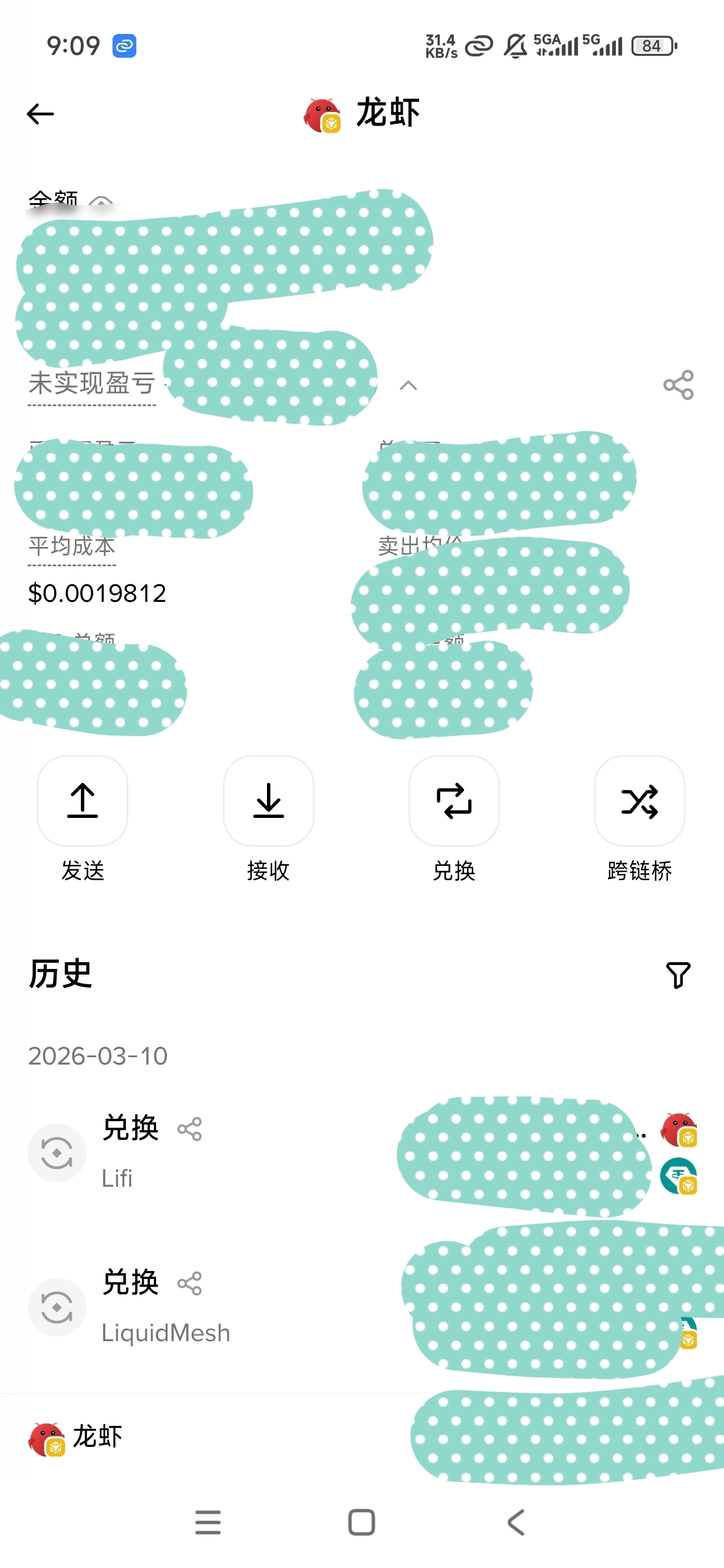
$Lobster logging into Binance Alpha is indeed unexpected, entry average price 0.00198, today's highest 0.022U, 80% has been sold at a high position, still holding 20% of the bottom position in anticipation, thank you @BinanceCN @CZ @binancezh
To show my happiness, sending 1000U🧧
Old rule: Follow, retweet, and comment: Lobster 666
{alpha}(560xeccbb861c0dda7efd964010085488b69317e4444)
$Lobster logging into Binance Alpha is indeed unexpected, entry average price 0.00198, today's highest 0.022U, 80% has been sold at a high position, still holding 20% of the bottom position in anticipation, thank you @币安中文社区 @CZ @币安Binance华语
To show my happiness, sending 1000U🧧
Old rule: Follow, retweet, and comment: Lobster 666
To show my happiness, sending 1000U🧧
Old rule: Follow, retweet, and comment: Lobster 666
4.9k
110
382
4.9k
·
--
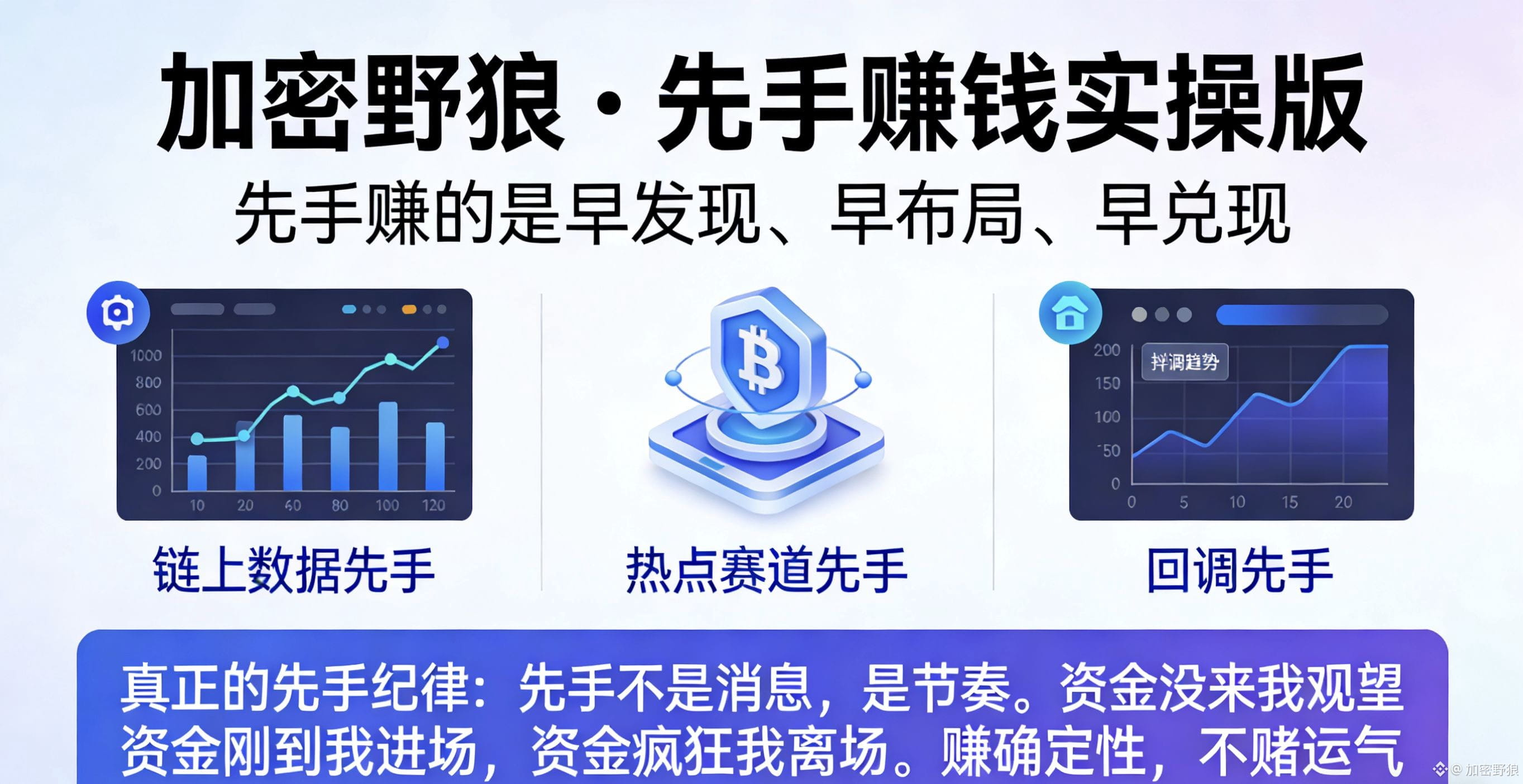
【Crypto Wild Wolf · Alpha First-Mover Profit Practical Edition】
1. What is first-mover profit?
Not insider information, not private equity, not a Ponzi scheme
It is: early detection, early layout, early realization
2. Three first-mover strategies that ordinary people can directly implement
1. On-Chain Data First-Move (Most Stable, Most Legal)
Watch: Whale address movements
Watch: New public chains / new ecosystem capital inflows
Watch: Large amounts of stablecoins entering exchanges
First-move action: Capital enters → Ambush → Sell when the price rises
Do not chase high prices, just ambush
2. Hot Track First-Move (Highest Win Rate)
Only do:
When a new narrative just emerges
Hasn't skyrocketed significantly yet
The leader hasn't multiplied by 10 times
First-move action:
Look for tracks with small market caps and clean fundamentals, lightly ambush
Wait for the heat to spread, then profit and exit
3. Pullback First-Move (Most Suitable for Contracts/Spot Trading)
Do not guess the tops and bottoms of large coins, only do:
Strong coins retracing to key support
Volume stabilizes
Small positions for trial and error
First-move = Enter a step earlier than others, not betting on direction
3. True First-Move Discipline (Can Save Lives)
1. First-move is not going all-in
2. First-move must have stop-loss
3. First-move does not linger in battle, earn the difference in cognition and exit
4. Do not touch Ponzi schemes, do not touch insider schemes, do not touch private models
4. Summary in One Sentence
Crypto Wild Wolf's Viewpoint:
First-move is not about news, it's about rhythm.
When capital is absent, I wait and see; when capital arrives, I enter; when capital is frantic, I exit.
Earn certainty, do not gamble on luck.
Follow, share, and comment: 888
【Crypto Wild Wolf · Alpha First-Mover Profit Practical Edition】
1. What is first-mover profit?
Not insider information, not private equity, not a Ponzi scheme
It is: early detection, early layout, early realization
2. Three first-mover strategies that ordinary people can directly implement
1. On-Chain Data First-Move (Most Stable, Most Legal)
Watch: Whale address movements
Watch: New public chains / new ecosystem capital inflows
Watch: Large amounts of stablecoins entering exchanges
First-move action: Capital enters → Ambush → Sell when the price rises
Do not chase high prices, just ambush
2. Hot Track First-Move (Highest Win Rate)
Only do:
When a new narrative just emerges
Hasn't skyrocketed significantly yet
The leader hasn't multiplied by 10 times
First-move action:
Look for tracks with small market caps and clean fundamentals, lightly ambush
Wait for the heat to spread, then profit and exit
3. Pullback First-Move (Most Suitable for Contracts/Spot Trading)
Do not guess the tops and bottoms of large coins, only do:
Strong coins retracing to key support
Volume stabilizes
Small positions for trial and error
First-move = Enter a step earlier than others, not betting on direction
3. True First-Move Discipline (Can Save Lives)
1. First-move is not going all-in
2. First-move must have stop-loss
3. First-move does not linger in battle, earn the difference in cognition and exit
4. Do not touch Ponzi schemes, do not touch insider schemes, do not touch private models
4. Summary in One Sentence
Crypto Wild Wolf's Viewpoint:
First-move is not about news, it's about rhythm.
When capital is absent, I wait and see; when capital arrives, I enter; when capital is frantic, I exit.
Earn certainty, do not gamble on luck.
Follow, share, and comment: 888
1. What is first-mover profit?
Not insider information, not private equity, not a Ponzi scheme
It is: early detection, early layout, early realization
2. Three first-mover strategies that ordinary people can directly implement
1. On-Chain Data First-Move (Most Stable, Most Legal)
Watch: Whale address movements
Watch: New public chains / new ecosystem capital inflows
Watch: Large amounts of stablecoins entering exchanges
First-move action: Capital enters → Ambush → Sell when the price rises
Do not chase high prices, just ambush
2. Hot Track First-Move (Highest Win Rate)
Only do:
When a new narrative just emerges
Hasn't skyrocketed significantly yet
The leader hasn't multiplied by 10 times
First-move action:
Look for tracks with small market caps and clean fundamentals, lightly ambush
Wait for the heat to spread, then profit and exit
3. Pullback First-Move (Most Suitable for Contracts/Spot Trading)
Do not guess the tops and bottoms of large coins, only do:
Strong coins retracing to key support
Volume stabilizes
Small positions for trial and error
First-move = Enter a step earlier than others, not betting on direction
3. True First-Move Discipline (Can Save Lives)
1. First-move is not going all-in
2. First-move must have stop-loss
3. First-move does not linger in battle, earn the difference in cognition and exit
4. Do not touch Ponzi schemes, do not touch insider schemes, do not touch private models
4. Summary in One Sentence
Crypto Wild Wolf's Viewpoint:
First-move is not about news, it's about rhythm.
When capital is absent, I wait and see; when capital arrives, I enter; when capital is frantic, I exit.
Earn certainty, do not gamble on luck.
Follow, share, and comment: 888
139
1
24
655
·
--
Today's Binance Futures · Opening Suggestions:
Current fluctuations are slightly strong, do not chase, do not hold, only do pullbacks
Direction: Above MA20, only long trades, no shorts
Entry: Wait for stabilization on pullback before entering, do not chase highs
Risk Control: Always set a stop-loss, operate with light positions
Conclusion: Observe and wait for pullbacks, do not open positions blindly
---Crypto Wolf
🧧One-click 4 consecutive: 666
$BTC
{future}(BTCUSDT)
$ETH
{future}(ETHUSDT)
$BNB
{future}(BNBUSDT)
#比特币回落至63000美元附近
Today's Binance Futures · Opening Suggestions:
Current fluctuations are slightly strong, do not chase, do not hold, only do pullbacks
Direction: Above MA20, only long trades, no shorts
Entry: Wait for stabilization on pullback before entering, do not chase highs
Risk Control: Always set a stop-loss, operate with light positions
Conclusion: Observe and wait for pullbacks, do not open positions blindly
---Crypto Wolf
🧧One-click 4 consecutive: 666
$BTC
$ETH
$BNB
#比特币回落至63000美元附近
Current fluctuations are slightly strong, do not chase, do not hold, only do pullbacks
Direction: Above MA20, only long trades, no shorts
Entry: Wait for stabilization on pullback before entering, do not chase highs
Risk Control: Always set a stop-loss, operate with light positions
Conclusion: Observe and wait for pullbacks, do not open positions blindly
---Crypto Wolf
🧧One-click 4 consecutive: 666
$BTC
$ETH
$BNB
#比特币回落至63000美元附近

3.6k
1.6k
295
3.6k
·
--
A person's greatest confidence is:
No matter where they are
No matter what situation they are in
Unwaveringly certain of their strong creativity
Creating relationships
Creating health
Creating money
Creating resources
Possessing strong learning and action capabilities
Having the ability to create something from nothing
🧧Follow, share, like, and comment: 888
A person's greatest confidence is:
No matter where they are
No matter what situation they are in
Unwaveringly certain of their strong creativity
Creating relationships
Creating health
Creating money
Creating resources
Possessing strong learning and action capabilities
Having the ability to create something from nothing
🧧Follow, share, like, and comment: 888
No matter where they are
No matter what situation they are in
Unwaveringly certain of their strong creativity
Creating relationships
Creating health
Creating money
Creating resources
Possessing strong learning and action capabilities
Having the ability to create something from nothing
🧧Follow, share, like, and comment: 888


3.3k
1.5k
311
3.3k
·
--
Article
Federal Reserve Interest Rate Decision Day · Cryptocurrency Operation Quick Reference Table🧧 Follow, like, share, comment: 777
Federal Reserve Interest Rate Decision Day · Cryptocurrency Operation Quick Reference Table
🧧 Follow, like, share, comment: 777
1.7k
773
137
1.7k
·
--
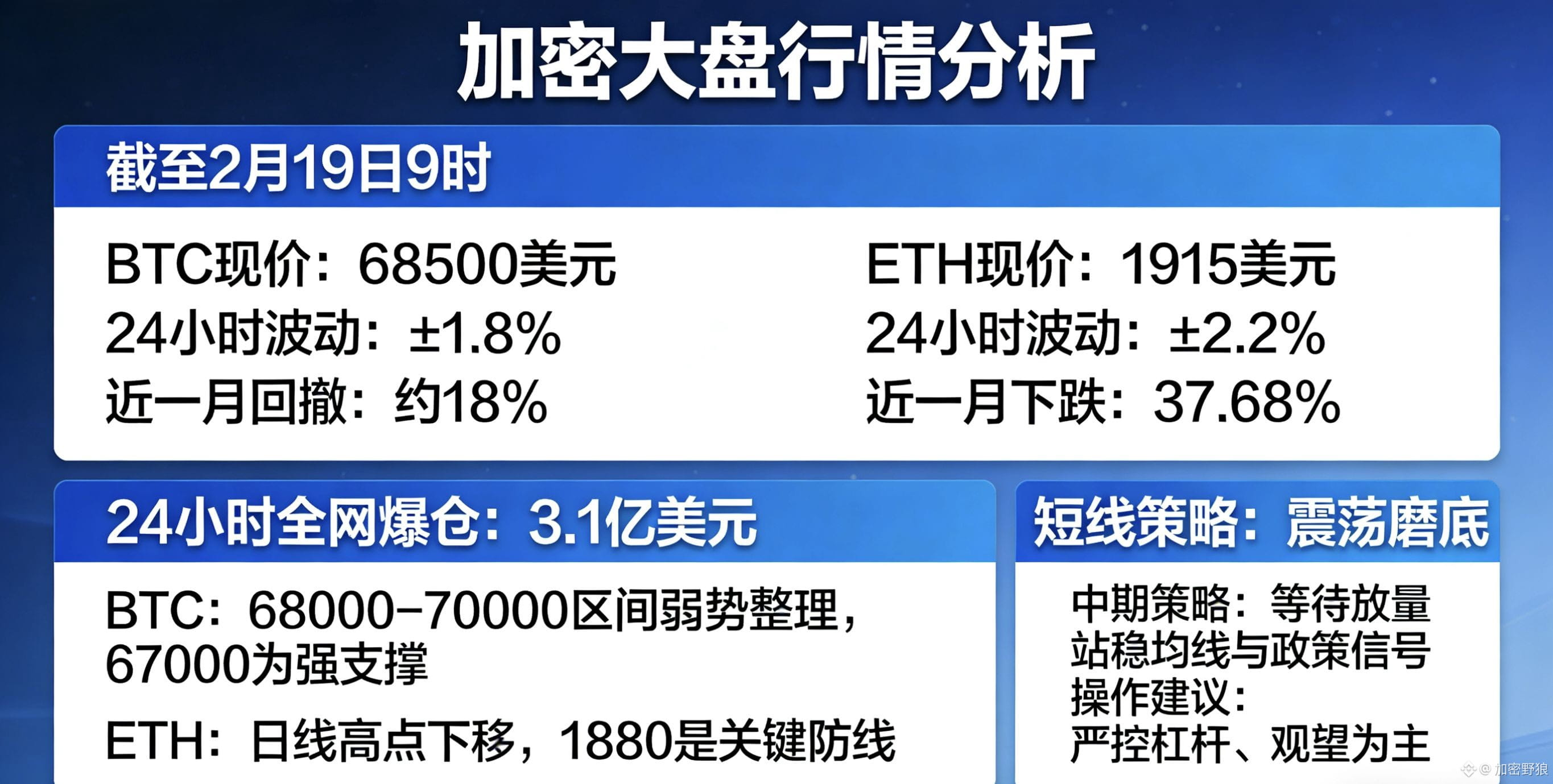
Encrypted Market Quotation | 2026.2.19
As of 9:00 on February 19, the current price of BTC is $68500, with a 24-hour fluctuation of ±1.8% and a withdrawal of about 18% in the past month;
The current price of ETH is $1915, fluctuating by ±2.2% in 24 hours, falling by 37.68% in recent months, leading the mainstream currency in weakness.
In 24 hours, the whole network burst $310 million, and the contract market was bearish. Macroscopically, the US economic data is strong, interest rate cuts are expected to be delayed, and capital flows to gold and crude oil suppress risky assets.
Technical side: BTC is weak in the 68000–70000 range, and 67000 is strong support; the daily high point of ETH moves down, and 1880 is the key line of defense.
Short-term focuses on shaking the bottom, and the rebound is difficult to continue; medium-term waits for volume to stabilize the moving average and policy signals, it is recommended to strictly control leverage and mainly observe.
Follow, forward, like and comment: 999
$BTC
{future}(BTCUSDT)
$ETH
{future}(ETHUSDT)
$BNB
{future}(BNBUSDT)
Encrypted Market Quotation | 2026.2.19
As of 9:00 on February 19, the current price of BTC is $68500, with a 24-hour fluctuation of ±1.8% and a withdrawal of about 18% in the past month;
The current price of ETH is $1915, fluctuating by ±2.2% in 24 hours, falling by 37.68% in recent months, leading the mainstream currency in weakness.
In 24 hours, the whole network burst $310 million, and the contract market was bearish. Macroscopically, the US economic data is strong, interest rate cuts are expected to be delayed, and capital flows to gold and crude oil suppress risky assets.
Technical side: BTC is weak in the 68000–70000 range, and 67000 is strong support; the daily high point of ETH moves down, and 1880 is the key line of defense.
Short-term focuses on shaking the bottom, and the rebound is difficult to continue; medium-term waits for volume to stabilize the moving average and policy signals, it is recommended to strictly control leverage and mainly observe.
Follow, forward, like and comment: 999
$BTC
$ETH
$BNB
As of 9:00 on February 19, the current price of BTC is $68500, with a 24-hour fluctuation of ±1.8% and a withdrawal of about 18% in the past month;
The current price of ETH is $1915, fluctuating by ±2.2% in 24 hours, falling by 37.68% in recent months, leading the mainstream currency in weakness.
In 24 hours, the whole network burst $310 million, and the contract market was bearish. Macroscopically, the US economic data is strong, interest rate cuts are expected to be delayed, and capital flows to gold and crude oil suppress risky assets.
Technical side: BTC is weak in the 68000–70000 range, and 67000 is strong support; the daily high point of ETH moves down, and 1880 is the key line of defense.
Short-term focuses on shaking the bottom, and the rebound is difficult to continue; medium-term waits for volume to stabilize the moving average and policy signals, it is recommended to strictly control leverage and mainly observe.
Follow, forward, like and comment: 999
$BTC
$ETH
$BNB
3.8k
1.8k
331
3.8k
·
--
🎙️ Happy New Year, let's meet at the Binance Square New Year’s Eve event!
💗💗
End
05 h 59 m 59 s
74.6k
102
175
·
--

Article
In the next 7 days (February 6-12), the crypto market is expected to experience weak fluctuations, and technical rebounds will not change the downward main tone.In the next 7 days (February 6-12), the crypto market is expected to experience weak fluctuations, and technical rebounds will not change the downward main tone. There is a high probability of a weak rebound after initial suppression, with vigilance against secondary bottom-testing and high volatility risks. Below are the core judgments and key bases.
📊 Core judgment (February 6-12)
- Bitcoin: Core range $60000-$65000, first watch for strong support at $60000, resistance on the rebound at $67000-$70000.
- Ethereum: Linked downward, key support at $1600-$1800, resistance at $2000-$2200.
- Altcoins: Greater volatility, high-leverage varieties are prone to corrections/spikes, prioritize risk aversion.
In the next 7 days (February 6-12), the crypto market is expected to experience weak fluctuations, and technical rebounds will not change the downward main tone.
In the next 7 days (February 6-12), the crypto market is expected to experience weak fluctuations, and technical rebounds will not change the downward main tone. There is a high probability of a weak rebound after initial suppression, with vigilance against secondary bottom-testing and high volatility risks. Below are the core judgments and key bases.
📊 Core judgment (February 6-12)
- Bitcoin: Core range $60000-$65000, first watch for strong support at $60000, resistance on the rebound at $67000-$70000.
- Ethereum: Linked downward, key support at $1600-$1800, resistance at $2000-$2200.
- Altcoins: Greater volatility, high-leverage varieties are prone to corrections/spikes, prioritize risk aversion.
📊 Core judgment (February 6-12)
- Bitcoin: Core range $60000-$65000, first watch for strong support at $60000, resistance on the rebound at $67000-$70000.
- Ethereum: Linked downward, key support at $1600-$1800, resistance at $2000-$2200.
- Altcoins: Greater volatility, high-leverage varieties are prone to corrections/spikes, prioritize risk aversion.
865
366
85
865
Log in to explore more content
Join global crypto users on Binance Square
⚡️ Get latest and useful information about crypto.
💬 Trusted by the world’s largest crypto exchange.
👍 Discover real insights from verified creators.
Email / Phone number
Trending Topics
FedMinutesFocusOnOctoberPause
6,395 views
247 Discussing
#fedminutesfocusonoctoberpause
🚨 OCTOBER FED HIKE ODDS COLLAPSE TO 21.6%… Is $BTC About to React? 👀
The Fed is about to give markets another major clue.
Investors are waiting for today’s FOMC minutes — and the biggest question is whether October brings another rate hike… or a pause.
Right now, the odds of a 25-basis-point October hike have fallen to just 21.6%.
That’s a huge shift in expectations.
But here’s what makes this interesting… 👀
The Fed raised rates to 3.75%–4.00% in September, but recent weakness in jobs data and softer inflation have made another immediate hike look less certain.
And for crypto, this matters.
A Fed pause could reduce pressure on financial conditions and potentially improve risk appetite.
That could become a tailwind for BTC
But there’s a catch…
Bitcoin is already under pressure as the dollar and Treasury yields move higher.
So tonight’s minutes could become a volatility trigger.
Dovish Fed → liquidity hopes → bullish .
BTC narrative?
Hawkish Fed → higher-rate fears → more pressure on risk assets?
The real question:
Is October becoming the pause Bitcoin bulls have been waiting for… or could the Fed surprise the market again? 👀
Watch BTC + Fed expectations + Treasury yields closely.
#FederalReserve #Fed #Crypto #InterestRates
$ETH
$SOL
Shae Cassler Sw9r
·5 Likes
·11.5k views
BinanceLaunchesBinanceIntelligence
904,859 views
5,522 Discussing
RobinhoodAdds$25MInBitcoinToBalanceSheet
480 views
22 Discussing