

Cointelegraph
37.5k Posts

Cointelegraph
 Square Verified+
Report
Block User
Cointelegraph covers fintech, blockchain and Bitcoin, bringing you the latest news and analyses on the future of money.
2 Following
186.4K+ Followers
567.2K+ Liked
1 Badges
Posts
Zcash co-founder calls to stop funding ‘over $125M’ grants programZcash co-founder Sean Bowe proposed ending the automatic funding stream to Zcash Community Grants (ZCG), saying its treasury was large enough to continue funding projects without further automatic payments.
“ZCG has over $125M in funding, and will receive millions more before the spigot is turned off,” Bowe said Tuesday on X. “The program was never designed to handle this amount of funding.”
Bowe shared a draft GitHub proposal that would redirect ZCG’s 8% share of the Zcash (ZEC) block subsidy to the network’s sustainability reserve, while leaving its existing funds untouched.
The allocation would flow to the Network Sustainability Mechanism until the current funding period ends in 2028. The mechanism is designed to hold ZEC out of circulation and gradually reissue it through future block rewards.
In September, Haseeb Qureshi, managing partner at crypto venture capital firm Dragonfly, proposed ending the Zcash developer fund when its current funding period expires, saying that it risks being “politicized” as it approaches $100 million in value.
ZCG’s dashboard listed 91,453 ZEC and $8.8 million in cash as of Wednesday, with $2.4 million in outstanding grant commitments. The ZEC holdings alone were worth about $111 million at press time.
The network’s separate development lockbox held 72,351 ZEC, worth roughly $89 million, according to ZecStats.
Zcash co-founder calls to stop funding ‘over $125M’ grants program
Zcash co-founder Sean Bowe proposed ending the automatic funding stream to Zcash Community Grants (ZCG), saying its treasury was large enough to continue funding projects without further automatic payments.
“ZCG has over $125M in funding, and will receive millions more before the spigot is turned off,” Bowe said Tuesday on X. “The program was never designed to handle this amount of funding.”
Bowe shared a draft GitHub proposal that would redirect ZCG’s 8% share of the Zcash (ZEC) block subsidy to the network’s sustainability reserve, while leaving its existing funds untouched.
The allocation would flow to the Network Sustainability Mechanism until the current funding period ends in 2028. The mechanism is designed to hold ZEC out of circulation and gradually reissue it through future block rewards.
In September, Haseeb Qureshi, managing partner at crypto venture capital firm Dragonfly, proposed ending the Zcash developer fund when its current funding period expires, saying that it risks being “politicized” as it approaches $100 million in value.
ZCG’s dashboard listed 91,453 ZEC and $8.8 million in cash as of Wednesday, with $2.4 million in outstanding grant commitments. The ZEC holdings alone were worth about $111 million at press time.
The network’s separate development lockbox held 72,351 ZEC, worth roughly $89 million, according to ZecStats.
“ZCG has over $125M in funding, and will receive millions more before the spigot is turned off,” Bowe said Tuesday on X. “The program was never designed to handle this amount of funding.”
Bowe shared a draft GitHub proposal that would redirect ZCG’s 8% share of the Zcash (ZEC) block subsidy to the network’s sustainability reserve, while leaving its existing funds untouched.
The allocation would flow to the Network Sustainability Mechanism until the current funding period ends in 2028. The mechanism is designed to hold ZEC out of circulation and gradually reissue it through future block rewards.
In September, Haseeb Qureshi, managing partner at crypto venture capital firm Dragonfly, proposed ending the Zcash developer fund when its current funding period expires, saying that it risks being “politicized” as it approaches $100 million in value.
ZCG’s dashboard listed 91,453 ZEC and $8.8 million in cash as of Wednesday, with $2.4 million in outstanding grant commitments. The ZEC holdings alone were worth about $111 million at press time.
The network’s separate development lockbox held 72,351 ZEC, worth roughly $89 million, according to ZecStats.
86
Bloom bot hackers loot $953K faster than you can microwave popcornHackers stole nearly $1 million from wallets linked to Telegram trading bot Bloom in under two minutes, according to blockchain analytics company Bitquery.
The attack drained $953,000 in 94 seconds from 48 cryptocurrency wallets belonging to nine traders who had used the bot, Bitquery reported Monday.
Bitquery said each drain was a Solana (SOL) transfer signed with the affected wallet’s private key.
Bloom pledged to reimburse all affected traders in full. In a later Monday statement, it attributed the attack to a remote code execution vulnerability in a third-party module and said no private keys had been accessed or compromised.
Trading bots such as Bloom hold users’ private keys to trade on their behalf, which can leave lingering security risks even after traders stop using them. Five wallets drained in the Bloom attack had been inactive on the bot since the first half of 2025, Bitquery said.
This is not the first time Telegram trading bot users have lost funds in an attack. In September 2024, Banana Gun reported that 11 users lost about $3 million. In October 2023, users of Telegram trading bots Maestro and Unibot lost a combined $1.1 million to exploits of their router contracts.
Bloom bot hackers loot $953K faster than you can microwave popcorn
Hackers stole nearly $1 million from wallets linked to Telegram trading bot Bloom in under two minutes, according to blockchain analytics company Bitquery.
The attack drained $953,000 in 94 seconds from 48 cryptocurrency wallets belonging to nine traders who had used the bot, Bitquery reported Monday.
Bitquery said each drain was a Solana (SOL) transfer signed with the affected wallet’s private key.
Bloom pledged to reimburse all affected traders in full. In a later Monday statement, it attributed the attack to a remote code execution vulnerability in a third-party module and said no private keys had been accessed or compromised.
Trading bots such as Bloom hold users’ private keys to trade on their behalf, which can leave lingering security risks even after traders stop using them. Five wallets drained in the Bloom attack had been inactive on the bot since the first half of 2025, Bitquery said.
This is not the first time Telegram trading bot users have lost funds in an attack. In September 2024, Banana Gun reported that 11 users lost about $3 million. In October 2023, users of Telegram trading bots Maestro and Unibot lost a combined $1.1 million to exploits of their router contracts.
The attack drained $953,000 in 94 seconds from 48 cryptocurrency wallets belonging to nine traders who had used the bot, Bitquery reported Monday.
Bitquery said each drain was a Solana (SOL) transfer signed with the affected wallet’s private key.
Bloom pledged to reimburse all affected traders in full. In a later Monday statement, it attributed the attack to a remote code execution vulnerability in a third-party module and said no private keys had been accessed or compromised.
Trading bots such as Bloom hold users’ private keys to trade on their behalf, which can leave lingering security risks even after traders stop using them. Five wallets drained in the Bloom attack had been inactive on the bot since the first half of 2025, Bitquery said.
This is not the first time Telegram trading bot users have lost funds in an attack. In September 2024, Banana Gun reported that 11 users lost about $3 million. In October 2023, users of Telegram trading bots Maestro and Unibot lost a combined $1.1 million to exploits of their router contracts.
103
Binance files for Brazil crypto license ahead of Friday deadlineBinance has applied for a cryptocurrency service provider license in Brazil, seeking to maintain its operations in one of Latin America’s largest crypto markets ahead of a regulatory deadline on Friday, Oct. 30.
The exchange submitted its application to the Central Bank of Brazil on Friday, Oct. 23, through its local entity, BBrasil, according to a statement shared with Cointelegraph.
The company said the filing would allow Brazilian users to continue accessing crypto assets, stablecoin trading, payments and investment services.
Binance has also announced changes for Brazilian users effective Tuesday, including restrictions on crypto lending, margin trading and other services. The exchange is also delisting 22 crypto assets in the country.
“We support a regulated market that considers the characteristics of virtual assets, so that access to technology and innovation continues to advance, but we hope that the ongoing dialogue with the Central Bank will allow us to offer, in the near future, other products that were discontinued to comply with current regulations,” said Thiago Sarandy, Binance’s general manager in the country.
Brazil requires existing crypto service providers to submit authorization applications by Oct. 30 to continue operating under transitional arrangements. Filing an application does not constitute regulatory approval.
Binance files for Brazil crypto license ahead of Friday deadline
Binance has applied for a cryptocurrency service provider license in Brazil, seeking to maintain its operations in one of Latin America’s largest crypto markets ahead of a regulatory deadline on Friday, Oct. 30.
The exchange submitted its application to the Central Bank of Brazil on Friday, Oct. 23, through its local entity, BBrasil, according to a statement shared with Cointelegraph.
The company said the filing would allow Brazilian users to continue accessing crypto assets, stablecoin trading, payments and investment services.
Binance has also announced changes for Brazilian users effective Tuesday, including restrictions on crypto lending, margin trading and other services. The exchange is also delisting 22 crypto assets in the country.
“We support a regulated market that considers the characteristics of virtual assets, so that access to technology and innovation continues to advance, but we hope that the ongoing dialogue with the Central Bank will allow us to offer, in the near future, other products that were discontinued to comply with current regulations,” said Thiago Sarandy, Binance’s general manager in the country.
Brazil requires existing crypto service providers to submit authorization applications by Oct. 30 to continue operating under transitional arrangements. Filing an application does not constitute regulatory approval.
The exchange submitted its application to the Central Bank of Brazil on Friday, Oct. 23, through its local entity, BBrasil, according to a statement shared with Cointelegraph.
The company said the filing would allow Brazilian users to continue accessing crypto assets, stablecoin trading, payments and investment services.
Binance has also announced changes for Brazilian users effective Tuesday, including restrictions on crypto lending, margin trading and other services. The exchange is also delisting 22 crypto assets in the country.
“We support a regulated market that considers the characteristics of virtual assets, so that access to technology and innovation continues to advance, but we hope that the ongoing dialogue with the Central Bank will allow us to offer, in the near future, other products that were discontinued to comply with current regulations,” said Thiago Sarandy, Binance’s general manager in the country.
Brazil requires existing crypto service providers to submit authorization applications by Oct. 30 to continue operating under transitional arrangements. Filing an application does not constitute regulatory approval.
1
1
236
Article
Bitcoin ETFs claw back $110M after $774M exitUS-listed spot Bitcoin exchange-traded funds (ETFs) returned to net inflows on Monday despite weakening market sentiment and continued volatility in BTC price.
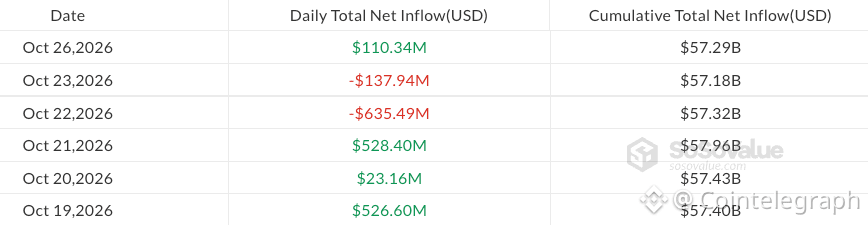
The funds attracted $110 million in net inflows on Monday, bouncing back from $774 million in withdrawals over the previous two trading sessions, according to SoSoValue.
Despite the rebound, October remained negative, with approximately $202 million in net outflows through Monday.
Flows in US spot Bitcoin ETFs since Oct. 19. Source: SoSoValue
Bitcoin traded at $79,595 at the time of publication and was down 2.6% over the past seven days, according to CoinGecko.
Market sentiment also weakened, with the Crypto Fear & Greed Index falling to 48 from 50 the previous day, while remaining in “Neutral” territory.
CryptoQuant data also showed retail investors sending more Bitcoin to Binance while large holders reduced their deposits.
Analyst Darkfost wrote on CryptoQuant that retail Bitcoin deposits to Binance nearly doubled to $10.8 billion over 30 days, while deposits from large holders fell to $3.8 billion. Darkfost suggested that smaller investors might be using the recent price rebound as an opportunity to sell.
Bitcoin ETFs claw back $110M after $774M exit
US-listed spot Bitcoin exchange-traded funds (ETFs) returned to net inflows on Monday despite weakening market sentiment and continued volatility in BTC price.
The funds attracted $110 million in net inflows on Monday, bouncing back from $774 million in withdrawals over the previous two trading sessions, according to SoSoValue.
Despite the rebound, October remained negative, with approximately $202 million in net outflows through Monday.
Flows in US spot Bitcoin ETFs since Oct. 19. Source: SoSoValue
Bitcoin traded at $79,595 at the time of publication and was down 2.6% over the past seven days, according to CoinGecko.
Market sentiment also weakened, with the Crypto Fear & Greed Index falling to 48 from 50 the previous day, while remaining in “Neutral” territory.
CryptoQuant data also showed retail investors sending more Bitcoin to Binance while large holders reduced their deposits.
Analyst Darkfost wrote on CryptoQuant that retail Bitcoin deposits to Binance nearly doubled to $10.8 billion over 30 days, while deposits from large holders fell to $3.8 billion. Darkfost suggested that smaller investors might be using the recent price rebound as an opportunity to sell.
The funds attracted $110 million in net inflows on Monday, bouncing back from $774 million in withdrawals over the previous two trading sessions, according to SoSoValue.
Despite the rebound, October remained negative, with approximately $202 million in net outflows through Monday.
Flows in US spot Bitcoin ETFs since Oct. 19. Source: SoSoValue
Bitcoin traded at $79,595 at the time of publication and was down 2.6% over the past seven days, according to CoinGecko.
Market sentiment also weakened, with the Crypto Fear & Greed Index falling to 48 from 50 the previous day, while remaining in “Neutral” territory.
CryptoQuant data also showed retail investors sending more Bitcoin to Binance while large holders reduced their deposits.
Analyst Darkfost wrote on CryptoQuant that retail Bitcoin deposits to Binance nearly doubled to $10.8 billion over 30 days, while deposits from large holders fell to $3.8 billion. Darkfost suggested that smaller investors might be using the recent price rebound as an opportunity to sell.
151
RedotPay weighs confidential US IPO filing by year-end: BloombergHong Kong-based stablecoin payments company RedotPay is reportedly considering a confidential filing for a US initial public offering by the end of 2026, two months after reports that it had delayed its listing plans amid regulatory and legal hurdles.
RedotPay is also in talks with investors about a potential pre-IPO funding round that could value the company at between $4 billion and $5 billion, Bloomberg reported Monday, citing people familiar with the matter.
RedotPay says it has more than 8 million users, while data from Paymentscan shows $410.5 million in 30-day stablecoin card transaction volume.
The company was first reported in February exploring a New York listing that could raise more than $1 billion at a valuation exceeding $4 billion, with JPMorgan Chase, Goldman Sachs and Jefferies reportedly working on the offering.
However, Bloomberg reported in August that RedotPay had delayed its US listing plans amid regulatory hurdles and legal disputes involving Binance.
The company subsequently disputed that characterization, reportedly saying “there has been no deferral of our IPO,” and that the company is “continuing to work with our partners on the IPO process.”
In August, Binance-affiliated companies sued the founders of RedotPay, seeking nearly $473 million in damages over allegations that they used confidential information to build a competing payments business and divert customers.
RedotPay has denied the allegations and previously told Cointelegraph that it would “vigorously defend all claims.”
RedotPay weighs confidential US IPO filing by year-end: Bloomberg
Hong Kong-based stablecoin payments company RedotPay is reportedly considering a confidential filing for a US initial public offering by the end of 2026, two months after reports that it had delayed its listing plans amid regulatory and legal hurdles.
RedotPay is also in talks with investors about a potential pre-IPO funding round that could value the company at between $4 billion and $5 billion, Bloomberg reported Monday, citing people familiar with the matter.
RedotPay says it has more than 8 million users, while data from Paymentscan shows $410.5 million in 30-day stablecoin card transaction volume.
The company was first reported in February exploring a New York listing that could raise more than $1 billion at a valuation exceeding $4 billion, with JPMorgan Chase, Goldman Sachs and Jefferies reportedly working on the offering.
However, Bloomberg reported in August that RedotPay had delayed its US listing plans amid regulatory hurdles and legal disputes involving Binance.
The company subsequently disputed that characterization, reportedly saying “there has been no deferral of our IPO,” and that the company is “continuing to work with our partners on the IPO process.”
In August, Binance-affiliated companies sued the founders of RedotPay, seeking nearly $473 million in damages over allegations that they used confidential information to build a competing payments business and divert customers.
RedotPay has denied the allegations and previously told Cointelegraph that it would “vigorously defend all claims.”
RedotPay is also in talks with investors about a potential pre-IPO funding round that could value the company at between $4 billion and $5 billion, Bloomberg reported Monday, citing people familiar with the matter.
RedotPay says it has more than 8 million users, while data from Paymentscan shows $410.5 million in 30-day stablecoin card transaction volume.
The company was first reported in February exploring a New York listing that could raise more than $1 billion at a valuation exceeding $4 billion, with JPMorgan Chase, Goldman Sachs and Jefferies reportedly working on the offering.
However, Bloomberg reported in August that RedotPay had delayed its US listing plans amid regulatory hurdles and legal disputes involving Binance.
The company subsequently disputed that characterization, reportedly saying “there has been no deferral of our IPO,” and that the company is “continuing to work with our partners on the IPO process.”
In August, Binance-affiliated companies sued the founders of RedotPay, seeking nearly $473 million in damages over allegations that they used confidential information to build a competing payments business and divert customers.
RedotPay has denied the allegations and previously told Cointelegraph that it would “vigorously defend all claims.”
198
Keystone breach deepens: Hackers stole key used to verify wallets as genuineHardware wallet maker Keystone said an attacker who breached its website last week also stole a key used to verify the authenticity of its devices, widening the scope of an incident initially disclosed as a customer data leak.
In a statement Monday, Keystone said the stolen authentication key could allow attackers to produce counterfeit wallets that pass its authenticity checks.
“These devices could then be sold or shipped to customers, who might unknowingly use them as genuine products, potentially resulting in asset theft,” Keystone said.
The incident adds to a series of attacks targeting hardware wallet manufacturers this year.
Earlier this month, Ledger asked resellers across Southeast Asia and Hong Kong to suspend sales following reports that devices sold in the region contained unauthorized implants capable of capturing recovery phrases.
In late July, Coldcard manufacturer Coinkite issued a warning to users after attackers exploited a bug that caused its devices to generate wallet seeds with less entropy than intended, resulting in the theft of millions of dollars in crypto.
Keystone to destroy more than 18,000 devices with old key
In its latest update, Keystone said the attacker exploited a vulnerability in a third-party monitoring tool used by its website to escalate privileges.
“This enabled the attacker to obtain some customer information and a key used to verify the authenticity of our devices.”
Keystone said it plans to destroy 18,835 devices in its inventory that contain the compromised key and has suspended production shipments of all devices using it.
The company said shipments would resume once it begins producing devices with a new authentication key.
Keystone said devices manufactured and delivered before the Oct. 20 incident should be considered safe and that their authenticity checks remain trustworthy.
However, it could not guarantee the authenticity of devices delivered after that date and urged affected customers to contact its support team for additional verification.
Keystone confirms 25,964 buyer records leaked
Keystone also disclosed the extent of the customer data breach, saying its website’s Shopify store had generated 51,083 buyer records.
Of those, 25,119 had been deleted per its 180-day data retention policy.
However, the remaining 25,964 records dating from 2024 to 2026 were stolen by the attacker. Keystone said the older entries were not deleted due to a failure in its automated tool used to handle bulk erasure of data.
“The tool did not operate reliably. Some erasure tasks failed, and we did not detect and address these failures in time, resulting in certain personal information being retained beyond the permitted period,” Keystone said.
In addition, the attacker managed to steal another 12,873 customer checkout records retained by Shopify — information from purchases that had not been completed.
Keystone said it had contacted Shopify to request the deletion of personal information in checkout records retained for more than 30 days.
The incident echoes a June 2020 data breach at Ledger that exposed more than 1 million email addresses, along with customer names, phone numbers and physical addresses. The leaked information fueled years of phishing attempts targeting affected users.
Other hardware wallet manufacturers have also suffered breaches involving customer information and third-party services this year.
In August, Trezor disclosed a breach at its shipping partner that exposed customer information, with the number of affected users expanding to more than 80,000 in September.
SafePal also reported an order-tracking vulnerability in August that exposed data belonging to nearly 40,000 customers, while BitBox was targeted in a September phishing campaign involving a compromised third-party email provider.
Magazine: 5 alternatives to Ledger to store your Bitcoin
Keystone breach deepens: Hackers stole key used to verify wallets as genuine
Hardware wallet maker Keystone said an attacker who breached its website last week also stole a key used to verify the authenticity of its devices, widening the scope of an incident initially disclosed as a customer data leak.
In a statement Monday, Keystone said the stolen authentication key could allow attackers to produce counterfeit wallets that pass its authenticity checks.
“These devices could then be sold or shipped to customers, who might unknowingly use them as genuine products, potentially resulting in asset theft,” Keystone said.
The incident adds to a series of attacks targeting hardware wallet manufacturers this year.
Earlier this month, Ledger asked resellers across Southeast Asia and Hong Kong to suspend sales following reports that devices sold in the region contained unauthorized implants capable of capturing recovery phrases.
In late July, Coldcard manufacturer Coinkite issued a warning to users after attackers exploited a bug that caused its devices to generate wallet seeds with less entropy than intended, resulting in the theft of millions of dollars in crypto.
Keystone to destroy more than 18,000 devices with old key
In its latest update, Keystone said the attacker exploited a vulnerability in a third-party monitoring tool used by its website to escalate privileges.
“This enabled the attacker to obtain some customer information and a key used to verify the authenticity of our devices.”
Keystone said it plans to destroy 18,835 devices in its inventory that contain the compromised key and has suspended production shipments of all devices using it.
The company said shipments would resume once it begins producing devices with a new authentication key.
Keystone said devices manufactured and delivered before the Oct. 20 incident should be considered safe and that their authenticity checks remain trustworthy.
However, it could not guarantee the authenticity of devices delivered after that date and urged affected customers to contact its support team for additional verification.
Keystone confirms 25,964 buyer records leaked
Keystone also disclosed the extent of the customer data breach, saying its website’s Shopify store had generated 51,083 buyer records.
Of those, 25,119 had been deleted per its 180-day data retention policy.
However, the remaining 25,964 records dating from 2024 to 2026 were stolen by the attacker. Keystone said the older entries were not deleted due to a failure in its automated tool used to handle bulk erasure of data.
“The tool did not operate reliably. Some erasure tasks failed, and we did not detect and address these failures in time, resulting in certain personal information being retained beyond the permitted period,” Keystone said.
In addition, the attacker managed to steal another 12,873 customer checkout records retained by Shopify — information from purchases that had not been completed.
Keystone said it had contacted Shopify to request the deletion of personal information in checkout records retained for more than 30 days.
The incident echoes a June 2020 data breach at Ledger that exposed more than 1 million email addresses, along with customer names, phone numbers and physical addresses. The leaked information fueled years of phishing attempts targeting affected users.
Other hardware wallet manufacturers have also suffered breaches involving customer information and third-party services this year.
In August, Trezor disclosed a breach at its shipping partner that exposed customer information, with the number of affected users expanding to more than 80,000 in September.
SafePal also reported an order-tracking vulnerability in August that exposed data belonging to nearly 40,000 customers, while BitBox was targeted in a September phishing campaign involving a compromised third-party email provider.
Magazine: 5 alternatives to Ledger to store your Bitcoin
In a statement Monday, Keystone said the stolen authentication key could allow attackers to produce counterfeit wallets that pass its authenticity checks.
“These devices could then be sold or shipped to customers, who might unknowingly use them as genuine products, potentially resulting in asset theft,” Keystone said.
The incident adds to a series of attacks targeting hardware wallet manufacturers this year.
Earlier this month, Ledger asked resellers across Southeast Asia and Hong Kong to suspend sales following reports that devices sold in the region contained unauthorized implants capable of capturing recovery phrases.
In late July, Coldcard manufacturer Coinkite issued a warning to users after attackers exploited a bug that caused its devices to generate wallet seeds with less entropy than intended, resulting in the theft of millions of dollars in crypto.
Keystone to destroy more than 18,000 devices with old key
In its latest update, Keystone said the attacker exploited a vulnerability in a third-party monitoring tool used by its website to escalate privileges.
“This enabled the attacker to obtain some customer information and a key used to verify the authenticity of our devices.”
Keystone said it plans to destroy 18,835 devices in its inventory that contain the compromised key and has suspended production shipments of all devices using it.
The company said shipments would resume once it begins producing devices with a new authentication key.
Keystone said devices manufactured and delivered before the Oct. 20 incident should be considered safe and that their authenticity checks remain trustworthy.
However, it could not guarantee the authenticity of devices delivered after that date and urged affected customers to contact its support team for additional verification.
Keystone confirms 25,964 buyer records leaked
Keystone also disclosed the extent of the customer data breach, saying its website’s Shopify store had generated 51,083 buyer records.
Of those, 25,119 had been deleted per its 180-day data retention policy.
However, the remaining 25,964 records dating from 2024 to 2026 were stolen by the attacker. Keystone said the older entries were not deleted due to a failure in its automated tool used to handle bulk erasure of data.
“The tool did not operate reliably. Some erasure tasks failed, and we did not detect and address these failures in time, resulting in certain personal information being retained beyond the permitted period,” Keystone said.
In addition, the attacker managed to steal another 12,873 customer checkout records retained by Shopify — information from purchases that had not been completed.
Keystone said it had contacted Shopify to request the deletion of personal information in checkout records retained for more than 30 days.
The incident echoes a June 2020 data breach at Ledger that exposed more than 1 million email addresses, along with customer names, phone numbers and physical addresses. The leaked information fueled years of phishing attempts targeting affected users.
Other hardware wallet manufacturers have also suffered breaches involving customer information and third-party services this year.
In August, Trezor disclosed a breach at its shipping partner that exposed customer information, with the number of affected users expanding to more than 80,000 in September.
SafePal also reported an order-tracking vulnerability in August that exposed data belonging to nearly 40,000 customers, while BitBox was targeted in a September phishing campaign involving a compromised third-party email provider.
Magazine: 5 alternatives to Ledger to store your Bitcoin
1
388
Verified
Ripple wins final US approval for national trust bankRipple announced Monday that its national trust bank has secured final approval from the Office of the Comptroller of the Currency (OCC).
The approval completes the chartering process for Ripple National Trust Bank (RNTB), which received conditional approval from the OCC in December 2025.
The federally supervised trust bank is authorized to manage reserves backing Ripple USD (RLUSD), act as collateral trustee for the benefit of RLUSD holders and provide digital asset custody services, according to Ripple.
RLUSD will continue to be issued by Standard Custody & Trust Company, Ripple’s limited purpose trust company regulated by the New York Department of Financial Services.
“We’ve always said crypto and banks work better together — this is what that looks like. Real innovation, real accountability, federal oversight,” Ripple CEO Brad Garlinghouse said on X on Monday.
Ripple follows Circle, which secured final OCC approval in July. Other crypto firms remain at the conditional approval stage, including Coinbase, which received its preliminary green light in April, and Crypto.com and Stripe-owned Bridge, which received conditional approvals in February.
A national trust bank is a federally chartered institution focused on holding and managing assets on behalf of clients. Unlike a typical commercial bank, most national trust banks do not accept deposits or make loans and do not carry Federal Deposit Insurance Corporation insurance, according to the OCC.
Ripple wins final US approval for national trust bank
Ripple announced Monday that its national trust bank has secured final approval from the Office of the Comptroller of the Currency (OCC).
The approval completes the chartering process for Ripple National Trust Bank (RNTB), which received conditional approval from the OCC in December 2025.
The federally supervised trust bank is authorized to manage reserves backing Ripple USD (RLUSD), act as collateral trustee for the benefit of RLUSD holders and provide digital asset custody services, according to Ripple.
RLUSD will continue to be issued by Standard Custody & Trust Company, Ripple’s limited purpose trust company regulated by the New York Department of Financial Services.
“We’ve always said crypto and banks work better together — this is what that looks like. Real innovation, real accountability, federal oversight,” Ripple CEO Brad Garlinghouse said on X on Monday.
Ripple follows Circle, which secured final OCC approval in July. Other crypto firms remain at the conditional approval stage, including Coinbase, which received its preliminary green light in April, and Crypto.com and Stripe-owned Bridge, which received conditional approvals in February.
A national trust bank is a federally chartered institution focused on holding and managing assets on behalf of clients. Unlike a typical commercial bank, most national trust banks do not accept deposits or make loans and do not carry Federal Deposit Insurance Corporation insurance, according to the OCC.
The approval completes the chartering process for Ripple National Trust Bank (RNTB), which received conditional approval from the OCC in December 2025.
The federally supervised trust bank is authorized to manage reserves backing Ripple USD (RLUSD), act as collateral trustee for the benefit of RLUSD holders and provide digital asset custody services, according to Ripple.
RLUSD will continue to be issued by Standard Custody & Trust Company, Ripple’s limited purpose trust company regulated by the New York Department of Financial Services.
“We’ve always said crypto and banks work better together — this is what that looks like. Real innovation, real accountability, federal oversight,” Ripple CEO Brad Garlinghouse said on X on Monday.
Ripple follows Circle, which secured final OCC approval in July. Other crypto firms remain at the conditional approval stage, including Coinbase, which received its preliminary green light in April, and Crypto.com and Stripe-owned Bridge, which received conditional approvals in February.
A national trust bank is a federally chartered institution focused on holding and managing assets on behalf of clients. Unlike a typical commercial bank, most national trust banks do not accept deposits or make loans and do not carry Federal Deposit Insurance Corporation insurance, according to the OCC.
372
US OCC calls on community banks to become payment stablecoin issuersThe Office of the Comptroller of the Currency (OCC) has petitioned community banks to enter the payment stablecoin market as part of the regulator’s rules on the Guiding and Establishing National Innovation for US Stablecoins (GENIUS) Act.
In a Monday X post, the OCC said that it was “encouraging the development of payment stablecoin capabilities within the community banking sector,” citing its finalized rules for the GENIUS Act. The payment stablecoin law is set to be enforced starting in January, and the OCC finalized its rules for the bill last week.
“Interested community banks are encouraged to consider applying to become, or for a subsidiary to become, a permitted payment stablecoin issuer, as applicable,” said the US banking regulator.
The plea to community banks came as many banking advocacy groups pushed back against the OCC’s proposed rules on stablecoin yield, with some arguing that they went against the congressional intent behind GENIUS. If enough community banks were to enter the stablecoin market, they could challenge the market share of crypto companies and financial institutions.
Community banks are already engaged in legal action against the OCC over the regulator’s approval for charter applications from crypto companies. Earlier this month, the Independent Community Bankers of America filed a lawsuit alleging that crypto companies had an advantage over community bankers by not being subject to the same regulatory requirements.
US OCC calls on community banks to become payment stablecoin issuers
The Office of the Comptroller of the Currency (OCC) has petitioned community banks to enter the payment stablecoin market as part of the regulator’s rules on the Guiding and Establishing National Innovation for US Stablecoins (GENIUS) Act.
In a Monday X post, the OCC said that it was “encouraging the development of payment stablecoin capabilities within the community banking sector,” citing its finalized rules for the GENIUS Act. The payment stablecoin law is set to be enforced starting in January, and the OCC finalized its rules for the bill last week.
“Interested community banks are encouraged to consider applying to become, or for a subsidiary to become, a permitted payment stablecoin issuer, as applicable,” said the US banking regulator.
The plea to community banks came as many banking advocacy groups pushed back against the OCC’s proposed rules on stablecoin yield, with some arguing that they went against the congressional intent behind GENIUS. If enough community banks were to enter the stablecoin market, they could challenge the market share of crypto companies and financial institutions.
Community banks are already engaged in legal action against the OCC over the regulator’s approval for charter applications from crypto companies. Earlier this month, the Independent Community Bankers of America filed a lawsuit alleging that crypto companies had an advantage over community bankers by not being subject to the same regulatory requirements.
In a Monday X post, the OCC said that it was “encouraging the development of payment stablecoin capabilities within the community banking sector,” citing its finalized rules for the GENIUS Act. The payment stablecoin law is set to be enforced starting in January, and the OCC finalized its rules for the bill last week.
“Interested community banks are encouraged to consider applying to become, or for a subsidiary to become, a permitted payment stablecoin issuer, as applicable,” said the US banking regulator.
The plea to community banks came as many banking advocacy groups pushed back against the OCC’s proposed rules on stablecoin yield, with some arguing that they went against the congressional intent behind GENIUS. If enough community banks were to enter the stablecoin market, they could challenge the market share of crypto companies and financial institutions.
Community banks are already engaged in legal action against the OCC over the regulator’s approval for charter applications from crypto companies. Earlier this month, the Independent Community Bankers of America filed a lawsuit alleging that crypto companies had an advantage over community bankers by not being subject to the same regulatory requirements.
188
Article
Injective launches onchain futures market tracking Nvidia GPU rental costsLayer-1 blockchain Injective has launched a perpetual futures market tracking the rental prices of five Nvidia GPUs, allowing traders to bet on changes in AI computing costs with up to 10x leverage.
The Super Intelligence Compute Index (SICI) tracks rental prices for Nvidia’s H100, B200, H200, A100 and RTX 4090 chips, using data from compute marketplaces compiled by London-based market data firm LO:TECH.
According to Monday’s announcement, the index assigns the largest weight to the H100 at 40%, followed by the B200 at 25%. It is updated hourly using a trailing seven-day average of rental prices. Traders can take positions on whether the index will rise or fall, using USDC as margin.
The launch builds on Injective’s August 2025 introduction of a market tied to Nvidia H100 rental prices, expanding the offering from a single GPU model to a five-chip index.
Companies developing AI models often rent computing power from cloud providers such as CoreWeave and Nebius rather than purchasing Nvidia GPUs outright. As rental prices rise and fall with demand, Injective said the futures market could help developers hedge against higher computing costs while allowing GPU providers to protect against declining rental revenue.
AI infrastructure boom raises financial concerns
The launch comes as companies renting out AI computing power face questions about whether they can recover the cost of building and operating GPU infrastructure.
Research firm Gartner warned in October that more than 80% of specialist AI cloud providers, known as neoclouds, could cease operating independently by 2030 as they struggle to generate sufficient returns on their investments.
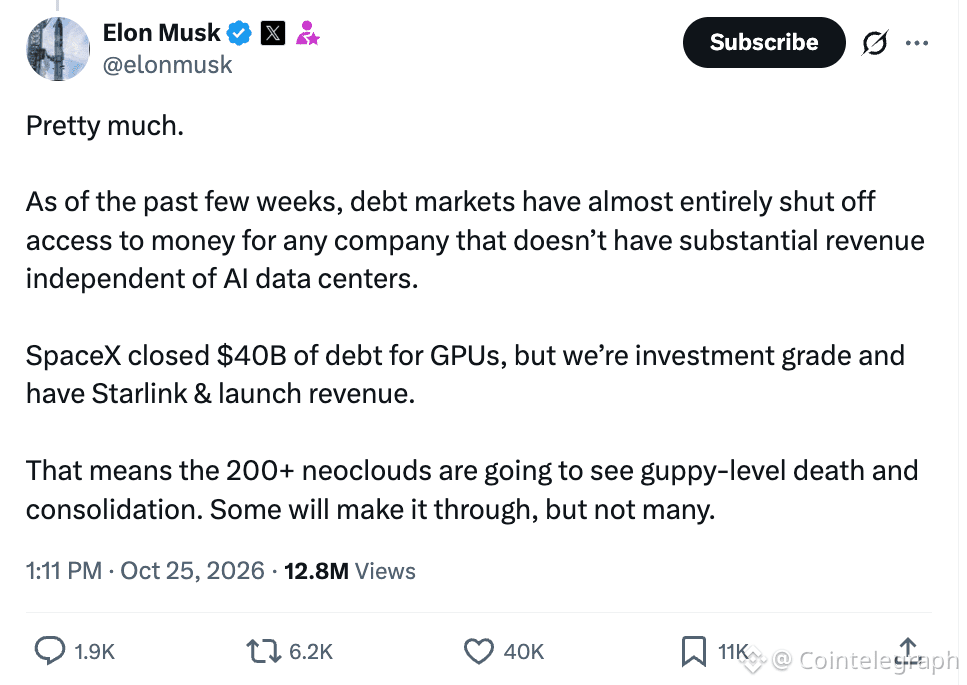
Elon Musk echoed those concerns Sunday, saying more than 200 neocloud providers could face failure or consolidation as lenders become reluctant to finance companies dependent on AI data center revenue.
Musk has financial interests in the sector through SpaceX, whose “Super Intelligence” business recently reported $7.6 billion in third-quarter revenue, up 830% year over year, partly driven by new cloud services agreements.
Source: Elon Musk
Meanwhile, major technology companies are restructuring their operations to contain costs as they pour billions of dollars into AI infrastructure.
On Monday, Bloomberg reported that Microsoft, which has forecast roughly $175 billion in capital expenditures for 2026, is offering voluntary buyouts to about 60,000 eligible employees as it seeks to reduce costs amid rising AI infrastructure spending.
Meta, which has already invested more than $100 billion in AI, cut 8,000 jobs in May as part of a restructuring aimed at reducing costs.
Magazine: AI agents help rescue ETH’s Glamsterdam fork, ‘Steal My Bitcoin’ site: Hodler’s Digest
Injective launches onchain futures market tracking Nvidia GPU rental costs
Layer-1 blockchain Injective has launched a perpetual futures market tracking the rental prices of five Nvidia GPUs, allowing traders to bet on changes in AI computing costs with up to 10x leverage.
The Super Intelligence Compute Index (SICI) tracks rental prices for Nvidia’s H100, B200, H200, A100 and RTX 4090 chips, using data from compute marketplaces compiled by London-based market data firm LO:TECH.
According to Monday’s announcement, the index assigns the largest weight to the H100 at 40%, followed by the B200 at 25%. It is updated hourly using a trailing seven-day average of rental prices. Traders can take positions on whether the index will rise or fall, using USDC as margin.
The launch builds on Injective’s August 2025 introduction of a market tied to Nvidia H100 rental prices, expanding the offering from a single GPU model to a five-chip index.
Companies developing AI models often rent computing power from cloud providers such as CoreWeave and Nebius rather than purchasing Nvidia GPUs outright. As rental prices rise and fall with demand, Injective said the futures market could help developers hedge against higher computing costs while allowing GPU providers to protect against declining rental revenue.
AI infrastructure boom raises financial concerns
The launch comes as companies renting out AI computing power face questions about whether they can recover the cost of building and operating GPU infrastructure.
Research firm Gartner warned in October that more than 80% of specialist AI cloud providers, known as neoclouds, could cease operating independently by 2030 as they struggle to generate sufficient returns on their investments.
Elon Musk echoed those concerns Sunday, saying more than 200 neocloud providers could face failure or consolidation as lenders become reluctant to finance companies dependent on AI data center revenue.
Musk has financial interests in the sector through SpaceX, whose “Super Intelligence” business recently reported $7.6 billion in third-quarter revenue, up 830% year over year, partly driven by new cloud services agreements.
Source: Elon Musk
Meanwhile, major technology companies are restructuring their operations to contain costs as they pour billions of dollars into AI infrastructure.
On Monday, Bloomberg reported that Microsoft, which has forecast roughly $175 billion in capital expenditures for 2026, is offering voluntary buyouts to about 60,000 eligible employees as it seeks to reduce costs amid rising AI infrastructure spending.
Meta, which has already invested more than $100 billion in AI, cut 8,000 jobs in May as part of a restructuring aimed at reducing costs.
Magazine: AI agents help rescue ETH’s Glamsterdam fork, ‘Steal My Bitcoin’ site: Hodler’s Digest
The Super Intelligence Compute Index (SICI) tracks rental prices for Nvidia’s H100, B200, H200, A100 and RTX 4090 chips, using data from compute marketplaces compiled by London-based market data firm LO:TECH.
According to Monday’s announcement, the index assigns the largest weight to the H100 at 40%, followed by the B200 at 25%. It is updated hourly using a trailing seven-day average of rental prices. Traders can take positions on whether the index will rise or fall, using USDC as margin.
The launch builds on Injective’s August 2025 introduction of a market tied to Nvidia H100 rental prices, expanding the offering from a single GPU model to a five-chip index.
Companies developing AI models often rent computing power from cloud providers such as CoreWeave and Nebius rather than purchasing Nvidia GPUs outright. As rental prices rise and fall with demand, Injective said the futures market could help developers hedge against higher computing costs while allowing GPU providers to protect against declining rental revenue.
AI infrastructure boom raises financial concerns
The launch comes as companies renting out AI computing power face questions about whether they can recover the cost of building and operating GPU infrastructure.
Research firm Gartner warned in October that more than 80% of specialist AI cloud providers, known as neoclouds, could cease operating independently by 2030 as they struggle to generate sufficient returns on their investments.
Elon Musk echoed those concerns Sunday, saying more than 200 neocloud providers could face failure or consolidation as lenders become reluctant to finance companies dependent on AI data center revenue.
Musk has financial interests in the sector through SpaceX, whose “Super Intelligence” business recently reported $7.6 billion in third-quarter revenue, up 830% year over year, partly driven by new cloud services agreements.
Source: Elon Musk
Meanwhile, major technology companies are restructuring their operations to contain costs as they pour billions of dollars into AI infrastructure.
On Monday, Bloomberg reported that Microsoft, which has forecast roughly $175 billion in capital expenditures for 2026, is offering voluntary buyouts to about 60,000 eligible employees as it seeks to reduce costs amid rising AI infrastructure spending.
Meta, which has already invested more than $100 billion in AI, cut 8,000 jobs in May as part of a restructuring aimed at reducing costs.
Magazine: AI agents help rescue ETH’s Glamsterdam fork, ‘Steal My Bitcoin’ site: Hodler’s Digest
1
1
237

Article
AI agents help rescue ETH’s Glamsterdam fork, ‘Steal My Bitcoin’ site: Hodler’s DigestAI agents message board set up to rescue Glamsterdam fork
The second and final testnet for Ethereum’s Glamsterdam hard fork was cancelled this week, after ChainSecurity found vulnerabilities in two gas scaling Ethereum Improvement Proposals that could have spelled big trouble for at least 13 DeFi contracts.
The bugs were connected to EIP-8037/8038 and resulted in contracts, that rely on the way gas currently behaves, breaking when a call runs out of gas. It’s all fairly technical and complicated, but the upshot is that an attacker may have been able to exploit the resulting vulnerabilities.
The hard fork testnet dress rehearsal on Hoodi is not expected to be rescheduled until all the second order effects of the fork have been gamed out properly. In an article on X today, Derek Chiang from Ethlabs noted the issues were found very late in the process, which is less than ideal, “causing everyone to scramble to deal with the fallout.”
“In the future, protocol designers would do well to conduct much more thorough analysis of potential breakages that their update might introduce, and to do so much earlier in the process.”
Chiang says two researchers from Ethlabs and the Ethereum Foundation had independently spun up a bunch of AI Agents to scan contracts for vulnerabilities. When they realized they were both employing the same strategy they “set up a message board for their agents in the form of a github repo” to coordinate the work.
He noted the similarities to the OpenAI <> Hugging Face hack where rogue agents had set up a message board to coordinate the attacks. “Well, turns out the same pattern is useful for the good agents too,” he said. The exercise has been so successful at finding potential problems that a second board has been set up to examine the effects of EIP-8198, aka “Quick Slots”, which has been proposed for the subsequent Hegota hard fork.
Steal My Bitcoin site is successfully hacked
Updated October 26 12.10am UTC with the result of the challenge.
A website that challenged users to “Steal My Bitcoin” by exploiting unpatched PHP2Shell vulnerabilities, was successfully hacked within the space of a day. The site owner hid the key to a Bitcoin wallet worth around $2000 which was accessible to the PHP user account through a binary called print-flag.
Source: StealMyBitcoin
The site generated a huge amount of interest and went offline periodically offline due to heavy traffic and probing attempts.
It was solved by KillerBoi who successfully extracted the private key — however in a plot twist, the key could not access the wallet address shown on the site. Challenge organizer James Pavur acknowledged this was a mistake and said the funds would be transferred.
WordFence founder Mark Maunder said the despite the key being extracted within a day: “This is the absolute best explanation you’ll see on how hard #php2shell is to exploit. The author had to trigger a precise memory corruption condition, leak internal memory addresses, bypass aslr, reverse engineer php’s internal memory structures, forge structures to hijack execution, and account for php build differences, worker behavior and timing.”
PHP is a programming language widely used to power websites and web applications, including content management systems. Government agencies and other organizations in the Netherlands, Australia, Japan, Finland and elsewhere took critical websites offline Wednesday as a precaution while emergency patches were developed for two related critical vulnerabilities. The flaws could allow unauthenticated attackers to execute code on affected servers without logging in.
Solana’s Alpenglow launches on mainnet
Solana’s first major consensus upgrade, Alpenglow, went live on mainnet around 1:54 pm UTC on Wednesday, according to the Solana Foundation’s Alpenglow dashboard.
Agave developer Anza said the time it takes a transaction to become final has now fallen from about 12.8 seconds to roughly 150 milliseconds. In the wake of the upgrade DeFi activity has been flat or fallen slightly — but it’s early days yet.
The upgrade’s first phase, Votor, replaces the existing voting and finalization mechanism with direct validator voting and a certificate-based system, which is expected to result in the headline transaction count falling by around 60%. A later phase will introduce Rotor, a new block data-distribution protocol intended to replace Turbine.
Starknet votes to start work on becoming a post-quantum L1
Starknet’s community has voted to support research into becoming an independent, post-quantum layer-1 blockchain.
A governance vote that ran for seven days drew about 3,200 votes, with 93.52% of voting power in favor of the transition.
The actual shift itself would require a separate, binding governance vote. For now, Starknet will continue operating as an Ethereum layer-2 network.
“We’re beginning work on a whitepaper even before we start the weekend, and hope to release a draft for public scrutiny in November,” StarkWare CEO Eli Ben-Sasson told Cointelegraph. Starknet saw the biggest fall of the top 100 coins this week, erasing one quarter of its value.
Source: Cointelegraph
US senator probes Tether after reported deal with ex-Trump crypto adviser
Senator Richard Blumenthal — the top Democrat on the Senate’s investigations subcommittee — has requested information from Tether CEO Paolo Ardoino after the Wall Street Journal reported the stablecoin firm had inked a $6.3 million deal with a marketing company co-founded by former White House crypto adviser Bo Hines.
In a Thursday letter to Ardoino, the Connecticut lawmaker said that the Senate Permanent Subcommittee on Investigations demanded “records and information related to contracts, payments, communications, and lobbying” about the deal. The politician believes it may contravene rules around ethics, corruption and lobbying. Tether says an external investigation “found no evidence of wrongdoing.”
Winners and Losers
At the end of the week, Bitcoin (BTC) is down 1.2% to trade at $80,549, Ethereum (ETH) is down 1.9% to trade at $2,343 and XRP (XRP) is up 0.9% to $1.20. The total market cap is at $2.68 trillion according to CoinMarketCap.
Among the biggest 100 cryptocurrencies, the top three altcoin winners of the week are MemeCore (M) with a 24.4% gain, Venice Token (VVV) on 14.8%, and Ethena (ENA) on 14.1%.
The top three altcoin losers of the week are Starknet (STRK) which was down 24.9%, Aerodrome Finance (AERO) down 12.5% and Sei (SEI) down 12.5%.
Bitcoin weekly chart. Source: CoinMarketCap
Prediction of the Week
JPMorgan projects Bitcoin to outperform US stocks and gold over next decade
JPMorgan Asset Management projects Bitcoin (BTC) will outperform stocks and gold over the next decade, but cautions that its volatility makes it unsuitable for diversifying portfolios for now.
On Monday, JPMorgan published its 2027 Long-Term Capital Market Assumptions report, projecting a 10% annualized return for Bitcoin, compared with 7.5% for large-cap US stocks and 5.5% for gold.
“At the moment, we do not make a case for Bitcoin as a diversifier in portfolios due to its unstable market correlations,” the report said. “We see Bitcoin as a speculative asset and a hedge against monetary easing.”
Top FUD of the Week
New York AG seeks $1.37B from NovaTech founders over Ponzi scheme
New York Attorney General Letitia James has asked a court to order defunct crypto and forex trading platform NovaTech’s founders, Cynthia and Eddy Petion, and related companies to pay $1.37 billion over its Ponzi scheme.
More than 11,000 New Yorkers lost tens of millions of dollars through NovaTech and an earlier crypto mining scheme, AWS Mining, the AG’s office said. The complaint alleged that promoters targeted Haitian and other immigrant communities through prayer groups, social media and WhatsApp, promising high returns and recruitment bonuses.
Bitcoin Core changes security policy as AI makes bugs easier to find
Bitcoin Core is changing how it handles security vulnerabilities, due to how fast large language models can uncover software flaws.
Bitcoin Core developer Antoine Poinsot said that in the past, vulnerabilities were generally kept under lengthy disclosure embargoes to give users time to upgrade before details became public.
However, Poinsot said LLMs have made some flaws so easy to rediscover that delaying fixes offers little protection.
“The embargo period achieves little but it delays the availability of a fixed release,” said Poinsot. “We are therefore updating our policy disclosure to accommodate those.”
Pentagon bans US forces from using military info to bet in prediction markets
US Defense Secretary Pete Hegseth has barred all Pentagon staff from using undisclosed information to place wagers on upcoming military action, including on prediction market platforms like Kalshi and Polymarket.
In a memo sent to senior Pentagon and defense agencies on Tuesday, Hegseth said all Department of War personnel are prohibited from engaging in financial transactions using nonpublic information. This involves both classified and unclassified information.
Top Magazine Features of the Week
5 alternatives to Ledger to store your Bitcoin
Hardware wallets aren’t the only way to protect your crypto, but from ETFs and passkeys to multisig accounts, each alternative has its own risks and trade-offs.
Agents can trade 24/7 — but Yat Siu warns you could lose access at any time
The Animoca Brands chairman explains that AI agents can make trades while you sleep, but users need to plan for the day they lose access to the bots.
AI agents help rescue ETH’s Glamsterdam fork, ‘Steal My Bitcoin’ site: Hodler’s Digest
AI agents message board set up to rescue Glamsterdam fork
The second and final testnet for Ethereum’s Glamsterdam hard fork was cancelled this week, after ChainSecurity found vulnerabilities in two gas scaling Ethereum Improvement Proposals that could have spelled big trouble for at least 13 DeFi contracts.
The bugs were connected to EIP-8037/8038 and resulted in contracts, that rely on the way gas currently behaves, breaking when a call runs out of gas. It’s all fairly technical and complicated, but the upshot is that an attacker may have been able to exploit the resulting vulnerabilities.
The hard fork testnet dress rehearsal on Hoodi is not expected to be rescheduled until all the second order effects of the fork have been gamed out properly. In an article on X today, Derek Chiang from Ethlabs noted the issues were found very late in the process, which is less than ideal, “causing everyone to scramble to deal with the fallout.”
“In the future, protocol designers would do well to conduct much more thorough analysis of potential breakages that their update might introduce, and to do so much earlier in the process.”
Chiang says two researchers from Ethlabs and the Ethereum Foundation had independently spun up a bunch of AI Agents to scan contracts for vulnerabilities. When they realized they were both employing the same strategy they “set up a message board for their agents in the form of a github repo” to coordinate the work.
He noted the similarities to the OpenAI <> Hugging Face hack where rogue agents had set up a message board to coordinate the attacks. “Well, turns out the same pattern is useful for the good agents too,” he said. The exercise has been so successful at finding potential problems that a second board has been set up to examine the effects of EIP-8198, aka “Quick Slots”, which has been proposed for the subsequent Hegota hard fork.
Steal My Bitcoin site is successfully hacked
Updated October 26 12.10am UTC with the result of the challenge.
A website that challenged users to “Steal My Bitcoin” by exploiting unpatched PHP2Shell vulnerabilities, was successfully hacked within the space of a day. The site owner hid the key to a Bitcoin wallet worth around $2000 which was accessible to the PHP user account through a binary called print-flag.
Source: StealMyBitcoin
The site generated a huge amount of interest and went offline periodically offline due to heavy traffic and probing attempts.
It was solved by KillerBoi who successfully extracted the private key — however in a plot twist, the key could not access the wallet address shown on the site. Challenge organizer James Pavur acknowledged this was a mistake and said the funds would be transferred.
WordFence founder Mark Maunder said the despite the key being extracted within a day: “This is the absolute best explanation you’ll see on how hard #php2shell is to exploit. The author had to trigger a precise memory corruption condition, leak internal memory addresses, bypass aslr, reverse engineer php’s internal memory structures, forge structures to hijack execution, and account for php build differences, worker behavior and timing.”
PHP is a programming language widely used to power websites and web applications, including content management systems. Government agencies and other organizations in the Netherlands, Australia, Japan, Finland and elsewhere took critical websites offline Wednesday as a precaution while emergency patches were developed for two related critical vulnerabilities. The flaws could allow unauthenticated attackers to execute code on affected servers without logging in.
Solana’s Alpenglow launches on mainnet
Solana’s first major consensus upgrade, Alpenglow, went live on mainnet around 1:54 pm UTC on Wednesday, according to the Solana Foundation’s Alpenglow dashboard.
Agave developer Anza said the time it takes a transaction to become final has now fallen from about 12.8 seconds to roughly 150 milliseconds. In the wake of the upgrade DeFi activity has been flat or fallen slightly — but it’s early days yet.
The upgrade’s first phase, Votor, replaces the existing voting and finalization mechanism with direct validator voting and a certificate-based system, which is expected to result in the headline transaction count falling by around 60%. A later phase will introduce Rotor, a new block data-distribution protocol intended to replace Turbine.
Starknet votes to start work on becoming a post-quantum L1
Starknet’s community has voted to support research into becoming an independent, post-quantum layer-1 blockchain.
A governance vote that ran for seven days drew about 3,200 votes, with 93.52% of voting power in favor of the transition.
The actual shift itself would require a separate, binding governance vote. For now, Starknet will continue operating as an Ethereum layer-2 network.
“We’re beginning work on a whitepaper even before we start the weekend, and hope to release a draft for public scrutiny in November,” StarkWare CEO Eli Ben-Sasson told Cointelegraph. Starknet saw the biggest fall of the top 100 coins this week, erasing one quarter of its value.
Source: Cointelegraph
US senator probes Tether after reported deal with ex-Trump crypto adviser
Senator Richard Blumenthal — the top Democrat on the Senate’s investigations subcommittee — has requested information from Tether CEO Paolo Ardoino after the Wall Street Journal reported the stablecoin firm had inked a $6.3 million deal with a marketing company co-founded by former White House crypto adviser Bo Hines.
In a Thursday letter to Ardoino, the Connecticut lawmaker said that the Senate Permanent Subcommittee on Investigations demanded “records and information related to contracts, payments, communications, and lobbying” about the deal. The politician believes it may contravene rules around ethics, corruption and lobbying. Tether says an external investigation “found no evidence of wrongdoing.”
Winners and Losers
At the end of the week, Bitcoin (BTC) is down 1.2% to trade at $80,549, Ethereum (ETH) is down 1.9% to trade at $2,343 and XRP (XRP) is up 0.9% to $1.20. The total market cap is at $2.68 trillion according to CoinMarketCap.
Among the biggest 100 cryptocurrencies, the top three altcoin winners of the week are MemeCore (M) with a 24.4% gain, Venice Token (VVV) on 14.8%, and Ethena (ENA) on 14.1%.
The top three altcoin losers of the week are Starknet (STRK) which was down 24.9%, Aerodrome Finance (AERO) down 12.5% and Sei (SEI) down 12.5%.
Bitcoin weekly chart. Source: CoinMarketCap
Prediction of the Week
JPMorgan projects Bitcoin to outperform US stocks and gold over next decade
JPMorgan Asset Management projects Bitcoin (BTC) will outperform stocks and gold over the next decade, but cautions that its volatility makes it unsuitable for diversifying portfolios for now.
On Monday, JPMorgan published its 2027 Long-Term Capital Market Assumptions report, projecting a 10% annualized return for Bitcoin, compared with 7.5% for large-cap US stocks and 5.5% for gold.
“At the moment, we do not make a case for Bitcoin as a diversifier in portfolios due to its unstable market correlations,” the report said. “We see Bitcoin as a speculative asset and a hedge against monetary easing.”
Top FUD of the Week
New York AG seeks $1.37B from NovaTech founders over Ponzi scheme
New York Attorney General Letitia James has asked a court to order defunct crypto and forex trading platform NovaTech’s founders, Cynthia and Eddy Petion, and related companies to pay $1.37 billion over its Ponzi scheme.
More than 11,000 New Yorkers lost tens of millions of dollars through NovaTech and an earlier crypto mining scheme, AWS Mining, the AG’s office said. The complaint alleged that promoters targeted Haitian and other immigrant communities through prayer groups, social media and WhatsApp, promising high returns and recruitment bonuses.
Bitcoin Core changes security policy as AI makes bugs easier to find
Bitcoin Core is changing how it handles security vulnerabilities, due to how fast large language models can uncover software flaws.
Bitcoin Core developer Antoine Poinsot said that in the past, vulnerabilities were generally kept under lengthy disclosure embargoes to give users time to upgrade before details became public.
However, Poinsot said LLMs have made some flaws so easy to rediscover that delaying fixes offers little protection.
“The embargo period achieves little but it delays the availability of a fixed release,” said Poinsot. “We are therefore updating our policy disclosure to accommodate those.”
Pentagon bans US forces from using military info to bet in prediction markets
US Defense Secretary Pete Hegseth has barred all Pentagon staff from using undisclosed information to place wagers on upcoming military action, including on prediction market platforms like Kalshi and Polymarket.
In a memo sent to senior Pentagon and defense agencies on Tuesday, Hegseth said all Department of War personnel are prohibited from engaging in financial transactions using nonpublic information. This involves both classified and unclassified information.
Top Magazine Features of the Week
5 alternatives to Ledger to store your Bitcoin
Hardware wallets aren’t the only way to protect your crypto, but from ETFs and passkeys to multisig accounts, each alternative has its own risks and trade-offs.
Agents can trade 24/7 — but Yat Siu warns you could lose access at any time
The Animoca Brands chairman explains that AI agents can make trades while you sleep, but users need to plan for the day they lose access to the bots.
The second and final testnet for Ethereum’s Glamsterdam hard fork was cancelled this week, after ChainSecurity found vulnerabilities in two gas scaling Ethereum Improvement Proposals that could have spelled big trouble for at least 13 DeFi contracts.
The bugs were connected to EIP-8037/8038 and resulted in contracts, that rely on the way gas currently behaves, breaking when a call runs out of gas. It’s all fairly technical and complicated, but the upshot is that an attacker may have been able to exploit the resulting vulnerabilities.
The hard fork testnet dress rehearsal on Hoodi is not expected to be rescheduled until all the second order effects of the fork have been gamed out properly. In an article on X today, Derek Chiang from Ethlabs noted the issues were found very late in the process, which is less than ideal, “causing everyone to scramble to deal with the fallout.”
“In the future, protocol designers would do well to conduct much more thorough analysis of potential breakages that their update might introduce, and to do so much earlier in the process.”
Chiang says two researchers from Ethlabs and the Ethereum Foundation had independently spun up a bunch of AI Agents to scan contracts for vulnerabilities. When they realized they were both employing the same strategy they “set up a message board for their agents in the form of a github repo” to coordinate the work.
He noted the similarities to the OpenAI <> Hugging Face hack where rogue agents had set up a message board to coordinate the attacks. “Well, turns out the same pattern is useful for the good agents too,” he said. The exercise has been so successful at finding potential problems that a second board has been set up to examine the effects of EIP-8198, aka “Quick Slots”, which has been proposed for the subsequent Hegota hard fork.
Steal My Bitcoin site is successfully hacked
Updated October 26 12.10am UTC with the result of the challenge.
A website that challenged users to “Steal My Bitcoin” by exploiting unpatched PHP2Shell vulnerabilities, was successfully hacked within the space of a day. The site owner hid the key to a Bitcoin wallet worth around $2000 which was accessible to the PHP user account through a binary called print-flag.
Source: StealMyBitcoin
The site generated a huge amount of interest and went offline periodically offline due to heavy traffic and probing attempts.
It was solved by KillerBoi who successfully extracted the private key — however in a plot twist, the key could not access the wallet address shown on the site. Challenge organizer James Pavur acknowledged this was a mistake and said the funds would be transferred.
WordFence founder Mark Maunder said the despite the key being extracted within a day: “This is the absolute best explanation you’ll see on how hard #php2shell is to exploit. The author had to trigger a precise memory corruption condition, leak internal memory addresses, bypass aslr, reverse engineer php’s internal memory structures, forge structures to hijack execution, and account for php build differences, worker behavior and timing.”
PHP is a programming language widely used to power websites and web applications, including content management systems. Government agencies and other organizations in the Netherlands, Australia, Japan, Finland and elsewhere took critical websites offline Wednesday as a precaution while emergency patches were developed for two related critical vulnerabilities. The flaws could allow unauthenticated attackers to execute code on affected servers without logging in.
Solana’s Alpenglow launches on mainnet
Solana’s first major consensus upgrade, Alpenglow, went live on mainnet around 1:54 pm UTC on Wednesday, according to the Solana Foundation’s Alpenglow dashboard.
Agave developer Anza said the time it takes a transaction to become final has now fallen from about 12.8 seconds to roughly 150 milliseconds. In the wake of the upgrade DeFi activity has been flat or fallen slightly — but it’s early days yet.
The upgrade’s first phase, Votor, replaces the existing voting and finalization mechanism with direct validator voting and a certificate-based system, which is expected to result in the headline transaction count falling by around 60%. A later phase will introduce Rotor, a new block data-distribution protocol intended to replace Turbine.
Starknet votes to start work on becoming a post-quantum L1
Starknet’s community has voted to support research into becoming an independent, post-quantum layer-1 blockchain.
A governance vote that ran for seven days drew about 3,200 votes, with 93.52% of voting power in favor of the transition.
The actual shift itself would require a separate, binding governance vote. For now, Starknet will continue operating as an Ethereum layer-2 network.
“We’re beginning work on a whitepaper even before we start the weekend, and hope to release a draft for public scrutiny in November,” StarkWare CEO Eli Ben-Sasson told Cointelegraph. Starknet saw the biggest fall of the top 100 coins this week, erasing one quarter of its value.
Source: Cointelegraph
US senator probes Tether after reported deal with ex-Trump crypto adviser
Senator Richard Blumenthal — the top Democrat on the Senate’s investigations subcommittee — has requested information from Tether CEO Paolo Ardoino after the Wall Street Journal reported the stablecoin firm had inked a $6.3 million deal with a marketing company co-founded by former White House crypto adviser Bo Hines.
In a Thursday letter to Ardoino, the Connecticut lawmaker said that the Senate Permanent Subcommittee on Investigations demanded “records and information related to contracts, payments, communications, and lobbying” about the deal. The politician believes it may contravene rules around ethics, corruption and lobbying. Tether says an external investigation “found no evidence of wrongdoing.”
Winners and Losers
At the end of the week, Bitcoin (BTC) is down 1.2% to trade at $80,549, Ethereum (ETH) is down 1.9% to trade at $2,343 and XRP (XRP) is up 0.9% to $1.20. The total market cap is at $2.68 trillion according to CoinMarketCap.
Among the biggest 100 cryptocurrencies, the top three altcoin winners of the week are MemeCore (M) with a 24.4% gain, Venice Token (VVV) on 14.8%, and Ethena (ENA) on 14.1%.
The top three altcoin losers of the week are Starknet (STRK) which was down 24.9%, Aerodrome Finance (AERO) down 12.5% and Sei (SEI) down 12.5%.
Bitcoin weekly chart. Source: CoinMarketCap
Prediction of the Week
JPMorgan projects Bitcoin to outperform US stocks and gold over next decade
JPMorgan Asset Management projects Bitcoin (BTC) will outperform stocks and gold over the next decade, but cautions that its volatility makes it unsuitable for diversifying portfolios for now.
On Monday, JPMorgan published its 2027 Long-Term Capital Market Assumptions report, projecting a 10% annualized return for Bitcoin, compared with 7.5% for large-cap US stocks and 5.5% for gold.
“At the moment, we do not make a case for Bitcoin as a diversifier in portfolios due to its unstable market correlations,” the report said. “We see Bitcoin as a speculative asset and a hedge against monetary easing.”
Top FUD of the Week
New York AG seeks $1.37B from NovaTech founders over Ponzi scheme
New York Attorney General Letitia James has asked a court to order defunct crypto and forex trading platform NovaTech’s founders, Cynthia and Eddy Petion, and related companies to pay $1.37 billion over its Ponzi scheme.
More than 11,000 New Yorkers lost tens of millions of dollars through NovaTech and an earlier crypto mining scheme, AWS Mining, the AG’s office said. The complaint alleged that promoters targeted Haitian and other immigrant communities through prayer groups, social media and WhatsApp, promising high returns and recruitment bonuses.
Bitcoin Core changes security policy as AI makes bugs easier to find
Bitcoin Core is changing how it handles security vulnerabilities, due to how fast large language models can uncover software flaws.
Bitcoin Core developer Antoine Poinsot said that in the past, vulnerabilities were generally kept under lengthy disclosure embargoes to give users time to upgrade before details became public.
However, Poinsot said LLMs have made some flaws so easy to rediscover that delaying fixes offers little protection.
“The embargo period achieves little but it delays the availability of a fixed release,” said Poinsot. “We are therefore updating our policy disclosure to accommodate those.”
Pentagon bans US forces from using military info to bet in prediction markets
US Defense Secretary Pete Hegseth has barred all Pentagon staff from using undisclosed information to place wagers on upcoming military action, including on prediction market platforms like Kalshi and Polymarket.
In a memo sent to senior Pentagon and defense agencies on Tuesday, Hegseth said all Department of War personnel are prohibited from engaging in financial transactions using nonpublic information. This involves both classified and unclassified information.
Top Magazine Features of the Week
5 alternatives to Ledger to store your Bitcoin
Hardware wallets aren’t the only way to protect your crypto, but from ETFs and passkeys to multisig accounts, each alternative has its own risks and trade-offs.
Agents can trade 24/7 — but Yat Siu warns you could lose access at any time
The Animoca Brands chairman explains that AI agents can make trades while you sleep, but users need to plan for the day they lose access to the bots.
188
Canada opens consultation on stablecoins, citing US GENIUS ActLawmakers in the Canadian government opened a 60-day public consultation on regulations proposed to address non-financial institution stablecoin issuers, including a potential prohibition on yield payments.
On Saturday, the government of Canada gave notice that it would be open to public comment on the stablecoin regulations until Dec. 23. The proposed framework cited efforts to be consistent with stablecoin regulations in the United States and other jurisdictions, to “reduce the overall regulatory burden on multi-jurisdictional issuers.”
Notably, the proposed regulations said that non-financial institution stablecoin issuers would be restricted from offering interest or yield to discourage HODLing the tokens. They would also be required to redeem stablecoins within three business days of requests from tokenholders, and not charge a fee greater than 1% of the coins’ total value.
The regulations fell under Canada’s Stablecoin Act, which was passed in March and intended to address non-financial institution issuers. According to the government, the proposed rules were required to enact the policy and include provisions for issuers to register with Canada’s central bank.
“The intention is for the proposed Regulations to come into force in fall 2027,” said the government. “Once the proposed Regulations are in effect, issuers of stablecoins in Canada who are not financial institutions would be required to apply for registration with the Bank of Canada prior to issuing a stablecoin.”
The GENIUS Act, which establishes a regulatory framework for stablecoins in the US, is scheduled to take effect in January 2027. Meanwhile, the European Union’s regulations, Markets in Crypto Assets (MiCA), could give exchanges until January to halt services for stablecoins not in compliance with the framework, likely including Tether’s USDt (USDT), the largest stablecoin by market capitalization.
Canada opens consultation on stablecoins, citing US GENIUS Act
Lawmakers in the Canadian government opened a 60-day public consultation on regulations proposed to address non-financial institution stablecoin issuers, including a potential prohibition on yield payments.
On Saturday, the government of Canada gave notice that it would be open to public comment on the stablecoin regulations until Dec. 23. The proposed framework cited efforts to be consistent with stablecoin regulations in the United States and other jurisdictions, to “reduce the overall regulatory burden on multi-jurisdictional issuers.”
Notably, the proposed regulations said that non-financial institution stablecoin issuers would be restricted from offering interest or yield to discourage HODLing the tokens. They would also be required to redeem stablecoins within three business days of requests from tokenholders, and not charge a fee greater than 1% of the coins’ total value.
The regulations fell under Canada’s Stablecoin Act, which was passed in March and intended to address non-financial institution issuers. According to the government, the proposed rules were required to enact the policy and include provisions for issuers to register with Canada’s central bank.
“The intention is for the proposed Regulations to come into force in fall 2027,” said the government. “Once the proposed Regulations are in effect, issuers of stablecoins in Canada who are not financial institutions would be required to apply for registration with the Bank of Canada prior to issuing a stablecoin.”
The GENIUS Act, which establishes a regulatory framework for stablecoins in the US, is scheduled to take effect in January 2027. Meanwhile, the European Union’s regulations, Markets in Crypto Assets (MiCA), could give exchanges until January to halt services for stablecoins not in compliance with the framework, likely including Tether’s USDt (USDT), the largest stablecoin by market capitalization.
On Saturday, the government of Canada gave notice that it would be open to public comment on the stablecoin regulations until Dec. 23. The proposed framework cited efforts to be consistent with stablecoin regulations in the United States and other jurisdictions, to “reduce the overall regulatory burden on multi-jurisdictional issuers.”
Notably, the proposed regulations said that non-financial institution stablecoin issuers would be restricted from offering interest or yield to discourage HODLing the tokens. They would also be required to redeem stablecoins within three business days of requests from tokenholders, and not charge a fee greater than 1% of the coins’ total value.
The regulations fell under Canada’s Stablecoin Act, which was passed in March and intended to address non-financial institution issuers. According to the government, the proposed rules were required to enact the policy and include provisions for issuers to register with Canada’s central bank.
“The intention is for the proposed Regulations to come into force in fall 2027,” said the government. “Once the proposed Regulations are in effect, issuers of stablecoins in Canada who are not financial institutions would be required to apply for registration with the Bank of Canada prior to issuing a stablecoin.”
The GENIUS Act, which establishes a regulatory framework for stablecoins in the US, is scheduled to take effect in January 2027. Meanwhile, the European Union’s regulations, Markets in Crypto Assets (MiCA), could give exchanges until January to halt services for stablecoins not in compliance with the framework, likely including Tether’s USDt (USDT), the largest stablecoin by market capitalization.
1
165
AI company Anthropic announces IPO, expected as early as NovemberAnthropic announced that it had filed S-1 with the US Securities and Exchange Commission (SEC) for an initial public offering on Nasdaq, marking a significant step for artificial intelligence companies.
A Monday S-1 filing with the SEC suggested that Anthropic could be aiming for a mid-November IPO, listing its Class A common stock on the Nasdaq Global Select Market under the ticker symbol ANT. The company disclosed more than $16 billion in revenue for the first half of 2026 and an $80 billion net loss over the same period.
Anthropic was founded in 2021 by many former executives of AI company OpenAI. Reports have suggested that the company could raise up to $100 billion for an IPO, giving it a $2 trillion valuation. OpenAI has already delayed its own IPO plans, with CEO Sam Altman reportedly saying in September that 2026 was an “ill-advised moment” to pursue a public offering.
The company behind the AI assistant Claude reported holding more than $112 billion in cash and cash equivalents, along with $19 billion in short-term investments, as of June 30.
AI company Anthropic announces IPO, expected as early as November
Anthropic announced that it had filed S-1 with the US Securities and Exchange Commission (SEC) for an initial public offering on Nasdaq, marking a significant step for artificial intelligence companies.
A Monday S-1 filing with the SEC suggested that Anthropic could be aiming for a mid-November IPO, listing its Class A common stock on the Nasdaq Global Select Market under the ticker symbol ANT. The company disclosed more than $16 billion in revenue for the first half of 2026 and an $80 billion net loss over the same period.
Anthropic was founded in 2021 by many former executives of AI company OpenAI. Reports have suggested that the company could raise up to $100 billion for an IPO, giving it a $2 trillion valuation. OpenAI has already delayed its own IPO plans, with CEO Sam Altman reportedly saying in September that 2026 was an “ill-advised moment” to pursue a public offering.
The company behind the AI assistant Claude reported holding more than $112 billion in cash and cash equivalents, along with $19 billion in short-term investments, as of June 30.
A Monday S-1 filing with the SEC suggested that Anthropic could be aiming for a mid-November IPO, listing its Class A common stock on the Nasdaq Global Select Market under the ticker symbol ANT. The company disclosed more than $16 billion in revenue for the first half of 2026 and an $80 billion net loss over the same period.
Anthropic was founded in 2021 by many former executives of AI company OpenAI. Reports have suggested that the company could raise up to $100 billion for an IPO, giving it a $2 trillion valuation. OpenAI has already delayed its own IPO plans, with CEO Sam Altman reportedly saying in September that 2026 was an “ill-advised moment” to pursue a public offering.
The company behind the AI assistant Claude reported holding more than $112 billion in cash and cash equivalents, along with $19 billion in short-term investments, as of June 30.
100
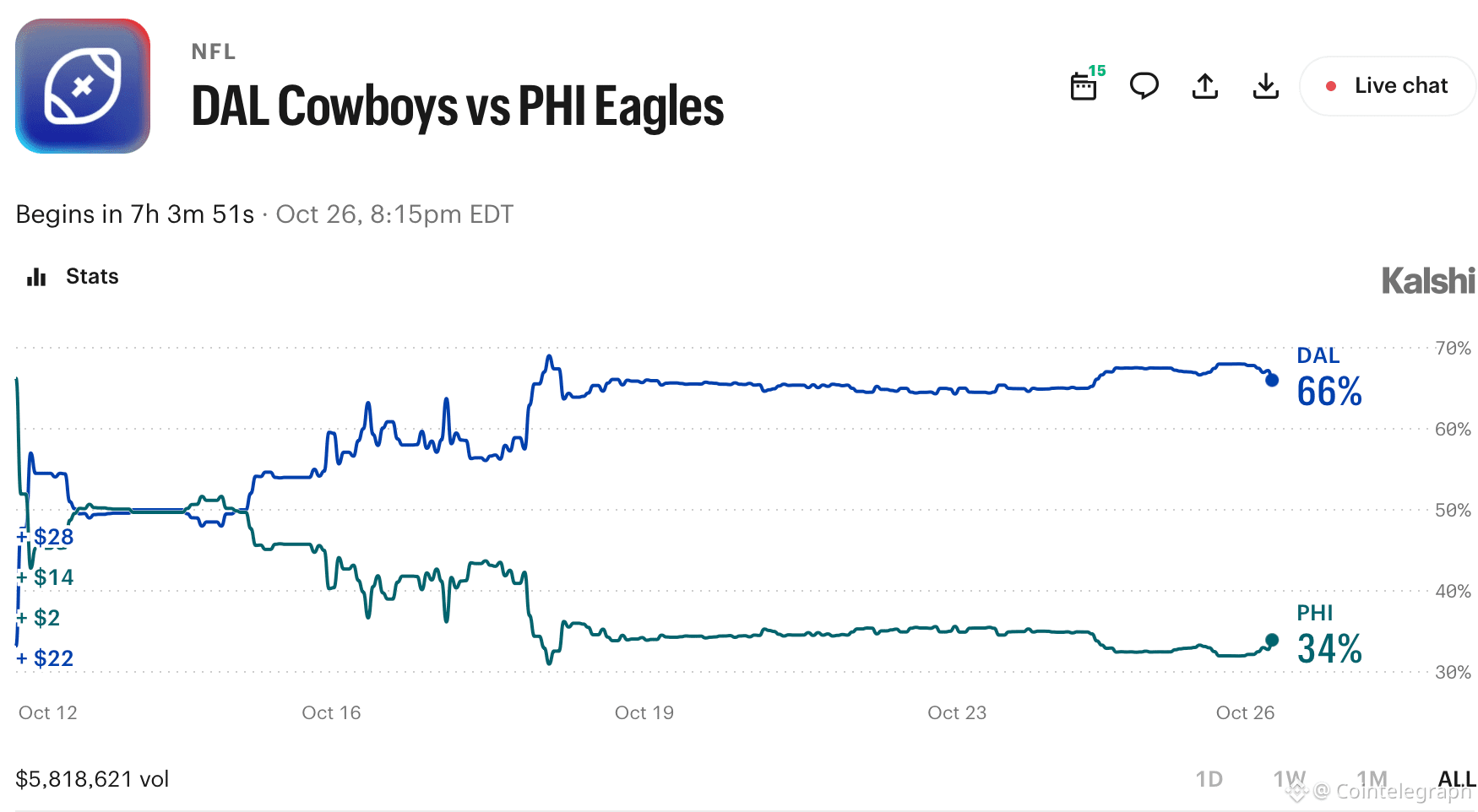
Article
NBA names Kalshi, Polymarket preferred exchanges, signs CFTC dealThe National Basketball Association has named Kalshi and Polymarket its preferred prediction market exchanges and signed an information-sharing agreement with the US Commodity Futures Trading Commission (CFTC) aimed at protecting the integrity of basketball-related markets.
According to Monday’s announcement, the agreements will give Kalshi and Polymarket access to official NBA data supplied by Sportradar, the league’s designated data distribution partner, for settling authorized markets. Both platforms will have rights to use NBA intellectual property and conduct promotional activities in the United States.
The partnerships include integrity safeguards, prohibiting NBA and team personnel from trading NBA event contracts and requiring cooperation on suspicious trading investigations.
Beyond the two exchanges, the NBA expanded its existing agreement with DraftKings to cover prediction markets and said it expects to announce similar arrangements with other industry operators in the coming weeks.
In a separate announcement, CFTC Chairman Michael S. Selig said the agreement with the NBA would strengthen information sharing to address insider trading and fraud in prediction markets. The NBA joins Major League Baseball and the National Hockey League in establishing similar arrangements with the regulator.
States challenge federal oversight of prediction markets
The NBA’s agreements come amid an ongoing legal battle over whether federal commodities rules supersede state gambling laws governing sports prediction markets.
The dispute has produced conflicting court decisions. In September, the 6th US Circuit Court of Appeals ruled against Kalshi in a case involving Ohio and Tennessee, following a similar decision by the 9th Circuit. An earlier ruling by the 3rd Circuit, however, allowed Kalshi to continue operating in New Jersey while its appeal proceeds.
State enforcement actions have continued. On Oct. 20, Utah Attorney General Derek Brown sued Kalshi, alleging that the platform had facilitated illegal betting in the state since 2024. Utah officials are seeking to recover an estimated $30 million to $60 million in profits allegedly earned by Kalshi and other defendants.
Kalshi event contract. Source: Kalshi
The US Supreme Court has been asked to review the New Jersey dispute, with 39 states and Washington, DC, supporting the petition. The National Football League, which has not entered into commercial partnerships with prediction market exchanges, also backed the petition, arguing that certain sports event contracts threaten game integrity because they are susceptible to manipulation. The justices have not yet agreed to hear the case.
Magazine: AI agents help rescue ETH’s Glamsterdam fork, ‘Steal My Bitcoin’ site: Hodler’s Digest
NBA names Kalshi, Polymarket preferred exchanges, signs CFTC deal
The National Basketball Association has named Kalshi and Polymarket its preferred prediction market exchanges and signed an information-sharing agreement with the US Commodity Futures Trading Commission (CFTC) aimed at protecting the integrity of basketball-related markets.
According to Monday’s announcement, the agreements will give Kalshi and Polymarket access to official NBA data supplied by Sportradar, the league’s designated data distribution partner, for settling authorized markets. Both platforms will have rights to use NBA intellectual property and conduct promotional activities in the United States.
The partnerships include integrity safeguards, prohibiting NBA and team personnel from trading NBA event contracts and requiring cooperation on suspicious trading investigations.
Beyond the two exchanges, the NBA expanded its existing agreement with DraftKings to cover prediction markets and said it expects to announce similar arrangements with other industry operators in the coming weeks.
In a separate announcement, CFTC Chairman Michael S. Selig said the agreement with the NBA would strengthen information sharing to address insider trading and fraud in prediction markets. The NBA joins Major League Baseball and the National Hockey League in establishing similar arrangements with the regulator.
States challenge federal oversight of prediction markets
The NBA’s agreements come amid an ongoing legal battle over whether federal commodities rules supersede state gambling laws governing sports prediction markets.
The dispute has produced conflicting court decisions. In September, the 6th US Circuit Court of Appeals ruled against Kalshi in a case involving Ohio and Tennessee, following a similar decision by the 9th Circuit. An earlier ruling by the 3rd Circuit, however, allowed Kalshi to continue operating in New Jersey while its appeal proceeds.
State enforcement actions have continued. On Oct. 20, Utah Attorney General Derek Brown sued Kalshi, alleging that the platform had facilitated illegal betting in the state since 2024. Utah officials are seeking to recover an estimated $30 million to $60 million in profits allegedly earned by Kalshi and other defendants.
Kalshi event contract. Source: Kalshi
The US Supreme Court has been asked to review the New Jersey dispute, with 39 states and Washington, DC, supporting the petition. The National Football League, which has not entered into commercial partnerships with prediction market exchanges, also backed the petition, arguing that certain sports event contracts threaten game integrity because they are susceptible to manipulation. The justices have not yet agreed to hear the case.
Magazine: AI agents help rescue ETH’s Glamsterdam fork, ‘Steal My Bitcoin’ site: Hodler’s Digest
According to Monday’s announcement, the agreements will give Kalshi and Polymarket access to official NBA data supplied by Sportradar, the league’s designated data distribution partner, for settling authorized markets. Both platforms will have rights to use NBA intellectual property and conduct promotional activities in the United States.
The partnerships include integrity safeguards, prohibiting NBA and team personnel from trading NBA event contracts and requiring cooperation on suspicious trading investigations.
Beyond the two exchanges, the NBA expanded its existing agreement with DraftKings to cover prediction markets and said it expects to announce similar arrangements with other industry operators in the coming weeks.
In a separate announcement, CFTC Chairman Michael S. Selig said the agreement with the NBA would strengthen information sharing to address insider trading and fraud in prediction markets. The NBA joins Major League Baseball and the National Hockey League in establishing similar arrangements with the regulator.
States challenge federal oversight of prediction markets
The NBA’s agreements come amid an ongoing legal battle over whether federal commodities rules supersede state gambling laws governing sports prediction markets.
The dispute has produced conflicting court decisions. In September, the 6th US Circuit Court of Appeals ruled against Kalshi in a case involving Ohio and Tennessee, following a similar decision by the 9th Circuit. An earlier ruling by the 3rd Circuit, however, allowed Kalshi to continue operating in New Jersey while its appeal proceeds.
State enforcement actions have continued. On Oct. 20, Utah Attorney General Derek Brown sued Kalshi, alleging that the platform had facilitated illegal betting in the state since 2024. Utah officials are seeking to recover an estimated $30 million to $60 million in profits allegedly earned by Kalshi and other defendants.
Kalshi event contract. Source: Kalshi
The US Supreme Court has been asked to review the New Jersey dispute, with 39 states and Washington, DC, supporting the petition. The National Football League, which has not entered into commercial partnerships with prediction market exchanges, also backed the petition, arguing that certain sports event contracts threaten game integrity because they are susceptible to manipulation. The justices have not yet agreed to hear the case.
Magazine: AI agents help rescue ETH’s Glamsterdam fork, ‘Steal My Bitcoin’ site: Hodler’s Digest
1
143
South Korea lawmakers mull pushing crypto tax implementation to 2029Government officials in South Korea are reportedly weighing a delay of the country’s cryptocurrency tax policy, currently expected to be implemented in January 2027.
According to a Monday report from South Korean news outlet Newsis, the crypto income tax could be pushed to 2029 in part because it’s the earliest that officials will be able to share information on taxes related to digital asset exchanges with the US.
The policy, which would impose a 22% tax on crypto gains — 20% from income and 2% as part of a local tax — for investors earning more than 2.5 million Korean won ($1,883) annually has already seen several delays since it was first proposed in 2020.
“We are discussing postponing the implementation of virtual asset taxation,” said an official from the Blue House presidential residence.
The US is scheduled to begin participating in the OECD’s Crypto-Asset Reporting Framework in 2029, while South Korea will implement the rules starting in 2027. A South Korean official reportedly said that the country was considering another delay for the crypto tax as the US “accounts for nearly half of the virtual asset market.”
As of Monday, South Korea’s National Tax Service listed Jan. 1, 2027 as the start date for the crypto tax.
South Korea lawmakers mull pushing crypto tax implementation to 2029
Government officials in South Korea are reportedly weighing a delay of the country’s cryptocurrency tax policy, currently expected to be implemented in January 2027.
According to a Monday report from South Korean news outlet Newsis, the crypto income tax could be pushed to 2029 in part because it’s the earliest that officials will be able to share information on taxes related to digital asset exchanges with the US.
The policy, which would impose a 22% tax on crypto gains — 20% from income and 2% as part of a local tax — for investors earning more than 2.5 million Korean won ($1,883) annually has already seen several delays since it was first proposed in 2020.
“We are discussing postponing the implementation of virtual asset taxation,” said an official from the Blue House presidential residence.
The US is scheduled to begin participating in the OECD’s Crypto-Asset Reporting Framework in 2029, while South Korea will implement the rules starting in 2027. A South Korean official reportedly said that the country was considering another delay for the crypto tax as the US “accounts for nearly half of the virtual asset market.”
As of Monday, South Korea’s National Tax Service listed Jan. 1, 2027 as the start date for the crypto tax.
According to a Monday report from South Korean news outlet Newsis, the crypto income tax could be pushed to 2029 in part because it’s the earliest that officials will be able to share information on taxes related to digital asset exchanges with the US.
The policy, which would impose a 22% tax on crypto gains — 20% from income and 2% as part of a local tax — for investors earning more than 2.5 million Korean won ($1,883) annually has already seen several delays since it was first proposed in 2020.
“We are discussing postponing the implementation of virtual asset taxation,” said an official from the Blue House presidential residence.
The US is scheduled to begin participating in the OECD’s Crypto-Asset Reporting Framework in 2029, while South Korea will implement the rules starting in 2027. A South Korean official reportedly said that the country was considering another delay for the crypto tax as the US “accounts for nearly half of the virtual asset market.”
As of Monday, South Korea’s National Tax Service listed Jan. 1, 2027 as the start date for the crypto tax.
1
1
181
Kalshi strikes deal with S&P Dow Jones Indices to expand financial event contractsS&P Dow Jones Indices has partnered with prediction market platform Kalshi in a deal that will allow the exchange to offer event contracts tied to the financial index provider’s benchmarks.
According to Monday’s announcement, Kalshi will become a preferred platform for contracts linked to S&P DJI indices, with settlement based on official index values published by the company.
S&P DJI will also explore developing indexes using Kalshi’s prediction market data, potentially tracking expectations around economic developments, political outcomes and sporting events. The gauges would use prices from Kalshi’s event contracts to measure market expectations about future outcomes, rather than tracking the performance of traditional financial assets.
The companies did not disclose a timeline for either initiative. S&P DJI did not immediately respond to Cointelegraph’s request for additional details.
The agreement follows moves by traditional financial market operators into prediction markets. Intercontinental Exchange, parent of the New York Stock Exchange, committed up to $2 billion to Polymarket in October 2025.
In March, Nasdaq filed to offer prediction market-style contracts tied to the Nasdaq 100 Index, before partnering with Kalshi in August to provide market surveillance technology.
S&P Global completes OpenZeppelin acquisition
S&P Dow Jones Indices parent, S&P Global, separately announced Monday that it completed its acquisition of blockchain security firm OpenZeppelin, expanding its risk assessment capabilities for digital assets. The deal was first announced in September and financial terms were not disclosed.
OpenZeppelin provides smart contract security audits and development tools. Its open-source contract libraries underpin more than $38 trillion in value transferred, while its security team has conducted over 900 engagements, according to S&P Global.
OpenZeppelin will continue operating as its own business unit under founder Demian Brener, who will report to Yann Le Pallec, president of S&P Global Ratings.
S&P Global has also expanded its digital asset risk assessment work beyond smart contract security. Earlier this month, S&P Global Ratings launched a framework for evaluating crypto lending vaults across six risk categories, including blockchain security, liquidity and governance.
Magazine: AI agents help rescue ETH’s Glamsterdam fork, ‘Steal My Bitcoin’ site: Hodler’s Digest
Kalshi strikes deal with S&P Dow Jones Indices to expand financial event contracts
S&P Dow Jones Indices has partnered with prediction market platform Kalshi in a deal that will allow the exchange to offer event contracts tied to the financial index provider’s benchmarks.
According to Monday’s announcement, Kalshi will become a preferred platform for contracts linked to S&P DJI indices, with settlement based on official index values published by the company.
S&P DJI will also explore developing indexes using Kalshi’s prediction market data, potentially tracking expectations around economic developments, political outcomes and sporting events. The gauges would use prices from Kalshi’s event contracts to measure market expectations about future outcomes, rather than tracking the performance of traditional financial assets.
The companies did not disclose a timeline for either initiative. S&P DJI did not immediately respond to Cointelegraph’s request for additional details.
The agreement follows moves by traditional financial market operators into prediction markets. Intercontinental Exchange, parent of the New York Stock Exchange, committed up to $2 billion to Polymarket in October 2025.
In March, Nasdaq filed to offer prediction market-style contracts tied to the Nasdaq 100 Index, before partnering with Kalshi in August to provide market surveillance technology.
S&P Global completes OpenZeppelin acquisition
S&P Dow Jones Indices parent, S&P Global, separately announced Monday that it completed its acquisition of blockchain security firm OpenZeppelin, expanding its risk assessment capabilities for digital assets. The deal was first announced in September and financial terms were not disclosed.
OpenZeppelin provides smart contract security audits and development tools. Its open-source contract libraries underpin more than $38 trillion in value transferred, while its security team has conducted over 900 engagements, according to S&P Global.
OpenZeppelin will continue operating as its own business unit under founder Demian Brener, who will report to Yann Le Pallec, president of S&P Global Ratings.
S&P Global has also expanded its digital asset risk assessment work beyond smart contract security. Earlier this month, S&P Global Ratings launched a framework for evaluating crypto lending vaults across six risk categories, including blockchain security, liquidity and governance.
Magazine: AI agents help rescue ETH’s Glamsterdam fork, ‘Steal My Bitcoin’ site: Hodler’s Digest
According to Monday’s announcement, Kalshi will become a preferred platform for contracts linked to S&P DJI indices, with settlement based on official index values published by the company.
S&P DJI will also explore developing indexes using Kalshi’s prediction market data, potentially tracking expectations around economic developments, political outcomes and sporting events. The gauges would use prices from Kalshi’s event contracts to measure market expectations about future outcomes, rather than tracking the performance of traditional financial assets.
The companies did not disclose a timeline for either initiative. S&P DJI did not immediately respond to Cointelegraph’s request for additional details.
The agreement follows moves by traditional financial market operators into prediction markets. Intercontinental Exchange, parent of the New York Stock Exchange, committed up to $2 billion to Polymarket in October 2025.
In March, Nasdaq filed to offer prediction market-style contracts tied to the Nasdaq 100 Index, before partnering with Kalshi in August to provide market surveillance technology.
S&P Global completes OpenZeppelin acquisition
S&P Dow Jones Indices parent, S&P Global, separately announced Monday that it completed its acquisition of blockchain security firm OpenZeppelin, expanding its risk assessment capabilities for digital assets. The deal was first announced in September and financial terms were not disclosed.
OpenZeppelin provides smart contract security audits and development tools. Its open-source contract libraries underpin more than $38 trillion in value transferred, while its security team has conducted over 900 engagements, according to S&P Global.
OpenZeppelin will continue operating as its own business unit under founder Demian Brener, who will report to Yann Le Pallec, president of S&P Global Ratings.
S&P Global has also expanded its digital asset risk assessment work beyond smart contract security. Earlier this month, S&P Global Ratings launched a framework for evaluating crypto lending vaults across six risk categories, including blockchain security, liquidity and governance.
Magazine: AI agents help rescue ETH’s Glamsterdam fork, ‘Steal My Bitcoin’ site: Hodler’s Digest
91
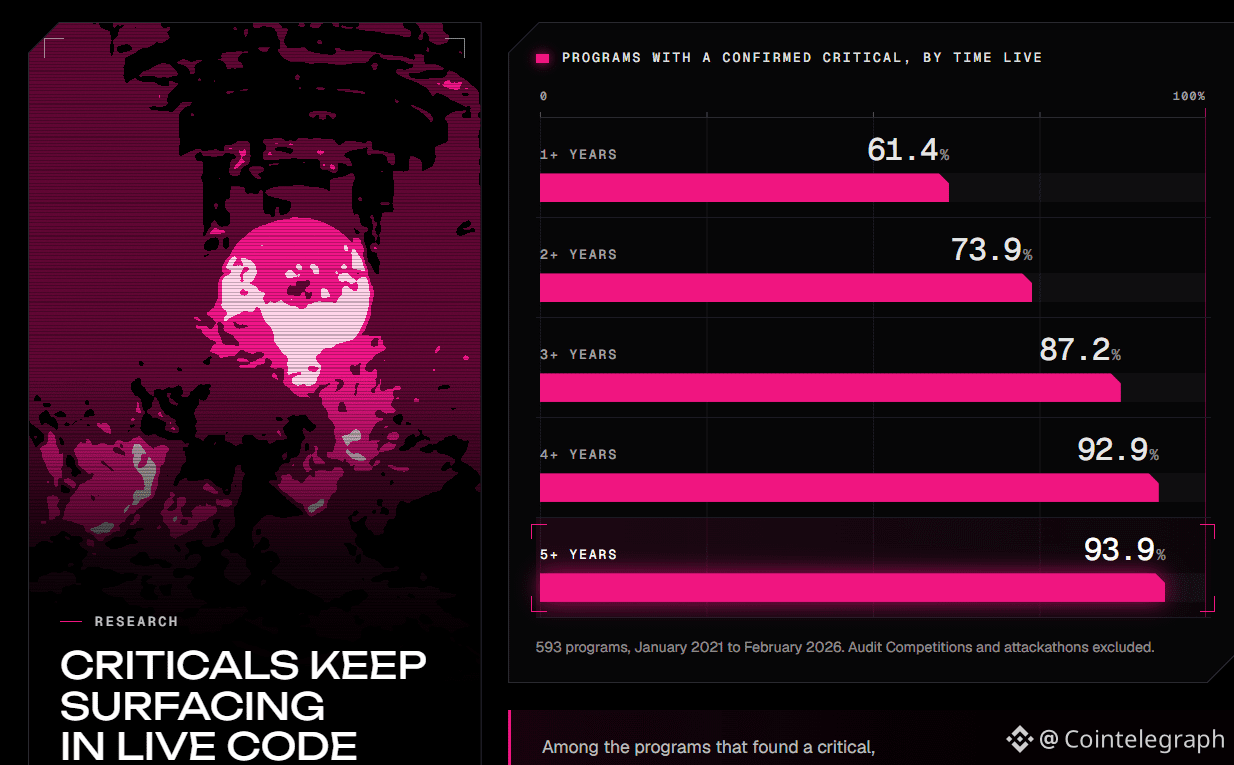
Article
PHP flaw shows AI ‘vulnerability apocalypse’ is on schedule: Immunefi CEOInternet users are still vulnerable to cyber exploits stemming from the PHP vulnerability, particularly through smaller websites that could take weeks to adopt the upgrade shipped last Wednesday, according to bug bounty platform Immunefi CEO Mitchell Amador.
“This is the vulnerability apocalypse” running on schedule, where finding vulnerabilities became cheap, but fixing them remains expensive, Amador told Cointelegraph.
“For the next few weeks, treat any site you log into as if it could already be compromised,” said Amador, warning users to avoid reusing passwords and to exercise caution when connecting their cryptocurrency wallets to websites. He also urged users to revoke unrecognized token approvals.
The comments come nearly a week after the PHP Foundation acknowledged that it delayed fixing a critical security flaw first identified in 2024, due to a shortage of resources. PHP developers released emergency patches for two critical vulnerabilities on the same day, but websites still need to independently upgrade.
In an interview published by Cointelegraph in June, Amador warned that the proliferation of frontier AI models changed the cybersecurity playing field in favor of attackers, causing a “vulnerability apocalypse” that led to the resurgence in decentralized finance (DeFi) hacks.
Percentage of programs with a confirmed critical vulnerability by time live.
Source: Immunefi
Immunefi is the world’s largest bug bounty platform that paid out $140 million in bounties across 650 protocols to date, according to its homepage.
PHP flaw drew millions of exploit attempts within hours
According to Cloudflare’s CEO Matthew Prince, the network saw millions of exploit attempts in the 24 hours after the PHP vulnerabilities were publicly revealed and thousands of attempts even before their disclosure, he wrote a Thursday X post.
About one in five websites worldwide routes traffic through Cloudflare, according to the internet infrastructure company, which helps websites load faster and protect users from cyber threats.
Research service W3Techs estimates that PHP powers about 69% of websites with a known server-side programming language. The vulnerabilities may allow attackers to spread malware or inject malicious scripts into websites around the world.
The FBI’s Cyber Division also warned that the vulnerabilities may allow malicious actors to “remotely execute code in PHP core, potentially compromising sensitive data and networks,” according to a Wednesday X post.
Magazine: How a ‘Wrong Number’ message turned into a $3.4M crypto scam
PHP flaw shows AI ‘vulnerability apocalypse’ is on schedule: Immunefi CEO
Internet users are still vulnerable to cyber exploits stemming from the PHP vulnerability, particularly through smaller websites that could take weeks to adopt the upgrade shipped last Wednesday, according to bug bounty platform Immunefi CEO Mitchell Amador.
“This is the vulnerability apocalypse” running on schedule, where finding vulnerabilities became cheap, but fixing them remains expensive, Amador told Cointelegraph.
“For the next few weeks, treat any site you log into as if it could already be compromised,” said Amador, warning users to avoid reusing passwords and to exercise caution when connecting their cryptocurrency wallets to websites. He also urged users to revoke unrecognized token approvals.
The comments come nearly a week after the PHP Foundation acknowledged that it delayed fixing a critical security flaw first identified in 2024, due to a shortage of resources. PHP developers released emergency patches for two critical vulnerabilities on the same day, but websites still need to independently upgrade.
In an interview published by Cointelegraph in June, Amador warned that the proliferation of frontier AI models changed the cybersecurity playing field in favor of attackers, causing a “vulnerability apocalypse” that led to the resurgence in decentralized finance (DeFi) hacks.
Percentage of programs with a confirmed critical vulnerability by time live.
Source: Immunefi
Immunefi is the world’s largest bug bounty platform that paid out $140 million in bounties across 650 protocols to date, according to its homepage.
PHP flaw drew millions of exploit attempts within hours
According to Cloudflare’s CEO Matthew Prince, the network saw millions of exploit attempts in the 24 hours after the PHP vulnerabilities were publicly revealed and thousands of attempts even before their disclosure, he wrote a Thursday X post.
About one in five websites worldwide routes traffic through Cloudflare, according to the internet infrastructure company, which helps websites load faster and protect users from cyber threats.
Research service W3Techs estimates that PHP powers about 69% of websites with a known server-side programming language. The vulnerabilities may allow attackers to spread malware or inject malicious scripts into websites around the world.
The FBI’s Cyber Division also warned that the vulnerabilities may allow malicious actors to “remotely execute code in PHP core, potentially compromising sensitive data and networks,” according to a Wednesday X post.
Magazine: How a ‘Wrong Number’ message turned into a $3.4M crypto scam
“This is the vulnerability apocalypse” running on schedule, where finding vulnerabilities became cheap, but fixing them remains expensive, Amador told Cointelegraph.
“For the next few weeks, treat any site you log into as if it could already be compromised,” said Amador, warning users to avoid reusing passwords and to exercise caution when connecting their cryptocurrency wallets to websites. He also urged users to revoke unrecognized token approvals.
The comments come nearly a week after the PHP Foundation acknowledged that it delayed fixing a critical security flaw first identified in 2024, due to a shortage of resources. PHP developers released emergency patches for two critical vulnerabilities on the same day, but websites still need to independently upgrade.
In an interview published by Cointelegraph in June, Amador warned that the proliferation of frontier AI models changed the cybersecurity playing field in favor of attackers, causing a “vulnerability apocalypse” that led to the resurgence in decentralized finance (DeFi) hacks.
Percentage of programs with a confirmed critical vulnerability by time live.
Source: Immunefi
Immunefi is the world’s largest bug bounty platform that paid out $140 million in bounties across 650 protocols to date, according to its homepage.
PHP flaw drew millions of exploit attempts within hours
According to Cloudflare’s CEO Matthew Prince, the network saw millions of exploit attempts in the 24 hours after the PHP vulnerabilities were publicly revealed and thousands of attempts even before their disclosure, he wrote a Thursday X post.
About one in five websites worldwide routes traffic through Cloudflare, according to the internet infrastructure company, which helps websites load faster and protect users from cyber threats.
Research service W3Techs estimates that PHP powers about 69% of websites with a known server-side programming language. The vulnerabilities may allow attackers to spread malware or inject malicious scripts into websites around the world.
The FBI’s Cyber Division also warned that the vulnerabilities may allow malicious actors to “remotely execute code in PHP core, potentially compromising sensitive data and networks,” according to a Wednesday X post.
Magazine: How a ‘Wrong Number’ message turned into a $3.4M crypto scam
235
Strategy skips Bitcoin purchases, spends $205M on STRC buybacksMichael Saylor’s Strategy refrained from buying or selling Bitcoin last week, choosing instead to spend $204.9 million on STRC preferred stock buybacks.
Strategy repurchased 2.07 million shares between Monday and Friday, reporting no Bitcoin (BTC) transactions or stock sales through its at-the-market offering program, according to its Monday filing with the US Securities and Exchange Commission.
The company said its Bitcoin holdings remained at 848,517 BTC, acquired for $64.02 billion at an average price of $75,446 per coin. At Monday’s US equities open, the biggest cryptocurrency was trading hands at roughly $79,992 apiece.
Strategy’s US dollar reserve remained unchanged from the previous week, at $4.83 billion, Its USD Cash balance fell around 46% to $242.4 million from $447.3 million after management used $204.9 million to repurchase STRC shares.
Since October began, Strategy has spent about $664 million repurchasing STRC preferred shares, compared with $72.3 million buying 851 BTC.
The pause came as Bitcoin fell toward $80,000 last week after reaching $84,777 on Wednesday, according to CoinGecko.
Strategy’s common stock (MSTR) fell 2.2% to $142.80 in Monday’s premarket activity, while its STRC preferred shares edged down 0.01% to $99.35, according to Yahoo Finance.
Strategy skips Bitcoin purchases, spends $205M on STRC buybacks
Michael Saylor’s Strategy refrained from buying or selling Bitcoin last week, choosing instead to spend $204.9 million on STRC preferred stock buybacks.
Strategy repurchased 2.07 million shares between Monday and Friday, reporting no Bitcoin (BTC) transactions or stock sales through its at-the-market offering program, according to its Monday filing with the US Securities and Exchange Commission.
The company said its Bitcoin holdings remained at 848,517 BTC, acquired for $64.02 billion at an average price of $75,446 per coin. At Monday’s US equities open, the biggest cryptocurrency was trading hands at roughly $79,992 apiece.
Strategy’s US dollar reserve remained unchanged from the previous week, at $4.83 billion, Its USD Cash balance fell around 46% to $242.4 million from $447.3 million after management used $204.9 million to repurchase STRC shares.
Since October began, Strategy has spent about $664 million repurchasing STRC preferred shares, compared with $72.3 million buying 851 BTC.
The pause came as Bitcoin fell toward $80,000 last week after reaching $84,777 on Wednesday, according to CoinGecko.
Strategy’s common stock (MSTR) fell 2.2% to $142.80 in Monday’s premarket activity, while its STRC preferred shares edged down 0.01% to $99.35, according to Yahoo Finance.
Strategy repurchased 2.07 million shares between Monday and Friday, reporting no Bitcoin (BTC) transactions or stock sales through its at-the-market offering program, according to its Monday filing with the US Securities and Exchange Commission.
The company said its Bitcoin holdings remained at 848,517 BTC, acquired for $64.02 billion at an average price of $75,446 per coin. At Monday’s US equities open, the biggest cryptocurrency was trading hands at roughly $79,992 apiece.
Strategy’s US dollar reserve remained unchanged from the previous week, at $4.83 billion, Its USD Cash balance fell around 46% to $242.4 million from $447.3 million after management used $204.9 million to repurchase STRC shares.
Since October began, Strategy has spent about $664 million repurchasing STRC preferred shares, compared with $72.3 million buying 851 BTC.
The pause came as Bitcoin fell toward $80,000 last week after reaching $84,777 on Wednesday, according to CoinGecko.
Strategy’s common stock (MSTR) fell 2.2% to $142.80 in Monday’s premarket activity, while its STRC preferred shares edged down 0.01% to $99.35, according to Yahoo Finance.
144
HOOD’s prediction markets to add $1.7B to revenue, exceed crypto by 2028: BernsteinBernstein analysts expect prediction markets to become one of the incremental earnings drivers for trading platform Robinhood Markets (HOOD), potentially surpassing its crypto-derived revenue.
Prediction markets could drive up to $1.7 billion in business for Robinhood by 2028, surpassing the projected $1.6 billion in crypto-based revenues for that year, according to a Bernstein analysts’ forecast shared with Cointelegraph on Monday.
The analysts expects Robinhood’s prediction market revenue to increase to $1.7 billion in 2028 from about $650 million this year, accounting for roughly 18% of Robinhood’s projected $9.4 billion in total 2028 revenue.
The forecast comes a day ahead of Robinhood’s third-quarter 2026 report and shows that prediction markets are becoming a growing revenue source for the retail-focused trading platform.
Bernstein expects Robinhood’s Q3 revenue to increase 13% quarter-over-quarter to around $1.5 billion, driven by growing equity notional volumes, options volumes, event contract volumes, along with a recovery in crypto trading volume.
Bernstein raised Robinhood’s revenue estimates by 3% for 2026, 4% for 2027 and 3% for 2028, while keeping its $160 price target unchanged, citing higher equities and crypto revenue assumptions.
The Nasdaq-traded shares were poised to open down on Monday, with premarket activity paring the stock price down to $93.60, according to Yahoo Finance. HOOD stock is down more than 29% over the past 12 months.
HOOD’s prediction markets to add $1.7B to revenue, exceed crypto by 2028: Bernstein
Bernstein analysts expect prediction markets to become one of the incremental earnings drivers for trading platform Robinhood Markets (HOOD), potentially surpassing its crypto-derived revenue.
Prediction markets could drive up to $1.7 billion in business for Robinhood by 2028, surpassing the projected $1.6 billion in crypto-based revenues for that year, according to a Bernstein analysts’ forecast shared with Cointelegraph on Monday.
The analysts expects Robinhood’s prediction market revenue to increase to $1.7 billion in 2028 from about $650 million this year, accounting for roughly 18% of Robinhood’s projected $9.4 billion in total 2028 revenue.
The forecast comes a day ahead of Robinhood’s third-quarter 2026 report and shows that prediction markets are becoming a growing revenue source for the retail-focused trading platform.
Bernstein expects Robinhood’s Q3 revenue to increase 13% quarter-over-quarter to around $1.5 billion, driven by growing equity notional volumes, options volumes, event contract volumes, along with a recovery in crypto trading volume.
Bernstein raised Robinhood’s revenue estimates by 3% for 2026, 4% for 2027 and 3% for 2028, while keeping its $160 price target unchanged, citing higher equities and crypto revenue assumptions.
The Nasdaq-traded shares were poised to open down on Monday, with premarket activity paring the stock price down to $93.60, according to Yahoo Finance. HOOD stock is down more than 29% over the past 12 months.
Prediction markets could drive up to $1.7 billion in business for Robinhood by 2028, surpassing the projected $1.6 billion in crypto-based revenues for that year, according to a Bernstein analysts’ forecast shared with Cointelegraph on Monday.
The analysts expects Robinhood’s prediction market revenue to increase to $1.7 billion in 2028 from about $650 million this year, accounting for roughly 18% of Robinhood’s projected $9.4 billion in total 2028 revenue.
The forecast comes a day ahead of Robinhood’s third-quarter 2026 report and shows that prediction markets are becoming a growing revenue source for the retail-focused trading platform.
Bernstein expects Robinhood’s Q3 revenue to increase 13% quarter-over-quarter to around $1.5 billion, driven by growing equity notional volumes, options volumes, event contract volumes, along with a recovery in crypto trading volume.
Bernstein raised Robinhood’s revenue estimates by 3% for 2026, 4% for 2027 and 3% for 2028, while keeping its $160 price target unchanged, citing higher equities and crypto revenue assumptions.
The Nasdaq-traded shares were poised to open down on Monday, with premarket activity paring the stock price down to $93.60, according to Yahoo Finance. HOOD stock is down more than 29% over the past 12 months.
146
Verified
Aviva Investors launches tokenized share class of $29B Sterling fund on XRP LedgerAviva Investors, the asset management arm of UK-based insurer Aviva, launched a tokenized share class of its Sterling (GBP) Liquidity Fund on the XRP Ledger (XRPL).
The development adds a tokenized share class of the company’s largest fund of approximately 22 billion British pounds ($29.4 billion) in assets under management on XRPL and allows investment in the fund in tokenized format, Ripple and Aviva revealed in a joint announcement on Monday.
It is the asset manager’s second tokenized fund, after Aviva expanded its USD Liquidity Fund to the XRPL network earlier in July.
Aviva said this makes it one of Europe’s largest asset management providers of tokenized money market funds, with about 86 million pounds invested across its two tokenized share class offerings.
Aviva made an 50-million-pound investment in the Sterling Liquidity Fund’s new tokenized share class, according to the announcement. The expansion is part of a broader collaboration between Aviva and Ripple, seeking to bring more tokenized funds to the XRP Ledger.
The XRP Ledger ranks as the ninth-largest blockchain network for tokenized assets, with $642 million in total distributed real-world asset value and about 2,900 unique holders, according to RWA.xyz data.
Aviva Investors launches tokenized share class of $29B Sterling fund on XRP Ledger
Aviva Investors, the asset management arm of UK-based insurer Aviva, launched a tokenized share class of its Sterling (GBP) Liquidity Fund on the XRP Ledger (XRPL).
The development adds a tokenized share class of the company’s largest fund of approximately 22 billion British pounds ($29.4 billion) in assets under management on XRPL and allows investment in the fund in tokenized format, Ripple and Aviva revealed in a joint announcement on Monday.
It is the asset manager’s second tokenized fund, after Aviva expanded its USD Liquidity Fund to the XRPL network earlier in July.
Aviva said this makes it one of Europe’s largest asset management providers of tokenized money market funds, with about 86 million pounds invested across its two tokenized share class offerings.
Aviva made an 50-million-pound investment in the Sterling Liquidity Fund’s new tokenized share class, according to the announcement. The expansion is part of a broader collaboration between Aviva and Ripple, seeking to bring more tokenized funds to the XRP Ledger.
The XRP Ledger ranks as the ninth-largest blockchain network for tokenized assets, with $642 million in total distributed real-world asset value and about 2,900 unique holders, according to RWA.xyz data.
The development adds a tokenized share class of the company’s largest fund of approximately 22 billion British pounds ($29.4 billion) in assets under management on XRPL and allows investment in the fund in tokenized format, Ripple and Aviva revealed in a joint announcement on Monday.
It is the asset manager’s second tokenized fund, after Aviva expanded its USD Liquidity Fund to the XRPL network earlier in July.
Aviva said this makes it one of Europe’s largest asset management providers of tokenized money market funds, with about 86 million pounds invested across its two tokenized share class offerings.
Aviva made an 50-million-pound investment in the Sterling Liquidity Fund’s new tokenized share class, according to the announcement. The expansion is part of a broader collaboration between Aviva and Ripple, seeking to bring more tokenized funds to the XRP Ledger.
The XRP Ledger ranks as the ninth-largest blockchain network for tokenized assets, with $642 million in total distributed real-world asset value and about 2,900 unique holders, according to RWA.xyz data.
2
1
3
316
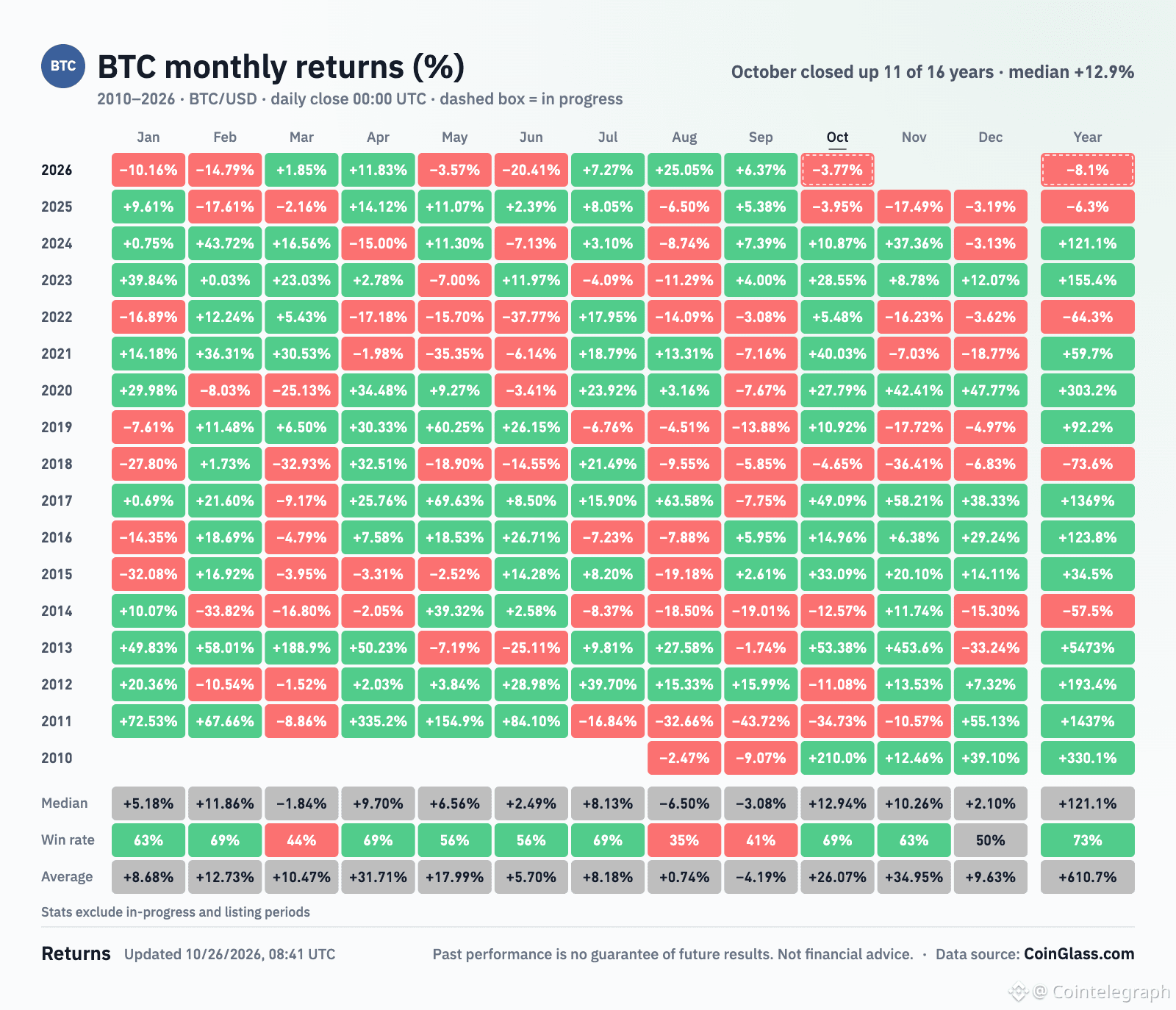
Article
BTC price risks $80K loss into FOMC, earnings: Three things to know in Bitcoin this weekBitcoin (BTC) begins the last week of October fighting to hold $80,000 support ahead of a busy week of US macro data and earnings reports.
Key points:
Markets see the Fed holding interest rates in their current 3.75-4% range at its meeting on Wednesday as Brent crude cools to $110 per barrel.
South Korea’s KOSPI Composite Index resumes downside ahead of a major round of US corporate earnings results.
Bitcoin is on track to end October down 4%, copying 2025 performance, as $80,000 support appears weak.
Markets see Fed rate-hike pause with oil still above $100
The US Federal Reserve is in focus for macro analysts this week as it will decide the next move on the federal funds rate on Wednesday. Markets will be watching the rate decision by the Federal Open Market Committee (FOMC), as well as language used by Fed chair Kevin Warsh at the accompanying press conference.
Markets have little doubt over what officials will decide, seeing over 90% odds that rates will stay in their current 3.75-4% range. FedWatch data shows consensus favoring a 0.25% hike at the December FOMC meeting.
Fed target-rate probabilities (screenshot). Source: CME Group
Commenting, economist Robin Brooks argued that such expectations were a gift to Warsh, who would not need to fight external demands to change course.
“After very contentious Fed meetings earlier in 2026, this week’s meeting gets zero interest in markets, which price only 12% odds of a hike. That’s nothing versus how markets tried to push Warsh into hiking back in July. A temporary reprieve for Warsh,” he summarized.
In separate analysis last week, Brooks saw a rate pause as all but inevitable, even amid rising oil prices and growing concerns over military escalation in the Middle East. Brent crude reached $117 per barrel on Friday, its highest level since March 19, before dropping to around $110 on Monday. Even a rise to $125, however, would not force the Fed to change course, he continued.
“The debt crisis in France would escalate sharply, anxiety around all the AI and data center debt would increase and the S&P 500 would tumble. That just isn’t a setting where the Fed is itching to hike,” Brooks wrote.
“If anything, financial conditions would be tightening sharply, so the last thing you’d want to do is hike.”
CFDs on Brent crude oil one-day chart. Source: Cointelegraph/TradingView
On Thursday, new US macro data will be released in the form of the Personal Consumption Expenditures (PCE) index, known as the Fed’s “preferred” inflation gauge. Last month, PCE came in lower than expected at 3.4% year-on-year, but analysts explained that the drop was a result of changes to the way certain index elements are calculated.
KOSPI struggles as markets prepare for US tech earnings
Nerves about prospects for the AI sector continued to pressure equities on Monday ahead of the week’s first Wall Street open.
After attempting to recoup some of its losses late last week, South Korea’s KOSPI Composite Index closed down 1.5% on Monday at 5,469 points. On Friday, the tech-heavy index fell as low as 5,308 points — a level not seen since late July.
KOSPI Composite Index one-day chart. Source: Cointelegraph/TradingView
The low came as a result of significant tech-stock selling as foreign capital sought safety. Last week, stronger-than-expected US earnings reports ultimately failed to lift the mood, with attention instead drawn to Tesla’s reduced Q3 capital expenditure. The Nasdaq Composite Index closed at 25,955 points on Friday, its lowest daily close since Aug. 3.
Nasdaq Composite Index one-day chart. Source: Cointelegraph/TradingView
Speaking to CNBC on Monday, JPMorgan Asset Management’s Raisah Rasid was unfazed by the state of the AI trade.
“It’s really about investors thinking, ‘Look, we’re not rewarding capex anymore; what we are rewarding is return on capital. I think that’s what’s happening with AI,’” she said.
Further Q3 earnings are due out this week, with Microsoft and Alphabet both reporting after the market close on Wednesday, while Amazon and Intel follow on Thursday. In total, around 20% of S&P 500 companies will report during the week, while Thursday also sees the release of US Q3 GDP numbers.
Bitcoin “Uptober” sentiment meets 4% month-to-date losses
Bitcoin is on track to end October down 4% if the monthly candle closes near current levels around $80,000.
BTC/USD one-day chart. Source: Cointelegraph/TradingView
Data from CoinGlass shows that despite average October upside for BTC/USD totaling 26.1% since 2010, earning the nickname ‘Uptober’, both this year and last have bucked the trend. After falling 3.9% in October 2025, Bitcoin went on to lose another 17.5% in November, once more going against historical patterns that have seen average November returns of 35%.
BTC/USD monthly returns. Source: CoinGlass
Almost $150 million of long positions were liquidated over two hours on Saturday as Bitcoin fell to $79,145. The $80,000 level failed to offer support on lower time frames despite its status as a psychological boundary. CoinGlass shows a $73 million wall of bids keeping price above $79,300, with asks centered around $81,000.
BTC liquidation heatmap. Source: CoinGlass
Market participants are increasingly cautious about a rebound under current macro conditions. Benjamin Cowen, founder of crypto analytics platform Into the Cryptoverse, described Bitcoin’s trips to $87,000 in late September and early October as a “fakeout.”
BTC/USD should continue to see weakness through the end of the year, he told X followers on Monday, citing historical precedent and calling for downside pressure around US midterm election years.
As Cointelegraph reported, the resistance zone around $87,000 contains important price points: the 2026 yearly open at $87,490 and 20-month moving average at $87,165.
BTC price risks $80K loss into FOMC, earnings: Three things to know in Bitcoin this week
Bitcoin (BTC) begins the last week of October fighting to hold $80,000 support ahead of a busy week of US macro data and earnings reports.
Key points:
Markets see the Fed holding interest rates in their current 3.75-4% range at its meeting on Wednesday as Brent crude cools to $110 per barrel.
South Korea’s KOSPI Composite Index resumes downside ahead of a major round of US corporate earnings results.
Bitcoin is on track to end October down 4%, copying 2025 performance, as $80,000 support appears weak.
Markets see Fed rate-hike pause with oil still above $100
The US Federal Reserve is in focus for macro analysts this week as it will decide the next move on the federal funds rate on Wednesday. Markets will be watching the rate decision by the Federal Open Market Committee (FOMC), as well as language used by Fed chair Kevin Warsh at the accompanying press conference.
Markets have little doubt over what officials will decide, seeing over 90% odds that rates will stay in their current 3.75-4% range. FedWatch data shows consensus favoring a 0.25% hike at the December FOMC meeting.
Fed target-rate probabilities (screenshot). Source: CME Group
Commenting, economist Robin Brooks argued that such expectations were a gift to Warsh, who would not need to fight external demands to change course.
“After very contentious Fed meetings earlier in 2026, this week’s meeting gets zero interest in markets, which price only 12% odds of a hike. That’s nothing versus how markets tried to push Warsh into hiking back in July. A temporary reprieve for Warsh,” he summarized.
In separate analysis last week, Brooks saw a rate pause as all but inevitable, even amid rising oil prices and growing concerns over military escalation in the Middle East. Brent crude reached $117 per barrel on Friday, its highest level since March 19, before dropping to around $110 on Monday. Even a rise to $125, however, would not force the Fed to change course, he continued.
“The debt crisis in France would escalate sharply, anxiety around all the AI and data center debt would increase and the S&P 500 would tumble. That just isn’t a setting where the Fed is itching to hike,” Brooks wrote.
“If anything, financial conditions would be tightening sharply, so the last thing you’d want to do is hike.”
CFDs on Brent crude oil one-day chart. Source: Cointelegraph/TradingView
On Thursday, new US macro data will be released in the form of the Personal Consumption Expenditures (PCE) index, known as the Fed’s “preferred” inflation gauge. Last month, PCE came in lower than expected at 3.4% year-on-year, but analysts explained that the drop was a result of changes to the way certain index elements are calculated.
KOSPI struggles as markets prepare for US tech earnings
Nerves about prospects for the AI sector continued to pressure equities on Monday ahead of the week’s first Wall Street open.
After attempting to recoup some of its losses late last week, South Korea’s KOSPI Composite Index closed down 1.5% on Monday at 5,469 points. On Friday, the tech-heavy index fell as low as 5,308 points — a level not seen since late July.
KOSPI Composite Index one-day chart. Source: Cointelegraph/TradingView
The low came as a result of significant tech-stock selling as foreign capital sought safety. Last week, stronger-than-expected US earnings reports ultimately failed to lift the mood, with attention instead drawn to Tesla’s reduced Q3 capital expenditure. The Nasdaq Composite Index closed at 25,955 points on Friday, its lowest daily close since Aug. 3.
Nasdaq Composite Index one-day chart. Source: Cointelegraph/TradingView
Speaking to CNBC on Monday, JPMorgan Asset Management’s Raisah Rasid was unfazed by the state of the AI trade.
“It’s really about investors thinking, ‘Look, we’re not rewarding capex anymore; what we are rewarding is return on capital. I think that’s what’s happening with AI,’” she said.
Further Q3 earnings are due out this week, with Microsoft and Alphabet both reporting after the market close on Wednesday, while Amazon and Intel follow on Thursday. In total, around 20% of S&P 500 companies will report during the week, while Thursday also sees the release of US Q3 GDP numbers.
Bitcoin “Uptober” sentiment meets 4% month-to-date losses
Bitcoin is on track to end October down 4% if the monthly candle closes near current levels around $80,000.
BTC/USD one-day chart. Source: Cointelegraph/TradingView
Data from CoinGlass shows that despite average October upside for BTC/USD totaling 26.1% since 2010, earning the nickname ‘Uptober’, both this year and last have bucked the trend. After falling 3.9% in October 2025, Bitcoin went on to lose another 17.5% in November, once more going against historical patterns that have seen average November returns of 35%.
BTC/USD monthly returns. Source: CoinGlass
Almost $150 million of long positions were liquidated over two hours on Saturday as Bitcoin fell to $79,145. The $80,000 level failed to offer support on lower time frames despite its status as a psychological boundary. CoinGlass shows a $73 million wall of bids keeping price above $79,300, with asks centered around $81,000.
BTC liquidation heatmap. Source: CoinGlass
Market participants are increasingly cautious about a rebound under current macro conditions. Benjamin Cowen, founder of crypto analytics platform Into the Cryptoverse, described Bitcoin’s trips to $87,000 in late September and early October as a “fakeout.”
BTC/USD should continue to see weakness through the end of the year, he told X followers on Monday, citing historical precedent and calling for downside pressure around US midterm election years.
As Cointelegraph reported, the resistance zone around $87,000 contains important price points: the 2026 yearly open at $87,490 and 20-month moving average at $87,165.
Key points:
Markets see the Fed holding interest rates in their current 3.75-4% range at its meeting on Wednesday as Brent crude cools to $110 per barrel.
South Korea’s KOSPI Composite Index resumes downside ahead of a major round of US corporate earnings results.
Bitcoin is on track to end October down 4%, copying 2025 performance, as $80,000 support appears weak.
Markets see Fed rate-hike pause with oil still above $100
The US Federal Reserve is in focus for macro analysts this week as it will decide the next move on the federal funds rate on Wednesday. Markets will be watching the rate decision by the Federal Open Market Committee (FOMC), as well as language used by Fed chair Kevin Warsh at the accompanying press conference.
Markets have little doubt over what officials will decide, seeing over 90% odds that rates will stay in their current 3.75-4% range. FedWatch data shows consensus favoring a 0.25% hike at the December FOMC meeting.
Fed target-rate probabilities (screenshot). Source: CME Group
Commenting, economist Robin Brooks argued that such expectations were a gift to Warsh, who would not need to fight external demands to change course.
“After very contentious Fed meetings earlier in 2026, this week’s meeting gets zero interest in markets, which price only 12% odds of a hike. That’s nothing versus how markets tried to push Warsh into hiking back in July. A temporary reprieve for Warsh,” he summarized.
In separate analysis last week, Brooks saw a rate pause as all but inevitable, even amid rising oil prices and growing concerns over military escalation in the Middle East. Brent crude reached $117 per barrel on Friday, its highest level since March 19, before dropping to around $110 on Monday. Even a rise to $125, however, would not force the Fed to change course, he continued.
“The debt crisis in France would escalate sharply, anxiety around all the AI and data center debt would increase and the S&P 500 would tumble. That just isn’t a setting where the Fed is itching to hike,” Brooks wrote.
“If anything, financial conditions would be tightening sharply, so the last thing you’d want to do is hike.”
CFDs on Brent crude oil one-day chart. Source: Cointelegraph/TradingView
On Thursday, new US macro data will be released in the form of the Personal Consumption Expenditures (PCE) index, known as the Fed’s “preferred” inflation gauge. Last month, PCE came in lower than expected at 3.4% year-on-year, but analysts explained that the drop was a result of changes to the way certain index elements are calculated.
KOSPI struggles as markets prepare for US tech earnings
Nerves about prospects for the AI sector continued to pressure equities on Monday ahead of the week’s first Wall Street open.
After attempting to recoup some of its losses late last week, South Korea’s KOSPI Composite Index closed down 1.5% on Monday at 5,469 points. On Friday, the tech-heavy index fell as low as 5,308 points — a level not seen since late July.
KOSPI Composite Index one-day chart. Source: Cointelegraph/TradingView
The low came as a result of significant tech-stock selling as foreign capital sought safety. Last week, stronger-than-expected US earnings reports ultimately failed to lift the mood, with attention instead drawn to Tesla’s reduced Q3 capital expenditure. The Nasdaq Composite Index closed at 25,955 points on Friday, its lowest daily close since Aug. 3.
Nasdaq Composite Index one-day chart. Source: Cointelegraph/TradingView
Speaking to CNBC on Monday, JPMorgan Asset Management’s Raisah Rasid was unfazed by the state of the AI trade.
“It’s really about investors thinking, ‘Look, we’re not rewarding capex anymore; what we are rewarding is return on capital. I think that’s what’s happening with AI,’” she said.
Further Q3 earnings are due out this week, with Microsoft and Alphabet both reporting after the market close on Wednesday, while Amazon and Intel follow on Thursday. In total, around 20% of S&P 500 companies will report during the week, while Thursday also sees the release of US Q3 GDP numbers.
Bitcoin “Uptober” sentiment meets 4% month-to-date losses
Bitcoin is on track to end October down 4% if the monthly candle closes near current levels around $80,000.
BTC/USD one-day chart. Source: Cointelegraph/TradingView
Data from CoinGlass shows that despite average October upside for BTC/USD totaling 26.1% since 2010, earning the nickname ‘Uptober’, both this year and last have bucked the trend. After falling 3.9% in October 2025, Bitcoin went on to lose another 17.5% in November, once more going against historical patterns that have seen average November returns of 35%.
BTC/USD monthly returns. Source: CoinGlass
Almost $150 million of long positions were liquidated over two hours on Saturday as Bitcoin fell to $79,145. The $80,000 level failed to offer support on lower time frames despite its status as a psychological boundary. CoinGlass shows a $73 million wall of bids keeping price above $79,300, with asks centered around $81,000.
BTC liquidation heatmap. Source: CoinGlass
Market participants are increasingly cautious about a rebound under current macro conditions. Benjamin Cowen, founder of crypto analytics platform Into the Cryptoverse, described Bitcoin’s trips to $87,000 in late September and early October as a “fakeout.”
BTC/USD should continue to see weakness through the end of the year, he told X followers on Monday, citing historical precedent and calling for downside pressure around US midterm election years.
As Cointelegraph reported, the resistance zone around $87,000 contains important price points: the 2026 yearly open at $87,490 and 20-month moving average at $87,165.
269
Log in to explore more content
Join global crypto users on Binance Square
⚡️ Get latest and useful information about crypto.
💬 Trusted by the world’s largest crypto exchange.
👍 Discover real insights from verified creators.
Email / Phone number
Trending Topics
FOMCWatch
8.9M views
26,651 Discussing
🚨 FOMC WATCH JUST GOT SERIOUS! 📊
Three Fed officials backed a rate hike at the July meeting while rates stayed at 3.50%–3.75%.
That divide could create major volatility for risk assets like $BTC, $ETH and $BNB when new economic data arrives.
#fomcwatch
CryptoMahibaloch
·0 Likes
·46 views
EthereumDropsBelow$2300
2,443 views
89 Discussing
BitcoinSlipsBelow$80KAgain
7,407 views
58 Discussing