

ChemistDeFi
28 Posts

ChemistDeFi
 Square Verified
Report
Block User
Software Engineer & Onchain Degen
Writing about Crypto & DeFi | AI is my slave, I'm the master
9 Following
1.4K+ Followers
380 Liked
Posts
All
Videos
·
--
One of the most expensive things you can put into a position is not money.
It is time.
The more I research a token, read the docs, build a thesis and talk about it publicly, the harder it becomes to look at the position objectively.
Behavioral economists call this the sunk cost effect.
Past effort starts feeling like something the future needs to justify.
So when the thesis weakens, selling can feel like admitting all that research was wasted.
And that is where a position quietly changes.
You stop asking:
“Would I buy this today?”
And start asking:
“How can I still be right?”
One of the most expensive things you can put into a position is not money.
It is time.
The more I research a token, read the docs, build a thesis and talk about it publicly, the harder it becomes to look at the position objectively.
Behavioral economists call this the sunk cost effect.
Past effort starts feeling like something the future needs to justify.
So when the thesis weakens, selling can feel like admitting all that research was wasted.
And that is where a position quietly changes.
You stop asking:
“Would I buy this today?”
And start asking:
“How can I still be right?”
It is time.
The more I research a token, read the docs, build a thesis and talk about it publicly, the harder it becomes to look at the position objectively.
Behavioral economists call this the sunk cost effect.
Past effort starts feeling like something the future needs to justify.
So when the thesis weakens, selling can feel like admitting all that research was wasted.
And that is where a position quietly changes.
You stop asking:
“Would I buy this today?”
And start asking:
“How can I still be right?”
1
3
370
·
--
Aave is starting to look less like just a DeFi lending protocol and more like a crypto-native credit institution.
Yesterday, Aave Labs proposed “Aave Institutional.”
The DAO would authorize two funding routes:
→ 25M GHO through a new facilitator
→ up to $25M USDC/USDT borrowed against DAO balance-sheet assets
That capital would fund overcollateralized loans to institutions posting BTC or ETH with qualified custodians, typically at 60–75% LTV.
The economics are interesting.
Borrower rate: 6–8%
Funding cost: ~4.5%
Net margin to the DAO: 1.5–3.5%
At $50M fully deployed, that’s roughly $750K–$1.75M in annualized net interest.
But I think the bigger shift is where the yield comes from.
It isn’t another DeFi loop recycling the same onchain leverage and incentives.
GHO becomes funding capital for institutional credit outside DeFi.
There is a tradeoff.
The proposed 25M GHO capacity is ~42% of the $59.9M currently available in GHO Stability Module redemption inventory, so peg liquidity has to be managed carefully. Every funding authorization would require GHO Steward approval.
And this is still an ARFC proposal, not something already live.
But if governance approves it, Aave starts exporting DeFi liquidity into offchain credit markets.
That’s a much bigger business than simply waiting for more people to borrow stablecoins onchain.
Aave is starting to look less like just a DeFi lending protocol and more like a crypto-native credit institution.
Yesterday, Aave Labs proposed “Aave Institutional.”
The DAO would authorize two funding routes:
→ 25M GHO through a new facilitator
→ up to $25M USDC/USDT borrowed against DAO balance-sheet assets
That capital would fund overcollateralized loans to institutions posting BTC or ETH with qualified custodians, typically at 60–75% LTV.
The economics are interesting.
Borrower rate: 6–8%
Funding cost: ~4.5%
Net margin to the DAO: 1.5–3.5%
At $50M fully deployed, that’s roughly $750K–$1.75M in annualized net interest.
But I think the bigger shift is where the yield comes from.
It isn’t another DeFi loop recycling the same onchain leverage and incentives.
GHO becomes funding capital for institutional credit outside DeFi.
There is a tradeoff.
The proposed 25M GHO capacity is ~42% of the $59.9M currently available in GHO Stability Module redemption inventory, so peg liquidity has to be managed carefully. Every funding authorization would require GHO Steward approval.
And this is still an ARFC proposal, not something already live.
But if governance approves it, Aave starts exporting DeFi liquidity into offchain credit markets.
That’s a much bigger business than simply waiting for more people to borrow stablecoins onchain.
Yesterday, Aave Labs proposed “Aave Institutional.”
The DAO would authorize two funding routes:
→ 25M GHO through a new facilitator
→ up to $25M USDC/USDT borrowed against DAO balance-sheet assets
That capital would fund overcollateralized loans to institutions posting BTC or ETH with qualified custodians, typically at 60–75% LTV.
The economics are interesting.
Borrower rate: 6–8%
Funding cost: ~4.5%
Net margin to the DAO: 1.5–3.5%
At $50M fully deployed, that’s roughly $750K–$1.75M in annualized net interest.
But I think the bigger shift is where the yield comes from.
It isn’t another DeFi loop recycling the same onchain leverage and incentives.
GHO becomes funding capital for institutional credit outside DeFi.
There is a tradeoff.
The proposed 25M GHO capacity is ~42% of the $59.9M currently available in GHO Stability Module redemption inventory, so peg liquidity has to be managed carefully. Every funding authorization would require GHO Steward approval.
And this is still an ARFC proposal, not something already live.
But if governance approves it, Aave starts exporting DeFi liquidity into offchain credit markets.
That’s a much bigger business than simply waiting for more people to borrow stablecoins onchain.
2
1
545
·
--
$746M left spot Bitcoin ETFs on Sept 15 and 16. $BTC is up ~7% since.
That is the entire argument against news-based forecasting, in two lines.
What those two days actually looked like ↓
- Sept 15: CLARITY Act cloture fails 49-50, 60 needed. $BTC -4.2%
- Sept 15 ETF flow: -$450.4M
- Sept 16: Fed hikes 25bps to 3.75-4.00%, first since July 2023, unanimous
- Sept 16 ETF flow: -$295.9M
- Sept 16 low: $74,913
Then it reversed ↓
- Sept 17-18 ETF flow: +$484.1M
- 24h liquidations: $547M, $469M of it shorts, 107K traders
- $BTC now: ~$81,100, +25% on the month
- $ETH : +37% on the month
Backdrop: the US 10Y just tagged 5%, highest since July 2007. Rates at a 19 year high, the industry's main bill dead, and crypto up 25%.
The analogs said the opposite. March 2022, Fed's first hike, $BTC sitting 40% under its ATH, rallied 18% over 12 days and then fell 50%. That is the exact chart everyone posted this week.
Jan 2024 was the mirror image. Most bullish headline crypto has ever had, spot ETFs approved, and $BTC lost 16.6% over the next 12 days.
Imo the analogs are worse than useless now, because they are public. If you and I can both pull up the 2022 overlay, so can the funding rate. It gets positioned into before it resolves.
The single biggest day of this month proves it. Aug 20, $BTC +8%, $2.74B of shorts liquidated, a record. Not new demand. Forced buying.
What still works: measuring the gap between what is priced and what prints.
Polymarket had CLARITY at 12% in early September, ~30% the day before it died. The outcome was already known. That 4.2% drop was positioning unwinding, not information.
News plus history gives you a volatility map, not a price target. Different products.
Change my mind.
$746M left spot Bitcoin ETFs on Sept 15 and 16. $BTC is up ~7% since.
That is the entire argument against news-based forecasting, in two lines.
What those two days actually looked like ↓
- Sept 15: CLARITY Act cloture fails 49-50, 60 needed. $BTC -4.2%
- Sept 15 ETF flow: -$450.4M
- Sept 16: Fed hikes 25bps to 3.75-4.00%, first since July 2023, unanimous
- Sept 16 ETF flow: -$295.9M
- Sept 16 low: $74,913
Then it reversed ↓
- Sept 17-18 ETF flow: +$484.1M
- 24h liquidations: $547M, $469M of it shorts, 107K traders
- $BTC now: ~$81,100, +25% on the month
- $ETH : +37% on the month
Backdrop: the US 10Y just tagged 5%, highest since July 2007. Rates at a 19 year high, the industry's main bill dead, and crypto up 25%.
The analogs said the opposite. March 2022, Fed's first hike, $BTC sitting 40% under its ATH, rallied 18% over 12 days and then fell 50%. That is the exact chart everyone posted this week.
Jan 2024 was the mirror image. Most bullish headline crypto has ever had, spot ETFs approved, and $BTC lost 16.6% over the next 12 days.
Imo the analogs are worse than useless now, because they are public. If you and I can both pull up the 2022 overlay, so can the funding rate. It gets positioned into before it resolves.
The single biggest day of this month proves it. Aug 20, $BTC +8%, $2.74B of shorts liquidated, a record. Not new demand. Forced buying.
What still works: measuring the gap between what is priced and what prints.
Polymarket had CLARITY at 12% in early September, ~30% the day before it died. The outcome was already known. That 4.2% drop was positioning unwinding, not information.
News plus history gives you a volatility map, not a price target. Different products.
Change my mind.
That is the entire argument against news-based forecasting, in two lines.
What those two days actually looked like ↓
- Sept 15: CLARITY Act cloture fails 49-50, 60 needed. $BTC -4.2%
- Sept 15 ETF flow: -$450.4M
- Sept 16: Fed hikes 25bps to 3.75-4.00%, first since July 2023, unanimous
- Sept 16 ETF flow: -$295.9M
- Sept 16 low: $74,913
Then it reversed ↓
- Sept 17-18 ETF flow: +$484.1M
- 24h liquidations: $547M, $469M of it shorts, 107K traders
- $BTC now: ~$81,100, +25% on the month
- $ETH : +37% on the month
Backdrop: the US 10Y just tagged 5%, highest since July 2007. Rates at a 19 year high, the industry's main bill dead, and crypto up 25%.
The analogs said the opposite. March 2022, Fed's first hike, $BTC sitting 40% under its ATH, rallied 18% over 12 days and then fell 50%. That is the exact chart everyone posted this week.
Jan 2024 was the mirror image. Most bullish headline crypto has ever had, spot ETFs approved, and $BTC lost 16.6% over the next 12 days.
Imo the analogs are worse than useless now, because they are public. If you and I can both pull up the 2022 overlay, so can the funding rate. It gets positioned into before it resolves.
The single biggest day of this month proves it. Aug 20, $BTC +8%, $2.74B of shorts liquidated, a record. Not new demand. Forced buying.
What still works: measuring the gap between what is priced and what prints.
Polymarket had CLARITY at 12% in early September, ~30% the day before it died. The outcome was already known. That 4.2% drop was positioning unwinding, not information.
News plus history gives you a volatility map, not a price target. Different products.
Change my mind.
1
3
309
·
--

Article
Bubblemaps V2 Changes When Token Research BeginsI’ve always used @bubblemaps … but maybe a bit late in the research process.
Find a token somewhere else, notice something interesting, then open Bubblemaps to figure out who’s actually holding what.
The new version flips that workflow around because now starts at discovery.
There’s a live feed for fresh and trending tokens across chains, with filters for launchpad, liquidity, volume, price etc.
Hover a token and you can inspect the bubble map without leaving the feed.
Could sound like a small UX change, but I think it’s probably the most important part of the revamp.
Instead of discovering first and investigating second, the investigation is sitting directly inside discovery.
And they’ve pushed that idea further than I expected.
The new Bubblemaps Score surfaces insider clusters and bundled wallets.
Wallet labels are reviewed by onchain investigators and also project socials are verified/reviewed.
But the feature I’ve spent the most time playing with is historical distribution.
Click a candle and Bubblemaps reconstructs the holder map at that point in time.
If you’ve used Bubblemaps for a while, you know a current holder map only gives you the end state.
Being able to move backwards through the chart lets you ask much better questions:
Was that cluster already there before the move?
Did wallets accumulate together?
When did the supply start consolidating?
Did the ownership structure change before or after price reacted?
That’s much closer to forensic analysis than a static token scan.
You can now go from finding a new token, to checking its structure, to digging through historical distribution, and ultimately swapping, without jumping between five different tools.
Arc is already included too, despite the recent launch.
Bubblemaps is changing when in the research process you encounter them.
And putting onchain structure before the trade rather than in the post-mortem is a much more useful place for it.
🔗 Try the revamped version:
https://v2.bubblemaps.io/
I also put together a deeper breakdown on my website, including an interactive historical-distribution explainer and a repeatable pre-trade research checklist:
🧪 Read the full review:
https://chemistdefi.com/blog/bubblemaps-v2-changes-when-token-research-begins
Bubblemaps V2 Changes When Token Research Begins
I’ve always used @Bubblemaps.io … but maybe a bit late in the research process.
Find a token somewhere else, notice something interesting, then open Bubblemaps to figure out who’s actually holding what.
The new version flips that workflow around because now starts at discovery.
There’s a live feed for fresh and trending tokens across chains, with filters for launchpad, liquidity, volume, price etc.
Hover a token and you can inspect the bubble map without leaving the feed.
Could sound like a small UX change, but I think it’s probably the most important part of the revamp.
Instead of discovering first and investigating second, the investigation is sitting directly inside discovery.
And they’ve pushed that idea further than I expected.
The new Bubblemaps Score surfaces insider clusters and bundled wallets.
Wallet labels are reviewed by onchain investigators and also project socials are verified/reviewed.
But the feature I’ve spent the most time playing with is historical distribution.
Click a candle and Bubblemaps reconstructs the holder map at that point in time.
If you’ve used Bubblemaps for a while, you know a current holder map only gives you the end state.
Being able to move backwards through the chart lets you ask much better questions:
Was that cluster already there before the move?
Did wallets accumulate together?
When did the supply start consolidating?
Did the ownership structure change before or after price reacted?
That’s much closer to forensic analysis than a static token scan.
You can now go from finding a new token, to checking its structure, to digging through historical distribution, and ultimately swapping, without jumping between five different tools.
Arc is already included too, despite the recent launch.
Bubblemaps is changing when in the research process you encounter them.
And putting onchain structure before the trade rather than in the post-mortem is a much more useful place for it.
🔗 Try the revamped version:
https://v2.bubblemaps.io/
I also put together a deeper breakdown on my website, including an interactive historical-distribution explainer and a repeatable pre-trade research checklist:
🧪 Read the full review:
https://chemistdefi.com/blog/bubblemaps-v2-changes-when-token-research-begins
Find a token somewhere else, notice something interesting, then open Bubblemaps to figure out who’s actually holding what.
The new version flips that workflow around because now starts at discovery.
There’s a live feed for fresh and trending tokens across chains, with filters for launchpad, liquidity, volume, price etc.
Hover a token and you can inspect the bubble map without leaving the feed.
Could sound like a small UX change, but I think it’s probably the most important part of the revamp.
Instead of discovering first and investigating second, the investigation is sitting directly inside discovery.
And they’ve pushed that idea further than I expected.
The new Bubblemaps Score surfaces insider clusters and bundled wallets.
Wallet labels are reviewed by onchain investigators and also project socials are verified/reviewed.
But the feature I’ve spent the most time playing with is historical distribution.
Click a candle and Bubblemaps reconstructs the holder map at that point in time.
If you’ve used Bubblemaps for a while, you know a current holder map only gives you the end state.
Being able to move backwards through the chart lets you ask much better questions:
Was that cluster already there before the move?
Did wallets accumulate together?
When did the supply start consolidating?
Did the ownership structure change before or after price reacted?
That’s much closer to forensic analysis than a static token scan.
You can now go from finding a new token, to checking its structure, to digging through historical distribution, and ultimately swapping, without jumping between five different tools.
Arc is already included too, despite the recent launch.
Bubblemaps is changing when in the research process you encounter them.
And putting onchain structure before the trade rather than in the post-mortem is a much more useful place for it.
🔗 Try the revamped version:
https://v2.bubblemaps.io/
I also put together a deeper breakdown on my website, including an interactive historical-distribution explainer and a repeatable pre-trade research checklist:
🧪 Read the full review:
https://chemistdefi.com/blog/bubblemaps-v2-changes-when-token-research-begins
17
10
24.1k
·
--
Verified
Ethena finally gave $ENA a value accrual mechanism you can actually track.
And the metric is pretty simple: USDe supply.
USDe is around $4.35B today.
The first fee-switch rung only kicks in once the 14-day average reaches $7.5B. At that point, 5% of gross protocol revenue starts flowing toward ENA buybacks.
So the path is pretty clear:
→ $4.35B today
→ $7.5B = first buyback rung
→ $10B = higher allocation
→ $15B = 15% of gross revenue into the mechanism
The setup is real. It just still depends on Ethena continuing to grow USDe.
And lately, that part has been moving in the right direction.
The investor buyout helps too.
Ethena bought out 14 selling wallets, while 30 investors that hadn't sold rejected the par-value offer.
That's a cleaner way to reduce part of the overhang than just talking about future buybacks.
There is still supply to watch, especially the October unlock and ongoing team/Foundation vesting.
But for me, the main question is pretty simple.
If USDe keeps growing, the buyback starts to matter more.
If it stalls, the mechanism stays mostly theoretical.
So the chart I'd watch here isn't $ENA.
It's USDe supply.
Ethena finally gave $ENA a value accrual mechanism you can actually track.
And the metric is pretty simple: USDe supply.
USDe is around $4.35B today.
The first fee-switch rung only kicks in once the 14-day average reaches $7.5B. At that point, 5% of gross protocol revenue starts flowing toward ENA buybacks.
So the path is pretty clear:
→ $4.35B today
→ $7.5B = first buyback rung
→ $10B = higher allocation
→ $15B = 15% of gross revenue into the mechanism
The setup is real. It just still depends on Ethena continuing to grow USDe.
And lately, that part has been moving in the right direction.
The investor buyout helps too.
Ethena bought out 14 selling wallets, while 30 investors that hadn't sold rejected the par-value offer.
That's a cleaner way to reduce part of the overhang than just talking about future buybacks.
There is still supply to watch, especially the October unlock and ongoing team/Foundation vesting.
But for me, the main question is pretty simple.
If USDe keeps growing, the buyback starts to matter more.
If it stalls, the mechanism stays mostly theoretical.
So the chart I'd watch here isn't $ENA .
It's USDe supply.
And the metric is pretty simple: USDe supply.
USDe is around $4.35B today.
The first fee-switch rung only kicks in once the 14-day average reaches $7.5B. At that point, 5% of gross protocol revenue starts flowing toward ENA buybacks.
So the path is pretty clear:
→ $4.35B today
→ $7.5B = first buyback rung
→ $10B = higher allocation
→ $15B = 15% of gross revenue into the mechanism
The setup is real. It just still depends on Ethena continuing to grow USDe.
And lately, that part has been moving in the right direction.
The investor buyout helps too.
Ethena bought out 14 selling wallets, while 30 investors that hadn't sold rejected the par-value offer.
That's a cleaner way to reduce part of the overhang than just talking about future buybacks.
There is still supply to watch, especially the October unlock and ongoing team/Foundation vesting.
But for me, the main question is pretty simple.
If USDe keeps growing, the buyback starts to matter more.
If it stalls, the mechanism stays mostly theoretical.
So the chart I'd watch here isn't $ENA .
It's USDe supply.
5
23
42k
·
--

Article
Inside Dusk: How Programmable Privacy Brings Regulated Finance OnchainLet's break down what $DUSK is actually building, because "privacy blockchain for regulated finance" gets thrown around without much explanation of what that means mechanically.
Let’s start with the core problem: public blockchains show every transaction to everyone.
Fine for most crypto use cases is fine but not for a securities settlement system, because trade data, counterparty identity, and position sizing are exactly the information regulated finance has legal obligations to protect.
So you'd think the answer is a privacy chain.
But full privacy creates a different problem: a regulator with a legitimate audit requirement can't see anything either. Neither extreme works for the actual use case.
@Dusk_Foundation approach is what they call programmable privacy, and it's worth understanding as a spectrum rather than a switch.
A transaction can be private by default to the public, while remaining selectively disclosable to an authorized party like a regulator or auditor. That's the design goal underneath everything else in the stack, so keep it in mind as we go through the pieces.
The execution layer: DuskEVM
DuskEVM is Dusk's EVM-compatible application layer. If you're a developer who already knows Solidity, this is your on-ramp, you don't need to learn a new smart contract language to build here.
That matters practically: EVM familiarity is the largest existing developer pool in crypto, and building a compatible layer instead of a novel one lowers the barrier for anyone porting an existing application over.
The confidential piece of DuskEVM runs through a module called Hedger.
Mechanically, Hedger combines two cryptographic tools: homomorphic encryption, which allows computation on encrypted data without decrypting it first, and zero-knowledge proofs, which let you prove a statement is true without revealing the underlying data.
Combined, this is how #Dusk delivers the "private but reviewable" property described above. Transaction details stay encrypted from public view, but the proof structure allows an authorized party to verify what happened without the data ever being broadcast openly.
The application layer: Dusk Trade
DuskEVM is infrastructure. Dusk Trade is where you'd actually interact with it as a user.
It's built as a neobroker interface, think of the onboarding and trading experience of a regular brokerage app, for tokenized financial assets: money market funds, ETFs, bonds, and other real-world asset categories.
The functional pieces are what you'd expect from any brokerage: account onboarding, wallet connection, asset discovery, order execution, and settlement, just built to operate under EU regulated-market rules rather than existing outside them.
The institutional layer: partnerships
Infrastructure and a trading interface don't mean much without regulated counterparties actually using them, so this layer matters more than it might seem.
NPEX is the clearest example: it's an AFM-regulated exchange in the Netherlands, licensed as a Multilateral Trading Facility, a broker, and an ECSP (crowdfunding platform license).
NPEX's plan is to bring a meaningful volume of tokenized European securities onto Dusk's infrastructure, which is a real test of whether the technical design holds up under actual regulated usage rather than staying theoretical.
Chainlink is the other piece worth understanding.
Chainlink CCIP provides the cross-chain interoperability layer, meaning assets issued on DuskEVM can move and settle across other chains without a custom bridge for every connection.
For institutional users this is less about hype and more about plumbing, whether an asset can actually move where it needs to go.
Tokenization vs. native issuance
This distinction gets glossed over a lot, so it's worth being precise.
Tokenization takes an asset that already exists somewhere else, a bond, a fund share, and wraps it in a token that represents it.
The legal reality and lifecycle of that asset still lives off-chain.
Native issuance is different: it tries to move the actual lifecycle of the asset on-chain, issuance, transfer restrictions, settlement, servicing, all natively rather than represented.
It's a harder infrastructure problem to solve correctly, and it's the direction Dusk's stack is oriented toward rather than the simpler wrap-and-list model.
Where this actually stands
To be clear-eyed about it: shipping the infrastructure and proving institutional adoption are two different milestones, and Dusk has completed more of the first than the second so far.
On-chain activity has been modest relative to what's been built, and NPEX bringing sustained real volume through the system is the next real test.
Regulated finance moves slowly by design, so that's not necessarily a red flag, but it's the honest state of things rather than a finished story.
If you're trying to understand the RWA/regulated-DeFi category generally, Dusk is a useful case study regardless of where you land on the token, because the technical approach (selective disclosure over binary privacy) is addressing a constraint that tokenization projects don't solve for at all.
Inside Dusk: How Programmable Privacy Brings Regulated Finance Onchain
Let's break down what $DUSK is actually building, because "privacy blockchain for regulated finance" gets thrown around without much explanation of what that means mechanically.
Let’s start with the core problem: public blockchains show every transaction to everyone.
Fine for most crypto use cases is fine but not for a securities settlement system, because trade data, counterparty identity, and position sizing are exactly the information regulated finance has legal obligations to protect.
So you'd think the answer is a privacy chain.
But full privacy creates a different problem: a regulator with a legitimate audit requirement can't see anything either. Neither extreme works for the actual use case.
@Dusk approach is what they call programmable privacy, and it's worth understanding as a spectrum rather than a switch.
A transaction can be private by default to the public, while remaining selectively disclosable to an authorized party like a regulator or auditor. That's the design goal underneath everything else in the stack, so keep it in mind as we go through the pieces.
The execution layer: DuskEVM
DuskEVM is Dusk's EVM-compatible application layer. If you're a developer who already knows Solidity, this is your on-ramp, you don't need to learn a new smart contract language to build here.
That matters practically: EVM familiarity is the largest existing developer pool in crypto, and building a compatible layer instead of a novel one lowers the barrier for anyone porting an existing application over.
The confidential piece of DuskEVM runs through a module called Hedger.
Mechanically, Hedger combines two cryptographic tools: homomorphic encryption, which allows computation on encrypted data without decrypting it first, and zero-knowledge proofs, which let you prove a statement is true without revealing the underlying data.
Combined, this is how #Dusk delivers the "private but reviewable" property described above. Transaction details stay encrypted from public view, but the proof structure allows an authorized party to verify what happened without the data ever being broadcast openly.
The application layer: Dusk Trade
DuskEVM is infrastructure. Dusk Trade is where you'd actually interact with it as a user.
It's built as a neobroker interface, think of the onboarding and trading experience of a regular brokerage app, for tokenized financial assets: money market funds, ETFs, bonds, and other real-world asset categories.
The functional pieces are what you'd expect from any brokerage: account onboarding, wallet connection, asset discovery, order execution, and settlement, just built to operate under EU regulated-market rules rather than existing outside them.
The institutional layer: partnerships
Infrastructure and a trading interface don't mean much without regulated counterparties actually using them, so this layer matters more than it might seem.
NPEX is the clearest example: it's an AFM-regulated exchange in the Netherlands, licensed as a Multilateral Trading Facility, a broker, and an ECSP (crowdfunding platform license).
NPEX's plan is to bring a meaningful volume of tokenized European securities onto Dusk's infrastructure, which is a real test of whether the technical design holds up under actual regulated usage rather than staying theoretical.
Chainlink is the other piece worth understanding.
Chainlink CCIP provides the cross-chain interoperability layer, meaning assets issued on DuskEVM can move and settle across other chains without a custom bridge for every connection.
For institutional users this is less about hype and more about plumbing, whether an asset can actually move where it needs to go.
Tokenization vs. native issuance
This distinction gets glossed over a lot, so it's worth being precise.
Tokenization takes an asset that already exists somewhere else, a bond, a fund share, and wraps it in a token that represents it.
The legal reality and lifecycle of that asset still lives off-chain.
Native issuance is different: it tries to move the actual lifecycle of the asset on-chain, issuance, transfer restrictions, settlement, servicing, all natively rather than represented.
It's a harder infrastructure problem to solve correctly, and it's the direction Dusk's stack is oriented toward rather than the simpler wrap-and-list model.
Where this actually stands
To be clear-eyed about it: shipping the infrastructure and proving institutional adoption are two different milestones, and Dusk has completed more of the first than the second so far.
On-chain activity has been modest relative to what's been built, and NPEX bringing sustained real volume through the system is the next real test.
Regulated finance moves slowly by design, so that's not necessarily a red flag, but it's the honest state of things rather than a finished story.
If you're trying to understand the RWA/regulated-DeFi category generally, Dusk is a useful case study regardless of where you land on the token, because the technical approach (selective disclosure over binary privacy) is addressing a constraint that tokenization projects don't solve for at all.
Let’s start with the core problem: public blockchains show every transaction to everyone.
Fine for most crypto use cases is fine but not for a securities settlement system, because trade data, counterparty identity, and position sizing are exactly the information regulated finance has legal obligations to protect.
So you'd think the answer is a privacy chain.
But full privacy creates a different problem: a regulator with a legitimate audit requirement can't see anything either. Neither extreme works for the actual use case.
@Dusk approach is what they call programmable privacy, and it's worth understanding as a spectrum rather than a switch.
A transaction can be private by default to the public, while remaining selectively disclosable to an authorized party like a regulator or auditor. That's the design goal underneath everything else in the stack, so keep it in mind as we go through the pieces.
The execution layer: DuskEVM
DuskEVM is Dusk's EVM-compatible application layer. If you're a developer who already knows Solidity, this is your on-ramp, you don't need to learn a new smart contract language to build here.
That matters practically: EVM familiarity is the largest existing developer pool in crypto, and building a compatible layer instead of a novel one lowers the barrier for anyone porting an existing application over.
The confidential piece of DuskEVM runs through a module called Hedger.
Mechanically, Hedger combines two cryptographic tools: homomorphic encryption, which allows computation on encrypted data without decrypting it first, and zero-knowledge proofs, which let you prove a statement is true without revealing the underlying data.
Combined, this is how #Dusk delivers the "private but reviewable" property described above. Transaction details stay encrypted from public view, but the proof structure allows an authorized party to verify what happened without the data ever being broadcast openly.
The application layer: Dusk Trade
DuskEVM is infrastructure. Dusk Trade is where you'd actually interact with it as a user.
It's built as a neobroker interface, think of the onboarding and trading experience of a regular brokerage app, for tokenized financial assets: money market funds, ETFs, bonds, and other real-world asset categories.
The functional pieces are what you'd expect from any brokerage: account onboarding, wallet connection, asset discovery, order execution, and settlement, just built to operate under EU regulated-market rules rather than existing outside them.
The institutional layer: partnerships
Infrastructure and a trading interface don't mean much without regulated counterparties actually using them, so this layer matters more than it might seem.
NPEX is the clearest example: it's an AFM-regulated exchange in the Netherlands, licensed as a Multilateral Trading Facility, a broker, and an ECSP (crowdfunding platform license).
NPEX's plan is to bring a meaningful volume of tokenized European securities onto Dusk's infrastructure, which is a real test of whether the technical design holds up under actual regulated usage rather than staying theoretical.
Chainlink is the other piece worth understanding.
Chainlink CCIP provides the cross-chain interoperability layer, meaning assets issued on DuskEVM can move and settle across other chains without a custom bridge for every connection.
For institutional users this is less about hype and more about plumbing, whether an asset can actually move where it needs to go.
Tokenization vs. native issuance
This distinction gets glossed over a lot, so it's worth being precise.
Tokenization takes an asset that already exists somewhere else, a bond, a fund share, and wraps it in a token that represents it.
The legal reality and lifecycle of that asset still lives off-chain.
Native issuance is different: it tries to move the actual lifecycle of the asset on-chain, issuance, transfer restrictions, settlement, servicing, all natively rather than represented.
It's a harder infrastructure problem to solve correctly, and it's the direction Dusk's stack is oriented toward rather than the simpler wrap-and-list model.
Where this actually stands
To be clear-eyed about it: shipping the infrastructure and proving institutional adoption are two different milestones, and Dusk has completed more of the first than the second so far.
On-chain activity has been modest relative to what's been built, and NPEX bringing sustained real volume through the system is the next real test.
Regulated finance moves slowly by design, so that's not necessarily a red flag, but it's the honest state of things rather than a finished story.
If you're trying to understand the RWA/regulated-DeFi category generally, Dusk is a useful case study regardless of where you land on the token, because the technical approach (selective disclosure over binary privacy) is addressing a constraint that tokenization projects don't solve for at all.
4
9
6.1k
·
--
Bullish
Still believe in $BTC.
Maybe more importantly, I still want to believe.
Some trades are about price.
Some are about conviction.
This one is both.
NFA. Always DYOR.
Still believe in $BTC.
Maybe more importantly, I still want to believe.
Some trades are about price.
Some are about conviction.
This one is both.
NFA. Always DYOR.
Maybe more importantly, I still want to believe.
Some trades are about price.
Some are about conviction.
This one is both.
NFA. Always DYOR.
2
11
4.6k
·
--
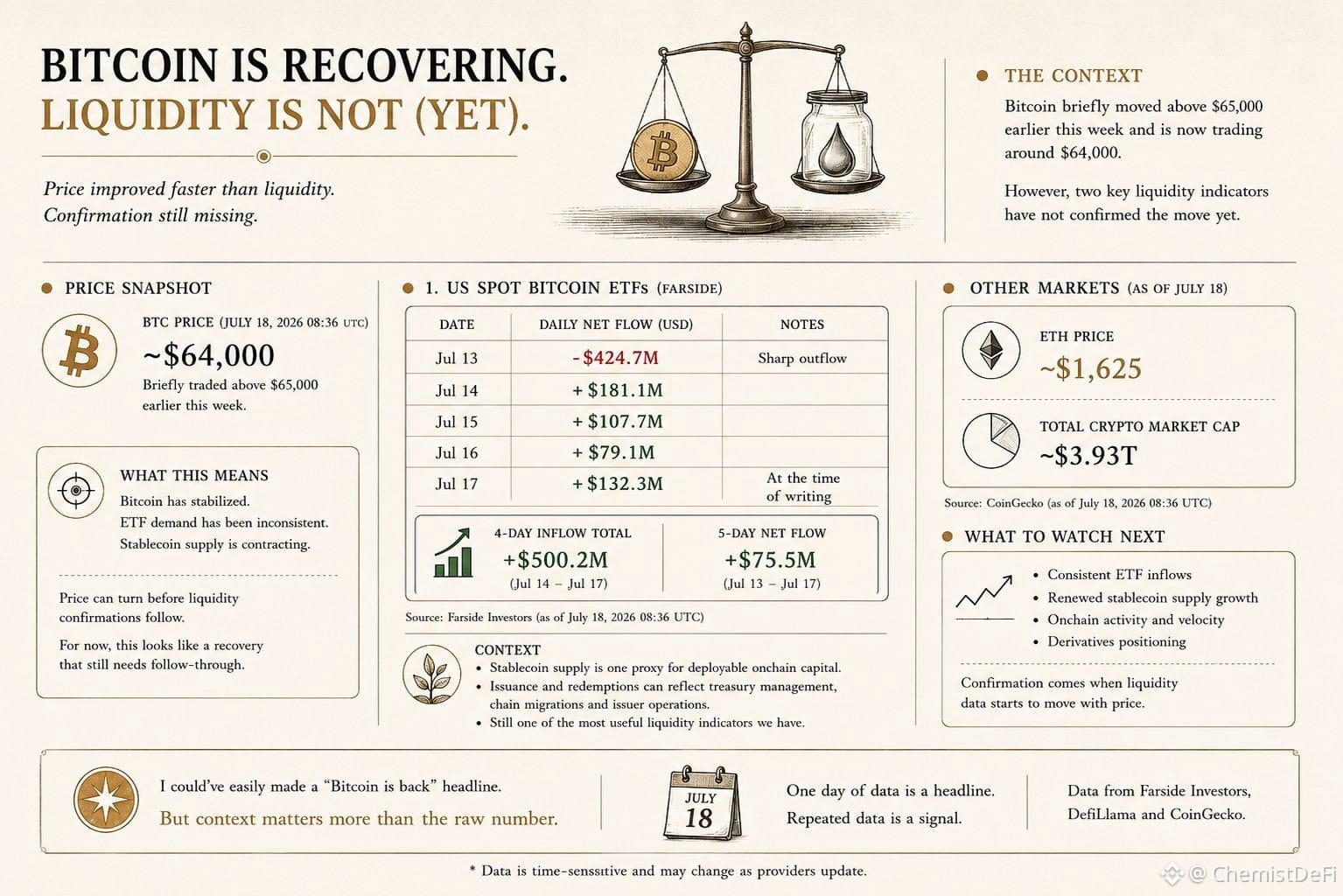
Bitcoin is trying to recover.
Short term ETF flows have turned supportive.
Stablecoin supply has not.
BTC is trading around $64,000 at the time of writing.
At the time of writing, Farside shows the following US spot Bitcoin ETF flows:
→ July 13: -$424.7M
→ July 14: +$181.1M
→ July 15: +$107.7M
→ July 16: +$79.1M
→ July 17: +$132.3M
After the sharp outflow on July 13, four consecutive inflow sessions totaled $500.2M.
Across the full five session window, however, net inflows amount to only $75.5M.
I’d label the ETF rebound as encouraging, but it still needs follow through.
DefiLlama shows a different side of the liquidity picture:
→ Total stablecoin supply: $309.99B
→ 7 day change: -$1.572B (-0.50%)
→ 30 day change: -1.40%
Aggregate stablecoin supply is therefore contracting across both the weekly and monthly windows.
That metric is not a perfect measure of liquidity.
Issuance and redemptions can also reflect treasury management, chain migrations and issuer operations.
Even so, stablecoin supply remains a useful proxy for deployable onchain capital.
That leaves us with divergent signals:
→ US spot ETF demand has improved
→ Aggregate stablecoin supply is still shrinking
These signals do not contradict each other.
They measure different channels of capital and different parts of the market.
My take:
Bitcoin’s recovery now has short term support from US spot ETF flows, but broader liquidity confirmation remains incomplete.
The next signal I’d watch is whether ETF inflows persist while stablecoin supply stabilizes or begins expanding again.
Bitcoin is trying to recover.
Short term ETF flows have turned supportive.
Stablecoin supply has not.
BTC is trading around $64,000 at the time of writing.
At the time of writing, Farside shows the following US spot Bitcoin ETF flows:
→ July 13: -$424.7M
→ July 14: +$181.1M
→ July 15: +$107.7M
→ July 16: +$79.1M
→ July 17: +$132.3M
After the sharp outflow on July 13, four consecutive inflow sessions totaled $500.2M.
Across the full five session window, however, net inflows amount to only $75.5M.
I’d label the ETF rebound as encouraging, but it still needs follow through.
DefiLlama shows a different side of the liquidity picture:
→ Total stablecoin supply: $309.99B
→ 7 day change: -$1.572B (-0.50%)
→ 30 day change: -1.40%
Aggregate stablecoin supply is therefore contracting across both the weekly and monthly windows.
That metric is not a perfect measure of liquidity.
Issuance and redemptions can also reflect treasury management, chain migrations and issuer operations.
Even so, stablecoin supply remains a useful proxy for deployable onchain capital.
That leaves us with divergent signals:
→ US spot ETF demand has improved
→ Aggregate stablecoin supply is still shrinking
These signals do not contradict each other.
They measure different channels of capital and different parts of the market.
My take:
Bitcoin’s recovery now has short term support from US spot ETF flows, but broader liquidity confirmation remains incomplete.
The next signal I’d watch is whether ETF inflows persist while stablecoin supply stabilizes or begins expanding again.
Short term ETF flows have turned supportive.
Stablecoin supply has not.
BTC is trading around $64,000 at the time of writing.
At the time of writing, Farside shows the following US spot Bitcoin ETF flows:
→ July 13: -$424.7M
→ July 14: +$181.1M
→ July 15: +$107.7M
→ July 16: +$79.1M
→ July 17: +$132.3M
After the sharp outflow on July 13, four consecutive inflow sessions totaled $500.2M.
Across the full five session window, however, net inflows amount to only $75.5M.
I’d label the ETF rebound as encouraging, but it still needs follow through.
DefiLlama shows a different side of the liquidity picture:
→ Total stablecoin supply: $309.99B
→ 7 day change: -$1.572B (-0.50%)
→ 30 day change: -1.40%
Aggregate stablecoin supply is therefore contracting across both the weekly and monthly windows.
That metric is not a perfect measure of liquidity.
Issuance and redemptions can also reflect treasury management, chain migrations and issuer operations.
Even so, stablecoin supply remains a useful proxy for deployable onchain capital.
That leaves us with divergent signals:
→ US spot ETF demand has improved
→ Aggregate stablecoin supply is still shrinking
These signals do not contradict each other.
They measure different channels of capital and different parts of the market.
My take:
Bitcoin’s recovery now has short term support from US spot ETF flows, but broader liquidity confirmation remains incomplete.
The next signal I’d watch is whether ETF inflows persist while stablecoin supply stabilizes or begins expanding again.
2
116
·
--
GameFi quietly ran one of the biggest UX experiments in DeFi history.
And I still think the results are underrated.
For years, people said DeFi stayed small because it was too complex.
Seed phrases.
Gas.
Bridges.
Slippage.
Approvals.
Then play to earn happened.
People who had never touched crypto learned all of it in weeks.
The interfaces were not suddenly better.
The reason to care was.
That is the part GameFi proved.
Complexity is real, but it behaves like a price.
People will pay it when the thing behind it feels worth the effort.
Of course, the first wave had problems.
Many economies leaned too hard on rewards, emissions, and new players entering.
When incentives slowed, activity slowed too.
But that does not make the category dead.
It makes the lesson clearer.
The next version of GameFi cannot just be DeFi with a game skin.
It has to be a real game where ownership, markets, identity, and progression make the experience better.
And this is where timing gets interesting.
AI has changed the cost of building.
A simple or mid level game does not take the same time to ship as it used to.
Art, prototyping, NPC logic, world building, testing, iteration.
A lot of the slow parts are getting faster.
That does not magically create good games.
But it does make the category harder to ignore.
Because if GameFi already proved people will learn complex systems when they care about the world behind them,
I am genuinely curious what happens when we start seeing GameFi products that feel closer to AAA-quality experiences.
Or even strategy games with the depth of something like Age of Empires.
Not just rewards with better graphics.
Actual games.
With economies that support the world instead of replacing it.
GameFi quietly ran one of the biggest UX experiments in DeFi history.
And I still think the results are underrated.
For years, people said DeFi stayed small because it was too complex.
Seed phrases.
Gas.
Bridges.
Slippage.
Approvals.
Then play to earn happened.
People who had never touched crypto learned all of it in weeks.
The interfaces were not suddenly better.
The reason to care was.
That is the part GameFi proved.
Complexity is real, but it behaves like a price.
People will pay it when the thing behind it feels worth the effort.
Of course, the first wave had problems.
Many economies leaned too hard on rewards, emissions, and new players entering.
When incentives slowed, activity slowed too.
But that does not make the category dead.
It makes the lesson clearer.
The next version of GameFi cannot just be DeFi with a game skin.
It has to be a real game where ownership, markets, identity, and progression make the experience better.
And this is where timing gets interesting.
AI has changed the cost of building.
A simple or mid level game does not take the same time to ship as it used to.
Art, prototyping, NPC logic, world building, testing, iteration.
A lot of the slow parts are getting faster.
That does not magically create good games.
But it does make the category harder to ignore.
Because if GameFi already proved people will learn complex systems when they care about the world behind them,
I am genuinely curious what happens when we start seeing GameFi products that feel closer to AAA-quality experiences.
Or even strategy games with the depth of something like Age of Empires.
Not just rewards with better graphics.
Actual games.
With economies that support the world instead of replacing it.
And I still think the results are underrated.
For years, people said DeFi stayed small because it was too complex.
Seed phrases.
Gas.
Bridges.
Slippage.
Approvals.
Then play to earn happened.
People who had never touched crypto learned all of it in weeks.
The interfaces were not suddenly better.
The reason to care was.
That is the part GameFi proved.
Complexity is real, but it behaves like a price.
People will pay it when the thing behind it feels worth the effort.
Of course, the first wave had problems.
Many economies leaned too hard on rewards, emissions, and new players entering.
When incentives slowed, activity slowed too.
But that does not make the category dead.
It makes the lesson clearer.
The next version of GameFi cannot just be DeFi with a game skin.
It has to be a real game where ownership, markets, identity, and progression make the experience better.
And this is where timing gets interesting.
AI has changed the cost of building.
A simple or mid level game does not take the same time to ship as it used to.
Art, prototyping, NPC logic, world building, testing, iteration.
A lot of the slow parts are getting faster.
That does not magically create good games.
But it does make the category harder to ignore.
Because if GameFi already proved people will learn complex systems when they care about the world behind them,
I am genuinely curious what happens when we start seeing GameFi products that feel closer to AAA-quality experiences.
Or even strategy games with the depth of something like Age of Empires.
Not just rewards with better graphics.
Actual games.
With economies that support the world instead of replacing it.
3
150
·
--
Strategy disclosed yesterday that it sold 3,588 $BTC for $216 million.
{spot}(BTCUSDT)
The largest sale in the company’s history.
But the reason matters more than the size.
The proceeds went to dividends on its preferred shares.
Those dividends are paid in cash.
They are contractual.
And the software business does not cover them.
Grayscale’s research desk estimates the annual bill at around $1.5 billion.
For years, the machine only worked in one direction:
Issue paper.
Buy bitcoin.
Repeat.
The promise was simple:
Never sell.
Now, one of the preferred shares trades below its $100 par value.
New paper is harder to place.
And the bill still arrives every quarter.
So the structure built to convert dollars into bitcoin has started converting bitcoin back into dollars.
On a schedule.
At whatever the price is that day.
Strategy still holds 843,775 BTC.
This is not a collapse story.
But an asset the market priced as permanently off the market has now become a recurring seller.
And what I keep thinking about is simple:
How many other treasury companies copied this machine?
And when do their bills arrive?
Strategy disclosed yesterday that it sold 3,588 $BTC for $216 million.
The largest sale in the company’s history.
But the reason matters more than the size.
The proceeds went to dividends on its preferred shares.
Those dividends are paid in cash.
They are contractual.
And the software business does not cover them.
Grayscale’s research desk estimates the annual bill at around $1.5 billion.
For years, the machine only worked in one direction:
Issue paper.
Buy bitcoin.
Repeat.
The promise was simple:
Never sell.
Now, one of the preferred shares trades below its $100 par value.
New paper is harder to place.
And the bill still arrives every quarter.
So the structure built to convert dollars into bitcoin has started converting bitcoin back into dollars.
On a schedule.
At whatever the price is that day.
Strategy still holds 843,775 BTC.
This is not a collapse story.
But an asset the market priced as permanently off the market has now become a recurring seller.
And what I keep thinking about is simple:
How many other treasury companies copied this machine?
And when do their bills arrive?
The largest sale in the company’s history.
But the reason matters more than the size.
The proceeds went to dividends on its preferred shares.
Those dividends are paid in cash.
They are contractual.
And the software business does not cover them.
Grayscale’s research desk estimates the annual bill at around $1.5 billion.
For years, the machine only worked in one direction:
Issue paper.
Buy bitcoin.
Repeat.
The promise was simple:
Never sell.
Now, one of the preferred shares trades below its $100 par value.
New paper is harder to place.
And the bill still arrives every quarter.
So the structure built to convert dollars into bitcoin has started converting bitcoin back into dollars.
On a schedule.
At whatever the price is that day.
Strategy still holds 843,775 BTC.
This is not a collapse story.
But an asset the market priced as permanently off the market has now become a recurring seller.
And what I keep thinking about is simple:
How many other treasury companies copied this machine?
And when do their bills arrive?
2
239
·
--
Article
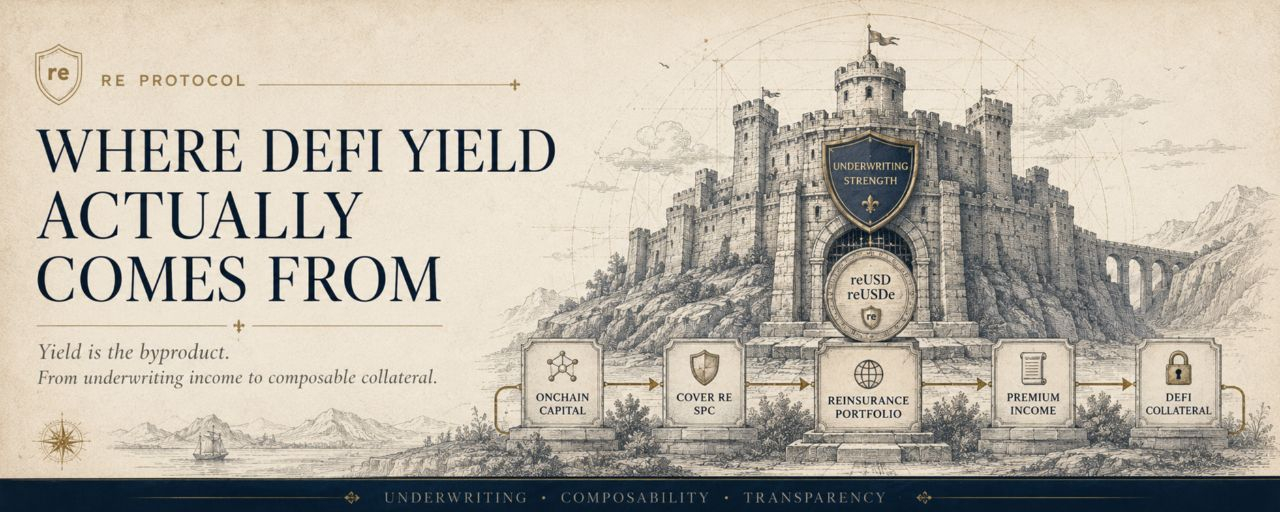
RE Protocol: When Reinsurance Yield Becomes DeFi-Native CollateralA lot of DeFi yield products are trying to answer the same question:
Where does the return actually come from?
@Re_protocol , the project behind $RE / $REUSDT answers it in an unusual way.
The yield is not the product.
It is the byproduct.
THE UNDERWRITING BUSINESS FIRST
RE Protocol routes onchain capital into an operating reinsurance portfolio through Cover Re SPC, the regulated reinsurance entity behind the structure.
Not a simulation of reinsurance. Not just a tokenized wrapper around someone else's yield.
An actual underwriting portfolio with $510.5M across 48 insurance programs, 49 U.S. states, and 700K+ policyholders.
The key metric here is the combined ratio.
A 92% combined ratio means that for every dollar of insurance premium collected, 92 cents goes to claims and expenses, and 8 cents remains as underwriting profit.
That is the source of the margin.
The yield depositors earn is downstream of that underwriting business: insurance premium income flowing back through the capital structure.
This matters because it changes the nature of what you're holding.
You're not holding a yield token that only works while incentives are alive.
You're holding exposure to the economics of a reinsurance book that operates whether or not anyone is paying attention to the token.
WHY THE COMPOSABILITY DATA IS ACTUALLY INTERESTING
Here's a number that stopped me:
80%.
That's the share of tokenized reinsurance actively deposited in DeFi lending protocols.
The highest deposit rate of any asset class in the tokenized RWA market.
For comparison, tokenized Treasuries are the largest RWA category by market cap, but only a tiny share of DeFi deposits.
The reason is simple math.
Treasuries yield roughly 4-5%.
Stablecoin borrow rates on Morpho sit around 3-4%.
There is not much spread to work with, so nobody really loops them.
reUSD is different.
A senior-tranche yield around 6%, against borrow costs around 3-4%, creates actual positive carry.
That is why Morpho curators have independently built strategies around it.
$96M on Morpho, including $50M in Pendle PT-reUSD.
Another $94M on Fluid.
That is the market vote.
Third-party protocols put real capital to work around reinsurance yield because the math works better than the alternatives.
HOW THE RE POINTS PROGRAM IS ACTUALLY DESIGNED
The points multipliers tell you what behavior RE Protocol wants to incentivize.
That is a more useful frame than just staring at the numbers.
Holding reUSD: 5x Holding reUSDe: 5x Morpho collateral: 5x Pendle YT reUSD: 30x Pendle YT reUSDe: 40x
The highest multipliers go to the positions that make the asset more active inside DeFi.
Pendle YT positions are not passive parking spots.
They are explicit bets on the yield stream itself.
That tells you what RE wants: not just TVL sitting idle, but reUSD and reUSDe being used as building blocks across the market.
Collateral. Yield tokens. Looping strategies. Liquidity routes.
That is how an RWA stops being a static wrapper and starts becoming composable financial infrastructure.
THE TRANSPARENCY STACK IS A PREREQUISITE
Lending protocols need to underwrite the collateral they accept.
They cannot accept what they cannot verify.
This is why RE Protocol's infrastructure matters more than it might look at first glance.
Daily attestations by The Network Firm, published through Chainlink oracles.
Dual audits from Certora and Hacken.
Fireblocks custody.
3-of-5 and 5-of-8 MPC multisig structures.
48-hour timelock on upgrades.
Live transparency dashboard.
Morpho markets did not grow around reUSD just because the story was interesting.
They grew because the collateral is underwritable.
The verification stack is what makes that possible.
THE PART PEOPLE SHOULD NOT IGNORE
reUSDe absorbs losses before reUSD.
If the reinsurance book performs badly, reUSDe holders take the first hit above the reinsurer's equity buffer.
The higher target return is compensation for that real exposure.
That is the point of the structure.
reUSD sits senior. reUSDe sits junior.
Different yield, different risk, same underlying insurance capital layer.
Quarterly redemption windows for reUSDe are not a design flaw either.
They are the honest reflection of what it means to be capitalized into actual reinsurance contracts with real settlement timelines.
THE END
The interesting part of RE Protocol is not only that it brings reinsurance onchain.
It is that the asset is already being treated like collateral by the rest of DeFi.
That is the difference between an RWA that simply exists onchain and an RWA that actually gets used.
The yield story starts with insurance premiums.
But the bigger story is what happens after the token leaves the vault.
That is where composability turns a real-world asset into DeFi-native collateral.
RE Protocol: When Reinsurance Yield Becomes DeFi-Native Collateral
A lot of DeFi yield products are trying to answer the same question:
Where does the return actually come from?
@ReProtocol , the project behind $RE / $REUSDT answers it in an unusual way.
The yield is not the product.
It is the byproduct.
THE UNDERWRITING BUSINESS FIRST
RE Protocol routes onchain capital into an operating reinsurance portfolio through Cover Re SPC, the regulated reinsurance entity behind the structure.
Not a simulation of reinsurance. Not just a tokenized wrapper around someone else's yield.
An actual underwriting portfolio with $510.5M across 48 insurance programs, 49 U.S. states, and 700K+ policyholders.
The key metric here is the combined ratio.
A 92% combined ratio means that for every dollar of insurance premium collected, 92 cents goes to claims and expenses, and 8 cents remains as underwriting profit.
That is the source of the margin.
The yield depositors earn is downstream of that underwriting business: insurance premium income flowing back through the capital structure.
This matters because it changes the nature of what you're holding.
You're not holding a yield token that only works while incentives are alive.
You're holding exposure to the economics of a reinsurance book that operates whether or not anyone is paying attention to the token.
WHY THE COMPOSABILITY DATA IS ACTUALLY INTERESTING
Here's a number that stopped me:
80%.
That's the share of tokenized reinsurance actively deposited in DeFi lending protocols.
The highest deposit rate of any asset class in the tokenized RWA market.
For comparison, tokenized Treasuries are the largest RWA category by market cap, but only a tiny share of DeFi deposits.
The reason is simple math.
Treasuries yield roughly 4-5%.
Stablecoin borrow rates on Morpho sit around 3-4%.
There is not much spread to work with, so nobody really loops them.
reUSD is different.
A senior-tranche yield around 6%, against borrow costs around 3-4%, creates actual positive carry.
That is why Morpho curators have independently built strategies around it.
$96M on Morpho, including $50M in Pendle PT-reUSD.
Another $94M on Fluid.
That is the market vote.
Third-party protocols put real capital to work around reinsurance yield because the math works better than the alternatives.
HOW THE RE POINTS PROGRAM IS ACTUALLY DESIGNED
The points multipliers tell you what behavior RE Protocol wants to incentivize.
That is a more useful frame than just staring at the numbers.
Holding reUSD: 5x Holding reUSDe: 5x Morpho collateral: 5x Pendle YT reUSD: 30x Pendle YT reUSDe: 40x
The highest multipliers go to the positions that make the asset more active inside DeFi.
Pendle YT positions are not passive parking spots.
They are explicit bets on the yield stream itself.
That tells you what RE wants: not just TVL sitting idle, but reUSD and reUSDe being used as building blocks across the market.
Collateral. Yield tokens. Looping strategies. Liquidity routes.
That is how an RWA stops being a static wrapper and starts becoming composable financial infrastructure.
THE TRANSPARENCY STACK IS A PREREQUISITE
Lending protocols need to underwrite the collateral they accept.
They cannot accept what they cannot verify.
This is why RE Protocol's infrastructure matters more than it might look at first glance.
Daily attestations by The Network Firm, published through Chainlink oracles.
Dual audits from Certora and Hacken.
Fireblocks custody.
3-of-5 and 5-of-8 MPC multisig structures.
48-hour timelock on upgrades.
Live transparency dashboard.
Morpho markets did not grow around reUSD just because the story was interesting.
They grew because the collateral is underwritable.
The verification stack is what makes that possible.
THE PART PEOPLE SHOULD NOT IGNORE
reUSDe absorbs losses before reUSD.
If the reinsurance book performs badly, reUSDe holders take the first hit above the reinsurer's equity buffer.
The higher target return is compensation for that real exposure.
That is the point of the structure.
reUSD sits senior. reUSDe sits junior.
Different yield, different risk, same underlying insurance capital layer.
Quarterly redemption windows for reUSDe are not a design flaw either.
They are the honest reflection of what it means to be capitalized into actual reinsurance contracts with real settlement timelines.
THE END
The interesting part of RE Protocol is not only that it brings reinsurance onchain.
It is that the asset is already being treated like collateral by the rest of DeFi.
That is the difference between an RWA that simply exists onchain and an RWA that actually gets used.
The yield story starts with insurance premiums.
But the bigger story is what happens after the token leaves the vault.
That is where composability turns a real-world asset into DeFi-native collateral.
Where does the return actually come from?
@ReProtocol , the project behind $RE / $REUSDT answers it in an unusual way.
The yield is not the product.
It is the byproduct.
THE UNDERWRITING BUSINESS FIRST
RE Protocol routes onchain capital into an operating reinsurance portfolio through Cover Re SPC, the regulated reinsurance entity behind the structure.
Not a simulation of reinsurance. Not just a tokenized wrapper around someone else's yield.
An actual underwriting portfolio with $510.5M across 48 insurance programs, 49 U.S. states, and 700K+ policyholders.
The key metric here is the combined ratio.
A 92% combined ratio means that for every dollar of insurance premium collected, 92 cents goes to claims and expenses, and 8 cents remains as underwriting profit.
That is the source of the margin.
The yield depositors earn is downstream of that underwriting business: insurance premium income flowing back through the capital structure.
This matters because it changes the nature of what you're holding.
You're not holding a yield token that only works while incentives are alive.
You're holding exposure to the economics of a reinsurance book that operates whether or not anyone is paying attention to the token.
WHY THE COMPOSABILITY DATA IS ACTUALLY INTERESTING
Here's a number that stopped me:
80%.
That's the share of tokenized reinsurance actively deposited in DeFi lending protocols.
The highest deposit rate of any asset class in the tokenized RWA market.
For comparison, tokenized Treasuries are the largest RWA category by market cap, but only a tiny share of DeFi deposits.
The reason is simple math.
Treasuries yield roughly 4-5%.
Stablecoin borrow rates on Morpho sit around 3-4%.
There is not much spread to work with, so nobody really loops them.
reUSD is different.
A senior-tranche yield around 6%, against borrow costs around 3-4%, creates actual positive carry.
That is why Morpho curators have independently built strategies around it.
$96M on Morpho, including $50M in Pendle PT-reUSD.
Another $94M on Fluid.
That is the market vote.
Third-party protocols put real capital to work around reinsurance yield because the math works better than the alternatives.
HOW THE RE POINTS PROGRAM IS ACTUALLY DESIGNED
The points multipliers tell you what behavior RE Protocol wants to incentivize.
That is a more useful frame than just staring at the numbers.
Holding reUSD: 5x Holding reUSDe: 5x Morpho collateral: 5x Pendle YT reUSD: 30x Pendle YT reUSDe: 40x
The highest multipliers go to the positions that make the asset more active inside DeFi.
Pendle YT positions are not passive parking spots.
They are explicit bets on the yield stream itself.
That tells you what RE wants: not just TVL sitting idle, but reUSD and reUSDe being used as building blocks across the market.
Collateral. Yield tokens. Looping strategies. Liquidity routes.
That is how an RWA stops being a static wrapper and starts becoming composable financial infrastructure.
THE TRANSPARENCY STACK IS A PREREQUISITE
Lending protocols need to underwrite the collateral they accept.
They cannot accept what they cannot verify.
This is why RE Protocol's infrastructure matters more than it might look at first glance.
Daily attestations by The Network Firm, published through Chainlink oracles.
Dual audits from Certora and Hacken.
Fireblocks custody.
3-of-5 and 5-of-8 MPC multisig structures.
48-hour timelock on upgrades.
Live transparency dashboard.
Morpho markets did not grow around reUSD just because the story was interesting.
They grew because the collateral is underwritable.
The verification stack is what makes that possible.
THE PART PEOPLE SHOULD NOT IGNORE
reUSDe absorbs losses before reUSD.
If the reinsurance book performs badly, reUSDe holders take the first hit above the reinsurer's equity buffer.
The higher target return is compensation for that real exposure.
That is the point of the structure.
reUSD sits senior. reUSDe sits junior.
Different yield, different risk, same underlying insurance capital layer.
Quarterly redemption windows for reUSDe are not a design flaw either.
They are the honest reflection of what it means to be capitalized into actual reinsurance contracts with real settlement timelines.
THE END
The interesting part of RE Protocol is not only that it brings reinsurance onchain.
It is that the asset is already being treated like collateral by the rest of DeFi.
That is the difference between an RWA that simply exists onchain and an RWA that actually gets used.
The yield story starts with insurance premiums.
But the bigger story is what happens after the token leaves the vault.
That is where composability turns a real-world asset into DeFi-native collateral.
15
1
158
16.5k
·
--
Crypto is the only major market that does not close for the weekend.
Every market before it had rest built into the structure.
The bell rang.
The week ended.
Everyone recovered, whether they planned to or not.
Crypto removed the bell and quietly made recovery a personal responsibility.
Most people never noticed the transfer.
Here is the chemistry part.
Your stress system was built for short episodes.
React hard.
Return to baseline.
Cortisol is useful in bursts and corrosive as a background level.
An always-on market with an open position keeps that system mildly activated around the clock.
Nothing dramatic happens on any single chart check.
That is exactly why the cost stays invisible.
And weekends make the trade worse.
Order books thin out.
Moves get exaggerated, then often unwind by Monday.
Weekend price action is the least reliable information of the week, offered at full emotional price.
Peak attention spent on the market’s lowest quality signal.
What changed my behavior was a simple test:
If no decision can come out of this chart check, it is not risk management.
It is just stress wearing a productivity costume.
On most weekends, with a plan already written, that test fails every single time.
The market does not rest.
That was never in question.
The question is whether you still remember that you can.
Crypto is the only major market that does not close for the weekend.
Every market before it had rest built into the structure.
The bell rang.
The week ended.
Everyone recovered, whether they planned to or not.
Crypto removed the bell and quietly made recovery a personal responsibility.
Most people never noticed the transfer.
Here is the chemistry part.
Your stress system was built for short episodes.
React hard.
Return to baseline.
Cortisol is useful in bursts and corrosive as a background level.
An always-on market with an open position keeps that system mildly activated around the clock.
Nothing dramatic happens on any single chart check.
That is exactly why the cost stays invisible.
And weekends make the trade worse.
Order books thin out.
Moves get exaggerated, then often unwind by Monday.
Weekend price action is the least reliable information of the week, offered at full emotional price.
Peak attention spent on the market’s lowest quality signal.
What changed my behavior was a simple test:
If no decision can come out of this chart check, it is not risk management.
It is just stress wearing a productivity costume.
On most weekends, with a plan already written, that test fails every single time.
The market does not rest.
That was never in question.
The question is whether you still remember that you can.
Every market before it had rest built into the structure.
The bell rang.
The week ended.
Everyone recovered, whether they planned to or not.
Crypto removed the bell and quietly made recovery a personal responsibility.
Most people never noticed the transfer.
Here is the chemistry part.
Your stress system was built for short episodes.
React hard.
Return to baseline.
Cortisol is useful in bursts and corrosive as a background level.
An always-on market with an open position keeps that system mildly activated around the clock.
Nothing dramatic happens on any single chart check.
That is exactly why the cost stays invisible.
And weekends make the trade worse.
Order books thin out.
Moves get exaggerated, then often unwind by Monday.
Weekend price action is the least reliable information of the week, offered at full emotional price.
Peak attention spent on the market’s lowest quality signal.
What changed my behavior was a simple test:
If no decision can come out of this chart check, it is not risk management.
It is just stress wearing a productivity costume.
On most weekends, with a plan already written, that test fails every single time.
The market does not rest.
That was never in question.
The question is whether you still remember that you can.
23
189
·
--
In its July 1 weekly report, Glassnode flagged that more bitcoin was held at a loss than at a profit.
Roughly 10.8M BTC underwater against 9.2M in profit.
The latest crossover first hit in early June. Since then, price has been chopping around the flip level, moving in and out of the zone as the market tests that line.
Most feeds posted the June flip as a bottom signal the day it happened.
The history is more honest than that.
Yes, this crossover has appeared near every major low. But the time spent inside it varied wildly.
Around six months in 2019.
One month in the covid crash.
Six months again in 2022.
Close to a year in 2015.
So the metric answers one question and gets quoted as if it answers another.
It tells you which zone you are in.
It says nothing about how long you stay there.
This cycle is already proving the point. We have spent a month oscillating around the line itself.
The part I keep coming back to is that this same data made people early in every one of those windows.
Being right about the zone and wrong about the clock feels exactly like being wrong.
Maybe patience is the actual signal here.
In its July 1 weekly report, Glassnode flagged that more bitcoin was held at a loss than at a profit.
Roughly 10.8M BTC underwater against 9.2M in profit.
The latest crossover first hit in early June. Since then, price has been chopping around the flip level, moving in and out of the zone as the market tests that line.
Most feeds posted the June flip as a bottom signal the day it happened.
The history is more honest than that.
Yes, this crossover has appeared near every major low. But the time spent inside it varied wildly.
Around six months in 2019.
One month in the covid crash.
Six months again in 2022.
Close to a year in 2015.
So the metric answers one question and gets quoted as if it answers another.
It tells you which zone you are in.
It says nothing about how long you stay there.
This cycle is already proving the point. We have spent a month oscillating around the line itself.
The part I keep coming back to is that this same data made people early in every one of those windows.
Being right about the zone and wrong about the clock feels exactly like being wrong.
Maybe patience is the actual signal here.
Roughly 10.8M BTC underwater against 9.2M in profit.
The latest crossover first hit in early June. Since then, price has been chopping around the flip level, moving in and out of the zone as the market tests that line.
Most feeds posted the June flip as a bottom signal the day it happened.
The history is more honest than that.
Yes, this crossover has appeared near every major low. But the time spent inside it varied wildly.
Around six months in 2019.
One month in the covid crash.
Six months again in 2022.
Close to a year in 2015.
So the metric answers one question and gets quoted as if it answers another.
It tells you which zone you are in.
It says nothing about how long you stay there.
This cycle is already proving the point. We have spent a month oscillating around the line itself.
The part I keep coming back to is that this same data made people early in every one of those windows.
Being right about the zone and wrong about the clock feels exactly like being wrong.
Maybe patience is the actual signal here.
37
258
·
--
DYOR is the most repeated and least explained advice in crypto.
Here is the strange part. The checklist itself is not a secret.
→ who unlocks tokens, and when
→ would anyone use this without the rewards
→ how many months of runway before the team has to raise
→ who backed it, and who stayed involved after the check cleared
Anyone can write that list.
Most people reading this could.
The question that actually matters is why almost nobody runs it.
My honest answer:
the list feels like homework, and buying feels like action, hello dopamine.
A few hours of reading has a visible cost.
Skipping it has an invisible one, and invisible costs never win the argument in the moment.
The item I would keep if I could only keep one is not even on most lists.
The competition.
A good project in a crowded sector is often worth less than an average one in an empty sector.
Quality does not price in a vacuum.
Every expensive lesson I have taken from this market traces back to a question I already knew to ask and decided to skip.
The research was never the hard part.
Sitting down to do it before the position, instead of after, is.
DYOR is the most repeated and least explained advice in crypto.
Here is the strange part. The checklist itself is not a secret.
→ who unlocks tokens, and when
→ would anyone use this without the rewards
→ how many months of runway before the team has to raise
→ who backed it, and who stayed involved after the check cleared
Anyone can write that list.
Most people reading this could.
The question that actually matters is why almost nobody runs it.
My honest answer:
the list feels like homework, and buying feels like action, hello dopamine.
A few hours of reading has a visible cost.
Skipping it has an invisible one, and invisible costs never win the argument in the moment.
The item I would keep if I could only keep one is not even on most lists.
The competition.
A good project in a crowded sector is often worth less than an average one in an empty sector.
Quality does not price in a vacuum.
Every expensive lesson I have taken from this market traces back to a question I already knew to ask and decided to skip.
The research was never the hard part.
Sitting down to do it before the position, instead of after, is.
Here is the strange part. The checklist itself is not a secret.
→ who unlocks tokens, and when
→ would anyone use this without the rewards
→ how many months of runway before the team has to raise
→ who backed it, and who stayed involved after the check cleared
Anyone can write that list.
Most people reading this could.
The question that actually matters is why almost nobody runs it.
My honest answer:
the list feels like homework, and buying feels like action, hello dopamine.
A few hours of reading has a visible cost.
Skipping it has an invisible one, and invisible costs never win the argument in the moment.
The item I would keep if I could only keep one is not even on most lists.
The competition.
A good project in a crowded sector is often worth less than an average one in an empty sector.
Quality does not price in a vacuum.
Every expensive lesson I have taken from this market traces back to a question I already knew to ask and decided to skip.
The research was never the hard part.
Sitting down to do it before the position, instead of after, is.
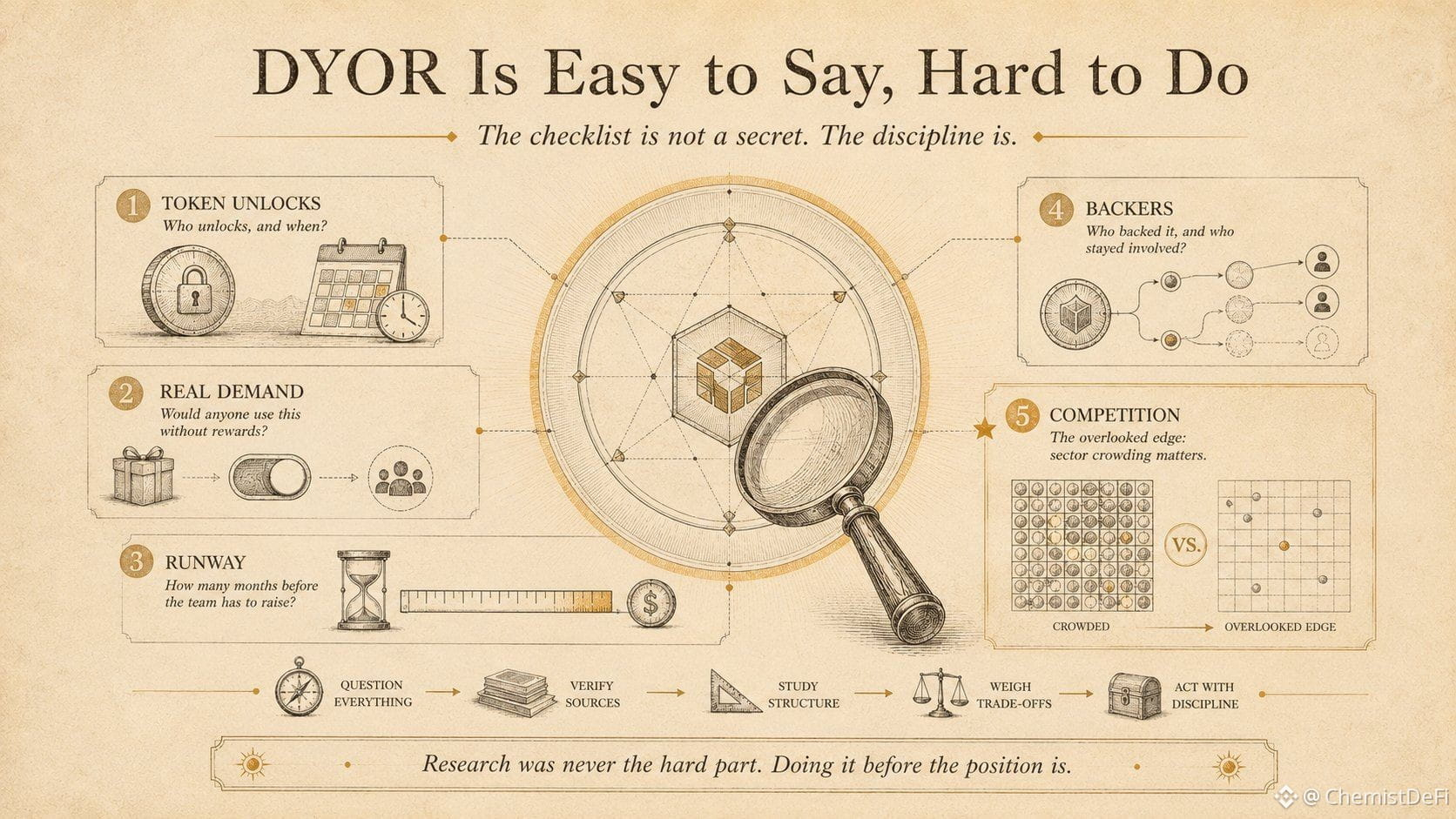
20
249
·
--
DefiLlama's front page is telling two stories at once, and most people only read one of them.
Total DeFi TVL sits around 70 billion, down from roughly 114 at the start of the year.
That is the story everyone reads. DeFi is shrinking.
But TVL is a strange metric. It mixes two different units inside one number.
Most of it is crypto collateral. ETH in Lido, ETH in restaking, coins sitting in lending markets. When prices fall, that TVL falls with them. Nobody has to withdraw anything. The same coins just get repriced.
A smaller slice is denominated in dollars. Tokenized treasuries and private credit. That part does not reprice when ETH falls. It only moves when someone actually deposits or actually leaves.
Open the one month column and the gradient is hard to miss.
→ Staking and restaking categories down 15 to 25 percent, tracking ETH
→ Lending down high single digits, tracking its collateral
→ RWA down low single digits, the smallest drop on the board
So the honest read is that most of this year's decline is a price echo, not an exodus. The further a category sits from crypto price exposure, the less it fell.
And inside that quietest category, the dollar credit names are still growing. Centrifuge is up double digits in a month where almost everything else bled.
To be fair, holding steady is easy when your unit does not reprice. Stability proves nothing here. Growth does.
New money choosing tokenized credit and treasuries in the middle of a drawdown is a decision someone made on purpose.
The sector's onchain value went from about 6 billion to over 25 billion in eighteen months and did not pause for any of this.
What I keep asking myself is which number I will actually care about in two years.
The TVL that breathes with the price of ETH, or the TVL that only moves when someone decides.
DefiLlama's front page is telling two stories at once, and most people only read one of them.
Total DeFi TVL sits around 70 billion, down from roughly 114 at the start of the year.
That is the story everyone reads. DeFi is shrinking.
But TVL is a strange metric. It mixes two different units inside one number.
Most of it is crypto collateral. ETH in Lido, ETH in restaking, coins sitting in lending markets. When prices fall, that TVL falls with them. Nobody has to withdraw anything. The same coins just get repriced.
A smaller slice is denominated in dollars. Tokenized treasuries and private credit. That part does not reprice when ETH falls. It only moves when someone actually deposits or actually leaves.
Open the one month column and the gradient is hard to miss.
→ Staking and restaking categories down 15 to 25 percent, tracking ETH
→ Lending down high single digits, tracking its collateral
→ RWA down low single digits, the smallest drop on the board
So the honest read is that most of this year's decline is a price echo, not an exodus. The further a category sits from crypto price exposure, the less it fell.
And inside that quietest category, the dollar credit names are still growing. Centrifuge is up double digits in a month where almost everything else bled.
To be fair, holding steady is easy when your unit does not reprice. Stability proves nothing here. Growth does.
New money choosing tokenized credit and treasuries in the middle of a drawdown is a decision someone made on purpose.
The sector's onchain value went from about 6 billion to over 25 billion in eighteen months and did not pause for any of this.
What I keep asking myself is which number I will actually care about in two years.
The TVL that breathes with the price of ETH, or the TVL that only moves when someone decides.
Total DeFi TVL sits around 70 billion, down from roughly 114 at the start of the year.
That is the story everyone reads. DeFi is shrinking.
But TVL is a strange metric. It mixes two different units inside one number.
Most of it is crypto collateral. ETH in Lido, ETH in restaking, coins sitting in lending markets. When prices fall, that TVL falls with them. Nobody has to withdraw anything. The same coins just get repriced.
A smaller slice is denominated in dollars. Tokenized treasuries and private credit. That part does not reprice when ETH falls. It only moves when someone actually deposits or actually leaves.
Open the one month column and the gradient is hard to miss.
→ Staking and restaking categories down 15 to 25 percent, tracking ETH
→ Lending down high single digits, tracking its collateral
→ RWA down low single digits, the smallest drop on the board
So the honest read is that most of this year's decline is a price echo, not an exodus. The further a category sits from crypto price exposure, the less it fell.
And inside that quietest category, the dollar credit names are still growing. Centrifuge is up double digits in a month where almost everything else bled.
To be fair, holding steady is easy when your unit does not reprice. Stability proves nothing here. Growth does.
New money choosing tokenized credit and treasuries in the middle of a drawdown is a decision someone made on purpose.
The sector's onchain value went from about 6 billion to over 25 billion in eighteen months and did not pause for any of this.
What I keep asking myself is which number I will actually care about in two years.
The TVL that breathes with the price of ETH, or the TVL that only moves when someone decides.
22
416
·
--
We are in a new month, and the July catalyst threads are already going up.
Every start of a month works this way. Someone lists the dates, the market nods, and the calendar gets treated like a forecast.
The dates are real this time too.
→ a jobs report this week
→ the Fed meets at the end of the month
→ the usual run of token unlocks, lighter than last month
None of that is what actually decides July.
BTC walks into this month roughly halved from its high, and the market around it is sitting in extreme fear.
That is the input almost nobody puts on the list.
In this state, events stop setting direction. They hand a frightened crowd permission to do what it already wanted to do.
The same jobs number lands one way in a confident market and the opposite way in a scared one.
The event does not change.
The crowd receiving it does.
And the reflex that carried two years of dip buying is quietly gone.
For most of this cycle the bull case rested on one silent assumption. Money would get cheaper. Cuts were coming, liquidity was on the way, and every dip had that floor underneath it.
The Fed spent June removing that floor. Rates held, the tone turned hawkish, and the market stopped pricing cuts for this year.
So a scared crowd is being asked to price this market without the one story it was built on.
What I keep coming back to is that none of this shows up on a catalyst list.
The dates will move price for an hour.
The fear is what gets to decide the month.
We are in a new month, and the July catalyst threads are already going up.
Every start of a month works this way. Someone lists the dates, the market nods, and the calendar gets treated like a forecast.
The dates are real this time too.
→ a jobs report this week
→ the Fed meets at the end of the month
→ the usual run of token unlocks, lighter than last month
None of that is what actually decides July.
BTC walks into this month roughly halved from its high, and the market around it is sitting in extreme fear.
That is the input almost nobody puts on the list.
In this state, events stop setting direction. They hand a frightened crowd permission to do what it already wanted to do.
The same jobs number lands one way in a confident market and the opposite way in a scared one.
The event does not change.
The crowd receiving it does.
And the reflex that carried two years of dip buying is quietly gone.
For most of this cycle the bull case rested on one silent assumption. Money would get cheaper. Cuts were coming, liquidity was on the way, and every dip had that floor underneath it.
The Fed spent June removing that floor. Rates held, the tone turned hawkish, and the market stopped pricing cuts for this year.
So a scared crowd is being asked to price this market without the one story it was built on.
What I keep coming back to is that none of this shows up on a catalyst list.
The dates will move price for an hour.
The fear is what gets to decide the month.
Every start of a month works this way. Someone lists the dates, the market nods, and the calendar gets treated like a forecast.
The dates are real this time too.
→ a jobs report this week
→ the Fed meets at the end of the month
→ the usual run of token unlocks, lighter than last month
None of that is what actually decides July.
BTC walks into this month roughly halved from its high, and the market around it is sitting in extreme fear.
That is the input almost nobody puts on the list.
In this state, events stop setting direction. They hand a frightened crowd permission to do what it already wanted to do.
The same jobs number lands one way in a confident market and the opposite way in a scared one.
The event does not change.
The crowd receiving it does.
And the reflex that carried two years of dip buying is quietly gone.
For most of this cycle the bull case rested on one silent assumption. Money would get cheaper. Cuts were coming, liquidity was on the way, and every dip had that floor underneath it.
The Fed spent June removing that floor. Rates held, the tone turned hawkish, and the market stopped pricing cuts for this year.
So a scared crowd is being asked to price this market without the one story it was built on.
What I keep coming back to is that none of this shows up on a catalyst list.
The dates will move price for an hour.
The fear is what gets to decide the month.
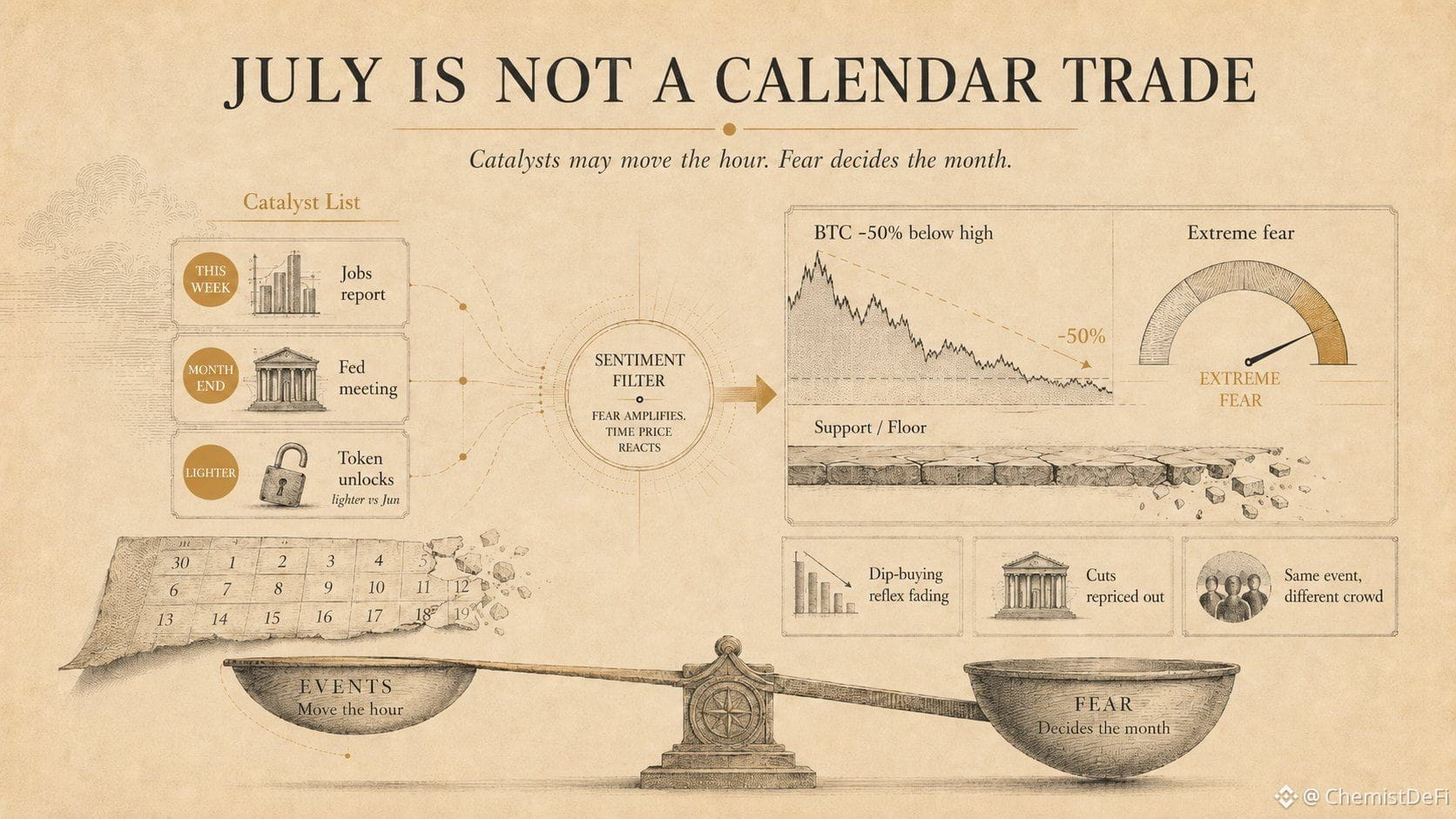
2
24
443
·
--
GM, new month, new platform.
First day on Binance Square.
Same chaos, better focus.
I’ll be sharing how I look at crypto, DeFi, liquidity and market narratives from here too.
Let’s cook 🧪
GM, new month, new platform.
First day on Binance Square.
Same chaos, better focus.
I’ll be sharing how I look at crypto, DeFi, liquidity and market narratives from here too.
Let’s cook 🧪
First day on Binance Square.
Same chaos, better focus.
I’ll be sharing how I look at crypto, DeFi, liquidity and market narratives from here too.
Let’s cook 🧪

1
21
527
Log in to explore more content
Join global crypto users on Binance Square
⚡️ Get latest and useful information about crypto.
💬 Trusted by the world’s largest crypto exchange.
👍 Discover real insights from verified creators.
Email / Phone number
Trending Topics
BNBSurpasses$790
13,773 views
115 Discussing
$BNB strategic long plan -> FOCUS NOW
BNB has created 2 strong lows after taking out internal liquidity
I'm expecting a move towards swing high $815-$830 and looking for a long on a retest of the green box
#BNBSurpasses$790 #bnb
Ghost Writer
·5 Likes
·6.6k views
ZamaRises15.99%ToIntradayHigh$0.09
9,651 views
92 Discussing
BitcoinSpotETFsDraw$6.34BInflowsInQ3
4,694 views
78 Discussing