
carjoman
2.6k Posts

carjoman

Traders League Badge Beginner
736 Following
483 Followers
5.5K+ Liked
1 Badges
Posts
Portfolio
All
Quotes

Suyay
·
--
#dusk $DUSK @Dusk
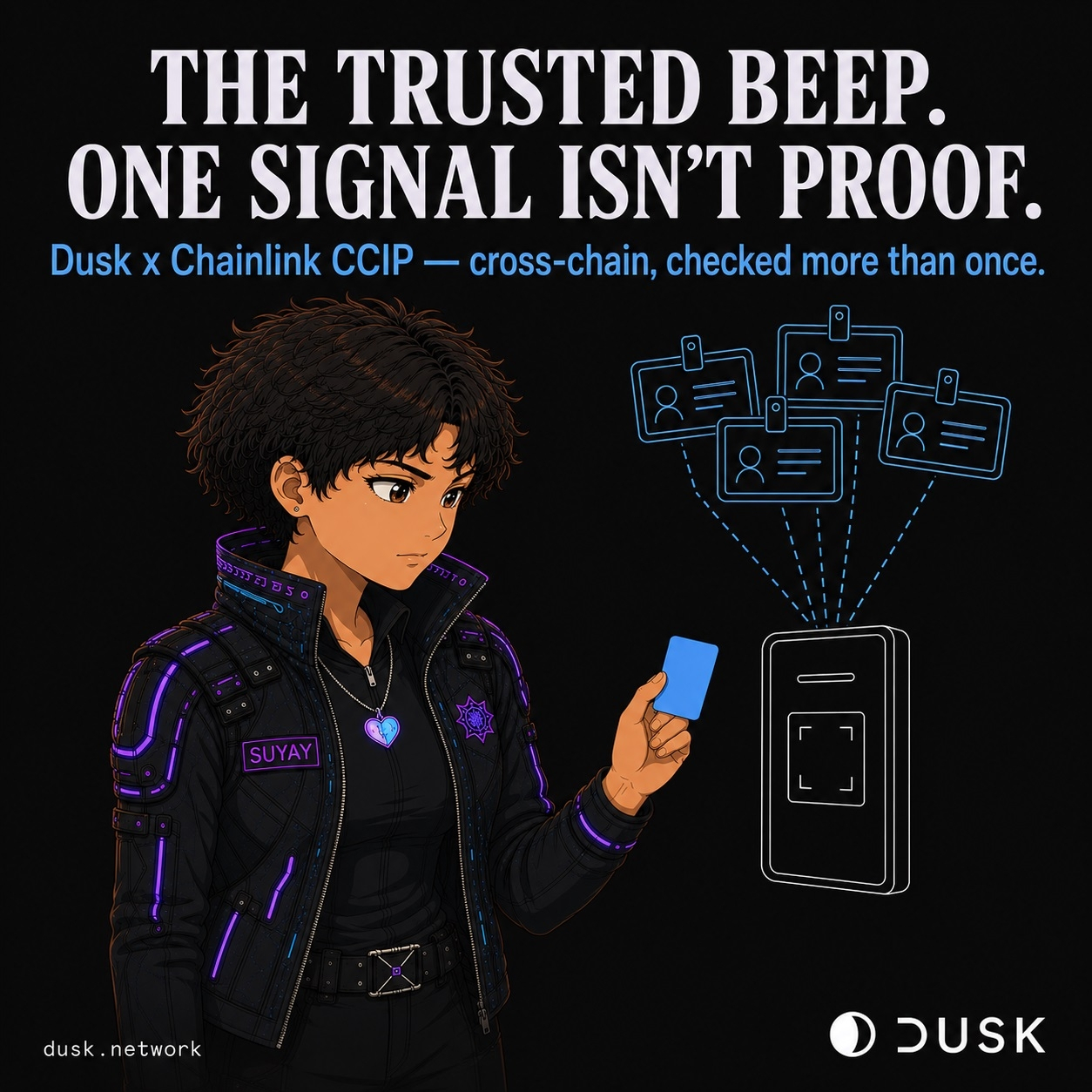
Reading about Dusk's Chainlink CCIP integration this week put me right back at a reception desk I temped years ago, the one with a badge scanner at the loading door. Courier badge beeps green, door opens, nobody checks the photo against the face holding it. Just the beep.
One week someone walked out with an outgoing shipment, badge beeping green under a name that wasn't theirs. Security footage caught it eventually. The scanner had done exactly what it was built to do: trust the beep, not the person.
Call it the trusted beep: a system that verifies the signal saying something is true, never the thing itself. Most cross-chain bridges run on the same shape, and it's the gap Dusk is choosing not to leave open. One chain sends a message claiming funds are locked, the other pays out the moment it hears that message land clean.
On August 9, someone drained roughly 199,916 XRP, about $200,000, from the bridge connecting the $XRP Ledger to the tx chain. No private key touched, no contract bug on either ledger. The attacker forged a deposit-verification message in the relayer software, and it paid out through 94 withdrawals in 97 minutes, all because the message beeped green.
This is the single-relayer setup Dusk skips with the Chainlink CCIP integration it's building alongside NPEX. Multiple independent oracle networks reach consensus before a cross-chain action executes, backed by a separate Risk Management Network watching for a pattern like 94 rapid withdrawals. For $DUSK itself, the CCT standard burns the token on the sending chain and mints on the receiving one, so no locked liquidity pool sits there as a badge scanner waiting to be spoofed.
What doesn't disappear even with Dusk's setup: more parties checking it isn't the same as nobody being able to forge it. It shifts the risk from one relayer's code to whether enough of those networks could ever be compromised or collude at once, a different shape of the same trust question.
I still think about that badge, beeping green for a face it never looked at. @Dusk
Reading about Dusk's Chainlink CCIP integration this week put me right back at a reception desk I temped years ago, the one with a badge scanner at the loading door. Courier badge beeps green, door opens, nobody checks the photo against the face holding it. Just the beep.
One week someone walked out with an outgoing shipment, badge beeping green under a name that wasn't theirs. Security footage caught it eventually. The scanner had done exactly what it was built to do: trust the beep, not the person.
Call it the trusted beep: a system that verifies the signal saying something is true, never the thing itself. Most cross-chain bridges run on the same shape, and it's the gap Dusk is choosing not to leave open. One chain sends a message claiming funds are locked, the other pays out the moment it hears that message land clean.
On August 9, someone drained roughly 199,916 XRP, about $200,000, from the bridge connecting the $XRP Ledger to the tx chain. No private key touched, no contract bug on either ledger. The attacker forged a deposit-verification message in the relayer software, and it paid out through 94 withdrawals in 97 minutes, all because the message beeped green.
This is the single-relayer setup Dusk skips with the Chainlink CCIP integration it's building alongside NPEX. Multiple independent oracle networks reach consensus before a cross-chain action executes, backed by a separate Risk Management Network watching for a pattern like 94 rapid withdrawals. For $DUSK itself, the CCT standard burns the token on the sending chain and mints on the receiving one, so no locked liquidity pool sits there as a badge scanner waiting to be spoofed.
What doesn't disappear even with Dusk's setup: more parties checking it isn't the same as nobody being able to forge it. It shifts the risk from one relayer's code to whether enough of those networks could ever be compromised or collude at once, a different shape of the same trust question.
I still think about that badge, beeping green for a face it never looked at. @Dusk
Verified
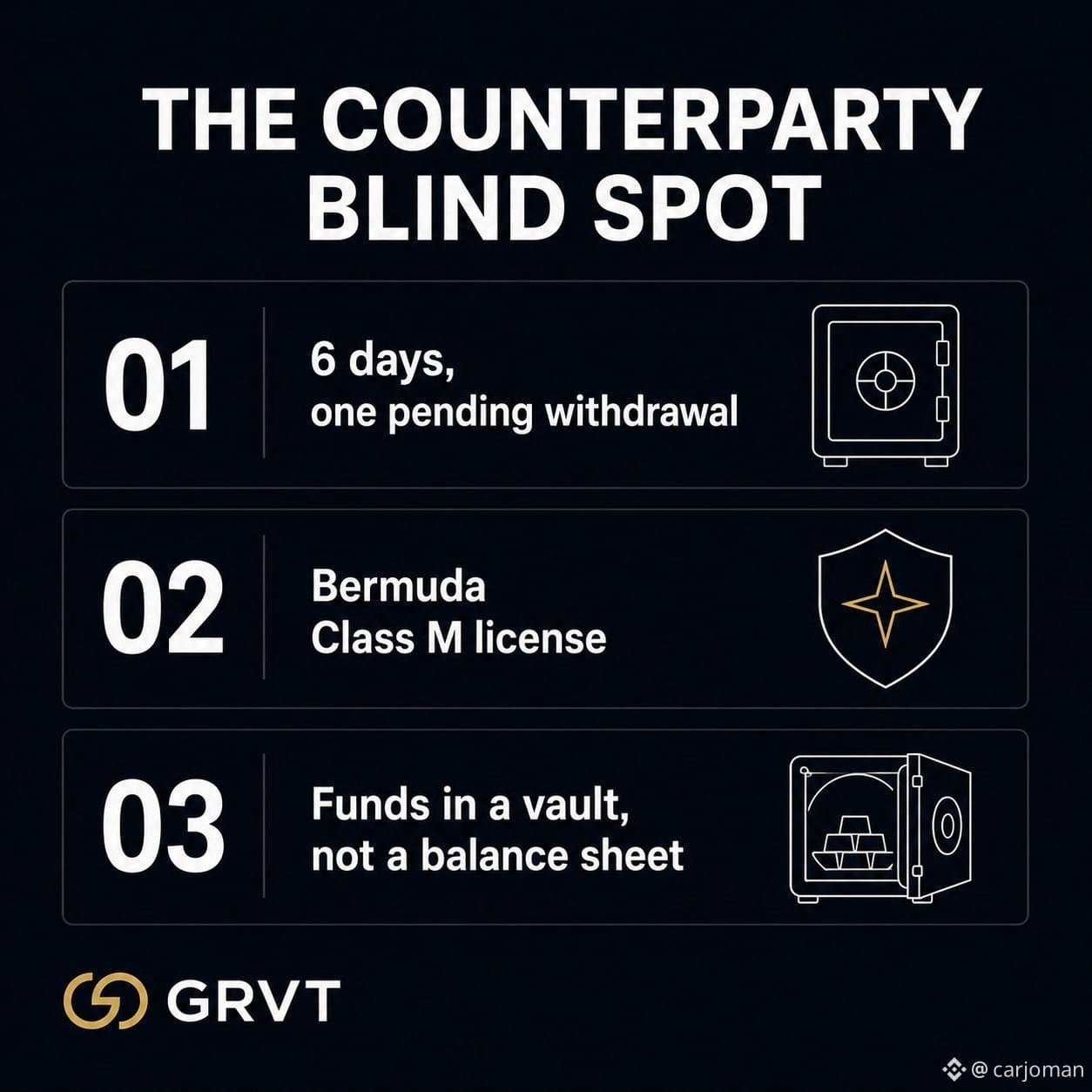
I still have a screenshot saved from a withdrawal request in 2022 — status stuck on "pending" for six days before the exchange finally admitted it wasn't processing. I never got clarity on what happened to that balance in the meantime. Only that it wasn't really mine while it sat there.
That gap — between what an exchange tells you your balance is and what actually still belongs to you if something goes wrong — is what I've started calling the counterparty blind spot. Most traders never check it, because checking means admitting the platform holding your funds is also the single point of failure protecting them.
What made me read the fine print on @grvt_io was learning it holds a Class M Digital Asset Business License from the Bermuda Monetary Authority, making it the first regulated DEX under that framework, on top of a non-custodial structure where funds sit in a smart contract vault rather than a company balance sheet — accessible on-chain even if the company itself went dark.
I'm not going to pretend a modified license from one jurisdiction closes every gap; it's a step toward accountability, not a guarantee, and GRVT itself is still pursuing broader licensing under MiCA and in Abu Dhabi. But I checked my balance today the way I used to check that pending withdrawal. This time, it wasn't a question.
#grvt #grvt
That gap — between what an exchange tells you your balance is and what actually still belongs to you if something goes wrong — is what I've started calling the counterparty blind spot. Most traders never check it, because checking means admitting the platform holding your funds is also the single point of failure protecting them.
What made me read the fine print on @grvt_io was learning it holds a Class M Digital Asset Business License from the Bermuda Monetary Authority, making it the first regulated DEX under that framework, on top of a non-custodial structure where funds sit in a smart contract vault rather than a company balance sheet — accessible on-chain even if the company itself went dark.
I'm not going to pretend a modified license from one jurisdiction closes every gap; it's a step toward accountability, not a guarantee, and GRVT itself is still pursuing broader licensing under MiCA and in Abu Dhabi. But I checked my balance today the way I used to check that pending withdrawal. This time, it wasn't a question.
#grvt #grvt
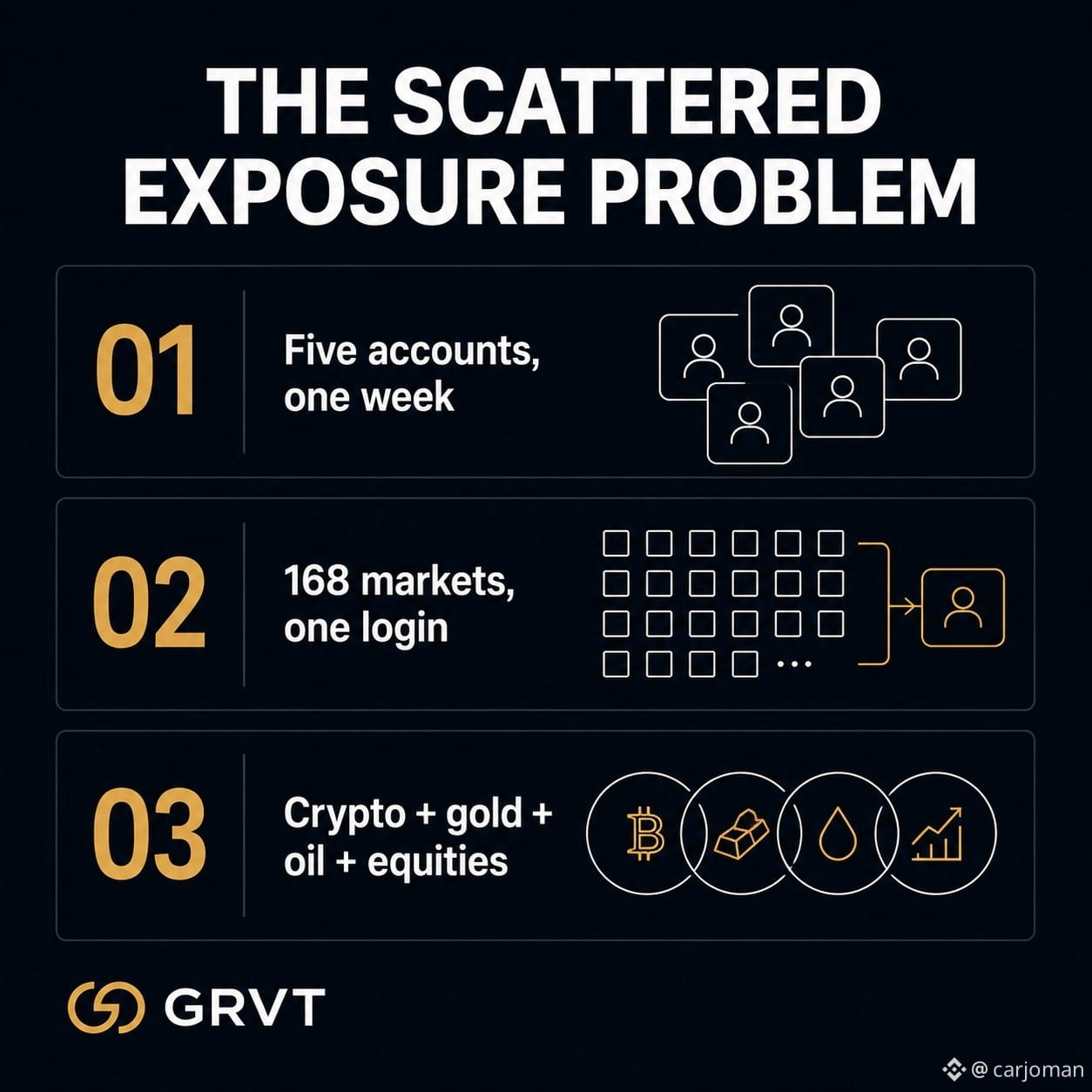
I once had five tabs open — one exchange for crypto, one broker for gold, one for a stock I was watching — just to manage a single week of positions across markets that don't talk to each other.
I call that the scattered exposure problem: your capital is spread across accounts that don't share margin, don't share risk, and don't let you actually see your full exposure in one place. Diversifying is supposed to reduce risk. Managing it like that quietly adds risk back in, through blind spots.
@grvt_io lists close to 168 perpetual markets from a single account, mixing crypto perps like BTC and ETH with real-world-asset perpetuals on things like gold and oil, alongside equity-linked markets — one balance, one margin system, instead of five logins.
I'm honestly unsure how deep the liquidity is on the RWA side compared to a dedicated commodities venue, and that's worth checking before sizing a position there. But this week I managed all of it from one tab.
#grvt #grvt
I call that the scattered exposure problem: your capital is spread across accounts that don't share margin, don't share risk, and don't let you actually see your full exposure in one place. Diversifying is supposed to reduce risk. Managing it like that quietly adds risk back in, through blind spots.
@grvt_io lists close to 168 perpetual markets from a single account, mixing crypto perps like BTC and ETH with real-world-asset perpetuals on things like gold and oil, alongside equity-linked markets — one balance, one margin system, instead of five logins.
I'm honestly unsure how deep the liquidity is on the RWA side compared to a dedicated commodities venue, and that's worth checking before sizing a position there. But this week I managed all of it from one tab.
#grvt #grvt
Partly True
off-chain matching + on-chain settlement con ZK proofs (anti front-running), Retail Price Improvement (RPI) orders
A few months ago I watched a trade get worse the exact second I hit confirm — the price I saw wasn't the price I got, and the gap was too clean to be coincidence.
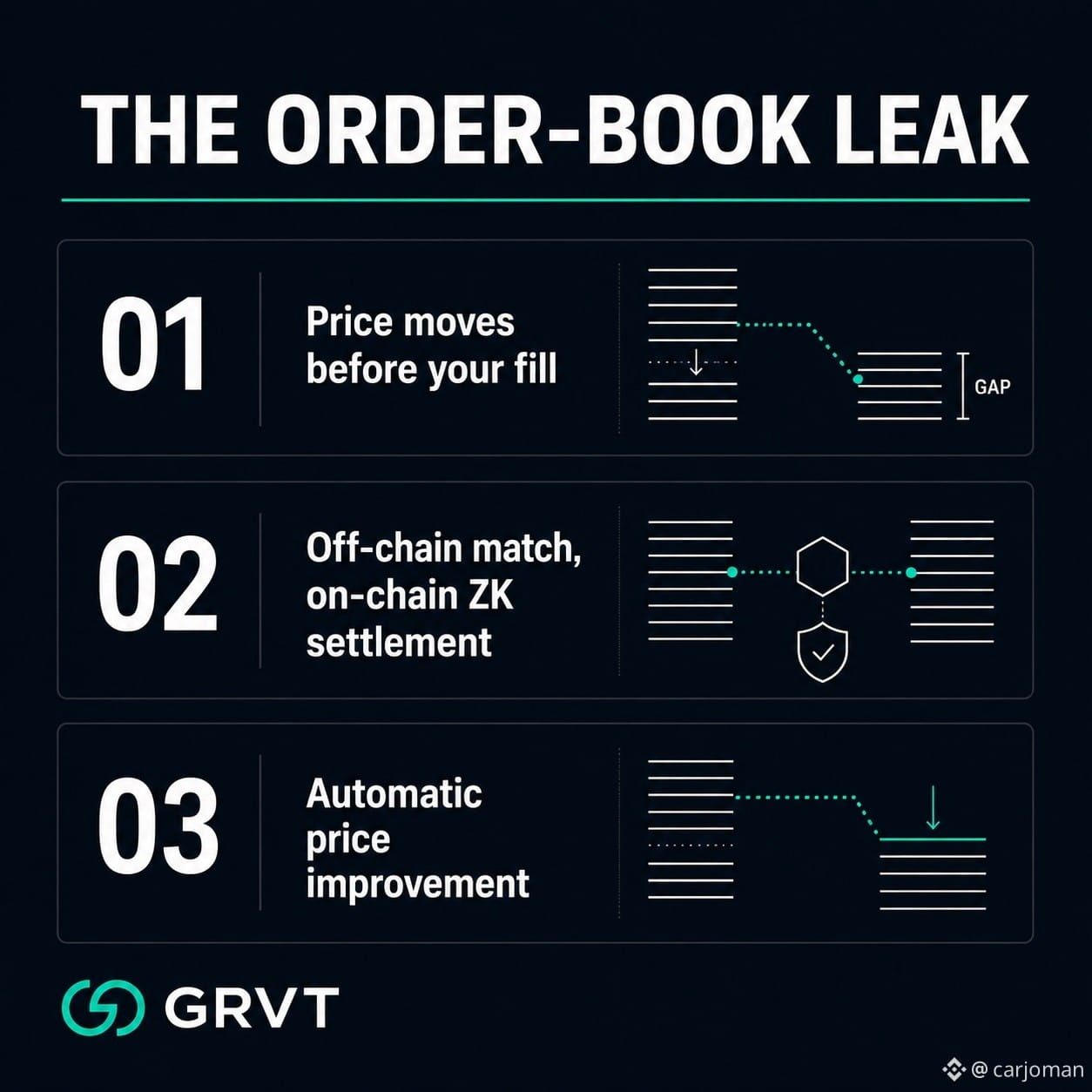
I started calling that gap the order-book leak: the small, repeated tax that happens when someone else sees your order before it settles and moves first. It rarely shows up as a single dramatic loss. It shows up as a hundred small ones you stop noticing because they feel like "just how trading works."
@grvt_io 's architecture separates order matching from settlement and verifies every trade with zero-knowledge proofs on Ethereum, which is the specific design meant to close that gap — on top of retail price improvement orders that check for a better execution price automatically before a trade fills.
Whether that fully closes the leak in practice, versus just making it harder to see, is something I'd want more independent execution data on before calling it solved. But the last time I watched a fill happen live, the price didn't move against me first.
#grvt
A few months ago I watched a trade get worse the exact second I hit confirm — the price I saw wasn't the price I got, and the gap was too clean to be coincidence.
I started calling that gap the order-book leak: the small, repeated tax that happens when someone else sees your order before it settles and moves first. It rarely shows up as a single dramatic loss. It shows up as a hundred small ones you stop noticing because they feel like "just how trading works."
@grvt_io 's architecture separates order matching from settlement and verifies every trade with zero-knowledge proofs on Ethereum, which is the specific design meant to close that gap — on top of retail price improvement orders that check for a better execution price automatically before a trade fills.
Whether that fully closes the leak in practice, versus just making it harder to see, is something I'd want more independent execution data on before calling it solved. But the last time I watched a fill happen live, the price didn't move against me first.
#grvt
Partly True
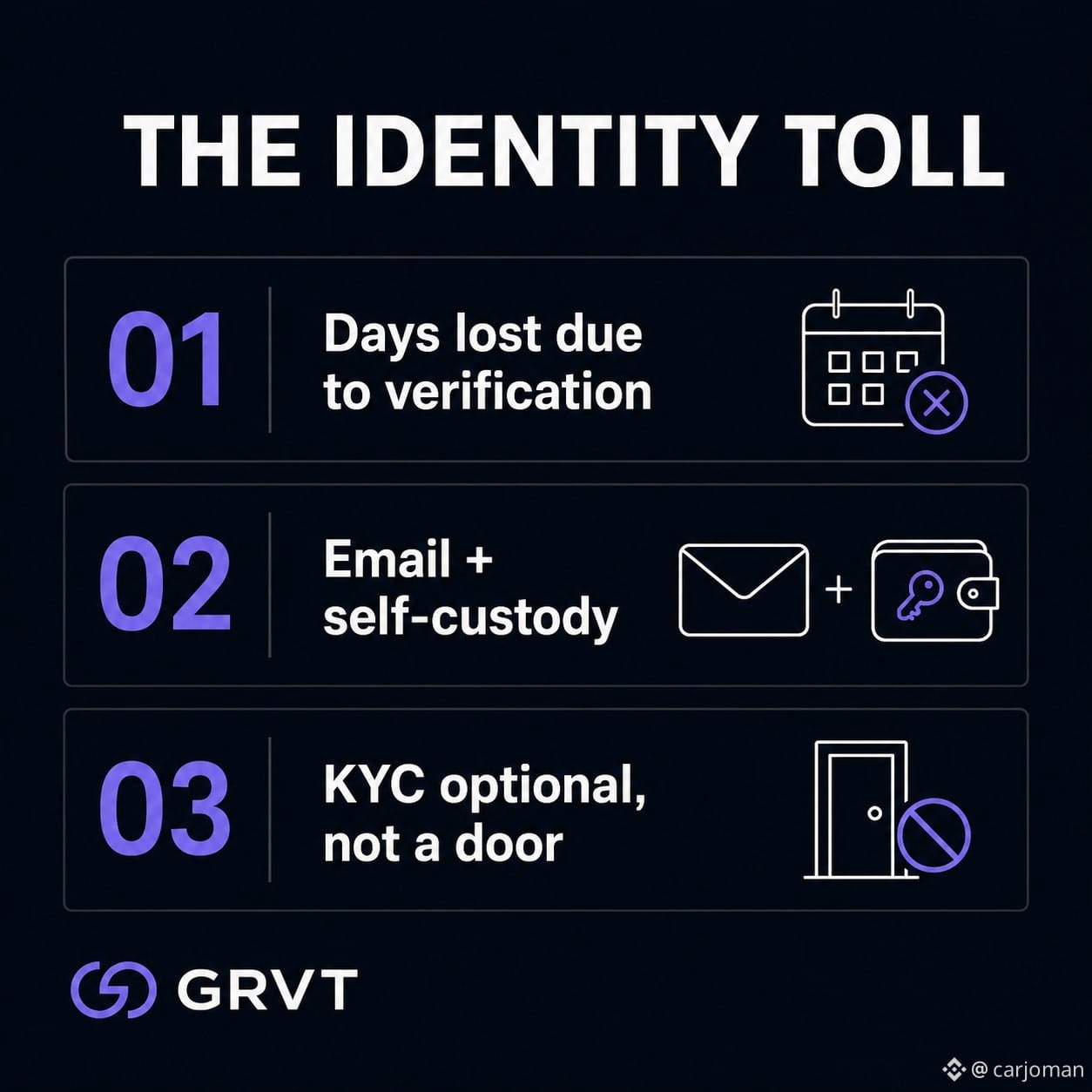
Last year I spent four days waiting on a centralized exchange's verification team to re-approve a document I'd already submitted twice, while a trade I wanted to make sat untouched. By the time I got access again, the setup I'd been watching was gone.
I've come to think of that wait as the identity toll: the cost paid in time and missed opportunity just to prove who you are before you're allowed to touch your own money. It's rarely counted as a real cost, but for anyone trading on a schedule the market doesn't respect, it is.
What made me look twice at @grvt_io was that it lets you start trading with just an email, self-custodially, with no mandatory identity verification standing between you and your funds. KYC still exists there, but only if you want to claim airdrop tokens later — not as a gate to trade in the meantime.
I'm still not sure removing that gate doesn't just shift risk somewhere else instead of removing it, and that's a fair question to sit with. But the four days I lost last year are the reason I noticed the difference at all.
#grvt
I've come to think of that wait as the identity toll: the cost paid in time and missed opportunity just to prove who you are before you're allowed to touch your own money. It's rarely counted as a real cost, but for anyone trading on a schedule the market doesn't respect, it is.
What made me look twice at @grvt_io was that it lets you start trading with just an email, self-custodially, with no mandatory identity verification standing between you and your funds. KYC still exists there, but only if you want to claim airdrop tokens later — not as a gate to trade in the meantime.
I'm still not sure removing that gate doesn't just shift risk somewhere else instead of removing it, and that's a fair question to sit with. But the four days I lost last year are the reason I noticed the difference at all.
#grvt
Partly True
I checked my exchange balance last week and did the actual math on what it had earned me over the past three months sitting there, unused, between trades. Zero. Not a rounding error — actual zero, because I'd always treated an idle balance as a neutral state. Not gaining, but also not losing, right?
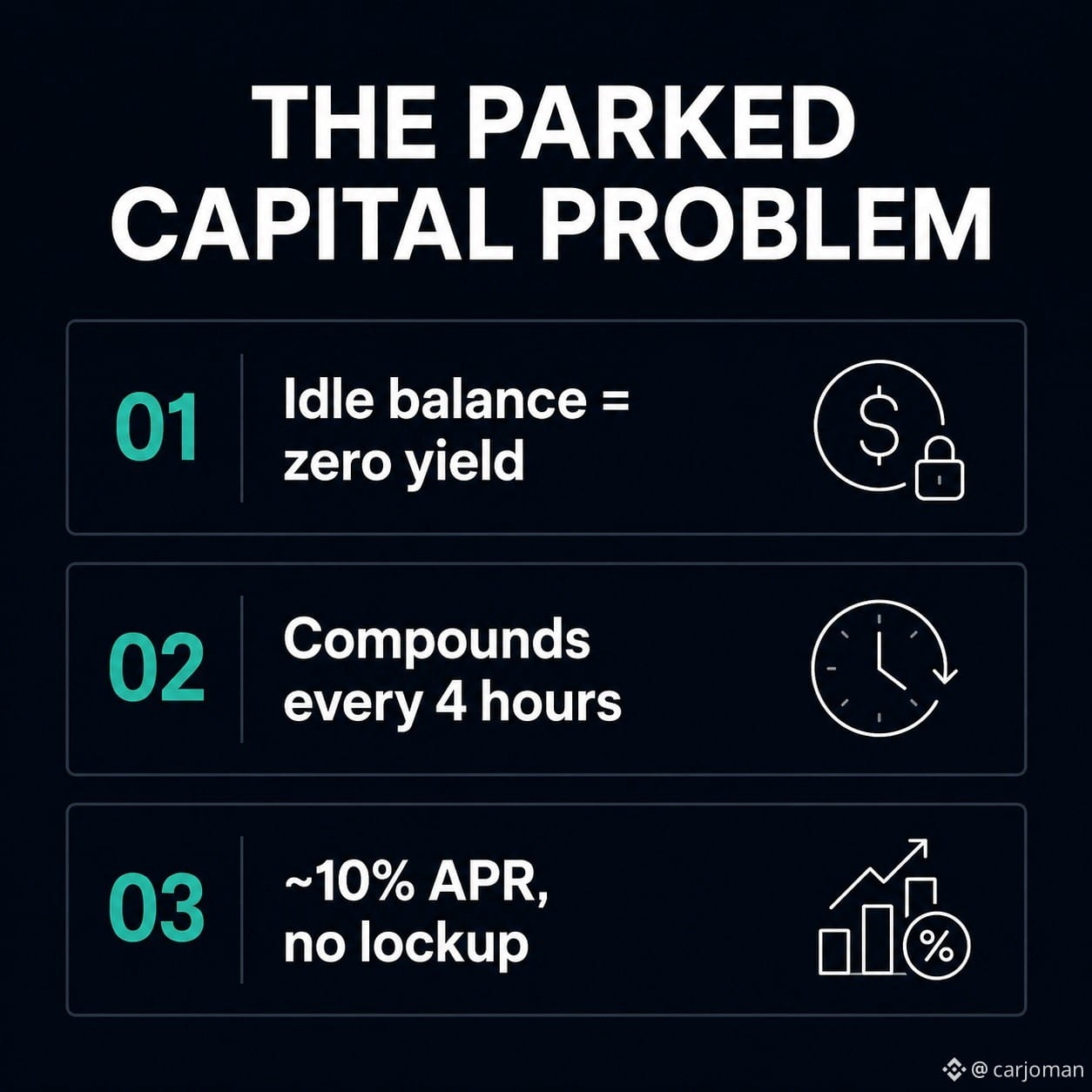
Turns out that assumption is where most retail traders quietly bleed value. I started calling it the parked capital problem: money that isn't exposed to risk, but also isn't doing anything for you, sitting in an account as if holding cash under a mattress were free. It isn't. Every day that balance stays idle is a day of yield you didn't get paid.
I went looking for a setup where that stops being true, and found @grvt_io 's Earn on Equity feature — account balances compound roughly every four hours toward an annualized yield, with no lockup, while the same funds remain available to trade whenever you want.
I genuinely don't know if that yield holds steady through a real volatility spike, and I think that's the question worth watching before trusting it fully. But I did the math again this week. This time the number wasn't zero.
#grvt
Turns out that assumption is where most retail traders quietly bleed value. I started calling it the parked capital problem: money that isn't exposed to risk, but also isn't doing anything for you, sitting in an account as if holding cash under a mattress were free. It isn't. Every day that balance stays idle is a day of yield you didn't get paid.
I went looking for a setup where that stops being true, and found @grvt_io 's Earn on Equity feature — account balances compound roughly every four hours toward an annualized yield, with no lockup, while the same funds remain available to trade whenever you want.
I genuinely don't know if that yield holds steady through a real volatility spike, and I think that's the question worth watching before trusting it fully. But I did the math again this week. This time the number wasn't zero.
#grvt
I like how SIGN is being projected, they are developing a robust and reliable system step by step, its expansion and growth in the Middle East is significant, we will see how it evolves in the medium and long term !!
@SignOfficial $SIGN #SignDigitalSovereignInfra
@SignOfficial $SIGN #SignDigitalSovereignInfra
Suyay
·
--
Crypto Was Built for Users. Sign Is Being Built for Nations
For most of its history, crypto has been built around users. Wallets, apps, trading interfaces, onboarding flows… everything optimized for individuals interacting with systems. Even when projects talk about “mass adoption,” what they usually mean is more users, more activity, more transactions. The assumption has always been that if enough individuals participate, the system becomes valuable. But that model has limits, especially when you move beyond consumer applications and into environments where coordination, compliance, and control actually matter.
Because nations don’t operate like users.
They don’t experiment freely, they don’t tolerate unreliable systems, and they don’t rebuild infrastructure every cycle. When a government integrates a digital system, it has to persist. It has to be auditable. And it has to function under constraints that most crypto products were never designed to handle. This is where the gap between “crypto adoption” and “infrastructure deployment” becomes visible, and why so many narratives fail when they meet real-world requirements.
Sign is positioning itself directly in that gap.
Instead of optimizing for individual interaction, it focuses on how systems define, issue, and verify data at scale. Through schemas and attestations, it creates a structured way to turn claims into verifiable records that can be used across different environments. This is not just a feature for applications. It is a requirement for any system that needs to operate consistently across institutions, jurisdictions, and layers of governance.
Because once you move to a national level, data cannot be informal.
Identity needs to be provable. Records need to be consistent. And processes need to be auditable not just internally, but across multiple entities that depend on the same information. Without a shared structure, every system becomes isolated, forcing constant verification, duplication, and reconciliation. That inefficiency scales quickly, and it is one of the reasons why many digital systems struggle to integrate with each other.
Sign’s approach introduces a different model.
Schemas define how data is structured. Attestations encode and sign that data.
And once those records exist, they can be referenced, verified, and reused without needing to be recreated every time. This creates a shared layer of verifiable information that multiple systems can rely on simultaneously, reducing redundancy and allowing coordination without centralizing control.
That distinction becomes critical when you consider where this is being applied.
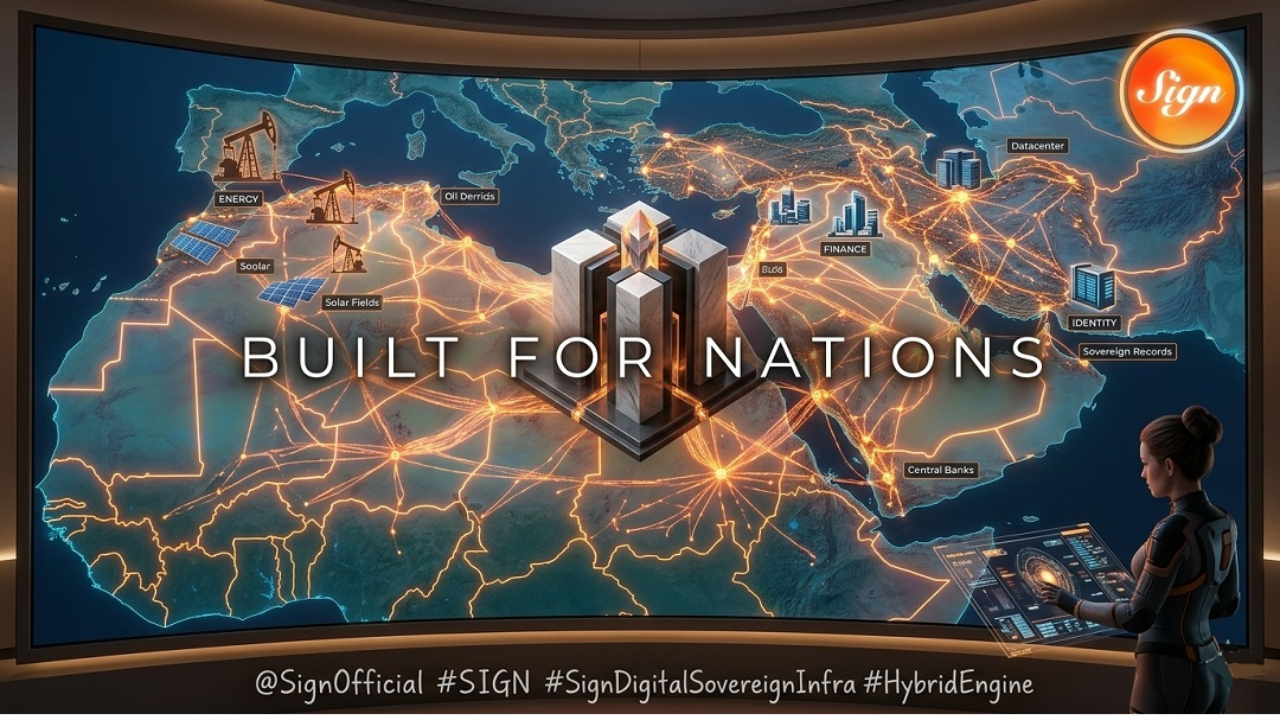
In regions like the Middle East, the conversation around digital infrastructure is not theoretical. Sovereign funds, national programs, and public systems are actively exploring how to build digital layers that are independent, auditable, and scalable. The goal is not just digitization, but sovereignty. Control over data, control over systems, and the ability to coordinate economic activity without relying on external platforms.
This is where Sign’s positioning becomes more concrete.
It is not competing as another application. It is aligning with a structural need: how to build systems where trust does not depend on a single authority, but can be verified across participants. In that context, attestations are not just technical constructs. They become building blocks for identity, financial systems, and digital processes that need to function reliably at scale.
The growth of the ecosystem reflects this shift.
Millions of attestations and hundreds of thousands of schemas indicate that developers are already structuring data in ways that can be reused across systems. This is not just activity. It is the early formation of a shared infrastructure layer, where information becomes portable, verifiable, and interoperable. And as more systems connect to that layer, the value compounds, because each new attestation is not isolated, but part of a larger network of verifiable data.
But there is a deeper implication behind this.
Most crypto systems are designed to attract participation. They rely on incentives, interfaces, and user growth to expand. Infrastructure works differently. It becomes valuable when it is embedded into processes that cannot easily be replaced. When systems depend on it, not because they are incentivized to use it, but because they need it to function.
That is the difference between usage and dependency.
And that difference is what separates applications from infrastructure.
Once a system becomes part of identity frameworks, financial coordination, or public records, it stops being optional. It becomes part of how things operate. At that point, the conversation is no longer about adoption in the traditional sense. It is about how far that infrastructure can extend, and how many other systems can build on top of it.
That is the trajectory Sign is moving toward.
Not as a product competing for attention, but as a layer integrating into systems that require stability, verifiability, and control. And in a landscape where most projects are still trying to capture users, that shift toward serving nations may end up defining where real adoption actually happens.
@SignOfficial $SIGN #SignDigitalSovereignInfra
Because nations don’t operate like users.
They don’t experiment freely, they don’t tolerate unreliable systems, and they don’t rebuild infrastructure every cycle. When a government integrates a digital system, it has to persist. It has to be auditable. And it has to function under constraints that most crypto products were never designed to handle. This is where the gap between “crypto adoption” and “infrastructure deployment” becomes visible, and why so many narratives fail when they meet real-world requirements.
Sign is positioning itself directly in that gap.
Instead of optimizing for individual interaction, it focuses on how systems define, issue, and verify data at scale. Through schemas and attestations, it creates a structured way to turn claims into verifiable records that can be used across different environments. This is not just a feature for applications. It is a requirement for any system that needs to operate consistently across institutions, jurisdictions, and layers of governance.
Because once you move to a national level, data cannot be informal.
Identity needs to be provable. Records need to be consistent. And processes need to be auditable not just internally, but across multiple entities that depend on the same information. Without a shared structure, every system becomes isolated, forcing constant verification, duplication, and reconciliation. That inefficiency scales quickly, and it is one of the reasons why many digital systems struggle to integrate with each other.
Sign’s approach introduces a different model.
Schemas define how data is structured. Attestations encode and sign that data.
And once those records exist, they can be referenced, verified, and reused without needing to be recreated every time. This creates a shared layer of verifiable information that multiple systems can rely on simultaneously, reducing redundancy and allowing coordination without centralizing control.
That distinction becomes critical when you consider where this is being applied.
In regions like the Middle East, the conversation around digital infrastructure is not theoretical. Sovereign funds, national programs, and public systems are actively exploring how to build digital layers that are independent, auditable, and scalable. The goal is not just digitization, but sovereignty. Control over data, control over systems, and the ability to coordinate economic activity without relying on external platforms.
This is where Sign’s positioning becomes more concrete.
It is not competing as another application. It is aligning with a structural need: how to build systems where trust does not depend on a single authority, but can be verified across participants. In that context, attestations are not just technical constructs. They become building blocks for identity, financial systems, and digital processes that need to function reliably at scale.
The growth of the ecosystem reflects this shift.
Millions of attestations and hundreds of thousands of schemas indicate that developers are already structuring data in ways that can be reused across systems. This is not just activity. It is the early formation of a shared infrastructure layer, where information becomes portable, verifiable, and interoperable. And as more systems connect to that layer, the value compounds, because each new attestation is not isolated, but part of a larger network of verifiable data.
But there is a deeper implication behind this.
Most crypto systems are designed to attract participation. They rely on incentives, interfaces, and user growth to expand. Infrastructure works differently. It becomes valuable when it is embedded into processes that cannot easily be replaced. When systems depend on it, not because they are incentivized to use it, but because they need it to function.
That is the difference between usage and dependency.
And that difference is what separates applications from infrastructure.
Once a system becomes part of identity frameworks, financial coordination, or public records, it stops being optional. It becomes part of how things operate. At that point, the conversation is no longer about adoption in the traditional sense. It is about how far that infrastructure can extend, and how many other systems can build on top of it.
That is the trajectory Sign is moving toward.
Not as a product competing for attention, but as a layer integrating into systems that require stability, verifiability, and control. And in a landscape where most projects are still trying to capture users, that shift toward serving nations may end up defining where real adoption actually happens.
@SignOfficial $SIGN #SignDigitalSovereignInfra
The launch is ready!! Let's try!!! It's time to know if everything that was said works in real time, we will see over the days how it behaves!!
@MidnightNetwork $NIGHT #night #NIGHT
@MidnightNetwork $NIGHT #night #NIGHT
Suyay
·
--
Tomorrow, Midnight Goes Live. The Real Test Starts After.
I've been watching the countdown all week. The block explorers, the Discord channels, the quiet announcements from the Midnight Foundation as they finalized the last pieces before tomorrow. Every few hours, something new appeared. Worldpay joining the node operator alliance. Bullish committing to build proof of reserves. MoneyGram completing their identity oracle integration. eToro becoming an Identity Provider.
Tomorrow, the Midnight mainnet opens. The headlines will write themselves. Fourth-generation blockchain. Programmable privacy. Institutional DeFi. The inevitable comparisons to Cardano, to Ethereum, to every network that came before. All of it true. All of it important. None of it the real story.
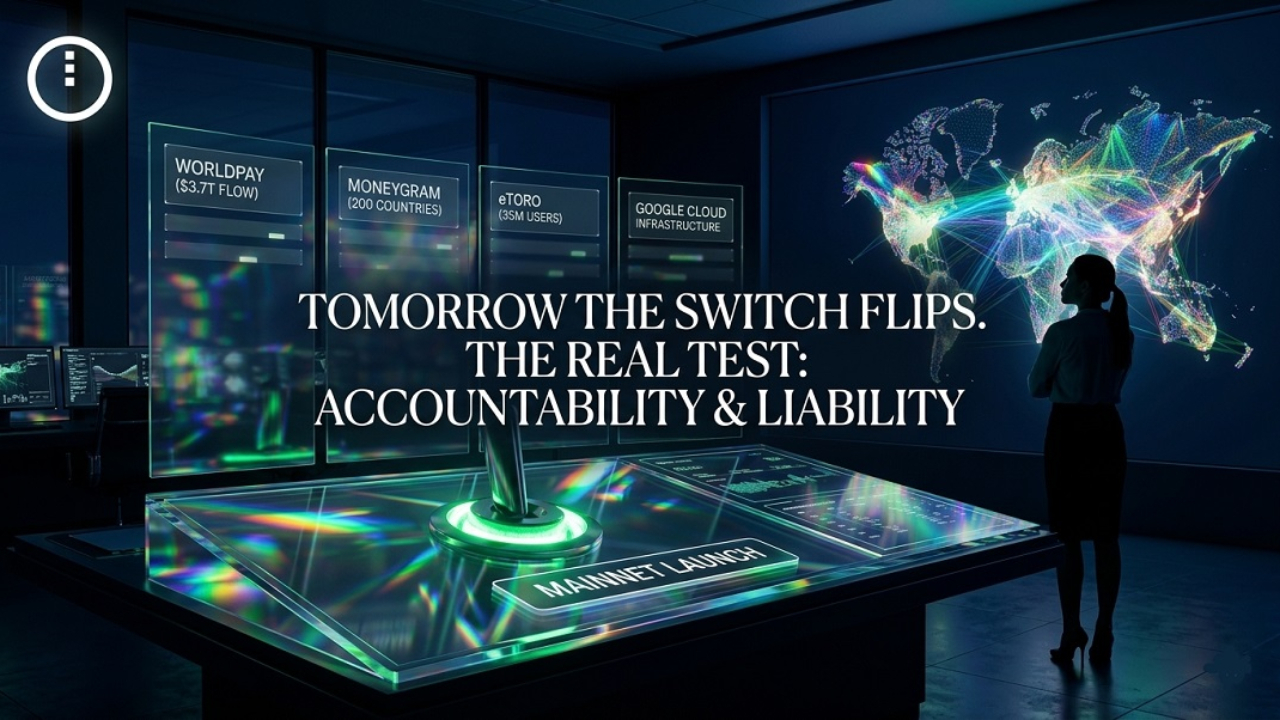
Here's what I keep coming back to. Midnight isn't launching into a vacuum. It's launching into a world where $3.7 trillion in annual payments already flow through Worldpay. Where MoneyGram operates across 200 countries, connecting people who often don't have bank accounts. Where eToro's 35 million users have been waiting for a way to take their verified identities into DeFi without starting over. Where Google Cloud and Vodafone are running nodes not as experiments, but as production infrastructure.
The network is ready. The validators are in place. The credentials are issued. The viewing keys are generated. Tomorrow, the switch flips.
But there's a question that's been sitting with me since the announcements started rolling in last week. When MoneyGram starts moving real remittances through Midnight, and a regulator uses a viewing key to audit a transaction, and something doesn't match — a compliance flag, a disputed amount, a question about source of funds — who explains what happened?
The user who initiated the transaction? The node operator who validated the block? The Identity Provider who issued the credential? The developer who wrote the contract? The Midnight Foundation, which coordinates the network but doesn't control it?
This is not a technical question. The cryptography works. The ZK-SNARKs generate proofs in milliseconds. The selective disclosure is elegant. The viewing keys do exactly what they're designed to do: reveal specific details to authorized parties, hide everything else.
The question is about something messier. It's about accountability in a system where no single party controls the whole stack, but where every party has obligations. Regulated institutions don't get to say "the protocol did it" when an auditor comes calling. Their compliance teams, their legal departments, their reputations are on the line.
Midnight's federated model was designed for stability. Fifteen institutions running nodes at launch, each with reputations to protect, each with compliance teams, each with legal obligations. Google Cloud doesn't operate infrastructure at this scale without layers of review. MoneyGram doesn't integrate with a blockchain before mainnet without answering hard questions internally. eToro doesn't become an Identity Provider without understanding exactly what they're signing up for.
That's the trade-off Midnight made. Instead of waiting years for permissionless validation to mature organically, they launched with enterprise-grade reliability from day one. The validators are known entities. The rules are clear. The infrastructure is battle-tested by organizations that run systems at global scale.
But stability and accountability are not the same thing. A system can run perfectly for years and still fail the moment someone asks a question no one prepared for. The question isn't whether the blocks will produce on time. They will. The question isn't whether the proofs will verify correctly. They will. The question is what happens when the system works exactly as designed, and the outcome still creates a dispute that no one anticipated.
The Liqwid DAO dispute this week over 18.8 million NIGHT tokens was a preview. Governance mechanisms are already being tested. Arguments are already happening about who controls what, who decides what, who gets what. That's healthy. Decentralized systems are supposed to have friction. But it's also a reminder that where there are tokens, there are conflicts. Where there are conflicts, there are questions about who decides. Where there are questions about who decides, there are gaps in the architecture that no amount of cryptography can fill.
Tomorrow, the network goes live. The validators start producing blocks. The Identity Providers start issuing credentials. The first users start transacting. The block explorers that I've been refreshing for weeks will finally show something more than configuration transactions. They'll show real activity. Real value. Real people using a network that was designed to give them exactly what they need and nothing more.
I want to watch what happens in the first week, not the first hour. The technical launch is guaranteed to work. That's what testnets are for. 962,000 transactions on Preprod proved the architecture scales. The 1,617% increase in smart contract deployments proved developers are building. ShieldUSD's MVP deployment on March 17 proved the use cases are real.
The question is what happens when real institutions, real users, and real regulators start interacting with a system designed to give everyone exactly what they need and nothing more. The elegance of selective disclosure is that it separates data from proof. You can prove you're compliant without exposing your transaction history. You can prove you're solvent without revealing your positions. You can prove you're eligible without sharing your identity.
The challenge is that liability doesn't separate so cleanly. When a proof is generated, a credential is issued, a transaction is validated, and a viewing key is used, the pieces are distributed. The accountability is not.
Midnight has solved the data problem. The cryptography is sound. The architecture is tested. The institutions are ready.
Who is solving the liability problem?
Tomorrow, we start finding out.
$NIGHT @MidnightNetwork #night
Tomorrow, the Midnight mainnet opens. The headlines will write themselves. Fourth-generation blockchain. Programmable privacy. Institutional DeFi. The inevitable comparisons to Cardano, to Ethereum, to every network that came before. All of it true. All of it important. None of it the real story.
Here's what I keep coming back to. Midnight isn't launching into a vacuum. It's launching into a world where $3.7 trillion in annual payments already flow through Worldpay. Where MoneyGram operates across 200 countries, connecting people who often don't have bank accounts. Where eToro's 35 million users have been waiting for a way to take their verified identities into DeFi without starting over. Where Google Cloud and Vodafone are running nodes not as experiments, but as production infrastructure.
The network is ready. The validators are in place. The credentials are issued. The viewing keys are generated. Tomorrow, the switch flips.
But there's a question that's been sitting with me since the announcements started rolling in last week. When MoneyGram starts moving real remittances through Midnight, and a regulator uses a viewing key to audit a transaction, and something doesn't match — a compliance flag, a disputed amount, a question about source of funds — who explains what happened?
The user who initiated the transaction? The node operator who validated the block? The Identity Provider who issued the credential? The developer who wrote the contract? The Midnight Foundation, which coordinates the network but doesn't control it?
This is not a technical question. The cryptography works. The ZK-SNARKs generate proofs in milliseconds. The selective disclosure is elegant. The viewing keys do exactly what they're designed to do: reveal specific details to authorized parties, hide everything else.
The question is about something messier. It's about accountability in a system where no single party controls the whole stack, but where every party has obligations. Regulated institutions don't get to say "the protocol did it" when an auditor comes calling. Their compliance teams, their legal departments, their reputations are on the line.
Midnight's federated model was designed for stability. Fifteen institutions running nodes at launch, each with reputations to protect, each with compliance teams, each with legal obligations. Google Cloud doesn't operate infrastructure at this scale without layers of review. MoneyGram doesn't integrate with a blockchain before mainnet without answering hard questions internally. eToro doesn't become an Identity Provider without understanding exactly what they're signing up for.
That's the trade-off Midnight made. Instead of waiting years for permissionless validation to mature organically, they launched with enterprise-grade reliability from day one. The validators are known entities. The rules are clear. The infrastructure is battle-tested by organizations that run systems at global scale.
But stability and accountability are not the same thing. A system can run perfectly for years and still fail the moment someone asks a question no one prepared for. The question isn't whether the blocks will produce on time. They will. The question isn't whether the proofs will verify correctly. They will. The question is what happens when the system works exactly as designed, and the outcome still creates a dispute that no one anticipated.
The Liqwid DAO dispute this week over 18.8 million NIGHT tokens was a preview. Governance mechanisms are already being tested. Arguments are already happening about who controls what, who decides what, who gets what. That's healthy. Decentralized systems are supposed to have friction. But it's also a reminder that where there are tokens, there are conflicts. Where there are conflicts, there are questions about who decides. Where there are questions about who decides, there are gaps in the architecture that no amount of cryptography can fill.
Tomorrow, the network goes live. The validators start producing blocks. The Identity Providers start issuing credentials. The first users start transacting. The block explorers that I've been refreshing for weeks will finally show something more than configuration transactions. They'll show real activity. Real value. Real people using a network that was designed to give them exactly what they need and nothing more.
I want to watch what happens in the first week, not the first hour. The technical launch is guaranteed to work. That's what testnets are for. 962,000 transactions on Preprod proved the architecture scales. The 1,617% increase in smart contract deployments proved developers are building. ShieldUSD's MVP deployment on March 17 proved the use cases are real.
The question is what happens when real institutions, real users, and real regulators start interacting with a system designed to give everyone exactly what they need and nothing more. The elegance of selective disclosure is that it separates data from proof. You can prove you're compliant without exposing your transaction history. You can prove you're solvent without revealing your positions. You can prove you're eligible without sharing your identity.
The challenge is that liability doesn't separate so cleanly. When a proof is generated, a credential is issued, a transaction is validated, and a viewing key is used, the pieces are distributed. The accountability is not.
Midnight has solved the data problem. The cryptography is sound. The architecture is tested. The institutions are ready.
Who is solving the liability problem?
Tomorrow, we start finding out.
$NIGHT @MidnightNetwork #night
Focus on Utility 🛠️
Tired of your data being the business of others? With @MidnightNetwork and its token $NIGHT , privacy stops being a luxury and becomes the standard. Join the campaign on Creator Pad and discover how to protect your digital identity while you scale your community.
The future of creation is private and secure. 🔐🔥
#night #MidnightNetwork #crypto #CreatorEconomy
Tired of your data being the business of others? With @MidnightNetwork and its token $NIGHT , privacy stops being a luxury and becomes the standard. Join the campaign on Creator Pad and discover how to protect your digital identity while you scale your community.
The future of creation is private and secure. 🔐🔥
#night #MidnightNetwork #crypto #CreatorEconomy
Can you imagine a world where robots pay for their own repairs? @Fabric Foundation is making it possible. With the $ROBO token, the integration between AI and hardware reaches a new level of efficiency and transparency. Join the community of #ROBO and be part of the technological revolution that will change the industry forever. 🚀🤖
Decentralized AI is no longer a promise; it is a reality thanks to @Mira - Trust Layer of AI . By combining computing power with the transparency of blockchain, they are creating an ecosystem where everyone wins. The token $MIRA is essential for this new open intelligence market. If you seek real innovation in the AI + Web3 space, you must closely follow #Mira .
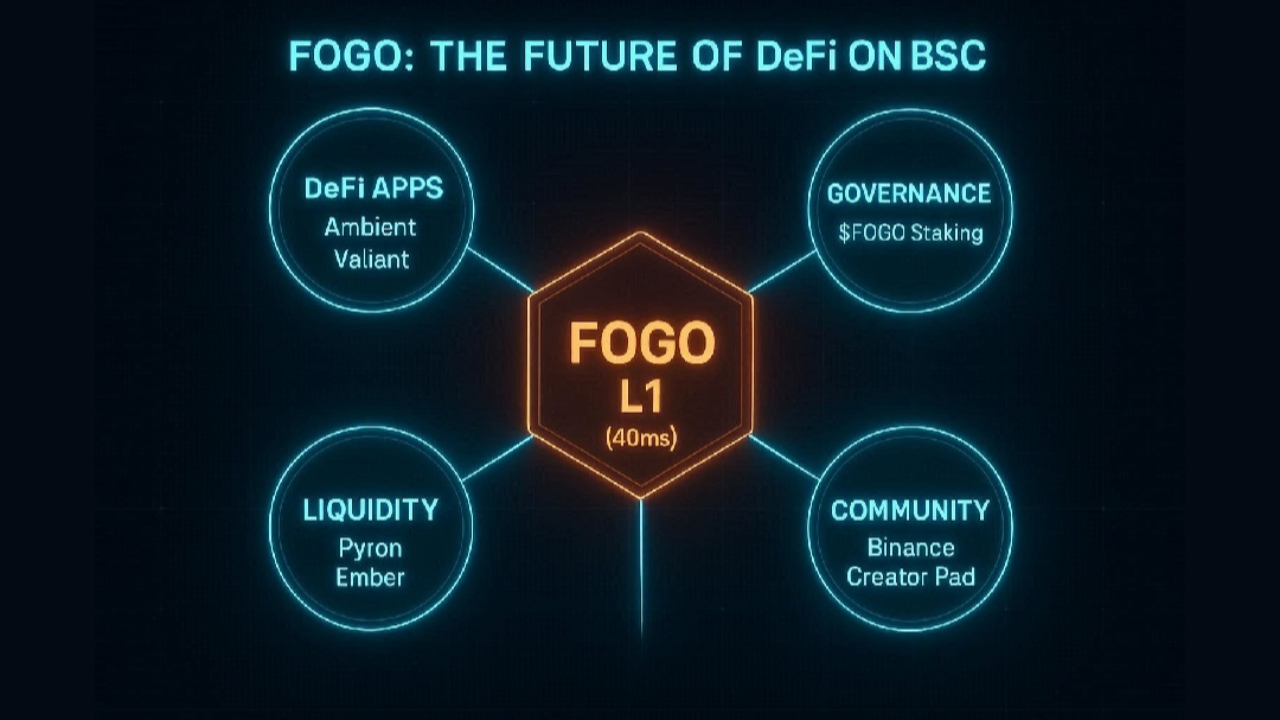
The power of community: The engine behind Fogo 🚀
In the crypto world, technology is the body, but community is the soul. Fogo has demonstrated that to succeed in the Creator Pad of Binance Square, a real connection with people is needed.
Why is there so much enthusiasm around this project? Because Fogo does not feel like a distant entity, but rather a collective effort. Transparency in its communication and openness to feedback have created a bond of trust that is hard to break in this space.
Why join the conversation now?
. Early Opportunity: Being part of the Creator Pad phase allows you to influence the project's direction.
. Ongoing Education: Not only do you invest, but you also learn about governance and Web3 dynamics.
. Networking: You connect with other enthusiasts who share your vision for the future of BSC.
Success in Web3 is not only measured by price but by the resilience of the ecosystem. Fogo is building iron foundations under a vibrant aesthetic. If you are looking for a project where your voice matters and innovation is the priority, you have come to the right place. Let's go all in!
@Fogo Official $FOGO #fogo
In the crypto world, technology is the body, but community is the soul. Fogo has demonstrated that to succeed in the Creator Pad of Binance Square, a real connection with people is needed.
Why is there so much enthusiasm around this project? Because Fogo does not feel like a distant entity, but rather a collective effort. Transparency in its communication and openness to feedback have created a bond of trust that is hard to break in this space.
Why join the conversation now?
. Early Opportunity: Being part of the Creator Pad phase allows you to influence the project's direction.
. Ongoing Education: Not only do you invest, but you also learn about governance and Web3 dynamics.
. Networking: You connect with other enthusiasts who share your vision for the future of BSC.
Success in Web3 is not only measured by price but by the resilience of the ecosystem. Fogo is building iron foundations under a vibrant aesthetic. If you are looking for a project where your voice matters and innovation is the priority, you have come to the right place. Let's go all in!
@Fogo Official $FOGO #fogo
This platform is excellent, minimum gas @Plasma
Suyay
·
--
Custom gas tokens and UX-driven blockchain design
@Plasma $XPL #plasma
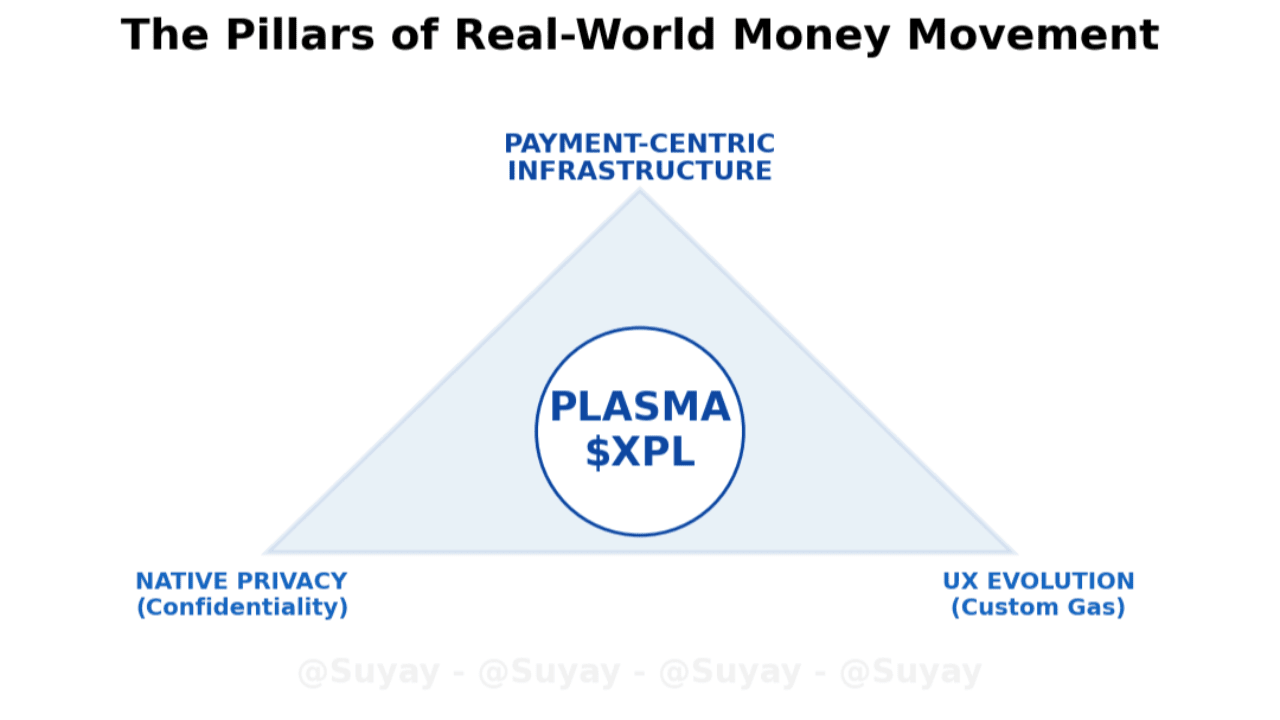
The way users pay transaction fees on a blockchain often determines whether the experience feels natural or burdensome. On many networks, users must acquire, hold, and manage a native token just to interact — even if all their activity revolves around stablecoins or simple value transfers. Plasma takes a different path: it embraces custom gas tokens and account abstraction tools as core elements of its UX-driven blockchain design. This approach reduces friction, aligns gas payment with user intent, and redefines how people interact with money on-chain.
At its essence, custom gas tokens let users pay transaction fees in ERC-20 assets they already hold — like USD₮ or other whitelisted tokens — rather than forcing them to hold the chain’s native token. This seemingly simple idea addresses one of the most persistent UX barriers in crypto: the awkward, confusing task of managing native gas tokens before meaningful activity can even begin. By making fee payment practical and intuitive, Plasma removes a heavy psychological and operational block to adoption.
Why gas UX matters
Imagine a world where someone receiving a stablecoin transfer must first buy a separate token just to accept funds. This is how many chains work today, and it creates unnecessary complexity. Users unfamiliar with token economics see gas tokens as an obstacle — not a feature — leading to drop-offs, confusion, and lost engagement.
Custom gas tokens change that narrative. Instead of requiring users to:
Swap assets to acquire gas tokens.
Manage multiple balances.Anticipate gas price volatility.
they can simply pay fees in the tokens they already intend to use. The experience becomes intuitive: send money, not confusion.
For stablecoin-centric networks like Plasma, this is especially powerful. Stablecoins represent real economic activity — payments, remittances, payroll, merchant settlement — and the last thing such flows need is an unnecessary gateway token.
How Plasma implements custom gas
Plasma employs a protocol-managed ERC-20 paymaster that enables approved tokens to serve directly as gas. This paymaster works with standard wallet flows and supports both traditional EOA accounts and smart contract wallets built on account abstraction standards like EIP-4337. Developers don’t need to build or maintain their own gas logic; they simply register a whitelisted token and integrate with the paymaster.
The way it works is straightforward:
Users approve an ERC-20 token (e.g., USD₮) for gas payment.The Plasma paymaster calculates a gas equivalent price using trusted oracles.The paymaster sponsors the actual network gas (in XPL) behind the scenes while deducting the token from the user’s balance.The transaction is processed seamlessly with no need for the user to ever hold XPL.
This model preserves full EVM compatibility and does not introduce new token standards or specialized wallets. Users enjoy a smoother experience without making trade-offs in security or composability.
Account abstraction elevates UX further
Custom gas tokens are only part of the UX story. Plasma’s ecosystem also supports account abstraction tooling that further simplifies everyday interactions. Tools like smart contract wallets and paymaster integration make onboarding and transaction flows frictionless — enabling features like gasless meta-transactions, bundled actions, social logins, and automated approval flows.
Account abstraction removes barriers for new users by abstracting away traditional blockchain complexity. Instead of teaching users about gas tokens, nonces, and native balances, apps can focus on value: payments, transfers, merchant interactions, and financial services. This is the UX shift that bridges crypto’s technical capabilities with real-world user expectations.
Strategic implications for adoption
Custom gas tokens and UX-centric design are not superficial enhancements — they reflect a strategic commitment to making blockchain feel like money, not a tech experiment. By enabling users to pay for activity in the tokens they already care about, Plasma reduces cognitive load and operational risk. Users can interact with stablecoins directly, without unnecessary detours.
This UX-first philosophy also improves developer economics. Builders don’t need to reinvent fee abstraction logic or create complex workarounds to avoid gas friction. Instead, they can focus on designing experiences that feel familiar to users of traditional finance — yet powerful enough to leverage on-chain programmability.
Conclusion
Custom gas tokens and account abstraction form a core part of Plasma’s UX-driven blockchain design. By letting users pay fees in familiar tokens, abstracting away native gas complexity, and supporting wallet-level innovations, Plasma tackles one of the most persistent barriers to adoption in crypto.
This design choice does more than streamline interactions — it aligns the network with how people expect money to behave: simple, predictable, and user-centric.
The way users pay transaction fees on a blockchain often determines whether the experience feels natural or burdensome. On many networks, users must acquire, hold, and manage a native token just to interact — even if all their activity revolves around stablecoins or simple value transfers. Plasma takes a different path: it embraces custom gas tokens and account abstraction tools as core elements of its UX-driven blockchain design. This approach reduces friction, aligns gas payment with user intent, and redefines how people interact with money on-chain.
At its essence, custom gas tokens let users pay transaction fees in ERC-20 assets they already hold — like USD₮ or other whitelisted tokens — rather than forcing them to hold the chain’s native token. This seemingly simple idea addresses one of the most persistent UX barriers in crypto: the awkward, confusing task of managing native gas tokens before meaningful activity can even begin. By making fee payment practical and intuitive, Plasma removes a heavy psychological and operational block to adoption.
Why gas UX matters
Imagine a world where someone receiving a stablecoin transfer must first buy a separate token just to accept funds. This is how many chains work today, and it creates unnecessary complexity. Users unfamiliar with token economics see gas tokens as an obstacle — not a feature — leading to drop-offs, confusion, and lost engagement.
Custom gas tokens change that narrative. Instead of requiring users to:
Swap assets to acquire gas tokens.
Manage multiple balances.Anticipate gas price volatility.
they can simply pay fees in the tokens they already intend to use. The experience becomes intuitive: send money, not confusion.
For stablecoin-centric networks like Plasma, this is especially powerful. Stablecoins represent real economic activity — payments, remittances, payroll, merchant settlement — and the last thing such flows need is an unnecessary gateway token.
How Plasma implements custom gas
Plasma employs a protocol-managed ERC-20 paymaster that enables approved tokens to serve directly as gas. This paymaster works with standard wallet flows and supports both traditional EOA accounts and smart contract wallets built on account abstraction standards like EIP-4337. Developers don’t need to build or maintain their own gas logic; they simply register a whitelisted token and integrate with the paymaster.
The way it works is straightforward:
Users approve an ERC-20 token (e.g., USD₮) for gas payment.The Plasma paymaster calculates a gas equivalent price using trusted oracles.The paymaster sponsors the actual network gas (in XPL) behind the scenes while deducting the token from the user’s balance.The transaction is processed seamlessly with no need for the user to ever hold XPL.
This model preserves full EVM compatibility and does not introduce new token standards or specialized wallets. Users enjoy a smoother experience without making trade-offs in security or composability.
Account abstraction elevates UX further
Custom gas tokens are only part of the UX story. Plasma’s ecosystem also supports account abstraction tooling that further simplifies everyday interactions. Tools like smart contract wallets and paymaster integration make onboarding and transaction flows frictionless — enabling features like gasless meta-transactions, bundled actions, social logins, and automated approval flows.
Account abstraction removes barriers for new users by abstracting away traditional blockchain complexity. Instead of teaching users about gas tokens, nonces, and native balances, apps can focus on value: payments, transfers, merchant interactions, and financial services. This is the UX shift that bridges crypto’s technical capabilities with real-world user expectations.
Strategic implications for adoption
Custom gas tokens and UX-centric design are not superficial enhancements — they reflect a strategic commitment to making blockchain feel like money, not a tech experiment. By enabling users to pay for activity in the tokens they already care about, Plasma reduces cognitive load and operational risk. Users can interact with stablecoins directly, without unnecessary detours.
This UX-first philosophy also improves developer economics. Builders don’t need to reinvent fee abstraction logic or create complex workarounds to avoid gas friction. Instead, they can focus on designing experiences that feel familiar to users of traditional finance — yet powerful enough to leverage on-chain programmability.
Conclusion
Custom gas tokens and account abstraction form a core part of Plasma’s UX-driven blockchain design. By letting users pay fees in familiar tokens, abstracting away native gas complexity, and supporting wallet-level innovations, Plasma tackles one of the most persistent barriers to adoption in crypto.
This design choice does more than streamline interactions — it aligns the network with how people expect money to behave: simple, predictable, and user-centric.
Excellent report!!!
Suyay
·
--
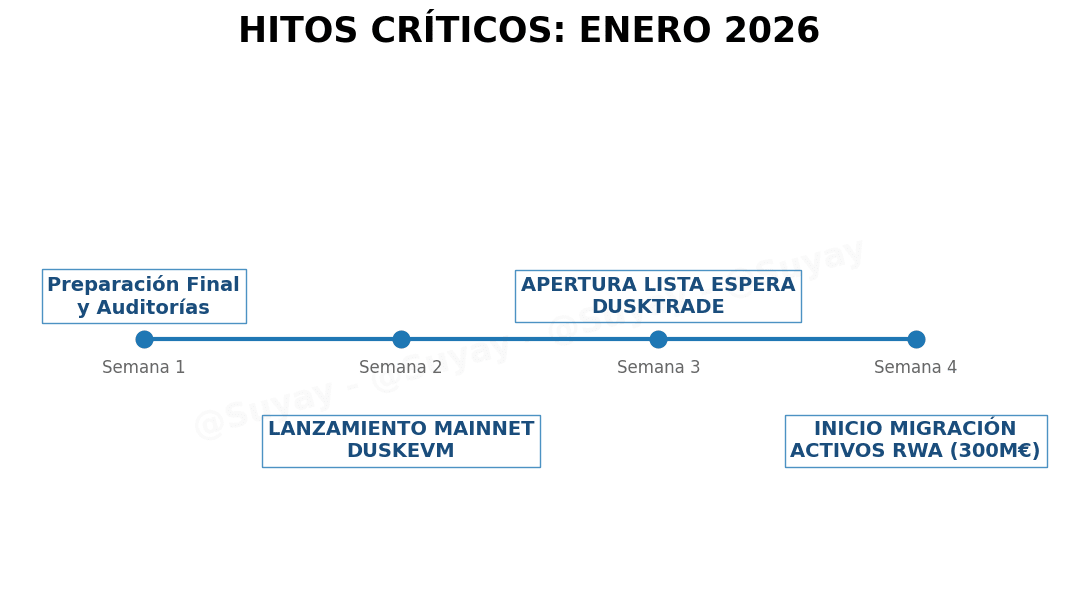
January: The month that changes everything for Dusk 🚀
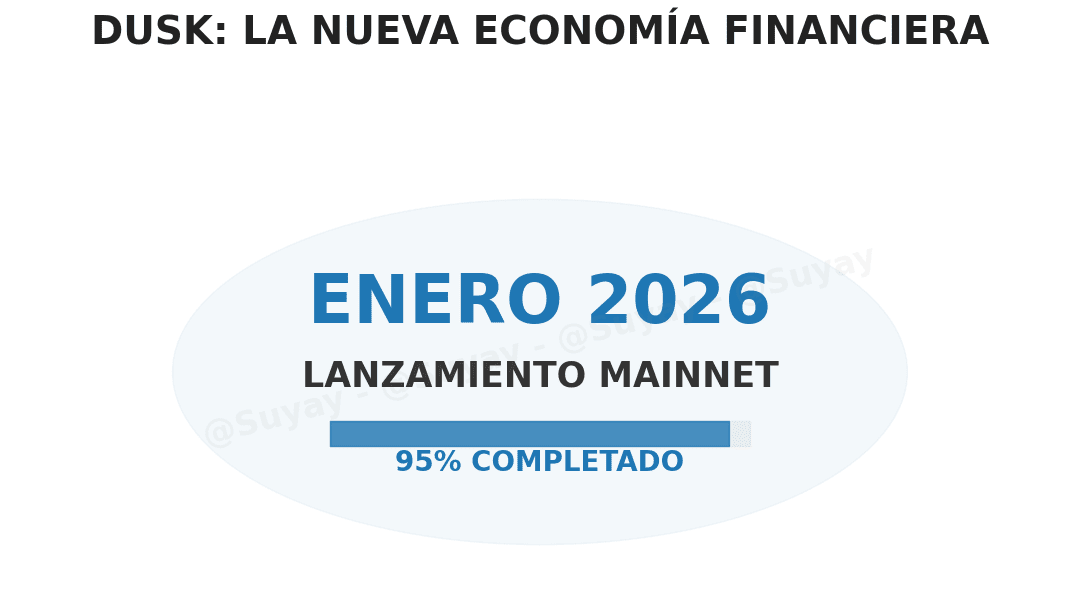
The roadmap for this month of January is clear and ambitious. We are not talking about distant promises, but about imminent milestones:
💥Launch of the DuskEVM Mainnet: The second week of January marks the beginning of the multilayer evolution.
🔥Opening of the DuskTrade waitlist: Your opportunity to access the platform that will host over €300M in tokenized values.
Dusk is not just launching a network; it is inaugurating a new regulated and private financial economy. Are you ready for the most important RWA movement of 2026?
@Dusk $DUSK #Dusk #Mainnet #CryptoNews
The roadmap for this month of January is clear and ambitious. We are not talking about distant promises, but about imminent milestones:
💥Launch of the DuskEVM Mainnet: The second week of January marks the beginning of the multilayer evolution.
🔥Opening of the DuskTrade waitlist: Your opportunity to access the platform that will host over €300M in tokenized values.
Dusk is not just launching a network; it is inaugurating a new regulated and private financial economy. Are you ready for the most important RWA movement of 2026?
@Dusk $DUSK #Dusk #Mainnet #CryptoNews
Real adoption occurs when technology is invisible and efficient. @Vanar achieves this with low fixed costs and eco-friendly infrastructure. By integrating $VANRY into PayFi processes and real-world assets (RWA), they are building the ultimate bridge between traditional finance and decentralized AI. Join the evolution with #Vanar .
#vanar
#vanar
Log in to explore more content