

YohannaOlva 1
146 Posts

YohannaOlva 1
Report
Block User
Verified BS creator || KOL || TG~ @YohannaOlva56 24/7 Dm me
0 Following
8 Followers
32 Liked
Posts
The Auditor Never Saw The Data 🌳
Every carbon credit rests on a claim about something that did not happen, which is a tonne that was not emitted, and the only thing standing behind it is an auditor who signed off.
A report published last month went through those audits and found the verification bodies are not the check buyers assume they are, which is a problem for the fastest growing RWA category on the board.
$LINK has spent years wiring real world measurement into contracts for institutions like Swift, Euroclear and UBS, and on $SOL the same limit applies to anything built on it, because a program has to be handed a whole input before it can act on it.
So the operational data that would actually prove a project, which is meter readings, fuel logs, satellite passes and production figures, stays with the company being audited, because publishing it hands rivals the inside of the business.
Arcium computes on that material without receiving it. The readings are split into fragments across a cluster of nodes, no single node holds a readable copy, and what comes back is whether the claim holds.
That answer settles on Solana as an ordinary public transaction, so a buyer or a regulator can see the test ran and what it returned.
Confidential computation has been live on Mainnet Alpha since February 2, with fifteen teams building on it.
A market worth billions runs on signatures rather than measurements, and the version that survives is the one where the proof is computed instead of attested.
#RWA #Solana
The Auditor Never Saw The Data 🌳
Every carbon credit rests on a claim about something that did not happen, which is a tonne that was not emitted, and the only thing standing behind it is an auditor who signed off.
A report published last month went through those audits and found the verification bodies are not the check buyers assume they are, which is a problem for the fastest growing RWA category on the board.
$LINK has spent years wiring real world measurement into contracts for institutions like Swift, Euroclear and UBS, and on $SOL the same limit applies to anything built on it, because a program has to be handed a whole input before it can act on it.
So the operational data that would actually prove a project, which is meter readings, fuel logs, satellite passes and production figures, stays with the company being audited, because publishing it hands rivals the inside of the business.
Arcium computes on that material without receiving it. The readings are split into fragments across a cluster of nodes, no single node holds a readable copy, and what comes back is whether the claim holds.
That answer settles on Solana as an ordinary public transaction, so a buyer or a regulator can see the test ran and what it returned.
Confidential computation has been live on Mainnet Alpha since February 2, with fifteen teams building on it.
A market worth billions runs on signatures rather than measurements, and the version that survives is the one where the proof is computed instead of attested.
#RWA #Solana
Every carbon credit rests on a claim about something that did not happen, which is a tonne that was not emitted, and the only thing standing behind it is an auditor who signed off.
A report published last month went through those audits and found the verification bodies are not the check buyers assume they are, which is a problem for the fastest growing RWA category on the board.
$LINK has spent years wiring real world measurement into contracts for institutions like Swift, Euroclear and UBS, and on $SOL the same limit applies to anything built on it, because a program has to be handed a whole input before it can act on it.
So the operational data that would actually prove a project, which is meter readings, fuel logs, satellite passes and production figures, stays with the company being audited, because publishing it hands rivals the inside of the business.
Arcium computes on that material without receiving it. The readings are split into fragments across a cluster of nodes, no single node holds a readable copy, and what comes back is whether the claim holds.
That answer settles on Solana as an ordinary public transaction, so a buyer or a regulator can see the test ran and what it returned.
Confidential computation has been live on Mainnet Alpha since February 2, with fifteen teams building on it.
A market worth billions runs on signatures rather than measurements, and the version that survives is the one where the proof is computed instead of attested.
#RWA #Solana
78
Tokenization Needs More Than Tokens 🏦
I've been following the growth of real-world asset tokenization, and there's one challenge I think deserves more attention.
The information supporting those assets often exists outside the blockchain.
We're talking about valuations, financial records, payment schedules, and other data that applications may need to reference.
Projects like $ONDO are developing tokenized financial products, but tokenization itself doesn't automatically make every supporting calculation verifiable.
That's where Space and Time comes into the picture.
Its decentralized data infrastructure enables applications to work with committed offchain datasets and generate cryptographic proofs for supported SQL computations.
💡 A token represents an asset.
🔐 Verifiable data helps establish confidence in calculations involving that asset.
For me, the next stage of tokenization isn't simply bringing more financial products onchain.
It's building the infrastructure needed to make the information supporting those products more trustworthy.
#Altcoin Season#
Tokenization Needs More Than Tokens 🏦
I've been following the growth of real-world asset tokenization, and there's one challenge I think deserves more attention.
The information supporting those assets often exists outside the blockchain.
We're talking about valuations, financial records, payment schedules, and other data that applications may need to reference.
Projects like $ONDO are developing tokenized financial products, but tokenization itself doesn't automatically make every supporting calculation verifiable.
That's where Space and Time comes into the picture.
Its decentralized data infrastructure enables applications to work with committed offchain datasets and generate cryptographic proofs for supported SQL computations.
💡 A token represents an asset.
🔐 Verifiable data helps establish confidence in calculations involving that asset.
For me, the next stage of tokenization isn't simply bringing more financial products onchain.
It's building the infrastructure needed to make the information supporting those products more trustworthy.
#Altcoin Season#
I've been following the growth of real-world asset tokenization, and there's one challenge I think deserves more attention.
The information supporting those assets often exists outside the blockchain.
We're talking about valuations, financial records, payment schedules, and other data that applications may need to reference.
Projects like $ONDO are developing tokenized financial products, but tokenization itself doesn't automatically make every supporting calculation verifiable.
That's where Space and Time comes into the picture.
Its decentralized data infrastructure enables applications to work with committed offchain datasets and generate cryptographic proofs for supported SQL computations.
💡 A token represents an asset.
🔐 Verifiable data helps establish confidence in calculations involving that asset.
For me, the next stage of tokenization isn't simply bringing more financial products onchain.
It's building the infrastructure needed to make the information supporting those products more trustworthy.
#Altcoin Season#
72
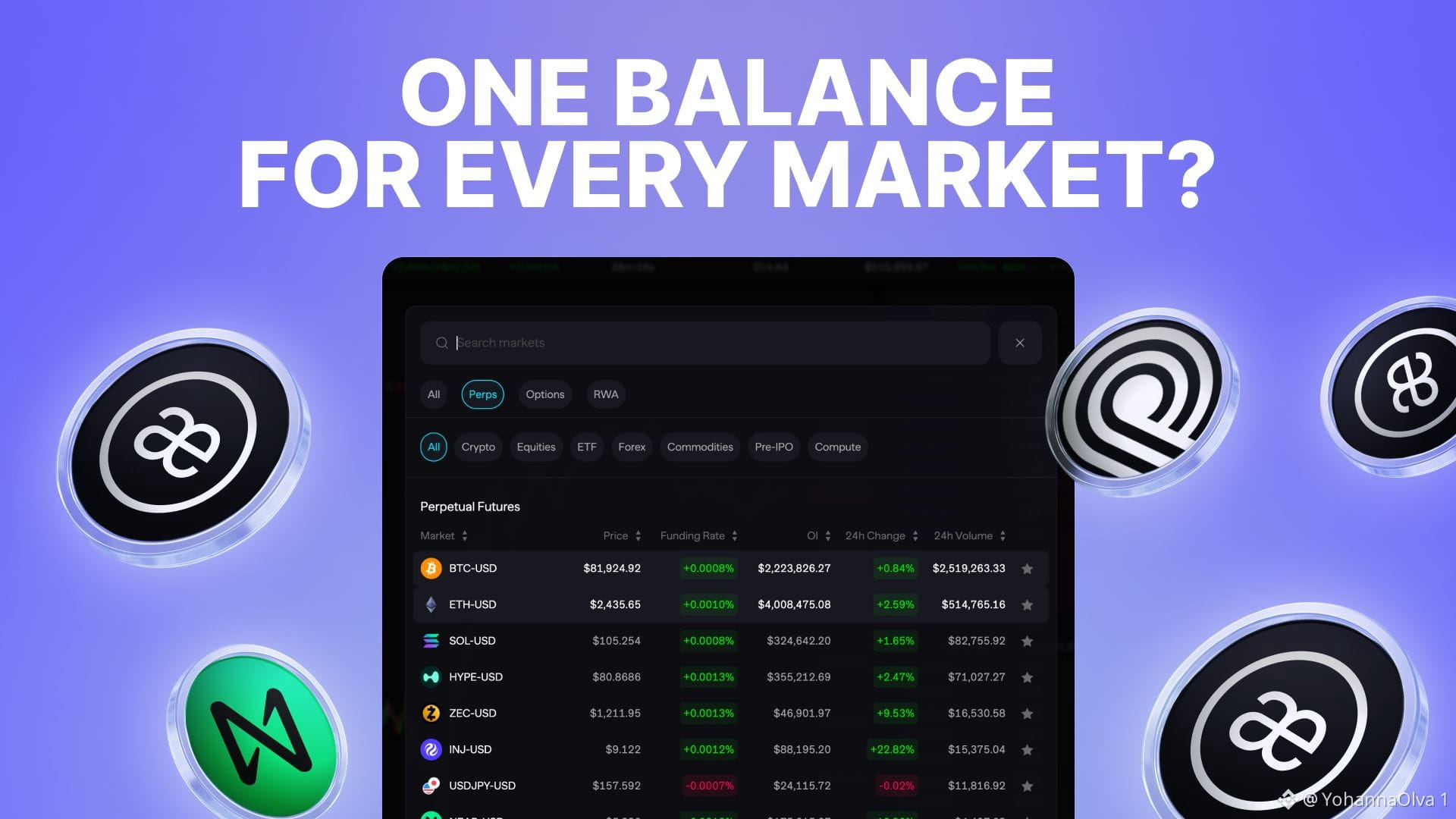
One balance should follow the opportunity 🔥
Markets around $ONDO and $NEAR can move for completely different reasons, and that is exactly why I dislike keeping every market thesis in a separate account.
The best opportunity this week may come from crypto, while the next one appears in equities, forex, commodities, or even the price of AI compute.
Splitting capital across several venues creates friction every time that focus changes, and I think the better model is letting collateral follow the opportunity.
Aevo now offers perpetual markets across crypto, equities, commodities, forex, and compute.
Those positions can be opened through the same account and collateral pool.
For me, that market breadth becomes genuinely useful when capital can move between those markets without leaving the trading account 💫
#Altcoin Season#
One balance should follow the opportunity 🔥
Markets around $ONDO and $NEAR can move for completely different reasons, and that is exactly why I dislike keeping every market thesis in a separate account.
The best opportunity this week may come from crypto, while the next one appears in equities, forex, commodities, or even the price of AI compute.
Splitting capital across several venues creates friction every time that focus changes, and I think the better model is letting collateral follow the opportunity.
Aevo now offers perpetual markets across crypto, equities, commodities, forex, and compute.
Those positions can be opened through the same account and collateral pool.
For me, that market breadth becomes genuinely useful when capital can move between those markets without leaving the trading account 💫
#Altcoin Season#
Markets around $ONDO and $NEAR can move for completely different reasons, and that is exactly why I dislike keeping every market thesis in a separate account.
The best opportunity this week may come from crypto, while the next one appears in equities, forex, commodities, or even the price of AI compute.
Splitting capital across several venues creates friction every time that focus changes, and I think the better model is letting collateral follow the opportunity.
Aevo now offers perpetual markets across crypto, equities, commodities, forex, and compute.
Those positions can be opened through the same account and collateral pool.
For me, that market breadth becomes genuinely useful when capital can move between those markets without leaving the trading account 💫
#Altcoin Season#
76
$PYTH Priced $2.04T, Capturing 94.4% RWA Share 📈
Everyone talks about $LINK when discussing oracles, but Pyth just reported 86% quarterly ARR growth and a rule committing 100% of DAO product funds to PYTH accumulation.
I've been looking at the latest RWA derivatives data, and the gap between the two projects' market perception is pretty remarkable.
Across 22 venues and 429 assets, tracked RWA perps generated $2.16T in Q3 volume. Pyth supplied the pricing for $2.04T of that activity.
Chainlink, Stork and RedStone combined accounted for roughly 3% of the same market.
And before someone says Pyth only dominates one category, look at the breakdown:
• Equities: 98.3%
• Commodities: 91.6%
• Indices: 91.2%
Those are extraordinary numbers for an infrastructure provider competing in a market where traders depend on accurate prices for margin, risk management and liquidations.
Now the financial side is catching up.
Pyth finished Q3 with $11.49M ARR, up 86% QoQ, and its DAO approved the 100% Rule. All funds the DAO receives from Pyth products are now committed to accumulating PYTH, with stablecoin receipts used for open-market purchases.
I think there's an interesting disconnect here.
The most recognizable oracle brand isn't necessarily the one dominating RWA derivatives pricing. And Pyth is now pairing that market position with accelerating commercial revenue and a measurable token accumulation policy.
I'd be paying much closer attention to the next quarterly numbers.
#Altcoin Season# #RWA
$PYTH Priced $2.04T, Capturing 94.4% RWA Share 📈
Everyone talks about $LINK when discussing oracles, but Pyth just reported 86% quarterly ARR growth and a rule committing 100% of DAO product funds to PYTH accumulation.
I've been looking at the latest RWA derivatives data, and the gap between the two projects' market perception is pretty remarkable.
Across 22 venues and 429 assets, tracked RWA perps generated $2.16T in Q3 volume. Pyth supplied the pricing for $2.04T of that activity.
Chainlink, Stork and RedStone combined accounted for roughly 3% of the same market.
And before someone says Pyth only dominates one category, look at the breakdown:
• Equities: 98.3%
• Commodities: 91.6%
• Indices: 91.2%
Those are extraordinary numbers for an infrastructure provider competing in a market where traders depend on accurate prices for margin, risk management and liquidations.
Now the financial side is catching up.
Pyth finished Q3 with $11.49M ARR, up 86% QoQ, and its DAO approved the 100% Rule. All funds the DAO receives from Pyth products are now committed to accumulating PYTH, with stablecoin receipts used for open-market purchases.
I think there's an interesting disconnect here.
The most recognizable oracle brand isn't necessarily the one dominating RWA derivatives pricing. And Pyth is now pairing that market position with accelerating commercial revenue and a measurable token accumulation policy.
I'd be paying much closer attention to the next quarterly numbers.
#Altcoin Season# #RWA
Everyone talks about $LINK when discussing oracles, but Pyth just reported 86% quarterly ARR growth and a rule committing 100% of DAO product funds to PYTH accumulation.
I've been looking at the latest RWA derivatives data, and the gap between the two projects' market perception is pretty remarkable.
Across 22 venues and 429 assets, tracked RWA perps generated $2.16T in Q3 volume. Pyth supplied the pricing for $2.04T of that activity.
Chainlink, Stork and RedStone combined accounted for roughly 3% of the same market.
And before someone says Pyth only dominates one category, look at the breakdown:
• Equities: 98.3%
• Commodities: 91.6%
• Indices: 91.2%
Those are extraordinary numbers for an infrastructure provider competing in a market where traders depend on accurate prices for margin, risk management and liquidations.
Now the financial side is catching up.
Pyth finished Q3 with $11.49M ARR, up 86% QoQ, and its DAO approved the 100% Rule. All funds the DAO receives from Pyth products are now committed to accumulating PYTH, with stablecoin receipts used for open-market purchases.
I think there's an interesting disconnect here.
The most recognizable oracle brand isn't necessarily the one dominating RWA derivatives pricing. And Pyth is now pairing that market position with accelerating commercial revenue and a measurable token accumulation policy.
I'd be paying much closer attention to the next quarterly numbers.
#Altcoin Season# #RWA
69
Some Of The Best Altseason Narratives Live Under The Apps ⛏️
$2Z is infrastructure rather than another venue competing for trader attention.
$SOL shows how valuable the underlying rails become once an ecosystem starts generating serious activity.
When crypto gets busy, everyone notices the applications.
The exchanges.
The tokens.
The trading volume.
But every one of those layers creates demand underneath it.
Connectivity.
Bandwidth.
Market-data distribution.
DoubleZero sits in that lower layer.
That makes 2Z a very different type of altseason story from another application token.
#Altcoin Season# #Macro Insights#
Some Of The Best Altseason Narratives Live Under The Apps ⛏️
$2Z is infrastructure rather than another venue competing for trader attention.
$SOL shows how valuable the underlying rails become once an ecosystem starts generating serious activity.
When crypto gets busy, everyone notices the applications.
The exchanges.
The tokens.
The trading volume.
But every one of those layers creates demand underneath it.
Connectivity.
Bandwidth.
Market-data distribution.
DoubleZero sits in that lower layer.
That makes 2Z a very different type of altseason story from another application token.
#Altcoin Season# #Macro Insights#
$2Z is infrastructure rather than another venue competing for trader attention.
$SOL shows how valuable the underlying rails become once an ecosystem starts generating serious activity.
When crypto gets busy, everyone notices the applications.
The exchanges.
The tokens.
The trading volume.
But every one of those layers creates demand underneath it.
Connectivity.
Bandwidth.
Market-data distribution.
DoubleZero sits in that lower layer.
That makes 2Z a very different type of altseason story from another application token.
#Altcoin Season# #Macro Insights#
63
38 days until the next chapter 👀
Communities around $HYPE and $INJ are used to moving from one catalyst to the next as attention shifts across the market.
An event calendar has a different challenge because attention must survive between dates, but I think the interval between experiences matters as much as the events themselves.
An empty gap can erase momentum, while rushing ahead can prevent the previous chapter from settling.
This matters most after a major weekend concludes.
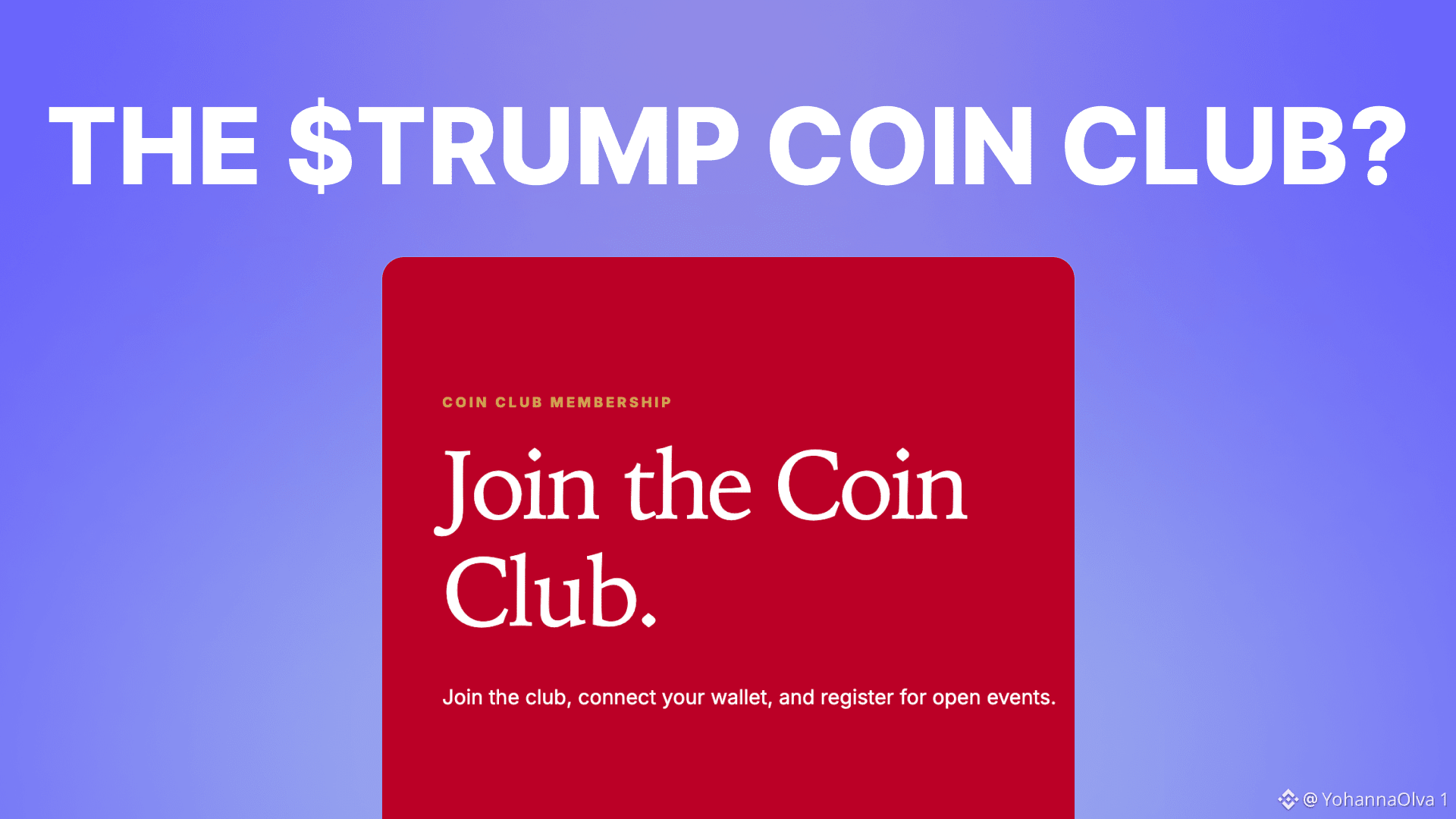
Singapore is now part of the $Trump Coin Club’s completed event history, and the Club’s next listed gathering is a gala dinner planned for November 22.
From October 15, that leaves 38 days between the current conversation and the next event date.
For me, that period should connect both chapters naturally.
Singapore can remain visible as the completed experience while the gala dinner gradually becomes the next focus.
#Macro Insights#
38 days until the next chapter 👀
Communities around $HYPE and $INJ are used to moving from one catalyst to the next as attention shifts across the market.
An event calendar has a different challenge because attention must survive between dates, but I think the interval between experiences matters as much as the events themselves.
An empty gap can erase momentum, while rushing ahead can prevent the previous chapter from settling.
This matters most after a major weekend concludes.
Singapore is now part of the $Trump Coin Club’s completed event history, and the Club’s next listed gathering is a gala dinner planned for November 22.
From October 15, that leaves 38 days between the current conversation and the next event date.
For me, that period should connect both chapters naturally.
Singapore can remain visible as the completed experience while the gala dinner gradually becomes the next focus.
#Macro Insights#
Communities around $HYPE and $INJ are used to moving from one catalyst to the next as attention shifts across the market.
An event calendar has a different challenge because attention must survive between dates, but I think the interval between experiences matters as much as the events themselves.
An empty gap can erase momentum, while rushing ahead can prevent the previous chapter from settling.
This matters most after a major weekend concludes.
Singapore is now part of the $Trump Coin Club’s completed event history, and the Club’s next listed gathering is a gala dinner planned for November 22.
From October 15, that leaves 38 days between the current conversation and the next event date.
For me, that period should connect both chapters naturally.
Singapore can remain visible as the completed experience while the gala dinner gradually becomes the next focus.
#Macro Insights#
71
DeFi's Real Problem Was Never The Finance 💬
$UNI solved onchain trading and then spent six years watching people bounce off the interface. $BNKR is making the case that the fix is a chat box.
The Bankr terminal runs in a browser with no install, no extension and no setup ritual. You open it, you type what you want, it executes.
That description sounds too simple to be a product, which is exactly why most people have not tried it.
Think about what using DeFi normally requires. A wallet extension, a seed phrase stored somewhere you hope is safe, the right network selected, enough of the right gas token, an aggregator tab, a block explorer tab, and the specific vocabulary of whichever protocol you landed on.
None of that is finance. It is operational overhead that the industry stopped noticing because everyone here already paid the cost of learning it.
A chat interface removes the vocabulary requirement first. You do not need to know whether the thing you want is a swap, a route or a bridge. You describe the outcome.
The honest limit is that a friendlier surface does not make the underlying actions safer. A sentence can move real money, and the responsibility for checking what you signed does not move anywhere.
But the hesitation most people have about DeFi has never been about risk appetite. It is about not wanting to look stupid in front of an interface that assumes you already know everything.
That part is solvable, and this is what solving it looks like.
#DeFi #Base
DeFi's Real Problem Was Never The Finance 💬
$UNI solved onchain trading and then spent six years watching people bounce off the interface. $BNKR is making the case that the fix is a chat box.
The Bankr terminal runs in a browser with no install, no extension and no setup ritual. You open it, you type what you want, it executes.
That description sounds too simple to be a product, which is exactly why most people have not tried it.
Think about what using DeFi normally requires. A wallet extension, a seed phrase stored somewhere you hope is safe, the right network selected, enough of the right gas token, an aggregator tab, a block explorer tab, and the specific vocabulary of whichever protocol you landed on.
None of that is finance. It is operational overhead that the industry stopped noticing because everyone here already paid the cost of learning it.
A chat interface removes the vocabulary requirement first. You do not need to know whether the thing you want is a swap, a route or a bridge. You describe the outcome.
The honest limit is that a friendlier surface does not make the underlying actions safer. A sentence can move real money, and the responsibility for checking what you signed does not move anywhere.
But the hesitation most people have about DeFi has never been about risk appetite. It is about not wanting to look stupid in front of an interface that assumes you already know everything.
That part is solvable, and this is what solving it looks like.
#DeFi #Base
$UNI solved onchain trading and then spent six years watching people bounce off the interface. $BNKR is making the case that the fix is a chat box.
The Bankr terminal runs in a browser with no install, no extension and no setup ritual. You open it, you type what you want, it executes.
That description sounds too simple to be a product, which is exactly why most people have not tried it.
Think about what using DeFi normally requires. A wallet extension, a seed phrase stored somewhere you hope is safe, the right network selected, enough of the right gas token, an aggregator tab, a block explorer tab, and the specific vocabulary of whichever protocol you landed on.
None of that is finance. It is operational overhead that the industry stopped noticing because everyone here already paid the cost of learning it.
A chat interface removes the vocabulary requirement first. You do not need to know whether the thing you want is a swap, a route or a bridge. You describe the outcome.
The honest limit is that a friendlier surface does not make the underlying actions safer. A sentence can move real money, and the responsibility for checking what you signed does not move anywhere.
But the hesitation most people have about DeFi has never been about risk appetite. It is about not wanting to look stupid in front of an interface that assumes you already know everything.
That part is solvable, and this is what solving it looks like.
#DeFi #Base

67
Kinetiq's Price Predictions 🌊
Three targets. Three very different probabilities.
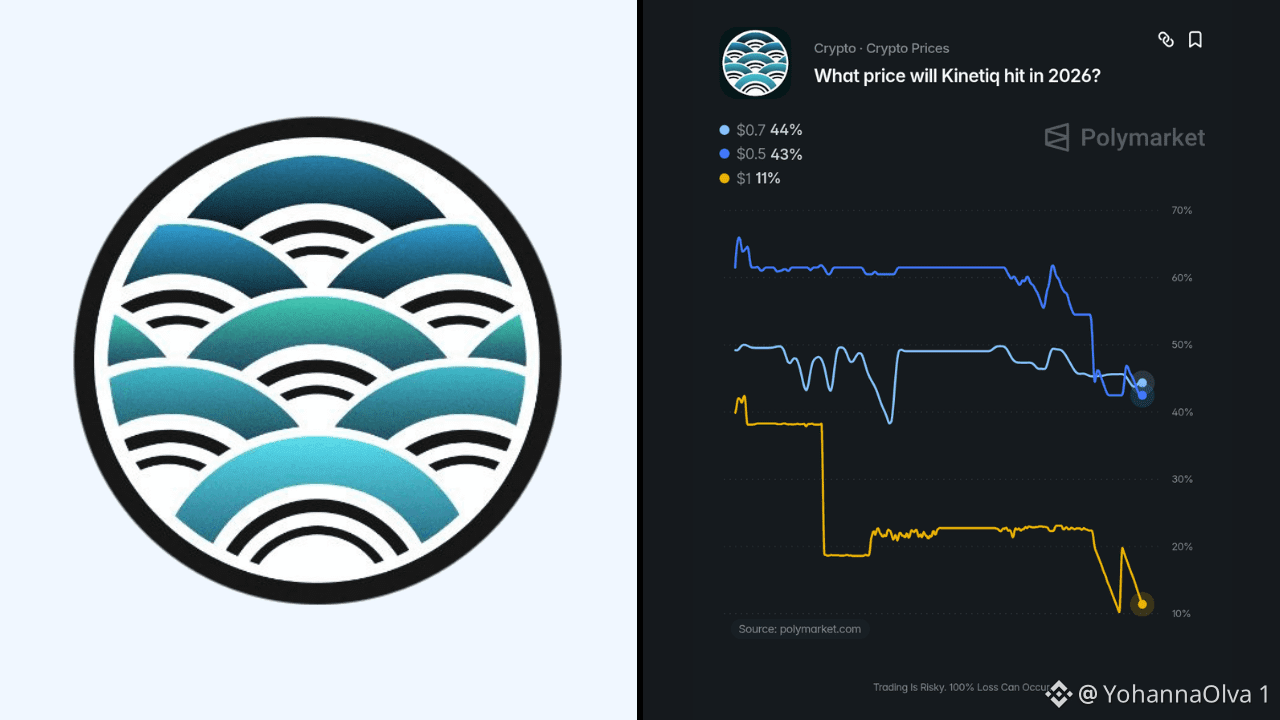
Polymarket traders are pricing several possible milestones for Kinetiq in 2026, and the numbers are worth looking at.
Here's the breakdown:
🌊 $0.70 → 44% probability
📈 $0.50 → 43% probability
🚀 $1.00 → 11% probability
What stands out immediately is how closely the first two outcomes are priced.
Meanwhile, the $1 target is considerably less likely according to the market.
At an 11% YES price, a $100 position on the $1 milestone could return approximately $909 if the outcome resolves successfully.
That's a potential 9x payout.
But I'm more interested in how these probabilities might change as the year progresses.
Let's say positive developments around Kinetiq push the $1 probability from 11% to 22%.
An existing YES position could potentially double in market value without the token ever reaching that price.
And that's exactly why I like following these smaller crypto prediction markets.
Instead of needing to purchase the underlying asset, I can trade the market's expectations surrounding specific price milestones.
For traders following the $HYPE ecosystem, Kinetiq represents another narrative worth watching through Polymarket.
The real question is whether the current probabilities are underestimating its potential or accurately reflecting the remaining time before year-end.
Which target would you trade?
#Altcoin Season#
Kinetiq's Price Predictions 🌊
Three targets. Three very different probabilities.
Polymarket traders are pricing several possible milestones for Kinetiq in 2026, and the numbers are worth looking at.
Here's the breakdown:
🌊 $0.70 → 44% probability
📈 $0.50 → 43% probability
🚀 $1.00 → 11% probability
What stands out immediately is how closely the first two outcomes are priced.
Meanwhile, the $1 target is considerably less likely according to the market.
At an 11% YES price, a $100 position on the $1 milestone could return approximately $909 if the outcome resolves successfully.
That's a potential 9x payout.
But I'm more interested in how these probabilities might change as the year progresses.
Let's say positive developments around Kinetiq push the $1 probability from 11% to 22%.
An existing YES position could potentially double in market value without the token ever reaching that price.
And that's exactly why I like following these smaller crypto prediction markets.
Instead of needing to purchase the underlying asset, I can trade the market's expectations surrounding specific price milestones.
For traders following the $HYPE ecosystem, Kinetiq represents another narrative worth watching through Polymarket.
The real question is whether the current probabilities are underestimating its potential or accurately reflecting the remaining time before year-end.
Which target would you trade?
#Altcoin Season#
Three targets. Three very different probabilities.
Polymarket traders are pricing several possible milestones for Kinetiq in 2026, and the numbers are worth looking at.
Here's the breakdown:
🌊 $0.70 → 44% probability
📈 $0.50 → 43% probability
🚀 $1.00 → 11% probability
What stands out immediately is how closely the first two outcomes are priced.
Meanwhile, the $1 target is considerably less likely according to the market.
At an 11% YES price, a $100 position on the $1 milestone could return approximately $909 if the outcome resolves successfully.
That's a potential 9x payout.
But I'm more interested in how these probabilities might change as the year progresses.
Let's say positive developments around Kinetiq push the $1 probability from 11% to 22%.
An existing YES position could potentially double in market value without the token ever reaching that price.
And that's exactly why I like following these smaller crypto prediction markets.
Instead of needing to purchase the underlying asset, I can trade the market's expectations surrounding specific price milestones.
For traders following the $HYPE ecosystem, Kinetiq represents another narrative worth watching through Polymarket.
The real question is whether the current probabilities are underestimating its potential or accurately reflecting the remaining time before year-end.
Which target would you trade?
#Altcoin Season#
72
$LINK Just Got More Interesting 👀
One development that deserves more attention is Space and Time's availability within the Chainlink Runtime Environment.
Think about what this enables.
Smart contracts increasingly need information beyond their native blockchain. But relying on external data introduces questions about accuracy and trust.
Space and Time addresses the computation side through Proof of SQL.
The process is straightforward:
➡️ Query blockchain data through Space and Time.
➡️ Generate a cryptographic proof alongside the result.
➡️ Verify that proof inside a Chainlink CRE workflow.
➡️ Use the verified result to inform subsequent contract actions.
This creates opportunities for more sophisticated DeFi applications, including reserve checks, automated decisions, and data-driven financial products.
What catches my attention is the combination of two complementary technologies: Chainlink's orchestration infrastructure and Space and Time's verifiable computation.
The next generation of smart contracts won't just need more data. They'll need stronger guarantees about the data they're using.
#Altcoin Season#
$LINK Just Got More Interesting 👀
One development that deserves more attention is Space and Time's availability within the Chainlink Runtime Environment.
Think about what this enables.
Smart contracts increasingly need information beyond their native blockchain. But relying on external data introduces questions about accuracy and trust.
Space and Time addresses the computation side through Proof of SQL.
The process is straightforward:
➡️ Query blockchain data through Space and Time.
➡️ Generate a cryptographic proof alongside the result.
➡️ Verify that proof inside a Chainlink CRE workflow.
➡️ Use the verified result to inform subsequent contract actions.
This creates opportunities for more sophisticated DeFi applications, including reserve checks, automated decisions, and data-driven financial products.
What catches my attention is the combination of two complementary technologies: Chainlink's orchestration infrastructure and Space and Time's verifiable computation.
The next generation of smart contracts won't just need more data. They'll need stronger guarantees about the data they're using.
#Altcoin Season#
One development that deserves more attention is Space and Time's availability within the Chainlink Runtime Environment.
Think about what this enables.
Smart contracts increasingly need information beyond their native blockchain. But relying on external data introduces questions about accuracy and trust.
Space and Time addresses the computation side through Proof of SQL.
The process is straightforward:
➡️ Query blockchain data through Space and Time.
➡️ Generate a cryptographic proof alongside the result.
➡️ Verify that proof inside a Chainlink CRE workflow.
➡️ Use the verified result to inform subsequent contract actions.
This creates opportunities for more sophisticated DeFi applications, including reserve checks, automated decisions, and data-driven financial products.
What catches my attention is the combination of two complementary technologies: Chainlink's orchestration infrastructure and Space and Time's verifiable computation.
The next generation of smart contracts won't just need more data. They'll need stronger guarantees about the data they're using.
#Altcoin Season#
73
Strong communities need their own finality 🔥
Networks around $STRK and $ZK are designed to move activity from pending to confirmed.
Web3 communities have a human version of the same challenge.
Online moments pass quickly, and even meaningful interactions can disappear into an endless feed, but an IRL experience gives a group a fixed point in its shared history.
I think that matters because culture develops through moments people can reference with certainty.
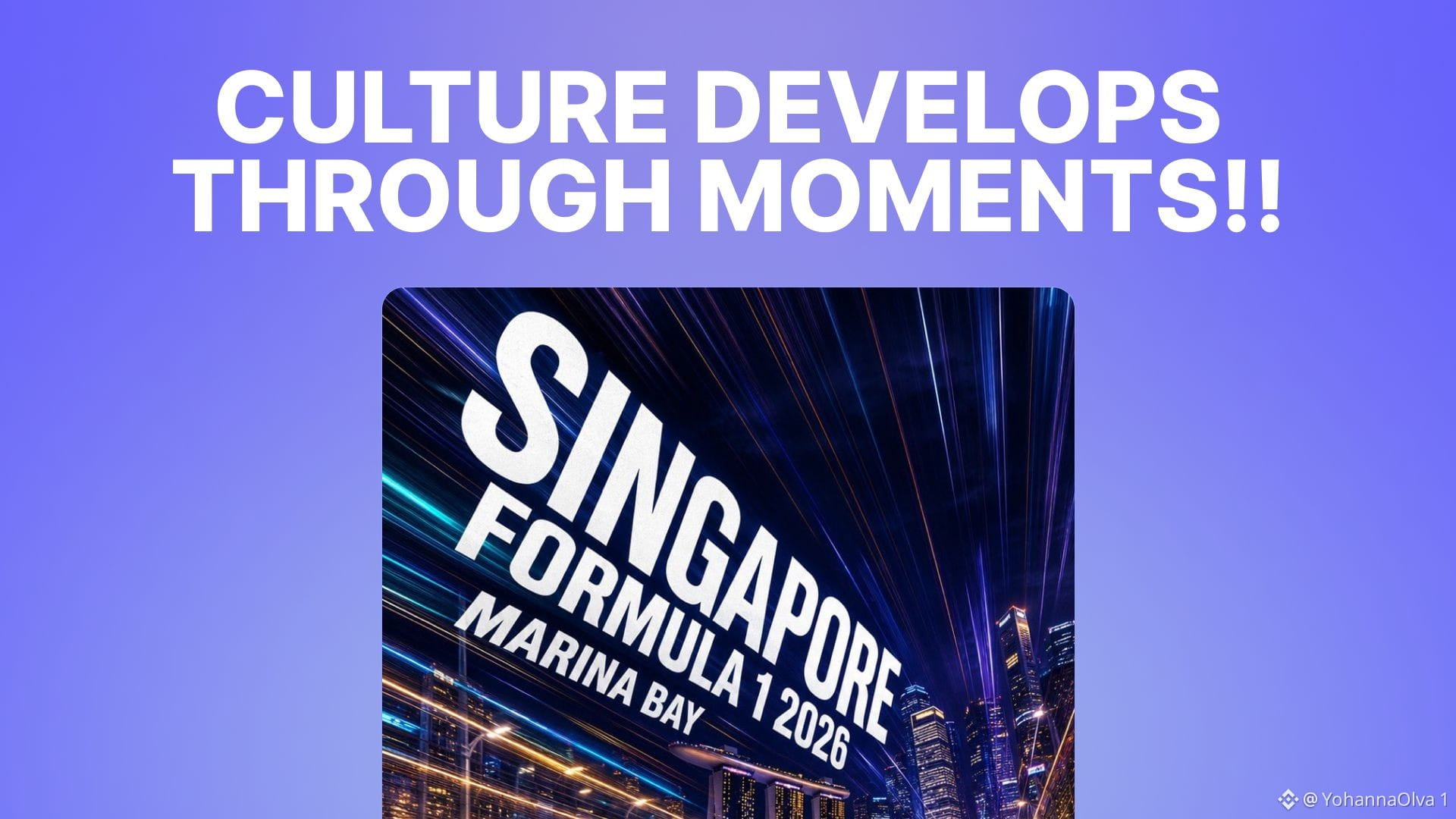
The $Trump Coin Club Singapore experience reaches its scheduled final day today and when the programme closes, the weekend can become part of how the Club understands its own story.
Future conversations will have a real experience behind them instead of existing entirely online.
That is the community version of finality.
#Macro Insights#
Strong communities need their own finality 🔥
Networks around $STRK and $ZK are designed to move activity from pending to confirmed.
Web3 communities have a human version of the same challenge.
Online moments pass quickly, and even meaningful interactions can disappear into an endless feed, but an IRL experience gives a group a fixed point in its shared history.
I think that matters because culture develops through moments people can reference with certainty.
The $Trump Coin Club Singapore experience reaches its scheduled final day today and when the programme closes, the weekend can become part of how the Club understands its own story.
Future conversations will have a real experience behind them instead of existing entirely online.
That is the community version of finality.
#Macro Insights#
Networks around $STRK and $ZK are designed to move activity from pending to confirmed.
Web3 communities have a human version of the same challenge.
Online moments pass quickly, and even meaningful interactions can disappear into an endless feed, but an IRL experience gives a group a fixed point in its shared history.
I think that matters because culture develops through moments people can reference with certainty.
The $Trump Coin Club Singapore experience reaches its scheduled final day today and when the programme closes, the weekend can become part of how the Club understands its own story.
Future conversations will have a real experience behind them instead of existing entirely online.
That is the community version of finality.
#Macro Insights#
62
Shared Interests Travel Across The Map 🌍
A useful part of the $XLM story is Stellar’s focus on access to digital assets.
It makes me think about how communities form across borders.
An interest in a car can connect people who have never visited the same country.
DeLorean has that kind of recognizable identity.
Its digital ecosystem creates another setting in which people can explore a shared interest, wherever access is supported.
That is an appealing direction for the broader RWA conversation.
The potential audience includes people who arrive through culture, collecting, or automotive enthusiasm.
They will bring different expectations with them.
For Altcoin Season, I think that diversity of entry points is worth considering.
A project can become interesting to someone before they ever think of themselves as a crypto user.
#Altcoin Season#
Shared Interests Travel Across The Map 🌍
A useful part of the $XLM story is Stellar’s focus on access to digital assets.
It makes me think about how communities form across borders.
An interest in a car can connect people who have never visited the same country.
DeLorean has that kind of recognizable identity.
Its digital ecosystem creates another setting in which people can explore a shared interest, wherever access is supported.
That is an appealing direction for the broader RWA conversation.
The potential audience includes people who arrive through culture, collecting, or automotive enthusiasm.
They will bring different expectations with them.
For Altcoin Season, I think that diversity of entry points is worth considering.
A project can become interesting to someone before they ever think of themselves as a crypto user.
#Altcoin Season#
A useful part of the $XLM story is Stellar’s focus on access to digital assets.
It makes me think about how communities form across borders.
An interest in a car can connect people who have never visited the same country.
DeLorean has that kind of recognizable identity.
Its digital ecosystem creates another setting in which people can explore a shared interest, wherever access is supported.
That is an appealing direction for the broader RWA conversation.
The potential audience includes people who arrive through culture, collecting, or automotive enthusiasm.
They will bring different expectations with them.
For Altcoin Season, I think that diversity of entry points is worth considering.
A project can become interesting to someone before they ever think of themselves as a crypto user.
#Altcoin Season#
59
Profits From The Narrative Gap 💸
$DRV is now available to trade on Pear Protocol, and there's already an interesting relative-value opportunity worth watching.
Derive's revenue recently hit an ATH while PONS revenue has been gradually declining.
Pair trading allows you to capitalize on that divergence for profit with top traders on Pear Protocol already building out the trade that you can easily join or counter with one-click.
You can discover ideas from traders you trust, use AI Agent Pear to pressure-test the reasoning with quant data and help structure the position, then join or counter the trade.
For this particular trade, you'd need to select the $LIT engine and instead of betting that a narrative will pump, you're expressing a view on which asset could outperform the other. Takes a lot of the directional risk out of your positions.
Explore the trades on app.pear.garden/trade
#Altcoin Season#
Profits From The Narrative Gap 💸
$DRV is now available to trade on Pear Protocol, and there's already an interesting relative-value opportunity worth watching.
Derive's revenue recently hit an ATH while PONS revenue has been gradually declining.
Pair trading allows you to capitalize on that divergence for profit with top traders on Pear Protocol already building out the trade that you can easily join or counter with one-click.
You can discover ideas from traders you trust, use AI Agent Pear to pressure-test the reasoning with quant data and help structure the position, then join or counter the trade.
For this particular trade, you'd need to select the $LIT engine and instead of betting that a narrative will pump, you're expressing a view on which asset could outperform the other. Takes a lot of the directional risk out of your positions.
Explore the trades on app.pear.garden/trade
#Altcoin Season#
$DRV is now available to trade on Pear Protocol, and there's already an interesting relative-value opportunity worth watching.
Derive's revenue recently hit an ATH while PONS revenue has been gradually declining.
Pair trading allows you to capitalize on that divergence for profit with top traders on Pear Protocol already building out the trade that you can easily join or counter with one-click.
You can discover ideas from traders you trust, use AI Agent Pear to pressure-test the reasoning with quant data and help structure the position, then join or counter the trade.
For this particular trade, you'd need to select the $LIT engine and instead of betting that a narrative will pump, you're expressing a view on which asset could outperform the other. Takes a lot of the directional risk out of your positions.
Explore the trades on app.pear.garden/trade
#Altcoin Season#
65
Binance Data Now Fits Into The Same Edge Setup 📡
$2Z gives trading desks a growing set of market-data sources through one shared connection.
$HYPE helps show the value of that when desks are already following multiple fast-moving venues.
With Binance futures market data now available through DoubleZero Edge, the catalog becomes more useful without changing the underlying delivery model.
The data can arrive into the same region as other Edge feeds.
Same connection.
Same format.
More market coverage through infrastructure already in place. That is the part I like most about the launch.
Every new source makes the existing setup more valuable.
#MarketData #DeFi
Binance Data Now Fits Into The Same Edge Setup 📡
$2Z gives trading desks a growing set of market-data sources through one shared connection.
$HYPE helps show the value of that when desks are already following multiple fast-moving venues.
With Binance futures market data now available through DoubleZero Edge, the catalog becomes more useful without changing the underlying delivery model.
The data can arrive into the same region as other Edge feeds.
Same connection.
Same format.
More market coverage through infrastructure already in place. That is the part I like most about the launch.
Every new source makes the existing setup more valuable.
#MarketData #DeFi
$2Z gives trading desks a growing set of market-data sources through one shared connection.
$HYPE helps show the value of that when desks are already following multiple fast-moving venues.
With Binance futures market data now available through DoubleZero Edge, the catalog becomes more useful without changing the underlying delivery model.
The data can arrive into the same region as other Edge feeds.
Same connection.
Same format.
More market coverage through infrastructure already in place. That is the part I like most about the launch.
Every new source makes the existing setup more valuable.
#MarketData #DeFi
87
$11.49M ARR, 86% growth, and 100% product funds now go to PYTH 📈
For $SEI and $UNI readers, the important part is not another “partnership” headline. It is that Pyth is showing up where market infrastructure actually gets tested: regulated filings, exchange-originated data, prediction markets and live financial products.
Pyth closed Q3 with $11.49M in active ARR, up 86% from Q2, and the DAO approved the 100% Rule, where all funds it receives from Pyth products now go into PYTH bought on the open market.
That alone is a strong holder update, but the paperwork makes it much harder to ignore.
Kalshi uses Pyth prices for stock and commodity markets, and in September named Pyth as the sole Source Agency in filings for gold and silver perpetuals on its CFTC-registered exchange.
Coinbase uses Pyth data for continuously priced thematic markets and named Pyth in its filing for single-name equity perpetuals.
Pyth was also approved as an external distributor of Nasdaq Basic through the Pyth Data Marketplace.
I like this angle because filings are harder to dismiss than logo posts. When real venues and institutional datasets keep touching the same pricing layer, the market has to update how it thinks about the asset behind that layer.
My read is that this is where PYTH starts feeling less like a trade on oracle mindshare and more like a trade on Pyth becoming serious market-data infrastructure.
The revenue grew fast, the credibility stack improved, and the new rule gives product-linked funds a direct open-market path into PYTH.
#Altcoin Season# #DeFi
$11.49M ARR, 86% growth, and 100% product funds now go to PYTH 📈
For $SEI and $UNI readers, the important part is not another “partnership” headline. It is that Pyth is showing up where market infrastructure actually gets tested: regulated filings, exchange-originated data, prediction markets and live financial products.
Pyth closed Q3 with $11.49M in active ARR, up 86% from Q2, and the DAO approved the 100% Rule, where all funds it receives from Pyth products now go into PYTH bought on the open market.
That alone is a strong holder update, but the paperwork makes it much harder to ignore.
Kalshi uses Pyth prices for stock and commodity markets, and in September named Pyth as the sole Source Agency in filings for gold and silver perpetuals on its CFTC-registered exchange.
Coinbase uses Pyth data for continuously priced thematic markets and named Pyth in its filing for single-name equity perpetuals.
Pyth was also approved as an external distributor of Nasdaq Basic through the Pyth Data Marketplace.
I like this angle because filings are harder to dismiss than logo posts. When real venues and institutional datasets keep touching the same pricing layer, the market has to update how it thinks about the asset behind that layer.
My read is that this is where PYTH starts feeling less like a trade on oracle mindshare and more like a trade on Pyth becoming serious market-data infrastructure.
The revenue grew fast, the credibility stack improved, and the new rule gives product-linked funds a direct open-market path into PYTH.
#Altcoin Season# #DeFi
For $SEI and $UNI readers, the important part is not another “partnership” headline. It is that Pyth is showing up where market infrastructure actually gets tested: regulated filings, exchange-originated data, prediction markets and live financial products.
Pyth closed Q3 with $11.49M in active ARR, up 86% from Q2, and the DAO approved the 100% Rule, where all funds it receives from Pyth products now go into PYTH bought on the open market.
That alone is a strong holder update, but the paperwork makes it much harder to ignore.
Kalshi uses Pyth prices for stock and commodity markets, and in September named Pyth as the sole Source Agency in filings for gold and silver perpetuals on its CFTC-registered exchange.
Coinbase uses Pyth data for continuously priced thematic markets and named Pyth in its filing for single-name equity perpetuals.
Pyth was also approved as an external distributor of Nasdaq Basic through the Pyth Data Marketplace.
I like this angle because filings are harder to dismiss than logo posts. When real venues and institutional datasets keep touching the same pricing layer, the market has to update how it thinks about the asset behind that layer.
My read is that this is where PYTH starts feeling less like a trade on oracle mindshare and more like a trade on Pyth becoming serious market-data infrastructure.
The revenue grew fast, the credibility stack improved, and the new rule gives product-linked funds a direct open-market path into PYTH.
#Altcoin Season# #DeFi
61
IRL has no recommendation algorithm 👀
Feeds decide which narratives we see and which voices reach us, as communities around $HYPE and $TON can feel massive online, yet each person’s view is still shaped by whatever an algorithm chooses to surface.
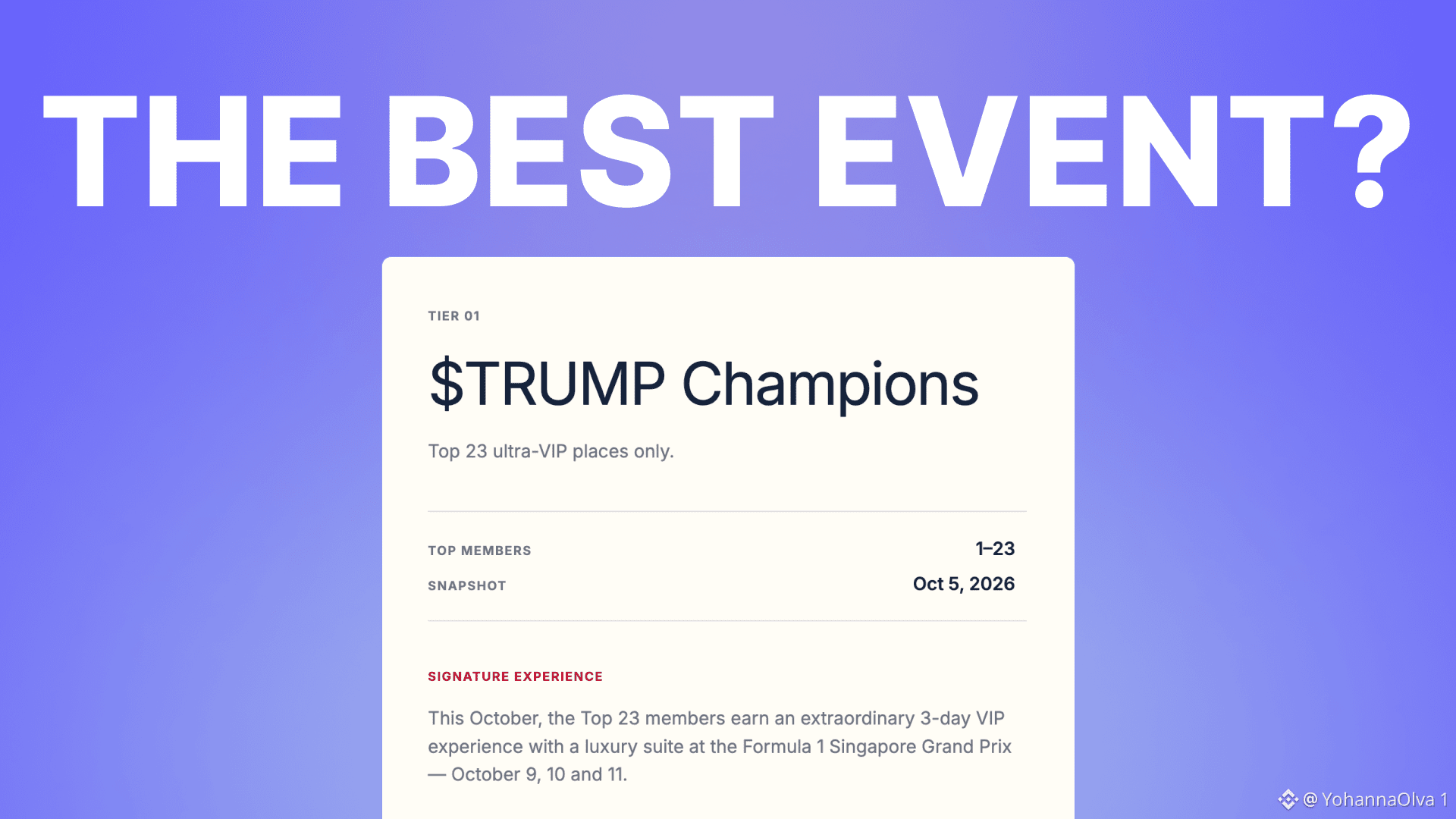
TOKEN2049 begins today with more than 25,000 attendees expected in Singapore.
For two days, discovery becomes physical. People decide which conversations to continue and which connections deserve more time.
To me, that is the overlooked value of bringing an online community into the same environment.
The planned $Trump Coin Club Singapore experience carries that idea into a smaller setting around the city’s race weekend.
Across three days, eligible members are expected to share hospitality and activities around Singapore.
Imo that’s how projects and clubs should handle their events.
#Macro Insights#
IRL has no recommendation algorithm 👀
Feeds decide which narratives we see and which voices reach us, as communities around $HYPE and $TON can feel massive online, yet each person’s view is still shaped by whatever an algorithm chooses to surface.
TOKEN2049 begins today with more than 25,000 attendees expected in Singapore.
For two days, discovery becomes physical. People decide which conversations to continue and which connections deserve more time.
To me, that is the overlooked value of bringing an online community into the same environment.
The planned $Trump Coin Club Singapore experience carries that idea into a smaller setting around the city’s race weekend.
Across three days, eligible members are expected to share hospitality and activities around Singapore.
Imo that’s how projects and clubs should handle their events.
#Macro Insights#
Feeds decide which narratives we see and which voices reach us, as communities around $HYPE and $TON can feel massive online, yet each person’s view is still shaped by whatever an algorithm chooses to surface.
TOKEN2049 begins today with more than 25,000 attendees expected in Singapore.
For two days, discovery becomes physical. People decide which conversations to continue and which connections deserve more time.
To me, that is the overlooked value of bringing an online community into the same environment.
The planned $Trump Coin Club Singapore experience carries that idea into a smaller setting around the city’s race weekend.
Across three days, eligible members are expected to share hospitality and activities around Singapore.
Imo that’s how projects and clubs should handle their events.
#Macro Insights#
76
A Shielded Coin Is Not A Shielded App 🪙
The trade people are making right now is buying an asset that can be held quietly, and the numbers behind it are real, with $ZEC crossing 30% of its supply in the shielded pool this year against 8% in early 2024.
That answers one question, which is how to hold value without publishing a balance, and it answers nothing about everything else a person or a company does.
On $SOL the open part is not the coin, it is the activity. The order, the position, the payroll run, the model being queried, all of it has to be handed to a program in readable form before anything happens.
So an asset you can hold quietly does not help the fund that cannot show its book, the company that cannot show its salaries, or the AI app that cannot show its inputs.
Arcium is built one level below the asset. Any computation is split into fragments across a cluster of nodes, no single node holds a readable copy, and the correct answer still comes back.
That answer settles on Solana as an ordinary public transaction, so the DeFi app stays auditable while the inputs never were.
Mainnet Alpha has run that way since February 2, with fifteen teams building on it.
Buying a sealed asset and owning the layer every sealed app runs on are two different trades, and only one of them gets bigger as more things move onchain.
#DeFi #Solana
A Shielded Coin Is Not A Shielded App 🪙
The trade people are making right now is buying an asset that can be held quietly, and the numbers behind it are real, with $ZEC crossing 30% of its supply in the shielded pool this year against 8% in early 2024.
That answers one question, which is how to hold value without publishing a balance, and it answers nothing about everything else a person or a company does.
On $SOL the open part is not the coin, it is the activity. The order, the position, the payroll run, the model being queried, all of it has to be handed to a program in readable form before anything happens.
So an asset you can hold quietly does not help the fund that cannot show its book, the company that cannot show its salaries, or the AI app that cannot show its inputs.
Arcium is built one level below the asset. Any computation is split into fragments across a cluster of nodes, no single node holds a readable copy, and the correct answer still comes back.
That answer settles on Solana as an ordinary public transaction, so the DeFi app stays auditable while the inputs never were.
Mainnet Alpha has run that way since February 2, with fifteen teams building on it.
Buying a sealed asset and owning the layer every sealed app runs on are two different trades, and only one of them gets bigger as more things move onchain.
#DeFi #Solana
The trade people are making right now is buying an asset that can be held quietly, and the numbers behind it are real, with $ZEC crossing 30% of its supply in the shielded pool this year against 8% in early 2024.
That answers one question, which is how to hold value without publishing a balance, and it answers nothing about everything else a person or a company does.
On $SOL the open part is not the coin, it is the activity. The order, the position, the payroll run, the model being queried, all of it has to be handed to a program in readable form before anything happens.
So an asset you can hold quietly does not help the fund that cannot show its book, the company that cannot show its salaries, or the AI app that cannot show its inputs.
Arcium is built one level below the asset. Any computation is split into fragments across a cluster of nodes, no single node holds a readable copy, and the correct answer still comes back.
That answer settles on Solana as an ordinary public transaction, so the DeFi app stays auditable while the inputs never were.
Mainnet Alpha has run that way since February 2, with fifteen teams building on it.
Buying a sealed asset and owning the layer every sealed app runs on are two different trades, and only one of them gets bigger as more things move onchain.
#DeFi #Solana
63
Basecamp Could Unlock Sui’s Finance Era 💧
Onchain finance has plenty of conferences where people discuss what might eventually work. $SUI Basecamp is shaping up as a place where the market can watch financial infrastructure operate live.
DeepBook’s new application runs on an onchain order book that has already supported more than $20 billion in Sui trading volume.
At Basecamp, the Trading Arena will put real-time trading directly in front of attendees through the Hudi competition. I like this approach because markets expose weaknesses quickly.
Liquidity, execution and settlement either hold up when traders arrive or they do not. Sui is letting the technology face that pressure while ecosystem teams demonstrate what they have built on top of it.
The official Basecamp programme also promises product reveals and a closer look at the infrastructure carrying finance onchain.
That creates a potentially important moment for the network.
Sui has already built fast settlement, native liquidity infrastructure and gasless stablecoin transfers. Basecamp can connect those pieces into one understandable financial thesis and show how capital moves through the ecosystem in practice.
If the event delivers meaningful launches alongside live demonstrations, Sui could leave Singapore with a much stronger identity as a serious financial network.
I’m bullish because Basecamp has the potential to showcase an ecosystem that is ready to compete for traders, builders and global liquidity now.
#Altcoin Season# #DeFi
Basecamp Could Unlock Sui’s Finance Era 💧
Onchain finance has plenty of conferences where people discuss what might eventually work. $SUI Basecamp is shaping up as a place where the market can watch financial infrastructure operate live.
DeepBook’s new application runs on an onchain order book that has already supported more than $20 billion in Sui trading volume.
At Basecamp, the Trading Arena will put real-time trading directly in front of attendees through the Hudi competition. I like this approach because markets expose weaknesses quickly.
Liquidity, execution and settlement either hold up when traders arrive or they do not. Sui is letting the technology face that pressure while ecosystem teams demonstrate what they have built on top of it.
The official Basecamp programme also promises product reveals and a closer look at the infrastructure carrying finance onchain.
That creates a potentially important moment for the network.
Sui has already built fast settlement, native liquidity infrastructure and gasless stablecoin transfers. Basecamp can connect those pieces into one understandable financial thesis and show how capital moves through the ecosystem in practice.
If the event delivers meaningful launches alongside live demonstrations, Sui could leave Singapore with a much stronger identity as a serious financial network.
I’m bullish because Basecamp has the potential to showcase an ecosystem that is ready to compete for traders, builders and global liquidity now.
#Altcoin Season# #DeFi
Onchain finance has plenty of conferences where people discuss what might eventually work. $SUI Basecamp is shaping up as a place where the market can watch financial infrastructure operate live.
DeepBook’s new application runs on an onchain order book that has already supported more than $20 billion in Sui trading volume.
At Basecamp, the Trading Arena will put real-time trading directly in front of attendees through the Hudi competition. I like this approach because markets expose weaknesses quickly.
Liquidity, execution and settlement either hold up when traders arrive or they do not. Sui is letting the technology face that pressure while ecosystem teams demonstrate what they have built on top of it.
The official Basecamp programme also promises product reveals and a closer look at the infrastructure carrying finance onchain.
That creates a potentially important moment for the network.
Sui has already built fast settlement, native liquidity infrastructure and gasless stablecoin transfers. Basecamp can connect those pieces into one understandable financial thesis and show how capital moves through the ecosystem in practice.
If the event delivers meaningful launches alongside live demonstrations, Sui could leave Singapore with a much stronger identity as a serious financial network.
I’m bullish because Basecamp has the potential to showcase an ecosystem that is ready to compete for traders, builders and global liquidity now.
#Altcoin Season# #DeFi
74
$DOGE touches $0.20 this year? 🐶
I'm taking YES.
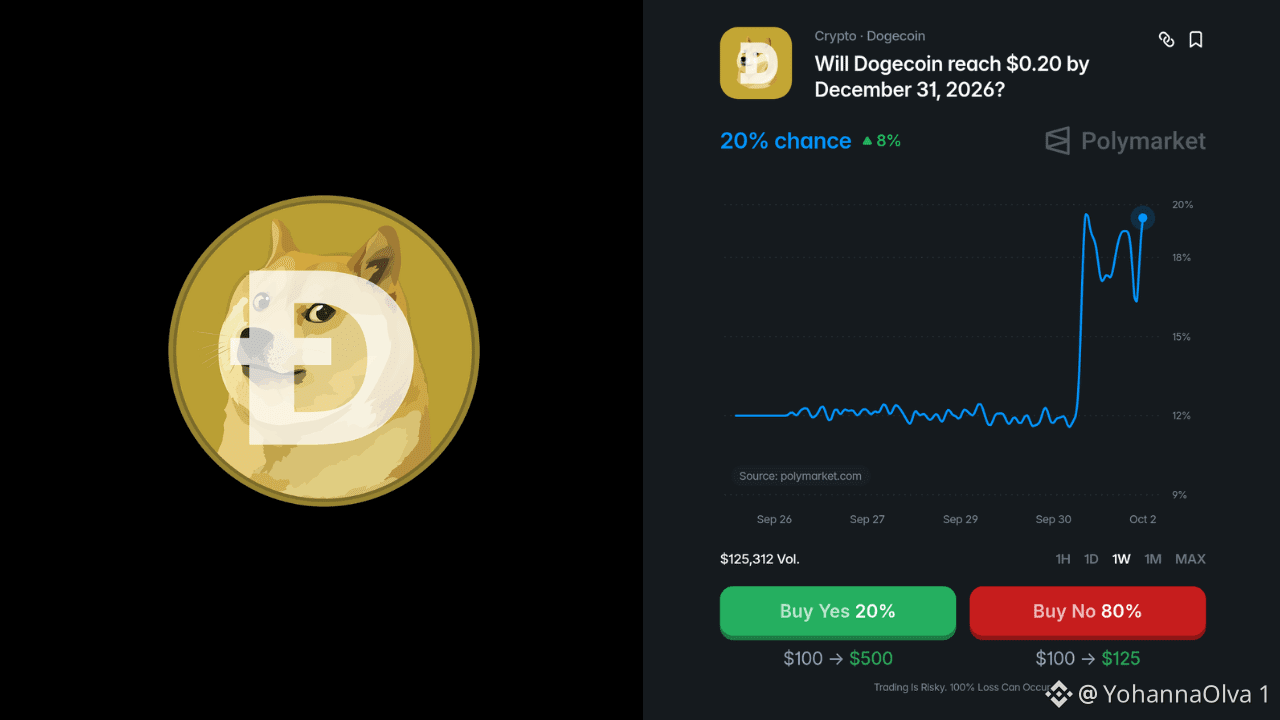
The crowd isn't with me either. The screenshot has only 20% pricing that outcome before December 31.
But DOGE doesn't need to stay above $0.20 for this market. Under Polymarket's rules, it needs to print a qualifying Binance one-minute candle with a high of $0.20 or above before the deadline.
That's an important distinction.
One violent meme rotation could be enough.
And here's my favorite part: at the screenshot price, $100 represents a $500 gross payout if YES resolves correctly.
I'm effectively looking at a 5x payout on an event I personally think has a better shot than the market is giving it.
There is already $125K+ behind the market too, so this isn't some completely untouched prediction.
Polymarket gives me a cleaner way to express this particular DOGE thesis than simply buying more DOGE and needing sustained price appreciation.
What’s funny is that among many other tokens, DOGE could be used for the trade itself.
#Altcoin Season#
$DOGE touches $0.20 this year? 🐶
I'm taking YES.
The crowd isn't with me either. The screenshot has only 20% pricing that outcome before December 31.
But DOGE doesn't need to stay above $0.20 for this market. Under Polymarket's rules, it needs to print a qualifying Binance one-minute candle with a high of $0.20 or above before the deadline.
That's an important distinction.
One violent meme rotation could be enough.
And here's my favorite part: at the screenshot price, $100 represents a $500 gross payout if YES resolves correctly.
I'm effectively looking at a 5x payout on an event I personally think has a better shot than the market is giving it.
There is already $125K+ behind the market too, so this isn't some completely untouched prediction.
Polymarket gives me a cleaner way to express this particular DOGE thesis than simply buying more DOGE and needing sustained price appreciation.
What’s funny is that among many other tokens, DOGE could be used for the trade itself.
#Altcoin Season#
I'm taking YES.
The crowd isn't with me either. The screenshot has only 20% pricing that outcome before December 31.
But DOGE doesn't need to stay above $0.20 for this market. Under Polymarket's rules, it needs to print a qualifying Binance one-minute candle with a high of $0.20 or above before the deadline.
That's an important distinction.
One violent meme rotation could be enough.
And here's my favorite part: at the screenshot price, $100 represents a $500 gross payout if YES resolves correctly.
I'm effectively looking at a 5x payout on an event I personally think has a better shot than the market is giving it.
There is already $125K+ behind the market too, so this isn't some completely untouched prediction.
Polymarket gives me a cleaner way to express this particular DOGE thesis than simply buying more DOGE and needing sustained price appreciation.
What’s funny is that among many other tokens, DOGE could be used for the trade itself.
#Altcoin Season#
84
The Trading Session Is A Human Convention 🌙
$LINK and $ONDO both exist to bring offchain things onchain, facts in one case and real-world assets in the other. Neither changes the fact that the venue those assets came from closes at four.
The clearest demonstration of what that gap creates came from a GME meme token launched on Bankr and paired against real GameStop stock on Robinhood Chain.
Approximately $18M in meme token volume and $30M in stock token volume moved overnight, while conventional markets were shut. With a limited float tokenized onchain, GME traded onchain at roughly $200 against a real-world price of roughly $21.
The resolution is the part that matters.
Arbitrageurs bought real GameStop shares offchain and brought them onchain to close the gap, materially increasing the tokenized float. Onchain demand caused real-world equity purchases. That is the causal direction worth sitting with, and most people would have guessed it ran the other way.
Those figures describe one event rather than ongoing performance, and a dislocation that size needs a thin float to exist at all. It is market structure, not a strategy.
The structural point survives the caveats. A market that never closes and a market that shuts every evening cannot stay in agreement, and something has to move to reconcile them.
#RWA #DeFi
The Trading Session Is A Human Convention 🌙
$LINK and $ONDO both exist to bring offchain things onchain, facts in one case and real-world assets in the other. Neither changes the fact that the venue those assets came from closes at four.
The clearest demonstration of what that gap creates came from a GME meme token launched on Bankr and paired against real GameStop stock on Robinhood Chain.
Approximately $18M in meme token volume and $30M in stock token volume moved overnight, while conventional markets were shut. With a limited float tokenized onchain, GME traded onchain at roughly $200 against a real-world price of roughly $21.
The resolution is the part that matters.
Arbitrageurs bought real GameStop shares offchain and brought them onchain to close the gap, materially increasing the tokenized float. Onchain demand caused real-world equity purchases. That is the causal direction worth sitting with, and most people would have guessed it ran the other way.
Those figures describe one event rather than ongoing performance, and a dislocation that size needs a thin float to exist at all. It is market structure, not a strategy.
The structural point survives the caveats. A market that never closes and a market that shuts every evening cannot stay in agreement, and something has to move to reconcile them.
#RWA #DeFi
$LINK and $ONDO both exist to bring offchain things onchain, facts in one case and real-world assets in the other. Neither changes the fact that the venue those assets came from closes at four.
The clearest demonstration of what that gap creates came from a GME meme token launched on Bankr and paired against real GameStop stock on Robinhood Chain.
Approximately $18M in meme token volume and $30M in stock token volume moved overnight, while conventional markets were shut. With a limited float tokenized onchain, GME traded onchain at roughly $200 against a real-world price of roughly $21.
The resolution is the part that matters.
Arbitrageurs bought real GameStop shares offchain and brought them onchain to close the gap, materially increasing the tokenized float. Onchain demand caused real-world equity purchases. That is the causal direction worth sitting with, and most people would have guessed it ran the other way.
Those figures describe one event rather than ongoing performance, and a dislocation that size needs a thin float to exist at all. It is market structure, not a strategy.
The structural point survives the caveats. A market that never closes and a market that shuts every evening cannot stay in agreement, and something has to move to reconcile them.
#RWA #DeFi
77
Follow The Apps, Then Data 🌐
Something I've noticed about crypto infrastructure:
Every time applications become more sophisticated, their data requirements explode.
More users → more history
More chains → more sources
More assets → more calculations
More automation → more consequences
That's why I think Space and Time is positioned in an interesting part of the stack.
$SUI and other high-throughput ecosystems can keep pushing execution forward, while Space and Time focuses on giving applications access to large datasets and verifiable computation over them.
Those aren't competing jobs.
They're complementary infrastructure.
The front end of crypto keeps getting faster.
The backend has to evolve with it.
#Altcoin Season#
Follow The Apps, Then Data 🌐
Something I've noticed about crypto infrastructure:
Every time applications become more sophisticated, their data requirements explode.
More users → more history
More chains → more sources
More assets → more calculations
More automation → more consequences
That's why I think Space and Time is positioned in an interesting part of the stack.
$SUI and other high-throughput ecosystems can keep pushing execution forward, while Space and Time focuses on giving applications access to large datasets and verifiable computation over them.
Those aren't competing jobs.
They're complementary infrastructure.
The front end of crypto keeps getting faster.
The backend has to evolve with it.
#Altcoin Season#
Something I've noticed about crypto infrastructure:
Every time applications become more sophisticated, their data requirements explode.
More users → more history
More chains → more sources
More assets → more calculations
More automation → more consequences
That's why I think Space and Time is positioned in an interesting part of the stack.
$SUI and other high-throughput ecosystems can keep pushing execution forward, while Space and Time focuses on giving applications access to large datasets and verifiable computation over them.
Those aren't competing jobs.
They're complementary infrastructure.
The front end of crypto keeps getting faster.
The backend has to evolve with it.
#Altcoin Season#
72
Log in to explore more content
Join global crypto users on Binance Square
⚡️ Get latest and useful information about crypto.
💬 Trusted by the world’s largest crypto exchange.
👍 Discover real insights from verified creators.
Email / Phone number