
BOBO波波
2.6k Posts

BOBO波波
Report
Block User
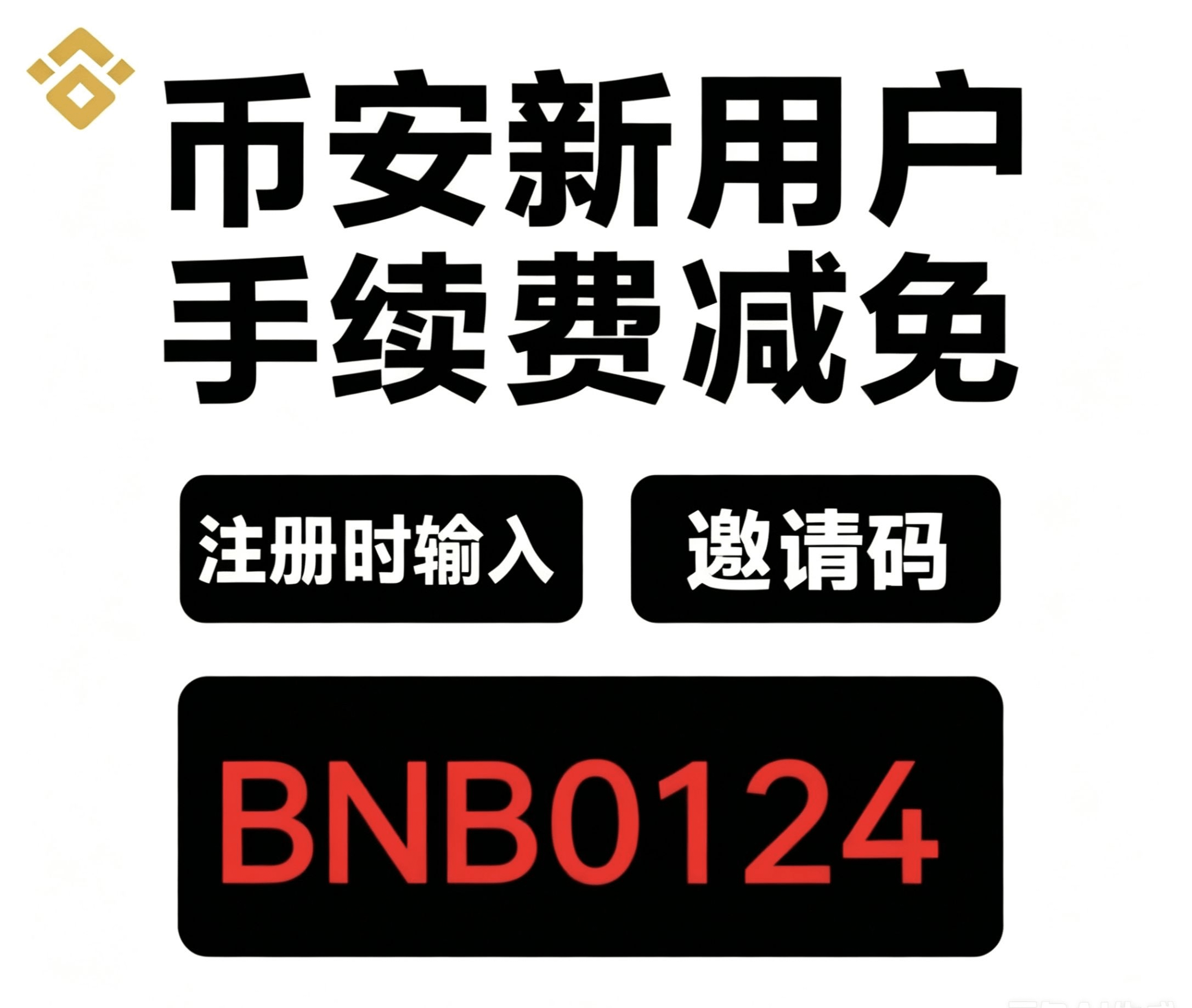
邀请码BNB0124🔥聊天id:bnb0124🔥欢迎打扰🔥ALPHA现货赛合约赛爱好者🔥有兴趣者私聊🔥
Open Trade

SOL Holder
High-Frequency Trader
1.1 Years
202 Following
23.3K+ Followers
7.9K+ Liked
Posts
Portfolio
All
Quotes
Live
PINNED
·
--
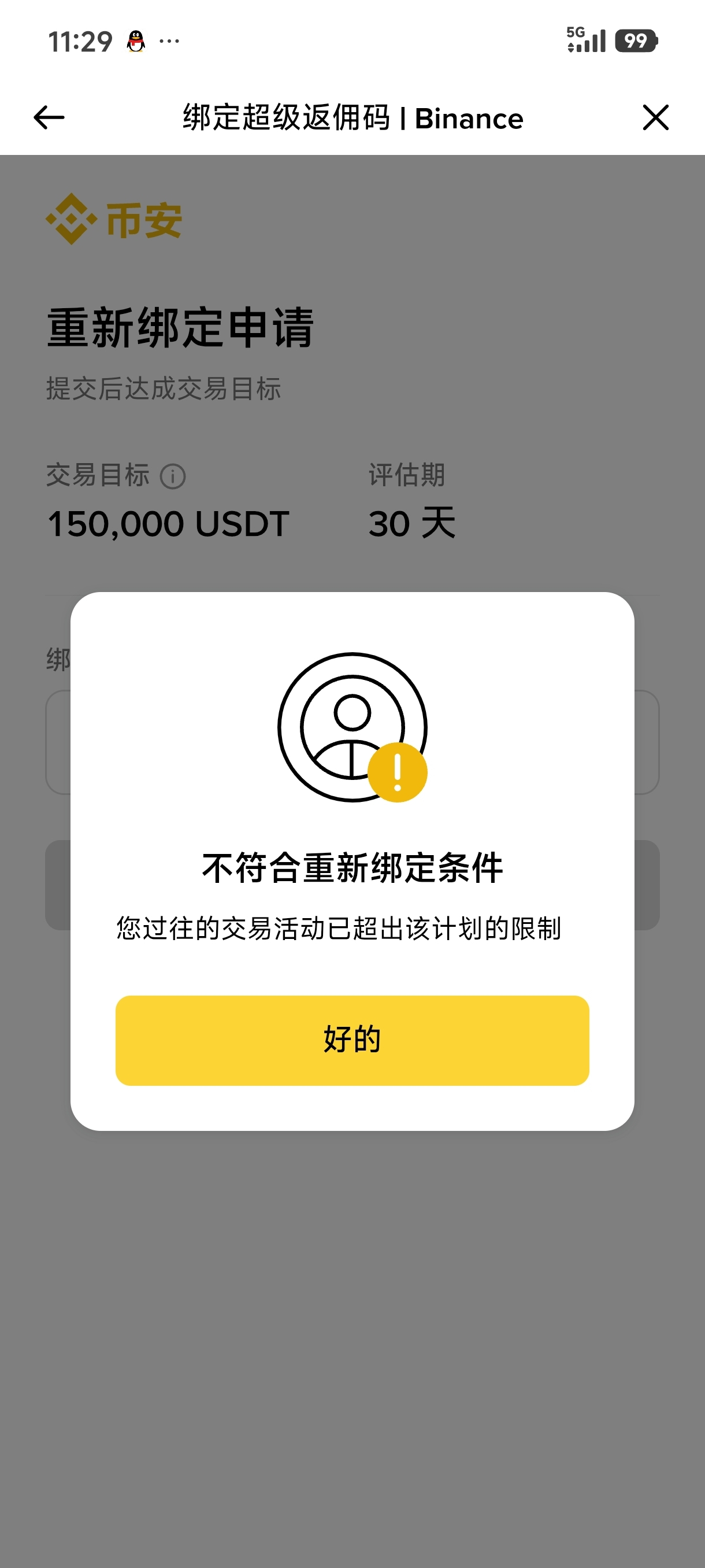
Old users can also补-bind an invitation code.
Who can supplement-bind:
1. Never entered an invitation code during registration
2. Trading volume in the past 3 months < 5000
Check eligibility: Tap the Query entry to get the result instantly.
If you’re eligible, follow these steps: [点击查询资格](https://www.bsmkweb.cc/activity/referral/bind-ref)
1. Fill in the invitation code BNB0124
2. Within 30 days, generate 150,000 in trading volume (spot or futures). It’s recommended to use futures—the fees are low and it’s faster.
3. Trade XAUT or USDC in futures; placing orders will be fee-free.
4. Those who registered via an invitation link (any rewards like voucher/USDC/token count as having an invitation relationship) cannot supplement-bind.
5. If the query shows you don’t meet the requirements = no chance.
6. If you meet the requirements, get started directly; completing 300,000 in futures volume will be used for the evaluation.
For old users without an invitation code, we recommend self-checking.
#币安九周年 #ALPHA
Old users can also补-bind an invitation code.
Who can supplement-bind:
1. Never entered an invitation code during registration
2. Trading volume in the past 3 months < 5000
Check eligibility: Tap the Query entry to get the result instantly.
If you’re eligible, follow these steps: 点击查询资格
1. Fill in the invitation code BNB0124
2. Within 30 days, generate 150,000 in trading volume (spot or futures). It’s recommended to use futures—the fees are low and it’s faster.
3. Trade XAUT or USDC in futures; placing orders will be fee-free.
4. Those who registered via an invitation link (any rewards like voucher/USDC/token count as having an invitation relationship) cannot supplement-bind.
5. If the query shows you don’t meet the requirements = no chance.
6. If you meet the requirements, get started directly; completing 300,000 in futures volume will be used for the evaluation.
For old users without an invitation code, we recommend self-checking.
#币安九周年 #ALPHA
Who can supplement-bind:
1. Never entered an invitation code during registration
2. Trading volume in the past 3 months < 5000
Check eligibility: Tap the Query entry to get the result instantly.
If you’re eligible, follow these steps: 点击查询资格
1. Fill in the invitation code BNB0124
2. Within 30 days, generate 150,000 in trading volume (spot or futures). It’s recommended to use futures—the fees are low and it’s faster.
3. Trade XAUT or USDC in futures; placing orders will be fee-free.
4. Those who registered via an invitation link (any rewards like voucher/USDC/token count as having an invitation relationship) cannot supplement-bind.
5. If the query shows you don’t meet the requirements = no chance.
6. If you meet the requirements, get started directly; completing 300,000 in futures volume will be used for the evaluation.
For old users without an invitation code, we recommend self-checking.
#币安九周年 #ALPHA
7
1
5
383
·
--
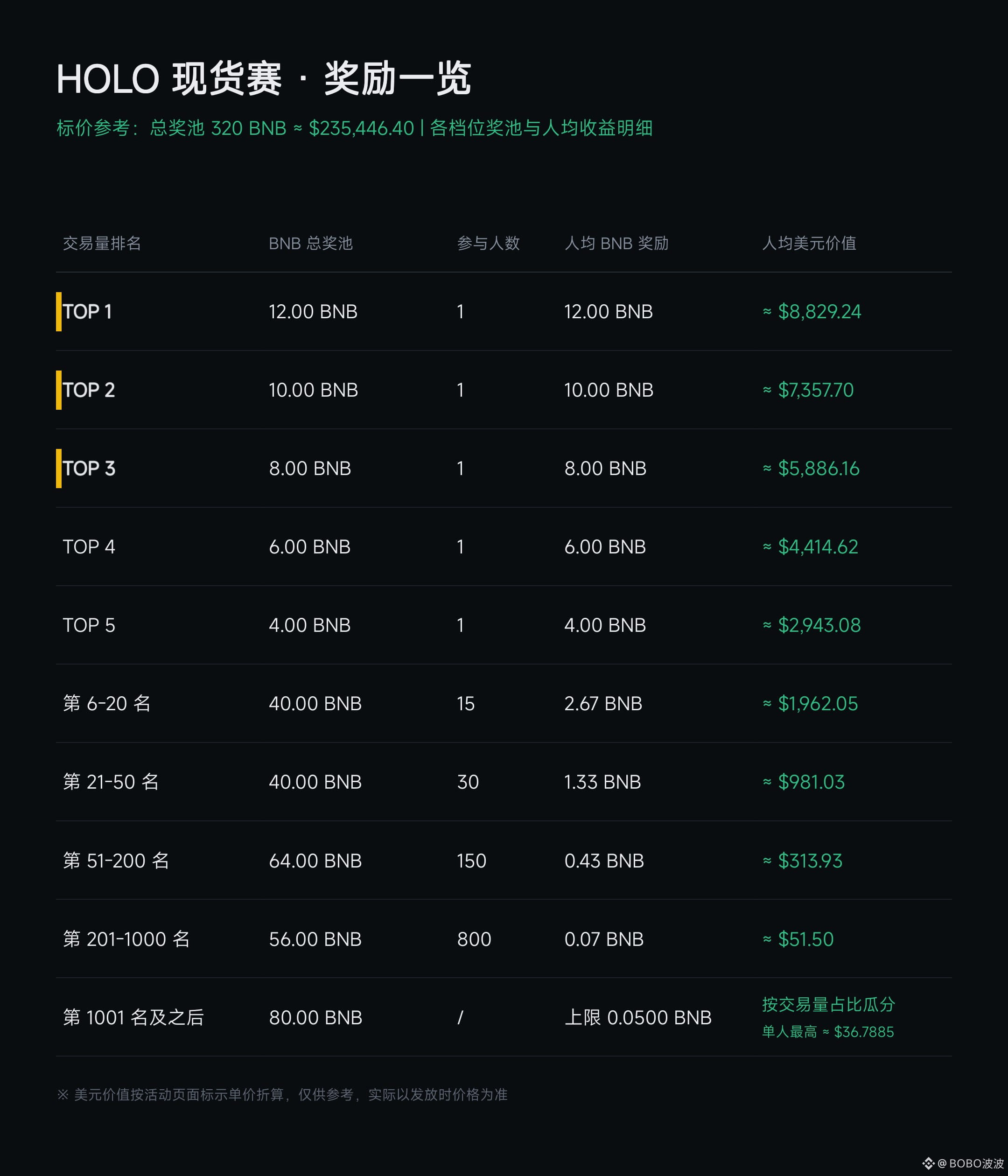
$HOLO spot price difference 75k, big meat
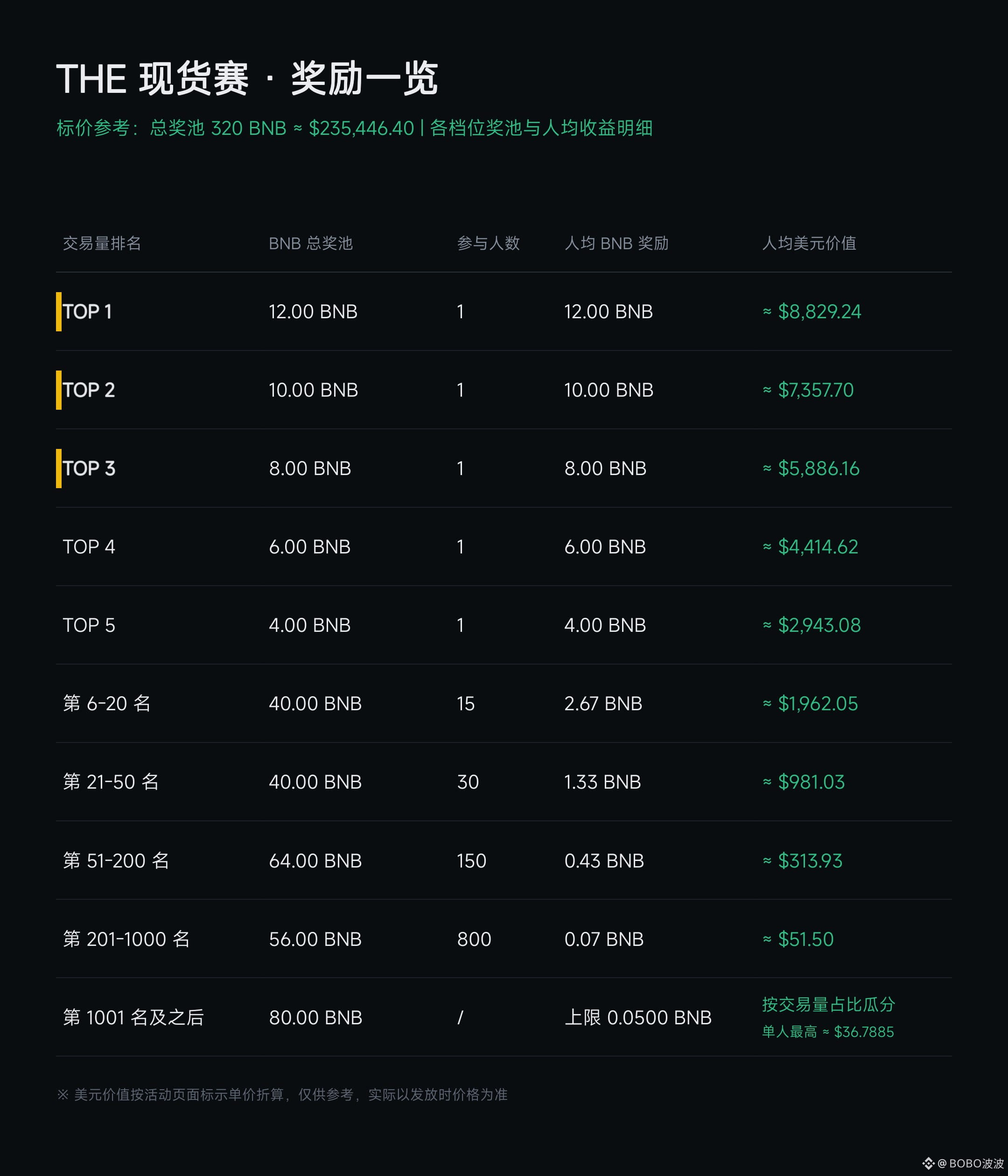
$THE spot price difference 70k, big meat
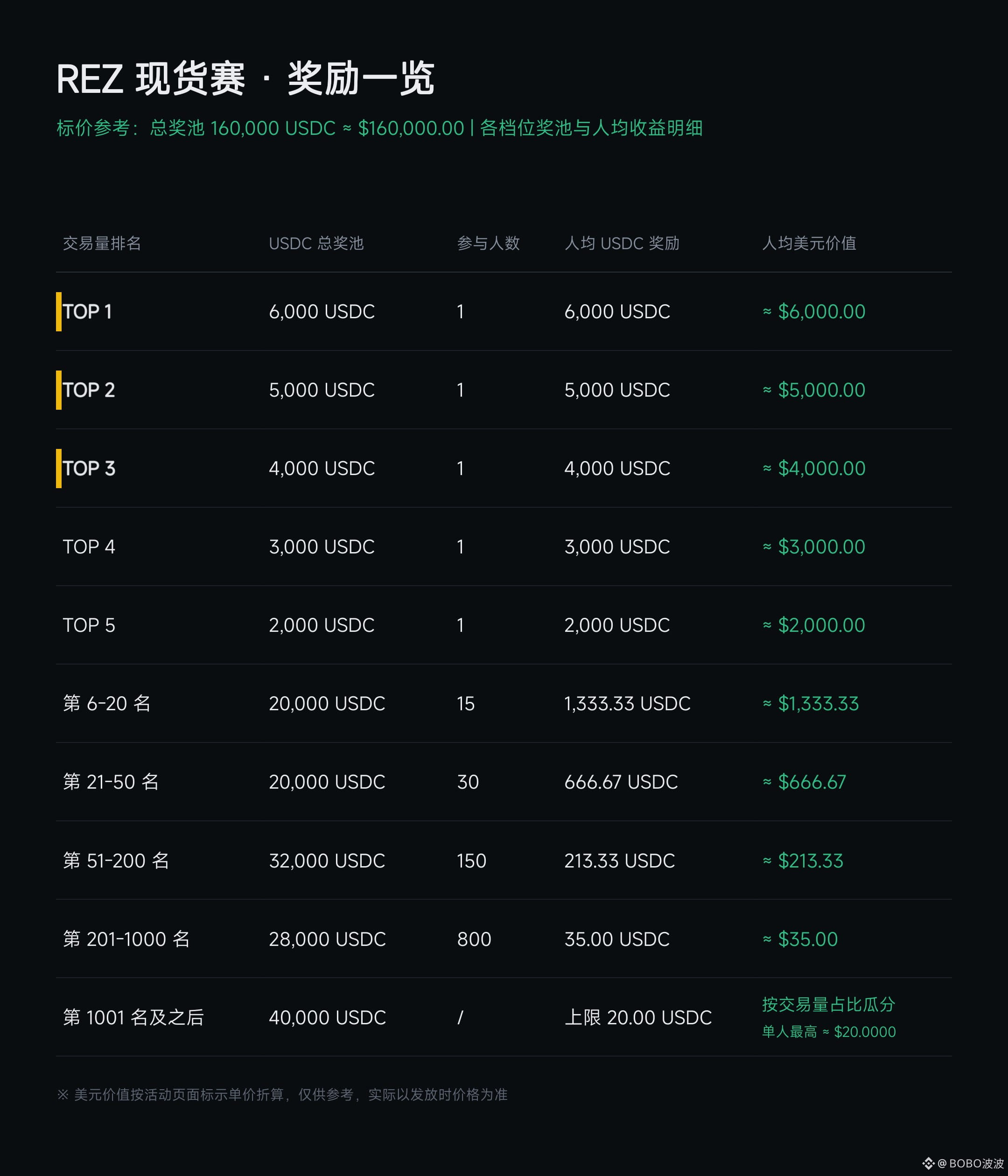
$REZ spot price difference 15k, a match for VIPs
#以太坊时隔七个月重返2600美元
$HOLO spot price difference 75k, big meat
$THE spot price difference 70k, big meat
$REZ spot price difference 15k, a match for VIPs
#以太坊时隔七个月重返2600美元
$THE spot price difference 70k, big meat
$REZ spot price difference 15k, a match for VIPs
#以太坊时隔七个月重返2600美元
2
545
·
--
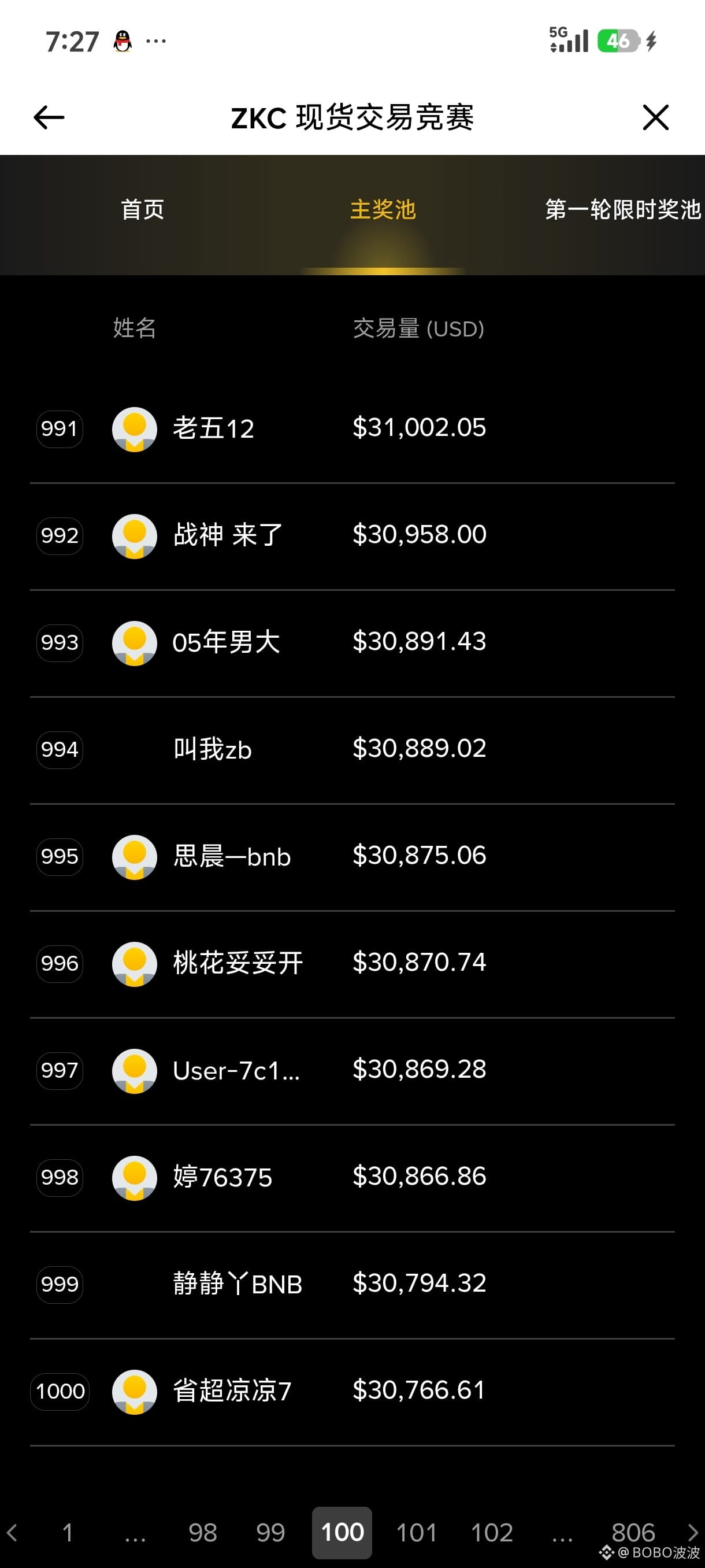
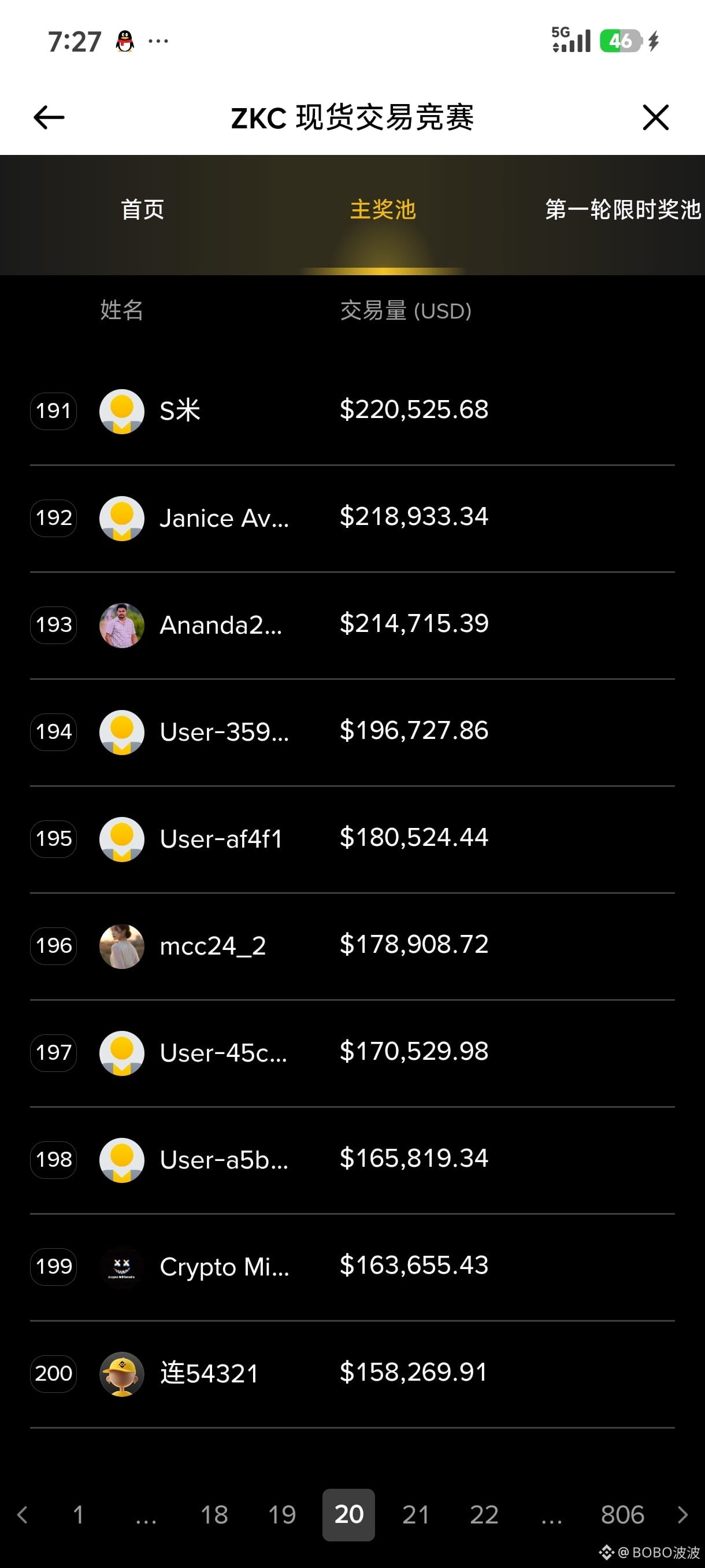
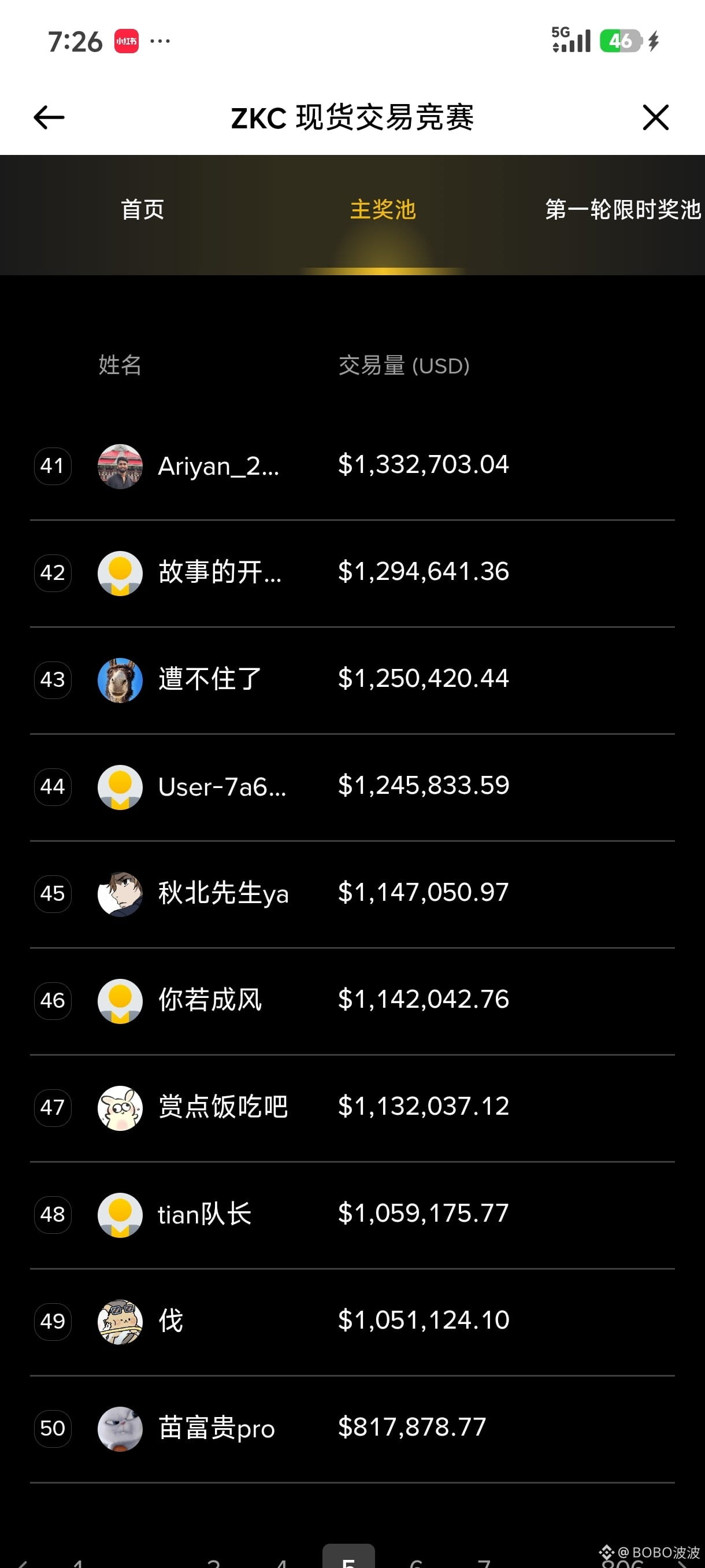
$ZKC In-stock game report. The price difference of Wan Shi caused the top 50 to be mostly missed/left out (a lot of leakage). The top 200 is even worse—a huge miss. It’s all just using about 200–300k (i.e., tens of thousands) to end up with the results. With a cost of around 100U, I managed to get a profit of 150U.
Rank 20 reward: 1,640 u, trading volume: 2,494,161
Rank 50 reward: 820 u, trading volume: 817,879
Rank 200 reward: 262 u, trading volume: 158,270
Rank 1,000 reward: 43 u, trading volume: 30,767
Rank 1,001 and after
For every 10,000 trading volume / reward: 22.14 u (limit: 450ZKC ≈ 22 u)
Total trading volume: 21,595,457
Trading volume needed to max the limit: 9,718
$ZKC In-stock game report. The price difference of Wan Shi caused the top 50 to be mostly missed/left out (a lot of leakage). The top 200 is even worse—a huge miss. It’s all just using about 200–300k (i.e., tens of thousands) to end up with the results. With a cost of around 100U, I managed to get a profit of 150U.
Rank 20 reward: 1,640 u, trading volume: 2,494,161
Rank 50 reward: 820 u, trading volume: 817,879
Rank 200 reward: 262 u, trading volume: 158,270
Rank 1,000 reward: 43 u, trading volume: 30,767
Rank 1,001 and after
For every 10,000 trading volume / reward: 22.14 u (limit: 450ZKC ≈ 22 u)
Total trading volume: 21,595,457
Trading volume needed to max the limit: 9,718
Rank 20 reward: 1,640 u, trading volume: 2,494,161
Rank 50 reward: 820 u, trading volume: 817,879
Rank 200 reward: 262 u, trading volume: 158,270
Rank 1,000 reward: 43 u, trading volume: 30,767
Rank 1,001 and after
For every 10,000 trading volume / reward: 22.14 u (limit: 450ZKC ≈ 22 u)
Total trading volume: 21,595,457
Trading volume needed to max the limit: 9,718
2
542
·
--
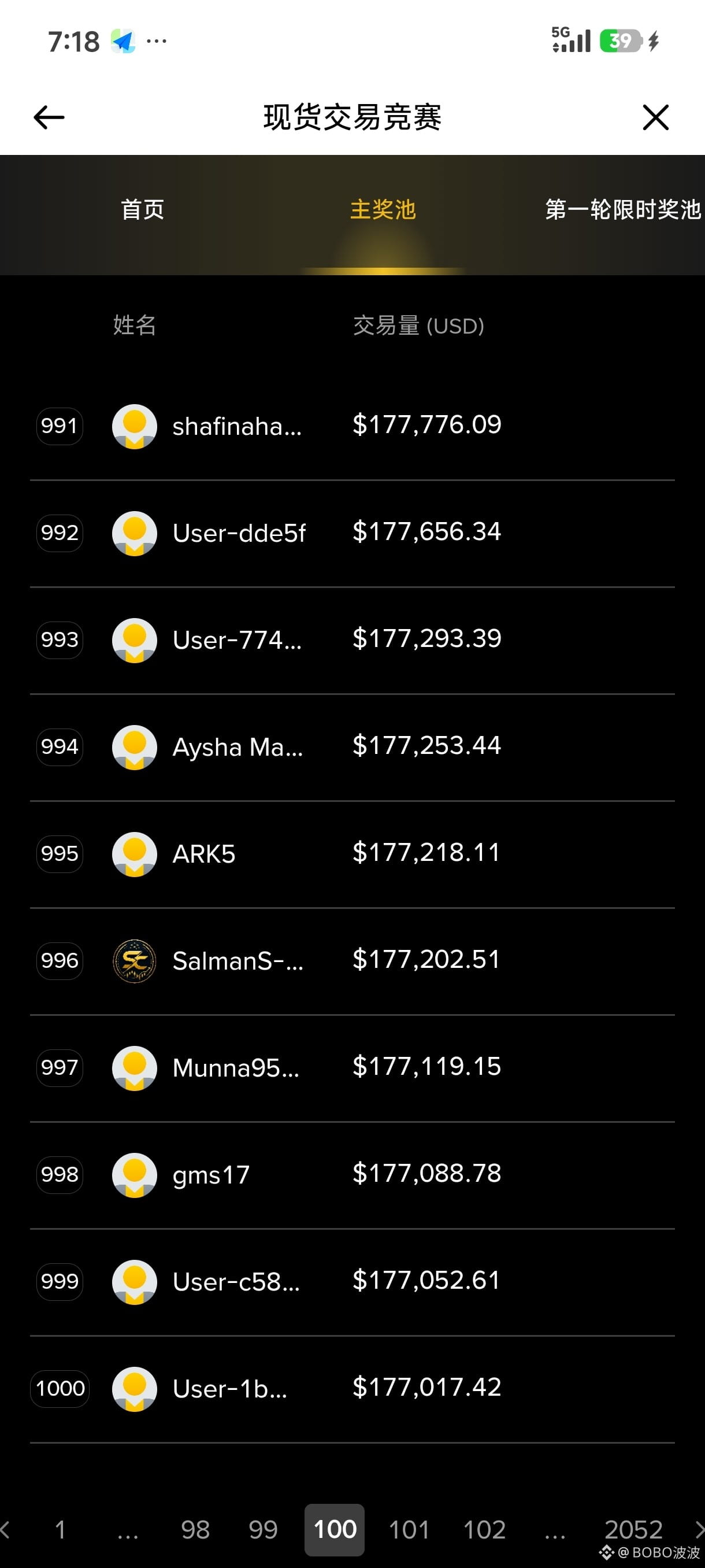
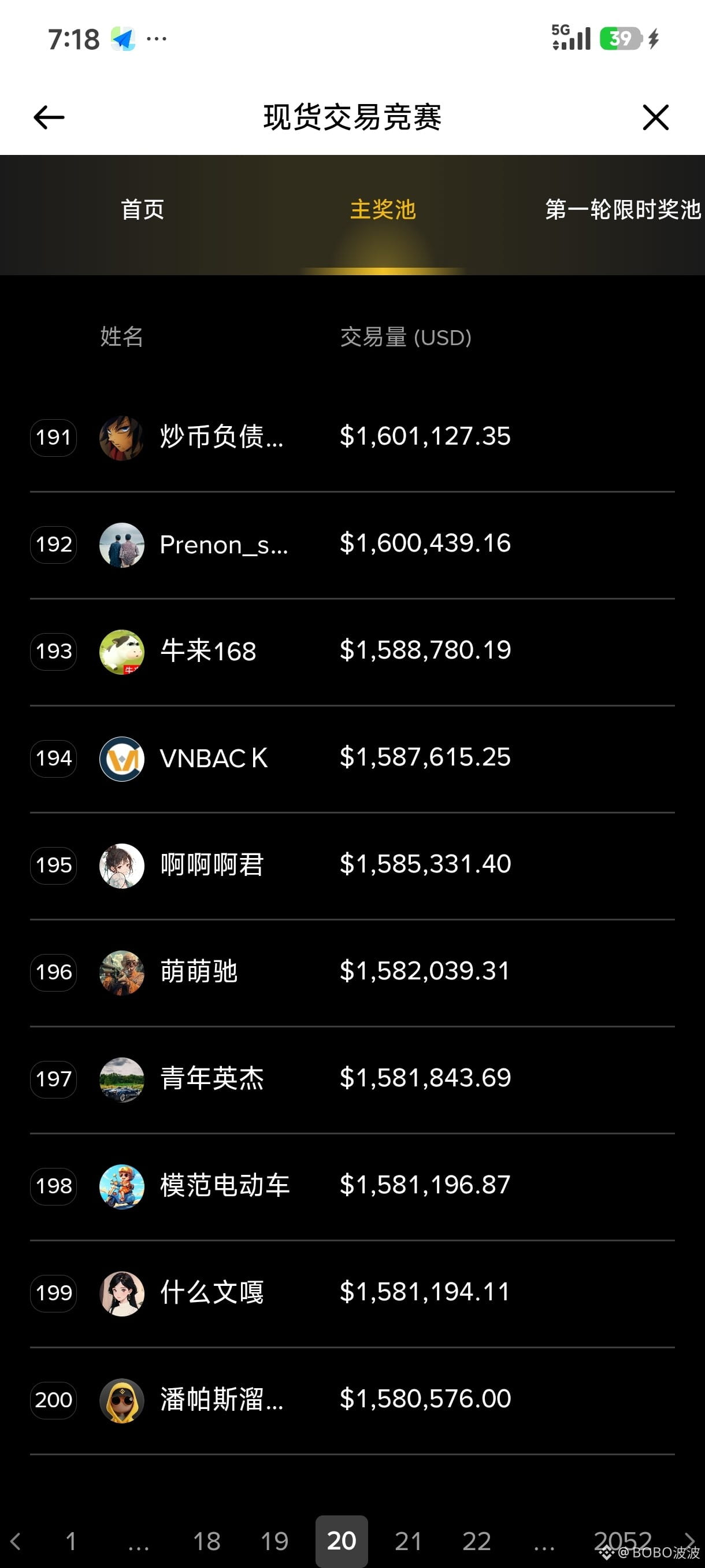
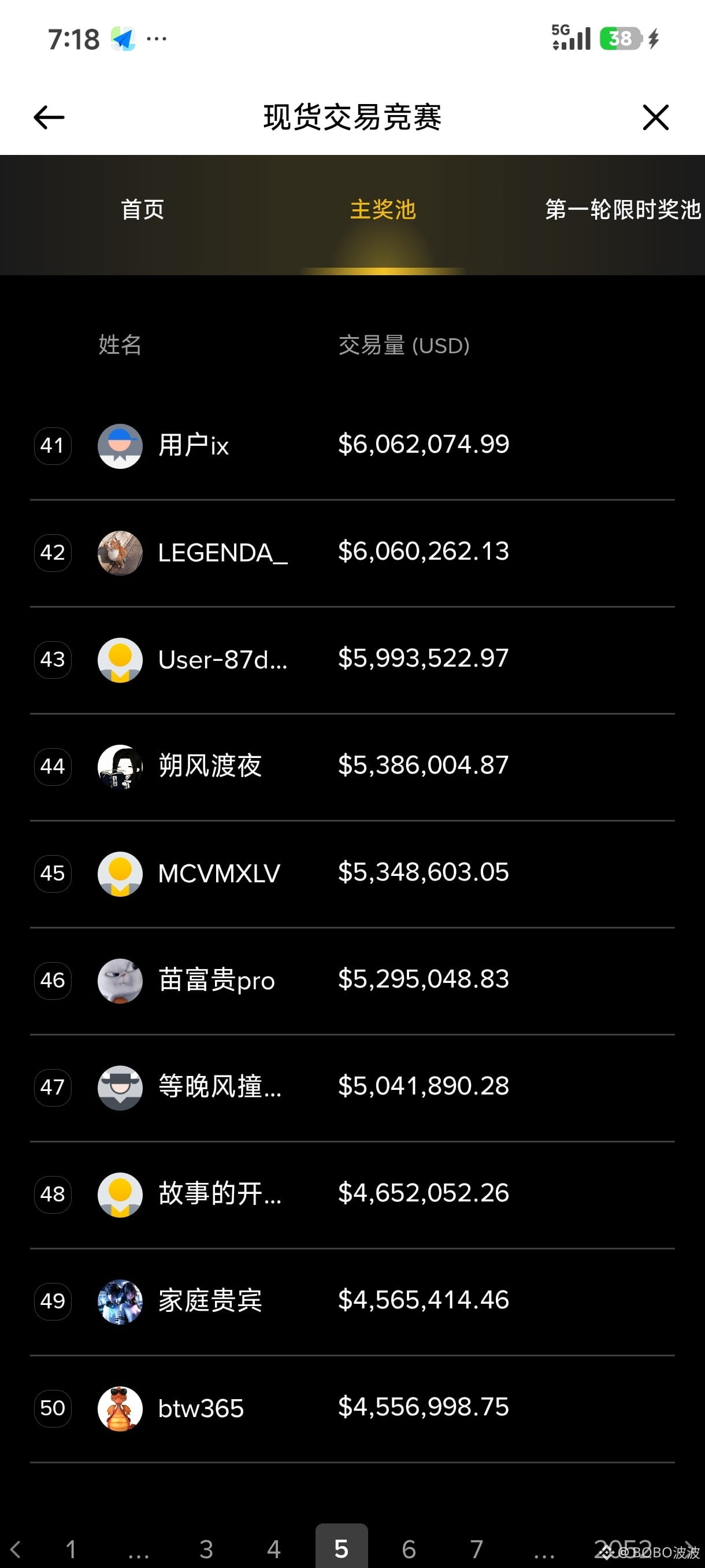
$BTC Ready-Stock Match Battle Report, getting overwhelmed—racing to pile on VIP
Rank 20 prize: 3,333 u, trading volume: 9,086,988
Rank 50 prize: 1,667 u, trading volume: 4,556,999
Rank 200 prize: 533 u, trading volume: 1,580,576
Rank 1,000 prize: 88 u, trading volume: 177,017
After rank 1,001: every 10,000 in trading volume / reward 5.03 u
Trading volume needed to reach the cap: 119,330
$BTC Ready-Stock Match Battle Report, getting overwhelmed—racing to pile on VIP
Rank 20 prize: 3,333 u, trading volume: 9,086,988
Rank 50 prize: 1,667 u, trading volume: 4,556,999
Rank 200 prize: 533 u, trading volume: 1,580,576
Rank 1,000 prize: 88 u, trading volume: 177,017
After rank 1,001: every 10,000 in trading volume / reward 5.03 u
Trading volume needed to reach the cap: 119,330
Rank 20 prize: 3,333 u, trading volume: 9,086,988
Rank 50 prize: 1,667 u, trading volume: 4,556,999
Rank 200 prize: 533 u, trading volume: 1,580,576
Rank 1,000 prize: 88 u, trading volume: 177,017
After rank 1,001: every 10,000 in trading volume / reward 5.03 u
Trading volume needed to reach the cap: 119,330
1
2
233
·
--
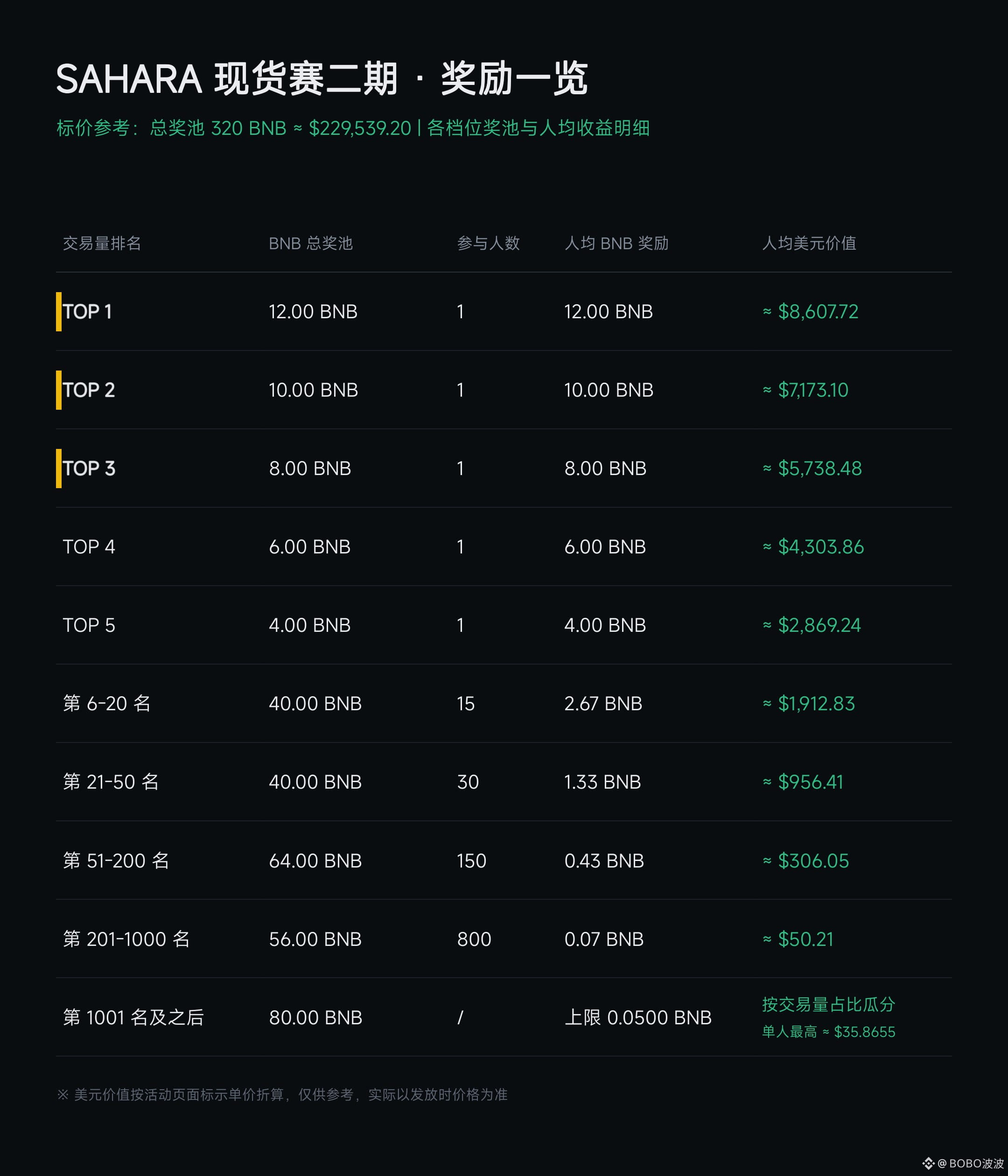
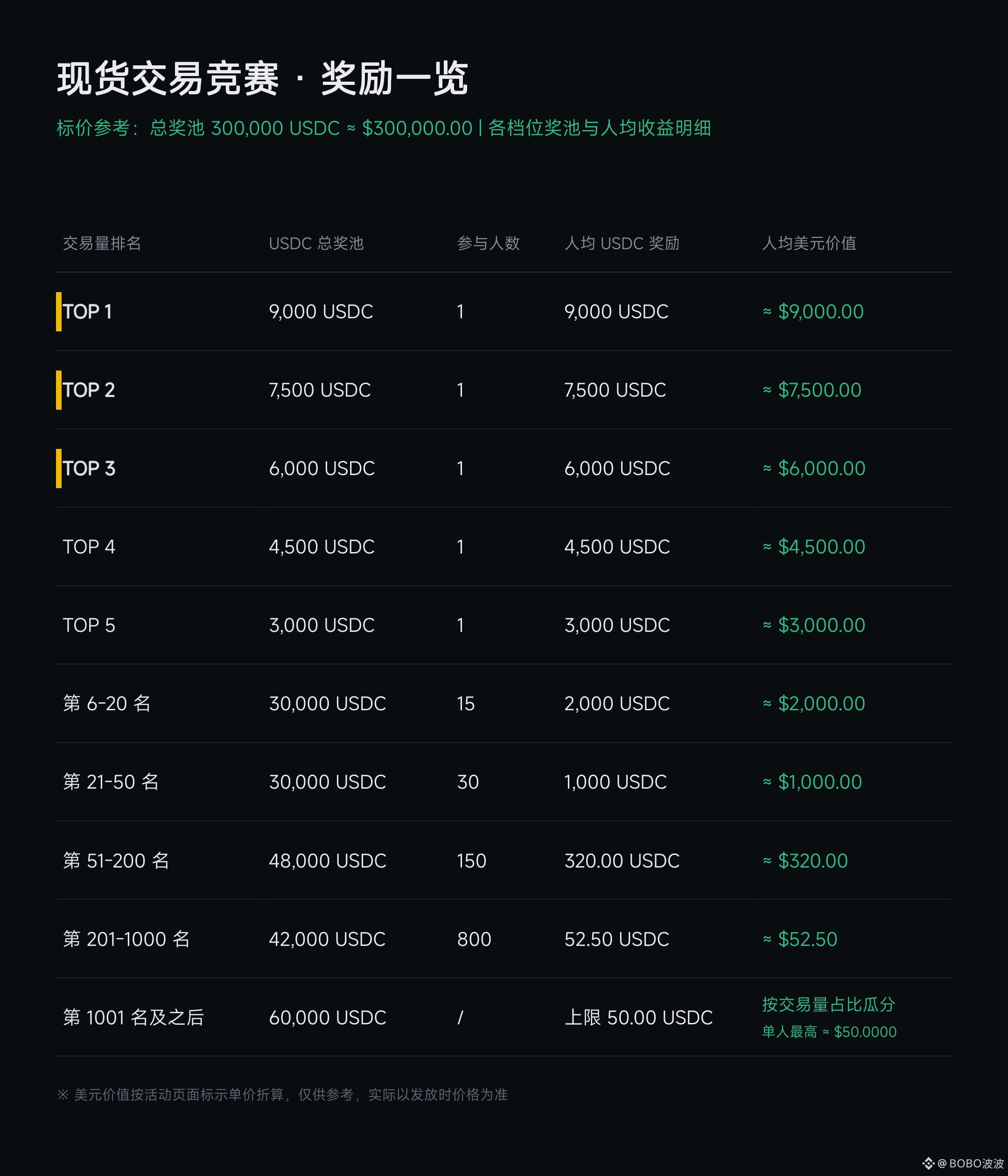
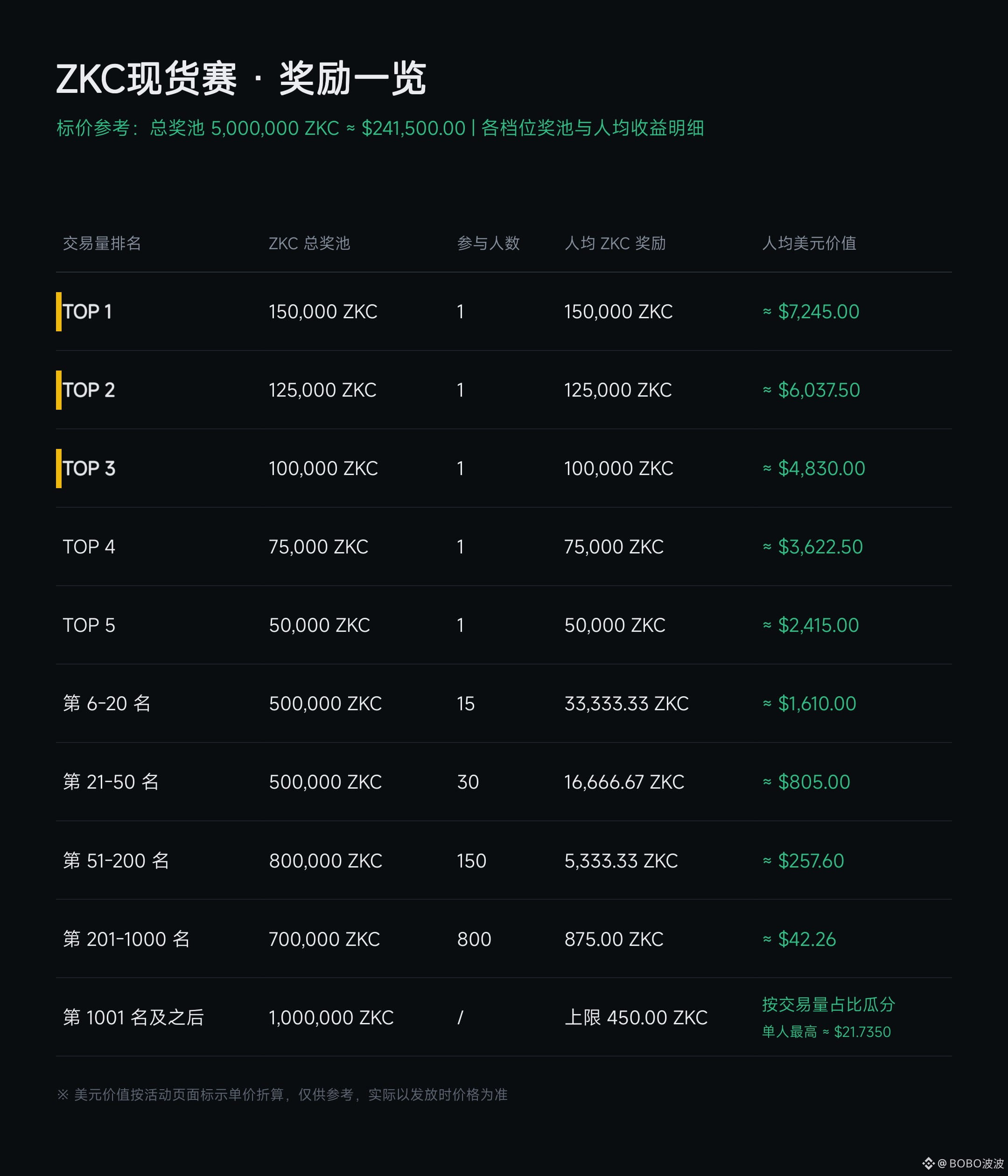
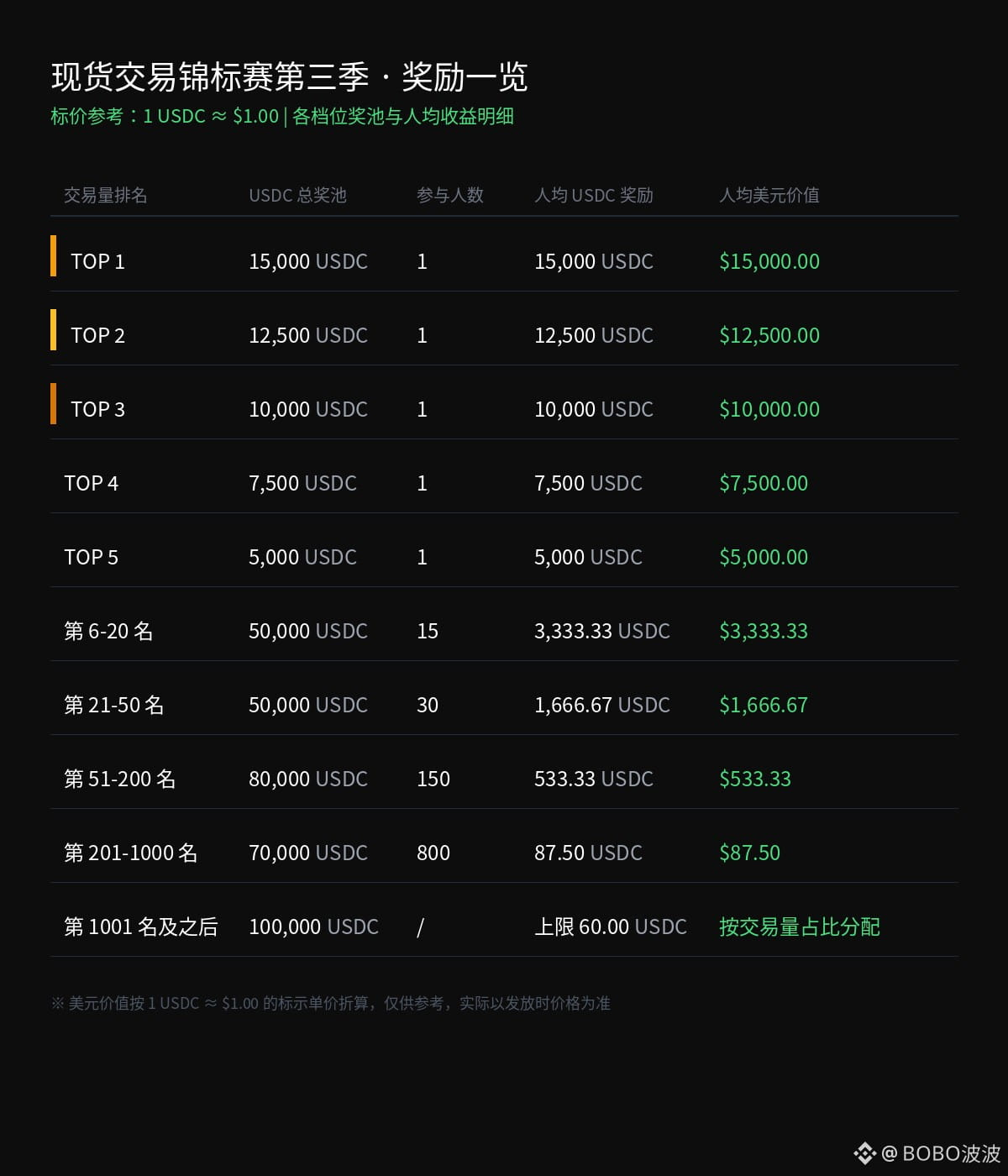
$SAHARA spot trading competition, spread 5.3 ten-thousandths
Spot trading competition, there are three trading pairs, just trade PROM, the spread is a bit smaller; for the other two trading pairs, the spread is very large.
$ZKC spot trading competition, spread 10 ten-thousandths, the profit-making traders are extremely happy
Spot trading championship season 3, just trade $BTC
$SAHARA spot trading competition, spread 5.3 ten-thousandths
Spot trading competition, there are three trading pairs, just trade PROM, the spread is a bit smaller; for the other two trading pairs, the spread is very large.
$ZKC spot trading competition, spread 10 ten-thousandths, the profit-making traders are extremely happy
Spot trading championship season 3, just trade $BTC
Spot trading competition, there are three trading pairs, just trade PROM, the spread is a bit smaller; for the other two trading pairs, the spread is very large.
$ZKC spot trading competition, spread 10 ten-thousandths, the profit-making traders are extremely happy
Spot trading championship season 3, just trade $BTC
2
3
910
·
--
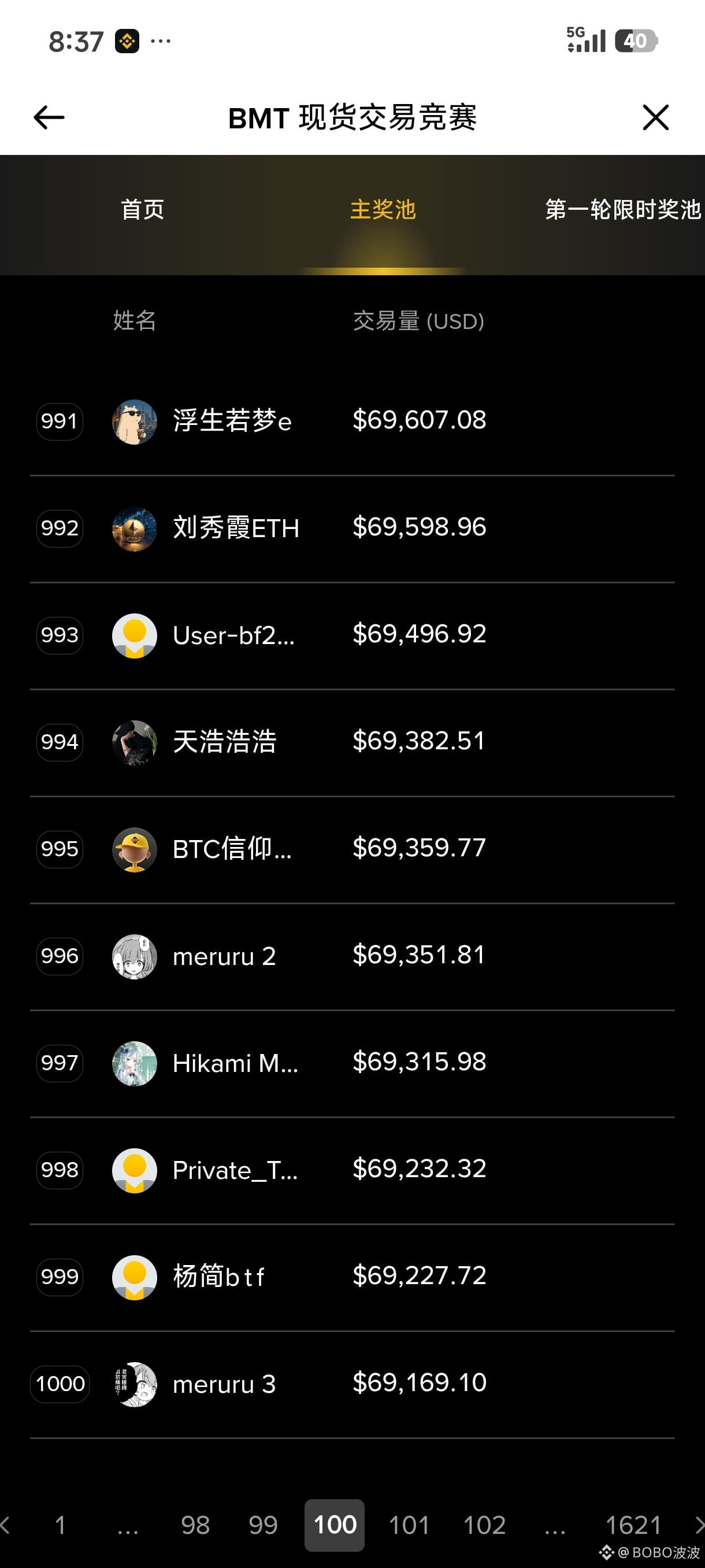
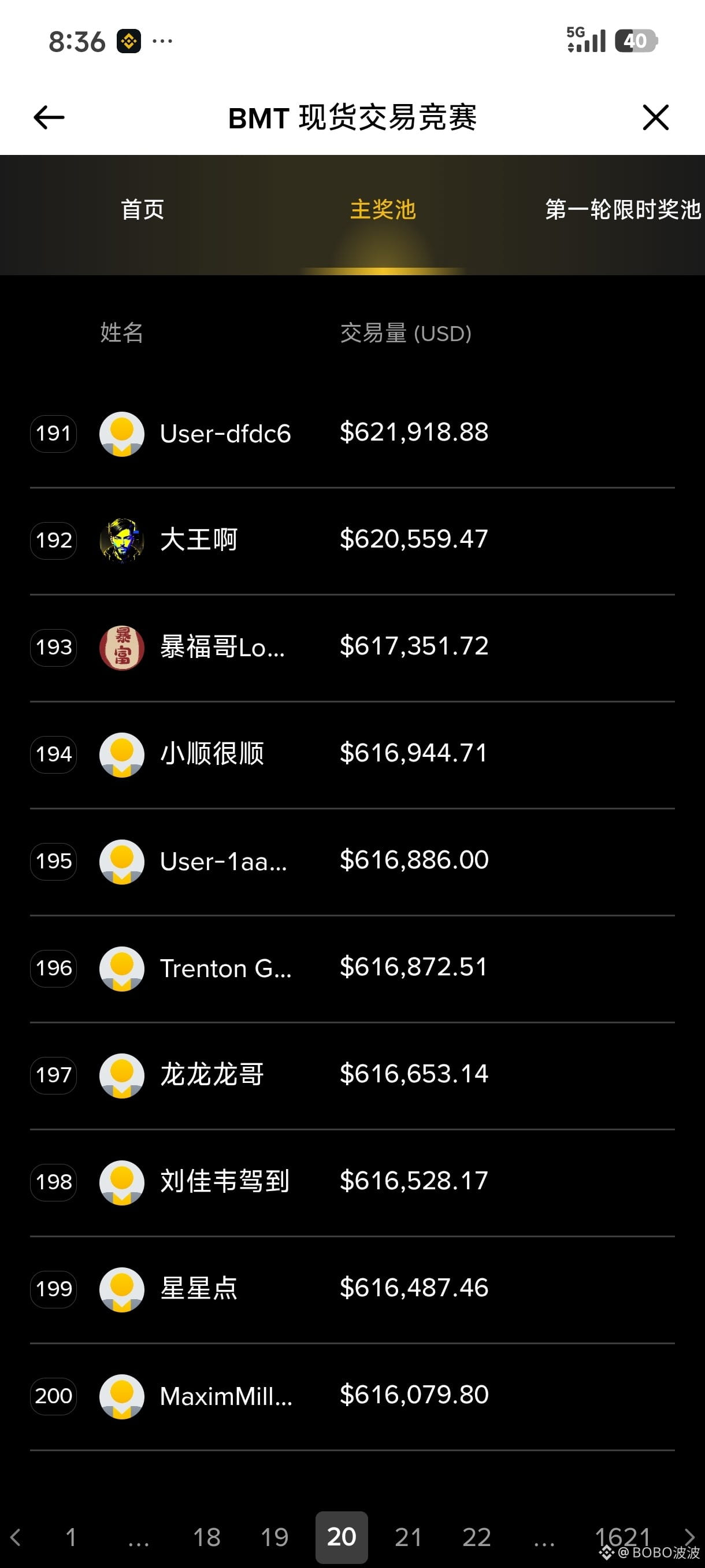
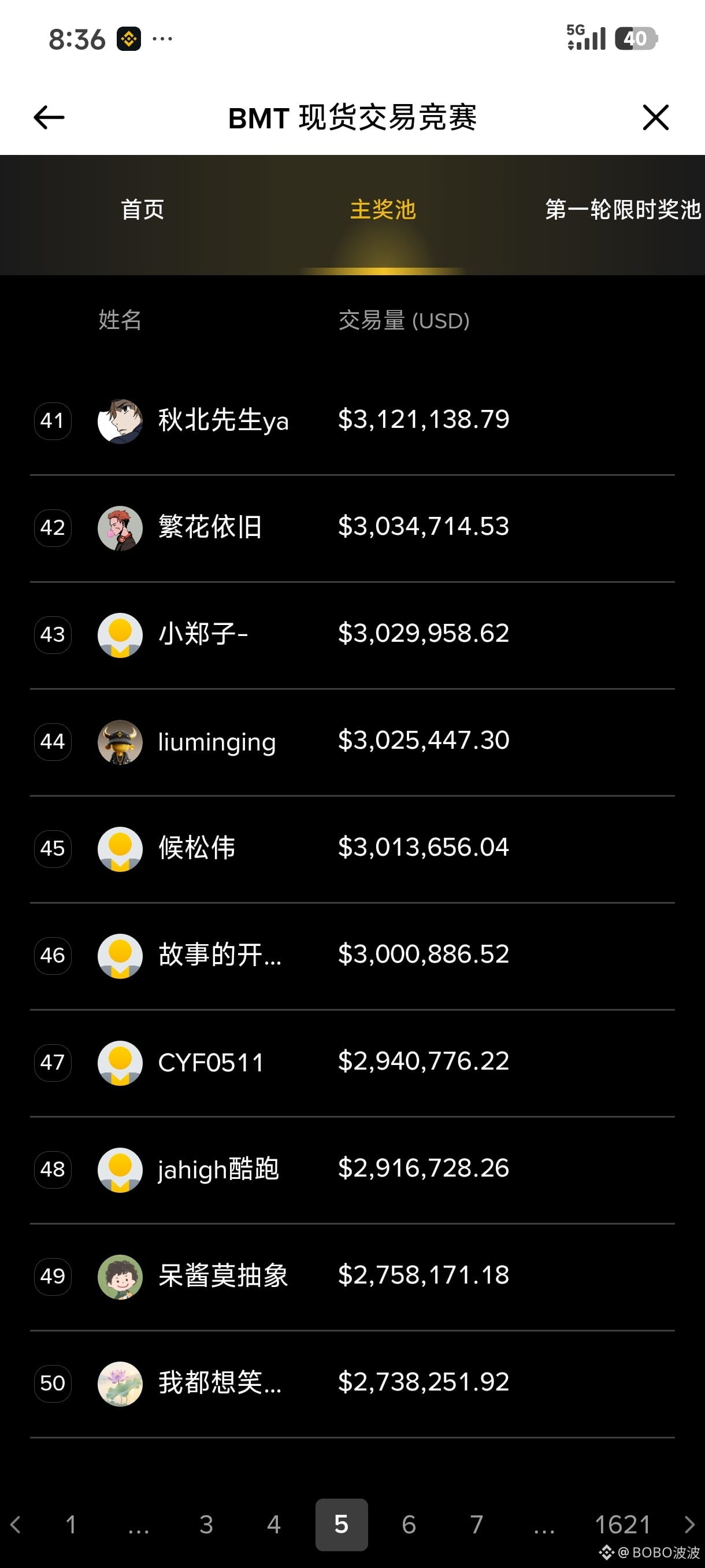
$BMT spot market entry threshold—those first couple hundred draws are already exhausted; even most studios have dropped out. This time it’s actually about splitting the non-carries: the official VIP event and the assist-a-person event will make upcoming competitions increasingly intense in the near term. Better just stay comfortably in the back row.
20th place, reward 1,891 u, trading volume: 4,646,055
50th place reward 945 u, trading volume: 2,738,252
200th place reward 303 u, trading volume: 616,080
1,000th place reward 50 u, trading volume: 68,782
After 1,001st place
Every 10,000 in trading volume / reward 8.01 u
Total trading volume: 70,808,556
Trading volume needed to hit the cap: 53,106
$BMT spot market entry threshold—those first couple hundred draws are already exhausted; even most studios have dropped out. This time it’s actually about splitting the non-carries: the official VIP event and the assist-a-person event will make upcoming competitions increasingly intense in the near term. Better just stay comfortably in the back row.
20th place, reward 1,891 u, trading volume: 4,646,055
50th place reward 945 u, trading volume: 2,738,252
200th place reward 303 u, trading volume: 616,080
1,000th place reward 50 u, trading volume: 68,782
After 1,001st place
Every 10,000 in trading volume / reward 8.01 u
Total trading volume: 70,808,556
Trading volume needed to hit the cap: 53,106
20th place, reward 1,891 u, trading volume: 4,646,055
50th place reward 945 u, trading volume: 2,738,252
200th place reward 303 u, trading volume: 616,080
1,000th place reward 50 u, trading volume: 68,782
After 1,001st place
Every 10,000 in trading volume / reward 8.01 u
Total trading volume: 70,808,556
Trading volume needed to hit the cap: 53,106
1
478
·
--
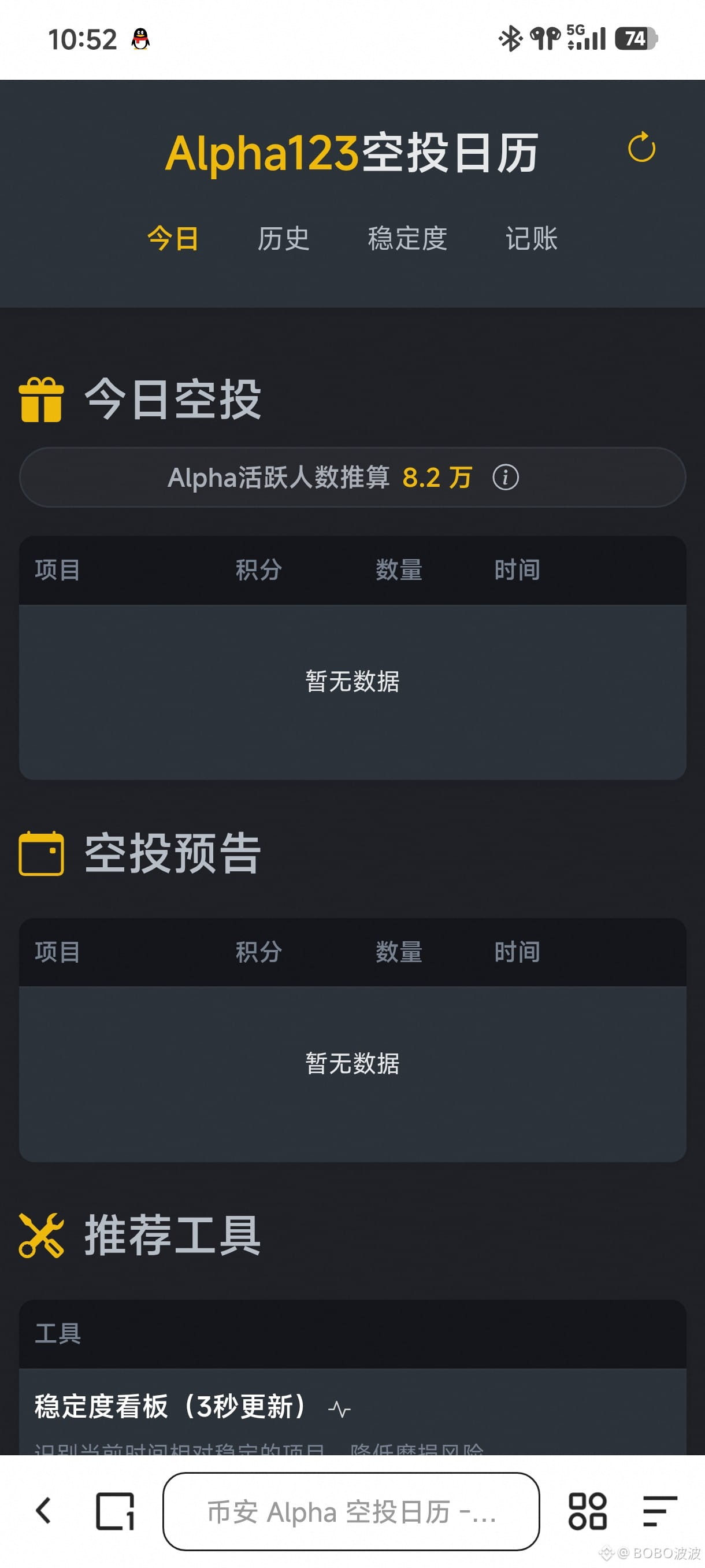
#ALPHA Daily Report, It’s now a given that there will be no air drops on weekends—just rest easy
1️⃣ Points farming tip: $GRVT is no longer eligible for the four-times bonus. Now we recommend farming using $DOS . With a 500U budget, the wear and tear is a bit smaller since the volume isn’t that large right now.
2️⃣ Trading competition: As of now, the entry thresholds for all four competitions are zero. I don’t know whether it’s competitive or not—go based on your situation and decide whether to join.
#ALPHA Daily Report, It’s now a given that there will be no air drops on weekends—just rest easy
1️⃣ Points farming tip: $GRVT is no longer eligible for the four-times bonus. Now we recommend farming using $DOS . With a 500U budget, the wear and tear is a bit smaller since the volume isn’t that large right now.
2️⃣ Trading competition: As of now, the entry thresholds for all four competitions are zero. I don’t know whether it’s competitive or not—go based on your situation and decide whether to join.
1️⃣ Points farming tip: $GRVT is no longer eligible for the four-times bonus. Now we recommend farming using $DOS . With a 500U budget, the wear and tear is a bit smaller since the volume isn’t that large right now.
2️⃣ Trading competition: As of now, the entry thresholds for all four competitions are zero. I don’t know whether it’s competitive or not—go based on your situation and decide whether to join.
1
8
1.6k
·
--
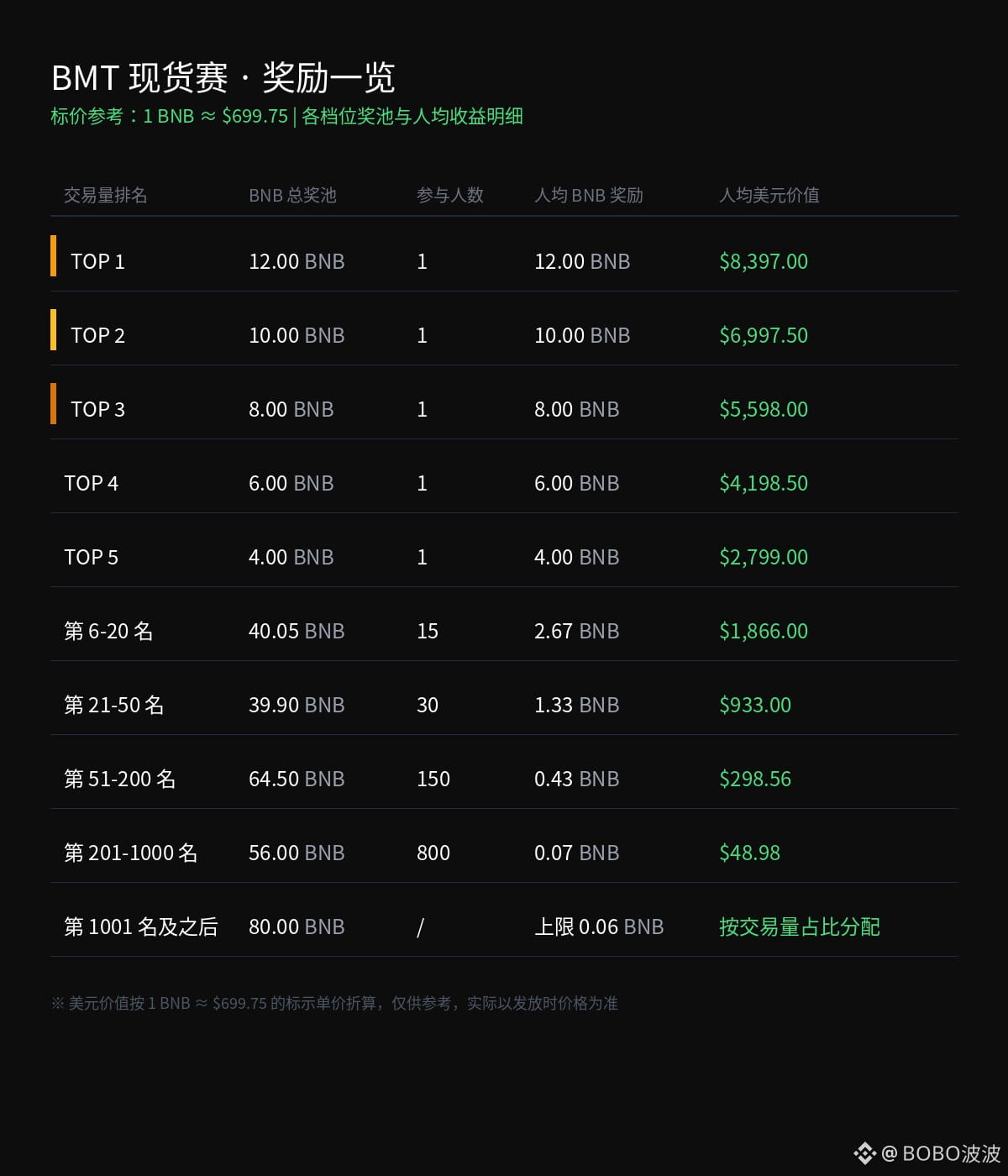
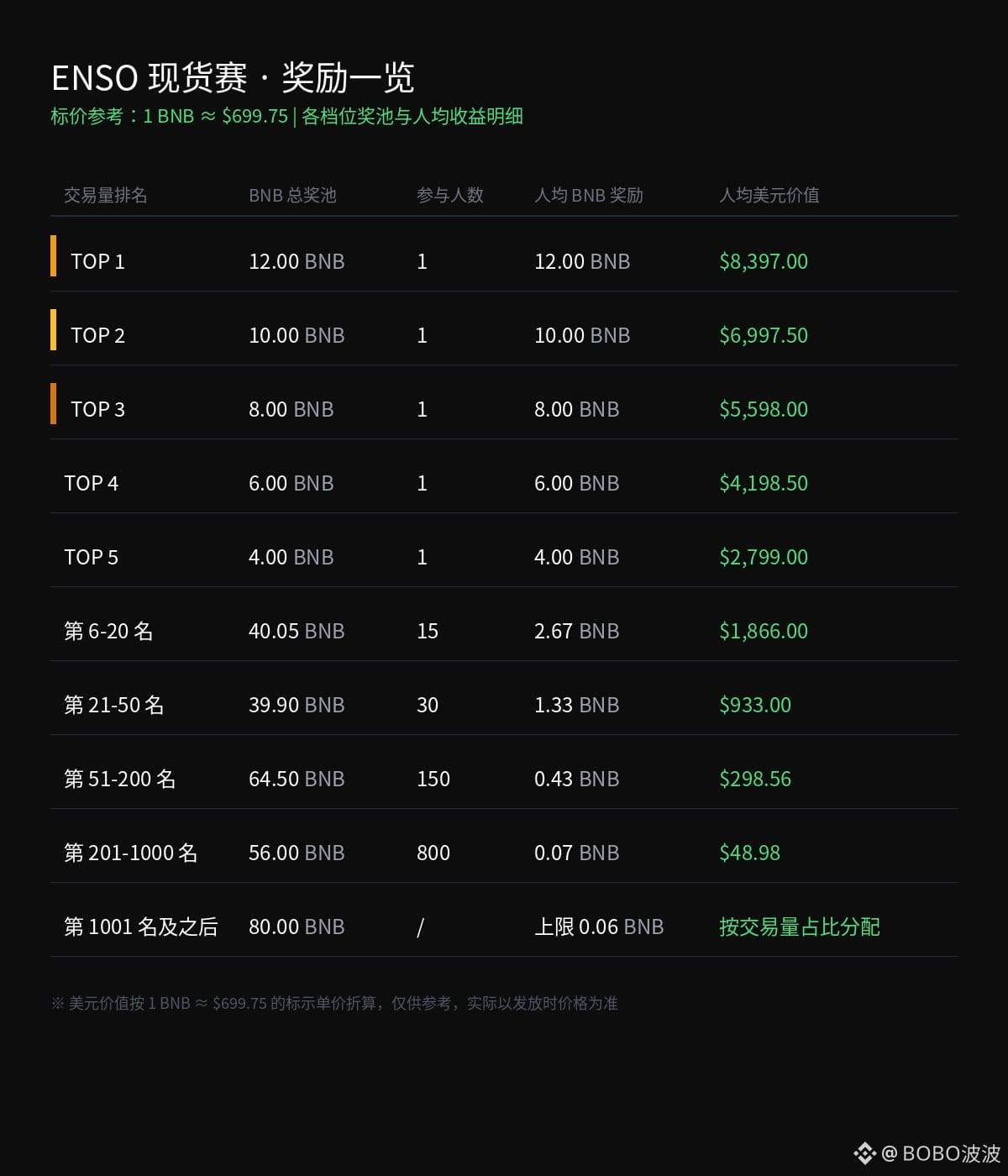
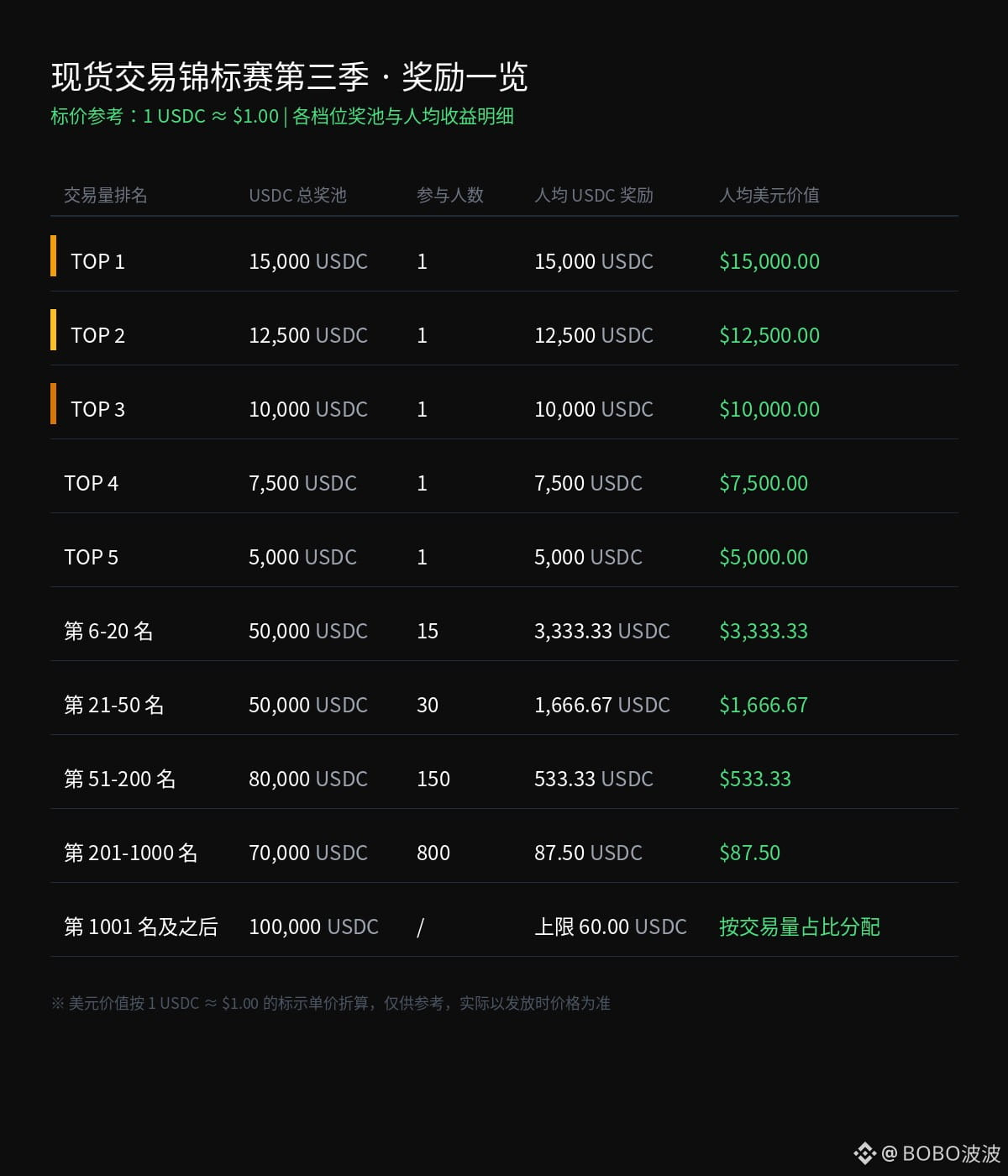
$BMT spot contest profit chart, spread 万2.3
$ENSO spot contest profit chart, spread 万六
$BTC spot contest profit chart, no spread, VIP拼的比赛
$BMT spot contest profit chart, spread 万2.3
$ENSO spot contest profit chart, spread 万六
$BTC spot contest profit chart, no spread, VIP拼的比赛
$ENSO spot contest profit chart, spread 万六
$BTC spot contest profit chart, no spread, VIP拼的比赛
7
1.4k
·
--
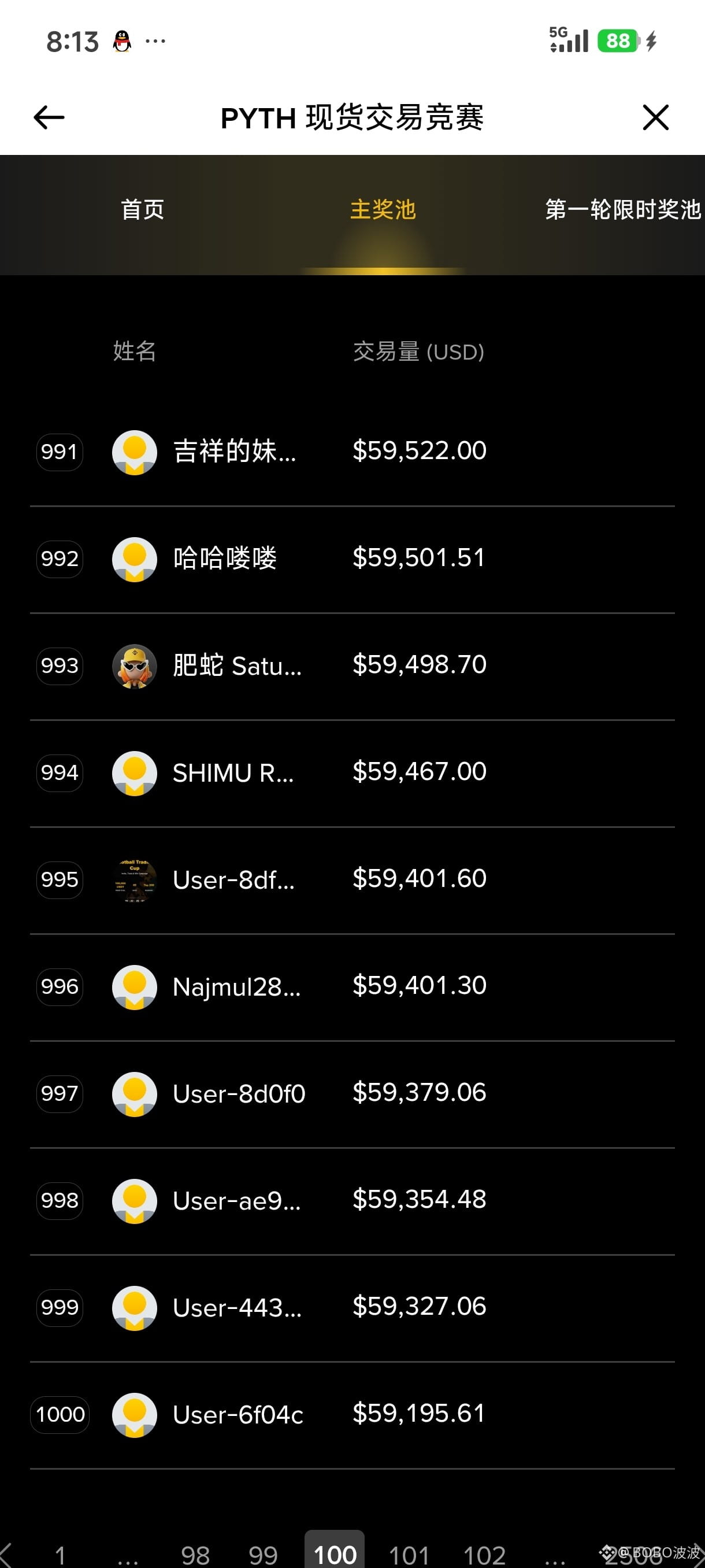
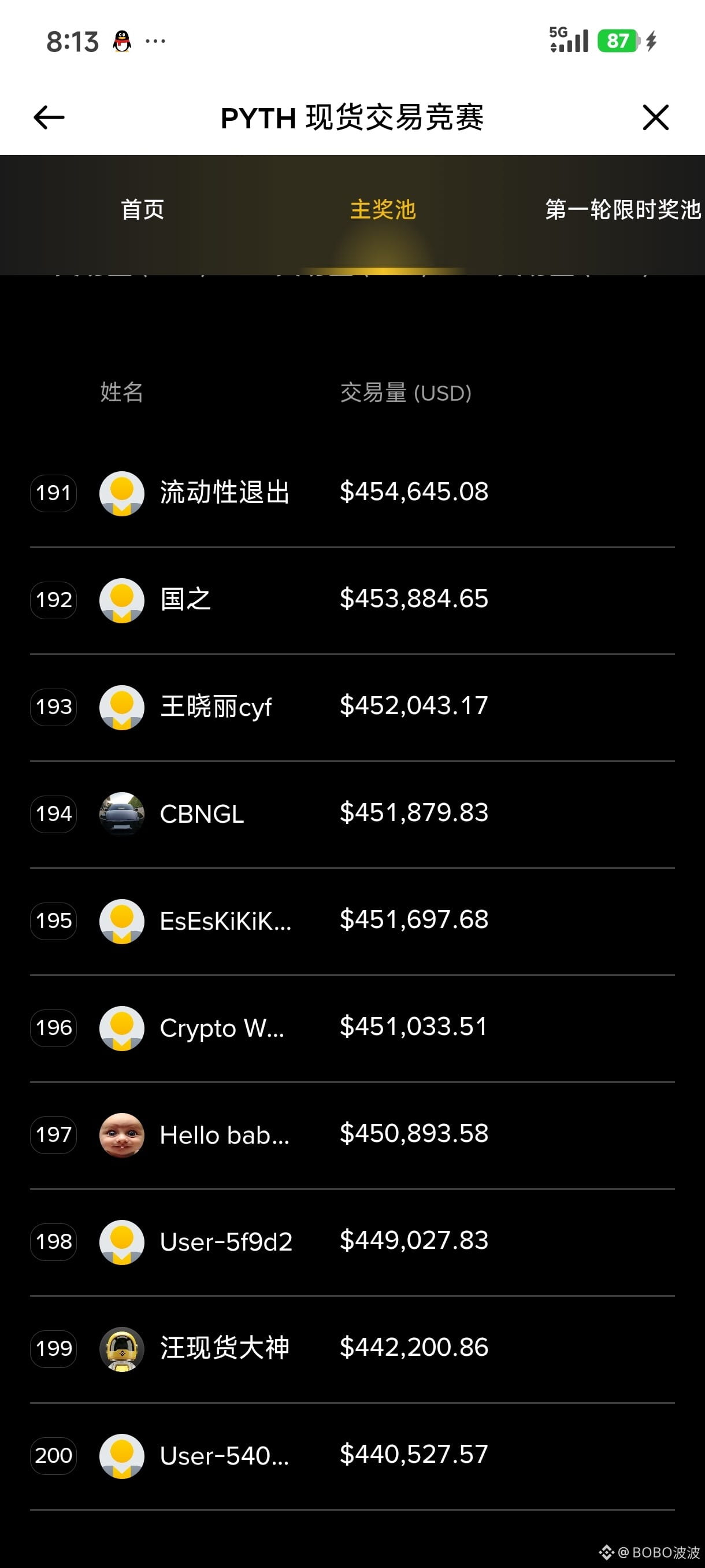
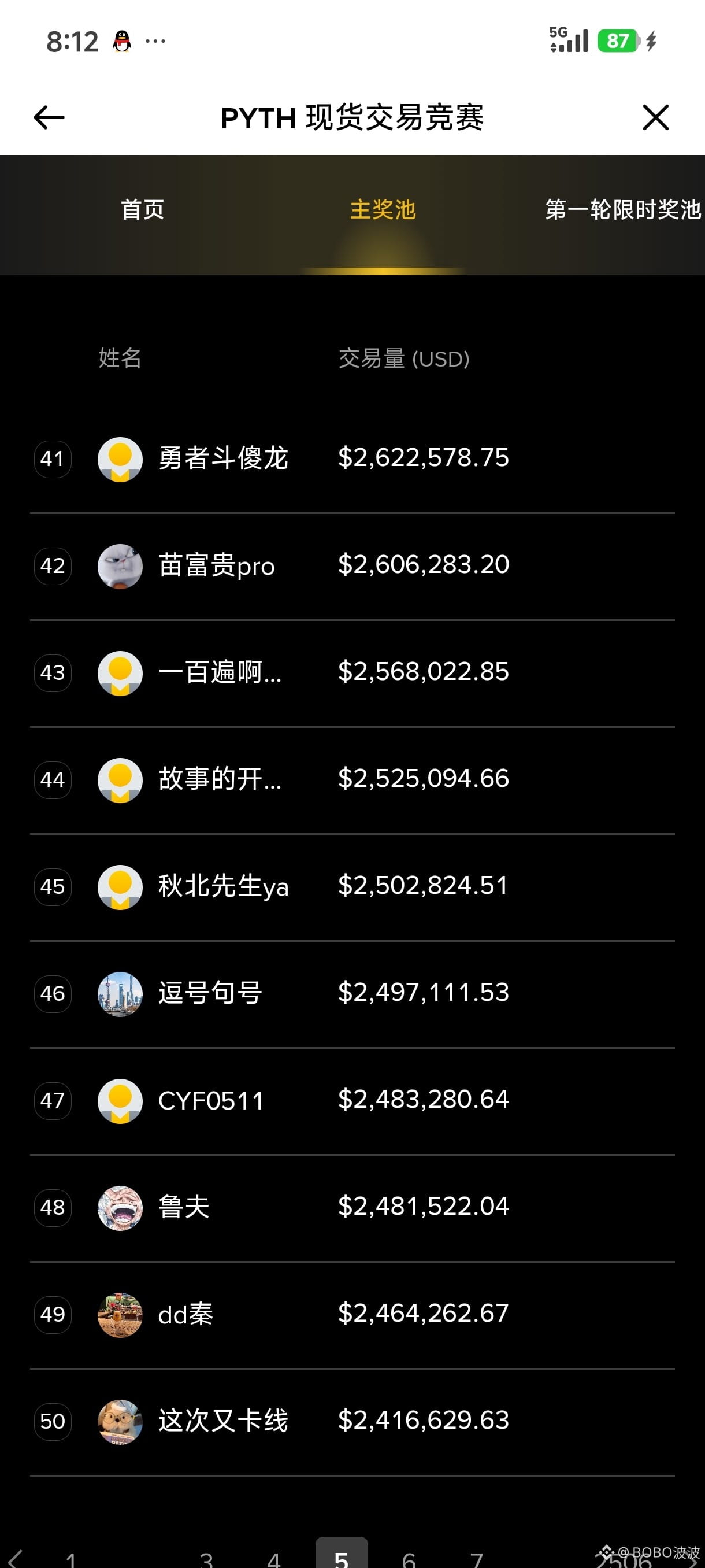
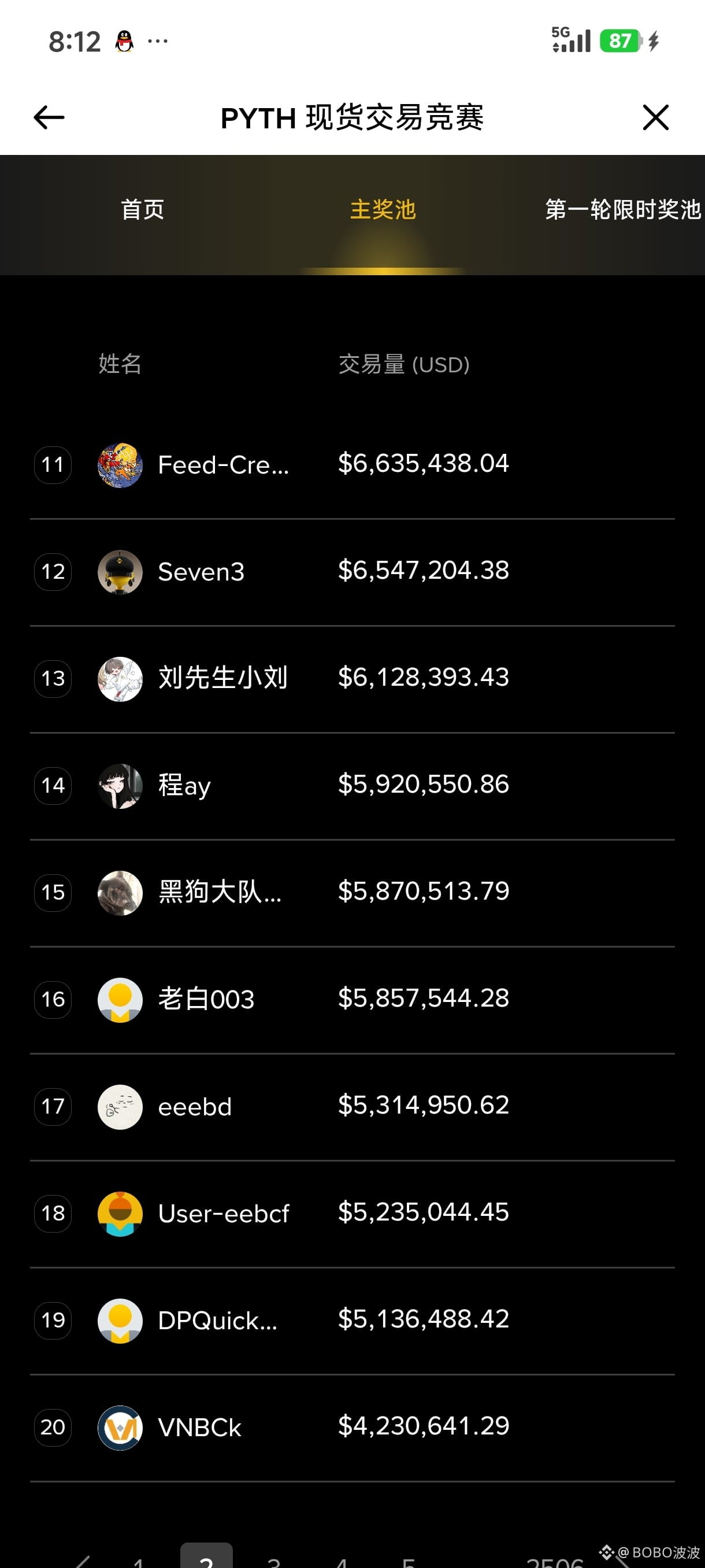
Yesterday’s $RE first 200 spot contest isn’t competitive. Today’s $PYTH first 200 is competitive. Now playing spot contests has become a psychological game. But it’s still the same as yesterday: the top 1,000 get into the top 1,000 as long as you fill the bonus. It’s slightly competitive, but compared to before, it’s much better.
Rankings & leaderboard 🔥
Rank 20: Reward 1,626 u, Trading volume: 4,230,641
Rank 50: Reward 813 u, Trading volume: 2,416,630
Rank 200: Reward 260 u, Trading volume: 440,528
Rank 1,000: Reward 43 u, Trading volume: 59,196
Rank 1,001 and after
For every 10,000 trading volume / Reward 6.35 u
Total trading volume: 76,840,063
Trading volume required to reach the cap: 61,472
#ALPHA $BTC
Yesterday’s $RE first 200 spot contest isn’t competitive. Today’s $PYTH first 200 is competitive. Now playing spot contests has become a psychological game. But it’s still the same as yesterday: the top 1,000 get into the top 1,000 as long as you fill the bonus. It’s slightly competitive, but compared to before, it’s much better.
Rankings & leaderboard 🔥
Rank 20: Reward 1,626 u, Trading volume: 4,230,641
Rank 50: Reward 813 u, Trading volume: 2,416,630
Rank 200: Reward 260 u, Trading volume: 440,528
Rank 1,000: Reward 43 u, Trading volume: 59,196
Rank 1,001 and after
For every 10,000 trading volume / Reward 6.35 u
Total trading volume: 76,840,063
Trading volume required to reach the cap: 61,472
#ALPHA $BTC
Rankings & leaderboard 🔥
Rank 20: Reward 1,626 u, Trading volume: 4,230,641
Rank 50: Reward 813 u, Trading volume: 2,416,630
Rank 200: Reward 260 u, Trading volume: 440,528
Rank 1,000: Reward 43 u, Trading volume: 59,196
Rank 1,001 and after
For every 10,000 trading volume / Reward 6.35 u
Total trading volume: 76,840,063
Trading volume required to reach the cap: 61,472
#ALPHA $BTC
7
865
·
--
When I researched the PoS chain, the things I cared about most were APY and the lock-up period. After studying Dusk’s Succinct Attestation and Proof-of-Blind Bid, I started to focus on a more practical question instead: once $DUSK has entered the Blind Bid state, what exact conditions must a user meet to actually get it back?
I originally thought participating in consensus is simply about staking and delegating. But after reading Dusk’s technical documentation, I realized this is really a state transition. Normally, a user locks #dusk into the Bid Contract, creates a bid containing the committed amount and a secretHash, inserts it into the Merkle Tree, and also includes two critical heights: h{eligibility} (when they can start participating in consensus) and h{expiration} (the expiration height). During the Generation phase, the network privately extracts the Generator via Proof-of-Blind Bid, so the bidder’s identity remains obfuscated. Meanwhile, the Provisioner deterministically gets selected into the committee, and during the Reduction and Agreement phases, it votes on candidate blocks in two rounds to reach statistical finality.
What really concerns me is that submitting a Bid does not mean you can exit at any time. The Bid Contract specifies that before h{expiration} is reached, users cannot initiate F^{WithdrawBid}. Dusk also separates roles: you can be a Generator (competing for the right to produce blocks through Blind Bid), or you can be a Provisioner (locking stake in the Stake Contract to take part in validation). If, as a Provisioner, you double-sign or act maliciously, anyone can call the Stake Contract’s F^{Slash} function to report you, and your stake will be partially slashed. In other words, participating in consensus is not a button—it’s a time window constrained by the protocol’s rules. Your @Dusk_Foundation is not only protecting the network before expiration, but also bearing the risk of penalties.
So in my view, what Dusk truly solves is: in PoS consensus, the transparency of leader election and the MEV problem. The protocol assembles these states using Blind Bid, deterministic committee selection, role separation, and statistical finality. The trade-off is also obvious: users are no longer just “staking DUSK to earn rewards,” but must understand the relationships among Bid, Stake, Generator, Provisioner, and Slashing.
What I will keep watching is not how simple the staking entry is, but whether ordinary users actually understand what they are waiting for when they participate in consensus.
When I researched the PoS chain, the things I cared about most were APY and the lock-up period. After studying Dusk’s Succinct Attestation and Proof-of-Blind Bid, I started to focus on a more practical question instead: once $DUSK has entered the Blind Bid state, what exact conditions must a user meet to actually get it back?
I originally thought participating in consensus is simply about staking and delegating. But after reading Dusk’s technical documentation, I realized this is really a state transition. Normally, a user locks #dusk into the Bid Contract, creates a bid containing the committed amount and a secretHash, inserts it into the Merkle Tree, and also includes two critical heights: h{eligibility} (when they can start participating in consensus) and h{expiration} (the expiration height). During the Generation phase, the network privately extracts the Generator via Proof-of-Blind Bid, so the bidder’s identity remains obfuscated. Meanwhile, the Provisioner deterministically gets selected into the committee, and during the Reduction and Agreement phases, it votes on candidate blocks in two rounds to reach statistical finality.
What really concerns me is that submitting a Bid does not mean you can exit at any time. The Bid Contract specifies that before h{expiration} is reached, users cannot initiate F^{WithdrawBid}. Dusk also separates roles: you can be a Generator (competing for the right to produce blocks through Blind Bid), or you can be a Provisioner (locking stake in the Stake Contract to take part in validation). If, as a Provisioner, you double-sign or act maliciously, anyone can call the Stake Contract’s F^{Slash} function to report you, and your stake will be partially slashed. In other words, participating in consensus is not a button—it’s a time window constrained by the protocol’s rules. Your @Dusk is not only protecting the network before expiration, but also bearing the risk of penalties.
So in my view, what Dusk truly solves is: in PoS consensus, the transparency of leader election and the MEV problem. The protocol assembles these states using Blind Bid, deterministic committee selection, role separation, and statistical finality. The trade-off is also obvious: users are no longer just “staking DUSK to earn rewards,” but must understand the relationships among Bid, Stake, Generator, Provisioner, and Slashing.
What I will keep watching is not how simple the staking entry is, but whether ordinary users actually understand what they are waiting for when they participate in consensus.
I originally thought participating in consensus is simply about staking and delegating. But after reading Dusk’s technical documentation, I realized this is really a state transition. Normally, a user locks #dusk into the Bid Contract, creates a bid containing the committed amount and a secretHash, inserts it into the Merkle Tree, and also includes two critical heights: h{eligibility} (when they can start participating in consensus) and h{expiration} (the expiration height). During the Generation phase, the network privately extracts the Generator via Proof-of-Blind Bid, so the bidder’s identity remains obfuscated. Meanwhile, the Provisioner deterministically gets selected into the committee, and during the Reduction and Agreement phases, it votes on candidate blocks in two rounds to reach statistical finality.
What really concerns me is that submitting a Bid does not mean you can exit at any time. The Bid Contract specifies that before h{expiration} is reached, users cannot initiate F^{WithdrawBid}. Dusk also separates roles: you can be a Generator (competing for the right to produce blocks through Blind Bid), or you can be a Provisioner (locking stake in the Stake Contract to take part in validation). If, as a Provisioner, you double-sign or act maliciously, anyone can call the Stake Contract’s F^{Slash} function to report you, and your stake will be partially slashed. In other words, participating in consensus is not a button—it’s a time window constrained by the protocol’s rules. Your @Dusk is not only protecting the network before expiration, but also bearing the risk of penalties.
So in my view, what Dusk truly solves is: in PoS consensus, the transparency of leader election and the MEV problem. The protocol assembles these states using Blind Bid, deterministic committee selection, role separation, and statistical finality. The trade-off is also obvious: users are no longer just “staking DUSK to earn rewards,” but must understand the relationships among Bid, Stake, Generator, Provisioner, and Slashing.
What I will keep watching is not how simple the staking entry is, but whether ordinary users actually understand what they are waiting for when they participate in consensus.
223
·
--
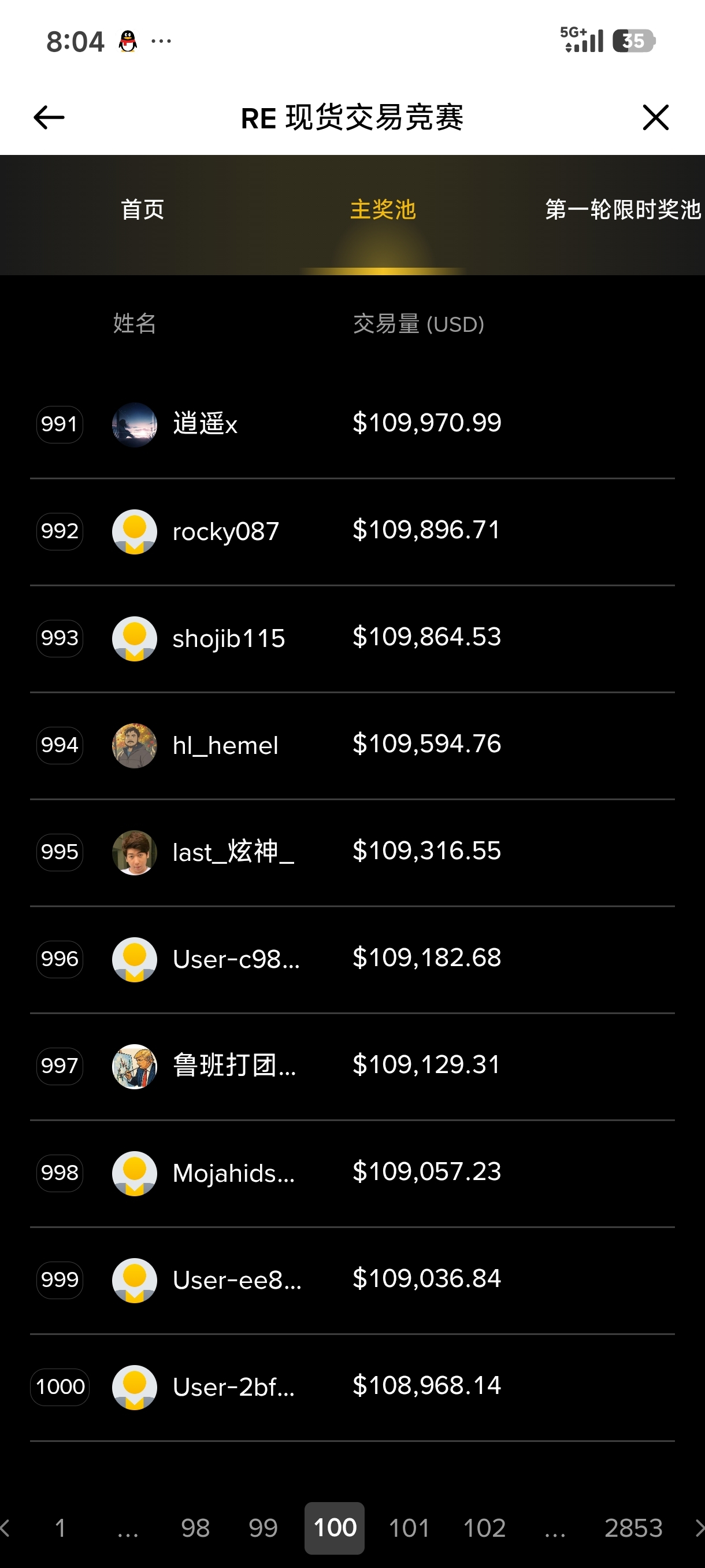
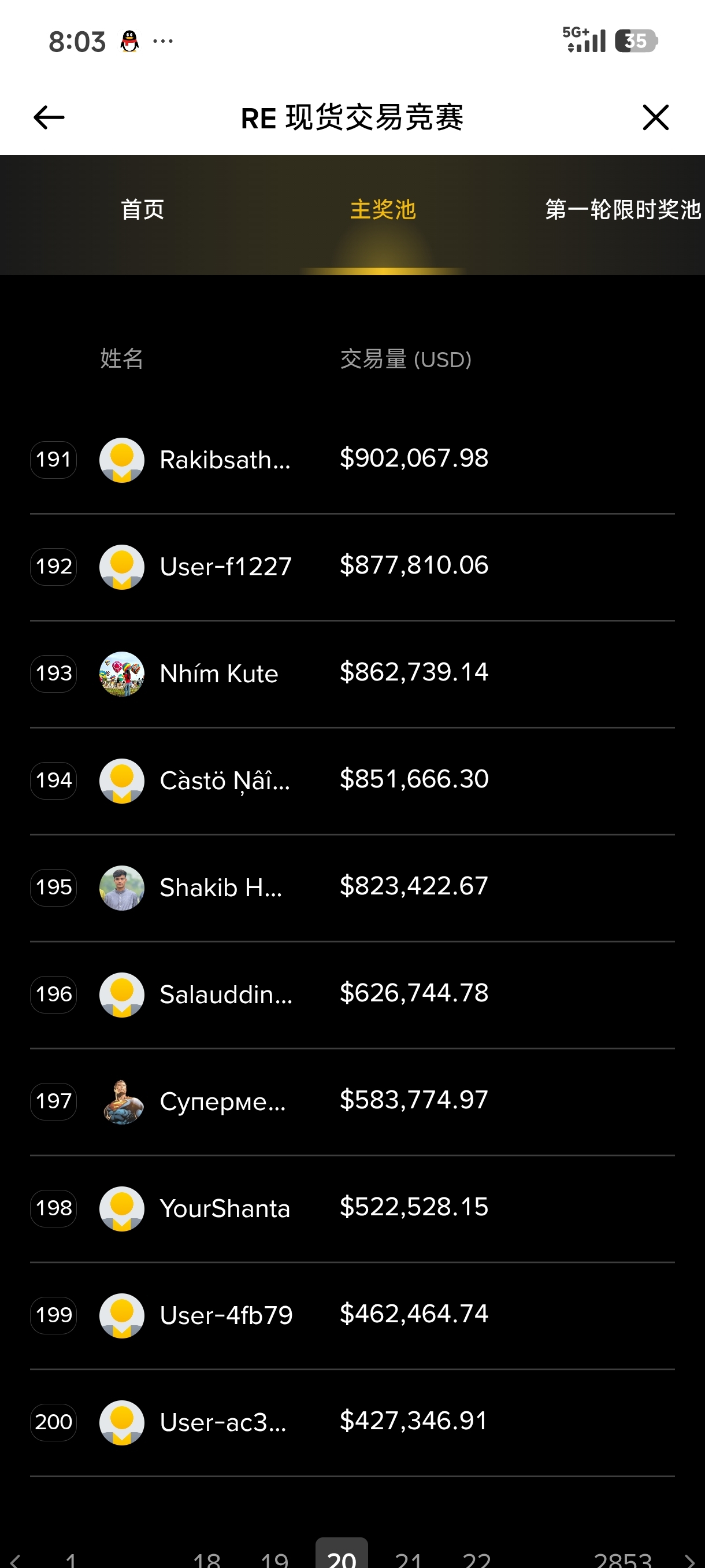
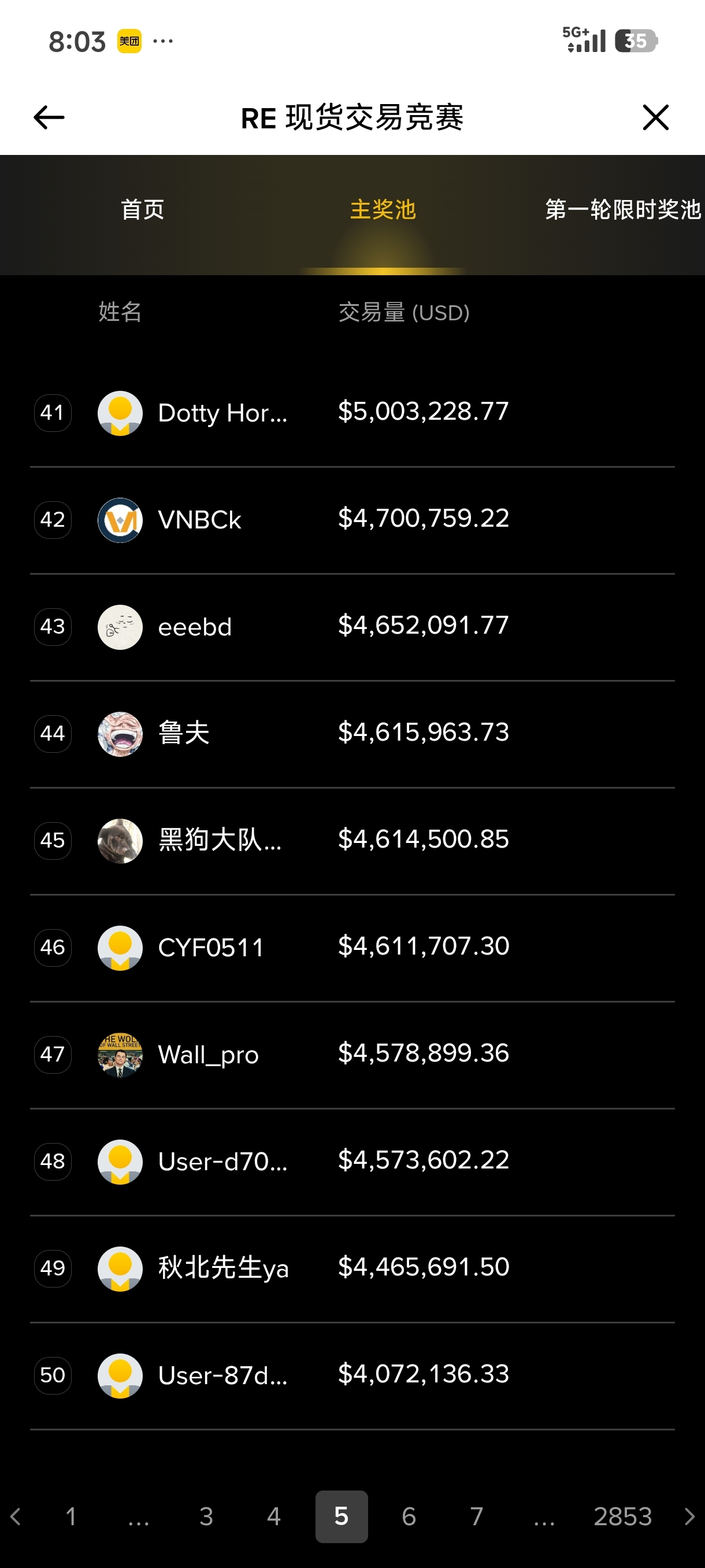
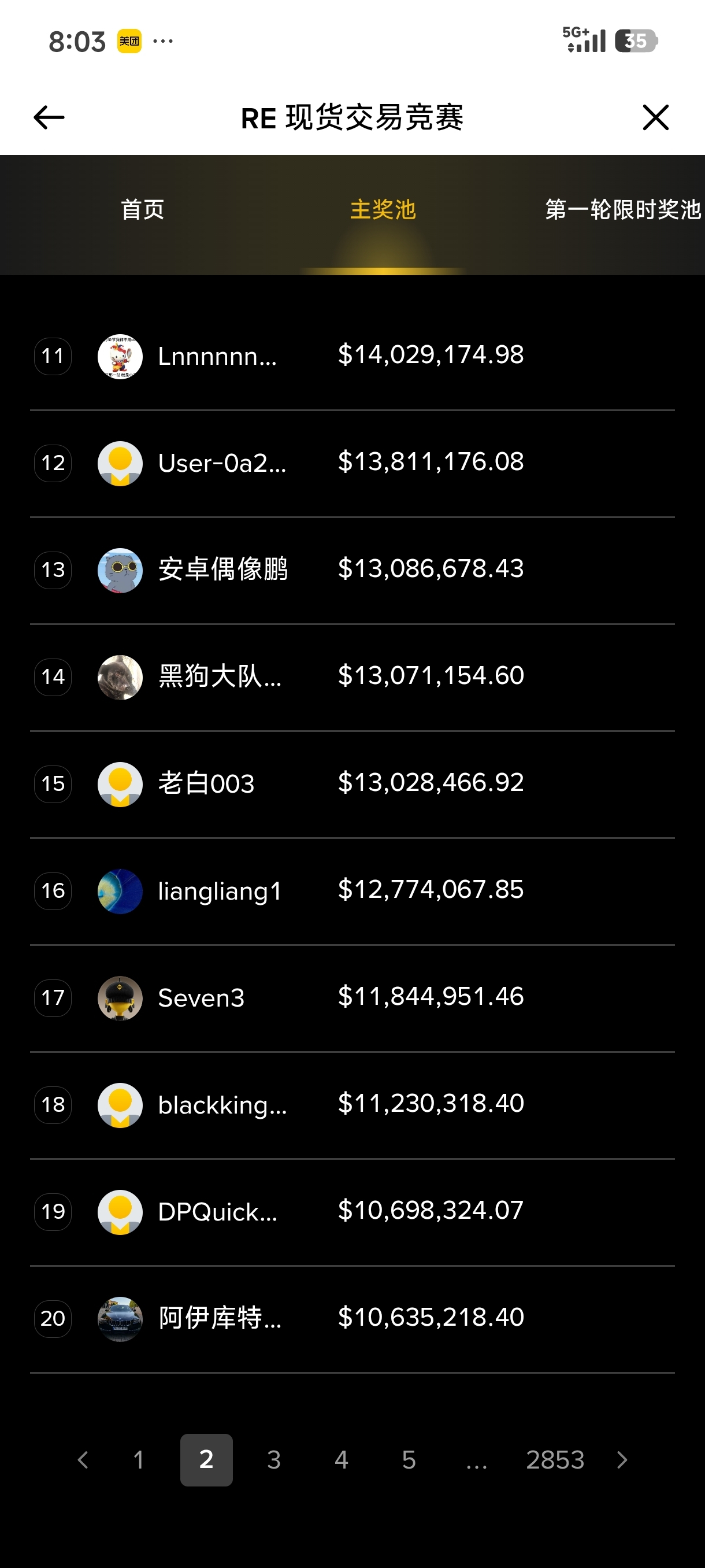
The spot market ended for $RE . The top two hundred picked up ten bargains, and my boys got a few hundred USDT in profit 😂😂😂😂 The first thousand didn’t even bother competing—turns out the瓜分 (division) part was the real chaos. People who filled the division cap already ran off to the first thousand. In the end, the guy who did 100,000 couldn’t even claim enough rewards from the division.
Rank #20 reward 3,595 u, trading volume: 10,635,218
Rank #50 reward 1,798 u, trading volume: 4,072,136
Rank #200 reward 575 u, trading volume: 427,347
Rank #1,000 reward 94 u, trading volume: 108,968
Rank #1,001 and after
Every 10,000 trading volume / reward 7 u Total trading volume: 151,827,340 Trading volume needed to hit the cap: 113,871
#ALPHA
The spot market ended for $RE . The top two hundred picked up ten bargains, and my boys got a few hundred USDT in profit 😂😂😂😂 The first thousand didn’t even bother competing—turns out the瓜分 (division) part was the real chaos. People who filled the division cap already ran off to the first thousand. In the end, the guy who did 100,000 couldn’t even claim enough rewards from the division.
Rank #20 reward 3,595 u, trading volume: 10,635,218
Rank #50 reward 1,798 u, trading volume: 4,072,136
Rank #200 reward 575 u, trading volume: 427,347
Rank #1,000 reward 94 u, trading volume: 108,968
Rank #1,001 and after
Every 10,000 trading volume / reward 7 u Total trading volume: 151,827,340 Trading volume needed to hit the cap: 113,871
#ALPHA
Rank #20 reward 3,595 u, trading volume: 10,635,218
Rank #50 reward 1,798 u, trading volume: 4,072,136
Rank #200 reward 575 u, trading volume: 427,347
Rank #1,000 reward 94 u, trading volume: 108,968
Rank #1,001 and after
Every 10,000 trading volume / reward 7 u Total trading volume: 151,827,340 Trading volume needed to hit the cap: 113,871
#ALPHA
3
314
·
--
I took apart the privacy architecture of @Dusk_Foundation and found several issues covered up by the “compliant privacy L1” narrative.
First layer: two tracks, two different costs—$DUSK mainnets running Moonlight (transparent) and Phoenix (private) at the same time. Moonlight offers a standard EVM experience; but Phoenix requires the client to generate a zk-SNARK proof for every single transaction. Wallet-core supports offloading proof generation to an external Prover—this design alone shows local devices can’t handle the computational pressure of high-frequency circuits.
Second layer: KYC is a gatekeeping prerequisite
The Citadel licensing model used for RWA requires completing KYC first. That’s fine, but it locks the current mainnet traffic into the “institutional, small-batch, high-value settlement” range. The stability you see is the result of low-concurrency scenarios.
Third layer: constraints distort verification
Phoenix’s share of transactions isn’t high right now, so the proof workload is limited. The system is stable in a controlled environment, but that doesn’t mean client compute power, Prover queue throughput, and verifier capacity can maintain efficiency after retail scales to mass concurrency. The mainnet can prove that “privacy is feasible,” but it can’t prove that “privacy can handle volume.”
Fourth layer: users may get stuck at the very last step
After users complete KYC, lock their assets, and initiate a Phoenix transaction, the transaction can’t go through if local compute power is insufficient or if the Prover queue is congested at the final moment. If DUSK wants to bring retail private DeFi online, Prover scaling and failure feedback can’t be limited to technical updates alone.
My take
I won’t use ZK costs or KYC to dismiss #dusk . Privacy L1 and unpermissioned chains are simply two different paths. But “can the process run” and “can it handle volume” are two different things. Once Phoenix’s share rises, the Prover network matures, and optimizations for complex contract circuit design are in place, then we can observe failure rates, proof times, and the smoothness of cross-model conversions—only then will we know whether it’s “private that runs” or “privacy that can handle volume.”
I took apart the privacy architecture of @Dusk and found several issues covered up by the “compliant privacy L1” narrative.
First layer: two tracks, two different costs—$DUSK mainnets running Moonlight (transparent) and Phoenix (private) at the same time. Moonlight offers a standard EVM experience; but Phoenix requires the client to generate a zk-SNARK proof for every single transaction. Wallet-core supports offloading proof generation to an external Prover—this design alone shows local devices can’t handle the computational pressure of high-frequency circuits.
Second layer: KYC is a gatekeeping prerequisite
The Citadel licensing model used for RWA requires completing KYC first. That’s fine, but it locks the current mainnet traffic into the “institutional, small-batch, high-value settlement” range. The stability you see is the result of low-concurrency scenarios.
Third layer: constraints distort verification
Phoenix’s share of transactions isn’t high right now, so the proof workload is limited. The system is stable in a controlled environment, but that doesn’t mean client compute power, Prover queue throughput, and verifier capacity can maintain efficiency after retail scales to mass concurrency. The mainnet can prove that “privacy is feasible,” but it can’t prove that “privacy can handle volume.”
Fourth layer: users may get stuck at the very last step
After users complete KYC, lock their assets, and initiate a Phoenix transaction, the transaction can’t go through if local compute power is insufficient or if the Prover queue is congested at the final moment. If DUSK wants to bring retail private DeFi online, Prover scaling and failure feedback can’t be limited to technical updates alone.
My take
I won’t use ZK costs or KYC to dismiss #dusk . Privacy L1 and unpermissioned chains are simply two different paths. But “can the process run” and “can it handle volume” are two different things. Once Phoenix’s share rises, the Prover network matures, and optimizations for complex contract circuit design are in place, then we can observe failure rates, proof times, and the smoothness of cross-model conversions—only then will we know whether it’s “private that runs” or “privacy that can handle volume.”
First layer: two tracks, two different costs—$DUSK mainnets running Moonlight (transparent) and Phoenix (private) at the same time. Moonlight offers a standard EVM experience; but Phoenix requires the client to generate a zk-SNARK proof for every single transaction. Wallet-core supports offloading proof generation to an external Prover—this design alone shows local devices can’t handle the computational pressure of high-frequency circuits.
Second layer: KYC is a gatekeeping prerequisite
The Citadel licensing model used for RWA requires completing KYC first. That’s fine, but it locks the current mainnet traffic into the “institutional, small-batch, high-value settlement” range. The stability you see is the result of low-concurrency scenarios.
Third layer: constraints distort verification
Phoenix’s share of transactions isn’t high right now, so the proof workload is limited. The system is stable in a controlled environment, but that doesn’t mean client compute power, Prover queue throughput, and verifier capacity can maintain efficiency after retail scales to mass concurrency. The mainnet can prove that “privacy is feasible,” but it can’t prove that “privacy can handle volume.”
Fourth layer: users may get stuck at the very last step
After users complete KYC, lock their assets, and initiate a Phoenix transaction, the transaction can’t go through if local compute power is insufficient or if the Prover queue is congested at the final moment. If DUSK wants to bring retail private DeFi online, Prover scaling and failure feedback can’t be limited to technical updates alone.
My take
I won’t use ZK costs or KYC to dismiss #dusk . Privacy L1 and unpermissioned chains are simply two different paths. But “can the process run” and “can it handle volume” are two different things. Once Phoenix’s share rises, the Prover network matures, and optimizations for complex contract circuit design are in place, then we can observe failure rates, proof times, and the smoothness of cross-model conversions—only then will we know whether it’s “private that runs” or “privacy that can handle volume.”
503
·
--
#ALPHA daily report
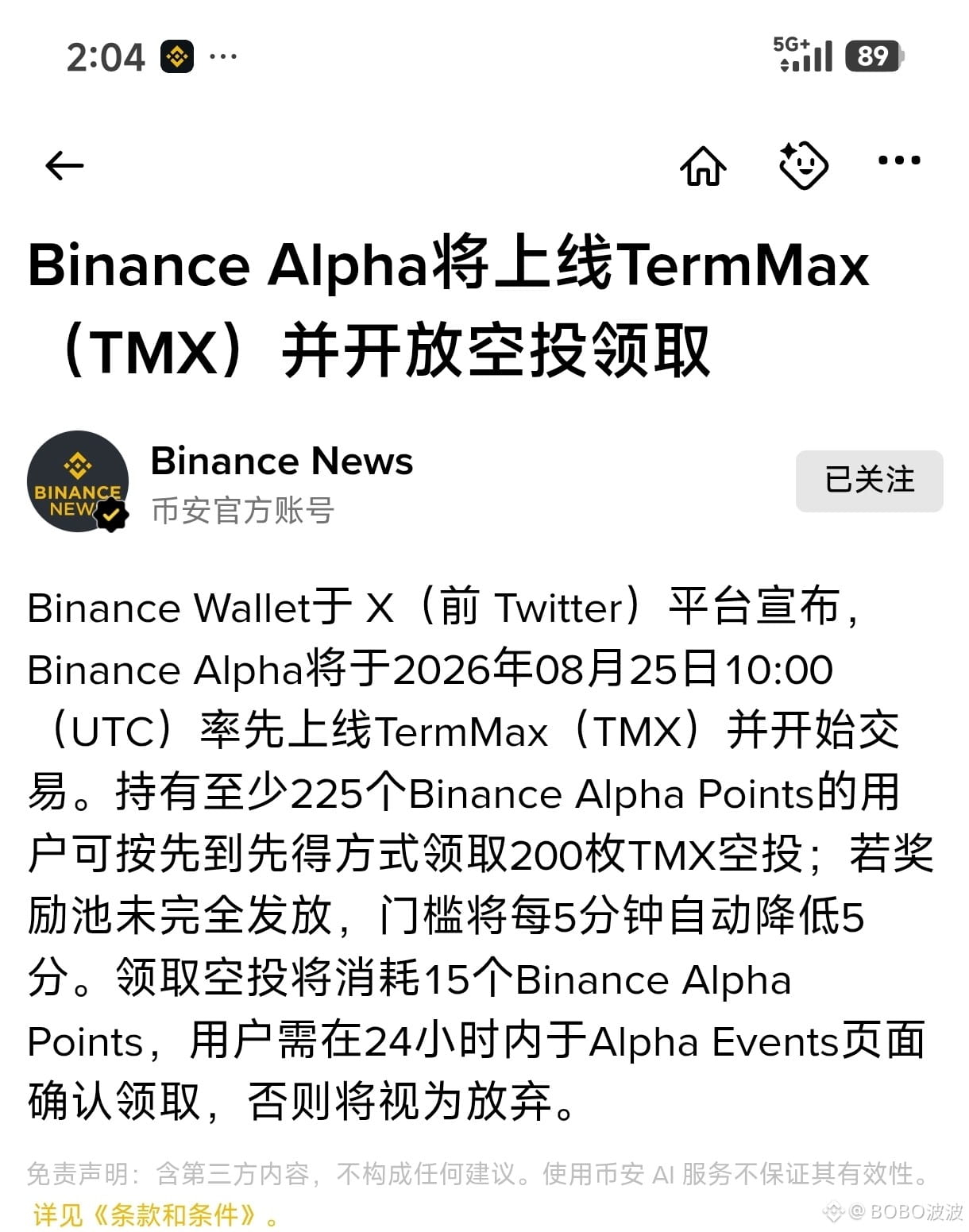
1️⃣ After days, finally two new coins arrived. The new coin this afternoon, TMX, has a threshold of 225 points. Total supply: 50,000. Time: 18:00
Tomorrow there will be another new coin—so you can eat two new coins in a row.
2️⃣ Trading competition
Competition ending today: kii
The threshold today for $DOS is 87664
$KII today’s threshold is 489.24
$KGEN today’s threshold is 177285.1
For farming points, I still recommend farming 6.6w: $GRVT
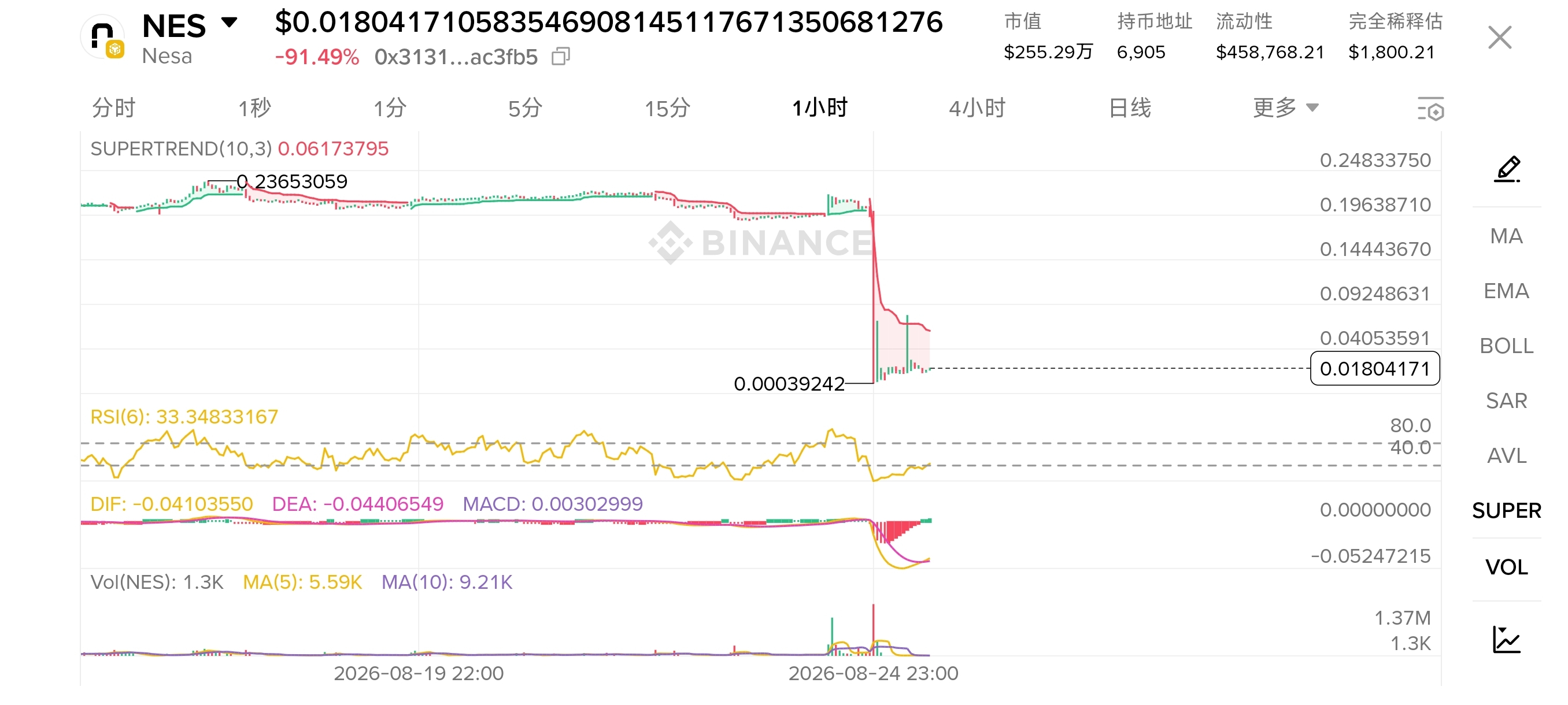
3️⃣ $NES The buy has been smashed 99%. The bottom rebound has already gone up 30x. When I saw it, I bought in and took profit after it reached 3x. Now you can only buy and not sell. Luckily I got out fast.
#ALPHA daily report
1️⃣ After days, finally two new coins arrived. The new coin this afternoon, TMX, has a threshold of 225 points. Total supply: 50,000. Time: 18:00
Tomorrow there will be another new coin—so you can eat two new coins in a row.
2️⃣ Trading competition
Competition ending today: kii
The threshold today for $DOS is 87664
$KII today’s threshold is 489.24
$KGEN today’s threshold is 177285.1
For farming points, I still recommend farming 6.6w: $GRVT
3️⃣ $NES The buy has been smashed 99%. The bottom rebound has already gone up 30x. When I saw it, I bought in and took profit after it reached 3x. Now you can only buy and not sell. Luckily I got out fast.
1️⃣ After days, finally two new coins arrived. The new coin this afternoon, TMX, has a threshold of 225 points. Total supply: 50,000. Time: 18:00
Tomorrow there will be another new coin—so you can eat two new coins in a row.
2️⃣ Trading competition
Competition ending today: kii
The threshold today for $DOS is 87664
$KII today’s threshold is 489.24
$KGEN today’s threshold is 177285.1
For farming points, I still recommend farming 6.6w: $GRVT
3️⃣ $NES The buy has been smashed 99%. The bottom rebound has already gone up 30x. When I saw it, I bought in and took profit after it reached 3x. Now you can only buy and not sell. Luckily I got out fast.
3
3
2.2k
·
--
I stared at the documentation for two hours and finally figured out the Dusk staking logic. What I thought beforehand was too straightforward—turns out there’s a privacy wall in the middle.
@Dusk_Foundation
Most people’s default assumption: since DUSK is a privacy chain, staking rewards should be the same for everyone. After all, on any PoS chain these days, you just delegate in your wallet and you’re done.
But once you break it down, it’s completely different.
$DUSK Native staking is called provisioner. The threshold is 1000 DUSK, but the hard requirement is a 24/7 online node—2 cores, 4GB RAM, Ubuntu 24.04, with the 9000/udp port left open. Ordinary users basically can’t go this route; they can only use third-party staking pools like Sozu.
However, Sozu’s contract is built on Moonlight’s public account. For the Phoenix privacy address #dusk , the contract can’t read the balance, and it can’t sign public transactions. The documentation draws the boundary very strictly: shielded funding is not offered.
In plain language: if you want privacy coins to “just lie there and earn yield,” you can’t get any staking rewards. If you want to earn interest, you have to exit Phoenix first, go back to Moonlight’s transparent ledger, complete the public contract interaction, and then you can enter the pool.
This isn’t a “privacy option.” It’s “privacy and functionality: choose one.” The two tracks run in parallel, with no transfer station. If you hide some DUSK in Phoenix today and tomorrow you want to move it to a lending protocol—sorry, there’s no direct channel. You must expose it first, then restructure it.
It’s nothing like the experience of traditional privacy coins where you can just flip a button between transparent and shielded. More like two bank cards: money in the black card (privacy) can never directly buy investments—you have to move it to a debit card (public) to do anything, and the transfer records are visible to the whole network.
My current plan is to treat DUSK as two separate assets. The public holdings go to Sozu for testing the staking yield; the private holdings are just for configuration—I don’t expect them to earn interest at the same time. Once the DeFi apps on DuskEVM come in, will privacy balances also need to “bridge” to the public layer before they can participate?
I stared at the documentation for two hours and finally figured out the Dusk staking logic. What I thought beforehand was too straightforward—turns out there’s a privacy wall in the middle.
@Dusk
Most people’s default assumption: since DUSK is a privacy chain, staking rewards should be the same for everyone. After all, on any PoS chain these days, you just delegate in your wallet and you’re done.
But once you break it down, it’s completely different.
$DUSK Native staking is called provisioner. The threshold is 1000 DUSK, but the hard requirement is a 24/7 online node—2 cores, 4GB RAM, Ubuntu 24.04, with the 9000/udp port left open. Ordinary users basically can’t go this route; they can only use third-party staking pools like Sozu.
However, Sozu’s contract is built on Moonlight’s public account. For the Phoenix privacy address #dusk , the contract can’t read the balance, and it can’t sign public transactions. The documentation draws the boundary very strictly: shielded funding is not offered.
In plain language: if you want privacy coins to “just lie there and earn yield,” you can’t get any staking rewards. If you want to earn interest, you have to exit Phoenix first, go back to Moonlight’s transparent ledger, complete the public contract interaction, and then you can enter the pool.
This isn’t a “privacy option.” It’s “privacy and functionality: choose one.” The two tracks run in parallel, with no transfer station. If you hide some DUSK in Phoenix today and tomorrow you want to move it to a lending protocol—sorry, there’s no direct channel. You must expose it first, then restructure it.
It’s nothing like the experience of traditional privacy coins where you can just flip a button between transparent and shielded. More like two bank cards: money in the black card (privacy) can never directly buy investments—you have to move it to a debit card (public) to do anything, and the transfer records are visible to the whole network.
My current plan is to treat DUSK as two separate assets. The public holdings go to Sozu for testing the staking yield; the private holdings are just for configuration—I don’t expect them to earn interest at the same time. Once the DeFi apps on DuskEVM come in, will privacy balances also need to “bridge” to the public layer before they can participate?
@Dusk
Most people’s default assumption: since DUSK is a privacy chain, staking rewards should be the same for everyone. After all, on any PoS chain these days, you just delegate in your wallet and you’re done.
But once you break it down, it’s completely different.
$DUSK Native staking is called provisioner. The threshold is 1000 DUSK, but the hard requirement is a 24/7 online node—2 cores, 4GB RAM, Ubuntu 24.04, with the 9000/udp port left open. Ordinary users basically can’t go this route; they can only use third-party staking pools like Sozu.
However, Sozu’s contract is built on Moonlight’s public account. For the Phoenix privacy address #dusk , the contract can’t read the balance, and it can’t sign public transactions. The documentation draws the boundary very strictly: shielded funding is not offered.
In plain language: if you want privacy coins to “just lie there and earn yield,” you can’t get any staking rewards. If you want to earn interest, you have to exit Phoenix first, go back to Moonlight’s transparent ledger, complete the public contract interaction, and then you can enter the pool.
This isn’t a “privacy option.” It’s “privacy and functionality: choose one.” The two tracks run in parallel, with no transfer station. If you hide some DUSK in Phoenix today and tomorrow you want to move it to a lending protocol—sorry, there’s no direct channel. You must expose it first, then restructure it.
It’s nothing like the experience of traditional privacy coins where you can just flip a button between transparent and shielded. More like two bank cards: money in the black card (privacy) can never directly buy investments—you have to move it to a debit card (public) to do anything, and the transfer records are visible to the whole network.
My current plan is to treat DUSK as two separate assets. The public holdings go to Sozu for testing the staking yield; the private holdings are just for configuration—I don’t expect them to earn interest at the same time. Once the DeFi apps on DuskEVM come in, will privacy balances also need to “bridge” to the public layer before they can participate?
489
·
--
Verified
$DUSK tells a near-universal L1-tale to envy—EU compliance, institutional RWA, and auditable privacy. NPEX holds €200–300M in securities, Quantoz’s EURQ is integrated, and MiCA and MiFID II are aligned. But DUSK’s price is 0.13, and its market cap is just enough for 100 million—down nearly 90% from the peak. The issue isn’t that the story isn’t big enough; it’s that there’s no quantifiable cash-flow bridge between the narrative and the token.
The supply side is “honest,” and also brutal. Circulating supply is roughly 500 million tokens; the hard cap is 1 billion; the remaining 500 million are released over 36 years using a geometric decay model, cutting in half every 4 years. The inflation pressure facing the market isn’t “how much gets unlocked next month,” but “for decades, staking rewards will keep diluting holders’ share.” Currently, more than 200 million tokens are staked, with an APY around 12%—but block producers take over 70% and the development fund takes another 10%. What stakers receive, in essence, is the accounting gain from newly issued coins.
Early allocations are freely circulating. Of the 500 million tokens from the 2018 ICO: 50% went to private placement, 6.4% to the team, 6.4% to advisors, and all vesting finished before April 2022. The market is facing a base of fully circulating supply plus 36 years of sustained inflation. To make price respond to the narrative, you need harder demand-side data.
@Dusk_Foundation ’s technology is indeed unique. Phoenix + Moonlight uses two models to split privacy and transparency—allowing institutions to maintain confidential settlement while still meeting regulatory requirements. But technology and tokenomics are two different things. As long as on-chain fees can’t cover staking rewards, DUSK’s valuation will remain at “discounted expectations,” not “discounted cash flows.”
I don’t want an MOU from the next exchange. I want three sets of on-chain numbers: how many trades NPEX’s securities actually settled over the past year, how many fees were generated, and how many were burned or flowed back to stakers; whether Dusk Pay’s transaction volume can drive #dusk into net deflation; and whether any third party is willing to keep paying for DuskEVM on an ongoing basis.
Before that, the €200–300M RWA scale and the MiCA compliance labels are more like a milestone checklist than an income statement. Narrative sets the ceiling; cash flow sets the floor.
$DUSK tells a near-universal L1-tale to envy—EU compliance, institutional RWA, and auditable privacy. NPEX holds €200–300M in securities, Quantoz’s EURQ is integrated, and MiCA and MiFID II are aligned. But DUSK’s price is 0.13, and its market cap is just enough for 100 million—down nearly 90% from the peak. The issue isn’t that the story isn’t big enough; it’s that there’s no quantifiable cash-flow bridge between the narrative and the token.
The supply side is “honest,” and also brutal. Circulating supply is roughly 500 million tokens; the hard cap is 1 billion; the remaining 500 million are released over 36 years using a geometric decay model, cutting in half every 4 years. The inflation pressure facing the market isn’t “how much gets unlocked next month,” but “for decades, staking rewards will keep diluting holders’ share.” Currently, more than 200 million tokens are staked, with an APY around 12%—but block producers take over 70% and the development fund takes another 10%. What stakers receive, in essence, is the accounting gain from newly issued coins.
Early allocations are freely circulating. Of the 500 million tokens from the 2018 ICO: 50% went to private placement, 6.4% to the team, 6.4% to advisors, and all vesting finished before April 2022. The market is facing a base of fully circulating supply plus 36 years of sustained inflation. To make price respond to the narrative, you need harder demand-side data.
@Dusk ’s technology is indeed unique. Phoenix + Moonlight uses two models to split privacy and transparency—allowing institutions to maintain confidential settlement while still meeting regulatory requirements. But technology and tokenomics are two different things. As long as on-chain fees can’t cover staking rewards, DUSK’s valuation will remain at “discounted expectations,” not “discounted cash flows.”
I don’t want an MOU from the next exchange. I want three sets of on-chain numbers: how many trades NPEX’s securities actually settled over the past year, how many fees were generated, and how many were burned or flowed back to stakers; whether Dusk Pay’s transaction volume can drive #dusk into net deflation; and whether any third party is willing to keep paying for DuskEVM on an ongoing basis.
Before that, the €200–300M RWA scale and the MiCA compliance labels are more like a milestone checklist than an income statement. Narrative sets the ceiling; cash flow sets the floor.
The supply side is “honest,” and also brutal. Circulating supply is roughly 500 million tokens; the hard cap is 1 billion; the remaining 500 million are released over 36 years using a geometric decay model, cutting in half every 4 years. The inflation pressure facing the market isn’t “how much gets unlocked next month,” but “for decades, staking rewards will keep diluting holders’ share.” Currently, more than 200 million tokens are staked, with an APY around 12%—but block producers take over 70% and the development fund takes another 10%. What stakers receive, in essence, is the accounting gain from newly issued coins.
Early allocations are freely circulating. Of the 500 million tokens from the 2018 ICO: 50% went to private placement, 6.4% to the team, 6.4% to advisors, and all vesting finished before April 2022. The market is facing a base of fully circulating supply plus 36 years of sustained inflation. To make price respond to the narrative, you need harder demand-side data.
@Dusk ’s technology is indeed unique. Phoenix + Moonlight uses two models to split privacy and transparency—allowing institutions to maintain confidential settlement while still meeting regulatory requirements. But technology and tokenomics are two different things. As long as on-chain fees can’t cover staking rewards, DUSK’s valuation will remain at “discounted expectations,” not “discounted cash flows.”
I don’t want an MOU from the next exchange. I want three sets of on-chain numbers: how many trades NPEX’s securities actually settled over the past year, how many fees were generated, and how many were burned or flowed back to stakers; whether Dusk Pay’s transaction volume can drive #dusk into net deflation; and whether any third party is willing to keep paying for DuskEVM on an ongoing basis.
Before that, the €200–300M RWA scale and the MiCA compliance labels are more like a milestone checklist than an income statement. Narrative sets the ceiling; cash flow sets the floor.
1
597
·
--
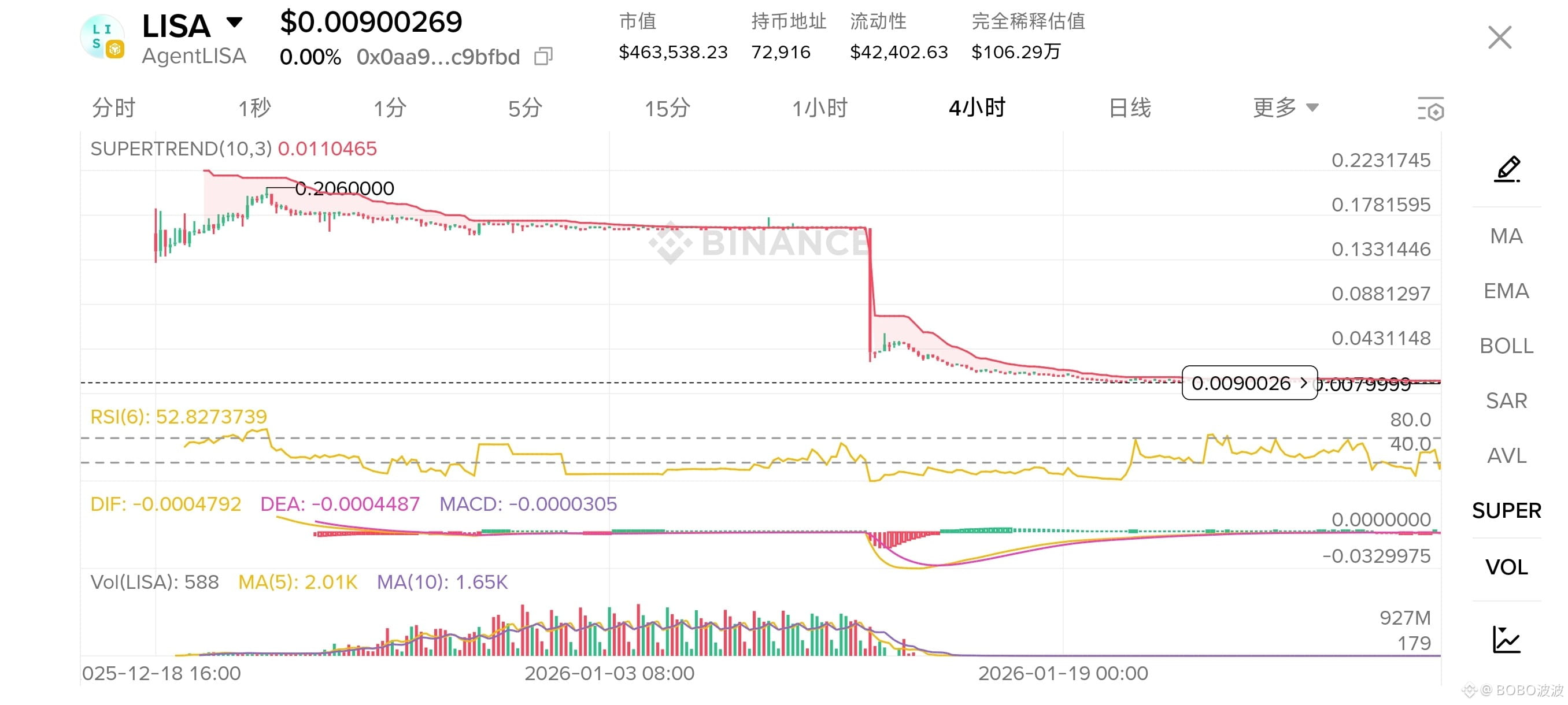
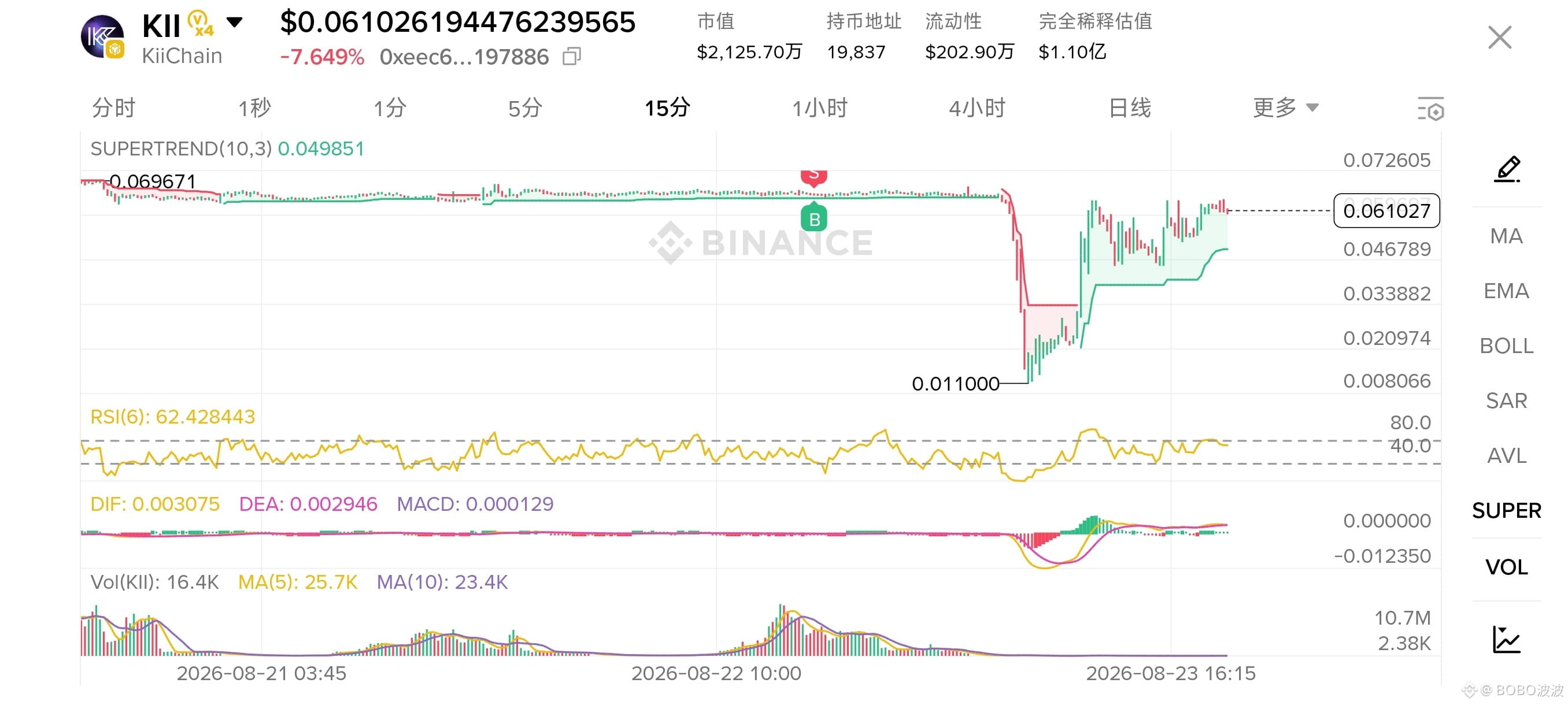
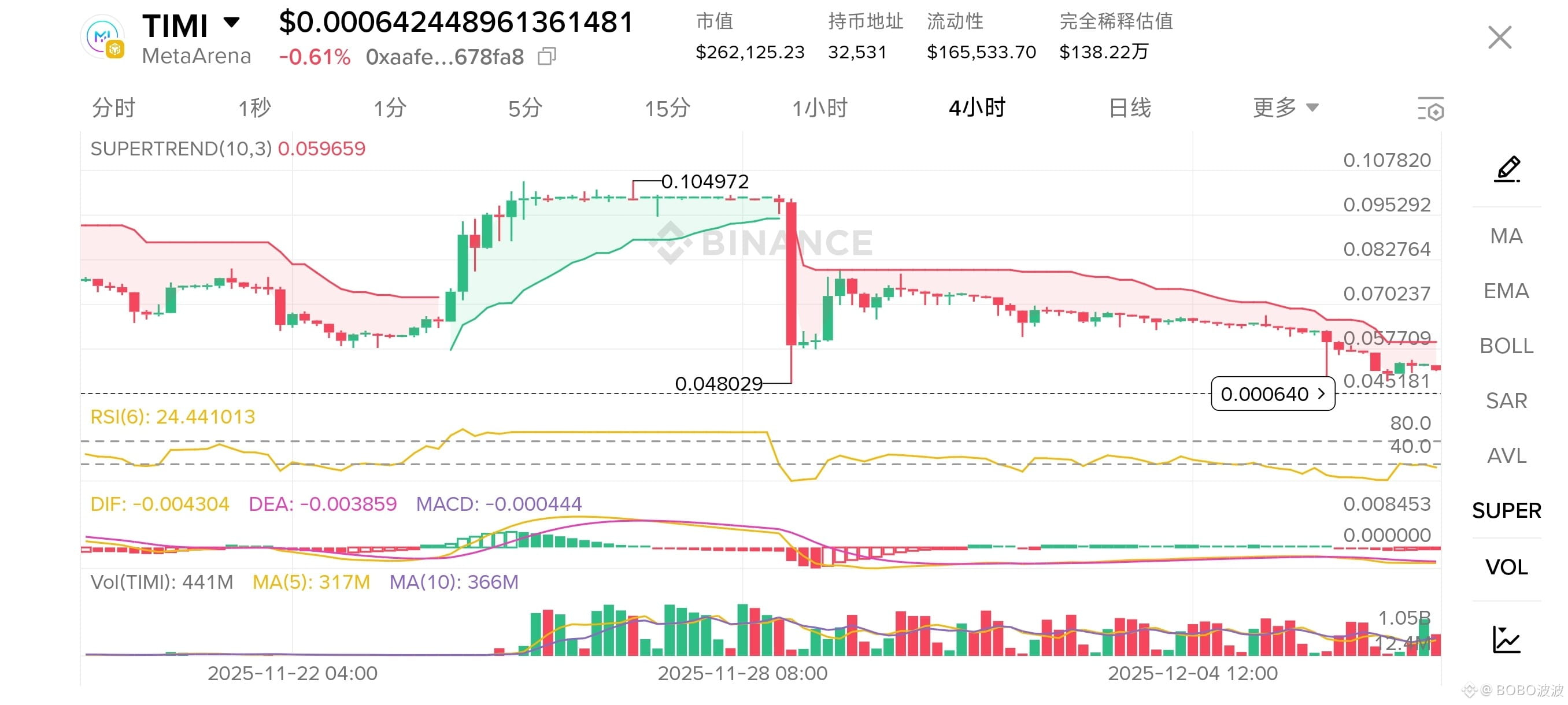
$KII dropped by 80% today, and then got pumped back up. That’s just absurd. Luckily it wasn’t grvt that dropped by 80%, otherwise the #ALPHA farmers would all be crying and panicking. Most farmers don’t even realize the risks of farming these on-chain tokens, and don’t know that the project team can dump endlessly.
$TIMI $LISA These two tokens are also used to fleece point-farming players. You think you’re here to farm, but actually you’re the one getting farmed.
$KII dropped by 80% today, and then got pumped back up. That’s just absurd. Luckily it wasn’t grvt that dropped by 80%, otherwise the #ALPHA farmers would all be crying and panicking. Most farmers don’t even realize the risks of farming these on-chain tokens, and don’t know that the project team can dump endlessly.
$TIMI $LISA These two tokens are also used to fleece point-farming players. You think you’re here to farm, but actually you’re the one getting farmed.
$TIMI $LISA These two tokens are also used to fleece point-farming players. You think you’re here to farm, but actually you’re the one getting farmed.
3
1.4k
·
--
"Privacy" is discussed too much that it gets muddied instead. Everyone assumes it equals "anonymity". Recently I swapped it for another term and reread it— a compliant cost structure.
From the perspective of @Dusk_Foundation , what changes isn’t whether there is regulation, but what form the compliance costs take. The compliance risk of traditional privacy coins (XMR/ZEC) is a single-point disaster: once regulators classify it, all holders are simultaneously faced with delisting and account freezes. That’s an atomic bomb. The #dusk model is a distributed, small-amount type: Moonlight accounts are selectively transparent as needed, Phoenix transactions are selectively shielded as needed, and issuers independently configure ZKC compliance rules. Each event only impacts locally. With selective disclosure and on-chain auditing paths, it can be corrected. This is countless small firecrackers, not an atomic bomb.
This difference matters differently to people with different capital sizes. Small users fear the "atomic bomb"—one policy shift can put them out. Large funds fear the "small firecrackers"—even if the probability is low, compliance reviews and auditing friction accumulated at high frequency will keep eating up operating costs. The significance of running €200M+ securities issuance on NPEX on the mainnet is precisely here: it doesn’t validate whether "Dusk can hide data"; it validates whether Dusk’s compliance cost distribution falls within a range that institutions can accept.
So my way of judging the maturity of $DUSK has changed too. I don’t ask, "Is it privacy?" I ask: how large are the grains of compliance cost that it spreads, what is the correction cost for each grain, and whether the correction mechanisms have actually been tested against real issuance data. The part where the game-theoretic costs of roles like DUSK staking nodes, validators, and compliance oracles are written into protocol parameters—that’s where the true cost shape of this "Privacy-First Regulated Finance" structure shows up. The path to learn fewer lessons isn’t to trust slogans; it’s to see the granularity of compliance.
"Privacy" is discussed too much that it gets muddied instead. Everyone assumes it equals "anonymity". Recently I swapped it for another term and reread it— a compliant cost structure.
From the perspective of @Dusk , what changes isn’t whether there is regulation, but what form the compliance costs take. The compliance risk of traditional privacy coins (XMR/ZEC) is a single-point disaster: once regulators classify it, all holders are simultaneously faced with delisting and account freezes. That’s an atomic bomb. The #dusk model is a distributed, small-amount type: Moonlight accounts are selectively transparent as needed, Phoenix transactions are selectively shielded as needed, and issuers independently configure ZKC compliance rules. Each event only impacts locally. With selective disclosure and on-chain auditing paths, it can be corrected. This is countless small firecrackers, not an atomic bomb.
This difference matters differently to people with different capital sizes. Small users fear the "atomic bomb"—one policy shift can put them out. Large funds fear the "small firecrackers"—even if the probability is low, compliance reviews and auditing friction accumulated at high frequency will keep eating up operating costs. The significance of running €200M+ securities issuance on NPEX on the mainnet is precisely here: it doesn’t validate whether "Dusk can hide data"; it validates whether Dusk’s compliance cost distribution falls within a range that institutions can accept.
So my way of judging the maturity of $DUSK has changed too. I don’t ask, "Is it privacy?" I ask: how large are the grains of compliance cost that it spreads, what is the correction cost for each grain, and whether the correction mechanisms have actually been tested against real issuance data. The part where the game-theoretic costs of roles like DUSK staking nodes, validators, and compliance oracles are written into protocol parameters—that’s where the true cost shape of this "Privacy-First Regulated Finance" structure shows up. The path to learn fewer lessons isn’t to trust slogans; it’s to see the granularity of compliance.
From the perspective of @Dusk , what changes isn’t whether there is regulation, but what form the compliance costs take. The compliance risk of traditional privacy coins (XMR/ZEC) is a single-point disaster: once regulators classify it, all holders are simultaneously faced with delisting and account freezes. That’s an atomic bomb. The #dusk model is a distributed, small-amount type: Moonlight accounts are selectively transparent as needed, Phoenix transactions are selectively shielded as needed, and issuers independently configure ZKC compliance rules. Each event only impacts locally. With selective disclosure and on-chain auditing paths, it can be corrected. This is countless small firecrackers, not an atomic bomb.
This difference matters differently to people with different capital sizes. Small users fear the "atomic bomb"—one policy shift can put them out. Large funds fear the "small firecrackers"—even if the probability is low, compliance reviews and auditing friction accumulated at high frequency will keep eating up operating costs. The significance of running €200M+ securities issuance on NPEX on the mainnet is precisely here: it doesn’t validate whether "Dusk can hide data"; it validates whether Dusk’s compliance cost distribution falls within a range that institutions can accept.
So my way of judging the maturity of $DUSK has changed too. I don’t ask, "Is it privacy?" I ask: how large are the grains of compliance cost that it spreads, what is the correction cost for each grain, and whether the correction mechanisms have actually been tested against real issuance data. The part where the game-theoretic costs of roles like DUSK staking nodes, validators, and compliance oracles are written into protocol parameters—that’s where the true cost shape of this "Privacy-First Regulated Finance" structure shows up. The path to learn fewer lessons isn’t to trust slogans; it’s to see the granularity of compliance.
308
·
--
Partly True
Recently I was scrolling on X and saw many people call $DUSK a “privacy chain with KYC.” After reading the SBA consensus paper, I realized that label is completely wrong.
At first, I thought the only difference between @Dusk_Foundation and anonymous coins was that it had an “extra layer of compliant interface.” But after looking at the technical stack, I understood the real difference lies in where privacy is constructed. Monero and Zcash add privacy on top of the chain, whereas #dusk essentially fuses the two from the consensus layer: SBA uses cryptographic sortition to separate block generation from verification, and blind auctions ensure that staked amounts are not visible on-chain. Verifiers don’t even know who produced a block, yet this does not compromise consensus security.
What truly changed my mind was the slashing logic. SBA’s slashing isn’t a matter of post-hoc audits and then fines; instead, it establishes finality at the protocol level via Succinct Attestation. After a block is committed, the rollback cost is cryptographically—i.e., in the mathematical sense—impossible.
So Dusk isn’t just putting a compliance shell onto a privacy coin; it’s an L1 redesigned from the ground up for regulated finance. Its goal is to allow exchanges to issue bonds on-chain while also meeting MiCA audit requirements.
What I’m most interested in observing is this: will regulators accept “cryptography equals compliance”? If regulators continue to insist on the traditional audit trail, Dusk could get stuck at the last mile. Engineering has proven it’s feasible, but whether the system will recognize mathematical proofs as equivalent to compliance evidence—that’s the real key.
Recently I was scrolling on X and saw many people call $DUSK a “privacy chain with KYC.” After reading the SBA consensus paper, I realized that label is completely wrong.
At first, I thought the only difference between @Dusk and anonymous coins was that it had an “extra layer of compliant interface.” But after looking at the technical stack, I understood the real difference lies in where privacy is constructed. Monero and Zcash add privacy on top of the chain, whereas #dusk essentially fuses the two from the consensus layer: SBA uses cryptographic sortition to separate block generation from verification, and blind auctions ensure that staked amounts are not visible on-chain. Verifiers don’t even know who produced a block, yet this does not compromise consensus security.
What truly changed my mind was the slashing logic. SBA’s slashing isn’t a matter of post-hoc audits and then fines; instead, it establishes finality at the protocol level via Succinct Attestation. After a block is committed, the rollback cost is cryptographically—i.e., in the mathematical sense—impossible.
So Dusk isn’t just putting a compliance shell onto a privacy coin; it’s an L1 redesigned from the ground up for regulated finance. Its goal is to allow exchanges to issue bonds on-chain while also meeting MiCA audit requirements.
What I’m most interested in observing is this: will regulators accept “cryptography equals compliance”? If regulators continue to insist on the traditional audit trail, Dusk could get stuck at the last mile. Engineering has proven it’s feasible, but whether the system will recognize mathematical proofs as equivalent to compliance evidence—that’s the real key.
At first, I thought the only difference between @Dusk and anonymous coins was that it had an “extra layer of compliant interface.” But after looking at the technical stack, I understood the real difference lies in where privacy is constructed. Monero and Zcash add privacy on top of the chain, whereas #dusk essentially fuses the two from the consensus layer: SBA uses cryptographic sortition to separate block generation from verification, and blind auctions ensure that staked amounts are not visible on-chain. Verifiers don’t even know who produced a block, yet this does not compromise consensus security.
What truly changed my mind was the slashing logic. SBA’s slashing isn’t a matter of post-hoc audits and then fines; instead, it establishes finality at the protocol level via Succinct Attestation. After a block is committed, the rollback cost is cryptographically—i.e., in the mathematical sense—impossible.
So Dusk isn’t just putting a compliance shell onto a privacy coin; it’s an L1 redesigned from the ground up for regulated finance. Its goal is to allow exchanges to issue bonds on-chain while also meeting MiCA audit requirements.
What I’m most interested in observing is this: will regulators accept “cryptography equals compliance”? If regulators continue to insist on the traditional audit trail, Dusk could get stuck at the last mile. Engineering has proven it’s feasible, but whether the system will recognize mathematical proofs as equivalent to compliance evidence—that’s the real key.
1
764
·
--
Honestly, I’ve borrowed and lent in DeFi. What I dislike most isn’t the high interest rate—it’s uncertainty. On Aave, yesterday it was 5%, and after you sleep it becomes 2%. This kind of “floating” mechanism effectively dumps all the risk onto users. What #TermMax is doing is to nail the interest rate down: before opening a position you sign for a rate, and at maturity you settle exactly according to that amount.
The direction itself is correct. FT, XT, and GT split borrowing and lending into tradable components, and the AMM logic can work.
But what I’m most worried about is physical delivery and liquidation clearance. In traditional DeFi, when a default happens, collateral is auctioned to get stablecoins, and the lender ends up with the most liquid assets. @termmax doesn’t take that route: when there’s a default, the lender directly collects the collateral itself in proportion. The official line is that it’s to support RWA, but when panic hits the market, the lender receives a bunch of tokens that can’t be sold. Can “fixed income” really hold up? Even more problematic is that liquidation is concentrated at the maturity date. Low-liquidity assets combined with physical settlement can easily turn into a chain-reaction stampede.
TMX tokens also have their own concerns. All protocol revenue goes into the Treasury, so holders only get staking and governance rights—the core cash flow and the token price are separated by a layer. On top of that, investors get 28% and the team gets 15% with a linear unlock after one year; if revenue hasn’t taken off by then, the sell pressure won’t be small.
The numbers are indeed impressive: TVL over 90 million+, 1.5 million wallets, and 10 chain deployments. The global fixed-income market is 100 trillion, while DeFi fixed-rate is under 20 billion—so the gap itself is part of the narrative.
But the real test for fixed-rate protocols comes in a bear market. In a bull market, everyone can make money. Only when the market swings violently and liquidations happen frequently will physical settlement and the three-token settlement model be truly tested. At that point, will TermMax be solid infrastructure—or just another clever yet fragile financial toy? The answer will be revealed then.
What do you think? Is fixed-rate truly a real need in DeFi, or is it “looks good on paper”?
Honestly, I’ve borrowed and lent in DeFi. What I dislike most isn’t the high interest rate—it’s uncertainty. On Aave, yesterday it was 5%, and after you sleep it becomes 2%. This kind of “floating” mechanism effectively dumps all the risk onto users. What #TermMax is doing is to nail the interest rate down: before opening a position you sign for a rate, and at maturity you settle exactly according to that amount.
The direction itself is correct. FT, XT, and GT split borrowing and lending into tradable components, and the AMM logic can work.
But what I’m most worried about is physical delivery and liquidation clearance. In traditional DeFi, when a default happens, collateral is auctioned to get stablecoins, and the lender ends up with the most liquid assets. @TermMax doesn’t take that route: when there’s a default, the lender directly collects the collateral itself in proportion. The official line is that it’s to support RWA, but when panic hits the market, the lender receives a bunch of tokens that can’t be sold. Can “fixed income” really hold up? Even more problematic is that liquidation is concentrated at the maturity date. Low-liquidity assets combined with physical settlement can easily turn into a chain-reaction stampede.
TMX tokens also have their own concerns. All protocol revenue goes into the Treasury, so holders only get staking and governance rights—the core cash flow and the token price are separated by a layer. On top of that, investors get 28% and the team gets 15% with a linear unlock after one year; if revenue hasn’t taken off by then, the sell pressure won’t be small.
The numbers are indeed impressive: TVL over 90 million+, 1.5 million wallets, and 10 chain deployments. The global fixed-income market is 100 trillion, while DeFi fixed-rate is under 20 billion—so the gap itself is part of the narrative.
But the real test for fixed-rate protocols comes in a bear market. In a bull market, everyone can make money. Only when the market swings violently and liquidations happen frequently will physical settlement and the three-token settlement model be truly tested. At that point, will TermMax be solid infrastructure—or just another clever yet fragile financial toy? The answer will be revealed then.
What do you think? Is fixed-rate truly a real need in DeFi, or is it “looks good on paper”?
The direction itself is correct. FT, XT, and GT split borrowing and lending into tradable components, and the AMM logic can work.
But what I’m most worried about is physical delivery and liquidation clearance. In traditional DeFi, when a default happens, collateral is auctioned to get stablecoins, and the lender ends up with the most liquid assets. @TermMax doesn’t take that route: when there’s a default, the lender directly collects the collateral itself in proportion. The official line is that it’s to support RWA, but when panic hits the market, the lender receives a bunch of tokens that can’t be sold. Can “fixed income” really hold up? Even more problematic is that liquidation is concentrated at the maturity date. Low-liquidity assets combined with physical settlement can easily turn into a chain-reaction stampede.
TMX tokens also have their own concerns. All protocol revenue goes into the Treasury, so holders only get staking and governance rights—the core cash flow and the token price are separated by a layer. On top of that, investors get 28% and the team gets 15% with a linear unlock after one year; if revenue hasn’t taken off by then, the sell pressure won’t be small.
The numbers are indeed impressive: TVL over 90 million+, 1.5 million wallets, and 10 chain deployments. The global fixed-income market is 100 trillion, while DeFi fixed-rate is under 20 billion—so the gap itself is part of the narrative.
But the real test for fixed-rate protocols comes in a bear market. In a bull market, everyone can make money. Only when the market swings violently and liquidations happen frequently will physical settlement and the three-token settlement model be truly tested. At that point, will TermMax be solid infrastructure—or just another clever yet fragile financial toy? The answer will be revealed then.
What do you think? Is fixed-rate truly a real need in DeFi, or is it “looks good on paper”?
422
·
--
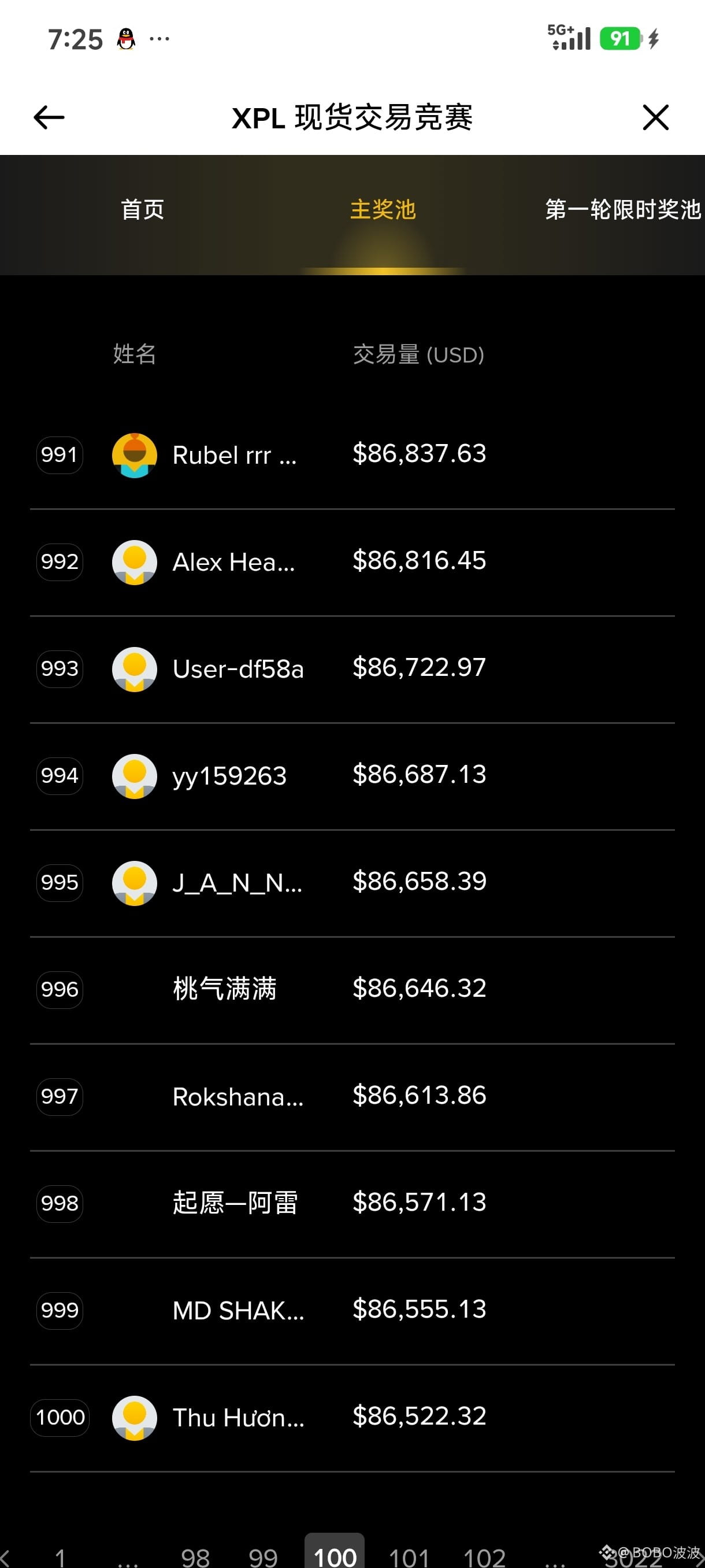
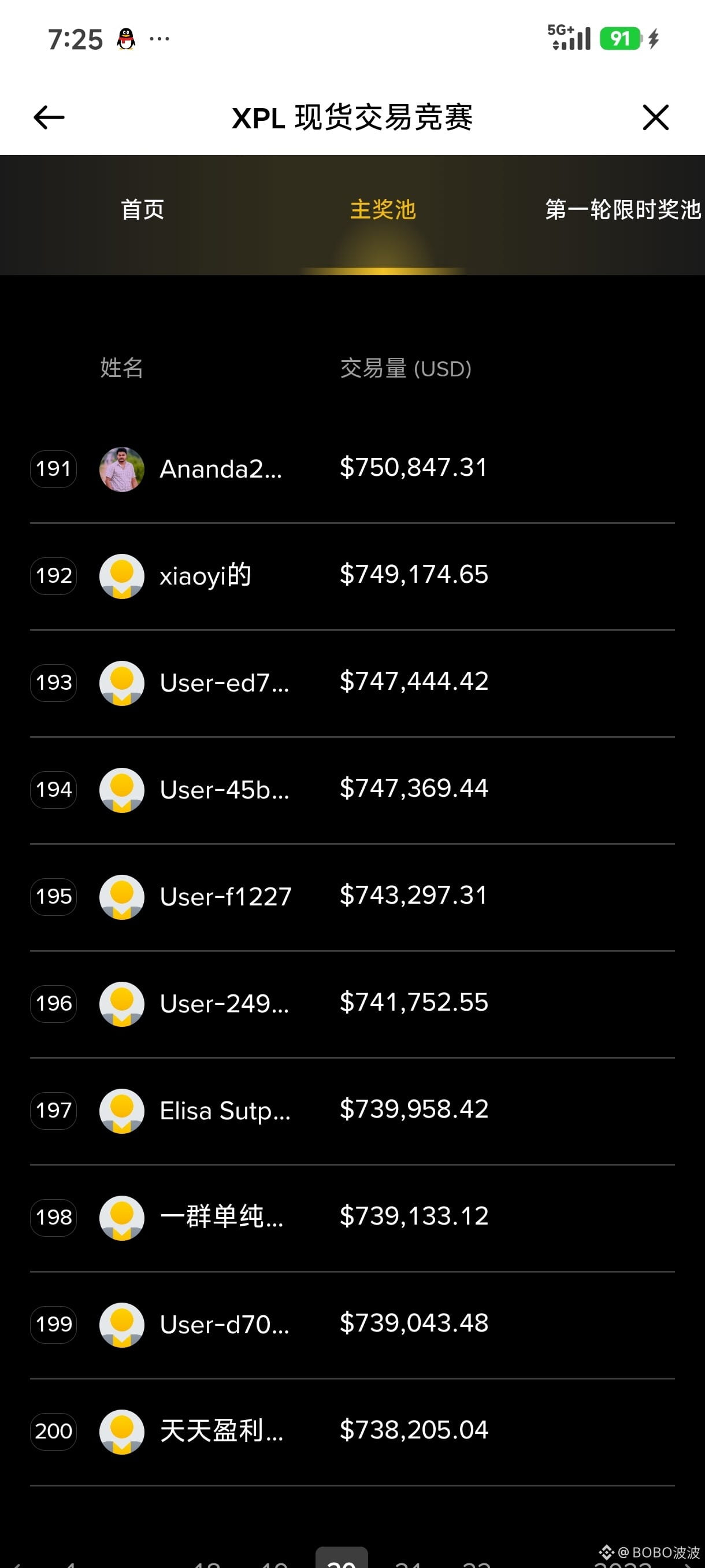
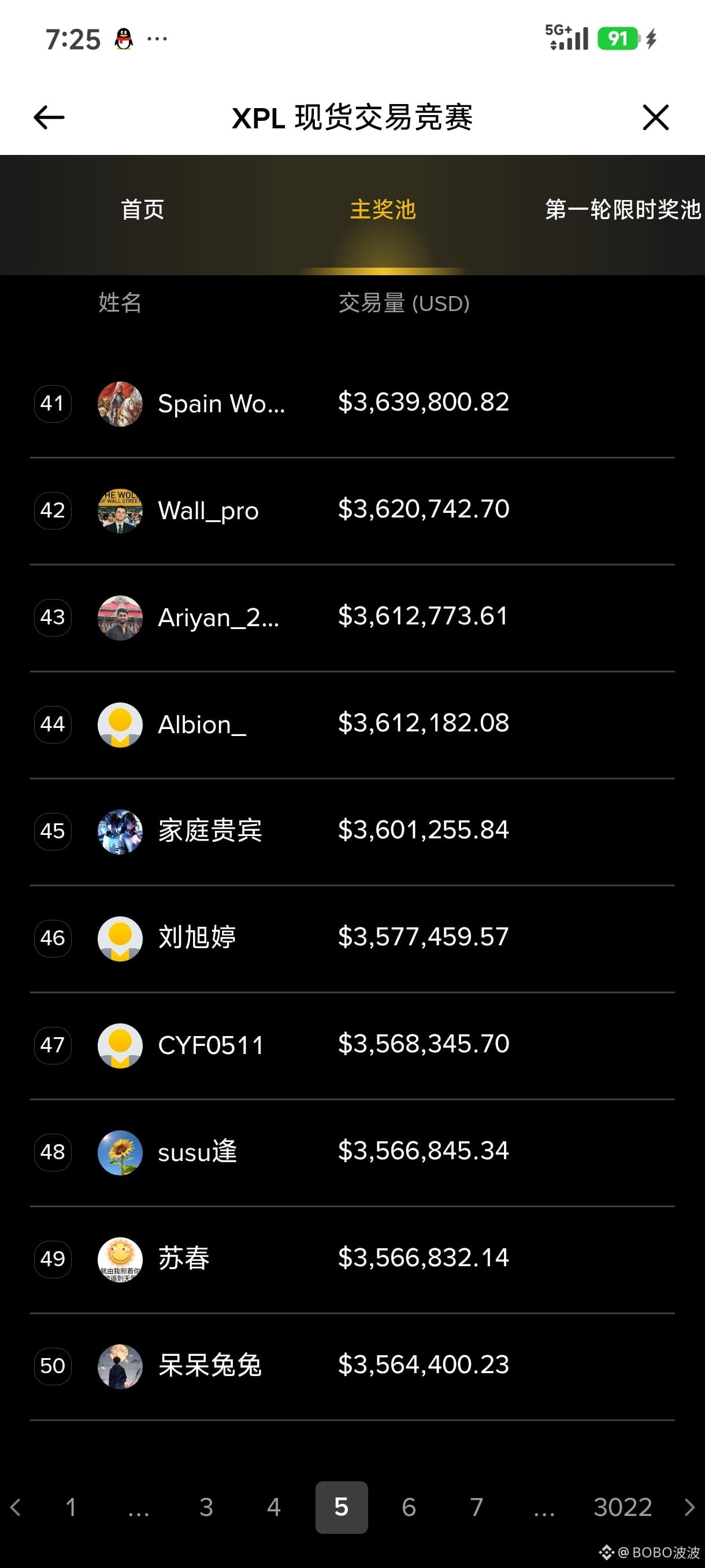
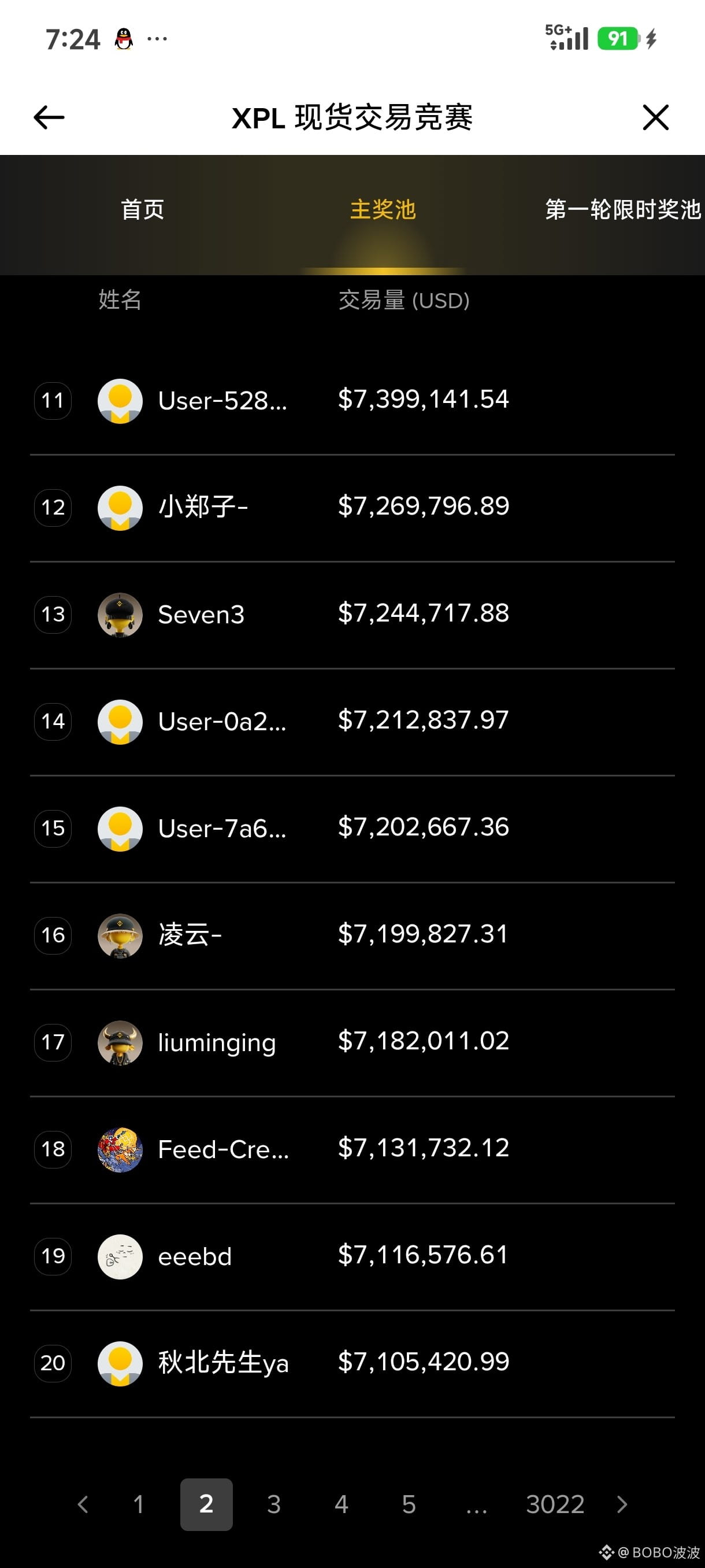
$XPL The spot trading session has ended. The top one thousand and those that split the瓜 are all big chunks of profit; the risk is low and the profit is high. Now, those who are aiming for the top one thousand have all gone to split the瓜 instead. The front rows are still a bit crowded: #BTC走势分析 $BTC
Rank 20 trading volume: 7,105,421
Rank 50 trading volume: 3,564,400
Rank 200 trading volume: 738,205
Rank 1,000 trading volume: 86,522
Rank 1,001 and beyond
Every 10,000 trading volume / reward 9 u
Current total trading volume: 97,285,277
Trading volume needed to reach the cap: 60,803
$XPL The spot trading session has ended. The top one thousand and those that split the瓜 are all big chunks of profit; the risk is low and the profit is high. Now, those who are aiming for the top one thousand have all gone to split the瓜 instead. The front rows are still a bit crowded: #BTC走势分析 $BTC
Rank 20 trading volume: 7,105,421
Rank 50 trading volume: 3,564,400
Rank 200 trading volume: 738,205
Rank 1,000 trading volume: 86,522
Rank 1,001 and beyond
Every 10,000 trading volume / reward 9 u
Current total trading volume: 97,285,277
Trading volume needed to reach the cap: 60,803
Rank 20 trading volume: 7,105,421
Rank 50 trading volume: 3,564,400
Rank 200 trading volume: 738,205
Rank 1,000 trading volume: 86,522
Rank 1,001 and beyond
Every 10,000 trading volume / reward 9 u
Current total trading volume: 97,285,277
Trading volume needed to reach the cap: 60,803
1
532
Log in to explore more content
Join global crypto users on Binance Square
⚡️ Get latest and useful information about crypto.
💬 Trusted by the world’s largest crypto exchange.
👍 Discover real insights from verified creators.
Email / Phone number
Trending Topics
ClarityActFacesProceduralVoteSept15
43,056 views
644 Discussing
Tuesday, September 15, 2:15pm ET. Mark it. 🗓️
The Senate votes on whether to even debate the CLARITY Act, the bill that would finally define which coins are securities vs commodities under US law.
Needs 60 votes. Republicans have 53. Several Democrats need to cross over, and it's not guaranteed.
Fail this vote = the bill is dead for 2026, likely until 2029 (midterms eat the calendar after this).
Pass this vote = doors open to real debate, still a long way to actual law.
Biggest crypto regulation moment of the year happens in a few days.
#ClarityActFacesProceduralVoteSept15
NewbieToNode
·3 Likes
·4.1k views
US2YearYieldRisesTo4.61%
32,636 views
624 Discussing
US10YearTreasuryYieldNears5%
19,159 views
359 Discussing