
Lady Rose 1
175 Posts

Lady Rose 1
Report
Block User
Crypto trader & Web3 content creator Kol
0 Following
2 Followers
1 Liked
Posts
·
--
$NEAR and $ENA are showing two interesting sides of the crypto market this week, with ecosystem developments and price action worth watching. $NEAR has made progress on its tokenomics. HSP-029 has been ratified, targeting a gradual reduction in maximum annual issuance from 2.5% to 1.6% over 24 months. Its $250K Global Hackathon also attracted over 2,400 submissions across AI, autonomous payments and cross-chain applications. On the trading side, NEAR is hovering around $2.92, with its daily price below the 10-day and 20-day moving averages. I'm watching the $2.77 area as a key 4H reference, while a move above $3.00 could signal improving momentum. $ENA has another interesting development. Ethena's approved revenue framework links protocol revenue to ENA buybacks through USDe supply milestones, creating a clearer connection between ecosystem growth and token value. Its daily chart remains under pressure, with RSI at 26.49. I'm watching $0.0959 as a key 4H level, with $0.102 as the first recovery area. My take is that both assets have compelling developments, and the next moves in price and volume will be important in assessing how the market responds. The Bitget Trading Club Championship runs November 24–30, featuring a 70,000 USDT reward pool and rewards of up to 8,000 USDT per participant. Eligible traders can also qualify for a voucher after reaching 5,000 USDT in trading volume. Explore the event and its terms: https://www.bitget.com/launchhub/trading-club/234046
$NEAR and $ENA are showing two interesting sides of the crypto market this week, with ecosystem developments and price action worth watching. $NEAR has made progress on its tokenomics. HSP-029 has been ratified, targeting a gradual reduction in maximum annual issuance from 2.5% to 1.6% over 24 months. Its $250K Global Hackathon also attracted over 2,400 submissions across AI, autonomous payments and cross-chain applications. On the trading side, NEAR is hovering around $2.92, with its daily price below the 10-day and 20-day moving averages. I'm watching the $2.77 area as a key 4H reference, while a move above $3.00 could signal improving momentum. $ENA has another interesting development. Ethena's approved revenue framework links protocol revenue to ENA buybacks through USDe supply milestones, creating a clearer connection between ecosystem growth and token value. Its daily chart remains under pressure, with RSI at 26.49. I'm watching $0.0959 as a key 4H level, with $0.102 as the first recovery area. My take is that both assets have compelling developments, and the next moves in price and volume will be important in assessing how the market responds. The Bitget Trading Club Championship runs November 24–30, featuring a 70,000 USDT reward pool and rewards of up to 8,000 USDT per participant. Eligible traders can also qualify for a voucher after reaching 5,000 USDT in trading volume. Explore the event and its terms: https://www.bitget.com/launchhub/trading-club/234046

·
--
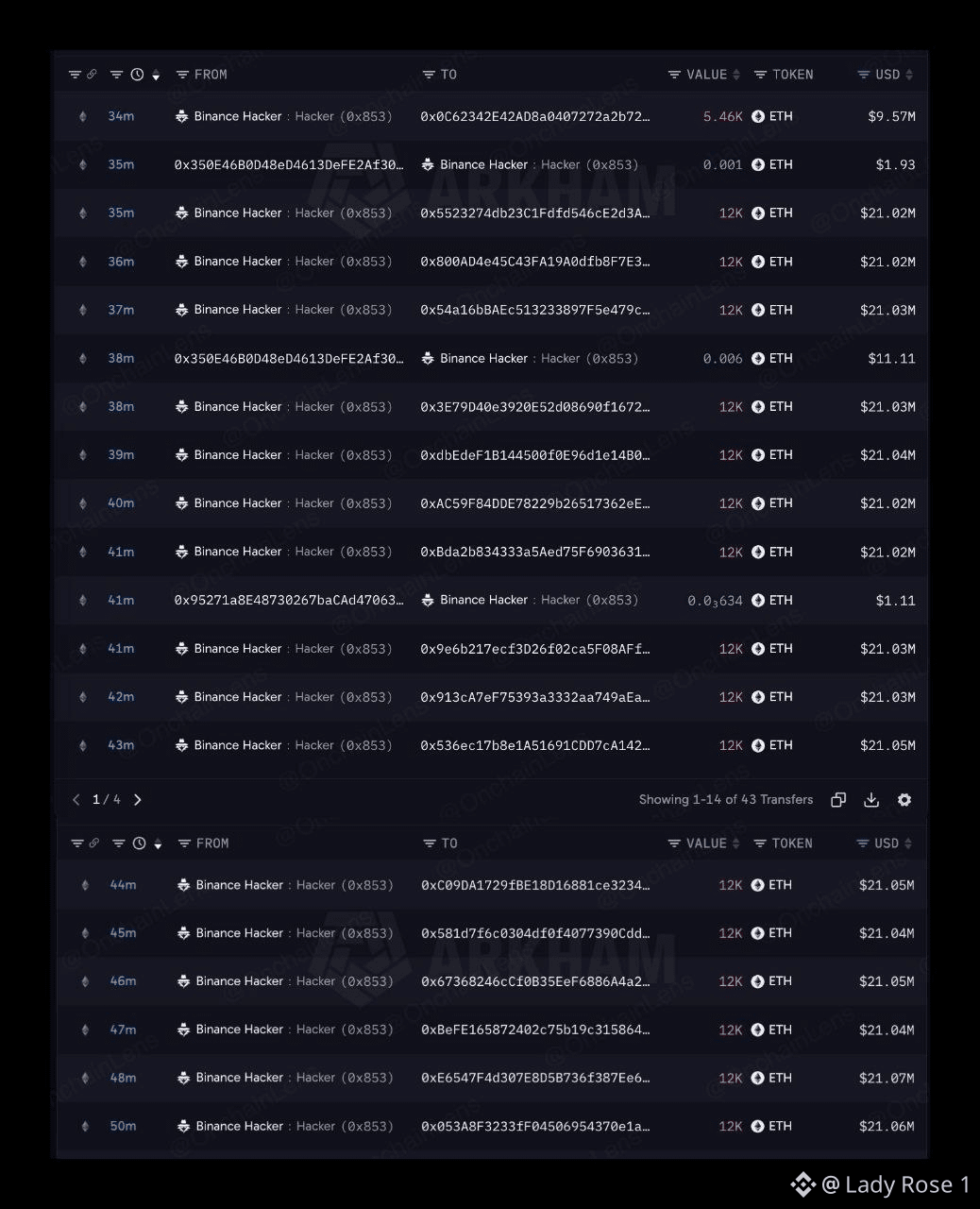
Nearly $594M in Ethereum has been moved by the Binance hacker within just 48 hours. According to Onchain Lens, $248M in $ETH was transferred on November 19, followed by another $346M today. The funds are being spread across newly created wallets, with part of the transfers moving through Chainflip and THORChain, cross-chain protocols that allow assets to move between different blockchains. And there is still more to watch. Wallets linked to the hacker reportedly hold around 226,665 ETH, worth approximately $396M. The movement of such large amounts of $ETH puts these wallets and their next transactions firmly on the radar.
Nearly $594M in Ethereum has been moved by the Binance hacker within just 48 hours. According to Onchain Lens, $248M in $ETH was transferred on November 19, followed by another $346M today. The funds are being spread across newly created wallets, with part of the transfers moving through Chainflip and THORChain, cross-chain protocols that allow assets to move between different blockchains. And there is still more to watch. Wallets linked to the hacker reportedly hold around 226,665 ETH, worth approximately $396M. The movement of such large amounts of $ETH puts these wallets and their next transactions firmly on the radar.

·
--
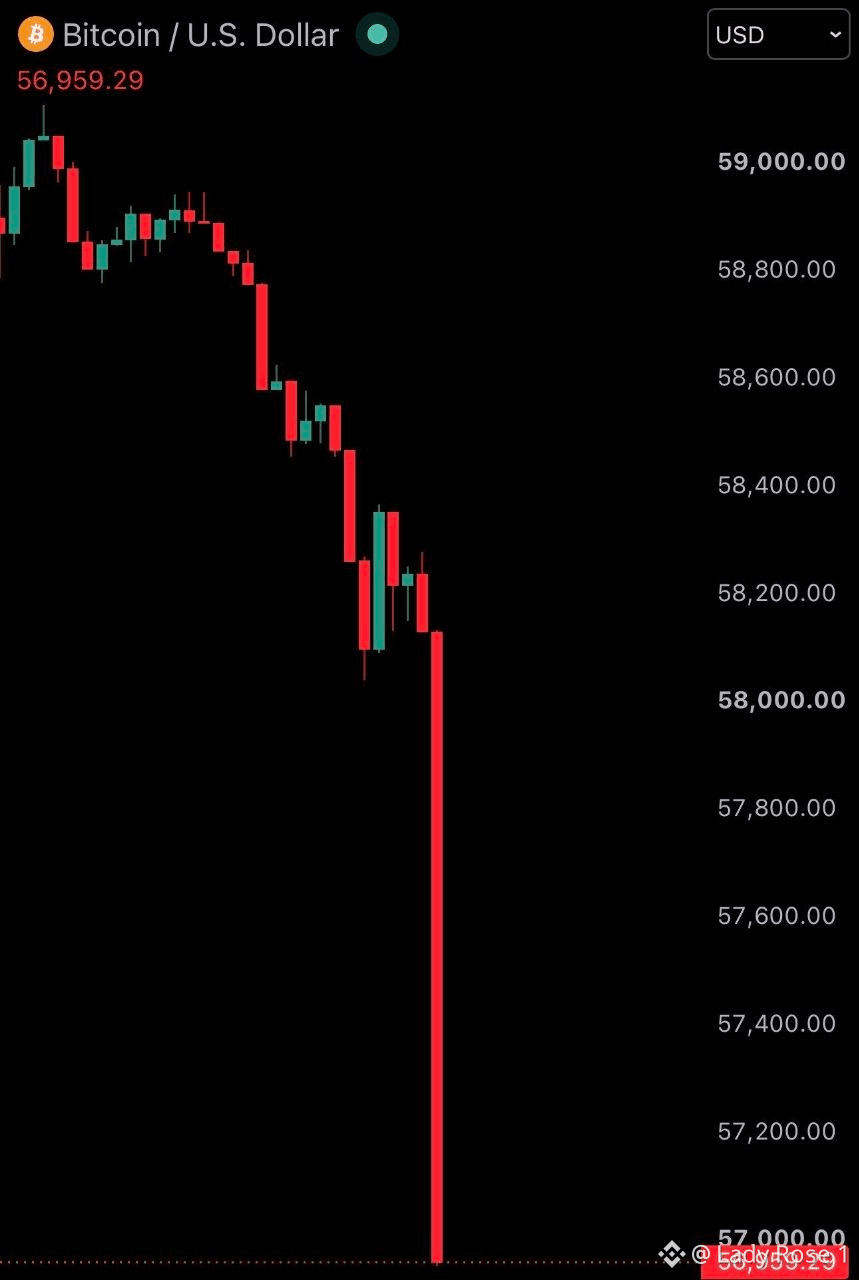
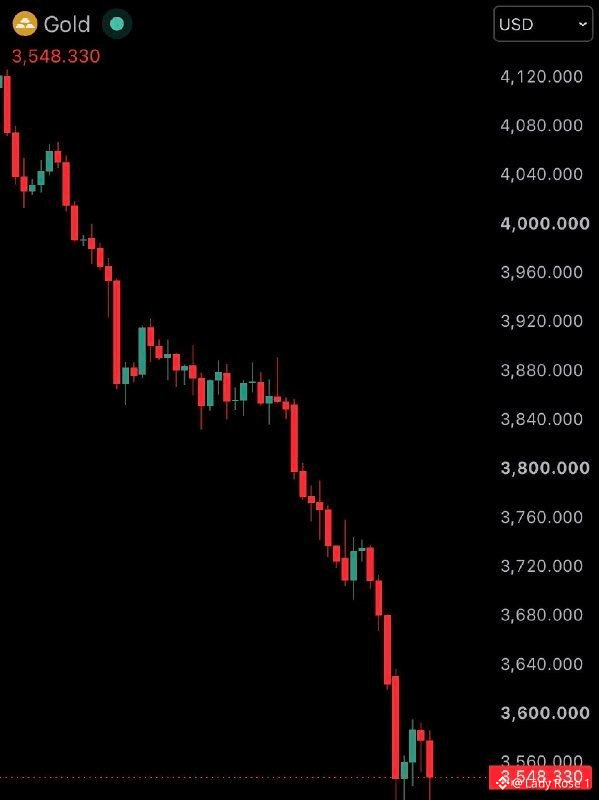
Global markets are facing a brutal sell-off. Stocks, gold and Bitcoin are falling simultaneously, wiping trillions of dollars off global market valuations. Gold has dropped below $3,550 per ounce, while $BTC briefly slipped under $57,000. Several factors are driving the pressure, including growing concerns over AI company valuations and expectations of further US interest rate hikes. The sell-off is also reaching traditional safe-haven assets, as investors reassess risk across financial markets. One thing is clear: market uncertainty is spreading across asset classes, and crypto is feeling the pressure too.
Global markets are facing a brutal sell-off. Stocks, gold and Bitcoin are falling simultaneously, wiping trillions of dollars off global market valuations. Gold has dropped below $3,550 per ounce, while $BTC briefly slipped under $57,000. Several factors are driving the pressure, including growing concerns over AI company valuations and expectations of further US interest rate hikes. The sell-off is also reaching traditional safe-haven assets, as investors reassess risk across financial markets. One thing is clear: market uncertainty is spreading across asset classes, and crypto is feeling the pressure too.
6
·
--
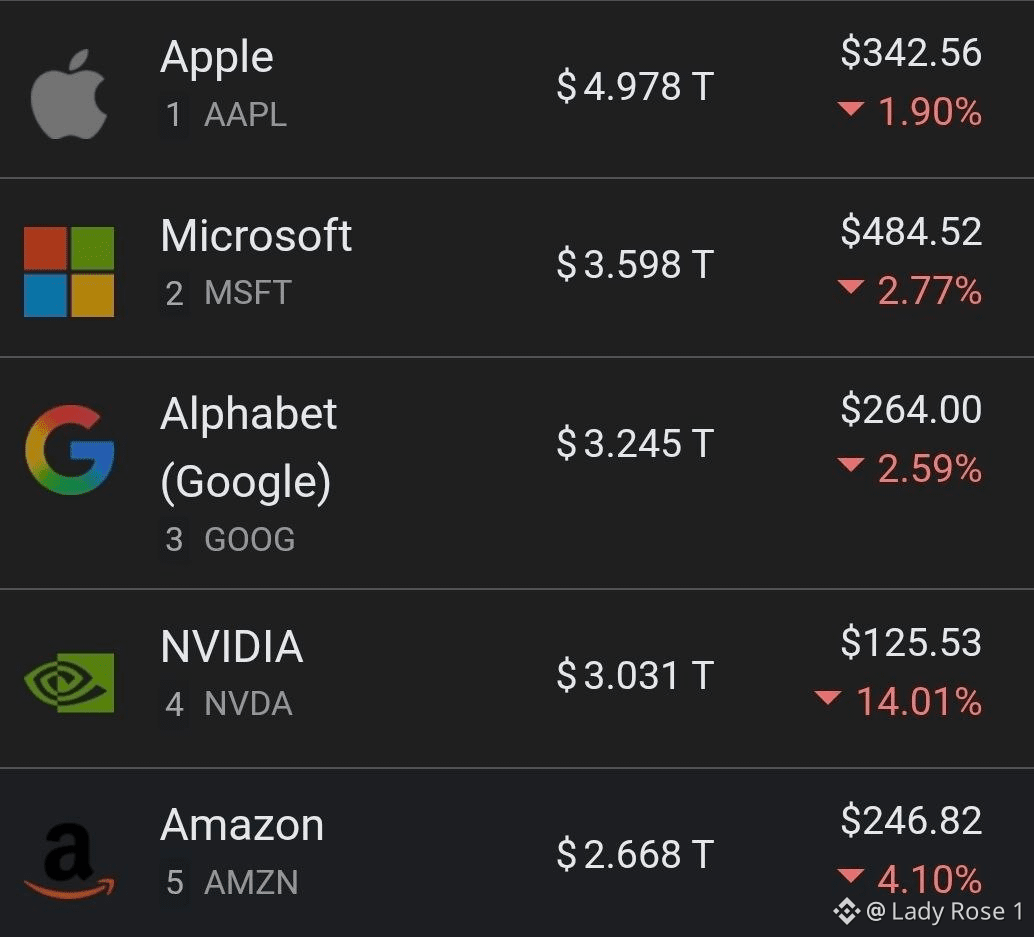
🚨 Nvidia has lost its position as the world's most valuable company. In less than a month, the AI chip giant has fallen from 1st to 4th place, now trailing Apple $AAPL , Microsoft $MSFT and Alphabet $GOOGL . Its market capitalization has dropped to $3.031 trillion, with shares down 14.01% in the figures shown. The most striking figure: nearly $2.7 trillion in market value wiped out since its October 6 all-time high. The tech landscape is shifting, and Nvidia is right at the center of it. $NVDA
🚨 Nvidia has lost its position as the world's most valuable company. In less than a month, the AI chip giant has fallen from 1st to 4th place, now trailing Apple $AAPL , Microsoft $MSFT and Alphabet $GOOGL . Its market capitalization has dropped to $3.031 trillion, with shares down 14.01% in the figures shown. The most striking figure: nearly $2.7 trillion in market value wiped out since its October 6 all-time high. The tech landscape is shifting, and Nvidia is right at the center of it. $NVDA
3
·
--
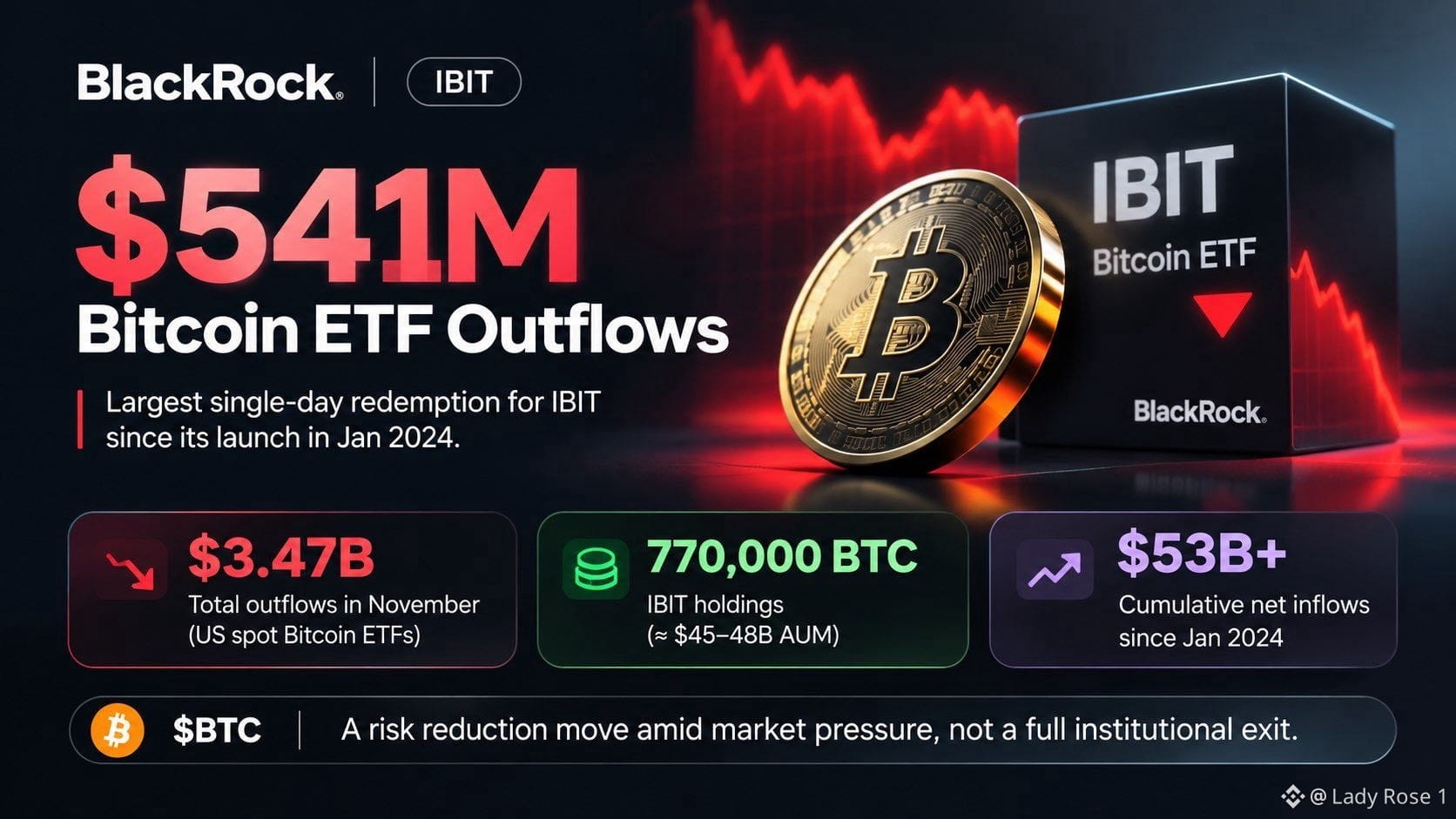
BlackRock’s Bitcoin ETF, $IBIT , recorded $541M in outflows on November 19, its largest single-day redemption since its launch in January 2024.
The timing is worth looking at.
Bitcoin was going through a sharp sell-off, and November’s total outflows across US spot Bitcoin ETFs had reached $3.47B by November 19.
Still, the bigger picture matters.
$IBIT continued to hold around 770,000 BTC, while US spot Bitcoin ETFs maintained over $53B in cumulative net inflows since launch.
These figures show how institutional exposure to Bitcoin is evolving through market volatility.
Investors are reducing risk, adjusting positions and responding to changing market conditions.
One record-breaking day tells part of the story. The longer-term capital flows tell the rest.
$BTC
34
·
--
Anthropic’s $81.3B IPO is a major moment for the tech industry.
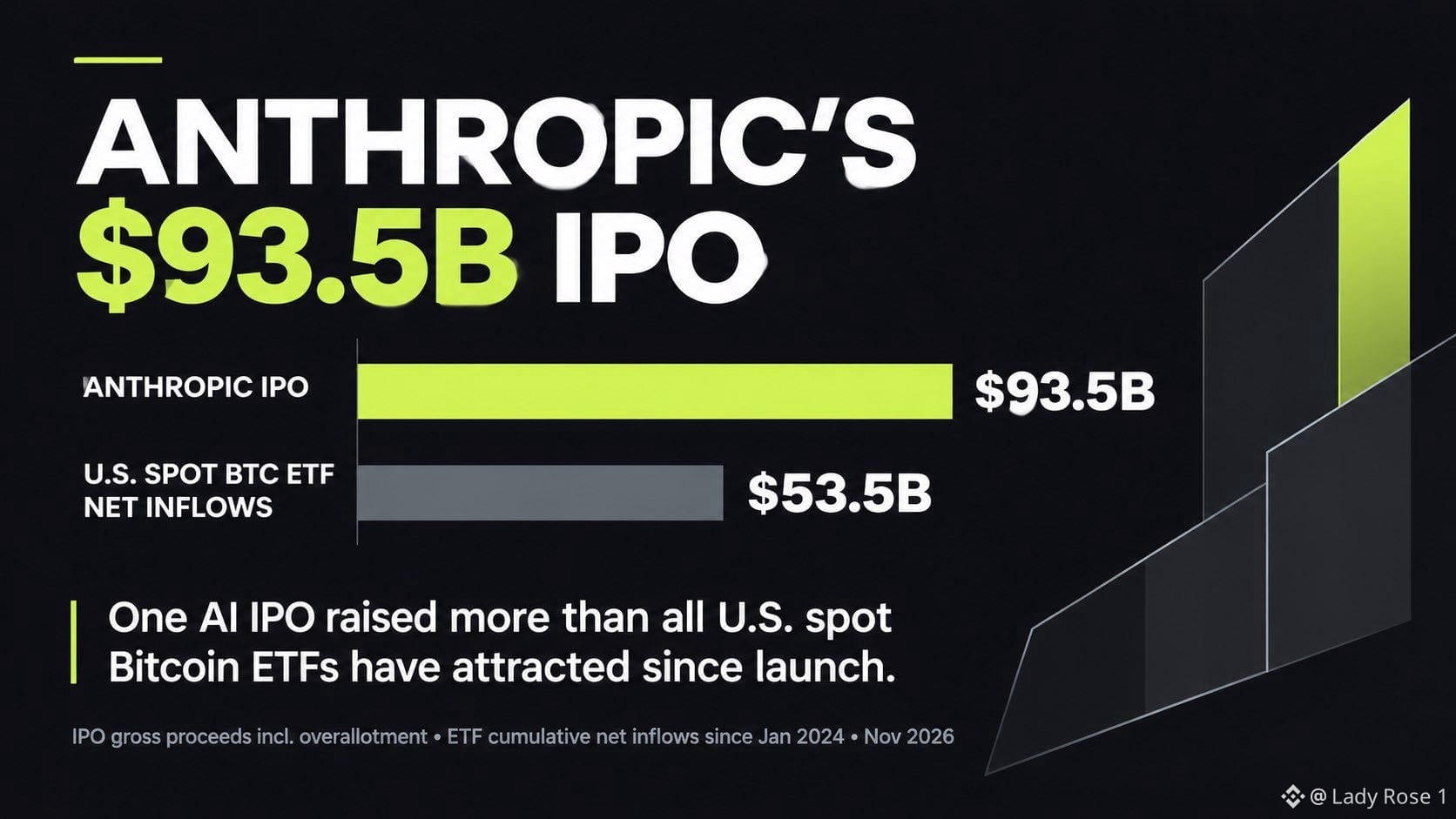
At $83 per share, $ANT raised $81.3 billion in its public offering, making it the largest IPO by gross proceeds on record.
To put that into perspective, all U.S. spot Bitcoin ETFs have attracted around $54 billion in cumulative net inflows since their launch in January 2024.
That means Anthropic’s single IPO surpassed the combined net inflows of every U.S. spot Bitcoin ETF.
The funding came from traditional market investors and major technology players, including Google, Nvidia, AMD and Microsoft.
For crypto, this puts the scale of institutional capital flowing into AI into perspective.
AI and crypto remain two major forces shaping the next phase of technological growth, and institutional money is closely watching both.
29
·
--
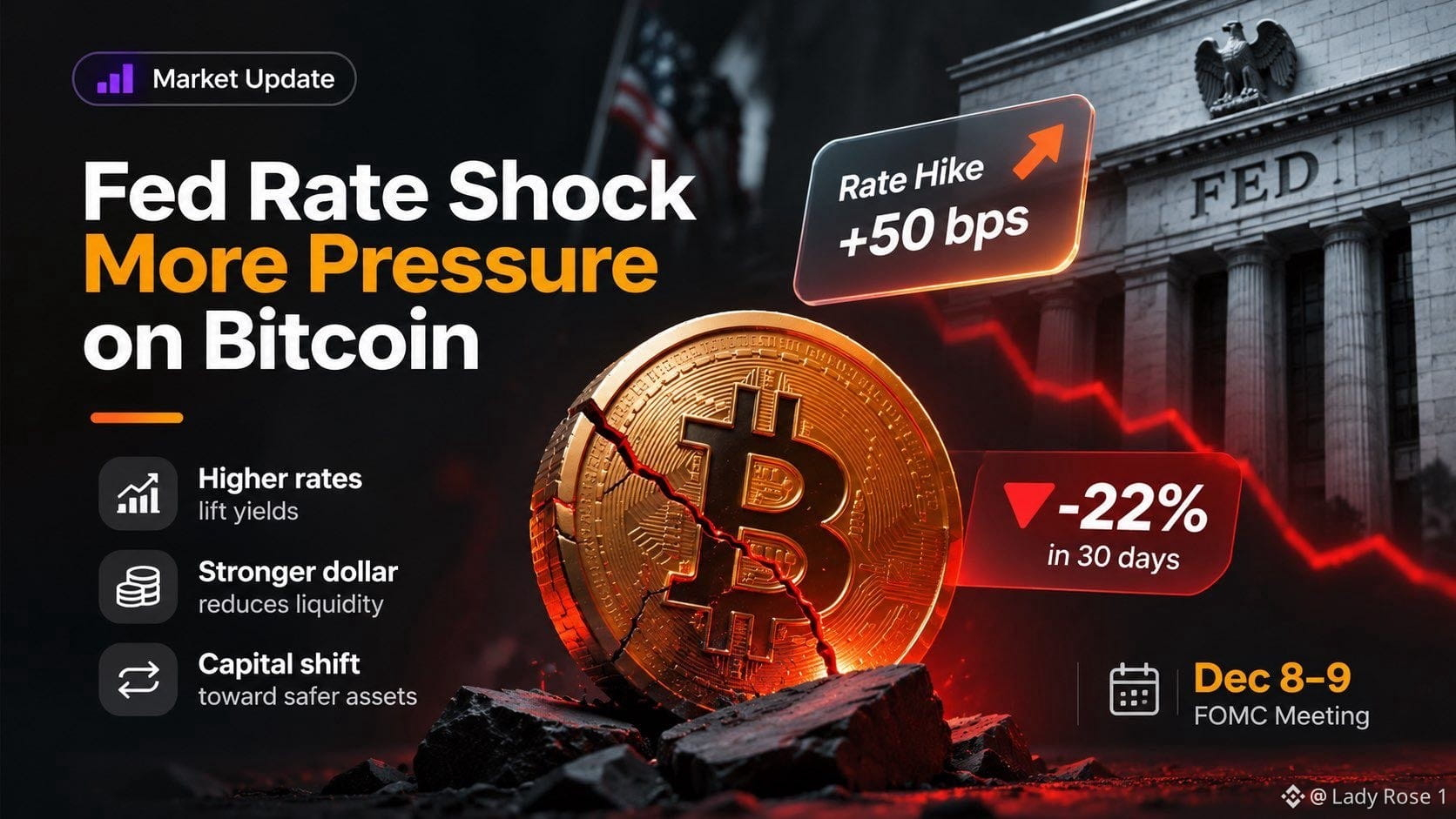
Bitcoin’s 22% drop has brought the Fed back into focus.
On November 18, Fed Governor Christopher Waller raised the possibility of a 50-basis-point rate hike in December, adding fresh pressure to an already struggling market.
Higher interest rates make safer assets more attractive, strengthen the dollar and reduce liquidity. Bitcoin tends to feel that pressure, especially when investors become more cautious.
$BTC is now trading around $59K–$60K, down sharply from its recent highs near $80K.
A 50-basis-point hike or another inflation surprise could trigger further selling. At the same time, markets have already priced in a December rate increase, and much of the recent sell-off reflects changing expectations around Fed policy.
The December 8–9 FOMC meeting will be a key moment for the market.
For $BTC , the next move will depend heavily on inflation, interest rates and liquidity.
41
·
--
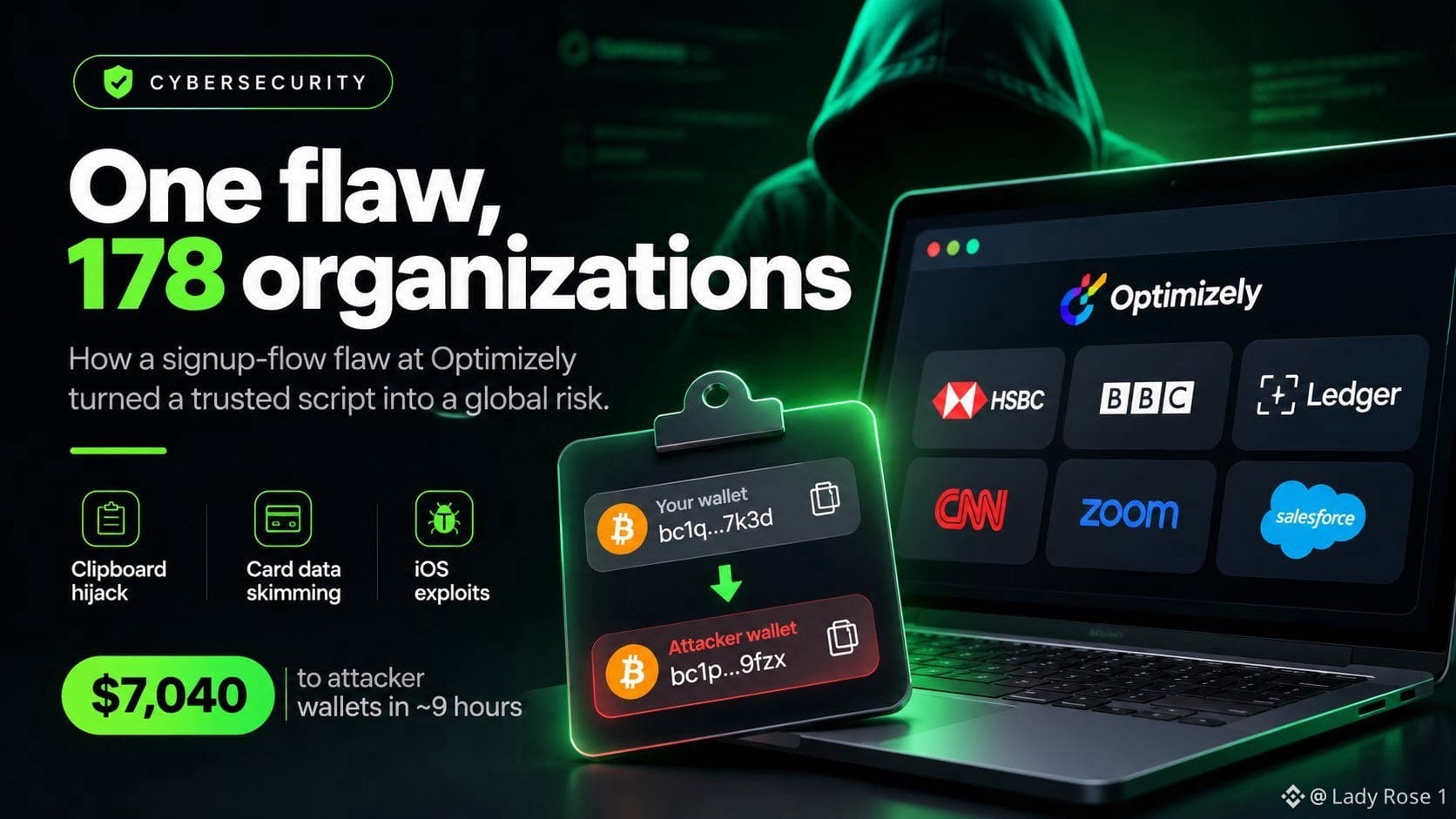
A signup-flow flaw at Optimizely exposed 178 organizations to malicious code, including HSBC, BBC, CNN, Ledger, Zoom and Salesforce.
On 16 November, attackers impersonated users on customer accounts and injected JavaScript through Optimizely Web Experimentation. The code could replace crypto wallet addresses in the clipboard, skim card details, steal cookies and capture screenshots. Around $7,040 in crypto, mostly $BTC , reached the attackers’ wallets in roughly nine hours.
Responsibility sits at three levels:
• The attackers, who built and deployed the malicious code.
• Optimizely, whose flaw allowed unauthorized access to customer accounts.
• The affected websites, which gave a dynamic third-party script permission to run across their pages.
The striking detail: a trusted script, served from a familiar domain with a valid certificate, could redirect a crypto payment through one copied address.
Third-party scripts deserve the same security checks as code built in-house.
64
·
--
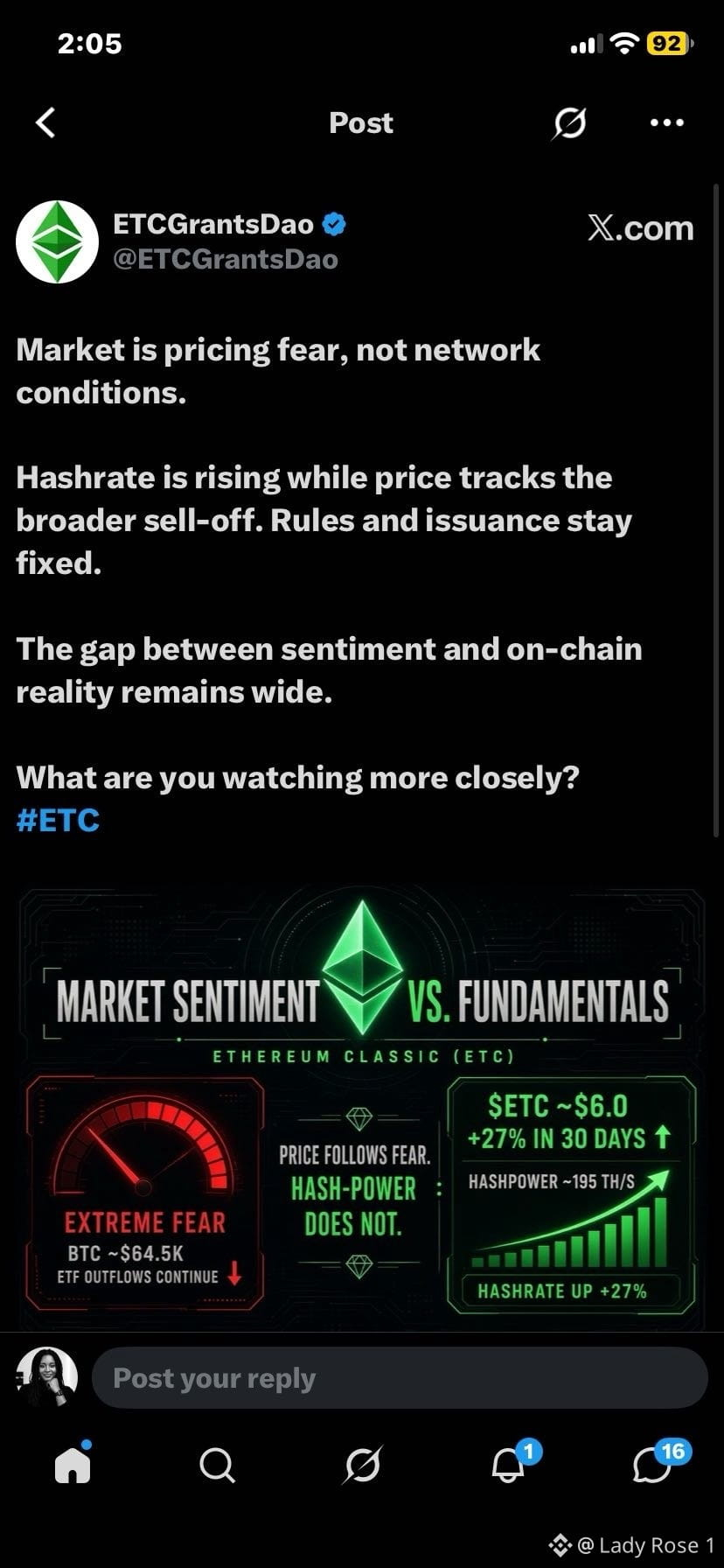
$XRP is back below $1, a level last seen before its major rally in late 2024.
Back then, XRP spent most of the year trading between $0.40 and $0.70 before breaking above $1 following the US election.
Today, the price is around $0.91, roughly 75% below its 2025 peak.
What makes this situation interesting is how much has changed since 2024.
Ripple has expanded its institutional partnerships, RLUSD has grown beyond $2.8B in supply, and the company has secured OCC approval for a national trust bank.
Yet $XRP is facing heavy market pressure, with extreme fear, ETF outflows and weaker demand across the crypto market.
For long-term holders, these prices bring back memories of 2024, but the fundamentals tell a different story today.
The $0.80–$0.90 range is now worth watching closely. A recovery above $1, backed by stronger volume and ETF inflows, would be an important signal.
75
·
--
$NEAR is showing signs of a potential recovery after a prolonged correction. On the 4H chart, price has bounced from the $2.86 area and is now trading around $3.34. Short-term momentum is improving, with buyers pushing price back toward the moving averages. The $3.40–$3.45 zone remains an important resistance to watch. A breakout could open room for further recovery, while a rejection may bring another retest of support. Beyond the chart, NEAR has several catalysts worth watching. Its $250K AI hackathon, cross-chain development, and the approved proposal to gradually reduce annual inflation from 2.5% to 1.6% could strengthen its long-term narrative. $LINK is also worth keeping on the radar as institutional adoption and tokenized assets continue to expand. With both ecosystems evolving, the coming days could bring interesting trading opportunities. Bitget’s Trading Club Championship runs from November 17 to 23, with 70,000 USDT in rewards and up to 8,000 USDT per participant. If you’re already watching these markets, this could be a good time to put your strategy into action:https://www.bitget.com/campaigns/f7cbb6a039924c428720278414750f18
$NEAR is showing signs of a potential recovery after a prolonged correction. On the 4H chart, price has bounced from the $2.86 area and is now trading around $3.34. Short-term momentum is improving, with buyers pushing price back toward the moving averages. The $3.40–$3.45 zone remains an important resistance to watch. A breakout could open room for further recovery, while a rejection may bring another retest of support. Beyond the chart, NEAR has several catalysts worth watching. Its $250K AI hackathon, cross-chain development, and the approved proposal to gradually reduce annual inflation from 2.5% to 1.6% could strengthen its long-term narrative. $LINK is also worth keeping on the radar as institutional adoption and tokenized assets continue to expand. With both ecosystems evolving, the coming days could bring interesting trading opportunities. Bitget’s Trading Club Championship runs from November 17 to 23, with 70,000 USDT in rewards and up to 8,000 USDT per participant. If you’re already watching these markets, this could be a good time to put your strategy into action:https://www.bitget.com/campaigns/f7cbb6a039924c428720278414750f18

·
--
Ethereum Foundation sells $ETH 4 times in 5 days. Should holders be concerned? The Ethereum Foundation has reportedly sold between 5,000 and 7,500 ETH over a few days, worth approximately $10M–$14.5M, depending on the reporting period. Naturally, this has caught the market's attention, especially with ETH trading around $1,800–$1,900. But there's something worth looking at before jumping to conclusions. In June 2025, the Ethereum Foundation published its treasury policy, outlining plans to maintain an operating reserve covering approximately 2.5 years of expenses. This reserve helps fund research, grants, ecosystem development and daily operations. Periodic ETH sales are part of that strategy. In other words, these transactions fit a financial framework the Foundation had already made public. A few details deserve attention: - The purpose: $ETH sales help maintain the Foundation's operating reserves. - The timing: These transactions come during a period of considerable market pressure. - The bigger picture: The Foundation still holds substantial ETH reserves and continues to support Ethereum's development. - The transparency: Clear communication around treasury movements remains important for holders and the wider community. Personally, I see this primarily as treasury management. An organization responsible for funding an entire ecosystem needs financial resources to sustain its work through different market cycles. Still, the timing makes these sales worth watching. What matters most is whether Ethereum continues to deliver on its long-term vision, attract developers and grow its ecosystem. Price movements tell one part of the story. The fundamentals tell another.
Ethereum Foundation sells $ETH 4 times in 5 days. Should holders be concerned? The Ethereum Foundation has reportedly sold between 5,000 and 7,500 ETH over a few days, worth approximately $10M–$14.5M, depending on the reporting period. Naturally, this has caught the market's attention, especially with ETH trading around $1,800–$1,900. But there's something worth looking at before jumping to conclusions. In June 2025, the Ethereum Foundation published its treasury policy, outlining plans to maintain an operating reserve covering approximately 2.5 years of expenses. This reserve helps fund research, grants, ecosystem development and daily operations. Periodic ETH sales are part of that strategy. In other words, these transactions fit a financial framework the Foundation had already made public. A few details deserve attention: - The purpose: $ETH sales help maintain the Foundation's operating reserves. - The timing: These transactions come during a period of considerable market pressure. - The bigger picture: The Foundation still holds substantial ETH reserves and continues to support Ethereum's development. - The transparency: Clear communication around treasury movements remains important for holders and the wider community. Personally, I see this primarily as treasury management. An organization responsible for funding an entire ecosystem needs financial resources to sustain its work through different market cycles. Still, the timing makes these sales worth watching. What matters most is whether Ethereum continues to deliver on its long-term vision, attract developers and grow its ecosystem. Price movements tell one part of the story. The fundamentals tell another.

·
--
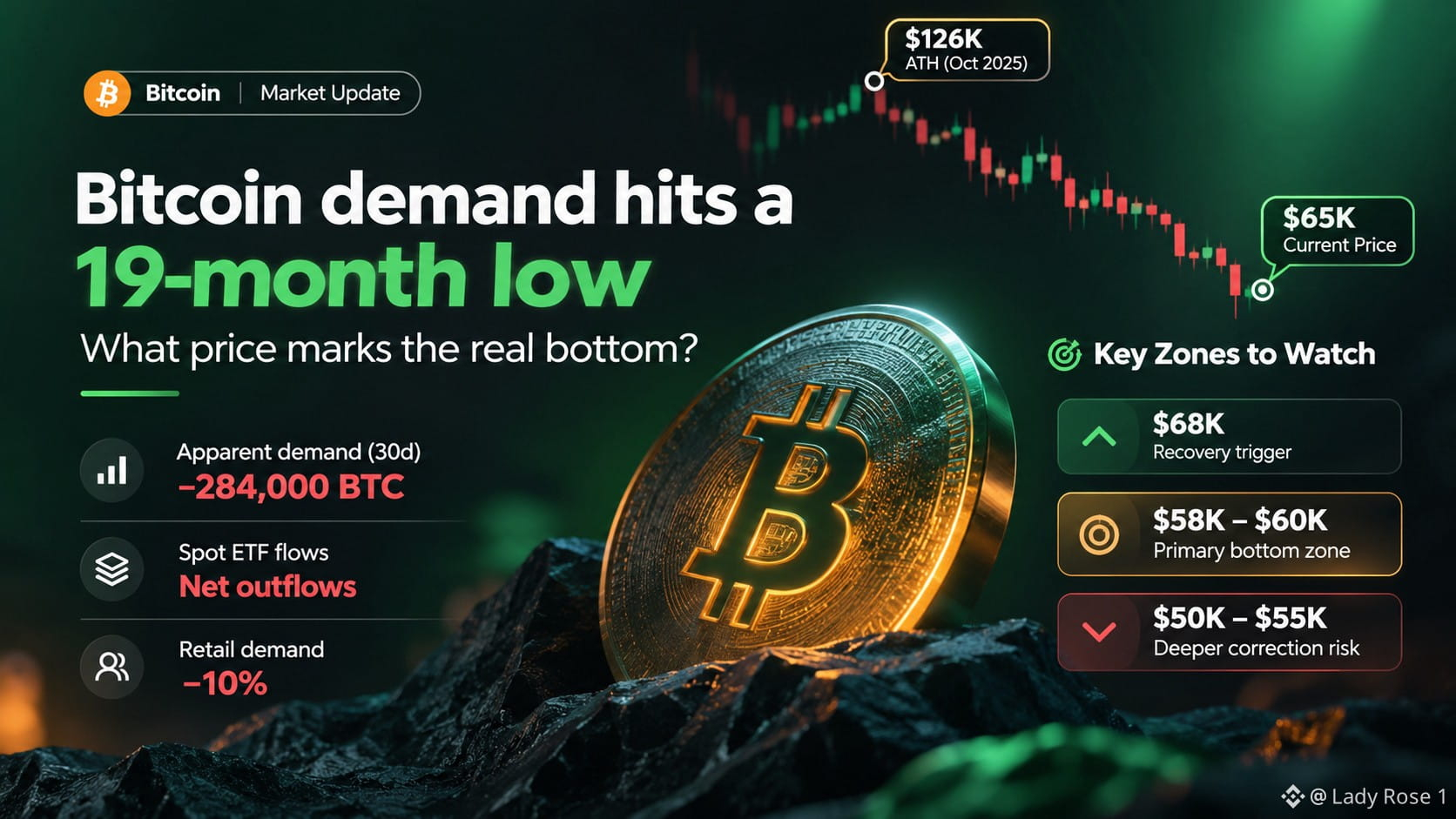
$BTC is now trading around $65K, and the latest demand data is raising serious questions about how much further this correction could go. The market has lost considerable momentum since BTC reached its October 2025 ATH of approximately $126K. Here's what I'm watching: • 30-day apparent demand has fallen to around -284,000 $BTC . • Spot Bitcoin ETFs have shifted to net outflows. • Retail demand has dropped nearly 10%. • BTC has slipped below its 200-week moving average, currently around $68K. Together, these signals point to weakening buying pressure across several parts of the market. So, where could the bottom be? Three price levels stand out: $58K–$60K: My primary zone to watch. This area sits close to the July 2026 low and represents an important historical support. $50K–$55K: A deeper correction scenario if selling pressure pushes BTC below the $58K support. $68K: The 200-week moving average. Reclaiming this level would be an important step towards restoring market confidence. Personally, I'm keeping my eyes on the $58K–$60K range. It offers a key area to watch as the market searches for stronger demand and a potential recovery. For me, the real bottom will come with a combination of price stability, renewed spot buying and improving ETF flows.
$BTC is now trading around $65K, and the latest demand data is raising serious questions about how much further this correction could go. The market has lost considerable momentum since BTC reached its October 2025 ATH of approximately $126K. Here's what I'm watching: • 30-day apparent demand has fallen to around -284,000 $BTC . • Spot Bitcoin ETFs have shifted to net outflows. • Retail demand has dropped nearly 10%. • BTC has slipped below its 200-week moving average, currently around $68K. Together, these signals point to weakening buying pressure across several parts of the market. So, where could the bottom be? Three price levels stand out: $58K–$60K: My primary zone to watch. This area sits close to the July 2026 low and represents an important historical support. $50K–$55K: A deeper correction scenario if selling pressure pushes BTC below the $58K support. $68K: The 200-week moving average. Reclaiming this level would be an important step towards restoring market confidence. Personally, I'm keeping my eyes on the $58K–$60K range. It offers a key area to watch as the market searches for stronger demand and a potential recovery. For me, the real bottom will come with a combination of price stability, renewed spot buying and improving ETF flows.
·
--
I think the most interesting part of this market is what happens after the leverage gets flushed out. Most of these liquidations have been concentrated in leveraged long positions, accounting for roughly 80–93% of total liquidations in reported periods. That creates a chain reaction: forced selling pushes prices lower, triggers more liquidations and puts additional pressure on the market. But every major leverage flush also removes a portion of speculative exposure. And that's where I'm looking for opportunities. Three areas deserve attention right now: 1. $BTC and $ETH spot accumulation Bitcoin has traded around the low-$62K area, while market sentiment has fallen into Extreme Fear, with readings around 10–14. For long-term investors, these conditions can offer attractive entry opportunities as prices stabilize. 2. Potential short squeeze Declining open interest suggests significant deleveraging across derivatives markets. If buying pressure returns while speculative positioning remains lighter, a recovery could trigger a sharp short squeeze. 3. Selective altcoin opportunities A market recovery could create interesting opportunities in fundamentally strong altcoins. I'm particularly interested in projects with real usage, healthy liquidity and sustainable demand. The indicators I'm keeping an eye on: - Open interest and funding rates. - Spot buying volume. - Daily Bitcoin ETF flows. - Changes in liquidation volume. - BTC's ability to hold its recent lows. One thing matters above everything else: confirmation. Extreme fear, reduced leverage and falling prices create interesting conditions. A sustainable recovery will need real spot demand and stronger buying pressure.
I think the most interesting part of this market is what happens after the leverage gets flushed out. Most of these liquidations have been concentrated in leveraged long positions, accounting for roughly 80–93% of total liquidations in reported periods. That creates a chain reaction: forced selling pushes prices lower, triggers more liquidations and puts additional pressure on the market. But every major leverage flush also removes a portion of speculative exposure. And that's where I'm looking for opportunities. Three areas deserve attention right now: 1. $BTC and $ETH spot accumulation Bitcoin has traded around the low-$62K area, while market sentiment has fallen into Extreme Fear, with readings around 10–14. For long-term investors, these conditions can offer attractive entry opportunities as prices stabilize. 2. Potential short squeeze Declining open interest suggests significant deleveraging across derivatives markets. If buying pressure returns while speculative positioning remains lighter, a recovery could trigger a sharp short squeeze. 3. Selective altcoin opportunities A market recovery could create interesting opportunities in fundamentally strong altcoins. I'm particularly interested in projects with real usage, healthy liquidity and sustainable demand. The indicators I'm keeping an eye on: - Open interest and funding rates. - Spot buying volume. - Daily Bitcoin ETF flows. - Changes in liquidation volume. - BTC's ability to hold its recent lows. One thing matters above everything else: confirmation. Extreme fear, reduced leverage and falling prices create interesting conditions. A sustainable recovery will need real spot demand and stronger buying pressure.

30
·
--
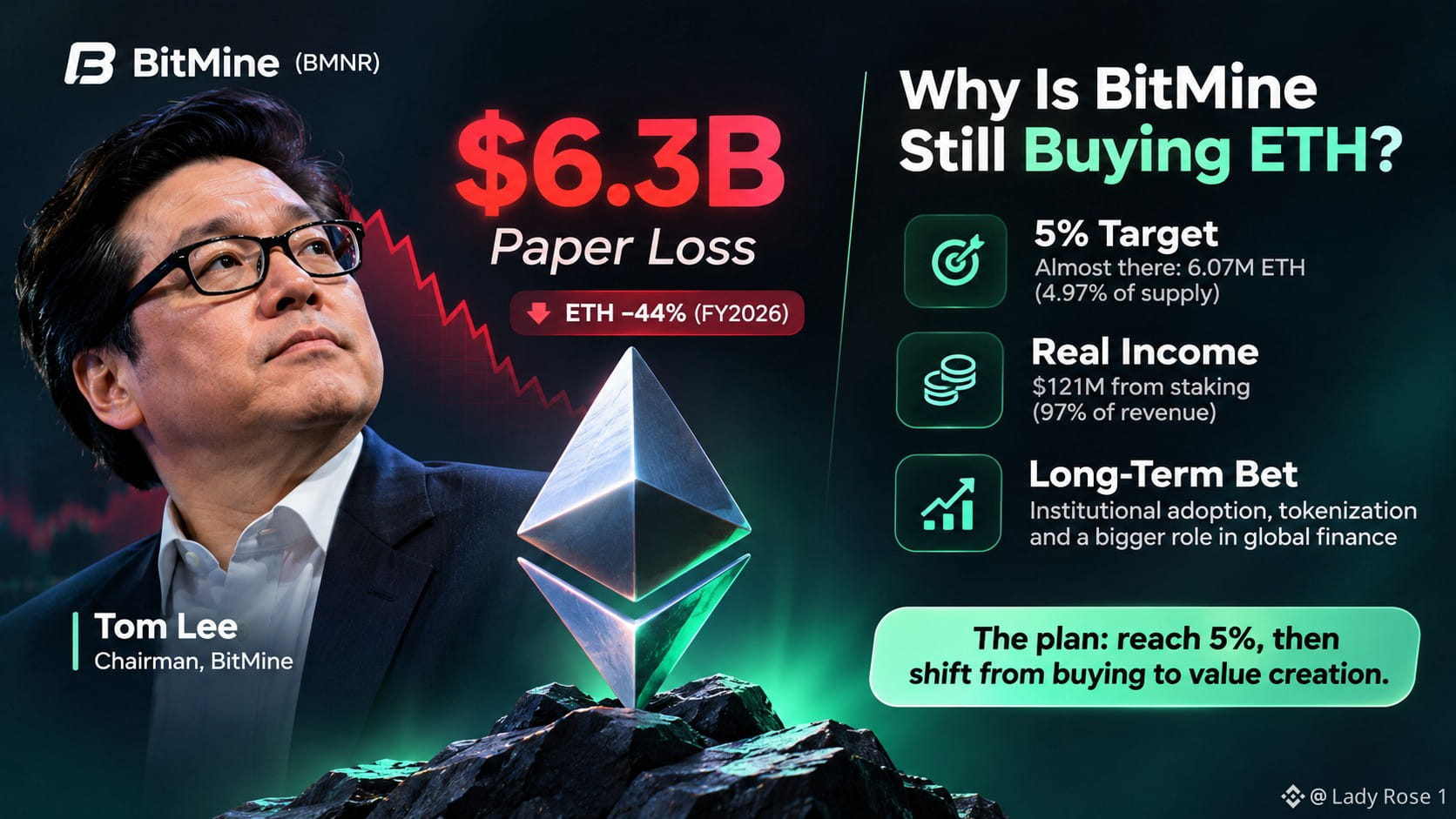
At first glance, this looks like a risky bet. But there's a bigger strategy behind it. BitMine reported a $6.3 billion net loss for FY2026, with approximately $6.23 billion coming from unrealized losses on its digital assets. Ethereum had fallen around 44% during the fiscal year. Yet BitMine keeps buying. Here's why. 1. It's chasing a 5% ownership target. Tom Lee's plan, known as the "Alchemy of 5%", aims to give BitMine ownership of 5% of Ethereum's total supply. By early November, the company held approximately 6.07 million $ETH , representing 4.97% of supply. It's now very close to its target. 2. Tom Lee is betting on Ethereum's long-term growth. His thesis revolves around institutional adoption, tokenization, stablecoins and the growing role of Ethereum in global finance. He believes these developments could drive substantial demand for ETH over the coming years. 3. Its $ETH holdings generate income. Staking and validation contributed approximately $121 million of BitMine's $125 million in FY2026 revenue. This gives the company an additional source of income while it holds its $ETH. 4. There's a clear endgame. The 5% target is designed as a hard cap. Once reached, BitMine expects to end its regular accumulation and focus on generating value from its existing holdings. Of course, the risks remain. $ETH price declines affect the value of its treasury, while equity issuance can dilute existing shareholders. Tom Lee is building a long-term Ethereum position around a very specific target. The real question is whether Ethereum's future growth will justify the enormous capital committed to this strategy. $6.3 billion in paper losses is a serious warning sign. But the conviction behind this bet is equally significant.
At first glance, this looks like a risky bet. But there's a bigger strategy behind it. BitMine reported a $6.3 billion net loss for FY2026, with approximately $6.23 billion coming from unrealized losses on its digital assets. Ethereum had fallen around 44% during the fiscal year. Yet BitMine keeps buying. Here's why. 1. It's chasing a 5% ownership target. Tom Lee's plan, known as the "Alchemy of 5%", aims to give BitMine ownership of 5% of Ethereum's total supply. By early November, the company held approximately 6.07 million $ETH , representing 4.97% of supply. It's now very close to its target. 2. Tom Lee is betting on Ethereum's long-term growth. His thesis revolves around institutional adoption, tokenization, stablecoins and the growing role of Ethereum in global finance. He believes these developments could drive substantial demand for ETH over the coming years. 3. Its $ETH holdings generate income. Staking and validation contributed approximately $121 million of BitMine's $125 million in FY2026 revenue. This gives the company an additional source of income while it holds its $ETH. 4. There's a clear endgame. The 5% target is designed as a hard cap. Once reached, BitMine expects to end its regular accumulation and focus on generating value from its existing holdings. Of course, the risks remain. $ETH price declines affect the value of its treasury, while equity issuance can dilute existing shareholders. Tom Lee is building a long-term Ethereum position around a very specific target. The real question is whether Ethereum's future growth will justify the enormous capital committed to this strategy. $6.3 billion in paper losses is a serious warning sign. But the conviction behind this bet is equally significant.
71
·
--
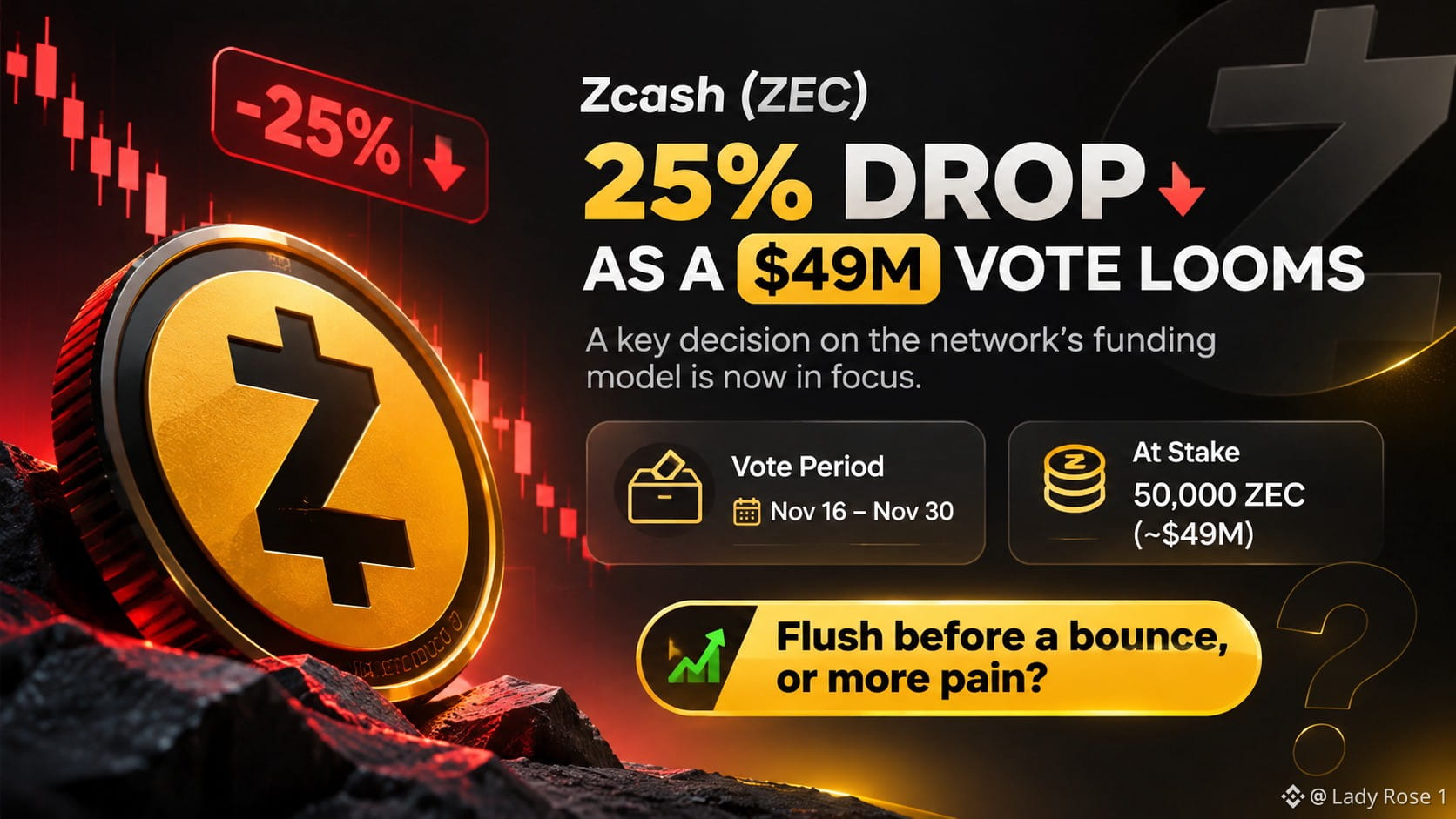
There is a lot happening around $ZEC right now. From November 16 to 30, Zcash holders and community panels will vote on proposals that could reshape how the ecosystem funds its development. One proposal is attracting particular attention: moving 50,000 ZEC, worth approximately $49 million, from the Zcash Community Grants treasury into the Network Sustainability Mechanism. Here's why this matters: • The 50,000 ZEC represents roughly 55% of the grants treasury. • Zcash Community Grants would give up its current 8% share of newly issued ZEC. • That allocation would build a new Future Development and Legal Defense Fund until the next halving. The idea is to strengthen network sustainability while creating a dedicated reserve for future development and legal support. But there's a bigger question here: how should Zcash balance funding its developers, supporting miners and protecting the network over the long term? That's what makes this vote so important. My attention is on two things: 1. How the community responds to the proposed funding changes. 2. Whether ZEC can find buying support after its sharp correction. A 25% drop puts ZEC on traders' radar, but the real opportunity depends on what happens next. The vote could become an important turning point for the $ZEC ecosystem.
There is a lot happening around $ZEC right now. From November 16 to 30, Zcash holders and community panels will vote on proposals that could reshape how the ecosystem funds its development. One proposal is attracting particular attention: moving 50,000 ZEC, worth approximately $49 million, from the Zcash Community Grants treasury into the Network Sustainability Mechanism. Here's why this matters: • The 50,000 ZEC represents roughly 55% of the grants treasury. • Zcash Community Grants would give up its current 8% share of newly issued ZEC. • That allocation would build a new Future Development and Legal Defense Fund until the next halving. The idea is to strengthen network sustainability while creating a dedicated reserve for future development and legal support. But there's a bigger question here: how should Zcash balance funding its developers, supporting miners and protecting the network over the long term? That's what makes this vote so important. My attention is on two things: 1. How the community responds to the proposed funding changes. 2. Whether ZEC can find buying support after its sharp correction. A 25% drop puts ZEC on traders' radar, but the real opportunity depends on what happens next. The vote could become an important turning point for the $ZEC ecosystem.
40
·
--
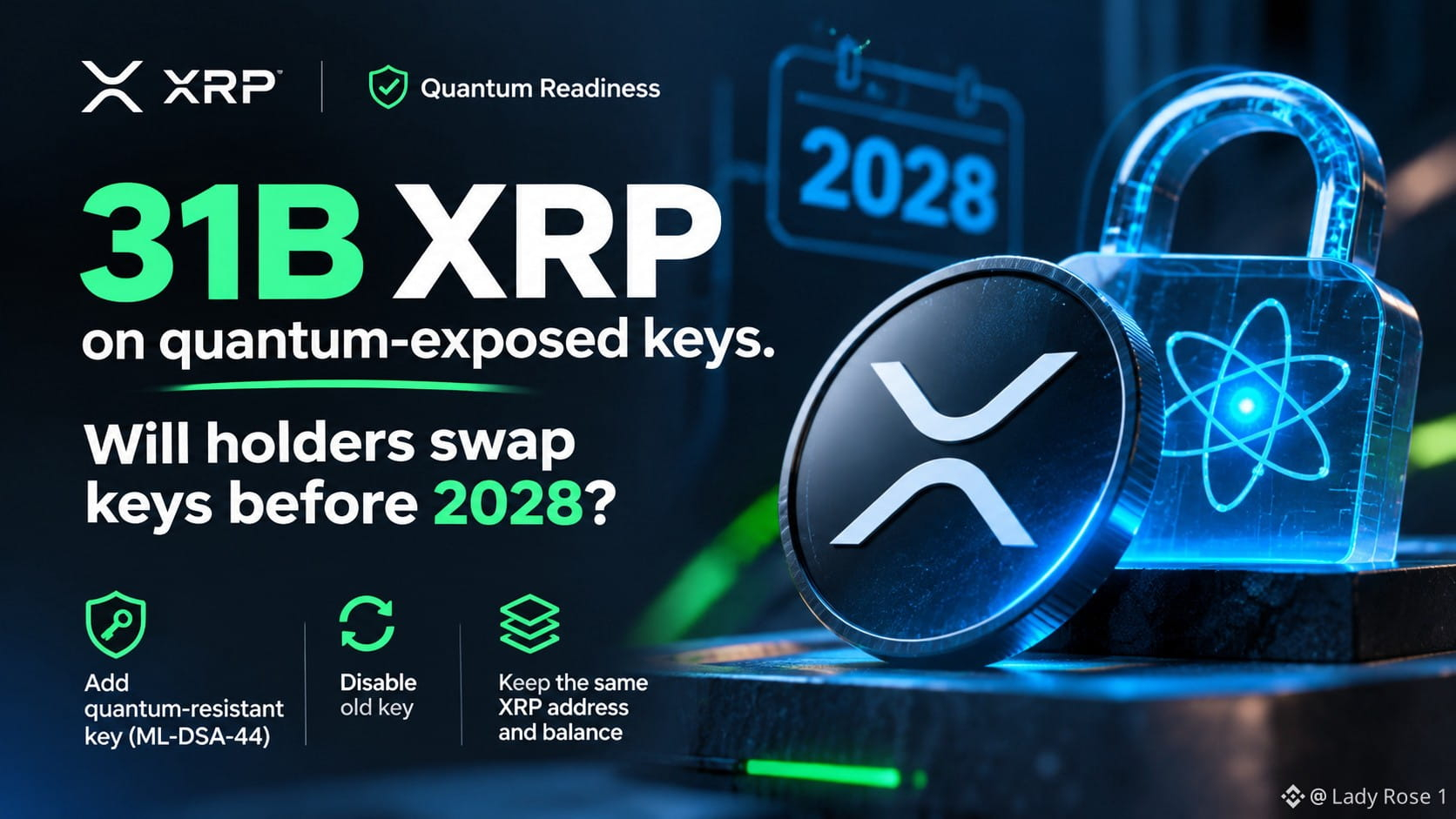
31.4 billion $XRP held across 561 accounts. That's a significant amount of value to consider when looking at quantum security. And there's a much bigger picture. An analysis of the top 1,000 XRPL accounts in November 2026 identified 561 accounts using single-key signatures, holding approximately 31.4 billion XRP. The reason this matters comes down to how account security works. Once an XRPL account signs a transaction, its public key becomes visible on-chain. A sufficiently powerful quantum computer could eventually use Shor's algorithm to derive the corresponding private key, putting those funds at risk. A broader analysis of approximately 7.81 million XRPL accounts estimated that 76.8 billion XRP could be quantum-exposed. The proposed solution is already taking shape. The XRPL Quantum amendment would allow account owners to: • Add a quantum-resistant ML-DSA-44 signing key. • Disable their existing classical key. • Keep their current $XRP address and balances. The migration is particularly important for exchanges, institutional wallets and active holders, who will need to coordinate the transition once the feature becomes available. Then there's another side of the problem: lost keys, forgotten wallets and accounts whose owners are no longer able to authorize changes. The proposed timeline targets preparation ahead of 2028, with a migration study planned for the first half of 2027. Personally, I think the real test will be adoption. Building quantum-resistant technology is one thing. Getting an entire ecosystem to migrate successfully is another.
31.4 billion $XRP held across 561 accounts. That's a significant amount of value to consider when looking at quantum security. And there's a much bigger picture. An analysis of the top 1,000 XRPL accounts in November 2026 identified 561 accounts using single-key signatures, holding approximately 31.4 billion XRP. The reason this matters comes down to how account security works. Once an XRPL account signs a transaction, its public key becomes visible on-chain. A sufficiently powerful quantum computer could eventually use Shor's algorithm to derive the corresponding private key, putting those funds at risk. A broader analysis of approximately 7.81 million XRPL accounts estimated that 76.8 billion XRP could be quantum-exposed. The proposed solution is already taking shape. The XRPL Quantum amendment would allow account owners to: • Add a quantum-resistant ML-DSA-44 signing key. • Disable their existing classical key. • Keep their current $XRP address and balances. The migration is particularly important for exchanges, institutional wallets and active holders, who will need to coordinate the transition once the feature becomes available. Then there's another side of the problem: lost keys, forgotten wallets and accounts whose owners are no longer able to authorize changes. The proposed timeline targets preparation ahead of 2028, with a migration study planned for the first half of 2027. Personally, I think the real test will be adoption. Building quantum-resistant technology is one thing. Getting an entire ecosystem to migrate successfully is another.
45
·
--
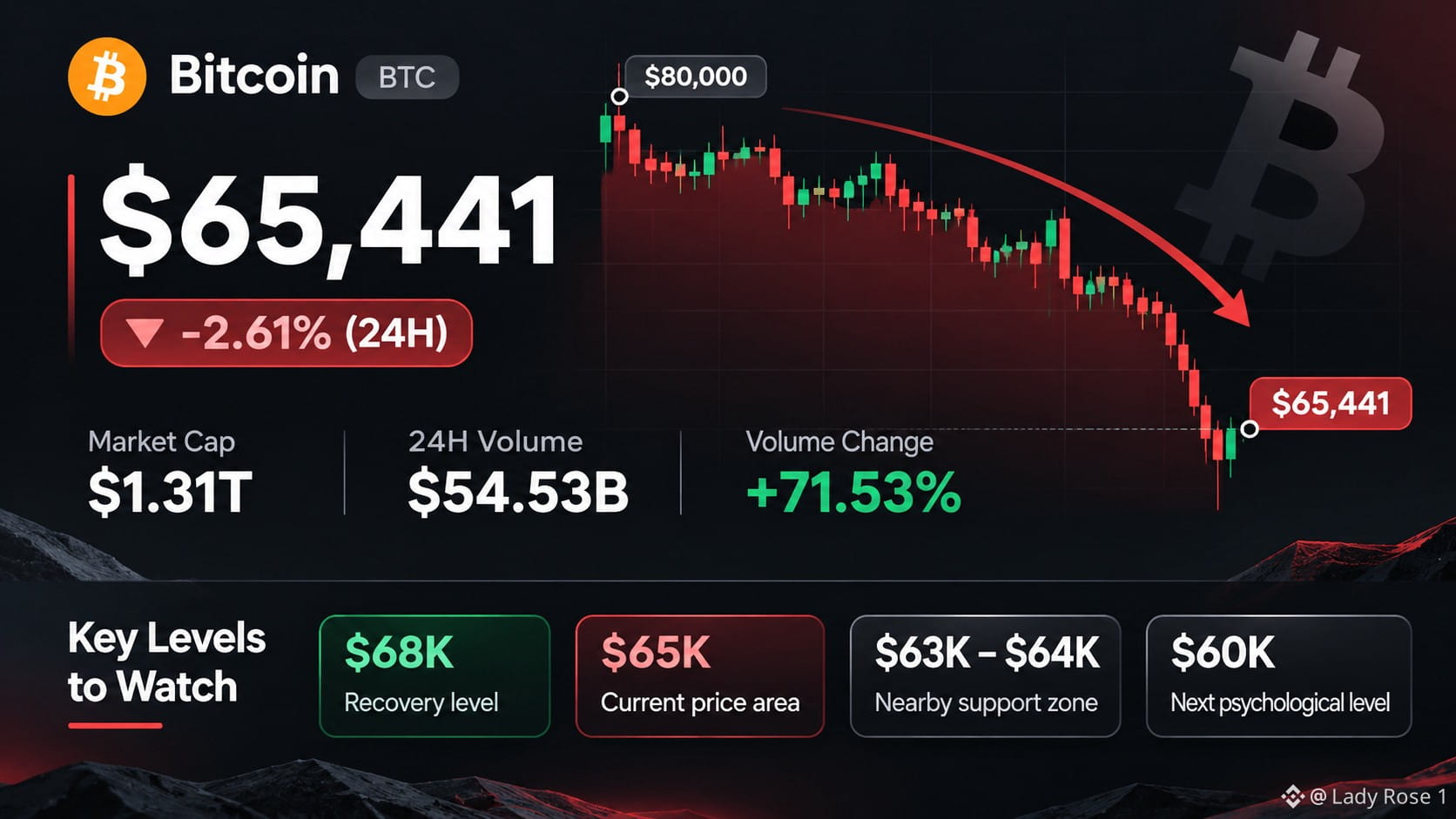
Bitcoin is now trading around $65.4K after falling from above $80K. That's a significant correction in just a few weeks. According to the latest CoinMarketCap data: • BTC price: $65,441.67 • 24h change: -2.61% • Market cap: $1.31T • 24h trading volume: $54.53B, up 71.53%. The sharp increase in trading volume is particularly interesting. It shows that market activity has intensified during the decline, with traders reacting to the latest price movements. Looking at the chart, Bitcoin has broken through several important price areas, including $80K, $76K, $72K and $68K. So, where could $BTC go from here? Here are the levels worth watching: • $65K: The current trading area. • $63K–$64K: A nearby zone to watch after the latest sell-off. • $60K: The next major psychological level if selling pressure continues. • $68K: An important level for buyers to reclaim to strengthen the recovery. The next move will depend on buying demand, market liquidity and broader economic conditions. After such a sharp correction, I'm watching how $BTC behaves around $63K–$65K. A sustained recovery could bring fresh confidence, while further selling could put $60K within reach.
Bitcoin is now trading around $65.4K after falling from above $80K. That's a significant correction in just a few weeks. According to the latest CoinMarketCap data: • BTC price: $65,441.67 • 24h change: -2.61% • Market cap: $1.31T • 24h trading volume: $54.53B, up 71.53%. The sharp increase in trading volume is particularly interesting. It shows that market activity has intensified during the decline, with traders reacting to the latest price movements. Looking at the chart, Bitcoin has broken through several important price areas, including $80K, $76K, $72K and $68K. So, where could $BTC go from here? Here are the levels worth watching: • $65K: The current trading area. • $63K–$64K: A nearby zone to watch after the latest sell-off. • $60K: The next major psychological level if selling pressure continues. • $68K: An important level for buyers to reclaim to strengthen the recovery. The next move will depend on buying demand, market liquidity and broader economic conditions. After such a sharp correction, I'm watching how $BTC behaves around $63K–$65K. A sustained recovery could bring fresh confidence, while further selling could put $60K within reach.
73
·
--
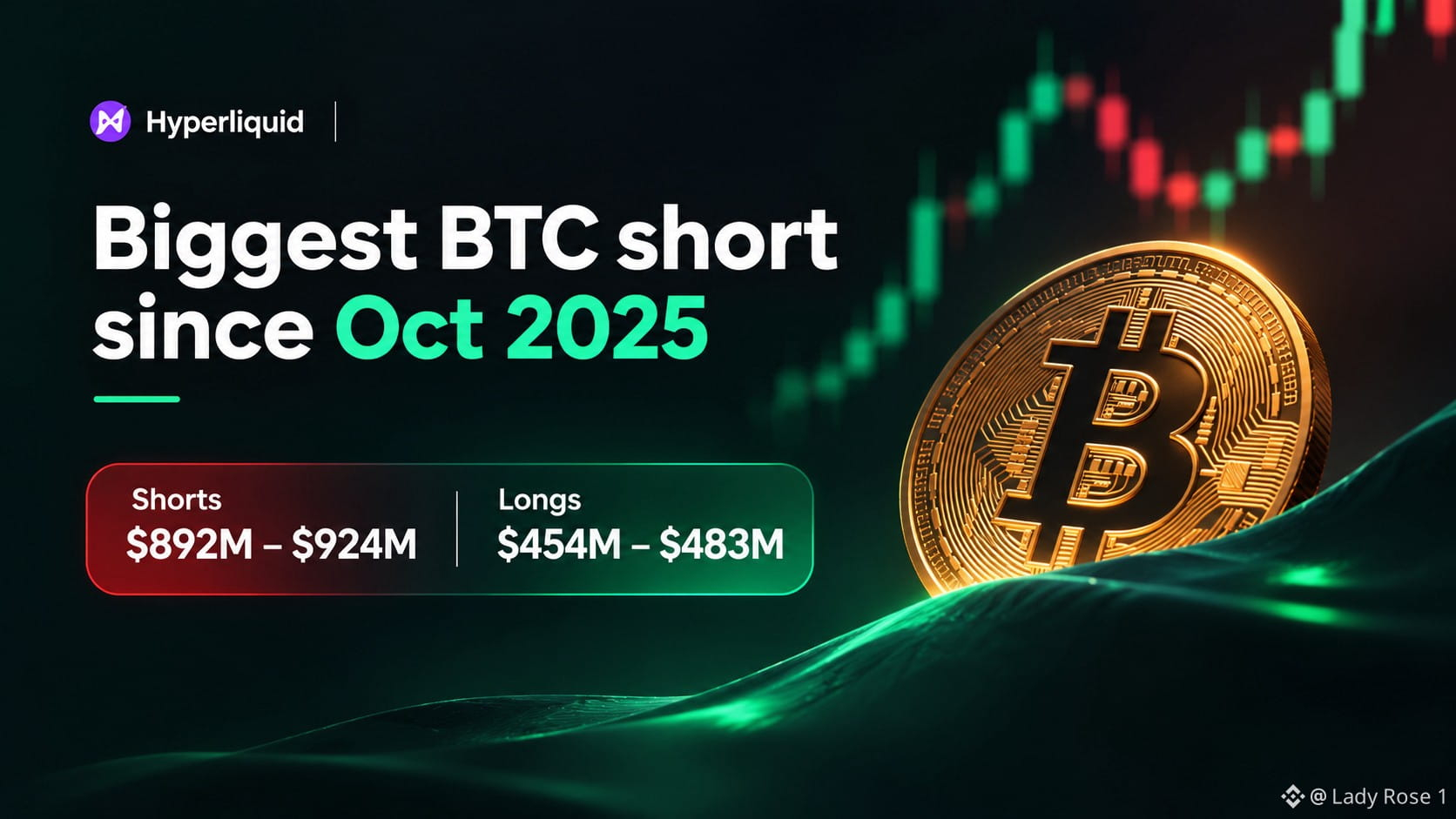
$BTC whales are taking their biggest bearish positions on Hyperliquid since October 2025. The latest figures show: • $892M–$924M in BTC shorts. • $454M–$483M in longs. • The largest individual short stands at around $178.5M, with an entry near $76.4K. This shift is particularly interesting because the last time whale shorts reached similar levels was in October 2025, ahead of Bitcoin's sharp sell-off. The current setup brings back that same bearish sentiment. With BTC trading below the major short entry zone, these positions are currently sitting in profit. However, the growing concentration of short positions also creates room for a potential squeeze. A sustained move above $76.4K could put pressure on short sellers and trigger a wave of buying as they close their positions. For now, whale positioning points to strong bearish conviction, while the possibility of a short squeeze keeps the upside scenario alive. October 2025 offers a useful comparison, but the coming price action will determine whether history repeats itself.
$BTC whales are taking their biggest bearish positions on Hyperliquid since October 2025. The latest figures show: • $892M–$924M in BTC shorts. • $454M–$483M in longs. • The largest individual short stands at around $178.5M, with an entry near $76.4K. This shift is particularly interesting because the last time whale shorts reached similar levels was in October 2025, ahead of Bitcoin's sharp sell-off. The current setup brings back that same bearish sentiment. With BTC trading below the major short entry zone, these positions are currently sitting in profit. However, the growing concentration of short positions also creates room for a potential squeeze. A sustained move above $76.4K could put pressure on short sellers and trigger a wave of buying as they close their positions. For now, whale positioning points to strong bearish conviction, while the possibility of a short squeeze keeps the upside scenario alive. October 2025 offers a useful comparison, but the coming price action will determine whether history repeats itself.
63
·
--
Collector Crypt is building a bridge between physical trading cards and digital ownership on Solana.
Its model is straightforward: graded physical cards are stored securely and represented by redeemable NFTs. Users can discover cards through Gacha packs, trade them on the marketplace, or redeem the physical collectible.
The business numbers are worth watching. In Q3 2026, Collector Crypt reported $433.5M in revenue and $25.4M in gross profit. Its cumulative platform revenue also passed $1B in August.
Market access is expanding too.
Upbit has opened $CARDS markets against KRW, BTC and USDT. Coinbase has added the token to its listing roadmap, although trading has yet to begin.
That creates interesting catalysts, but price momentum deserves a closer look. With $CARDS seeing increased trading activity, volatility can rise quickly around major exchange developments. I would watch volume, liquidity and price stability before considering an entry, rather than chasing a sudden move.
For anyone researching the token, Bitget Onchain offers a way to explore $CARDS directly through Bitget.
How to find it:
1. Open Bitget and go to Onchain.
2. Select the Solana network.
3. Paste the contract address: CARDSccUMFKoPRZxt5vt3ksUbxEFEcnZ3H2pd3dKxYjp
4. Verify the token and review the market details before making a decision.
Explore the project and follow its progress: https://coinmarketcap.com/currencies/collector-crypt/
Physical collectibles, digital ownership, and a growing market. $CARDS is an interesting project to keep on the radar.

·
--
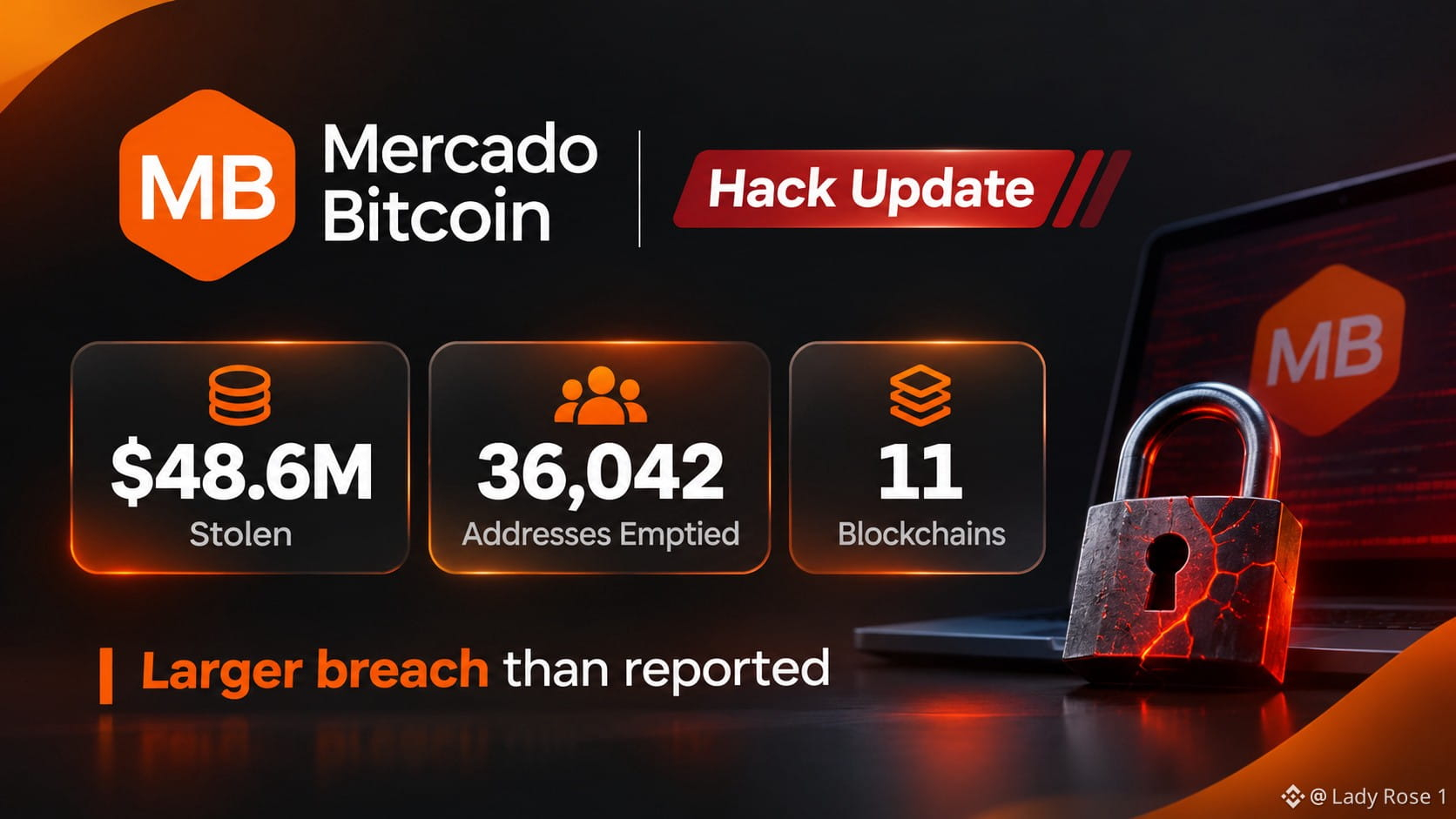
Mercado Bitcoin said its hack was contained. On-chain data tells a different story. According to Bitquery, the attacker continued draining customer deposit addresses for nearly four hours after the exchange's announcement. The investigation found: • 36,042 $ETH deposit addresses emptied. • $48.6 million stolen across 11 blockchains. • Around $11.8 million frozen by stablecoin issuers. That puts Bitquery's estimate above the roughly $38 million initially reported by the exchange. The most alarming detail? The attacker could sign transactions from customer deposit addresses, suggesting access to their private keys or the system managing them. Mercado $BTC says customers will be reimbursed, but withdrawals remain suspended. This incident raises a serious question about exchange security: how safe are customer funds when the platform's signing infrastructure is compromised?
Mercado Bitcoin said its hack was contained. On-chain data tells a different story. According to Bitquery, the attacker continued draining customer deposit addresses for nearly four hours after the exchange's announcement. The investigation found: • 36,042 $ETH deposit addresses emptied. • $48.6 million stolen across 11 blockchains. • Around $11.8 million frozen by stablecoin issuers. That puts Bitquery's estimate above the roughly $38 million initially reported by the exchange. The most alarming detail? The attacker could sign transactions from customer deposit addresses, suggesting access to their private keys or the system managing them. Mercado $BTC says customers will be reimbursed, but withdrawals remain suspended. This incident raises a serious question about exchange security: how safe are customer funds when the platform's signing infrastructure is compromised?
67
Log in to explore more content
Join global crypto users on Binance Square
⚡️ Get latest and useful information about crypto.
💬 Trusted by the world’s largest crypto exchange.
👍 Discover real insights from verified creators.
Email / Phone number
Trending Topics
AnthropicFallsBelow$83IPOPricePremarket
2,852 views
75 Discussing
TradFi News | Anthropic Falls 5% Premarket, Slipping Below Its $83 IPO Price
Binance News
·10 Likes
·6.3k views
NVDASoarsOnJensenReturn
42,610 views
692 Discussing
Bitcoin'sReboundFadesBelow$60K
37,682 views
241 Discussing