

BitcoinPierre
484 Posts

BitcoinPierre
Report
Block User
0 Following
12 Followers
42 Liked
Posts

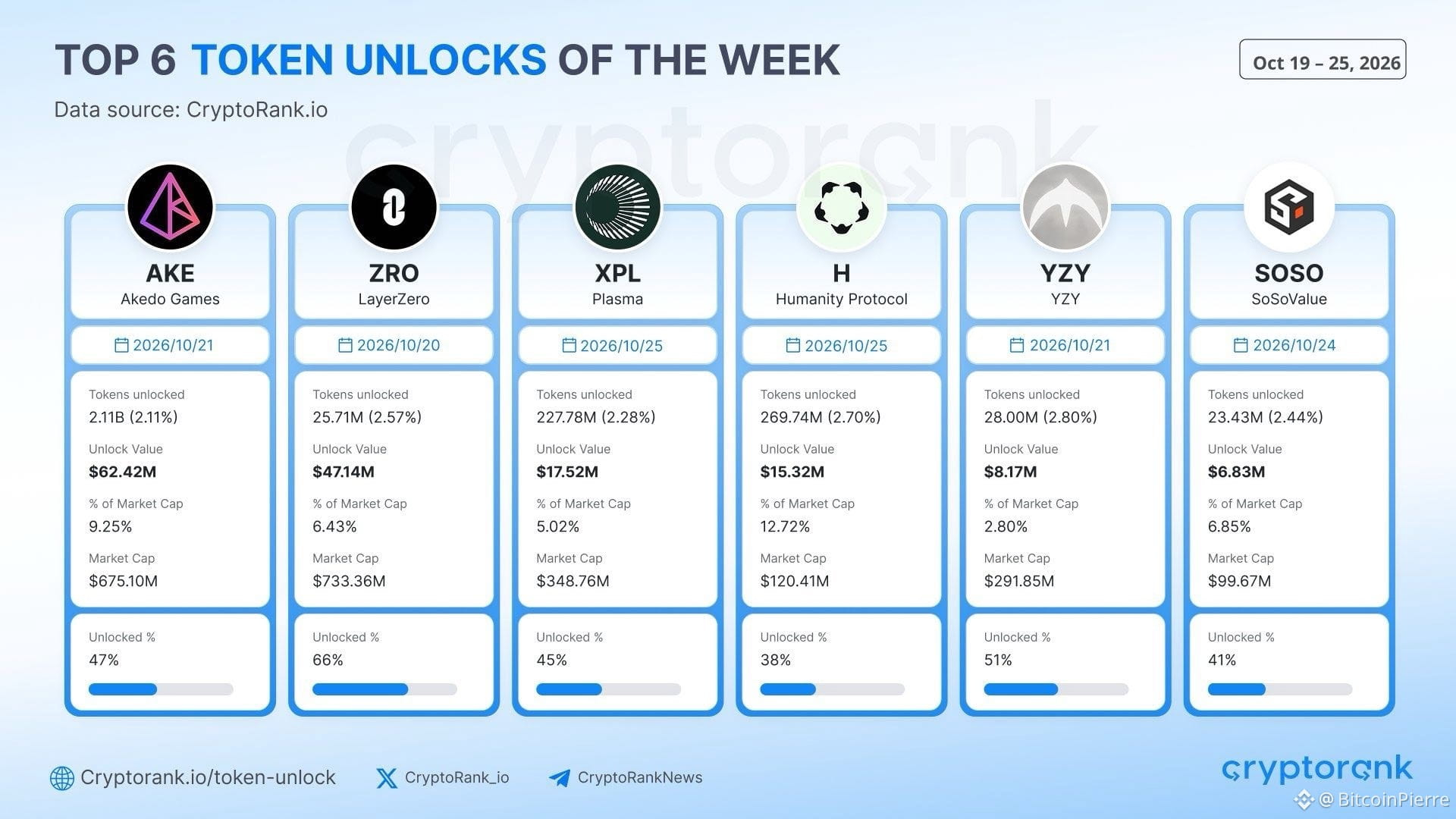
Several major token unlocks are scheduled for October 19–25, with AKE and ZRO leading the list.
The biggest unlocks by value:
* AKE — $62.42M
* ZRO — $47.14M
* XPL — $17.52M
* H — $15.32M
* YZY — $8.17M
* SOSO — $6.83M
The combined value is around $157.4 million, putting these tokens on traders’ watchlists this week.
Unlocks don’t automatically mean a price dump, but newly available supply can create selling pressure if recipients decide to take profits, especially when liquidity is limited.
Keep an eye on $AKE and $ZRO for the largest dollar value releases, and $H for its relatively large unlock compared with its market cap.
Will the market absorb the extra supply, or are these tokens heading into a volatile week?
#BTC Price Analysis# #Altcoin Season#
Several major token unlocks are scheduled for October 19–25, with AKE and ZRO leading the list.
The biggest unlocks by value:
* AKE — $62.42M
* ZRO — $47.14M
* XPL — $17.52M
* H — $15.32M
* YZY — $8.17M
* SOSO — $6.83M
The combined value is around $157.4 million, putting these tokens on traders’ watchlists this week.
Unlocks don’t automatically mean a price dump, but newly available supply can create selling pressure if recipients decide to take profits, especially when liquidity is limited.
Keep an eye on $AKE and $ZRO for the largest dollar value releases, and $H for its relatively large unlock compared with its market cap.
Will the market absorb the extra supply, or are these tokens heading into a volatile week?
#BTC Price Analysis# #Altcoin Season#
The biggest unlocks by value:
* AKE — $62.42M
* ZRO — $47.14M
* XPL — $17.52M
* H — $15.32M
* YZY — $8.17M
* SOSO — $6.83M
The combined value is around $157.4 million, putting these tokens on traders’ watchlists this week.
Unlocks don’t automatically mean a price dump, but newly available supply can create selling pressure if recipients decide to take profits, especially when liquidity is limited.
Keep an eye on $AKE and $ZRO for the largest dollar value releases, and $H for its relatively large unlock compared with its market cap.
Will the market absorb the extra supply, or are these tokens heading into a volatile week?
#BTC Price Analysis# #Altcoin Season#
49
SWITZERLAND APPROVES ITS FIRST RETAIL SPOT BITCOIN ETF
Switzerland’s financial regulator, FINMA, has approved the country’s first Bitcoin ETF open to retail investors, allowing the public to gain direct Bitcoin exposure through a regulated investment fund.
This is a significant step for Bitcoin adoption. Investors can access BTC through traditional investment infrastructure without having to manage private keys or hold Bitcoin directly themselves.
The headline also points to a potential market of 3.5 million investors. However, that doesn’t mean all of them will invest, and the claim of an average $750,000 per individual needs independent verification.
Another major financial market is opening the door to retail Bitcoin investment.
#BTC Price Analysis# #Macro Insights# $BTC
SWITZERLAND APPROVES ITS FIRST RETAIL SPOT BITCOIN ETF
Switzerland’s financial regulator, FINMA, has approved the country’s first Bitcoin ETF open to retail investors, allowing the public to gain direct Bitcoin exposure through a regulated investment fund.
This is a significant step for Bitcoin adoption. Investors can access BTC through traditional investment infrastructure without having to manage private keys or hold Bitcoin directly themselves.
The headline also points to a potential market of 3.5 million investors. However, that doesn’t mean all of them will invest, and the claim of an average $750,000 per individual needs independent verification.
Another major financial market is opening the door to retail Bitcoin investment.
#BTC Price Analysis# #Macro Insights# $BTC
Switzerland’s financial regulator, FINMA, has approved the country’s first Bitcoin ETF open to retail investors, allowing the public to gain direct Bitcoin exposure through a regulated investment fund.
This is a significant step for Bitcoin adoption. Investors can access BTC through traditional investment infrastructure without having to manage private keys or hold Bitcoin directly themselves.
The headline also points to a potential market of 3.5 million investors. However, that doesn’t mean all of them will invest, and the claim of an average $750,000 per individual needs independent verification.
Another major financial market is opening the door to retail Bitcoin investment.
#BTC Price Analysis# #Macro Insights# $BTC


52
🔥 STRATEGY ADDS ANOTHER $22.1M IN BITCOIN
Michael Saylor’s Strategy has purchased another 267 BTC for approximately $22.1 million, bringing its total holdings to a record 848,517 BTC.
The company paid an average of $82,900 per BTC in this latest purchase, continuing its accumulation strategy despite recent market volatility.
Strategy now holds Bitcoin acquired for roughly $64.02 billion, at an average cost of $75,446 per coin.
Another week, another Bitcoin purchase. Saylor is still stacking BTC.
#BTC Price Analysis# #Macro Insights# $BTC
🔥 STRATEGY ADDS ANOTHER $22.1M IN BITCOIN
Michael Saylor’s Strategy has purchased another 267 BTC for approximately $22.1 million, bringing its total holdings to a record 848,517 BTC.
The company paid an average of $82,900 per BTC in this latest purchase, continuing its accumulation strategy despite recent market volatility.
Strategy now holds Bitcoin acquired for roughly $64.02 billion, at an average cost of $75,446 per coin.
Another week, another Bitcoin purchase. Saylor is still stacking BTC.
#BTC Price Analysis# #Macro Insights# $BTC
Michael Saylor’s Strategy has purchased another 267 BTC for approximately $22.1 million, bringing its total holdings to a record 848,517 BTC.
The company paid an average of $82,900 per BTC in this latest purchase, continuing its accumulation strategy despite recent market volatility.
Strategy now holds Bitcoin acquired for roughly $64.02 billion, at an average cost of $75,446 per coin.
Another week, another Bitcoin purchase. Saylor is still stacking BTC.
#BTC Price Analysis# #Macro Insights# $BTC


50
Where do you see the market moving this week?
#BTC Price Analysis# #Macro Insights# $BTC $ETH
Where do you see the market moving this week?
#BTC Price Analysis# #Macro Insights# $BTC $ETH
#BTC Price Analysis# #Macro Insights# $BTC $ETH
71
Tom Lee believes crypto and other risk assets could be setting up for a recovery, even as investor sentiment turns increasingly fearful.
His argument is simple: prices have pulled back toward key support levels, but if the underlying fundamentals remain strong, the current weakness could create an attractive risk reward setup for investors.
Of course, fear alone doesn’t mean the bottom is in. The real test is whether fundamentals hold and buyers return.
The market is getting fearful. Lee believes that could be an opportunity rather than a warning.
#BTC Price Analysis# #Macro Insights# $ETH $BTC
Tom Lee believes crypto and other risk assets could be setting up for a recovery, even as investor sentiment turns increasingly fearful.
His argument is simple: prices have pulled back toward key support levels, but if the underlying fundamentals remain strong, the current weakness could create an attractive risk reward setup for investors.
Of course, fear alone doesn’t mean the bottom is in. The real test is whether fundamentals hold and buyers return.
The market is getting fearful. Lee believes that could be an opportunity rather than a warning.
#BTC Price Analysis# #Macro Insights# $ETH $BTC
His argument is simple: prices have pulled back toward key support levels, but if the underlying fundamentals remain strong, the current weakness could create an attractive risk reward setup for investors.
Of course, fear alone doesn’t mean the bottom is in. The real test is whether fundamentals hold and buyers return.
The market is getting fearful. Lee believes that could be an opportunity rather than a warning.
#BTC Price Analysis# #Macro Insights# $ETH $BTC


78
Visa is expanding stablecoin adoption with USDC powered payouts through Visa Direct, targeting near instant transfers across more than 180 countries.
The move could make cross-border payments faster by using blockchain-based dollar transfers rather than relying entirely on traditional banking settlement systems.
For businesses and payment providers, the potential benefit is quicker access to funds and more flexible international payouts. For USDC, it creates another route into real-world payment infrastructure beyond crypto trading and DeFi.
Stablecoins are moving beyond exchanges and into everyday financial services.
#BTC Price Analysis# #Macro Insights# $BTC $USDC
Visa is expanding stablecoin adoption with USDC powered payouts through Visa Direct, targeting near instant transfers across more than 180 countries.
The move could make cross-border payments faster by using blockchain-based dollar transfers rather than relying entirely on traditional banking settlement systems.
For businesses and payment providers, the potential benefit is quicker access to funds and more flexible international payouts. For USDC, it creates another route into real-world payment infrastructure beyond crypto trading and DeFi.
Stablecoins are moving beyond exchanges and into everyday financial services.
#BTC Price Analysis# #Macro Insights# $BTC $USDC
The move could make cross-border payments faster by using blockchain-based dollar transfers rather than relying entirely on traditional banking settlement systems.
For businesses and payment providers, the potential benefit is quicker access to funds and more flexible international payouts. For USDC, it creates another route into real-world payment infrastructure beyond crypto trading and DeFi.
Stablecoins are moving beyond exchanges and into everyday financial services.
#BTC Price Analysis# #Macro Insights# $BTC $USDC


81
A fake website can look almost identical to the real one. A fraudulent reward link can seem convincing, and a wallet request can appear harmless until you realise what you’ve approved.
These are some of the tricks scammers use in DeFi, where a single careless action can put your funds at risk.
When using Stonfi, start by bookmarking its official website so you can return to the correct page without relying on random links. Treat unsolicited DMs, unexpected reward offers and messages urging you to act quickly as potential threats.
Never share your seed phrase or private keys, even with someone claiming to be a support agent. Before signing a wallet request, read the prompt carefully and make sure you understand what you’re authorising.
Also, verify token contract addresses and destination addresses before completing a transaction. Token names and logos can be copied, so don’t rely on appearances alone.
If something seems suspicious, stop interacting and reach out through Stonfi’s official support channels. Never trust contact details sent by an unknown account.
Staying safe doesn’t require complicated tools. It starts with slowing down, checking the details and refusing to approve anything you don’t understand.
Learn more about dex and staysafe while using them: https://whatisdex.com/
#BTC Price Analysis# #Macro Insights# $GRAM $AGT
A fake website can look almost identical to the real one. A fraudulent reward link can seem convincing, and a wallet request can appear harmless until you realise what you’ve approved.
These are some of the tricks scammers use in DeFi, where a single careless action can put your funds at risk.
When using Stonfi, start by bookmarking its official website so you can return to the correct page without relying on random links. Treat unsolicited DMs, unexpected reward offers and messages urging you to act quickly as potential threats.
Never share your seed phrase or private keys, even with someone claiming to be a support agent. Before signing a wallet request, read the prompt carefully and make sure you understand what you’re authorising.
Also, verify token contract addresses and destination addresses before completing a transaction. Token names and logos can be copied, so don’t rely on appearances alone.
If something seems suspicious, stop interacting and reach out through Stonfi’s official support channels. Never trust contact details sent by an unknown account.
Staying safe doesn’t require complicated tools. It starts with slowing down, checking the details and refusing to approve anything you don’t understand.
Learn more about dex and staysafe while using them: https://whatisdex.com/
#BTC Price Analysis# #Macro Insights# $GRAM $AGT
These are some of the tricks scammers use in DeFi, where a single careless action can put your funds at risk.
When using Stonfi, start by bookmarking its official website so you can return to the correct page without relying on random links. Treat unsolicited DMs, unexpected reward offers and messages urging you to act quickly as potential threats.
Never share your seed phrase or private keys, even with someone claiming to be a support agent. Before signing a wallet request, read the prompt carefully and make sure you understand what you’re authorising.
Also, verify token contract addresses and destination addresses before completing a transaction. Token names and logos can be copied, so don’t rely on appearances alone.
If something seems suspicious, stop interacting and reach out through Stonfi’s official support channels. Never trust contact details sent by an unknown account.
Staying safe doesn’t require complicated tools. It starts with slowing down, checking the details and refusing to approve anything you don’t understand.
Learn more about dex and staysafe while using them: https://whatisdex.com/
#BTC Price Analysis# #Macro Insights# $GRAM $AGT

76
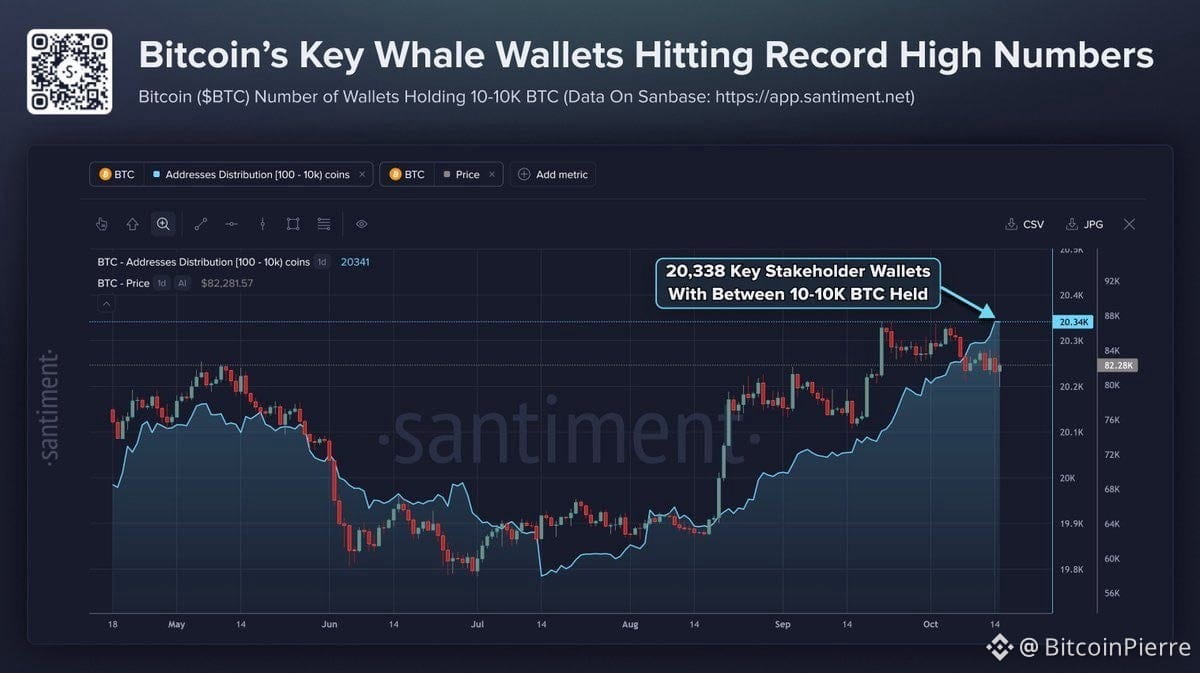
The number of Bitcoin wallets holding between 10 and 10,000 BTC has reached an all time high of 20,338, with the count climbing steadily since mid July despite ongoing price volatility.
This is worth watching because these wallets represent a broad group of substantial Bitcoin holders. Their continued growth could indicate that larger market participants are accumulating or that more wallets are moving into these balance ranges.
However, wallet numbers alone don’t confirm net accumulation. One holder can split funds across multiple wallets, and exchange movements can also affect the figures.
The key signal is whether this growth continues alongside rising BTC balances and stronger demand. If it does, it could point to growing conviction among larger holders.
#BTC Price Analysis# #Macro Insights# $BTC $ETH
The number of Bitcoin wallets holding between 10 and 10,000 BTC has reached an all time high of 20,338, with the count climbing steadily since mid July despite ongoing price volatility.
This is worth watching because these wallets represent a broad group of substantial Bitcoin holders. Their continued growth could indicate that larger market participants are accumulating or that more wallets are moving into these balance ranges.
However, wallet numbers alone don’t confirm net accumulation. One holder can split funds across multiple wallets, and exchange movements can also affect the figures.
The key signal is whether this growth continues alongside rising BTC balances and stronger demand. If it does, it could point to growing conviction among larger holders.
#BTC Price Analysis# #Macro Insights# $BTC $ETH
This is worth watching because these wallets represent a broad group of substantial Bitcoin holders. Their continued growth could indicate that larger market participants are accumulating or that more wallets are moving into these balance ranges.
However, wallet numbers alone don’t confirm net accumulation. One holder can split funds across multiple wallets, and exchange movements can also affect the figures.
The key signal is whether this growth continues alongside rising BTC balances and stronger demand. If it does, it could point to growing conviction among larger holders.
#BTC Price Analysis# #Macro Insights# $BTC $ETH
62
Charles Schwab, with $13.4 trillion in client assets and 40.1 million active brokerage accounts, has completed its rollout of direct Bitcoin and Ethereum trading to eligible U.S. retail clients.
This is a major step for crypto adoption. Schwab gives investors access to BTC and ETH alongside their traditional investments, making crypto easier to access without relying on a dedicated crypto exchange.
The scale is what makes this significant. Even a small portion of Schwab’s massive client base exploring crypto could bring substantial new demand into the market.
Bitcoin and Ethereum are moving deeper into traditional finance. The question is how many of Schwab’s millions of clients will take the opportunity.
#BTC Price Analysis# #Macro Insights# $BTC $ETH
Charles Schwab, with $13.4 trillion in client assets and 40.1 million active brokerage accounts, has completed its rollout of direct Bitcoin and Ethereum trading to eligible U.S. retail clients.
This is a major step for crypto adoption. Schwab gives investors access to BTC and ETH alongside their traditional investments, making crypto easier to access without relying on a dedicated crypto exchange.
The scale is what makes this significant. Even a small portion of Schwab’s massive client base exploring crypto could bring substantial new demand into the market.
Bitcoin and Ethereum are moving deeper into traditional finance. The question is how many of Schwab’s millions of clients will take the opportunity.
#BTC Price Analysis# #Macro Insights# $BTC $ETH
This is a major step for crypto adoption. Schwab gives investors access to BTC and ETH alongside their traditional investments, making crypto easier to access without relying on a dedicated crypto exchange.
The scale is what makes this significant. Even a small portion of Schwab’s massive client base exploring crypto could bring substantial new demand into the market.
Bitcoin and Ethereum are moving deeper into traditional finance. The question is how many of Schwab’s millions of clients will take the opportunity.
#BTC Price Analysis# #Macro Insights# $BTC $ETH


156
Arthur Hayes is taking a different approach to the AI bubble debate. Instead of trying to predict when AI stocks will crash, he believes the bigger opportunity could come from the multi trillion dollar bailout that might follow.
His thesis is that excessive AI infrastructure spending could eventually lead to a major downturn, forcing governments to inject liquidity into the financial system.
Hayes believes Bitcoin and Ethereum could benefit from that response as investors look for assets that may appreciate when liquidity expands.
Of course, the crash and bailout remain a forecast, not a certainty. But his strategy is clear, don’t gamble on when the bubble bursts, position for what might happen afterward.
#BTC Price Analysis# #Macro Insights# $BTC $ETH
Arthur Hayes is taking a different approach to the AI bubble debate. Instead of trying to predict when AI stocks will crash, he believes the bigger opportunity could come from the multi trillion dollar bailout that might follow.
His thesis is that excessive AI infrastructure spending could eventually lead to a major downturn, forcing governments to inject liquidity into the financial system.
Hayes believes Bitcoin and Ethereum could benefit from that response as investors look for assets that may appreciate when liquidity expands.
Of course, the crash and bailout remain a forecast, not a certainty. But his strategy is clear, don’t gamble on when the bubble bursts, position for what might happen afterward.
#BTC Price Analysis# #Macro Insights# $BTC $ETH
His thesis is that excessive AI infrastructure spending could eventually lead to a major downturn, forcing governments to inject liquidity into the financial system.
Hayes believes Bitcoin and Ethereum could benefit from that response as investors look for assets that may appreciate when liquidity expands.
Of course, the crash and bailout remain a forecast, not a certainty. But his strategy is clear, don’t gamble on when the bubble bursts, position for what might happen afterward.
#BTC Price Analysis# #Macro Insights# $BTC $ETH

43
Vitalik Buterin says the top priority for zkEVMs should now shift to security following ZKsync’s Airbender milestone, which demonstrated real time proof generation on a single GPU.
Airbender reportedly generated proofs for 99% of 7,200 consecutive Ethereum blocks in under 10 seconds. That’s a major step toward making zero knowledge proofs practical at Ethereum’s pace.
But speed alone isn’t enough. Vitalik wants stronger formal verification, accurate execution of Ethereum’s specifications, and proof systems that can be trusted.
The next challenge isn’t just proving transactions faster. It’s proving they’re correct and secure.
#Ethereum #Macro Insights# $ETH
Vitalik Buterin says the top priority for zkEVMs should now shift to security following ZKsync’s Airbender milestone, which demonstrated real time proof generation on a single GPU.
Airbender reportedly generated proofs for 99% of 7,200 consecutive Ethereum blocks in under 10 seconds. That’s a major step toward making zero knowledge proofs practical at Ethereum’s pace.
But speed alone isn’t enough. Vitalik wants stronger formal verification, accurate execution of Ethereum’s specifications, and proof systems that can be trusted.
The next challenge isn’t just proving transactions faster. It’s proving they’re correct and secure.
#Ethereum #Macro Insights# $ETH
Airbender reportedly generated proofs for 99% of 7,200 consecutive Ethereum blocks in under 10 seconds. That’s a major step toward making zero knowledge proofs practical at Ethereum’s pace.
But speed alone isn’t enough. Vitalik wants stronger formal verification, accurate execution of Ethereum’s specifications, and proof systems that can be trusted.
The next challenge isn’t just proving transactions faster. It’s proving they’re correct and secure.
#Ethereum #Macro Insights# $ETH


63
Finding a token you want to hold is one thing. Knowing how to exchange it safely, without moving your funds through a centralized exchange, is another.
On TON, you can swap directly from a compatible wallet using a decentralized exchange (DEX). You keep control of your assets and approve the transaction yourself rather than depositing funds into an exchange account.
Stonfi makes this process straightforward, and this is how its done.. Connect your wallet, choose the token you’re selling and the one you want to receive, enter the amount, then review the quote before confirming. Through Omniston, swaps can be routed across connected TON liquidity sources, depending on availability.
The price deserves attention, too. Unlike a centralized exchange order book, a DEX may use liquidity pools to facilitate trades. The amount you receive can change with pool depth, trade size, fees and price impact. A token’s displayed market price doesn’t always match the final swap rate.
Before signing, check the estimated output, slippage tolerance, minimum received and network fee. Make sure you’re using the genuine website and the correct token. Keep some TON available for transaction costs, and never share your recovery phrase.
A few seconds spent reviewing the details can help you avoid an expensive mistake.
Swap smoothly in less than a second with stonfi: https://ston.fi/cross-chain-swap-from-ton-to-base
#BTC Price Analysis# #Macro Insights# $GRAM $PUFFER
Finding a token you want to hold is one thing. Knowing how to exchange it safely, without moving your funds through a centralized exchange, is another.
On TON, you can swap directly from a compatible wallet using a decentralized exchange (DEX). You keep control of your assets and approve the transaction yourself rather than depositing funds into an exchange account.
Stonfi makes this process straightforward, and this is how its done.. Connect your wallet, choose the token you’re selling and the one you want to receive, enter the amount, then review the quote before confirming. Through Omniston, swaps can be routed across connected TON liquidity sources, depending on availability.
The price deserves attention, too. Unlike a centralized exchange order book, a DEX may use liquidity pools to facilitate trades. The amount you receive can change with pool depth, trade size, fees and price impact. A token’s displayed market price doesn’t always match the final swap rate.
Before signing, check the estimated output, slippage tolerance, minimum received and network fee. Make sure you’re using the genuine website and the correct token. Keep some TON available for transaction costs, and never share your recovery phrase.
A few seconds spent reviewing the details can help you avoid an expensive mistake.
Swap smoothly in less than a second with stonfi: https://ston.fi/cross-chain-swap-from-ton-to-base
#BTC Price Analysis# #Macro Insights# $GRAM $PUFFER
On TON, you can swap directly from a compatible wallet using a decentralized exchange (DEX). You keep control of your assets and approve the transaction yourself rather than depositing funds into an exchange account.
Stonfi makes this process straightforward, and this is how its done.. Connect your wallet, choose the token you’re selling and the one you want to receive, enter the amount, then review the quote before confirming. Through Omniston, swaps can be routed across connected TON liquidity sources, depending on availability.
The price deserves attention, too. Unlike a centralized exchange order book, a DEX may use liquidity pools to facilitate trades. The amount you receive can change with pool depth, trade size, fees and price impact. A token’s displayed market price doesn’t always match the final swap rate.
Before signing, check the estimated output, slippage tolerance, minimum received and network fee. Make sure you’re using the genuine website and the correct token. Keep some TON available for transaction costs, and never share your recovery phrase.
A few seconds spent reviewing the details can help you avoid an expensive mistake.
Swap smoothly in less than a second with stonfi: https://ston.fi/cross-chain-swap-from-ton-to-base
#BTC Price Analysis# #Macro Insights# $GRAM $PUFFER
82
🔥 BITCOIN SENTIMENT IS AT ITS MOST BULLISH SINCE AUGUST 2025
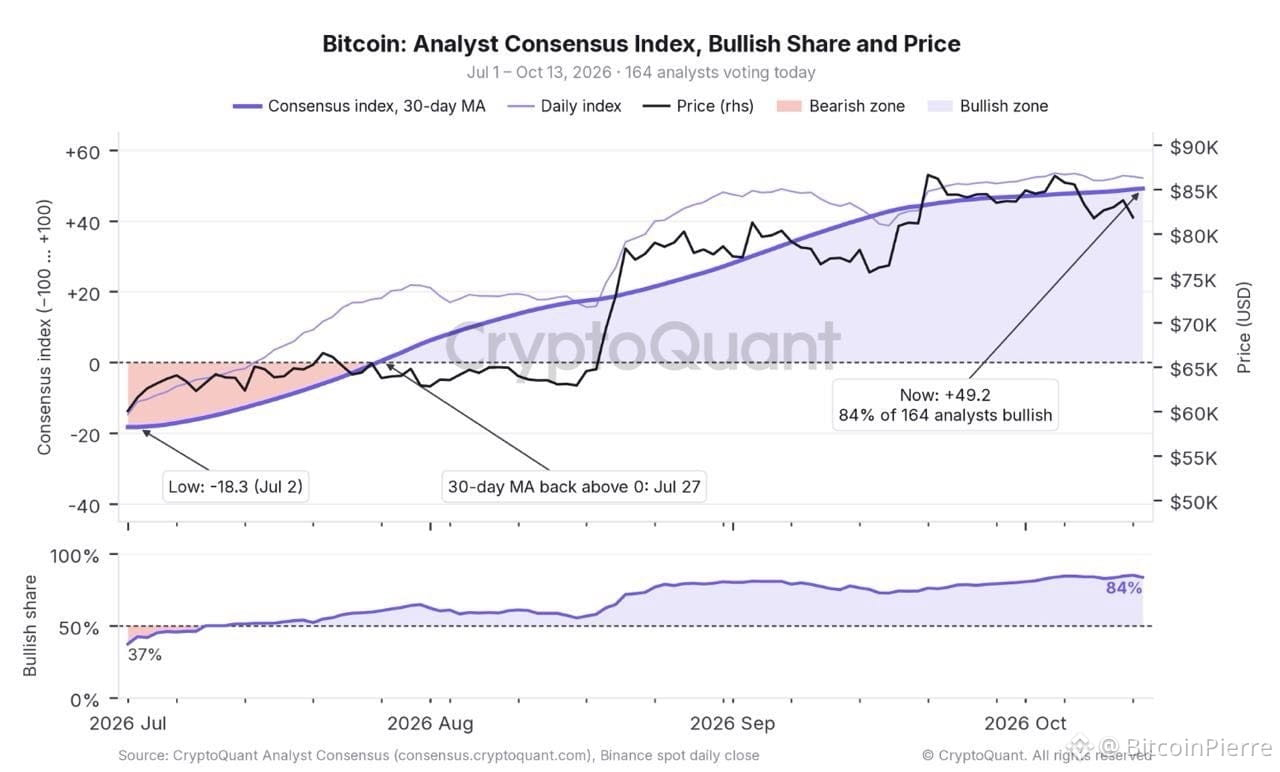
CryptoQuant’s latest analyst survey shows a major shift in market sentiment. 84% of 164 tracked analysts are now bullish on Bitcoin, up sharply from just 37% in July.
The change is significant: 47 analysts have flipped from bearish to bullish, while only five moved in the opposite direction. Even macro analysts have shifted dramatically, with bullish sentiment climbing from 6% to 94%.
On chain analysts, the largest group tracked, are now 79% bullish.
But here’s the part worth watching: when sentiment becomes this one sided, expectations rise alongside the potential for disappointment.
Analysts are increasingly convinced. Now Bitcoin needs price action and demand to back up that confidence.
#BTC Price Analysis# #Macro Insights# $BTC $ETH
🔥 BITCOIN SENTIMENT IS AT ITS MOST BULLISH SINCE AUGUST 2025
CryptoQuant’s latest analyst survey shows a major shift in market sentiment. 84% of 164 tracked analysts are now bullish on Bitcoin, up sharply from just 37% in July.
The change is significant: 47 analysts have flipped from bearish to bullish, while only five moved in the opposite direction. Even macro analysts have shifted dramatically, with bullish sentiment climbing from 6% to 94%.
On chain analysts, the largest group tracked, are now 79% bullish.
But here’s the part worth watching: when sentiment becomes this one sided, expectations rise alongside the potential for disappointment.
Analysts are increasingly convinced. Now Bitcoin needs price action and demand to back up that confidence.
#BTC Price Analysis# #Macro Insights# $BTC $ETH
CryptoQuant’s latest analyst survey shows a major shift in market sentiment. 84% of 164 tracked analysts are now bullish on Bitcoin, up sharply from just 37% in July.
The change is significant: 47 analysts have flipped from bearish to bullish, while only five moved in the opposite direction. Even macro analysts have shifted dramatically, with bullish sentiment climbing from 6% to 94%.
On chain analysts, the largest group tracked, are now 79% bullish.
But here’s the part worth watching: when sentiment becomes this one sided, expectations rise alongside the potential for disappointment.
Analysts are increasingly convinced. Now Bitcoin needs price action and demand to back up that confidence.
#BTC Price Analysis# #Macro Insights# $BTC $ETH
57
🔥STRIVE ADDS ANOTHER $235M IN BITCOIN
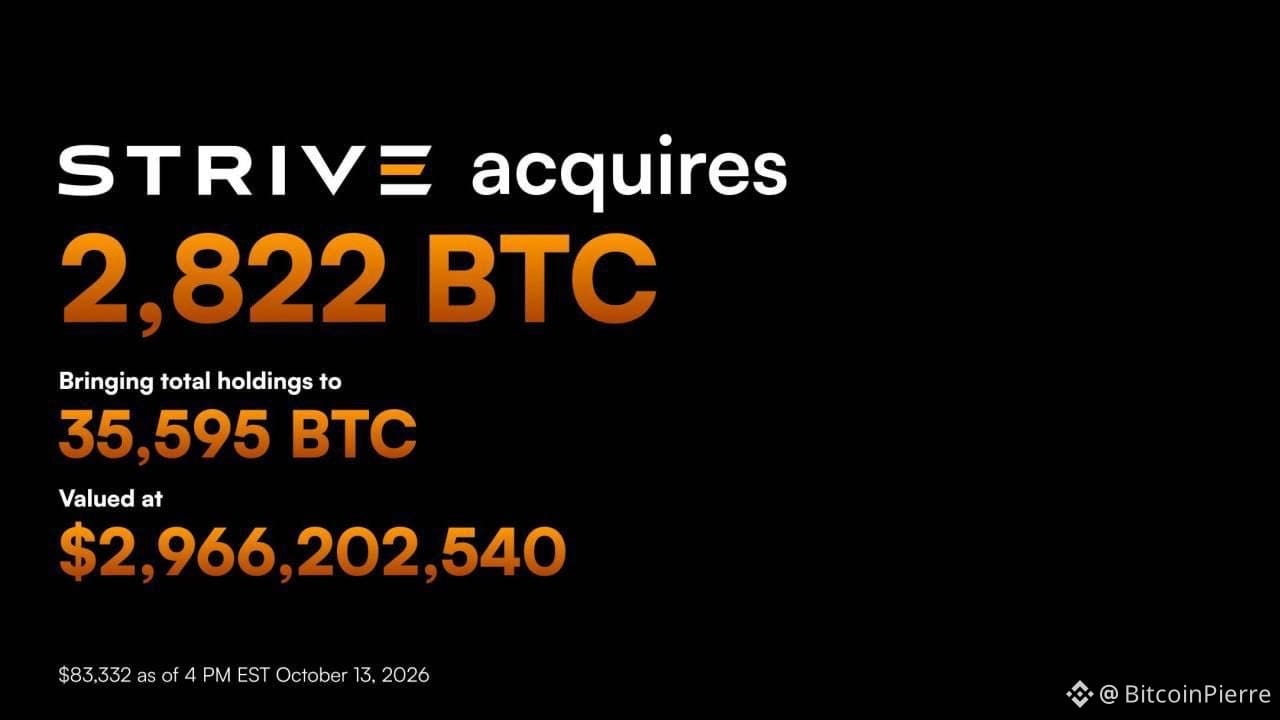
Strive has purchased another 2,822 BTC for approximately $235 million, bringing its total Bitcoin holdings to 35,595 BTC.
The latest acquisition shows that Strive is continuing to expand its Bitcoin treasury, adding thousands of BTC in a single move rather than slowing its accumulation strategy.
At an average purchase price of roughly $83,274 per BTC, this is a significant capital commitment. For Bitcoin watchers, the important detail is not just the size of the purchase, but the growing number of companies choosing to hold BTC as a long term treasury asset.
Corporate accumulation doesn’t guarantee higher prices, but purchases of this scale show that some companies are still willing to make substantial bets on Bitcoin despite market uncertainty.
Another 2,822 BTC off the market. Strive now holds 35,595 BTC.
#BTC Price Analysis# #Macro Insights# $BTC $ETH
🔥STRIVE ADDS ANOTHER $235M IN BITCOIN
Strive has purchased another 2,822 BTC for approximately $235 million, bringing its total Bitcoin holdings to 35,595 BTC.
The latest acquisition shows that Strive is continuing to expand its Bitcoin treasury, adding thousands of BTC in a single move rather than slowing its accumulation strategy.
At an average purchase price of roughly $83,274 per BTC, this is a significant capital commitment. For Bitcoin watchers, the important detail is not just the size of the purchase, but the growing number of companies choosing to hold BTC as a long term treasury asset.
Corporate accumulation doesn’t guarantee higher prices, but purchases of this scale show that some companies are still willing to make substantial bets on Bitcoin despite market uncertainty.
Another 2,822 BTC off the market. Strive now holds 35,595 BTC.
#BTC Price Analysis# #Macro Insights# $BTC $ETH
Strive has purchased another 2,822 BTC for approximately $235 million, bringing its total Bitcoin holdings to 35,595 BTC.
The latest acquisition shows that Strive is continuing to expand its Bitcoin treasury, adding thousands of BTC in a single move rather than slowing its accumulation strategy.
At an average purchase price of roughly $83,274 per BTC, this is a significant capital commitment. For Bitcoin watchers, the important detail is not just the size of the purchase, but the growing number of companies choosing to hold BTC as a long term treasury asset.
Corporate accumulation doesn’t guarantee higher prices, but purchases of this scale show that some companies are still willing to make substantial bets on Bitcoin despite market uncertainty.
Another 2,822 BTC off the market. Strive now holds 35,595 BTC.
#BTC Price Analysis# #Macro Insights# $BTC $ETH
65
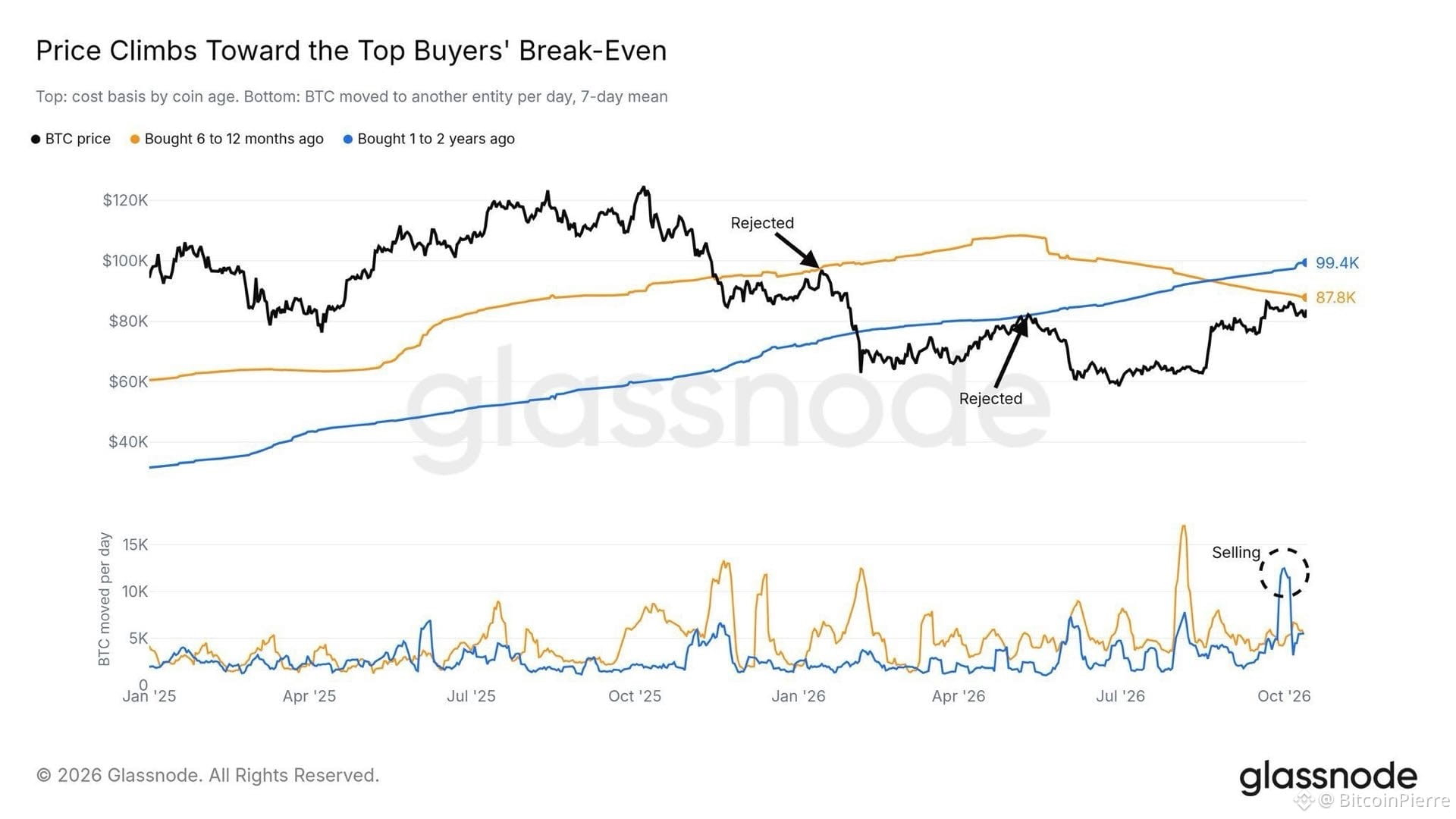
🚨 BITCOIN APPROACHES A CRITICAL $87,800 LEVEL
Glassnode data shows BTC is nearing the break-even price for investors who bought Bitcoin 6–12 months ago, while selling activity is increasing among holders who entered 1–2 years ago.
This creates an important test for the market. If Bitcoin reaches $87,800, some recent holders could finally exit without a loss, potentially adding selling pressure. Meanwhile, older holders are already showing signs of taking profits or reducing exposure.
The key is how BTC reacts at this level. If buyers absorb the selling and price pushes through, it could strengthen the recovery. If demand weakens, the market may struggle to break higher.
Bitcoin is approaching a level where investor behavior could decide the next move.
#BTC Price Analysis# #Macro Insights# $BTC $ETH
🚨 BITCOIN APPROACHES A CRITICAL $87,800 LEVEL
Glassnode data shows BTC is nearing the break-even price for investors who bought Bitcoin 6–12 months ago, while selling activity is increasing among holders who entered 1–2 years ago.
This creates an important test for the market. If Bitcoin reaches $87,800, some recent holders could finally exit without a loss, potentially adding selling pressure. Meanwhile, older holders are already showing signs of taking profits or reducing exposure.
The key is how BTC reacts at this level. If buyers absorb the selling and price pushes through, it could strengthen the recovery. If demand weakens, the market may struggle to break higher.
Bitcoin is approaching a level where investor behavior could decide the next move.
#BTC Price Analysis# #Macro Insights# $BTC $ETH
Glassnode data shows BTC is nearing the break-even price for investors who bought Bitcoin 6–12 months ago, while selling activity is increasing among holders who entered 1–2 years ago.
This creates an important test for the market. If Bitcoin reaches $87,800, some recent holders could finally exit without a loss, potentially adding selling pressure. Meanwhile, older holders are already showing signs of taking profits or reducing exposure.
The key is how BTC reacts at this level. If buyers absorb the selling and price pushes through, it could strengthen the recovery. If demand weakens, the market may struggle to break higher.
Bitcoin is approaching a level where investor behavior could decide the next move.
#BTC Price Analysis# #Macro Insights# $BTC $ETH
55
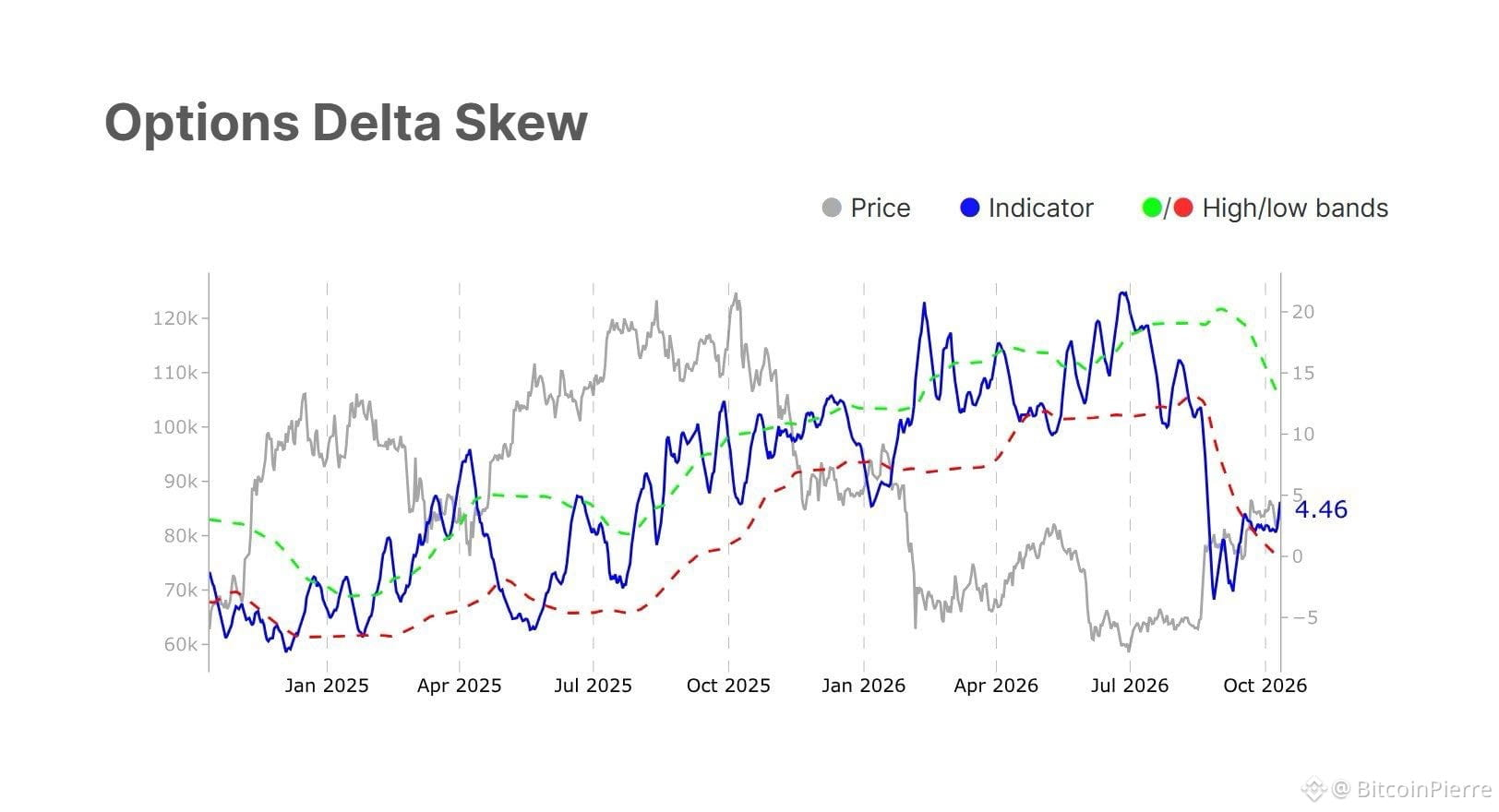
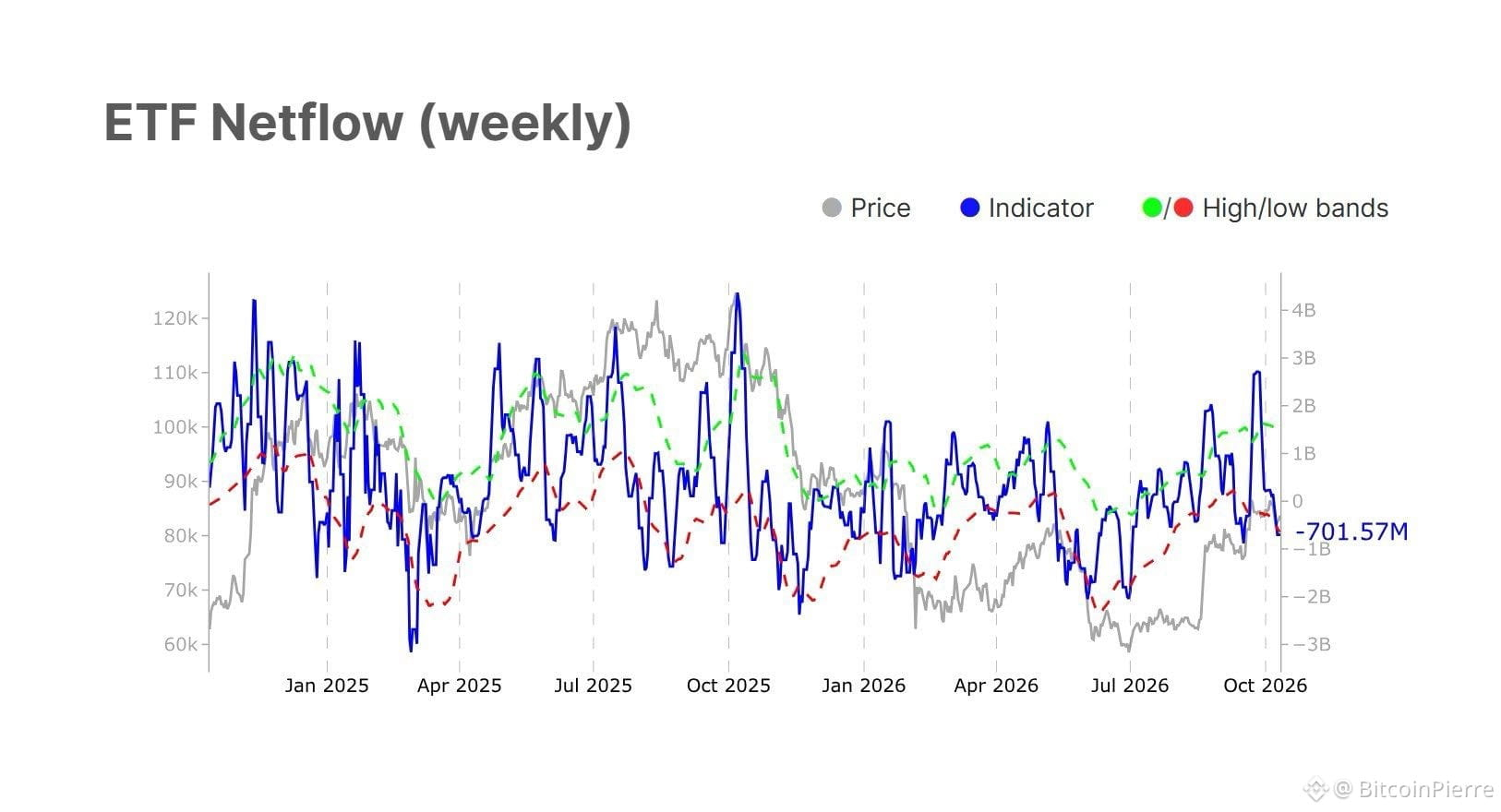
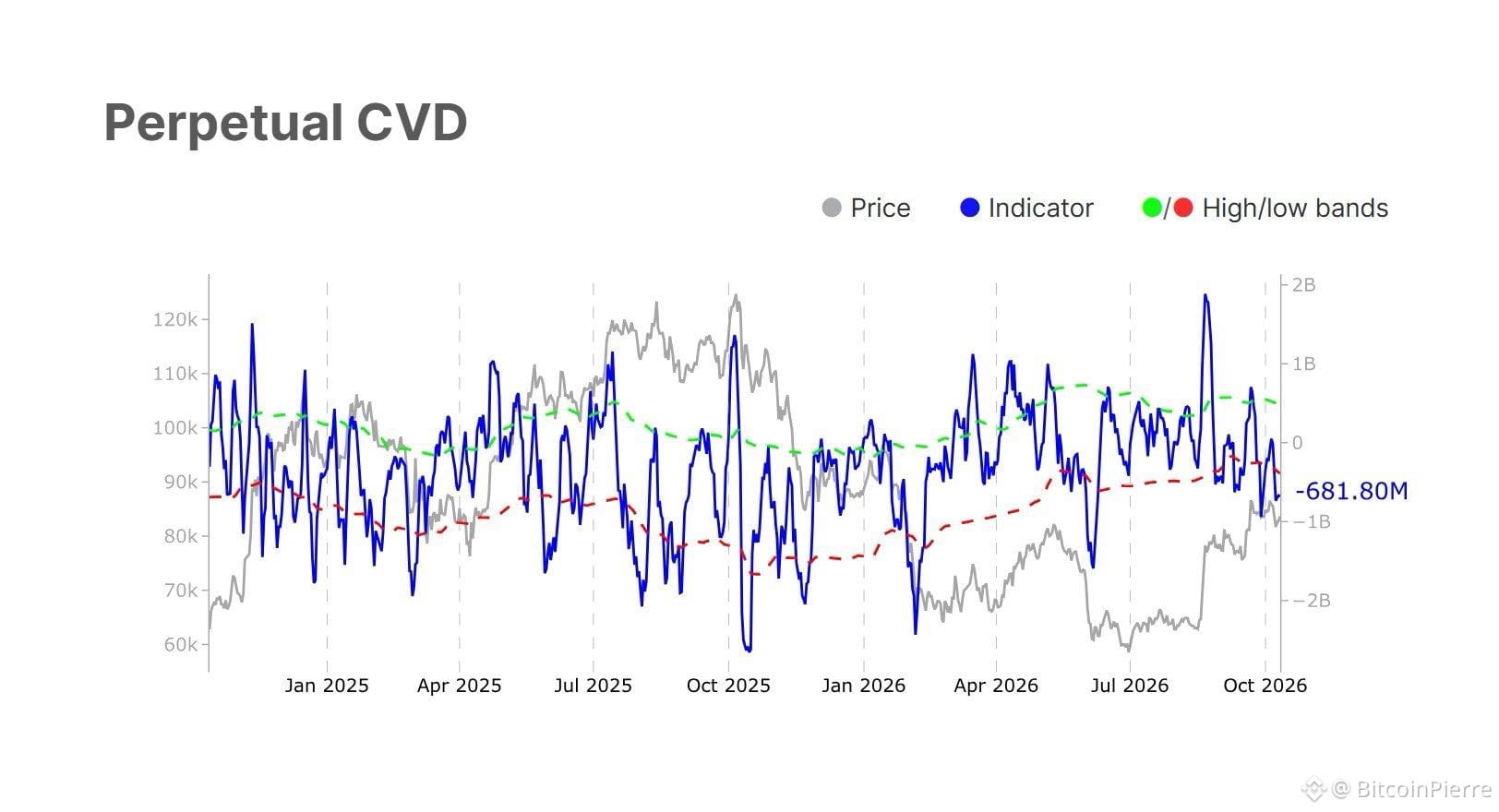
Bitcoin is trading just below $83,000 after a mid week sell off erased much of the momentum from its September breakout.
Perpetual futures traders and ETF investors have been among the main sources of selling, putting pressure on BTC despite fresh capital continuing to enter the market on chain.
The interesting part is the divergence. New money is still arriving, but existing holders are facing stretched profitability, increasing the potential incentive to take profits. That creates a battle between fresh demand and selling from investors already sitting on gains.
For bulls, reclaiming $83K would help restore confidence in the breakout. If selling continues, however, Bitcoin could face further downside before finding a stable base.
Fresh capital is coming in, but sellers are still in control of the short term momentum. Which side wins next?
#BTC Price Analysis# #Macro Insights# $BTC $ETH
Bitcoin is trading just below $83,000 after a mid week sell off erased much of the momentum from its September breakout.
Perpetual futures traders and ETF investors have been among the main sources of selling, putting pressure on BTC despite fresh capital continuing to enter the market on chain.
The interesting part is the divergence. New money is still arriving, but existing holders are facing stretched profitability, increasing the potential incentive to take profits. That creates a battle between fresh demand and selling from investors already sitting on gains.
For bulls, reclaiming $83K would help restore confidence in the breakout. If selling continues, however, Bitcoin could face further downside before finding a stable base.
Fresh capital is coming in, but sellers are still in control of the short term momentum. Which side wins next?
#BTC Price Analysis# #Macro Insights# $BTC $ETH
Perpetual futures traders and ETF investors have been among the main sources of selling, putting pressure on BTC despite fresh capital continuing to enter the market on chain.
The interesting part is the divergence. New money is still arriving, but existing holders are facing stretched profitability, increasing the potential incentive to take profits. That creates a battle between fresh demand and selling from investors already sitting on gains.
For bulls, reclaiming $83K would help restore confidence in the breakout. If selling continues, however, Bitcoin could face further downside before finding a stable base.
Fresh capital is coming in, but sellers are still in control of the short term momentum. Which side wins next?
#BTC Price Analysis# #Macro Insights# $BTC $ETH
42
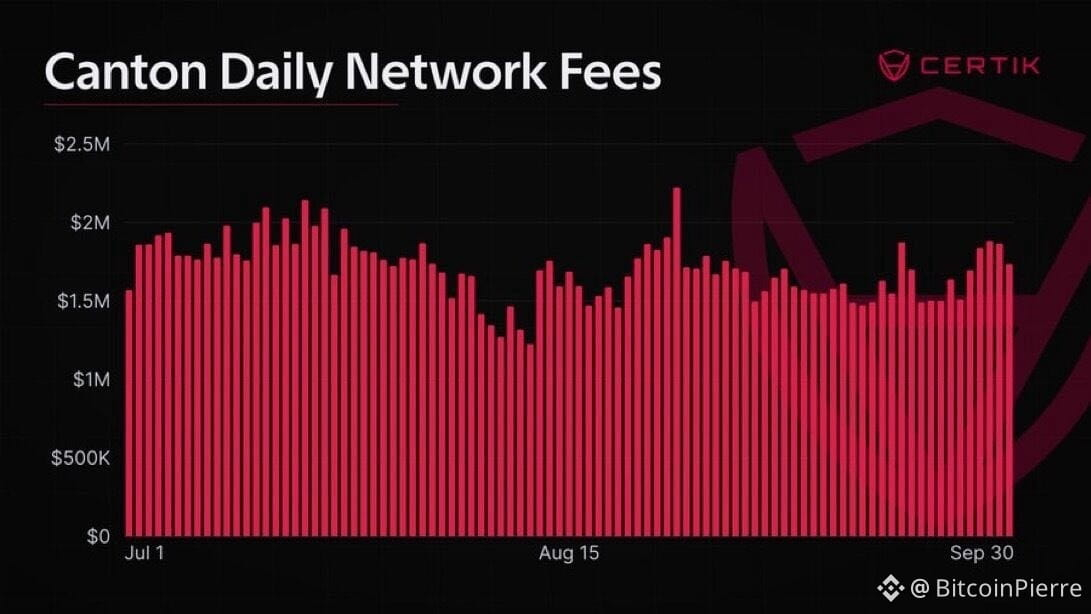
🔥 CANTON LEADS Q3 WITH $155M+ IN NETWORK FEES
Canton recorded more than $155 million in fees during Q3 2026, according to CertiK Skynet, ranking first among the chains included in its comparison.
The figure stands out because Canton focuses on institutional finance, connecting traditional financial markets with blockchain infrastructure designed for privacy and regulated transactions.
This is an important metric to watch. Network fees can provide a clearer picture of economic activity than hype alone, particularly when institutions are using blockchain infrastructure for real financial operations.
However, high fees don’t automatically translate into value accruing to a network’s token. The source of that activity and how the network’s economics work still matter.
$155M+ in quarterly fees. Canton is putting institutional blockchain activity firmly on the radar.
#BTC Price Analysis# #Macro Insights# $BTC $NEAR
🔥 CANTON LEADS Q3 WITH $155M+ IN NETWORK FEES
Canton recorded more than $155 million in fees during Q3 2026, according to CertiK Skynet, ranking first among the chains included in its comparison.
The figure stands out because Canton focuses on institutional finance, connecting traditional financial markets with blockchain infrastructure designed for privacy and regulated transactions.
This is an important metric to watch. Network fees can provide a clearer picture of economic activity than hype alone, particularly when institutions are using blockchain infrastructure for real financial operations.
However, high fees don’t automatically translate into value accruing to a network’s token. The source of that activity and how the network’s economics work still matter.
$155M+ in quarterly fees. Canton is putting institutional blockchain activity firmly on the radar.
#BTC Price Analysis# #Macro Insights# $BTC $NEAR
Canton recorded more than $155 million in fees during Q3 2026, according to CertiK Skynet, ranking first among the chains included in its comparison.
The figure stands out because Canton focuses on institutional finance, connecting traditional financial markets with blockchain infrastructure designed for privacy and regulated transactions.
This is an important metric to watch. Network fees can provide a clearer picture of economic activity than hype alone, particularly when institutions are using blockchain infrastructure for real financial operations.
However, high fees don’t automatically translate into value accruing to a network’s token. The source of that activity and how the network’s economics work still matter.
$155M+ in quarterly fees. Canton is putting institutional blockchain activity firmly on the radar.
#BTC Price Analysis# #Macro Insights# $BTC $NEAR
57
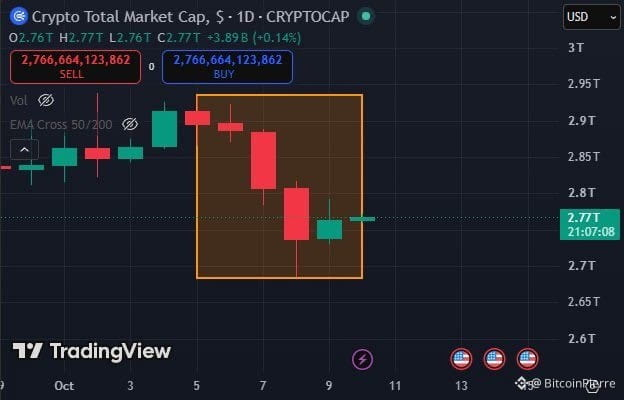
The total crypto market cap has taken a serious hit as selling pressure spreads across the market, wiping out roughly $170 billion in value in just a few days.
Bitcoin and Ethereum have both faced pressure, while leveraged liquidations have made the decline even more painful. On October 9, marketwide liquidations reached roughly $740 million, with long positions accounting for the majority.
This is what happens when falling prices meet crowded leverage. Forced liquidations can accelerate the sell off, putting even more pressure on traders who were positioned for a recovery.
The key now is whether buyers step in to defend support or whether fear triggers another wave of selling.
#BTC Price Analysis# #Macro Insights# $BTC $ETH
The total crypto market cap has taken a serious hit as selling pressure spreads across the market, wiping out roughly $170 billion in value in just a few days.
Bitcoin and Ethereum have both faced pressure, while leveraged liquidations have made the decline even more painful. On October 9, marketwide liquidations reached roughly $740 million, with long positions accounting for the majority.
This is what happens when falling prices meet crowded leverage. Forced liquidations can accelerate the sell off, putting even more pressure on traders who were positioned for a recovery.
The key now is whether buyers step in to defend support or whether fear triggers another wave of selling.
#BTC Price Analysis# #Macro Insights# $BTC $ETH
Bitcoin and Ethereum have both faced pressure, while leveraged liquidations have made the decline even more painful. On October 9, marketwide liquidations reached roughly $740 million, with long positions accounting for the majority.
This is what happens when falling prices meet crowded leverage. Forced liquidations can accelerate the sell off, putting even more pressure on traders who were positioned for a recovery.
The key now is whether buyers step in to defend support or whether fear triggers another wave of selling.
#BTC Price Analysis# #Macro Insights# $BTC $ETH
67
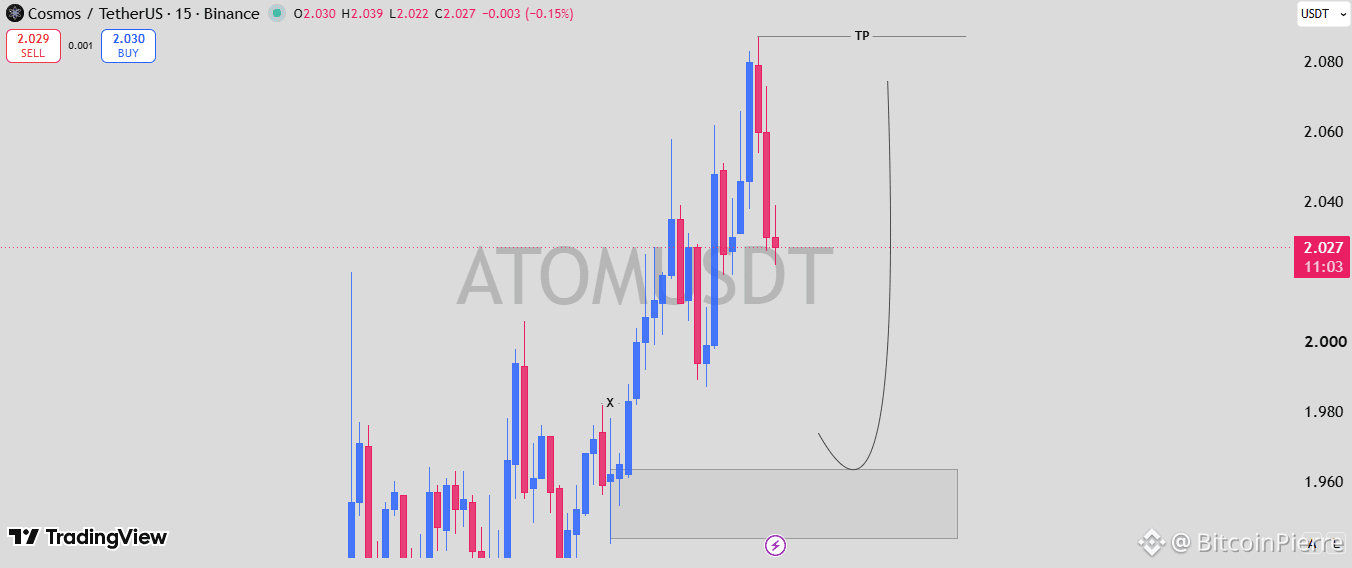
$ATOM is approaching a critical decision point after an impressive bullish move on the 15-minute chart. Price rallied toward the $2.08 resistance area before facing rejection and pulling back toward $2.027, suggesting that a short-term retracement may be developing. The key area to watch is the demand zone around $1.95–$1.965. If price retraces into this zone and buyers step in with a convincing reaction, ATOM could regain bullish momentum and attempt another move toward $2.08. However, if this demand area fails to hold, further downside could follow. For now, patience is important. I’m watching how price reacts around the marked demand zone before looking for the next opportunity. The setup remains conditional on confirmation, and the projected move toward the previous high is not guaranteed. #BTC Price Analysis# #Macro Insights#
$ATOM is approaching a critical decision point after an impressive bullish move on the 15-minute chart. Price rallied toward the $2.08 resistance area before facing rejection and pulling back toward $2.027, suggesting that a short-term retracement may be developing. The key area to watch is the demand zone around $1.95–$1.965. If price retraces into this zone and buyers step in with a convincing reaction, ATOM could regain bullish momentum and attempt another move toward $2.08. However, if this demand area fails to hold, further downside could follow. For now, patience is important. I’m watching how price reacts around the marked demand zone before looking for the next opportunity. The setup remains conditional on confirmation, and the projected move toward the previous high is not guaranteed. #BTC Price Analysis# #Macro Insights#
28
Log in to explore more content
Join global crypto users on Binance Square
⚡️ Get latest and useful information about crypto.
💬 Trusted by the world’s largest crypto exchange.
👍 Discover real insights from verified creators.
Email / Phone number