

R3N 1
574 Posts

R3N 1
Report
Block User
Web3 & crypto Analyst || Breaking down market moves || token updates daily ➪NFA!!!
0 Following
3 Followers
3 Liked
Posts
·
--
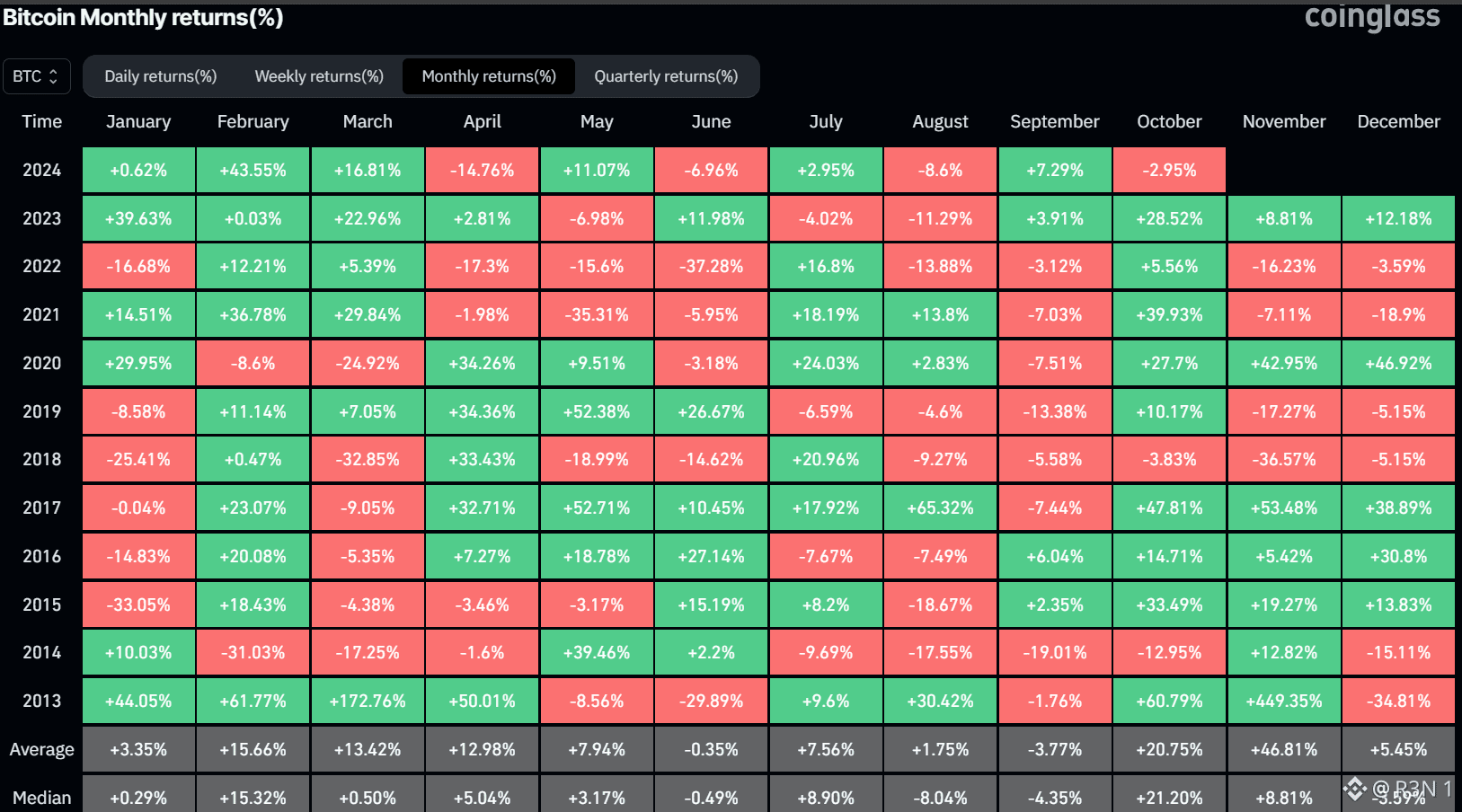
Ten green Octobers out of thirteen since 2013, averaging roughly 19% gains. That's the stat getting repeated everywhere right now, and it's accurate, but the one year that broke the pattern is actually more instructive than the nine that confirmed it. October 2025 started with $BTC near $119,000, hit a record above $126,000 early in the month, looked like Uptober playing out exactly as scripted, then finished down nearly 4%, the first red October since 2018. A US China trade dispute flare up and record liquidations did that, not a failure of the seasonal pattern itself, an external macro shock overriding historical tendency. That's the actual lesson, seasonality is a probability, not a guarantee, and it's broken before specifically when something unrelated to the calendar intervened. This year's setup into October is genuinely different from last year's though. BTC just posted three green months in a row for the first time since 2012, up roughly 25% in August and another 9% in September, reaching an eight month high above $87,000. Large entities reportedly accumulated around 30,269 BTC, worth about $2.57 billion, over a recent 96 hour stretch, and spot ETFs pulled in close to $3 billion over ten days. When September itself closed positive, the five prior instances still saw October gains four times, averaging just under 17%, a smaller sample worth noting, not treating as separately conclusive. My honest read: the base rate is real and well documented, not cherry picked, but 2025 proved strong seasonal odds don't override a genuine macro shock. This year's momentum looks more constructive than last year's setup, but that's a different claim than the pattern being more reliable this time. What I'm watching: whether any comparable macro catalyst, trade policy, Fed surprises, shows up this October the way it did last year, since that's historically been the actual variable that's broken this pattern, not anything about the calendar itself.
Ten green Octobers out of thirteen since 2013, averaging roughly 19% gains. That's the stat getting repeated everywhere right now, and it's accurate, but the one year that broke the pattern is actually more instructive than the nine that confirmed it. October 2025 started with $BTC near $119,000, hit a record above $126,000 early in the month, looked like Uptober playing out exactly as scripted, then finished down nearly 4%, the first red October since 2018. A US China trade dispute flare up and record liquidations did that, not a failure of the seasonal pattern itself, an external macro shock overriding historical tendency. That's the actual lesson, seasonality is a probability, not a guarantee, and it's broken before specifically when something unrelated to the calendar intervened. This year's setup into October is genuinely different from last year's though. BTC just posted three green months in a row for the first time since 2012, up roughly 25% in August and another 9% in September, reaching an eight month high above $87,000. Large entities reportedly accumulated around 30,269 BTC, worth about $2.57 billion, over a recent 96 hour stretch, and spot ETFs pulled in close to $3 billion over ten days. When September itself closed positive, the five prior instances still saw October gains four times, averaging just under 17%, a smaller sample worth noting, not treating as separately conclusive. My honest read: the base rate is real and well documented, not cherry picked, but 2025 proved strong seasonal odds don't override a genuine macro shock. This year's momentum looks more constructive than last year's setup, but that's a different claim than the pattern being more reliable this time. What I'm watching: whether any comparable macro catalyst, trade policy, Fed surprises, shows up this October the way it did last year, since that's historically been the actual variable that's broken this pattern, not anything about the calendar itself.
23
·
--
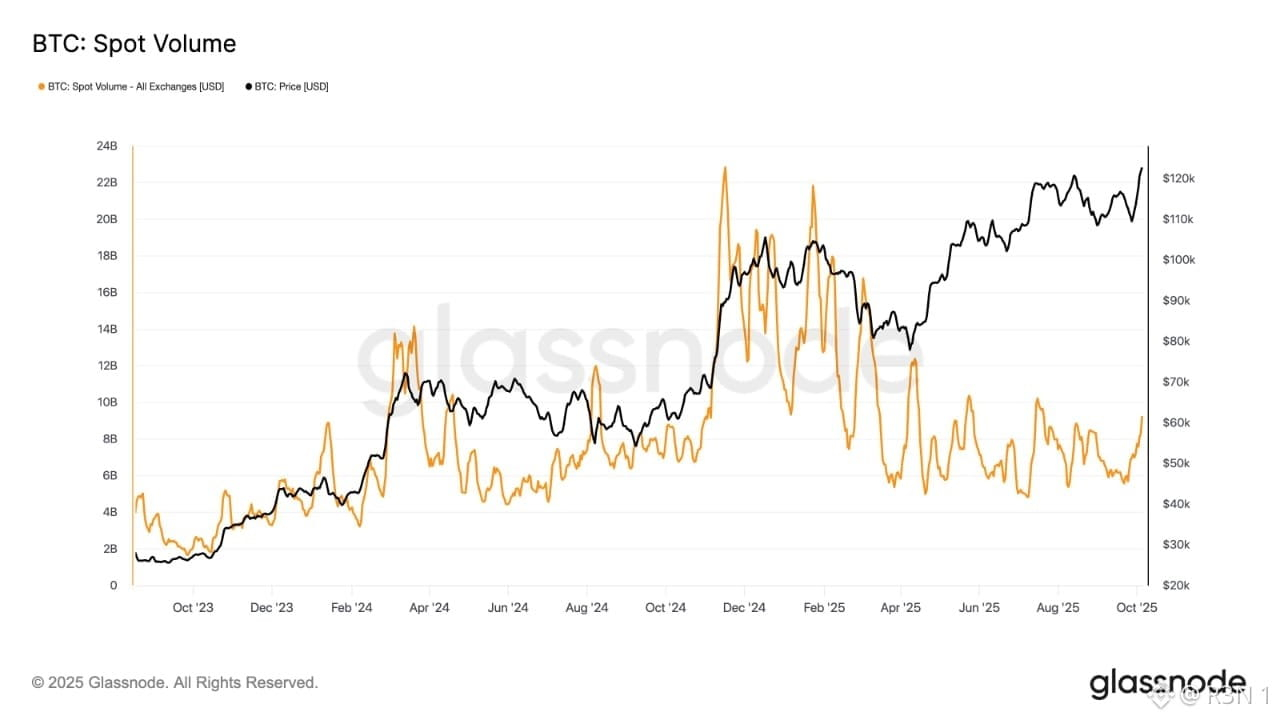
The 4x figure is turnover, not net capital inflow. The same money can get counted repeatedly as positions change hands, and volume captures both buying and selling, not a directional four times more capital rotating into alts. The more accurate read is that trading attention and liquidity have broadened beyond BTC, not that four times as much fresh money showed up.
The breadth data backs that broadening up. 72.5% of tracked altcoins outperformed Bitcoin over the seven days ending September 22, against just 39% during a similar August surge. The Altcoin Season Index climbed to 62%, up from 50% a week earlier and 33% a month prior. Zcash and Uniswap posted 295% and 248% three month gains, dwarfing BTC's own 44%. Worth noting the leverage picture looks calm, altcoin perpetual open interest has barely grown in 30 days, this rotation is showing up in spot participation, not leveraged futures.
Here's the genuine tension. Glassnode itself flagged that similar spikes in this ratio have historically coincided with local Bitcoin price tops, not confirmed altseason continuations. And September 28 specifically saw crypto's total market value fall about 3% while volume surged 125%, a pattern that reads more like forced liquidation than fresh altseason buying.
My honest read: the breadth and index data genuinely support an early altseason case, but Glassnode's own historical framing and last week's volume spike during a selloff argue the opposite just as plausibly. This is a real fork in the data, not a clean signal either way.
What I'm watching: whether altcoin exchange deposits keep climbing, since rising deposits alongside this volume would point toward selling pressure building rather than sustained rotation.
$BTC #BTC Price Analysis# #Altcoin Season# $XAUt
The 4x figure is turnover, not net capital inflow. The same money can get counted repeatedly as positions change hands, and volume captures both buying and selling, not a directional four times more capital rotating into alts. The more accurate read is that trading attention and liquidity have broadened beyond BTC, not that four times as much fresh money showed up.
The breadth data backs that broadening up. 72.5% of tracked altcoins outperformed Bitcoin over the seven days ending September 22, against just 39% during a similar August surge. The Altcoin Season Index climbed to 62%, up from 50% a week earlier and 33% a month prior. Zcash and Uniswap posted 295% and 248% three month gains, dwarfing BTC's own 44%. Worth noting the leverage picture looks calm, altcoin perpetual open interest has barely grown in 30 days, this rotation is showing up in spot participation, not leveraged futures.
Here's the genuine tension. Glassnode itself flagged that similar spikes in this ratio have historically coincided with local Bitcoin price tops, not confirmed altseason continuations. And September 28 specifically saw crypto's total market value fall about 3% while volume surged 125%, a pattern that reads more like forced liquidation than fresh altseason buying.
My honest read: the breadth and index data genuinely support an early altseason case, but Glassnode's own historical framing and last week's volume spike during a selloff argue the opposite just as plausibly. This is a real fork in the data, not a clean signal either way.
What I'm watching: whether altcoin exchange deposits keep climbing, since rising deposits alongside this volume would point toward selling pressure building rather than sustained rotation.
$BTC #BTC Price Analysis# #Altcoin Season# $XAUt
The breadth data backs that broadening up. 72.5% of tracked altcoins outperformed Bitcoin over the seven days ending September 22, against just 39% during a similar August surge. The Altcoin Season Index climbed to 62%, up from 50% a week earlier and 33% a month prior. Zcash and Uniswap posted 295% and 248% three month gains, dwarfing BTC's own 44%. Worth noting the leverage picture looks calm, altcoin perpetual open interest has barely grown in 30 days, this rotation is showing up in spot participation, not leveraged futures.
Here's the genuine tension. Glassnode itself flagged that similar spikes in this ratio have historically coincided with local Bitcoin price tops, not confirmed altseason continuations. And September 28 specifically saw crypto's total market value fall about 3% while volume surged 125%, a pattern that reads more like forced liquidation than fresh altseason buying.
My honest read: the breadth and index data genuinely support an early altseason case, but Glassnode's own historical framing and last week's volume spike during a selloff argue the opposite just as plausibly. This is a real fork in the data, not a clean signal either way.
What I'm watching: whether altcoin exchange deposits keep climbing, since rising deposits alongside this volume would point toward selling pressure building rather than sustained rotation.
$BTC #BTC Price Analysis# #Altcoin Season# $XAUt
57
·
--
UsePaid's native token dropped 38% not because the protocol failed, but because the payment rail underneath it couldn't handle success. That distinction matters for how you read this.
Claimed fees through UsePaid surged to $1.54 million on September 27, roughly 26 times the previous day's total and more than the entire prior seven days combined.
UsePaid routes creator fees from Pump.fun token launches directly to designated X accounts through X Money's payment rails, and the volume spike broke that pipeline. The protocol first capped payouts at $750 per recipient daily, then paused X Money transfers entirely by Sunday night.
What stands out to me is the mechanism generating this volume. Anyone can launch a Pump.fun token, redirect its creator fees to UsePaid, and name virtually any X account as beneficiary, no consent required. UsePaid's dashboard reportedly showed 367 tokens naming one prominent account and 764 naming Elon Musk's, some recipients have called it being "financially DDoS'd." The surge is downstream of that dynamic accelerating fast.
By September 28, UsePaid shipped a claims portal letting recipients withdraw directly to a Solana wallet in SOL, bypassing X Money entirely. Existing balances remain intact and fees keep accruing, per the protocol, this is a payout bottleneck, not a solvency issue.
Worth being precise on scope, X Money itself continues operating independently, this is specifically UsePaid's integration that got restricted, not a broader X Money outage.
The open question isn't whether the claims portal works as a stopgap, it's live and functional. It's whether this pushes UsePaid toward permanently favoring on-chain SOL claims over the X Money path it was originally built around, and what that means for a product whose entire pitch was frictionless fiat payouts.
$SOL #BTC Price Analysis# #Altcoin Season# $HYPE
UsePaid's native token dropped 38% not because the protocol failed, but because the payment rail underneath it couldn't handle success. That distinction matters for how you read this.
Claimed fees through UsePaid surged to $1.54 million on September 27, roughly 26 times the previous day's total and more than the entire prior seven days combined.
UsePaid routes creator fees from Pump.fun token launches directly to designated X accounts through X Money's payment rails, and the volume spike broke that pipeline. The protocol first capped payouts at $750 per recipient daily, then paused X Money transfers entirely by Sunday night.
What stands out to me is the mechanism generating this volume. Anyone can launch a Pump.fun token, redirect its creator fees to UsePaid, and name virtually any X account as beneficiary, no consent required. UsePaid's dashboard reportedly showed 367 tokens naming one prominent account and 764 naming Elon Musk's, some recipients have called it being "financially DDoS'd." The surge is downstream of that dynamic accelerating fast.
By September 28, UsePaid shipped a claims portal letting recipients withdraw directly to a Solana wallet in SOL, bypassing X Money entirely. Existing balances remain intact and fees keep accruing, per the protocol, this is a payout bottleneck, not a solvency issue.
Worth being precise on scope, X Money itself continues operating independently, this is specifically UsePaid's integration that got restricted, not a broader X Money outage.
The open question isn't whether the claims portal works as a stopgap, it's live and functional. It's whether this pushes UsePaid toward permanently favoring on-chain SOL claims over the X Money path it was originally built around, and what that means for a product whose entire pitch was frictionless fiat payouts.
$SOL #BTC Price Analysis# #Altcoin Season# $HYPE
Claimed fees through UsePaid surged to $1.54 million on September 27, roughly 26 times the previous day's total and more than the entire prior seven days combined.
UsePaid routes creator fees from Pump.fun token launches directly to designated X accounts through X Money's payment rails, and the volume spike broke that pipeline. The protocol first capped payouts at $750 per recipient daily, then paused X Money transfers entirely by Sunday night.
What stands out to me is the mechanism generating this volume. Anyone can launch a Pump.fun token, redirect its creator fees to UsePaid, and name virtually any X account as beneficiary, no consent required. UsePaid's dashboard reportedly showed 367 tokens naming one prominent account and 764 naming Elon Musk's, some recipients have called it being "financially DDoS'd." The surge is downstream of that dynamic accelerating fast.
By September 28, UsePaid shipped a claims portal letting recipients withdraw directly to a Solana wallet in SOL, bypassing X Money entirely. Existing balances remain intact and fees keep accruing, per the protocol, this is a payout bottleneck, not a solvency issue.
Worth being precise on scope, X Money itself continues operating independently, this is specifically UsePaid's integration that got restricted, not a broader X Money outage.
The open question isn't whether the claims portal works as a stopgap, it's live and functional. It's whether this pushes UsePaid toward permanently favoring on-chain SOL claims over the X Money path it was originally built around, and what that means for a product whose entire pitch was frictionless fiat payouts.
$SOL #BTC Price Analysis# #Altcoin Season# $HYPE

60
·
--
Blockchain.com hit $14 billion at the top of the last cycle. It's now targeting $4 to 6 billion, less than half that peak, and calling it a comeback story anyway. Worth sitting with that gap before reading this purely as bullish momentum.
Per Bloomberg, the company is telling prospective investors it wants to raise roughly $500 million in a US listing this year, with room to accept a smaller raise if market conditions demand it. It confidentially filed with the SEC back in May, and has reportedly posted adjusted profitability for three straight years, a real operating detail, not just a narrative pitch. The timing lines up with BTC's own recovery, up roughly 30 to 33% since mid August, when Treasury's buyback program started reshaping liquidity conditions.
Worth being honest about the backdrop this IPO is stepping into. Gemini, Bullish, and eToro all went public last year, and the aftermath hasn't been kind, Gemini's down more than 80% from its debut, BitGo roughly 60%, eToro around 50%. That's the actual track record recent crypto listings have set.
Blockchain.com has also been genuinely expanding its product surface beyond core wallet and exchange services, tokenized stocks and ETFs through Ondo Finance, and reportedly a new NYSE agreement explored last week. That diversification is a real part of the pitch to investors, not just riding BTC's price.
My honest read: profitable operations and a real product expansion story make this a more substantive listing than pure momentum plays, but the sector's post IPO performance this year is a genuine headwind this valuation range has to overcome, not just market sentiment.
What I'm watching: whether Blockchain.com actually files the S-1 and locks a valuation, and how it trades relative to Gemini, BitGo, and eToro's rough first year if it does.
$BTC #BTC Price Analysis# $XRP #Meme Alpha#
Blockchain.com hit $14 billion at the top of the last cycle. It's now targeting $4 to 6 billion, less than half that peak, and calling it a comeback story anyway. Worth sitting with that gap before reading this purely as bullish momentum.
Per Bloomberg, the company is telling prospective investors it wants to raise roughly $500 million in a US listing this year, with room to accept a smaller raise if market conditions demand it. It confidentially filed with the SEC back in May, and has reportedly posted adjusted profitability for three straight years, a real operating detail, not just a narrative pitch. The timing lines up with BTC's own recovery, up roughly 30 to 33% since mid August, when Treasury's buyback program started reshaping liquidity conditions.
Worth being honest about the backdrop this IPO is stepping into. Gemini, Bullish, and eToro all went public last year, and the aftermath hasn't been kind, Gemini's down more than 80% from its debut, BitGo roughly 60%, eToro around 50%. That's the actual track record recent crypto listings have set.
Blockchain.com has also been genuinely expanding its product surface beyond core wallet and exchange services, tokenized stocks and ETFs through Ondo Finance, and reportedly a new NYSE agreement explored last week. That diversification is a real part of the pitch to investors, not just riding BTC's price.
My honest read: profitable operations and a real product expansion story make this a more substantive listing than pure momentum plays, but the sector's post IPO performance this year is a genuine headwind this valuation range has to overcome, not just market sentiment.
What I'm watching: whether Blockchain.com actually files the S-1 and locks a valuation, and how it trades relative to Gemini, BitGo, and eToro's rough first year if it does.
$BTC #BTC Price Analysis# $XRP #Meme Alpha#
Per Bloomberg, the company is telling prospective investors it wants to raise roughly $500 million in a US listing this year, with room to accept a smaller raise if market conditions demand it. It confidentially filed with the SEC back in May, and has reportedly posted adjusted profitability for three straight years, a real operating detail, not just a narrative pitch. The timing lines up with BTC's own recovery, up roughly 30 to 33% since mid August, when Treasury's buyback program started reshaping liquidity conditions.
Worth being honest about the backdrop this IPO is stepping into. Gemini, Bullish, and eToro all went public last year, and the aftermath hasn't been kind, Gemini's down more than 80% from its debut, BitGo roughly 60%, eToro around 50%. That's the actual track record recent crypto listings have set.
Blockchain.com has also been genuinely expanding its product surface beyond core wallet and exchange services, tokenized stocks and ETFs through Ondo Finance, and reportedly a new NYSE agreement explored last week. That diversification is a real part of the pitch to investors, not just riding BTC's price.
My honest read: profitable operations and a real product expansion story make this a more substantive listing than pure momentum plays, but the sector's post IPO performance this year is a genuine headwind this valuation range has to overcome, not just market sentiment.
What I'm watching: whether Blockchain.com actually files the S-1 and locks a valuation, and how it trades relative to Gemini, BitGo, and eToro's rough first year if it does.
$BTC #BTC Price Analysis# $XRP #Meme Alpha#


66
·
--
STONfi DAO is where STON holders shape the protocol's direction. Eight proposals have been submitted so far with 11,576 unique voters participating. Here is the complete process for both voting and creating proposals. To access the DAO go to dao.ston.fi or click the DAO tab in the main Ston.fi navigation at app.ston.fi . To get voting power you need to stake STON through ARKENSTON at app.ston.fi/stake . Choose a lock-up period between three and twenty-four months. Longer lock-ups produce higher voting power per STON staked. Your staked position issues an ARKENSTON soulbound NFT representing your voting weight. This NFT cannot be transferred or borrowed. To vote on an existing proposal connect your wallet at dao.ston.fi , navigate to Proposals, find an active proposal in the Voting tab, and cast your vote. Any staked STON position with voting power can participate in votes. To create a proposal you need at least 273.32 voting power in a single ARKENSTON NFT. If your stake is below this threshold you cannot create proposals but you can still vote. Proposals require a title of up to 80 characters and a description covering Summary, Motivation, and Details. The quorum needed for any proposal to pass is 25,798 voting power. The discussion period before voting opens is seven days. GEMSTON is earned alongside STON staking rewards. Governance participation is the practical output of the staking decision we covered in the staking versus farming post. Access STONfi DAO → https://dao.ston.fi $BTC #BTC Price Analysis# #Altcoin Season# $HYPE #Meme Alpha#
STONfi DAO is where STON holders shape the protocol's direction. Eight proposals have been submitted so far with 11,576 unique voters participating. Here is the complete process for both voting and creating proposals. To access the DAO go to dao.ston.fi or click the DAO tab in the main Ston.fi navigation at app.ston.fi . To get voting power you need to stake STON through ARKENSTON at app.ston.fi/stake . Choose a lock-up period between three and twenty-four months. Longer lock-ups produce higher voting power per STON staked. Your staked position issues an ARKENSTON soulbound NFT representing your voting weight. This NFT cannot be transferred or borrowed. To vote on an existing proposal connect your wallet at dao.ston.fi , navigate to Proposals, find an active proposal in the Voting tab, and cast your vote. Any staked STON position with voting power can participate in votes. To create a proposal you need at least 273.32 voting power in a single ARKENSTON NFT. If your stake is below this threshold you cannot create proposals but you can still vote. Proposals require a title of up to 80 characters and a description covering Summary, Motivation, and Details. The quorum needed for any proposal to pass is 25,798 voting power. The discussion period before voting opens is seven days. GEMSTON is earned alongside STON staking rewards. Governance participation is the practical output of the staking decision we covered in the staking versus farming post. Access STONfi DAO → https://dao.ston.fi $BTC #BTC Price Analysis# #Altcoin Season# $HYPE #Meme Alpha#

70
·
--
"It's really not just a blockchain anymore." A strange thing for Ethereum's own co-founder to say about Ethereum, and the essay behind it is more specific than the soundbite suggests.
Buterin's new piece, "The Cryptographic World Computer," published Sunday, frames Hegota, next year's upgrade, as likely Ethereum's last "normal" fork. After that, a shift toward recursive STARKs, automated formal verification, and quantum-safe cryptography, a hybrid combining blockchain design with cryptographic tools that weren't mature enough to use back in 2009.
What stands out to me is the mechanism he points to for why Ethereum stops being "just" a blockchain. FOCIL, fork-choice enforced inclusion lists, is a Hegota feature letting a committee of validators force valid transactions into blocks rather than relying on a single builder. Buterin connects this directly to privacy, saying it will make ZK-SNARK-based transactions, which already break the whitepaper's assumption that transactions get announced publicly, "much more first-class citizens" going forward.
Worth adding real numbers to the vision, he projects 4 to 8 second slot times and 8 to 32 second finality by 2030. He's also direct about a limit, Ethereum's base layer is unlikely to match centralized server latency even with all this, though surrounding infrastructure could close some of that gap.
Worth noting Hegota's scope isn't finalized, Ethereum's roadmap places it in 2027 following Glamsterdam, and this essay is Buterin's framing of what comes after, not a locked spec.
The open question isn't whether this direction is real, FOCIL and related EIPs are already scheduled. It's whether "hybrid architecture" delivers privacy and performance simultaneously at scale, or one of those goals ends up trading against the other once this moves from essay to shipped code.
#BTC Price Analysis# $ETH #Ethereum
"It's really not just a blockchain anymore." A strange thing for Ethereum's own co-founder to say about Ethereum, and the essay behind it is more specific than the soundbite suggests.
Buterin's new piece, "The Cryptographic World Computer," published Sunday, frames Hegota, next year's upgrade, as likely Ethereum's last "normal" fork. After that, a shift toward recursive STARKs, automated formal verification, and quantum-safe cryptography, a hybrid combining blockchain design with cryptographic tools that weren't mature enough to use back in 2009.
What stands out to me is the mechanism he points to for why Ethereum stops being "just" a blockchain. FOCIL, fork-choice enforced inclusion lists, is a Hegota feature letting a committee of validators force valid transactions into blocks rather than relying on a single builder. Buterin connects this directly to privacy, saying it will make ZK-SNARK-based transactions, which already break the whitepaper's assumption that transactions get announced publicly, "much more first-class citizens" going forward.
Worth adding real numbers to the vision, he projects 4 to 8 second slot times and 8 to 32 second finality by 2030. He's also direct about a limit, Ethereum's base layer is unlikely to match centralized server latency even with all this, though surrounding infrastructure could close some of that gap.
Worth noting Hegota's scope isn't finalized, Ethereum's roadmap places it in 2027 following Glamsterdam, and this essay is Buterin's framing of what comes after, not a locked spec.
The open question isn't whether this direction is real, FOCIL and related EIPs are already scheduled. It's whether "hybrid architecture" delivers privacy and performance simultaneously at scale, or one of those goals ends up trading against the other once this moves from essay to shipped code.
#BTC Price Analysis# $ETH #Ethereum
Buterin's new piece, "The Cryptographic World Computer," published Sunday, frames Hegota, next year's upgrade, as likely Ethereum's last "normal" fork. After that, a shift toward recursive STARKs, automated formal verification, and quantum-safe cryptography, a hybrid combining blockchain design with cryptographic tools that weren't mature enough to use back in 2009.
What stands out to me is the mechanism he points to for why Ethereum stops being "just" a blockchain. FOCIL, fork-choice enforced inclusion lists, is a Hegota feature letting a committee of validators force valid transactions into blocks rather than relying on a single builder. Buterin connects this directly to privacy, saying it will make ZK-SNARK-based transactions, which already break the whitepaper's assumption that transactions get announced publicly, "much more first-class citizens" going forward.
Worth adding real numbers to the vision, he projects 4 to 8 second slot times and 8 to 32 second finality by 2030. He's also direct about a limit, Ethereum's base layer is unlikely to match centralized server latency even with all this, though surrounding infrastructure could close some of that gap.
Worth noting Hegota's scope isn't finalized, Ethereum's roadmap places it in 2027 following Glamsterdam, and this essay is Buterin's framing of what comes after, not a locked spec.
The open question isn't whether this direction is real, FOCIL and related EIPs are already scheduled. It's whether "hybrid architecture" delivers privacy and performance simultaneously at scale, or one of those goals ends up trading against the other once this moves from essay to shipped code.
#BTC Price Analysis# $ETH #Ethereum

2
·
--
Omniston just crossed $7.5 million in all-time cross-chain swap volume. Earlier this month it passed $3 million. It more than doubled in the time between those two milestones.
The week of September 17 to 23 alone brought in $1.8 million, up 26% from the week before. The busiest route was BNB Chain to TON at 78% of that weekly volume.
That route distribution is the most interesting data point. BNB Chain to TON at 78% of weekly volume tells you where demand is actually coming from. Capital on BNB Chain wants access to TON's DeFi layer — STONfi's pools, farming opportunities, xStocks, Telegram-native applications. The route isn't theoretical. It is the most active cross-chain path in the network right now.
The doubling from $3M to $7.5M within a single month reflects one of two patterns. Volume spikes at launch from novelty and then normalizes. Or it builds progressively as more users discover the routes and more products integrate the execution layer. The 26% week-over-week growth alongside the all-time milestone suggests the second pattern.
The One Swap Across Chains campaign running simultaneously is driving structured engagement with cross-chain routes. Campaigns that teach by doing produce more durable volume behavior than passive awareness campaigns because participants have actually executed the swap rather than just read about it.
$7.5 million all-time. $1.8 million in one week. 78% on BNB Chain to TON. The network is being used.
Try cross-chain swaps →https://app.ston.fi/swap?mode=cross-chain
$ZEC #BTC Price Analysis# $NEAR #Altcoin Season#
Omniston just crossed $7.5 million in all-time cross-chain swap volume. Earlier this month it passed $3 million. It more than doubled in the time between those two milestones.
The week of September 17 to 23 alone brought in $1.8 million, up 26% from the week before. The busiest route was BNB Chain to TON at 78% of that weekly volume.
That route distribution is the most interesting data point. BNB Chain to TON at 78% of weekly volume tells you where demand is actually coming from. Capital on BNB Chain wants access to TON's DeFi layer — STONfi's pools, farming opportunities, xStocks, Telegram-native applications. The route isn't theoretical. It is the most active cross-chain path in the network right now.
The doubling from $3M to $7.5M within a single month reflects one of two patterns. Volume spikes at launch from novelty and then normalizes. Or it builds progressively as more users discover the routes and more products integrate the execution layer. The 26% week-over-week growth alongside the all-time milestone suggests the second pattern.
The One Swap Across Chains campaign running simultaneously is driving structured engagement with cross-chain routes. Campaigns that teach by doing produce more durable volume behavior than passive awareness campaigns because participants have actually executed the swap rather than just read about it.
$7.5 million all-time. $1.8 million in one week. 78% on BNB Chain to TON. The network is being used.
Try cross-chain swaps →https://app.ston.fi/swap?mode=cross-chain
$ZEC #BTC Price Analysis# $NEAR #Altcoin Season#
The week of September 17 to 23 alone brought in $1.8 million, up 26% from the week before. The busiest route was BNB Chain to TON at 78% of that weekly volume.
That route distribution is the most interesting data point. BNB Chain to TON at 78% of weekly volume tells you where demand is actually coming from. Capital on BNB Chain wants access to TON's DeFi layer — STONfi's pools, farming opportunities, xStocks, Telegram-native applications. The route isn't theoretical. It is the most active cross-chain path in the network right now.
The doubling from $3M to $7.5M within a single month reflects one of two patterns. Volume spikes at launch from novelty and then normalizes. Or it builds progressively as more users discover the routes and more products integrate the execution layer. The 26% week-over-week growth alongside the all-time milestone suggests the second pattern.
The One Swap Across Chains campaign running simultaneously is driving structured engagement with cross-chain routes. Campaigns that teach by doing produce more durable volume behavior than passive awareness campaigns because participants have actually executed the swap rather than just read about it.
$7.5 million all-time. $1.8 million in one week. 78% on BNB Chain to TON. The network is being used.
Try cross-chain swaps →https://app.ston.fi/swap?mode=cross-chain
$ZEC #BTC Price Analysis# $NEAR #Altcoin Season#
38
·
--
Tokenized stocks just became collateral, not just a tradable wrapper, and that distinction is the actual unlock, more than the headline number.
Aave V4's Equities Hub launched Friday on Base, accepting seven Coinbase-issued tokenized stocks, Apple, Amazon, Alphabet, Meta, Microsoft, Nvidia, Tesla, as collateral for USDC loans. Users deposit equity tokens and borrow USDC against them, collateral-only at launch, the stocks can't be borrowed or shorted yet. Chainlink prices them through dedicated tokenized equity feeds, restricted to eligible non-US users in permitted jurisdictions, not available to US retail right now.
What stands out to me is how deliberately small this launch is. Initial caps sit at $29 million total collateral, $32 million USDC supply, $21 million USDC borrow, genuinely tiny next to Aave's $3.6 trillion in cumulative deposits and $1 trillion in all-time loans. Collateral factors range 65-79% by stock. A cautious pilot, not a full-scale launch, which makes sense given tokenized equities sitting in a still-unsettled regulatory space.
The architecture matters too, Aave's using its Hub and Spoke model, pooling all seven stocks into one USDC market while keeping risk parameters isolated per asset, so a problem with one tokenized stock doesn't cascade into the others.
Worth noting this had a parallel move already, Morpho launched its own lending market for five of Coinbase's tokenized stocks on Base back on September 18, so Aave isn't first to this idea, it's the second major lending protocol adopting the same collateral category within about a week.
The open question isn't whether tokenized equities can function as DeFi collateral, this proves the mechanism works. It's whether $29 million in caps expands once real usage data comes in, or whether regulatory uncertainty keeps this permanently niche and non-US-only.
#BTC Price Analysis# $BTC #Meme Alpha#
Tokenized stocks just became collateral, not just a tradable wrapper, and that distinction is the actual unlock, more than the headline number.
Aave V4's Equities Hub launched Friday on Base, accepting seven Coinbase-issued tokenized stocks, Apple, Amazon, Alphabet, Meta, Microsoft, Nvidia, Tesla, as collateral for USDC loans. Users deposit equity tokens and borrow USDC against them, collateral-only at launch, the stocks can't be borrowed or shorted yet. Chainlink prices them through dedicated tokenized equity feeds, restricted to eligible non-US users in permitted jurisdictions, not available to US retail right now.
What stands out to me is how deliberately small this launch is. Initial caps sit at $29 million total collateral, $32 million USDC supply, $21 million USDC borrow, genuinely tiny next to Aave's $3.6 trillion in cumulative deposits and $1 trillion in all-time loans. Collateral factors range 65-79% by stock. A cautious pilot, not a full-scale launch, which makes sense given tokenized equities sitting in a still-unsettled regulatory space.
The architecture matters too, Aave's using its Hub and Spoke model, pooling all seven stocks into one USDC market while keeping risk parameters isolated per asset, so a problem with one tokenized stock doesn't cascade into the others.
Worth noting this had a parallel move already, Morpho launched its own lending market for five of Coinbase's tokenized stocks on Base back on September 18, so Aave isn't first to this idea, it's the second major lending protocol adopting the same collateral category within about a week.
The open question isn't whether tokenized equities can function as DeFi collateral, this proves the mechanism works. It's whether $29 million in caps expands once real usage data comes in, or whether regulatory uncertainty keeps this permanently niche and non-US-only.
#BTC Price Analysis# $BTC #Meme Alpha#
Aave V4's Equities Hub launched Friday on Base, accepting seven Coinbase-issued tokenized stocks, Apple, Amazon, Alphabet, Meta, Microsoft, Nvidia, Tesla, as collateral for USDC loans. Users deposit equity tokens and borrow USDC against them, collateral-only at launch, the stocks can't be borrowed or shorted yet. Chainlink prices them through dedicated tokenized equity feeds, restricted to eligible non-US users in permitted jurisdictions, not available to US retail right now.
What stands out to me is how deliberately small this launch is. Initial caps sit at $29 million total collateral, $32 million USDC supply, $21 million USDC borrow, genuinely tiny next to Aave's $3.6 trillion in cumulative deposits and $1 trillion in all-time loans. Collateral factors range 65-79% by stock. A cautious pilot, not a full-scale launch, which makes sense given tokenized equities sitting in a still-unsettled regulatory space.
The architecture matters too, Aave's using its Hub and Spoke model, pooling all seven stocks into one USDC market while keeping risk parameters isolated per asset, so a problem with one tokenized stock doesn't cascade into the others.
Worth noting this had a parallel move already, Morpho launched its own lending market for five of Coinbase's tokenized stocks on Base back on September 18, so Aave isn't first to this idea, it's the second major lending protocol adopting the same collateral category within about a week.
The open question isn't whether tokenized equities can function as DeFi collateral, this proves the mechanism works. It's whether $29 million in caps expands once real usage data comes in, or whether regulatory uncertainty keeps this permanently niche and non-US-only.
#BTC Price Analysis# $BTC #Meme Alpha#


31
·
--
Energy Secretary Chris Wright has separately claimed daily volumes as high as 17-18 million barrels, and Fortune's own earlier reporting specifically called out Wright's math as questionable, TankerTrackers' co-founder Samir Madani suggested Wright may have been stacking multi-day ship-to-ship transfer volumes into single-day totals, joking it was "mathemagics." So even among people tracking this closely, there's real disagreement on the actual number, not just between the US and Iran.
What's driving the doubling itself is more mundane than a military breakthrough. Tanker Trackers attributes part of it to Saudi Arabia shifting oil shipments back through the Persian Gulf after previously rerouting via the East-West Pipeline to Red Sea ports, a diversion that happened because Houthi and Iraqi fighters were attacking Saudi infrastructure. That bypass being paused, not primarily new US military capability, is doing real work in this number.
The cost detail matters more than the headline barrel count though. $30-40 extra per barrel just to move it through, not including the cost of the military presence itself, is a structural tax on every barrel leaving the strait. One analyst's blunt framing: that math "doesn't work if global prices fall." WTI just dropped 8% to $92.41 this week. Those two facts sitting next to each other are the actual tension here, rising flow volume against falling prices that make the elevated flow economically harder to sustain.
Trump rejecting a 7-day ceasefire while flows already sit at 13 million barrels, well below the roughly 20 million pre-war, tells you the current strategy is betting time and pressure work in Washington's favor before the cost side breaks that math. Worth noting even US officials aren't claiming full normalization, this is a partial recovery under expensive, contested conditions, not confirmation the blockade's actually broken.
$BTC #BTC Price Analysis# #Altcoin Season# $XAUt
Energy Secretary Chris Wright has separately claimed daily volumes as high as 17-18 million barrels, and Fortune's own earlier reporting specifically called out Wright's math as questionable, TankerTrackers' co-founder Samir Madani suggested Wright may have been stacking multi-day ship-to-ship transfer volumes into single-day totals, joking it was "mathemagics." So even among people tracking this closely, there's real disagreement on the actual number, not just between the US and Iran.
What's driving the doubling itself is more mundane than a military breakthrough. Tanker Trackers attributes part of it to Saudi Arabia shifting oil shipments back through the Persian Gulf after previously rerouting via the East-West Pipeline to Red Sea ports, a diversion that happened because Houthi and Iraqi fighters were attacking Saudi infrastructure. That bypass being paused, not primarily new US military capability, is doing real work in this number.
The cost detail matters more than the headline barrel count though. $30-40 extra per barrel just to move it through, not including the cost of the military presence itself, is a structural tax on every barrel leaving the strait. One analyst's blunt framing: that math "doesn't work if global prices fall." WTI just dropped 8% to $92.41 this week. Those two facts sitting next to each other are the actual tension here, rising flow volume against falling prices that make the elevated flow economically harder to sustain.
Trump rejecting a 7-day ceasefire while flows already sit at 13 million barrels, well below the roughly 20 million pre-war, tells you the current strategy is betting time and pressure work in Washington's favor before the cost side breaks that math. Worth noting even US officials aren't claiming full normalization, this is a partial recovery under expensive, contested conditions, not confirmation the blockade's actually broken.
$BTC #BTC Price Analysis# #Altcoin Season# $XAUt
What's driving the doubling itself is more mundane than a military breakthrough. Tanker Trackers attributes part of it to Saudi Arabia shifting oil shipments back through the Persian Gulf after previously rerouting via the East-West Pipeline to Red Sea ports, a diversion that happened because Houthi and Iraqi fighters were attacking Saudi infrastructure. That bypass being paused, not primarily new US military capability, is doing real work in this number.
The cost detail matters more than the headline barrel count though. $30-40 extra per barrel just to move it through, not including the cost of the military presence itself, is a structural tax on every barrel leaving the strait. One analyst's blunt framing: that math "doesn't work if global prices fall." WTI just dropped 8% to $92.41 this week. Those two facts sitting next to each other are the actual tension here, rising flow volume against falling prices that make the elevated flow economically harder to sustain.
Trump rejecting a 7-day ceasefire while flows already sit at 13 million barrels, well below the roughly 20 million pre-war, tells you the current strategy is betting time and pressure work in Washington's favor before the cost side breaks that math. Worth noting even US officials aren't claiming full normalization, this is a partial recovery under expensive, contested conditions, not confirmation the blockade's actually broken.
$BTC #BTC Price Analysis# #Altcoin Season# $XAUt


95
·
--
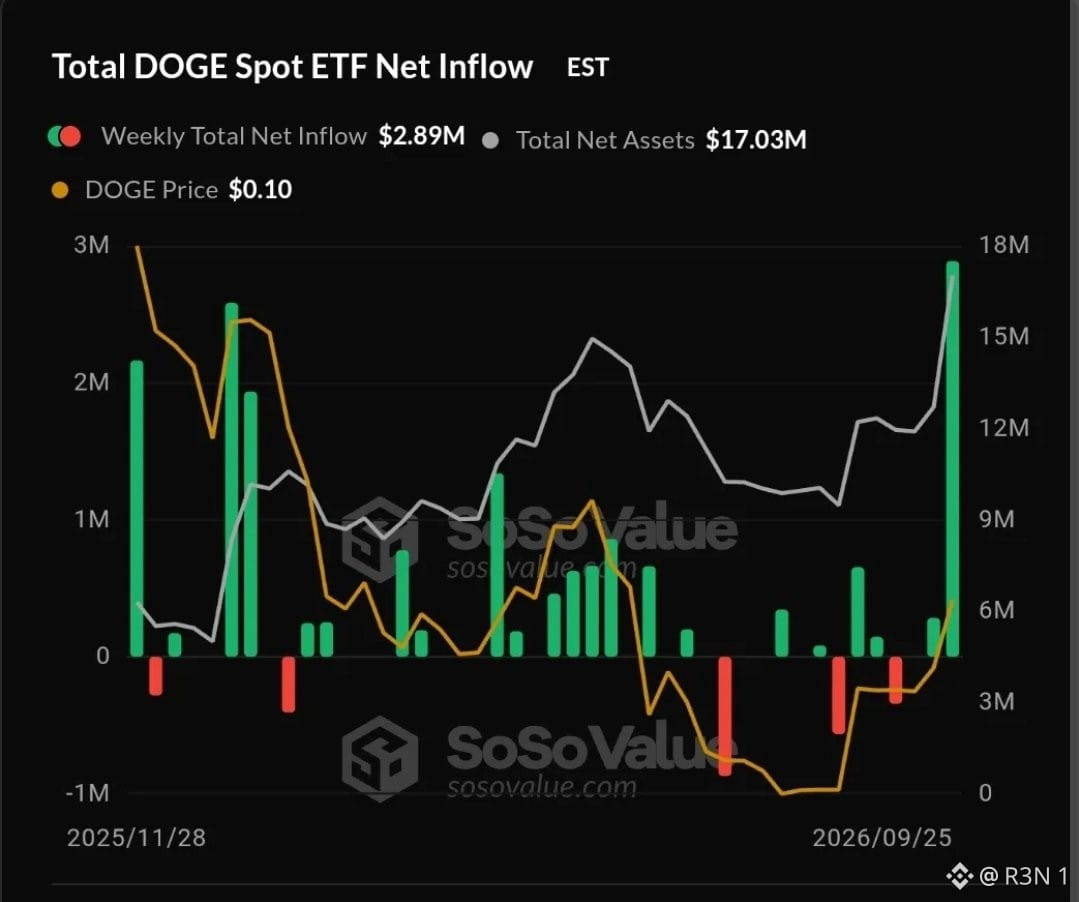
$2.89 million into DOGE ETFs this week, the strongest since they launched in November 2025, but the composition underneath that headline number tells a more fragile story than "record week" implies.
Most of the inflow, $3.48 million, came from Grayscale's Dogecoin Trust alone. 21Shares actually saw $593,000 in outflows over the same week, and Bitwise's DOGE ETF recorded zero, because it's shutting down entirely on October 14. One fund is carrying this record, not broad demand across the product category, and one of the four funds tracking DOGE is already exiting the market.
What stands out to me is a comparison almost nobody's running alongside this headline. Dogecoin's protocol issues roughly 13.53 million new coins daily, worth about $1.32 million at current prices.
The single strongest ETF day this month, $1.17 million on September 22, still came in below one day's worth of new supply. New issuance has outpaced the best day ETFs have ever had. That doesn't mean price has to fall, new supply hitting the market doesn't automatically overwhelm demand, but it does mean a record inflow week isn't the dominant force acting on DOGE's supply-demand balance right now.
Worth adding scale context too, total DOGE ETF net assets sit at $17.03 million, just 0.11% of Dogecoin's $16.6 billion market cap. This is still a genuinely tiny product category in absolute terms, record week or not.
The open question isn't whether institutional interest is picking up, the inflow trend across September, mostly zero to $2.89 million, is a real directional shift. It's whether that interest can broaden beyond Grayscale specifically, and whether it can meaningfully offset daily new issuance, before one shrinking fund lineup means "record week" becomes a smaller and smaller pool to set records in.
$DOGE #BTC Price Analysis# #BNBChain# #BNBChain#
$2.89 million into DOGE ETFs this week, the strongest since they launched in November 2025, but the composition underneath that headline number tells a more fragile story than "record week" implies.
Most of the inflow, $3.48 million, came from Grayscale's Dogecoin Trust alone. 21Shares actually saw $593,000 in outflows over the same week, and Bitwise's DOGE ETF recorded zero, because it's shutting down entirely on October 14. One fund is carrying this record, not broad demand across the product category, and one of the four funds tracking DOGE is already exiting the market.
What stands out to me is a comparison almost nobody's running alongside this headline. Dogecoin's protocol issues roughly 13.53 million new coins daily, worth about $1.32 million at current prices.
The single strongest ETF day this month, $1.17 million on September 22, still came in below one day's worth of new supply. New issuance has outpaced the best day ETFs have ever had. That doesn't mean price has to fall, new supply hitting the market doesn't automatically overwhelm demand, but it does mean a record inflow week isn't the dominant force acting on DOGE's supply-demand balance right now.
Worth adding scale context too, total DOGE ETF net assets sit at $17.03 million, just 0.11% of Dogecoin's $16.6 billion market cap. This is still a genuinely tiny product category in absolute terms, record week or not.
The open question isn't whether institutional interest is picking up, the inflow trend across September, mostly zero to $2.89 million, is a real directional shift. It's whether that interest can broaden beyond Grayscale specifically, and whether it can meaningfully offset daily new issuance, before one shrinking fund lineup means "record week" becomes a smaller and smaller pool to set records in.
$DOGE #BTC Price Analysis# #BNBChain# #BNBChain#
Most of the inflow, $3.48 million, came from Grayscale's Dogecoin Trust alone. 21Shares actually saw $593,000 in outflows over the same week, and Bitwise's DOGE ETF recorded zero, because it's shutting down entirely on October 14. One fund is carrying this record, not broad demand across the product category, and one of the four funds tracking DOGE is already exiting the market.
What stands out to me is a comparison almost nobody's running alongside this headline. Dogecoin's protocol issues roughly 13.53 million new coins daily, worth about $1.32 million at current prices.
The single strongest ETF day this month, $1.17 million on September 22, still came in below one day's worth of new supply. New issuance has outpaced the best day ETFs have ever had. That doesn't mean price has to fall, new supply hitting the market doesn't automatically overwhelm demand, but it does mean a record inflow week isn't the dominant force acting on DOGE's supply-demand balance right now.
Worth adding scale context too, total DOGE ETF net assets sit at $17.03 million, just 0.11% of Dogecoin's $16.6 billion market cap. This is still a genuinely tiny product category in absolute terms, record week or not.
The open question isn't whether institutional interest is picking up, the inflow trend across September, mostly zero to $2.89 million, is a real directional shift. It's whether that interest can broaden beyond Grayscale specifically, and whether it can meaningfully offset daily new issuance, before one shrinking fund lineup means "record week" becomes a smaller and smaller pool to set records in.
$DOGE #BTC Price Analysis# #BNBChain# #BNBChain#
49
·
--
Circle's SEC filing confirms Binance bought 1,237,011 Class A shares at $80.84 each, $100 million total, in a private placement that closed September 17, at roughly a 5% discount to Circle's market price that day. The five-year commercial agreement signed alongside it replaces earlier deals from November 2024 and August 2025, which reportedly ran shorter and structured payments differently, a $60.25 million upfront fee back then versus straight equity now.
What stands out to me is the lockup structure. Binance can't sell, transfer, or hedge these shares for up to two years, but keeps full voting rights the entire time. That's a real constraint on Binance's ability to just flip the position, while still giving it a say in how Circle's run, a meaningfully different commitment than a short-term commercial partnership.
The stated focus is emerging markets specifically, expanding USDC access where Circle's presence has been thinner, competing more directly against Tether's dominance there. Circle pays Binance a monthly incentive fee tied to USDC balances held through its Modular Smart Contract Wallet infrastructure, so Binance now profits from USDC in two separate ways at once, the fee stream and the equity stake itself.
Worth being precise about scale though, $100 million is real money but it's a minority stake, not board control or anything close to it. Circle's stock did rise over 1% in premarket trading on the news, a modest, not explosive, market reaction.
The open question isn't whether this deepens the relationship, it clearly does structurally. It's whether Binance actually pushes USDC adoption meaningfully in emerging markets where Tether has entrenched network effects, or whether owning equity doesn't translate into the distribution edge both companies are describing.
$BNB #BTC Price Analysis# $XRP #Macro Insights# #Macro Insights#
Circle's SEC filing confirms Binance bought 1,237,011 Class A shares at $80.84 each, $100 million total, in a private placement that closed September 17, at roughly a 5% discount to Circle's market price that day. The five-year commercial agreement signed alongside it replaces earlier deals from November 2024 and August 2025, which reportedly ran shorter and structured payments differently, a $60.25 million upfront fee back then versus straight equity now.
What stands out to me is the lockup structure. Binance can't sell, transfer, or hedge these shares for up to two years, but keeps full voting rights the entire time. That's a real constraint on Binance's ability to just flip the position, while still giving it a say in how Circle's run, a meaningfully different commitment than a short-term commercial partnership.
The stated focus is emerging markets specifically, expanding USDC access where Circle's presence has been thinner, competing more directly against Tether's dominance there. Circle pays Binance a monthly incentive fee tied to USDC balances held through its Modular Smart Contract Wallet infrastructure, so Binance now profits from USDC in two separate ways at once, the fee stream and the equity stake itself.
Worth being precise about scale though, $100 million is real money but it's a minority stake, not board control or anything close to it. Circle's stock did rise over 1% in premarket trading on the news, a modest, not explosive, market reaction.
The open question isn't whether this deepens the relationship, it clearly does structurally. It's whether Binance actually pushes USDC adoption meaningfully in emerging markets where Tether has entrenched network effects, or whether owning equity doesn't translate into the distribution edge both companies are describing.
$BNB #BTC Price Analysis# $XRP #Macro Insights# #Macro Insights#
What stands out to me is the lockup structure. Binance can't sell, transfer, or hedge these shares for up to two years, but keeps full voting rights the entire time. That's a real constraint on Binance's ability to just flip the position, while still giving it a say in how Circle's run, a meaningfully different commitment than a short-term commercial partnership.
The stated focus is emerging markets specifically, expanding USDC access where Circle's presence has been thinner, competing more directly against Tether's dominance there. Circle pays Binance a monthly incentive fee tied to USDC balances held through its Modular Smart Contract Wallet infrastructure, so Binance now profits from USDC in two separate ways at once, the fee stream and the equity stake itself.
Worth being precise about scale though, $100 million is real money but it's a minority stake, not board control or anything close to it. Circle's stock did rise over 1% in premarket trading on the news, a modest, not explosive, market reaction.
The open question isn't whether this deepens the relationship, it clearly does structurally. It's whether Binance actually pushes USDC adoption meaningfully in emerging markets where Tether has entrenched network effects, or whether owning equity doesn't translate into the distribution edge both companies are describing.
$BNB #BTC Price Analysis# $XRP #Macro Insights# #Macro Insights#


68
·
--
Strategy's 950 BTC purchase looks tiny next to Strive's 1,355, until you realize Strategy already holds 32 times Strive's entire stack. Same week, same price range, completely different scale story. Per the filings, Strategy bought 950 BTC at an average $79,670 between September 14 and 20, its first purchase since August, bringing total holdings to 846,000 BTC at a $75,416 average cost basis. Strive bought 1,355 BTC at $79,475 over roughly the same window, lifting its treasury to 26,355 BTC. I don't have independent confirmation of the 1.273 million BTC figure for all public companies combined, so I'd treat that aggregate as reported rather than verified. What's actually interesting is how differently this identical dollar range affects each company. Strategy's 846,000 BTC represents just over 4% of Bitcoin's fixed 21 million supply, at that scale even tens of millions in fresh buying barely moves the needle, this week's purchase added roughly 0.16% to its position. Strive's 1,355 BTC add represented 5.42% of its own starting stack, materially faster percentage growth simply from a smaller base. Strive's BTC per effective common share reportedly rose 14.1% between August 21 and September 18. Strategy also repurchased $174 million of its STRC preferred shares this same week, resuming Bitcoin buying after roughly a two week pause while simultaneously managing a more complex balance sheet, cash, BTC, preferred securities, and recurring distributions all competing for capital. My honest read: treating these two purchases as equivalent signals misses the actual story, Strategy optimizing a mature, multi lever balance sheet, and Strive still on a steep, straightforward accumulation curve. Same asset, same week, genuinely different capital allocation problems. What I'm watching: whether Strategy's resumed buying continues at this pace, or whether this was a one week return before pausing again for buybacks. #BTC Price Analysis# $BTC #Altcoin Season# #Meme Alpha#
Strategy's 950 BTC purchase looks tiny next to Strive's 1,355, until you realize Strategy already holds 32 times Strive's entire stack. Same week, same price range, completely different scale story. Per the filings, Strategy bought 950 BTC at an average $79,670 between September 14 and 20, its first purchase since August, bringing total holdings to 846,000 BTC at a $75,416 average cost basis. Strive bought 1,355 BTC at $79,475 over roughly the same window, lifting its treasury to 26,355 BTC. I don't have independent confirmation of the 1.273 million BTC figure for all public companies combined, so I'd treat that aggregate as reported rather than verified. What's actually interesting is how differently this identical dollar range affects each company. Strategy's 846,000 BTC represents just over 4% of Bitcoin's fixed 21 million supply, at that scale even tens of millions in fresh buying barely moves the needle, this week's purchase added roughly 0.16% to its position. Strive's 1,355 BTC add represented 5.42% of its own starting stack, materially faster percentage growth simply from a smaller base. Strive's BTC per effective common share reportedly rose 14.1% between August 21 and September 18. Strategy also repurchased $174 million of its STRC preferred shares this same week, resuming Bitcoin buying after roughly a two week pause while simultaneously managing a more complex balance sheet, cash, BTC, preferred securities, and recurring distributions all competing for capital. My honest read: treating these two purchases as equivalent signals misses the actual story, Strategy optimizing a mature, multi lever balance sheet, and Strive still on a steep, straightforward accumulation curve. Same asset, same week, genuinely different capital allocation problems. What I'm watching: whether Strategy's resumed buying continues at this pace, or whether this was a one week return before pausing again for buybacks. #BTC Price Analysis# $BTC #Altcoin Season# #Meme Alpha#


10
·
--
"Decentralization is a design principle, not a shield for facilitating the movement of known stolen funds." That's Gracy Chen's actual line, and it's a direct callback to a pattern THORChain has already been called out for once before. Bitget confirmed the attacker moved roughly $387.5 million to controlled addresses, revised up from the initial $351.6 million after transfers on Zcash and TRON were counted. Chen publicly asked THORChain to refuse service to the flagged addresses on September 26, and the comparison she drew is pointed, after the $1.46 billion Bybit hack last year, roughly $1.2 billion in stolen funds reportedly passed through THORChain during laundering. TRM Labs has separately called THORChain the "bridge of choice" for laundering North Korea's largest heists, noting the protocol has consistently declined to block illicit activity. Worth noting THORChain's own track record here. It didn't freeze transactions after its own $10.7 million vault exploit earlier this year, so there's no precedent suggesting this request gets a different response. Other actors moved faster, Circle and Tether reportedly already froze close to $318,000 in stablecoin movement tied to this same hack on September 25. North Korean involvement is described as "very likely" by Chen, based on IP addresses linked to VPN services tied to a known North Korean hacking group, with on chain overlaps connecting the laundering wallets to previous Bybit and AFX Bridge proceeds. My honest read: this is a legitimate industry accountability question, not just PR positioning. A protocol that's repeatedly the preferred laundering route for major hacks, and has repeatedly declined to act even when addresses are publicly known, is a real governance gap worth scrutinizing. What I'm watching: whether THORChain actually responds this time, or whether the Bybit precedent simply repeats itself. #BTC Price Analysis# $BGB #Macro Insights# $SOL
"Decentralization is a design principle, not a shield for facilitating the movement of known stolen funds." That's Gracy Chen's actual line, and it's a direct callback to a pattern THORChain has already been called out for once before. Bitget confirmed the attacker moved roughly $387.5 million to controlled addresses, revised up from the initial $351.6 million after transfers on Zcash and TRON were counted. Chen publicly asked THORChain to refuse service to the flagged addresses on September 26, and the comparison she drew is pointed, after the $1.46 billion Bybit hack last year, roughly $1.2 billion in stolen funds reportedly passed through THORChain during laundering. TRM Labs has separately called THORChain the "bridge of choice" for laundering North Korea's largest heists, noting the protocol has consistently declined to block illicit activity. Worth noting THORChain's own track record here. It didn't freeze transactions after its own $10.7 million vault exploit earlier this year, so there's no precedent suggesting this request gets a different response. Other actors moved faster, Circle and Tether reportedly already froze close to $318,000 in stablecoin movement tied to this same hack on September 25. North Korean involvement is described as "very likely" by Chen, based on IP addresses linked to VPN services tied to a known North Korean hacking group, with on chain overlaps connecting the laundering wallets to previous Bybit and AFX Bridge proceeds. My honest read: this is a legitimate industry accountability question, not just PR positioning. A protocol that's repeatedly the preferred laundering route for major hacks, and has repeatedly declined to act even when addresses are publicly known, is a real governance gap worth scrutinizing. What I'm watching: whether THORChain actually responds this time, or whether the Bybit precedent simply repeats itself. #BTC Price Analysis# $BGB #Macro Insights# $SOL


31
·
--
$76.06 million in total liquidations over the past 24 hours, split $30.92 million long against $45.13 million short. Short liquidations leading isn't unusual during a rally, it's actually the expected mechanic, price pushing higher forces shorts to cover, which is a different situation than the massive spike visible earlier on this same chart. That spike, the huge red bar sitting in the historical view around mid September, lines up directly with the CLARITY Act's Senate failure and the Fed's rate hike landing in the same stretch, both real catalysts that triggered genuine long liquidations as BTC dropped toward $75,000. What's notable looking at the chart since then is how liquidations have stayed elevated and volatile on both sides, alternating green and red spikes, rather than settling back into the quieter, smaller bars that dominated July and most of August. BTC's own price line on this chart tells the more important part of the story though, it dipped hard around that same liquidation spike, then continued climbing afterward toward the recent highs. That sequence matters, the market absorbed a real shock and kept trending up rather than that liquidation event marking a lasting top. My honest read: today's snapshot, short liquidations outpacing longs at a moderate scale, fits a market still working through a genuine uptrend rather than showing distress. The bigger historical spike earlier this month was the real stress test, and price recovering past it says more about underlying demand than any single day's liquidation split does. What I'm watching: whether liquidations stay this elevated and two sided as price continues higher, or whether they calm back down toward the quieter pre September baseline, which would suggest the market's finding a more settled trend rather than churning through leverage repeatedly. #BTC Price Analysis# #Altcoin Season# #BNBChain# $BTC $ETH
$76.06 million in total liquidations over the past 24 hours, split $30.92 million long against $45.13 million short. Short liquidations leading isn't unusual during a rally, it's actually the expected mechanic, price pushing higher forces shorts to cover, which is a different situation than the massive spike visible earlier on this same chart. That spike, the huge red bar sitting in the historical view around mid September, lines up directly with the CLARITY Act's Senate failure and the Fed's rate hike landing in the same stretch, both real catalysts that triggered genuine long liquidations as BTC dropped toward $75,000. What's notable looking at the chart since then is how liquidations have stayed elevated and volatile on both sides, alternating green and red spikes, rather than settling back into the quieter, smaller bars that dominated July and most of August. BTC's own price line on this chart tells the more important part of the story though, it dipped hard around that same liquidation spike, then continued climbing afterward toward the recent highs. That sequence matters, the market absorbed a real shock and kept trending up rather than that liquidation event marking a lasting top. My honest read: today's snapshot, short liquidations outpacing longs at a moderate scale, fits a market still working through a genuine uptrend rather than showing distress. The bigger historical spike earlier this month was the real stress test, and price recovering past it says more about underlying demand than any single day's liquidation split does. What I'm watching: whether liquidations stay this elevated and two sided as price continues higher, or whether they calm back down toward the quieter pre September baseline, which would suggest the market's finding a more settled trend rather than churning through leverage repeatedly. #BTC Price Analysis# #Altcoin Season# #BNBChain# $BTC $ETH
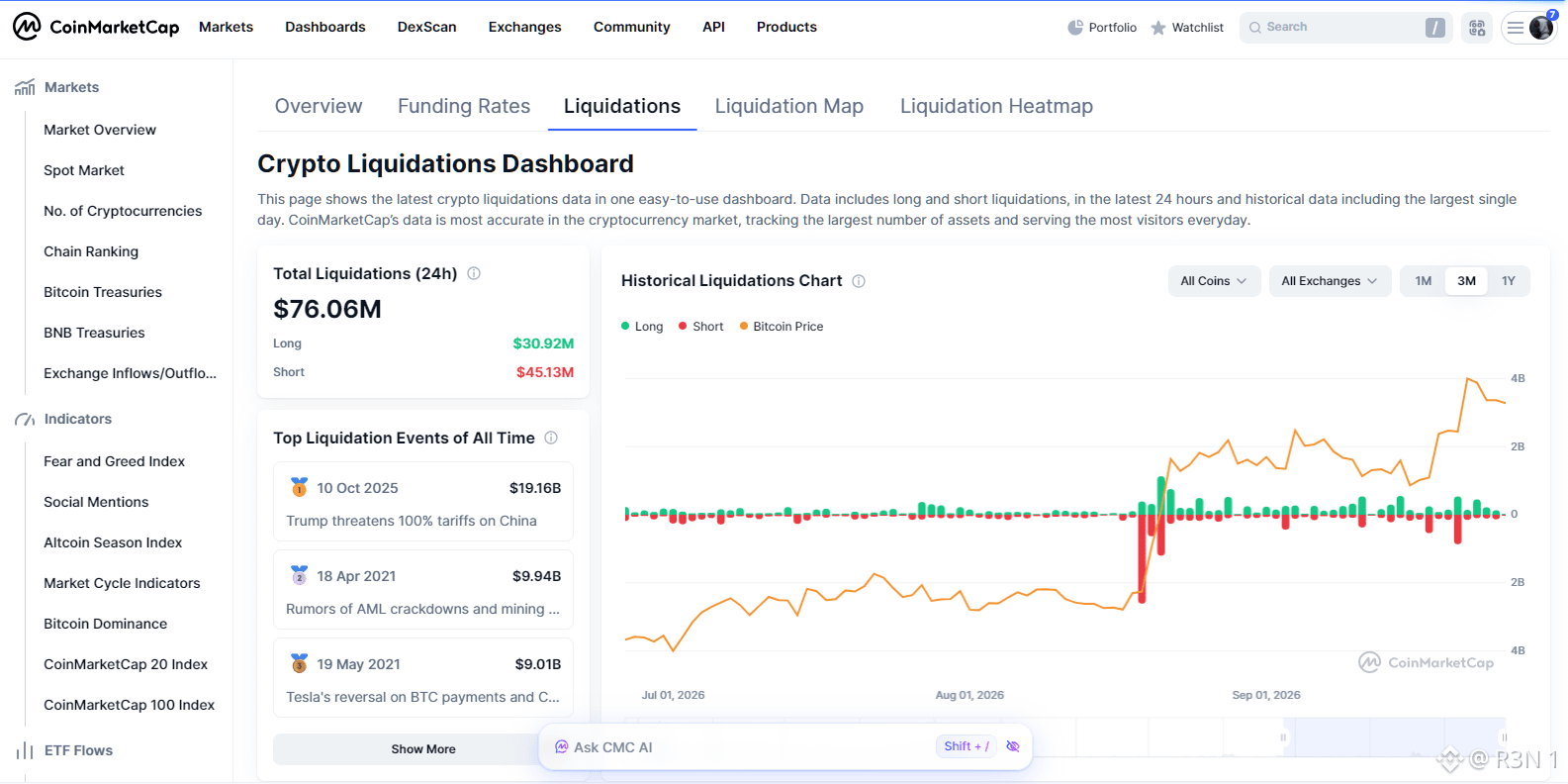
27
·
--
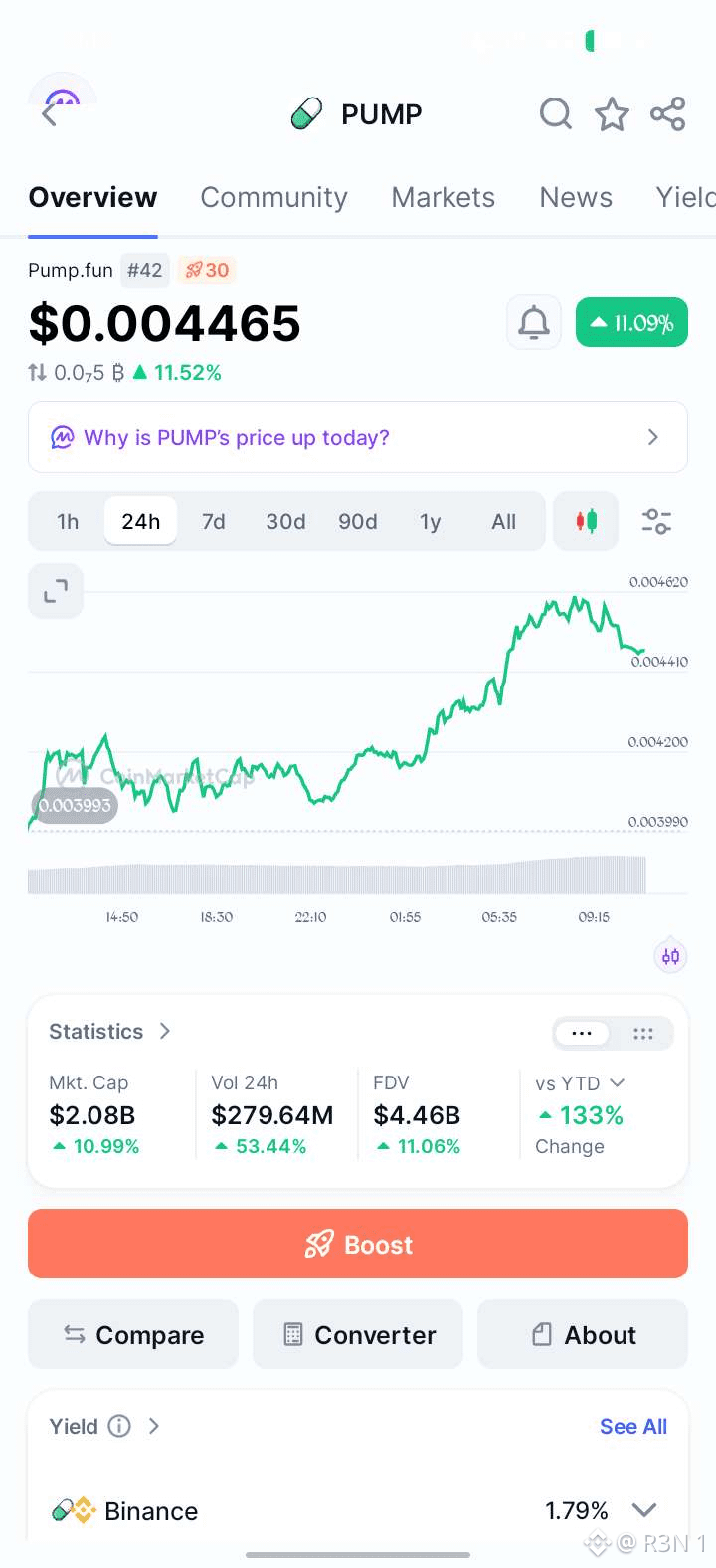
PUMPis making some noise again.
Pump token is up roughly 11% in the last 24 hours, trading around $0.00446, with market cap pushing above $2B.
But the number that caught my attention isn't the price.
It's the volume.
24h trading volume is sitting around $280M, up more than 53% alongside the move.
That tells me this isn't just a slow grind higher. There is fresh attention and actual trading activity behind it.
And pump is now up roughly 133% on the year.
Still, this is where I slow down.
A $2B market cap against a $4.46B FDV leaves a pretty large gap between circulating and fully diluted valuation. And with launchpad driven narratives, momentum can change quickly.
One thing I've learned from watching DeFi is that the headline metric rarely tells the whole story.
Price can move.
Volume can spike.
But I want to know what's happening underneath that move and whether the activity can actually sustain it.
That's why I'm watching the volume more than the green candle.
If buyers keep showing up and PUMP starts building above these levels, the move becomes more interesting.
If volume disappears and price gives it all back, then this may have simply been another liquidity rotation.
For now, I'm watching what happens beneath the move.
Explore the infrastructure behind onchain liquidity → https://ston.fi/omniston
$PUMP #BTC Price Analysis# $BTC #Altcoin Season#
PUMPis making some noise again.
Pump token is up roughly 11% in the last 24 hours, trading around $0.00446, with market cap pushing above $2B.
But the number that caught my attention isn't the price.
It's the volume.
24h trading volume is sitting around $280M, up more than 53% alongside the move.
That tells me this isn't just a slow grind higher. There is fresh attention and actual trading activity behind it.
And pump is now up roughly 133% on the year.
Still, this is where I slow down.
A $2B market cap against a $4.46B FDV leaves a pretty large gap between circulating and fully diluted valuation. And with launchpad driven narratives, momentum can change quickly.
One thing I've learned from watching DeFi is that the headline metric rarely tells the whole story.
Price can move.
Volume can spike.
But I want to know what's happening underneath that move and whether the activity can actually sustain it.
That's why I'm watching the volume more than the green candle.
If buyers keep showing up and PUMP starts building above these levels, the move becomes more interesting.
If volume disappears and price gives it all back, then this may have simply been another liquidity rotation.
For now, I'm watching what happens beneath the move.
Explore the infrastructure behind onchain liquidity → https://ston.fi/omniston
$PUMP #BTC Price Analysis# $BTC #Altcoin Season#
Pump token is up roughly 11% in the last 24 hours, trading around $0.00446, with market cap pushing above $2B.
But the number that caught my attention isn't the price.
It's the volume.
24h trading volume is sitting around $280M, up more than 53% alongside the move.
That tells me this isn't just a slow grind higher. There is fresh attention and actual trading activity behind it.
And pump is now up roughly 133% on the year.
Still, this is where I slow down.
A $2B market cap against a $4.46B FDV leaves a pretty large gap between circulating and fully diluted valuation. And with launchpad driven narratives, momentum can change quickly.
One thing I've learned from watching DeFi is that the headline metric rarely tells the whole story.
Price can move.
Volume can spike.
But I want to know what's happening underneath that move and whether the activity can actually sustain it.
That's why I'm watching the volume more than the green candle.
If buyers keep showing up and PUMP starts building above these levels, the move becomes more interesting.
If volume disappears and price gives it all back, then this may have simply been another liquidity rotation.
For now, I'm watching what happens beneath the move.
Explore the infrastructure behind onchain liquidity → https://ston.fi/omniston
$PUMP #BTC Price Analysis# $BTC #Altcoin Season#
40
·
--
Slippage and price impact are two of the most commonly confused terms in DeFi. Most users treat them as interchangeable. They describe different things and understanding both changes how you set up swaps.
Price impact is what your specific trade does to the pool's price. When you buy an asset from a liquidity pool you are removing that asset from the pool and adding the asset you're selling. This changes the ratio of assets in the pool which changes the price. A small trade in a deep pool produces minimal price impact. A large trade in a shallow pool produces significant price impact, you effectively move the market against yourself as you execute.
Price impact is deterministic. Given the pool's current depth and your trade size, the price impact is calculable before you submit. STONfi's interface shows this figure before confirmation. A price impact above 1% on a stablecoin swap is worth reconsidering. Above 3% on any swap is usually a signal that the pool is too shallow for your trade size.
Slippage is different. It is the difference between the price you expected when you submitted the transaction and the price you actually received when it confirmed. Slippage happens because other transactions can process between your submission and your confirmation, changing the pool's state before your trade executes.
Slippage tolerance is the maximum slippage you are willing to accept. Setting it too tight means your transaction fails if any price movement occurs between submission and confirmation. Setting it too loose means you accept more deviation than necessary. For stablecoin swaps 0.5% is usually appropriate. For volatile asset swaps 1% to 2% is more realistic during active market periods.
Price impact you know before you confirm. Slippage is what can happen between submission and confirmation. Both matter and they require different responses.
Swap on STONfi→ https://app.ston.fi/swap
$BTC #BTC Price Analysis# #Meme Alpha# $SOL
Slippage and price impact are two of the most commonly confused terms in DeFi. Most users treat them as interchangeable. They describe different things and understanding both changes how you set up swaps.
Price impact is what your specific trade does to the pool's price. When you buy an asset from a liquidity pool you are removing that asset from the pool and adding the asset you're selling. This changes the ratio of assets in the pool which changes the price. A small trade in a deep pool produces minimal price impact. A large trade in a shallow pool produces significant price impact, you effectively move the market against yourself as you execute.
Price impact is deterministic. Given the pool's current depth and your trade size, the price impact is calculable before you submit. STONfi's interface shows this figure before confirmation. A price impact above 1% on a stablecoin swap is worth reconsidering. Above 3% on any swap is usually a signal that the pool is too shallow for your trade size.
Slippage is different. It is the difference between the price you expected when you submitted the transaction and the price you actually received when it confirmed. Slippage happens because other transactions can process between your submission and your confirmation, changing the pool's state before your trade executes.
Slippage tolerance is the maximum slippage you are willing to accept. Setting it too tight means your transaction fails if any price movement occurs between submission and confirmation. Setting it too loose means you accept more deviation than necessary. For stablecoin swaps 0.5% is usually appropriate. For volatile asset swaps 1% to 2% is more realistic during active market periods.
Price impact you know before you confirm. Slippage is what can happen between submission and confirmation. Both matter and they require different responses.
Swap on STONfi→ https://app.ston.fi/swap
$BTC #BTC Price Analysis# #Meme Alpha# $SOL
Price impact is what your specific trade does to the pool's price. When you buy an asset from a liquidity pool you are removing that asset from the pool and adding the asset you're selling. This changes the ratio of assets in the pool which changes the price. A small trade in a deep pool produces minimal price impact. A large trade in a shallow pool produces significant price impact, you effectively move the market against yourself as you execute.
Price impact is deterministic. Given the pool's current depth and your trade size, the price impact is calculable before you submit. STONfi's interface shows this figure before confirmation. A price impact above 1% on a stablecoin swap is worth reconsidering. Above 3% on any swap is usually a signal that the pool is too shallow for your trade size.
Slippage is different. It is the difference between the price you expected when you submitted the transaction and the price you actually received when it confirmed. Slippage happens because other transactions can process between your submission and your confirmation, changing the pool's state before your trade executes.
Slippage tolerance is the maximum slippage you are willing to accept. Setting it too tight means your transaction fails if any price movement occurs between submission and confirmation. Setting it too loose means you accept more deviation than necessary. For stablecoin swaps 0.5% is usually appropriate. For volatile asset swaps 1% to 2% is more realistic during active market periods.
Price impact you know before you confirm. Slippage is what can happen between submission and confirmation. Both matter and they require different responses.
Swap on STONfi→ https://app.ston.fi/swap
$BTC #BTC Price Analysis# #Meme Alpha# $SOL

44
·
--
$1.23 million just moved through Binance and landed in the Bitget hacker's wallet, two days after the original breach. The laundering trail is still active in real time, not wrapped up.
Per Arkham and multiple on chain trackers, wallet 0x4885 withdrew 257.6 ETH and 545,000 USDT from Binance on September 26, swapped the USDT for another 200.2 ETH, then forwarded all 457.9 ETH to an address tied to the Bitget attacker. This follows the same playbook as five earlier Binance withdrawals from September 25, pull funds from a major exchange, consolidate into ETH, move it somewhere no single platform can freeze.
Worth updating the broader numbers too. Bitget's total loss was revised upward from $351.6 million to $387.5 million after investigators found additional affected assets on Zcash and TRON not included in the initial estimate. North Korean linked actors, possibly Lazarus Group, are now suspected based on IP address patterns, though that attribution remains unconfirmed by authorities. The attack itself didn't involve stolen keys, the attacker compromised Bitget's backend system, spoofing transaction data to trick it into authorizing transfers that looked legitimate internally.
My honest read: this specific $1.23 million movement is small relative to the total loss, but it matters as a signal, the laundering operation is still active and methodical two days later, not a one time smash and grab. Bitget and Binance collaborating on tracing this publicly is a genuine positive, transparency here beats silence, but tracing funds and recovering them are different outcomes.
What I'm watching: whether any of these tracked addresses actually get frozen or funds recovered, versus this staying a running commentary on funds moving further out of reach.
$BTC $ETH #Macro Insights# #BNBChain# #BTC Price Analysis#
$1.23 million just moved through Binance and landed in the Bitget hacker's wallet, two days after the original breach. The laundering trail is still active in real time, not wrapped up.
Per Arkham and multiple on chain trackers, wallet 0x4885 withdrew 257.6 ETH and 545,000 USDT from Binance on September 26, swapped the USDT for another 200.2 ETH, then forwarded all 457.9 ETH to an address tied to the Bitget attacker. This follows the same playbook as five earlier Binance withdrawals from September 25, pull funds from a major exchange, consolidate into ETH, move it somewhere no single platform can freeze.
Worth updating the broader numbers too. Bitget's total loss was revised upward from $351.6 million to $387.5 million after investigators found additional affected assets on Zcash and TRON not included in the initial estimate. North Korean linked actors, possibly Lazarus Group, are now suspected based on IP address patterns, though that attribution remains unconfirmed by authorities. The attack itself didn't involve stolen keys, the attacker compromised Bitget's backend system, spoofing transaction data to trick it into authorizing transfers that looked legitimate internally.
My honest read: this specific $1.23 million movement is small relative to the total loss, but it matters as a signal, the laundering operation is still active and methodical two days later, not a one time smash and grab. Bitget and Binance collaborating on tracing this publicly is a genuine positive, transparency here beats silence, but tracing funds and recovering them are different outcomes.
What I'm watching: whether any of these tracked addresses actually get frozen or funds recovered, versus this staying a running commentary on funds moving further out of reach.
$BTC $ETH #Macro Insights# #BNBChain# #BTC Price Analysis#
Per Arkham and multiple on chain trackers, wallet 0x4885 withdrew 257.6 ETH and 545,000 USDT from Binance on September 26, swapped the USDT for another 200.2 ETH, then forwarded all 457.9 ETH to an address tied to the Bitget attacker. This follows the same playbook as five earlier Binance withdrawals from September 25, pull funds from a major exchange, consolidate into ETH, move it somewhere no single platform can freeze.
Worth updating the broader numbers too. Bitget's total loss was revised upward from $351.6 million to $387.5 million after investigators found additional affected assets on Zcash and TRON not included in the initial estimate. North Korean linked actors, possibly Lazarus Group, are now suspected based on IP address patterns, though that attribution remains unconfirmed by authorities. The attack itself didn't involve stolen keys, the attacker compromised Bitget's backend system, spoofing transaction data to trick it into authorizing transfers that looked legitimate internally.
My honest read: this specific $1.23 million movement is small relative to the total loss, but it matters as a signal, the laundering operation is still active and methodical two days later, not a one time smash and grab. Bitget and Binance collaborating on tracing this publicly is a genuine positive, transparency here beats silence, but tracing funds and recovering them are different outcomes.
What I'm watching: whether any of these tracked addresses actually get frozen or funds recovered, versus this staying a running commentary on funds moving further out of reach.
$BTC $ETH #Macro Insights# #BNBChain# #BTC Price Analysis#

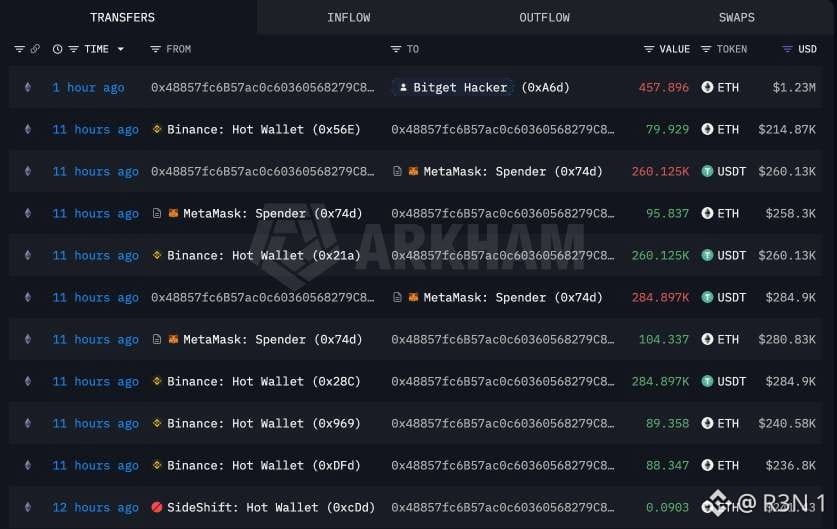
58
·
--
No private keys were stolen here. That detail matters more than the $351.6 million headline, because it changes what kind of problem this actually is.
Bitget CEO Gracy Chen confirmed the attacker compromised a backend system within the wallet infrastructure, spoofed transaction data, and triggered the exchange's own authorization process to move funds out, rather than obtaining keys directly. The breach hit hot and warm wallets, detected at 18:31 UTC on September 24. XRP was the largest single asset taken, Lookonchain estimates 102.93 million tokens worth $157.48 million. Cold wallets, Bitget says, remain fully secure and untouched.
The response has been fast on paper. Emergency protocols activated within minutes, withdrawals suspended pending a security review while deposits and trading stayed open, and Chen says the full loss falls within Bitget's User Protection Fund, holding over $464 million. Law enforcement and on-chain security firms have been notified, flagged addresses already identified. Chen has also said preliminary IP and VPN similarities point toward possible North Korean involvement, though she's stopped short of confirming it.
Context that matters, this is now the largest single crypto theft of 2026, surpassing the roughly $320 million taken from Blockstream's Liquid Network on September 6, making September the costliest month for crypto hacks this year.
My honest read: a compromised authorization process rather than stolen keys is a somewhat more containable failure mode, an infrastructure or access control gap rather than a cryptographic compromise, and cold wallet separation held. Whether funds are genuinely safe still depends on that protection fund actually paying out as promised.
What I'm watching: the full technical report Chen promised, and whether withdrawals resume once the review clears, she's explicitly said she won't commit to a timeline she can't guarantee.
#BTC Price Analysis# #Altcoin Season# $BTC $ETH
No private keys were stolen here. That detail matters more than the $351.6 million headline, because it changes what kind of problem this actually is.
Bitget CEO Gracy Chen confirmed the attacker compromised a backend system within the wallet infrastructure, spoofed transaction data, and triggered the exchange's own authorization process to move funds out, rather than obtaining keys directly. The breach hit hot and warm wallets, detected at 18:31 UTC on September 24. XRP was the largest single asset taken, Lookonchain estimates 102.93 million tokens worth $157.48 million. Cold wallets, Bitget says, remain fully secure and untouched.
The response has been fast on paper. Emergency protocols activated within minutes, withdrawals suspended pending a security review while deposits and trading stayed open, and Chen says the full loss falls within Bitget's User Protection Fund, holding over $464 million. Law enforcement and on-chain security firms have been notified, flagged addresses already identified. Chen has also said preliminary IP and VPN similarities point toward possible North Korean involvement, though she's stopped short of confirming it.
Context that matters, this is now the largest single crypto theft of 2026, surpassing the roughly $320 million taken from Blockstream's Liquid Network on September 6, making September the costliest month for crypto hacks this year.
My honest read: a compromised authorization process rather than stolen keys is a somewhat more containable failure mode, an infrastructure or access control gap rather than a cryptographic compromise, and cold wallet separation held. Whether funds are genuinely safe still depends on that protection fund actually paying out as promised.
What I'm watching: the full technical report Chen promised, and whether withdrawals resume once the review clears, she's explicitly said she won't commit to a timeline she can't guarantee.
#BTC Price Analysis# #Altcoin Season# $BTC $ETH
Bitget CEO Gracy Chen confirmed the attacker compromised a backend system within the wallet infrastructure, spoofed transaction data, and triggered the exchange's own authorization process to move funds out, rather than obtaining keys directly. The breach hit hot and warm wallets, detected at 18:31 UTC on September 24. XRP was the largest single asset taken, Lookonchain estimates 102.93 million tokens worth $157.48 million. Cold wallets, Bitget says, remain fully secure and untouched.
The response has been fast on paper. Emergency protocols activated within minutes, withdrawals suspended pending a security review while deposits and trading stayed open, and Chen says the full loss falls within Bitget's User Protection Fund, holding over $464 million. Law enforcement and on-chain security firms have been notified, flagged addresses already identified. Chen has also said preliminary IP and VPN similarities point toward possible North Korean involvement, though she's stopped short of confirming it.
Context that matters, this is now the largest single crypto theft of 2026, surpassing the roughly $320 million taken from Blockstream's Liquid Network on September 6, making September the costliest month for crypto hacks this year.
My honest read: a compromised authorization process rather than stolen keys is a somewhat more containable failure mode, an infrastructure or access control gap rather than a cryptographic compromise, and cold wallet separation held. Whether funds are genuinely safe still depends on that protection fund actually paying out as promised.
What I'm watching: the full technical report Chen promised, and whether withdrawals resume once the review clears, she's explicitly said she won't commit to a timeline she can't guarantee.
#BTC Price Analysis# #Altcoin Season# $BTC $ETH

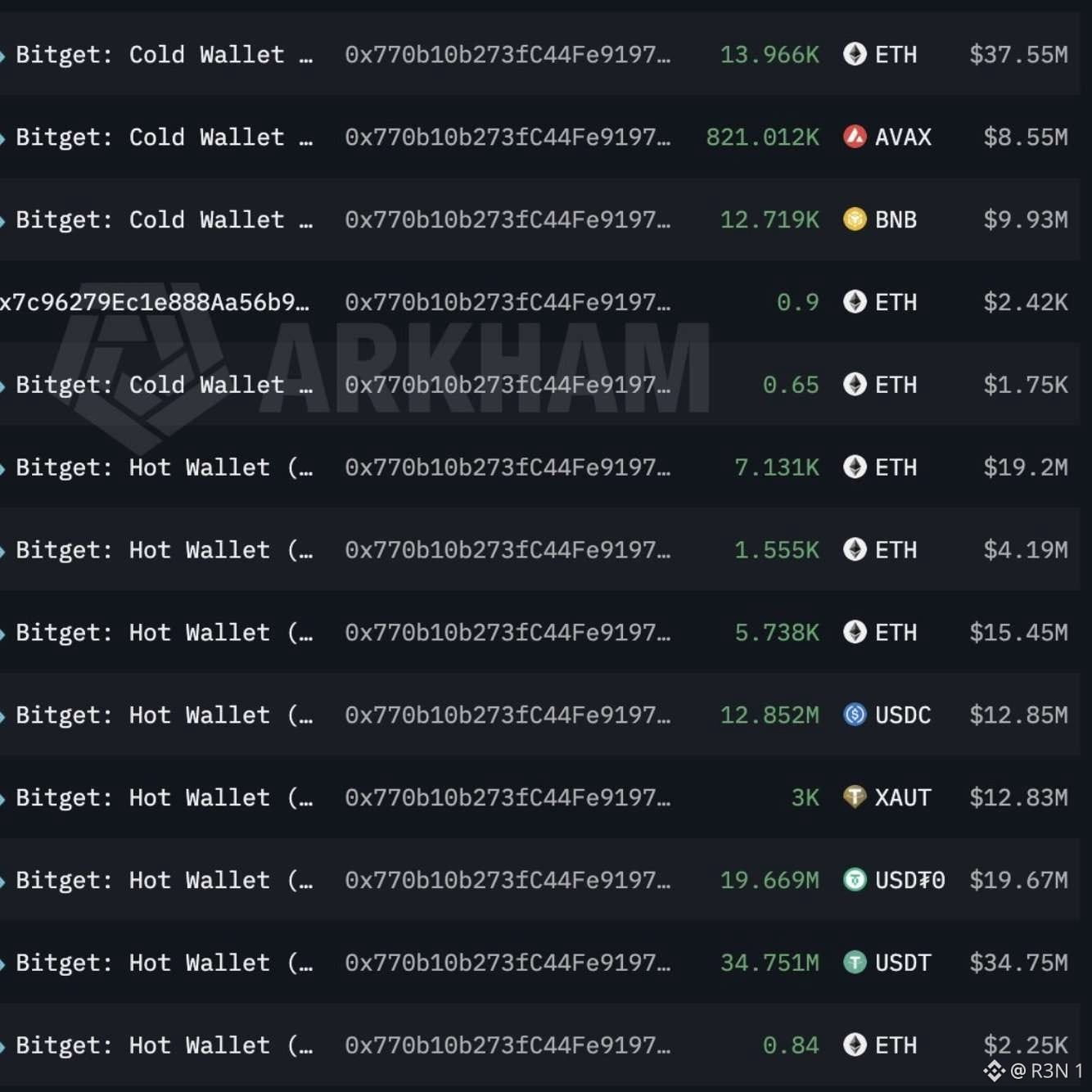
59
·
--
A liquidity pool is a smart contract holding two assets that users can swap between. The assets are deposited by liquidity providers, people who lock their tokens in the contract in exchange for a share of the fees every swap generates.
When someone swaps Token A for Token B on a DEX like Ston.fi they are not trading against another person. They are trading against the pool. The pool always provides a price using a formula based on the current ratio of the two assets. Buy Token A and the ratio shifts, Token A becomes more expensive, Token B becomes cheaper. The formula does this automatically with every trade.
Liquidity providers earn because every swap pays a fee. On Ston.fi that fee is 0.2% of the swap amount. That 0.2% distributes to everyone providing liquidity in the pool proportional to their share. If you own 1% of the pool's total liquidity you earn 1% of every fee generated.
The catch is impermanent loss. When the price ratio between the two assets in your pool changes the pool automatically rebalances against you accumulating more of the declining asset and less of the appreciating one. When you withdraw your position reflects that rebalanced ratio rather than what you deposited. The difference between what you would have held and what you actually hold is impermanent loss.
Whether providing liquidity is profitable depends on whether the fees earned exceed the impermanent loss accumulated over the holding period. Pools with high trading volume relative to their total liquidity generate more fees per dollar deployed. Stable pairs where the price ratio rarely changes produce less impermanent loss.
Reading both numbers together before entering any pool is the starting point for evaluating whether the position makes sense.
Explore STONfi pools → https://app.ston.fi/pools
$BTC #BTC Price Analysis# #Meme Alpha# $SOL
A liquidity pool is a smart contract holding two assets that users can swap between. The assets are deposited by liquidity providers, people who lock their tokens in the contract in exchange for a share of the fees every swap generates.
When someone swaps Token A for Token B on a DEX like Ston.fi they are not trading against another person. They are trading against the pool. The pool always provides a price using a formula based on the current ratio of the two assets. Buy Token A and the ratio shifts, Token A becomes more expensive, Token B becomes cheaper. The formula does this automatically with every trade.
Liquidity providers earn because every swap pays a fee. On Ston.fi that fee is 0.2% of the swap amount. That 0.2% distributes to everyone providing liquidity in the pool proportional to their share. If you own 1% of the pool's total liquidity you earn 1% of every fee generated.
The catch is impermanent loss. When the price ratio between the two assets in your pool changes the pool automatically rebalances against you accumulating more of the declining asset and less of the appreciating one. When you withdraw your position reflects that rebalanced ratio rather than what you deposited. The difference between what you would have held and what you actually hold is impermanent loss.
Whether providing liquidity is profitable depends on whether the fees earned exceed the impermanent loss accumulated over the holding period. Pools with high trading volume relative to their total liquidity generate more fees per dollar deployed. Stable pairs where the price ratio rarely changes produce less impermanent loss.
Reading both numbers together before entering any pool is the starting point for evaluating whether the position makes sense.
Explore STONfi pools → https://app.ston.fi/pools
$BTC #BTC Price Analysis# #Meme Alpha# $SOL
When someone swaps Token A for Token B on a DEX like Ston.fi they are not trading against another person. They are trading against the pool. The pool always provides a price using a formula based on the current ratio of the two assets. Buy Token A and the ratio shifts, Token A becomes more expensive, Token B becomes cheaper. The formula does this automatically with every trade.
Liquidity providers earn because every swap pays a fee. On Ston.fi that fee is 0.2% of the swap amount. That 0.2% distributes to everyone providing liquidity in the pool proportional to their share. If you own 1% of the pool's total liquidity you earn 1% of every fee generated.
The catch is impermanent loss. When the price ratio between the two assets in your pool changes the pool automatically rebalances against you accumulating more of the declining asset and less of the appreciating one. When you withdraw your position reflects that rebalanced ratio rather than what you deposited. The difference between what you would have held and what you actually hold is impermanent loss.
Whether providing liquidity is profitable depends on whether the fees earned exceed the impermanent loss accumulated over the holding period. Pools with high trading volume relative to their total liquidity generate more fees per dollar deployed. Stable pairs where the price ratio rarely changes produce less impermanent loss.
Reading both numbers together before entering any pool is the starting point for evaluating whether the position makes sense.
Explore STONfi pools → https://app.ston.fi/pools
$BTC #BTC Price Analysis# #Meme Alpha# $SOL
33
·
--
Omniston is the cross-chain execution protocol built by Ston.fi's development team. It is what powers every swap between TON and the ten chains currently supported in STONfi's cross-chain interface. Understanding what it actually does not just what it is called, is the most useful thing anyone new to TON DeFi can learn before making their first cross-chain move.
The core idea is straightforward. When you submit a cross-chain swap on STONfi you are not sending instructions to a bridge. You are expressing an intent, I want to receive this asset on this chain in this amount. Omniston broadcasts that intent to a network of professional liquidity providers called resolvers. Resolvers compete to fill the intent through a Request for Quote process. The one who offers the best rate wins the order.
The resolver who wins does not just promise to deliver. They lock the destination-side assets in a Hashed Timelock Contract before the user's source-side assets commit. Both contracts share the same cryptographic condition. When the condition is met both sides settle simultaneously. The user receives exactly what was quoted or both sides return to their starting position automatically through the timelock. There is no execution path where both parties lose funds.
This is why quote certainty is the defining property of Omniston swaps. The amount shown at confirmation is the amount that arrives. The resolver committed to delivering it. The HTLC structure enforced that commitment cryptographically rather than through trust.
Omniston currently connects TON to TRON, Ethereum, Base, BNB Chain, Polygon, Avalanche, Arbitrum, Robinhood Chain, and X Layer. It is also integrated into TONCO, My Wallet, TractionEye, Predict, Gramstox, Gram Store, and a growing list of TON products.
Try Omniston →https://app.ston.fi/swap?mode=cross-chain
#BTC Price Analysis# #Macro Insights# $ONDO #Altcoin Season# $LTC
Omniston is the cross-chain execution protocol built by Ston.fi's development team. It is what powers every swap between TON and the ten chains currently supported in STONfi's cross-chain interface. Understanding what it actually does not just what it is called, is the most useful thing anyone new to TON DeFi can learn before making their first cross-chain move.
The core idea is straightforward. When you submit a cross-chain swap on STONfi you are not sending instructions to a bridge. You are expressing an intent, I want to receive this asset on this chain in this amount. Omniston broadcasts that intent to a network of professional liquidity providers called resolvers. Resolvers compete to fill the intent through a Request for Quote process. The one who offers the best rate wins the order.
The resolver who wins does not just promise to deliver. They lock the destination-side assets in a Hashed Timelock Contract before the user's source-side assets commit. Both contracts share the same cryptographic condition. When the condition is met both sides settle simultaneously. The user receives exactly what was quoted or both sides return to their starting position automatically through the timelock. There is no execution path where both parties lose funds.
This is why quote certainty is the defining property of Omniston swaps. The amount shown at confirmation is the amount that arrives. The resolver committed to delivering it. The HTLC structure enforced that commitment cryptographically rather than through trust.
Omniston currently connects TON to TRON, Ethereum, Base, BNB Chain, Polygon, Avalanche, Arbitrum, Robinhood Chain, and X Layer. It is also integrated into TONCO, My Wallet, TractionEye, Predict, Gramstox, Gram Store, and a growing list of TON products.
Try Omniston →https://app.ston.fi/swap?mode=cross-chain
#BTC Price Analysis# #Macro Insights# $ONDO #Altcoin Season# $LTC
The core idea is straightforward. When you submit a cross-chain swap on STONfi you are not sending instructions to a bridge. You are expressing an intent, I want to receive this asset on this chain in this amount. Omniston broadcasts that intent to a network of professional liquidity providers called resolvers. Resolvers compete to fill the intent through a Request for Quote process. The one who offers the best rate wins the order.
The resolver who wins does not just promise to deliver. They lock the destination-side assets in a Hashed Timelock Contract before the user's source-side assets commit. Both contracts share the same cryptographic condition. When the condition is met both sides settle simultaneously. The user receives exactly what was quoted or both sides return to their starting position automatically through the timelock. There is no execution path where both parties lose funds.
This is why quote certainty is the defining property of Omniston swaps. The amount shown at confirmation is the amount that arrives. The resolver committed to delivering it. The HTLC structure enforced that commitment cryptographically rather than through trust.
Omniston currently connects TON to TRON, Ethereum, Base, BNB Chain, Polygon, Avalanche, Arbitrum, Robinhood Chain, and X Layer. It is also integrated into TONCO, My Wallet, TractionEye, Predict, Gramstox, Gram Store, and a growing list of TON products.
Try Omniston →https://app.ston.fi/swap?mode=cross-chain
#BTC Price Analysis# #Macro Insights# $ONDO #Altcoin Season# $LTC

57
Log in to explore more content
Join global crypto users on Binance Square
⚡️ Get latest and useful information about crypto.
💬 Trusted by the world’s largest crypto exchange.
👍 Discover real insights from verified creators.
Email / Phone number
Trending Topics
MetaMaskExitsLidoValidatorsAfterSecurityIncident
41,962 views
717 Discussing
🚨 METAMASK JUST STARTED EXITING ETH VALIDATORS AFTER A SECURITY INCIDENT.
MetaMask says an ongoing security incident hit part of its infrastructure, forcing it to proactively exit affected validators from its non-custodial staking operations. The company says it has found no immediate threat to MetaMask wallets so far.
The key detail?
These validators are tied to Lido staking, and the exit process may temporarily remove ETH from staking while the investigation continues. Lido-related reports say the full exit, withdrawal and re-entry cycle could take up to roughly 45 days.
That means the market should separate two things:
Wallet users are not currently being told they’re at immediate risk.
But validator infrastructure clearly was serious enough to trigger an emergency exit.
And when one of Ethereum’s biggest wallet brands starts pulling validators as a precaution, traders pay attention.
Security incidents don’t need stolen funds to become market-moving.
Sometimes the reaction itself is the signal. 👀
$ETH $LDO
#metamaskexitslidovalidatorsaftersecurityincident
KimHotbae
·1 Likes
·2.6k views
MicronBeatsEarningsLiftsGuidance
27,830 views
573 Discussing
CFTCSubmitsTwoEventContractRulesToWhiteHouse
20,338 views
500 Discussing