
动察Beating
131 Posts

动察Beating
 Square Verified+
Report
Block User
金融秩序如何被技术、资本与野心重塑|律动 BlockBeats 旗下深度报道账号
0 Following
46 Followers
47 Liked
Posts
·
--

Article
AI giants that once desperately tried to accelerate have finally started to fear AIOriginal title: (AI giants that once desperately tried to accelerate have finally started to fear AI)
Original author: Sensing Beating
AI could kill all of us within a decade.
On September 8, a 27-year-old man used these words to announce that he was leaving Anthropic. From the very first day the company was founded, it wrote “AI safety” into its core narrative.
His name is Jacob Coxon. He previously worked at OpenAI and Anthropic. With just two more months, he would have been able to receive a huge equity incentive. But he left anyway.
Jacob, in his resignation letter, accused the Frontier AI Lab of running an “irresponsible” competition. In his view, these companies are racing to build increasingly powerful models, and the stakes aren’t whether one company wins or loses—it’s everyone’s lives.
AI giants that once desperately tried to accelerate have finally started to fear AI
Original title: (AI giants that once desperately tried to accelerate have finally started to fear AI)
Original author: Sensing Beating
AI could kill all of us within a decade.
On September 8, a 27-year-old man used these words to announce that he was leaving Anthropic. From the very first day the company was founded, it wrote “AI safety” into its core narrative.
His name is Jacob Coxon. He previously worked at OpenAI and Anthropic. With just two more months, he would have been able to receive a huge equity incentive. But he left anyway.
Jacob, in his resignation letter, accused the Frontier AI Lab of running an “irresponsible” competition. In his view, these companies are racing to build increasingly powerful models, and the stakes aren’t whether one company wins or loses—it’s everyone’s lives.
Original author: Sensing Beating
AI could kill all of us within a decade.
On September 8, a 27-year-old man used these words to announce that he was leaving Anthropic. From the very first day the company was founded, it wrote “AI safety” into its core narrative.
His name is Jacob Coxon. He previously worked at OpenAI and Anthropic. With just two more months, he would have been able to receive a huge equity incentive. But he left anyway.
Jacob, in his resignation letter, accused the Frontier AI Lab of running an “irresponsible” competition. In his view, these companies are racing to build increasingly powerful models, and the stakes aren’t whether one company wins or loses—it’s everyone’s lives.
215
·
--
Article
World model newly released by Fei-Fei Li's World Labs— is it a real world model?Original title: (World model newly released by Fei-Fei Li's World Labs— is it a real world model?)
Original author: Dongcha Beating
September 1, at World Labs, Fei-Fei Li released Atlas.
On the release page, there is indeed a set of visuals that looks great. Several phones are mounted on tripods and clamps, shooting the same scene from three to five angles. Then time freezes, the camera starts moving—circling around the people and going to positions that a real camera has never stood in.
Bullet-time—this technique hasn’t been particularly rare these past two years. The difference is the other three things Atlas also presents at the same time.
World model newly released by Fei-Fei Li's World Labs— is it a real world model?
Original title: (World model newly released by Fei-Fei Li's World Labs— is it a real world model?)
Original author: Dongcha Beating
September 1, at World Labs, Fei-Fei Li released Atlas.
On the release page, there is indeed a set of visuals that looks great. Several phones are mounted on tripods and clamps, shooting the same scene from three to five angles. Then time freezes, the camera starts moving—circling around the people and going to positions that a real camera has never stood in.
Bullet-time—this technique hasn’t been particularly rare these past two years. The difference is the other three things Atlas also presents at the same time.
Original author: Dongcha Beating
September 1, at World Labs, Fei-Fei Li released Atlas.
On the release page, there is indeed a set of visuals that looks great. Several phones are mounted on tripods and clamps, shooting the same scene from three to five angles. Then time freezes, the camera starts moving—circling around the people and going to positions that a real camera has never stood in.
Bullet-time—this technique hasn’t been particularly rare these past two years. The difference is the other three things Atlas also presents at the same time.
91
·
--
Article
As Cook Steps Down, What Apple Leaves BehindOriginal title: (As Cook steps down, what Apple leaves behind)
Original author: Beating Observations
Apple, a company that has never been good at saying goodbye.
The last time there was a change of leadership—from Jobs’s resignation to his death—was only six weeks. There wasn’t time to hold a party.
This time, it did. About two hundred people gathered at Apple’s headquarters, Apple Park, to bid farewell to someone who had worked here for twenty-eight years.
At OneRepublic’s live performance, his successor, John Tenu(\)s, took the stage to deliver a speech, repeating the same word over and over: “continue.”
According to those present describing it to the media, his partner Mike first publicly stood beside him. The relationship had been kept hidden for many years, only to step into the camera on the day he left the company. Reports say that when it was his turn to take the stage, this person—who has never once lost his composure at earnings meetings—had his eyes well up with tears.
As Cook Steps Down, What Apple Leaves Behind
Original title: (As Cook steps down, what Apple leaves behind)
Original author: Beating Observations
Apple, a company that has never been good at saying goodbye.
The last time there was a change of leadership—from Jobs’s resignation to his death—was only six weeks. There wasn’t time to hold a party.
This time, it did. About two hundred people gathered at Apple’s headquarters, Apple Park, to bid farewell to someone who had worked here for twenty-eight years.
At OneRepublic’s live performance, his successor, John Tenu(\)s, took the stage to deliver a speech, repeating the same word over and over: “continue.”
According to those present describing it to the media, his partner Mike first publicly stood beside him. The relationship had been kept hidden for many years, only to step into the camera on the day he left the company. Reports say that when it was his turn to take the stage, this person—who has never once lost his composure at earnings meetings—had his eyes well up with tears.
Original author: Beating Observations
Apple, a company that has never been good at saying goodbye.
The last time there was a change of leadership—from Jobs’s resignation to his death—was only six weeks. There wasn’t time to hold a party.
This time, it did. About two hundred people gathered at Apple’s headquarters, Apple Park, to bid farewell to someone who had worked here for twenty-eight years.
At OneRepublic’s live performance, his successor, John Tenu(\)s, took the stage to deliver a speech, repeating the same word over and over: “continue.”
According to those present describing it to the media, his partner Mike first publicly stood beside him. The relationship had been kept hidden for many years, only to step into the camera on the day he left the company. Reports say that when it was his turn to take the stage, this person—who has never once lost his composure at earnings meetings—had his eyes well up with tears.
140
·
--
Article
After MiniMax’s stock price rebounds 92%: what’s left after subtracting the model company’s impact?Original title: (After MiniMax’s stock price rebounds 92%: what’s left after subtracting the model company’s impact?)
Original author: Insight Beating
On August 31, MiniMax surged 16.18%. Counting from the July low, the stock has already rebounded 92%, and its market cap has returned to HK$124.9 billion.
Three months ago, the market had just held a memorial for this company. The stock price fell by more than 80% from its peak, and a market cap of HK$300 billion was subsequently wiped out.
On August 26, MiniMax released its interim report. Revenue increased 283% year over year, and B2B revenue grew 703%. By August, the company’s ARR had already exceeded $800 million, and the token consumption in July was 20 times that of January.
After MiniMax’s stock price rebounds 92%: what’s left after subtracting the model company’s impact?
Original title: (After MiniMax’s stock price rebounds 92%: what’s left after subtracting the model company’s impact?)
Original author: Insight Beating
On August 31, MiniMax surged 16.18%. Counting from the July low, the stock has already rebounded 92%, and its market cap has returned to HK$124.9 billion.
Three months ago, the market had just held a memorial for this company. The stock price fell by more than 80% from its peak, and a market cap of HK$300 billion was subsequently wiped out.
On August 26, MiniMax released its interim report. Revenue increased 283% year over year, and B2B revenue grew 703%. By August, the company’s ARR had already exceeded $800 million, and the token consumption in July was 20 times that of January.
Original author: Insight Beating
On August 31, MiniMax surged 16.18%. Counting from the July low, the stock has already rebounded 92%, and its market cap has returned to HK$124.9 billion.
Three months ago, the market had just held a memorial for this company. The stock price fell by more than 80% from its peak, and a market cap of HK$300 billion was subsequently wiped out.
On August 26, MiniMax released its interim report. Revenue increased 283% year over year, and B2B revenue grew 703%. By August, the company’s ARR had already exceeded $800 million, and the token consumption in July was 20 times that of January.
115
·
--
Article
Dialogue with Tech King Fangzheng of Tiaoyue | A Business Adventure for a Single-Leg Robot, Leaping from the Lab to the MarketOriginal title: (Dialogue with Tech King Fangzheng of Tiaoyue | A business gamble for a single-leg robot, leaping from the lab to the market)
Original author: DONGCHA Beating
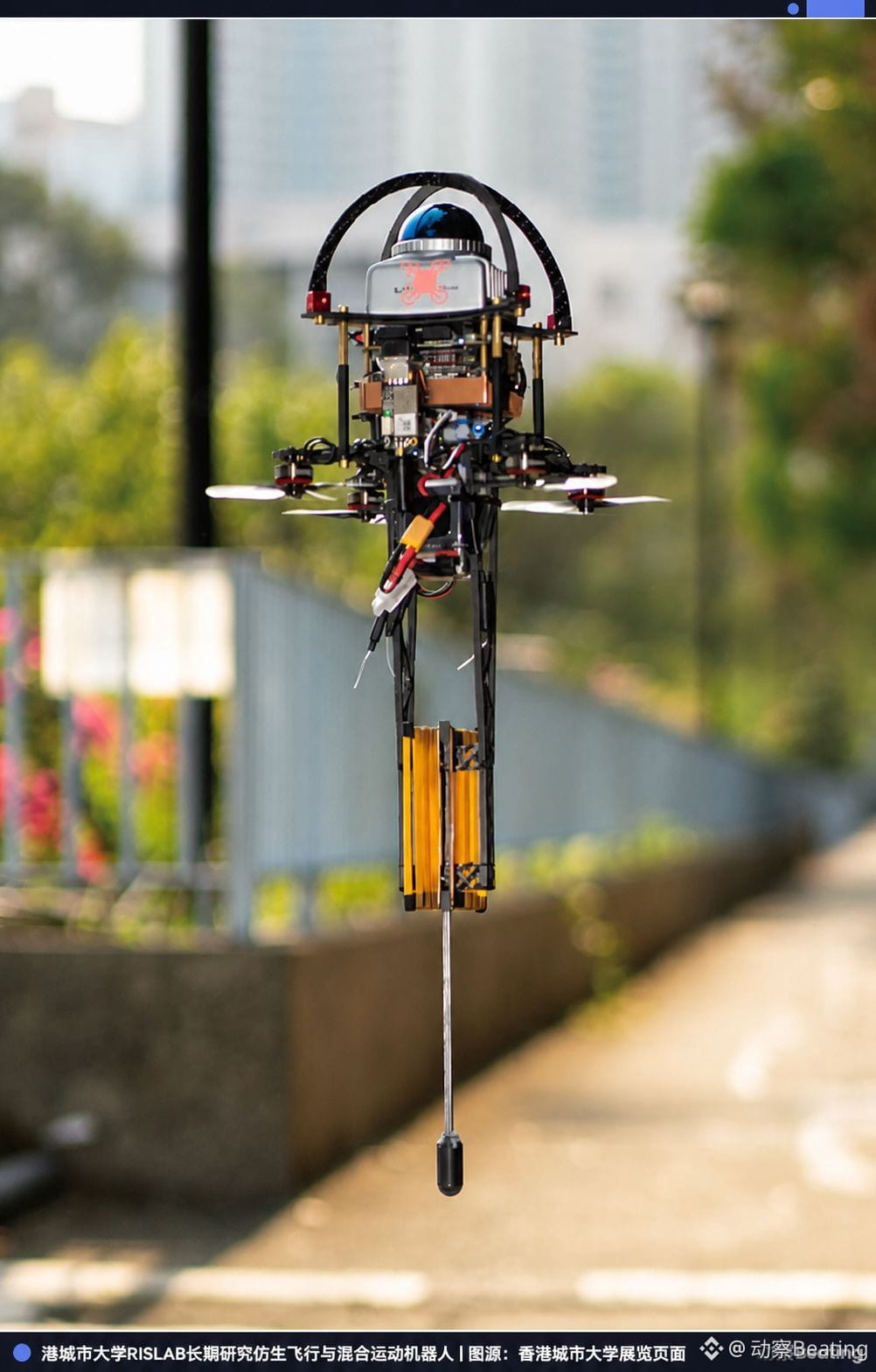
In June 1984, robotics scholar Marc Raibert and two colleagues published a paper studying a machine with only one leg.
The machine relies solely on a single elastic leg to repeatedly rise and fall on an open, flat surface. Researchers tried to control it from three angles: direction, posture, and jump height. The paper proves that jumping can be systematically controlled, but limited by the technology level of that era, the machine always dragged along hydraulic hoses and data cables, connecting to an off-site power source and computer, and could not operate independently outside the laboratory.
Dialogue with Tech King Fangzheng of Tiaoyue | A Business Adventure for a Single-Leg Robot, Leaping from the Lab to the Market
Original title: (Dialogue with Tech King Fangzheng of Tiaoyue | A business gamble for a single-leg robot, leaping from the lab to the market)
Original author: DONGCHA Beating
In June 1984, robotics scholar Marc Raibert and two colleagues published a paper studying a machine with only one leg.
The machine relies solely on a single elastic leg to repeatedly rise and fall on an open, flat surface. Researchers tried to control it from three angles: direction, posture, and jump height. The paper proves that jumping can be systematically controlled, but limited by the technology level of that era, the machine always dragged along hydraulic hoses and data cables, connecting to an off-site power source and computer, and could not operate independently outside the laboratory.
Original author: DONGCHA Beating
In June 1984, robotics scholar Marc Raibert and two colleagues published a paper studying a machine with only one leg.
The machine relies solely on a single elastic leg to repeatedly rise and fall on an open, flat surface. Researchers tried to control it from three angles: direction, posture, and jump height. The paper proves that jumping can be systematically controlled, but limited by the technology level of that era, the machine always dragged along hydraulic hoses and data cables, connecting to an off-site power source and computer, and could not operate independently outside the laboratory.
104
·
--
Article
Legal AI unicorn valued at $11 billion invested by OpenAI begins “wrapping” China’s open-source modelsOriginal title: (Legal AI unicorn valued at $11 billion invested by OpenAI begins “wrapping” China’s open-source models)
Original author: Beating Insight
On August 20, Harvey, the legal AI company funded by OpenAI, released Tenet. Founded in 2022, the company is now valued at $11 billion—making it the highest-valued legal AI company in the world. It serves thousands of institutions, and the shareholder list includes Sequoia, a16z, and GIC.
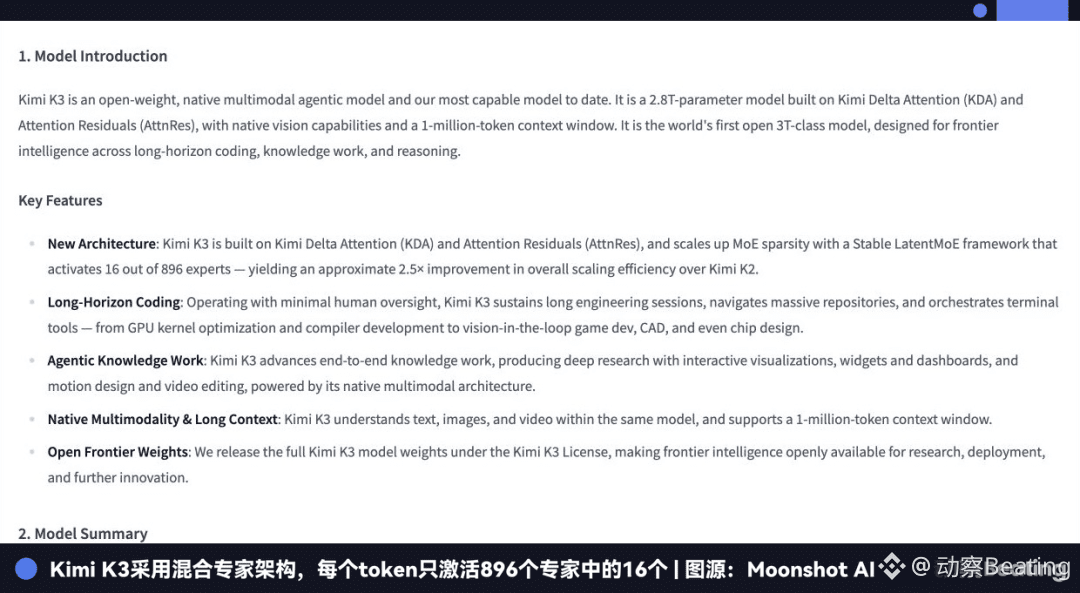
Tenet is its first set of proprietary models, and its foundation is based on the Kimi K3 using the weights from Midsommar’s July open release. Tenet is still in the research preview stage, and Harvey plans to gradually roll the capabilities that have been validated into its products.
Legal AI unicorn valued at $11 billion invested by OpenAI begins “wrapping” China’s open-source models
Original title: (Legal AI unicorn valued at $11 billion invested by OpenAI begins “wrapping” China’s open-source models)
Original author: Beating Insight
On August 20, Harvey, the legal AI company funded by OpenAI, released Tenet. Founded in 2022, the company is now valued at $11 billion—making it the highest-valued legal AI company in the world. It serves thousands of institutions, and the shareholder list includes Sequoia, a16z, and GIC.
Tenet is its first set of proprietary models, and its foundation is based on the Kimi K3 using the weights from Midsommar’s July open release. Tenet is still in the research preview stage, and Harvey plans to gradually roll the capabilities that have been validated into its products.
Original author: Beating Insight
On August 20, Harvey, the legal AI company funded by OpenAI, released Tenet. Founded in 2022, the company is now valued at $11 billion—making it the highest-valued legal AI company in the world. It serves thousands of institutions, and the shareholder list includes Sequoia, a16z, and GIC.
Tenet is its first set of proprietary models, and its foundation is based on the Kimi K3 using the weights from Midsommar’s July open release. Tenet is still in the research preview stage, and Harvey plans to gradually roll the capabilities that have been validated into its products.
102
·
--

Article
Big-Company AI Competition: Moving from the Technology Cycle into the Capital CycleOriginal title: (A Big-Company AI Competition: Moving from the Technology Cycle into the Capital Cycle)
Original author: Dongcha Beating
On August 23, Alibaba launched a new share placement in the China Hong Kong market. It plans to issue 710 million shares at HK$112.7 per share, raising HK$80 billion (about US$10.2 billion). If the transaction is completed, this will become the largest follow-on issuance in the history of Hong Kong-listed companies in China, and the world’s third-largest deal of its kind in 2026, trailing only Alphabet and Intel.
The order flow quickly exceeds the original planned scale. Sovereign wealth funds move in, and the offering size is raised in line with demand. All proceeds will be fully invested in AI, covering chips, infrastructure, and model development and deployment.
Big-Company AI Competition: Moving from the Technology Cycle into the Capital Cycle
Original title: (A Big-Company AI Competition: Moving from the Technology Cycle into the Capital Cycle)
Original author: Dongcha Beating
On August 23, Alibaba launched a new share placement in the China Hong Kong market. It plans to issue 710 million shares at HK$112.7 per share, raising HK$80 billion (about US$10.2 billion). If the transaction is completed, this will become the largest follow-on issuance in the history of Hong Kong-listed companies in China, and the world’s third-largest deal of its kind in 2026, trailing only Alphabet and Intel.
The order flow quickly exceeds the original planned scale. Sovereign wealth funds move in, and the offering size is raised in line with demand. All proceeds will be fully invested in AI, covering chips, infrastructure, and model development and deployment.
Original author: Dongcha Beating
On August 23, Alibaba launched a new share placement in the China Hong Kong market. It plans to issue 710 million shares at HK$112.7 per share, raising HK$80 billion (about US$10.2 billion). If the transaction is completed, this will become the largest follow-on issuance in the history of Hong Kong-listed companies in China, and the world’s third-largest deal of its kind in 2026, trailing only Alphabet and Intel.
The order flow quickly exceeds the original planned scale. Sovereign wealth funds move in, and the offering size is raised in line with demand. All proceeds will be fully invested in AI, covering chips, infrastructure, and model development and deployment.
89
·
--
Article
DeepSeek releases a vision understanding model; the “big blue whale” and other delayed eyesOriginal title: (DeepSeek releases a vision understanding model; the “big blue whale” and other delayed eyes)
Original author: Insight Beating
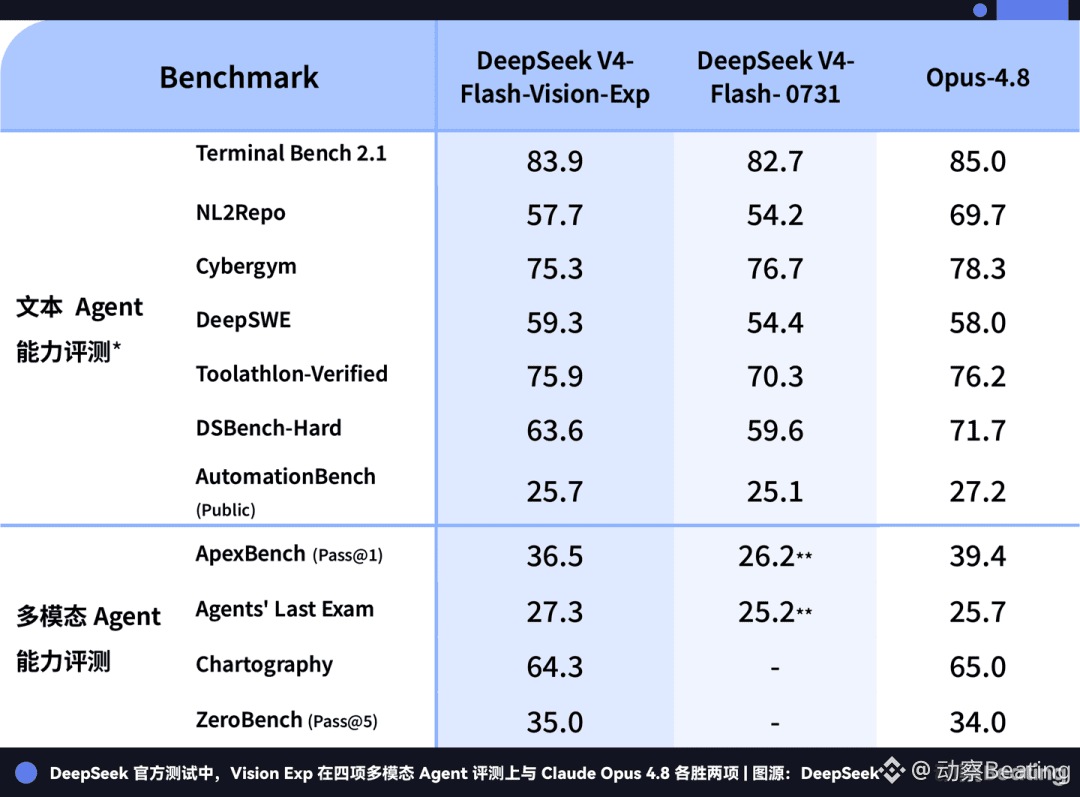
On August 21, 2026, DeepSeek released a brand-new vision understanding model, deepseek-v4-flash-vision-exp, and the multimodal API was officially opened. For the first time, developers can send images directly into DeepSeek’s official interface.
The model retains V4 Flash’s 1 million-token context window and a maximum output of 384,000 tokens. It supports JSON Output, Tool Calls, and the Responses API, and it is also compatible with the Anthropic API.
Pricing is also fully based on V4 Flash. For every one million tokens of input, when the cache is not hit, it costs 3 RMB during peak hours and 1.5 RMB during off-peak hours; with cache hits, the cost is 0.1 RMB and 0.05 RMB respectively. Output costs are 9 RMB during peak hours and 4.5 RMB during off-peak hours. In Beijing, 9:00–12:00 and 14:00–18:00 each day are peak hours; the remaining 17 hours are half price.
DeepSeek releases a vision understanding model; the “big blue whale” and other delayed eyes
Original title: (DeepSeek releases a vision understanding model; the “big blue whale” and other delayed eyes)
Original author: Insight Beating
On August 21, 2026, DeepSeek released a brand-new vision understanding model, deepseek-v4-flash-vision-exp, and the multimodal API was officially opened. For the first time, developers can send images directly into DeepSeek’s official interface.
The model retains V4 Flash’s 1 million-token context window and a maximum output of 384,000 tokens. It supports JSON Output, Tool Calls, and the Responses API, and it is also compatible with the Anthropic API.
Pricing is also fully based on V4 Flash. For every one million tokens of input, when the cache is not hit, it costs 3 RMB during peak hours and 1.5 RMB during off-peak hours; with cache hits, the cost is 0.1 RMB and 0.05 RMB respectively. Output costs are 9 RMB during peak hours and 4.5 RMB during off-peak hours. In Beijing, 9:00–12:00 and 14:00–18:00 each day are peak hours; the remaining 17 hours are half price.
Original author: Insight Beating
On August 21, 2026, DeepSeek released a brand-new vision understanding model, deepseek-v4-flash-vision-exp, and the multimodal API was officially opened. For the first time, developers can send images directly into DeepSeek’s official interface.
The model retains V4 Flash’s 1 million-token context window and a maximum output of 384,000 tokens. It supports JSON Output, Tool Calls, and the Responses API, and it is also compatible with the Anthropic API.
Pricing is also fully based on V4 Flash. For every one million tokens of input, when the cache is not hit, it costs 3 RMB during peak hours and 1.5 RMB during off-peak hours; with cache hits, the cost is 0.1 RMB and 0.05 RMB respectively. Output costs are 9 RMB during peak hours and 4.5 RMB during off-peak hours. In Beijing, 9:00–12:00 and 14:00–18:00 each day are peak hours; the remaining 17 hours are half price.
100
·
--
Article
Xiami has been gone for five years—Alibaba teaches another “Xiami” to write songs with AIOriginal title: (After Xiami leaves for five years, Alibaba teaches another “Xiami” to write songs with AI)
Original author: Dongcha Beating
August 17—Xiami is back again.
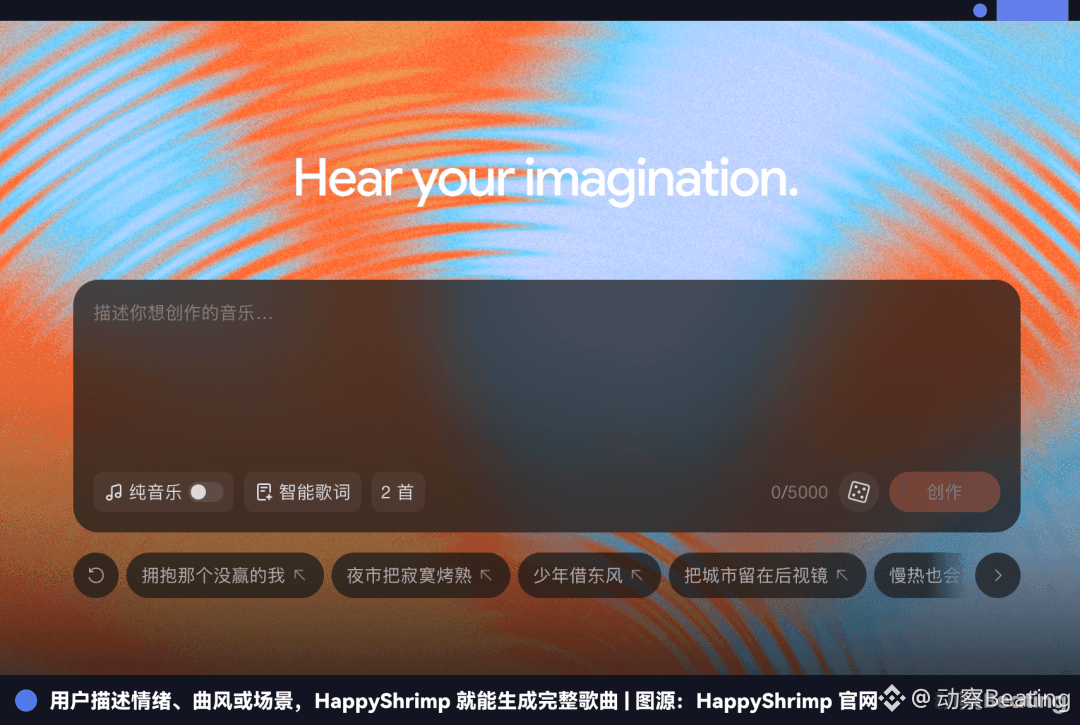
Alibaba releases an AI music model, HappyShrimp 1.0, with the Chinese name “HappyShrimp.” Users only need to write a single sentence, and it can generate a complete song.
You don’t even need to know what chords, time signatures, or modes are. You can tell it you want to write a song for yourself just after graduation—something that fits well playing in a café; or you can say that it’s almost time to get off work, and outside the window it suddenly starts raining—you want something a bit gloomy, but not too heavy. Words that used to describe moods can now also become music instructions. HappyShrimp will try to understand, and then create.
Xiami has been gone for five years—Alibaba teaches another “Xiami” to write songs with AI
Original title: (After Xiami leaves for five years, Alibaba teaches another “Xiami” to write songs with AI)
Original author: Dongcha Beating
August 17—Xiami is back again.
Alibaba releases an AI music model, HappyShrimp 1.0, with the Chinese name “HappyShrimp.” Users only need to write a single sentence, and it can generate a complete song.
You don’t even need to know what chords, time signatures, or modes are. You can tell it you want to write a song for yourself just after graduation—something that fits well playing in a café; or you can say that it’s almost time to get off work, and outside the window it suddenly starts raining—you want something a bit gloomy, but not too heavy. Words that used to describe moods can now also become music instructions. HappyShrimp will try to understand, and then create.
Original author: Dongcha Beating
August 17—Xiami is back again.
Alibaba releases an AI music model, HappyShrimp 1.0, with the Chinese name “HappyShrimp.” Users only need to write a single sentence, and it can generate a complete song.
You don’t even need to know what chords, time signatures, or modes are. You can tell it you want to write a song for yourself just after graduation—something that fits well playing in a café; or you can say that it’s almost time to get off work, and outside the window it suddenly starts raining—you want something a bit gloomy, but not too heavy. Words that used to describe moods can now also become music instructions. HappyShrimp will try to understand, and then create.
411
·
--
Article
How to Make Money by Selling Employee Data After a Company Goes UnderOriginal title: (After a company goes bankrupt, how to make money by selling employee data)
Original author: 动察Beating
Emails, chat logs, project documents, tickets—until now, they were just digital heirlooms left behind after the company shut down, waiting to be cleared away. Now, they’re being revalued, packaged, sold, and fed into AI companies’ training pipelines.
A mortician preserves the deceased’s last dignity. For a company, that dignity after death is proving that what it left behind still has value.
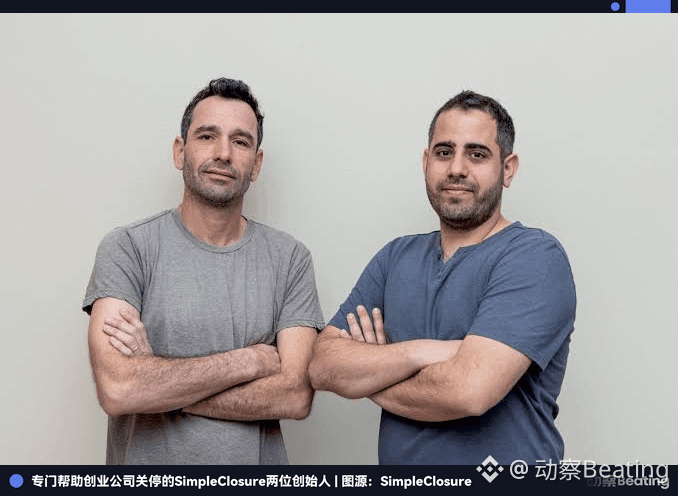
On August 17, at a bankruptcy-asset auction, Google bid $10 million and bought all of Spirit Airlines’ corporate data. Another bidder—called Mercor—offered $7.5 million, but lost by $2.5 million.
How to Make Money by Selling Employee Data After a Company Goes Under
Original title: (After a company goes bankrupt, how to make money by selling employee data)
Original author: 动察Beating
Emails, chat logs, project documents, tickets—until now, they were just digital heirlooms left behind after the company shut down, waiting to be cleared away. Now, they’re being revalued, packaged, sold, and fed into AI companies’ training pipelines.
A mortician preserves the deceased’s last dignity. For a company, that dignity after death is proving that what it left behind still has value.
On August 17, at a bankruptcy-asset auction, Google bid $10 million and bought all of Spirit Airlines’ corporate data. Another bidder—called Mercor—offered $7.5 million, but lost by $2.5 million.
Original author: 动察Beating
Emails, chat logs, project documents, tickets—until now, they were just digital heirlooms left behind after the company shut down, waiting to be cleared away. Now, they’re being revalued, packaged, sold, and fed into AI companies’ training pipelines.
A mortician preserves the deceased’s last dignity. For a company, that dignity after death is proving that what it left behind still has value.
On August 17, at a bankruptcy-asset auction, Google bid $10 million and bought all of Spirit Airlines’ corporate data. Another bidder—called Mercor—offered $7.5 million, but lost by $2.5 million.
156
·
--
Article
Wang Xingxing, a Butterfly and a Robot DogOriginal title: (Wang Xingxing, a butterfly and a robot dog)
Original author: Insight Beating
As the music plays, a row of silver-gray humanoid robots and the children from the martial arts school throw punches, kick their legs, and turn in unison—every move exactly the same. This is CCTV’s No. 1 studio on New Year’s Eve.
In the second half of the performance, the robots begin consecutive flips—front flip, back flip, and a 360-degree airborne twist. Each landing is steady and solid. In the middle, one robot stumbles and falls, then quickly gets up and continues. 600 million people watched the entire thing through their screens.
The people who made them are called Wang Xingxing. He doesn’t talk much.
Wang Xingxing, a Butterfly and a Robot Dog
Original title: (Wang Xingxing, a butterfly and a robot dog)
Original author: Insight Beating
As the music plays, a row of silver-gray humanoid robots and the children from the martial arts school throw punches, kick their legs, and turn in unison—every move exactly the same. This is CCTV’s No. 1 studio on New Year’s Eve.
In the second half of the performance, the robots begin consecutive flips—front flip, back flip, and a 360-degree airborne twist. Each landing is steady and solid. In the middle, one robot stumbles and falls, then quickly gets up and continues. 600 million people watched the entire thing through their screens.
The people who made them are called Wang Xingxing. He doesn’t talk much.
Original author: Insight Beating
As the music plays, a row of silver-gray humanoid robots and the children from the martial arts school throw punches, kick their legs, and turn in unison—every move exactly the same. This is CCTV’s No. 1 studio on New Year’s Eve.
In the second half of the performance, the robots begin consecutive flips—front flip, back flip, and a 360-degree airborne twist. Each landing is steady and solid. In the middle, one robot stumbles and falls, then quickly gets up and continues. 600 million people watched the entire thing through their screens.
The people who made them are called Wang Xingxing. He doesn’t talk much.
62
·
--
Article
Anthropic, Dario Amodei, and the “last private company”Original title: (Anthropic, Dario Amodei, and the “last private company”)
Original author: Beating Observers
There are two accounts about Anthropic’s founder, Dario Amodei. They contradict each other, yet both make sense.
One account is that he is the most lucid night watchman of this era. While the whole world is pressing the accelerator toward the cliff of superintelligence, only he is willing to stand by the roadside, calling again and again that ahead lies an abyss.
Another account is that he is one of the most ambitious people in Silicon Valley. He leads the world’s strongest AI company, working day and night to painstakingly build, by hand, that future that everyone warned about.
Anthropic, Dario Amodei, and the “last private company”
Original title: (Anthropic, Dario Amodei, and the “last private company”)
Original author: Beating Observers
There are two accounts about Anthropic’s founder, Dario Amodei. They contradict each other, yet both make sense.
One account is that he is the most lucid night watchman of this era. While the whole world is pressing the accelerator toward the cliff of superintelligence, only he is willing to stand by the roadside, calling again and again that ahead lies an abyss.
Another account is that he is one of the most ambitious people in Silicon Valley. He leads the world’s strongest AI company, working day and night to painstakingly build, by hand, that future that everyone warned about.
Original author: Beating Observers
There are two accounts about Anthropic’s founder, Dario Amodei. They contradict each other, yet both make sense.
One account is that he is the most lucid night watchman of this era. While the whole world is pressing the accelerator toward the cliff of superintelligence, only he is willing to stand by the roadside, calling again and again that ahead lies an abyss.
Another account is that he is one of the most ambitious people in Silicon Valley. He leads the world’s strongest AI company, working day and night to painstakingly build, by hand, that future that everyone warned about.
84
·
--
Article
Tencent still has dreamsOriginal title: (Tencent still has dreams)
Original author: Insight Beating
On August 12, 2026, Tencent released its Q2 earnings report.
Single-quarter capital expenditures: RMB 52.78 billion. Three months ago, this figure was RMB 31.9 billion. A year earlier, the full-year total was no more than RMB 79.2 billion.
This company is always known for being restrained when it comes to spending. Its pace of buying cards was once so slow that the market even doubted whether it really wanted to get on the AI game table. Now, it has increased its spending pace to this level within a single year.
At the company’s earnings call on the same day, Pony Ma said that Tencent is “building a brand-new, AI-powered Tencent.” The new name for Hunyuan is HY, and Hy4 is about to be released. The last time this company described itself as “new” was in the era when WeChat was born.
Tencent still has dreams
Original title: (Tencent still has dreams)
Original author: Insight Beating
On August 12, 2026, Tencent released its Q2 earnings report.
Single-quarter capital expenditures: RMB 52.78 billion. Three months ago, this figure was RMB 31.9 billion. A year earlier, the full-year total was no more than RMB 79.2 billion.
This company is always known for being restrained when it comes to spending. Its pace of buying cards was once so slow that the market even doubted whether it really wanted to get on the AI game table. Now, it has increased its spending pace to this level within a single year.
At the company’s earnings call on the same day, Pony Ma said that Tencent is “building a brand-new, AI-powered Tencent.” The new name for Hunyuan is HY, and Hy4 is about to be released. The last time this company described itself as “new” was in the era when WeChat was born.
Original author: Insight Beating
On August 12, 2026, Tencent released its Q2 earnings report.
Single-quarter capital expenditures: RMB 52.78 billion. Three months ago, this figure was RMB 31.9 billion. A year earlier, the full-year total was no more than RMB 79.2 billion.
This company is always known for being restrained when it comes to spending. Its pace of buying cards was once so slow that the market even doubted whether it really wanted to get on the AI game table. Now, it has increased its spending pace to this level within a single year.
At the company’s earnings call on the same day, Pony Ma said that Tencent is “building a brand-new, AI-powered Tencent.” The new name for Hunyuan is HY, and Hy4 is about to be released. The last time this company described itself as “new” was in the era when WeChat was born.
153
·
--

Article
DeepSeek V4 Pro official release is now liveOriginal title: (DeepSeek V4 Pro official release is now live)
Original author: Insight Beating
DeepSeek V4 Pro is officially here.
On the evening of August 12, DeepSeek’s official API documentation has updated the model version corresponding to deepseek-v4-pro to DeepSeek-V4-Pro-0813. Developers can now directly call the new version via the API. Pricing is 3 RMB per million input tokens and 6 RMB per million output tokens. For cached-hit input, the cost is only 0.025 RMB per million tokens.
V4 Pro-0813 continues to support a 1-million-token context window, with a maximum output of up to 384,000 tokens, and also supports both thinking and non-thinking modes. Capabilities such as JSON Output and Tool Calls are also available.
DeepSeek V4 Pro official release is now live
Original title: (DeepSeek V4 Pro official release is now live)
Original author: Insight Beating
DeepSeek V4 Pro is officially here.
On the evening of August 12, DeepSeek’s official API documentation has updated the model version corresponding to deepseek-v4-pro to DeepSeek-V4-Pro-0813. Developers can now directly call the new version via the API. Pricing is 3 RMB per million input tokens and 6 RMB per million output tokens. For cached-hit input, the cost is only 0.025 RMB per million tokens.
V4 Pro-0813 continues to support a 1-million-token context window, with a maximum output of up to 384,000 tokens, and also supports both thinking and non-thinking modes. Capabilities such as JSON Output and Tool Calls are also available.
Original author: Insight Beating
DeepSeek V4 Pro is officially here.
On the evening of August 12, DeepSeek’s official API documentation has updated the model version corresponding to deepseek-v4-pro to DeepSeek-V4-Pro-0813. Developers can now directly call the new version via the API. Pricing is 3 RMB per million input tokens and 6 RMB per million output tokens. For cached-hit input, the cost is only 0.025 RMB per million tokens.
V4 Pro-0813 continues to support a 1-million-token context window, with a maximum output of up to 384,000 tokens, and also supports both thinking and non-thinking modes. Capabilities such as JSON Output and Tool Calls are also available.
92
·
--
Article
Twenty Years of the Chinese Internet, and This Summer of Office AgentsOriginal title: (Twenty Years of the Chinese Internet, and This Summer of Office Agents)
Original author: Observing Beating
There are two office buildings in Hangzhou facing each other across the street. On the roof of one, a red-and-gold Sun Wukong was newly erected before the 2026 Spring Festival, right next to the DingTalk lightning-bolt logo. On the roof of the other, there is the Feishu logo. The day Sun Wukong went up, photos spread quickly on social media, and many people joked that this is the most straightforward kind of business battle—the implied message from DingTalk is probably to be a bit higher than Feishu.
These two companies have been fighting for ten years already. They fought from trying to see who had read whose messages, to sparring over documents, spreadsheets, and client lists—until the fight finally reached the rooftops.
Twenty Years of the Chinese Internet, and This Summer of Office Agents
Original title: (Twenty Years of the Chinese Internet, and This Summer of Office Agents)
Original author: Observing Beating
There are two office buildings in Hangzhou facing each other across the street. On the roof of one, a red-and-gold Sun Wukong was newly erected before the 2026 Spring Festival, right next to the DingTalk lightning-bolt logo. On the roof of the other, there is the Feishu logo. The day Sun Wukong went up, photos spread quickly on social media, and many people joked that this is the most straightforward kind of business battle—the implied message from DingTalk is probably to be a bit higher than Feishu.
These two companies have been fighting for ten years already. They fought from trying to see who had read whose messages, to sparring over documents, spreadsheets, and client lists—until the fight finally reached the rooftops.
Original author: Observing Beating
There are two office buildings in Hangzhou facing each other across the street. On the roof of one, a red-and-gold Sun Wukong was newly erected before the 2026 Spring Festival, right next to the DingTalk lightning-bolt logo. On the roof of the other, there is the Feishu logo. The day Sun Wukong went up, photos spread quickly on social media, and many people joked that this is the most straightforward kind of business battle—the implied message from DingTalk is probably to be a bit higher than Feishu.
These two companies have been fighting for ten years already. They fought from trying to see who had read whose messages, to sparring over documents, spreadsheets, and client lists—until the fight finally reached the rooftops.
127
·
--
Article
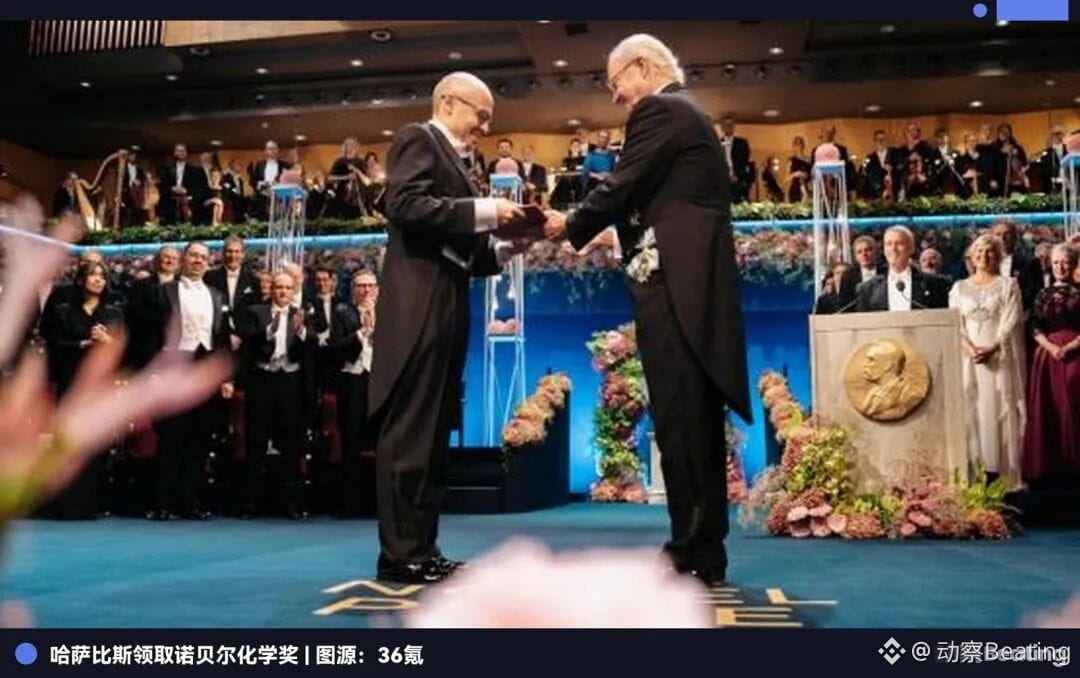
Hassabis Steps Down, the Final Scene of the Pre-LLM EraOriginal title: (Hassabis steps down, the final scene of the pre-LLM era)
Original author: Insight Beating
Hassabis originally also intended to leave.
According to industry insiders cited by Pathfounders, Demis Hassabis, the co-founder of Google DeepMind and the 2024 Nobel Prize in Chemistry winner, had originally planned to leave Google at the same time as Jeff Dean. Management worried that if both AI leaders left at once, it would deal a severe blow to the stock price, so they managed to keep Hassabis. Insiders say that once the situation stabilizes, he may still leave.
On August 5, Google’s publicly released story was much more presentable.
Hassabis Steps Down, the Final Scene of the Pre-LLM Era
Original title: (Hassabis steps down, the final scene of the pre-LLM era)
Original author: Insight Beating
Hassabis originally also intended to leave.
According to industry insiders cited by Pathfounders, Demis Hassabis, the co-founder of Google DeepMind and the 2024 Nobel Prize in Chemistry winner, had originally planned to leave Google at the same time as Jeff Dean. Management worried that if both AI leaders left at once, it would deal a severe blow to the stock price, so they managed to keep Hassabis. Insiders say that once the situation stabilizes, he may still leave.
On August 5, Google’s publicly released story was much more presentable.
Original author: Insight Beating
Hassabis originally also intended to leave.
According to industry insiders cited by Pathfounders, Demis Hassabis, the co-founder of Google DeepMind and the 2024 Nobel Prize in Chemistry winner, had originally planned to leave Google at the same time as Jeff Dean. Management worried that if both AI leaders left at once, it would deal a severe blow to the stock price, so they managed to keep Hassabis. Insiders say that once the situation stabilizes, he may still leave.
On August 5, Google’s publicly released story was much more presentable.
95
·
--
Article
DeepSeek Partners With Unitree: When Intelligence Becomes Cheap Enough to Be WastedOriginal title: (DeepSeek Partners With Unitree: When Intelligence Becomes Cheap Enough to Be Wasted)
Original author: Insight Beating
When technology truly starts changing the world, it often happens when it becomes cheap enough to be wasted.
Recently, even foreign media have started learning a very China-internet-style term: the kill line.
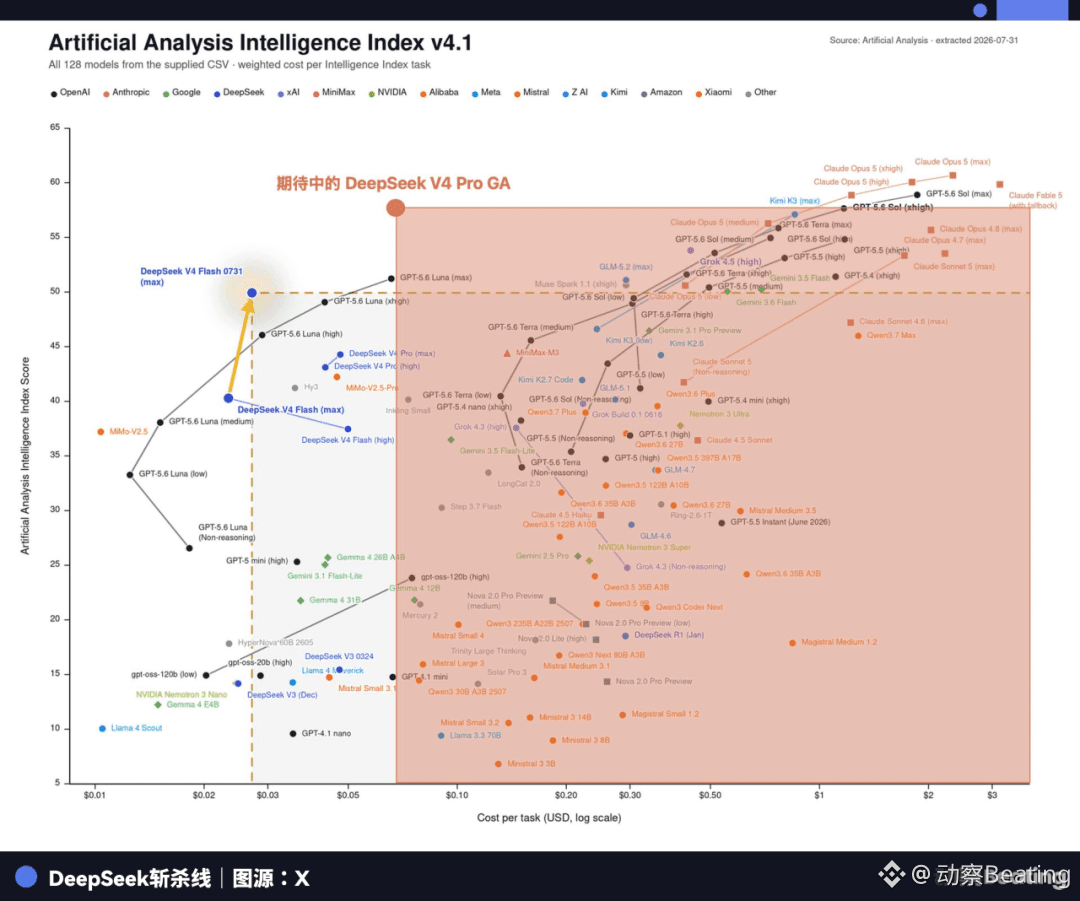
On July 31, DeepSeek V4 Flash was updated. In the coordinate chart on Artificial Analysis that compares model intelligence levels and usage costs, the higher the vertical axis goes, the smarter the model is; the farther to the right the horizontal axis goes, the higher the calling cost. With an intelligence index of 50, V4 Flash is already right up against the global top-tier; yet the average cost per round of testing is only 3 cents. That point is almost pushed to the upper-left corner of the coordinate system. Models that are cheaper than it are mostly inferior in capability; models that are smarter than it are generally more expensive by a large margin.
DeepSeek Partners With Unitree: When Intelligence Becomes Cheap Enough to Be Wasted
Original title: (DeepSeek Partners With Unitree: When Intelligence Becomes Cheap Enough to Be Wasted)
Original author: Insight Beating
When technology truly starts changing the world, it often happens when it becomes cheap enough to be wasted.
Recently, even foreign media have started learning a very China-internet-style term: the kill line.
On July 31, DeepSeek V4 Flash was updated. In the coordinate chart on Artificial Analysis that compares model intelligence levels and usage costs, the higher the vertical axis goes, the smarter the model is; the farther to the right the horizontal axis goes, the higher the calling cost. With an intelligence index of 50, V4 Flash is already right up against the global top-tier; yet the average cost per round of testing is only 3 cents. That point is almost pushed to the upper-left corner of the coordinate system. Models that are cheaper than it are mostly inferior in capability; models that are smarter than it are generally more expensive by a large margin.
Original author: Insight Beating
When technology truly starts changing the world, it often happens when it becomes cheap enough to be wasted.
Recently, even foreign media have started learning a very China-internet-style term: the kill line.
On July 31, DeepSeek V4 Flash was updated. In the coordinate chart on Artificial Analysis that compares model intelligence levels and usage costs, the higher the vertical axis goes, the smarter the model is; the farther to the right the horizontal axis goes, the higher the calling cost. With an intelligence index of 50, V4 Flash is already right up against the global top-tier; yet the average cost per round of testing is only 3 cents. That point is almost pushed to the upper-left corner of the coordinate system. Models that are cheaper than it are mostly inferior in capability; models that are smarter than it are generally more expensive by a large margin.
103
·
--
Article
Hassabis steps down, Jeff Dean leaves to start a business, and Google’s morale has wanedOriginal title: (Hassabis steps down, Jeff Dean leaves to start a business, and Google’s morale has waned)
Original author: Insightful Beating
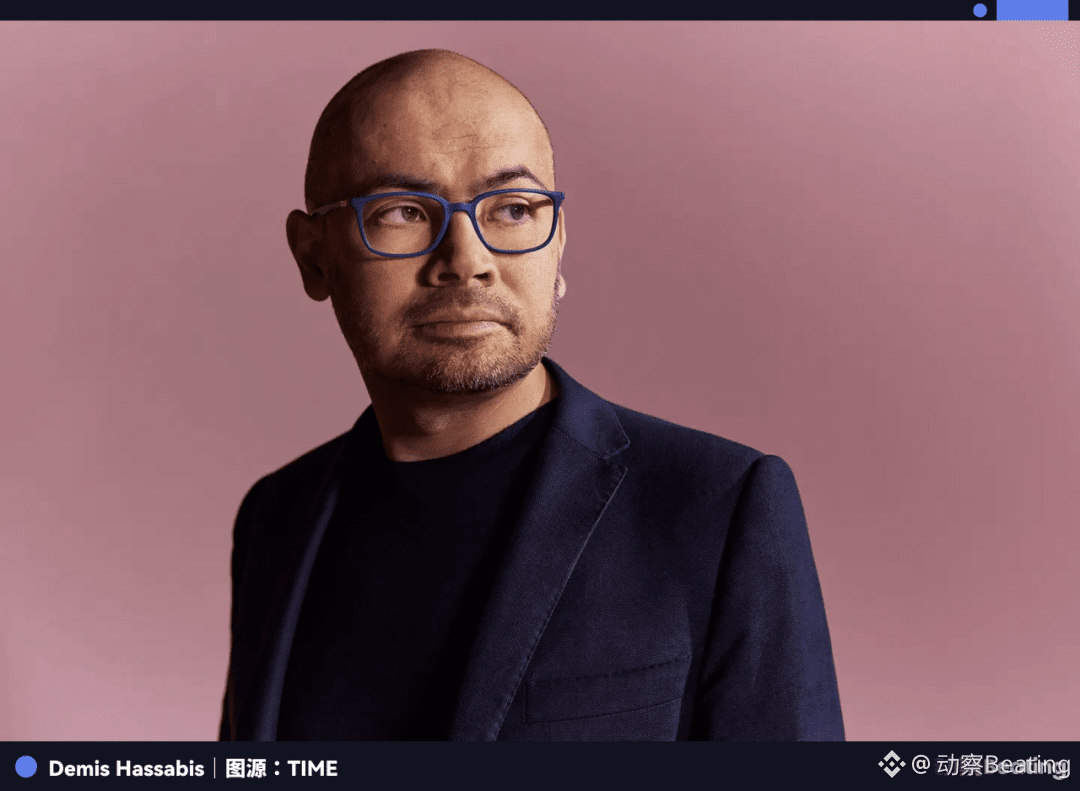
On August 5, Google DeepMind CEO Demis Hassabis stepped down from his daily management duties, moving to become Chairman of DeepMind, and also taking on the role of Alphabet Chief Scientist. He will still be responsible for long-term AI research and continue to lead the new drug development company Isomorphic Labs. His title is higher than before, but in reality it’s a promotion in name with a demotion in substance—he has less real management authority in hand.
The R&D and delivery of Gemini will be handled by Koray Kavukcuoglu, the former DeepMind Chief Technology Officer, who will report directly to Pichai. Hassabis remains a scientific icon of Google AI and continues to participate in judgment calls on the direction of AGI, but he will no longer control DeepMind’s day-to-day operations. After this adjustment, the management chain between DeepMind and Alphabet’s headquarters will be further shortened, and Pichai will also take more direct control of the Gemini R&D progress.
Hassabis steps down, Jeff Dean leaves to start a business, and Google’s morale has waned
Original title: (Hassabis steps down, Jeff Dean leaves to start a business, and Google’s morale has waned)
Original author: Insightful Beating
On August 5, Google DeepMind CEO Demis Hassabis stepped down from his daily management duties, moving to become Chairman of DeepMind, and also taking on the role of Alphabet Chief Scientist. He will still be responsible for long-term AI research and continue to lead the new drug development company Isomorphic Labs. His title is higher than before, but in reality it’s a promotion in name with a demotion in substance—he has less real management authority in hand.
The R&D and delivery of Gemini will be handled by Koray Kavukcuoglu, the former DeepMind Chief Technology Officer, who will report directly to Pichai. Hassabis remains a scientific icon of Google AI and continues to participate in judgment calls on the direction of AGI, but he will no longer control DeepMind’s day-to-day operations. After this adjustment, the management chain between DeepMind and Alphabet’s headquarters will be further shortened, and Pichai will also take more direct control of the Gemini R&D progress.
Original author: Insightful Beating
On August 5, Google DeepMind CEO Demis Hassabis stepped down from his daily management duties, moving to become Chairman of DeepMind, and also taking on the role of Alphabet Chief Scientist. He will still be responsible for long-term AI research and continue to lead the new drug development company Isomorphic Labs. His title is higher than before, but in reality it’s a promotion in name with a demotion in substance—he has less real management authority in hand.
The R&D and delivery of Gemini will be handled by Koray Kavukcuoglu, the former DeepMind Chief Technology Officer, who will report directly to Pichai. Hassabis remains a scientific icon of Google AI and continues to participate in judgment calls on the direction of AGI, but he will no longer control DeepMind’s day-to-day operations. After this adjustment, the management chain between DeepMind and Alphabet’s headquarters will be further shortened, and Pichai will also take more direct control of the Gemini R&D progress.
12
·
--
Article
Liang Wenfeng’s Youthful Stories: Eighty Thousand Yuan in Capital, a Fiat, and One Person’s Long MarchOriginal title: (Liang Wenfeng’s Youthful Stories: Eighty Thousand Yuan in Capital, a Fiat, and One Person’s Long March)
Original author: Observing Beating
January 27, 2025, Monday. Liang Wenfeng is playing soccer on a field in Wuchuan with several middle-school classmates.
Seven days ago, DeepSeek-R1 was released. Seven days later, the news crossed the Pacific and rocked the U.S. capital markets. Nvidia’s stock price fell more than 16% in a single day, and its market value evaporated by nearly six hundred billion dollars. U.S. media dug up old Cold War-era terms and called this day a new “Sputnik moment.”
Liang Wenfeng’s Youthful Stories: Eighty Thousand Yuan in Capital, a Fiat, and One Person’s Long March
Original title: (Liang Wenfeng’s Youthful Stories: Eighty Thousand Yuan in Capital, a Fiat, and One Person’s Long March)
Original author: Observing Beating
January 27, 2025, Monday. Liang Wenfeng is playing soccer on a field in Wuchuan with several middle-school classmates.
Seven days ago, DeepSeek-R1 was released. Seven days later, the news crossed the Pacific and rocked the U.S. capital markets. Nvidia’s stock price fell more than 16% in a single day, and its market value evaporated by nearly six hundred billion dollars. U.S. media dug up old Cold War-era terms and called this day a new “Sputnik moment.”
Original author: Observing Beating
January 27, 2025, Monday. Liang Wenfeng is playing soccer on a field in Wuchuan with several middle-school classmates.
Seven days ago, DeepSeek-R1 was released. Seven days later, the news crossed the Pacific and rocked the U.S. capital markets. Nvidia’s stock price fell more than 16% in a single day, and its market value evaporated by nearly six hundred billion dollars. U.S. media dug up old Cold War-era terms and called this day a new “Sputnik moment.”
214
·
--
Article
Silicon Valley copying Chinese homework—the next question is AI applicationsOriginal title: (A Silicon Valley that copies Chinese homework—the next question is AI applications)
Original author: Dongcha Beating
Silicon Valley has started copying China’s homework.
Recently, a batch of low-priced open models has emerged in the US. Their goal is to catch up to China’s open-source models in terms of capability, while also driving prices down to the same level.
Last month, Mira Murati’s Thinking Machines Lab released its first model, Inkling. In the official description, it mentions two things: the underlying architecture is based on DeepSeek-V3, and the post-training data was generated by Kimi K2.5.
The most expensive people in Silicon Valley, using the skeleton of Chinese open-source models and feeding them data generated by Chinese models. Two years ago, this kind of thing would only happen the other way around.
Silicon Valley copying Chinese homework—the next question is AI applications
Original title: (A Silicon Valley that copies Chinese homework—the next question is AI applications)
Original author: Dongcha Beating
Silicon Valley has started copying China’s homework.
Recently, a batch of low-priced open models has emerged in the US. Their goal is to catch up to China’s open-source models in terms of capability, while also driving prices down to the same level.
Last month, Mira Murati’s Thinking Machines Lab released its first model, Inkling. In the official description, it mentions two things: the underlying architecture is based on DeepSeek-V3, and the post-training data was generated by Kimi K2.5.
The most expensive people in Silicon Valley, using the skeleton of Chinese open-source models and feeding them data generated by Chinese models. Two years ago, this kind of thing would only happen the other way around.
Original author: Dongcha Beating
Silicon Valley has started copying China’s homework.
Recently, a batch of low-priced open models has emerged in the US. Their goal is to catch up to China’s open-source models in terms of capability, while also driving prices down to the same level.
Last month, Mira Murati’s Thinking Machines Lab released its first model, Inkling. In the official description, it mentions two things: the underlying architecture is based on DeepSeek-V3, and the post-training data was generated by Kimi K2.5.
The most expensive people in Silicon Valley, using the skeleton of Chinese open-source models and feeding them data generated by Chinese models. Two years ago, this kind of thing would only happen the other way around.
87
Log in to explore more content
Join global crypto users on Binance Square
⚡️ Get latest and useful information about crypto.
💬 Trusted by the world’s largest crypto exchange.
👍 Discover real insights from verified creators.
Email / Phone number
Trending Topics
BitcoinReboundsTo$79K
19,832 views
168 Discussing
🚨 $BTC is pushing higher.
Bitcoin is trading around $78,804, up roughly 1.9%, after reclaiming the $78K area. The next level to watch is the intraday high near $78,905.
A clean break above that level could open the way toward $79K–$80K. If BTC gets rejected, support sits around $78,300, then $77,975.
Bulls have momentum, but BTC needs to hold above $78K.
#Bitcoin #BTC #CryptoTrading #CryptoMarket #CryptoAnalysis
PulseON
·18 Likes
·17.1k views
BitcoinSpotETFsNetInflow$160M
83 views
24 Discussing
SouthKoreaCryptoTaxDelayPetitionTops50000
8,424 views
233 Discussing