

Jens 1
128 Posts

Jens 1
Report
Block User
Gas fees don't scare me
0 Following
0 Followers
5 Liked
Posts
·
--
Altseason Rewards More Than Just The Apps 🚀
$2Z sits in one of the most important layers of crypto's next expansion. $SOL has already demonstrated what happens when a high-performance ecosystem generates serious demand.
Everyone notices the applications when markets heat up.
But underneath every new trading venue, every spike in activity, and every wave of users, infrastructure is doing the heavy lifting.
More activity means more information moving between systems.
More information means greater demand for efficient connectivity.
That's where DoubleZero comes in.
Its dedicated network supports high-performance distributed systems, while Edge extends that infrastructure into real-time financial market data.
The next crypto wave needs more than new applications.
It needs the infrastructure to power them.
#Altcoin Season# #DeFi
58
·
--
The Next GPU Buyers Are AI Agents 👀 $RENDER has proposed Forth, a new AI gateway designed to let applications and autonomous agents access compute and pay using RENDER or USDC. The proposal highlights an important shift in the compute market. More AI activity is creating demand for infrastructure that can turn GPU capacity into actual paying workloads. That's exactly the opportunity we're building around with $B3. B3IQ is a customer-owned neocloud where customers own NVIDIA machines while we handle deployment, hosting and operations. Owners can use their hardware privately or make spare capacity available to paying customers through Earn Mode. The next AI infrastructure race isn't just about deploying more GPUs. It's about bringing together hardware, ownership and customers willing to pay for compute. We believe that's where the biggest opportunities will emerge as AI adoption accelerates. 🔥 #AI #DePIN
The Next GPU Buyers Are AI Agents 👀 $RENDER has proposed Forth, a new AI gateway designed to let applications and autonomous agents access compute and pay using RENDER or USDC. The proposal highlights an important shift in the compute market. More AI activity is creating demand for infrastructure that can turn GPU capacity into actual paying workloads. That's exactly the opportunity we're building around with $B3. B3IQ is a customer-owned neocloud where customers own NVIDIA machines while we handle deployment, hosting and operations. Owners can use their hardware privately or make spare capacity available to paying customers through Earn Mode. The next AI infrastructure race isn't just about deploying more GPUs. It's about bringing together hardware, ownership and customers willing to pay for compute. We believe that's where the biggest opportunities will emerge as AI adoption accelerates. 🔥 #AI #DePIN
67
·
--
Digital culture needs physical memory 🔥
Communities around $PENGU and $INJ have shown that digital identity becomes stronger when people can recognize it beyond a chart.
Most crypto culture is built through posts, memes and profile pictures and that works for attention, but attention moves quickly.
I think the harder challenge is turning an online moment into something people still talk about months later.
That is what caught my attention in the latest $Trump Coin Club event summary.
Across Korea and Singapore, the Club says 2,000 watches and 500 gold sneakers were distributed over two weeks.
The figures are large, but the stronger signal is what those objects can become afterward.
They are reminders of a specific place, crowd and period in the Club’s history.
Meme communities already understand the value of that, as for me, that is how an event becomes community memory.
#Altcoin Season#

76
·
--
$ETH 's $3,000 Odds Are Falling 📊
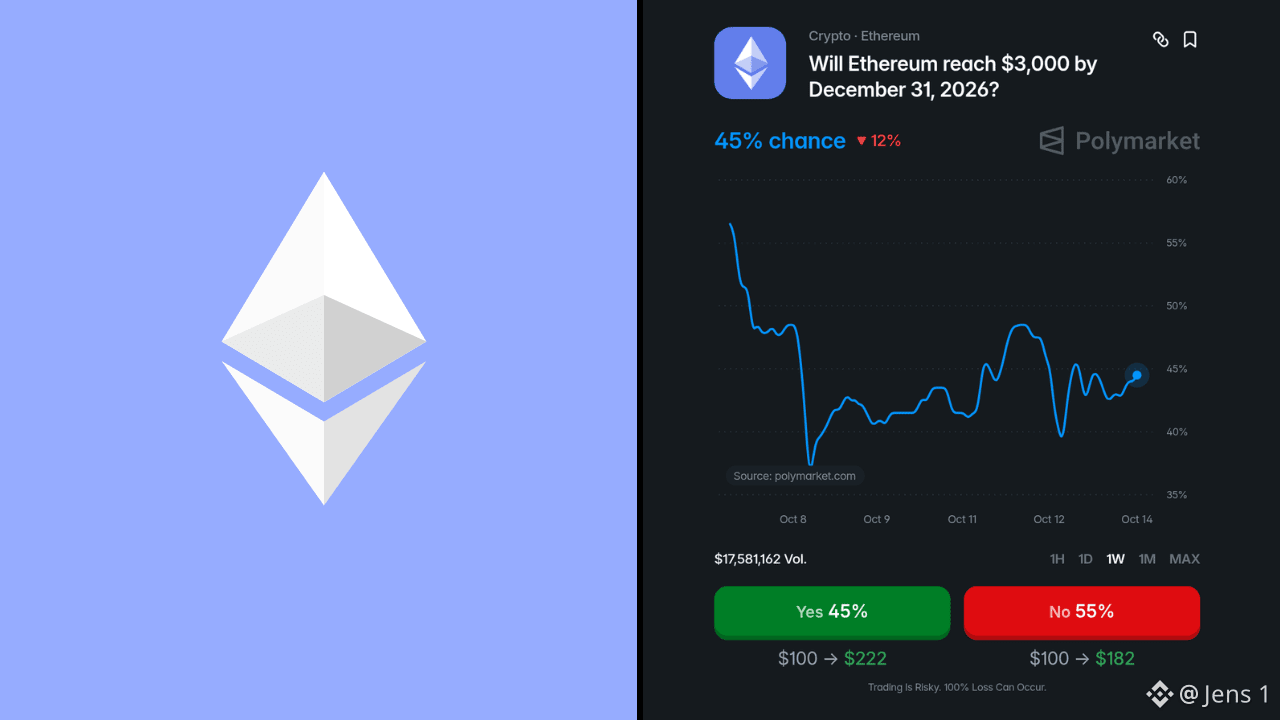
Polymarket traders are becoming less confident about Ethereum reaching $3,000 before December 31, 2026.
The probability has dropped 12 percentage points over the past week.
And the current market is almost evenly divided.
YES: 45%
NO: 55%
What caught my attention is the trading activity.
💰 More than $17.5 million in volume has been recorded on this market.
📉 YES currently offers approximately 2.22x if Ethereum reaches the target.
🔥 A move from 45% to 60% would increase the implied value of YES shares by roughly 33%.
That's the kind of movement I'm interested in.
Instead of only trading cryptocurrencies like $SOL based on their price charts, Polymarket allows traders to express views on specific market milestones.
You can enter when you believe a probability is undervalued and potentially exit when expectations change.
Of course, probabilities can move against you just as easily.
I'm watching whether traders regain confidence in the $3,000 target before year-end.
#Altcoin Season#
73
·
--
Quantum Migration Now Has Real Deadlines ⏳
$STRK put STARK based proving systems on the radar of investors far beyond cryptography circles.
This month, the NSA announced that new commercial national security systems must support quantum-resistant algorithms from 2027.
Legacy systems unable to support them are due to be phased out by 2030.
That matters because cryptography cannot be replaced overnight.
ZK teams face their own version of this migration problem.
A project may choose a hash-based STARK because it values transparent setup and its underlying security assumptions.
If that proof is later wrapped inside an elliptic-curve SNARK purely to make verification easier on an EVM chain, a new dependency has been added.
The wrapper can weaken the security properties the original architecture was selected to preserve.
zkVerify can natively verify supported STARK-based proofs, including RISC Zero, without first converting them into Groth16 proofs.
There is an important limit to this thesis.
zkVerify itself should not be described as quantum-safe because its network signatures and consensus still use conventional cryptography.
The value is more precise.
Its verification path can preserve the supported proof system’s existing security properties instead of replacing them with those of a convenient wrapper.
As migration deadlines approach, I think investors will start examining the verification layer as closely as the proof system itself.
#Altcoin Season# #Security
67
·
--
More Market Activity Means Less Time To React ⏱️
$2Z gives trading systems more time to respond when information changes. $HYPE is a good example because perpetual markets can move quickly across prices, liquidity and positioning.
The value is straightforward.
Information arrives.
Your system processes it.
Your system reacts.
Reducing the time spent waiting on the first step gives everything after it more room.
DoubleZero does not make the trading decision.
It improves the infrastructure delivering the information that decision depends on.
When markets get more competitive, reaction time becomes increasingly valuable.
#Trading #Altcoin Season#
2
399
·
--
$89B Says Markets Are Becoming Media 🧠
Prediction platforms processed roughly $89.1 billion over the latest measured 30-day period, up 66% from the previous window.
When attention can be priced, the gap between $PENGU and $ONDO becomes smaller and smaller.
Culture, financial assets and public opinion are all becoming things people can take positions on.
People no longer just consume a narrative.
They trade it, debate it publicly and turn the outcome into content.
Yet most token pages remain lifeless dashboards with a chart and a transaction button.
Zora’s social layer makes this thesis more compelling.
Users can:
- Create a market through Custom Pairs
- Trade across supported networks from mobile
- Publish a Take and see how other traders respond
The Take feature matters because it gives every market a living thesis instead of leaving price as the entire conversation.
I see a far stronger retention loop in participation and reputation than in temporary points farming. Crypto’s next consumer winner could resemble a social network where opinions, cultural moments and assets all have markets attached.
Zora is already building in that direction.
#RWA #Altcoin Season#
2
471
·
--
$2B+ In Trading Volume. Now Comes The Token Catalyst 📈
Most token launches promise future utility. I pay more attention when there's already a revenue-generating business behind the token.
Pear Protocol has processed over $2B in trading volume and generated more than $1.3M in protocol fees.
And now, with its token migration from $ARB to the $HYPE ecosystem underway, Pear is entering a new chapter with an established trading business behind it.
Under its PIP-3 tokenomics proposal, 70% of protocol revenue is allocated toward token buybacks, burns and liquidity support.
That creates a direct economic connection between trading activity on Pear and potential demand for its token.
And with Pear expanding beyond pair trading into AI-powered execution, automated Vaults and professional asset-management strategies, there's plenty of room for that fee-generating activity to grow.
This is what makes the migration bullish to me. It's not just a token moving chains. It's an established trading ecosystem entering its next phase with token economics designed around real usage.
Definitely one to keep on the radar.
#Altcoin Season#
66
·
--
Community proof arrives after the hype 👀
Crypto conversations around $LINK and $HBAR move quickly because announcements can travel across the market within minutes.
Evidence usually takes longer to emerge.
That matters even more with private experiences because most of the community understands them through the material shared afterward.
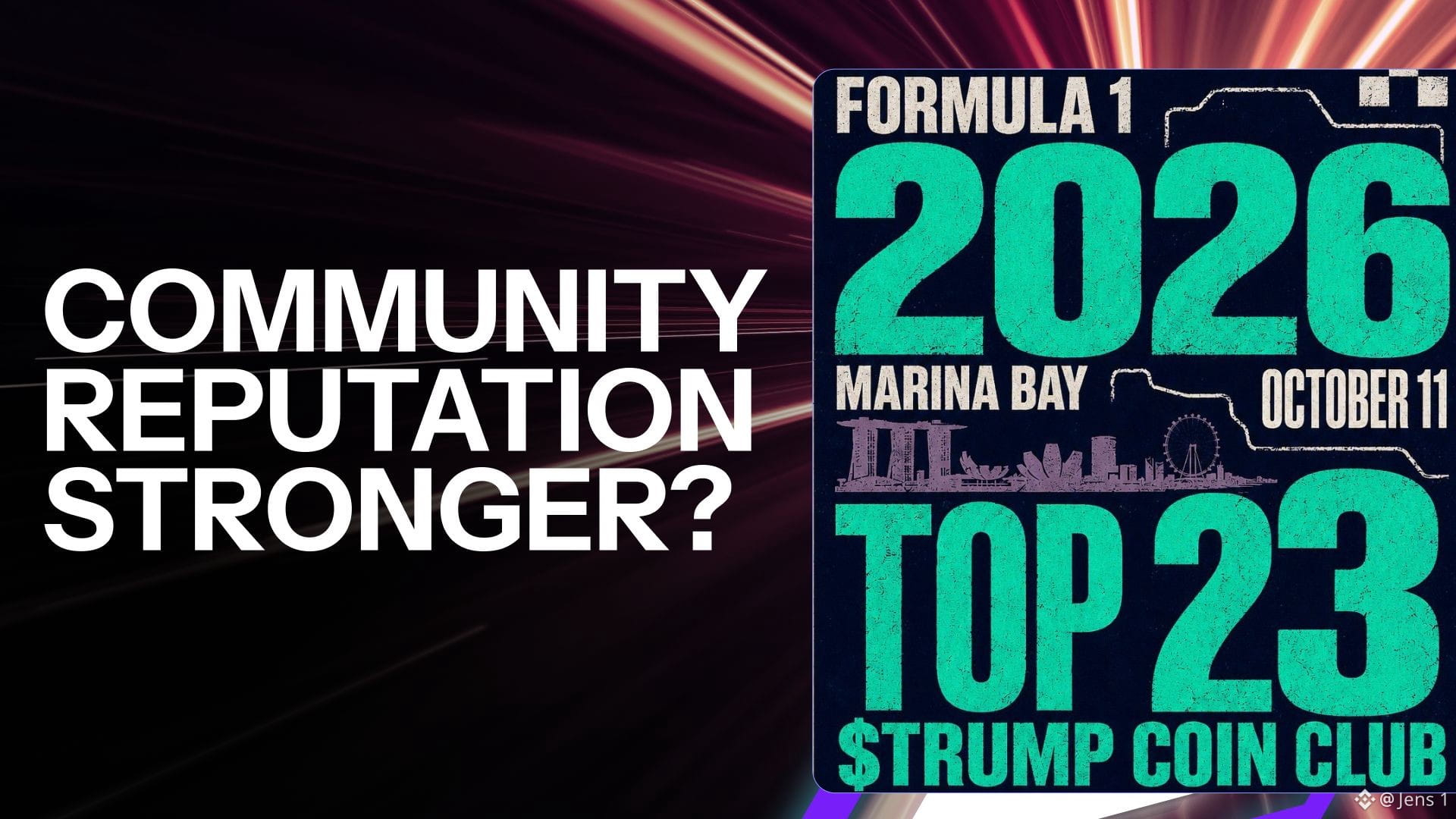
The $Trump Coin Club Singapore experience concluded yesterday after a three-day weekend in Singapore.
Now the conversation should move from anticipation toward verification.
I am watching for approved material that shows what the weekend actually delivered and how the experience felt for those involved.
Until that material arrives, the honest position is that the experience is complete while its evaluation is still beginning.
The macro lesson is simple.
Community reputation becomes stronger when visible proof follows a major promise.
#Macro Insights#
82
·
--
Crypto can’t measure this one thing 👀
Dashboards can track activity around $UNI and usage across $OP in real time as web3 is exceptionally good at turning behaviour into numbers, which is why community health often gets reduced to whatever can be measured publicly.
Those metrics can show attention and participation, but they reveal much less about whether people genuinely enjoy sharing time with one another.
I think IRL settings make that social layer easier to understand.
The $Trump Coin Club Singapore experience is now underway as a three-day hospitality programme for eligible attendees.
Its multi-day format gives interactions time to develop naturally beyond a single introduction, and the eventual approved recap material will show us what those interactions produced.
For now, the interesting idea is that every community has qualities no dashboard can capture.
Chemistry only becomes visible when people enter the same environment 🌟
#Macro Insights#

77
·
--
A good market read can still lose 👀
This week’s liquidation wave showed how a $BTC view can eventually be right and still fail as a leveraged trade in DeFi, and the same path risk appears in $HYPE whenever a sharp move reaches liquidation before the original thesis gets time to play out.
Perps work when direction and timing arrive together, but the market rarely promises a clean path with a trader expecting a recovery still having to survive everything that happens before it.
This is when I start comparing the usual perp with a bought call.
The call can expire worthless if the move does not happen before expiry, its maximum loss is the premium paid, and the position cannot be liquidated along the way.
Aevo puts that comparison inside Options Easy Mode.
The trader builds around the market view and sees the win and loss zones before confirming, and I do not think this makes every call better than a perp.
It simply changes what can end the trade, from a liquidation price to a fixed expiry and premium.
After a week like this, that difference becomes much easier to understand 🧠
#Altcoin Season#
65
·
--
The Binance News Is Bigger Than Just Another Feed 🧩
$2Z now makes Binance futures market data available through DoubleZero Edge.
$SOL helps show why that matters: traders increasingly need to consume very different kinds of real-time data without rebuilding their setup every time.
The obvious headline is Binance.
The more interesting part is the integration model.
Top-of-book data and trade prints arrive in the same format as other Edge feeds.
So adding another market does not automatically mean adding another completely separate parser, monitoring stack and reconnect process.
That is the part I think compounds over time.
Every new source makes the existing connection more useful.
#MarketData #DeFi
59
·
--
I’m betting traffic normalizes by December 🚢
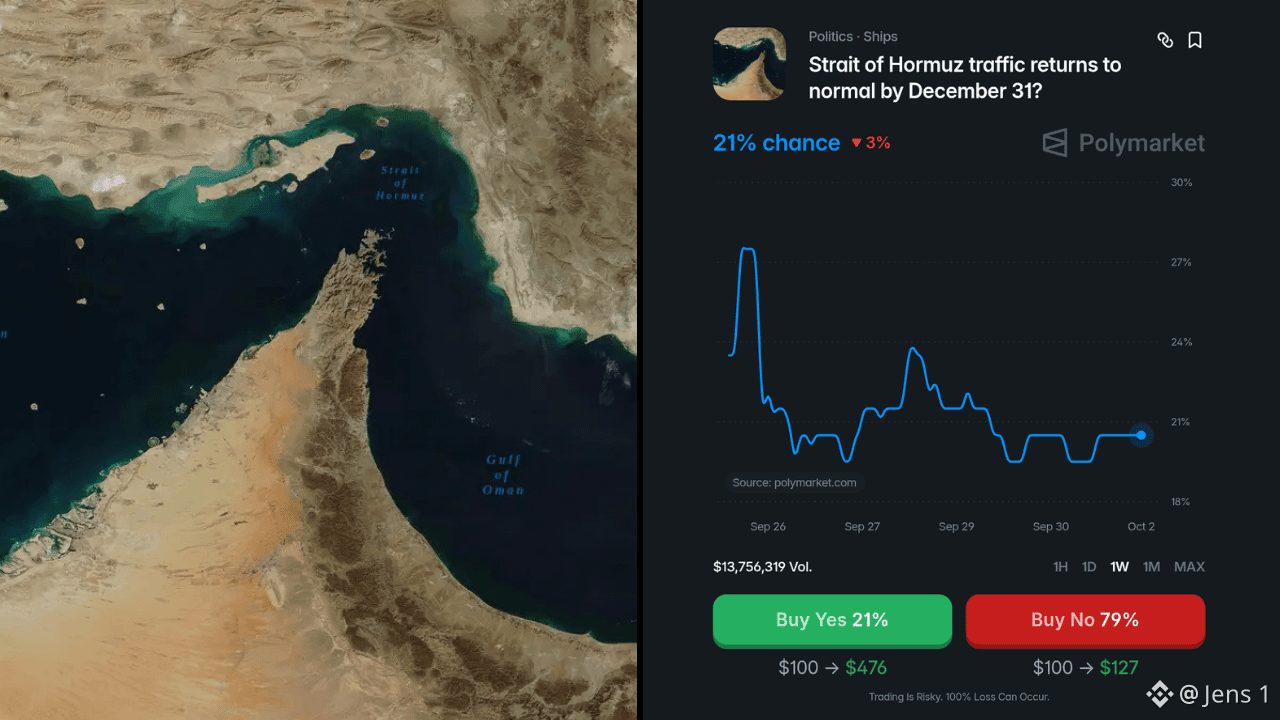
21% is where Polymarket currently has my side in the screenshot.
And I'm comfortable taking YES.
This isn't a vague "things get better" prediction either. The market has a specific resolution condition tied to the IMF PortWatch measure of qualifying transit calls.
What really caught my attention, though, was the $13.7M+ volume.
That's serious participation.
When that much capital is trading a question, I pay attention because the probability is being challenged continuously by people with completely different views.
At 21%, $100 on my side represents roughly $476 at correct resolution.
I can fund a position using something like $BNB , take exposure to a global shipping thesis, and still have the option to exit the position before final resolution if the probability moves enough for me.
That's what makes Polymarket such a powerful opportunity engine to me.
Crypto capital, but the opportunity doesn't have to be a crypto price.
#Altcoin Season#
74
·
--
The Gullwing Doors Still Do It 🚗
Seeing DeLorean connected to $SUI makes perfect sense to the part of my brain that likes cars and strange ideas about the future.
Some designs stay with you.
The doors alone can start a conversation.
That kind of recognition is why I’m interested in IP becoming a bigger crypto theme.
DeLorean already brought its identity into digital collectibles through the 8,800 Time Capsule collection.
It gives the story an actual chapter people participated in.
DMC adds another element to the ecosystem on Sui.
The appeal for me is seeing how a familiar cultural identity translates into new experiences.
Altcoin Season tends to reward things people want to talk about.
DeLorean certainly gives people an opening line.
#Altcoin Season#
81
·
--
Scale Creates A Strange Problem 📈
10 users need data.
10,000 users need more data.
Millions of automated interactions?
Now the amount of information applications need to process starts looking completely different.
That's something I think gets overlooked when discussing blockchain scalability.
$BNB can support enormous amounts of ecosystem activity, but execution throughput is only one dimension of scale.
Applications also need infrastructure capable of analyzing increasingly large datasets.
This is where Space and Time comes into the picture for me.
Large SQL workloads can happen at the data layer while Proof of SQL provides cryptographic verification of the result.
⚡ Scale execution
📊 Scale data
🔐 Scale verification
Eventually you need all three.
#Altcoin Season#
74
·
--
Access Should Reveal Only What Matters 🎟️
$ZEC demonstrated to crypto that verification does not always require total exposure. The $VFY opportunity sits in making those private proofs practical to check.
Think about a festival wristband.
It proves you have access to the venue without displaying your payment card, home address or full purchase history.
The wristband still gets scanned at the gate.
That second step is the part to focus on- because displaying a credential and verifying it are different jobs.
A privacy-preserving application can create a Zero Knowledge proof confirming that a user meets its access conditions.
zkVerify independently checks whether that submitted proof is cryptographically valid.
The network does not create the credential or decide what information remains hidden. A valid proof also cannot rescue a badly designed rule or an unreliable source credential.
But when the underlying system is sound, applications can verify the required answer without collecting the user’s entire identity again.
As digital identity spreads across finance, commerce and online communities, repeated document uploads will become increasingly difficult to justify. I think the infrastructure checking selective proofs will become as important as the applications issuing them.
Privacy works better when the gate receives the answer instead of your whole life story.
#Privacy #Altcoin Season#
74
·
--
Privacy Is Moving Up The AI Stack 🔒
$ZEC made that pretty obvious to traders this year. Its rally put privacy back on the board as something the market is still willing to pay a premium for, not some dead 2017 narrative.
What I find more interesting is where that trade goes next.
Privacy used to mean hiding a transaction.
Now AI companies have prompts, customer data, API keys, proprietary models and internal workflows running through somebody else’s GPUs.
$VVV already validates that demand. Venice now offers private inference, hardware-isolated TEE execution and even end-to-end encrypted inference where the GPU operator cannot read the prompt.
To me, $B3 takes the same thesis one layer deeper.
B3IQ’s default setup is a private fleet: your gateway keys route only to machines your account owns, and outside workloads cannot touch them unless you deliberately switch that machine into Earn Mode.
That distinction matters.
ZEC gave traders private money.
Venice is proving there is demand for private intelligence.
B3IQ is betting that the next step is private compute you actually own.
If privacy keeps moving from wallets into the rest of the AI stack, I think GPU ownership becomes a much bigger part of that trade.
#AI #DePIN
91
·
--
The Hedge Fund Playbook Is Going Onchain 👀
The smartest funds don't expect one trader to be good at everything.
They allocate capital across specialists. One team might trade momentum, another statistical arbitrage and another relative value, with each running the strategy they're actually best at.
Pear Protocol is bringing that same playbook onchain.
Instead of needing to master every trading strategy yourself, Pear Vaults are being built so you can choose which specialist managers and strategies get your capital, with allocations starting from just 10 bucks.
Agent Pear already handles statistical arbitrage. Emporium brought quality long/short. And Pear plans to expand that lineup across strategies like momentum, sentiment, liquidation capture, thematic baskets and equity relative value.
So rather than simply deciding whether something like $ZEC goes up or down, you can eventually build your own mix of specialist approaches.
Every Vault currently executes through the $HYPE ecosystem, giving traders access to an expanding lineup of asset-management strategies without having to become experts in each one themselves.
You don't have to become an expert at every strategy. You can decide which experts and strategies deserve your capital.
Explore Pear Vaults at vaults.pear.garden
#Altcoin Season#
73
·
--
Crypto’s Next Launchpad Won’t Look Familiar 🔥
The strongest launch platform this cycle may look more like a social app than an exchange. Attention around $BONK and the growing RWA narrative surrounding assets like $ONDO point toward the same opportunity.
Crypto users increasingly want to create the market, discover it and trade it without bouncing between disconnected products.
Most platforms still cater to one side.
Creators launch.Traders speculate elsewhere. Zora is building around the idea that both groups belong inside the same product.
Custom Pairs gives creators a new canvas while opening an entirely different discovery layer for traders.
Now the team is optimising the app’s UI and UX every week, using its current community to shape an experience capable of reaching far beyond it.
That combination has my attention, and in a big way.
A live community provides the feedback. Constant shipping improves the product. A simpler mobile experience gives thousands of new creators and traders a reason to enter.
I think Zora deserves a serious look while that expansion is still taking shape.
#Altcoin Season#
63
·
--
Faster Data Gives Trading Systems More Time ⏱️
$2Z gives systems more time to react when market information changes. $HYPE shows exactly why that matters in continuously moving perp markets.
A market maker has orders sitting in the market at all times.
When new information makes one of those prices outdated, its systems need to decide whether to cancel, move or keep the quote.
Receiving the information earlier does not make the decision for them.
It gives them more time to make it before somebody else trades against that stale price.
That is the edge faster delivery creates.
More information is useful, but more time to act on it is even better.
#DeFi #Trading
505
Log in to explore more content
Join global crypto users on Binance Square
⚡️ Get latest and useful information about crypto.
💬 Trusted by the world’s largest crypto exchange.
👍 Discover real insights from verified creators.
Email / Phone number