
ASMA_加密143
3k Posts

ASMA_加密143
Report
Block User
专注加密、空投与交易机会 🚀
Frequent Trader
1.9 Years
2.3K+ Following
4.7K+ Followers
4.6K+ Liked
Posts
All
Quotes
Live
·
--
Join the live with kim
Join the live with kim


KIM_加密 143
·
--
[Ended] 🎙️ Hello Friend Join Kim Crypto family clubs Discuss on Crypto related
2.7k listens
150
·
--
Join the live with kim
Join the live with kim
KIM_加密 143
·
--
[Replay] 🎙️ Let's Discuss Market Situation today & what comes tomorrow's Market.
04 h 49 m 44 s · 1.5k listens
1
157
·
--
Go
Go

Night King Official
·
--
🚨 GIVEAWAY LIVE! 🎁
3,000 Red Packets are up for grabs! 🔥
✅ Follow
🔁 Repost
💬 Comment "666"
🎁 Claim Reward
Who’s ready? 👀
3,000 Red Packets are up for grabs! 🔥
✅ Follow
🔁 Repost
💬 Comment "666"
🎁 Claim Reward
Who’s ready? 👀

1
151
·
--
Bearish
#dusk $DUSK @Dusk_Foundation I went into Dusk’s consensus design expecting the interesting part to be how validators reach agreement.
Instead, I found a problem Dusk openly addresses: future block generators can be predictable within the same round.
That creates a strange incentive. A provisioner selected for a later iteration could theoretically prefer earlier iterations to fail, hoping to capture the block reward.
Dusk’s answer isn’t simply “trust the validators.”
The protocol adds voter rewards, conditions part of the generator reward on including known votes, excludes the next iteration’s generator from voting, and limits the number of iterations. These mechanisms are specifically designed to reduce that incentive.
The reward structure is also interesting: 80% goes to the block generator, 10% to the voting committee, and 10% to Dusk in the documented design.
What caught my attention isn’t the percentages.
It’s the idea that consensus security is also an incentive design problem.
How much of a blockchain’s security comes from cryptography, and how much comes from making honest behavior economically rational?
{spot}(DUSKUSDT)
What matters more for consensus security?
#dusk $DUSK @Dusk I went into Dusk’s consensus design expecting the interesting part to be how validators reach agreement.
Instead, I found a problem Dusk openly addresses: future block generators can be predictable within the same round.
That creates a strange incentive. A provisioner selected for a later iteration could theoretically prefer earlier iterations to fail, hoping to capture the block reward.
Dusk’s answer isn’t simply “trust the validators.”
The protocol adds voter rewards, conditions part of the generator reward on including known votes, excludes the next iteration’s generator from voting, and limits the number of iterations. These mechanisms are specifically designed to reduce that incentive.
The reward structure is also interesting: 80% goes to the block generator, 10% to the voting committee, and 10% to Dusk in the documented design.
What caught my attention isn’t the percentages.
It’s the idea that consensus security is also an incentive design problem.
How much of a blockchain’s security comes from cryptography, and how much comes from making honest behavior economically rational?
What matters more for consensus security?
Instead, I found a problem Dusk openly addresses: future block generators can be predictable within the same round.
That creates a strange incentive. A provisioner selected for a later iteration could theoretically prefer earlier iterations to fail, hoping to capture the block reward.
Dusk’s answer isn’t simply “trust the validators.”
The protocol adds voter rewards, conditions part of the generator reward on including known votes, excludes the next iteration’s generator from voting, and limits the number of iterations. These mechanisms are specifically designed to reduce that incentive.
The reward structure is also interesting: 80% goes to the block generator, 10% to the voting committee, and 10% to Dusk in the documented design.
What caught my attention isn’t the percentages.
It’s the idea that consensus security is also an incentive design problem.
How much of a blockchain’s security comes from cryptography, and how much comes from making honest behavior economically rational?
What matters more for consensus security?
A. Cryptography
50%
B. Economic incentives
0%
C. Both equally
50%
D. Depends on the design
0%
2 votes • Voting closed
2
107
·
--
Bullish
#dusk $DUSK @Dusk_Foundation There’s an uncomfortable question around institutional blockchain adoption: does transparency actually help when every market participant can see sensitive financial activity?
That is where @Dusk_Foundation takes a different architectural approach. Its design separates what needs to be public from what needs to remain confidential. Moonlight handles transparent account flows, while Phoenix uses zero knowledge proofs for shielded transactions, allowing validity to be verified without exposing the underlying transaction data.
The interesting part is not “privacy” alone. It is privacy with controlled disclosure. Dusk’s current documentation explicitly frames this around regulated assets, access controls, reporting and selective disclosure.
My bullish interpretation: this architecture could matter if tokenized markets genuinely need confidentiality without abandoning compliance.
But technology is only half the equation. Will real institutions create enough economic activity on Dusk to make that architecture valuable?
$DUSK #dusk
What matters most for Dusk’s next growth phase?
{spot}(DUSKUSDT)
#dusk $DUSK @Dusk There’s an uncomfortable question around institutional blockchain adoption: does transparency actually help when every market participant can see sensitive financial activity?
That is where @Dusk takes a different architectural approach. Its design separates what needs to be public from what needs to remain confidential. Moonlight handles transparent account flows, while Phoenix uses zero knowledge proofs for shielded transactions, allowing validity to be verified without exposing the underlying transaction data.
The interesting part is not “privacy” alone. It is privacy with controlled disclosure. Dusk’s current documentation explicitly frames this around regulated assets, access controls, reporting and selective disclosure.
My bullish interpretation: this architecture could matter if tokenized markets genuinely need confidentiality without abandoning compliance.
But technology is only half the equation. Will real institutions create enough economic activity on Dusk to make that architecture valuable?
$DUSK #dusk
What matters most for Dusk’s next growth phase?
That is where @Dusk takes a different architectural approach. Its design separates what needs to be public from what needs to remain confidential. Moonlight handles transparent account flows, while Phoenix uses zero knowledge proofs for shielded transactions, allowing validity to be verified without exposing the underlying transaction data.
The interesting part is not “privacy” alone. It is privacy with controlled disclosure. Dusk’s current documentation explicitly frames this around regulated assets, access controls, reporting and selective disclosure.
My bullish interpretation: this architecture could matter if tokenized markets genuinely need confidentiality without abandoning compliance.
But technology is only half the equation. Will real institutions create enough economic activity on Dusk to make that architecture valuable?
$DUSK #dusk
What matters most for Dusk’s next growth phase?
Privacy + compliance
50%
RWA adoption
25%
Developer activity
25%
Liquidity + users
0%
4 votes • Voting closed
2
255
·
--
#dusk $DUSK @Dusk_Foundation
Previously, I thought a blockchain’s virtual machine was just the place where smart contracts “run.” Looking deeper into Dusk changed that view.
Piecrust was built as Dusk’s WASM virtual machine, with "piecrust" handling contract execution and "piecrust-uplink" providing the developer layer for creating and working with contracts. The interesting part is not the name of the VM. It is the design choice behind it: using WASM and Rust to create a controlled execution environment for Dusk smart contracts.
Today, Dusk’s documentation describes this execution path as DuskVM, based on the Wasmtime runtime with custom support for Dusk’s execution model. It runs Rust/WASM contracts directly on the Dusk L1, including applications that need direct access to Dusk’s transaction model, assets, privacy, or zero knowledge capabilities.
That distinction matters.
Dusk now presents developers with two different paths: DuskVM for Rust/WASM applications requiring native L1 capabilities, and DuskEVM for Solidity and Ethereum compatible tooling.
So I no longer see the VM as merely a technical component. It is part of the decision about what kind of application Dusk can support natively.
The question I’m watching is whether this dual execution model can give developers flexibility without making the ecosystem harder to understand.
@Dusk_Foundation $DUSK
#dusk $DUSK @Dusk
Previously, I thought a blockchain’s virtual machine was just the place where smart contracts “run.” Looking deeper into Dusk changed that view.
Piecrust was built as Dusk’s WASM virtual machine, with "piecrust" handling contract execution and "piecrust-uplink" providing the developer layer for creating and working with contracts. The interesting part is not the name of the VM. It is the design choice behind it: using WASM and Rust to create a controlled execution environment for Dusk smart contracts.
Today, Dusk’s documentation describes this execution path as DuskVM, based on the Wasmtime runtime with custom support for Dusk’s execution model. It runs Rust/WASM contracts directly on the Dusk L1, including applications that need direct access to Dusk’s transaction model, assets, privacy, or zero knowledge capabilities.
That distinction matters.
Dusk now presents developers with two different paths: DuskVM for Rust/WASM applications requiring native L1 capabilities, and DuskEVM for Solidity and Ethereum compatible tooling.
So I no longer see the VM as merely a technical component. It is part of the decision about what kind of application Dusk can support natively.
The question I’m watching is whether this dual execution model can give developers flexibility without making the ecosystem harder to understand.
@Dusk $DUSK
Previously, I thought a blockchain’s virtual machine was just the place where smart contracts “run.” Looking deeper into Dusk changed that view.
Piecrust was built as Dusk’s WASM virtual machine, with "piecrust" handling contract execution and "piecrust-uplink" providing the developer layer for creating and working with contracts. The interesting part is not the name of the VM. It is the design choice behind it: using WASM and Rust to create a controlled execution environment for Dusk smart contracts.
Today, Dusk’s documentation describes this execution path as DuskVM, based on the Wasmtime runtime with custom support for Dusk’s execution model. It runs Rust/WASM contracts directly on the Dusk L1, including applications that need direct access to Dusk’s transaction model, assets, privacy, or zero knowledge capabilities.
That distinction matters.
Dusk now presents developers with two different paths: DuskVM for Rust/WASM applications requiring native L1 capabilities, and DuskEVM for Solidity and Ethereum compatible tooling.
So I no longer see the VM as merely a technical component. It is part of the decision about what kind of application Dusk can support natively.
The question I’m watching is whether this dual execution model can give developers flexibility without making the ecosystem harder to understand.
@Dusk $DUSK
2
124
·
--
UNDER THE HOOD: WHY DUSK USES KADCAST INSTEAD OF ORDINARY GOSSIP
The networking layer is easy to ignore until a blockchain gets busy.
DUSK uses Kadcast, a structured P2P protocol built around Kademlia principles. Instead of randomly pushing every message to many neighboring nodes, Kadcast organizes peers using XOR distance and structured routing, allowing messages to spread through selected paths with less redundant transmission. DUSK says this approach is designed to reduce bandwidth use and make latency more predictable.
That matters because financial infrastructure doesn’t only need speed. It needs network behavior that remains predictable as participation grows. DUSK’s updated whitepaper reports a 25–50% bandwidth reduction versus popular gossip protocols, while Kadcast has also undergone a Blaize Security audit.
But structured propagation creates its own challenge: resilience when peers fail, disappear, or behave unexpectedly.
Can Kadcast maintain its efficiency and predictability as DUSK scales toward real financial activity?
@Dusk_Foundation $DUSK #dusk
{spot}(DUSKUSDT)
UNDER THE HOOD: WHY DUSK USES KADCAST INSTEAD OF ORDINARY GOSSIP
The networking layer is easy to ignore until a blockchain gets busy.
DUSK uses Kadcast, a structured P2P protocol built around Kademlia principles. Instead of randomly pushing every message to many neighboring nodes, Kadcast organizes peers using XOR distance and structured routing, allowing messages to spread through selected paths with less redundant transmission. DUSK says this approach is designed to reduce bandwidth use and make latency more predictable.
That matters because financial infrastructure doesn’t only need speed. It needs network behavior that remains predictable as participation grows. DUSK’s updated whitepaper reports a 25–50% bandwidth reduction versus popular gossip protocols, while Kadcast has also undergone a Blaize Security audit.
But structured propagation creates its own challenge: resilience when peers fail, disappear, or behave unexpectedly.
Can Kadcast maintain its efficiency and predictability as DUSK scales toward real financial activity?
@Dusk $DUSK #dusk
The networking layer is easy to ignore until a blockchain gets busy.
DUSK uses Kadcast, a structured P2P protocol built around Kademlia principles. Instead of randomly pushing every message to many neighboring nodes, Kadcast organizes peers using XOR distance and structured routing, allowing messages to spread through selected paths with less redundant transmission. DUSK says this approach is designed to reduce bandwidth use and make latency more predictable.
That matters because financial infrastructure doesn’t only need speed. It needs network behavior that remains predictable as participation grows. DUSK’s updated whitepaper reports a 25–50% bandwidth reduction versus popular gossip protocols, while Kadcast has also undergone a Blaize Security audit.
But structured propagation creates its own challenge: resilience when peers fail, disappear, or behave unexpectedly.
Can Kadcast maintain its efficiency and predictability as DUSK scales toward real financial activity?
@Dusk $DUSK #dusk
Bullish
100%
Bearish
0%
1 votes • Voting closed
2
144
·
--
Join the live with kim
Join the live with kim
KIM_加密 143
·
--
[Replay] 🎙️ EVERYTHING IS DEPENDING ON TIME..... THIS IS YOUR TIME...
05 h 59 m 58 s · 2.9k listens
228
·
--
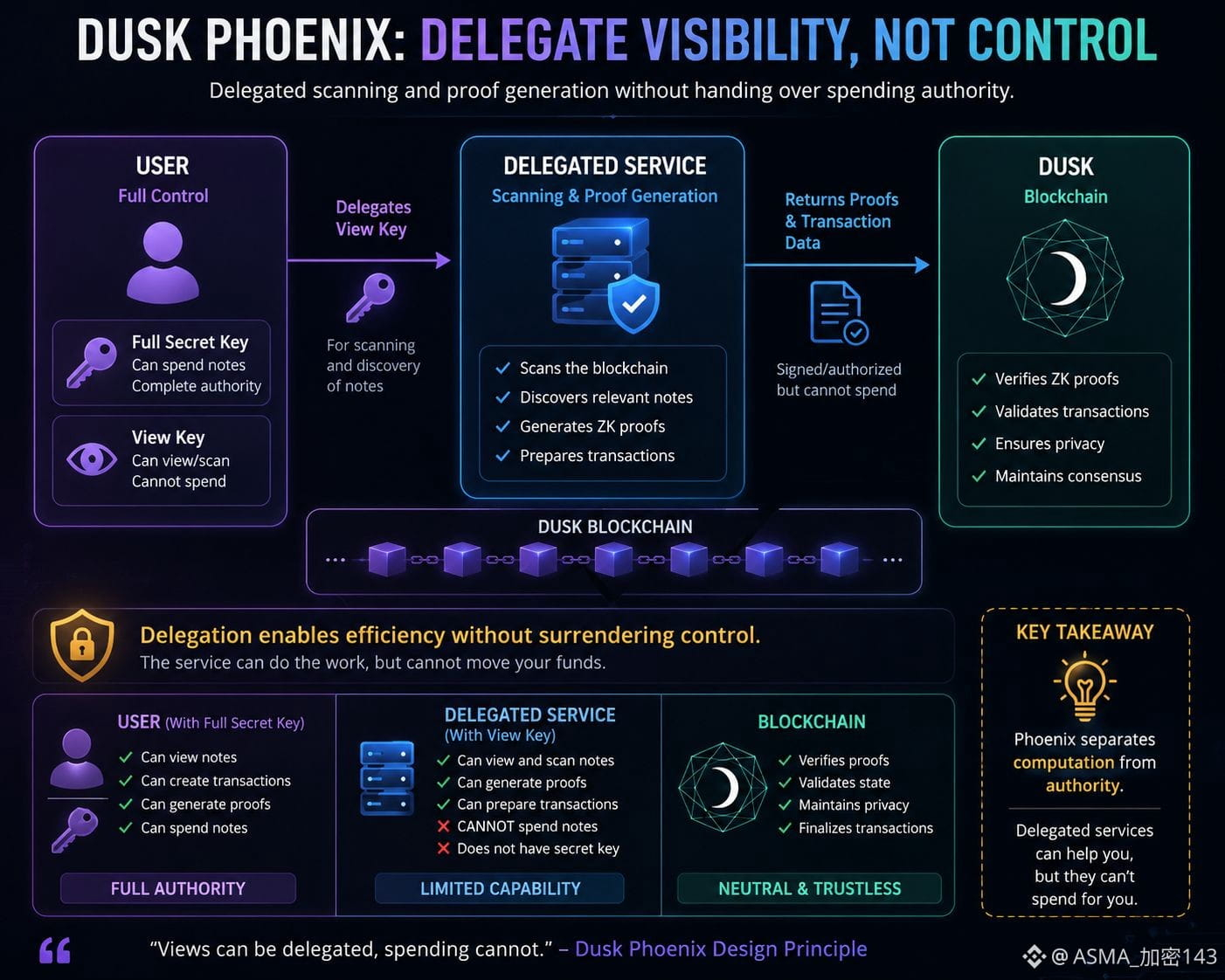
I nearly missed a distinction in Dusk’s Phoenix design that changes how I think about transaction delegation.
My first assumption was simple: if a third party helps with a private transaction, giving it more visibility must also mean giving it more control.
The whitepaper draws a much sharper boundary. Phoenix allows a user to delegate network scanning with a view key, while the delegated party still cannot spend the notes because it does not possess the user’s complete secret key. It also says ZK proof generation can be delegated through signatures without compromising transaction integrity.
That caught my attention because the architecture separates computation from authority. A service can perform expensive work, but the ability to actually spend a note remains tied to the full secret key. The note secret itself requires the complete key pair, not merely the view key.
But this creates a different systems question.
The security boundary may be stronger against delegated services spending funds, yet the user now has to manage which capability is exposed to which service. A compromised or poorly designed delegation layer could still create operational or privacy problems, even if it cannot directly spend.
@Dusk_Foundation $DUSK #dusk
{spot}(DUSKUSDT)
Does this separation genuinely minimize the attack surface, or does it simply move the hardest security problem into capability management and operational trust?
I nearly missed a distinction in Dusk’s Phoenix design that changes how I think about transaction delegation.
My first assumption was simple: if a third party helps with a private transaction, giving it more visibility must also mean giving it more control.
The whitepaper draws a much sharper boundary. Phoenix allows a user to delegate network scanning with a view key, while the delegated party still cannot spend the notes because it does not possess the user’s complete secret key. It also says ZK proof generation can be delegated through signatures without compromising transaction integrity.
That caught my attention because the architecture separates computation from authority. A service can perform expensive work, but the ability to actually spend a note remains tied to the full secret key. The note secret itself requires the complete key pair, not merely the view key.
But this creates a different systems question.
The security boundary may be stronger against delegated services spending funds, yet the user now has to manage which capability is exposed to which service. A compromised or poorly designed delegation layer could still create operational or privacy problems, even if it cannot directly spend.
@Dusk $DUSK #dusk
Does this separation genuinely minimize the attack surface, or does it simply move the hardest security problem into capability management and operational trust?
My first assumption was simple: if a third party helps with a private transaction, giving it more visibility must also mean giving it more control.
The whitepaper draws a much sharper boundary. Phoenix allows a user to delegate network scanning with a view key, while the delegated party still cannot spend the notes because it does not possess the user’s complete secret key. It also says ZK proof generation can be delegated through signatures without compromising transaction integrity.
That caught my attention because the architecture separates computation from authority. A service can perform expensive work, but the ability to actually spend a note remains tied to the full secret key. The note secret itself requires the complete key pair, not merely the view key.
But this creates a different systems question.
The security boundary may be stronger against delegated services spending funds, yet the user now has to manage which capability is exposed to which service. A compromised or poorly designed delegation layer could still create operational or privacy problems, even if it cannot directly spend.
@Dusk $DUSK #dusk
Does this separation genuinely minimize the attack surface, or does it simply move the hardest security problem into capability management and operational trust?
2
131
·
--
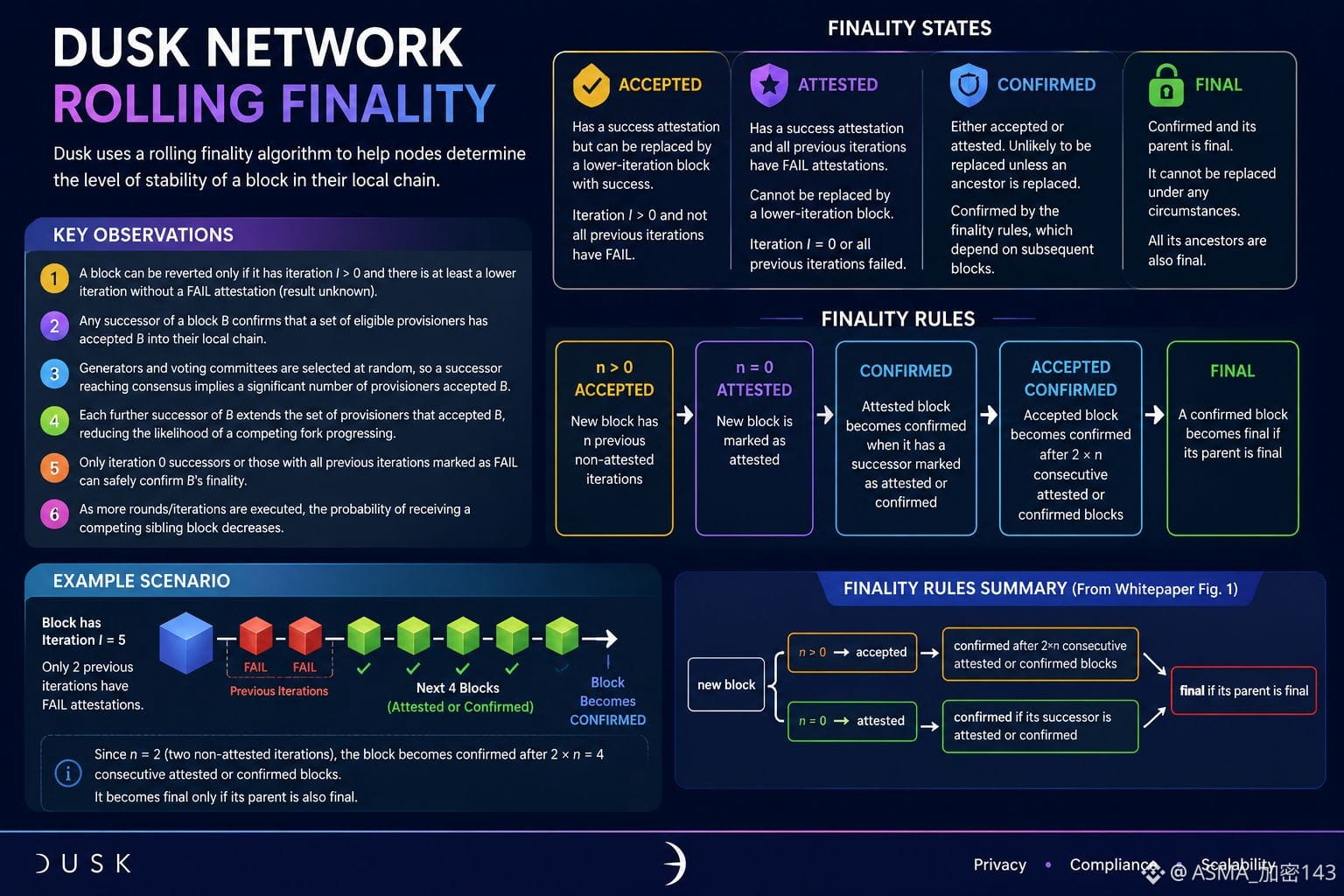
I went deeper into Dusk’s rolling finality rules, and one detail changed how I think about “finality.”
A block is not simply final the moment it gets a successful attestation. Dusk distinguishes between accepted, attested, confirmed, and final states. An accepted block can still be replaced by a lower iteration block, while an attested block cannot be replaced by one.
The interesting part is how later blocks strengthen confidence. An accepted block becomes confirmed only after 2×n consecutive attested or confirmed blocks, where n represents previous non-attested iterations. Finality then depends on the parent already being final.
So the deeper question for @Dusk_Foundation and $DUSK is not simply “How fast is finality?”
It is: how should applications price risk while a block moves through these intermediate states?
For financial infrastructure, that distinction could matter more than a headline finality number.
How would you design an application around Dusk’s accepted → confirmed → final progression?
{spot}(DUSKUSDT)
#dusk
I went deeper into Dusk’s rolling finality rules, and one detail changed how I think about “finality.”
A block is not simply final the moment it gets a successful attestation. Dusk distinguishes between accepted, attested, confirmed, and final states. An accepted block can still be replaced by a lower iteration block, while an attested block cannot be replaced by one.
The interesting part is how later blocks strengthen confidence. An accepted block becomes confirmed only after 2×n consecutive attested or confirmed blocks, where n represents previous non-attested iterations. Finality then depends on the parent already being final.
So the deeper question for @Dusk and $DUSK is not simply “How fast is finality?”
It is: how should applications price risk while a block moves through these intermediate states?
For financial infrastructure, that distinction could matter more than a headline finality number.
How would you design an application around Dusk’s accepted → confirmed → final progression?
#dusk
A block is not simply final the moment it gets a successful attestation. Dusk distinguishes between accepted, attested, confirmed, and final states. An accepted block can still be replaced by a lower iteration block, while an attested block cannot be replaced by one.
The interesting part is how later blocks strengthen confidence. An accepted block becomes confirmed only after 2×n consecutive attested or confirmed blocks, where n represents previous non-attested iterations. Finality then depends on the parent already being final.
So the deeper question for @Dusk and $DUSK is not simply “How fast is finality?”
It is: how should applications price risk while a block moves through these intermediate states?
For financial infrastructure, that distinction could matter more than a headline finality number.
How would you design an application around Dusk’s accepted → confirmed → final progression?
#dusk
1
3
182
·
--
🎙️ BIG CONGRATULATIONS DEAR KIRAN FINALLY COMPLETED 30K FOLLOWERS JOURNEY

End
06 h 00 m 00 s
2.8k
3
2
·
--
#dusk $DUSK @Dusk_Foundation
Most blockchains talk a lot about what happens when everything works. I find the failure case more revealing.
Dusk has a detail I hadn’t noticed before: its consensus can enter an emergency mode after 16 failed iterations when provisioners are unavailable or isolated. Instead of simply stopping, the protocol keeps opening iterations until a candidate block reaches quorum.
If the network still cannot recover, provisioners holding a majority of stake can request an emergency block. That block contains no transactions; it carries a new verifiable seed to help restart progress.
What makes this interesting is the tradeoff. Emergency mode can keep the network moving, but the design explicitly acknowledges that concurrent recovery attempts can increase the possibility of forks.
So the real question isn't whether a blockchain can handle normal conditions.
How much recovery risk should a consensus protocol accept before “staying alive” becomes more dangerous than stopping?
{spot}(DUSKUSDT)
What matters more during a severe network failure?
#dusk $DUSK @Dusk
Most blockchains talk a lot about what happens when everything works. I find the failure case more revealing.
Dusk has a detail I hadn’t noticed before: its consensus can enter an emergency mode after 16 failed iterations when provisioners are unavailable or isolated. Instead of simply stopping, the protocol keeps opening iterations until a candidate block reaches quorum.
If the network still cannot recover, provisioners holding a majority of stake can request an emergency block. That block contains no transactions; it carries a new verifiable seed to help restart progress.
What makes this interesting is the tradeoff. Emergency mode can keep the network moving, but the design explicitly acknowledges that concurrent recovery attempts can increase the possibility of forks.
So the real question isn't whether a blockchain can handle normal conditions.
How much recovery risk should a consensus protocol accept before “staying alive” becomes more dangerous than stopping?
What matters more during a severe network failure?
Most blockchains talk a lot about what happens when everything works. I find the failure case more revealing.
Dusk has a detail I hadn’t noticed before: its consensus can enter an emergency mode after 16 failed iterations when provisioners are unavailable or isolated. Instead of simply stopping, the protocol keeps opening iterations until a candidate block reaches quorum.
If the network still cannot recover, provisioners holding a majority of stake can request an emergency block. That block contains no transactions; it carries a new verifiable seed to help restart progress.
What makes this interesting is the tradeoff. Emergency mode can keep the network moving, but the design explicitly acknowledges that concurrent recovery attempts can increase the possibility of forks.
So the real question isn't whether a blockchain can handle normal conditions.
How much recovery risk should a consensus protocol accept before “staying alive” becomes more dangerous than stopping?
What matters more during a severe network failure?
Keep recovering
0%
Stop and protect consistency
100%
1 votes • Voting closed
2
6
104
·
--
🎙️ Binance square live campaign on Dusk 480k complete task get 40k Dusk

End
01 h 56 m 26 s
482
5
3
·
--
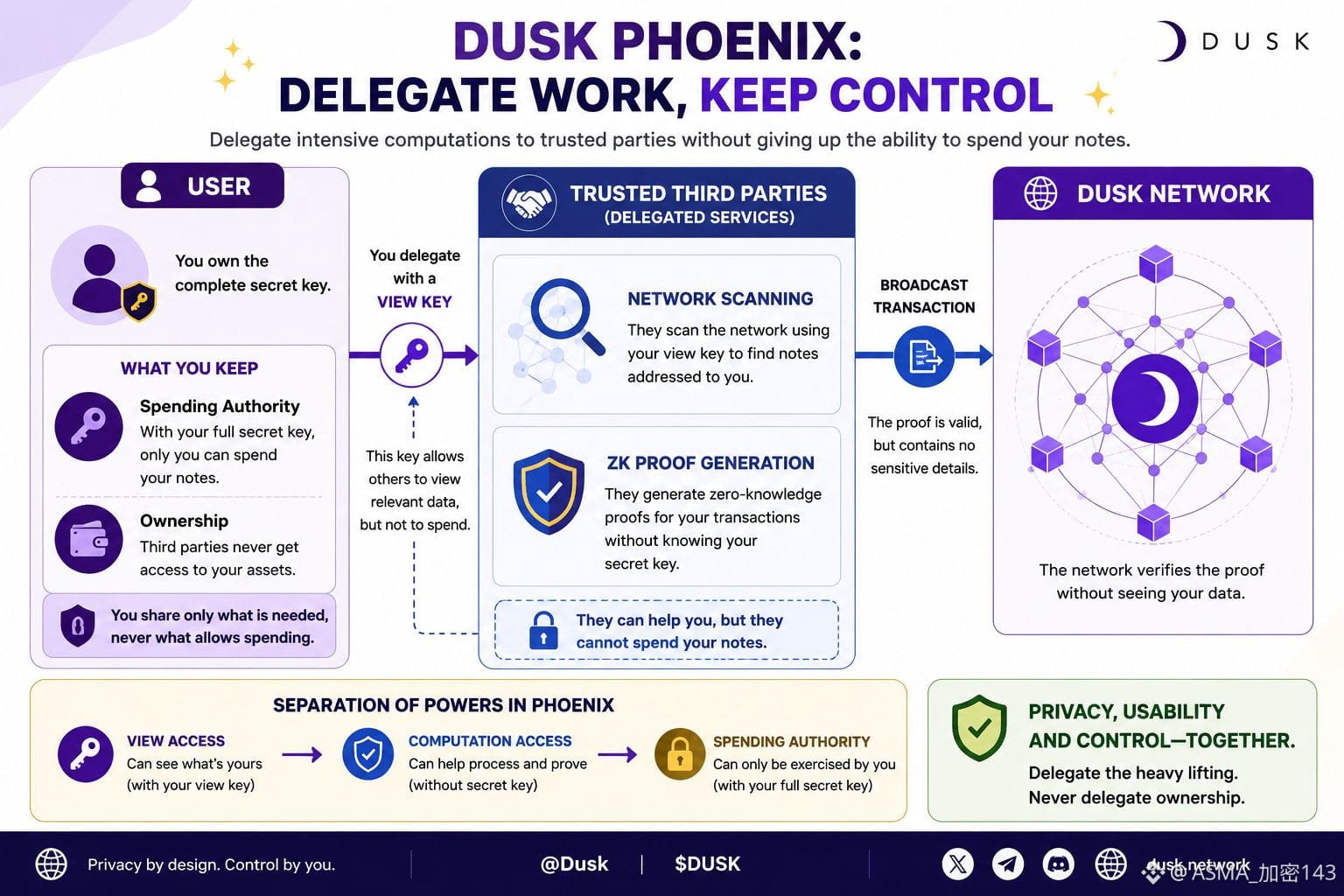
I used to think privacy on a blockchain meant the user had to handle everything themselves, but one detail in Dusk’s Phoenix model made me look at that differently. @Dusk_Foundation allows intensive computations to be delegated to trusted third parties, including scanning the network for transactions addressed to you using a view key and even generating ZK proofs, while the delegated party still cannot spend your notes because it does not have your complete secret key. That separation is more interesting than it first sounds. It suggests that private blockchain activity doesn’t necessarily have to mean every user performs every expensive computation locally. You can delegate the heavy work while keeping the authority to spend your assets under your control. For financial applications, where usability and privacy both matter, that distinction could become important if these systems have to serve people who are not cryptography experts. The question I’m left with is: would you trust secure delegation for private transactions, or would you prefer to keep every computation under your own control? $DUSK #dusk
{spot}(DUSKUSDT)
$EDEN
{spot}(EDENUSDT)
$RED
{spot}(REDUSDT)
I used to think privacy on a blockchain meant the user had to handle everything themselves, but one detail in Dusk’s Phoenix model made me look at that differently. @Dusk allows intensive computations to be delegated to trusted third parties, including scanning the network for transactions addressed to you using a view key and even generating ZK proofs, while the delegated party still cannot spend your notes because it does not have your complete secret key. That separation is more interesting than it first sounds. It suggests that private blockchain activity doesn’t necessarily have to mean every user performs every expensive computation locally. You can delegate the heavy work while keeping the authority to spend your assets under your control. For financial applications, where usability and privacy both matter, that distinction could become important if these systems have to serve people who are not cryptography experts. The question I’m left with is: would you trust secure delegation for private transactions, or would you prefer to keep every computation under your own control? $DUSK #dusk
$EDEN
$RED
$EDEN
$RED
4
4
211
·
--
#dusk $DUSK @Dusk_Foundation
I used to think blockchain privacy simply meant hiding transaction data.
The more I studied Dusk, the more interesting the problem became: can financial transactions stay private while still being verifiable?
That is where Phoenix caught my attention. In its obfuscated mode, Dusk uses zero knowledge proofs so the network can verify ownership, balance integrity, fee coverage and double spend prevention without directly checking the underlying transaction details.
For financial markets, this distinction matters. A completely transparent ledger can expose sensitive positions and transaction details. But complete opacity creates problems for auditing and regulation.
Dusk is trying to approach the middle ground: prove that the rules were followed without necessarily exposing everything behind the transaction.
That made me think differently about $DUSK .
The bigger question is whether this model can work at the scale and complexity of real financial markets.
{spot}(DUSKUSDT)
What matters more for institutional blockchain adoption?
#dusk $DUSK @Dusk
I used to think blockchain privacy simply meant hiding transaction data.
The more I studied Dusk, the more interesting the problem became: can financial transactions stay private while still being verifiable?
That is where Phoenix caught my attention. In its obfuscated mode, Dusk uses zero knowledge proofs so the network can verify ownership, balance integrity, fee coverage and double spend prevention without directly checking the underlying transaction details.
For financial markets, this distinction matters. A completely transparent ledger can expose sensitive positions and transaction details. But complete opacity creates problems for auditing and regulation.
Dusk is trying to approach the middle ground: prove that the rules were followed without necessarily exposing everything behind the transaction.
That made me think differently about $DUSK .
The bigger question is whether this model can work at the scale and complexity of real financial markets.
What matters more for institutional blockchain adoption?
I used to think blockchain privacy simply meant hiding transaction data.
The more I studied Dusk, the more interesting the problem became: can financial transactions stay private while still being verifiable?
That is where Phoenix caught my attention. In its obfuscated mode, Dusk uses zero knowledge proofs so the network can verify ownership, balance integrity, fee coverage and double spend prevention without directly checking the underlying transaction details.
For financial markets, this distinction matters. A completely transparent ledger can expose sensitive positions and transaction details. But complete opacity creates problems for auditing and regulation.
Dusk is trying to approach the middle ground: prove that the rules were followed without necessarily exposing everything behind the transaction.
That made me think differently about $DUSK .
The bigger question is whether this model can work at the scale and complexity of real financial markets.
What matters more for institutional blockchain adoption?
Privacy with verifiability
100%
Full transparency
0%
1 votes • Voting closed
4
127
·
--
#dusk $DUSK @Dusk_Foundation
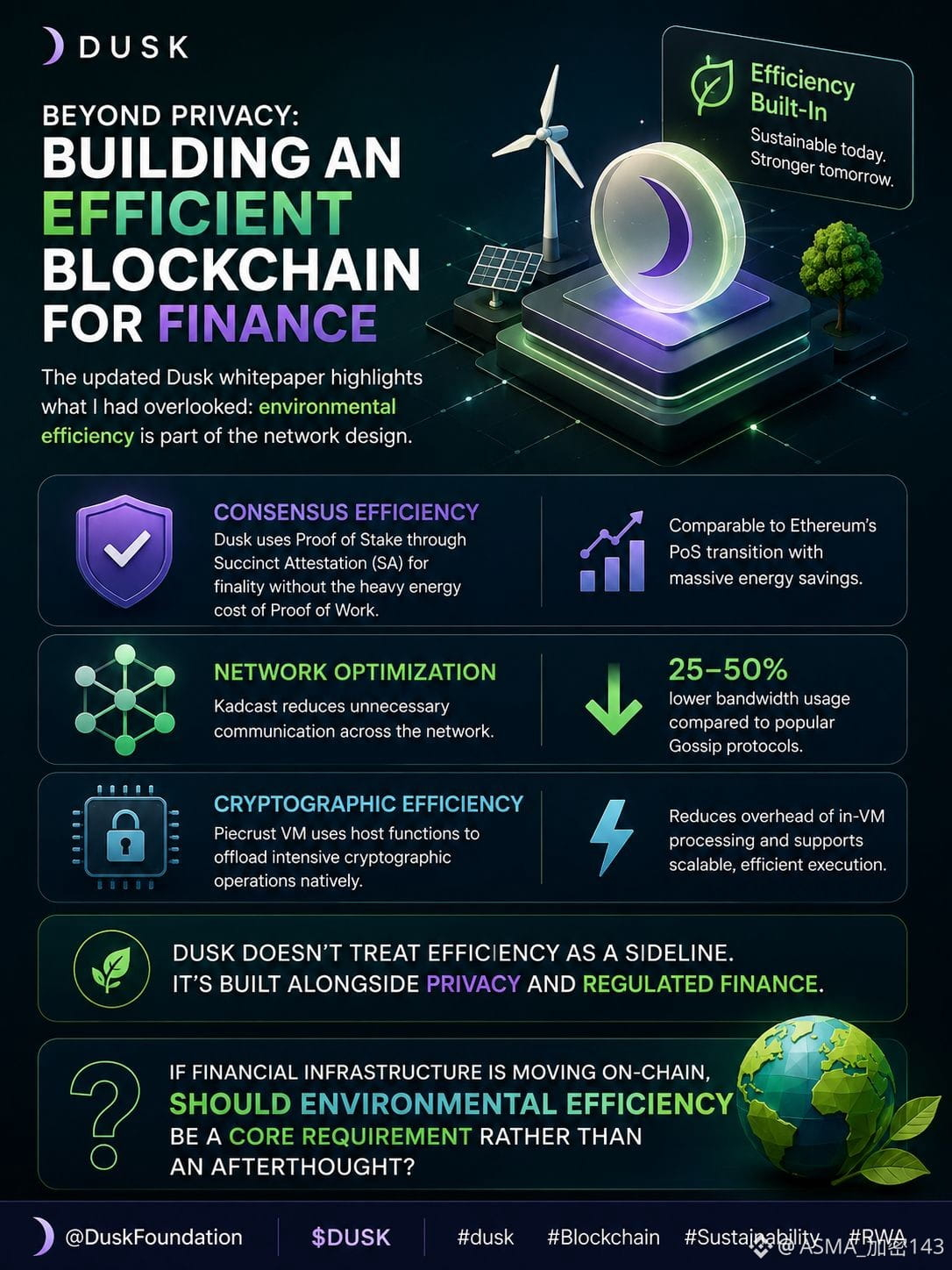
I used to think privacy blockchains were mainly about hiding transaction details. Dusk made me look at the bigger infrastructure question.
The updated Dusk whitepaper highlights something I had overlooked: environmental efficiency is part of the network design. Dusk uses Proof of Stake through Succinct Attestation, while Kadcast is designed to reduce unnecessary network communication.
The whitepaper cites approximately 25–50% lower bandwidth usage for Kadcast compared with popular Gossip protocols. That matters because blockchain efficiency is not only about transaction speed. Consensus, communication, and cryptographic workloads all affect how resources are used across a network.
What caught my attention is that @Dusk treats efficiency alongside privacy and regulated finance rather than as a completely separate issue.
If financial infrastructure is moving on-chain, should environmental efficiency be considered a core requirement rather than an afterthought?
{spot}(DUSKUSDT)
{spot}(HEMIUSDT)
{spot}(CHIPUSDT)
#dusk $DUSK @Dusk
I used to think privacy blockchains were mainly about hiding transaction details. Dusk made me look at the bigger infrastructure question.
The updated Dusk whitepaper highlights something I had overlooked: environmental efficiency is part of the network design. Dusk uses Proof of Stake through Succinct Attestation, while Kadcast is designed to reduce unnecessary network communication.
The whitepaper cites approximately 25–50% lower bandwidth usage for Kadcast compared with popular Gossip protocols. That matters because blockchain efficiency is not only about transaction speed. Consensus, communication, and cryptographic workloads all affect how resources are used across a network.
What caught my attention is that @Dusk treats efficiency alongside privacy and regulated finance rather than as a completely separate issue.
If financial infrastructure is moving on-chain, should environmental efficiency be considered a core requirement rather than an afterthought?
I used to think privacy blockchains were mainly about hiding transaction details. Dusk made me look at the bigger infrastructure question.
The updated Dusk whitepaper highlights something I had overlooked: environmental efficiency is part of the network design. Dusk uses Proof of Stake through Succinct Attestation, while Kadcast is designed to reduce unnecessary network communication.
The whitepaper cites approximately 25–50% lower bandwidth usage for Kadcast compared with popular Gossip protocols. That matters because blockchain efficiency is not only about transaction speed. Consensus, communication, and cryptographic workloads all affect how resources are used across a network.
What caught my attention is that @Dusk treats efficiency alongside privacy and regulated finance rather than as a completely separate issue.
If financial infrastructure is moving on-chain, should environmental efficiency be considered a core requirement rather than an afterthought?
4
111
·
--
Bullish
Verified
#dusk $DUSK @Dusk_Foundation
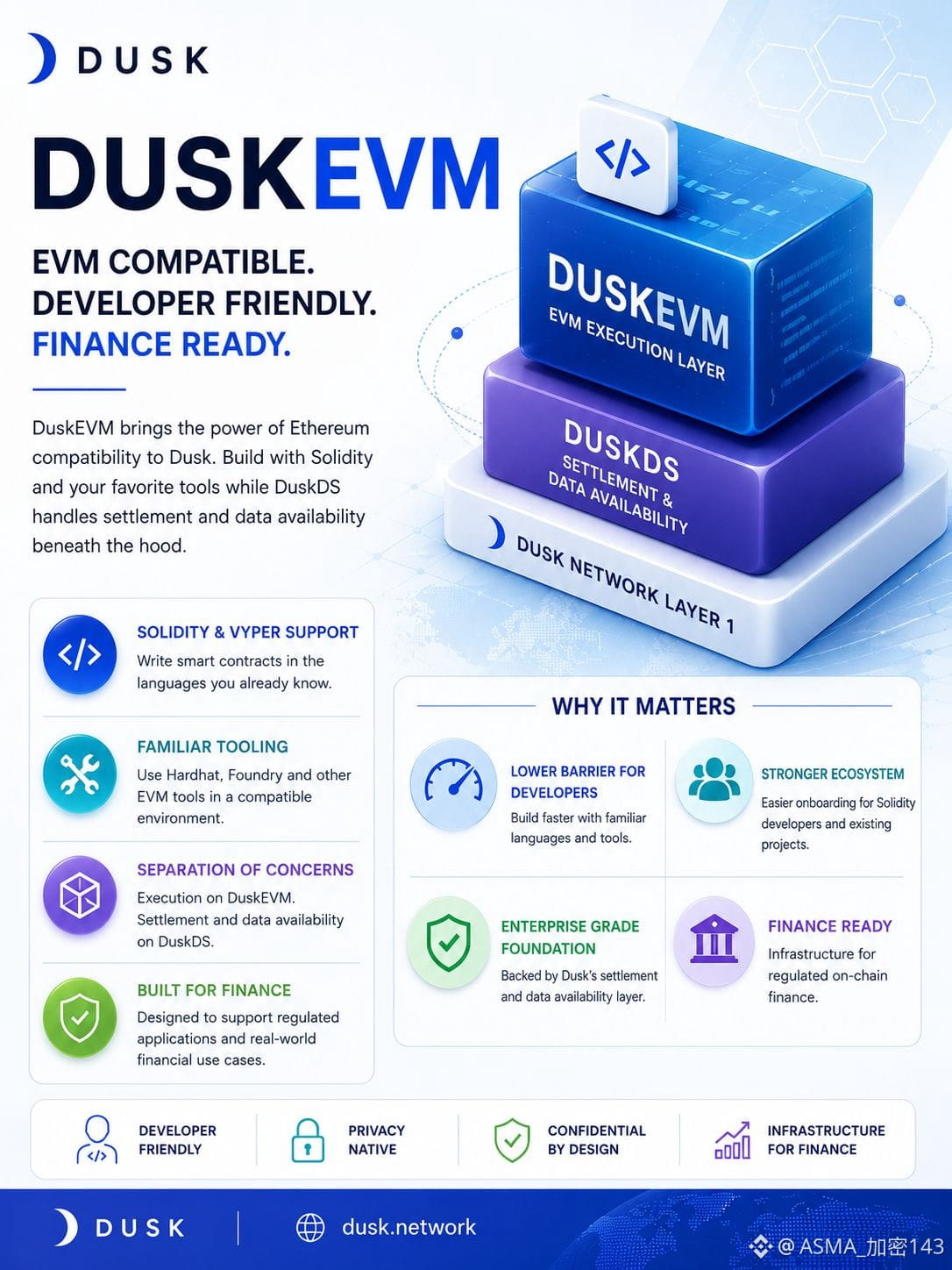
A blockchain built for finance still needs to be easy for developers to build on.
That is where DuskEVM becomes interesting. @Dusk_Foundation provides an EVM execution environment where developers can use Solidity and familiar tools such as Hardhat and Foundry, while DuskDS handles settlement and data availability underneath.
This means developers can work with an environment they already understand instead of learning an entirely unfamiliar smart contract stack from scratch.
For financial applications, that developer layer matters because infrastructure is only useful when teams can actually build, deploy, and maintain applications on it.
Dusk’s architecture separates execution from settlement, giving developers an EVM compatible path while keeping Dusk’s settlement foundation underneath.
{spot}(DUSKUSDT)
{spot}(COWUSDT)
{spot}(WALUSDT)
#dusk $DUSK @Dusk
A blockchain built for finance still needs to be easy for developers to build on.
That is where DuskEVM becomes interesting. @Dusk provides an EVM execution environment where developers can use Solidity and familiar tools such as Hardhat and Foundry, while DuskDS handles settlement and data availability underneath.
This means developers can work with an environment they already understand instead of learning an entirely unfamiliar smart contract stack from scratch.
For financial applications, that developer layer matters because infrastructure is only useful when teams can actually build, deploy, and maintain applications on it.
Dusk’s architecture separates execution from settlement, giving developers an EVM compatible path while keeping Dusk’s settlement foundation underneath.
A blockchain built for finance still needs to be easy for developers to build on.
That is where DuskEVM becomes interesting. @Dusk provides an EVM execution environment where developers can use Solidity and familiar tools such as Hardhat and Foundry, while DuskDS handles settlement and data availability underneath.
This means developers can work with an environment they already understand instead of learning an entirely unfamiliar smart contract stack from scratch.
For financial applications, that developer layer matters because infrastructure is only useful when teams can actually build, deploy, and maintain applications on it.
Dusk’s architecture separates execution from settlement, giving developers an EVM compatible path while keeping Dusk’s settlement foundation underneath.
6
4
796
·
--
Join the live with Kim
Join the live with Kim
KIM_加密 143
·
--
[Replay] 🎙️ WELCOME EVERYONE HOPE EVERYTHING IS ALRIGHT ALL FRIENDS
04 h 39 m 57 s · 1.6k listens
1
141

Log in to explore more content
Join global crypto users on Binance Square
⚡️ Get latest and useful information about crypto.
💬 Trusted by the world’s largest crypto exchange.
👍 Discover real insights from verified creators.
Email / Phone number
Trending Topics
USBankCompletesCrossBorderPaymentPilotOnStellar
8,324 views
287 Discussing
#usbankcompletescrossborderpaymentpilotonstellar BIG MOVE IN DIGITAL PAYMENTS! 🌍💸
U.S. Bank has completed a cross-border payment pilot on the Stellar network, highlighting how blockchain technology could transform international payments.
⚡ Faster settlement
🌎 Global reach
💰 Potentially lower costs
🔗 Blockchain-powered infrastructure
This is another strong signal that traditional financial institutions are exploring public blockchain networks for real-world payment use cases.#USBankCompletesCrossBorderPaymentPilotOnStellar $MXL.US
$BTC
$ARB
Crypto_With_Kinza
·0 Likes
·1k views
NvidiaInTalksToInvestUpTo$10BInAnthropicIPO
482 views
30 Discussing
EtherRalliesAsBearishBetsLiquidate
19,534 views
502 Discussing