

Than_e
5.3k Posts

Than_e
Report
Block User
Chart based trader. Simple levels. Clear execution.
234 Following
15.2K+ Followers
6.9K+ Liked
Posts
All
Quotes
Live
·
--
Bullish
Verified
I went down a bit of a rabbit hole with MOVR today, and the chart wasn’t actually the most interesting part.
The $2.00 reclaim caught my attention, but digging into the project’s recent changes added another layer. Moonriver moved MOVR from its original Kusama environment to Base through a 1:1 migration, while the old Moonriver network entered maintenance mode in August.
What stood out to me is that the token is now tied to a very different infrastructure story. BaseScan shows the new MOVR contract and early post-migration activity, but the on-chain footprint is still something I’m trying to understand rather than assume is meaningful.
So I’m watching the price structure around $2.00 alongside actual activity on Base.
No strong conclusion yet. Are you seeing the same transition, or am I missing something in the data?
$MOVR
{future}(MOVRUSDT)
$CT
{alpha}(560x0a092e544da31150b439a1aaa1a3a2214a867f46)
$GLMR
{spot}(GLMRUSDT)
I went down a bit of a rabbit hole with MOVR today, and the chart wasn’t actually the most interesting part.
The $2.00 reclaim caught my attention, but digging into the project’s recent changes added another layer. Moonriver moved MOVR from its original Kusama environment to Base through a 1:1 migration, while the old Moonriver network entered maintenance mode in August.
What stood out to me is that the token is now tied to a very different infrastructure story. BaseScan shows the new MOVR contract and early post-migration activity, but the on-chain footprint is still something I’m trying to understand rather than assume is meaningful.
So I’m watching the price structure around $2.00 alongside actual activity on Base.
No strong conclusion yet. Are you seeing the same transition, or am I missing something in the data?
$MOVR
$CT
$GLMR
The $2.00 reclaim caught my attention, but digging into the project’s recent changes added another layer. Moonriver moved MOVR from its original Kusama environment to Base through a 1:1 migration, while the old Moonriver network entered maintenance mode in August.
What stood out to me is that the token is now tied to a very different infrastructure story. BaseScan shows the new MOVR contract and early post-migration activity, but the on-chain footprint is still something I’m trying to understand rather than assume is meaningful.
So I’m watching the price structure around $2.00 alongside actual activity on Base.
No strong conclusion yet. Are you seeing the same transition, or am I missing something in the data?
$MOVR
$CT
$GLMR
A) $2.50-$2.70
24%
B) $2.70-$3.00
20%
C) $3.00
44%
Pullback before another leg up
12%
100 votes • Voting closed
1
2
5.2k
·
--
Bullish
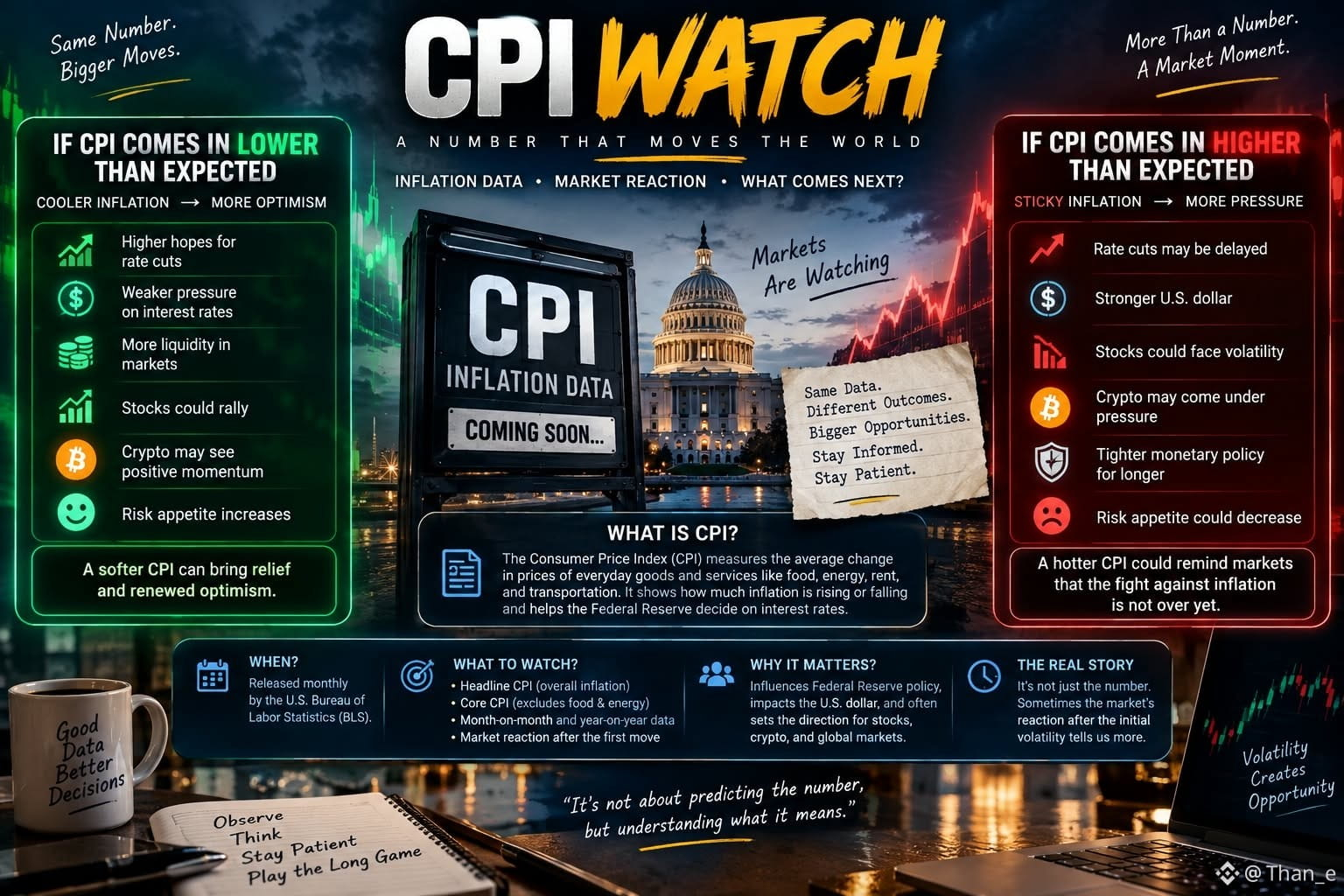
CPI day always feels a little different.
The market gets quieter, traders start guessing, and suddenly everyone is waiting for one number that could change the mood within minutes.
This time, the focus is simple: is inflation actually coming down, or is it still proving harder to control than expected?
A lower CPI number could give markets some breathing room. It may strengthen hopes that the Federal Reserve will have more flexibility with interest rates, which is usually a positive environment for risk assets.
But if inflation comes in hotter than expected, things could get interesting very quickly.
The dollar could react, stocks could turn volatile, and crypto will likely feel the pressure too. We have seen this story before: expectations build for days, the data drops, and the market suddenly moves much faster than anyone expected.
I was looking through the market earlier, and honestly, the tension is already visible. People are trying to position themselves before the number arrives, but nobody really knows which direction the first major move will go.
For me, the most interesting part won't just be the CPI number itself.
It will be what happens after the first reaction.
Sometimes the market tells you what it truly thinks only after the initial excitement disappears.
#CPIWatch
$CNPY
{alpha}(560xc69b16cf18cea1e5d0bb6a1a9db802097790ddd2)
$TFUEL
{spot}(TFUELUSDT)
$VTHO
{future}(VTHOUSDT)
#CPIWatch
CPI day always feels a little different.
The market gets quieter, traders start guessing, and suddenly everyone is waiting for one number that could change the mood within minutes.
This time, the focus is simple: is inflation actually coming down, or is it still proving harder to control than expected?
A lower CPI number could give markets some breathing room. It may strengthen hopes that the Federal Reserve will have more flexibility with interest rates, which is usually a positive environment for risk assets.
But if inflation comes in hotter than expected, things could get interesting very quickly.
The dollar could react, stocks could turn volatile, and crypto will likely feel the pressure too. We have seen this story before: expectations build for days, the data drops, and the market suddenly moves much faster than anyone expected.
I was looking through the market earlier, and honestly, the tension is already visible. People are trying to position themselves before the number arrives, but nobody really knows which direction the first major move will go.
For me, the most interesting part won't just be the CPI number itself.
It will be what happens after the first reaction.
Sometimes the market tells you what it truly thinks only after the initial excitement disappears.
#CPIWatch
$CNPY
$TFUEL
$VTHO
#CPIWatch
The market gets quieter, traders start guessing, and suddenly everyone is waiting for one number that could change the mood within minutes.
This time, the focus is simple: is inflation actually coming down, or is it still proving harder to control than expected?
A lower CPI number could give markets some breathing room. It may strengthen hopes that the Federal Reserve will have more flexibility with interest rates, which is usually a positive environment for risk assets.
But if inflation comes in hotter than expected, things could get interesting very quickly.
The dollar could react, stocks could turn volatile, and crypto will likely feel the pressure too. We have seen this story before: expectations build for days, the data drops, and the market suddenly moves much faster than anyone expected.
I was looking through the market earlier, and honestly, the tension is already visible. People are trying to position themselves before the number arrives, but nobody really knows which direction the first major move will go.
For me, the most interesting part won't just be the CPI number itself.
It will be what happens after the first reaction.
Sometimes the market tells you what it truly thinks only after the initial excitement disappears.
#CPIWatch
$CNPY
$TFUEL
$VTHO
#CPIWatch
1
97
·
--
Bullish
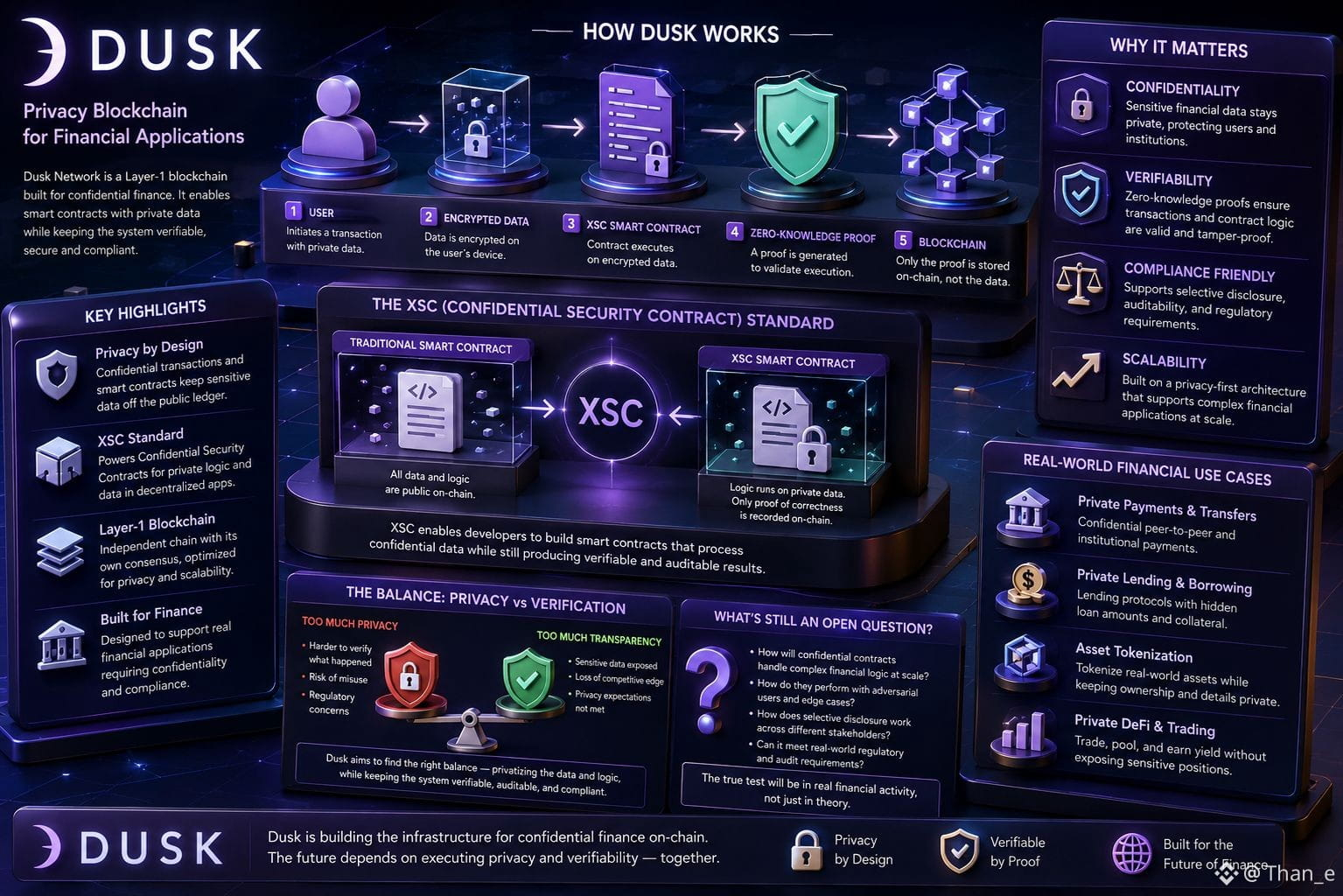
I spent some time looking through Dusk, and one thing kept pulling me back: privacy sounds easy until you ask what a financial system actually needs to reveal.
Dusk is built around confidential smart contracts and its XSC standard, so sensitive financial logic and data don’t have to be exposed in the same way they would on a fully transparent chain.
That part makes sense.
But then I started thinking about the other side of it.
Financial markets still need verification. Someone has to prove that rules were followed, assets exist, transactions are valid, and counterparties can trust the outcome. So the real challenge isn’t simply hiding information. It’s deciding what should stay private and what still needs to be provable.
That’s where I think Dusk gets more interesting than the usual “privacy blockchain” description suggests.
I haven’t seen enough to conclude how well that balance works in real financial activity, especially when contracts become more complex and different participants need different levels of visibility.
So that’s the part I’m paying attention to.
Not whether Dusk can keep information private, but whether it can make privacy compatible with the verification requirements that financial systems depend on.
$TMX
{alpha}(560x3c2f61f2e27c865981d2e7aaf6b2cdf823030039)
#dusk $DUSK @Dusk_Foundation
{future}(DUSKUSDT)
$BMT
{future}(BMTUSDT)
I spent some time looking through Dusk, and one thing kept pulling me back: privacy sounds easy until you ask what a financial system actually needs to reveal.
Dusk is built around confidential smart contracts and its XSC standard, so sensitive financial logic and data don’t have to be exposed in the same way they would on a fully transparent chain.
That part makes sense.
But then I started thinking about the other side of it.
Financial markets still need verification. Someone has to prove that rules were followed, assets exist, transactions are valid, and counterparties can trust the outcome. So the real challenge isn’t simply hiding information. It’s deciding what should stay private and what still needs to be provable.
That’s where I think Dusk gets more interesting than the usual “privacy blockchain” description suggests.
I haven’t seen enough to conclude how well that balance works in real financial activity, especially when contracts become more complex and different participants need different levels of visibility.
So that’s the part I’m paying attention to.
Not whether Dusk can keep information private, but whether it can make privacy compatible with the verification requirements that financial systems depend on.
$TMX
#dusk $DUSK @Dusk
$BMT
Dusk is built around confidential smart contracts and its XSC standard, so sensitive financial logic and data don’t have to be exposed in the same way they would on a fully transparent chain.
That part makes sense.
But then I started thinking about the other side of it.
Financial markets still need verification. Someone has to prove that rules were followed, assets exist, transactions are valid, and counterparties can trust the outcome. So the real challenge isn’t simply hiding information. It’s deciding what should stay private and what still needs to be provable.
That’s where I think Dusk gets more interesting than the usual “privacy blockchain” description suggests.
I haven’t seen enough to conclude how well that balance works in real financial activity, especially when contracts become more complex and different participants need different levels of visibility.
So that’s the part I’m paying attention to.
Not whether Dusk can keep information private, but whether it can make privacy compatible with the verification requirements that financial systems depend on.
$TMX
#dusk $DUSK @Dusk
$BMT
1
2
279
·
--
Bullish
I started digging into Dusk because I kept wondering whether “more transparency” is always better for financial blockchains.
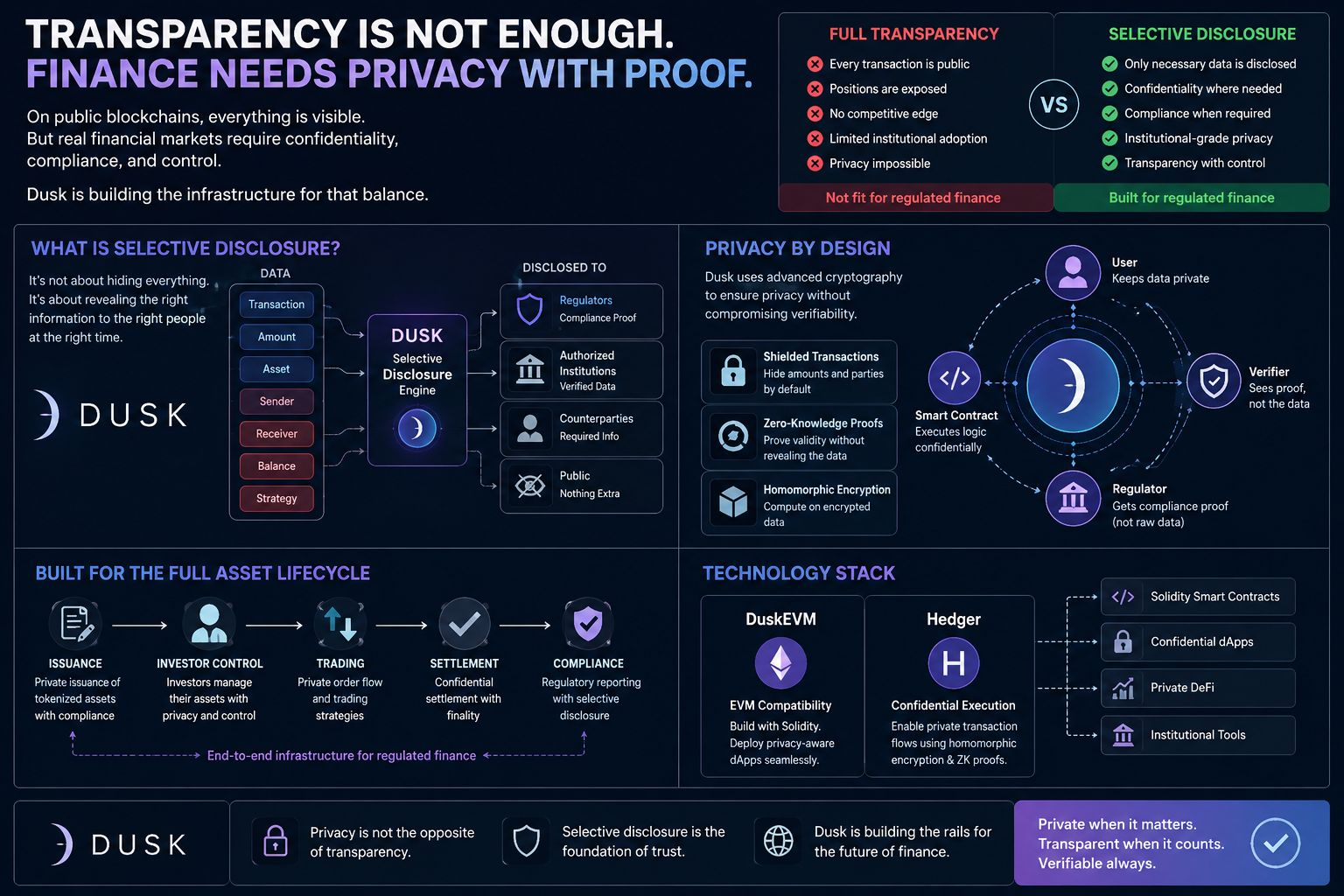
The deeper I went, the less obvious the answer became. In traditional markets, a fund exposing every position or a market maker revealing its strategy in real time wouldn’t exactly be ideal. But regulators still need to verify ownership, transactions, and compliance.
That’s what made Dusk’s approach interesting to me. Instead of treating privacy as hiding everything, it seems to be built around selective disclosure: keep sensitive data private while proving the specific facts that actually need to be verified.
I also found it interesting that the design goes beyond private transfers. Dusk is trying to cover issuance, trading, settlement and compliance, while DuskEVM brings Solidity/EVM compatibility and Hedger explores confidential execution with zero-knowledge proofs and homomorphic encryption.
I’m still trying to work out how practical all of this becomes once real assets, users and regulatory requirements enter the picture.
Maybe the bigger question isn’t whether blockchains should be transparent or private, but whether they can be both in the right places.
Curious what others researching Dusk have noticed. Am I missing an important trade-off?
$PROM
{future}(PROMUSDT)
#dusk $DUSK @Dusk_Foundation
{future}(DUSKUSDT)
$UAI
{alpha}(560x3e5d4f8aee0d9b3082d5f6da5d6e225d17ba9ea0)
I started digging into Dusk because I kept wondering whether “more transparency” is always better for financial blockchains.
The deeper I went, the less obvious the answer became. In traditional markets, a fund exposing every position or a market maker revealing its strategy in real time wouldn’t exactly be ideal. But regulators still need to verify ownership, transactions, and compliance.
That’s what made Dusk’s approach interesting to me. Instead of treating privacy as hiding everything, it seems to be built around selective disclosure: keep sensitive data private while proving the specific facts that actually need to be verified.
I also found it interesting that the design goes beyond private transfers. Dusk is trying to cover issuance, trading, settlement and compliance, while DuskEVM brings Solidity/EVM compatibility and Hedger explores confidential execution with zero-knowledge proofs and homomorphic encryption.
I’m still trying to work out how practical all of this becomes once real assets, users and regulatory requirements enter the picture.
Maybe the bigger question isn’t whether blockchains should be transparent or private, but whether they can be both in the right places.
Curious what others researching Dusk have noticed. Am I missing an important trade-off?
$PROM
#dusk $DUSK @Dusk
$UAI
The deeper I went, the less obvious the answer became. In traditional markets, a fund exposing every position or a market maker revealing its strategy in real time wouldn’t exactly be ideal. But regulators still need to verify ownership, transactions, and compliance.
That’s what made Dusk’s approach interesting to me. Instead of treating privacy as hiding everything, it seems to be built around selective disclosure: keep sensitive data private while proving the specific facts that actually need to be verified.
I also found it interesting that the design goes beyond private transfers. Dusk is trying to cover issuance, trading, settlement and compliance, while DuskEVM brings Solidity/EVM compatibility and Hedger explores confidential execution with zero-knowledge proofs and homomorphic encryption.
I’m still trying to work out how practical all of this becomes once real assets, users and regulatory requirements enter the picture.
Maybe the bigger question isn’t whether blockchains should be transparent or private, but whether they can be both in the right places.
Curious what others researching Dusk have noticed. Am I missing an important trade-off?
$PROM
#dusk $DUSK @Dusk
$UAI
1
135
·
--
Bullish
I went down a bit of a rabbit hole on Dusk, and the thing I keep coming back to isn’t simply “privacy blockchain.”
It’s the trade-off that comes with it.
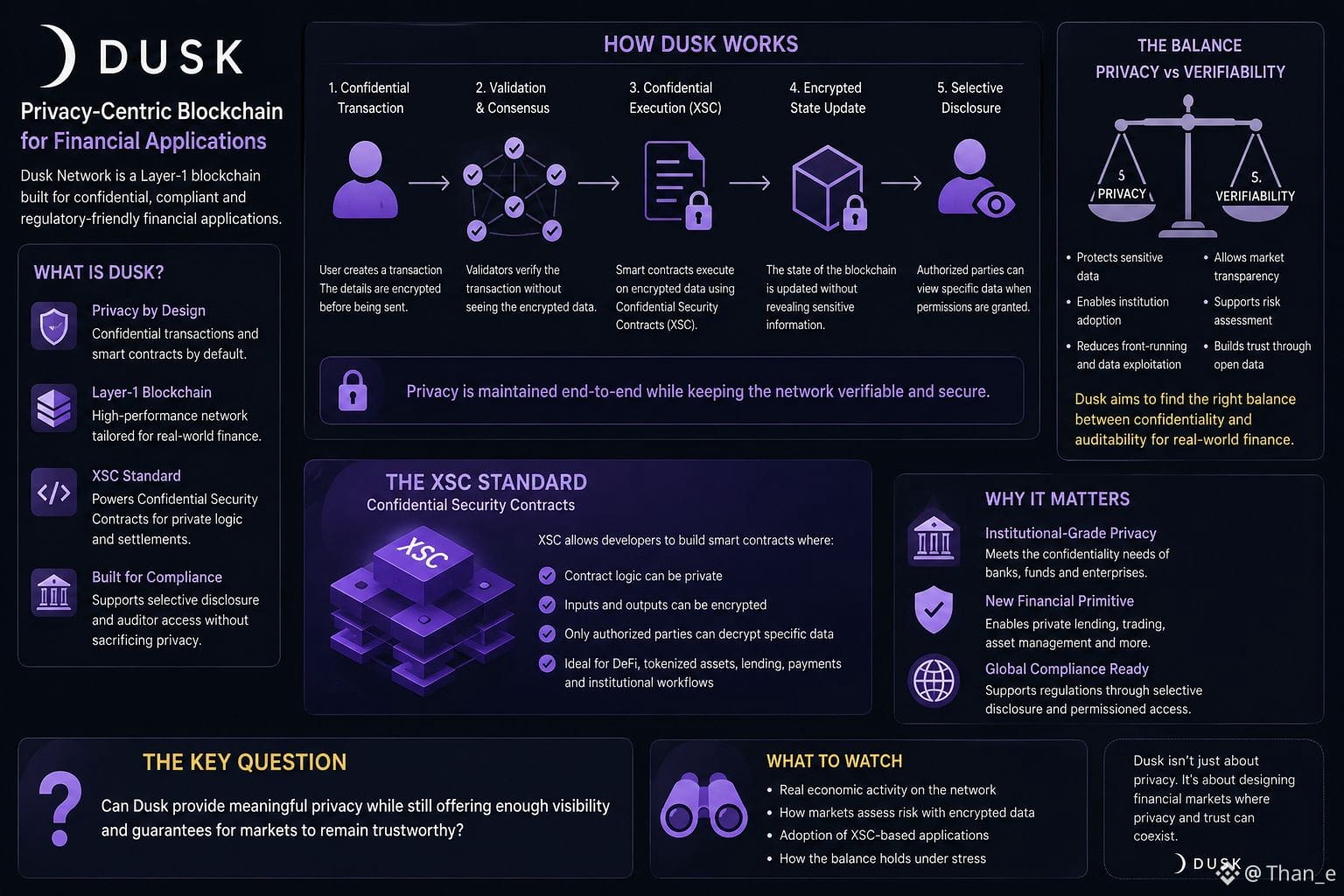
Dusk is built as a Layer-1 for financial applications, with confidential smart contracts and the XSC standard sitting at the center of the design. The obvious benefit is pretty clear: sensitive financial activity doesn’t have to be exposed to everyone just because it happens on-chain.
But that immediately made me wonder about the other side.
If I can’t see everything, how do I build a strong picture of what’s happening inside the market?
That matters more in finance than it might in other applications. Liquidity, positions, counterparties and risk all depend on information. Hiding sensitive data can make a system more usable for certain participants, but too much opacity could make independent analysis harder.
I’m not saying Dusk has solved or failed this problem. I actually think this is one of the more interesting questions around the project.
The real test, in my view, is what happens when there’s enough real activity for these trade-offs to matter.
Can Dusk give users meaningful privacy while still providing enough guarantees for other participants to trust the system?
That’s what I’d want to see before drawing any bigger conclusions.
$KII
{alpha}(560xeec6574eabba52bac3f0277f2cd5ac7e67197886)
#dusk $DUSK @Dusk_Foundation
{future}(DUSKUSDT)
$SPK
{future}(SPKUSDT)
I went down a bit of a rabbit hole on Dusk, and the thing I keep coming back to isn’t simply “privacy blockchain.”
It’s the trade-off that comes with it.
Dusk is built as a Layer-1 for financial applications, with confidential smart contracts and the XSC standard sitting at the center of the design. The obvious benefit is pretty clear: sensitive financial activity doesn’t have to be exposed to everyone just because it happens on-chain.
But that immediately made me wonder about the other side.
If I can’t see everything, how do I build a strong picture of what’s happening inside the market?
That matters more in finance than it might in other applications. Liquidity, positions, counterparties and risk all depend on information. Hiding sensitive data can make a system more usable for certain participants, but too much opacity could make independent analysis harder.
I’m not saying Dusk has solved or failed this problem. I actually think this is one of the more interesting questions around the project.
The real test, in my view, is what happens when there’s enough real activity for these trade-offs to matter.
Can Dusk give users meaningful privacy while still providing enough guarantees for other participants to trust the system?
That’s what I’d want to see before drawing any bigger conclusions.
$KII
#dusk $DUSK @Dusk
$SPK
It’s the trade-off that comes with it.
Dusk is built as a Layer-1 for financial applications, with confidential smart contracts and the XSC standard sitting at the center of the design. The obvious benefit is pretty clear: sensitive financial activity doesn’t have to be exposed to everyone just because it happens on-chain.
But that immediately made me wonder about the other side.
If I can’t see everything, how do I build a strong picture of what’s happening inside the market?
That matters more in finance than it might in other applications. Liquidity, positions, counterparties and risk all depend on information. Hiding sensitive data can make a system more usable for certain participants, but too much opacity could make independent analysis harder.
I’m not saying Dusk has solved or failed this problem. I actually think this is one of the more interesting questions around the project.
The real test, in my view, is what happens when there’s enough real activity for these trade-offs to matter.
Can Dusk give users meaningful privacy while still providing enough guarantees for other participants to trust the system?
That’s what I’d want to see before drawing any bigger conclusions.
$KII
#dusk $DUSK @Dusk
$SPK
4
2
474
·
--
Bullish
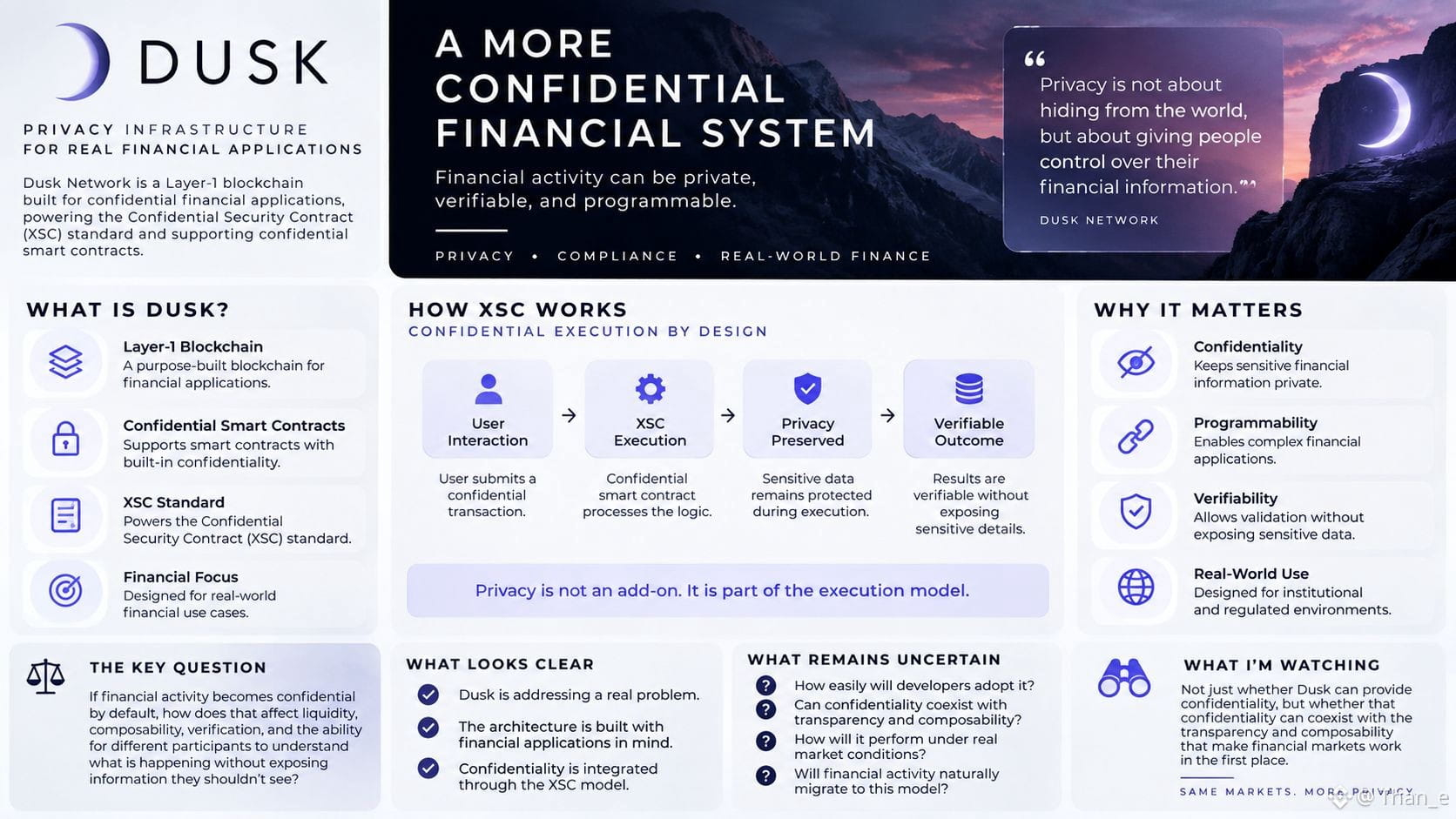
I went a little deeper into Dusk and ended up thinking less about “privacy blockchain” and more about what privacy actually changes for financial apps.
The interesting part is the XSC approach. Confidential smart contracts are not just an extra privacy feature sitting on top of the chain; they are part of the execution model itself.
That sounds clean on paper, but it creates a question I don’t think gets enough attention.
If financial activity becomes confidential by default, how does that affect everything around it — liquidity, composability, verification, and the ability for different participants to understand what is happening without exposing information they shouldn’t see?
That trade-off is probably more important than the headline privacy claim.
From what I’ve looked at, Dusk is clearly trying to solve a real problem: financial applications often need information to remain private while still being verifiable. But I’m still separating the architecture from the outcome here. A well-designed system doesn’t automatically mean developers will find it easy to use or that financial activity will naturally migrate there.
So the thing I’m watching isn’t whether Dusk can provide confidentiality.
It’s whether that confidentiality can coexist with the transparency and composability that make financial markets work in the first place.
$TUT
{future}(TUTUSDT)
#dusk $DUSK @Dusk_Foundation
{future}(DUSKUSDT)
$AOP
{alpha}(560xd5df4d260d7a0145f655bcbf3b398076f21016c7)
I went a little deeper into Dusk and ended up thinking less about “privacy blockchain” and more about what privacy actually changes for financial apps.
The interesting part is the XSC approach. Confidential smart contracts are not just an extra privacy feature sitting on top of the chain; they are part of the execution model itself.
That sounds clean on paper, but it creates a question I don’t think gets enough attention.
If financial activity becomes confidential by default, how does that affect everything around it — liquidity, composability, verification, and the ability for different participants to understand what is happening without exposing information they shouldn’t see?
That trade-off is probably more important than the headline privacy claim.
From what I’ve looked at, Dusk is clearly trying to solve a real problem: financial applications often need information to remain private while still being verifiable. But I’m still separating the architecture from the outcome here. A well-designed system doesn’t automatically mean developers will find it easy to use or that financial activity will naturally migrate there.
So the thing I’m watching isn’t whether Dusk can provide confidentiality.
It’s whether that confidentiality can coexist with the transparency and composability that make financial markets work in the first place.
$TUT
#dusk $DUSK @Dusk
$AOP
The interesting part is the XSC approach. Confidential smart contracts are not just an extra privacy feature sitting on top of the chain; they are part of the execution model itself.
That sounds clean on paper, but it creates a question I don’t think gets enough attention.
If financial activity becomes confidential by default, how does that affect everything around it — liquidity, composability, verification, and the ability for different participants to understand what is happening without exposing information they shouldn’t see?
That trade-off is probably more important than the headline privacy claim.
From what I’ve looked at, Dusk is clearly trying to solve a real problem: financial applications often need information to remain private while still being verifiable. But I’m still separating the architecture from the outcome here. A well-designed system doesn’t automatically mean developers will find it easy to use or that financial activity will naturally migrate there.
So the thing I’m watching isn’t whether Dusk can provide confidentiality.
It’s whether that confidentiality can coexist with the transparency and composability that make financial markets work in the first place.
$TUT
#dusk $DUSK @Dusk
$AOP
1
1
195
·
--
Bullish
$RED is trading around 0.1162 after gaining more than 10%.
Trade setup:
Entry: 0.113–0.117
TP1: 0.122
TP2: 0.128
TP3: 0.135
Stop: 0.107
The setup needs confirmation around the 0.113–0.117 zone. If buyers defend the area and volume returns, continuation becomes more interesting. Below 0.107, I'd consider the structure invalid.
{spot}(REDUSDT)
$RED is trading around 0.1162 after gaining more than 10%.
Trade setup:
Entry: 0.113–0.117
TP1: 0.122
TP2: 0.128
TP3: 0.135
Stop: 0.107
The setup needs confirmation around the 0.113–0.117 zone. If buyers defend the area and volume returns, continuation becomes more interesting. Below 0.107, I'd consider the structure invalid.
Trade setup:
Entry: 0.113–0.117
TP1: 0.122
TP2: 0.128
TP3: 0.135
Stop: 0.107
The setup needs confirmation around the 0.113–0.117 zone. If buyers defend the area and volume returns, continuation becomes more interesting. Below 0.107, I'd consider the structure invalid.
69
·
--
Bullish
$STX is showing strength around 0.2044.
Trade setup:
Entry: 0.200–0.205
TP1: 0.215
TP2: 0.225
TP3: 0.240
Stop: 0.190
The 0.200 psychological level is important. Staying above it keeps the bullish thesis alive, while a breakdown could send price back into the previous range.
{spot}(STXUSDT)
$STX is showing strength around 0.2044.
Trade setup:
Entry: 0.200–0.205
TP1: 0.215
TP2: 0.225
TP3: 0.240
Stop: 0.190
The 0.200 psychological level is important. Staying above it keeps the bullish thesis alive, while a breakdown could send price back into the previous range.
Trade setup:
Entry: 0.200–0.205
TP1: 0.215
TP2: 0.225
TP3: 0.240
Stop: 0.190
The 0.200 psychological level is important. Staying above it keeps the bullish thesis alive, while a breakdown could send price back into the previous range.
74
·
--
Bullish
$GPS has pushed to around 0.01212 with buyers clearly active.
Trade setup:
Entry: 0.01180–0.01215
TP1: 0.01270
TP2: 0.01330
TP3: 0.01400
Stop: 0.01125
The risk here is chasing momentum after a rapid move. A retest of 0.0118 followed by a higher low would give the cleaner confirmation.
{spot}(GPSUSDT)
$GPS has pushed to around 0.01212 with buyers clearly active.
Trade setup:
Entry: 0.01180–0.01215
TP1: 0.01270
TP2: 0.01330
TP3: 0.01400
Stop: 0.01125
The risk here is chasing momentum after a rapid move. A retest of 0.0118 followed by a higher low would give the cleaner confirmation.
Trade setup:
Entry: 0.01180–0.01215
TP1: 0.01270
TP2: 0.01330
TP3: 0.01400
Stop: 0.01125
The risk here is chasing momentum after a rapid move. A retest of 0.0118 followed by a higher low would give the cleaner confirmation.
86
·
--
Bullish
$FF is trading near 0.08302 after another strong push higher.
Trade setup:
Entry: 0.0800–0.0830
TP1: 0.0870
TP2: 0.0920
TP3: 0.0980
Stop: 0.0750
The 0.080 zone is the level I'd watch. Holding above it could allow another leg higher; losing it would suggest momentum is cooling.
{spot}(FFUSDT)
$FF is trading near 0.08302 after another strong push higher.
Trade setup:
Entry: 0.0800–0.0830
TP1: 0.0870
TP2: 0.0920
TP3: 0.0980
Stop: 0.0750
The 0.080 zone is the level I'd watch. Holding above it could allow another leg higher; losing it would suggest momentum is cooling.
Trade setup:
Entry: 0.0800–0.0830
TP1: 0.0870
TP2: 0.0920
TP3: 0.0980
Stop: 0.0750
The 0.080 zone is the level I'd watch. Holding above it could allow another leg higher; losing it would suggest momentum is cooling.
66
·
--
Bullish
$COTI is showing steady momentum around 0.01205.
Trade setup:
Entry: 0.01175–0.01210
TP1: 0.01260
TP2: 0.01320
TP3: 0.01400
Stop: 0.01120
This is more interesting on a retest than on a straight pump. If 0.01175 becomes support, the structure remains constructive.
{spot}(COTIUSDT)
$COTI is showing steady momentum around 0.01205.
Trade setup:
Entry: 0.01175–0.01210
TP1: 0.01260
TP2: 0.01320
TP3: 0.01400
Stop: 0.01120
This is more interesting on a retest than on a straight pump. If 0.01175 becomes support, the structure remains constructive.
Trade setup:
Entry: 0.01175–0.01210
TP1: 0.01260
TP2: 0.01320
TP3: 0.01400
Stop: 0.01120
This is more interesting on a retest than on a straight pump. If 0.01175 becomes support, the structure remains constructive.
82
·
--
Bullish
$ACE has reached roughly 0.2314 after an 18% move.
Trade setup:
Entry: 0.225–0.232
TP1: 0.245
TP2: 0.260
TP3: 0.280
Stop: 0.212
I wouldn't chase the green candle here. The cleaner setup would be a pullback that holds the 0.225 region and then starts printing higher lows.
{spot}(ACEUSDT)
$ACE has reached roughly 0.2314 after an 18% move.
Trade setup:
Entry: 0.225–0.232
TP1: 0.245
TP2: 0.260
TP3: 0.280
Stop: 0.212
I wouldn't chase the green candle here. The cleaner setup would be a pullback that holds the 0.225 region and then starts printing higher lows.
Trade setup:
Entry: 0.225–0.232
TP1: 0.245
TP2: 0.260
TP3: 0.280
Stop: 0.212
I wouldn't chase the green candle here. The cleaner setup would be a pullback that holds the 0.225 region and then starts printing higher lows.
1
150
·
--
Bullish
$ZRO is trading around 1.137 with strong momentum behind it.
Trade setup:
Entry: 1.10–1.14
TP1: 1.20
TP2: 1.28
TP3: 1.38
Stop: 1.03
The important zone is around 1.10. If buyers defend that area, momentum can continue. A decisive loss of 1.03 invalidates this setup.
{spot}(ZROUSDT)
$ZRO is trading around 1.137 with strong momentum behind it.
Trade setup:
Entry: 1.10–1.14
TP1: 1.20
TP2: 1.28
TP3: 1.38
Stop: 1.03
The important zone is around 1.10. If buyers defend that area, momentum can continue. A decisive loss of 1.03 invalidates this setup.
Trade setup:
Entry: 1.10–1.14
TP1: 1.20
TP2: 1.28
TP3: 1.38
Stop: 1.03
The important zone is around 1.10. If buyers defend that area, momentum can continue. A decisive loss of 1.03 invalidates this setup.
86
·
--
Bullish
$PORTAL
{future}(PORTALUSDT)
is sitting near 0.01353 after a strong move higher.
Trade setup:
Entry: 0.01320–0.01355
TP1: 0.01420
TP2: 0.01500
TP3: 0.01600
Stop: 0.01260
The setup becomes interesting if price consolidates instead of immediately retracing. I would rather see a controlled retest than chase a vertical candle.
$PORTAL
is sitting near 0.01353 after a strong move higher.
Trade setup:
Entry: 0.01320–0.01355
TP1: 0.01420
TP2: 0.01500
TP3: 0.01600
Stop: 0.01260
The setup becomes interesting if price consolidates instead of immediately retracing. I would rather see a controlled retest than chase a vertical candle.
is sitting near 0.01353 after a strong move higher.
Trade setup:
Entry: 0.01320–0.01355
TP1: 0.01420
TP2: 0.01500
TP3: 0.01600
Stop: 0.01260
The setup becomes interesting if price consolidates instead of immediately retracing. I would rather see a controlled retest than chase a vertical candle.
94
·
--
Bullish
$PUMP has pushed into momentum territory after gaining more than 30%.
Trade setup:
Entry: 0.00465–0.00485
TP1: 0.00510
TP2: 0.00545
TP3: 0.00590
Stop: 0.00435
I would watch the previous breakout area closely. Holding it as support keeps the bullish structure intact; falling back below it could turn the move into a fakeout.
{spot}(PUMPUSDT)
$PUMP has pushed into momentum territory after gaining more than 30%.
Trade setup:
Entry: 0.00465–0.00485
TP1: 0.00510
TP2: 0.00545
TP3: 0.00590
Stop: 0.00435
I would watch the previous breakout area closely. Holding it as support keeps the bullish structure intact; falling back below it could turn the move into a fakeout.
Trade setup:
Entry: 0.00465–0.00485
TP1: 0.00510
TP2: 0.00545
TP3: 0.00590
Stop: 0.00435
I would watch the previous breakout area closely. Holding it as support keeps the bullish structure intact; falling back below it could turn the move into a fakeout.
164
·
--
Bullish
$TUT is showing the strongest momentum on the board, up around 59%.
Trade setup:
Entry: 0.0570–0.0590
TP1: 0.0620
TP2: 0.0670
TP3: 0.0720
Stop: 0.0530
The key is whether buyers can hold above the 0.057 area. A clean breakout with volume could extend the move, while losing 0.053 would weaken the setup significantly.
{spot}(TUTUSDT)
$TUT is showing the strongest momentum on the board, up around 59%.
Trade setup:
Entry: 0.0570–0.0590
TP1: 0.0620
TP2: 0.0670
TP3: 0.0720
Stop: 0.0530
The key is whether buyers can hold above the 0.057 area. A clean breakout with volume could extend the move, while losing 0.053 would weaken the setup significantly.
Trade setup:
Entry: 0.0570–0.0590
TP1: 0.0620
TP2: 0.0670
TP3: 0.0720
Stop: 0.0530
The key is whether buyers can hold above the 0.057 area. A clean breakout with volume could extend the move, while losing 0.053 would weaken the setup significantly.
173
·
--
Bullish
Verified
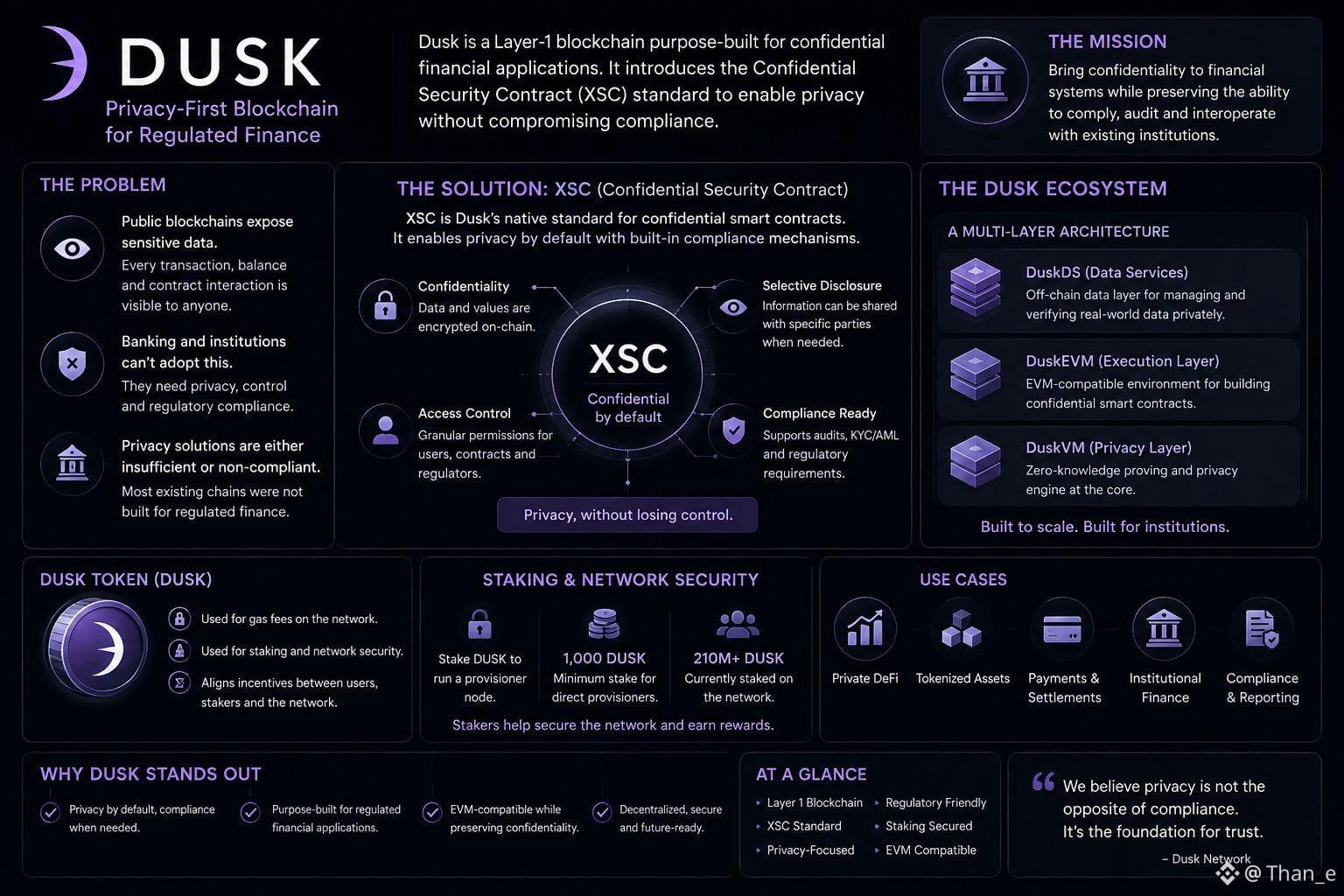
I started digging into Dusk because the privacy narrative sounded familiar, but the deeper I went, the more specific the design started to feel.
One thing that stood out is that Dusk isn’t really treating privacy as “hide everything and call it a day.” Its XSC approach is built around confidential financial activity while still allowing things like compliance and selective disclosure when needed.
That made me look more closely at the network itself. DUSK has a role in gas and staking, and staking is tied directly to securing the network rather than being some completely separate yield mechanism.
I’m still unsure how much of this architecture is translating into actual usage. That’s probably the part I’d want to understand before forming a stronger opinion.
What I find interesting is the trade-off: financial applications need privacy, but they also need rules, accountability, and ways to prove certain things when necessary.
I don’t have a strong conclusion yet. I’m mainly curious whether others researching Dusk are seeing the same gap between an interesting technical design and measurable adoption, or if I’m missing something.
$ENS
{future}(ENSUSDT)
#dusk $DUSK @Dusk_Foundation
{future}(DUSKUSDT)
$BEAT
{alpha}(560xcf3232b85b43bca90e51d38cc06cc8bb8c8a3e36)
I started digging into Dusk because the privacy narrative sounded familiar, but the deeper I went, the more specific the design started to feel.
One thing that stood out is that Dusk isn’t really treating privacy as “hide everything and call it a day.” Its XSC approach is built around confidential financial activity while still allowing things like compliance and selective disclosure when needed.
That made me look more closely at the network itself. DUSK has a role in gas and staking, and staking is tied directly to securing the network rather than being some completely separate yield mechanism.
I’m still unsure how much of this architecture is translating into actual usage. That’s probably the part I’d want to understand before forming a stronger opinion.
What I find interesting is the trade-off: financial applications need privacy, but they also need rules, accountability, and ways to prove certain things when necessary.
I don’t have a strong conclusion yet. I’m mainly curious whether others researching Dusk are seeing the same gap between an interesting technical design and measurable adoption, or if I’m missing something.
$ENS
#dusk $DUSK @Dusk
$BEAT
One thing that stood out is that Dusk isn’t really treating privacy as “hide everything and call it a day.” Its XSC approach is built around confidential financial activity while still allowing things like compliance and selective disclosure when needed.
That made me look more closely at the network itself. DUSK has a role in gas and staking, and staking is tied directly to securing the network rather than being some completely separate yield mechanism.
I’m still unsure how much of this architecture is translating into actual usage. That’s probably the part I’d want to understand before forming a stronger opinion.
What I find interesting is the trade-off: financial applications need privacy, but they also need rules, accountability, and ways to prove certain things when necessary.
I don’t have a strong conclusion yet. I’m mainly curious whether others researching Dusk are seeing the same gap between an interesting technical design and measurable adoption, or if I’m missing something.
$ENS
#dusk $DUSK @Dusk
$BEAT
4
5
723
·
--
Bullish
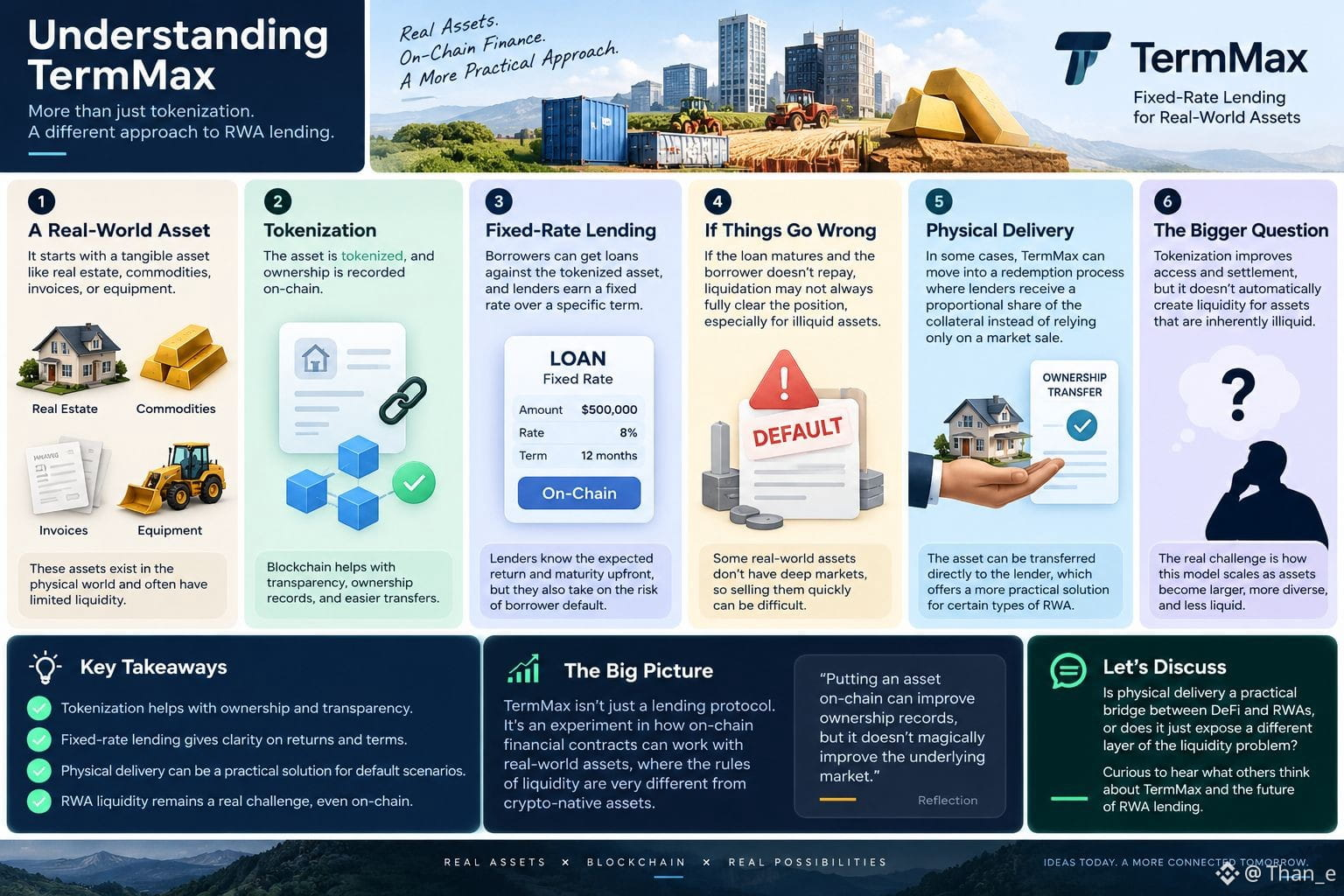
I started digging into TermMax because I wanted to understand what actually changes when real-world assets move on-chain.
At first, I thought the main challenge was simply tokenization. Put ownership on-chain, make the asset transferable, and the rest should get easier.
The more I read, the less convincing that felt.
One thing that stood out was the idea of physical delivery. If a fixed-term loan matures and the borrower doesn’t repay, the solution can’t always be “just sell the collateral.” Some real-world assets simply don’t have the kind of instant liquidity we’re used to with ETH or stablecoins.
That made me look at TermMax a little differently. The interesting part isn’t only the lending market itself, but what happens when an on-chain financial contract meets an asset whose liquidity still depends on the physical world.
I’m still trying to figure out how well that model works as collateral becomes larger and more diverse.
It feels like one of the less-discussed problems with RWA: putting an asset on-chain can improve ownership records and settlement, but it doesn’t magically improve the underlying market.
Curious what others think. Is physical delivery a practical bridge between DeFi and RWAs, or does it just expose a different layer of the liquidity problem?
$PEOPLE
{future}(PEOPLEUSDT)
$BNB
{future}(BNBUSDT)
$ONG
{future}(ONGUSDT)
#termmax @termmax
I started digging into TermMax because I wanted to understand what actually changes when real-world assets move on-chain.
At first, I thought the main challenge was simply tokenization. Put ownership on-chain, make the asset transferable, and the rest should get easier.
The more I read, the less convincing that felt.
One thing that stood out was the idea of physical delivery. If a fixed-term loan matures and the borrower doesn’t repay, the solution can’t always be “just sell the collateral.” Some real-world assets simply don’t have the kind of instant liquidity we’re used to with ETH or stablecoins.
That made me look at TermMax a little differently. The interesting part isn’t only the lending market itself, but what happens when an on-chain financial contract meets an asset whose liquidity still depends on the physical world.
I’m still trying to figure out how well that model works as collateral becomes larger and more diverse.
It feels like one of the less-discussed problems with RWA: putting an asset on-chain can improve ownership records and settlement, but it doesn’t magically improve the underlying market.
Curious what others think. Is physical delivery a practical bridge between DeFi and RWAs, or does it just expose a different layer of the liquidity problem?
$PEOPLE
$BNB
$ONG
#termmax @TermMax
At first, I thought the main challenge was simply tokenization. Put ownership on-chain, make the asset transferable, and the rest should get easier.
The more I read, the less convincing that felt.
One thing that stood out was the idea of physical delivery. If a fixed-term loan matures and the borrower doesn’t repay, the solution can’t always be “just sell the collateral.” Some real-world assets simply don’t have the kind of instant liquidity we’re used to with ETH or stablecoins.
That made me look at TermMax a little differently. The interesting part isn’t only the lending market itself, but what happens when an on-chain financial contract meets an asset whose liquidity still depends on the physical world.
I’m still trying to figure out how well that model works as collateral becomes larger and more diverse.
It feels like one of the less-discussed problems with RWA: putting an asset on-chain can improve ownership records and settlement, but it doesn’t magically improve the underlying market.
Curious what others think. Is physical delivery a practical bridge between DeFi and RWAs, or does it just expose a different layer of the liquidity problem?
$PEOPLE
$BNB
$ONG
#termmax @TermMax
4
4
240
·
--
Bullish
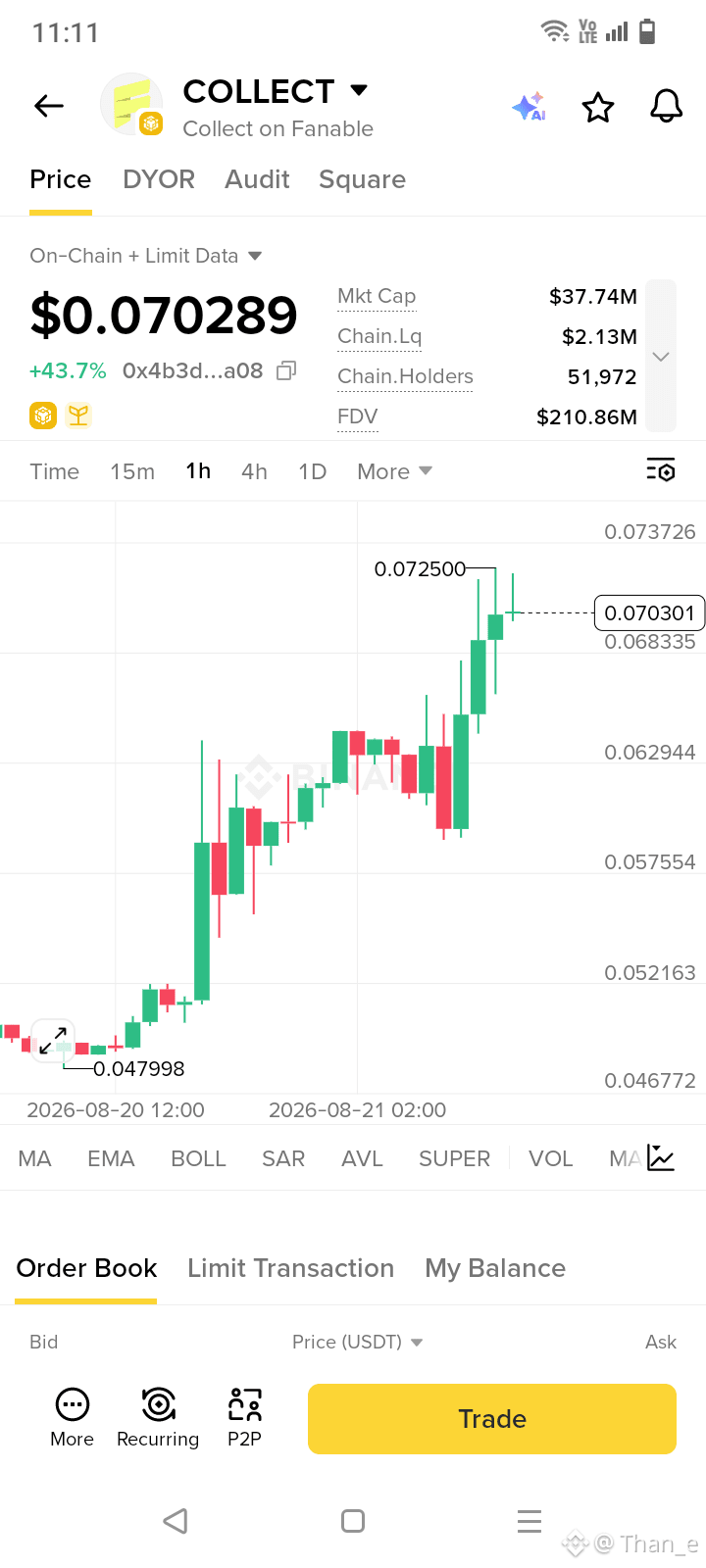
$COLLECT — BULLISH SIGNAL
📈 Trend: Bullish
💰 Current: ~$0.0703
🎯 Resistance: $0.0725
🟢 Support: $0.0683
🟢 Next Support: $0.0629
$COLLECT is holding a strong 1H uptrend after breaking through previous resistance.
A clean break and hold above $0.0725 could open the door for another continuation move.
Entry: $0.0685–$0.0705 on confirmation
Targets: $0.0725 → $0.0760 → $0.0800
Invalidation: Sustained loss of $0.0629
Momentum is strong, but chasing the vertical move carries higher risk. Confirmation matters.
Let's trade $COLLECT
Ad #OKXOrbitTopics
$COLLECT
{alpha}(560x4b3d30992f003c8167699735f5ab2831b2a087d3)
$COLLECT — BULLISH SIGNAL
📈 Trend: Bullish
💰 Current: ~$0.0703
🎯 Resistance: $0.0725
🟢 Support: $0.0683
🟢 Next Support: $0.0629
$COLLECT is holding a strong 1H uptrend after breaking through previous resistance.
A clean break and hold above $0.0725 could open the door for another continuation move.
Entry: $0.0685–$0.0705 on confirmation
Targets: $0.0725 → $0.0760 → $0.0800
Invalidation: Sustained loss of $0.0629
Momentum is strong, but chasing the vertical move carries higher risk. Confirmation matters.
Let's trade $COLLECT
Ad #OKXOrbitTopics
$COLLECT
📈 Trend: Bullish
💰 Current: ~$0.0703
🎯 Resistance: $0.0725
🟢 Support: $0.0683
🟢 Next Support: $0.0629
$COLLECT is holding a strong 1H uptrend after breaking through previous resistance.
A clean break and hold above $0.0725 could open the door for another continuation move.
Entry: $0.0685–$0.0705 on confirmation
Targets: $0.0725 → $0.0760 → $0.0800
Invalidation: Sustained loss of $0.0629
Momentum is strong, but chasing the vertical move carries higher risk. Confirmation matters.
Let's trade $COLLECT
Ad #OKXOrbitTopics
$COLLECT
183
·
--
Bullish
I went down a bit of a rabbit hole on Dusk today, and the part that caught my attention wasn’t the usual RWA narrative.
It was PlonKup, the proving system developed with Dusk involvement that combines PLONK with lookup arguments. Instead of forcing every operation into conventional arithmetic constraints, lookup tables can let a prover check whether values belong to a predefined set. That can reduce the complexity of certain ZK circuits.
What I find interesting is the trade-off. Dusk’s architecture is clearly built around privacy-preserving financial applications, but ZK proving is still computationally demanding. Their own documentation separates specialized prover nodes for this workload and lists 8 GB RAM as a minimum configuration.
So I’m not convinced the hard problem is simply “make ZK faster.” It feels more like a systems question: how much proving complexity can be pushed away from ordinary users without creating a new infrastructure bottleneck?
Dusk is also connecting this privacy layer to regulated securities, settlement, and RWA workflows, which makes that question more practical than theoretical.
No strong conclusion yet. I’m still trying to figure out where the real bottleneck sits. What are you seeing?
$BOME
{future}(BOMEUSDT)
$COLLECT
{alpha}(560x4b3d30992f003c8167699735f5ab2831b2a087d3)
#dusk $DUSK @Dusk_Foundation
{future}(DUSKUSDT)
I went down a bit of a rabbit hole on Dusk today, and the part that caught my attention wasn’t the usual RWA narrative.
It was PlonKup, the proving system developed with Dusk involvement that combines PLONK with lookup arguments. Instead of forcing every operation into conventional arithmetic constraints, lookup tables can let a prover check whether values belong to a predefined set. That can reduce the complexity of certain ZK circuits.
What I find interesting is the trade-off. Dusk’s architecture is clearly built around privacy-preserving financial applications, but ZK proving is still computationally demanding. Their own documentation separates specialized prover nodes for this workload and lists 8 GB RAM as a minimum configuration.
So I’m not convinced the hard problem is simply “make ZK faster.” It feels more like a systems question: how much proving complexity can be pushed away from ordinary users without creating a new infrastructure bottleneck?
Dusk is also connecting this privacy layer to regulated securities, settlement, and RWA workflows, which makes that question more practical than theoretical.
No strong conclusion yet. I’m still trying to figure out where the real bottleneck sits. What are you seeing?
$BOME
$COLLECT
#dusk $DUSK @Dusk
It was PlonKup, the proving system developed with Dusk involvement that combines PLONK with lookup arguments. Instead of forcing every operation into conventional arithmetic constraints, lookup tables can let a prover check whether values belong to a predefined set. That can reduce the complexity of certain ZK circuits.
What I find interesting is the trade-off. Dusk’s architecture is clearly built around privacy-preserving financial applications, but ZK proving is still computationally demanding. Their own documentation separates specialized prover nodes for this workload and lists 8 GB RAM as a minimum configuration.
So I’m not convinced the hard problem is simply “make ZK faster.” It feels more like a systems question: how much proving complexity can be pushed away from ordinary users without creating a new infrastructure bottleneck?
Dusk is also connecting this privacy layer to regulated securities, settlement, and RWA workflows, which makes that question more practical than theoretical.
No strong conclusion yet. I’m still trying to figure out where the real bottleneck sits. What are you seeing?
$BOME
$COLLECT
#dusk $DUSK @Dusk
The project is ready for RWA
100%
Too much theory
0%
It will take time
0%
Privacy is a base
0%
1 votes • Voting closed
1
1
260
Log in to explore more content
Join global crypto users on Binance Square
⚡️ Get latest and useful information about crypto.
💬 Trusted by the world’s largest crypto exchange.
👍 Discover real insights from verified creators.
Email / Phone number