
安叫兽_
50 Posts

安叫兽_
Report
Block User
兄弟们,用我的推荐码 手续费打8折 :CRYPTO1818
56 Following
1.0K+ Followers
34 Liked
Posts
All
Quotes
·
--
Bitcoin falls below $69,000: look at demand before price
Breaking a round-number threshold is striking, but the more important question is: after the selling pressure, who will step in to buy? According to a report by Decrypt writer Ryan S. Gladwin on November 13, 2026, Bitcoin briefly fell below $69,000 that day, with a 24-hour low of about $67,922. The report cited analysts who said that concentrated liquidations of leveraged long positions amplified the decline, while weakening demand from ETFs, stablecoins, and corporate allocations was a deeper source of pressure. These are data and assessments from the time of the report, and should not be treated as conclusions about subsequent market movements.
My observation is that liquidations explain why the drop was so rapid, while changes in demand affect whether the price can find sustained support. When watching this kind of volatility, don't focus only on whether the price recovers a particular level. Consider ETF fund flows, changes in stablecoin supply, and trading activity during rebounds together, and watch whether they improve consistently. A one-day rebound is not enough to prove that demand has recovered, just as a single day of outflows is not enough to conclude that the trend is set.
If you use futures, checking your leverage, available margin, and maximum tolerable loss is more practical than guessing the next candlestick. Markets change, and it's best not to wait until volatility picks up to review your risk exposure.
Bitcoin market outlook risk management BTC
Source: Decrypt / Ryan S. Gladwin, 2026-11-13T11:20:44+00:00 (link: https://decrypt.co/383214/bitcoin-drops-to-69k-on-concentrated-liquidation-and-weakening-demand).
This content is for informational purposes only and does not constitute investment advice. Investing involves risk; please exercise caution.
371
·
--
Bitcoin Falls to a 12-Week Low; Oversold Does Not Mean Bottomed Out
A price entering “oversold” territory doesn’t mean the market will immediately hand out rebound gains. The sharper the move, the more tempting it is to jump to conclusions.
According to a report by Decrypt reporter Jose Antonio Lanz, published on November 13, 2026, at 17:22 UTC (https://decrypt.co/383231/bitcoin-hits-12-week-low-fed-rate-fears-undo-summer-rally), Bitcoin fell to around $68,500 that day, its lowest level in about 12 weeks. This is the market price reported at the time, not a real-time quote.
The report also noted that U.S. core CPI rose 0.3% month over month in October, and that U.S. spot Bitcoin ETFs saw net outflows of about $1.49 billion over six consecutive trading days from November 5 to 12. Interest-rate futures reflect market pricing of rate hikes; they do not mean the Federal Reserve has already made a decision. ETF outflows alone also cannot fully explain this decline.
My observation: The daily RSI cited in the report fell to 25.4, but oversold conditions can persist. This reading alone cannot confirm that the market has bottomed.
Risk management can start with a simple calculation: divide the loss you can afford by the difference between your spot cost per coin and your planned exit price to estimate your position size, while setting aside room for fees and slippage. A stop-loss does not guarantee an execution price, and during sharp volatility, actual losses may exceed your budget. If you use leverage, also check your margin and liquidation price.
More important than guessing the low is knowing whether you can handle it if the market doesn’t follow the script.
#BTC #风险管理 $BTC
Source: Decrypt / Jose Antonio Lanz, 2026-11-13T17:22:54+00:00 (link: https://decrypt.co/383231/bitcoin-hits-12-week-low-fed-rate-fears-undo-summer-rally).
The content above is for reference only and does not constitute investment advice. Markets involve risk; invest with caution.
7
·
--
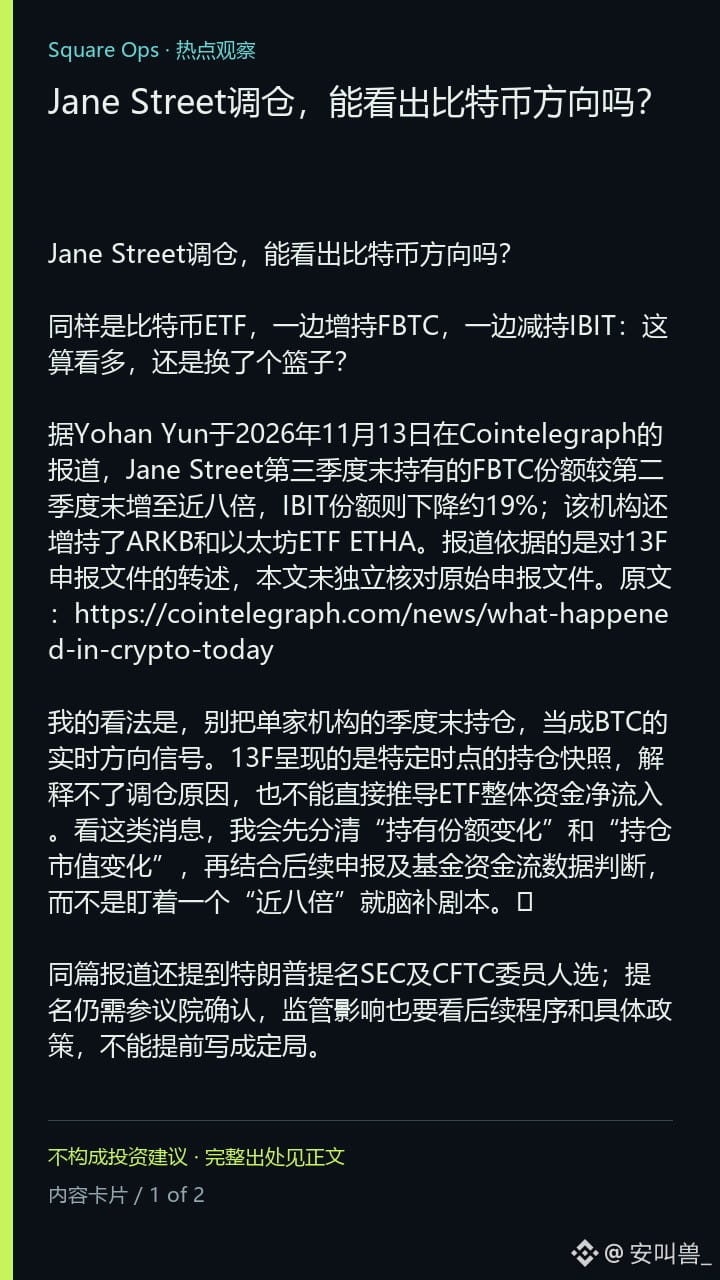
Jane Street rebalances its holdings—does this reveal where Bitcoin is headed?
They’re both Bitcoin ETFs: Jane Street increased its FBTC holdings while reducing its IBIT holdings. Is that bullish, or simply switching baskets?
According to a report by Yohan Yun in Cointelegraph on November 13, 2026, Jane Street’s FBTC shares at the end of the third quarter had risen to nearly eight times their level at the end of the second quarter, while its IBIT shares fell by about 19%. The firm also increased its holdings of ARKB and the Ethereum ETF ETHA. The report is based on an account of 13F filings; this article has not independently checked the original filings. Original article: https://cointelegraph.com/news/what-happened-in-crypto-today
My take: don’t treat one firm’s quarter-end holdings as a real-time signal of BTC’s direction. A 13F shows a snapshot of holdings at a specific point in time. It doesn’t explain why the firm rebalanced, and it can’t directly tell us the net inflows into ETFs overall. When I see news like this, I first distinguish between “changes in shares held” and “changes in the market value of holdings,” then look at subsequent filings and fund flow data before drawing conclusions—instead of seeing “nearly eight times” and imagining a whole story. 🧐
The same report also mentions Trump’s nominees for SEC and CFTC commissioner positions. Their nominations still require Senate confirmation, and the regulatory impact will depend on subsequent proceedings and specific policies; it’s too early to treat the outcome as settled.
Bitcoin ETF market watch risk awareness BTC
Source: Yohan Yun, 2026-11-13T13:49:44.838000+00:00 (link: https://cointelegraph.com/news/what-happened-in-crypto-today).
The content above is for informational purposes only and does not constitute investment advice. Markets involve risk; invest with caution.
9
·
--
AI deepfakes are redrawing the boundaries of crypto security
The most dangerous phishing attempt may not be hiding in an unfamiliar link; it could also be dressed up as a “video call with someone you know.” According to a November 12, 2026 report by Decrypt Staff, the U.S. Department of Justice said North Korean hackers had stolen more than $400 million in crypto assets over the past roughly 18 months using a social engineering technique called “FaceStealer.” The attackers used prerecorded webcam footage and AI-generated deepfake videos to impersonate trusted contacts, then tricked targets into installing malware under the pretense of fixing a “meeting glitch.” The report also said the DOJ had been authorized to seize or restrict more than $1.2 billion in funds related to the October 29 Binance theft, with some of the funds in the case already frozen. The FBI attributed the theft to TraderTraitor, while North Korea denied involvement. Original article: Decrypt Staff, “North Korea Stole $400 Million in Crypto Using Deepfake Video Calls, DOJ Says,” https://decrypt.co/383208/north-korea-stole-400-million-crypto-deepfake-video-calls
My observation is that the industry’s security focus is expanding beyond “Has the private key been leaked?” to include “Who are you actually talking to, what have you downloaded, and what have you authorized?” Teams should treat video identity verification as supporting evidence, not as the ultimate basis for trust. For actions involving wallets, code repositories, and production access, it is best to use multiple reviewers, hardware keys, least-privilege access, and independent callback verification. For individuals, never skip verification for a meeting software update, plugin installation, or wallet signing request just because the other person “looks familiar.” AI makes scams seem more real, but it doesn’t make the risks more manageable. This article is solely a personal observation based on publicly available reporting and does not constitute investment, trading, legal, or security advice. Crypto assets and related activities carry significant risks. Independently verify information and make prudent decisions based on your own circumstances. Do not rely on this article as a basis for buying, selling, or allocating assets.
#加密安全 #AI深伪 #币安生态 #Risk Prevention
Source: Decrypt / Decrypt Staff, 2026-11-12T22:06:03+00:00 (link: https://decrypt.co/383208/north-korea-stole-400-million-crypto-deepfake-video-calls).
The above content is for informational purposes only and does not constitute investment advice. Markets involve risk; invest with caution.
68
·
--
Bitcoin Reaches a Long-Term Moving Average: What Can Proof of Reserves Tell Us?
BTC has reached its 200-week moving average, and Binance has released another proof-of-reserves report. One concerns price levels; the other, asset disclosures. Looking at them together can easily lead people to mistakenly believe that “the risk is over.” In reality, they answer fundamentally different questions.
According to a report by Decrypt’s Tyler Warner dated November 13, 2026, BTC touched the area around its 200-week moving average during a downturn. Binance released an additional proof-of-reserves snapshot and said that assets affected by the earlier hack had been replenished. These statements come from the report and the exchange’s statements quoted in it; they do not constitute an independent audit of the assets on my part. Original article: https://decrypt.co/383222/morning-minute-crypto-plummets-as-jensen-huang-exits-nvidia
My observation is this: a long-term moving average can indicate where the market has reached, but it cannot guarantee that this is the bottom. A reserves snapshot can help us assess the disclosed asset coverage, but a single snapshot cannot answer every question about liabilities, liquidity, and security. It’s like a thermometer and a medical checkup report: both are useful, but neither can replace the other. 🙂 In the face of a sharp drop, I would first distinguish price risk from platform risk, then look at whether disclosures continue regularly and whether fund flows remain stable, rather than letting one piece of news make the decision for me.
Disclaimer: This article is for informational purposes only and does not constitute investment, trading, or financial advice. Market volatility and platform risks may both result in losses. Reported information and data may change; please refer to the original disclosures and independent verification results, make careful judgments based on your own circumstances, and assume responsibility for your own risks.
BTC Bitcoin proof of reserves risk management BTC
Sources: Decrypt / Tyler Warner, 2026-11-13T13:03:40+00:00 (link: https://decrypt.co/383222/morning-minute-crypto-plummets-as-jensen-huang-exits-nvidia).
The above is for reference only and does not constitute investment advice. Markets involve risks; invest with caution.
147
·
--
The BTC withdrawal network is reopening; that doesn’t mean all withdrawals have resumed
“BTC withdrawals are available” and “withdrawals for all assets are available” may sound only a few words apart, but in practice they involve several separate checks. According to a November 1, 2026 report by Cointelegraph’s Michael Millard, Binance said it had opened the Bitcoin network for BTC withdrawals in the first phase of a phased resumption, following an incident in which approximately $6.3 billion in assets was stolen. Other assets and networks will be restored gradually based on user demand and after stability and security checks are completed. Original report: https://cointelegraph.com/news/binance-says-phase-one-of-withdrawals-opens-after-63b-hack
My observation is that at least three things need to be distinguished when withdrawals resume: whether the selected asset can be withdrawn, whether the selected network is open, and whether the transaction can be processed smoothly after submission. An indication that the first is available does not mean the other two will not be delayed. When making a transfer, first check the status of the relevant asset and network through Binance’s official channels, then confirm that the recipient address matches the network. If there is congestion or a temporary failure, don’t keep switching networks out of urgency. During an incident, also beware of messages from people impersonating customer support and claiming they can “speed up withdrawals.”
This news is better used to update expectations about the process than to infer the direction of BTC prices. Service restoration is progress in the process; asset security and subsequent handling should still be guided by official announcements. This is a personal observation only and does not constitute investment advice.
Binance BTC withdrawals security risk management BTC
Reference: Michael Millard, 2026-11-01T09:38:18.486000+00:00 (link: https://cointelegraph.com/news/binance-says-phase-one-of-withdrawals-opens-after-63b-hack).
The above content is for reference only and does not constitute any investment advice. Markets involve risks; invest with caution.
204
·
--
Bullish
Two brothers rush to a new high
$币安人生 $GIGGLE
Two brothers rush to a new high
$币安人生 $GIGGLE
$币安人生 $GIGGLE
598
·
--
Investing in Midnight Network: The Privacy Goldmine of Cardano's Ecosystem in 2026 and the Explosive Potential of $NIGHTIn the Web3 era, privacy has become the core battleground of cryptocurrency, and the Midnight Network, as Cardano's privacy sidechain, is leading this revolution with zero-knowledge proof (ZKP) technology. This is not just a technical upgrade, but an excellent opportunity for investors to capture the trillion-dollar privacy market. Midnight employs a 'rational privacy' model, allowing users to selectively disclose data on the blockchain, ensuring compliance while protecting sensitive information.
With deep interoperability with Cardano, it seamlessly connects to the ADA ecosystem, allowing users to easily bridge assets and achieve cross-chain privacy transactions. This means that holding $NIGHT is not just an investment in a token but a gateway to the entire Cardano privacy infrastructure. Imagine this: traditional blockchains like Ethereum face risks of privacy leaks, while Midnight utilizes ZKP to build 'programmable privacy', supporting DeFi, NFTs, and enterprise applications. For instance, in supply chains, businesses can verify transaction authenticity without exposing trade secrets; in healthcare, patient data can be shared securely.
Investing in Midnight Network: The Privacy Goldmine of Cardano's Ecosystem in 2026 and the Explosive Potential of $NIGHT
In the Web3 era, privacy has become the core battleground of cryptocurrency, and the Midnight Network, as Cardano's privacy sidechain, is leading this revolution with zero-knowledge proof (ZKP) technology. This is not just a technical upgrade, but an excellent opportunity for investors to capture the trillion-dollar privacy market. Midnight employs a 'rational privacy' model, allowing users to selectively disclose data on the blockchain, ensuring compliance while protecting sensitive information.
With deep interoperability with Cardano, it seamlessly connects to the ADA ecosystem, allowing users to easily bridge assets and achieve cross-chain privacy transactions. This means that holding $NIGHT is not just an investment in a token but a gateway to the entire Cardano privacy infrastructure. Imagine this: traditional blockchains like Ethereum face risks of privacy leaks, while Midnight utilizes ZKP to build 'programmable privacy', supporting DeFi, NFTs, and enterprise applications. For instance, in supply chains, businesses can verify transaction authenticity without exposing trade secrets; in healthcare, patient data can be shared securely.
With deep interoperability with Cardano, it seamlessly connects to the ADA ecosystem, allowing users to easily bridge assets and achieve cross-chain privacy transactions. This means that holding $NIGHT is not just an investment in a token but a gateway to the entire Cardano privacy infrastructure. Imagine this: traditional blockchains like Ethereum face risks of privacy leaks, while Midnight utilizes ZKP to build 'programmable privacy', supporting DeFi, NFTs, and enterprise applications. For instance, in supply chains, businesses can verify transaction authenticity without exposing trade secrets; in healthcare, patient data can be shared securely.
9
·
--
#night $NIGHT @MidnightNetwork
In the wave of Web3, Midnight Network, as the privacy sidechain of the Cardano ecosystem, is reshaping the landscape of data protection with zero-knowledge proof technology. It offers a 'rational privacy' model, allowing users to selectively disclose information when executing smart contracts on-chain, avoiding the risks of full transparency. This is applicable not only to DeFi and NFTs but also extends to enterprise-level applications such as supply chain tracking and medical data sharing, ensuring compliance and privacy coexist. The $NIGHT token is the core fuel of Midnight, with a total fixed supply of 24 billion, currently circulating around 16.6 billion. Holders can generate DUST to pay for privacy transaction fees and participate in network governance. Through staking, $$NIGHT holders can also earn rewards, incentivizing ecosystem participation. The year 2026 is a crucial year for Midnight: the Kūkolu phase will launch the federal mainnet at the end of March, introducing node operators like Google Cloud to enhance stability. Subsequently, in the Mōhalu phase, DUST capacity exchange and staking mechanisms will be activated to promote network decentralization. The Hua phase aims to achieve cross-chain interoperability in Q3, connecting Cardano with other public chains.
In the wave of Web3, Midnight Network, as the privacy sidechain of the Cardano ecosystem, is reshaping the landscape of data protection with zero-knowledge proof technology. It offers a 'rational privacy' model, allowing users to selectively disclose information when executing smart contracts on-chain, avoiding the risks of full transparency. This is applicable not only to DeFi and NFTs but also extends to enterprise-level applications such as supply chain tracking and medical data sharing, ensuring compliance and privacy coexist. The $NIGHT token is the core fuel of Midnight, with a total fixed supply of 24 billion, currently circulating around 16.6 billion. Holders can generate DUST to pay for privacy transaction fees and participate in network governance. Through staking, $$NIGHT holders can also earn rewards, incentivizing ecosystem participation. The year 2026 is a crucial year for Midnight: the Kūkolu phase will launch the federal mainnet at the end of March, introducing node operators like Google Cloud to enhance stability. Subsequently, in the Mōhalu phase, DUST capacity exchange and staking mechanisms will be activated to promote network decentralization. The Hua phase aims to achieve cross-chain interoperability in Q3, connecting Cardano with other public chains.
4
·
--
The Web3 Era: AI Agents and Fabric Protocol Reshaping the Decentralized New EcosystemIn the era of Web3, AI agents are quietly rising to become the core players driving innovation in decentralized ecosystems. These intelligent entities are no longer just simple chatbots, but 'digital workers' with autonomous decision-making capabilities, seamlessly integrated into blockchain networks to execute complex tasks, optimize resource allocation, and even manage digital assets.
This transformation stems from the deep integration of AI and blockchain, shifting Web3 from a static protocol layer to a dynamic intelligent system. Imagine an AI agent that can monitor DeFi market fluctuations in real time, automatically execute arbitrage strategies, or bid in NFT auctions, all without human intervention. This autonomy not only enhances efficiency but also reduces the risk of human error, allowing ordinary users to easily participate in the complex games of Web3.
The Web3 Era: AI Agents and Fabric Protocol Reshaping the Decentralized New Ecosystem
In the era of Web3, AI agents are quietly rising to become the core players driving innovation in decentralized ecosystems. These intelligent entities are no longer just simple chatbots, but 'digital workers' with autonomous decision-making capabilities, seamlessly integrated into blockchain networks to execute complex tasks, optimize resource allocation, and even manage digital assets.
This transformation stems from the deep integration of AI and blockchain, shifting Web3 from a static protocol layer to a dynamic intelligent system. Imagine an AI agent that can monitor DeFi market fluctuations in real time, automatically execute arbitrage strategies, or bid in NFT auctions, all without human intervention. This autonomy not only enhances efficiency but also reduces the risk of human error, allowing ordinary users to easily participate in the complex games of Web3.
This transformation stems from the deep integration of AI and blockchain, shifting Web3 from a static protocol layer to a dynamic intelligent system. Imagine an AI agent that can monitor DeFi market fluctuations in real time, automatically execute arbitrage strategies, or bid in NFT auctions, all without human intervention. This autonomy not only enhances efficiency but also reduces the risk of human error, allowing ordinary users to easily participate in the complex games of Web3.
1
13
·
--
#robo $ROBO
In the Web3 era, AI agents are indeed expected to become a revolutionary new role, driving the decentralized ecosystem towards intelligent transformation. Imagine that these agents are not just tools, but autonomous entities capable of analyzing massive blockchain data in real-time, executing complex tasks, and even optimizing asset allocation without human intervention. This will fundamentally change the operational models of DeFi, NFTs, and DAOs, freeing users from cumbersome operations. Fabric Protocol, as a pioneer of computing networks, is paving the way for this. It provides an efficient, verifiable computing environment, ensuring the secure operation of AI agents on the blockchain, avoiding centralized risks. By integrating zero-knowledge proofs and distributed computing, Fabric enables agents to handle sensitive data while maintaining transparency and privacy. Here, the ROBO token plays a key role. As the native fuel of Fabric Protocol, ROBO is not only a value carrier but also the cornerstone of the agent economy. It incentivizes developers to build intelligent agent networks, supporting collaboration and resource allocation among agents. For example, a $ROBO-driven agent can automatically monitor market fluctuations, execute cross-chain transactions, or manage DAO funds, achieving true automated autonomy. As AI technology matures, ROBO will capture the core value of the agent economy, helping users seize Alpha opportunities in Web3. Looking to the future, the combination of AI agents and ROBO will give rise to a "agent-dominated" Web3 world, where users simply set goals, and agents can execute efficiently. This is not just a technological upgrade but an ecological reshaping, worthy of attention and investment from every Web3 participant.
@FabricFND
#robo $ROBO
In the Web3 era, AI agents are indeed expected to become a revolutionary new role, driving the decentralized ecosystem towards intelligent transformation. Imagine that these agents are not just tools, but autonomous entities capable of analyzing massive blockchain data in real-time, executing complex tasks, and even optimizing asset allocation without human intervention. This will fundamentally change the operational models of DeFi, NFTs, and DAOs, freeing users from cumbersome operations. Fabric Protocol, as a pioneer of computing networks, is paving the way for this. It provides an efficient, verifiable computing environment, ensuring the secure operation of AI agents on the blockchain, avoiding centralized risks. By integrating zero-knowledge proofs and distributed computing, Fabric enables agents to handle sensitive data while maintaining transparency and privacy. Here, the ROBO token plays a key role. As the native fuel of Fabric Protocol, ROBO is not only a value carrier but also the cornerstone of the agent economy. It incentivizes developers to build intelligent agent networks, supporting collaboration and resource allocation among agents. For example, a $ROBO -driven agent can automatically monitor market fluctuations, execute cross-chain transactions, or manage DAO funds, achieving true automated autonomy. As AI technology matures, ROBO will capture the core value of the agent economy, helping users seize Alpha opportunities in Web3. Looking to the future, the combination of AI agents and ROBO will give rise to a "agent-dominated" Web3 world, where users simply set goals, and agents can execute efficiently. This is not just a technological upgrade but an ecological reshaping, worthy of attention and investment from every Web3 participant.
@Fabric Foundation
1
19
·
--
roboI'm actually not surprised at all by the attitude many people have towards ROBO now. Just like ten years ago, no one would believe that Bitcoin could reach this point today; most people will forever only realize it in hindsight, and then slap their thighs saying how they missed out back then. I hold 300,000 ROBO tokens, and my stance is very clear: I won't sell a single one if it’s not above $0.1. It's not that I'm stubborn, but I truly understand how large the potential is for this track in the future.
The vast majority of people’s understanding of AI robots is still at a very shallow stage. In their eyes, robots are nothing more than little toys that sweep the floor, serve tea, or chat with people; they are merely a pastime for the wealthy. This cognitive gap is precisely the biggest opportunity. They fail to realize that once robots are connected to the Fabric protocol, their nature completely changes — robots are no longer toys, but real labor that can work continuously for 24 hours; they are the core productivity of the future digital and real worlds.
robo
I'm actually not surprised at all by the attitude many people have towards ROBO now. Just like ten years ago, no one would believe that Bitcoin could reach this point today; most people will forever only realize it in hindsight, and then slap their thighs saying how they missed out back then. I hold 300,000 ROBO tokens, and my stance is very clear: I won't sell a single one if it’s not above $0.1. It's not that I'm stubborn, but I truly understand how large the potential is for this track in the future.
The vast majority of people’s understanding of AI robots is still at a very shallow stage. In their eyes, robots are nothing more than little toys that sweep the floor, serve tea, or chat with people; they are merely a pastime for the wealthy. This cognitive gap is precisely the biggest opportunity. They fail to realize that once robots are connected to the Fabric protocol, their nature completely changes — robots are no longer toys, but real labor that can work continuously for 24 hours; they are the core productivity of the future digital and real worlds.
The vast majority of people’s understanding of AI robots is still at a very shallow stage. In their eyes, robots are nothing more than little toys that sweep the floor, serve tea, or chat with people; they are merely a pastime for the wealthy. This cognitive gap is precisely the biggest opportunity. They fail to realize that once robots are connected to the Fabric protocol, their nature completely changes — robots are no longer toys, but real labor that can work continuously for 24 hours; they are the core productivity of the future digital and real worlds.
111
·
--
#robo $ROBO
Don't look at $ROBO with old views; before it reaches 0.1 USD, I won't sell even half of it.
I hold 300,000 $ROBO, not as a gamble, but I am certain about the future.
Those who couldn't understand Bitcoin back in the day still can't grasp the AI robot track.
History always repeats itself: however you missed Bitcoin is how you will miss $ROBO.
The vast majority of people still perceive robots as just for cleaning, entertainment, or toys.
They have no idea that AI robots are no longer just for leisure; they are the core of the next generation of productivity.
Once they access the Fabric protocol, robots transform from tools into labor that operates 24/7.
But having capabilities is not enough; without constraints, it becomes a disaster.
No matter how strong or efficient a robotic arm is, without credit as a safety net, it poses the risk of going out of control at any time.
The Fabric Foundation directly places a digital credit restraint on robots.
The only proof for unlocking, operating, staking, and compensation is $ROBO.
Without staking $ROBO, robots cannot be employed, cannot work, and cannot generate value.
Every single $ROBO is a security deposit for the robot's operation, a cornerstone of trust.
When a massive number of robots globally must rely on the Fabric protocol for operation,
$ROBO is the hardest token and the most core resource in the robot economy.
There will always be skeptics who doubt it can reach 0.1 USD.
Because they can't distinguish:
Air coins rely on hype and storytelling, and once the story collapses, they go to zero;
$ROBO is supported by real scenarios, real demands, and real consumption.
After the Q3 mainnet goes live, robots connected to the Fabric network will continue to consume $ROBO.
The demand is growing, and the tokens are becoming scarcer,
Do you think the price will remain stagnant?
The gap in understanding is the greatest opportunity.
#ROBO
@FabricFND
#robo $ROBO
Don't look at $ROBO with old views; before it reaches 0.1 USD, I won't sell even half of it.
I hold 300,000 $ROBO , not as a gamble, but I am certain about the future.
Those who couldn't understand Bitcoin back in the day still can't grasp the AI robot track.
History always repeats itself: however you missed Bitcoin is how you will miss $ROBO .
The vast majority of people still perceive robots as just for cleaning, entertainment, or toys.
They have no idea that AI robots are no longer just for leisure; they are the core of the next generation of productivity.
Once they access the Fabric protocol, robots transform from tools into labor that operates 24/7.
But having capabilities is not enough; without constraints, it becomes a disaster.
No matter how strong or efficient a robotic arm is, without credit as a safety net, it poses the risk of going out of control at any time.
The Fabric Foundation directly places a digital credit restraint on robots.
The only proof for unlocking, operating, staking, and compensation is $ROBO .
Without staking $ROBO , robots cannot be employed, cannot work, and cannot generate value.
Every single $ROBO is a security deposit for the robot's operation, a cornerstone of trust.
When a massive number of robots globally must rely on the Fabric protocol for operation,
$ROBO is the hardest token and the most core resource in the robot economy.
There will always be skeptics who doubt it can reach 0.1 USD.
Because they can't distinguish:
Air coins rely on hype and storytelling, and once the story collapses, they go to zero;
$ROBO is supported by real scenarios, real demands, and real consumption.
After the Q3 mainnet goes live, robots connected to the Fabric network will continue to consume $ROBO .
The demand is growing, and the tokens are becoming scarcer,
Do you think the price will remain stagnant?
The gap in understanding is the greatest opportunity.
#ROBO
@Fabric Foundation
1
101
·
--

Article
$ROBO: AI Robots × Web3, a new player committed to building infrastructure.AI and robots are moving from concept to reality, but collaboration and settlement between different devices and systems have always been pain points in the industry.$ROBO The Fabric Protocol is addressing this real issue—using blockchain for robot identity, payment, and coordination.
It does not engage in empty narratives $ROBO: AI Robots × Web3, a new player committed to building infrastructure.
AI and robots are moving from concept to reality, but collaboration and settlement between different devices and systems have always been pain points in the industry.$ROBO The Fabric Protocol is addressing this real issue—using blockchain for robot identity, payment, and coordination.
$ROBO: AI Robots × Web3, a new player committed to building infrastructure.
AI and robots are moving from concept to reality, but collaboration and settlement between different devices and systems have always been pain points in the industry.$ROBO The Fabric Protocol is addressing this real issue—using blockchain for robot identity, payment, and coordination.
It does not engage in empty narratives $ROBO : AI Robots × Web3, a new player committed to building infrastructure.
AI and robots are moving from concept to reality, but collaboration and settlement between different devices and systems have always been pain points in the industry.$ROBO The Fabric Protocol is addressing this real issue—using blockchain for robot identity, payment, and coordination.
1
15
·
--
#robo $ROBO
ROBO has been quite lively recently, the Fabric Protocol project has directly surged onto several major exchanges.
First, let's talk about the price. In the past few days, the fluctuations have been significant. A few days ago, it surged to around 0.049, with a 30% increase in 24 hours, and the trading volume exploded to over a hundred million dollars, leading the market cap to break the hundred million mark. However, in the past two days, it has retraced a bit and is now fluctuating in the range of 0.039-0.043 (specifics depend on real-time market conditions, as crypto can change in an instant).
The major actions are related to the exchanges: Binance Alpha was the first to get involved, and later it went directly to Binance spot trading, bringing along Seed Label (which serves as a reminder of the high risks), the claim portal has also opened. Many people claimed during the airdrop wave from late February to mid-March, with some showing amounts ranging from $700 to $1000, and those who were luckier got even more.
The project itself is focused on creating a decentralized robotic economy, with Proof of Robotic Work and so on, backed by VCs like Pantera and Coinbase Ventures, and the team has a Stanford background, which sounds quite reliable. The community over at Binance Square is hosting creator activities and trading competitions, with prizes ranging from thousands to hundreds of thousands of dollars, and the exposure is quite intense.
However, in the past two days, the trading volume has decreased, and the price has also been shaky. Many people say there might be another squeeze in the short term, but there are also those who believe the correction is not over yet, wondering if the support can hold around 0.038-0.039. If the on-chain data from the robots really picks up, and the narrative continues, it could surge again.
Overall, we are currently in a typical hot speculation phase of AI + robotic themes. Those who FOMO in should be cautious, and those taking profits on the retracement shouldn't go all in. Anyway, this coin has been restless lately; if you are holding it, you might be checking the market every day 😂 Are you currently holding or just planning to research?
@FabricFND
#robo $ROBO
ROBO has been quite lively recently, the Fabric Protocol project has directly surged onto several major exchanges.
First, let's talk about the price. In the past few days, the fluctuations have been significant. A few days ago, it surged to around 0.049, with a 30% increase in 24 hours, and the trading volume exploded to over a hundred million dollars, leading the market cap to break the hundred million mark. However, in the past two days, it has retraced a bit and is now fluctuating in the range of 0.039-0.043 (specifics depend on real-time market conditions, as crypto can change in an instant).
The major actions are related to the exchanges: Binance Alpha was the first to get involved, and later it went directly to Binance spot trading, bringing along Seed Label (which serves as a reminder of the high risks), the claim portal has also opened. Many people claimed during the airdrop wave from late February to mid-March, with some showing amounts ranging from $700 to $1000, and those who were luckier got even more.
The project itself is focused on creating a decentralized robotic economy, with Proof of Robotic Work and so on, backed by VCs like Pantera and Coinbase Ventures, and the team has a Stanford background, which sounds quite reliable. The community over at Binance Square is hosting creator activities and trading competitions, with prizes ranging from thousands to hundreds of thousands of dollars, and the exposure is quite intense.
However, in the past two days, the trading volume has decreased, and the price has also been shaky. Many people say there might be another squeeze in the short term, but there are also those who believe the correction is not over yet, wondering if the support can hold around 0.038-0.039. If the on-chain data from the robots really picks up, and the narrative continues, it could surge again.
Overall, we are currently in a typical hot speculation phase of AI + robotic themes. Those who FOMO in should be cautious, and those taking profits on the retracement shouldn't go all in. Anyway, this coin has been restless lately; if you are holding it, you might be checking the market every day 😂 Are you currently holding or just planning to research?
@Fabric Foundation
1
112
·
--
Article
Believe in roboFabric Protocol, to put it simply, is about creating a world where 'robots are their own bosses.' It's not the chaotic robot revolution you see in sci-fi movies, but rather connecting real-world robots (like vacuuming, food delivery, factory arms, etc.) to the blockchain, giving them their own on-chain identity, wallet, ability to take orders, earn money, make payments, and collaborate with each other, all in a decentralized manner without relying on large company servers as intermediaries.
The core token is $ROBO, with a total supply of 1 billion, and currently, only about 220 million is circulating. Its uses are extremely practical:
Network fees: Every time the robot works, verifies identity, or transfers money, it burns $ROBO
Believe in robo
Fabric Protocol, to put it simply, is about creating a world where 'robots are their own bosses.' It's not the chaotic robot revolution you see in sci-fi movies, but rather connecting real-world robots (like vacuuming, food delivery, factory arms, etc.) to the blockchain, giving them their own on-chain identity, wallet, ability to take orders, earn money, make payments, and collaborate with each other, all in a decentralized manner without relying on large company servers as intermediaries.
The core token is $ROBO , with a total supply of 1 billion, and currently, only about 220 million is circulating. Its uses are extremely practical:
Network fees: Every time the robot works, verifies identity, or transfers money, it burns $ROBO
The core token is $ROBO , with a total supply of 1 billion, and currently, only about 220 million is circulating. Its uses are extremely practical:
Network fees: Every time the robot works, verifies identity, or transfers money, it burns $ROBO
41
·
--
#robo $ROBO
$ROBO has started the engine again!🤖🚀
Brothers, we were still oscillating at 0.04x last night, today we are taking off directly, +16% in 24h, the volume is bursting, is the era of robot economy really coming?
From the DePIN+AI+real-world robot narrative of Fabric Protocol, to now on-chain nodes, autonomous collaboration, and machine identities are all accelerating to fruition, this is not just a simple memecoin pump, this is a true infrastructure-level rise!
Circulation is only 2.2B, total supply is 10B, the unlocking rhythm is controllable.
The trading volume has exceeded 100 million dollars for several consecutive days, smart money is quietly making profits.
The community has gone from “conspiracy market” to “above expectations”, sentiment has completely reversed.
Now those who got on board are shouting:
“If I had known, I would have gone all in last night!”
“This is the last chance of the bear market, don’t miss it again!”
Don’t ask, just know that:
The robots are awakening, $ROBO is taking off.
Are you still waiting for Han?
@FabricFND
#robo $ROBO
$ROBO has started the engine again!🤖🚀
Brothers, we were still oscillating at 0.04x last night, today we are taking off directly, +16% in 24h, the volume is bursting, is the era of robot economy really coming?
From the DePIN+AI+real-world robot narrative of Fabric Protocol, to now on-chain nodes, autonomous collaboration, and machine identities are all accelerating to fruition, this is not just a simple memecoin pump, this is a true infrastructure-level rise!
Circulation is only 2.2B, total supply is 10B, the unlocking rhythm is controllable.
The trading volume has exceeded 100 million dollars for several consecutive days, smart money is quietly making profits.
The community has gone from “conspiracy market” to “above expectations”, sentiment has completely reversed.
Now those who got on board are shouting:
“If I had known, I would have gone all in last night!”
“This is the last chance of the bear market, don’t miss it again!”
Don’t ask, just know that:
The robots are awakening, $ROBO is taking off.
Are you still waiting for Han?
@Fabric Foundation
62
·
--
#robo $ROBO
I indeed did not misjudge you
After holding for so long
Finally started to pull up again
Hope Han can go up soon
@FabricFND
#robo $ROBO
I indeed did not misjudge you
After holding for so long
Finally started to pull up again
Hope Han can go up soon
@Fabric Foundation
I indeed did not misjudge you
After holding for so long
Finally started to pull up again
Hope Han can go up soon
@Fabric Foundation
1
156
·
--
Article
$ROBO: The Invisible Force Behind the AI Robot RevolutionRecently, I've been focused on projects related to AI and robotics because I believe this wave is as significant as the DeFi explosion years ago. Today, I want to talk about $ROBO , the token of the Fabric Protocol. To be honest, when I first encountered it, I thought it was a bit too sci-fi, but after digging deeper, I found that it might truly be a part of the future economy. It’s not the kind of coin that’s purely speculative, but rather one with real practical potential.
Let's first talk about what the Fabric Protocol does. It is a decentralized network specifically designed for general-purpose robots, helping them coordinate, govern, and evolve. In simple terms, it allows robots to learn and collaborate autonomously, and they can use $ROBO to settle service fees and such. Just think, in the future, robots will not only help you with chores but also team up to tackle significant tasks, like logistics, healthcare, or even space exploration. Fabric uses verifiable computation and agency infrastructure to enable seamless interaction between humans and machines. This project is promoted by the Fabric Foundation, a non-profit organization, backed by VC firms like Coinbase Ventures and Pantera Capital, which gives it a decent level of credibility.
$ROBO: The Invisible Force Behind the AI Robot Revolution
Recently, I've been focused on projects related to AI and robotics because I believe this wave is as significant as the DeFi explosion years ago. Today, I want to talk about $ROBO , the token of the Fabric Protocol. To be honest, when I first encountered it, I thought it was a bit too sci-fi, but after digging deeper, I found that it might truly be a part of the future economy. It’s not the kind of coin that’s purely speculative, but rather one with real practical potential.
Let's first talk about what the Fabric Protocol does. It is a decentralized network specifically designed for general-purpose robots, helping them coordinate, govern, and evolve. In simple terms, it allows robots to learn and collaborate autonomously, and they can use $ROBO to settle service fees and such. Just think, in the future, robots will not only help you with chores but also team up to tackle significant tasks, like logistics, healthcare, or even space exploration. Fabric uses verifiable computation and agency infrastructure to enable seamless interaction between humans and machines. This project is promoted by the Fabric Foundation, a non-profit organization, backed by VC firms like Coinbase Ventures and Pantera Capital, which gives it a decent level of credibility.
Let's first talk about what the Fabric Protocol does. It is a decentralized network specifically designed for general-purpose robots, helping them coordinate, govern, and evolve. In simple terms, it allows robots to learn and collaborate autonomously, and they can use $ROBO to settle service fees and such. Just think, in the future, robots will not only help you with chores but also team up to tackle significant tasks, like logistics, healthcare, or even space exploration. Fabric uses verifiable computation and agency infrastructure to enable seamless interaction between humans and machines. This project is promoted by the Fabric Foundation, a non-profit organization, backed by VC firms like Coinbase Ventures and Pantera Capital, which gives it a decent level of credibility.
44
·
--
#robo $ROBO
. Today I want to talk about the $ROBO token. It is not just some random meme coin; it is the core driving force behind the Fabric Protocol. The Fabric Protocol is a decentralized network backed by the non-profit organization Fabric Foundation, dedicated to the coordination, governance, and evolution of general-purpose robots. Sounds a bit sci-fi, right? But this thing is already in the works, and $ROBO is its fuel.
Let's talk about the background first. Imagine a future where robots are not just assembly line workers in factories but intelligent agents that can learn and collaborate autonomously. The Fabric Protocol is the platform that builds this ecosystem, using verifiable computing and agent-native infrastructure to seamlessly connect humans, developers, and machines. As a utility and governance token, $ROBO incentivizes participation: from voting decisions to resource allocation, it aligns interests. The total supply is capped at 10 billion tokens, with nearly 30% allocated to the community and ecosystem, which is quite fair and avoids the situation where founders take all the profit.
Why do I have faith in it? Recently, the market data is quite impressive—the price hovers around $0.04, with a 24-hour increase of over 8%, and a market cap close to $95 million. The circulation is 223 million, and the trading volume has also surpassed 100 million, indicating real money is flowing. It's not a project that just pumps and dumps, but one with actual use cases. Think about it, the AI and robotics industry is experiencing explosive growth, and $ROBO can get a slice of that pie. For example, developers can use it to train robotic models, and users can participate in governance by holding it, preventing centralized giants from monopolizing everything.
Of course, there are risks; the crypto market is highly volatile, who knows what tomorrow will bring? But if you, like me, believe that the robot revolution is imminent, $ROBO is definitely worth watching. It is not just an investment; it is a vote for the future. Check out the data on CoinMarketCap or CoinGecko, or go directly to their official website to dig into the white paper. Who knows, maybe the next big bull market will start right here.
@FabricFND
#robo $ROBO
. Today I want to talk about the $ROBO token. It is not just some random meme coin; it is the core driving force behind the Fabric Protocol. The Fabric Protocol is a decentralized network backed by the non-profit organization Fabric Foundation, dedicated to the coordination, governance, and evolution of general-purpose robots. Sounds a bit sci-fi, right? But this thing is already in the works, and $ROBO is its fuel.
Let's talk about the background first. Imagine a future where robots are not just assembly line workers in factories but intelligent agents that can learn and collaborate autonomously. The Fabric Protocol is the platform that builds this ecosystem, using verifiable computing and agent-native infrastructure to seamlessly connect humans, developers, and machines. As a utility and governance token, $ROBO incentivizes participation: from voting decisions to resource allocation, it aligns interests. The total supply is capped at 10 billion tokens, with nearly 30% allocated to the community and ecosystem, which is quite fair and avoids the situation where founders take all the profit.
Why do I have faith in it? Recently, the market data is quite impressive—the price hovers around $0.04, with a 24-hour increase of over 8%, and a market cap close to $95 million. The circulation is 223 million, and the trading volume has also surpassed 100 million, indicating real money is flowing. It's not a project that just pumps and dumps, but one with actual use cases. Think about it, the AI and robotics industry is experiencing explosive growth, and $ROBO can get a slice of that pie. For example, developers can use it to train robotic models, and users can participate in governance by holding it, preventing centralized giants from monopolizing everything.
Of course, there are risks; the crypto market is highly volatile, who knows what tomorrow will bring? But if you, like me, believe that the robot revolution is imminent, $ROBO is definitely worth watching. It is not just an investment; it is a vote for the future. Check out the data on CoinMarketCap or CoinGecko, or go directly to their official website to dig into the white paper. Who knows, maybe the next big bull market will start right here.
@Fabric Foundation
72
Log in to explore more content
Join global crypto users on Binance Square
⚡️ Get latest and useful information about crypto.
💬 Trusted by the world’s largest crypto exchange.
👍 Discover real insights from verified creators.
Email / Phone number
Trending Topics
WhoWillSucceedJensenHuangatNvidia?
42,077 views
594 Discussing
Nvidia Says No CEO Talks Underway as "Stand With Jensen" Petition Tops 77,900 Signatures
Binance News
·16 Likes
·20.4k views
WhatWillDriveCryptoandStocks’NextRebound?
359,433 views
2,558 Discussing
USPPIMissMayEaseBTCPressure
165,701 views
1,803 Discussing