

Shah G Web3
203 Posts

Shah G Web3
Report
Block User
Crypto and Binance enthusiast with a strong understanding of trading, market trends, and risk management. Passionate about digital assets, blockchain technology
35 Following
158 Followers
433 Liked
Posts
·
--
I keep seeing "Bitcoin-level security" thrown around for Babylon and finally sat down to actually check what that means mechanically. Turns out it means something a lot narrower than the phrase suggests.
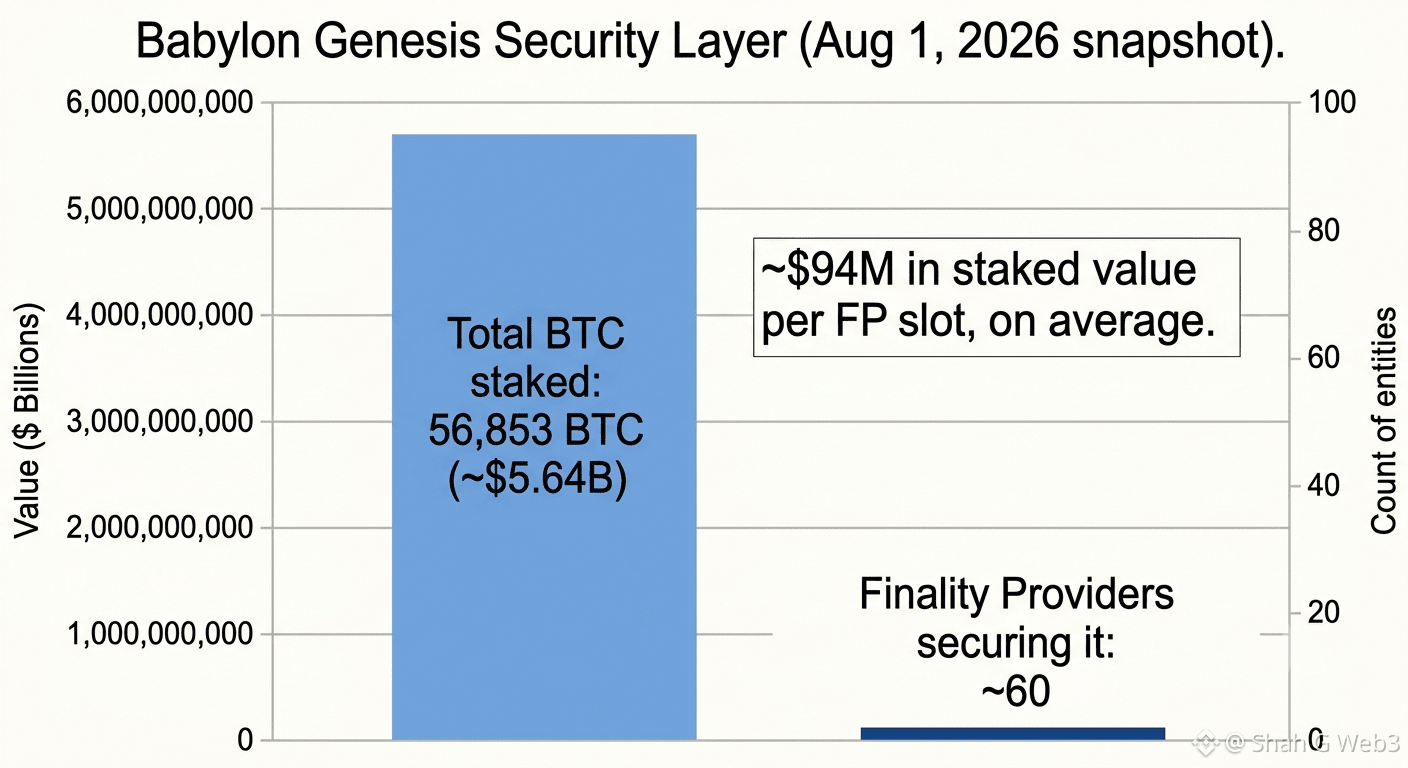
Per CoinMarketCap's Aug 1 snapshot, @babylonlabs_io 's protocol is holding 56,853 BTC staked, right around $5.64B. Big number. But Babylon's own docs are clear that Genesis security comes from a dual-quorum: 100 CometBFT validators plus only about 60 Bitcoin-staked Finality Providers doing the actual finality signing. That's it. Sixty entities carrying $5.64B of economic weight on their signatures.
Did the rough math and just sat there for a second — that's roughly $94M in staked BTC riding on each FP slot, on average. $BABY delegators pick a provider and trust them not to double-sign; if they do, EOTS slashing kicks in, sure. But "Bitcoin secures this" quietly becomes "sixty operators secure this, backed by Bitcoin's incentive design." Not the same sentence.
Not saying it's wrong, PoS security always concentrates somewhere. Just didn't expect the concentration point to be this specific, or this small, given the marketing language. Anyone tracked how those 60 slots are actually distributed?
#baby
I keep seeing "Bitcoin-level security" thrown around for Babylon and finally sat down to actually check what that means mechanically. Turns out it means something a lot narrower than the phrase suggests.
Per CoinMarketCap's Aug 1 snapshot, @BabylonLabs_io 's protocol is holding 56,853 BTC staked, right around $5.64B. Big number. But Babylon's own docs are clear that Genesis security comes from a dual-quorum: 100 CometBFT validators plus only about 60 Bitcoin-staked Finality Providers doing the actual finality signing. That's it. Sixty entities carrying $5.64B of economic weight on their signatures.
Did the rough math and just sat there for a second — that's roughly $94M in staked BTC riding on each FP slot, on average. $BABY delegators pick a provider and trust them not to double-sign; if they do, EOTS slashing kicks in, sure. But "Bitcoin secures this" quietly becomes "sixty operators secure this, backed by Bitcoin's incentive design." Not the same sentence.
Not saying it's wrong, PoS security always concentrates somewhere. Just didn't expect the concentration point to be this specific, or this small, given the marketing language. Anyone tracked how those 60 slots are actually distributed?
#baby
9
4
141
·
--
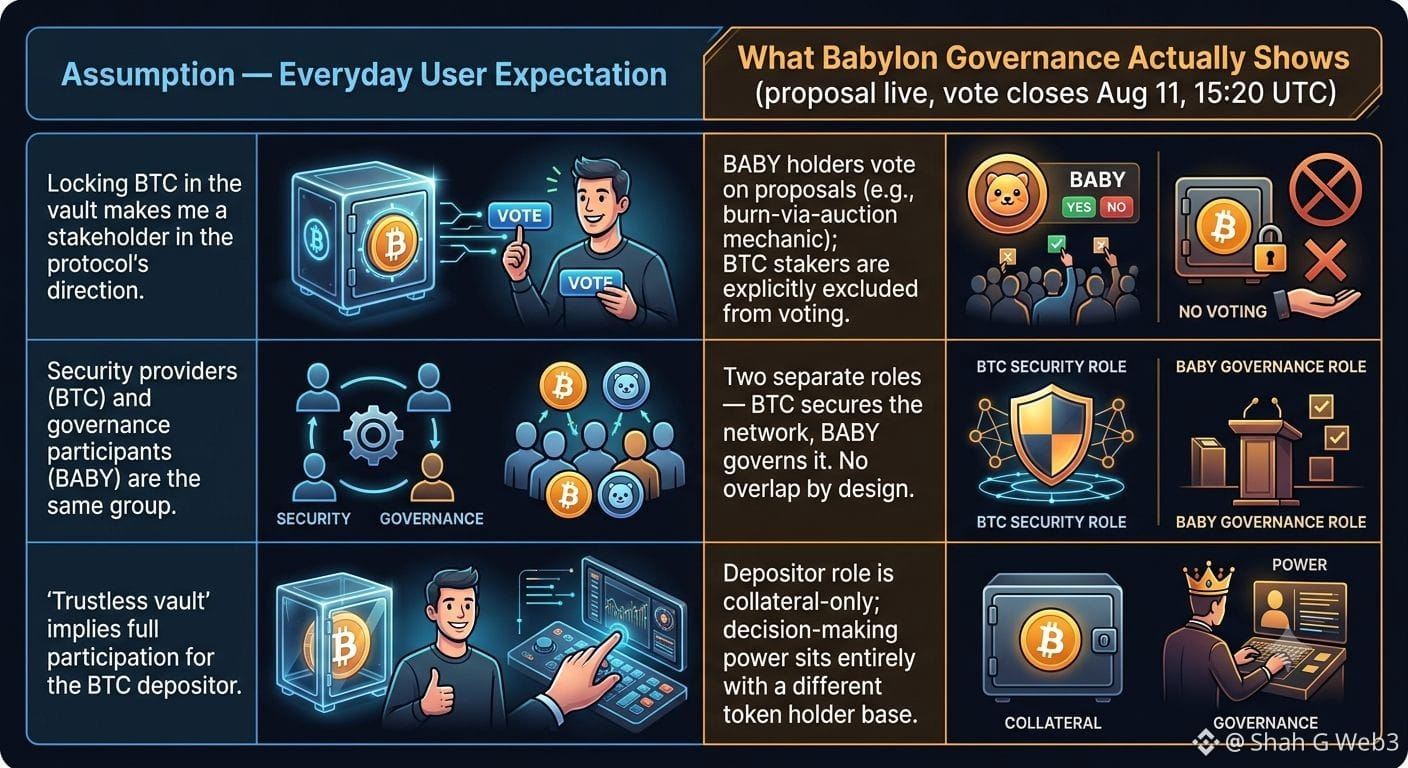
BABY governance proposal live right now — burn $BABY via auctions using BSN reward share, vote closes Monday Aug 11 at 15:20 UTC. I pulled it up expecting some technical parameter tweak. Instead it's a straight tokenomics decision: burn vs distribute to stakers, and BABY holders decide.
Here's the part that made me pause, though — my BTC, sitting locked in the vault, giving the whole system its security weight… doesn't get a vote. Only BABY stakers do. $BABY @babylonlabs_io
I locked BTC assuming "trustless vault" meant I'm a first-class participant in how this thing evolves. Turns out I'm the collateral, not the constituency. The token deciding my protocol's fee mechanics is a separate asset I may or may not even hold.
Went back and reread the proposal twice just to make sure I wasn't misreading who votes. Nope — BTC stakers explicitly sit outside the governance loop by design. Not a bug, just... a choice someone made early and never really advertised.
So for "everyday users" locking Bitcoin here — are we depositors, or are we just liquidity with no seat at the table?
#baby
BABY governance proposal live right now — burn $BABY via auctions using BSN reward share, vote closes Monday Aug 11 at 15:20 UTC. I pulled it up expecting some technical parameter tweak. Instead it's a straight tokenomics decision: burn vs distribute to stakers, and BABY holders decide.
Here's the part that made me pause, though — my BTC, sitting locked in the vault, giving the whole system its security weight… doesn't get a vote. Only BABY stakers do. $BABY @BabylonLabs_io
I locked BTC assuming "trustless vault" meant I'm a first-class participant in how this thing evolves. Turns out I'm the collateral, not the constituency. The token deciding my protocol's fee mechanics is a separate asset I may or may not even hold.
Went back and reread the proposal twice just to make sure I wasn't misreading who votes. Nope — BTC stakers explicitly sit outside the governance loop by design. Not a bug, just... a choice someone made early and never really advertised.
So for "everyday users" locking Bitcoin here — are we depositors, or are we just liquidity with no seat at the table?
#baby
6
4
110
·
--
I was digging into Babylon's ($BABY) BitVM3-based Trustless Bitcoin Vaults today, #Babylon @babylonlabs_io, and something small stopped me mid-scroll.
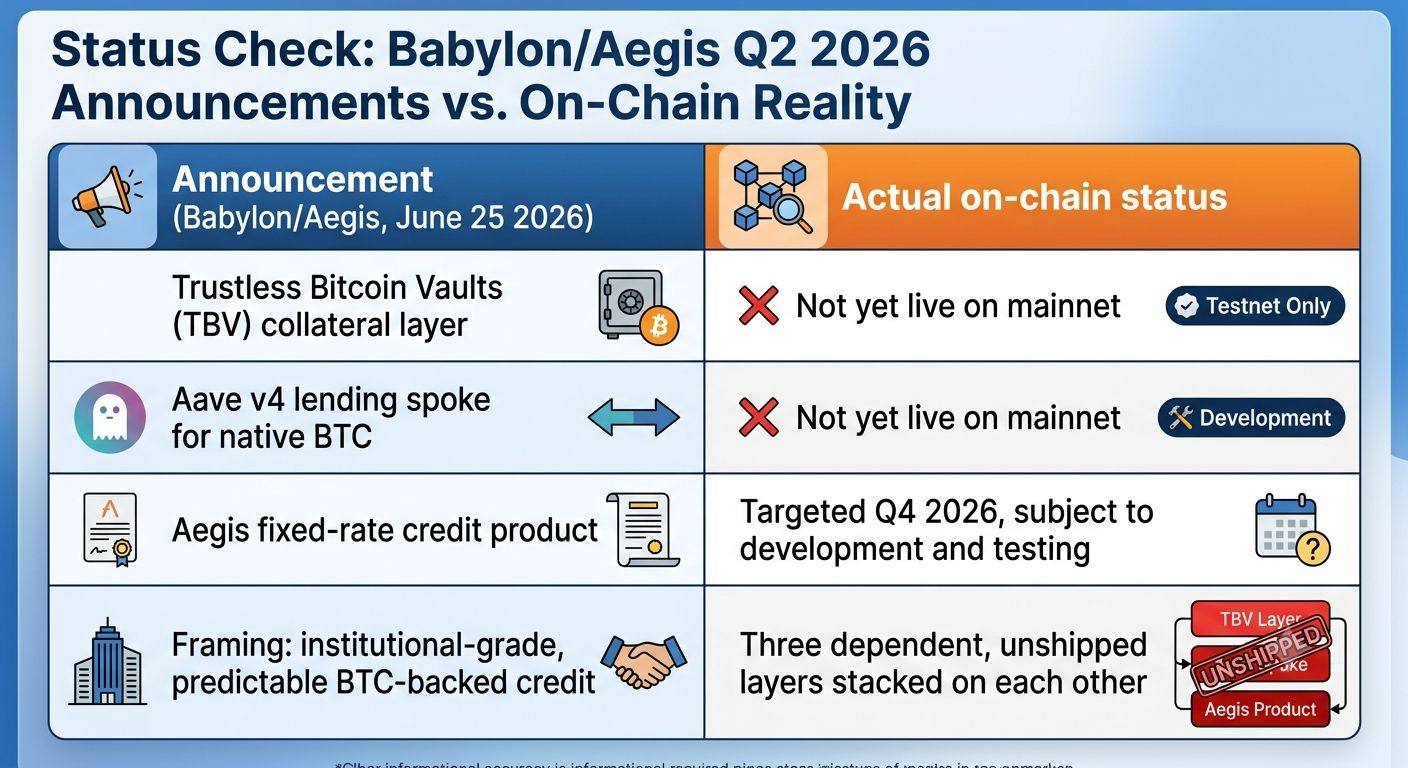
Babylon just announced its partnership with Aegis (June 25, 2026 post on their blog) — fixed-rate borrowing, built on top of Trustless Bitcoin Vaults plus an Aave v4 lending spoke. Sounds sturdy. Institutional-grade, predictable financing costs, the whole pitch. Then I actually traced the dependency chain… and hold up — none of the three layers are live yet. TBV mainnet isn't shipped. Aave v4 integration isn't shipped. Aegis's fixed-rate engine is "expected Q4 2026, subject to development and testing." So this is a partnership announcement for a product built on two other unfinished products.
That's the part that stuck with me. The marketing language is already fully formed — "self-custody," "no wrapping," "predictable capital costs" — months before any of the actual plumbing exists on mainnet. I caught myself almost writing this up as "Babylon expands into fixed-rate credit," which isn't wrong exactly, but it flattens the fact that right now this is three future promises stacked on each other, not one live product.
I don't think that makes it vaporware. Sequencing complex DeFi infra takes time. But I keep wondering — at what point does announcing the next layer before the current one ships start to matter for how people actually price the risk here?
@babylonlabs_io #baby $BABY
I was digging into Babylon's ($BABY ) BitVM3-based Trustless Bitcoin Vaults today, #Babylon @babylonlabs_io, and something small stopped me mid-scroll.
Babylon just announced its partnership with Aegis (June 25, 2026 post on their blog) — fixed-rate borrowing, built on top of Trustless Bitcoin Vaults plus an Aave v4 lending spoke. Sounds sturdy. Institutional-grade, predictable financing costs, the whole pitch. Then I actually traced the dependency chain… and hold up — none of the three layers are live yet. TBV mainnet isn't shipped. Aave v4 integration isn't shipped. Aegis's fixed-rate engine is "expected Q4 2026, subject to development and testing." So this is a partnership announcement for a product built on two other unfinished products.
That's the part that stuck with me. The marketing language is already fully formed — "self-custody," "no wrapping," "predictable capital costs" — months before any of the actual plumbing exists on mainnet. I caught myself almost writing this up as "Babylon expands into fixed-rate credit," which isn't wrong exactly, but it flattens the fact that right now this is three future promises stacked on each other, not one live product.
I don't think that makes it vaporware. Sequencing complex DeFi infra takes time. But I keep wondering — at what point does announcing the next layer before the current one ships start to matter for how people actually price the risk here?
@BabylonLabs_io #baby $BABY
18
9
392
·
--
Partly True
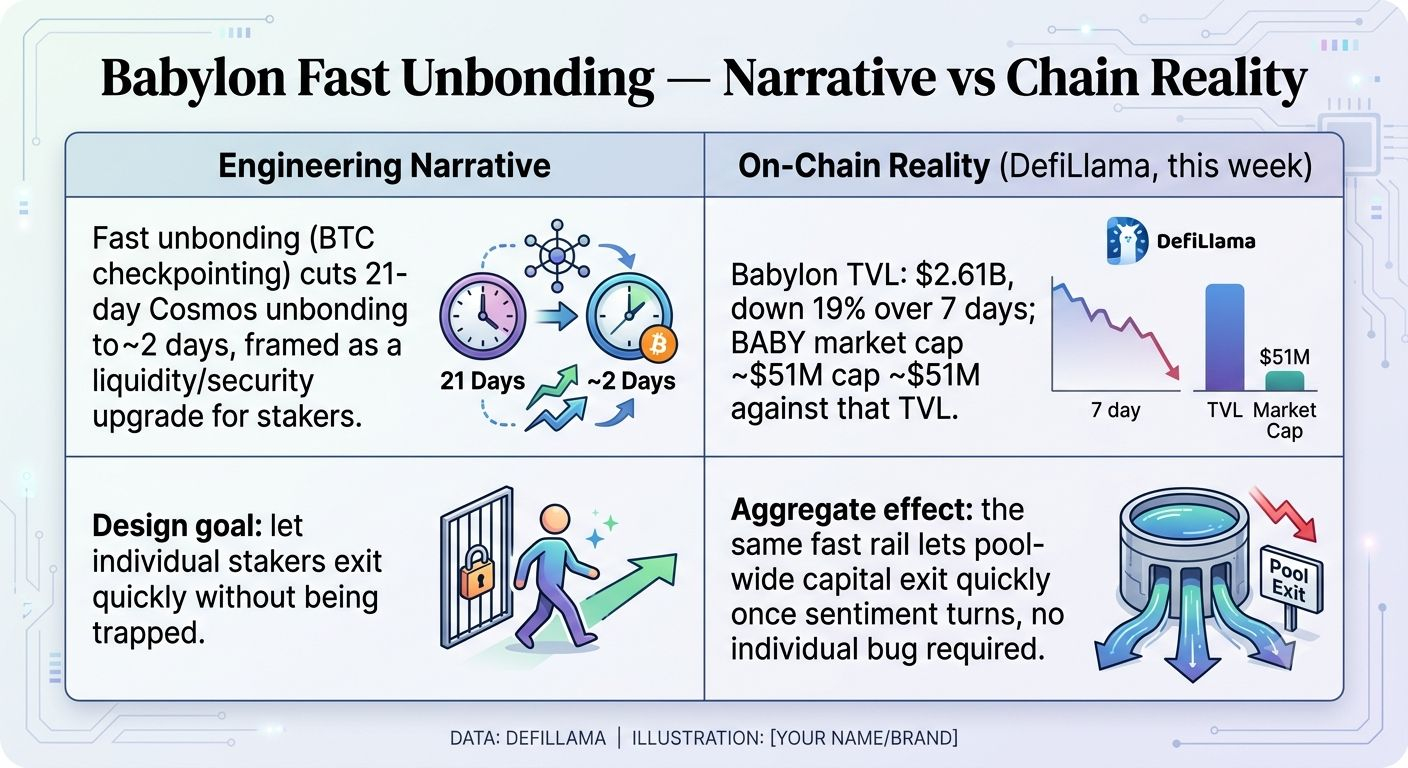
I lock my BTC into Babylon's vault and the pitch is trustless custody — cryptographic conditions instead of a company holding my keys. Fine. But what actually caught me this week wasn't the custody model, it was the exit mechanism. $BABY #Babylon @babylonlabs_io built "fast unbonding" — BTC checkpointing collapses the standard 21-day Cosmos unbonding window down to roughly 2 days. Genuinely nice engineering.
Except I pulled up DefiLlama today and TVL sits at $2.61B, down 19% in the last 7 days. Market cap's sitting around $51M against that. Hmm — the same rail engineered to let me exit fast when I need liquidity is the rail that lets a fifth of the pool leave in a week once sentiment shifts. Nobody built that as a bug. It's the feature working exactly as designed, just running in the direction the marketing rarely mentions.
Snack break, still staring at that unbonding number. Two days is impressive cryptography. It's also just a door that swings both ways, faster than most people clock until they watch it happen.
Is fast unbonding a security guarantee or a flight-risk mechanism — and does that answer just depend on which way the room's leaning that week?
$BABY #baby @babylonlabs_io
I lock my BTC into Babylon's vault and the pitch is trustless custody — cryptographic conditions instead of a company holding my keys. Fine. But what actually caught me this week wasn't the custody model, it was the exit mechanism. $BABY #Babylon @BabylonLabs_io built "fast unbonding" — BTC checkpointing collapses the standard 21-day Cosmos unbonding window down to roughly 2 days. Genuinely nice engineering.
Except I pulled up DefiLlama today and TVL sits at $2.61B, down 19% in the last 7 days. Market cap's sitting around $51M against that. Hmm — the same rail engineered to let me exit fast when I need liquidity is the rail that lets a fifth of the pool leave in a week once sentiment shifts. Nobody built that as a bug. It's the feature working exactly as designed, just running in the direction the marketing rarely mentions.
Snack break, still staring at that unbonding number. Two days is impressive cryptography. It's also just a door that swings both ways, faster than most people clock until they watch it happen.
Is fast unbonding a security guarantee or a flight-risk mechanism — and does that answer just depend on which way the room's leaning that week?
$BABY #baby @BabylonLabs_io
14
11
337
·
--
Verified
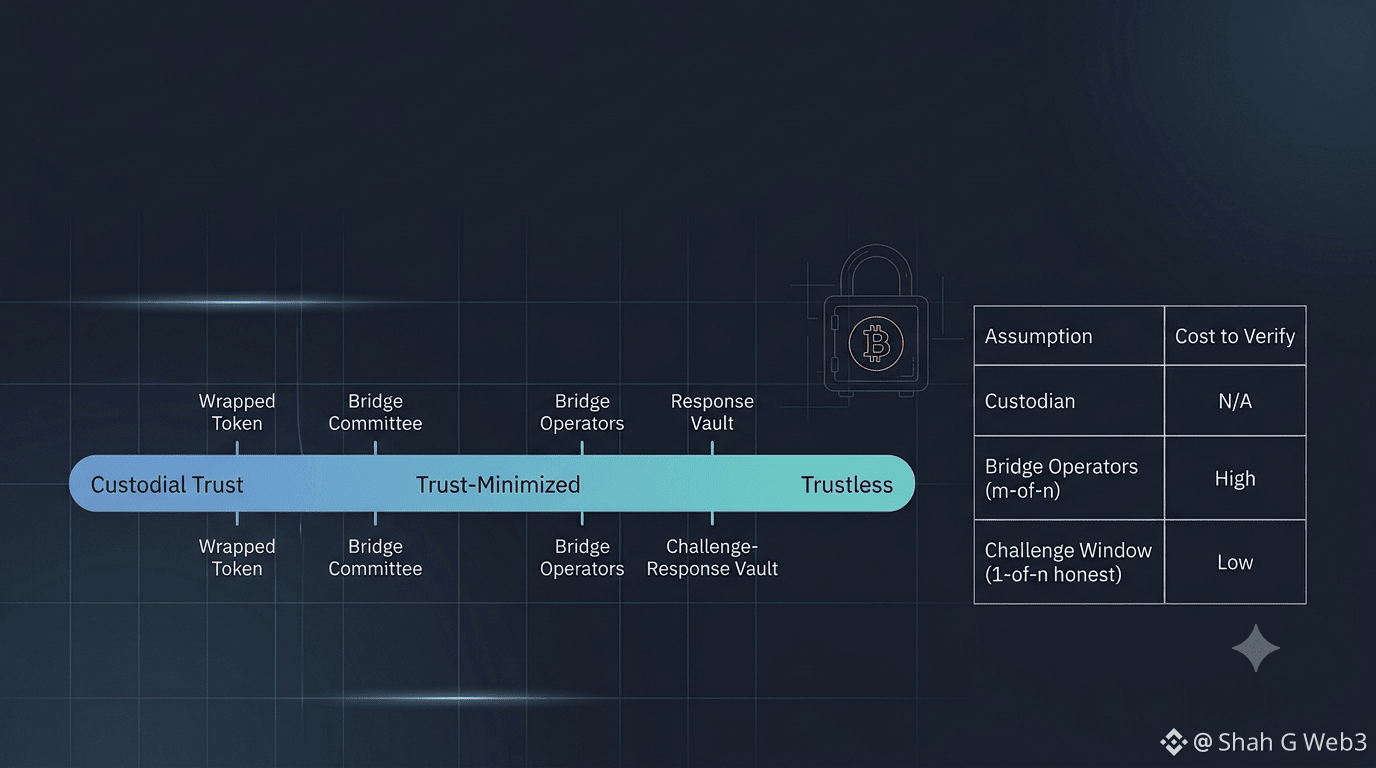
Babylon Labs closed out 2025 by borrowing USDC against native BTC on Ethereum mainnet through Morpho — not a testnet demo, a real loan against real Bitcoin, no wrapping. @babylonlabs_io calls the underlying mechanism a "trustless" vault, and the technical achievement is genuine: BitVM3 dropped on-chain proof costs from roughly $15,000 to under $100 for a challenged withdrawal, and to a few dollars in the standard case.
But look closer at what "trustless" actually rests on. The vault's security still depends on at least one honest party showing up to challenge a fraudulent withdrawal attempt within the challenge window. That's not zero trust — it's a minority-honesty assumption, the same family of model that BitVM bridges and DLC-based systems use, just with a smaller committee and cheaper enforcement.
Babylon's own comparison materials rank Trustless Bitcoin Vaults above wrapped BTC and above older bridge designs — a gradient, not a binary. WBTC requires trusting a custodian outright. Vaults require trusting that someone, somewhere, is watching and can afford to challenge.
Cheaper challenges make that assumption easier to satisfy. They don't remove it.
If security is really about who's economically incentivized to watch the chain, does that make Babylon's vaults meaningfully different from a permissionless bridge — or just a better-funded version of the same trust model?
Is Babylon's BitVM3 vault a genuinely new trust primitive, or a cheaper variant of the same minority-honesty assumption that bridges and DLCs already rely on?
$BABY #baby
Babylon Labs closed out 2025 by borrowing USDC against native BTC on Ethereum mainnet through Morpho — not a testnet demo, a real loan against real Bitcoin, no wrapping. @BabylonLabs_io calls the underlying mechanism a "trustless" vault, and the technical achievement is genuine: BitVM3 dropped on-chain proof costs from roughly $15,000 to under $100 for a challenged withdrawal, and to a few dollars in the standard case.
But look closer at what "trustless" actually rests on. The vault's security still depends on at least one honest party showing up to challenge a fraudulent withdrawal attempt within the challenge window. That's not zero trust — it's a minority-honesty assumption, the same family of model that BitVM bridges and DLC-based systems use, just with a smaller committee and cheaper enforcement.
Babylon's own comparison materials rank Trustless Bitcoin Vaults above wrapped BTC and above older bridge designs — a gradient, not a binary. WBTC requires trusting a custodian outright. Vaults require trusting that someone, somewhere, is watching and can afford to challenge.
Cheaper challenges make that assumption easier to satisfy. They don't remove it.
If security is really about who's economically incentivized to watch the chain, does that make Babylon's vaults meaningfully different from a permissionless bridge — or just a better-funded version of the same trust model?
Is Babylon's BitVM3 vault a genuinely new trust primitive, or a cheaper variant of the same minority-honesty assumption that bridges and DLCs already rely on?
$BABY #baby
10
12
941
·
--
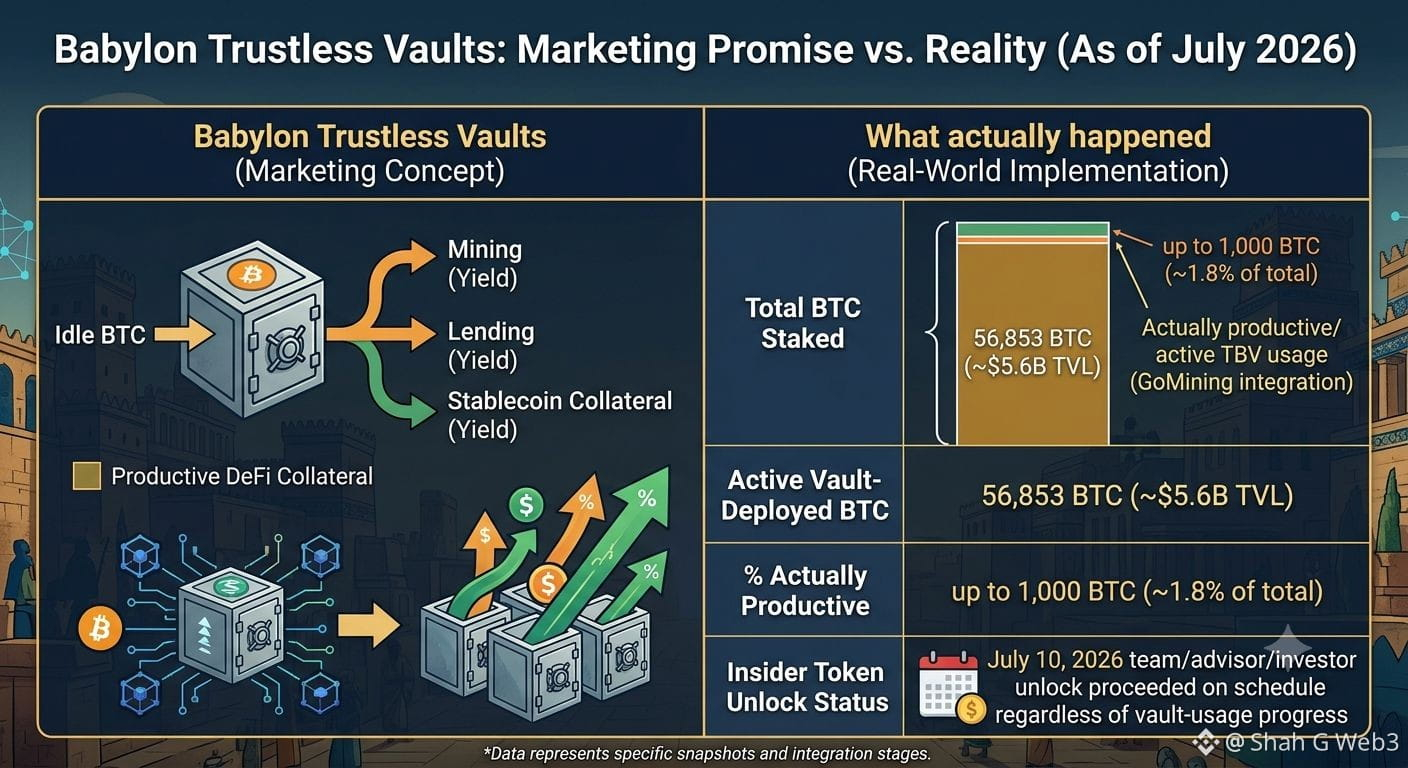
spent the afternoon digging into @babylonlabs_io Trustless Bitcoin Vaults again, and one number keeps nagging at me.
Babylon holds 56,853 BTC parked in its staking vaults — largest BTC staking protocol out there, no argument. But the actual "productive capital" piece, the GoMining TBV integration that's supposed to prove BTC can go work instead of just sit? Initial rollout caps at up to 1,000 BTC. That's roughly 1.8% of what's locked. Everything else is just... staked. Passive. Waiting on validator rewards.
Meanwhile the July 10 team/advisor/investor unlock cliff hit right on schedule per the vesting contract — tokens released to insiders regardless of how the vault-utility story is progressing. Kind of funny timing, ngo, hold up—not funny-haha, funny in the "the unlock clock doesn't care about your product roadmap" way.
I keep going back and forth on whether this matters. Maybe 1,000 BTC is just the cautious first cohort and it scales fast. Or maybe the "Bitcoin as productive collateral" narrative is mostly a on a paper right now, and the real behavior is 98% of BTC just sitting there earning baseline yield while the vault mechanics get their one showcase integration.
Does anyone actually track what percentage of TBV-eligible BTC moves into an active vault versus just staying parked?
$BABY #baby
spent the afternoon digging into @BabylonLabs_io Trustless Bitcoin Vaults again, and one number keeps nagging at me.
Babylon holds 56,853 BTC parked in its staking vaults — largest BTC staking protocol out there, no argument. But the actual "productive capital" piece, the GoMining TBV integration that's supposed to prove BTC can go work instead of just sit? Initial rollout caps at up to 1,000 BTC. That's roughly 1.8% of what's locked. Everything else is just... staked. Passive. Waiting on validator rewards.
Meanwhile the July 10 team/advisor/investor unlock cliff hit right on schedule per the vesting contract — tokens released to insiders regardless of how the vault-utility story is progressing. Kind of funny timing, ngo, hold up—not funny-haha, funny in the "the unlock clock doesn't care about your product roadmap" way.
I keep going back and forth on whether this matters. Maybe 1,000 BTC is just the cautious first cohort and it scales fast. Or maybe the "Bitcoin as productive collateral" narrative is mostly a on a paper right now, and the real behavior is 98% of BTC just sitting there earning baseline yield while the vault mechanics get their one showcase integration.
Does anyone actually track what percentage of TBV-eligible BTC moves into an active vault versus just staying parked?
$BABY #baby
9
9
122
·
--
Article
Newton Protocol: Moving Beyond Hype Toward Real AdoptionSpent the morning doing something unrelated — cleaning up a spreadsheet of my own trades from Q2, honestly boring work, the kind where your brain starts wandering. And somewhere in between rows I started thinking about all the "moving toward real adoption" language I keep seeing around AI-crypto projects lately. Newton Protocol specifically, since I've been circling it for weeks now.
So I opened their transparency report again, mostly to see what they're actually counting as adoption these days. Last time I skimmed it I didn't look closely at the metrics section. This time I did.
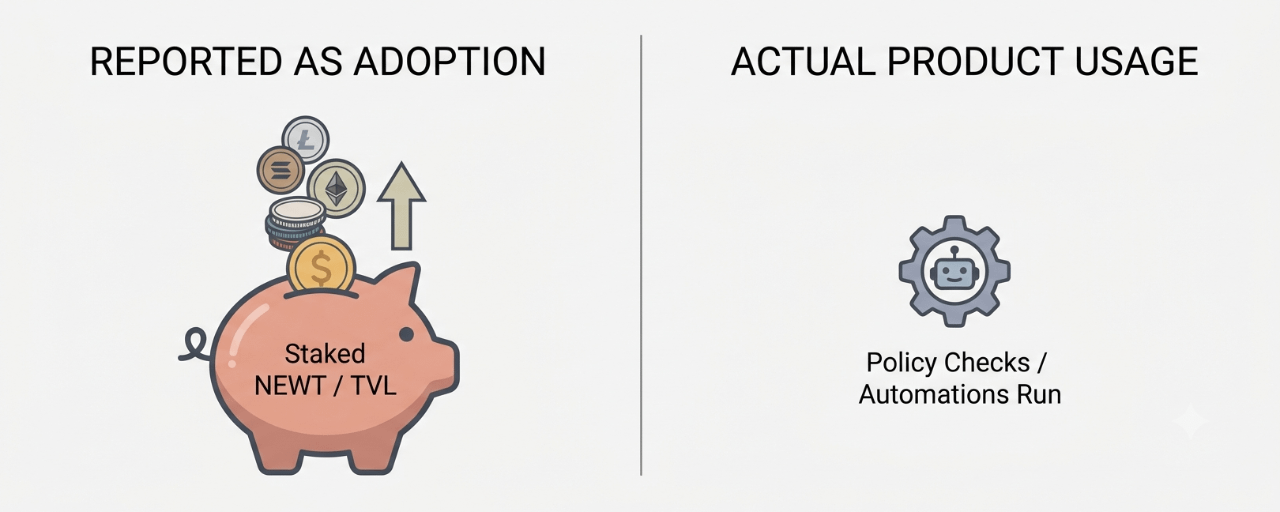
And here's the thing that got me — the adoption numbers they lead with are wallet connections, staked NEWT, and TVL-adjacent figures. Not agent executions. Not policy checks triggered. Not "X automations ran this week." The headline adoption metric is capital sitting in the system, not the system being used for what it's supposed to do.
I thought that was just me misreading it at first, so I went back and checked — is there anywhere they report actual automation volume, like number of policy evaluations processed on-chain? There's a technical explanation of how the AVS and policy engine works, sure, but the adoption-facing numbers are staking and deposit-shaped. Which, okay, staking is real, it's on-chain, it's verifiable. But staking isn't adoption of the automation product. Staking is people parking tokens for yield. Those are two completely different behaviors getting reported under one word.
This bugs me a little because "moving beyond hype toward real adoption" implies the next phase is usage-driven — people actually running agents, actually delegating tasks, actually needing the policy layer. But if the adoption metric being publicized is still deposit-based, then what's "beyond hype" here isn't the behavior, it's just the packaging. Same capital-seeking-yield pattern, described with more mature language.
I'm not fully convinced this is dishonest, to be clear — every early-stage protocol leans on TVL because it's the easiest number to show growth in, and usage metrics take longer to build up naturally. But it does mean when you read "adoption is growing," you should ask growing by what measure, because right now the measure and the product aren't quite the same thing.
This matters more for anyone using these adoption reports to time an entry, honestly, not just holders. If you're reading "adoption up" and picturing more agents doing more work, you're picturing something that isn't actually reflected in the number you're looking at. The gap only really shows up when yield incentives taper — that's when you find out whether the deposited capital was there for the product or just for the APR, and whether "adoption" holds once the reward rate stops doing the talking.
I caught myself almost writing "this proves the project is hollow" in my notes and had to walk that back — that's too strong, honestly. TEE/ZK infrastructure being built is real work, and the policy engine functions. It's specifically the adoption narrative that's ahead of the adoption metric, not the tech itself. Small distinction but it matters.
Anyway, went back to my spreadsheet after that, still not done reconciling Q2. Market's doing its usual afternoon nothing. I'll probably check Newton's next transparency report just to see if the metric definition changes, or if staking numbers keep getting called adoption either way.
@NewtonProtocol #Newt $NEWT
Newton Protocol: Moving Beyond Hype Toward Real Adoption
Spent the morning doing something unrelated — cleaning up a spreadsheet of my own trades from Q2, honestly boring work, the kind where your brain starts wandering. And somewhere in between rows I started thinking about all the "moving toward real adoption" language I keep seeing around AI-crypto projects lately. Newton Protocol specifically, since I've been circling it for weeks now.
So I opened their transparency report again, mostly to see what they're actually counting as adoption these days. Last time I skimmed it I didn't look closely at the metrics section. This time I did.
And here's the thing that got me — the adoption numbers they lead with are wallet connections, staked NEWT, and TVL-adjacent figures. Not agent executions. Not policy checks triggered. Not "X automations ran this week." The headline adoption metric is capital sitting in the system, not the system being used for what it's supposed to do.
I thought that was just me misreading it at first, so I went back and checked — is there anywhere they report actual automation volume, like number of policy evaluations processed on-chain? There's a technical explanation of how the AVS and policy engine works, sure, but the adoption-facing numbers are staking and deposit-shaped. Which, okay, staking is real, it's on-chain, it's verifiable. But staking isn't adoption of the automation product. Staking is people parking tokens for yield. Those are two completely different behaviors getting reported under one word.
This bugs me a little because "moving beyond hype toward real adoption" implies the next phase is usage-driven — people actually running agents, actually delegating tasks, actually needing the policy layer. But if the adoption metric being publicized is still deposit-based, then what's "beyond hype" here isn't the behavior, it's just the packaging. Same capital-seeking-yield pattern, described with more mature language.
I'm not fully convinced this is dishonest, to be clear — every early-stage protocol leans on TVL because it's the easiest number to show growth in, and usage metrics take longer to build up naturally. But it does mean when you read "adoption is growing," you should ask growing by what measure, because right now the measure and the product aren't quite the same thing.
This matters more for anyone using these adoption reports to time an entry, honestly, not just holders. If you're reading "adoption up" and picturing more agents doing more work, you're picturing something that isn't actually reflected in the number you're looking at. The gap only really shows up when yield incentives taper — that's when you find out whether the deposited capital was there for the product or just for the APR, and whether "adoption" holds once the reward rate stops doing the talking.
I caught myself almost writing "this proves the project is hollow" in my notes and had to walk that back — that's too strong, honestly. TEE/ZK infrastructure being built is real work, and the policy engine functions. It's specifically the adoption narrative that's ahead of the adoption metric, not the tech itself. Small distinction but it matters.
Anyway, went back to my spreadsheet after that, still not done reconciling Q2. Market's doing its usual afternoon nothing. I'll probably check Newton's next transparency report just to see if the metric definition changes, or if staking numbers keep getting called adoption either way.
@NewtonProtocol #Newt $NEWT
8
6
92
·
--
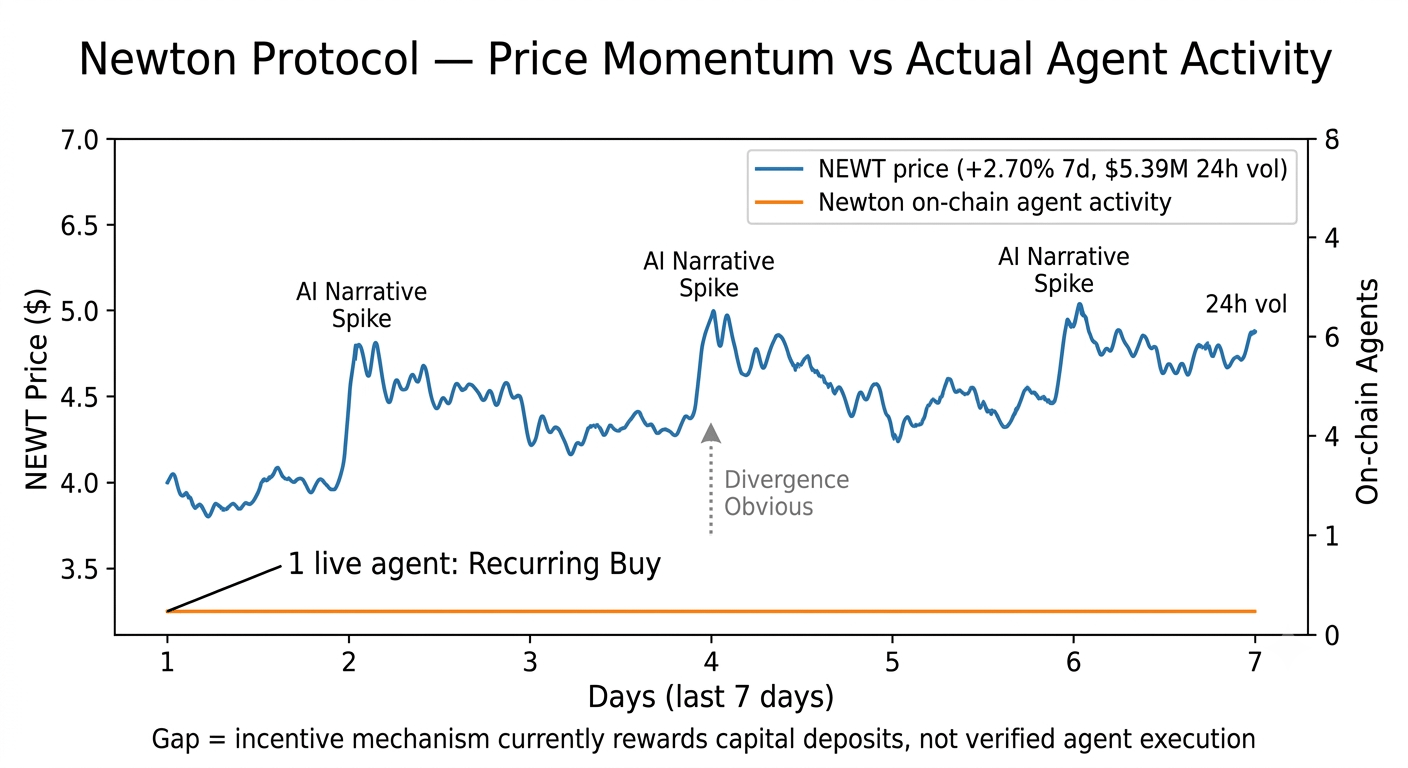
Newton Protocol's $NEWT up 2.70% over 7 days, sitting near $0.04953, on $5.39M in 24h volume… and I keep noticing the price moves harder on AI-narrative days than on actual protocol days.
So today I went back through the last week of activity instead of the chart. Nothing dramatic on-chain — no new agents, no fresh contract deploys, just the usual policy-check traffic. But the token still caught a bid whenever "AI agents on-chain" trended somewhere unrelated to Newton itself. That's the part that made me pause. The price isn't really tracking Newton's own usage curve, it's tracking sentiment around a category Newton happens to sit in.
Hmm — I actually double-checked this because I assumed I was reading too much into it. Went and confirmed there's still only the one live agent (Recurring Buy), same as last week. No change in on-chain agent count, yet the market cap moved like something shipped.
Kind of an odd thing to sit with. The token is priced partly on a sector narrative it doesn't fully control, which means when AI-crypto mood cools, Newton could get dragged down even if its own roadmap is progressing fine — and vice versa on the way up.
Not sure how you separate "project momentum" from "category momentum" here yet. Still chewing on that one.
@NewtonProtocol #Newt $NEWT
1
2
129
·
--

Article
Newton Protocol: The Race to Build the Autonomous InternetSpent the morning half-watching a stream about ETH restaking yields — one of those "3 to 6% extra yield, minimal effort" pitches — and honestly wasn't planning to connect it to anything. Then later I opened up Newton Protocol's docs again, out of curiosity more than anything, because the "autonomous internet" framing kept showing up in my feed and I wanted to see what was actually under it.
And that restaking video kind of followed me into it, which is annoying because now I can't unsee the overlap.
Newton's whole pitch is that it's building the trust layer for an internet where agents and vaults transact on their own, policies enforced automatically, no humans babysitting every transaction. Sounds autonomous. Sounds self-contained. So I went looking for what actually secures that enforcement layer, expecting some native mechanism specific to Newton.
It's not native. The operator network that evaluates policies and signs off on transactions is secured through EigenLayer restaking. Meaning the actual economic weight behind "this transaction was checked correctly" isn't coming from NEWT holders or Newton-specific stakers — it's coming from restaked ETH, delegated by people who are, at the end of the day, chasing yield across dozens of AVSs at once.
I thought that was just a technical footnote at first. Like, fine, it's built on EigenLayer, lots of things are, restaking is the whole "reuse Ethereum's security" model, that's kind of the point.
But here's the part that actually bothers me once I sat with it. Restaked ETH doesn't belong to Newton. It's rented. Restakers choose which operators to delegate to and which AVSs to support, and that decision is driven by where the yield and the risk-adjusted returns look best — not by loyalty to any one authorization layer. EigenLayer alone is sitting on something like 94% of restaking market share right now, so there's also just... concentration risk sitting underneath everything built on top of it. If restaker interest rotates toward whatever AVS is paying better that quarter, or if a slashing event anywhere in the restaking stack spooks capital, the security backing Newton's enforcement isn't something Newton controls. It's downstream of decisions being made by people who've never heard of Newton and don't need to care about it.
So the "autonomous internet" bit stops feeling quite right to me. An autonomous system, in my head, is one that doesn't depend on an external, mood-dependent capital allocation decision to keep functioning. What Newton's actually built is a policy enforcement layer whose trust is borrowed, week to week, from a restaking market that's still mostly running on incentives and points rather than durable AVS revenue — at least based on what I'm reading about the sector broadly. That's not nothing, but it's also not "autonomous," it's more like autonomous-if-the-landlord-keeps-renewing-the-lease.
I keep going back and forth on whether this is actually a real risk or just me being paranoid about a security model that, in fairness, has held up fine so far — EigenLayer's base contracts reportedly stayed intact even during stress events elsewhere in the restaking stack. Maybe borrowed security that's survived real stress is just... good infrastructure design, and I'm overthinking the "autonomous" word because marketing language is always a little aspirational.
Where I think this actually matters is for anyone treating a Newton-secured vault or agent as fully self-sufficient risk-wise. The policy logic might be airtight, the curator might be reasonable, but the enforcement guarantee underneath all of it is only as stable as restaker incentives happen to be that month, and that's a layer most people aren't even checking.
Anyway. Going back to actually looking at the charts now, which are somehow more boring than this was.
@NewtonProtocol #Newt $NEWT
Newton Protocol: The Race to Build the Autonomous Internet
Spent the morning half-watching a stream about ETH restaking yields — one of those "3 to 6% extra yield, minimal effort" pitches — and honestly wasn't planning to connect it to anything. Then later I opened up Newton Protocol's docs again, out of curiosity more than anything, because the "autonomous internet" framing kept showing up in my feed and I wanted to see what was actually under it.
And that restaking video kind of followed me into it, which is annoying because now I can't unsee the overlap.
Newton's whole pitch is that it's building the trust layer for an internet where agents and vaults transact on their own, policies enforced automatically, no humans babysitting every transaction. Sounds autonomous. Sounds self-contained. So I went looking for what actually secures that enforcement layer, expecting some native mechanism specific to Newton.
It's not native. The operator network that evaluates policies and signs off on transactions is secured through EigenLayer restaking. Meaning the actual economic weight behind "this transaction was checked correctly" isn't coming from NEWT holders or Newton-specific stakers — it's coming from restaked ETH, delegated by people who are, at the end of the day, chasing yield across dozens of AVSs at once.
I thought that was just a technical footnote at first. Like, fine, it's built on EigenLayer, lots of things are, restaking is the whole "reuse Ethereum's security" model, that's kind of the point.
But here's the part that actually bothers me once I sat with it. Restaked ETH doesn't belong to Newton. It's rented. Restakers choose which operators to delegate to and which AVSs to support, and that decision is driven by where the yield and the risk-adjusted returns look best — not by loyalty to any one authorization layer. EigenLayer alone is sitting on something like 94% of restaking market share right now, so there's also just... concentration risk sitting underneath everything built on top of it. If restaker interest rotates toward whatever AVS is paying better that quarter, or if a slashing event anywhere in the restaking stack spooks capital, the security backing Newton's enforcement isn't something Newton controls. It's downstream of decisions being made by people who've never heard of Newton and don't need to care about it.
So the "autonomous internet" bit stops feeling quite right to me. An autonomous system, in my head, is one that doesn't depend on an external, mood-dependent capital allocation decision to keep functioning. What Newton's actually built is a policy enforcement layer whose trust is borrowed, week to week, from a restaking market that's still mostly running on incentives and points rather than durable AVS revenue — at least based on what I'm reading about the sector broadly. That's not nothing, but it's also not "autonomous," it's more like autonomous-if-the-landlord-keeps-renewing-the-lease.
I keep going back and forth on whether this is actually a real risk or just me being paranoid about a security model that, in fairness, has held up fine so far — EigenLayer's base contracts reportedly stayed intact even during stress events elsewhere in the restaking stack. Maybe borrowed security that's survived real stress is just... good infrastructure design, and I'm overthinking the "autonomous" word because marketing language is always a little aspirational.
Where I think this actually matters is for anyone treating a Newton-secured vault or agent as fully self-sufficient risk-wise. The policy logic might be airtight, the curator might be reasonable, but the enforcement guarantee underneath all of it is only as stable as restaker incentives happen to be that month, and that's a layer most people aren't even checking.
Anyway. Going back to actually looking at the charts now, which are somehow more boring than this was.
@NewtonProtocol #Newt $NEWT
7
2
158
·
--
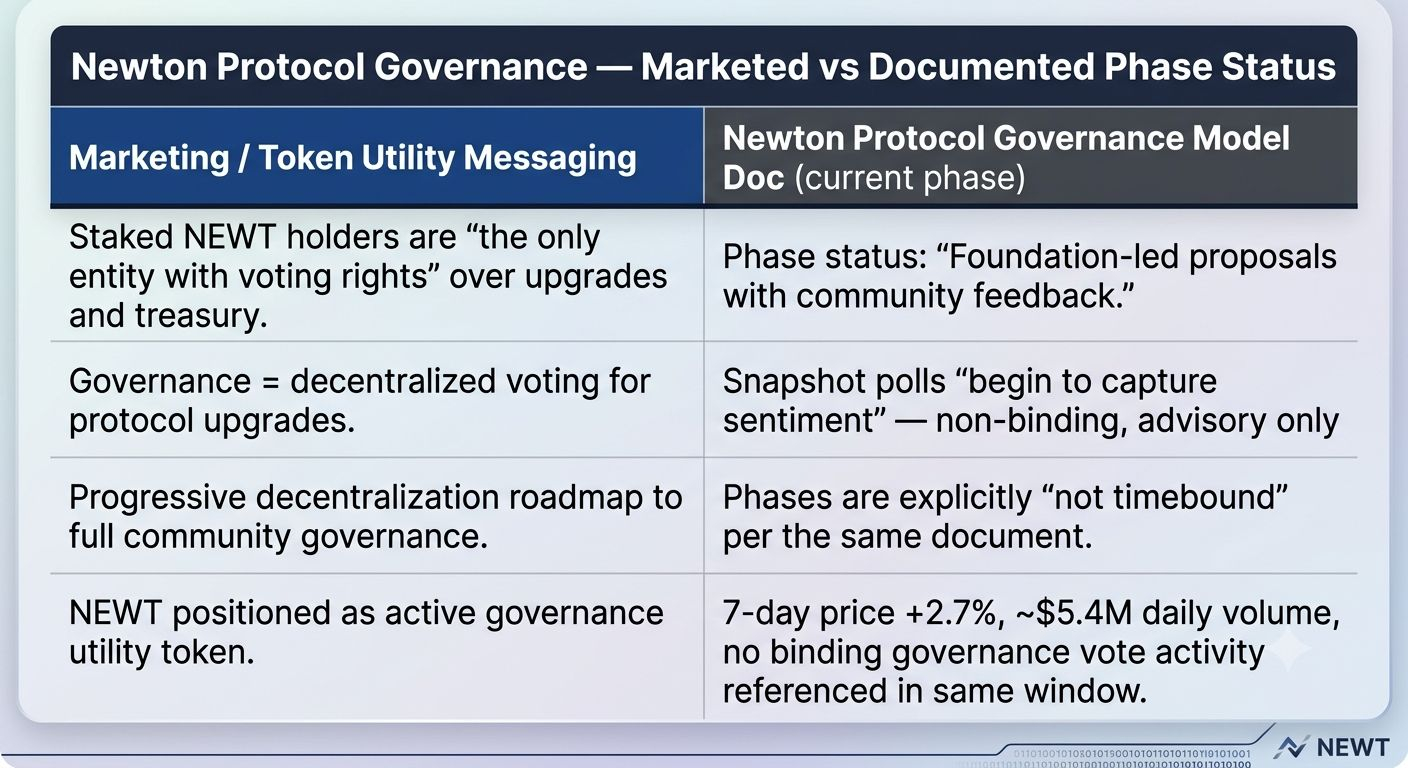
NEWT dipped 3.6% in the last 24 hours but is still up about 2.7% over 7 days, trading around $5.4M in daily volume — checked mid-afternoon out of habit more than anything. Newton Protocol markets governance as the layer where staked NEWT holders become "the only entity with voting rights" over upgrades and treasury moves. Went digging in the actual governance model doc instead of the pitch deck, though, and hmm — the current phase is described plainly as "Foundation-led proposals continue," with Snapshot polls only just starting to "capture sentiment," not decide anything.
So there's a gap sitting right there in their own documentation. The token utility slide says governance. The phase tracker says advisory sentiment-gathering, foundation still holding the pen. Not hiding it, to be fair — it's labeled as a phase, not a bug. But phases aren't timebound either, which is its own quiet detail.
Snack's gone, still turning this over — a "primary voting body" that hasn't started voting yet is a different thing than a marketing page implies. Curious how long "sentiment capture" runs before it becomes something binding, or if that's even the plan.
@NewtonProtocol #Newt $NEWT
7
4
144
·
--
Spent the afternoon poking around the BEP-20 side of $NEWT and something small kept nagging at me.
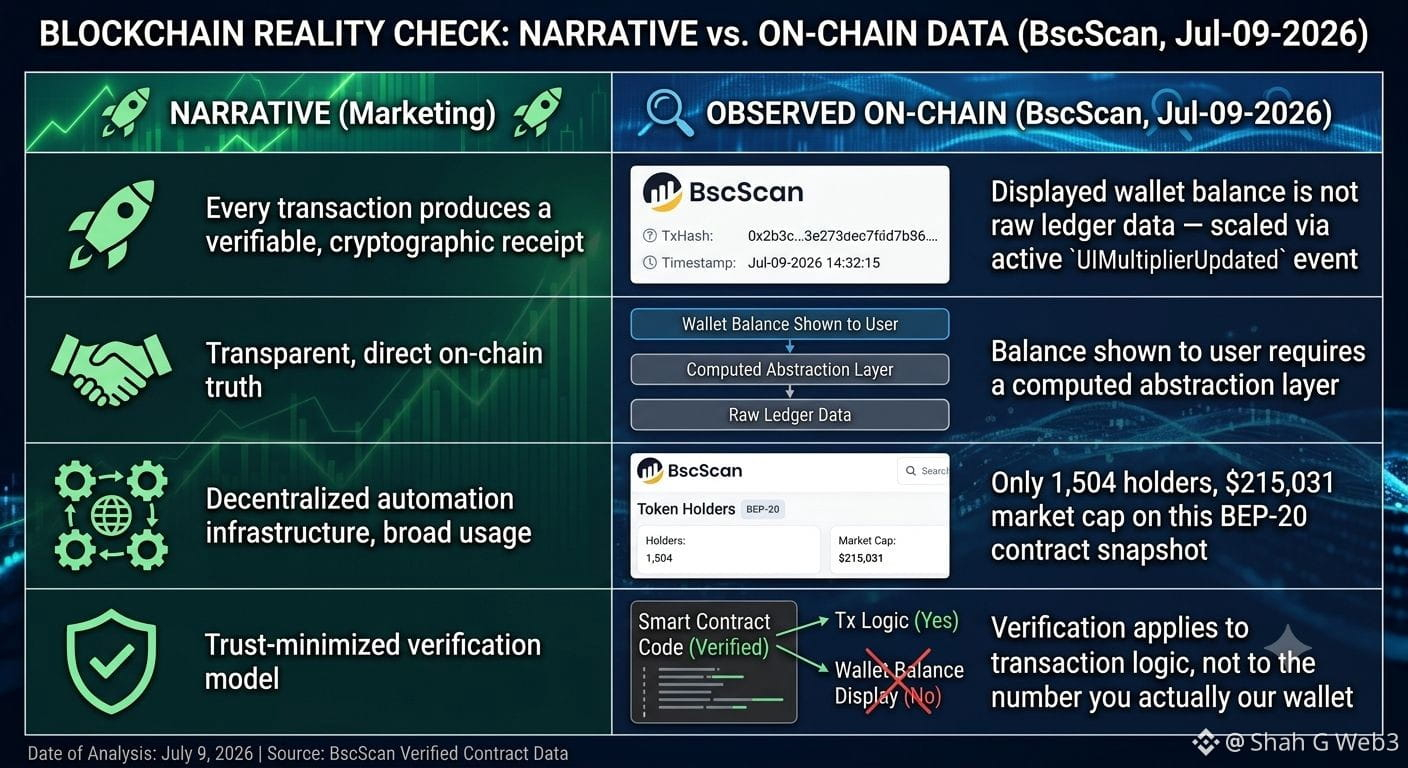
Checked the token contract snapshot from Jul-09-2026, 12:22:52 UTC — price sitting at $0.0463, market cap barely $215K, only 1,504 holders on that particular bridged version. Fine, expected for a wrapped asset. But then I noticed the contract flags "UI Multiplier changes (based on UIMultiplierUpdated event)" — meaning what you see in your wallet isn't your raw ledger balance. It's scaled, computed on the fly by an active multiplier.
Hold up— for a protocol whose entire pitch is cryptographic attestations, verifiable receipts, "trust but verify everything," that's an odd thing to find sitting quietly on the token's own contract page. The number in your wallet is technically true but not... direct. There's a layer between what happened and what you're shown.
Not saying it's shady, rebasing-style multipliers exist for legit reasons. But I keep thinking about the gap between "every transaction produces a verifiable proof" as the marketing line, and "your balance display itself needs an abstraction layer" as the quiet reality on one of its own token contracts.
Maybe I'm overreading a UI detail. Or maybe verification-first branding and display-layer abstraction just don't sit as cleanly together as the docs make it sound. Still chewing on that one.
@NewtonProtocol #Newt
13
5
77
·
--
Article
Newton Protocol Comparison: How It Differs From Traditional AI PlatformsMarket's been sideways for like three days now, that annoying kind of sideways where you refresh the chart out of habit more than actual interest. So I closed the tab and went down a different rabbit hole instead — people keep pitching Newton Protocol as "AI without the middleman," decentralized inference versus your typical OpenAI-style walled garden, and I wanted to actually sit with that comparison instead of just nodding along.
So I started pulling apart what "different from traditional AI platforms" is supposed to mean here. Out of curiosity I went back through how VaultKit and the Rego policy engine actually route a request versus how, say, a centralized API call works. And somewhere in there the comparison stopped making sense to me the way it's usually framed.
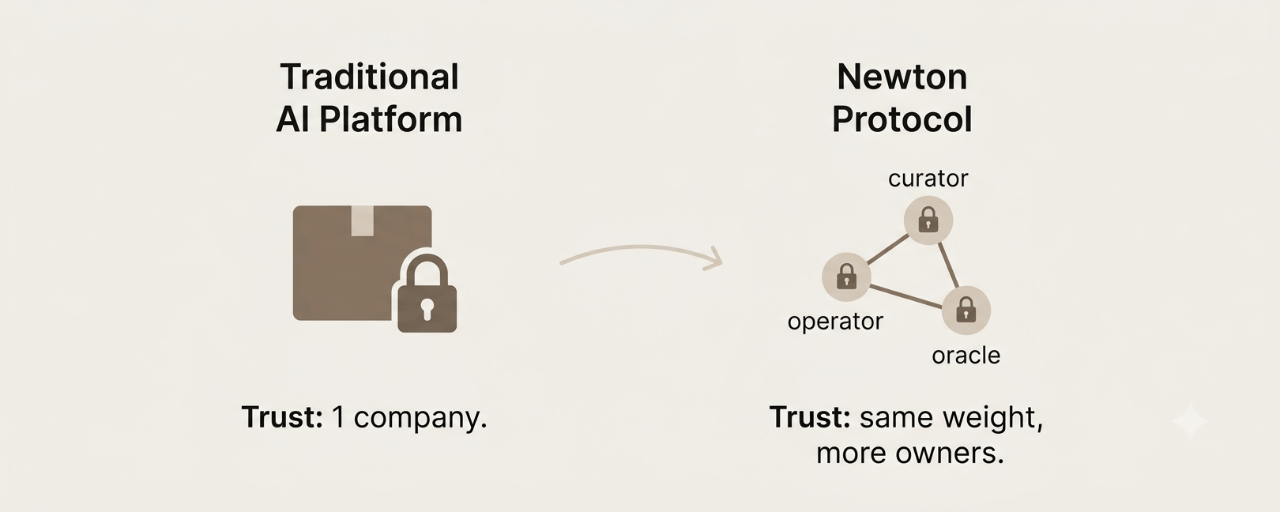
Here's the thing that got stuck in my head: the pitch is always "centralized platform holds the trust, Newton removes that." But it doesn't remove it. It moves it. When you call a traditional AI platform, you're trusting one company's black box — fine, that's the known tradeoff, everyone gets that. When you route through Newton, you're trusting a curator's vetting of a model, an operator's consensus behavior, and an oracle feed (Chainalysis, RedStone, whoever's plugged in for that vault) all agreeing with each other. That's not zero trust. That's trust split into more pieces and handed to more parties you now have to individually evaluate.
I thought that was a nitpick at first, honestly, like — okay sure, semantics. But actually, the more I looked at curator mechanics, the more it felt like the opposite of decentralization in the way people mean it. A curator deciding which models get surfaced in a marketplace is functionally doing the same gatekeeping OpenAI's moderation layer does. Just without the brand name attached, and without the same regulatory exposure. People assume "on-chain" means "trustless." What actually happens is the trust just gets distributed to entities with way less accountability infrastructure than a company that has lawyers and a reputation to protect.
And here's the part that bothers me, the contrarian turn I can't fully get past — if operator consensus is what's supposed to replace centralized trust, what happens when operators are economically aligned with each other rather than with the user? Consensus among people who all profit from the same outcome isn't really a check, it's just agreement. Traditional platforms have a single point of failure that's at least visible and identifiable. This model has multiple points of failure that are harder to see and harder to hold accountable, because "the curator" and "the oracle" aren't as easy to point a finger at as "the company."
I'm not saying that makes it worse necessarily. I'm saying the comparison "centralized bad, decentralized good" is doing a lot of lifting it hasn't earned yet. Maybe distributed trust actually is more resilient over time — more eyes, more incentive layers checking each other. That's the optimistic read. But I haven't seen this actually get pressure-tested yet, like a real dispute where a curator vetted something wrong and operators disagreed on the outcome. Until that happens once, publicly, this whole "better than traditional AI platforms" framing is still theoretical to me.
This actually matters most for anyone treating Newton's model marketplace as inherently safer than a centralized API just because it's on-chain. If you're building something that depends on inference quality — a trading bot, an agent making decisions with real capital — the question isn't "is this decentralized," it's "do I actually trust this specific curator and this specific oracle combination more than I'd trust a centralized provider's track record." Different question. People are answering the wrong one.
Anyway. I'll probably keep watching how the vault-level curator decisions get made over the next few weeks, see if any disagreement actually surfaces publicly. Market's still doing nothing so I've got the time.
@NewtonProtocol #Newt $NEWT
Newton Protocol Comparison: How It Differs From Traditional AI Platforms
Market's been sideways for like three days now, that annoying kind of sideways where you refresh the chart out of habit more than actual interest. So I closed the tab and went down a different rabbit hole instead — people keep pitching Newton Protocol as "AI without the middleman," decentralized inference versus your typical OpenAI-style walled garden, and I wanted to actually sit with that comparison instead of just nodding along.
So I started pulling apart what "different from traditional AI platforms" is supposed to mean here. Out of curiosity I went back through how VaultKit and the Rego policy engine actually route a request versus how, say, a centralized API call works. And somewhere in there the comparison stopped making sense to me the way it's usually framed.
Here's the thing that got stuck in my head: the pitch is always "centralized platform holds the trust, Newton removes that." But it doesn't remove it. It moves it. When you call a traditional AI platform, you're trusting one company's black box — fine, that's the known tradeoff, everyone gets that. When you route through Newton, you're trusting a curator's vetting of a model, an operator's consensus behavior, and an oracle feed (Chainalysis, RedStone, whoever's plugged in for that vault) all agreeing with each other. That's not zero trust. That's trust split into more pieces and handed to more parties you now have to individually evaluate.
I thought that was a nitpick at first, honestly, like — okay sure, semantics. But actually, the more I looked at curator mechanics, the more it felt like the opposite of decentralization in the way people mean it. A curator deciding which models get surfaced in a marketplace is functionally doing the same gatekeeping OpenAI's moderation layer does. Just without the brand name attached, and without the same regulatory exposure. People assume "on-chain" means "trustless." What actually happens is the trust just gets distributed to entities with way less accountability infrastructure than a company that has lawyers and a reputation to protect.
And here's the part that bothers me, the contrarian turn I can't fully get past — if operator consensus is what's supposed to replace centralized trust, what happens when operators are economically aligned with each other rather than with the user? Consensus among people who all profit from the same outcome isn't really a check, it's just agreement. Traditional platforms have a single point of failure that's at least visible and identifiable. This model has multiple points of failure that are harder to see and harder to hold accountable, because "the curator" and "the oracle" aren't as easy to point a finger at as "the company."
I'm not saying that makes it worse necessarily. I'm saying the comparison "centralized bad, decentralized good" is doing a lot of lifting it hasn't earned yet. Maybe distributed trust actually is more resilient over time — more eyes, more incentive layers checking each other. That's the optimistic read. But I haven't seen this actually get pressure-tested yet, like a real dispute where a curator vetted something wrong and operators disagreed on the outcome. Until that happens once, publicly, this whole "better than traditional AI platforms" framing is still theoretical to me.
This actually matters most for anyone treating Newton's model marketplace as inherently safer than a centralized API just because it's on-chain. If you're building something that depends on inference quality — a trading bot, an agent making decisions with real capital — the question isn't "is this decentralized," it's "do I actually trust this specific curator and this specific oracle combination more than I'd trust a centralized provider's track record." Different question. People are answering the wrong one.
Anyway. I'll probably keep watching how the vault-level curator decisions get made over the next few weeks, see if any disagreement actually surfaces publicly. Market's still doing nothing so I've got the time.
@NewtonProtocol #Newt $NEWT
5
2
82
·
--
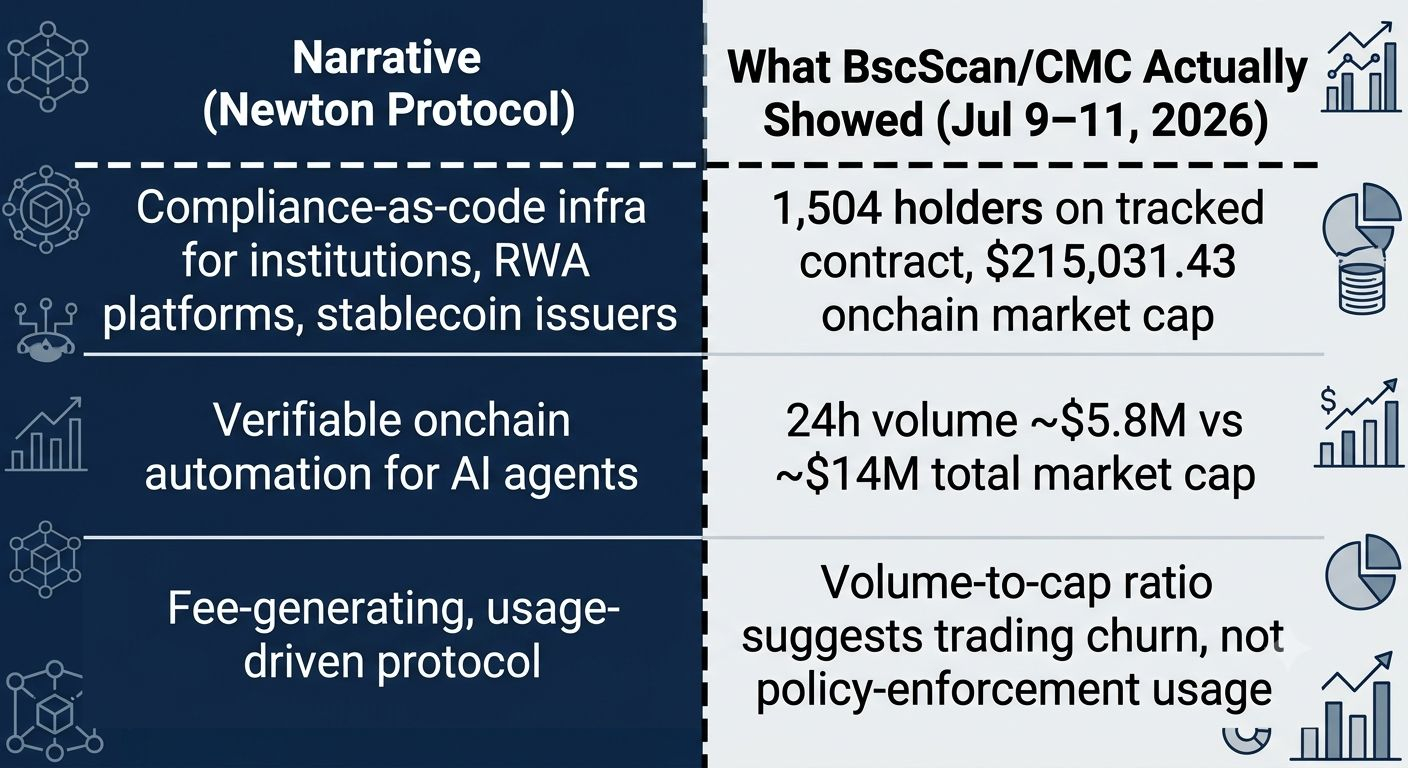
Was skimming Newton Protocol's BscScan page during a coffee break, not even looking for anything specific, and the holder count just kind of stopped me — 1,504 wallets on that contract, onchain market cap reading $215,031.43, snapshot dated Jul-09. Small. Genuinely small for something pitching itself to institutions, RWA platforms, stablecoin issuers as the compliance-as-code layer they're supposed to build financial automation on top of. $NEWT #Newton @newton_xyz
Then I flipped to CMC and saw 24h volume sitting around $5.8M against a total market cap near $14M. Hold up — that's almost 40% of the cap churning through exchanges in a single day while the actual holder base on-chain barely clears four digits. That's not a usage pattern. That's a trading pattern.
So which one's the real signal here — the policy-enforcement, verifiable-attestation infra story, or a token behaving exactly like every other thin-holder microcap getting flipped on volume spikes. Mainnet beta's only been live a couple weeks, so maybe this is just what early-stage looks like before real usage catches up to speculation.
Checked the numbers twice honestly, felt off the first time. Still not sure if that gap closes or just becomes the permanent shape of the thing.
@NewtonProtocol #Newt $NEWT
7
4
75
·
--
Article
Newton Protocol: Why Utility Will Decide AI Crypto WinnersWas refreshing a DEX aggregator earlier just to see if slippage improved on a swap I'd been putting off, and got distracted reading a thread arguing about which "AI crypto" projects have "real utility." Everyone was throwing around usage charts like they settled the argument. Closed that tab too, honestly.
So out of curiosity I went and pulled up Newton Protocol's on-chain activity myself, just to see what "utility" actually looks like in raw numbers rather than in someone's Twitter chart.
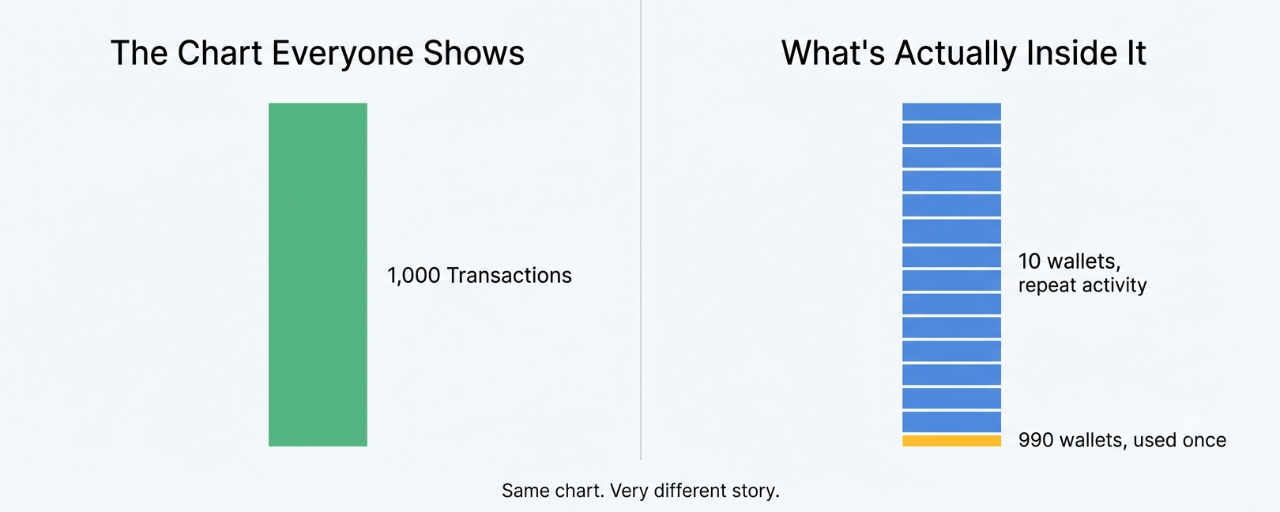
And something clicked that I didn't expect — the transaction count looks healthy, genuinely. But when I started poking at which addresses were generating that volume, it's a much smaller set of wallets than the headline number suggests. Not fake, not empty, just... concentrated. A handful of addresses doing a lot of repeat activity, and a much longer tail of addresses that touched the protocol once and never came back.
What people assume when they say "utility will decide the winner" is that utility equals transaction volume, full stop — more activity means more real-world use, means more staying power. What actually seems to be happening is that a chunk of that volume is a small group of wallets — possibly bots, possibly power users, possibly the team's own testing infrastructure, genuinely can't tell from outside — cycling transactions repeatedly, which inflates the "usage" number without necessarily reflecting broad organic adoption. Ten wallets doing a thousand transactions each looks identical in a bar chart to a thousand wallets doing ten each. But they're not the same thing at all.
I'm not fully convinced this is unique to Newton, to be clear — this is basically true of most early-stage chains and protocols right now. But here's the part that bothers me: if "utility" is the metric everyone's using to pick winners, and utility is currently indistinguishable between "broad genuine demand" and "concentrated repeat usage from a small group," then the entire framework people are using to rank these projects might be measuring the wrong thing. Or at least measuring something that looks like the right thing without actually being it.
I thought maybe unique wallet growth would clear this up — like if new addresses are climbing steadily, that's a decent proxy for broad adoption regardless of what the top wallets are doing. But actually, checking that specifically, new unique addresses are growing, just at a noticeably slower rate than raw transaction count. So the picture isn't "fake growth," it's more like growth happening on two different tracks at two different speeds, and only one of them gets shown in the headline stat.
This matters for anyone trying to actually rank "AI crypto" projects by utility rather than by narrative, because if the standard metric can't tell the difference between a protocol with real distributed demand and one with a smaller group of heavy users, then most comparisons being made right now — Newton against its peers, this generation of projects against each other — are probably less meaningful than they look. It's not that utility doesn't matter. It's that "utility" as currently measured might not be measuring utility.
Who this actually affects: anyone allocating capital based on usage-chart comparisons across AI-crypto projects, assuming those charts are apples to apples. They might not be, project to project, depending on how concentrated the underlying wallet activity is.
When would this stop mattering? Probably once someone builds a decent way to separate "unique meaningful usage" from "repeat usage by a small set of addresses" as a public, comparable metric. I haven't seen that done well yet, for Newton or really for anyone in this space. Might already exist somewhere and I just haven't found it.
@NewtonProtocol #Newt $NEWT
Newton Protocol: Why Utility Will Decide AI Crypto Winners
Was refreshing a DEX aggregator earlier just to see if slippage improved on a swap I'd been putting off, and got distracted reading a thread arguing about which "AI crypto" projects have "real utility." Everyone was throwing around usage charts like they settled the argument. Closed that tab too, honestly.
So out of curiosity I went and pulled up Newton Protocol's on-chain activity myself, just to see what "utility" actually looks like in raw numbers rather than in someone's Twitter chart.
And something clicked that I didn't expect — the transaction count looks healthy, genuinely. But when I started poking at which addresses were generating that volume, it's a much smaller set of wallets than the headline number suggests. Not fake, not empty, just... concentrated. A handful of addresses doing a lot of repeat activity, and a much longer tail of addresses that touched the protocol once and never came back.
What people assume when they say "utility will decide the winner" is that utility equals transaction volume, full stop — more activity means more real-world use, means more staying power. What actually seems to be happening is that a chunk of that volume is a small group of wallets — possibly bots, possibly power users, possibly the team's own testing infrastructure, genuinely can't tell from outside — cycling transactions repeatedly, which inflates the "usage" number without necessarily reflecting broad organic adoption. Ten wallets doing a thousand transactions each looks identical in a bar chart to a thousand wallets doing ten each. But they're not the same thing at all.
I'm not fully convinced this is unique to Newton, to be clear — this is basically true of most early-stage chains and protocols right now. But here's the part that bothers me: if "utility" is the metric everyone's using to pick winners, and utility is currently indistinguishable between "broad genuine demand" and "concentrated repeat usage from a small group," then the entire framework people are using to rank these projects might be measuring the wrong thing. Or at least measuring something that looks like the right thing without actually being it.
I thought maybe unique wallet growth would clear this up — like if new addresses are climbing steadily, that's a decent proxy for broad adoption regardless of what the top wallets are doing. But actually, checking that specifically, new unique addresses are growing, just at a noticeably slower rate than raw transaction count. So the picture isn't "fake growth," it's more like growth happening on two different tracks at two different speeds, and only one of them gets shown in the headline stat.
This matters for anyone trying to actually rank "AI crypto" projects by utility rather than by narrative, because if the standard metric can't tell the difference between a protocol with real distributed demand and one with a smaller group of heavy users, then most comparisons being made right now — Newton against its peers, this generation of projects against each other — are probably less meaningful than they look. It's not that utility doesn't matter. It's that "utility" as currently measured might not be measuring utility.
Who this actually affects: anyone allocating capital based on usage-chart comparisons across AI-crypto projects, assuming those charts are apples to apples. They might not be, project to project, depending on how concentrated the underlying wallet activity is.
When would this stop mattering? Probably once someone builds a decent way to separate "unique meaningful usage" from "repeat usage by a small set of addresses" as a public, comparable metric. I haven't seen that done well yet, for Newton or really for anyone in this space. Might already exist somewhere and I just haven't found it.
@NewtonProtocol #Newt $NEWT
3
3
49
·
--
@NewtonProtocol
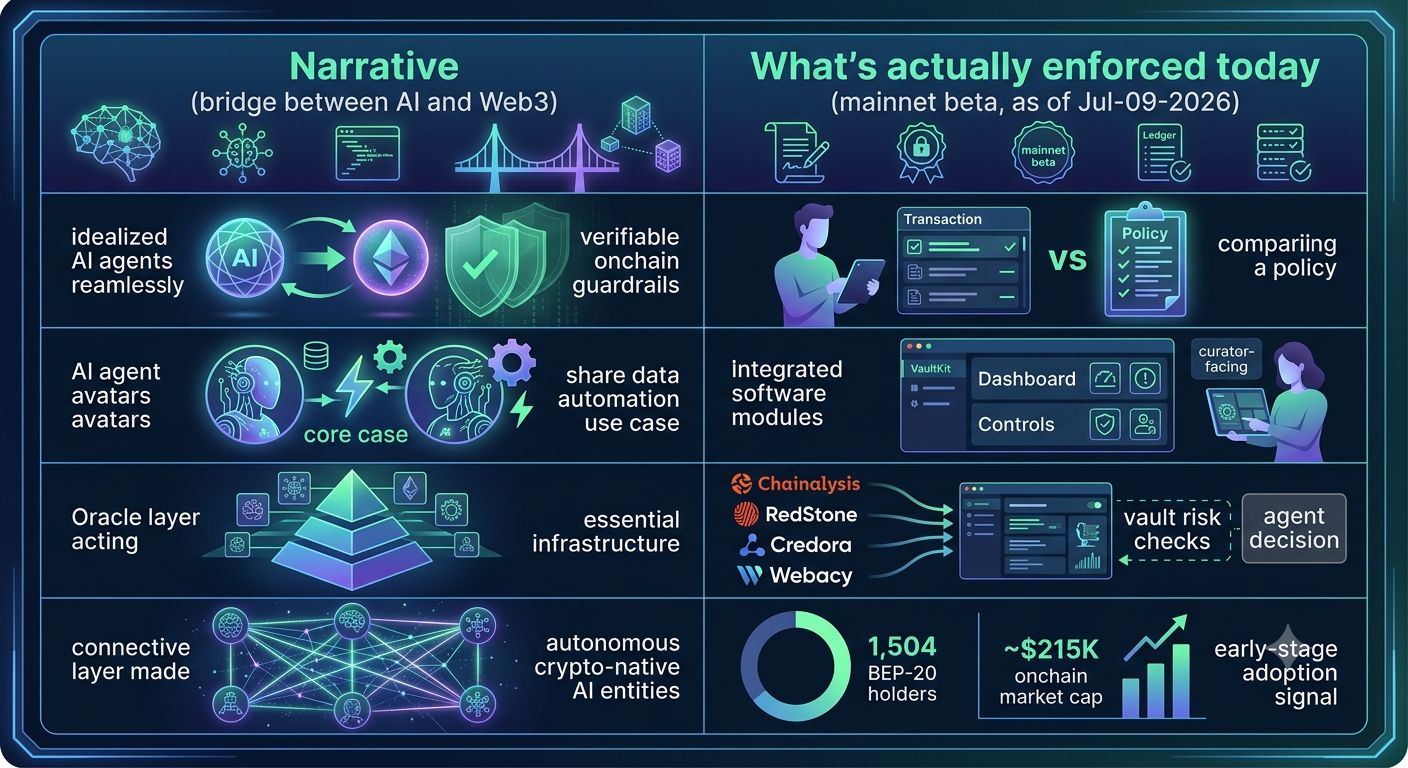
Third pass at this thing this week and the detail that got me this time was smaller — the oracle adapter layer. Newton's whole "AI meets Web3" framing rests on operators pulling live offchain data (Chainalysis, RedStone, Credora, Webacy) into a policy check before a transaction settles on Ethereum or Base. That's the bridge, supposedly. Agent wants to act, policy engine checks it against real-world data, only then does it clear.
Except — hold up — when you actually trace it, the "AI agent" part is mostly aspirational right now. What's live and being enforced today is vault curator actions. Human-run vaults, human curators, checked against risk and compliance policies. The agent-to-agent stuff, the autonomous execution layer, that's still the pitch, not the usage. Same BscScan pull I keep coming back to, 1,504 holders as of Jul-09 12:22 UTC, tells a similar story — infra ahead of adoption, and here it's also infra ahead of the exact use case it's named for.
Not a criticism, just… noticing the sequencing. Compliance rails get built first, agents get plugged in later, maybe. Makes sense operationally. Still feels like the "AI" half of the bridge is more blueprint than bridge right now.
Curious which comes first in practice — agents finding guardrails, or guardrails finding agents.
#Newt $NEWT
4
3
47
·
--
Article
Newton Protocol: Understanding the Value Flow Inside the EcosystemWas half-watching a stream about macro stuff, Fed dot plot, the usual doom and gloom, and I wasn't really paying attention. Ended up tabbing over to check unlock calendars instead, which is a habit I picked up a while back and can't really shake — it's oddly calming compared to staring at candles.
That's actually how I landed back on Newton. NEWT had a scheduled release late June, a big one, over a hundred million tokens in a single cliff, more than a third of circulating supply at the time, mostly core contributor allocation. I wasn't looking for it specifically, it just showed up near the top of the list.
And that's when the "value flow" framing people use for Newton started to feel off to me. The pitch is usually about fees — users pay NEWT to run automation and compliance checks, operators get paid in NEWT for doing the work correctly, staking rewards flow to people securing the network. It's presented as this closed loop, usage drives demand, demand supports the token. Standard utility-token story.
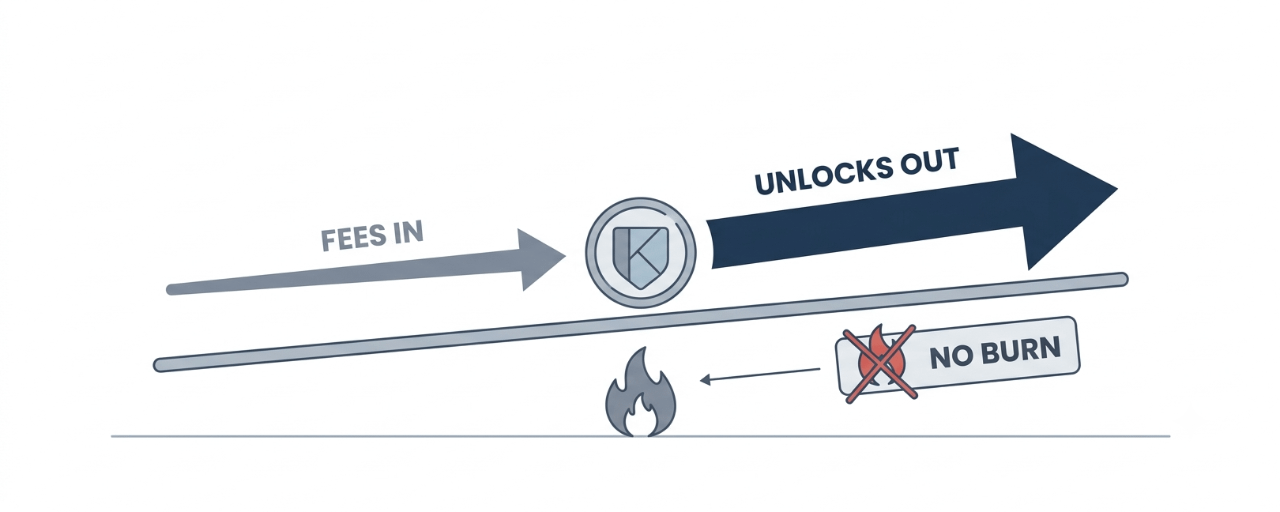
But when I actually looked at where the token volume is moving right now, the fee side isn't what's dominating. It's the unlock side. You've got a huge core contributor cliff releasing a massive chunk of supply, and separately a broader vesting schedule feeding tokens out over 36 to 48 months across investor and ecosystem buckets. Meanwhile there's no burn mechanism anywhere in the docs, no buyback program, nothing that routes usage fees back into reducing supply. Fees get paid to operators and stakers — real people, real addresses — but none of it exits the circulating supply. It just moves sideways.
I think I assumed, without really checking, that "value flow" meant something closer to what protocols like Aster or Jupiter are doing now, where fees actually feed a buyback-and-burn loop and usage volume has a direct line to token scarcity. Newton doesn't have that. The flow here is fees moving from users to operators, operators maybe converting some to cover costs, and none of it ever leaving the token supply. So "value flow" is real in the sense that money changes hands, but it's not a flow that pressures supply in either direction from the demand side.
Here's what actually bothers me about this. Right now, the outbound flow — unlocks hitting the market — is just structurally bigger than anything usage fees could plausibly generate at this stage. The protocol's still early, transaction volume through the compliance layer is nowhere near the size needed to offset a 37% supply release in one week. So when people talk about "value flow inside the ecosystem" like it's this elegant self-reinforcing loop, I keep thinking, sure, but which flow are we actually talking about? Because one of them is a rounding error next to the other right now.
I'm not saying the fee model is broken or pointless, operators and stakers are earning something real for real work. I just don't think it's doing the job people assume it's doing for the token itself, at least not yet, not at this stage of adoption.
This probably matters most for anyone holding NEWT specifically because they believe usage growth will show up in price the way a burn-based token might reflect it. It won't, not directly, not without some added mechanism. It'll matter more obviously whenever the unlock schedule slows down and usage volume has actually had time to grow — that's the point where you could fairly compare the two flows and see which one's winning.
Anyway. I ended up back on the unlock calendar for a totally different token after this, some other name I hadn't heard of with an even uglier cliff coming up. Rate hikes are apparently back on the table too, so who knows, might not matter much either way this week.
@NewtonProtocol #Newt $NEWT
{spot}(NEWTUSDT)
Newton Protocol: Understanding the Value Flow Inside the Ecosystem
Was half-watching a stream about macro stuff, Fed dot plot, the usual doom and gloom, and I wasn't really paying attention. Ended up tabbing over to check unlock calendars instead, which is a habit I picked up a while back and can't really shake — it's oddly calming compared to staring at candles.
That's actually how I landed back on Newton. NEWT had a scheduled release late June, a big one, over a hundred million tokens in a single cliff, more than a third of circulating supply at the time, mostly core contributor allocation. I wasn't looking for it specifically, it just showed up near the top of the list.
And that's when the "value flow" framing people use for Newton started to feel off to me. The pitch is usually about fees — users pay NEWT to run automation and compliance checks, operators get paid in NEWT for doing the work correctly, staking rewards flow to people securing the network. It's presented as this closed loop, usage drives demand, demand supports the token. Standard utility-token story.
But when I actually looked at where the token volume is moving right now, the fee side isn't what's dominating. It's the unlock side. You've got a huge core contributor cliff releasing a massive chunk of supply, and separately a broader vesting schedule feeding tokens out over 36 to 48 months across investor and ecosystem buckets. Meanwhile there's no burn mechanism anywhere in the docs, no buyback program, nothing that routes usage fees back into reducing supply. Fees get paid to operators and stakers — real people, real addresses — but none of it exits the circulating supply. It just moves sideways.
I think I assumed, without really checking, that "value flow" meant something closer to what protocols like Aster or Jupiter are doing now, where fees actually feed a buyback-and-burn loop and usage volume has a direct line to token scarcity. Newton doesn't have that. The flow here is fees moving from users to operators, operators maybe converting some to cover costs, and none of it ever leaving the token supply. So "value flow" is real in the sense that money changes hands, but it's not a flow that pressures supply in either direction from the demand side.
Here's what actually bothers me about this. Right now, the outbound flow — unlocks hitting the market — is just structurally bigger than anything usage fees could plausibly generate at this stage. The protocol's still early, transaction volume through the compliance layer is nowhere near the size needed to offset a 37% supply release in one week. So when people talk about "value flow inside the ecosystem" like it's this elegant self-reinforcing loop, I keep thinking, sure, but which flow are we actually talking about? Because one of them is a rounding error next to the other right now.
I'm not saying the fee model is broken or pointless, operators and stakers are earning something real for real work. I just don't think it's doing the job people assume it's doing for the token itself, at least not yet, not at this stage of adoption.
This probably matters most for anyone holding NEWT specifically because they believe usage growth will show up in price the way a burn-based token might reflect it. It won't, not directly, not without some added mechanism. It'll matter more obviously whenever the unlock schedule slows down and usage volume has actually had time to grow — that's the point where you could fairly compare the two flows and see which one's winning.
Anyway. I ended up back on the unlock calendar for a totally different token after this, some other name I hadn't heard of with an even uglier cliff coming up. Rate hikes are apparently back on the table too, so who knows, might not matter much either way this week.
@NewtonProtocol #Newt $NEWT
3
3
109
·
--
Been staring at the Newton Explorer for the last hour and something's bugging me.
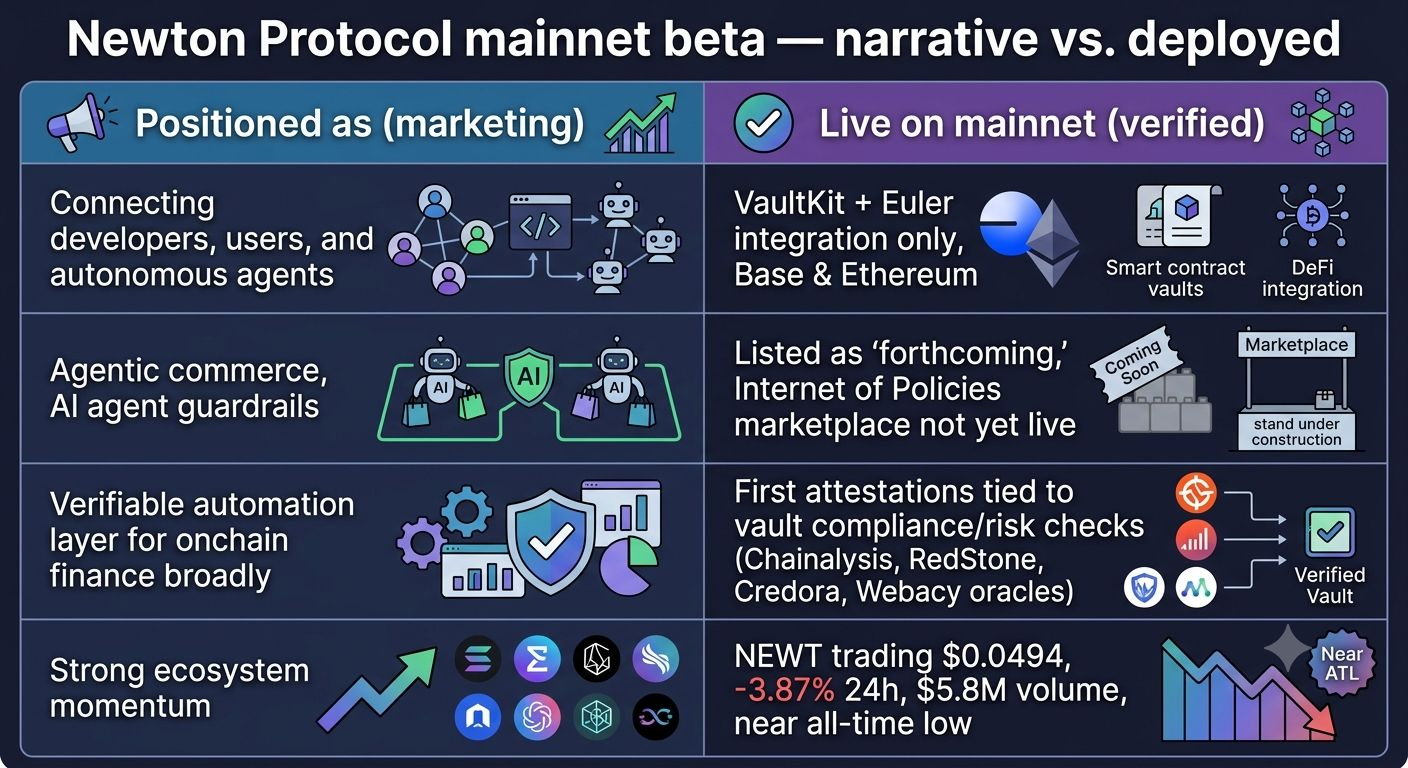
Newton Protocol ($NEWT) mainnet beta went live on Base and Ethereum with VaultKit shipping alongside it — Euler is the first integration, oracle partners like Chainalysis, RedStone, Credora, and Webacy all plugged in for real-time attestations. Meanwhile NEWT itself is sitting at $0.0494, down almost 4% in 24h on just $5.8M volume, hugging its all-time low from a couple weeks back. Hmm.
Here's the thing that stood out. The whole pitch for #Newton @newton_xyz is "connecting developers, users, and autonomous agents" — three legs of a stool. But what's actually enforcing policy onchain right now is vault compliance. Curators, depositors, oracle data. The agent piece? Still filed under "forthcoming," part of an "Internet of Policies marketplace" that doesn't exist yet on mainnet.
So developers and users get the live product. Agents get the roadmap slide. Not a knock — vaults are a sane place to start, TVL there did grow fast and needed guardrails. But if you're holding NEWT on the agentic-finance thesis, you're pricing in a leg that hasn't touched mainnet.
Makes me wonder how much of the "verifiable automation for agents" narrative actually depends on this vault-first sequencing working first — or if agents just keep getting pushed to the next release.
@NewtonProtocol #Newt $NEWT
Been staring at the Newton Explorer for the last hour and something's bugging me.
Newton Protocol ($NEWT ) mainnet beta went live on Base and Ethereum with VaultKit shipping alongside it — Euler is the first integration, oracle partners like Chainalysis, RedStone, Credora, and Webacy all plugged in for real-time attestations. Meanwhile NEWT itself is sitting at $0.0494, down almost 4% in 24h on just $5.8M volume, hugging its all-time low from a couple weeks back. Hmm.
Here's the thing that stood out. The whole pitch for #Newton @newton_xyz is "connecting developers, users, and autonomous agents" — three legs of a stool. But what's actually enforcing policy onchain right now is vault compliance. Curators, depositors, oracle data. The agent piece? Still filed under "forthcoming," part of an "Internet of Policies marketplace" that doesn't exist yet on mainnet.
So developers and users get the live product. Agents get the roadmap slide. Not a knock — vaults are a sane place to start, TVL there did grow fast and needed guardrails. But if you're holding NEWT on the agentic-finance thesis, you're pricing in a leg that hasn't touched mainnet.
Makes me wonder how much of the "verifiable automation for agents" narrative actually depends on this vault-first sequencing working first — or if agents just keep getting pushed to the next release.
@NewtonProtocol #Newt $NEWT
5
3
51
·
--
Article
Newton Protocol Utility Explained: Beyond Token SpeculationSpent the morning half-watching a green candle that went nowhere, one of those days where every alt just chops in a 2% band and you start clicking around instead of actually trading. Ended up back on NEWT again, this time not on the Explorer — on the tokenomics page, mostly out of boredom.
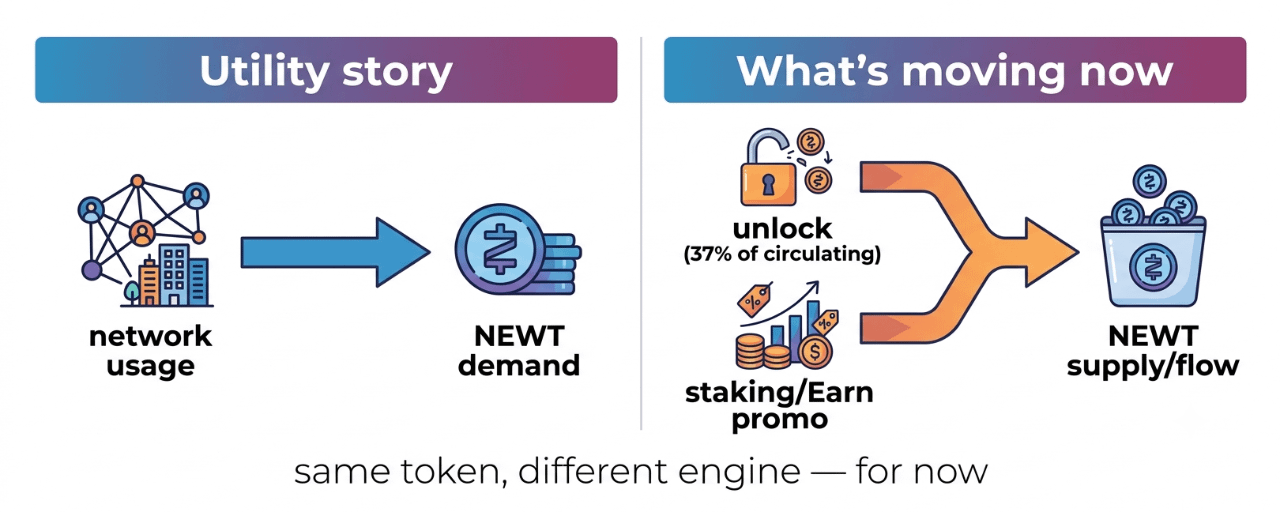
So I started pulling up the recent unlock data, just to check timing before I said anything dumb about supply. And there it was — the June 22 unlock, 139 million NEWT, roughly $7.55M, which worked out to something like 37% of circulating supply at the time. That's not a normal drip. That's more than a third of everything trading getting added in one shot.
Here's what actually stopped me, though. I'd been mentally filing NEWT's value case under "fees paid to operators for running policy checks" — the usual verifiable-automation pitch, agents and vaults paying for evaluation, demand tied to actual usage of the network. But when you line up what's really moving the token right now, it's not that. It's a huge unlock landing the same week Binance runs a Summer Earn promotion featuring NEWT. One event adds supply, the other pulls it into staking pools. Neither of those is "the network got used more." That's the part that feels slightly off — the utility story everyone repeats is downstream of usage, but the thing actually driving flows this month is upstream of it, pure token mechanics.
The simple version of what people assume: NEWT's utility comes from operators earning fees to evaluate policies, so as Newton processes more transactions, more NEWT gets used, and that's the bull case. What's actually happening right now, at this stage, mainnet beta is fresh, the volume of real policy evaluations is still small relative to a billion-token supply, so the fee-driven demand loop hasn't really had time to show up in any meaningful way yet. What is showing up is emissions-driven — staking rewards, exchange promotions, unlock schedules — the stuff that exists regardless of whether anyone's actually running automation through the protocol.
But here's the part that bothers me a little, and I keep going back and forth on it. If the "real utility" story needs operator fee volume to eventually outweigh emissions and unlocks, that's a timing bet, not a current fact. I'm not convinced the usage side scales fast enough to absorb what's still unlocking on the vesting schedule. A protocol can have genuinely useful infrastructure and still have a token that trades mostly on supply mechanics for a year or two before the usage catches up — I've watched that exact pattern play out with other AVS-style tokens, and it doesn't always resolve in the token's favor even when the tech is fine.
Why it matters, I think, comes down to what kind of holder you are. If you're looking at NEWT as a bet on Newton actually becoming the authorization layer everyone hopes it becomes, none of this changes that thesis — it just means the timeline for token utility catching up to network utility might be longer than the marketing implies. If you're trading it short-term though, unlock weeks and Earn-promo weeks are probably going to keep mattering more than fee volume for a while, and that's a different game than the one the litepaper is selling.
I almost didn't check the unlock number before writing this, actually — nearly went with vibes on "the token's been active lately," which would've been wrong in a way that matters. Glad I looked first.
Anyway, still watching to see if operator fee volume shows up anywhere in the Explorer data over the next few unlock cycles, or if it stays quiet while supply keeps doing most of the talking. Chart's still boring either way
@NewtonProtocol $NEWT #Newt
Newton Protocol Utility Explained: Beyond Token Speculation
Spent the morning half-watching a green candle that went nowhere, one of those days where every alt just chops in a 2% band and you start clicking around instead of actually trading. Ended up back on NEWT again, this time not on the Explorer — on the tokenomics page, mostly out of boredom.
So I started pulling up the recent unlock data, just to check timing before I said anything dumb about supply. And there it was — the June 22 unlock, 139 million NEWT, roughly $7.55M, which worked out to something like 37% of circulating supply at the time. That's not a normal drip. That's more than a third of everything trading getting added in one shot.
Here's what actually stopped me, though. I'd been mentally filing NEWT's value case under "fees paid to operators for running policy checks" — the usual verifiable-automation pitch, agents and vaults paying for evaluation, demand tied to actual usage of the network. But when you line up what's really moving the token right now, it's not that. It's a huge unlock landing the same week Binance runs a Summer Earn promotion featuring NEWT. One event adds supply, the other pulls it into staking pools. Neither of those is "the network got used more." That's the part that feels slightly off — the utility story everyone repeats is downstream of usage, but the thing actually driving flows this month is upstream of it, pure token mechanics.
The simple version of what people assume: NEWT's utility comes from operators earning fees to evaluate policies, so as Newton processes more transactions, more NEWT gets used, and that's the bull case. What's actually happening right now, at this stage, mainnet beta is fresh, the volume of real policy evaluations is still small relative to a billion-token supply, so the fee-driven demand loop hasn't really had time to show up in any meaningful way yet. What is showing up is emissions-driven — staking rewards, exchange promotions, unlock schedules — the stuff that exists regardless of whether anyone's actually running automation through the protocol.
But here's the part that bothers me a little, and I keep going back and forth on it. If the "real utility" story needs operator fee volume to eventually outweigh emissions and unlocks, that's a timing bet, not a current fact. I'm not convinced the usage side scales fast enough to absorb what's still unlocking on the vesting schedule. A protocol can have genuinely useful infrastructure and still have a token that trades mostly on supply mechanics for a year or two before the usage catches up — I've watched that exact pattern play out with other AVS-style tokens, and it doesn't always resolve in the token's favor even when the tech is fine.
Why it matters, I think, comes down to what kind of holder you are. If you're looking at NEWT as a bet on Newton actually becoming the authorization layer everyone hopes it becomes, none of this changes that thesis — it just means the timeline for token utility catching up to network utility might be longer than the marketing implies. If you're trading it short-term though, unlock weeks and Earn-promo weeks are probably going to keep mattering more than fee volume for a while, and that's a different game than the one the litepaper is selling.
I almost didn't check the unlock number before writing this, actually — nearly went with vibes on "the token's been active lately," which would've been wrong in a way that matters. Glad I looked first.
Anyway, still watching to see if operator fee volume shows up anywhere in the Explorer data over the next few unlock cycles, or if it stays quiet while supply keeps doing most of the talking. Chart's still boring either way
@NewtonProtocol $NEWT #Newt
4
3
46
·
--
Newton Protocol: How Smart Agents Could Transform DeFi OperationsSpent the morning half-watching a green candle that went nowhere for like four hours. Got bored, closed the chart, and ended up back in the Newton docs again — this time on the operator/execution side instead of the security stuff I was reading last week.
So I started looking at what "smart agent" actually means once you get past the marketing page. Everyone's using it like the agent is out there making calls — rebalancing your position, deciding when to exit, reacting to conditions in real time. That's the picture. That's what "transform DeFi operations" is supposed to mean.
But then I hit the part about exact-match operator consensus and had to stop and reread it twice.
Here's what I thought was happening: multiple operators run the agent's logic, and if their outputs are close enough or reach some kind of quorum, it executes. Normal decentralized-verification stuff. But it's not "close enough." It's exact match. Every operator has to produce the identical output, byte for byte, for the action to go through. Which means the agent literally cannot be making judgment calls, because judgment calls produce slightly different outputs depending on tiny variations in timing, inputs, rounding, whatever. Exact match only works if the task is fully deterministic — given the same inputs, there is exactly one correct output, no interpretation involved.
So the thing being verified isn't "did the agent make a good decision." It's "did every operator arrive at the identical, pre-determined answer to a narrow, well-defined problem." That's a very different claim than "autonomous agent operating DeFi for you."
And this is the part that's been sitting weird with me. If correctness requires exact match, then the actual space of things Newton agents can safely do right now is much smaller than the "transforming DeFi operations" language implies. You can automate a rebalance that follows a fixed rule. You probably can't have an agent weighing multiple strategies and picking the best one, because two operators running the same weighing logic could reasonably land on different outputs if there's any fuzziness at all — and fuzziness is disqualifying under this consensus model.
I'm not fully convinced the interesting, actually-valuable version of "smart agents" — the ones that adapt to market conditions, not just execute fixed rules — is even compatible with exact-match verification as it exists today. It might need a completely different consensus approach, something probabilistic or threshold-based, before it can do the stuff people are picturing when they hear the term.
Which matters most for anyone who read "autonomous agent" and assumed it meant something closer to a discretionary trading bot with guardrails. Right now it looks more like a very well-verified way to execute deterministic tasks — rule-based rebalancing, scheduled actions, conditional triggers — not open-ended strategy decisions. That's still useful. It's just a much narrower kind of "smart" than the branding suggests, and I think that gap is where a lot of the current enthusiasm is going to eventually run into a wall, or at least need clarifying.
Might be wrong about how narrow this actually is in practice — I haven't traced a live agent action through the whole consensus flow yet to see where the line actually sits. Could be there's more flexibility built in than the docs make obvious on a first pass. But if exact match really is the hard requirement it reads like, then "operations" is doing a lot of quiet work in that headline, and it's carrying more weight than "decisions" ever could here.
Anyway, candle's still not moving. Might just go stare at it some more.
@NewtonProtocol $NEWT #Newt
Newton Protocol: How Smart Agents Could Transform DeFi Operations
Spent the morning half-watching a green candle that went nowhere for like four hours. Got bored, closed the chart, and ended up back in the Newton docs again — this time on the operator/execution side instead of the security stuff I was reading last week.
So I started looking at what "smart agent" actually means once you get past the marketing page. Everyone's using it like the agent is out there making calls — rebalancing your position, deciding when to exit, reacting to conditions in real time. That's the picture. That's what "transform DeFi operations" is supposed to mean.
But then I hit the part about exact-match operator consensus and had to stop and reread it twice.
Here's what I thought was happening: multiple operators run the agent's logic, and if their outputs are close enough or reach some kind of quorum, it executes. Normal decentralized-verification stuff. But it's not "close enough." It's exact match. Every operator has to produce the identical output, byte for byte, for the action to go through. Which means the agent literally cannot be making judgment calls, because judgment calls produce slightly different outputs depending on tiny variations in timing, inputs, rounding, whatever. Exact match only works if the task is fully deterministic — given the same inputs, there is exactly one correct output, no interpretation involved.
So the thing being verified isn't "did the agent make a good decision." It's "did every operator arrive at the identical, pre-determined answer to a narrow, well-defined problem." That's a very different claim than "autonomous agent operating DeFi for you."
And this is the part that's been sitting weird with me. If correctness requires exact match, then the actual space of things Newton agents can safely do right now is much smaller than the "transforming DeFi operations" language implies. You can automate a rebalance that follows a fixed rule. You probably can't have an agent weighing multiple strategies and picking the best one, because two operators running the same weighing logic could reasonably land on different outputs if there's any fuzziness at all — and fuzziness is disqualifying under this consensus model.
I'm not fully convinced the interesting, actually-valuable version of "smart agents" — the ones that adapt to market conditions, not just execute fixed rules — is even compatible with exact-match verification as it exists today. It might need a completely different consensus approach, something probabilistic or threshold-based, before it can do the stuff people are picturing when they hear the term.
Which matters most for anyone who read "autonomous agent" and assumed it meant something closer to a discretionary trading bot with guardrails. Right now it looks more like a very well-verified way to execute deterministic tasks — rule-based rebalancing, scheduled actions, conditional triggers — not open-ended strategy decisions. That's still useful. It's just a much narrower kind of "smart" than the branding suggests, and I think that gap is where a lot of the current enthusiasm is going to eventually run into a wall, or at least need clarifying.
Might be wrong about how narrow this actually is in practice — I haven't traced a live agent action through the whole consensus flow yet to see where the line actually sits. Could be there's more flexibility built in than the docs make obvious on a first pass. But if exact match really is the hard requirement it reads like, then "operations" is doing a lot of quiet work in that headline, and it's carrying more weight than "decisions" ever could here.
Anyway, candle's still not moving. Might just go stare at it some more.
@NewtonProtocol $NEWT #Newt
7
3
46
·
--
Newton Protocol just dropped their July 1 writeup on how the Authorization Layer actually works — the piece walking through what happens before settlement, not after. Been staring at that page for an hour. $NEWT @NewtonProtocol
Here's what got me — the whole pitch is "trustless" and "cryptographically verifiable," and technically it is, operators run in TEEs, ZK proofs attest to correct evaluation. But the actual policy inputs — the stuff that decides pass or fail — come from a short list of onboarded partners. Chainalysis for sanctions. Webacy for wallet reputation. Credora for risk ratings. RedStone for price feeds. That's not nothing, it's just… a different kind of trust. You're not trusting Newton, sure. You're trusting whoever curated that partner list.
Had my own small "wait" moment reading it — I kept expecting the doc to address who decides which oracle gets whitelisted into a policy, and it just doesn't go there. Maybe that's a governance question for later, maybe it's already answered somewhere I haven't found yet.
So when they say "safer AI agents," is the safety coming from the crypto, or from picking good data vendors? Feels like those are two very different claims wearing the same word.
#Newt
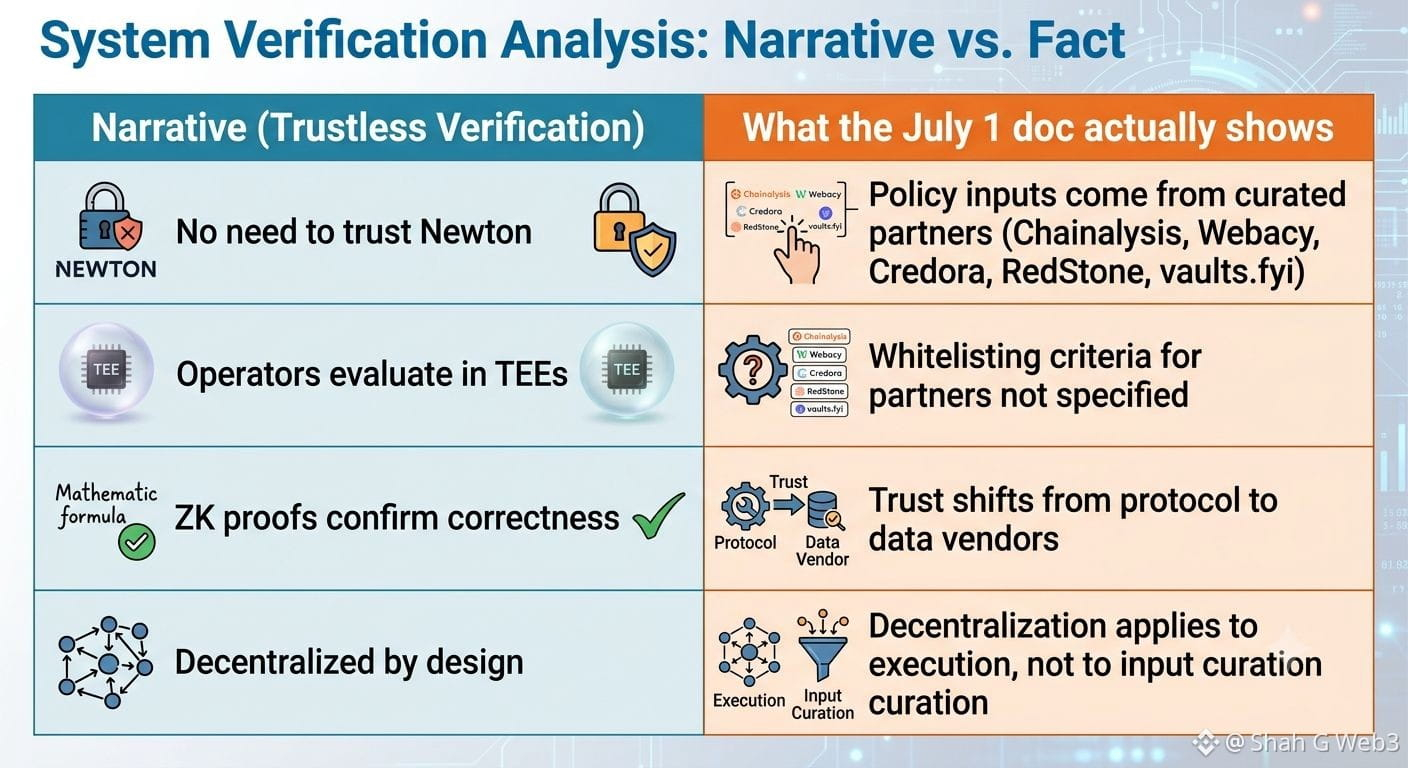
5
1
138
Log in to explore more content
Join global crypto users on Binance Square
⚡️ Get latest and useful information about crypto.
💬 Trusted by the world’s largest crypto exchange.
👍 Discover real insights from verified creators.
Email / Phone number