
Xoxomarket
55 Posts

Xoxomarket
Report
Block User
Following capital, AI & Crypto & Stocks;Less hype, more signal观察市场,也观察资本如何流动,不追热点,只聊值得思考的事 #Ai #Crypto #Stocks
2 Following
49 Followers
152 Liked
Posts
PINNED
·
--
The market doesn’t reward everyone who gets the direction right. First, you have to experience losses, learn to wait, and ride out the volatility!
You think what you’re missing is a good opportunity. In reality, what you need more is the ability to seize it!
Those who truly understand risk and respect the rules have a chance to go further.
You think what you’re missing is a good opportunity. In reality, what you need more is the ability to seize it!
Those who truly understand risk and respect the rules have a chance to go further.
1
6
·
--
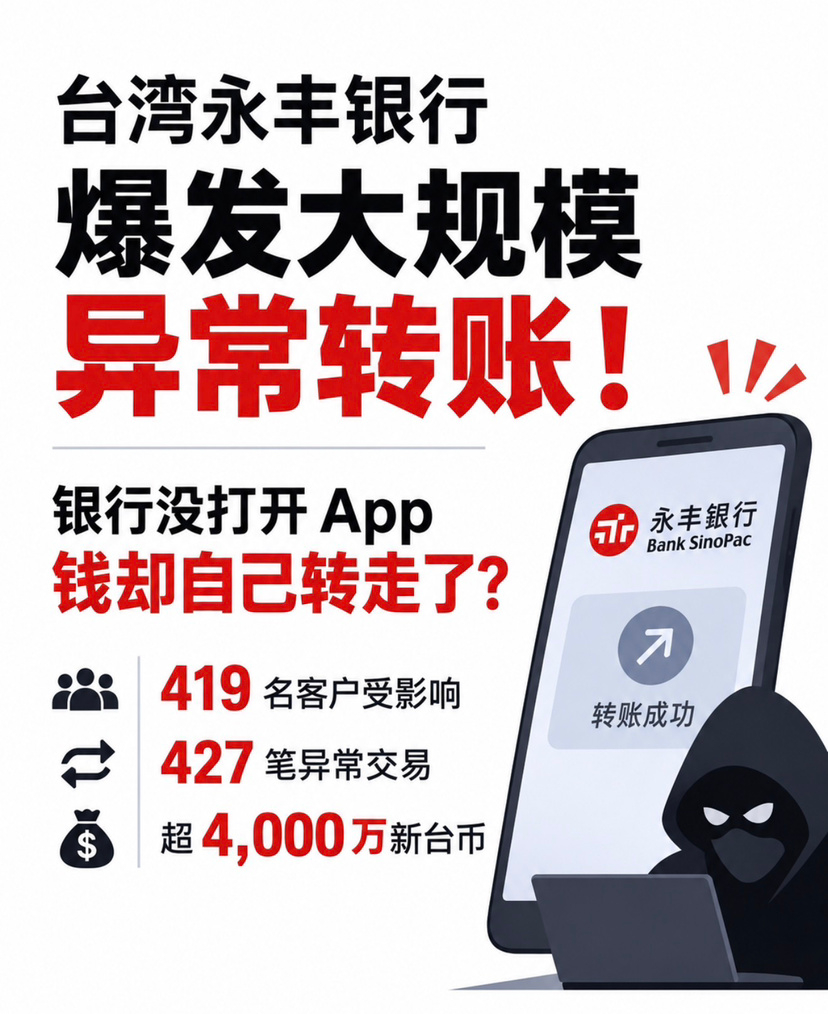
Taiwan’s Bank SinoPac was hacked!
The bank’s app wasn’t even open, yet the money was transferred out on its own?
419 customers affected
427 suspicious transactions
More than NT$40 million
All the funds went into the same account at Taipei Fubon Bank
Even more unsettling, some customers say they never logged in to the app or initiated any transfers, yet some transaction records show that facial recognition verification was completed.
Bank SinoPac has acknowledged a software malfunction in its new online banking transaction system and has refunded all affected amounts. The new app has been suspended, and the recipient account has been frozen.
But was this caused by a software vulnerability, a failure in the authorization mechanism, or an external attack? The investigation is still ongoing.
What makes this incident truly alarming isn’t just that money was transferred out, but that the system was able to complete transactions even when users took no action. Why?
The bank issuing refunds doesn’t mean the technical problem is over.
As financial systems become increasingly digital, where exactly is the security line?
#FinTech #Cybersecurity #Banking
1
125
·
--
Verified
Apple’s earnings beat expectations, yet its stock briefly fell more than 4% after hours! $AAPL
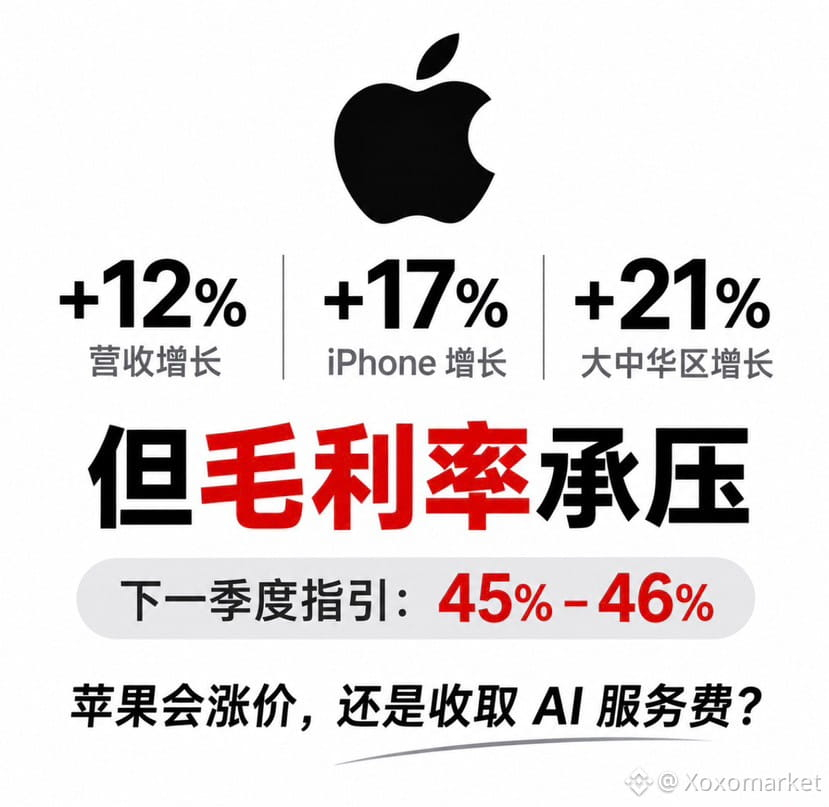
The first earnings report under new CEO Ternus showed revenue growth of 12%, iPhone growth of 17%, and growth of 21% in Greater China.
But what the market is really worried about isn’t that Apple can’t sell its products—it’s that costs are eating into profits.
Memory prices keep rising, while Siri AI is adding cloud costs. Gross margin guidance for the December quarter is just 45%–46%, below market expectations.
Even more notable: Apple has already adjusted prices on some products, but management expects memory costs to keep rising.
So the question is:
Will Apple keep raising prices, or turn AI into a new paid offering?
Higher hardware prices put consumers to the test; charging for AI puts user loyalty to the test.
In the AI era, Apple’s ability to protect its margins matters more than revenue growth alone.
168
·
--
Verified
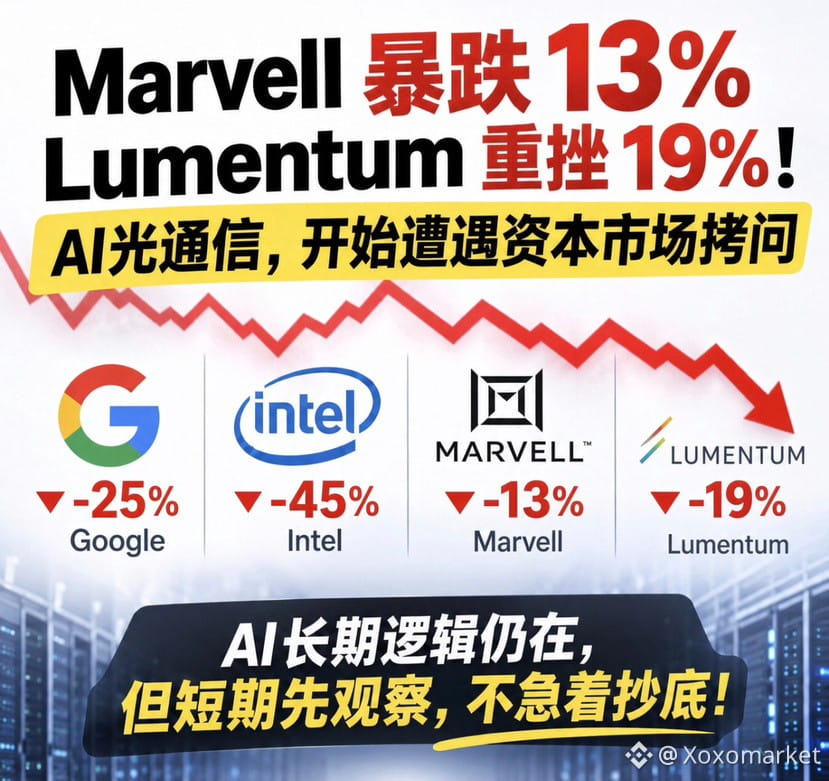
Marvell plunges 13%, Lumentum tumbles 19%! AI optical communications face a grilling from capital markets
The $115 billion all-stock acquisition was originally an important step for Marvell to strengthen its AI optical interconnect business. But after the deal was announced, shares of both companies unexpectedly plunged.
Google has plunged recently, and Intel has plunged too. Now I’m more inclined to wait and see rather than rush to buy the dip!
Next, watch closely to see whether Marvell can stabilize, whether Lumentum shareholders will approve the deal, and whether the optical communications sector can shake off the selling pressure triggered by the merger news.
This doesn’t mean the long-term outlook for AI and optical communications has changed.
AI computing power continues to grow, and demand for high-speed optical interconnects in data centers hasn’t disappeared. But the market environment is different now: geopolitics, interest rates, valuation pressures, and returns on AI capital spending are making investors more cautious.
#Marvell
293
·
--
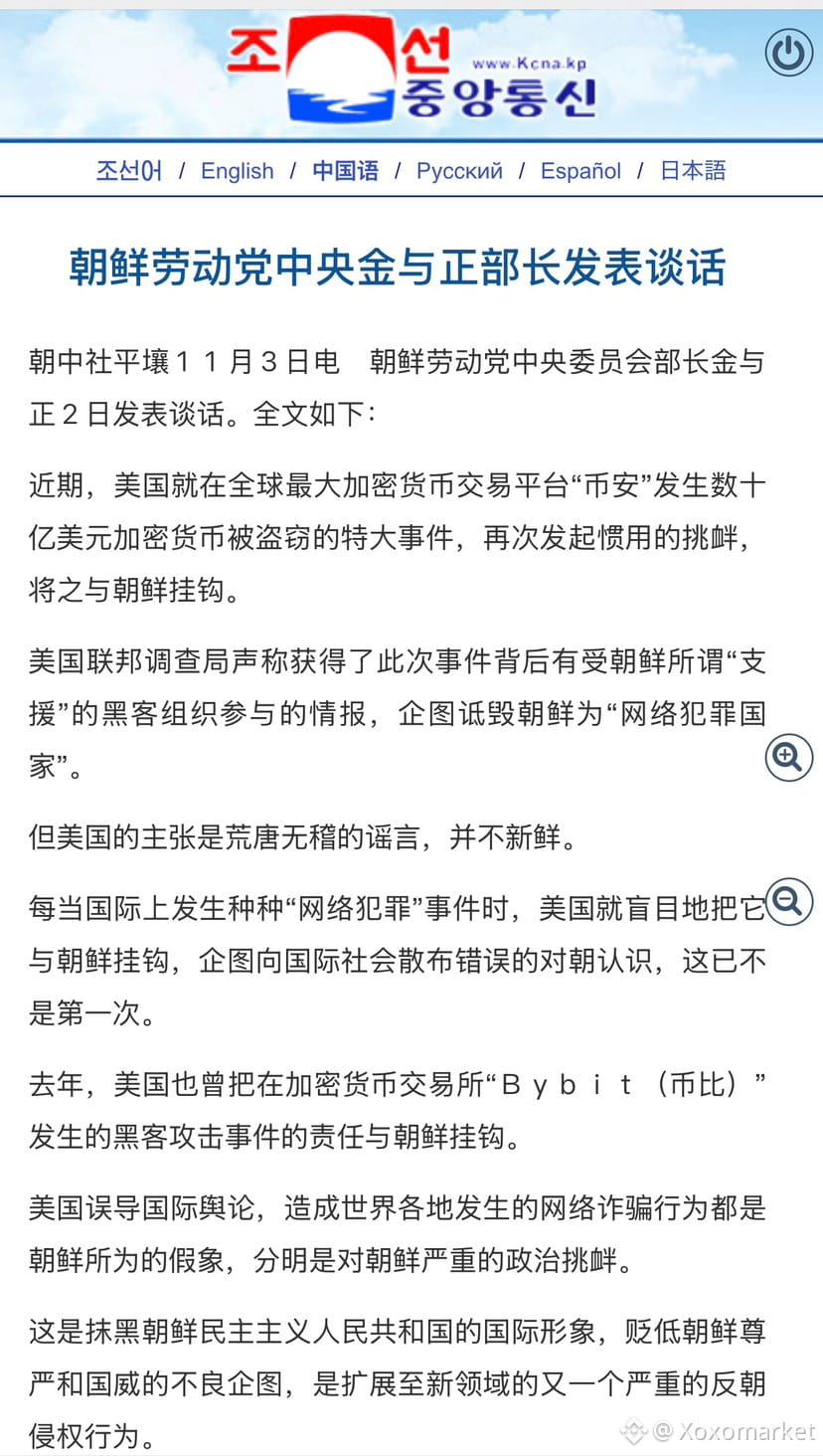
North Korea denies the FBI's claim that North Korean-backed hackers were involved in the Binance crypto theft! It also denies last year's Bybit theft!
North Korea denies the FBI's claim that North Korean-backed hackers were involved in the Binance crypto theft! It also denies last year's Bybit theft!
1
362
·
--
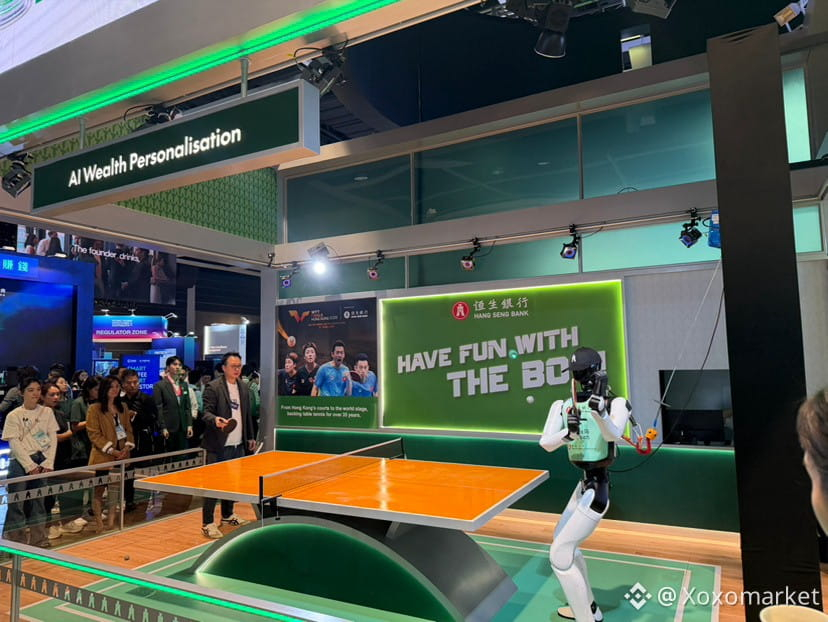
Hong Kong FinTech Week 2026. The biggest takeaway: every sector of finance is integrating deeply with AI.
Banks are exploring Agentic AI. AI is no longer just answering questions—it’s starting to carry out tasks;
Asset managers are using AI to optimize research and investment decisions;
Payments, cross-border settlement, digital assets, and RWA tokenization are also converging at an accelerating pace.
Today, the HKMA launched Project SAGE to advance the application and governance of AI in finance. HSBC also announced plans to establish an AI research institute in Hong Kong in the first quarter of 2027.
These signals show that AI is no longer just a story about tech companies—it is transforming the entire financial industry.
In the past, financial institutions competed on capital, distribution channels, and information advantages. In the future, AI capabilities, data quality, and execution efficiency may become the new competitive barriers.
Of course, the more powerful the technology, the more important risk governance becomes.
The real opportunities ahead lie not only in investing in AI, but also in finding real-world applications that bring AI together with finance, asset management, payments, and Web3.
#FinTechWeek2026 #AI #Web3
HSBCUS-0.95%
71
·
--
Verified
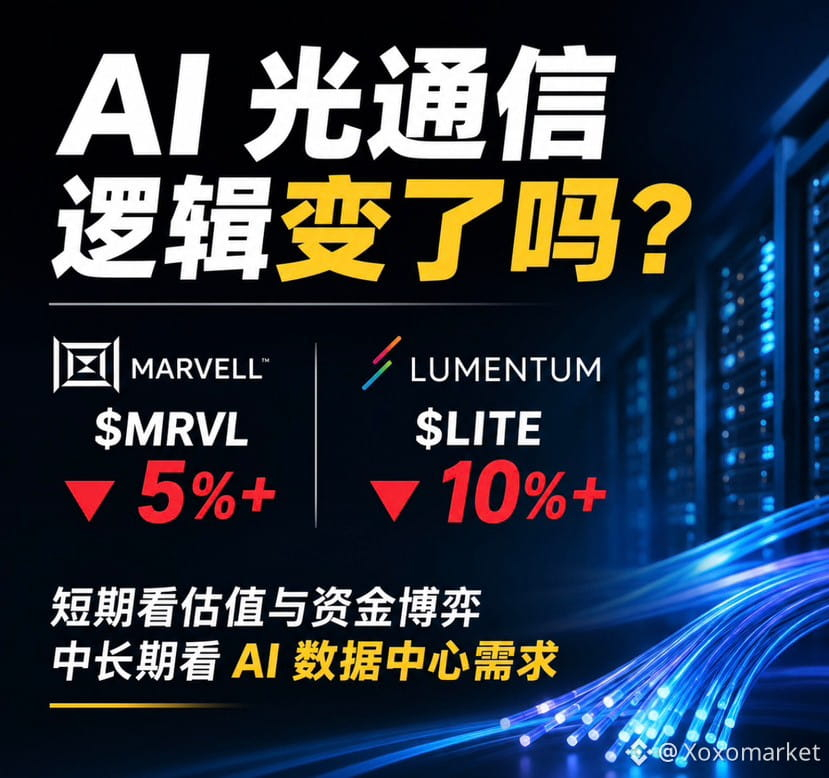
Optical communications giants plunge! Has the AI optical communications story changed?
During U.S. trading, Marvell $MRVL fell more than 5%, while Lumentum $LITE dropped over 10%.
The catalyst was the announcement that the two companies had reached an all-stock acquisition agreement worth approximately $115 billion.
The market is also concerned: Can a merger and acquisition deal of this scale deliver on its promises, given the potential for share dilution, integration costs, and future returns?
In the short term, it comes down to valuations and capital flows. Over the medium to long term, the focus is on actual demand from AI data centers. The industry trend toward optical interconnects is worth watching, but a promising outlook doesn't mean every price is worth paying.
Key things to watch next: AI capital expenditure, optical communications orders, earnings delivery, and whether the sector can find a floor and stabilize.
#Ai #光通信 #Marvell
1
2.5k
·
--
ETH has become hackers’ getaway car! Yet another institution has been hacked.
Funds in an EU institution’s accounts at several exchanges were allegedly withdrawn illegally, with losses exceeding $106 million!
The hackers used the same method: after withdrawing the funds, they swapped them on-chain for ETH (Ethereum), which cannot be frozen, then began frantically laundering the money across multiple chains.
#ETH #黑客攻击 #CryptoTheft
1
1
841
·
--
Verified
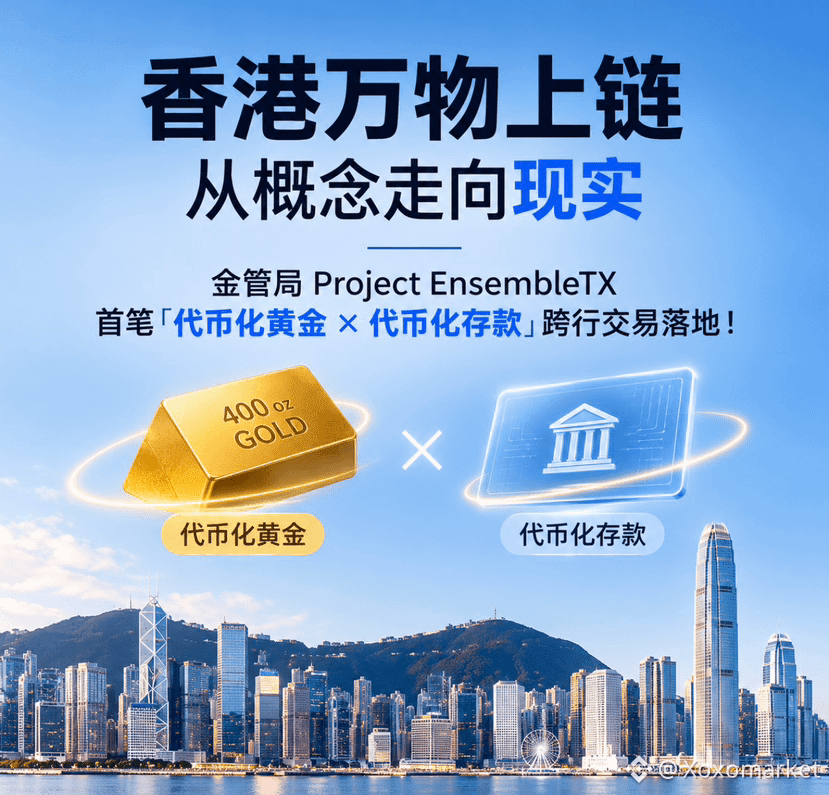
Tokenizing everything in Hong Kong is moving from concept to reality!
The first interbank transaction under the Hong Kong Monetary Authority’s Project EnsembleTX—combining “tokenized gold × tokenized deposits”—has been completed!
Each gold token represents an allocated interest in a standard 400-ounce gold bar, held in a Hong Kong vault and referenced to Hong Kong’s gold benchmark price, HAU.
Previously, China Asset Management and a subsidiary of Futu had launched tokenized funds.
From funds to gold, Hong Kong is accelerating the on-chain tokenization of traditional assets.
In the future, as assets move on-chain and payments are settled on-chain, Hong Kong’s goal is not just financial innovation—it is a voice in shaping the next generation of global financial infrastructure!
XAU-0.61%
FUTUUS+2.44%
2
2.3k
·
--
Verified
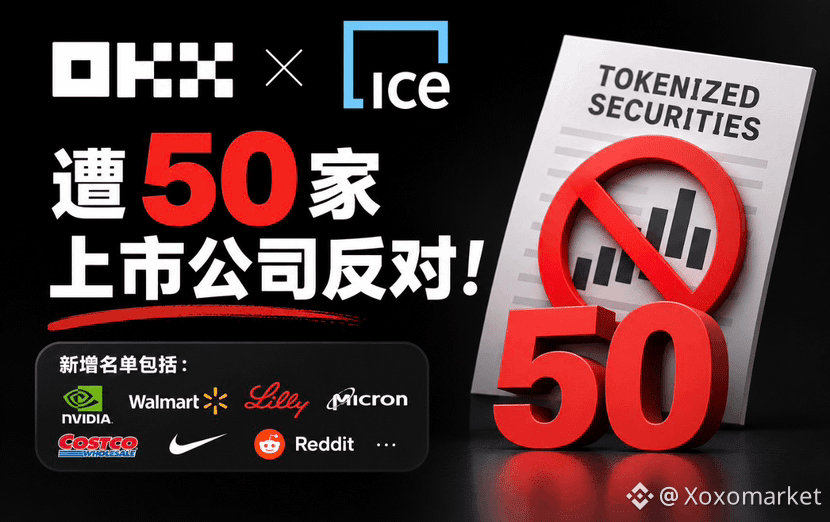
OKX × ICE Tokenized Securities Platform Faces Opposition from 50 Public Companies!
Newly added companies opposing it include:
Well-known companies such as Nvidia, Walmart, Eli Lilly, Micron, Costco, Nike, and Reddit
The latest notice, dated October 30, shows that the number of issuers opposing stock tokenization trading on the OKXICE TSV platform has risen to 50, up from 33 on October 27.
This sends an important signal:
The crypto industry wants to bring traditional stocks on-chain, but public companies may not be willing to cooperate.
The core conflict around stock tokenization is not just a technical issue. It also involves shareholder rights, brand licensing, regulatory compliance, and whether token holders truly own the rights to the underlying stocks.
If more and more issuers explicitly oppose it, the platform’s ability to continue expanding its asset coverage will be put to the test.
More importantly, who will lead the tokenized securities of the future: crypto platforms, or traditional exchanges and issuers?
#ICE #TokenizedStocks
3
1.6k
·
--
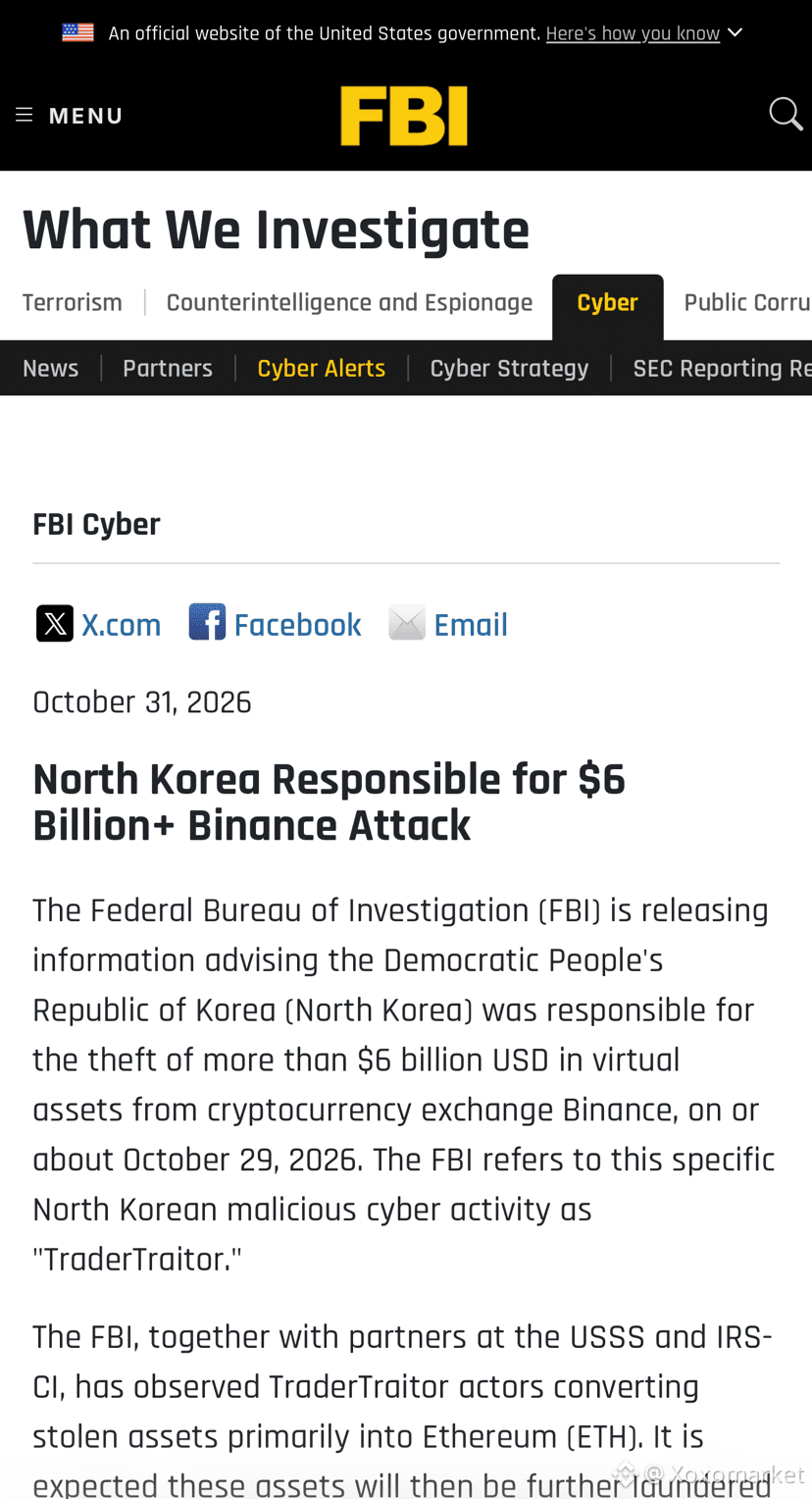
North Korea Responsible for the $6 Billion+ Binance Attack
The Federal Bureau of Investigation (FBI) is releasing information advising that the Democratic People’s Republic of Korea (North Korea) was responsible for the theft of more than $6 billion USD in virtual assets from cryptocurrency exchange Binance on or about October 29, 2026. The FBI refers to this specific North Korean malicious cyber activity as “TraderTraitor.”
The FBI, together with partners at the USSS and IRS-CI, has observed TraderTraitor actors converting stolen assets primarily into Ethereum (ETH). These assets are expected to be further laundered through conversion using DeFi and instant swap services as the actors prepare them for subsequent stages of laundering.
https://www.fbi.gov/investigate/cyber/alerts/2026/north-korea-responsible-for-6-billion-binance-attack/layout_view
North Korea Responsible for $6 Billion+ Binance Attack
The Federal Bureau of Investigation (FBI) is releasing information advising the Democratic People's Republic of Korea (North Korea) was responsible for the theft of more than $6 billion USD in virtual assets from cryptocurrency exchange Binance, on or about October 29, 2026. The FBI refers to this specific North Korean malicious cyber activity as "TraderTraitor."
The FBI, together with partners at the USSS and IRS-CI, has observed TraderTraitor actors converting stolen assets primarily into Ethereum (ETH). It is expected these assets will then be further laundered by converting them using DeFi and instant swap services as they prepare them for further laundering stages.
1
2.4k
·
--
Verified
How HYPE surged—and how it fell back down 🤣
The NYSE’s parent company, ICE, has now deleted its earlier tweet announcing its partnership with Trade.xyz. It has still kept the retweet of Trade.xyz’s promotional post.
https://x.com/ice_markets/status/2115773061613883803
ICE deletes partnership tweet. Short term: the positive news may already be priced in, and profit-takers could exit.
After the NYSE’s parent company, ICE, and Trade[XYZ] announced their partnership, HYPE surged sharply. The market quickly began trading on a bigger narrative:
A traditional finance giant is entering the space, giving Hyperliquid a chance to break into the U.S. regulated derivatives market!
ICE has deleted its earlier partnership tweet, while the related retweet remains up. The official announcement on its website has also not been taken down.
We can’t conclude from this alone that the partnership has been canceled, but it has at least cast a shadow over short-term market sentiment.
Investors had been trading on expectations of backing from a traditional finance giant. If the market starts to question when the partnership will come to fruition, buyers who chased the rally may take profits first. A rapid, news-driven surge may also be accompanied by a sharper pullback.
Keep watching over the medium to long term.
The market can reprice on the back of a tweet—and it can reassess its expectations because of one, too.
Positive news can be priced in early, but ultimately, real value must be delivered through performance and execution.
$HYPE
HYPE+1.53%
ICEUS-1.13%
1
780
·
--
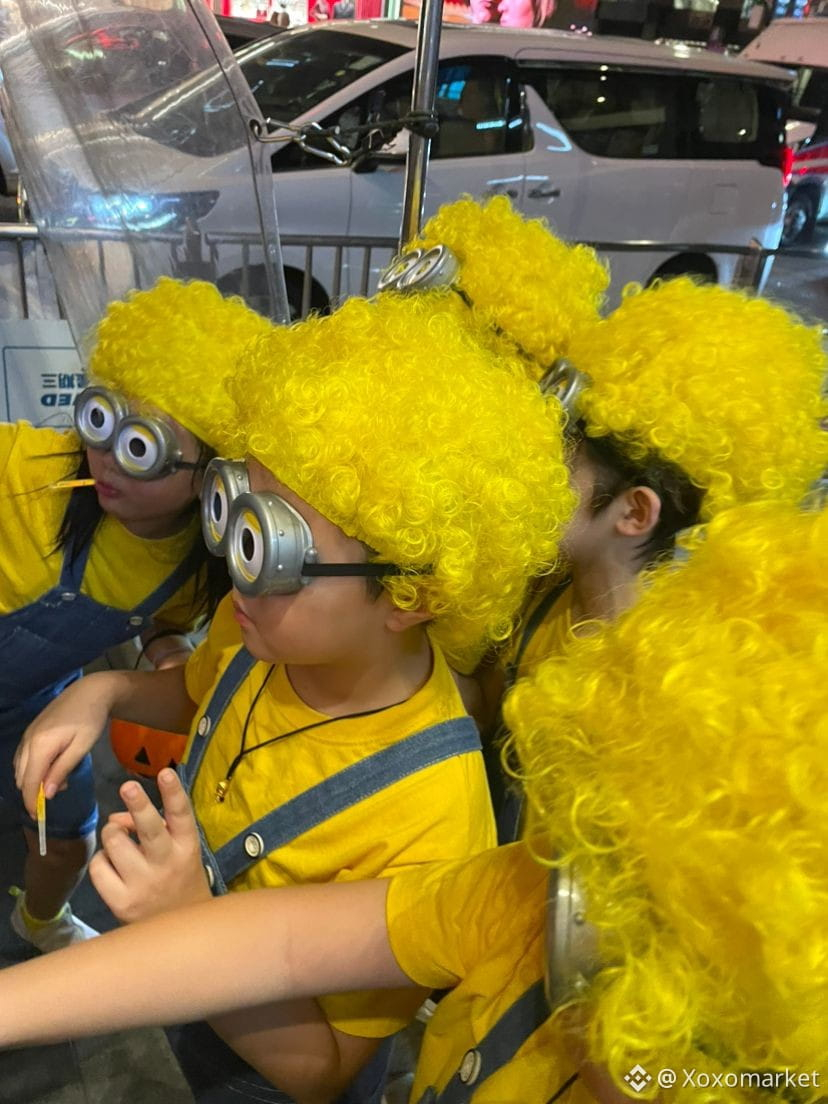
Halloween 🎃 has such a great atmosphere! But… there’s no way I’m going to Lan Kwai Fong!!!
#Halloween
Halloween 🎃 has such a great atmosphere! But… there’s no way I’m going to Lan Kwai Fong!!!
#Halloween
#Halloween



247
·
--
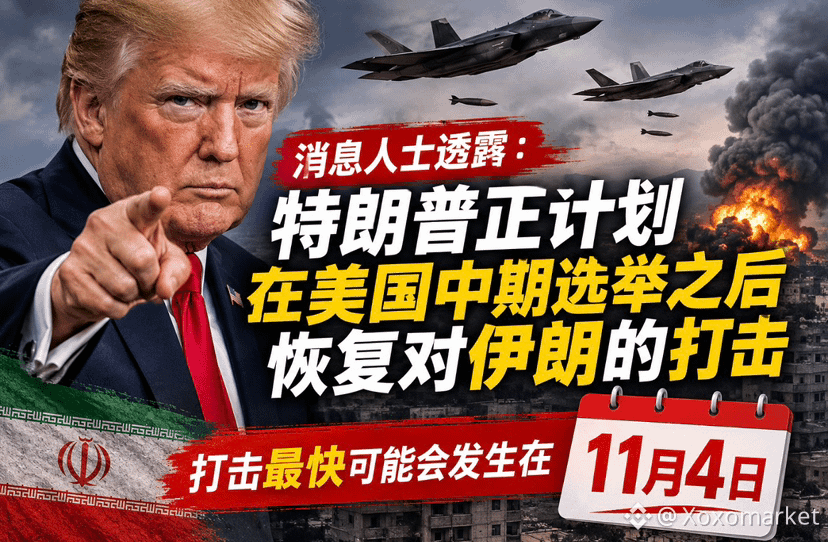
Come on! Let the storm rage even more fiercely!!!
Come on! Let the storm rage even more fiercely!!!
2
459
·
--
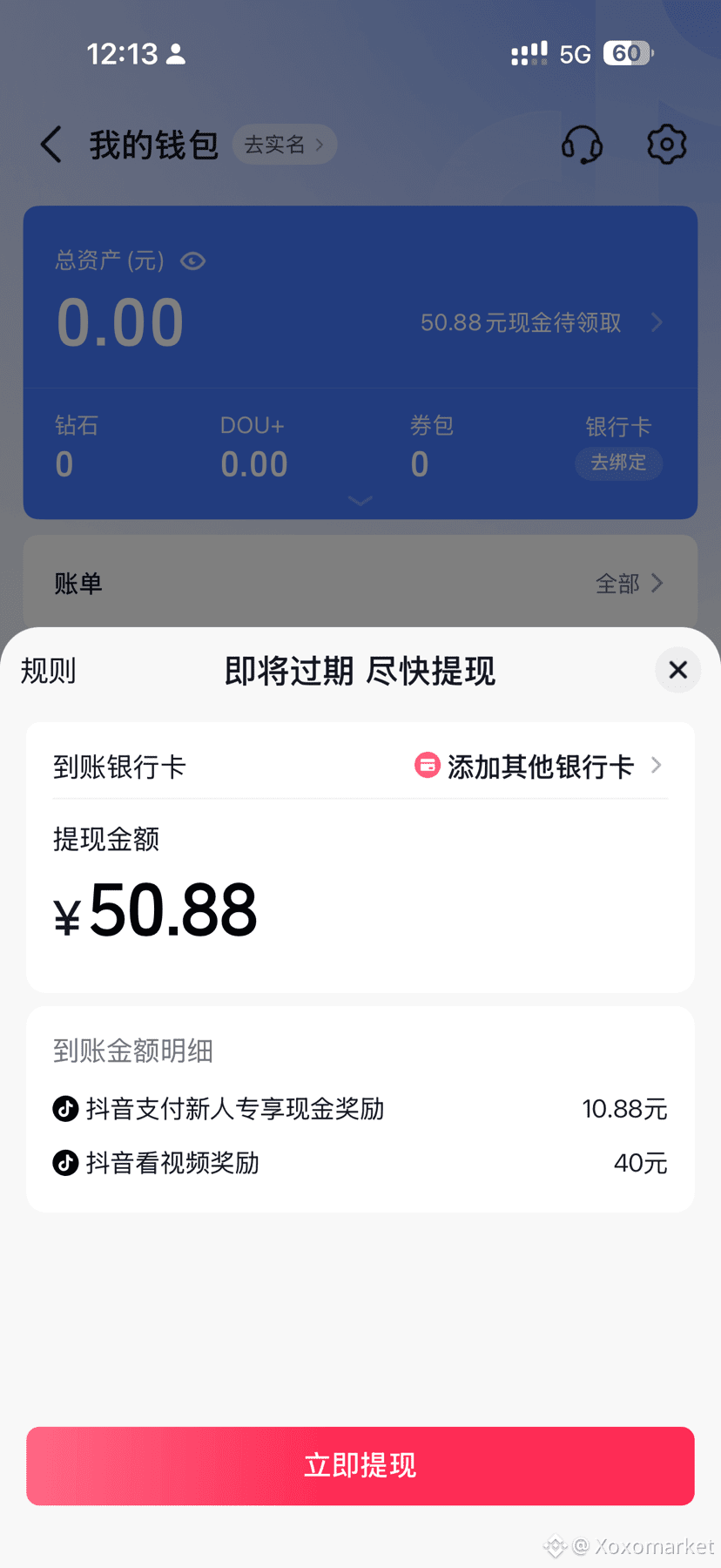
I signed up for Douyin with a new number and was about to post… Then I noticed there was still a balance of 50 yuan 😂 Is it like this for everyone? Hurry and sign up…
I signed up for Douyin with a new number and was about to post… Then I noticed there was still a balance of 50 yuan 😂 Is it like this for everyone? Hurry and sign up…
2
3.3k
·
--
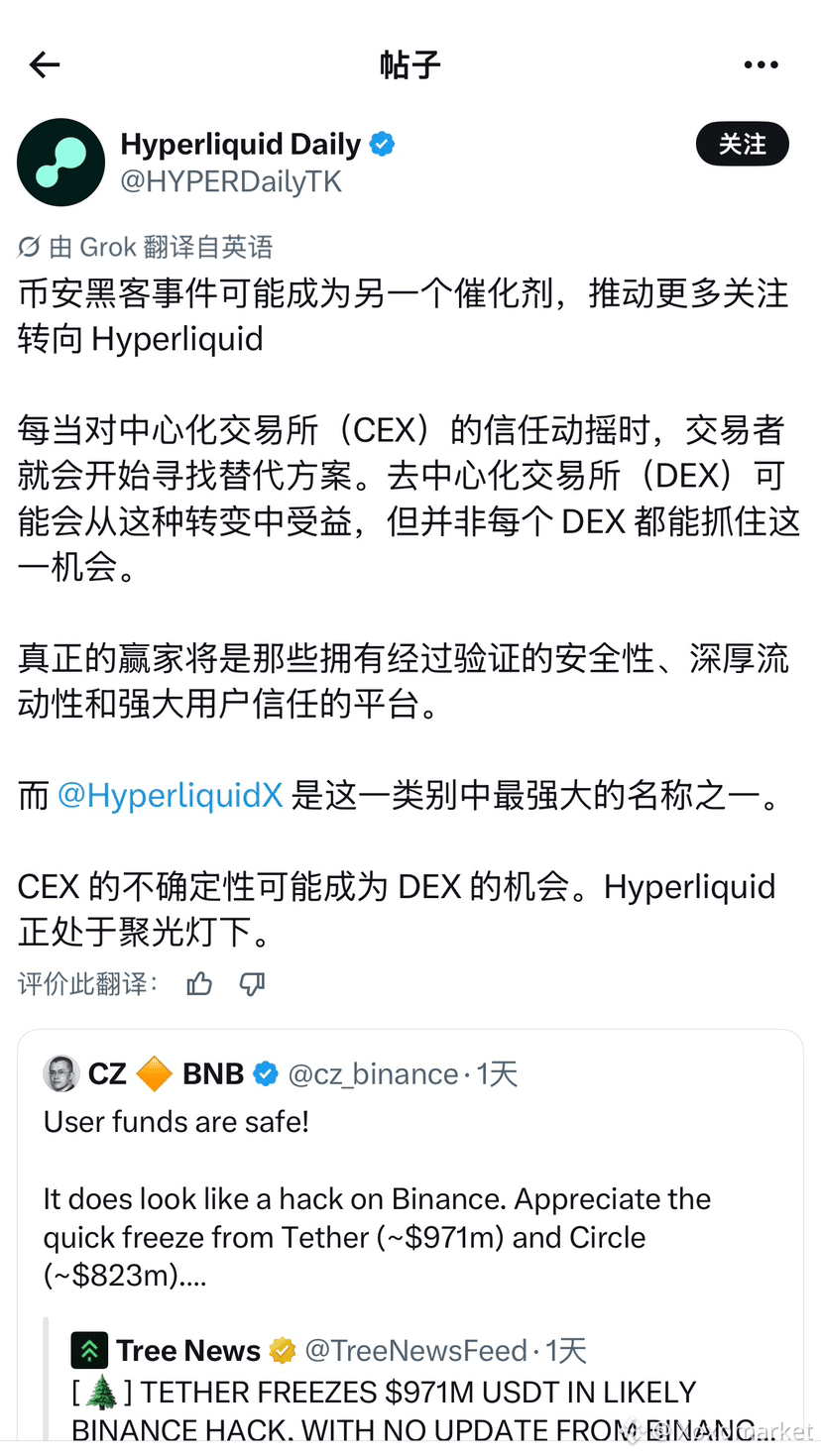
Hype, isn't it a bit unethical to stir things up at a time like this!
It's not cool to kick someone when they're down...
$BNB $HYPE
Hype, isn't it a bit unethical to stir things up at a time like this!
It's not cool to kick someone when they're down...
$BNB $HYPE
It's not cool to kick someone when they're down...
$BNB $HYPE
71
1
43
46.3k
·
--
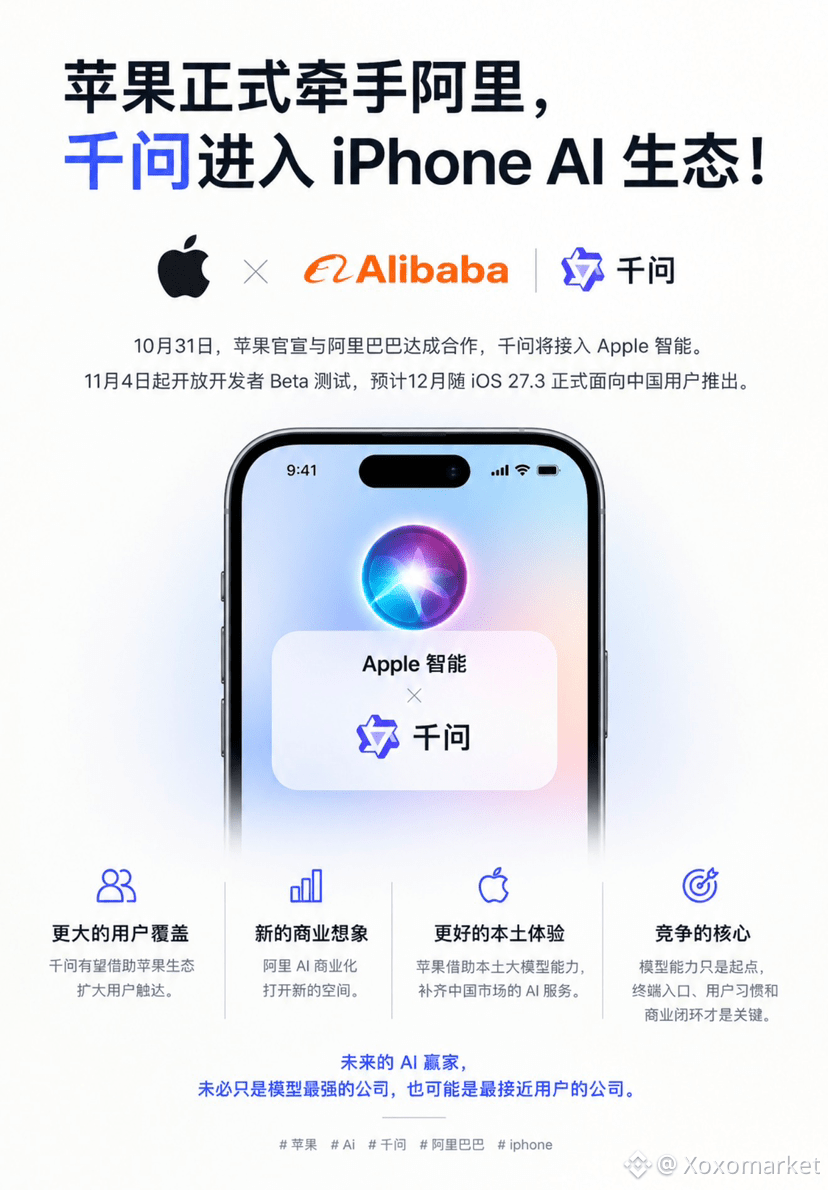
Apple officially partners with Alibaba, bringing Qianwen into the iPhone AI ecosystem! $BABA
On October 31, Apple announced a partnership with Alibaba, with Qianwen set to integrate with Apple Intelligence.
Developer beta testing opens on November 4, with a full rollout to users in China expected in December alongside iOS 27.3.
The AI competition is shifting from “whose model is stronger” to “who can truly reach users.”
Qianwen could leverage Apple’s ecosystem to reach more users, opening up new possibilities for AI commercialization. Apple can draw on local large language models to improve the AI service experience in the Chinese market.
Model capabilities are just the starting point. Device access, user habits, and a viable business loop will be at the heart of the next phase of competition. The AI winners of the future may not be the companies with the strongest models, but the ones closest to their users.
$AAPLB
#苹果 #Aİ #千问 #阿里巴巴 #iphone
1
3
1.9k
·
--
Verified
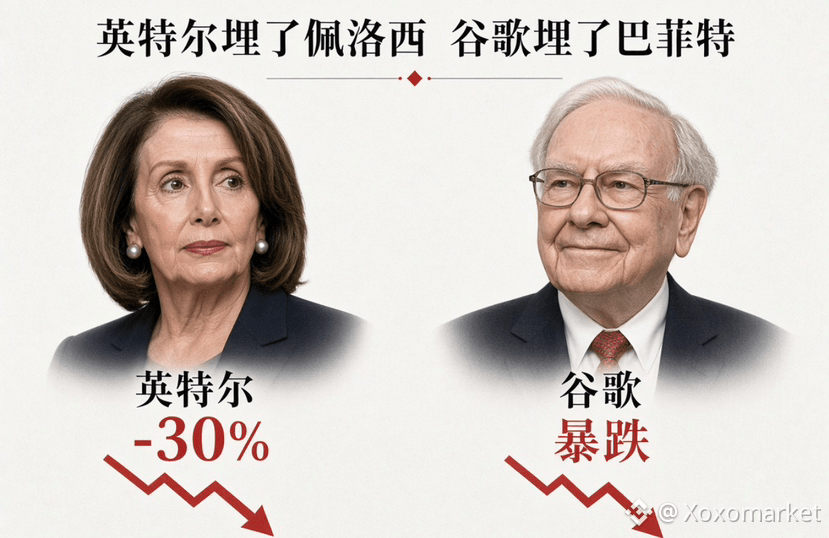
One is America’s most-watched “queen of congressional stock trading”
The other is the “Oracle of Omaha” of value investing
In the end, Intel plunged nearly 30%, dealing a major blow to Pelosi’s faith in tech stocks. Google plunged after its earnings report, putting the conflict between massive AI investments and returns on capital squarely before Buffett.
Even the once-dazzling halo of the “Oracle” must fade in the face of the market.
The capital markets have never believed in anyone’s fame; they believe only in performance, expectations, and real returns.
You can believe in the Oracle, but don’t ever hand over your own account to one.
They’re buying the future, but you’re the one who bears the drawdown.
$INTC $GOOGLB
879
·
--
Verified
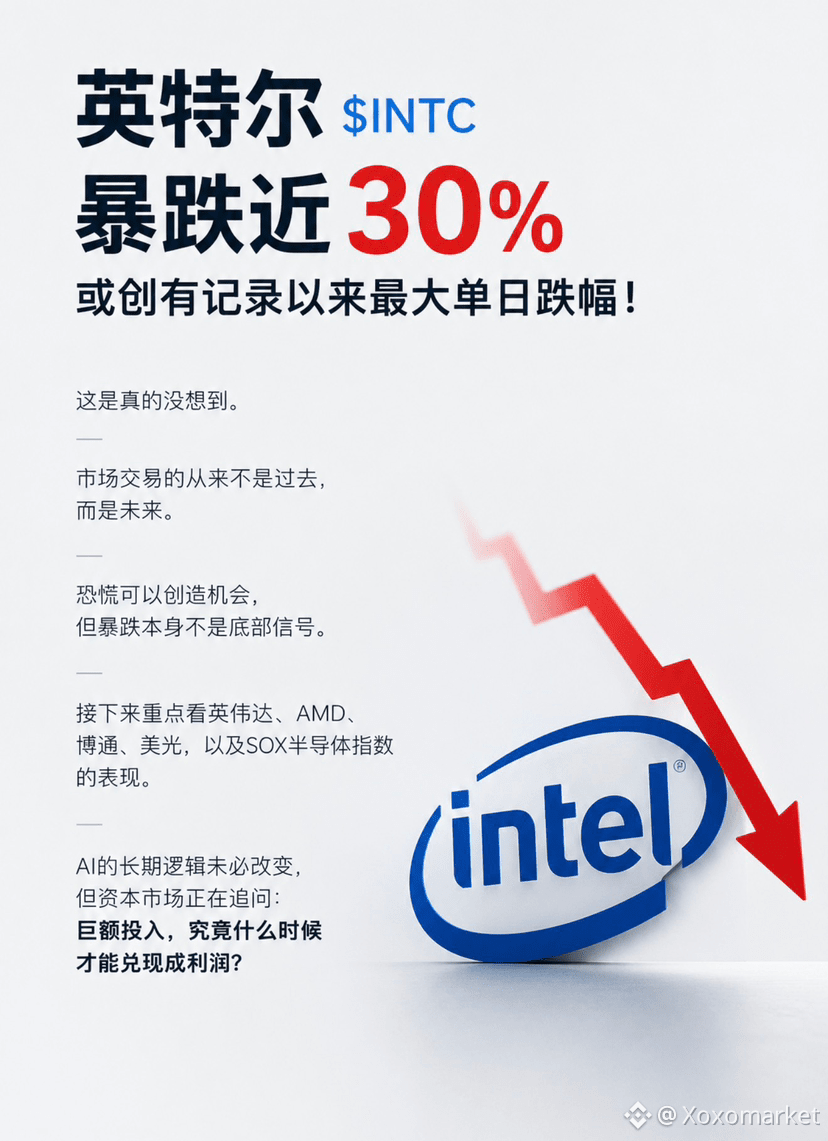
Intel $INTC plunges nearly 30%, potentially its biggest single-day drop on record!
I really didn’t see this coming! U.S. stocks are turning into memes…
Markets have never traded on the past, but on the future.
Panic can create opportunities, but a sharp sell-off in itself is not a signal that the bottom is in.
Next, keep a close eye on Nvidia, AMD, Broadcom, Micron, and the performance of the SOX Semiconductor Index.
The long-term AI thesis may not have changed, but capital markets are asking: when will these massive investments finally translate into profits?
1
821
Log in to explore more content
Join global crypto users on Binance Square
⚡️ Get latest and useful information about crypto.
💬 Trusted by the world’s largest crypto exchange.
👍 Discover real insights from verified creators.
Email / Phone number
Trending Topics
BinanceIncidentReport
0 views
26 Discussing
29 October 2026 Binance Security Incident: Initial Findings and Response Update
Binance Blog
·48 Likes
·111k views
BinanceReopensWithdrawalsForMoreAssets
76,279 views
1,376 Discussing
BinanceHourlyDepositsExceedWithdrawals
32,821 views
568 Discussing