
Vivi蓝心
269 Posts

Vivi蓝心
Report
Block User
撸毛博主😏
75 Following
6.7K+ Followers
751 Liked
Posts
All
Quotes
Videos
Live
·
--
❗#美国续请失业金人数177.4万 This number holds a secret the U.S. economy most doesn’t want to be seen
Last night, the U.S. jobless benefits continued claims were released: 1.774 million, slightly below expectations of 1.78 million, and down another 1,000 from the prior figure. At first glance, it looks as steady as ever.
But the “respectable” face of the numbers has always been good at disguising structural cracks. Initial claims of 206,000 and continued claims of 1.774 million are both sitting at historical lows—no fault to find. Yet the median duration of long-term unemployment is still pressing near a four-and-a-half-year high. Firms aren’t laying people off—at least not yet. But if they do, the cycle for the laid-off to land on their feet again will visibly stretch. “Low layoffs” is corporate camouflage; “slow hiring” is the real situation for workers.
When you shift your gaze from the Department of Labor’s table to the price chart (K-line), this sense of rupture shows up in another form. After the data release, Bitcoin briefly spiked from above 77,000 to $77,399, then stabilized. A year ago, the same figures would have caused BTC to swing up and down by a couple thousand dollars; now, it only took about $150 to absorb. The pricing power of unemployment benefits data over risk assets is shrinking—clearly visible to the naked eye.
Even more telling is the completely opposite answer coming from the capital side. In August, non-farm payrolls rose by 162,000—well above expectations—and the probability of a rate hike was pushed to 60% for September. Under the old script, expectations for tightening would surge, and Bitcoin should face pressure. But last week, Bitcoin spot ETF net inflows were nearly $987 million, with roughly $3.8 billion accumulated over three straight weeks. Strategy even continued adding, buying 4,603 BTC at an average price of $80,318. Higher rates and institutional buy-ins—cannot be explained by the old script.
At the root of all this is a silent migration of pricing power. In the first half of 2026, institutions accounted for 72% of Wintermute OTC spot trading volume; in the same period last year, it was only 59%. When the main buying force shifts from retail traders chasing pumps and dumping to institutions that allocate based on fundamentals, the marginal impact of macro data naturally gets diluted.
So, the number 1.774 million looks—on the surface—like a stable signal for the jobs market. But underneath, it reflects a structural worsening of reemployment difficulty. The Fed sees “no rush to cut rates.” Institutions see “the economy isn’t collapsing, and BTC can be held.” Same data, two interpretations. The market’s pricing power is no longer in the hands of those who just look at the data—it’s in the hands of those who cast votes with money. #加密市场 #加密货币 $BTC
❗#美国续请失业金人数177.4万 This number holds a secret the U.S. economy most doesn’t want to be seen
Last night, the U.S. jobless benefits continued claims were released: 1.774 million, slightly below expectations of 1.78 million, and down another 1,000 from the prior figure. At first glance, it looks as steady as ever.
But the “respectable” face of the numbers has always been good at disguising structural cracks. Initial claims of 206,000 and continued claims of 1.774 million are both sitting at historical lows—no fault to find. Yet the median duration of long-term unemployment is still pressing near a four-and-a-half-year high. Firms aren’t laying people off—at least not yet. But if they do, the cycle for the laid-off to land on their feet again will visibly stretch. “Low layoffs” is corporate camouflage; “slow hiring” is the real situation for workers.
When you shift your gaze from the Department of Labor’s table to the price chart (K-line), this sense of rupture shows up in another form. After the data release, Bitcoin briefly spiked from above 77,000 to $77,399, then stabilized. A year ago, the same figures would have caused BTC to swing up and down by a couple thousand dollars; now, it only took about $150 to absorb. The pricing power of unemployment benefits data over risk assets is shrinking—clearly visible to the naked eye.
Even more telling is the completely opposite answer coming from the capital side. In August, non-farm payrolls rose by 162,000—well above expectations—and the probability of a rate hike was pushed to 60% for September. Under the old script, expectations for tightening would surge, and Bitcoin should face pressure. But last week, Bitcoin spot ETF net inflows were nearly $987 million, with roughly $3.8 billion accumulated over three straight weeks. Strategy even continued adding, buying 4,603 BTC at an average price of $80,318. Higher rates and institutional buy-ins—cannot be explained by the old script.
At the root of all this is a silent migration of pricing power. In the first half of 2026, institutions accounted for 72% of Wintermute OTC spot trading volume; in the same period last year, it was only 59%. When the main buying force shifts from retail traders chasing pumps and dumping to institutions that allocate based on fundamentals, the marginal impact of macro data naturally gets diluted.
So, the number 1.774 million looks—on the surface—like a stable signal for the jobs market. But underneath, it reflects a structural worsening of reemployment difficulty. The Fed sees “no rush to cut rates.” Institutions see “the economy isn’t collapsing, and BTC can be held.” Same data, two interpretations. The market’s pricing power is no longer in the hands of those who just look at the data—it’s in the hands of those who cast votes with money. #加密市场 #加密货币 $BTC
Last night, the U.S. jobless benefits continued claims were released: 1.774 million, slightly below expectations of 1.78 million, and down another 1,000 from the prior figure. At first glance, it looks as steady as ever.
But the “respectable” face of the numbers has always been good at disguising structural cracks. Initial claims of 206,000 and continued claims of 1.774 million are both sitting at historical lows—no fault to find. Yet the median duration of long-term unemployment is still pressing near a four-and-a-half-year high. Firms aren’t laying people off—at least not yet. But if they do, the cycle for the laid-off to land on their feet again will visibly stretch. “Low layoffs” is corporate camouflage; “slow hiring” is the real situation for workers.
When you shift your gaze from the Department of Labor’s table to the price chart (K-line), this sense of rupture shows up in another form. After the data release, Bitcoin briefly spiked from above 77,000 to $77,399, then stabilized. A year ago, the same figures would have caused BTC to swing up and down by a couple thousand dollars; now, it only took about $150 to absorb. The pricing power of unemployment benefits data over risk assets is shrinking—clearly visible to the naked eye.
Even more telling is the completely opposite answer coming from the capital side. In August, non-farm payrolls rose by 162,000—well above expectations—and the probability of a rate hike was pushed to 60% for September. Under the old script, expectations for tightening would surge, and Bitcoin should face pressure. But last week, Bitcoin spot ETF net inflows were nearly $987 million, with roughly $3.8 billion accumulated over three straight weeks. Strategy even continued adding, buying 4,603 BTC at an average price of $80,318. Higher rates and institutional buy-ins—cannot be explained by the old script.
At the root of all this is a silent migration of pricing power. In the first half of 2026, institutions accounted for 72% of Wintermute OTC spot trading volume; in the same period last year, it was only 59%. When the main buying force shifts from retail traders chasing pumps and dumping to institutions that allocate based on fundamentals, the marginal impact of macro data naturally gets diluted.
So, the number 1.774 million looks—on the surface—like a stable signal for the jobs market. But underneath, it reflects a structural worsening of reemployment difficulty. The Fed sees “no rush to cut rates.” Institutions see “the economy isn’t collapsing, and BTC can be held.” Same data, two interpretations. The market’s pricing power is no longer in the hands of those who just look at the data—it’s in the hands of those who cast votes with money. #加密市场 #加密货币 $BTC

3k
·
--
🔥The middle-class cash cow has collapsed, yet $900 million rushed into crypto
Lululemon exploded last night—after hours it once plunged more than 20%. Second-quarter yoga pants sales fell about 20% year over year, and the full-year revenue guidance went from a prior cut to a second consecutive cut, with fiscal 2026 revenue expected to be $10.35 billion to $10.5 billion, down 5% to 7% year over year. Same-store sales in the Americas plunged 12%. The brand that once had the middle class lining up for a $900 pair of yoga pants suddenly couldn’t sell.
It’s pretty surreal when you think about it. On the same day, $900 million from Wall Street poured into Bitcoin and Ethereum ETFs. Bitcoin briefly broke above $81,000, and Ethereum climbed above $2,500. BTC ETFs saw $730 million in net inflows in a single day, setting the third-largest single-day record in 2026. Open interest in Bitcoin futures jumped to $57 billion, and more than $260 million in shorts were liquidated.
On one side, the myth of a consumer brand is collapsing; on the other, institutional money is frantically piling in.
There’s an angle here that not many people mention: consumer downgrading and crypto upgrading are happening at the same time. The price of one pair of Lululemon yoga pants is enough to buy 0.001 BTC, but the former is depreciating (same-store sales down 9%), while the latter is appreciating (rising from 76,000 back to 81,000 within the month). Middle-class purchasing power hasn’t disappeared; it’s just being repriced—from conspicuous consumption toward productive assets.
What’s even harsher is that this BTC rally wasn’t built on leverage—the funding rate was only +0.0088%. This was genuine traditional capital entering the market. As the moat around consumer brands gets chipped away by competitors like Alo and Vuori, Bitcoin’s “digital gold” narrative is becoming increasingly compelling in the eyes of institutions.
Lululemon’s new CEO doesn’t officially take office until next Monday, and he’s facing a mountain. Meanwhile, in the crypto market, $900 million of institutional money has already voted with its feet.
The story of consumer brands is ebbing; the story of crypto assets is rising. On the escalator of the times, going up and going down have never been on the same floor.#Lululemon因指引疲软跌20% $BTC
{spot}(BTCUSDT)
#加密货币 #加密市场
🔥The middle-class cash cow has collapsed, yet $900 million rushed into crypto
Lululemon exploded last night—after hours it once plunged more than 20%. Second-quarter yoga pants sales fell about 20% year over year, and the full-year revenue guidance went from a prior cut to a second consecutive cut, with fiscal 2026 revenue expected to be $10.35 billion to $10.5 billion, down 5% to 7% year over year. Same-store sales in the Americas plunged 12%. The brand that once had the middle class lining up for a $900 pair of yoga pants suddenly couldn’t sell.
It’s pretty surreal when you think about it. On the same day, $900 million from Wall Street poured into Bitcoin and Ethereum ETFs. Bitcoin briefly broke above $81,000, and Ethereum climbed above $2,500. BTC ETFs saw $730 million in net inflows in a single day, setting the third-largest single-day record in 2026. Open interest in Bitcoin futures jumped to $57 billion, and more than $260 million in shorts were liquidated.
On one side, the myth of a consumer brand is collapsing; on the other, institutional money is frantically piling in.
There’s an angle here that not many people mention: consumer downgrading and crypto upgrading are happening at the same time. The price of one pair of Lululemon yoga pants is enough to buy 0.001 BTC, but the former is depreciating (same-store sales down 9%), while the latter is appreciating (rising from 76,000 back to 81,000 within the month). Middle-class purchasing power hasn’t disappeared; it’s just being repriced—from conspicuous consumption toward productive assets.
What’s even harsher is that this BTC rally wasn’t built on leverage—the funding rate was only +0.0088%. This was genuine traditional capital entering the market. As the moat around consumer brands gets chipped away by competitors like Alo and Vuori, Bitcoin’s “digital gold” narrative is becoming increasingly compelling in the eyes of institutions.
Lululemon’s new CEO doesn’t officially take office until next Monday, and he’s facing a mountain. Meanwhile, in the crypto market, $900 million of institutional money has already voted with its feet.
The story of consumer brands is ebbing; the story of crypto assets is rising. On the escalator of the times, going up and going down have never been on the same floor.#Lululemon因指引疲软跌20% $BTC
#加密货币 #加密市场
Lululemon exploded last night—after hours it once plunged more than 20%. Second-quarter yoga pants sales fell about 20% year over year, and the full-year revenue guidance went from a prior cut to a second consecutive cut, with fiscal 2026 revenue expected to be $10.35 billion to $10.5 billion, down 5% to 7% year over year. Same-store sales in the Americas plunged 12%. The brand that once had the middle class lining up for a $900 pair of yoga pants suddenly couldn’t sell.
It’s pretty surreal when you think about it. On the same day, $900 million from Wall Street poured into Bitcoin and Ethereum ETFs. Bitcoin briefly broke above $81,000, and Ethereum climbed above $2,500. BTC ETFs saw $730 million in net inflows in a single day, setting the third-largest single-day record in 2026. Open interest in Bitcoin futures jumped to $57 billion, and more than $260 million in shorts were liquidated.
On one side, the myth of a consumer brand is collapsing; on the other, institutional money is frantically piling in.
There’s an angle here that not many people mention: consumer downgrading and crypto upgrading are happening at the same time. The price of one pair of Lululemon yoga pants is enough to buy 0.001 BTC, but the former is depreciating (same-store sales down 9%), while the latter is appreciating (rising from 76,000 back to 81,000 within the month). Middle-class purchasing power hasn’t disappeared; it’s just being repriced—from conspicuous consumption toward productive assets.
What’s even harsher is that this BTC rally wasn’t built on leverage—the funding rate was only +0.0088%. This was genuine traditional capital entering the market. As the moat around consumer brands gets chipped away by competitors like Alo and Vuori, Bitcoin’s “digital gold” narrative is becoming increasingly compelling in the eyes of institutions.
Lululemon’s new CEO doesn’t officially take office until next Monday, and he’s facing a mountain. Meanwhile, in the crypto market, $900 million of institutional money has already voted with its feet.
The story of consumer brands is ebbing; the story of crypto assets is rising. On the escalator of the times, going up and going down have never been on the same floor.#Lululemon因指引疲软跌20% $BTC
#加密货币 #加密市场

451
·
--
The market this week is really on fire! Bitcoin jumped straight through the $77,000 mark on Friday, and surged nearly 20% over the week. This is being called the “best weekly performance since March 2023”—and it’s not an exaggeration at all. Back in the week of March 2023, Bitcoin had skyrocketed more than 35% in a single week because Silicon Valley Bank collapsed. That time was an “all-risk flight” rally—this time is different. This time, three forces are detonating at the same time:
First, the Fed caved—money is about to get softer. The U.S. Treasury announced it would directly double the scale of its long-term Treasury buybacks to $4 billion per operation. In plain terms, the authorities are stepping in to buy long-term Treasuries and suppress yields. The 30-year U.S. Treasury yield just pushed up to 5.337%. This move is basically telling the market, “we’re scared.” Once the floodgates of liquidity expectations open, Bitcoin and other hard assets wouldn’t go up would be impossible.
Second, the shorts got swept away. Bitcoin traded sideways between $62,000 and $66,900 for a full six weeks. The shorts thought things were stable and piled on aggressively. Then once the price broke out, shorts were liquidated in a single day totaling $1.42 billion, and the entire crypto market racked up liquidations of $2.74 billion altogether. This isn’t a rise—it’s a “shorts’ graveyard.”
Third, regulators finally see some light. On August 18, the SEC released a proposal on “crypto-asset regulation.” The very next day, Trump called together more than 20 industry heavyweights at the White House—including the CEOs of Coinbase and Robinhood, and the Winklevoss brothers—to directly pressure Congress to pass the “Clear Act.” Although there are still differences in the Senate, the executive branch is already accelerating action.
What’s different this time from previous rallies is that the fundamentals are genuinely getting better. ETF inflows have been sucking in nearly $1 billion over three days, and institutions like BlackRock are buying with real money. On the technical side, Bitcoin’s daily chart has broken above both the 120-day and 200-day moving averages, and the weekly chart has broken above the 20-week moving average. Some analysts even say, “the bearish trend has officially ended.”
Of course, Bitcoin is still about 40% away from its all-time high of $126,000, and there’s plenty of supply ahead. But personally, I think as long as fiscal policy and regulatory trends don’t change, this move won’t end easily.
My advice: if you already have positions, hold steady—don’t get shaken out halfway; if you want to get in, wait for a pullback and build gradually instead of FOMO-chasing the highs; and for leveraged players, make sure you control your position size—this volatility is not something to mess around with.#比特币创2023年3月来最佳周表现 $BTC #比特币日内触及75500美元
{spot}(BTCUSDT)
The market this week is really on fire! Bitcoin jumped straight through the $77,000 mark on Friday, and surged nearly 20% over the week. This is being called the “best weekly performance since March 2023”—and it’s not an exaggeration at all. Back in the week of March 2023, Bitcoin had skyrocketed more than 35% in a single week because Silicon Valley Bank collapsed. That time was an “all-risk flight” rally—this time is different. This time, three forces are detonating at the same time:
First, the Fed caved—money is about to get softer. The U.S. Treasury announced it would directly double the scale of its long-term Treasury buybacks to $4 billion per operation. In plain terms, the authorities are stepping in to buy long-term Treasuries and suppress yields. The 30-year U.S. Treasury yield just pushed up to 5.337%. This move is basically telling the market, “we’re scared.” Once the floodgates of liquidity expectations open, Bitcoin and other hard assets wouldn’t go up would be impossible.
Second, the shorts got swept away. Bitcoin traded sideways between $62,000 and $66,900 for a full six weeks. The shorts thought things were stable and piled on aggressively. Then once the price broke out, shorts were liquidated in a single day totaling $1.42 billion, and the entire crypto market racked up liquidations of $2.74 billion altogether. This isn’t a rise—it’s a “shorts’ graveyard.”
Third, regulators finally see some light. On August 18, the SEC released a proposal on “crypto-asset regulation.” The very next day, Trump called together more than 20 industry heavyweights at the White House—including the CEOs of Coinbase and Robinhood, and the Winklevoss brothers—to directly pressure Congress to pass the “Clear Act.” Although there are still differences in the Senate, the executive branch is already accelerating action.
What’s different this time from previous rallies is that the fundamentals are genuinely getting better. ETF inflows have been sucking in nearly $1 billion over three days, and institutions like BlackRock are buying with real money. On the technical side, Bitcoin’s daily chart has broken above both the 120-day and 200-day moving averages, and the weekly chart has broken above the 20-week moving average. Some analysts even say, “the bearish trend has officially ended.”
Of course, Bitcoin is still about 40% away from its all-time high of $126,000, and there’s plenty of supply ahead. But personally, I think as long as fiscal policy and regulatory trends don’t change, this move won’t end easily.
My advice: if you already have positions, hold steady—don’t get shaken out halfway; if you want to get in, wait for a pullback and build gradually instead of FOMO-chasing the highs; and for leveraged players, make sure you control your position size—this volatility is not something to mess around with.#比特币创2023年3月来最佳周表现 $BTC #比特币日内触及75500美元
First, the Fed caved—money is about to get softer. The U.S. Treasury announced it would directly double the scale of its long-term Treasury buybacks to $4 billion per operation. In plain terms, the authorities are stepping in to buy long-term Treasuries and suppress yields. The 30-year U.S. Treasury yield just pushed up to 5.337%. This move is basically telling the market, “we’re scared.” Once the floodgates of liquidity expectations open, Bitcoin and other hard assets wouldn’t go up would be impossible.
Second, the shorts got swept away. Bitcoin traded sideways between $62,000 and $66,900 for a full six weeks. The shorts thought things were stable and piled on aggressively. Then once the price broke out, shorts were liquidated in a single day totaling $1.42 billion, and the entire crypto market racked up liquidations of $2.74 billion altogether. This isn’t a rise—it’s a “shorts’ graveyard.”
Third, regulators finally see some light. On August 18, the SEC released a proposal on “crypto-asset regulation.” The very next day, Trump called together more than 20 industry heavyweights at the White House—including the CEOs of Coinbase and Robinhood, and the Winklevoss brothers—to directly pressure Congress to pass the “Clear Act.” Although there are still differences in the Senate, the executive branch is already accelerating action.
What’s different this time from previous rallies is that the fundamentals are genuinely getting better. ETF inflows have been sucking in nearly $1 billion over three days, and institutions like BlackRock are buying with real money. On the technical side, Bitcoin’s daily chart has broken above both the 120-day and 200-day moving averages, and the weekly chart has broken above the 20-week moving average. Some analysts even say, “the bearish trend has officially ended.”
Of course, Bitcoin is still about 40% away from its all-time high of $126,000, and there’s plenty of supply ahead. But personally, I think as long as fiscal policy and regulatory trends don’t change, this move won’t end easily.
My advice: if you already have positions, hold steady—don’t get shaken out halfway; if you want to get in, wait for a pullback and build gradually instead of FOMO-chasing the highs; and for leveraged players, make sure you control your position size—this volatility is not something to mess around with.#比特币创2023年3月来最佳周表现 $BTC #比特币日内触及75500美元

2
1
4.4k
·
--
When I recently read the Dusk whitepaper, I had a strong feeling: this project may not be the best at telling stories, but the problems it aims to solve are, in fact, issues that the future financial markets can’t avoid.
Over the past few years, many chains have been shouting “faster, cheaper, more open.” After hearing it so often, the market has gotten a bit numb. TPS keeps climbing one after another, but when it comes to getting banks, securities firms, and institutional assets onto the chain, the question becomes—who would be willing to expose all sensitive trading data entirely on-chain? Transparency has its value, but the financial world isn’t a朋友圈, and not everything is suitable to be made public.
One thing about Dusk that I appreciate more is that it doesn’t simply treat “privacy” as a marketing label. Instead, it tries to find a balance between privacy and regulation. It uses the Phoenix trading model with zero-knowledge proofs to hide trading details, while still keeping an account model like Moonlight, so different scenarios can be supported flexibly.
To be honest, when I research projects like this, I often feel a kind of contradiction. On the one hand, the privacy track sounds exciting, but in the past many privacy projects have remained within niche circles. On the other hand, if in the future RWA, securities, and institutional capital really move onto the chain at scale, privacy and compliance could end up becoming essential infrastructure. That’s the direction Dusk is betting on.
Of course, I won’t blindly go bullish just because the whitepaper looks good. Technology is only the starting point—ecosystem, developers, and real-world applications determine the ultimate value. But the market can be quite interesting sometimes: people chase stories that have already exploded, yet they often overlook projects that laid the groundwork years ahead of time.
What Dusk feels like to me now is more like a seed planted early. The question is: when traditional finance truly embraces blockchain, will the market reward those who create hot topics, or those who solve problems in advance?
#dusk $DUSK @Dusk_Foundation
{spot}(DUSKUSDT)
When I recently read the Dusk whitepaper, I had a strong feeling: this project may not be the best at telling stories, but the problems it aims to solve are, in fact, issues that the future financial markets can’t avoid.
Over the past few years, many chains have been shouting “faster, cheaper, more open.” After hearing it so often, the market has gotten a bit numb. TPS keeps climbing one after another, but when it comes to getting banks, securities firms, and institutional assets onto the chain, the question becomes—who would be willing to expose all sensitive trading data entirely on-chain? Transparency has its value, but the financial world isn’t a朋友圈, and not everything is suitable to be made public.
One thing about Dusk that I appreciate more is that it doesn’t simply treat “privacy” as a marketing label. Instead, it tries to find a balance between privacy and regulation. It uses the Phoenix trading model with zero-knowledge proofs to hide trading details, while still keeping an account model like Moonlight, so different scenarios can be supported flexibly.
To be honest, when I research projects like this, I often feel a kind of contradiction. On the one hand, the privacy track sounds exciting, but in the past many privacy projects have remained within niche circles. On the other hand, if in the future RWA, securities, and institutional capital really move onto the chain at scale, privacy and compliance could end up becoming essential infrastructure. That’s the direction Dusk is betting on.
Of course, I won’t blindly go bullish just because the whitepaper looks good. Technology is only the starting point—ecosystem, developers, and real-world applications determine the ultimate value. But the market can be quite interesting sometimes: people chase stories that have already exploded, yet they often overlook projects that laid the groundwork years ahead of time.
What Dusk feels like to me now is more like a seed planted early. The question is: when traditional finance truly embraces blockchain, will the market reward those who create hot topics, or those who solve problems in advance?
#dusk $DUSK @Dusk
Over the past few years, many chains have been shouting “faster, cheaper, more open.” After hearing it so often, the market has gotten a bit numb. TPS keeps climbing one after another, but when it comes to getting banks, securities firms, and institutional assets onto the chain, the question becomes—who would be willing to expose all sensitive trading data entirely on-chain? Transparency has its value, but the financial world isn’t a朋友圈, and not everything is suitable to be made public.
One thing about Dusk that I appreciate more is that it doesn’t simply treat “privacy” as a marketing label. Instead, it tries to find a balance between privacy and regulation. It uses the Phoenix trading model with zero-knowledge proofs to hide trading details, while still keeping an account model like Moonlight, so different scenarios can be supported flexibly.
To be honest, when I research projects like this, I often feel a kind of contradiction. On the one hand, the privacy track sounds exciting, but in the past many privacy projects have remained within niche circles. On the other hand, if in the future RWA, securities, and institutional capital really move onto the chain at scale, privacy and compliance could end up becoming essential infrastructure. That’s the direction Dusk is betting on.
Of course, I won’t blindly go bullish just because the whitepaper looks good. Technology is only the starting point—ecosystem, developers, and real-world applications determine the ultimate value. But the market can be quite interesting sometimes: people chase stories that have already exploded, yet they often overlook projects that laid the groundwork years ahead of time.
What Dusk feels like to me now is more like a seed planted early. The question is: when traditional finance truly embraces blockchain, will the market reward those who create hot topics, or those who solve problems in advance?
#dusk $DUSK @Dusk
130
·
--
Hahaha, today I played my first contract and got picked up/copied all the way to the top with not a single mistake. Turns out new players really do have a protection period $SKYAI #SKYAI
Hahaha, today I played my first contract and got picked up/copied all the way to the top with not a single mistake. Turns out new players really do have a protection period $SKYAI #SKYAI
1
509
·
--
#黄金连涨第三日 gold must rise at least another seven days before I can get out of this mess; it's so terrible 😭$XAU
{future}(XAUUSDT)
#黄金连涨第三日 gold must rise at least another seven days before I can get out of this mess; it's so terrible 😭$XAU
320
·
--
The other night, while organizing my crypto notes, I came across the record of my first BTC purchase from a few years ago. Back then, I was pretty simple-minded—I thought buying Bitcoin meant buying the future. Years passed, and looking back, BTC really did prove its value. But in my heart I had one lingering question: why does an asset with the strongest security consensus in the world mostly just quietly lie there, doing nothing?
Later, I brought this up with a few friends. Someone said Bitcoin is digital gold; preserving value is enough. But I couldn’t shake the feeling that if an asset has such a strong foundation of trust, shouldn’t its value be unlocked even more? With this question, I began researching Babylon.
What truly interested me wasn’t the superficial story of “BTC staking rewards,” but the logic behind it: can we make Bitcoin’s security capabilities serve more blockchain ecosystems? A lot of past approaches that tried to bring BTC into other ecosystems often required cross-chain operations, wrapped assets, or relied on third parties. But Babylon’s idea is different. It attempts to use Bitcoin time stamps, staking protocols, and cryptographic mechanisms to provide security for PoS networks without BTC leaving its native network.
At that moment, I suddenly realized that what Babylon truly wants to change may not be “adding another revenue channel for BTC,” but rather redefining Bitcoin’s role. Previously, we believed BTC’s greatest value was storing wealth. But in the future, could it become a layer of security infrastructure for the Web3 world?
Of course, I won’t ignore the risks. Any innovation needs time to be validated—staking mechanisms, validator behavior, and slashing/penalty designs all require long-term market observation. But from my perspective, the most interesting part of Babylon is that it raises a question many people overlook: Bitcoin has been guarding its own security for more than a decade—could it also, one day, start guarding all of Web3?#baby $BABY @babylonlabs_io
The other night, while organizing my crypto notes, I came across the record of my first BTC purchase from a few years ago. Back then, I was pretty simple-minded—I thought buying Bitcoin meant buying the future. Years passed, and looking back, BTC really did prove its value. But in my heart I had one lingering question: why does an asset with the strongest security consensus in the world mostly just quietly lie there, doing nothing?
Later, I brought this up with a few friends. Someone said Bitcoin is digital gold; preserving value is enough. But I couldn’t shake the feeling that if an asset has such a strong foundation of trust, shouldn’t its value be unlocked even more? With this question, I began researching Babylon.
What truly interested me wasn’t the superficial story of “BTC staking rewards,” but the logic behind it: can we make Bitcoin’s security capabilities serve more blockchain ecosystems? A lot of past approaches that tried to bring BTC into other ecosystems often required cross-chain operations, wrapped assets, or relied on third parties. But Babylon’s idea is different. It attempts to use Bitcoin time stamps, staking protocols, and cryptographic mechanisms to provide security for PoS networks without BTC leaving its native network.
At that moment, I suddenly realized that what Babylon truly wants to change may not be “adding another revenue channel for BTC,” but rather redefining Bitcoin’s role. Previously, we believed BTC’s greatest value was storing wealth. But in the future, could it become a layer of security infrastructure for the Web3 world?
Of course, I won’t ignore the risks. Any innovation needs time to be validated—staking mechanisms, validator behavior, and slashing/penalty designs all require long-term market observation. But from my perspective, the most interesting part of Babylon is that it raises a question many people overlook: Bitcoin has been guarding its own security for more than a decade—could it also, one day, start guarding all of Web3?#baby $BABY @BabylonLabs_io
Later, I brought this up with a few friends. Someone said Bitcoin is digital gold; preserving value is enough. But I couldn’t shake the feeling that if an asset has such a strong foundation of trust, shouldn’t its value be unlocked even more? With this question, I began researching Babylon.
What truly interested me wasn’t the superficial story of “BTC staking rewards,” but the logic behind it: can we make Bitcoin’s security capabilities serve more blockchain ecosystems? A lot of past approaches that tried to bring BTC into other ecosystems often required cross-chain operations, wrapped assets, or relied on third parties. But Babylon’s idea is different. It attempts to use Bitcoin time stamps, staking protocols, and cryptographic mechanisms to provide security for PoS networks without BTC leaving its native network.
At that moment, I suddenly realized that what Babylon truly wants to change may not be “adding another revenue channel for BTC,” but rather redefining Bitcoin’s role. Previously, we believed BTC’s greatest value was storing wealth. But in the future, could it become a layer of security infrastructure for the Web3 world?
Of course, I won’t ignore the risks. Any innovation needs time to be validated—staking mechanisms, validator behavior, and slashing/penalty designs all require long-term market observation. But from my perspective, the most interesting part of Babylon is that it raises a question many people overlook: Bitcoin has been guarding its own security for more than a decade—could it also, one day, start guarding all of Web3?#baby $BABY @BabylonLabs_io

1
1
418
·
--
A few nights ago, when I was rummaging through my wallet, I suddenly stopped at the BTC section and stared at it for a long time. In that moment, my feelings were a bit complicated. After holding Bitcoin for so long, it feels like a silent old friend. When the market is doing well, it brings me faith; when the market is bad, I can’t help but wonder: besides waiting for the price to rise, can it create more value?
Later, I discussed this with a friend, and he said something that really stuck with me: “Bitcoin is clearly the safest asset in the entire crypto world—so why can it only protect itself?” I found that question very interesting.
Over the past few years, we’ve seen various public chains keep developing ecosystems—DeFi, games, and AI application layers have emerged one after another—but Bitcoin still mostly plays the role of a “store of value.” It has the strongest PoW security consensus, yet it participates far less in the development of other networks. It was because of this question that I began to dig deeper into Babylon.
What truly interests me isn’t its so-called yield, but the idea behind it: can we make BTC’s security capabilities usable by more chains? Babylon’s design is quite clever. It doesn’t require BTC to leave the Bitcoin network, nor does it wrap assets through traditional cross-chain bridges. Instead, it leverages Bitcoin timestamps, staking protocols, and cryptographic mechanisms so that BTC can provide economic security to PoS networks.
To put it simply, in the past Bitcoin was like a sturdy fortress that only protected itself. What Babylon wants to do is to let that fortress’s defensive power help more of the ecosystem.
Of course, I wouldn’t treat this as a risk-free story. Any new model needs time to be validated. Staking mechanisms, validator behavior, and the design of slashing and penalties all need long-term market testing. But I believe the most worth paying attention to aspect of Babylon is that it changes a certain way of thinking: maybe Bitcoin’s value isn’t only about how much wealth it stores, but about how much security it can provide for all of Web3 in the future.
If this path works, BTC’s next upgrade might not be a突破 in price, but a change in role. #baby $BABY @babylonlabs_io
{spot}(BABYUSDT)
A few nights ago, when I was rummaging through my wallet, I suddenly stopped at the BTC section and stared at it for a long time. In that moment, my feelings were a bit complicated. After holding Bitcoin for so long, it feels like a silent old friend. When the market is doing well, it brings me faith; when the market is bad, I can’t help but wonder: besides waiting for the price to rise, can it create more value?
Later, I discussed this with a friend, and he said something that really stuck with me: “Bitcoin is clearly the safest asset in the entire crypto world—so why can it only protect itself?” I found that question very interesting.
Over the past few years, we’ve seen various public chains keep developing ecosystems—DeFi, games, and AI application layers have emerged one after another—but Bitcoin still mostly plays the role of a “store of value.” It has the strongest PoW security consensus, yet it participates far less in the development of other networks. It was because of this question that I began to dig deeper into Babylon.
What truly interests me isn’t its so-called yield, but the idea behind it: can we make BTC’s security capabilities usable by more chains? Babylon’s design is quite clever. It doesn’t require BTC to leave the Bitcoin network, nor does it wrap assets through traditional cross-chain bridges. Instead, it leverages Bitcoin timestamps, staking protocols, and cryptographic mechanisms so that BTC can provide economic security to PoS networks.
To put it simply, in the past Bitcoin was like a sturdy fortress that only protected itself. What Babylon wants to do is to let that fortress’s defensive power help more of the ecosystem.
Of course, I wouldn’t treat this as a risk-free story. Any new model needs time to be validated. Staking mechanisms, validator behavior, and the design of slashing and penalties all need long-term market testing. But I believe the most worth paying attention to aspect of Babylon is that it changes a certain way of thinking: maybe Bitcoin’s value isn’t only about how much wealth it stores, but about how much security it can provide for all of Web3 in the future.
If this path works, BTC’s next upgrade might not be a突破 in price, but a change in role. #baby $BABY @BabylonLabs_io
Later, I discussed this with a friend, and he said something that really stuck with me: “Bitcoin is clearly the safest asset in the entire crypto world—so why can it only protect itself?” I found that question very interesting.
Over the past few years, we’ve seen various public chains keep developing ecosystems—DeFi, games, and AI application layers have emerged one after another—but Bitcoin still mostly plays the role of a “store of value.” It has the strongest PoW security consensus, yet it participates far less in the development of other networks. It was because of this question that I began to dig deeper into Babylon.
What truly interests me isn’t its so-called yield, but the idea behind it: can we make BTC’s security capabilities usable by more chains? Babylon’s design is quite clever. It doesn’t require BTC to leave the Bitcoin network, nor does it wrap assets through traditional cross-chain bridges. Instead, it leverages Bitcoin timestamps, staking protocols, and cryptographic mechanisms so that BTC can provide economic security to PoS networks.
To put it simply, in the past Bitcoin was like a sturdy fortress that only protected itself. What Babylon wants to do is to let that fortress’s defensive power help more of the ecosystem.
Of course, I wouldn’t treat this as a risk-free story. Any new model needs time to be validated. Staking mechanisms, validator behavior, and the design of slashing and penalties all need long-term market testing. But I believe the most worth paying attention to aspect of Babylon is that it changes a certain way of thinking: maybe Bitcoin’s value isn’t only about how much wealth it stores, but about how much security it can provide for all of Web3 in the future.
If this path works, BTC’s next upgrade might not be a突破 in price, but a change in role. #baby $BABY @BabylonLabs_io

2
350
·
--
Last month, I moved ETH to a new chain to chase an Alpha, and the cross-chain bridge got me stuck for a full 48 hours. Those two days, I felt like a parent who’d lost a child—refreshing the block explorer every ten minutes, watching the market swing from +15% to -8% right in front of my eyes. In that moment, I swore: if I ever touch a cross-chain bridge again, I’m a dog.
Until I figured out Babylon. It’s not some “bridge” at all—it’s a “remote wake-up” for Bitcoin. Your BTC doesn’t even need to move; it just sits in your own cold wallet, yet it can serve as a guard for projects in Cosmos and collect rent. It’s like you’re lying in bed in Beijing while your Shanghai property rents out and you collect the money—while the keys are still in your hands.
What really made my scalp tingle was its “slashing/penalty mechanism.” The whitepaper spells it out clearly: if the validator node you delegated to misbehaves, the BTC you staked will be remotely destroyed. Sounds terrifying? No—that’s the real crypto spirit: using cryptography instead of trust, not handing your fate over to some “bridge” multisig wallet.
Of course, I’m also worried that normal users might get “collateral damage” from choosing the wrong node. But then I thought—isn’t that exactly the rite of passage for DeFi? High returns were never free. You have to learn to take responsibility for your choices.
Babylon isn’t here to pander to beginners—it’s here to filter for people who truly understand the rules. In this “decentralization without custody” kind of war, which side are you on?#baby $BABY @babylonlabs_io
Last month, I moved ETH to a new chain to chase an Alpha, and the cross-chain bridge got me stuck for a full 48 hours. Those two days, I felt like a parent who’d lost a child—refreshing the block explorer every ten minutes, watching the market swing from +15% to -8% right in front of my eyes. In that moment, I swore: if I ever touch a cross-chain bridge again, I’m a dog.
Until I figured out Babylon. It’s not some “bridge” at all—it’s a “remote wake-up” for Bitcoin. Your BTC doesn’t even need to move; it just sits in your own cold wallet, yet it can serve as a guard for projects in Cosmos and collect rent. It’s like you’re lying in bed in Beijing while your Shanghai property rents out and you collect the money—while the keys are still in your hands.
What really made my scalp tingle was its “slashing/penalty mechanism.” The whitepaper spells it out clearly: if the validator node you delegated to misbehaves, the BTC you staked will be remotely destroyed. Sounds terrifying? No—that’s the real crypto spirit: using cryptography instead of trust, not handing your fate over to some “bridge” multisig wallet.
Of course, I’m also worried that normal users might get “collateral damage” from choosing the wrong node. But then I thought—isn’t that exactly the rite of passage for DeFi? High returns were never free. You have to learn to take responsibility for your choices.
Babylon isn’t here to pander to beginners—it’s here to filter for people who truly understand the rules. In this “decentralization without custody” kind of war, which side are you on?#baby $BABY @BabylonLabs_io
Until I figured out Babylon. It’s not some “bridge” at all—it’s a “remote wake-up” for Bitcoin. Your BTC doesn’t even need to move; it just sits in your own cold wallet, yet it can serve as a guard for projects in Cosmos and collect rent. It’s like you’re lying in bed in Beijing while your Shanghai property rents out and you collect the money—while the keys are still in your hands.
What really made my scalp tingle was its “slashing/penalty mechanism.” The whitepaper spells it out clearly: if the validator node you delegated to misbehaves, the BTC you staked will be remotely destroyed. Sounds terrifying? No—that’s the real crypto spirit: using cryptography instead of trust, not handing your fate over to some “bridge” multisig wallet.
Of course, I’m also worried that normal users might get “collateral damage” from choosing the wrong node. But then I thought—isn’t that exactly the rite of passage for DeFi? High returns were never free. You have to learn to take responsibility for your choices.
Babylon isn’t here to pander to beginners—it’s here to filter for people who truly understand the rules. In this “decentralization without custody” kind of war, which side are you on?#baby $BABY @BabylonLabs_io

3
404
·
--
To be honest, every time I used to see the words “cross-chain bridge,” the first thing that popped into my mind was not “profit,” but “how much money they got hacked for again.” Over the past two years, more than $2 billion in assets have vanished due to vulnerabilities in cross-chain bridges. And that kind of centralized custody, like wBTC, still makes my skin crawl—what’s the difference between handing money to a stranger? You send your BTC over, and in return you get an “IOU” on Ethereum. So I’ve always kept my distance from the idea of earning interest on Bitcoin. I’d rather let it sit in my wallet gathering dust than wake up in the middle of the night worrying whether my wallet balance is still there.
But just when I was almost ready to give up on Bitcoin DeFi for good, Babylon showed up and made me look twice. Its design approach put my mind at ease: the user’s BTC never leaves the Bitcoin mainnet at all. It stays locked in the user’s own address the entire time, and verification is done through time locks and cryptographic signatures. There is no “cross-chain” action. No bridge, no custodial wallet, no third-party controlling private keys. Even if hackers tore Babylon’s contracts apart, they wouldn’t be able to touch a single sat of yours.
That said, to be honest, at first I didn’t fully buy the story either—after all, I’ve been burned by too many projects. So I spent the whole weekend digging through its technical documentation. I found that it uses a combination of extractable one-time signatures (EOTS) and Bitcoin script time locks. The slashing transactions for malicious validators are also executed directly on the Bitcoin chain. In other words, it pins all its security anchors to the Bitcoin mainnet, not to some honey-pot contract of a cross-chain bridge.
Once I calmed down and thought it through, what truly moved me about Babylon wasn’t how much BTC it locks—it was the fact that it completely abandons the legacy poison of the “custody” era. Your key. Your coins. Your yield. That’s only natural. After all these years of tinkering in the crypto world, isn’t that what we’ve all been fighting for? #baby $BABY @babylonlabs_io
{future}(BABYUSDT)
To be honest, every time I used to see the words “cross-chain bridge,” the first thing that popped into my mind was not “profit,” but “how much money they got hacked for again.” Over the past two years, more than $2 billion in assets have vanished due to vulnerabilities in cross-chain bridges. And that kind of centralized custody, like wBTC, still makes my skin crawl—what’s the difference between handing money to a stranger? You send your BTC over, and in return you get an “IOU” on Ethereum. So I’ve always kept my distance from the idea of earning interest on Bitcoin. I’d rather let it sit in my wallet gathering dust than wake up in the middle of the night worrying whether my wallet balance is still there.
But just when I was almost ready to give up on Bitcoin DeFi for good, Babylon showed up and made me look twice. Its design approach put my mind at ease: the user’s BTC never leaves the Bitcoin mainnet at all. It stays locked in the user’s own address the entire time, and verification is done through time locks and cryptographic signatures. There is no “cross-chain” action. No bridge, no custodial wallet, no third-party controlling private keys. Even if hackers tore Babylon’s contracts apart, they wouldn’t be able to touch a single sat of yours.
That said, to be honest, at first I didn’t fully buy the story either—after all, I’ve been burned by too many projects. So I spent the whole weekend digging through its technical documentation. I found that it uses a combination of extractable one-time signatures (EOTS) and Bitcoin script time locks. The slashing transactions for malicious validators are also executed directly on the Bitcoin chain. In other words, it pins all its security anchors to the Bitcoin mainnet, not to some honey-pot contract of a cross-chain bridge.
Once I calmed down and thought it through, what truly moved me about Babylon wasn’t how much BTC it locks—it was the fact that it completely abandons the legacy poison of the “custody” era. Your key. Your coins. Your yield. That’s only natural. After all these years of tinkering in the crypto world, isn’t that what we’ve all been fighting for? #baby $BABY @BabylonLabs_io
But just when I was almost ready to give up on Bitcoin DeFi for good, Babylon showed up and made me look twice. Its design approach put my mind at ease: the user’s BTC never leaves the Bitcoin mainnet at all. It stays locked in the user’s own address the entire time, and verification is done through time locks and cryptographic signatures. There is no “cross-chain” action. No bridge, no custodial wallet, no third-party controlling private keys. Even if hackers tore Babylon’s contracts apart, they wouldn’t be able to touch a single sat of yours.
That said, to be honest, at first I didn’t fully buy the story either—after all, I’ve been burned by too many projects. So I spent the whole weekend digging through its technical documentation. I found that it uses a combination of extractable one-time signatures (EOTS) and Bitcoin script time locks. The slashing transactions for malicious validators are also executed directly on the Bitcoin chain. In other words, it pins all its security anchors to the Bitcoin mainnet, not to some honey-pot contract of a cross-chain bridge.
Once I calmed down and thought it through, what truly moved me about Babylon wasn’t how much BTC it locks—it was the fact that it completely abandons the legacy poison of the “custody” era. Your key. Your coins. Your yield. That’s only natural. After all these years of tinkering in the crypto world, isn’t that what we’ve all been fighting for? #baby $BABY @BabylonLabs_io

2
1
1
269
·
--
Verified
I’ve been thinking about something lately: Bitcoin’s total supply is 21 million, and its market cap is close to $2 trillion, but most of the money in there is basically “lying dormant.” I thought about it—besides waiting for the price to rise, there’s really nothing you can do with such a big sum. It’s not that people don’t want to move; it’s that in the past you simply couldn’t. Cross-chain bridges get hacked for billions at the drop of a hat, and centralized custodians like wBTC make “your keys, your coins” a joke. Using Bitcoin to earn interest is basically no different from handing your life over to someone else.
So when I saw Babylon’s data, I was genuinely shocked—56,853 BTC staked, with TVL reaching $5.6 billion. More importantly, those Bitcoins never left the mainnet end to end. So how did they pull that off? Babylon uses cryptography instead of bridges. Users lock their BTC to their own addresses with time-locked scripts, and then delegate “voting power” to validators. If a validator dares to act maliciously, the staked BTC is directly slashed—remote execution, no one’s permission required. The most impressive part is that this mechanism runs on Bitcoin, even though Bitcoin doesn’t even have smart contracts.
In my view, what’s truly great about Babylon isn’t how many BTC it locks, but the fact that it proves the path of “you can make money without ever leaving home” is feasible. Turning Bitcoin from “digital gold” into an “interest-bearing asset”—once this narrative holds, it could potentially reshape the underlying logic of the entire crypto market.
Of course, it’s not all without concerns. However elegant the slashing mechanism is, if ordinary users choose the wrong validators, they could still lose everything. And no one can guarantee that there will never be code vulnerabilities. But I think this direction is right. #baby $BABY @babylonlabs_io
I’ve been thinking about something lately: Bitcoin’s total supply is 21 million, and its market cap is close to $2 trillion, but most of the money in there is basically “lying dormant.” I thought about it—besides waiting for the price to rise, there’s really nothing you can do with such a big sum. It’s not that people don’t want to move; it’s that in the past you simply couldn’t. Cross-chain bridges get hacked for billions at the drop of a hat, and centralized custodians like wBTC make “your keys, your coins” a joke. Using Bitcoin to earn interest is basically no different from handing your life over to someone else.
So when I saw Babylon’s data, I was genuinely shocked—56,853 BTC staked, with TVL reaching $5.6 billion. More importantly, those Bitcoins never left the mainnet end to end. So how did they pull that off? Babylon uses cryptography instead of bridges. Users lock their BTC to their own addresses with time-locked scripts, and then delegate “voting power” to validators. If a validator dares to act maliciously, the staked BTC is directly slashed—remote execution, no one’s permission required. The most impressive part is that this mechanism runs on Bitcoin, even though Bitcoin doesn’t even have smart contracts.
In my view, what’s truly great about Babylon isn’t how many BTC it locks, but the fact that it proves the path of “you can make money without ever leaving home” is feasible. Turning Bitcoin from “digital gold” into an “interest-bearing asset”—once this narrative holds, it could potentially reshape the underlying logic of the entire crypto market.
Of course, it’s not all without concerns. However elegant the slashing mechanism is, if ordinary users choose the wrong validators, they could still lose everything. And no one can guarantee that there will never be code vulnerabilities. But I think this direction is right. #baby $BABY @BabylonLabs_io
So when I saw Babylon’s data, I was genuinely shocked—56,853 BTC staked, with TVL reaching $5.6 billion. More importantly, those Bitcoins never left the mainnet end to end. So how did they pull that off? Babylon uses cryptography instead of bridges. Users lock their BTC to their own addresses with time-locked scripts, and then delegate “voting power” to validators. If a validator dares to act maliciously, the staked BTC is directly slashed—remote execution, no one’s permission required. The most impressive part is that this mechanism runs on Bitcoin, even though Bitcoin doesn’t even have smart contracts.
In my view, what’s truly great about Babylon isn’t how many BTC it locks, but the fact that it proves the path of “you can make money without ever leaving home” is feasible. Turning Bitcoin from “digital gold” into an “interest-bearing asset”—once this narrative holds, it could potentially reshape the underlying logic of the entire crypto market.
Of course, it’s not all without concerns. However elegant the slashing mechanism is, if ordinary users choose the wrong validators, they could still lose everything. And no one can guarantee that there will never be code vulnerabilities. But I think this direction is right. #baby $BABY @BabylonLabs_io

3
3
1.2k
·
--

Article
Messi Chases History, Spain Takes On a Dynasty! But I’m More Focused on the “New Battlefield” Behind the World CupThe most thrilling part of a World Cup final is never who talks louder beforehand, but what happens after the 90 minutes begin—when all predictions get reshuffled. In the Spain vs. Argentina match, what looks on the surface like a title showdown is, in reality, a clash between two football philosophies. One side is Spain: young, fluid, and extremely strong in control. The other is Argentina: full of experience, resilience, and a title-winning “DNA” pushed to the max.
According to the data, these two teams have faced each other 14 times in history: each has won 6 matches, with 2 draws—so there is practically no absolute advantage. But the prediction agencies are sending different signals: Spain has a 59.6% chance to win the title, while Argentina has a 40.4% chance. When many fans see these numbers, their first reaction might be, “If the probability is higher, does that mean they’re guaranteed to win?” Actually, that’s exactly what’s most interesting about the betting market.
Messi Chases History, Spain Takes On a Dynasty! But I’m More Focused on the “New Battlefield” Behind the World Cup
The most thrilling part of a World Cup final is never who talks louder beforehand, but what happens after the 90 minutes begin—when all predictions get reshuffled. In the Spain vs. Argentina match, what looks on the surface like a title showdown is, in reality, a clash between two football philosophies. One side is Spain: young, fluid, and extremely strong in control. The other is Argentina: full of experience, resilience, and a title-winning “DNA” pushed to the max.
According to the data, these two teams have faced each other 14 times in history: each has won 6 matches, with 2 draws—so there is practically no absolute advantage. But the prediction agencies are sending different signals: Spain has a 59.6% chance to win the title, while Argentina has a 40.4% chance. When many fans see these numbers, their first reaction might be, “If the probability is higher, does that mean they’re guaranteed to win?” Actually, that’s exactly what’s most interesting about the betting market.
According to the data, these two teams have faced each other 14 times in history: each has won 6 matches, with 2 draws—so there is practically no absolute advantage. But the prediction agencies are sending different signals: Spain has a 59.6% chance to win the title, while Argentina has a 40.4% chance. When many fans see these numbers, their first reaction might be, “If the probability is higher, does that mean they’re guaranteed to win?” Actually, that’s exactly what’s most interesting about the betting market.
2
802
·
--
Before I saw this news, I didn’t know that an inflatable boat could also cause a flash explosion. A few days ago, I was so excited when I went rafting and rode in one—I can’t even think about it without feeling terrified 😰😰😰
Before I saw this news, I didn’t know that an inflatable boat could also cause a flash explosion. A few days ago, I was so excited when I went rafting and rode in one—I can’t even think about it without feeling terrified 😰😰😰

147
·
--
Verified

Article
The smarter AI gets, the more I’m afraid: Newton is tackling the “boundary problem” most easily overlooked in on-chain systemsLast night, I did something pretty stupid but also quite interesting. I opened up AI and asked it to help me analyze an on-chain strategy, and then, almost as an afterthought, I asked: “If in the future AI agents can automatically help users trade and manage assets, what’s the biggest risk?” The answer popped up quickly: efficiency, safety, data accuracy, model capability… All of those were correct. But I stared at those lines of text for a while, and then I suddenly felt that it was missing one of the most important questions. If a system is smart enough, shouldn’t it also know when it shouldn’t act? That question made me pause for several minutes.
The smarter AI gets, the more I’m afraid: Newton is tackling the “boundary problem” most easily overlooked in on-chain systems
Last night, I did something pretty stupid but also quite interesting. I opened up AI and asked it to help me analyze an on-chain strategy, and then, almost as an afterthought, I asked: “If in the future AI agents can automatically help users trade and manage assets, what’s the biggest risk?” The answer popped up quickly: efficiency, safety, data accuracy, model capability… All of those were correct. But I stared at those lines of text for a while, and then I suddenly felt that it was missing one of the most important questions. If a system is smart enough, shouldn’t it also know when it shouldn’t act? That question made me pause for several minutes.
704
·
--
I’ve been整理ing my on-chain notes these past few days, and I came across a sentence I wrote on Day 1, when I posted @@NewtonProtocol : “The most important questions in the future may not be whether AI can carry out tasks, but whether it has the right to carry them out.” When I read this, I actually laughed a little. Because when I first started studying Newton, like many people, my initial reaction was to look at the technology, the narrative, whether there were new stories. After researching this for a while, I’ve increasingly felt that the projects truly worth keeping are often not the ones that shout the loudest, but the ones that dare to take on the problems nobody is willing to touch.
In the past, I thought the biggest on-chain challenge was efficiency. But I found out it wasn’t. Efficiency can be improved through technology, but the cost of trust is hard to reduce. Especially once AI Agents begin participating in on-chain operations, this issue gets amplified endlessly. Before, when one person operated a wallet and made a mistake, they could still say it was a misjudgment. But if in the future an Agent executes trades for you and manages assets, the question becomes: why is it allowed to do that? Where does its permissions come from? Who defines its boundaries?
This is also the biggest shift in my understanding of Newton Mainnet Beta and VaultKit. It’s not just about enabling transaction automation; it’s exploring how the concept of “authorization” should be redesigned. VaultKit’s logic is simple: rules aren’t written in documentation waiting to be followed—they are validated before entering the execution flow. It sounds straightforward, but I think this change is important. Of course, I wouldn’t call it a perfect answer. The clearer the rules, the higher the determinism, but the less flexibility you have. That’s a problem all future automation systems will face. But at least Newton has shown me a different direction: future on-chain trust may not rely solely on one person’s reputation, but on a set of rules that can be verified and can be executed.
Now, when I look at $NEWT , my biggest feeling isn’t that some feature is getting cooler and cooler—it’s that it raises a question worth thinking about long term: as more and more intelligent systems start acting on our behalf, what we truly need to protect may not be execution capability, but the boundary before execution.#newt
I’ve been整理ing my on-chain notes these past few days, and I came across a sentence I wrote on Day 1, when I posted @@NewtonProtocol : “The most important questions in the future may not be whether AI can carry out tasks, but whether it has the right to carry them out.” When I read this, I actually laughed a little. Because when I first started studying Newton, like many people, my initial reaction was to look at the technology, the narrative, whether there were new stories. After researching this for a while, I’ve increasingly felt that the projects truly worth keeping are often not the ones that shout the loudest, but the ones that dare to take on the problems nobody is willing to touch.
In the past, I thought the biggest on-chain challenge was efficiency. But I found out it wasn’t. Efficiency can be improved through technology, but the cost of trust is hard to reduce. Especially once AI Agents begin participating in on-chain operations, this issue gets amplified endlessly. Before, when one person operated a wallet and made a mistake, they could still say it was a misjudgment. But if in the future an Agent executes trades for you and manages assets, the question becomes: why is it allowed to do that? Where does its permissions come from? Who defines its boundaries?
This is also the biggest shift in my understanding of Newton Mainnet Beta and VaultKit. It’s not just about enabling transaction automation; it’s exploring how the concept of “authorization” should be redesigned. VaultKit’s logic is simple: rules aren’t written in documentation waiting to be followed—they are validated before entering the execution flow. It sounds straightforward, but I think this change is important. Of course, I wouldn’t call it a perfect answer. The clearer the rules, the higher the determinism, but the less flexibility you have. That’s a problem all future automation systems will face. But at least Newton has shown me a different direction: future on-chain trust may not rely solely on one person’s reputation, but on a set of rules that can be verified and can be executed.
Now, when I look at $NEWT , my biggest feeling isn’t that some feature is getting cooler and cooler—it’s that it raises a question worth thinking about long term: as more and more intelligent systems start acting on our behalf, what we truly need to protect may not be execution capability, but the boundary before execution.#newt
In the past, I thought the biggest on-chain challenge was efficiency. But I found out it wasn’t. Efficiency can be improved through technology, but the cost of trust is hard to reduce. Especially once AI Agents begin participating in on-chain operations, this issue gets amplified endlessly. Before, when one person operated a wallet and made a mistake, they could still say it was a misjudgment. But if in the future an Agent executes trades for you and manages assets, the question becomes: why is it allowed to do that? Where does its permissions come from? Who defines its boundaries?
This is also the biggest shift in my understanding of Newton Mainnet Beta and VaultKit. It’s not just about enabling transaction automation; it’s exploring how the concept of “authorization” should be redesigned. VaultKit’s logic is simple: rules aren’t written in documentation waiting to be followed—they are validated before entering the execution flow. It sounds straightforward, but I think this change is important. Of course, I wouldn’t call it a perfect answer. The clearer the rules, the higher the determinism, but the less flexibility you have. That’s a problem all future automation systems will face. But at least Newton has shown me a different direction: future on-chain trust may not rely solely on one person’s reputation, but on a set of rules that can be verified and can be executed.
Now, when I look at $NEWT , my biggest feeling isn’t that some feature is getting cooler and cooler—it’s that it raises a question worth thinking about long term: as more and more intelligent systems start acting on our behalf, what we truly need to protect may not be execution capability, but the boundary before execution.#newt

226
·
--

Article
After asking the AI a question, I suddenly re-understood Newton: the most expensive thing on-chain isn’t assets—it’s trustLast night, while researching an on-chain strategy, I casually asked an AI: “If in the future more and more assets are entrusted to AI agents and automated systems to manage, what would be the biggest risk?” The AI’s answer was very standard: execution efficiency, security issues, and data accuracy. But I stared at the screen for a while and suddenly felt like something was missing. Because after spending long in the crypto space, I’ve found that what really keeps people awake is often not whether a system can execute, but who decides what it should execute. Technology can get faster and code can become more complex, but if there are no clear boundaries, a smarter system may actually introduce greater uncertainty. It was also from this question that I started re-examining @NewtonProtocol and its Newton Mainnet Beta.
After asking the AI a question, I suddenly re-understood Newton: the most expensive thing on-chain isn’t assets—it’s trust
Last night, while researching an on-chain strategy, I casually asked an AI: “If in the future more and more assets are entrusted to AI agents and automated systems to manage, what would be the biggest risk?” The AI’s answer was very standard: execution efficiency, security issues, and data accuracy. But I stared at the screen for a while and suddenly felt like something was missing. Because after spending long in the crypto space, I’ve found that what really keeps people awake is often not whether a system can execute, but who decides what it should execute. Technology can get faster and code can become more complex, but if there are no clear boundaries, a smarter system may actually introduce greater uncertainty. It was also from this question that I started re-examining @NewtonProtocol and its Newton Mainnet Beta.
2
2
198
·
--
Last night I was organizing my browser bookmarks and stumbled upon a bunch of links left behind from old research projects, and I suddenly felt like laughing. Back when I was studying projects, I loved bookmarking those “futuristic” introduction pages—things like changing finance, reshaping the world. After reading them, I’d get so fired up that I’d want to rush in right away. But after a few years, I found that what I actually remember most isn’t the projects that shout the loudest, but the ones that are willing to face the details. The crypto space can be kind of strange. People love talking about returns, speed, and scale, but very few stop to ask one question: as things on-chain become more and more transparent, are we really ready?
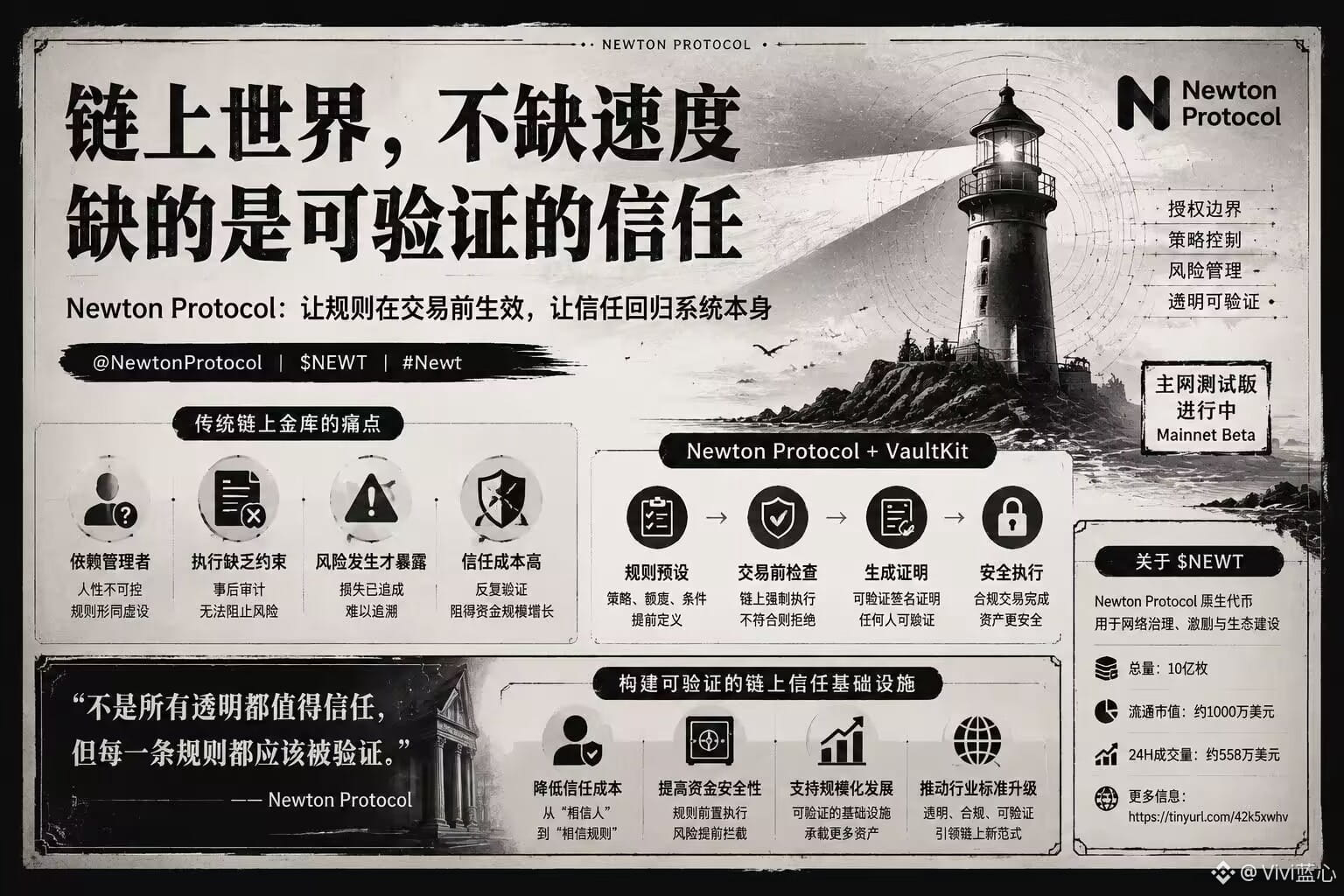
When I recently revisited @NewtonProtocol , my attention landed right on this point. Many people think of on-chain transparency as everything being public and all actions being traceable. But I think true maturity in transparency shouldn’t just be “everything exposed”; it should be “able to be verified when verification is needed.” That’s also what makes Newton Mainnet Beta and VaultKit interesting to me. They aren’t just laying everything out—they’re trying to make the rules work before execution. Whether a transaction meets the preset conditions can be checked in advance, and verifiable proofs can be generated.
In my personal opinion, the future competition on-chain won’t just be about who is more open, but who can handle the relationship between openness and order well. Too closed means there’s no trust foundation; too open, and the system’s boundaries are easier to lose. We used to trust that people wouldn’t make mistakes, but now we’re starting to try trusting that rules can constrain behavior. Of course, this path won’t be easy. The more carefully the rules are designed, the more complex scenarios you have to face.
So when I look at $NEWT now, I’m not as focused on a slogan like “transparent” or “secure,” but on the thinking behind it: as the on-chain world becomes increasingly complex, do we need more information, or better rules? Maybe what will truly matter in the future isn’t who can see everything, but who can prove that every step is worth trusting. #newt
{future}(NEWTUSDT)
Last night I was organizing my browser bookmarks and stumbled upon a bunch of links left behind from old research projects, and I suddenly felt like laughing. Back when I was studying projects, I loved bookmarking those “futuristic” introduction pages—things like changing finance, reshaping the world. After reading them, I’d get so fired up that I’d want to rush in right away. But after a few years, I found that what I actually remember most isn’t the projects that shout the loudest, but the ones that are willing to face the details. The crypto space can be kind of strange. People love talking about returns, speed, and scale, but very few stop to ask one question: as things on-chain become more and more transparent, are we really ready?
When I recently revisited @NewtonProtocol , my attention landed right on this point. Many people think of on-chain transparency as everything being public and all actions being traceable. But I think true maturity in transparency shouldn’t just be “everything exposed”; it should be “able to be verified when verification is needed.” That’s also what makes Newton Mainnet Beta and VaultKit interesting to me. They aren’t just laying everything out—they’re trying to make the rules work before execution. Whether a transaction meets the preset conditions can be checked in advance, and verifiable proofs can be generated.
In my personal opinion, the future competition on-chain won’t just be about who is more open, but who can handle the relationship between openness and order well. Too closed means there’s no trust foundation; too open, and the system’s boundaries are easier to lose. We used to trust that people wouldn’t make mistakes, but now we’re starting to try trusting that rules can constrain behavior. Of course, this path won’t be easy. The more carefully the rules are designed, the more complex scenarios you have to face.
So when I look at $NEWT now, I’m not as focused on a slogan like “transparent” or “secure,” but on the thinking behind it: as the on-chain world becomes increasingly complex, do we need more information, or better rules? Maybe what will truly matter in the future isn’t who can see everything, but who can prove that every step is worth trusting. #newt
When I recently revisited @NewtonProtocol , my attention landed right on this point. Many people think of on-chain transparency as everything being public and all actions being traceable. But I think true maturity in transparency shouldn’t just be “everything exposed”; it should be “able to be verified when verification is needed.” That’s also what makes Newton Mainnet Beta and VaultKit interesting to me. They aren’t just laying everything out—they’re trying to make the rules work before execution. Whether a transaction meets the preset conditions can be checked in advance, and verifiable proofs can be generated.
In my personal opinion, the future competition on-chain won’t just be about who is more open, but who can handle the relationship between openness and order well. Too closed means there’s no trust foundation; too open, and the system’s boundaries are easier to lose. We used to trust that people wouldn’t make mistakes, but now we’re starting to try trusting that rules can constrain behavior. Of course, this path won’t be easy. The more carefully the rules are designed, the more complex scenarios you have to face.
So when I look at $NEWT now, I’m not as focused on a slogan like “transparent” or “secure,” but on the thinking behind it: as the on-chain world becomes increasingly complex, do we need more information, or better rules? Maybe what will truly matter in the future isn’t who can see everything, but who can prove that every step is worth trusting. #newt
1
441
·
--

Article
I deleted a bunch of “get-rich-quick opportunities,” but kept Newton: because I finally understood the most expensive cost on-chainA few days ago, a friend in a group sent a sentence. I read it and immediately laughed. He said, “The safest asset on-chain isn’t what you keep in a wallet—it’s what you keep in your own hands.” At first it sounds like it makes a lot of sense. After all, in the crypto space, who hasn’t gone through a few “thought it was rock-solid back then, only to realize later I was too young” projects? But after thinking about it, I actually felt the sentence was rather contradictory. If everything has to be watched by yourself—studying contracts every day, checking data, sticking to your strategy—then what problem does this so-called on-chain freedom actually solve? Are we only switching from trusting traditional institutions to trusting the person behind some anonymous address? After going in circles, I realized the biggest cost in the on-chain world was never the gas fees. It’s trust.
I deleted a bunch of “get-rich-quick opportunities,” but kept Newton: because I finally understood the most expensive cost on-chain
A few days ago, a friend in a group sent a sentence. I read it and immediately laughed. He said, “The safest asset on-chain isn’t what you keep in a wallet—it’s what you keep in your own hands.” At first it sounds like it makes a lot of sense. After all, in the crypto space, who hasn’t gone through a few “thought it was rock-solid back then, only to realize later I was too young” projects? But after thinking about it, I actually felt the sentence was rather contradictory. If everything has to be watched by yourself—studying contracts every day, checking data, sticking to your strategy—then what problem does this so-called on-chain freedom actually solve? Are we only switching from trusting traditional institutions to trusting the person behind some anonymous address? After going in circles, I realized the biggest cost in the on-chain world was never the gas fees. It’s trust.
293
·
--
While organizing my wallet today, I suddenly found records from a few months ago of the on-chain interactions I did. It’s honestly a bit laughable and a little tear-jerking. For just a few air drops, I would sit up late at night to complete tasks, look up tutorials, and watch the Gas. My phone stayed lit until 2–3 a.m., and in the end what actually arrived was only a few dollars. That feeling is like, “I mined all night and found out I only mined enough for coffee”😂. But lately, watching Alpha’s market, I’ve noticed a pretty clear change: people are starting to care less about how big the rewards are, and more about whether the project actually solves real problems.
That’s also why I decided to re-study the Newton Protocol. To be honest, when I first looked at the Newton Mainnet Beta, I wasn’t particularly excited. There are just too many AI, automation, and on-chain execution projects talking up their concepts in the market right now. They sound great, but once you get down to actual implementation, there’s still an old problem that you can’t get around—trust. Especially with on-chain vaults: the rules can be written very completely, but in real execution, it still depends on the curator’s judgment. When the market is good, everyone is an expert. But when the market is wildly volatile, you only then realize that human emotions are the biggest variable.
What I find interesting about VaultKit is that it doesn’t keep emphasizing “trusting a person.” Instead, it tries to turn rules into conditions that can truly be executed. According to Newton’s official description, VaultKit allows vault rules to be forcibly enforced on-chain: it checks the rules before transaction settlement and generates verifiable signature proofs. Put simply, before it was “here’s a reminder not to do this.” Now it’s “since it doesn’t meet the rules, this action can’t continue.”
Personally, I think what @NewtonProtocol is truly worth paying attention to isn’t just safety—it’s how it changes the trust model on-chain. In the past, we trusted teams and trusted managers. In the future, we may trust a set of transparent, verifiable rules more often. And of course, the stronger the rules, the higher the determinism—and flexibility may decrease. So when I look at $NEWT and #Newt, I care more about a long-term question: when it comes to managing assets on-chain in the future, will it keep relying on people’s credibility, or will it gradually move toward being driven by rules? The market never lacks opportunities; what’s truly scarce is a system that lets strangers be willing to hand over trust. #newt $NEWT
While organizing my wallet today, I suddenly found records from a few months ago of the on-chain interactions I did. It’s honestly a bit laughable and a little tear-jerking. For just a few air drops, I would sit up late at night to complete tasks, look up tutorials, and watch the Gas. My phone stayed lit until 2–3 a.m., and in the end what actually arrived was only a few dollars. That feeling is like, “I mined all night and found out I only mined enough for coffee”😂. But lately, watching Alpha’s market, I’ve noticed a pretty clear change: people are starting to care less about how big the rewards are, and more about whether the project actually solves real problems.
That’s also why I decided to re-study the Newton Protocol. To be honest, when I first looked at the Newton Mainnet Beta, I wasn’t particularly excited. There are just too many AI, automation, and on-chain execution projects talking up their concepts in the market right now. They sound great, but once you get down to actual implementation, there’s still an old problem that you can’t get around—trust. Especially with on-chain vaults: the rules can be written very completely, but in real execution, it still depends on the curator’s judgment. When the market is good, everyone is an expert. But when the market is wildly volatile, you only then realize that human emotions are the biggest variable.
What I find interesting about VaultKit is that it doesn’t keep emphasizing “trusting a person.” Instead, it tries to turn rules into conditions that can truly be executed. According to Newton’s official description, VaultKit allows vault rules to be forcibly enforced on-chain: it checks the rules before transaction settlement and generates verifiable signature proofs. Put simply, before it was “here’s a reminder not to do this.” Now it’s “since it doesn’t meet the rules, this action can’t continue.”
Personally, I think what @NewtonProtocol is truly worth paying attention to isn’t just safety—it’s how it changes the trust model on-chain. In the past, we trusted teams and trusted managers. In the future, we may trust a set of transparent, verifiable rules more often. And of course, the stronger the rules, the higher the determinism—and flexibility may decrease. So when I look at $NEWT and #Newt, I care more about a long-term question: when it comes to managing assets on-chain in the future, will it keep relying on people’s credibility, or will it gradually move toward being driven by rules? The market never lacks opportunities; what’s truly scarce is a system that lets strangers be willing to hand over trust. #newt $NEWT
That’s also why I decided to re-study the Newton Protocol. To be honest, when I first looked at the Newton Mainnet Beta, I wasn’t particularly excited. There are just too many AI, automation, and on-chain execution projects talking up their concepts in the market right now. They sound great, but once you get down to actual implementation, there’s still an old problem that you can’t get around—trust. Especially with on-chain vaults: the rules can be written very completely, but in real execution, it still depends on the curator’s judgment. When the market is good, everyone is an expert. But when the market is wildly volatile, you only then realize that human emotions are the biggest variable.
What I find interesting about VaultKit is that it doesn’t keep emphasizing “trusting a person.” Instead, it tries to turn rules into conditions that can truly be executed. According to Newton’s official description, VaultKit allows vault rules to be forcibly enforced on-chain: it checks the rules before transaction settlement and generates verifiable signature proofs. Put simply, before it was “here’s a reminder not to do this.” Now it’s “since it doesn’t meet the rules, this action can’t continue.”
Personally, I think what @NewtonProtocol is truly worth paying attention to isn’t just safety—it’s how it changes the trust model on-chain. In the past, we trusted teams and trusted managers. In the future, we may trust a set of transparent, verifiable rules more often. And of course, the stronger the rules, the higher the determinism—and flexibility may decrease. So when I look at $NEWT and #Newt, I care more about a long-term question: when it comes to managing assets on-chain in the future, will it keep relying on people’s credibility, or will it gradually move toward being driven by rules? The market never lacks opportunities; what’s truly scarce is a system that lets strangers be willing to hand over trust. #newt $NEWT
314
·
--
Auntie Li is getting rich—she’s been handing out red envelopes every day lately.
Auntie Li is getting rich—she’s been handing out red envelopes every day lately.
Quoted content has been removed
196
Log in to explore more content
Join global crypto users on Binance Square
⚡️ Get latest and useful information about crypto.
💬 Trusted by the world’s largest crypto exchange.
👍 Discover real insights from verified creators.
Email / Phone number
Trending Topics
USAugustPPIRisesLessThanExpected
32,603 views
647 Discussing
🚨 US AUG PPI: Rises LESS Than Expected! Bullish for Crypto? 🚀
PPI +0.4% MoM as expected, but CORE PPI only +0.2% vs +0.3% expected - cooling!
What it means:
• Wholesale inflation softer than feared
• Fed rate hike chance now 62% - but dovish signals coming
• Core PCE revisions expected downward - bullish
• BTC usually pumps on softer PPI
Fed meeting Sep 15-16 - Market now expects pause, not hike?
Is this the green light for Q4 rally?
#Bitcoin #PPI #Fed #CryptoNews #BTC#usaugustppiriseslessthanexpected
True News
·1 Likes
·1.3k views
SECApprovesNasdaqTexasCommodityTrustRule
20,376 views
485 Discussing
ECBRaisesRatesSecondTimeTo2.5%
17,348 views
359 Discussing