



Last night, I did something pretty stupid but also quite interesting. I opened up AI and asked it to help me analyze an on-chain strategy, and then, almost as an afterthought, I asked: “If in the future AI agents can automatically help users trade and manage assets, what’s the biggest risk?” The answer popped up quickly: efficiency, safety, data accuracy, model capability… All of those were correct. But I stared at those lines of text for a while, and then I suddenly felt that it was missing one of the most important questions. If a system is smart enough, shouldn’t it also know when it shouldn’t act? That question made me pause for several minutes.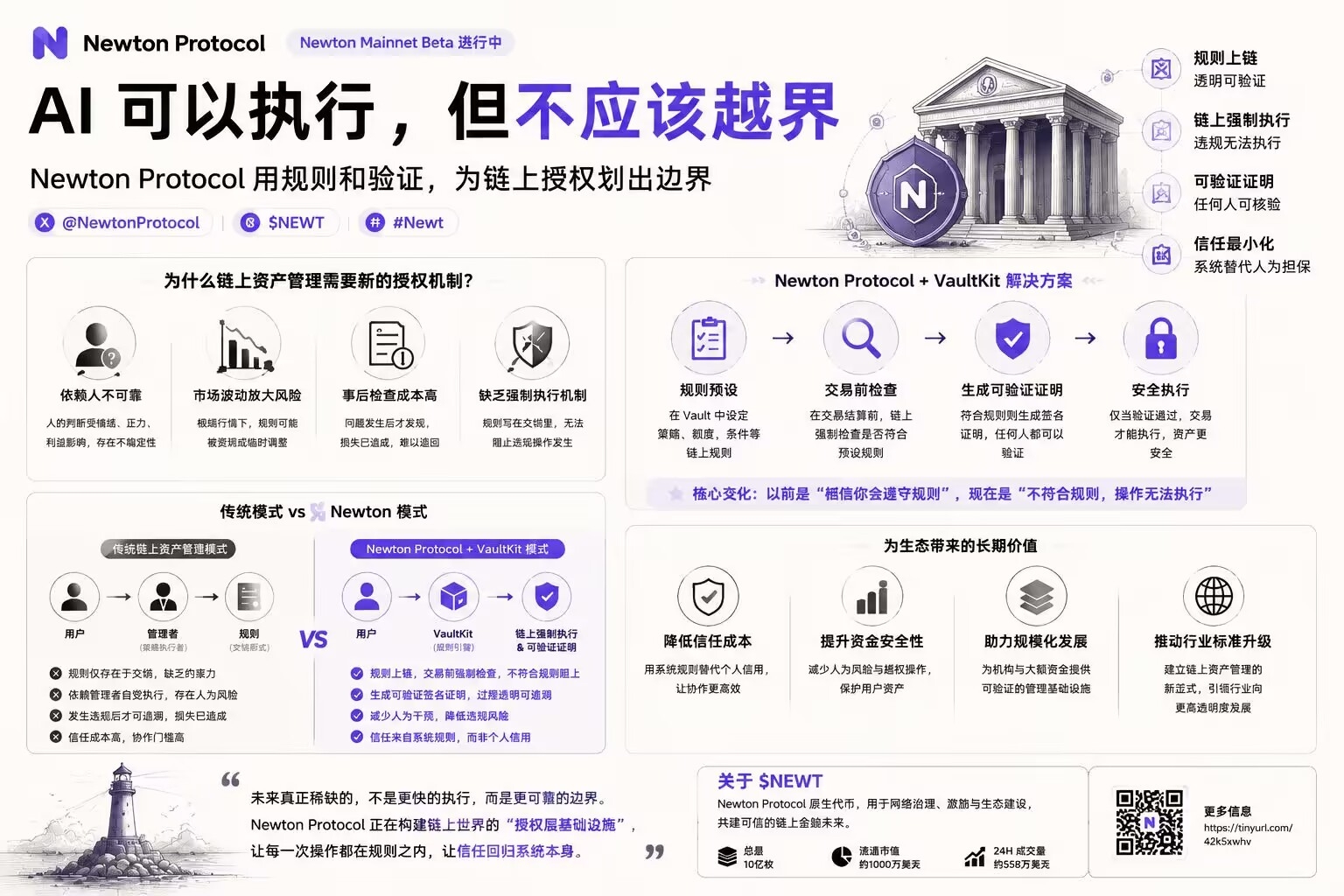
Because in the past few years, we’ve been discussing what AI can do, but we rarely seriously discuss where its boundaries are once AI actually has execution capability. This isn’t a distant sci-fi scenario. From automated trading to on-chain asset management, and to an increasing number of agents participating in decision-making in the future—this trend has already started to appear. And it’s from this question that I went back to re-examine @NewtonProtocol and Newton Mainnet Beta.
When I first got in touch with Newton, honestly, like many people, my first impression was to focus on the more popular directions: AI, agents, and on-chain automation. After all, the market loves to talk about the future right now. All kinds of projects tell you that the future will be smarter, more efficient, and more automated. But when I actually study it, I become more and more calm. Because I find that the faster technology develops, the less the truly hard problems are about “whether it can be done,” and the more they are about “who is responsible after it’s done.” This is also the biggest change I’ve come to re-understand about Newton Protocol over this period of time. It’s not just about improving execution efficiency; it’s about thinking at a deeper level: once asset and operational permissions are gradually handed over to automated systems, how should authorization be redefined?
In the past, many on-chain asset management models shared a common feature. Users put assets into a Vault, the curator handles strategy management, and the rules are written in documentation. It looks very complete. But in real execution, there’s always an unknown variable in between—people. The rules are there, but that doesn’t mean they will necessarily be executed. When the market is rising, everyone thinks the manager is professional and the strategy design is reasonable; but when you truly experience extreme market conditions, that’s when many issues finally surface. It’s not necessarily that the manager is unreliable—it’s that people themselves are the biggest variable. Emotions, pressure, judgment bias—these things are very difficult to fully avoid.
So I think VaultKit in Newton Mainnet Beta is worth paying attention to. It didn’t choose to further strengthen the idea of “trusting a better administrator.” Instead, it attempts to let the rules themselves participate in execution. According to Newton’s official description, VaultKit enables on-chain enforcement of vault rules: it checks relevant conditions before transaction settlement and generates signature proofs that anyone can verify. Put simply: in the past, it was “the rules tell you what you should do.” Now it’s “the rules determine whether this action can happen.” It sounds like just a small shift, but the underlying logic is completely different. Because it turns authorization from a promise of trust into a verifiable execution mechanism.
Personally, I think the truly interesting part of Newton isn’t only about solving risk—it’s about redesigning the trust model on-chain. In the past, we relied more on human credibility: trusting the team, trusting the manager, trusting that a particular strategy designer is rational enough. But in the future, when AI agents begin to have more and more execution authority, relying solely on human trust clearly isn’t enough. A system can be very intelligent, but if its boundaries aren’t clearly defined, the stronger its capabilities, the larger its potential impact. This makes me think of stop-loss in trading. Many people don’t not know how important stop-loss is—they just always change their plan when the moment to execute really comes, due to emotions: “Wait a bit.” “Maybe it will rebound soon.” “This time is special.” In the end, they discover that the hardest thing to control isn’t the market—it’s themselves. The purpose of rules is to hold the boundary in advance when it’s easiest to lose control.
Of course, I also don’t simply think that the more rules there are, the better. Because the market always involves complex situations. The stricter the rules, the higher the certainty, but the greater the reduction in flexibility. So I believe what Newton Protocol truly needs long-term validation isn’t just whether VaultKit can restrict mistakes—it’s whether it can find a balance between rules and freedom. After all, in the future on-chain world, it’s impossible to rely completely on people, and it’s also impossible to rely completely on code. A truly mature system should find a reasonable position between automation and constraints.
Now looking at $NEWT and #Newt , what I care about isn’t a simple technical narrative anymore. I care more about the direction behind it. In the past, competition on-chain was about solving “how to connect.” Later it became about solving “how to trade.” And in the future, what may need solving is: when more and more intelligent systems act for us, who will define their boundaries? I think the most worth discussing part of Newton Protocol is right here. It’s not just about giving machines more capability—it’s exploring how to make both capability and responsibility coexist. Because the truly dangerous thing in the future is never an AI that can’t execute. It’s an AI that can do everything, yet doesn’t know when it should stop.