

AshCrypto 1
151 Posts

AshCrypto 1
Report
Block User
Cryptocurrency expert | KOL | Simplifying #DeFi | Join the crypto revolution | NFT | #Binance #BNB ⭐
0 Following
7 Followers
8 Liked
Posts
·
--
Dead Projects Do Not Ship Weekly ⚡
The ecosystems around $AERO and $JUP reward teams that keep giving users new reasons to return.
Crypto loves declaring a project dead during the exact period its next identity is being built.
Price attention disappears first.
Product momentum can return long before the crowd notices.
That makes shipping cadence one of the cleaner signals available during a reset.
Zora has entered new leadership with a smaller, focused team and a noticeably faster product rhythm.
Custom Pairs have reached mobile alongside crosschain trading across four networks.
Token pages are becoming more social through Takes, while regular UX improvements keep reducing friction for creators and traders.
This is the behaviour I want to see from a platform attempting a serious comeback.
A pivot only matters when users receive the product.
Zora keeps putting the product in their hands.
If that cadence continues, the market will have to evaluate a very different platform from the one it priced during the slowdown.
#DeFi #Altcoin Season#
Dead Projects Do Not Ship Weekly ⚡
The ecosystems around $AERO and $JUP reward teams that keep giving users new reasons to return.
Crypto loves declaring a project dead during the exact period its next identity is being built.
Price attention disappears first.
Product momentum can return long before the crowd notices.
That makes shipping cadence one of the cleaner signals available during a reset.
Zora has entered new leadership with a smaller, focused team and a noticeably faster product rhythm.
Custom Pairs have reached mobile alongside crosschain trading across four networks.
Token pages are becoming more social through Takes, while regular UX improvements keep reducing friction for creators and traders.
This is the behaviour I want to see from a platform attempting a serious comeback.
A pivot only matters when users receive the product.
Zora keeps putting the product in their hands.
If that cadence continues, the market will have to evaluate a very different platform from the one it priced during the slowdown.
#DeFi #Altcoin Season#
The ecosystems around $AERO and $JUP reward teams that keep giving users new reasons to return.
Crypto loves declaring a project dead during the exact period its next identity is being built.
Price attention disappears first.
Product momentum can return long before the crowd notices.
That makes shipping cadence one of the cleaner signals available during a reset.
Zora has entered new leadership with a smaller, focused team and a noticeably faster product rhythm.
Custom Pairs have reached mobile alongside crosschain trading across four networks.
Token pages are becoming more social through Takes, while regular UX improvements keep reducing friction for creators and traders.
This is the behaviour I want to see from a platform attempting a serious comeback.
A pivot only matters when users receive the product.
Zora keeps putting the product in their hands.
If that cadence continues, the market will have to evaluate a very different platform from the one it priced during the slowdown.
#DeFi #Altcoin Season#
45
·
--
The Best Blockchain Apps Make Gas Invisible ⚡
$NEAR helped advance the conversation around blockchain usability. $NIGHT brings a different approach to making transactions easier for everyday users.
Midnight's DUST model creates opportunities for applications to cover network transaction resources on behalf of users.
Through DUST sponsorship, an application operator can provide the resource required for a transaction without taking control of the user's private keys.
That changes the onboarding experience.
Traditional crypto onboarding:
Create wallet → buy token → transfer funds → pay gas → use application
A sponsored transaction model:
Open application → interact → application handles transaction resources
The user doesn't need to understand every network mechanic before using the product.
And the underlying model still connects to NIGHT, which generates DUST.
The next generation of Web3 removes the infrastructure from the user experience.
Midnight is building the tools to make that possible.
#Crypto #Altcoin Season#
The Best Blockchain Apps Make Gas Invisible ⚡
$NEAR helped advance the conversation around blockchain usability. $NIGHT brings a different approach to making transactions easier for everyday users.
Midnight's DUST model creates opportunities for applications to cover network transaction resources on behalf of users.
Through DUST sponsorship, an application operator can provide the resource required for a transaction without taking control of the user's private keys.
That changes the onboarding experience.
Traditional crypto onboarding:
Create wallet → buy token → transfer funds → pay gas → use application
A sponsored transaction model:
Open application → interact → application handles transaction resources
The user doesn't need to understand every network mechanic before using the product.
And the underlying model still connects to NIGHT, which generates DUST.
The next generation of Web3 removes the infrastructure from the user experience.
Midnight is building the tools to make that possible.
#Crypto #Altcoin Season#
$NEAR helped advance the conversation around blockchain usability. $NIGHT brings a different approach to making transactions easier for everyday users.
Midnight's DUST model creates opportunities for applications to cover network transaction resources on behalf of users.
Through DUST sponsorship, an application operator can provide the resource required for a transaction without taking control of the user's private keys.
That changes the onboarding experience.
Traditional crypto onboarding:
Create wallet → buy token → transfer funds → pay gas → use application
A sponsored transaction model:
Open application → interact → application handles transaction resources
The user doesn't need to understand every network mechanic before using the product.
And the underlying model still connects to NIGHT, which generates DUST.
The next generation of Web3 removes the infrastructure from the user experience.
Midnight is building the tools to make that possible.
#Crypto #Altcoin Season#
60
·
--
One-off hype has a short shelf life 🔥
When I watch communities around $PUMP and $STONK I care less about one viral day than whether people have another reason to return.
Crypto is very good at manufacturing moments, but the harder part is linking those moments into a story that keeps moving after the timeline changes.
I think recurring IRL experiences create that link because each gathering gives a community both history and something new to anticipate.
This is what makes this Coin Club calendar worth watching from a community perspective.
Singapore has concluded, while a gala dinner is scheduled for November 22 and a Los Angeles experience is scheduled for February 12 to 14, 2027.
The settings are different, but the continuity between them is the real mechanism.
In my view, that rhythm is what keeps community culture active between gatherings.
#Altcoin Season#
One-off hype has a short shelf life 🔥
When I watch communities around $PUMP and $STONK I care less about one viral day than whether people have another reason to return.
Crypto is very good at manufacturing moments, but the harder part is linking those moments into a story that keeps moving after the timeline changes.
I think recurring IRL experiences create that link because each gathering gives a community both history and something new to anticipate.
This is what makes this Coin Club calendar worth watching from a community perspective.
Singapore has concluded, while a gala dinner is scheduled for November 22 and a Los Angeles experience is scheduled for February 12 to 14, 2027.
The settings are different, but the continuity between them is the real mechanism.
In my view, that rhythm is what keeps community culture active between gatherings.
#Altcoin Season#
When I watch communities around $PUMP and $STONK I care less about one viral day than whether people have another reason to return.
Crypto is very good at manufacturing moments, but the harder part is linking those moments into a story that keeps moving after the timeline changes.
I think recurring IRL experiences create that link because each gathering gives a community both history and something new to anticipate.
This is what makes this Coin Club calendar worth watching from a community perspective.
Singapore has concluded, while a gala dinner is scheduled for November 22 and a Los Angeles experience is scheduled for February 12 to 14, 2027.
The settings are different, but the continuity between them is the real mechanism.
In my view, that rhythm is what keeps community culture active between gatherings.
#Altcoin Season#
77
·
--
Merch hits different after the event ✨
$APE and $SHIB helped establish how physical collectibles can extend a Web3 identity beyond the screen, but I think an item becomes more meaningful when it is connected to something people actually experienced.
The difference is context.
An object tied to a city, a gathering and the people you met there carries a story that ordinary promotional merchandise cannot replicate.
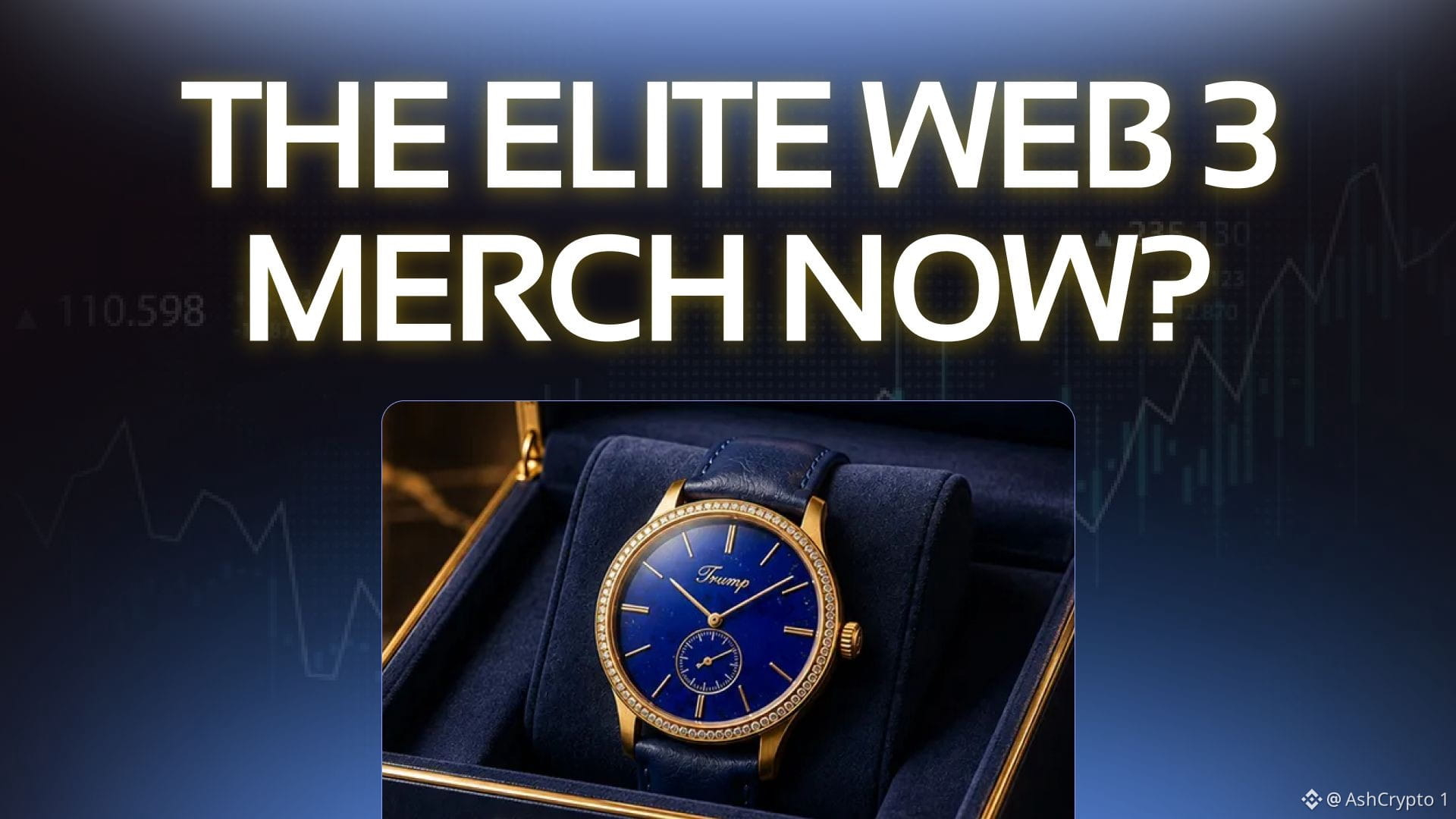
Across its recent Korea and Singapore activations, the $Trump Coin Club distributed 2,000 watches and 500 gold sneakers.
Those numbers demonstrate scale, but the lasting value of the items is personal.
Each one can become a physical reminder of a particular chapter in the Club’s IRL calendar, and for me, that is when merchandise stops feeling like marketing.
It becomes part of the memory.
#Altcoin Season#
Merch hits different after the event ✨
$APE and $SHIB helped establish how physical collectibles can extend a Web3 identity beyond the screen, but I think an item becomes more meaningful when it is connected to something people actually experienced.
The difference is context.
An object tied to a city, a gathering and the people you met there carries a story that ordinary promotional merchandise cannot replicate.
Across its recent Korea and Singapore activations, the $Trump Coin Club distributed 2,000 watches and 500 gold sneakers.
Those numbers demonstrate scale, but the lasting value of the items is personal.
Each one can become a physical reminder of a particular chapter in the Club’s IRL calendar, and for me, that is when merchandise stops feeling like marketing.
It becomes part of the memory.
#Altcoin Season#
$APE and $SHIB helped establish how physical collectibles can extend a Web3 identity beyond the screen, but I think an item becomes more meaningful when it is connected to something people actually experienced.
The difference is context.
An object tied to a city, a gathering and the people you met there carries a story that ordinary promotional merchandise cannot replicate.
Across its recent Korea and Singapore activations, the $Trump Coin Club distributed 2,000 watches and 500 gold sneakers.
Those numbers demonstrate scale, but the lasting value of the items is personal.
Each one can become a physical reminder of a particular chapter in the Club’s IRL calendar, and for me, that is when merchandise stops feeling like marketing.
It becomes part of the memory.
#Altcoin Season#
72
·
--
AI That Finds The Better Trades
Finding the strongest opportunity among several is where an AITA's real value really shows.
I asked Pear Protocol's Agent Pear to compare five potential pair trades and identify which one had the strongest statistical setup.
The winner? Long $LINK / Short WLD. (NFA)
Agent Pear identified a fresh signal, just 15 minutes old, with 100% of its reported edge still intact. Both Z-scores pointed in the same direction, suggesting WLD was relatively expensive compared with LINK.
The trade also had meaningful open interest on both sides, while WLD's crowded long positioning offered another reason to watch for potential downside.
But the comparison was just as valuable as the selection.
LINK/SEI and XLM/ETC had relatively thin short-side liquidity. Meanwhile, the HBAR/ $SUI setup had only 3% of its original signal strength remaining after nearly three days.
Rather than treating every price divergence as an opportunity, Agent Pear compared signal freshness, positioning, liquidity and statistical indicators to identify the stronger candidate.
It even provided a suggested 63% LINK / 37% WLD allocation to help construct the position.
That's what having a quant analyst in your pocket should feel like. Less time chasing signals, more clarity on which opportunities deserve your attention.
Agent Pear gives free trade analysis at pear.garden/trade
#Altcoin Season#
AI That Finds The Better Trades
Finding the strongest opportunity among several is where an AITA's real value really shows.
I asked Pear Protocol's Agent Pear to compare five potential pair trades and identify which one had the strongest statistical setup.
The winner? Long $LINK / Short WLD. (NFA)
Agent Pear identified a fresh signal, just 15 minutes old, with 100% of its reported edge still intact. Both Z-scores pointed in the same direction, suggesting WLD was relatively expensive compared with LINK.
The trade also had meaningful open interest on both sides, while WLD's crowded long positioning offered another reason to watch for potential downside.
But the comparison was just as valuable as the selection.
LINK/SEI and XLM/ETC had relatively thin short-side liquidity. Meanwhile, the HBAR/ $SUI setup had only 3% of its original signal strength remaining after nearly three days.
Rather than treating every price divergence as an opportunity, Agent Pear compared signal freshness, positioning, liquidity and statistical indicators to identify the stronger candidate.
It even provided a suggested 63% LINK / 37% WLD allocation to help construct the position.
That's what having a quant analyst in your pocket should feel like. Less time chasing signals, more clarity on which opportunities deserve your attention.
Agent Pear gives free trade analysis at pear.garden/trade
#Altcoin Season#
Finding the strongest opportunity among several is where an AITA's real value really shows.
I asked Pear Protocol's Agent Pear to compare five potential pair trades and identify which one had the strongest statistical setup.
The winner? Long $LINK / Short WLD. (NFA)
Agent Pear identified a fresh signal, just 15 minutes old, with 100% of its reported edge still intact. Both Z-scores pointed in the same direction, suggesting WLD was relatively expensive compared with LINK.
The trade also had meaningful open interest on both sides, while WLD's crowded long positioning offered another reason to watch for potential downside.
But the comparison was just as valuable as the selection.
LINK/SEI and XLM/ETC had relatively thin short-side liquidity. Meanwhile, the HBAR/ $SUI setup had only 3% of its original signal strength remaining after nearly three days.
Rather than treating every price divergence as an opportunity, Agent Pear compared signal freshness, positioning, liquidity and statistical indicators to identify the stronger candidate.
It even provided a suggested 63% LINK / 37% WLD allocation to help construct the position.
That's what having a quant analyst in your pocket should feel like. Less time chasing signals, more clarity on which opportunities deserve your attention.
Agent Pear gives free trade analysis at pear.garden/trade
#Altcoin Season#
64
·
--
Quantum Security Just Became Sui’s Edge 🛡️
One of crypto’s biggest future risks is barely discussed until the market gets scared.
$SUI has now completed its first native quantum-resistant transaction on Devnet.
The transaction used ML-DSA-65, a post-quantum signature scheme standardized by NIST.
In simple terms, Sui successfully tested an account authorizing a transaction with cryptography designed to withstand attacks from powerful quantum computers.
This is still a Devnet milestone.
Mainnet accounts have not suddenly become quantum-resistant, and the production rollout remains subject to testing and independent audits.
Native ML-DSA-65 authentication is currently targeted for Mainnet in Q1 2027.
What impresses me is the migration design.
Users are expected to derive quantum-safe keys from their existing recovery phrase, while address aliases provide a path to upgrade authorization without moving every asset into a new account.
That could remove enormous friction if the wider industry eventually needs to migrate billions of dollars toward post-quantum security.
Quantum computers may not threaten blockchains today, but cryptographic migrations take years to execute safely.
Sui is doing that preparation while the threat remains manageable.
For me, this strengthens the long-term infrastructure thesis around Sui considerably.
#Altcoin Season#
Quantum Security Just Became Sui’s Edge 🛡️
One of crypto’s biggest future risks is barely discussed until the market gets scared.
$SUI has now completed its first native quantum-resistant transaction on Devnet.
The transaction used ML-DSA-65, a post-quantum signature scheme standardized by NIST.
In simple terms, Sui successfully tested an account authorizing a transaction with cryptography designed to withstand attacks from powerful quantum computers.
This is still a Devnet milestone.
Mainnet accounts have not suddenly become quantum-resistant, and the production rollout remains subject to testing and independent audits.
Native ML-DSA-65 authentication is currently targeted for Mainnet in Q1 2027.
What impresses me is the migration design.
Users are expected to derive quantum-safe keys from their existing recovery phrase, while address aliases provide a path to upgrade authorization without moving every asset into a new account.
That could remove enormous friction if the wider industry eventually needs to migrate billions of dollars toward post-quantum security.
Quantum computers may not threaten blockchains today, but cryptographic migrations take years to execute safely.
Sui is doing that preparation while the threat remains manageable.
For me, this strengthens the long-term infrastructure thesis around Sui considerably.
#Altcoin Season#
One of crypto’s biggest future risks is barely discussed until the market gets scared.
$SUI has now completed its first native quantum-resistant transaction on Devnet.
The transaction used ML-DSA-65, a post-quantum signature scheme standardized by NIST.
In simple terms, Sui successfully tested an account authorizing a transaction with cryptography designed to withstand attacks from powerful quantum computers.
This is still a Devnet milestone.
Mainnet accounts have not suddenly become quantum-resistant, and the production rollout remains subject to testing and independent audits.
Native ML-DSA-65 authentication is currently targeted for Mainnet in Q1 2027.
What impresses me is the migration design.
Users are expected to derive quantum-safe keys from their existing recovery phrase, while address aliases provide a path to upgrade authorization without moving every asset into a new account.
That could remove enormous friction if the wider industry eventually needs to migrate billions of dollars toward post-quantum security.
Quantum computers may not threaten blockchains today, but cryptographic migrations take years to execute safely.
Sui is doing that preparation while the threat remains manageable.
For me, this strengthens the long-term infrastructure thesis around Sui considerably.
#Altcoin Season#
81
·
--
Strong clubs do not repeat themselves 🔄
Communities around $APE and $SHIB have remained recognizable because their identities can move across different parts of crypto culture, and I think an IRL community needs the same flexibility.
If every gathering follows the same structure, the occasion may change while the experience begins to feel familiar.
Different formats allow different sides of a community to emerge.
The $Trump Coin Club calendar for example currently presents three distinct formats.
• Singapore concluded with a three-day city experience
• A gala dinner is planned for November 22
• A Super Bowl experience is listed in Los Angeles from February 12 to 14
The range is what stands out to me.
A multi-day destination, a focused dinner and a major sporting weekend each create a different social rhythm.
That allows the Club’s identity to remain consistent without asking one event format to carry the entire programme.
#Macro Insights#
Strong clubs do not repeat themselves 🔄
Communities around $APE and $SHIB have remained recognizable because their identities can move across different parts of crypto culture, and I think an IRL community needs the same flexibility.
If every gathering follows the same structure, the occasion may change while the experience begins to feel familiar.
Different formats allow different sides of a community to emerge.
The $Trump Coin Club calendar for example currently presents three distinct formats.
• Singapore concluded with a three-day city experience
• A gala dinner is planned for November 22
• A Super Bowl experience is listed in Los Angeles from February 12 to 14
The range is what stands out to me.
A multi-day destination, a focused dinner and a major sporting weekend each create a different social rhythm.
That allows the Club’s identity to remain consistent without asking one event format to carry the entire programme.
#Macro Insights#
Communities around $APE and $SHIB have remained recognizable because their identities can move across different parts of crypto culture, and I think an IRL community needs the same flexibility.
If every gathering follows the same structure, the occasion may change while the experience begins to feel familiar.
Different formats allow different sides of a community to emerge.
The $Trump Coin Club calendar for example currently presents three distinct formats.
• Singapore concluded with a three-day city experience
• A gala dinner is planned for November 22
• A Super Bowl experience is listed in Los Angeles from February 12 to 14
The range is what stands out to me.
A multi-day destination, a focused dinner and a major sporting weekend each create a different social rhythm.
That allows the Club’s identity to remain consistent without asking one event format to carry the entire programme.
#Macro Insights#
73
·
--
THE AI TRADE IS REPRICING
$TAO is trading near $282, with a $3.3B market cap. Still 63% below its ATH, yet investors have already valued Bittensor's decentralized AI economy in the billions.
Its subnets compete to deliver useful AI services, with incentives tied to performance. The bet is simple: intelligence becomes a market.
$RENDER is around $2.21, up roughly 9% today but still 84% below its peak.
Its network connects spare GPU capacity to creators and AI workloads, while its burn-and-mint model ties token consumption to paid usage.
That's a $1.1B bet on compute access.
Now look at GPU ownership.
B3IQ lets customers buy physical NVIDIA machines, start with 30% down on select systems, and earn from rented-out capacity while financing the rest.
8 figures in GPU sales in its first two weeks.
9 figures in reported deployment demand.
Meanwhile, B3's token market cap sits near $31M.
AI intelligence: billions.
GPU access: billions.
Owning the hardware earning the revenue: still early.
If money rotates back into AI, the next big narrative might be who owns the machines.
#AI #DePIN
THE AI TRADE IS REPRICING
$TAO is trading near $282, with a $3.3B market cap. Still 63% below its ATH, yet investors have already valued Bittensor's decentralized AI economy in the billions.
Its subnets compete to deliver useful AI services, with incentives tied to performance. The bet is simple: intelligence becomes a market.
$RENDER is around $2.21, up roughly 9% today but still 84% below its peak.
Its network connects spare GPU capacity to creators and AI workloads, while its burn-and-mint model ties token consumption to paid usage.
That's a $1.1B bet on compute access.
Now look at GPU ownership.
B3IQ lets customers buy physical NVIDIA machines, start with 30% down on select systems, and earn from rented-out capacity while financing the rest.
8 figures in GPU sales in its first two weeks.
9 figures in reported deployment demand.
Meanwhile, B3's token market cap sits near $31M.
AI intelligence: billions.
GPU access: billions.
Owning the hardware earning the revenue: still early.
If money rotates back into AI, the next big narrative might be who owns the machines.
#AI #DePIN
$TAO is trading near $282, with a $3.3B market cap. Still 63% below its ATH, yet investors have already valued Bittensor's decentralized AI economy in the billions.
Its subnets compete to deliver useful AI services, with incentives tied to performance. The bet is simple: intelligence becomes a market.
$RENDER is around $2.21, up roughly 9% today but still 84% below its peak.
Its network connects spare GPU capacity to creators and AI workloads, while its burn-and-mint model ties token consumption to paid usage.
That's a $1.1B bet on compute access.
Now look at GPU ownership.
B3IQ lets customers buy physical NVIDIA machines, start with 30% down on select systems, and earn from rented-out capacity while financing the rest.
8 figures in GPU sales in its first two weeks.
9 figures in reported deployment demand.
Meanwhile, B3's token market cap sits near $31M.
AI intelligence: billions.
GPU access: billions.
Owning the hardware earning the revenue: still early.
If money rotates back into AI, the next big narrative might be who owns the machines.
#AI #DePIN
60
·
--
Altseason Usually Means Traders Start Looking Everywhere 👀
$2Z makes that broader market coverage easier to support.
$HYPE is already one of several categories of real-time information flowing through the Edge model.
A trader rarely stays focused on one market forever.
Perps get hot.
Then another ecosystem moves.
Then another venue takes volume.
DoubleZero Edge gives desks a growing data catalog through common infrastructure.
That means expanding what you watch does not have to mean rebuilding how you receive it.
More opportunities.
More markets.
One increasingly useful connection.
#Altcoin Season# #DeFi
Altseason Usually Means Traders Start Looking Everywhere 👀
$2Z makes that broader market coverage easier to support.
$HYPE is already one of several categories of real-time information flowing through the Edge model.
A trader rarely stays focused on one market forever.
Perps get hot.
Then another ecosystem moves.
Then another venue takes volume.
DoubleZero Edge gives desks a growing data catalog through common infrastructure.
That means expanding what you watch does not have to mean rebuilding how you receive it.
More opportunities.
More markets.
One increasingly useful connection.
#Altcoin Season# #DeFi
$2Z makes that broader market coverage easier to support.
$HYPE is already one of several categories of real-time information flowing through the Edge model.
A trader rarely stays focused on one market forever.
Perps get hot.
Then another ecosystem moves.
Then another venue takes volume.
DoubleZero Edge gives desks a growing data catalog through common infrastructure.
That means expanding what you watch does not have to mean rebuilding how you receive it.
More opportunities.
More markets.
One increasingly useful connection.
#Altcoin Season# #DeFi
83
·
--
Selective Disclosure Is Not A Mixer 🧭
The reason most sealed money ends up delisted is that it treats disclosure as the enemy, so the people who would use it most are the ones who cannot touch it.
$ONDO went the other way, keeping its tokenized RWA treasuries to wallets that cleared a check, and on $SOL that check leaves a record a program can act on.
A confidential payment built on Arcium travels in three layers rather than one. The user holds the key and the instruction. The cluster runs the computation on fragments where no single node holds a readable copy. Solana records the settlement the app chose to publish.
That last part is the one that gets missed. The address can be public while the amount is not, and the app decides what the chain shows rather than a protocol hiding everything by default.
So a business can hand an auditor a full account of what ran, and the market gets the transaction without the terms behind it.
Confidential computation has been live on Mainnet Alpha since February 2, with fifteen teams building on it, and C-SPL, which seals the amount inside a transfer, has not shipped yet.
The category spent years arguing that confidentiality and compliance are opposites, and the version that survives is the one where the user decides what to disclose and can still prove it.
#RWA #Solana
Selective Disclosure Is Not A Mixer 🧭
The reason most sealed money ends up delisted is that it treats disclosure as the enemy, so the people who would use it most are the ones who cannot touch it.
$ONDO went the other way, keeping its tokenized RWA treasuries to wallets that cleared a check, and on $SOL that check leaves a record a program can act on.
A confidential payment built on Arcium travels in three layers rather than one. The user holds the key and the instruction. The cluster runs the computation on fragments where no single node holds a readable copy. Solana records the settlement the app chose to publish.
That last part is the one that gets missed. The address can be public while the amount is not, and the app decides what the chain shows rather than a protocol hiding everything by default.
So a business can hand an auditor a full account of what ran, and the market gets the transaction without the terms behind it.
Confidential computation has been live on Mainnet Alpha since February 2, with fifteen teams building on it, and C-SPL, which seals the amount inside a transfer, has not shipped yet.
The category spent years arguing that confidentiality and compliance are opposites, and the version that survives is the one where the user decides what to disclose and can still prove it.
#RWA #Solana
The reason most sealed money ends up delisted is that it treats disclosure as the enemy, so the people who would use it most are the ones who cannot touch it.
$ONDO went the other way, keeping its tokenized RWA treasuries to wallets that cleared a check, and on $SOL that check leaves a record a program can act on.
A confidential payment built on Arcium travels in three layers rather than one. The user holds the key and the instruction. The cluster runs the computation on fragments where no single node holds a readable copy. Solana records the settlement the app chose to publish.
That last part is the one that gets missed. The address can be public while the amount is not, and the app decides what the chain shows rather than a protocol hiding everything by default.
So a business can hand an auditor a full account of what ran, and the market gets the transaction without the terms behind it.
Confidential computation has been live on Mainnet Alpha since February 2, with fifteen teams building on it, and C-SPL, which seals the amount inside a transfer, has not shipped yet.
The category spent years arguing that confidentiality and compliance are opposites, and the version that survives is the one where the user decides what to disclose and can still prove it.
#RWA #Solana
79
·
--
$HYPE Flipping Solana? ⚔️
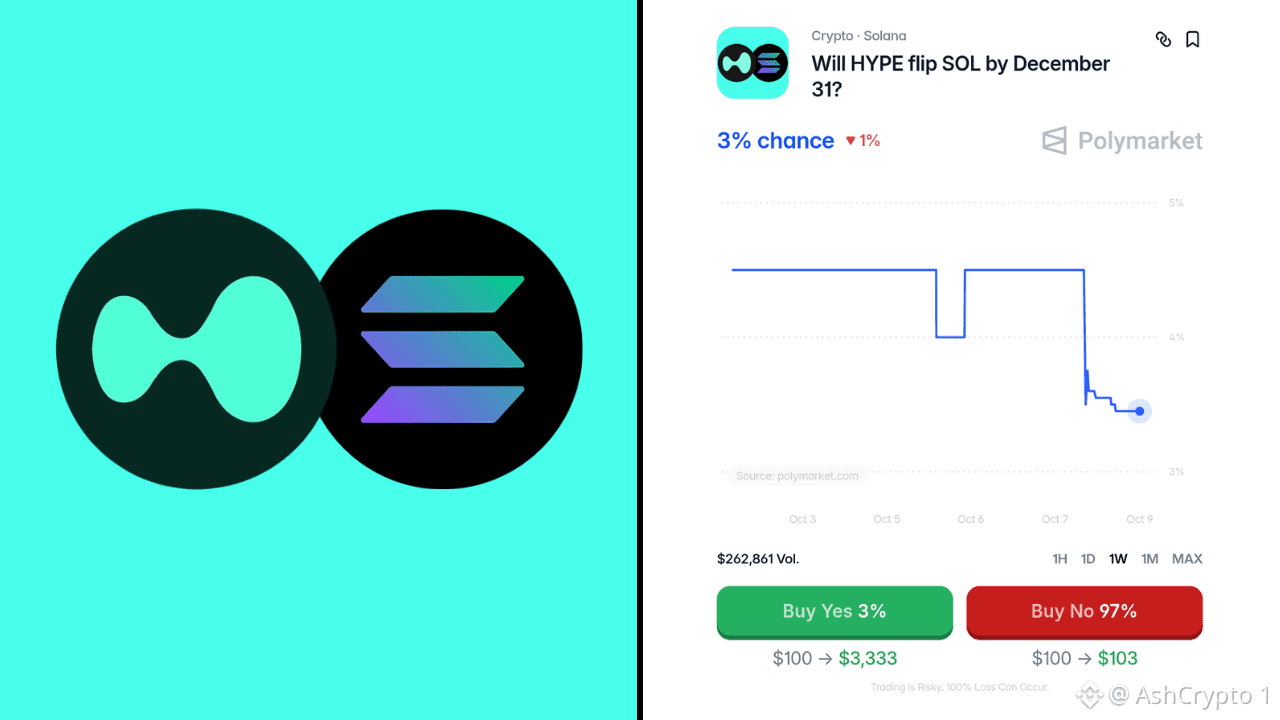
Only 3% of Polymarket traders believe Hyperliquid will overtake Solana by December 31.
That's a pretty overwhelming NO.
But there's something interesting about this market.
Hyperliquid has established itself as a major player in the decentralized trading ecosystem, while Solana remains one of crypto's most established networks.
For Hyperliquid to flip Solana under the market's criteria before year-end would require a significant change in their relative positions.
And Polymarket traders aren't expecting that anytime soon.
📉 YES: 3% probability
📊 NO: 97% probability
💰 $100 on YES could return approximately $3,333 if it resolves successfully.
Here's my perspective.
I wouldn't necessarily need Hyperliquid to overtake Solana to find an opportunity here.
If Hyperliquid gains significant momentum and the market reprices YES from 3% to 9%, that's potentially a 3x increase in the value of an existing YES position.
The actual flip wouldn't even need to happen.
That's why I find Polymarket particularly interesting for these head-to-head crypto narratives.
You're trading the probability of one ecosystem overtaking another, rather than simply buying either token and hoping its price increases.
Do you think Hyperliquid has any realistic chance of catching Solana this year?
#Altcoin Season#
$HYPE Flipping Solana? ⚔️
Only 3% of Polymarket traders believe Hyperliquid will overtake Solana by December 31.
That's a pretty overwhelming NO.
But there's something interesting about this market.
Hyperliquid has established itself as a major player in the decentralized trading ecosystem, while Solana remains one of crypto's most established networks.
For Hyperliquid to flip Solana under the market's criteria before year-end would require a significant change in their relative positions.
And Polymarket traders aren't expecting that anytime soon.
📉 YES: 3% probability
📊 NO: 97% probability
💰 $100 on YES could return approximately $3,333 if it resolves successfully.
Here's my perspective.
I wouldn't necessarily need Hyperliquid to overtake Solana to find an opportunity here.
If Hyperliquid gains significant momentum and the market reprices YES from 3% to 9%, that's potentially a 3x increase in the value of an existing YES position.
The actual flip wouldn't even need to happen.
That's why I find Polymarket particularly interesting for these head-to-head crypto narratives.
You're trading the probability of one ecosystem overtaking another, rather than simply buying either token and hoping its price increases.
Do you think Hyperliquid has any realistic chance of catching Solana this year?
#Altcoin Season#
Only 3% of Polymarket traders believe Hyperliquid will overtake Solana by December 31.
That's a pretty overwhelming NO.
But there's something interesting about this market.
Hyperliquid has established itself as a major player in the decentralized trading ecosystem, while Solana remains one of crypto's most established networks.
For Hyperliquid to flip Solana under the market's criteria before year-end would require a significant change in their relative positions.
And Polymarket traders aren't expecting that anytime soon.
📉 YES: 3% probability
📊 NO: 97% probability
💰 $100 on YES could return approximately $3,333 if it resolves successfully.
Here's my perspective.
I wouldn't necessarily need Hyperliquid to overtake Solana to find an opportunity here.
If Hyperliquid gains significant momentum and the market reprices YES from 3% to 9%, that's potentially a 3x increase in the value of an existing YES position.
The actual flip wouldn't even need to happen.
That's why I find Polymarket particularly interesting for these head-to-head crypto narratives.
You're trading the probability of one ecosystem overtaking another, rather than simply buying either token and hoping its price increases.
Do you think Hyperliquid has any realistic chance of catching Solana this year?
#Altcoin Season#
68
·
--
RWA narratives need real activity 🔥
Across $ONDO and $XLM the RWA sector is usually measured through issued value and market cap, but I think those numbers only capture the size of what has moved onchain.
They do not show whether the infrastructure supports settlement, trading, administration, and continued financial activity after issuance.
This matters because tokenization can create a digital representation without creating a functioning market around it.
Injective has surpassed $6.8B in settled RWA volume across its onchain markets.
That sits alongside more than 500 onchain assets, showing that the network is supporting a growing range of financial products.
For me, this makes Injective’s RWA thesis more interesting than an issuance-only story 👀
#RWA
RWA narratives need real activity 🔥
Across $ONDO and $XLM the RWA sector is usually measured through issued value and market cap, but I think those numbers only capture the size of what has moved onchain.
They do not show whether the infrastructure supports settlement, trading, administration, and continued financial activity after issuance.
This matters because tokenization can create a digital representation without creating a functioning market around it.
Injective has surpassed $6.8B in settled RWA volume across its onchain markets.
That sits alongside more than 500 onchain assets, showing that the network is supporting a growing range of financial products.
For me, this makes Injective’s RWA thesis more interesting than an issuance-only story 👀
#RWA
Across $ONDO and $XLM the RWA sector is usually measured through issued value and market cap, but I think those numbers only capture the size of what has moved onchain.
They do not show whether the infrastructure supports settlement, trading, administration, and continued financial activity after issuance.
This matters because tokenization can create a digital representation without creating a functioning market around it.
Injective has surpassed $6.8B in settled RWA volume across its onchain markets.
That sits alongside more than 500 onchain assets, showing that the network is supporting a growing range of financial products.
For me, this makes Injective’s RWA thesis more interesting than an issuance-only story 👀
#RWA
94
·
--
129,265 Terminal users, 86% ARR growth, PYTH buy-backs 📈
What stands out to me is not another RWA headline, it is the fact that $PYTH is turning product exploration into paid demand, which is exactly the kind of infrastructure signal $ONDO investors should care about when tokenized markets need reliable data behind them.
September was a strong signal.
Pyth Terminal reached 129,265 monthly active users, up 44.1% month over month, while Pyth ended Q3 with $11.49M in active ARR, up 86% from Q2.
The part I think people will underprice is the self-serve side.
Nearly half of the revenue added in September came from touchless signups, which means users are not just reading a dashboard. They are searching feeds, comparing data, checking publisher details, generating API keys and moving toward paid usage inside the product.
That is a very different signal from a crypto project posting engagement numbers.
It looks more like a market-data product learning how to sell itself.
Now add the token side: the DAO approved a rule where 100% of the funds it receives from Pyth products goes into PYTH bought on the open market.
My read is that Terminal growth matters because it can widen the top of the funnel for future product receipts.
More users exploring the catalog can mean more paid accounts.
More product receipts under the new DAO rule can mean more open-market PYTH buying.
That is why this update feels bigger than a monthly report.
#Altcoin Season# #Trading
129,265 Terminal users, 86% ARR growth, PYTH buy-backs 📈
What stands out to me is not another RWA headline, it is the fact that $PYTH is turning product exploration into paid demand, which is exactly the kind of infrastructure signal $ONDO investors should care about when tokenized markets need reliable data behind them.
September was a strong signal.
Pyth Terminal reached 129,265 monthly active users, up 44.1% month over month, while Pyth ended Q3 with $11.49M in active ARR, up 86% from Q2.
The part I think people will underprice is the self-serve side.
Nearly half of the revenue added in September came from touchless signups, which means users are not just reading a dashboard. They are searching feeds, comparing data, checking publisher details, generating API keys and moving toward paid usage inside the product.
That is a very different signal from a crypto project posting engagement numbers.
It looks more like a market-data product learning how to sell itself.
Now add the token side: the DAO approved a rule where 100% of the funds it receives from Pyth products goes into PYTH bought on the open market.
My read is that Terminal growth matters because it can widen the top of the funnel for future product receipts.
More users exploring the catalog can mean more paid accounts.
More product receipts under the new DAO rule can mean more open-market PYTH buying.
That is why this update feels bigger than a monthly report.
#Altcoin Season# #Trading
What stands out to me is not another RWA headline, it is the fact that $PYTH is turning product exploration into paid demand, which is exactly the kind of infrastructure signal $ONDO investors should care about when tokenized markets need reliable data behind them.
September was a strong signal.
Pyth Terminal reached 129,265 monthly active users, up 44.1% month over month, while Pyth ended Q3 with $11.49M in active ARR, up 86% from Q2.
The part I think people will underprice is the self-serve side.
Nearly half of the revenue added in September came from touchless signups, which means users are not just reading a dashboard. They are searching feeds, comparing data, checking publisher details, generating API keys and moving toward paid usage inside the product.
That is a very different signal from a crypto project posting engagement numbers.
It looks more like a market-data product learning how to sell itself.
Now add the token side: the DAO approved a rule where 100% of the funds it receives from Pyth products goes into PYTH bought on the open market.
My read is that Terminal growth matters because it can widen the top of the funnel for future product receipts.
More users exploring the catalog can mean more paid accounts.
More product receipts under the new DAO rule can mean more open-market PYTH buying.
That is why this update feels bigger than a monthly report.
#Altcoin Season# #Trading
59
·
--
Bullish Does Not Always Mean Breakout 👀
After a sharp move in $BTC or $HYPE I may still expect higher prices without expecting another vertical candle.
That view creates a different trade from simply betting on unlimited upside.
A plain long keeps all potential profit open, but its outcome remains fully dependent on the next price move while funding continues.
Sometimes I would rather exchange part of that unlikely upside for premium today, and Aevo’s PERPS+ allows that trade-off to be selected when opening the perp.
The trader stays long and receives premium upfront, while accepting a cap on profit.
If price rises without passing the cap, the position keeps its perp gains alongside the premium.
If price stalls or falls, that premium can offset part of the funding or loss.
A move beyond the cap means giving up the additional upside.
The downside still remains, and liquidation risk continues to apply.
For me, this structure only makes sense when the cap matches the market view I already had before entering.
#Macro Insights#
Bullish Does Not Always Mean Breakout 👀
After a sharp move in $BTC or $HYPE I may still expect higher prices without expecting another vertical candle.
That view creates a different trade from simply betting on unlimited upside.
A plain long keeps all potential profit open, but its outcome remains fully dependent on the next price move while funding continues.
Sometimes I would rather exchange part of that unlikely upside for premium today, and Aevo’s PERPS+ allows that trade-off to be selected when opening the perp.
The trader stays long and receives premium upfront, while accepting a cap on profit.
If price rises without passing the cap, the position keeps its perp gains alongside the premium.
If price stalls or falls, that premium can offset part of the funding or loss.
A move beyond the cap means giving up the additional upside.
The downside still remains, and liquidation risk continues to apply.
For me, this structure only makes sense when the cap matches the market view I already had before entering.
#Macro Insights#
After a sharp move in $BTC or $HYPE I may still expect higher prices without expecting another vertical candle.
That view creates a different trade from simply betting on unlimited upside.
A plain long keeps all potential profit open, but its outcome remains fully dependent on the next price move while funding continues.
Sometimes I would rather exchange part of that unlikely upside for premium today, and Aevo’s PERPS+ allows that trade-off to be selected when opening the perp.
The trader stays long and receives premium upfront, while accepting a cap on profit.
If price rises without passing the cap, the position keeps its perp gains alongside the premium.
If price stalls or falls, that premium can offset part of the funding or loss.
A move beyond the cap means giving up the additional upside.
The downside still remains, and liquidation risk continues to apply.
For me, this structure only makes sense when the cap matches the market view I already had before entering.
#Macro Insights#
81
·
--
Not All Yield Floats ⏳
One strategy inside Theoriq's broader approach made me look twice:
Pendle Principal Tokens.
Instead of relying entirely on lending rates that can change constantly, PT positions can offer a defined return profile through convergence toward maturity.
Theoriq has used this type of structure selectively when pricing, liquidity and funding conditions justify it.
I like the broader principle here.
Different markets require different tools.
Sometimes lending wins.
Sometimes relative value appears.
Sometimes locking a return profile makes more sense.
$HYPE traders know how quickly market conditions can change.
A curator shouldn't fall in love with one strategy.
The opportunity set changes.
The portfolio should be able to change with it.
#Altcoin Season#
Not All Yield Floats ⏳
One strategy inside Theoriq's broader approach made me look twice:
Pendle Principal Tokens.
Instead of relying entirely on lending rates that can change constantly, PT positions can offer a defined return profile through convergence toward maturity.
Theoriq has used this type of structure selectively when pricing, liquidity and funding conditions justify it.
I like the broader principle here.
Different markets require different tools.
Sometimes lending wins.
Sometimes relative value appears.
Sometimes locking a return profile makes more sense.
$HYPE traders know how quickly market conditions can change.
A curator shouldn't fall in love with one strategy.
The opportunity set changes.
The portfolio should be able to change with it.
#Altcoin Season#
One strategy inside Theoriq's broader approach made me look twice:
Pendle Principal Tokens.
Instead of relying entirely on lending rates that can change constantly, PT positions can offer a defined return profile through convergence toward maturity.
Theoriq has used this type of structure selectively when pricing, liquidity and funding conditions justify it.
I like the broader principle here.
Different markets require different tools.
Sometimes lending wins.
Sometimes relative value appears.
Sometimes locking a return profile makes more sense.
$HYPE traders know how quickly market conditions can change.
A curator shouldn't fall in love with one strategy.
The opportunity set changes.
The portfolio should be able to change with it.
#Altcoin Season#
86
·
--
Public Energy Makes Private Moments Stronger 🌟
Global communities around $AVAX and $ATOM usually experience culture through feeds that distribute the same moment across thousands of screens.
IRL settings create a different dynamic because the atmosphere surrounding a city becomes part of what a smaller group experiences together.
I think this contrast becomes especially powerful during major citywide weekends.
Singapore’s race weekend is expected to fill the city with energy, while the planned $Trump Coin Club experience creates a private three-day layer within that wider atmosphere.
Members can experience the scale of the weekend while returning to coordinated hospitality and a familiar group context.
That combination gives the private experience a larger cultural moment to exist within.
Sometimes the energy surrounding a city is what makes a smaller community experience feel even bigger.
#Macro Insights#
Public Energy Makes Private Moments Stronger 🌟
Global communities around $AVAX and $ATOM usually experience culture through feeds that distribute the same moment across thousands of screens.
IRL settings create a different dynamic because the atmosphere surrounding a city becomes part of what a smaller group experiences together.
I think this contrast becomes especially powerful during major citywide weekends.
Singapore’s race weekend is expected to fill the city with energy, while the planned $Trump Coin Club experience creates a private three-day layer within that wider atmosphere.
Members can experience the scale of the weekend while returning to coordinated hospitality and a familiar group context.
That combination gives the private experience a larger cultural moment to exist within.
Sometimes the energy surrounding a city is what makes a smaller community experience feel even bigger.
#Macro Insights#
Global communities around $AVAX and $ATOM usually experience culture through feeds that distribute the same moment across thousands of screens.
IRL settings create a different dynamic because the atmosphere surrounding a city becomes part of what a smaller group experiences together.
I think this contrast becomes especially powerful during major citywide weekends.
Singapore’s race weekend is expected to fill the city with energy, while the planned $Trump Coin Club experience creates a private three-day layer within that wider atmosphere.
Members can experience the scale of the weekend while returning to coordinated hospitality and a familiar group context.
That combination gives the private experience a larger cultural moment to exist within.
Sometimes the energy surrounding a city is what makes a smaller community experience feel even bigger.
#Macro Insights#
77
·
--
Cars Have An Entire Digital Lifecycle ⚙️
$AVAX makes the RWA thesis interesting from an infrastructure perspective.
Look at a vehicle over its lifetime.
A reservation becomes a purchase. Maintenance adds records, and a future sale introduces another owner.
Information needs to follow the asset through those changes.
DeLorean’s protocol describes ambitions around reservations, a marketplace, authentication, and automotive data.
That puts a specific industry workflow behind its tokenization story.
The potential value is easier to evaluate when you can identify the process being improved.
For automotive RWAs, better continuity of information is a meaningful target.
Altcoin Season can bring attention to the category.
The longer-term opportunity is improving something people already need to do.
There is plenty of work inside that brief.
#Altcoin Season#
Cars Have An Entire Digital Lifecycle ⚙️
$AVAX makes the RWA thesis interesting from an infrastructure perspective.
Look at a vehicle over its lifetime.
A reservation becomes a purchase. Maintenance adds records, and a future sale introduces another owner.
Information needs to follow the asset through those changes.
DeLorean’s protocol describes ambitions around reservations, a marketplace, authentication, and automotive data.
That puts a specific industry workflow behind its tokenization story.
The potential value is easier to evaluate when you can identify the process being improved.
For automotive RWAs, better continuity of information is a meaningful target.
Altcoin Season can bring attention to the category.
The longer-term opportunity is improving something people already need to do.
There is plenty of work inside that brief.
#Altcoin Season#
$AVAX makes the RWA thesis interesting from an infrastructure perspective.
Look at a vehicle over its lifetime.
A reservation becomes a purchase. Maintenance adds records, and a future sale introduces another owner.
Information needs to follow the asset through those changes.
DeLorean’s protocol describes ambitions around reservations, a marketplace, authentication, and automotive data.
That puts a specific industry workflow behind its tokenization story.
The potential value is easier to evaluate when you can identify the process being improved.
For automotive RWAs, better continuity of information is a meaningful target.
Altcoin Season can bring attention to the category.
The longer-term opportunity is improving something people already need to do.
There is plenty of work inside that brief.
#Altcoin Season#
77
·
--
Conference fatigue changes what stands out
The ecosystems around $SUI and $APT can turn conference week into a dense run of meetings and side events.
By the final day, another panel can struggle to hold attention because the audience has spent days moving through similar formats.
I think the strongest follow-on experience does not need to outscale the conference. It needs to change the rhythm.
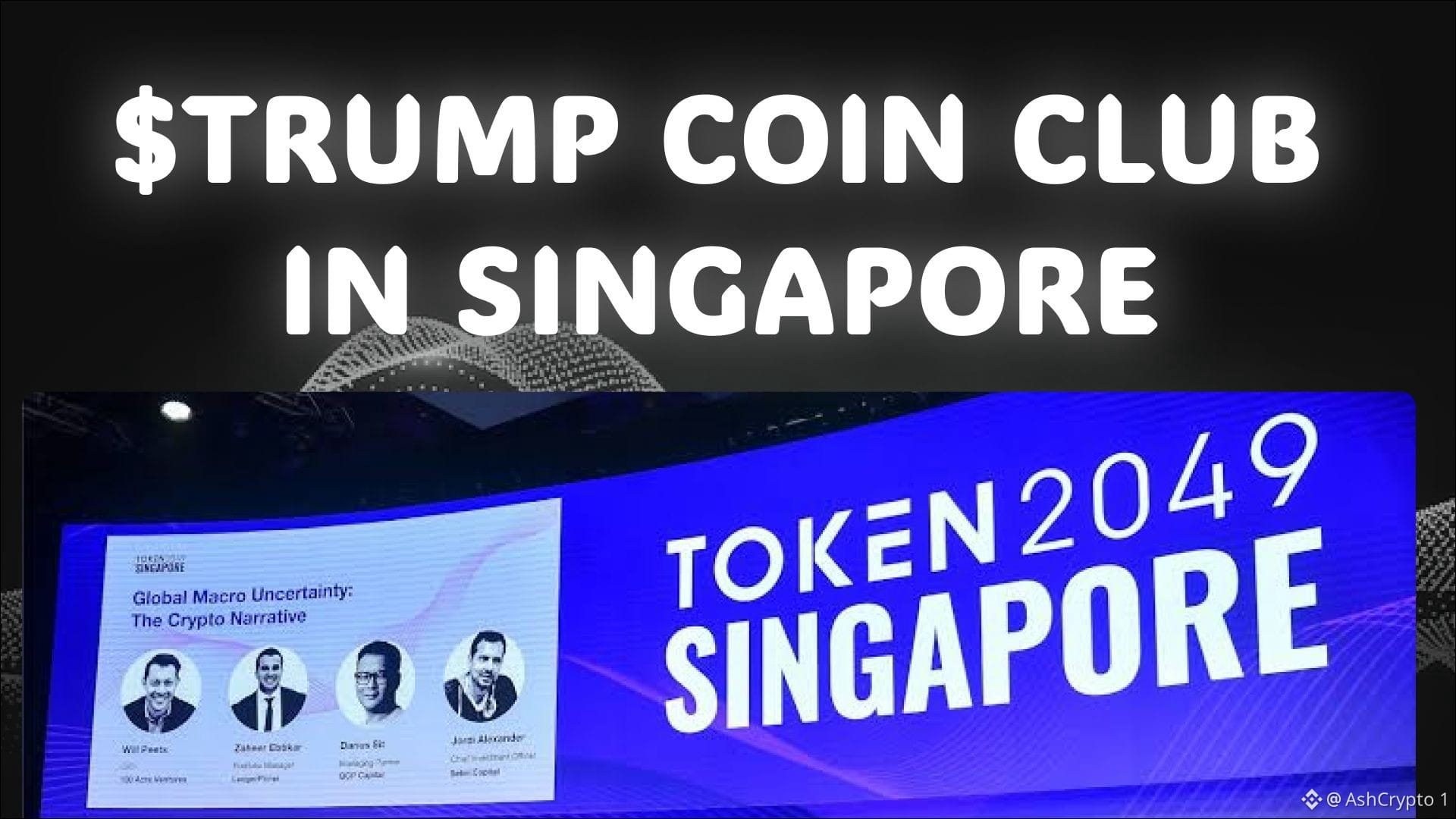
That is what makes the timing of the planned $Trump Coin Club Singapore experience interesting.
TOKEN2049 runs on October 7 and 8, while the Club’s three-day experience is scheduled to begin on October 9.
The focus then shifts toward private race-viewing hospitality and activities across the city, giving the week a completely different pace.
Sometimes the best way to extend a crypto week is to change what the week feels like.
#Macro Insights#
Conference fatigue changes what stands out
The ecosystems around $SUI and $APT can turn conference week into a dense run of meetings and side events.
By the final day, another panel can struggle to hold attention because the audience has spent days moving through similar formats.
I think the strongest follow-on experience does not need to outscale the conference. It needs to change the rhythm.
That is what makes the timing of the planned $Trump Coin Club Singapore experience interesting.
TOKEN2049 runs on October 7 and 8, while the Club’s three-day experience is scheduled to begin on October 9.
The focus then shifts toward private race-viewing hospitality and activities across the city, giving the week a completely different pace.
Sometimes the best way to extend a crypto week is to change what the week feels like.
#Macro Insights#
The ecosystems around $SUI and $APT can turn conference week into a dense run of meetings and side events.
By the final day, another panel can struggle to hold attention because the audience has spent days moving through similar formats.
I think the strongest follow-on experience does not need to outscale the conference. It needs to change the rhythm.
That is what makes the timing of the planned $Trump Coin Club Singapore experience interesting.
TOKEN2049 runs on October 7 and 8, while the Club’s three-day experience is scheduled to begin on October 9.
The focus then shifts toward private race-viewing hospitality and activities across the city, giving the week a completely different pace.
Sometimes the best way to extend a crypto week is to change what the week feels like.
#Macro Insights#
78
·
--
The best events have one club behind them 🔁
Communities around $PEPE and $FLOKI show how culture survives through references people keep repeating long after the original moment, and I think IRL experiences work the same way.
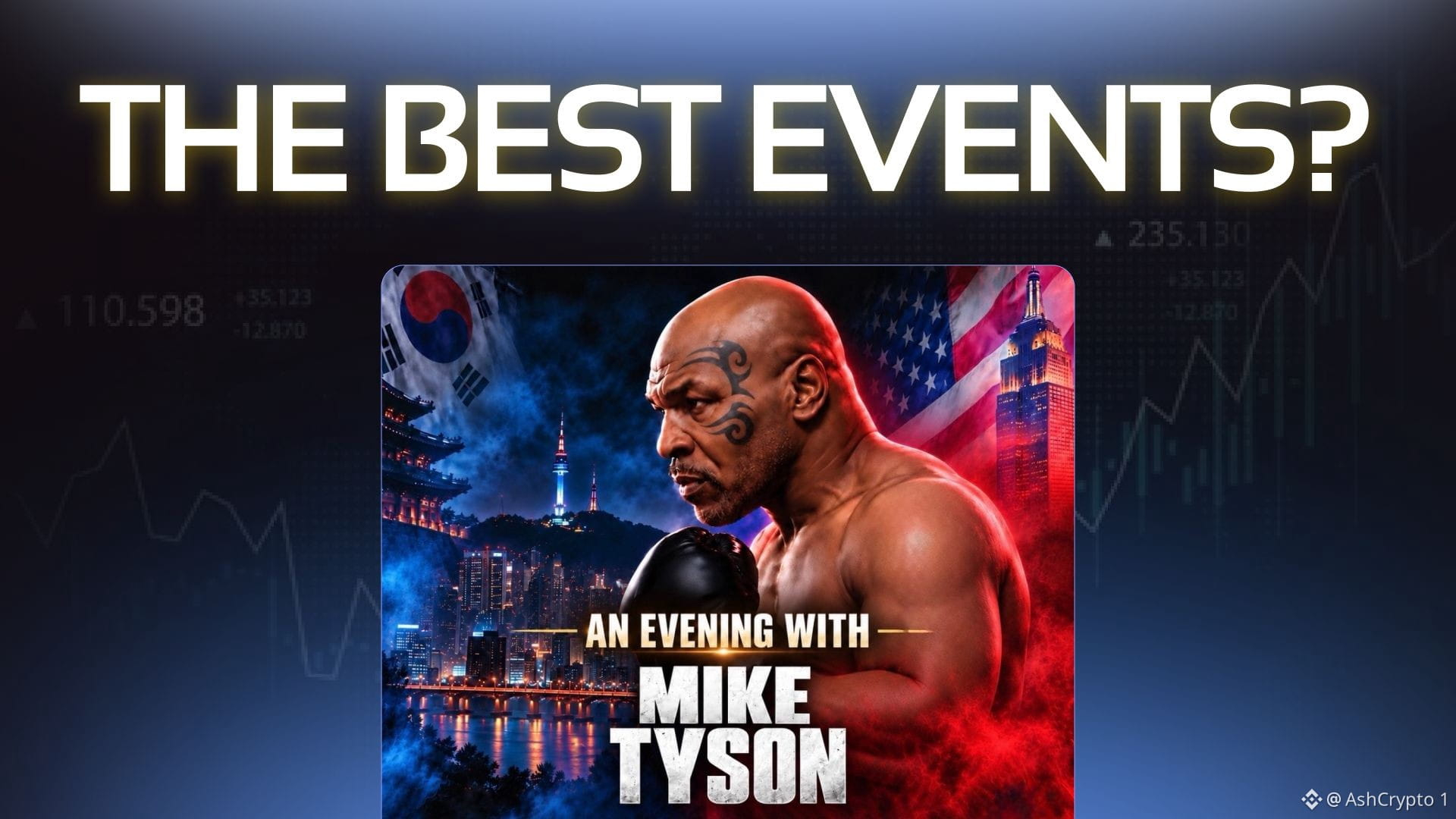
Yesterday’s invite-only Seoul gathering took place on the final day of Korea Blockchain Week, with Mike Tyson announced as one of the featured guests.
A name like Tyson can make an event instantly recognizable, but its longer life comes from the photographs, conversations and stories that continue circulating afterward.
The gathering was associated with the $Trump Coin Club’s Singapore programme, and it offered a useful reminder as attention turns to the Club’s next planned experience.
People may remember the headline guest, but the moments they retell are what give an event a second life.
An event occupies a date. A shared story can become part of the culture.
#Altcoin Season#
The best events have one club behind them 🔁
Communities around $PEPE and $FLOKI show how culture survives through references people keep repeating long after the original moment, and I think IRL experiences work the same way.
Yesterday’s invite-only Seoul gathering took place on the final day of Korea Blockchain Week, with Mike Tyson announced as one of the featured guests.
A name like Tyson can make an event instantly recognizable, but its longer life comes from the photographs, conversations and stories that continue circulating afterward.
The gathering was associated with the $Trump Coin Club’s Singapore programme, and it offered a useful reminder as attention turns to the Club’s next planned experience.
People may remember the headline guest, but the moments they retell are what give an event a second life.
An event occupies a date. A shared story can become part of the culture.
#Altcoin Season#
Communities around $PEPE and $FLOKI show how culture survives through references people keep repeating long after the original moment, and I think IRL experiences work the same way.
Yesterday’s invite-only Seoul gathering took place on the final day of Korea Blockchain Week, with Mike Tyson announced as one of the featured guests.
A name like Tyson can make an event instantly recognizable, but its longer life comes from the photographs, conversations and stories that continue circulating afterward.
The gathering was associated with the $Trump Coin Club’s Singapore programme, and it offered a useful reminder as attention turns to the Club’s next planned experience.
People may remember the headline guest, but the moments they retell are what give an event a second life.
An event occupies a date. A shared story can become part of the culture.
#Altcoin Season#
86
·
--
Will $SUI reach $2 before 2027? 📈
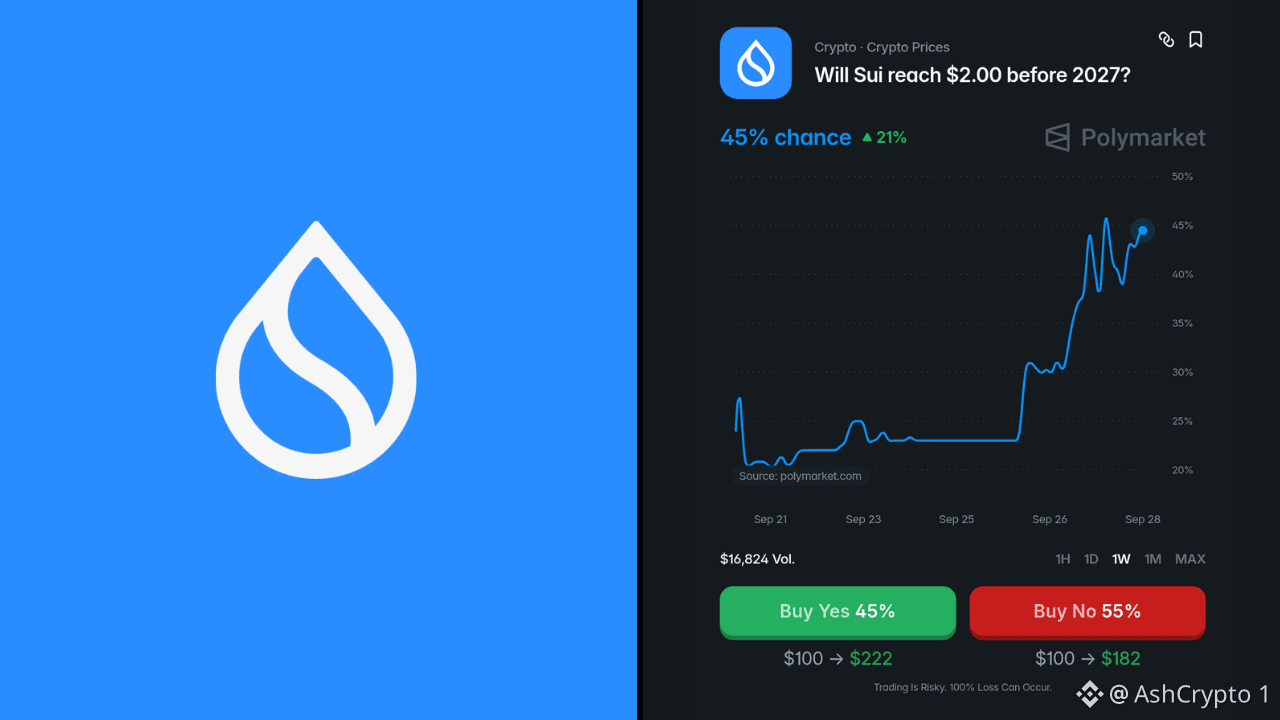
This chart shows exactly why I don't look at Polymarket as somewhere you simply make a prediction and wait.
YES was around 20% earlier in the week.
Now it's 45%.
That's a huge repricing of the same outcome before the actual event has even happened.
Someone who identified that opportunity early didn't need SUI to reach $2 before seeing their YES position become significantly more valuable.
That's what I want from Polymarket.
Find probabilities I believe are mispriced, enter before the crowd changes its mind, then decide whether I want to exit or continue toward resolution.
At today's 45% odds, $100 on YES would return roughly $222 if the prediction ultimately resolves correctly.
But the road between 45% and the final result can create opportunities of its own.
I'm not locked in.
I can enter, reduce, add or completely exit as new information changes the market.
That freedom makes Polymarket much more interesting to me than simply buying and holding.
#Altcoin Season#
Will $SUI reach $2 before 2027? 📈
This chart shows exactly why I don't look at Polymarket as somewhere you simply make a prediction and wait.
YES was around 20% earlier in the week.
Now it's 45%.
That's a huge repricing of the same outcome before the actual event has even happened.
Someone who identified that opportunity early didn't need SUI to reach $2 before seeing their YES position become significantly more valuable.
That's what I want from Polymarket.
Find probabilities I believe are mispriced, enter before the crowd changes its mind, then decide whether I want to exit or continue toward resolution.
At today's 45% odds, $100 on YES would return roughly $222 if the prediction ultimately resolves correctly.
But the road between 45% and the final result can create opportunities of its own.
I'm not locked in.
I can enter, reduce, add or completely exit as new information changes the market.
That freedom makes Polymarket much more interesting to me than simply buying and holding.
#Altcoin Season#
This chart shows exactly why I don't look at Polymarket as somewhere you simply make a prediction and wait.
YES was around 20% earlier in the week.
Now it's 45%.
That's a huge repricing of the same outcome before the actual event has even happened.
Someone who identified that opportunity early didn't need SUI to reach $2 before seeing their YES position become significantly more valuable.
That's what I want from Polymarket.
Find probabilities I believe are mispriced, enter before the crowd changes its mind, then decide whether I want to exit or continue toward resolution.
At today's 45% odds, $100 on YES would return roughly $222 if the prediction ultimately resolves correctly.
But the road between 45% and the final result can create opportunities of its own.
I'm not locked in.
I can enter, reduce, add or completely exit as new information changes the market.
That freedom makes Polymarket much more interesting to me than simply buying and holding.
#Altcoin Season#
81
Log in to explore more content
Join global crypto users on Binance Square
⚡️ Get latest and useful information about crypto.
💬 Trusted by the world’s largest crypto exchange.
👍 Discover real insights from verified creators.
Email / Phone number