
Alex1i9
138 Posts

Alex1i9
Report
Block User
Bull bear whatever - I am Here | #Binance KOL |
0 Following
11 Followers
16 Liked
Posts
·
--
Put SYN’s Chart Beside The Product 📊
$UNI makes a useful DeFi research habit clear. For $SYN I’m applying the same approach, reading the token chart alongside the activity of the underlying protocol.
The two measure different things.
Token trading volume shows activity in the asset. Protocol volume shows usage of the product. A change in one does not automatically establish a change in the other.
Hypercall gives SYN a product story to track, with options markets built on Hyperliquid and instruments extending into equities.
My baseline has three parts.
• SYN price and spot volume over a consistent period
• Hypercall options volume and open interest, where available
• Dated product milestones and changes in market availability
The interesting question is whether product usage develops alongside market attention.
That is how I want to assess the Hypercall thesis as it unfolds.
Each new observation should add something concrete to the case.
#DeFi
Put SYN’s Chart Beside The Product 📊
$UNI makes a useful DeFi research habit clear. For $SYN I’m applying the same approach, reading the token chart alongside the activity of the underlying protocol.
The two measure different things.
Token trading volume shows activity in the asset. Protocol volume shows usage of the product. A change in one does not automatically establish a change in the other.
Hypercall gives SYN a product story to track, with options markets built on Hyperliquid and instruments extending into equities.
My baseline has three parts.
• SYN price and spot volume over a consistent period
• Hypercall options volume and open interest, where available
• Dated product milestones and changes in market availability
The interesting question is whether product usage develops alongside market attention.
That is how I want to assess the Hypercall thesis as it unfolds.
Each new observation should add something concrete to the case.
#DeFi
$UNI makes a useful DeFi research habit clear. For $SYN I’m applying the same approach, reading the token chart alongside the activity of the underlying protocol.
The two measure different things.
Token trading volume shows activity in the asset. Protocol volume shows usage of the product. A change in one does not automatically establish a change in the other.
Hypercall gives SYN a product story to track, with options markets built on Hyperliquid and instruments extending into equities.
My baseline has three parts.
• SYN price and spot volume over a consistent period
• Hypercall options volume and open interest, where available
• Dated product milestones and changes in market availability
The interesting question is whether product usage develops alongside market attention.
That is how I want to assess the Hypercall thesis as it unfolds.
Each new observation should add something concrete to the case.
#DeFi
33
·
--
Why This Crypto App Could Blow Up 👇
The rise of $HYPE exposed a brutal truth about crypto products.
Users reward platforms that concentrate activity instead of sending them across five different interfaces.
Yet mobile crypto still feels like desktop DeFi squeezed onto a smaller screen.
Every extra handoff between wallets, bridges and trading venues kills attention and conversion.
The next dominant consumer product will make chains feel like invisible backend infrastructure. It will carry users from an idea to a live, tradable market without breaking their flow.
That is where I think the next breakout application gets built.
Zora’s latest mobile release moves directly at this opportunity.
Users can now:
• Create Custom Pairs with memes, majors and tokenized stocks
• Trade crosschain across Solana, BNB Chain, Robinhood Chain and Base
• Launch from their phone without returning to a desktop workflow
This changes the shape of the entire product.
Zora is starting to resemble a consumer operating system for onchain markets. Social discovery can flow into creation and trading inside the same interface. That flywheel becomes more
powerful as additional users, assets and chains enter the app.
I think the market is still looking at the old version of Zora while the team aggressively ships a far more ambitious one.
If mobile becomes crypto’s primary battleground, Zora now has a credible shot at owning a serious piece of it.
#Altcoin Season# #Stonk
Why This Crypto App Could Blow Up 👇
The rise of $HYPE exposed a brutal truth about crypto products.
Users reward platforms that concentrate activity instead of sending them across five different interfaces.
Yet mobile crypto still feels like desktop DeFi squeezed onto a smaller screen.
Every extra handoff between wallets, bridges and trading venues kills attention and conversion.
The next dominant consumer product will make chains feel like invisible backend infrastructure. It will carry users from an idea to a live, tradable market without breaking their flow.
That is where I think the next breakout application gets built.
Zora’s latest mobile release moves directly at this opportunity.
Users can now:
• Create Custom Pairs with memes, majors and tokenized stocks
• Trade crosschain across Solana, BNB Chain, Robinhood Chain and Base
• Launch from their phone without returning to a desktop workflow
This changes the shape of the entire product.
Zora is starting to resemble a consumer operating system for onchain markets. Social discovery can flow into creation and trading inside the same interface. That flywheel becomes more
powerful as additional users, assets and chains enter the app.
I think the market is still looking at the old version of Zora while the team aggressively ships a far more ambitious one.
If mobile becomes crypto’s primary battleground, Zora now has a credible shot at owning a serious piece of it.
#Altcoin Season# #Stonk
The rise of $HYPE exposed a brutal truth about crypto products.
Users reward platforms that concentrate activity instead of sending them across five different interfaces.
Yet mobile crypto still feels like desktop DeFi squeezed onto a smaller screen.
Every extra handoff between wallets, bridges and trading venues kills attention and conversion.
The next dominant consumer product will make chains feel like invisible backend infrastructure. It will carry users from an idea to a live, tradable market without breaking their flow.
That is where I think the next breakout application gets built.
Zora’s latest mobile release moves directly at this opportunity.
Users can now:
• Create Custom Pairs with memes, majors and tokenized stocks
• Trade crosschain across Solana, BNB Chain, Robinhood Chain and Base
• Launch from their phone without returning to a desktop workflow
This changes the shape of the entire product.
Zora is starting to resemble a consumer operating system for onchain markets. Social discovery can flow into creation and trading inside the same interface. That flywheel becomes more
powerful as additional users, assets and chains enter the app.
I think the market is still looking at the old version of Zora while the team aggressively ships a far more ambitious one.
If mobile becomes crypto’s primary battleground, Zora now has a credible shot at owning a serious piece of it.
#Altcoin Season# #Stonk
61
·
--
My favourite privacy play that is more than a demo environment 🤖
It is easy to make zero-knowledge technology look impressive when one carefully prepared transaction is doing all the work.
The harder question is what happens when software starts generating transactions continuously.
That matters as autonomous activity grows across networks like $FET , where agents are designed to find each other and transact without waiting for a human to approve every interaction. It doesn’t stop there either, other chains like $TAO are building the rails for agentic environments.
Midnight already has an interesting test environment for this.
Midnight City has autonomous agents generating real transactions and real zero-knowledge proofs on the network. The same activity can then produce different views for the public, auditors and regulators depending on what each party is permitted to see.
That is a much more interesting test of programmable privacy than hiding one transfer.
The application has to keep producing proofs while the agents keep doing things.
Crypto has spent years benchmarking transactions per second.
I think we are going to need another benchmark for this new meta. How much private computation can applications actually sustain once the machines start transacting for us?
#AI #Infrastructure
My favourite privacy play that is more than a demo environment 🤖
It is easy to make zero-knowledge technology look impressive when one carefully prepared transaction is doing all the work.
The harder question is what happens when software starts generating transactions continuously.
That matters as autonomous activity grows across networks like $FET , where agents are designed to find each other and transact without waiting for a human to approve every interaction. It doesn’t stop there either, other chains like $TAO are building the rails for agentic environments.
Midnight already has an interesting test environment for this.
Midnight City has autonomous agents generating real transactions and real zero-knowledge proofs on the network. The same activity can then produce different views for the public, auditors and regulators depending on what each party is permitted to see.
That is a much more interesting test of programmable privacy than hiding one transfer.
The application has to keep producing proofs while the agents keep doing things.
Crypto has spent years benchmarking transactions per second.
I think we are going to need another benchmark for this new meta. How much private computation can applications actually sustain once the machines start transacting for us?
#AI #Infrastructure
It is easy to make zero-knowledge technology look impressive when one carefully prepared transaction is doing all the work.
The harder question is what happens when software starts generating transactions continuously.
That matters as autonomous activity grows across networks like $FET , where agents are designed to find each other and transact without waiting for a human to approve every interaction. It doesn’t stop there either, other chains like $TAO are building the rails for agentic environments.
Midnight already has an interesting test environment for this.
Midnight City has autonomous agents generating real transactions and real zero-knowledge proofs on the network. The same activity can then produce different views for the public, auditors and regulators depending on what each party is permitted to see.
That is a much more interesting test of programmable privacy than hiding one transfer.
The application has to keep producing proofs while the agents keep doing things.
Crypto has spent years benchmarking transactions per second.
I think we are going to need another benchmark for this new meta. How much private computation can applications actually sustain once the machines start transacting for us?
#AI #Infrastructure
62
·
--
PYTH still has room to rerate ⚡
$SUI has the fast apps, liquidity and consumer UX crowd. $HBAR has enterprise trust, real-world infrastructure and institutional adoption baked into its narrative. Pyth sits underneath the market both audiences eventually need: real financial data moving into software.
Nasdaq Basic through Pyth Data Marketplace makes the ceiling look different.
This is real-time U.S. equity market data covering quotes, trades, best bid and offer, size, last sale, and official open and close reference prices.
For approved clients, Pyth becomes a channel to receive that data after licensing directly with Nasdaq.
Now compare that to where PYTH trades.
Rank #87.
Around $0.065.
Market cap around $516M.
FDV around $656M.
That is not tiny, but it is still nowhere near the size of the opportunity Pyth is chasing if it keeps moving into institutional data distribution, RWA pricing, indices, prediction markets and trading infrastructure.
Pyth has already priced $723.77B in August RWA perp volume.
It has 138+ first-party publishers.
It crossed $10.4M ARR in August.
The token is still being judged like a crypto oracle.
The product is building like a financial market-data layer.
That disconnect is the bullish part 💎
#Altcoin Season# #RWA
PYTH still has room to rerate ⚡
$SUI has the fast apps, liquidity and consumer UX crowd. $HBAR has enterprise trust, real-world infrastructure and institutional adoption baked into its narrative. Pyth sits underneath the market both audiences eventually need: real financial data moving into software.
Nasdaq Basic through Pyth Data Marketplace makes the ceiling look different.
This is real-time U.S. equity market data covering quotes, trades, best bid and offer, size, last sale, and official open and close reference prices.
For approved clients, Pyth becomes a channel to receive that data after licensing directly with Nasdaq.
Now compare that to where PYTH trades.
Rank #87.
Around $0.065.
Market cap around $516M.
FDV around $656M.
That is not tiny, but it is still nowhere near the size of the opportunity Pyth is chasing if it keeps moving into institutional data distribution, RWA pricing, indices, prediction markets and trading infrastructure.
Pyth has already priced $723.77B in August RWA perp volume.
It has 138+ first-party publishers.
It crossed $10.4M ARR in August.
The token is still being judged like a crypto oracle.
The product is building like a financial market-data layer.
That disconnect is the bullish part 💎
#Altcoin Season# #RWA
$SUI has the fast apps, liquidity and consumer UX crowd. $HBAR has enterprise trust, real-world infrastructure and institutional adoption baked into its narrative. Pyth sits underneath the market both audiences eventually need: real financial data moving into software.
Nasdaq Basic through Pyth Data Marketplace makes the ceiling look different.
This is real-time U.S. equity market data covering quotes, trades, best bid and offer, size, last sale, and official open and close reference prices.
For approved clients, Pyth becomes a channel to receive that data after licensing directly with Nasdaq.
Now compare that to where PYTH trades.
Rank #87.
Around $0.065.
Market cap around $516M.
FDV around $656M.
That is not tiny, but it is still nowhere near the size of the opportunity Pyth is chasing if it keeps moving into institutional data distribution, RWA pricing, indices, prediction markets and trading infrastructure.
Pyth has already priced $723.77B in August RWA perp volume.
It has 138+ first-party publishers.
It crossed $10.4M ARR in August.
The token is still being judged like a crypto oracle.
The product is building like a financial market-data layer.
That disconnect is the bullish part 💎
#Altcoin Season# #RWA
36
·
--
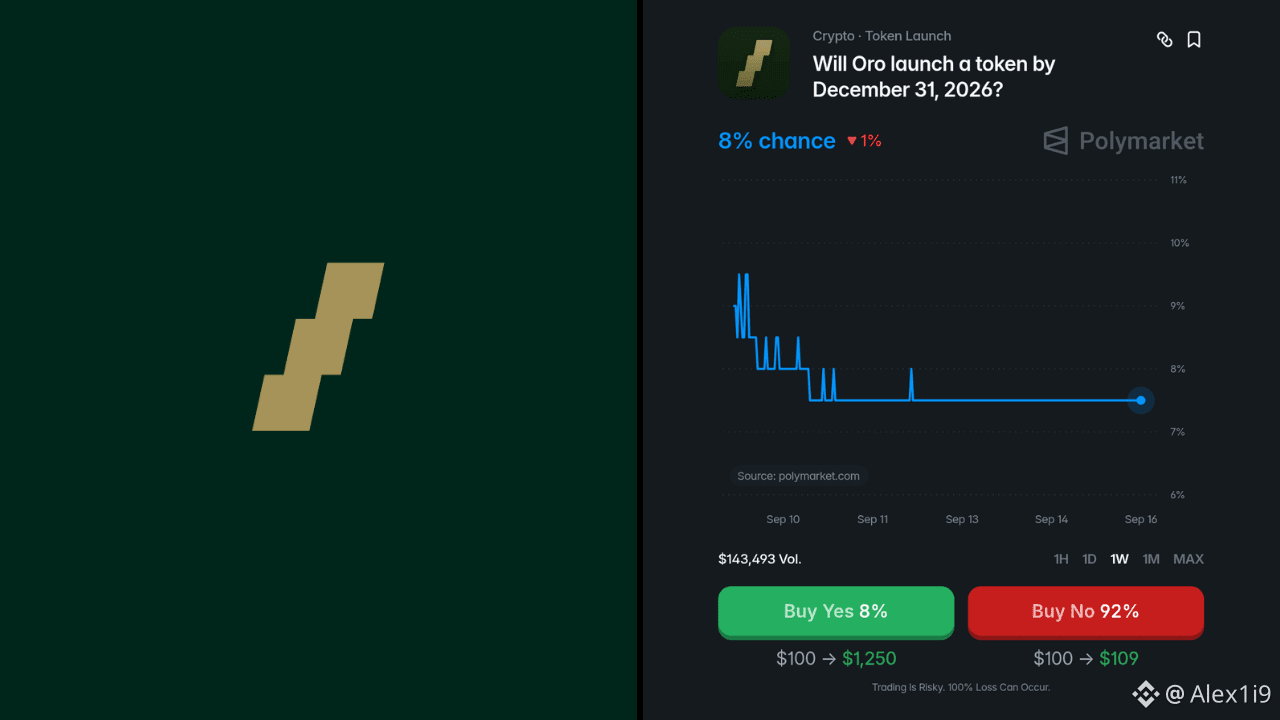
Oro still looks too early 🧊
8% Yes with around $143K traded.
I'm staying on No.
This isn't some tiny market where a handful of wallets pushed the probability down. A meaningful amount has already been traded, and the market continues to assign only a very small chance to a token launch before December 31.
I respect that.
There may still be surprises, but at this point the calendar matters.
Every week that passes without a clear path toward launch makes the remaining window smaller.
So instead of forcing another directional $SUI trade, I'd rather take a position on the event itself.
No is my side.
What I like about Polymarket is that even a high-conviction No doesn't have to become a three-month commitment.
If Oro suddenly changes the picture with credible launch information, I can sell before resolution.
That's important.
Prediction markets reward conviction, but they don't require stubbornness.
I can enter when I think the odds are wrong, leave when the facts change and immediately move into another market.
There are always more predictions coming.
#Altcoin Season#
Oro still looks too early 🧊
8% Yes with around $143K traded.
I'm staying on No.
This isn't some tiny market where a handful of wallets pushed the probability down. A meaningful amount has already been traded, and the market continues to assign only a very small chance to a token launch before December 31.
I respect that.
There may still be surprises, but at this point the calendar matters.
Every week that passes without a clear path toward launch makes the remaining window smaller.
So instead of forcing another directional $SUI trade, I'd rather take a position on the event itself.
No is my side.
What I like about Polymarket is that even a high-conviction No doesn't have to become a three-month commitment.
If Oro suddenly changes the picture with credible launch information, I can sell before resolution.
That's important.
Prediction markets reward conviction, but they don't require stubbornness.
I can enter when I think the odds are wrong, leave when the facts change and immediately move into another market.
There are always more predictions coming.
#Altcoin Season#
8% Yes with around $143K traded.
I'm staying on No.
This isn't some tiny market where a handful of wallets pushed the probability down. A meaningful amount has already been traded, and the market continues to assign only a very small chance to a token launch before December 31.
I respect that.
There may still be surprises, but at this point the calendar matters.
Every week that passes without a clear path toward launch makes the remaining window smaller.
So instead of forcing another directional $SUI trade, I'd rather take a position on the event itself.
No is my side.
What I like about Polymarket is that even a high-conviction No doesn't have to become a three-month commitment.
If Oro suddenly changes the picture with credible launch information, I can sell before resolution.
That's important.
Prediction markets reward conviction, but they don't require stubbornness.
I can enter when I think the odds are wrong, leave when the facts change and immediately move into another market.
There are always more predictions coming.
#Altcoin Season#
76
·
--
$39M Proves This Community Participates 🔥
Across DeFi, communities around $HYPE and $SUI keep token economics central to how holders judge long-term participation.
I think the strongest community models are the ones where involvement produces an onchain result anyone can track.
Injective’s Community BuyBack does exactly that through recurring monthly rounds.
Ninjas commit INJ for a pro rata share of collected ecosystem revenue, and every committed INJ is permanently burned when the round closes.
Those rounds have now reached more than $39M in cumulative buyback value.
For me, that figure says more about Injective’s community than follower counts ever could 🥷
#Altcoin Season#
$39M Proves This Community Participates 🔥
Across DeFi, communities around $HYPE and $SUI keep token economics central to how holders judge long-term participation.
I think the strongest community models are the ones where involvement produces an onchain result anyone can track.
Injective’s Community BuyBack does exactly that through recurring monthly rounds.
Ninjas commit INJ for a pro rata share of collected ecosystem revenue, and every committed INJ is permanently burned when the round closes.
Those rounds have now reached more than $39M in cumulative buyback value.
For me, that figure says more about Injective’s community than follower counts ever could 🥷
#Altcoin Season#
Across DeFi, communities around $HYPE and $SUI keep token economics central to how holders judge long-term participation.
I think the strongest community models are the ones where involvement produces an onchain result anyone can track.
Injective’s Community BuyBack does exactly that through recurring monthly rounds.
Ninjas commit INJ for a pro rata share of collected ecosystem revenue, and every committed INJ is permanently burned when the round closes.
Those rounds have now reached more than $39M in cumulative buyback value.
For me, that figure says more about Injective’s community than follower counts ever could 🥷
#Altcoin Season#

66
·
--
Building a real crypto club is hard 👀
Both $APE and $PENGU helped popularize the idea that a crypto community could become a recognizable social identity, but in my view, far fewer have created recurring reasons for their communities to meet in person.
A member label and a private chat can provide access, but they do not automatically create relationships.
A real club needs a physical life too.
The Trump Coin Club is building that side of its identity in the best way possible.
From New York, Mar-a-Lago to Seoul and Singapore next, each destination gives the community another setting in which real relationships can develop.
Those IRL events are becoming the clearest expression of what the Club is trying to build ⚡️
#Macro Insights#
Building a real crypto club is hard 👀
Both $APE and $PENGU helped popularize the idea that a crypto community could become a recognizable social identity, but in my view, far fewer have created recurring reasons for their communities to meet in person.
A member label and a private chat can provide access, but they do not automatically create relationships.
A real club needs a physical life too.
The Trump Coin Club is building that side of its identity in the best way possible.
From New York, Mar-a-Lago to Seoul and Singapore next, each destination gives the community another setting in which real relationships can develop.
Those IRL events are becoming the clearest expression of what the Club is trying to build ⚡️
#Macro Insights#
Both $APE and $PENGU helped popularize the idea that a crypto community could become a recognizable social identity, but in my view, far fewer have created recurring reasons for their communities to meet in person.
A member label and a private chat can provide access, but they do not automatically create relationships.
A real club needs a physical life too.
The Trump Coin Club is building that side of its identity in the best way possible.
From New York, Mar-a-Lago to Seoul and Singapore next, each destination gives the community another setting in which real relationships can develop.
Those IRL events are becoming the clearest expression of what the Club is trying to build ⚡️
#Macro Insights#
73
·
--
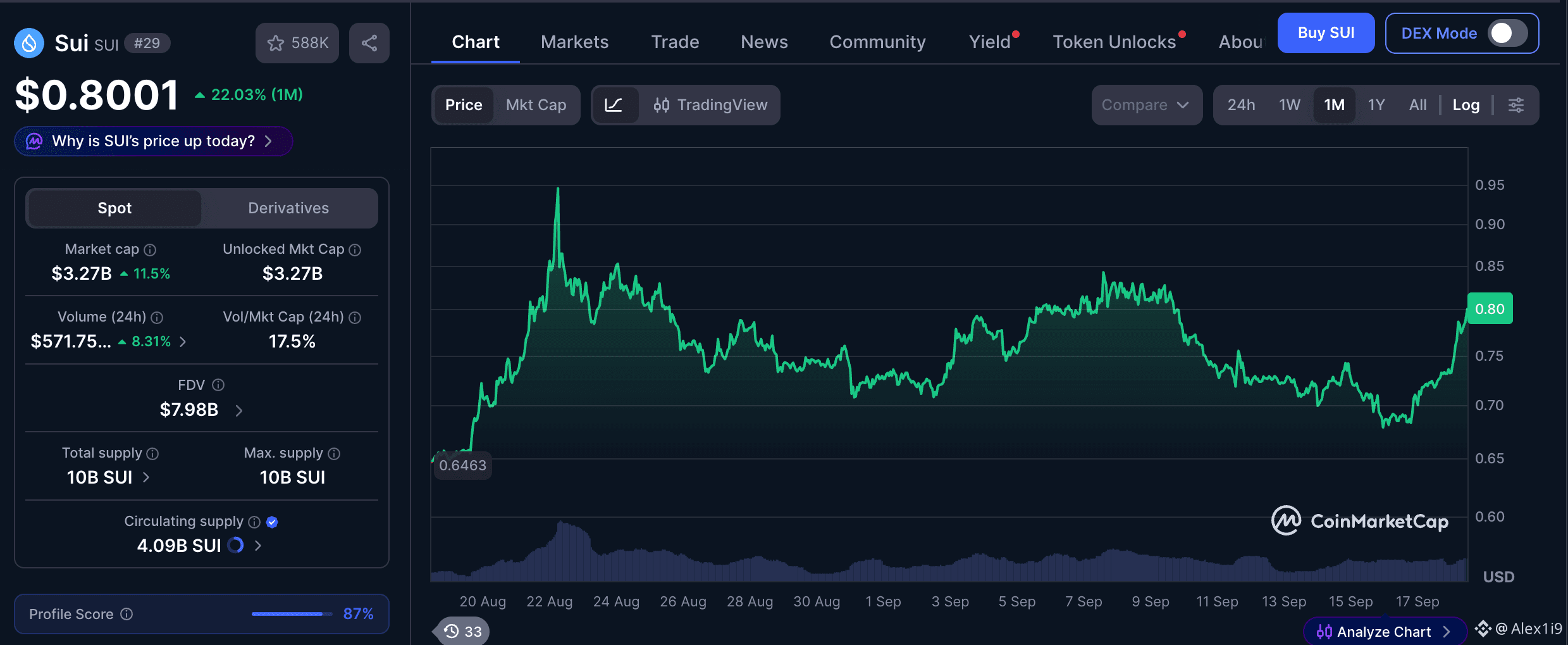
$SUI Bulls Just Reclaimed A Key Level 🔥
SUI has jumped roughly 8.6% to around $0.78, outperforming the wider market with $489M in daily volume behind the move.
The important level now sits at $0.764.
Holding above it would confirm that buyers have reclaimed the recent Fibonacci support and are willing to defend the bounce.
The first resistance is $0.80.
A decisive daily close above that zone would put $0.85 back in play, where the 200-day moving average becomes the real trend confirmation.
Clear $0.85 and the chart opens towards $0.95, followed by the larger psychological target around $1.04.
I would expect some turbulence before that happens.
Short-term momentum is already stretched, with the hourly RSI recently moving above 75, so a retest of support would be healthy.
The bullish structure survives while $0.764 holds.
If that level fails, $0.73 becomes the next defence before the stronger $0.677 to $0.65 demand zone.
My outlook stays bullish because price has recovered with volume and the market has given us a clean invalidation point.
Hold $0.764, break $0.80 and reclaim $0.85.
That is the route I’m watching towards a return above $1.
#Sui #Altcoin Season#
$SUI Bulls Just Reclaimed A Key Level 🔥
SUI has jumped roughly 8.6% to around $0.78, outperforming the wider market with $489M in daily volume behind the move.
The important level now sits at $0.764.
Holding above it would confirm that buyers have reclaimed the recent Fibonacci support and are willing to defend the bounce.
The first resistance is $0.80.
A decisive daily close above that zone would put $0.85 back in play, where the 200-day moving average becomes the real trend confirmation.
Clear $0.85 and the chart opens towards $0.95, followed by the larger psychological target around $1.04.
I would expect some turbulence before that happens.
Short-term momentum is already stretched, with the hourly RSI recently moving above 75, so a retest of support would be healthy.
The bullish structure survives while $0.764 holds.
If that level fails, $0.73 becomes the next defence before the stronger $0.677 to $0.65 demand zone.
My outlook stays bullish because price has recovered with volume and the market has given us a clean invalidation point.
Hold $0.764, break $0.80 and reclaim $0.85.
That is the route I’m watching towards a return above $1.
#Sui #Altcoin Season#
SUI has jumped roughly 8.6% to around $0.78, outperforming the wider market with $489M in daily volume behind the move.
The important level now sits at $0.764.
Holding above it would confirm that buyers have reclaimed the recent Fibonacci support and are willing to defend the bounce.
The first resistance is $0.80.
A decisive daily close above that zone would put $0.85 back in play, where the 200-day moving average becomes the real trend confirmation.
Clear $0.85 and the chart opens towards $0.95, followed by the larger psychological target around $1.04.
I would expect some turbulence before that happens.
Short-term momentum is already stretched, with the hourly RSI recently moving above 75, so a retest of support would be healthy.
The bullish structure survives while $0.764 holds.
If that level fails, $0.73 becomes the next defence before the stronger $0.677 to $0.65 demand zone.
My outlook stays bullish because price has recovered with volume and the market has given us a clean invalidation point.
Hold $0.764, break $0.80 and reclaim $0.85.
That is the route I’m watching towards a return above $1.
#Sui #Altcoin Season#
75
·
--
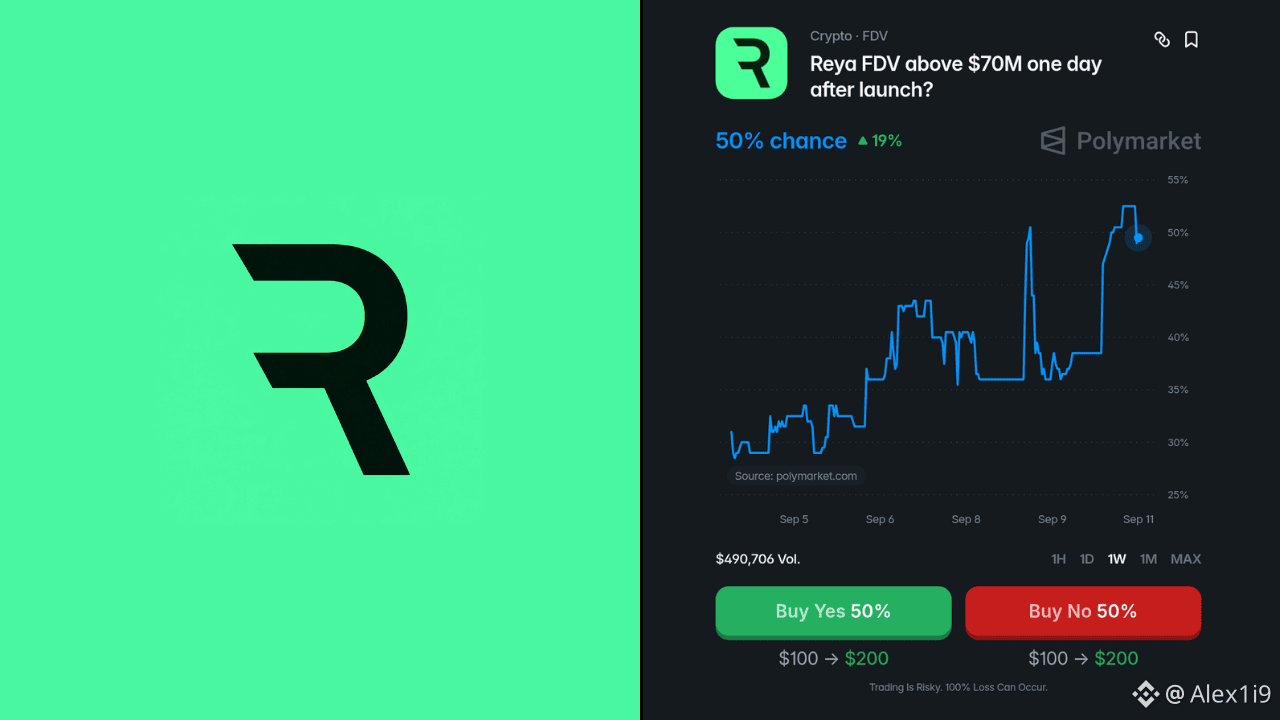
50/50 Is The Opportunity ⚔️
Polymarket has Reya perfectly split.
50% Yes. 50% No.
I know which side I want.
Yes.
The chart is why.
This market started below 30%.
Then traders steadily pushed it through 35%, 40%, and eventually 50%.
There were pullbacks along the way.
Every major one found buyers.
That's very different from a random one-day spike.
It's a week of gradually improving conviction.
And nearly $500K has already traded in the screenshot.
So this isn't some $5K market pretending to have a signal.
$ARB fits the onchain infrastructure side of this thesis.
$HYPE represents how aggressively traders can value crypto-native trading platforms once adoption starts showing.
Polymarket lets me trade that valuation question before launch day settles the argument.
That's the opportunity.
Everyone gets the same 50/50 price.
Only one side gets paid.
I'm taking Yes.
#Altcoin Season#
50/50 Is The Opportunity ⚔️
Polymarket has Reya perfectly split.
50% Yes. 50% No.
I know which side I want.
Yes.
The chart is why.
This market started below 30%.
Then traders steadily pushed it through 35%, 40%, and eventually 50%.
There were pullbacks along the way.
Every major one found buyers.
That's very different from a random one-day spike.
It's a week of gradually improving conviction.
And nearly $500K has already traded in the screenshot.
So this isn't some $5K market pretending to have a signal.
$ARB fits the onchain infrastructure side of this thesis.
$HYPE represents how aggressively traders can value crypto-native trading platforms once adoption starts showing.
Polymarket lets me trade that valuation question before launch day settles the argument.
That's the opportunity.
Everyone gets the same 50/50 price.
Only one side gets paid.
I'm taking Yes.
#Altcoin Season#
Polymarket has Reya perfectly split.
50% Yes. 50% No.
I know which side I want.
Yes.
The chart is why.
This market started below 30%.
Then traders steadily pushed it through 35%, 40%, and eventually 50%.
There were pullbacks along the way.
Every major one found buyers.
That's very different from a random one-day spike.
It's a week of gradually improving conviction.
And nearly $500K has already traded in the screenshot.
So this isn't some $5K market pretending to have a signal.
$ARB fits the onchain infrastructure side of this thesis.
$HYPE represents how aggressively traders can value crypto-native trading platforms once adoption starts showing.
Polymarket lets me trade that valuation question before launch day settles the argument.
That's the opportunity.
Everyone gets the same 50/50 price.
Only one side gets paid.
I'm taking Yes.
#Altcoin Season#
80
·
--
I Check The Exit 🛡️
When someone shows me a DeFi strategy, I usually start at the end.
How do I get out?
That tells me more than staring at the advertised APY.
I want to know what happens when liquidity disappears, collateral weakens or leverage suddenly becomes uncomfortable.
This is one reason Theoriq's risk model interests me.
Positions aren't just selected for return potential.
The framework considers collateral quality, liquidity, concentration and structural risk before capital gets committed.
Monitoring continues afterward rather than treating deployment as the finish line.
That mindset becomes increasingly important as onchain markets get more interconnected.
$AAVE can offer deep lending infrastructure, while $PENDLE can expose entirely different term-yield opportunities.
Both can be useful without carrying identical risks.
That's exactly the point.
A portfolio isn't safer because it contains more positions.
It's safer when someone understands why every position belongs there and what would make them leave.
#Altcoin Season#
I Check The Exit 🛡️
When someone shows me a DeFi strategy, I usually start at the end.
How do I get out?
That tells me more than staring at the advertised APY.
I want to know what happens when liquidity disappears, collateral weakens or leverage suddenly becomes uncomfortable.
This is one reason Theoriq's risk model interests me.
Positions aren't just selected for return potential.
The framework considers collateral quality, liquidity, concentration and structural risk before capital gets committed.
Monitoring continues afterward rather than treating deployment as the finish line.
That mindset becomes increasingly important as onchain markets get more interconnected.
$AAVE can offer deep lending infrastructure, while $PENDLE can expose entirely different term-yield opportunities.
Both can be useful without carrying identical risks.
That's exactly the point.
A portfolio isn't safer because it contains more positions.
It's safer when someone understands why every position belongs there and what would make them leave.
#Altcoin Season#
When someone shows me a DeFi strategy, I usually start at the end.
How do I get out?
That tells me more than staring at the advertised APY.
I want to know what happens when liquidity disappears, collateral weakens or leverage suddenly becomes uncomfortable.
This is one reason Theoriq's risk model interests me.
Positions aren't just selected for return potential.
The framework considers collateral quality, liquidity, concentration and structural risk before capital gets committed.
Monitoring continues afterward rather than treating deployment as the finish line.
That mindset becomes increasingly important as onchain markets get more interconnected.
$AAVE can offer deep lending infrastructure, while $PENDLE can expose entirely different term-yield opportunities.
Both can be useful without carrying identical risks.
That's exactly the point.
A portfolio isn't safer because it contains more positions.
It's safer when someone understands why every position belongs there and what would make them leave.
#Altcoin Season#
66
·
--
Two Major Markets Collide 🧠
The creator economy that once gathered around $IMX now overlaps with the RWA crowd following $SPCX in ways that sounded ridiculous three years ago.
From a distance, those look like completely different crypto cycles.
Up close, they are iterations of the same idea.
Internet culture can become ownable, tradable, and economically valuable to the people creating it.
The companies that survive long enough get to carry lessons from one cycle into the next.
Zora’s journey makes much more sense through that lens.
It began by giving creators an open alternative to traditional NFT marketplaces.
Since then, the product has moved through several expressions of the same underlying thesis.
- Open markets for digital art and media
- Creator and content coins
- Social experiences built around trading
- Custom Pairs connecting new tokens with memes, majors, and tokenized assets
More than 4,000 Custom Pairs have already been created.
Some people see that history as a series of pivots.
I see six years of trying to answer one difficult question.
How should value move through internet culture?
Zora has gone from helping creators sell individual works to letting anyone create an entire market around an idea.
With fresh leadership and a leaner team, the next challenge is turning those accumulated lessons into a product ordinary people actually want to use.
If Zora gets that distribution right, its past may become the strongest argument for its future.
#RWA #Altcoin Season#
Two Major Markets Collide 🧠
The creator economy that once gathered around $IMX now overlaps with the RWA crowd following $SPCX in ways that sounded ridiculous three years ago.
From a distance, those look like completely different crypto cycles.
Up close, they are iterations of the same idea.
Internet culture can become ownable, tradable, and economically valuable to the people creating it.
The companies that survive long enough get to carry lessons from one cycle into the next.
Zora’s journey makes much more sense through that lens.
It began by giving creators an open alternative to traditional NFT marketplaces.
Since then, the product has moved through several expressions of the same underlying thesis.
- Open markets for digital art and media
- Creator and content coins
- Social experiences built around trading
- Custom Pairs connecting new tokens with memes, majors, and tokenized assets
More than 4,000 Custom Pairs have already been created.
Some people see that history as a series of pivots.
I see six years of trying to answer one difficult question.
How should value move through internet culture?
Zora has gone from helping creators sell individual works to letting anyone create an entire market around an idea.
With fresh leadership and a leaner team, the next challenge is turning those accumulated lessons into a product ordinary people actually want to use.
If Zora gets that distribution right, its past may become the strongest argument for its future.
#RWA #Altcoin Season#
The creator economy that once gathered around $IMX now overlaps with the RWA crowd following $SPCX in ways that sounded ridiculous three years ago.
From a distance, those look like completely different crypto cycles.
Up close, they are iterations of the same idea.
Internet culture can become ownable, tradable, and economically valuable to the people creating it.
The companies that survive long enough get to carry lessons from one cycle into the next.
Zora’s journey makes much more sense through that lens.
It began by giving creators an open alternative to traditional NFT marketplaces.
Since then, the product has moved through several expressions of the same underlying thesis.
- Open markets for digital art and media
- Creator and content coins
- Social experiences built around trading
- Custom Pairs connecting new tokens with memes, majors, and tokenized assets
More than 4,000 Custom Pairs have already been created.
Some people see that history as a series of pivots.
I see six years of trying to answer one difficult question.
How should value move through internet culture?
Zora has gone from helping creators sell individual works to letting anyone create an entire market around an idea.
With fresh leadership and a leaner team, the next challenge is turning those accumulated lessons into a product ordinary people actually want to use.
If Zora gets that distribution right, its past may become the strongest argument for its future.
#RWA #Altcoin Season#

66
·
--
No Hospital Has Enough Patients Alone 🏥
A rare disease might show up a dozen times in one hospital's records, which is nowhere near enough to learn from, and the rest of the cases sit across hundreds of other hospitals that are not allowed to share with each other.
$TAO already showed that strangers can build a serious model together, with more than 70 independent participants on its Templar subnet producing Covenant-72B in March, and apps on $SOL settle work every day between parties who never have to trust one another.
That kind of collaboration works when the data is something anyone is allowed to see, and a patient record is the opposite, so healthcare sits on huge amounts of data with almost none of it usable together.
On fundamentals I look for valuable assets nobody can put to work yet, and medical data is the clearest case, because the more valuable the data, the less anyone can use it.
Arcium lets several institutions compute on their combined records without any of them handing the records over, since each input is split into fragments across a cluster of nodes, no single node can read any of it, and the cluster still returns the correct result.
Each hospital keeps its files, and what comes out is the finding, a count, a comparison or a statistical result, never the rows behind it.
That result can be recorded on Solana as an ordinary public transaction, so anyone can check that the study ran and what it found.
The compute layer doing this has been on Mainnet Alpha since February 2, and Blackthorn, which extends it to AI models, is still to come.
Healthcare data is valuable and split into thousands of pieces, and I think the network that computes across them without collecting them ends up mattering more than any single model.
#AI
No Hospital Has Enough Patients Alone 🏥
A rare disease might show up a dozen times in one hospital's records, which is nowhere near enough to learn from, and the rest of the cases sit across hundreds of other hospitals that are not allowed to share with each other.
$TAO already showed that strangers can build a serious model together, with more than 70 independent participants on its Templar subnet producing Covenant-72B in March, and apps on $SOL settle work every day between parties who never have to trust one another.
That kind of collaboration works when the data is something anyone is allowed to see, and a patient record is the opposite, so healthcare sits on huge amounts of data with almost none of it usable together.
On fundamentals I look for valuable assets nobody can put to work yet, and medical data is the clearest case, because the more valuable the data, the less anyone can use it.
Arcium lets several institutions compute on their combined records without any of them handing the records over, since each input is split into fragments across a cluster of nodes, no single node can read any of it, and the cluster still returns the correct result.
Each hospital keeps its files, and what comes out is the finding, a count, a comparison or a statistical result, never the rows behind it.
That result can be recorded on Solana as an ordinary public transaction, so anyone can check that the study ran and what it found.
The compute layer doing this has been on Mainnet Alpha since February 2, and Blackthorn, which extends it to AI models, is still to come.
Healthcare data is valuable and split into thousands of pieces, and I think the network that computes across them without collecting them ends up mattering more than any single model.
#AI
A rare disease might show up a dozen times in one hospital's records, which is nowhere near enough to learn from, and the rest of the cases sit across hundreds of other hospitals that are not allowed to share with each other.
$TAO already showed that strangers can build a serious model together, with more than 70 independent participants on its Templar subnet producing Covenant-72B in March, and apps on $SOL settle work every day between parties who never have to trust one another.
That kind of collaboration works when the data is something anyone is allowed to see, and a patient record is the opposite, so healthcare sits on huge amounts of data with almost none of it usable together.
On fundamentals I look for valuable assets nobody can put to work yet, and medical data is the clearest case, because the more valuable the data, the less anyone can use it.
Arcium lets several institutions compute on their combined records without any of them handing the records over, since each input is split into fragments across a cluster of nodes, no single node can read any of it, and the cluster still returns the correct result.
Each hospital keeps its files, and what comes out is the finding, a count, a comparison or a statistical result, never the rows behind it.
That result can be recorded on Solana as an ordinary public transaction, so anyone can check that the study ran and what it found.
The compute layer doing this has been on Mainnet Alpha since February 2, and Blackthorn, which extends it to AI models, is still to come.
Healthcare data is valuable and split into thousands of pieces, and I think the network that computes across them without collecting them ends up mattering more than any single model.
#AI

70
·
--
Oracles Solve Trust Before They Solve Distance 📊
$LINK answers one of crypto’s hardest questions, which is how a smart contract can rely on information that originated somewhere outside its own chain.
That is a trust problem.
Moving the resulting information between physical machines is a different one. A market can know exactly what the correct price is and still care enormously about whether that price arrives now or several moments later.
That is why $PYTH put so much emphasis on rapidly distributing financial information from publishers toward applications that need it. The more real-time those applications become, the more visible the underlying transport gets.
DoubleZero sits underneath both categories.
Its network aggregates dedicated bandwidth and configures routes for distributed systems where latency, consistency and throughput matter.
Let oracle infrastructure determine what data should be trusted.
Let specialized networking infrastructure deal with moving that trusted data between locations. The industry spent years improving the answer.
Is it starting to improve how fast the answer arrives?
#Altcoin Season#
Oracles Solve Trust Before They Solve Distance 📊
$LINK answers one of crypto’s hardest questions, which is how a smart contract can rely on information that originated somewhere outside its own chain.
That is a trust problem.
Moving the resulting information between physical machines is a different one. A market can know exactly what the correct price is and still care enormously about whether that price arrives now or several moments later.
That is why $PYTH put so much emphasis on rapidly distributing financial information from publishers toward applications that need it. The more real-time those applications become, the more visible the underlying transport gets.
DoubleZero sits underneath both categories.
Its network aggregates dedicated bandwidth and configures routes for distributed systems where latency, consistency and throughput matter.
Let oracle infrastructure determine what data should be trusted.
Let specialized networking infrastructure deal with moving that trusted data between locations. The industry spent years improving the answer.
Is it starting to improve how fast the answer arrives?
#Altcoin Season#
$LINK answers one of crypto’s hardest questions, which is how a smart contract can rely on information that originated somewhere outside its own chain.
That is a trust problem.
Moving the resulting information between physical machines is a different one. A market can know exactly what the correct price is and still care enormously about whether that price arrives now or several moments later.
That is why $PYTH put so much emphasis on rapidly distributing financial information from publishers toward applications that need it. The more real-time those applications become, the more visible the underlying transport gets.
DoubleZero sits underneath both categories.
Its network aggregates dedicated bandwidth and configures routes for distributed systems where latency, consistency and throughput matter.
Let oracle infrastructure determine what data should be trusted.
Let specialized networking infrastructure deal with moving that trusted data between locations. The industry spent years improving the answer.
Is it starting to improve how fast the answer arrives?
#Altcoin Season#

62
·
--
The Missing Data Layer 👀
I've been looking at Space and Time again, and I think people underestimate the problem it's actually solving.
Smart contracts can verify what happens onchain.
But the moment an application relies on external or computed data, trust starts creeping back into the system.
Space and Time attacks that gap with Proof of SQL.
A query can be executed offchain and returned with cryptographic proof that the result wasn't manipulated.
That's particularly interesting when I look at $LINK .
Oracles can deliver critical information to applications.
Space and Time adds another layer by making complex data computation verifiable before applications consume the result.
As DeFi, RWAs and autonomous applications become more data-heavy, I think this becomes infrastructure rather than an optional feature.
The chain might execute the decision.
But somebody still needs to prove the data behind it.
#Altcoin Season#
The Missing Data Layer 👀
I've been looking at Space and Time again, and I think people underestimate the problem it's actually solving.
Smart contracts can verify what happens onchain.
But the moment an application relies on external or computed data, trust starts creeping back into the system.
Space and Time attacks that gap with Proof of SQL.
A query can be executed offchain and returned with cryptographic proof that the result wasn't manipulated.
That's particularly interesting when I look at $LINK .
Oracles can deliver critical information to applications.
Space and Time adds another layer by making complex data computation verifiable before applications consume the result.
As DeFi, RWAs and autonomous applications become more data-heavy, I think this becomes infrastructure rather than an optional feature.
The chain might execute the decision.
But somebody still needs to prove the data behind it.
#Altcoin Season#
I've been looking at Space and Time again, and I think people underestimate the problem it's actually solving.
Smart contracts can verify what happens onchain.
But the moment an application relies on external or computed data, trust starts creeping back into the system.
Space and Time attacks that gap with Proof of SQL.
A query can be executed offchain and returned with cryptographic proof that the result wasn't manipulated.
That's particularly interesting when I look at $LINK .
Oracles can deliver critical information to applications.
Space and Time adds another layer by making complex data computation verifiable before applications consume the result.
As DeFi, RWAs and autonomous applications become more data-heavy, I think this becomes infrastructure rather than an optional feature.
The chain might execute the decision.
But somebody still needs to prove the data behind it.
#Altcoin Season#

61
·
--
Let Me Explain Some Crypto Infra’ To You 👇
$STRK helped make validity proofs part of the mainstream scaling conversation.
A ZK proof works like a cryptographic receipt.
It can show that a computation followed its rules without exposing the private information behind it.
Producing that receipt is only half the process.
Someone still has to confirm that the proof is valid.
Applications can build their own verification logic, although that becomes harder as different proof systems spread.
I think shared verification is the less obvious infrastructure category here.
zkVerify is a dedicated blockchain built for that job under the token $VFY
The process is straightforward:
• A proving system creates the proof
• zkVerify checks whether it is valid
• An application or chain consumes the verified result
Every verification request is paid in VFY.
Under the current fee model, 70% of each paid fee is burned.
If ZK usage grows, proof volume should create more network activity and more VFY fees.
That gives me a bullish thesis with real metrics to track.
#Altcoin Season#
Let Me Explain Some Crypto Infra’ To You 👇
$STRK helped make validity proofs part of the mainstream scaling conversation.
A ZK proof works like a cryptographic receipt.
It can show that a computation followed its rules without exposing the private information behind it.
Producing that receipt is only half the process.
Someone still has to confirm that the proof is valid.
Applications can build their own verification logic, although that becomes harder as different proof systems spread.
I think shared verification is the less obvious infrastructure category here.
zkVerify is a dedicated blockchain built for that job under the token $VFY
The process is straightforward:
• A proving system creates the proof
• zkVerify checks whether it is valid
• An application or chain consumes the verified result
Every verification request is paid in VFY.
Under the current fee model, 70% of each paid fee is burned.
If ZK usage grows, proof volume should create more network activity and more VFY fees.
That gives me a bullish thesis with real metrics to track.
#Altcoin Season#
$STRK helped make validity proofs part of the mainstream scaling conversation.
A ZK proof works like a cryptographic receipt.
It can show that a computation followed its rules without exposing the private information behind it.
Producing that receipt is only half the process.
Someone still has to confirm that the proof is valid.
Applications can build their own verification logic, although that becomes harder as different proof systems spread.
I think shared verification is the less obvious infrastructure category here.
zkVerify is a dedicated blockchain built for that job under the token $VFY
The process is straightforward:
• A proving system creates the proof
• zkVerify checks whether it is valid
• An application or chain consumes the verified result
Every verification request is paid in VFY.
Under the current fee model, 70% of each paid fee is burned.
If ZK usage grows, proof volume should create more network activity and more VFY fees.
That gives me a bullish thesis with real metrics to track.
#Altcoin Season#

59
·
--
Why Is Everyone Watching This Token 👀
Theoriq keeps showing up in more places at once than most projects manage across an entire year.
Real attention has landed on $THQ recently, and the reasons behind it honestly aren't that hard to find once you actually look closely.
Stack the recent timeline up for yourself:
A confirmed treasury funded buyback executed and disclosed publicly
A deepening Fordefi partnership expanding custody and execution options
A new compute partnership with Targon supporting the research pipeline
An institutional sandbox build running directly alongside WisdomTree
Most tokens ride exactly one narrative at a time and just hope it stays hot long enough to matter before it fades.
Picking the right narrative at the right moment is something chains like $HYPE get judged on constantly by traders watching closely.
Theoriq never really had to pick just one, AI driven curation running on one side, real world assets like gold running on the other, both compounding value at the same time.
That combination is rare enough across this market that I think it genuinely deserves more attention than it's currently getting.
#Altcoin Season# #DeFi
Why Is Everyone Watching This Token 👀
Theoriq keeps showing up in more places at once than most projects manage across an entire year.
Real attention has landed on $THQ recently, and the reasons behind it honestly aren't that hard to find once you actually look closely.
Stack the recent timeline up for yourself:
A confirmed treasury funded buyback executed and disclosed publicly
A deepening Fordefi partnership expanding custody and execution options
A new compute partnership with Targon supporting the research pipeline
An institutional sandbox build running directly alongside WisdomTree
Most tokens ride exactly one narrative at a time and just hope it stays hot long enough to matter before it fades.
Picking the right narrative at the right moment is something chains like $HYPE get judged on constantly by traders watching closely.
Theoriq never really had to pick just one, AI driven curation running on one side, real world assets like gold running on the other, both compounding value at the same time.
That combination is rare enough across this market that I think it genuinely deserves more attention than it's currently getting.
#Altcoin Season# #DeFi
Theoriq keeps showing up in more places at once than most projects manage across an entire year.
Real attention has landed on $THQ recently, and the reasons behind it honestly aren't that hard to find once you actually look closely.
Stack the recent timeline up for yourself:
A confirmed treasury funded buyback executed and disclosed publicly
A deepening Fordefi partnership expanding custody and execution options
A new compute partnership with Targon supporting the research pipeline
An institutional sandbox build running directly alongside WisdomTree
Most tokens ride exactly one narrative at a time and just hope it stays hot long enough to matter before it fades.
Picking the right narrative at the right moment is something chains like $HYPE get judged on constantly by traders watching closely.
Theoriq never really had to pick just one, AI driven curation running on one side, real world assets like gold running on the other, both compounding value at the same time.
That combination is rare enough across this market that I think it genuinely deserves more attention than it's currently getting.
#Altcoin Season# #DeFi

61
·
--
Can quantum computers really break Bitcoin? 🤖
Nervous little twitches near the bottom. That's this entire chart, start to finish.
2% chance right now, barely moved despite a few small spikes along the way.
$3,216 in volume is thin, which makes this a genuinely fresh corner of the board if you've actually got a read on it.
I'm taking No. Tail risk questions like this stay quiet until there's an actual breakthrough to react to, and there isn't one yet.
Exit whenever you want, long before December, no obligation to sit through the wait.
Polymarket remains the place to trade even the wildest questions out there, and coins like $TRUMP and $POL keep funding action on markets exactly this unusual, a smarter use of either than just holding them untouched.
#Altcoin Season#
Can quantum computers really break Bitcoin? 🤖
Nervous little twitches near the bottom. That's this entire chart, start to finish.
2% chance right now, barely moved despite a few small spikes along the way.
$3,216 in volume is thin, which makes this a genuinely fresh corner of the board if you've actually got a read on it.
I'm taking No. Tail risk questions like this stay quiet until there's an actual breakthrough to react to, and there isn't one yet.
Exit whenever you want, long before December, no obligation to sit through the wait.
Polymarket remains the place to trade even the wildest questions out there, and coins like $TRUMP and $POL keep funding action on markets exactly this unusual, a smarter use of either than just holding them untouched.
#Altcoin Season#
Nervous little twitches near the bottom. That's this entire chart, start to finish.
2% chance right now, barely moved despite a few small spikes along the way.
$3,216 in volume is thin, which makes this a genuinely fresh corner of the board if you've actually got a read on it.
I'm taking No. Tail risk questions like this stay quiet until there's an actual breakthrough to react to, and there isn't one yet.
Exit whenever you want, long before December, no obligation to sit through the wait.
Polymarket remains the place to trade even the wildest questions out there, and coins like $TRUMP and $POL keep funding action on markets exactly this unusual, a smarter use of either than just holding them untouched.
#Altcoin Season#

39
·
--
A new way to trade $PONS just dropped 👀
I pay more attention to listings that change what traders can do, not just what they can watch since being able to buy an asset is one thing but being able to trade either side gives me far more flexibility when sentiment changes.
That matters most in newer markets, where direction can shift quickly and conviction rarely stays fixed, and for me, the real value is having both choices available.
Aevo has now opened $PONS perpetual trading.
Traders can go long or short with up to 3x leverage through their Aevo account with the leverage ceiling being clear, and the market works in both directions.
That makes it possible to express a bullish thesis, a bearish thesis, or adjust as the setup changes, and it also expands the range of markets available to DeFi traders without changing platforms.
With PONS also live on Aevo, it goes without saying that the volume Im making accumulate for the year end 800k USDC reward and the weekly 1m AEVO rewards 🔥
#Altcoin Season#
A new way to trade $PONS just dropped 👀
I pay more attention to listings that change what traders can do, not just what they can watch since being able to buy an asset is one thing but being able to trade either side gives me far more flexibility when sentiment changes.
That matters most in newer markets, where direction can shift quickly and conviction rarely stays fixed, and for me, the real value is having both choices available.
Aevo has now opened $PONS perpetual trading.
Traders can go long or short with up to 3x leverage through their Aevo account with the leverage ceiling being clear, and the market works in both directions.
That makes it possible to express a bullish thesis, a bearish thesis, or adjust as the setup changes, and it also expands the range of markets available to DeFi traders without changing platforms.
With PONS also live on Aevo, it goes without saying that the volume Im making accumulate for the year end 800k USDC reward and the weekly 1m AEVO rewards 🔥
#Altcoin Season#
I pay more attention to listings that change what traders can do, not just what they can watch since being able to buy an asset is one thing but being able to trade either side gives me far more flexibility when sentiment changes.
That matters most in newer markets, where direction can shift quickly and conviction rarely stays fixed, and for me, the real value is having both choices available.
Aevo has now opened $PONS perpetual trading.
Traders can go long or short with up to 3x leverage through their Aevo account with the leverage ceiling being clear, and the market works in both directions.
That makes it possible to express a bullish thesis, a bearish thesis, or adjust as the setup changes, and it also expands the range of markets available to DeFi traders without changing platforms.
With PONS also live on Aevo, it goes without saying that the volume Im making accumulate for the year end 800k USDC reward and the weekly 1m AEVO rewards 🔥
#Altcoin Season#

61
·
--
AI Agents Cannot Audit Their Own Work 🔍
$FET reflects a market betting that autonomous AI agents will become economic actors.
Those agents can control wallets and move value without waiting for human approval.
This creates a basic control problem.
A company would never let an employee approve every expense they submitted.
Yet an agent’s logs and completion messages can come from the same system asking to be trusted.
A zero-knowledge proof gives the application something independent to check.
It can confirm that agreed rules were followed without exposing the private model or strategy.
zkVerify handles the verification step.
It does not create the proof or decide whether the agent made a good decision.
The network checks that the submitted proof is mathematically valid and records the result for other systems to use.
$VFY is consumed for that verification.
I see this as an integral layer for the agent economy - meaning this token could rip…and hard.
The risk is that widespread agent demand is still emerging.
Once software controls meaningful capital at machine speed, self-reported activity will no longer be enough.
Independent verification becomes infrastructure when autonomous actions create claims other systems must rely on.
#AI #Altcoin Season#
AI Agents Cannot Audit Their Own Work 🔍
$FET reflects a market betting that autonomous AI agents will become economic actors.
Those agents can control wallets and move value without waiting for human approval.
This creates a basic control problem.
A company would never let an employee approve every expense they submitted.
Yet an agent’s logs and completion messages can come from the same system asking to be trusted.
A zero-knowledge proof gives the application something independent to check.
It can confirm that agreed rules were followed without exposing the private model or strategy.
zkVerify handles the verification step.
It does not create the proof or decide whether the agent made a good decision.
The network checks that the submitted proof is mathematically valid and records the result for other systems to use.
$VFY is consumed for that verification.
I see this as an integral layer for the agent economy - meaning this token could rip…and hard.
The risk is that widespread agent demand is still emerging.
Once software controls meaningful capital at machine speed, self-reported activity will no longer be enough.
Independent verification becomes infrastructure when autonomous actions create claims other systems must rely on.
#AI #Altcoin Season#
$FET reflects a market betting that autonomous AI agents will become economic actors.
Those agents can control wallets and move value without waiting for human approval.
This creates a basic control problem.
A company would never let an employee approve every expense they submitted.
Yet an agent’s logs and completion messages can come from the same system asking to be trusted.
A zero-knowledge proof gives the application something independent to check.
It can confirm that agreed rules were followed without exposing the private model or strategy.
zkVerify handles the verification step.
It does not create the proof or decide whether the agent made a good decision.
The network checks that the submitted proof is mathematically valid and records the result for other systems to use.
$VFY is consumed for that verification.
I see this as an integral layer for the agent economy - meaning this token could rip…and hard.
The risk is that widespread agent demand is still emerging.
Once software controls meaningful capital at machine speed, self-reported activity will no longer be enough.
Independent verification becomes infrastructure when autonomous actions create claims other systems must rely on.
#AI #Altcoin Season#

67
·
--
This Mindshare Shift Predicted PENGU's Pump 👀
I check the Kaito mindshare leaderboard for $SOL tokens daily now, filtering it down specifically to Solana so I'm not wading through every token on the market just to find the ones that actually matter.
$PENGU 's mindshare was climbing well before its price actually pumped, and that's exactly the kind of pattern I'm watching for these days.
Price followed mindshare here, not the other way around. The leaderboard showed PENGU gaining real traction days before the chart actually caught up and reflected it, and that gap between the data moving first and the price following later is usually where the actual opportunity sits, before it's obvious to anyone just watching candles.
I don't think that timing is a coincidence either. When mindshare climbs on the leaderboard, it usually means real people are actually talking about a token across the timeline, not just a handful of accounts pumping engagement for a single day and disappearing right after.
That's the whole reason the leaderboard is useful in the first place. It's not measuring hype in the moment, it's measuring whether that attention is actually building or just spiking and fading, which is a completely different signal than watching price alone.
You can check this yourself directly on the Kaito mindshare leaderboard, filtered specifically for Solana memecoins, and see which tokens are climbing before the rest of the timeline catches on, instead of finding out once everyone's already talking about it.
What's honestly wild to me is barely anyone's actually talking about this part. Everyone reacts to the price after it moves and treats it like a surprise, and almost nobody's watching the data that predicted it days earlier, sitting there in plain sight the whole time.
#Meme Alpha# #Altcoin Season#
This Mindshare Shift Predicted PENGU's Pump 👀
I check the Kaito mindshare leaderboard for $SOL tokens daily now, filtering it down specifically to Solana so I'm not wading through every token on the market just to find the ones that actually matter.
$PENGU 's mindshare was climbing well before its price actually pumped, and that's exactly the kind of pattern I'm watching for these days.
Price followed mindshare here, not the other way around. The leaderboard showed PENGU gaining real traction days before the chart actually caught up and reflected it, and that gap between the data moving first and the price following later is usually where the actual opportunity sits, before it's obvious to anyone just watching candles.
I don't think that timing is a coincidence either. When mindshare climbs on the leaderboard, it usually means real people are actually talking about a token across the timeline, not just a handful of accounts pumping engagement for a single day and disappearing right after.
That's the whole reason the leaderboard is useful in the first place. It's not measuring hype in the moment, it's measuring whether that attention is actually building or just spiking and fading, which is a completely different signal than watching price alone.
You can check this yourself directly on the Kaito mindshare leaderboard, filtered specifically for Solana memecoins, and see which tokens are climbing before the rest of the timeline catches on, instead of finding out once everyone's already talking about it.
What's honestly wild to me is barely anyone's actually talking about this part. Everyone reacts to the price after it moves and treats it like a surprise, and almost nobody's watching the data that predicted it days earlier, sitting there in plain sight the whole time.
#Meme Alpha# #Altcoin Season#
I check the Kaito mindshare leaderboard for $SOL tokens daily now, filtering it down specifically to Solana so I'm not wading through every token on the market just to find the ones that actually matter.
$PENGU 's mindshare was climbing well before its price actually pumped, and that's exactly the kind of pattern I'm watching for these days.
Price followed mindshare here, not the other way around. The leaderboard showed PENGU gaining real traction days before the chart actually caught up and reflected it, and that gap between the data moving first and the price following later is usually where the actual opportunity sits, before it's obvious to anyone just watching candles.
I don't think that timing is a coincidence either. When mindshare climbs on the leaderboard, it usually means real people are actually talking about a token across the timeline, not just a handful of accounts pumping engagement for a single day and disappearing right after.
That's the whole reason the leaderboard is useful in the first place. It's not measuring hype in the moment, it's measuring whether that attention is actually building or just spiking and fading, which is a completely different signal than watching price alone.
You can check this yourself directly on the Kaito mindshare leaderboard, filtered specifically for Solana memecoins, and see which tokens are climbing before the rest of the timeline catches on, instead of finding out once everyone's already talking about it.
What's honestly wild to me is barely anyone's actually talking about this part. Everyone reacts to the price after it moves and treats it like a surprise, and almost nobody's watching the data that predicted it days earlier, sitting there in plain sight the whole time.
#Meme Alpha# #Altcoin Season#

86
Log in to explore more content
Join global crypto users on Binance Square
⚡️ Get latest and useful information about crypto.
💬 Trusted by the world’s largest crypto exchange.
👍 Discover real insights from verified creators.
Email / Phone number
Trending Topics
AIStocksWhatNext
1M views
7,065 Discussing
Share & Win Traffic Reward in our Trending Hashtag Campaign
✨Topic: What Other Investment Opportunities Remain as AI Stocks Keep Rising?
👉How to Join:
Publish a short post or article with hashtag #AIStocksWhatNext
Share whether you’re bullish or bearish, and post your AI stock holdings or trade — using the trade widget may improve your eligibility.
You can also strengthen your post by sharing data or charts, and avoiding AI-generated images.
✍️Create content based on the below angles:
- Nvidia says chip sales will double next year, and top AI companies keep hitting record revenue, the compute spend behind it is just as staggering. Is AI demand really taking off? And how long can it last? AI stocks are up across the board. Is this a real breakout, or just a short-term bounce?
- Industry leaders are calling to slow down AI development, while Trump plans to build an “AI Force”, claiming AI could account for 25% of U.S. GDP in the future. Whose side are you on? Will state-level backing be a long-term win for AI stocks?
- Are you buying AI stocks? Share your AI-related trade/holdings with our trade sharing widget.
⏰Campaign Period:
- 2026-09-22 7:00 - 2026-09-24 4:00 UTC
🎁Reward:
- Qualified posts that comply with the above guidelines and contain more than 100 words will be reviewed and may receive a random traffic boost of 500 to 3,000 views. You will receive a notification from your feed secretary if your post is selected.
- Get a chance to have your article featured on Binance Square Official
Need ideas for your post? Visit the topic page #AIStocksWhatNext or the Square Guide on How to Post for Better Reach.
Binance Square Official
·613 Likes
·1.8M views
BitcoinRejectedAt$87,300Twice
0 views
0 Discussing
BCHJumps28%OnCMEFuturesListing
26,328 views
685 Discussing