


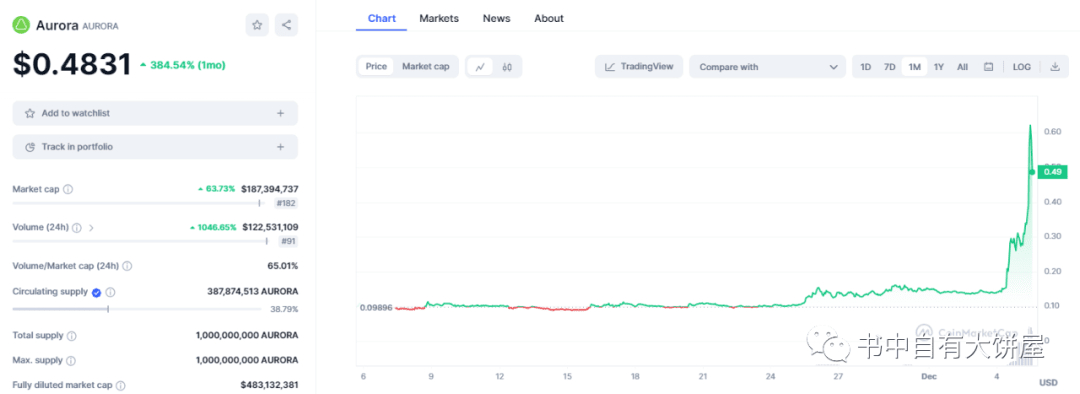
Today we are going to talk about a trump card project of the NEAR ecosystem. We have talked a lot about Ethereum before. When we introduced NEAR earlier, we also said that NEAR’s sharding technology is still very powerful and is the ultimate expansion plan for Ethereum. So when it comes to NEAR, we have to mention the Aurora project. You can understand it as Near’s L2, or the bridge connecting Ethereum and Near. At present, this project has actually reached the bottom range. It has increased by 3 times in a week and has already started in advance. Let’s analyze it today. Its current market value has reached 180 million US dollars, and its ranking has also entered the top 200.
Introduction
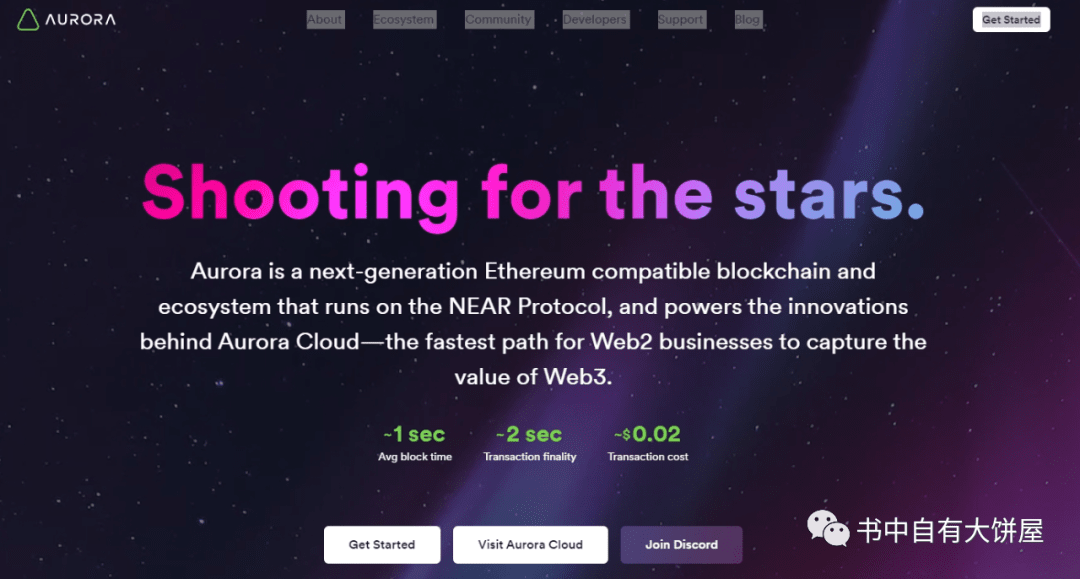
Aurora is a solution that allows the execution of Ethereum contracts in a higher performance environment - near the blockchain, a modern layer-1 zone that is fast (2-3 seconds transaction completion), scalable and carbon neutral Blockchain. Aurora is an Ethereum Virtual Machine (EVM). Aurora is a product that helps Ethereum users and dApps easily migrate to the NEAR blockchain. It allows users to do two different things: upload and interact with Solidity smart contracts on the NEAR blockchain, and move assets between Ethereum and NEAR (including ERC-20 tokens).
Aurora chain adopts DPOS BFT consensus mechanism, which greatly improves the operation speed of blockchain through P2P network and application intelligent isolation technology.
Architecture
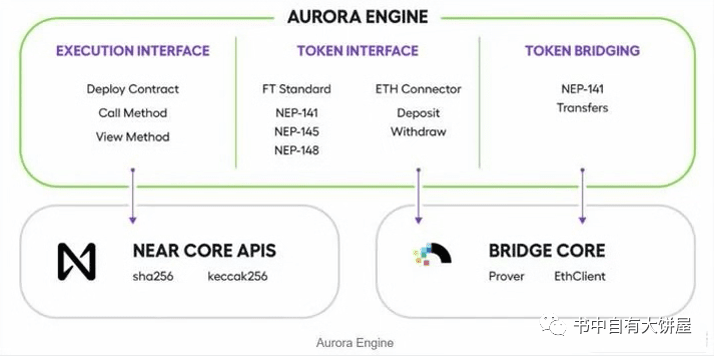
Execution Interface
The underlying interface interacts with Near Core Api
The upper layer provides RPC services (Deploy Contract/Call Method/View Method) that interact with EVM
Token Interface
Interaction between the underlying layer and Rainbow Bridge
The upper layer provides cross-chain and operation of various assets that comply with FT Standard (NIP-141/NIP-145/NIP-148).
How it works
3 components, Aurora engine + Near protocol + RPC service, as shown in the following figure:
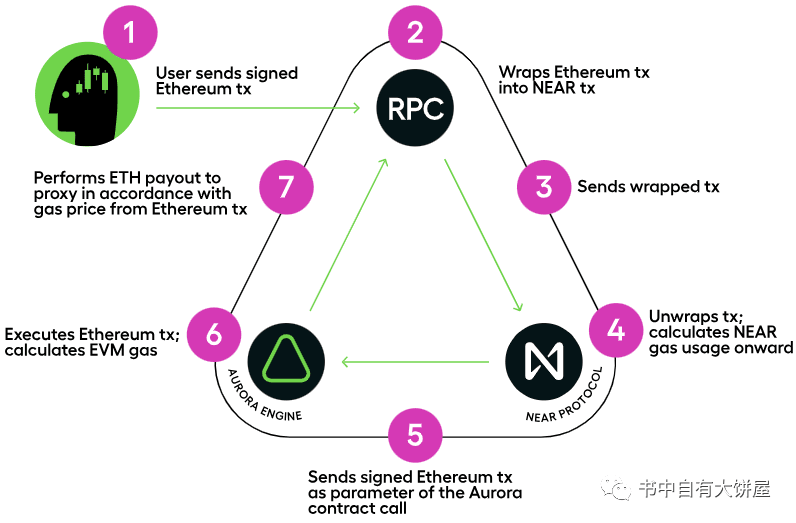
Aurora Engine is a set of smart contracts written in Rust on Near. It is a solution and toolset that supports EVM development on Near.
The Aurora Engine core is based on SputnikVM (the Rust EVM implementation from Parity), which can seamlessly deploy Solidity contracts.
Fully supports existing EVM development tools such as MetaMask/Remix/Truffle/HardHat/OpenZepplin.
Aurora enjoys all the technical advantages of Near. As Near's dynamic sharding is gradually launched, Aurora will also become the first EVM to truly support sharding. This is very worth looking forward to. Aurora + Near is regarded by many as the forerunner network of ETH2.0.
Aurora is not a chain-level EVM layer like Moonbeam/Evmos/Polygon, but more like a contract-level Layer 2. It has its own RPC service, Execution is executed on the Aurora node, Settlement and DA are placed on Near, so the security level is equal to the security level of Near. Gas Fee is settled using $ETH, which is very convenient for the migration of contracts deployed on Ethereum.
To sum up, for Ethereum, Aurora is a side chain. For Near, Aurora is Layer2.
product
1.Rainbow Bridge
Rainbow Bridge is a decentralized light node type cross-chain protocol, and together with Aurora Engine form Aurora Runtime
Currently supports cross-chain tokens between ETH/Near/Aurora, and will gradually open other chains
Not limited to token transfers, general information cross-chain will be supported in the future to achieve cross-chain interoperability.
2.Aurora Cloud
is a platform and suite of products including Borealis Business, Aurora Pass and Aurora Silos. Among them, Borealis Business is a transaction processing and accounting engine that allows enterprises to remove the concept of transaction fees from the user experience and can support almost any blockchain business model imaginable. Aurora Pass, coming soon to iOS and Android, allows blockchain-powered Web2 businesses to provide customers with cost-free and frictionless transaction signatures using Touch ID and Face D biometric devices. Aurora Silos is a dedicated blockchain available to Aurora Cloud customers that offers a range of features beyond Ethereum compatibility. With Aurora Silo, enterprises can leverage the benefits of blockchain in an environment that allows for multi-level access control, custom tokens, and transaction fee mechanisms, while maintaining full Ethereum compatibility and interoperability with the outside world.
Aurora Features Summary
1.Extensibility
The underlying expansion of Aurora Engine relies on the expansion capabilities of Near's dynamic sharding technology. Essentially, Aurora's expansion capabilities are equivalent to Near's expansion capabilities.
2. Rate
It can be seen from the process that the gas at the bottom of the transaction is actually paid with $NEAR. Relying on the low rate of Near, the final transaction rate is 500 times cheaper than the Ethereum layer. This is only when sharding is not open. Next, the rate will only be lower after sharding is gradually opened.
Auroa Engine is also constantly optimized, using less GasFee ($NEAR) and supporting the execution of more EVM work. This is also the focus of recent version updates.
3. Interoperability
Because Aurora Engine is essentially a set of smart contracts on Near, the interaction with other contracts on Near is contract-level interaction, which is very convenient and safe.
Financing
On October 14, 2021, Aurora received a US$12 million angel round through private placement, with more than 100 investors participating, including Pantera Capital, Electric Capital, Dragonfly
Capital、Zero Knowledge Validation、Global Coin Ventures、ImToken、Chronicle等。
The US$350 million that Near just raised in April 2022 will also greatly enrich the Aurora ecosystem.
team
Co-Funder Alex is also one of the founders of the Near team. He knows Near very well and works very closely with the Near team to promote the launch of new features. This provides the best testing ground for Near, so Aurora is Near's first-party team.
Ecology
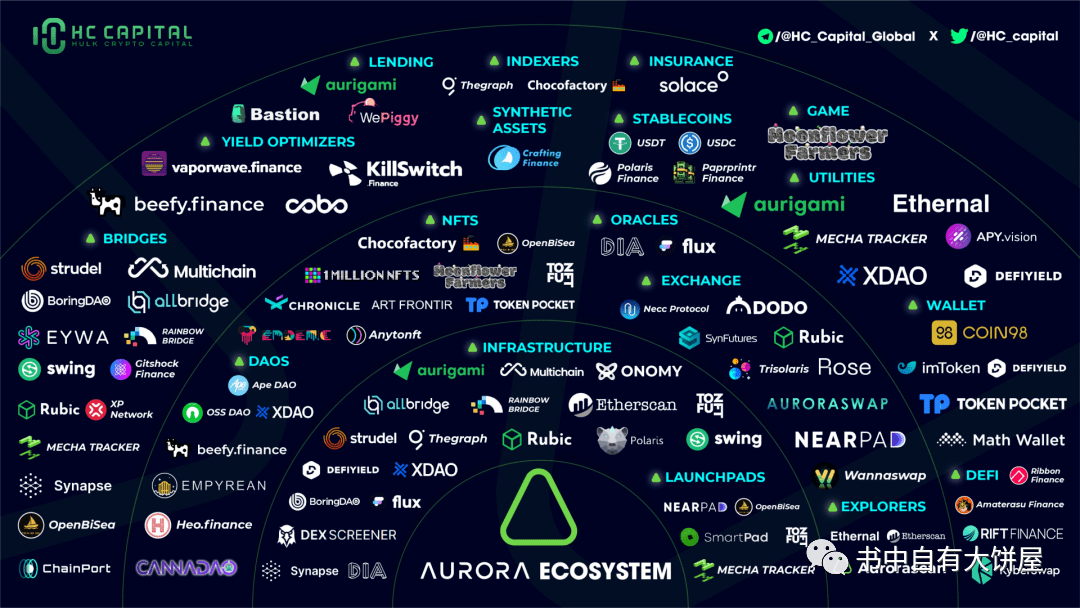
At present, the development of the ecosystem is still good, with more than 240 applications covering various fields, including Defi, exchanges, infrastructure, gaming, etc.
Token economy
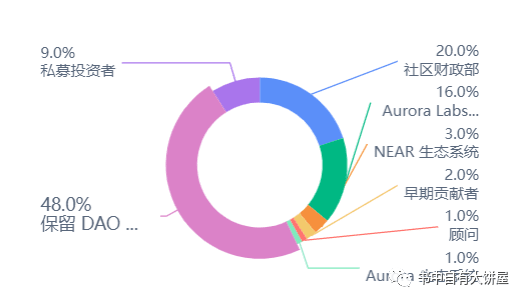
The current total number of tokens is 1,000,000,000, with 387,902,758 in circulation. The circulation rate is 38%, which is still unlocked by a large number of tokens. The current token price is 0.5 US dollars, and the high point of the previous bull market was $3.7212 (2022-05-31). Therefore, it can be regarded as a correction. The team’s finance department is 20% + labs 16% + ecosystem 3%. The team takes almost 40%, which is still relatively high.
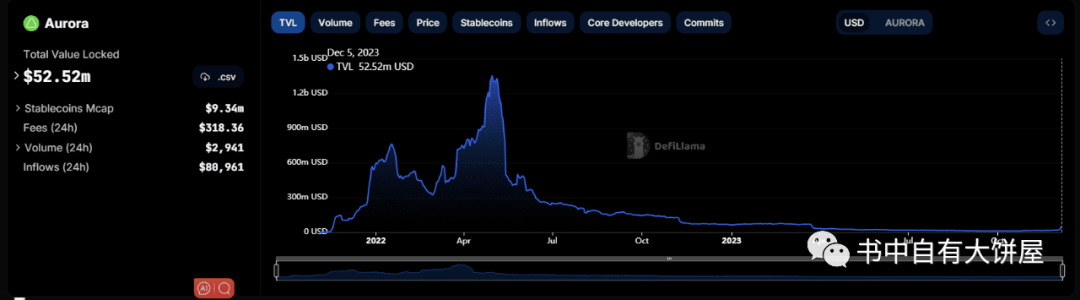
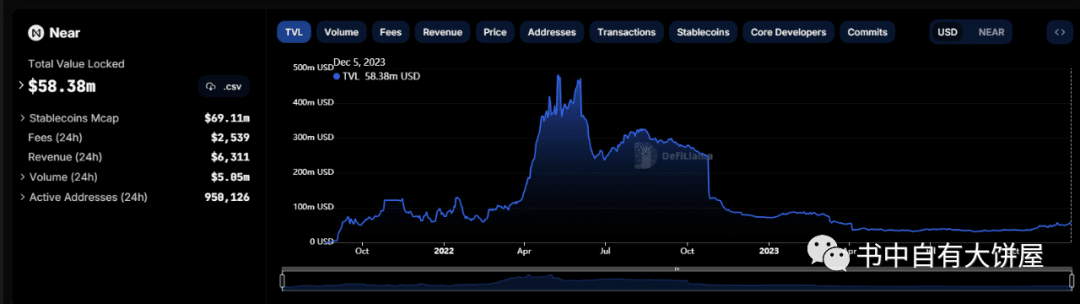
Then look at the TVL, which is 52 million U.S. dollars. Although it is not very high, if you compare it with NEAR, you will know that NEAR’s total TVL is only 58 million U.S. dollars. So by comparison, it can be seen that it is already rated as good as NEAR. , and NEAR’s market value is currently US$2.2 billion.
Finally, to summarize this project, Aurora is to Near what C-Chain is to Avalanche, Moonbeam is to Polkadot, and Evmos is to Cosmos. It is the most important component of non-EVM natively supported blockchains and the starting point of the entire chain ecosystem.
Aurora is also Near's TVL leader. The Aurora ecosystem is developing very rapidly, and products of almost all categories are continuously launched. With the help of Aurora Plus, there is great hope that Near will be brought back to the web2 user field.
The current trend of this project has actually been reflected in the price of the currency. It has been falling continuously before, reaching a minimum of 0.05. Now it has increased 10 times from the lowest point to the current high point. So how much room is there below it? Even if it reaches the high point of the last bull market, there is about 6 times of room. As for the token strategy, it is still analyzed in the planet.