


Today we continue to talk about this project. This project is for storage. I should have talked about filecoin before, but filecoin is currently in decline. I think there is really no problem with the project and technology. It is a very good and innovative project, but the currency value The management is not good, so this AR is the second in command in the storage track. We should also pay attention to it. What if he surpasses the first in command that day? It is not impossible, and its current market value is about 260 million US dollars, ranking 120+ , the market value is relatively low, so there is more room for imagination.
Arweave hopes to be a library on the Internet - an ancient library like the Library of Alexandria (once the largest library in the world, founded in 259 BC, but completely destroyed by fire) to store the world Knowledge. Prior to this, the Internet Archive was doing something similar.
AR is the native token of the Arweave network. Arweave is a new type of storage that supports data with sustainable persistent resources, allowing users and developers to store data truly permanently, forever. The utility of the token itself determines its value. AR can be used to encrypt information and enter it into the system, and it can also be used as a reward to motivate miners. The main function of AR is to permanently store payment data, but it also has transaction value. To put it simply, Arweave's storage mechanism is as follows: customers who want to store data upload the data to the Arweave network, and the file will be permanently saved for a one-time fee and cannot be changed, and the data can be read for free.
Arweave was founded in August 2017 and graduated from Berlin’s Techstars startup accelerator program in April 2018. As a file storage protocol based on blockchain, Arweave has the characteristics of one-time payment and permanent storage of files. Arweave provides a "Permaweb permanent network" solution. Internet users can implement it on the blockchain through the Arweave browser plug-in. Permanently store digital files and data such as web pages, emails, social media posts, and more. Arweave previously used proof of access (POA) to incentivize miners to store history forever. On February 25, 2021, Arweave completed the upgrade of the new competitive consensus SPoRA. SPoRA is a new competitive consensus mechanism based on the Arweave network to prohibit miners from retrieving data on demand from the network and reduce network energy consumption. It can fundamentally increase the number of data copies stored in the network to 100-1000 times the order of magnitude. , while moving more computation on that network to storage.
The principle and mechanism of Arweave
Blockweave
The blocks of traditional blockchain are connected one by one, and the current block contains all transactions that occurred within the entire network during this period. Each block saves the hash value of the previous block, so that each block can find its previous block, thus connecting these blocks to form a chain structure.
In order to solve the problems of chain congestion, high gas and low tps under the traditional blockchain architecture, Arweave has designed different blockchain data structures and proof methods, and various decentralized storages such as filecoin still use traditional The blockchain architecture is used to motivate and record transaction information. The idea of storing data off the chain is different. Arweave uses on-chain storage. Each node only stores a part of the blocks. Each block is linked to the previous one like the traditional blockchain protocol. A block also points to a random previous recall chunk, thus forming a spinning block structure blockweave, and there is no limit on the size of each block. (The filecoin miner’s hard drive contains two types of data, one is the block transaction data of the entire filecoin chain, and the other is the information stored by the user, while the ar miner’s hard drive only contains arweave’s block data, regardless of transaction Information or stored information are all in blocks.)
Block hash list and wallet table
However, the problem caused by this design that each node only stores a part of the block is that each node cannot verify the transaction like the traditional blockchain that stores the entire block. Such payment transaction information cannot be effectively verified for security. , Arweave solves this problem using 2 tables:
Block hash list
Wallet list
With the block hash list, we do not need to download all blocks to verify one by one, but continue to verify during the block generation process.
With the wallet table, Arweave can check the status of any account in the current block. The reason is the same as why the state tree in Ethereum does not only store the accounts involved in the current block like the transaction tree. That is, if you want to transfer money to an account that has not had a transaction, you need to traverse to the initial block. Ethereum is designed for efficiency, while Arweave is designed to achieve the goal of storing only a subset of blocks.
SPoRA consensus mechanism
If this is the case, Arweave solves the security problem caused by each node only storing part of the block, but it cannot guarantee the redundancy of the blocks, because in the extreme case, Arweave only needs to store the most recent block. Arwave uses SPoRA consensus proof to solve this problem. The most important thing about the design of the Blockchain is to serve Arweave’s consensus mechanism - SPoRA (Succinct Proofs of Random Access).
Before Arweave used the SPoRA consensus mechanism, it used the PoA+PoW mechanism.
And PoA stands for Proof of Access: Proof of Access. Under this mechanism, Arweave requires that every miner node in the network must access a random memory block locally if it wants to generate a new block and receive rewards. If it does not store the block, there is no way. Generate new blocks.
In this case, if the miner wants to obtain as high a mining profit as possible, then he will choose to store all blocks, because each next block will point to the current block and a random previous block, storing The more blocks there are, the more qualified you are to produce blocks and receive rewards. PoA incentivizes miners to store more Arweave blocks, and it also encourages miners to store some blocks that are less commonly stored to increase the probability of meeting PoA.
PoA uses the RandomX hash algorithm. The miner's probability of producing a block = the probability of randomly recalling the block * the probability of being the first to find the hash. Miners need to find the appropriate hash value to generate a new block through the PoW mechanism, but the random number (Nounce) relies on the previous block and any random recall block information. The randomness of recall blocks encourages miners to store more blocks, thereby obtaining a relatively high calculation success rate and block rewards. PoA also incentivizes miners to store "scarce blocks", that is, blocks that others have not stored, to obtain greater block production probability and rewards.
However, under a separate PoA mechanism, if all miners store all blocks, then everyone's probability of producing a block is exactly the same. Therefore, in addition to PoA, Arweave has introduced a PoW mechanism to enrich the competition dimension of block production.
Arweave upgraded PoA+POW to SPoRA in February 22. The simple PoA+PoW mechanism ensures the permanent storage of data, but does not guarantee the data access speed, and PoW also has the environmental problem of power consumption. The SPoRA mechanism reduces the weight of PoW in the previous probability of miners producing blocks, and adds the dimension of data access speed. In addition, SPoRA allows miners to focus more on maintaining their own local hardware and nodes, preventing miners from storing data in the same low-rate data center, facilitating the diversification of node locations, and improving the decentralization of the entire network. degree of ization. Reducing the weight of PoW blocks will reduce energy consumption, which is more in line with the concept of "carbon neutrality". Under SPoRA's architecture, there is a more decentralized and efficient block distribution. According to relevant calculations, the probability of Arweave network block loss is smaller than the probability of private key collision.
Wildfire node scoring mechanism
The arweave network is a one-time charge for permanent storage, that is, subsequent data reading is a free service. Sustainability means that users can access data at any time. Compared with filecoin, which requires additional charges for retrieval and reading of data, accessing data on Arweave is also faster. It is much faster to retrieve data directly from Filecoin, which takes 1-5 hours to unblock. So how does arweave motivate miners in the long term to provide data reading services at zero income?
Arweave adds Wildfire: node scoring mechanism. The working principle is to let the Arweave node create a ranking system for other nodes. The ranking is based on two points: 1. Generosity: the number of times new transactions and blocks are sent; 2. Responsiveness: the speed of response to network requests . The higher the score each node gives to neighboring nodes, the higher-ranked peer will be given priority to send requests. The higher its credibility, the greater the probability of producing blocks, and the greater the possibility of obtaining scarce blocks. This effectively solves the problem of sacrificial mining where miner nodes do not share and store rare data with other nodes. This sacrificial mining problem is currently very serious in filecoin. Most of the 18eb of data in the entire filecoin network is false data stored by miners in order to obtain block rewards.
In this way, the design of blockweave solves the problem of high handling fees of traditional blockchain architecture as the adoption rate increases. The handling fee for each payment information on the arweave network is the storage cost of this information, which is currently only 0.00000068ar. Based on the current ar price of $14, the handling fee is less than $0.00001. Filecoin, which is also a decentralized storage project and still uses the traditional blockchain architecture to motivate and record transaction information, has an average handling fee of up to 0.06 per transaction. fil, based on the current price of filecoin of US$5, it is 0.3 US dollars. The current handling fee of filecoin is 3,000 times that of ar. However, this is only when the decentralized storage track has not been widely adopted. When the number of adopters of the filecoin network increases, Eventually we will encounter a chain congestion problem similar to Ethereum. In the end, the handling fee for each storage transaction will be much higher than the storage cost, and the handling fee for every payment information on the arweave network is based on this information. Storage costs, with the development of storage technology, AR's handling fees will even continue to decrease. Currently, AR's transaction fees are dozens of times cheaper than when the mainnet was first launched four years ago.
storage cost
The cost of storing any data on Arweave depends on three factors:
1. The size of the data being stored
2. Today’s legal cost of permanently storing 1 GB of data
3. The legal price of AR (Arweave’s native token)
The premise of all this is based on the increasingly decreasing storage cost trend of Internet networks. Storage costs are primarily driven by data density and data reliability. Unlike Moore's Law, which slows down CPUs, the current maximum density of hardware data storage is far lower than the theoretical calculation value. Therefore, Arweave's calculation assumptions are more conservative, taking the market price of 1GB/hour of hard disk storage as the starting price, and assuming a downward trend in storage prices of 0.5% per year, instead of the average annual decrease of 30.5% in data storage costs over the past 50 years.
It should be noted that the storage fees paid by ** users are also set as the cost of permanent storage by miners. Arweave’s current charges are enough to cover the cost of storing data for 200 years. According to Arweavefees data, storing data currently costs around $2.927/GB.
system ecology
Since the mainnet went online in June 2018, Arweave has gradually been accepted by public chains, NFTs, etc. as one of the data storage solutions in the Web 3 world. Various data indicators have gradually increased, but they have always fluctuated slightly and climbed slowly. . Until 2021, NFT will be hot out of the circle. Benefiting from the explosive demand on the NFT track, Arweave's various data indicators began to grow explosively, and gradually developed on Arweave such as the decentralized network disk ardrive, the decentralized forum metaweave, the decentralized blog mirror, and the Web3 products that cannot be realized by traditional public chains such as centralized mailboxes
Smart contract smartweave on arweave
Smart contracts are the business logic layer of DApps. Similar to the data layer, the bottleneck of smart contracts is the scalability/computation cost issue. According to Vitalik's estimate, the computing and storage costs of Ethereum are approximately 1 million times that of Amazon Cloud Services. The previous estimate of the cost of the DApp data layer can also confirm this estimate. The fundamental reason for the high cost of public chain computing and storage is its fully redundant architecture, that is, all on-chain data is stored by every full node, and all calculations are performed on every full node. There are three ways to achieve public chain expansion: representative system, layering and sharding. The Smartweave smart contract on Arweave takes a completely different approach. Smartweave smart contracts are programs developed in Javascript and stored on the ar network, so they are immutable. Submitted to the network for storage at the same time as the contract code, is also the creation status of the contract. Unlike smart contracts in Ethereum (and other public chains), Smartweave is not executed by miner nodes, but is downloaded to the computer of the contract caller for execution. The execution process starts from the creation state of the contract, executes all transactions in the history of the contract in a determined order, and finally executes the transaction of the contract caller. After completion, the contract caller submits the input of his transaction and the executed contract status to the AR network and enters permanent storage. Subsequent contract calls repeat the above process.
In other words, for a smart contract transaction, the ar network only needs one node - the caller's own node to execute it (note that the ar network does not distinguish between full nodes and light clients). Since the caller node has executed (and verified) all transactions in the history of the contract, he does not need to trust or rely on any node to obtain credible calculation results (i.e., the new state of the smart contract). Therefore, each Smartweave contract can be regarded as the second-layer chain of arweave, and executing the smart contract is the full synchronization and verification of the second-layer chain. This design solves the scalability/computation cost problems of the DApp business logic layer. Smart contracts can contain almost unlimited complex calculations at very low marginal cost, because usually the caller's computing equipment has been purchased or rented for a long time.
This brings up a question: As the number of transactions increases, won’t smart contract execution become slower and slower? That's true, but there are ways around it. For example, the caller names the result state of the contract to form a snapshot of the contract state. If the caller is trustworthy (for example, if the caller is a smart contract developer), subsequent callers can specify the state snapshot as the initial state and only need to execute the transactions after the snapshot. State snapshots do not necessarily lead to the expansion of the trust set. After all, the premise for the reliability of smart contracts already includes trust in the initial state. Smartweave is still under development and has now been renamed Redstone. The above content should be regarded as a discussion of the potential of Smartweave.
Ardrive
ArDrive, a permanent version of Dropbox, uploads data to the ever-present network. Evermore on the desktop allows users to configure local folders, and the contents of the folders will be automatically backed up to Arweave. These dApps enable Yongzai.com to provide a user experience similar to the traditional Internet, but the content posted by users can be permanently accessed and used, and 404 will not appear.
Bundle no
In September 2021, Arweave released a second-tier solution — Bundlr. Bundlr is more like an L2 compatibility layer. Simply put, if the protocol needs to upload a large amount of data at one time, it may reach the current throughput limit of the Arweave network. Bundlr bundles/packages multiple Layer 2 transactions into a single Arweave (Layer 1) transaction (i.e. Bundle) and uploads it, thereby effectively alleviating Arweave network congestion and improving user experience. Bundlr nodes do not compress data, they just reduce the transaction count on Arweave. The receipt certificate given by Bundlr to the user will serve as a proof of equity to ensure the validity and security of its transactions. This solves the need to store large files on Arweave. Bundlr also supports users to use ETH, SOL, MATIC and other tokens to pay storage fees. Users no longer need to obtain AR tokens and link to the Arweave wallet. After the transaction complexity is reduced, the user experience is improved. It can be said that Bundlr provides a high-speed, efficient user experience similar to Web 2 without sacrificing security.
Currently, Bundlr has processed over 200 million transactions, over 90% of data uploaded to Arweave, and increased upload speeds by approximately 3000%. Intuitive data shows that Bundles provide more reliable, more cost-effective permanent storage, and also attract more developers and users to enter the AR ecosystem.
Decentralized blog Mirror
Mirror is currently the most widely used decentralized blogging platform in the crypto market. In the past year, the author has brought in more than 1 million US dollars in income. If creator crowdfunding is included, Mirror's data is 11 million US dollars. , Mirror is currently the most successful non-financial web3 product. Thanks to ar’s low permanent storage cost, it has attracted a large number of users in the encryption market in the past year. Nowadays, writing articles on mirror has become a mainstream habit in the encryption circle. , a blogging platform that will never be shut down has huge competitiveness against a large number of centralized blogging platforms that were shut down due to various reasons in the past. Mirror recently released a subscription function, and the iterative addition of new features will make Mirror more competitive.
Go to central mailbox
Email is the earliest invention and communication tool of the Internet in the last century, and arweave, a public chain with a permanent storage paradigm, is most suitable for decentralizing the email mailbox invented in the last century, and it can be very effective because sending emails requires payment. To solve the spam problem that traditional email cannot solve, the arweave ecosystem currently has two decentralized mailbox products, namely the official weve.mail and permamail.app.
Decentralized forum metaweave
metaweave.xyz is an interesting product in the current arweave ecosystem. It has implemented all the posting, like, and comment functions of a decentralized forum. However, since the block time for Arweave is 2 minutes, it takes about 2 minutes to confirm the post. , which is much longer than Ethereum’s 15 seconds, and there are indeed problems in terms of user experience. If a user only wants to upload a small amount of data, such as a 200KB PDF file, but has to wait 2 minutes for a confirmation, they won't want to use the product anymore. In order to solve this problem, the decentralized gateway http://ar.io raised US$17 million at the beginning of this year to build a powerful decentralized arweave gateway for caching data. The gateway can bundle multiple uploads into one Arweave transaction. China and Israel have reduced costs to enhance the arweave ecological experience. I believe that with the continuous construction of the ecosystem and the continuous deepening of data autonomy, truly decentralized forums like metaweave will be favored by more and more users.
Decentralized electronic games based on Storage Paradigm (SCP)
Taking Minecraft as an example, the first step in a decentralized game is to put resources on the chain. The second step is to use SCP to put all execution instructions on the chain, load a game back from the chain, and then run the game locally. These local clients may be Mac computers, Windows computers, or personal mobile phones. After the game is run, in order to comply with the SCP model, the local client first needs to load all historical instructions stored on Arweave to build every block in my world. The instructions in Minecraft are very simple, usually placing a certain block at a certain coordinate point, or removing a block from a certain coordinate point. All instructions a user makes while playing the game will be uploaded to Arweave in batches. Whether the user makes one million instructions or ten million instructions in the game, these instructions will be packaged into Arweave blocks. When the game materials, game core programs and player's game instructions exist on Arweave, any user can download the program through AR, load the instructions, and completely build the house that has been built.
Because only instructions are uploaded to the chain, the cost of consensus will be very low. Currently, 1GB of consensus data only costs US$4. Since 1GB is just an instruction storage, 1GB of data is used to process tens of millions of instructions. The instructions and all materials are on Arweave, and the core program is also on Arweave, so huge maps can be loaded and calculated from Arweave at any time. The buildings in these maps are composed of thousands of instructions. Even every step we move in the game can be uploaded to Arweave in batches.
At this time, the nodes of the chain game are just like Bitcoin. When users play this game and mine this game, they will directly inject their private keys into this node, just like Bitcoin miners must inject their private keys into their wallets when mining. Package, verify, and mine Bitcoins to miner wallets. When playing Minecraft, the private key you put in will sign every move made, every brick placed and removed. Eventually these signed instructions will be uploaded to Arweave to form a consensus. In this process, Arweave becomes a trusted communication channel. Everyone builds a trusted metaverse by loading trusted events stored on Arweave.
Token distribution
Maximum supply: 66,000,000 AR, circulation rate 50.60%. The current currency price is 5.8 US dollars, and the peak was around 90 US dollars. The team took 13% of the token distribution, which is still relatively small, but there is a reserved 26.5% that was not explained.
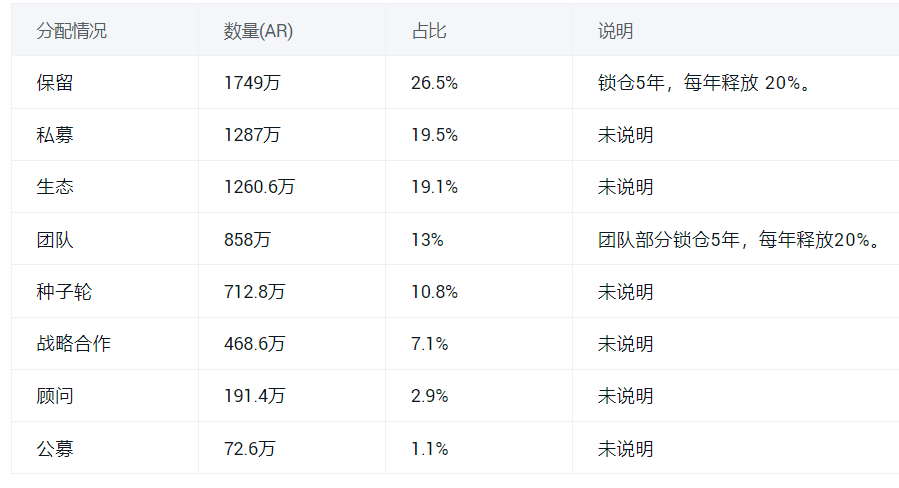
Finally, to summarize, AR is also a player in the storage track, which is still different from file. AR claims to be: "pay once and store permanently". This is its biggest highlight. We know that a large amount of data is lost every year, especially some important documents. If it is stored on paper, there are risks such as fire, flood, loss, etc.; if it is stored electronically, once the server is damaged, the data will also be lost. Therefore, persistent data is indeed a necessary scenario. But the cost of one-time storage can be expensive.
Filecoin is more about using the redundant space of idle computers to provide storage, targeting big players in the field of cloud computing, such as Amazon, Google Cloud, etc. Filecoin storage is cheaper. But filecoin's vision is larger. It is not limited to storage, but also an underlying web3 protocol.
But AR has also made outstanding achievements on the track, and it can be considered a good performance. As I said at the beginning, the current File is lifeless, and its market value is very high, and then many people are firmly trapped. However, the current market value of AR is low and the room for imagination is relatively large. I think from a cost-effectiveness perspective, AR’s cost-effectiveness is completely OK.