

What are trend lines?
In financial markets, trend lines are diagonal lines drawn on charts. They connect specific data marks, making it easier to determine future price movements and market trends.
Trendlines are one of the main tools of technical analysis (TA). They are widely used in the stock, fiat currency, derivatives and cryptocurrency markets.
Essentially, trend lines work like support and resistance levels, but are made up of diagonals rather than horizontal lines. Thus, they can have either a positive or a negative slope. Moreover, the greater the slope of the line, the stronger the trend.
Trendlines can be divided into two main categories: ascending and descending. An uptrend line is drawn from a lower position on the chart to a higher one. It connects two or more bottom points as shown in the image below.

In turn, a downtrend line is drawn from a higher position to a lower one, connecting two or more higher points.
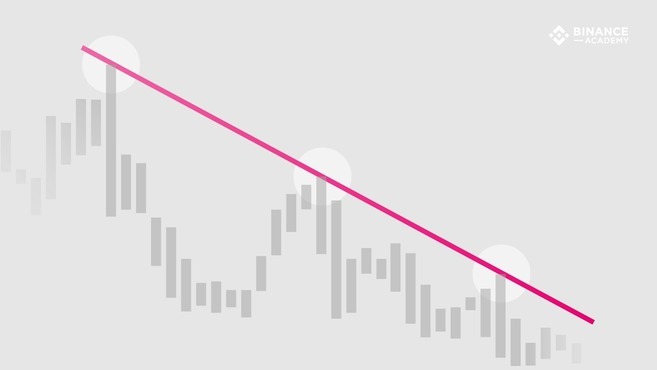
Thus, the difference between the types of lines lies in the choice of points that are used to construct them. To indicate an uptrend, lines are drawn through the lowest points on the chart (the bottoms of the Japanese candlesticks form higher lows). Downtrend lines are drawn using the highest values (the tops of Japanese candlesticks form lower highs).
Usage
Trend lines show areas where the price briefly goes out of bounds, testing the trend, and returns back. The line can be drawn further to try to predict future price movements. A trend line can be tested several times, but once it is broken, it can no longer be considered reliable.
Although trend lines can be used in all types of data charts, they are typically applied to financial charts based on market prices. They give an idea of supply and demand in the market. An uptrend line indicates increasing buying power when demand is greater than supply, while a downtrend line is associated with a continuous fall in price, indicating that supply is exceeding demand.
However, this analysis should also take into account trading volume. For example, an increase in price against the background of a decrease in volume can be mistaken for increased demand.
Trendlines are used to determine support and resistance levels, two basic concepts in technical analysis. An uptrend line shows support levels below which the price is unlikely to fall. At the same time, the downward trend line determines resistance levels above which the price most likely will not rise.
In other words, a trend cannot be considered valid if support or resistance levels are broken, either downward (for an uptrend line) or upward (for a downward trend line). In many cases, when these key zones fail to maintain a trend, the market tends to change direction.
However, technical analysis is subjective, so traders can use the lines in completely different ways. We recommend combining several methods of technical and fundamental analysis to reduce risks.
Marking current trend lines
Technically speaking, trend lines can be drawn using any two points on a chart, but most traders agree that using three or more points provides increased credibility to the line. In some cases, the first two points can be used to determine a potential trend, and the third (predictive) can be used to test the validity of the assumption.
Thus, when the price touches the trend line three or more times without breaking through it, the trend can be considered valid. Testing the line multiple times suggests that the trend is not just a coincidence caused by price fluctuations.
Setting the scale
In addition to selecting enough points to create a working trend line, you also need to consider the correct settings when drawing it. The scale is one of the most important elements to pay attention to.
The scale on financial charts displays price changes. The two most popular scales are arithmetic and semi-logarithmic. In an arithmetic chart, changes occur evenly as price moves up or down on the Y-axis. A semi-log chart expresses these changes as a percentage.
For example, displaying a price change from $5 to $10 on an arithmetic chart will be the same as from $120 to $125. Conversely, on a semi-log chart, a 100% gain ($5 to $10) takes up much more of the chart, as opposed to a 4% increase from $120 to $125.
When analyzing a trend line, it is extremely important to take into account the scale setting, since depending on the type, the graph may show different maximums and minimums, which will also influence the differences between the lines.
Summary
Trendlines are a useful technical analysis tool, but they are not the most reliable. The choice of points that will be used to determine the trend directly affects its correctness, making this method subjective.
For example, some traders draw a trend line based on Japanese candlesticks, ignoring vertical lines. Others prefer to draw vertical lines according to the highs and lows.
Therefore, it is important to use trendlines along with other charting tools and indicators such as Ichimoku Clouds, Bollinger Bands, MACD, Stochastic RSI, RSI and Moving Averages.