



Content
What is cryptoeconomics?
What problems does cryptoeconomics solve?
The role of cryptoeconomics in Bitcoin mining
How does cryptoeconomics improve Bitcoin security?
The cycle of cryptoeconomics
Conclusion
What is cryptoeconomics?
In simple terms, cryptoeconomics provides a way to coordinate the behavior of network participants by combining cryptography with economics.
From another perspective, cryptoeconomics is a field of computer science that seeks to solve problems of coordination among participants in digital ecosystems, through the use of cryptography and economic incentives.
Cryptoeconomics should always be taken into account when building decentralized networks, as it is a unique mechanism that provides the ability to align incentives among participants, without the need to trust third parties.
Cryptoeconomics is not a subset of traditional economics, but is a mixture of game theory, mechanism design, mathematics and other methodologies in the field. The main goal of this direction is to provide insight into how to finance, design, develop and facilitate the functioning of decentralized networks.
In this article, we will look at the origins of cryptoeconomics and its role in the creation of Bitcoin and other decentralized networks.
What problems does cryptoeconomics solve?
Before the advent of Bitcoin, it was believed that it was impossible to create a peer-to-peer network that could reach consensus without significant vulnerabilities to attacks and errors.
This problem is often referred to as the problem of the Byzantine generals. This is a logical dilemma that depicts the importance of communication among participants in distributed systems. The problem is that some of the participants may turn out to be fraudsters, and therefore it is not possible to come to a single agreement and the network cannot function properly.
With the creation of Bitcoin, Satoshi Nakamoto introduced economic incentives for the peer-to-peer network and solved this problem.
Since then, decentralized networks have continued to rely on cryptography to achieve consensus regarding the state of the network and the correct history of all transactions. In addition, most networks include various economic incentives that encourage participants to take certain actions.
This synergy of cryptographic protocols with economic incentives allows for the creation of an entirely new ecosystem of decentralized networks that are resistant to attacks and errors, and also have a high level of security.
The role of cryptoeconomics in Bitcoin mining
Bitcoin's goal is to create an immutable, censorship-resistant payment network where every financial transaction is tracked.
This is achieved through a process called mining, during which miners who successfully mine and confirm a block of transactions receive a reward in Bitcoin. This economic incentive encourages miners to work within the rules, which in turn has a positive impact on the reliability and security of the network.
The mining process involves solving a complex mathematical problem based on a cryptographic hashing algorithm. In this context, hashes are used to link blocks together and record confirmed transactions with a timestamp, collectively called a blockchain.
Hashes are also used in computational puzzles that miners try to solve. Additionally, one of the consensus rules that transactions must follow is that Bitcoin can only be spent if a valid digital signature has been generated from the private key.
These technological rules regarding mining comply with the security requirements of the Bitcoin network, which also include a set of automatic measures to prevent the seizure of control over the system in the event of an attack by intruders.
How does cryptoeconomics improve Bitcoin security?
Bitcoin's security model is built on the principle of majority rule. This means that, purely theoretically, attackers could take control of the blockchain, taking over most of the network’s computing power; such an attack is often called a 51% attack.
In the event of such an attack, attackers will be able to prevent the mining and validation of new blocks or even completely reverse some previously confirmed transactions. However, the very act of controlling such a large amount of hashing power is extremely expensive due to the hardware and large amounts of electricity required.
Cryptoeconomics is one of the reasons for Bitcoin's success. Satoshi Nakamoto implemented the order of guesses in such a way as to encourage different categories of participants. Guarantees of system security largely depend on how network participants respond to certain economic incentives.
Without a rigid cryptographic protocol structure, Bitcoin would not have a secure unit of account through which miners are rewarded for their work. Without miners, users would have no confidence in the authenticity of the transaction history recorded in the distributed ledger, in the absence of such verification by a trusted third party, negating one of the main advantages of Bitcoin.
Based on cryptoeconomic assumptions, the interdependent relationship between miners and the Bitcoin network ensures the validity and correctness of all work. However, this is not a guarantee that the system will function in the same way in the future as it does now.
The cycle of cryptoeconomics
The cycle of cryptoeconomics is a holistic model that connects all categories of participants with each other. This diagram was published by Joel Monegro and illustrates the flow of money through different classes of participants in a peer-to-peer economic environment.
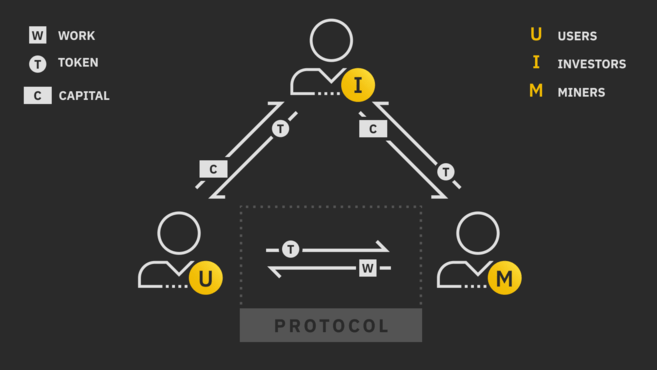
The model is a three-sided market that consists of miners (supply side), users (demand side) and investors (capital side). Each group of participants exchanges among themselves through a limited cryptoeconomic resource (tokens).
In this cycle, the miner receives payment for the work done in tokens that are used by users. A consensus protocol standardizes this entire process, and a cryptoeconomic model controls when and how miners receive rewards.
Creating a network architecture that is maintained by the party generating the distributed supply (the miners) is appropriate if the benefits outweigh the associated disadvantages. In this context, we are talking about such advantages as: censorship resistance, limitless transactions and a high level of security. However, decentralized systems have lower performance compared to their centralized counterparts.
In this model, the investor performs two roles at once: providing liquidity for tokens that miners can subsequently sell, as well as capitalization of the network by maintaining the price of the token at such a level that mining remains profitable.
In turn, investors are divided into two groups: traders (short-term investors) and hodlers (long-term investors).
Traders create liquidity in the market so that miners have the opportunity to sell mined tokens and cover their operating costs, while holders provide sufficient capital for network growth, maintaining the value of tokens. In the miner-trader relationship channel, they exchange cash flow with each other directly, in turn, the miner-holder does this indirectly.
This means that all participants in this process depend on each other in achieving their economic goals. This structure creates a reliable and secure network, and adherence to a motivating set of rules is a more beneficial direction for each individual participant, which in turn makes the network more resilient.
Conclusion
With the creation of Bitcoin, a relatively new concept emerged - cryptoeconomics, which is an element that must be taken into account when designing decentralized networks.
Separating roles in cryptoeconomic models helps analyze the costs, economic incentives, and flow of funds for each group of participants. It can also help to think more carefully about relative power and potential points of centralization, which is important when planning more balanced models of governance and token distribution.
The field of cryptoeconomics research, as well as the use of cryptoeconomic models, is needed to develop the next generation of networks. By studying cryptoeconomic models that have already been tried and tested in the real world, it is possible to design the networks of the future to be more efficient than current options, resulting in a more sustainable ecosystem for the decentralized economy.