



Content
Introduction
Relative Strength Index (RSI)
Moving average (MA)
Moving average convergence/divergence (MACD)
Stochastic RSI (StochRSI)
Bollinger Bands (BB)
Conclusion
Introduction
Traders use technical indicators to gain further insight into an asset's future price movements. Such tools make it easier to identify different patterns and provide buy or sell signals under certain market conditions. There are a large number of indicators that are used in day trading, swing trading, and sometimes even in long-term investing. While some professional market players even create their own indicators. In this article, we will provide a brief description of some of the most popular technical analysis indicators that can be a useful addition to any trader's toolbox.
1. Relative Strength Index (RSI)
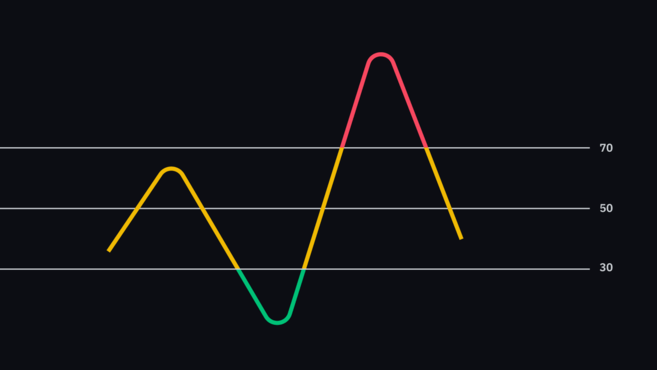
Relative Strength Index (RSI) is a momentum indicator that provides indicators that indicate whether an asset is overbought or oversold. This is achieved by measuring the magnitude of recent price changes (the standard setting is 14 previous periods, 14 days, 14 hours, etc.). The data is then displayed as an oscillator, which can range from 0 to 100.( j
Since RSI is a momentum indicator, it shows the strength with which price changes. This means that if the indicator increases when the price rises, the upward trend is strong and more and more buyers come. On the contrary, if the measure of an indicator decreases and the price increases, this may indicate that sellers may soon gain control of the market.
The traditional interpretation of RSI lies in the digital indicators of the line on the chart: if it is above 70, then the asset is overbought, and when it is less than 30, then the asset is considered oversold. Thus, extreme values may indicate an upcoming trend reversal or pullback. However, it would be better not to consider these values as direct buy or sell signals. As with many technical analysis (TA) techniques, the RSI can produce false or misleading signals, so it's always a good idea to consider other factors before entering a trade.
Want to know more about this indicator? We recommend that you read our: “What is the RSI indicator”.
2. Moving average (MA)
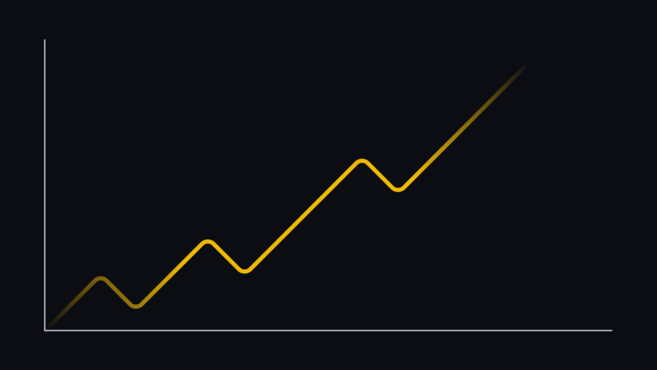
The moving average (from the English Moving Average, abbreviated MA) smooths out price fluctuations, filtering out market noise and highlighting the direction of the trend. Since the MA is based on past price data, it is a lagging indicator.
The two most commonly used moving averages are the simple moving average (SMA or MA) and the exponential moving average (EMA). SMA is formed based on price data for a certain period and their average value. For example, the 10-day SMA is constructed by calculating the average price over the last 10 days. In turn, the EMA gives more weight to the latest price data. This makes it more sensitive to recent price changes.
As already mentioned, the moving average is a lagging indicator. The longer the period, the greater the signal delay. Thus, the 200-day SMA will be much slower to react to a recent price change than the 50-day SMA.
Traders often use ratios of price to specific moving averages to measure the current trend. For example, if the price remains above the 200-day SMA for an extended period, then most traders consider the market to be bullish.
Traders can also use moving average crossovers as a buy or sell signal. For example, if the 100-day SMA crosses the 200-day SMA, it can be considered a sell signal. But what exactly does this cross mean? This indicates that the average price over the last 100 days is now lower than the average price over the last 200 days. The idea of selling here is that short-term price movements no longer follow the uptrend and in most cases the trend may reverse.
Want to know more about this indicator? We recommend that you read our detailed article about moving averages.
3. Convergence/divergence of moving averages (MACD)
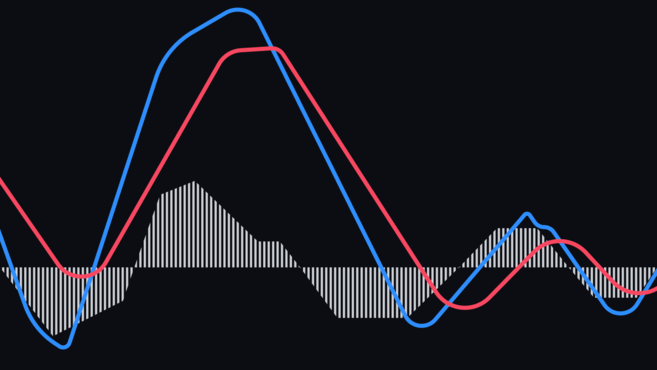
MACD (short for Moving Average Convergence Divergence) is a technical indicator designed to determine the future price movement of an asset using the relationship of two moving averages. It consists of two lines: the MACD line and the signal line. The MACD line is calculated by subtracting the 26-day EMA from the 12-day EMA and then plotting the result above the 9-day EMA, which acts as a signal line. Many charting tools often include a histogram that shows the distance between these lines.
By looking for divergence between the MACD and price movement, traders can gain insight into the strength of the current trend. For example: the price shows a new high, while the MACD reflects very low indicators, this suggests that the market may soon turn around. Thanks to this indicator, we can conclude that with such a high price and low momentum level, there is a high probability of a rollback or reversal.
In addition to this, traders can use this indicator to look for crossovers between the MACD line and its signal line. As a rule, a buy signal is considered when the MACD line crosses the signal line from bottom to top. Conversely, a sell signal is the point where the signal line crosses the MACD line from top to bottom.
MACD is often used in conjunction with RSI because both indicators measure momentum but do so based on different data. Together they are expected to provide a more comprehensive technical overview of the market.
Want to know more about this indicator? We recommend that you read our detailed article about MACD.
Do you want to start using cryptocurrency? Buy Bitcoin on Binance!
4. Stochastic RSI (StochRSI)
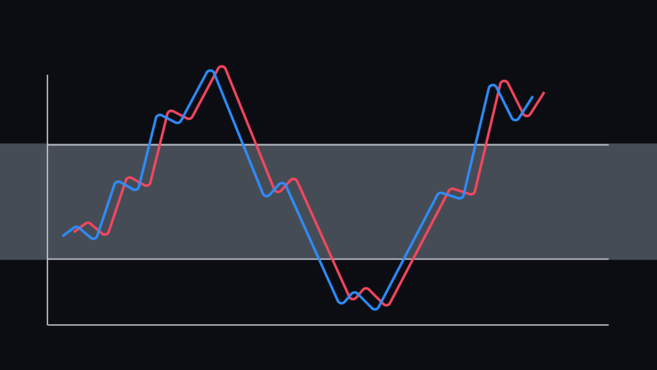
Stochastic RSI (from the English Relative Strength Index, abbreviated RSI) is an oscillator that tracks price movements to determine whether an asset is overbought or oversold. As the name suggests, stochastic is a derivative of the regular RSI that is generated based on fundamentals instead of price data. The indicator is calculated by applying the stochastic RSI formula to regular RSI values. Standard indicator settings range from 0 to 1 (or from 0 to 100).
Due to its sensitivity, the stochastic RSI can generate many difficult-to-interpret trading signals. Generally, it tends to be most useful when scores are near the high or low extremes of their range.
If the stochastic RSI indicator is above 0.8, it is considered to be overbought, and a value below 0.2 may indicate oversold. A value of 0 means that the RSI has the lowest value in the period being measured (the default setting is usually 14). Otherwise, a value of 1 means that the RSI has the highest value for the period being measured.
Similar to standard indicator settings, stochastic RSI overbought or oversold signals do not mean that the price will move in exactly the direction the indicator is pointing. In this case, it simply indicates that the RSI values (from which the stochastic RSI values were derived) are close to the extremes. It is important to remember that the stochastic RSI is more sensitive than its predecessor, so it generates more false or misleading signals.
Want to know more about this indicator? We recommend that you read our detailed article about stochastic RSI.
5. Bollinger Bands (BB)
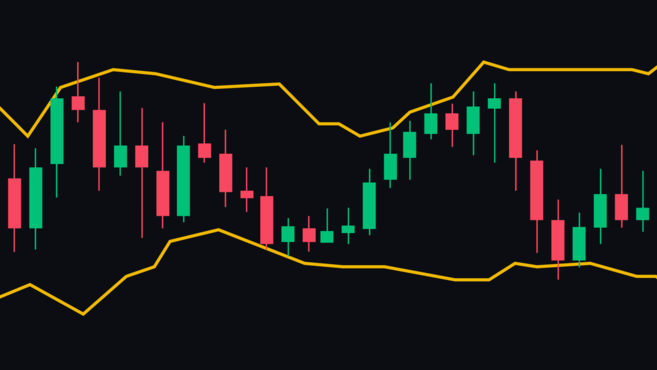
Bollinger Bands measure market volatility and also determine the level of overbought and oversold assets. The indicator consists of three lines: SMA (middle band), upper and lower bands. Settings may vary, but generally the upper and lower lines are two standard deviations from the moving average. The distance between the lines is directly related to volatility; as it increases or decreases, the distance changes.
As a rule, the closer the price is to the upper line, the more overbought the selected asset. In the opposite situation, the closer the price is to the lower line, the higher it is oversold. In most cases, the price does not go beyond the lines, but it is possible that it may break above or below them. While this scenario may not be a trading signal in itself, it does serve as an indicator of extreme market conditions.
Another important line concept is called squeeze. This case refers to a period of low volatility, when all lines are very close to each other. In this situation, the indicator can signal potential volatility in the future, in the opposite case, if the lines are located at a large distance from each other, this may indicate a possible decrease in price fluctuations.
Want to know more about this indicator? We recommend that you read our detailed article about Bollinger Bands.
Conclusion
While technical indicators provide data that can help you navigate the market, it is important to keep in mind that the interpretation of such data is highly subjective. Therefore, before you form your trades, you need to make sure that your personal biases do not in any way influence your decisions. What may be a direct buy or sell signal to one trader may seem like mere market noise to another.
As with most market analysis methods, indicators are most effective when used in combination with each other or with other methods such as fundamental analysis (FA).
The best way to learn technical analysis (TA) is through lots of practice. Head over to Binance and test your new knowledge!