



Content
Introduction
What is a private key?
What is a hardware wallet?
Why should you use a hardware wallet?
Disadvantages of Hardware Wallets
Review of hardware wallets 2020
Ledger Nano S
Ledger Nano X
Trezor One
Model T safe
Cobo Vault
CoolWallet S
SafePal S1
KeepKey
Conclusion
Introduction
When it comes to cryptocurrency, one of the paramount factors is storing your assets properly. The world of cryptocurrencies is filled with various dangers, as well as attackers who want to take over user funds through their fraudulent strategies. Developing a coin security strategy should be your top priority.
There are currently several different storage options available to you, each with their own safety and usability features. In most cases, beginners are limited to the exchange. These platforms provide your first exposure to cryptocurrency and allow users to store their funds in an online wallet, but this type of storage does not inherently involve an asset ownership factor. If the exchange is hacked or goes offline, users will not be able to access their funds.
Users may not see the need to withdraw their cryptocurrency from the exchange. This category of market participants tends to believe that storing their currency on an exchange is a much safer solution, in addition to the fact that the majority simply do not have any skills on how to withdraw it correctly. Ultimately, amateur actions can lead to loss of funds if the user makes a mistake.
The thought of managing your cryptocurrency yourself can be daunting. But in terms of security, hardware wallets are second to none. In this article we will try to explain to you what they are, how they work and why you should use them.
What is a private key?
Your private key is like a passport to the cryptocurrency ecosystem. In many ways, it also has something in common with the actual key with which you open your safe to take out the required amount of money. If someone else gets hold of it, they can steal all your cryptocurrency. If you lose your key you will lose access to your coins, there is no reset password button in a decentralized environment and there is no bank you can contact to reverse fraudulent transactions.
The basic idea is that private keys need to be kept secret and secure due to their incredible value to cryptocurrency users. It's no surprise that hackers and scammers are constantly trying to steal them, using phishing or malware to trick the user into sharing their sensitive information.
Storing the key itself is simple, since it consists of a number and a letter. Your keys can be written down on paper and stored in a safe. However, in order to use such a key to make transactions, it will need to be entered on the device to create proof that you are authorized to spend your coins.
What is a hardware wallet?
Hardware wallets are devices specifically designed to securely store private keys. They are considered a safer alternative to desktop or smartphone wallets, mainly because they do not maintain a constant connection to the Internet. Such properties significantly reduce the vector of possible attacks that are available to attackers, which in turn implies the absence of the ability to remotely interfere with the operation of such a device.
A good hardware wallet will ensure that your private keys never leave your device. Basically, keys are stored in a special memory section that does not allow them to be deleted.
Since hardware wallets are always offline, they must be used in conjunction with a computing device. Due to their design, such devices can be connected to a PC or smartphone infected with various viruses and avoid possible risks associated with leakage of the private key. This type of wallet interfaces with software that allows the user to view their balance or make transactions.
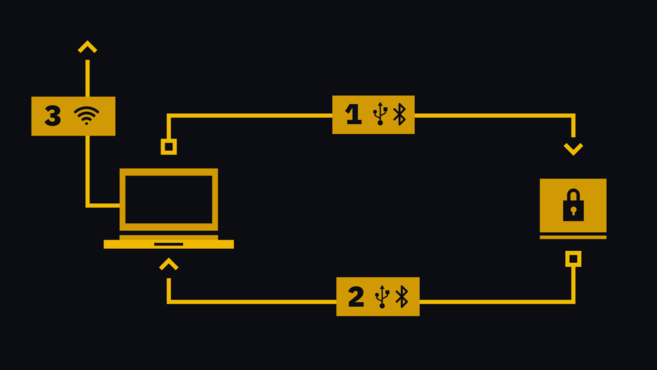
Once the user creates a transaction, he sends it to the hardware wallet (1 in the diagram below). Please note that the transaction is still not completed as it still needs to be signed with the private key that is located on the device. In addition, the user will have to confirm that the recipient's address and the number of coins being sent are correct. He then signs the transaction, thereby sending it back to the software (2), which broadcasts this operation to the cryptocurrency network (3).
Why should you use a hardware wallet?
Wallets that store private keys on PCs or smartphones connected to the Internet make user funds vulnerable to a large number of attacks. Malware can detect crypto activity on these devices and, at some point, withdraw users' funds to another wallet.
A hardware wallet is like an impenetrable shelter with a small window. When a user wants to create a transaction that the network will accept, he passes it through this window. Imagine there is an elf on the other side performing some cryptographic magic to sign transactions. The elf will never leave the shelter because there are no doors, while magic cannot pass through this window. All it can do is receive transactions and send them back.
Even if someone manages to take over your hardware wallet, you have additional protection in the form of a PIN code. On such devices, settings are often reset if the combination is entered incorrectly a certain number of times.
Funds that do not actively move their funds should store them in a cold wallet. The hardware wallet is convenient and understandable for all categories of users.
You should always have a backup copy of your hardware wallet in case it is lost, stolen, or damaged. When activating a wallet, in most cases the user is asked to write down a seed phrase - a list of words that can be used to restore your funds to a new device. These phrases provide the ability to send transactions from a wallet, similar to a private key, so they should be treated like any other valuable piece of information. Users are advised to write them down on paper (or engrave them on metal) and keep them in a safe place.
Disadvantages of Hardware Wallets
Hardware wallets, like other forms of storing funds, have some disadvantages, in this case, due to the provision of a high level of security. They strike a balance between security and usability. While software wallets for PCs or smartphones set the standard for ease of use, hardware wallets can't boast the same (given that you need to use two devices to send funds).
Hardware wallets also do not provide absolute security for your funds. A physical threat to the user can force him to open the wallet, but there are other types of attacks. Experienced attackers will be able to exploit the device if they gain physical access to it.
However, to date, no experienced hacker has been able to successfully hack and gain access to the private keys of a hardware device. When vulnerabilities are reported, manufacturers are quick to fix them, but this in turn does not mean that they do not exist; researchers regularly analyze and demonstrate various vulnerabilities in even the most popular wallets.
Supply chain attacks can also be an effective way to disrupt the secure operation of a hardware device. This occurs when an attacker acquires a wallet before it is delivered to the user. During the period of ownership of this device, it may weaken its security levels and open the possibility of transferring funds after the user makes a deposit.
Another disadvantage is that hardware wallets require personal asset management. Many see this as an advantage because no third party is responsible for the security of your funds, which also means that if something goes wrong there may not be a solution to some problems.
Review of hardware wallets 2020
At Binance Academy, we are working on a series of reviews of the most popular hardware wallets on the market.
Ledger Nano S
Undoubtedly, one of the most popular hardware wallets today is the Ledger Nano S, which is considered a must-have for both long-term holders and high-frequency traders. We recommend checking out our full review of the Ledger Nano S in 2020.
Ledger Nano X
The successor to the Ledger Nano S, the Nano X boasts an impressive number of upgrades, including wireless functionality and support for more cryptocurrencies. We recommend checking out our full Ledger Nano X 2020 review.
Trezor One
The product, which can be said to have launched the development of the entire hardware wallet industry, still remains relevant. Affordable yet powerful, Trezor One is the gold standard for many cryptocurrency holders. We recommend checking out our full Trezor One 2020 review.
Model T safe
It can be compared to the first version on steroids. Despite the higher price, you may like the device's touchscreen, support for more coins, and SD card compatibility for future updates. We recommend that you read our full review of the Trezor Model T in 2020.
Cobo Vault
A wallet for those who are preparing for the apocalypse. A device with a large touch screen, in a durable metal casing, which is designed for those who take security seriously. We recommend checking out our full review of Cobo Vault in 2020.
CoolWallet S
With a size similar to a credit card, the CoolWallet S is definitely a memorable device. While this wallet sacrifices on the UI/UX front, it will appeal to those looking for something new. We recommend checking out our full review of the CoolWallet S in 2020.
SafePal S1
For its price, SafePal implements some very interesting security features while minimizing the need to interact with other devices. We recommend that you read our full review of SafePal S1 in 2020.
KeepKey
Sleek and stylish with built-in ShapeShift support. However, user registration is required to realize its full potential. We recommend checking out our full review of KeepKey in 2020.
Did we forget to mention your favorite device? Let us know by tweeting at our Twitter account: @BinanceAcademy!
Conclusion
However, the disadvantages of hardware wallets cannot compete with their advantages. As digital asset storage solutions evolve, it is difficult to compare the security of hardware wallets to other similar methods, as none can replace cold storage, suggesting there is little risk in managing assets yourself.
Before choosing a hardware wallet, the user is advised to properly familiarize themselves with the range of available options. There are several types of devices on the market, each of which has its own characteristics, support for certain cryptocurrencies and a learning curve.