

Content
What is the Stock to Flow model?
Stock to Flow Ratio for Gold
Stock to Flow and Bitcoin
Stock to Flow Ratio for Bitcoin
Limited Stock to Flow models
Summary
What is the Stock to Flow model?
In a nutshell, the Stock to Flow (SF or S2F) model measures the abundance of a particular resource. The Stock to Flow ratio is the amount of a resource in stock divided by the amount produced per year.
The Stock to Flow model is typically applied to natural resources such as gold. The World Gold Council estimates that approximately 190,000 tons of gold have been mined throughout history. We call this quantity (that is, the total supply) stock. Meanwhile, about 2,500 – 3,200 tons of gold are mined annually. This volume is called flow.
The Stock to Flow ratio is calculated using these two indicators. But what exactly does this model allow us to understand? It shows how much supply enters the market each year for a given resource in relation to the total supply. The higher the stock-to-flow ratio, the less of that resource enters the market relative to the total supply. Thus, an asset with a higher Stock to Flow ratio should theoretically retain its value for a long time.
Consumables and industrial goods, in turn, have a low Stock to Flow ratio. The fact is that their value is usually associated with the destruction or consumption of these resources, and stocks exist only to satisfy consumer demand. These resources do not necessarily have high value and are therefore not suitable for use as investment assets. In rare cases, the price may rise quickly if a resource is expected to become scarce in the future. Under normal conditions, production will keep pace with demand.
It is important to note that scarcity in itself does not necessarily imply the value of a resource. This is not to say that gold, for example, is in great short supply - after all, 190,000 tons have already been mined! The Stock to Flow ratio suggests that this resource is valuable because annual production is relatively small compared to the existing stock.
Stock to Flow Ratio for Gold
Historically, gold has had the highest Stock to Flow ratio of any precious metal. How much is it? Let's take the previous example. Let's divide the total supply of 190,000 tons by 3,200 to get a Stock to Flow ratio of ~59. That is, at current mining rates it will take about 59 years to extract another 190,000 tons of gold.
It is worth noting that the volume of gold mined each year taken as an example is an approximate value. If annual production (flow) increases to 3,500, the Stock to Flow ratio decreases to ~54.
While we're on the subject, why not calculate the total value of all the gold mined? In some ways, this can be compared to the market capitalization of cryptocurrencies. If the price per ounce of gold is about $1,500, then the total value of all gold mined is about $9 trillion. The figure, at first glance, is huge. In reality, if you put all this gold in a large cube, it would be only the size of one football stadium!
If we draw an analogy with Bitcoin, at the end of 2017 the maximum total value of this network was about $300 billion, and at the time of writing - about $120 billion.
Stock to Flow and Bitcoin
If you are familiar with how Bitcoin works, then you understand how effective it is to apply the Stock to Flow model to it. Essentially, this model compares Bitcoins to scarce resources such as gold or silver.
They are also often called savings resources. In theory, they should retain their value over the long term due to relative scarcity and low flow. In addition, it is extremely difficult to increase their supply in a short period.
According to proponents of the Stock to Flow model, Bitcoin is a similar resource. It is in short supply, relatively expensive to produce, and has a maximum supply of 21 million coins. In addition, the emission of bitcoins is determined at the protocol level, which makes the flow completely predictable. You may have heard of Bitcoin halvings (halvings), in which the amount of new supply is halved every 210,000 blocks. This happens approximately once every four years.

Total BTC Mining (%) and Block Rewards (BTC).
According to proponents of this model, these properties combine to create a scarce digital resource with characteristics that allow it to retain value over the long term. Additionally, it is assumed that there is a statistically significant relationship between Stock to Flow and market value. Based on this model, it can be predicted that over time the price of Bitcoin should increase significantly due to the constant decrease in the Stock to Flow ratio.
It is believed that the idea of applying the Stock to Flow model to Bitcoin was first raised in the PlanB user article Modeling the value of Bitcoin taking into account scarcity.
Stock to Flow Ratio for Bitcoin
The current number of Bitcoins in circulation is approximately 18 million, and the new supply is approximately 0.7 million per year. At the time of writing, Bitcoin’s Stock To Flow ratio fluctuates around 25. After the next halving in May 2020, the ratio became 50.
The image below shows the relationship between Bitcoin's moving average Stock to Flow ratio and its price over the year. The vertical axis shows the dates of Bitcoin halvings.
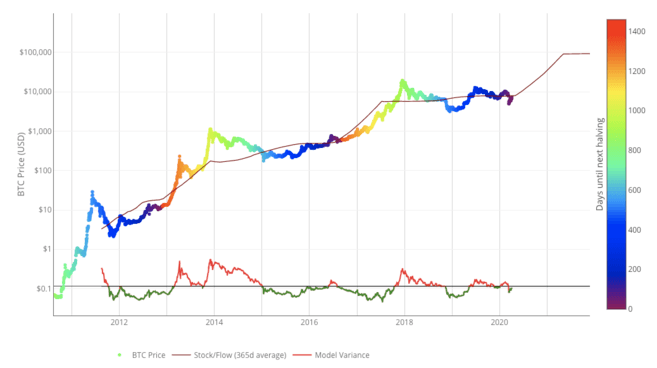
Stock To Flow model for Bitcoin. Source: LookIntoBitcoin.com
Are you wondering how to get started with cryptocurrencies? Buy Bitcoin on Binance!
Limited Stock to Flow models
Although Stock to Flow is a useful model for measuring scarcity, it does not take into account all aspects. Models are only as effective as their predictions. On the one hand, Stock to Flow is based on the assumption that scarcity should determine value. According to critics of Stock to Flow, this model will not work if Bitcoin does not have other necessary qualities besides supply shortage.
Gold's benefits include its scarcity, predictable flow, and global liquidity, making it a relatively stable store of value compared to fiat currencies that are prone to devaluation.
According to this model, Bitcoin volatility should also decrease over time, which is confirmed by Coinmetrics data.
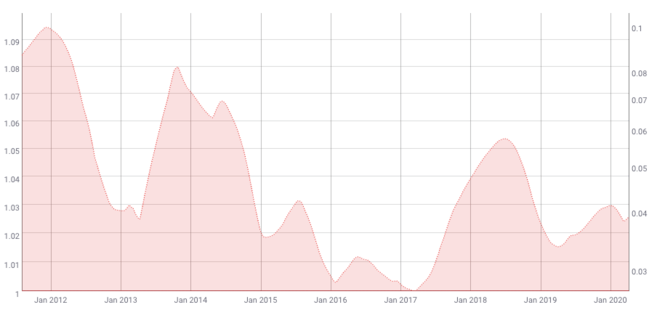
Bitcoin's 200-day moving average of 180-day volatility. Source: Coinmetrics.io
Valuing an asset requires taking into account its volatility. If volatility is predictable to a certain extent, then the pricing model will be more reliable. However, Bitcoin is notorious for significant price fluctuations.
While volatility may be declining at the macro level, Bitcoin's price was initially determined by the free market. In other words, the price on the open market is regulated by the users themselves, traders and speculators. Add to this relatively low liquidity, and Bitcoin is likely to be more susceptible to sudden spikes in volatility than other assets. This model may also not take this into account.
Other external factors, such as economic events like the Black Swan, can also undermine this model. Although it's worth noting that this applies to almost any model that attempts to predict the price of an asset based on historical data. A "black swan" by definition has an element of surprise, and historical data cannot account for sudden events.
Summary
The Stock to Flow model measures the relationship between the currently available stock of a resource and the volume of its production. This typically applies to precious metals and other commodities, but some argue that it could apply to Bitcoin as well.
In this sense, Bitcoin can be considered a scarce digital resource. According to this method of analysis, Bitcoin's unique advantages should help it maintain its value over the long term.
However, each model is only as strong as its predictions, which means it may not take into account absolutely every aspect of estimating the value of Bitcoin. Moreover, at the time of writing, Bitcoin has been around for a little over ten years. Although some will probably argue that long-term valuation models such as Stock to Flow require more data to be more accurate.