



Content
Introduction
What is dollar cost averaging?
What is it used for?
Examples of application of the DCA strategy
Dollar Cost Averaging Calculator
The Case Against Dollar-Cost Averaging
Conclusion
Introduction
Active trading is often a stressful and time-consuming process that may ultimately not bring the expected results. However, there are other investment strategies in the market. You, like many other investors, are pursuing a goal of finding a less demanding and time-consuming investment strategy, or a more passive investment style. In the Binance ecosystem, you will have a wide range of options, including: staking, lending your assets to Binance Savings, the ability to join the Binance mining pool, and much more.
What to do if you want to invest in the cryptocurrency market, but don’t know where to start? What is the best investment method to build a long-term position? In this article, we will discuss an investing strategy known as DCA, which allows you to reduce some of the risks when building your positions.
What is dollar cost averaging?
Dollar-cost averaging (DCA) is an investment strategy that aims to reduce the impact of volatility when purchasing assets. This strategy involves purchasing an equal amount of an asset at regular intervals.
The premise of this strategy is that entering the market in this way reduces the level of volatility of the asset compared to a one-time payment. Why is that? Buying at regular intervals helps smooth out the average price. In the long run, this strategy reduces the negative impact on your investment. Let's take a closer look at how DCA works and why you might seriously consider using this strategy.
What is it used for?
The main benefit of DCA is that it reduces the risk of a late bid. Determining the best time in the market is one of the most difficult decisions when it comes to trading or investing. Often, even with the right choice of trading direction, but with incorrect timing, the transaction may not bring the expected result. Dollar-cost averaging helps mitigate the impact of this risk category.
If you split your investment into smaller payments, you'll likely get a better return than investing the entire amount in one payment. It is very easy to make a trade at the wrong time, and this usually leads to negative results. Moreover, you may make mistakes while making a decision. Once you move to DCA, the strategy will make the decisions for you.
It is important to consider that DCA does not completely mitigate the risk, but only allows you to smooth out the moment of entering the market, minimizing the risks of unsuccessful timing. The DCA strategy does not guarantee the success of your investment as there are always other factors to consider.
As mentioned above, timing in markets is extremely important and has a certain complexity. Even the biggest trading veterans struggle from time to time to accurately read the market. Having an average dollar value at the time of entering a position, you will also need to think through an exit plan, that is, a trading strategy that determines the conditions for closing your position.
Now, if you have determined a target price (or price range), this can be quite simple. You again divide your investment into equal parts and start selling it as soon as the market approaches your target. This way you can reduce the risk of not going out at the right time. However, this all depends entirely on your individual trading system.
Some people follow a “buy and hold” strategy, where the goal is to never sell acquired assets because they are expected to continue to grow. Consider the performance of the Dow Jones Industrial Average over the past century.

Performance of the Dow Jones Industrial Average (DJIA) since 1915.
Despite short periods of recession, the Dow Jones Industrial Average has been in a continuous upward trend. The goal of a buy and hold strategy is to enter the market and stay in the position long enough that timing does not matter.
However, it is worth remembering that such a strategy is primarily focused on the stock market and, as such, was not intended to be used in the cryptocurrency markets. Keep in mind that the Dow Jones Industrial Average is tied to the actual performance of the economy, while other asset classes follow very different patterns.
Examples of application of the DCA strategy
Let's look at the dollar cost averaging strategy with the following example. Let's say we received a fixed amount of $10,000, and we believe that the smartest thing to do is invest it in Bitcoin. We believe that the price of the first cryptocurrency will fluctuate in the current range for some time, and at the moment we are in an advantageous place to accumulate and build positions using the DCA strategy.
We can divide $10,000 into 100 parts of $100. Every day we are going to buy $100 worth of Bitcoin, regardless of its price. Thus, we extend our entry period by 100 days.
Now let's look at the flexibility of DCA in other settings. Let's say Bitcoin just entered a bear market and we don't expect a bull market for at least two more years. But ultimately we believe a bullish trend is coming and we want to prepare for it in advance.
Can we use the same strategy? Probably not. This investment portfolio has a much longer time period. We need to be prepared for that $10,000 to be spread out as part of the strategy for several years to come. So what should we do in this situation?
We could again divide the investment into 100 parts of $100. However, this time we are going to buy $100 worth of Bitcoin every week. There are approximately 52 weeks in a year, so the entire strategy will take just under two years to complete.
This way we will create a long-term position while the downtrend continues. With such a construction of positions, we will not miss the likely beginning of an uptrend, and will also reduce some risks that involve entering the market during a downtrend.
But keep in mind that this strategy can be risky - after all, we are buying assets in a trend that is downward. For some investors, it would be better to wait until the end of the bearish trend is confirmed before entering into positions. If they expect this, then the average cost (or share price) will likely be higher, but at the same time, much of the risk will be correspondingly reduced.
Dollar Cost Averaging Calculator
You can find a great dollar cost averaging calculator for Bitcoin at dcabtc.com. You can specify the amount, time period, payment intervals and get an idea of how different strategies can be implemented. You will find that with Bitcoin, which is in a strong long-term uptrend, this strategy works quite well.
Below you can see the effectiveness of your investment if you bought just $10 worth of Bitcoin every week over the past five years. $10 a week isn't that much, is it? Well, as of April 2020, you would have invested a total of about $2,600, and your total in Bitcoin would be about $20,000.
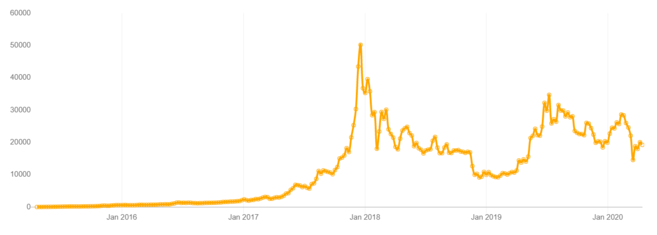
Performance of $10 worth of BTC purchases every week over the past five years. Resource: dcabtc.com
Do you want to start using cryptocurrency? Buy Bitcoin on Binance!
The Case Against Dollar-Cost Averaging
While dollar-cost averaging can be a fairly profitable strategy, there are investors who are skeptical about it. It certainly works best when markets are experiencing big swings. This makes sense since the strategy is designed to mitigate the impact of high volatility on a position.
However, according to some, it will ultimately lead to a loss of profits for investors in a stable market situation. How so? If the market is in a sustained bullish trend, it can be assumed that those who invested earlier will receive greater profits. Thus, DCA can have a moderating effect on the growth of an uptrend. In this case, a lump sum investment may outperform DCA in terms of profitability.
However, most investors do not have a large amount of money to make a one-time investment. However, they may invest small amounts over the long term - in this case, dollar-cost averaging is the most appropriate investment strategy.
Conclusion
Dollar cost averaging or DCA is a strategy that allows you to enter the market while minimizing the impact of volatility. DCA involves dividing investments into equal parts and purchasing assets at regular intervals.
The main advantage of using such a strategy is that choosing the right time to invest is quite a complex process and those who do not want to actively follow trends can invest in the above-mentioned manner.
However, according to some skeptics, dollar-cost averaging can lead to lost profits during a bull market. But considering all of the above, then this possibility of losing part of your investment is not a reason why you should avoid using DCA, since this trading activity option can be useful and effective for many other traders.