

Carefully! Lots of text.
DeFi is the only place where unicorns and cartoon sushi battle it out for liquidity. Uniswap has become one of the most successful DeFi protocols for token exchange on Ethereum. It was created by a small team of developers to make the code open source and available to everyone. This is exactly the task that SushiSwap accomplished!
SuhiSwap is a fork of Uniswap that created a delicious new token called SUSHI. It gives owners control over the protocol and pays a portion of transaction fees. Next we will learn how to get these tokens.
Introduction
As the decentralized finance (DeFi) space evolves, more and more new financial platforms are emerging. Investors actively use flash loans and profitability farming (liquidity mining) to earn money.
Uniswap has strengthened its position as one of the major DeFi protocols with the largest trading volume. However, despite its decentralization and heavy dependence on smart contracts, users have no say in its development.
SushiSwap, a newcomer to the space, promises to change that. And with over $1 billion locked in the protocol within days of launch, a lot of interest from the community is expected. In this article, we will discuss the Uniswap fork that is taking the cryptocurrency space by storm.

What is SushiSwap?
SushiSwap was launched in September 2020 by two anonymous developers, Chef Nomi and 0xMaki. It is one of the most popular decentralized applications (DApps) on the Ethereum blockchain. SushiSwap uses an automated market maker (AMM) model for its decentralized exchange (DEX) protocol. Simply put, there is no order book on SushiSwap. Buying and selling cryptocurrency is carried out using smart contracts.
SushiSwap was created as a fork of Uniswap. It is based on the Uniswap code, but SushiSwap introduced some key differences, in particular, it began distributing rewards in SUSHI tokens. Liquidity providers on SushiSwap are rewarded with the native SUSHI protocol token, which is also a governance token. Unlike Uniswap (UNI), SUSHI holders can receive rewards even after they stop providing liquidity.
When SushiSwap was first launched, it encouraged liquidity providers to stake their liquidity tokens (LP) on Uniswap by paying them additional SUSHI rewards with a high annual yield (APY). In just one week, SushiSwap successfully raised over $1 billion in liquidity, with the total amount locked reaching over $150 million. Two weeks later, staked LP tokens were moved from Uniswap to SushiSwap. This means that all Uniswap LP tokens staked on SuhiSwap have been redeemed on Uniswap for an equivalent amount of tokens. On SushiSwap, new liquidity pools were also created with them, marking the launch of the SushiSwap exchange.
In the second quarter of 2021, the SushiSwap ecosystem unveiled its latest project, a non-fungible token (NFT) platform called Shoyu (Soy Sauce). The idea for Shoyu originated from a member of the SUSHI administration who wanted to make Shoyu a simple and easy-to-use NFT platform. It aims to address current shortcomings of NFT marketplaces, such as limited possible file formats, limited image sizes, and high transaction fees on Ethereum.
What is SUSHI?
SUSHI is the native token of SushiSwap. This ERC-20 token was distributed to liquidity providers on SuhiSwap through liquidity mining. The maximum supply of SUSHI is 250 million tokens. SUSHI's offer depends on the block speed. As of November 2021, it is created at a rate of 100 tokens per block, and the number of tokens in circulation has already reached approximately 50% of the total supply of 127 million tokens.
SUSHI gives owners the right to manage and reimburses part of the commissions paid in the protocol. In other words, the protocol belongs to the SUSHI community. Why did this generate such interest? Community governance is closely tied to the nature of DeFi. The rise of liquidity mining (yield farming) as a valid method of token distribution has led to the launch of new tokens.
These fair token launch models aim to level the playing field for all participants. They often lack pre-mining, and distribution occurs based on the amount of funds provided by each user. However, only little or no distribution is made to the founders. In most cases, distributed tokens also provide governance rights to the owners.
But how can token holders exercise their governance rights? On SushiSwap, anyone can create a SushiSwap Improvement Proposal (SIP) that SUSHI holders will vote on. That is, users can make changes to the SushiSwap protocol. Instead of a traditional team like Uniswap, the development of SushiSwap is in the hands of SUSHI token holders.
A strong community can be a powerful asset for any token project, but especially for a DeFi protocol. For example, MISO, or SushiSwap's Minimum Initial Offering, is the product that results from such an offering. This is a platform for launching tokens in the SushiSwap ecosystem, tailored to the needs of the SUSHI community. MISO allows individuals and communities to launch their tokens through the SushiSwap platform.
How does SushiSwap work?
As we already said, SushiSwap is an automatic market maker (AMM) protocol that operates as a decentralized exchange, without an order book or centralized management. Cryptocurrency trading on SushiSwap is processed by smart contracts in liquidity pools. In a liquidity pool, SushiSwap users become liquidity providers (LPs) by locking up their crypto assets. At the same time, anyone can become a liquidity provider and start earning rewards according to their share in the pool. To do this, you need to contribute the equivalent value of two tokens to the pool. Each pool operates as a marketplace where users can buy and sell tokens. For more information on how AMM works on DEX protocols, check out our article on Uniswap.
SushiSwap, like other DEX protocols, allows you to exchange ERC-20 tokens. In most cases, they are less stable compared to large cryptocurrencies, such as Bitcoin (BTC) and Ether (ETH). In addition, various functions related to the theme of sushi are also integrated here and allow you to earn passive income. For example, you can add SUSHI to staking in SushiBar (sushi bar) and get xSUSHI. The resulting xSUSHI allows holders to earn 0.05% rewards on all trades from liquidity pools. Following the launch of Shoyu, SUSHI holders who stake their tokens to obtain xSUSHI will also be eligible to receive 2.5% of each NFT marketplace transaction.
BentoBox (bento box) is another opportunity to receive rewards on SushiSwap. This is an innovative repository where users can use all available tools to make a profit on SushiSwap. By placing their assets in BentoBox, the user will automatically receive interest from staking in SushiBar, as well as from providing tokens to other users. At the same time, xSUSHI holders can receive rewards as part of BentoBox transaction fees.
Uniswap and SushiSwap
It's no secret that cryptocurrency is open source. Many people think that Bitcoin and the growing number of public DeFi protocols act as new options for public goods in the form of software. Such projects are easy to copy and relaunch with minor changes, which in turn leads to competition between similar products. But ultimately, such a struggle should lead to the creation of better products for users.
There is no doubt that the DeFi space owes its progress to the Uniswap team. However, we are on the cusp of a future where both Uniswap and SuhiSwap (or other forks) will thrive. And while Uniswap can remain at the forefront of AMM innovation, SushiSwap will be an alternative that caters to the desires of the community.
With that said, liquidity fragmentation between similar protocols is not ideal. If you've read our article on Uniswap, you know that AMMs work best with as much liquidity as possible in the pools. If most of the liquidity in DeFi is split between many different AMM protocols, this can result in a worse experience for the end user.
How to provide liquidity on SushiSwap?
So, you have decided to stake tokens in exchange for SUSHI. The first step is to purchase these tokens. You can buy cryptocurrency to stake on centralized crypto exchanges like Binance or decentralized exchanges like Uniswap and 1inch.
In this example, we will provide liquidity for BNB-ETH, but you can choose any other pair (as long as LP tokens can be used in SushiSwap).
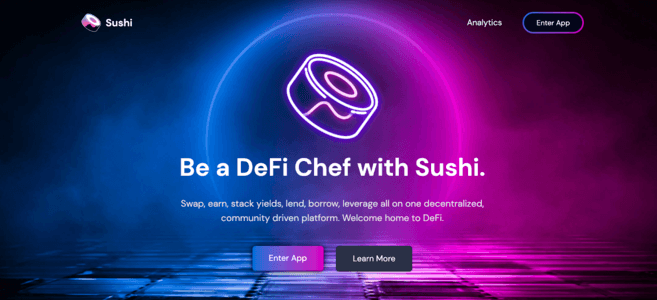
1. Go to Sushi and click [Enter App] to log in to SushiSwap.
2. Find the [Pool] tab in the navigation bar at the top of the page. You will need to connect a crypto wallet. You can use Binance Wallet, MetaMask, WalletConnect or any other supported Ethereum wallet. In this example we will use Binance Wallet.
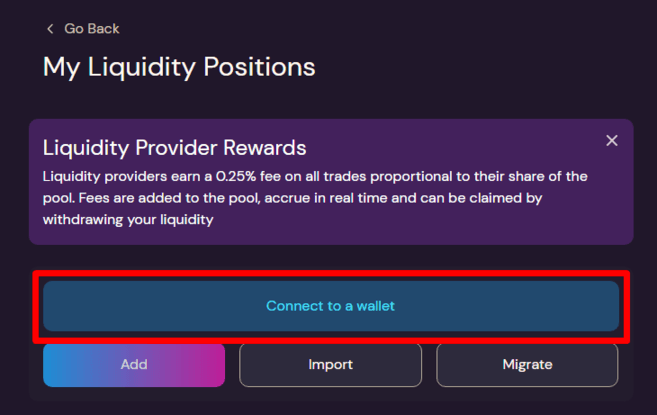
3. Click [Binance] and a pop-up window will appear. Enter your password to open your wallet, or click [Create a new wallet] if you don't have one.

4. Click [Connect].

5. You will be redirected to SushiSwap Pool again. Click [Add] to provide liquidity.

6. Click [Select a token] to find the cryptocurrency pair you want to provide liquidity for. Then enter the amount for one of the tokens (for example, 1 BNB). The system will automatically calculate the number of tokens available to you.
Your share will appear in the pool below. Click [Approve ETH].

7. A new pop-up window will appear with details and gas fees for this transaction. Click [Confirm] to approve or [Reject] if you want to change the details.

8. Click [Confirm Adding Liquidity] and then [Confirm Supply] to add liquidity to the BNB-ETH pool.
Note. Due to potential impermanent losses, the amount of tokens received upon redemption may differ from the amount originally added. So be sure to learn the process of adding liquidity before taking any financial risk.


9. Confirm the transaction in the wallet pop-up window.

10. You have successfully added liquidity to the BNB-ETH pool. Your position and share will be displayed in the pool. This way you will receive rewards when users trade BNB/ETH.
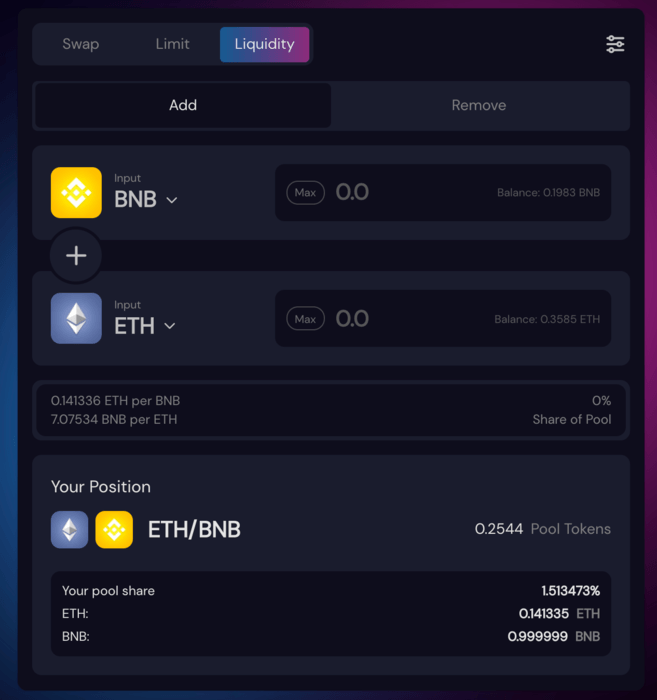
11. To manage your positions, go to the [Pool] tab on the top panel and click on your position to add or remove liquidity.
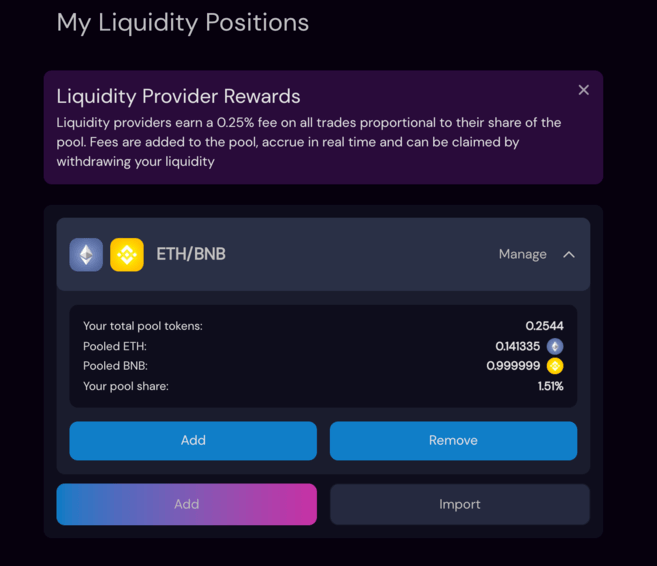
You will notice that you have several SLP tokens from the transaction in your wallet. SLP tokens are Sushiswap LP tokens. They represent the share you have contributed to the pool. All liquidity pools are labeled as SLP on SushiSwap, but in reality they are different pools.
How to Buy and Sell SUSHI on Binance
SUSHI can not only be earned on SushiSwap, but can also be purchased on cryptocurrency exchanges such as Binance. If you want to sell SUSHI received on SushiSwap, transfer it to your wallet and sell it on cryptocurrency exchanges, such as Binance.
1. Log into your Binance account, open the [Trading] tab in the top bar and select the classic or advanced interface.
2. On the right side of the screen, enter “SUSHI” in the search bar and you will see the available trading pairs. In this example we will use SUSHI/BUSD. Click on [SUSHI/BUSD] to open the trading page.

3. Scroll down and find the [Spot] field. Here you can buy or sell SUSHI. Enter the amount of SUSHI you want to buy or sell and select the order type. In this example we will use a market order. Click [Buy SUSHI] or [Sell SUSHI] to confirm the order.

SushiSwap safe?
Depositing funds into a smart contract always involves risk, even in the case of proven and reliable projects. Never deposit more than you are willing to lose, and always do your own research before investing. Additionally, due to the high cost of gas on Ethereum, even small deposits may require significant investments before they begin to generate profits.

Summary
SushiSwap is a unique experiment that challenges the competitive advantage of the already successful DeFi protocol Uniswap. As a fork of Uniswap, the SushiSwap project has added new features to its protocol, the key difference being community management. In 2021, SushiSwap also introduced an NFT platform to participate in the thriving NFT market.
SushiSwap has quickly surpassed other DeFi projects in total value recorded since launch, and its popularity continues to grow. But as successful as SushiSwap has been, it is an example of how no single product or service has an undeniable advantage in DeFi.