



Carefully! Lots of text.
When you trade stocks or cryptocurrencies, you interact with the market by placing orders:
A market order is an order to buy or sell immediately (at the current market price).
A limit order is an order to wait for an order to be executed until the price reaches a specified or more favorable price.
This is to put it briefly. Of course, each of these two categories opens up a range of opportunities that can be exploited depending on your trading method and strategy. Interesting? Then let's continue.
Introduction
Have you registered on the exchange and want to know what all these buttons are for? Or maybe you've been re-watching Wall Street and trying to better understand how stock markets work?
In this article we will talk about orders - instructions sent to the exchange to buy and sell assets. There are two main types of orders: limit orders and market orders. However, names are just characteristics used to describe a set of instructions.
Let's figure out what they really are.
Market orders and limit orders
Market orders are orders that require immediate execution. In other words, they instruct you to do x at the current price. Let's say you're registered on Binance and want to buy 3 BTC and Bitcoin is trading at $15,000. You're willing to pay $45,000 for the coins and don't want to wait for the price to go down, so you place a market buy order.
Who sells the coins in this case? To find out, you need to look at the order book. The exchange stores a list of limit orders in it. They are standard orders that do not execute immediately and tell you to do x at price y.
For example, another user may have previously placed an order to sell 3 BTC when the price per Bitcoin reaches $15,000. So, when you place a market order, the exchange matches it with a limit order on the book.
In fact, you do not create an order, but fill an existing one, and it is removed from the order book. You become a taker because you take away part of the exchange's liquidity. The other user, in turn, becomes a maker because he adds liquidity. Typically, makers have lower fees because they generate profits for the exchange.
You can learn more about the relationship between these two players in our article “Who are Market Makers and Market Takers.” Read it to better understand how exchanges work.
What you need to know about market orders
The main types of market orders are buy and sell orders. You instruct the exchange to complete the transaction at the best available price. However, the best available price does not always coincide with the value currently displayed. It depends on the order book, so the cost of executing a trade may vary slightly.
Market orders are suitable for instant (or nearly instant) transactions. In general, that's all you need to know about them. The fees associated with slippage and exchange mean that the same trade could be done cheaper with a limit order.
➟ Thinking about where to start working with cryptocurrencies? Buy Bitcoin on Binance!
Common order types
The simplest orders are market buy orders, market sell orders, limit buy orders and limit sell orders. However, if you stick to just this set of orders, your trading experience will be somewhat limited. Instead, you can complement them with other opportunities and take advantage of market conditions in the short and long term.
Limit stop orders

Stop limit orders are a good tool for limiting the losses you can incur while trading. It allows you to set a stop price and a limit price. Let's say BTC is trading at $10,000 and you set a limit stop order with a stop price of $9,900 and a limit price of $9,895. Then if the price drops from $10,000 to $9,900, a limit order would be placed at $9,985.
Please note: the order is placed only after the stop price is reached. The risk of a prolonged price decline still remains. If the price falls below $9,985, the order will not be executed and you may be left without protection.
OCO orders
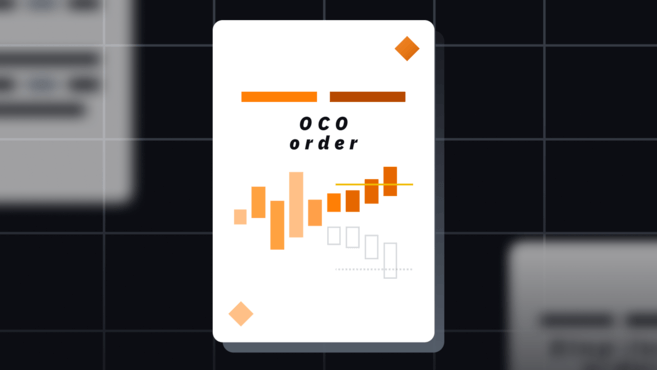
OCO orders (from the English one-cancels-the-other, or “one cancels the other”) are a complex tool that allows you to combine two orders with specified conditions. As soon as one of them is activated, the other is canceled. Let's take our $10,000 Bitcoin example again. You can use an OCO order to buy Bitcoin when the price reaches $9,900, or to sell when the price rises to $11,000. One of these two orders will be executed first, and the second will be automatically canceled.
What is "action time"?
Another important aspect of orders is their expiration time. This is the parameter that you specify when opening a trade, determining the conditions for its expiration.
GTC orders
A GTC order (good 'til canceled, or "good 'til canceled") is an order that requires a trade to remain open until it is executed or manually canceled. Typically, cryptocurrency trading platforms use this option by default.
In stock markets, a common alternative is to close the order at the end of the trading day. But since cryptocurrency markets operate 24/7, GTC orders are more common.
IOC orders
IOC orders (English immediate or cancel, or “execute or cancel”) suggest that any part of the order that is not executed immediately must be canceled. Let's say you create an order to buy 10 BTC at $10,000, but you can only receive 5 BTC at that execution price. In this case, you will buy 5 BTC and the rest of the order will be closed.
FOK orders
FOK orders (English fill-or-kill, or “execute or cancel”) must be executed instantly. Otherwise, they are destroyed (cancelled) and are not executed. For example, your order instructs the exchange to buy 10 BTC at a price of $10,000. If the entire supply of 10 BTC is not currently available at the specified price, then the order will be canceled.
Summary
Knowing the different types of orders is extremely important for informed and effective trading. Whether you choose to use stop orders to limit losses, OCO orders to plan for different outcomes in parallel, or other exchange features, it is important to know what trading tools are available to you.