

Carefully! Lots of text.
Elastic supply tokens have a changing supply. The idea is that instead of price volatility, the supply of tokens changes through events called rebasing.
Imagine that the Bitcoin protocol could regulate the number of Bitcoins in users' wallets to achieve a target price. Today you have 1 BTC. You wake up the next day and now you have 2 BTC, but each one is worth half. This is how the relocation mechanism works.
Introduction
Decentralized finance (DeFi) has seen an explosion of new types of financial products on the blockchain. We've already discussed yield farming, tokenized Bitcoin on Ethereum, Uniswap, and flash loans. Another segment in the cryptocurrency space that is interesting to watch is elastic supply tokens or rebasing tokens.
The unique mechanism behind them allows for many experiments. Let's take a look at how these tokens work.
What is an Elastic Supply Token
An elastic supply (or rebasing) token works in such a way that the circulating supply expands or contracts due to changes in the price of the token. This increase or decrease in supply works through a mechanism called rebasing. When a rebase occurs, the supply of tokens increases or decreases algorithmically depending on the current price of each token.
Elastic supply tokens have a lot in common with stablecoins. They use rebasing mechanics to achieve a target price. However, the key difference is that rebased tokens aim to achieve a price with varying (elastic) supply.
But many cryptocurrencies already work with a changing supply, right? This is true. Currently, 6.25 BTC is created with each new block. After the halving in 2024, this number will decrease to 3,125 per block. The release of coins is predictable and allows you to calculate how much BTC will be in circulation next year or after the halving.
Elastic supply tokens work differently. As mentioned earlier, the rebasing mechanism regulates the number of tokens in circulation. Let's say we have an elastic supply token that aims to reach a price of 1 USD. If the price exceeds 1 USD, after the rebase the supply will increase and the price of each token will fall. If the price is below 1 USD, the relocation will reduce the supply, causing the price of tokens to increase.
What does it mean? As a result of the relocation, the number of tokens in user wallets will change. Let's say we have rebased USD (rUSD) - a hypothetical token whose target price is 1 USD. Our hardware wallet contains 100 rUSD. Let's assume the price drops to 1 USD. Then, after the relocation, only 96 rUSD will remain in the wallet, but at the same time, each of them will cost more than before the relocation.
In other words, as a result of the relocation, users' stocks will remain the same relative to the total supply. If you had 1% supply before the rebase, then you will still have 1% after the rebase, even if the number of coins in your wallet changes. As a result, your share will remain the same regardless of the numbers on the balance sheet.
Examples of token relocation
Ampleforth
Ampleforth is one of the first coins to work with elastic supply. Ampleforth aims to be a synthetic commodity without collateral with a price of 1 AMPL = 1 USD. This coin is rebased every 24 hours.
The project had relatively little popularity before the launch of a liquidity mining campaign called Geyser. Please note the duration of the campaign: the distribution of tokens among participants occurs over a period of 10 years. Geyser is a prime example of how incentivizing liquidity can drive interest in a DeFi project.
While AMPL is technically a stablecoin, the price chart of this coin demonstrates how volatile elastic supply tokens can be.

The price of AMPL is heading towards $1, but it can be quite volatile.
This price chart only shows the price of individual AMPL tokens and does not take into account changes in supply. Ampleforth is extremely volatile and can be risky to trade.
It might be worth looking at a chart of elastic supply tokens in terms of market cap. Since the price of each unit is small, market capitalization can be a more accurate measure of a network's growth and popularity.
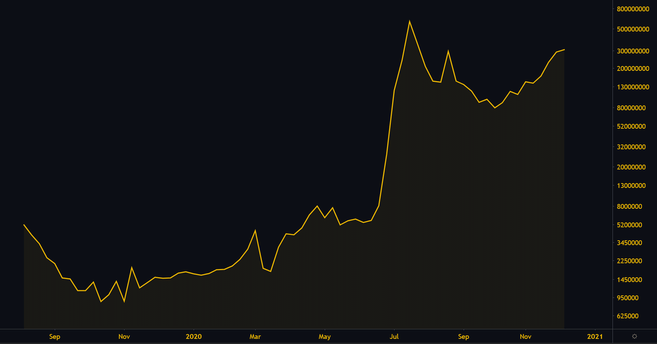
AMPL logarithmic market capitalization curve.
Yam Finance
Yam Finance is another popular project with elastic supply tokens. The Yam protocol design is a cross between Ampleforth's elastic offering, Synthetix's staking system, and yearn.finance's honest startup. YAM also aims to reach a target price of 1 USD.
YAM is a community-led experiment where all tokens have been distributed through liquidity mining. At the time of its launch, there was no pre-mining or distribution among the founders - any user could freely obtain tokens through yield farming.
Being a new and unknown project, Yam raised $600 million in its staking pools in less than two days. Its high liquidity was due to the fact that YAM farming targeted holders of popular DeFi coins such as COMP, LEND, LINK, MKR, SNX, ETH, YFI and ETH-AMPL Uniswap LP.
However, due to a bug in the rebasing mechanism, many more coins were created than planned. The community decided to restart the project and transfer it to a new token contract, independently funding the audit. Now the future of Yam depends entirely on the holders of the YAM token.
Risks of Elastic Supply Tokens
Investing in elastic supply tokens can be extremely risky. Invest only with complete confidence in your actions. Try not to rely solely on price charts as your token supply will change after the rebase.
As a result, you can either make a profit or incur losses. If the relocation occurs during a period when the token price is falling, then you will not only lose money, but you will also lose tokens after each relocation!
If you do not understand the issue well, investing in rebasable tokens can lead to serious losses. Invest in elastic supply tokens only if you have a good understanding of how they work. Otherwise, you will not be able to control your investments and make smart decisions.
➟ Thinking about where to start working with cryptocurrencies? Buy Bitcoin on Binance!
Summary
Elastic supply tokens are a pretty interesting innovation in DeFi. As we found out, they are coins and tokens whose supply is regulated by an algorithm to achieve a target price.
Will elastic supply tokens remain just an unusual experiment, or will they find their own niche in the world of cryptocurrencies? It's hard to say yet. However, some DeFi protocols are already being developed with the intention of developing this idea.


