


Carefully! Lots of text.
The network effect is expressed in the dependence of the value of a product on the number of its consumers. You may have heard about the social network Orkut, which stopped working due to insufficient number of users. Of course, there were other reasons, but it was this factor that reduced its value as a service.
When evaluating cryptocurrencies, it is extremely important to consider network effects, since the usefulness of money and blockchains ultimately depends on the number of users.
Introduction
What factors influence the popularity of cryptocurrency projects? One might assume that only the best solutions lead the market, but things are not that simple. The success of blockchain depends on many factors.
Developers can create innovative technologies, but if they are not market-fit at the time of release, they will not receive traction.
In some cases, technologically inferior projects are in high demand simply because they were available at the right time. This is where network effects play a significant role.
What is a network effect
A network effect is an economic effect in which the value of a good or service depends on the number of consumers. In this case, each new user adds value to the product, encouraging other people to join the network, increase its value, and so on.
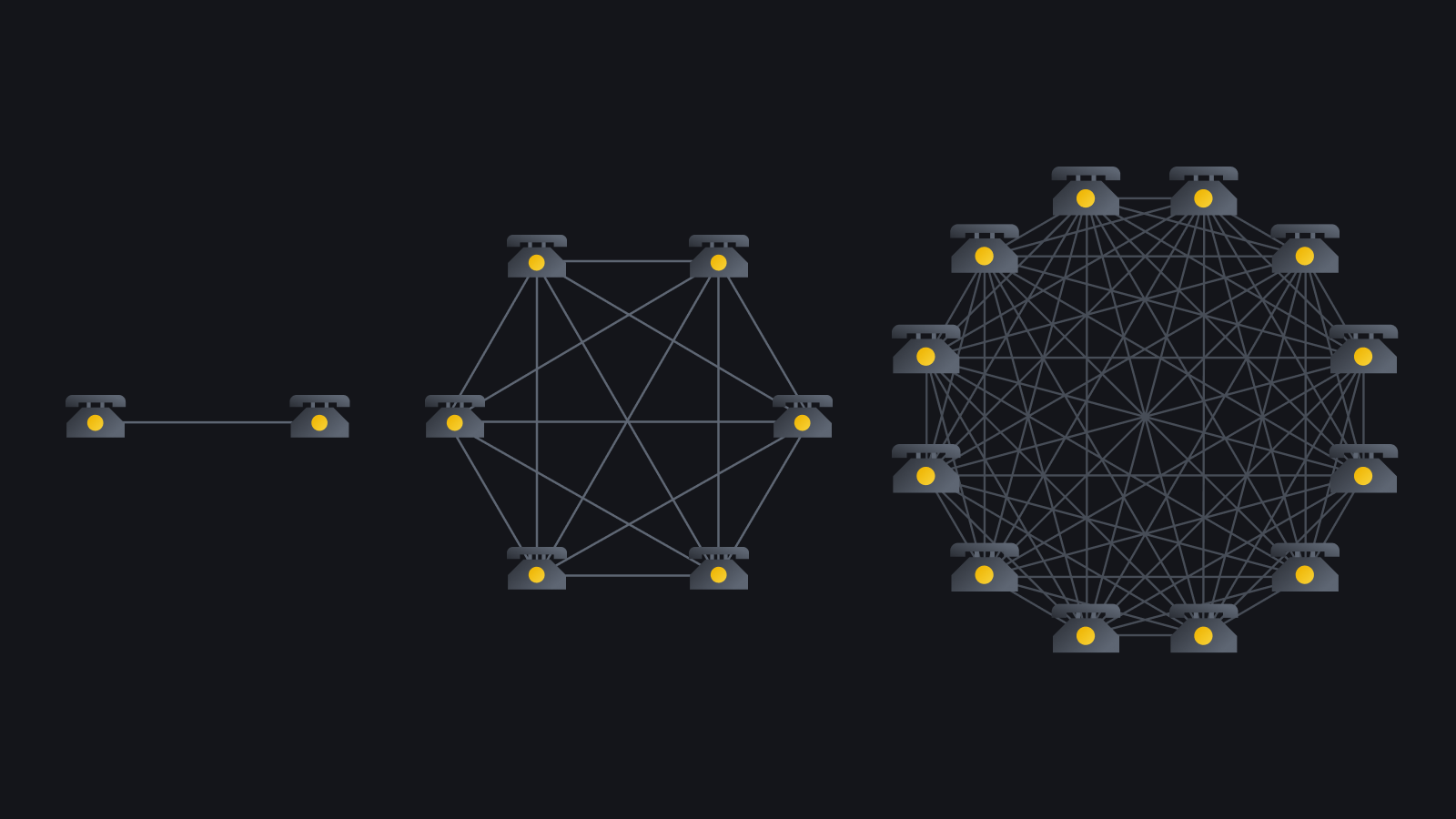
A classic example of a network effect is the telephone, which was originally a landline. When it first went on sale, only a few people bought it. Moreover, to access the network, the owners' homes had to be physically connected to each other.
As technology advanced, more people could afford a phone, and the growing number of users increased the value and usefulness of the entire network. This created a positive feedback loop as the more people joined, the more useful the phone became. Thus, increased usage has led to exponential growth.
Types of Network Effects
There are two main types of network effects: direct and indirect.
The telephone network is an example of a direct network effect, in which increased use of a product increases its value to other users.
Indirect network effects are more difficult to determine. They represent additional benefits of the network effect. For example, many cryptocurrencies are open source.
A project with a strong network effect can attract many experienced developers to audit the code, since a large amount of funds (including their own) are staked. This added value comes from the fact that there are many assets circulating on the network. As a result, the network attracts the attention of a large number of users, making the project a leader compared to its competitors.
Examples of network effects
Modern examples of network effects are present in a number of different product categories. For example, users usually choose social networks that people they know are already using. This encourages people to choose the same platforms, which is why some services have a monopoly position.
If new companies want to launch a social network, they will find it difficult to reach the required number of users. Why? Because the network effect gives a significant advantage to existing market leaders.
Another example of network effects is ride sharing. Network effects make it difficult for new services with smaller customer bases to compete with leaders like Uber or Lyft.
The same applies to online sales on Ebay and Amazon, the Google search service, the online rental service AirBNB, the Microsoft operating system and Apple gadgets. Does this only apply to commercial companies with certain business models? No. A good example of an open source project with significant network effects is Wikipedia.
Network effects and cryptocurrencies
Network effects play an important role when it comes to cryptocurrency and blockchain.
For example, Bitcoin, which has not only attractive properties, but also a powerful network effect.
Bitcoin miners provide security to the network and have high liquidity to support operations. But let's imagine that someone launched another network with higher rewards, but less liquidity to close positions. Miners can take a risk and invest in a new project, hoping for improved liquidity in the future, or continue to engage in relatively stable Bitcoin mining. This is how the network effect works. Even if the alternative is technically or otherwise superior, switching to it does not guarantee benefits.
However, Bitcoin's success is not just a result of network effects. Thanks to its fair launch, Bitcoin has unique properties that are extremely difficult to replicate. Think of this example more as a thought experiment.
Network effects also play an important role in the decentralized finance (DeFi) space. If a product, service, or even a smart contract has a significant advantage, it will be difficult for other projects to surpass it. However, DeFi is currently in its early stages of development, and it is worth noting that no product has yet achieved the network effect that would make it a clear winner.
➟ Do you think where to start working with cryptocurrencies? Buy Bitcoin (BTC) on Binance!
Negative network effects
Negative network effects work in the opposite direction, meaning that each new user will reduce the value of the network. This is also important to keep in mind when it comes to the design of blockchains. The project will not be successful if each new user does not add value to the network, because in this case the network will not scale. And if each user reduces its value, it will lead to overload.
For example, Ethereum gas works with an auction-type system where each user bids on a gas fee for Ethereum miners. As new users are added, gas fees typically become higher as each tries to beat the other's rate. However, this cannot go on forever. As gas charges become too high, some users abandon the network due to high costs—an example of a negative network effect.
But there are also solutions to this problem, for example, EIP-1559, an Ethereum proposal for upgrading the gas system. Additionally, the set of updates in ETH 2.0 can also significantly increase network throughput. This will correct the problem of high gas fees during periods of increased activity.
Summary
Network effects are present in many segments of the economy, including cryptocurrencies. Their idea is that the more users use a product, the higher its value.
Studying and applying network effects mechanisms can help blockchain and cryptocurrency network developers scale their projects more quickly.
Do you still have questions about network effects and cryptocurrency? Visit our Q&A platform, Ask Academy, where the Binance community can help you.