

Carefully! Lots of text.
Mining is the process by which Bitcoin transactions are verified and added to the blockchain. The goal of miners is to find correct solutions to complex mathematical problems, for which they receive rewards in the form of new bitcoins and commissions for completed transactions.
In the early years of Bitcoin, users could mine from their personal computers. However, today, in order to make a profit, it is necessary to use specialized mining equipment. Since solo mining is a very labor-intensive process, many miners join mining pools, increasing their chances of receiving a block reward, which is proportionally distributed among all pool participants.
Introduction
Bitcoin mining keeps the blockchain up to date and also ensures that the transactions being carried out are legal. This gives users the opportunity to trust the system itself, and not other participants in the process, when performing transactions. In this sense, mining is the basis of Bitcoin security.
The idea of getting BTC for mining is incredibly attractive. Gone are the days of mining using a CPU, and today even having a physical computer is not always necessary. But before you decide whether you are ready to start mining, let's take a quick look at how it works.
What is Bitcoin mining?
If a user creates a new transaction, he needs to wait for other network users (nodes) to review and confirm it. Miners are responsible for collecting pending transactions and grouping them into a candidate block (a new block that has not yet been verified).
The miner must find a valid block hash for his candidate block. A hash is a set of numbers and letters that serves as a unique identifier for each block. The block hash looks like this:
0000000000000000000b39e10cb246407aa676b43bdc6229a1536bd1d1643679
To create a new block hash, a miner needs to collect the hash of the previous block, the data of his candidate block, the nonce (one-time random code) and confirm all this using a hash function.
In this case, the miner must find a nonce that, in combination with all the data, will generate a block hash. The hash starts with a certain number of zeros, which varies depending on the difficulty of mining. A valid block hash proves that the miner has done the necessary work to verify his candidate block (hence the name of the Proof of Work algorithm).
After collecting unconfirmed transactions and creating a candidate block, only nonsense can be changed. Mining equipment is used precisely for this task. In a complex selection process, mining rigs continue to modify the nonce and hash the combined data until they find a solution for that block (that is, a hash starting with a certain number of zeros).
Once a miner finds a valid hash, he confirms his candidate block and receives a reward in bitcoins for this, and all pending transactions within this block receive the status of confirmed.
How much does a Bitcoin miner earn?
For each new block, the miner receives a reward, which consists of new generated bitcoins (block reward) and transaction fees. By reward, they most often mean the reward for the block, since commissions make up only a small part of it.
In 2009, the block reward was 50 BTC and was halved after every 210,000 blocks were created (approximately every four years). This process was called halving and led to the reward being reduced to 25 BTC in 2012, then to 12.5 BTC in 2016, and finally to 6.25 BTC in 2020. The next reduction is expected in 2024. As of May 2021, the reward per block is approximately $300,000.
But do not rush to purchase mining equipment until you evaluate all profitability factors. The most important indicator of a mining rig is the speed with which it picks up nones. This indicator is called hashrate and determines the success of a Bitcoin miner. The higher the hashrate, the faster your equipment will be able to pick up the nonce.
Another important indicator is energy consumption. If you spend more money on electricity than you earn from mining, you should think about the feasibility of this business.
How to start mining Bitcoin
Since Bitcoin is decentralized and open source, anyone can start mining. Previously, it was necessary to use a PC to mine new blocks, but as the complexity of this process has increased, so have the hardware power requirements (more on this below).
In theory, you can try to mine on your PC, but the likelihood of you finding a valid hash is almost zero. The hash function is calculated relatively quickly, but selecting a huge number of random inputs takes a long time. This is why without specialized equipment your chances of success are slim.
What equipment is best to use?
Usually CPU, GPU, FPGA or ASIC are used for mining (we will look at them further). Some altcoins can still be mined using graphics cards (GPUs). Depending on the mining algorithm, complexity and energy costs, you can also consider FPGA installations. However, in the case of Bitcoin, the most effective solution is ASIC systems.
CPU (central processing unit)
Processors work as a universal chip, responsible for distributing tasks across different parts of the computer. But for cryptocurrency mining they are no longer so effective.
GPU (graphics processing unit)
GPUs perform different functions. They are mainly used for processing graphics and displaying them on the screen. They can break complex tasks into smaller ones to improve productivity. Some altcoins can be mined using a GPU, but the efficiency will depend on the algorithm and the difficulty of mining.
FPGA (Field Programmable Gate Array)
FPGAs can be programmed and reprogrammed to serve different functions and applications. They are customizable and cheaper than ASIC systems, but less efficient for mining.
ASIC (Application-Specific Integrated Circuit)
The abbreviation ASIC stands for Special Purpose Integrated Circuit. That is, these computers serve the sole purpose of mining cryptocurrencies. ASIC systems have less customization options and are more expensive than FPGAs, but their hashrates and power consumption levels make them the most efficient option for Bitcoin mining.
Mining pool
The likelihood that you will mine a block on your own is extremely low. Joining a mining pool allows you to combine your computing power with that of other miners. When a pool successfully mines a block, miners receive their share of the mined bitcoins in proportion to the mining power they provided.
How to join a mining pool?
To join a pool, you need to set up your software to partner with other miners. Typically this process involves registering an account and connecting to the mining pool server.
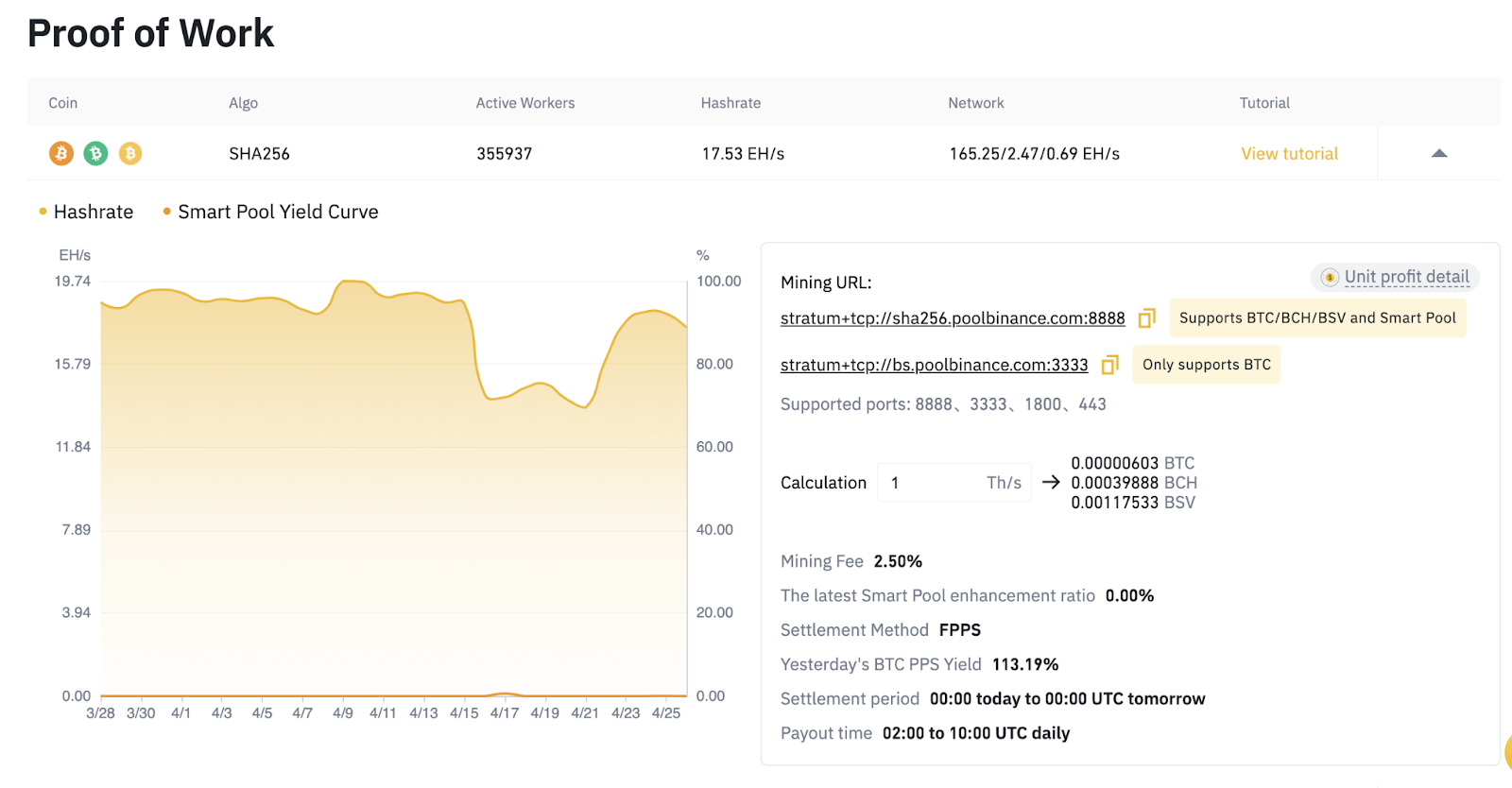
The presence of mining equipment, Binance Pool, is a good prerequisite for starting mining BTC and other coins based on the SHA-256 algorithm. Your hardware will automatically switch between BTC, BCH and BSV for maximum income.
You can find out information about potential profitability on the Binance Pool page. Earnings in Bitcoin will be paid daily to your Bitcoin wallet.
Cloud mining
If you don't want to go deep into the technical aspects, you can always join a cloud mining farm, and the farm owners will take care of the hardware and software. In other words, cloud mining is where you pay someone to mine on your behalf, and the owner of the farm, in turn, shares the profits with you. However, this option is very risky, since there is no guarantee that your investment will pay off. Many cloud mining services have often turned out to be scams, so be careful.
Summary
With a basic understanding of how Bitcoin works, you can't go wrong. With the right combination of hardware and software, anyone can start mining and contribute to the security of the Bitcoin network. And even if you decide that mining isn't for you, you can still contribute by running a Bitcoin node.
The initial investment for profitable mining is very large and comes with many risks. Your profits will also depend on market conditions and external factors such as electricity prices and equipment improvements. Before purchasing special equipment, carefully study all the necessary information.