

Carefully! Lots of text.
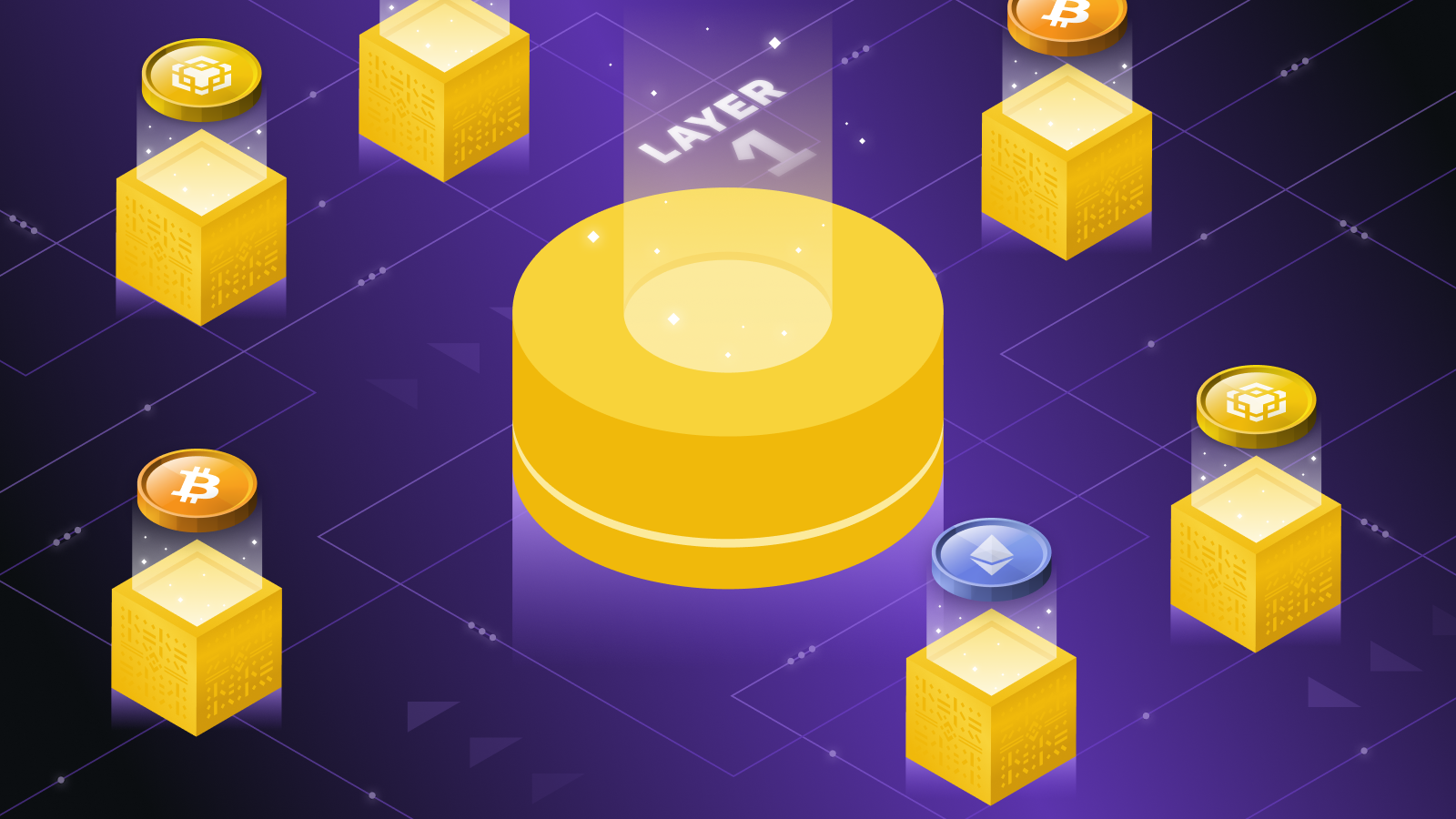
The first layer includes the main networks such as Bitcoin, BNB and Ethereum and their underlying infrastructure. Layer 1 blockchains are capable of validating and completing transactions without the involvement of another network. The development of the Bitcoin blockchain has shown that it is quite difficult to improve the scalability of layer 1 networks. As a solution, developers created Layer 2 protocols that rely on the security and consensus of the Layer 1 network. Lightning Network is one example of a layer 2 protocol. It allows users to freely make transactions without recording information on the public blockchain.
Introduction
Layer One and Layer Two are terms that help understand the architecture of various blockchains, projects, and developer tools. To understand the connection between Polygon and Ethereum or Polkadot and its parachains, it is necessary to study the different layers of the blockchain.

What is the first level
Layer 1 networks are the main blockchains, which include BNB Smart Chain (BNB), Ethereum (ETH), Bitcoin (BTC) and Solana. They are classified as tier one because they serve as the main networks in their ecosystem. In addition to them, there are also off-chain solutions - second-level blockchains built on top of the main ones.
In other words, the layer 1 protocol processes and completes transactions on its own blockchain. It also has a native token used to pay transaction fees.
Level 1 scaling
A common problem with Layer 1 networks is the inability to scale. Bitcoin and other major blockchains struggle to process transactions during periods of high demand. This is because Bitcoin uses a Proof of Work (PoW) consensus mechanism, which requires significant computing resources.
While Proof of Work provides decentralization and security, it often slows down the network when the transaction volume becomes too large. As a result, this leads to increased transaction confirmation times and increased commission costs.
Blockchain developers have been working on ways to increase scalability for many years, but have not yet come to a common solution. Possible solutions for level one scaling include:
1. Increasing the block size to process more transactions in each block.
2. Changes to the consensus mechanism, as in the upcoming Ethereum 2.0 update.
3. Use of sharding - a form of database division.
Implementing improvements for the first level is quite difficult, since not all network users will agree to them. This could lead to a community split or hard fork, as happened with Bitcoin and Bitcoin Cash in 2017.
SegWit
One example of a solution for scaling layer 1 networks is an update to the SegWit protocol. He managed to increase Bitcoin's throughput by changing the way block data is organized (eliminating digital signatures for transaction input). The update freed up space for transactions in blocks without affecting the security of the network. SegWit was implemented via a backwards compatible soft fork. This means that even Bitcoin nodes that have not yet undergone the upgrade are capable of processing transactions.
What is level 1 sharding?
Sharding is a popular layer 1 scaling solution used to increase transaction throughput. It is a form of database partitioning that can be applied to blockchain distributed ledgers. To distribute the workload and increase transaction speed, the network and its nodes are divided into different shards. Each shard manages a subset of network activity, that is, it has its own transactions, nodes and separate blocks.
Sharding eliminates the need for nodes to store a complete copy of the entire blockchain. Instead, each node reports to the main chain what work has been done by sharing the state of local data, including address balance and other key metrics.
First level and second level
The first level has certain technological limitations that are almost impossible to bypass in the main blockchain. For example, Ethereum is planning an upgrade to Proof of Stake (PoS), but the process has taken years to develop.
Some use cases are simply not compatible with the first layer due to scalability issues. For example, Bitcoin is not suitable for blockchain gaming due to its long transaction times. However, the game can still use the security and decentralization of the first level. To do this, you simply need to build a layer 2 solution on top of the main network.
Lightning Network
Second-tier solutions build on the first layer and use it to complete transactions. One famous example is the Lightning Network. During periods of high demand, transactions on the Bitcoin network may take several hours to process. The Lightning Network, on the other hand, allows users to make fast Bitcoin payments outside of the main network by transferring only the final balance to it. Essentially, the update consolidates all transactions into one final record, saving time and resources.
Examples of Level 1 Blockchains
Let's look at some examples of layer 1 blockchains. They come in a variety of varieties, and many have unique use cases. They are not limited to Bitcoin and Ethereum, with each network addressing the issues of decentralization, security and scalability differently.
Elrond
Elrond is a layer 1 network founded in 2018 that uses sharding to improve performance and scalability. The Elrond blockchain can process over 100,000 transactions per second (TPS). Its two unique features are the Secure Proof of Stake (SPoS) consensus protocol and Adaptive State Sharding technology.
Adaptive State Sharding feature - splitting and merging shards as the number of users decreases and increases. The entire network architecture uses sharding, including its state and transactions. Validators move between shards, preventing their abuse.
EGLD is the network's native token, used for transaction fees, DApps deployment, and validator rewards. Additionally, the Elrond network is Carbon Negative certified as it offsets the CO2 emissions of its PoS mechanism.
Harmony
Harmony is a layer 1 network with an Effective Proof of Stake (EPoS) consensus mechanism and support for sharding. The mainnet of this blockchain consists of four shards, each of which creates and verifies new blocks in parallel. Each shard maintains its own speed, that is, they can all have different block heights.
To attract developers and users, Harmony uses a cross-chain finance model. Trustless bridges with Ethereum (ETH) and Bitcoin play a key role in allowing users to exchange tokens without the risks associated with bridges. Harmony plans to scale Web3 through decentralized autonomous organizations (DAOs) and zero-knowledge proofs.
Harmony is gaining popularity among users as it becomes clear that the future of DeFi (decentralized finance) lies in multi- and cross-chain capabilities. This network mainly focuses on NFT infrastructure, DAO tools, and inter-protocol bridges.
Its native token ONE is used to pay transaction fees. It can also be staked to participate in the consensus mechanism and governance of Harmony. For these actions, network validators receive block rewards and transaction fees.
Forehead
Celo is a layer 1 network created as a result of the Go Ethereum (Geth) fork in 2017. However, some significant changes were made to it, including the introduction of PoS and a unique address system. The Celo Web3 ecosystem includes DeFi, NFTs and payment solutions with over a hundred million confirmed transactions. Celo users can use a phone number or email address as a public key. Blockchain runs easily on standard computers and does not require special hardware.
CELO is a utility token used to pay for transactions, provide security and rewards. The Celo network also has user-generated stablecoins cUSD, cEUR and cREAL. Their bindings are maintained by a mechanism similar to MakerDAO's DAI. However, transactions with Celo stablecoins can be paid for with any other Celo asset.
The CELO address system and stablecoins are aimed at increasing the accessibility of the network for new users who may be intimidated by the volatility of the cryptocurrency market.
THORChain
THORChain is a public decentralized cross-chain exchange (DEX). It is a first layer network built using the Cosmos SDK. THORChain also uses the Tendermint consensus mechanism to validate transactions. THORChain's main goal is to provide decentralized cross-chain liquidity without the need to tie or wrap assets. The network is popular with cross-chain investors, as the need to tie and wrap coins comes with additional risk.
Essentially, THORChain acts as a vault manager that controls deposits and withdrawals. This helps create decentralized liquidity and eliminate centralized intermediaries. RUNE is the native token of THORChain, used for transaction fees, governance, security and verification.
THORChain's Automatic Market Maker (AMM) model uses RUNE as its base pair, allowing the token to be traded for any other supported asset. In some ways, the project operates like a Uniswap cross-chain, with RUNE serving as a settlement and safe-haven asset for liquidity pools.
Kava
Kava is a layer 1 blockchain that combines the speed and compatibility of Cosmos with the developer support of Ethereum. Kava Network has a separate blockchain for the EVM and Cosmos SDK development environments. IBC support in the Cosmos chain allows developers to deploy decentralized applications to seamlessly interoperate between the Cosmos and Ethereum ecosystems.
Kava uses the Tendermint PoS consensus mechanism to provide powerful application scalability within the EVM chain. The Kava Network, funded by KavaDAO, also offers open on-chain developer incentives designed to reward the top one hundred projects in each chain based on usage.
This network has KAVA, a native token that acts as a utility token and governance token, as well as a USDX stablecoin pegged to the US dollar. KAVA is used to pay transaction fees and stake assets to achieve network consensus. Users can delegate staked KAVA to validators to receive a share of the KAVA supply. Stakers and validators can also vote on governance proposals that determine the parameters of the network.
IoTeX
IoTeX is a layer 1 network founded in 2017 with the goal of combining blockchain with the Internet of Things. It gives users control over the data generated by their devices, allowing them to use “machine-backed DApps, assets and services.” The network mechanism ensures the storage and security of its users' information.
The combination of IoTeX hardware and software has enabled the development of a new solution for effective privacy and data management. The resulting system for deriving digital assets from real data is called MachineFi.
IoTeX has released two useful hardware products known as Ucam and Pebble Tracker. Ucam is an advanced home security camera that allows you to monitor what's happening in your home from anywhere and in complete privacy. Pebble Tracker is a 4G smart GPS with track and control functionality. It tracks not only GPS data, but also real-time weather conditions, including temperature, humidity and air quality.
IoTeX has several layer 2 protocols built on top of it. Blockchain provides the tools to create custom networks that use IoT for completion. These chains can also interact with each other and exchange information through IoTeX. Developers can easily create a new subchain to meet the specific needs of an IoT device. IoTeX coins called IOTX are used to pay transaction fees, staking, governance and network validation.

Summary
The modern blockchain ecosystem has multiple layer 1 networks and layer 2 protocols. It's easy to get confused by them, but once you understand their principles, it will be easier to understand their structure. This knowledge can be useful when exploring new blockchain projects, especially when they involve network interoperability and cross-chain solutions.