


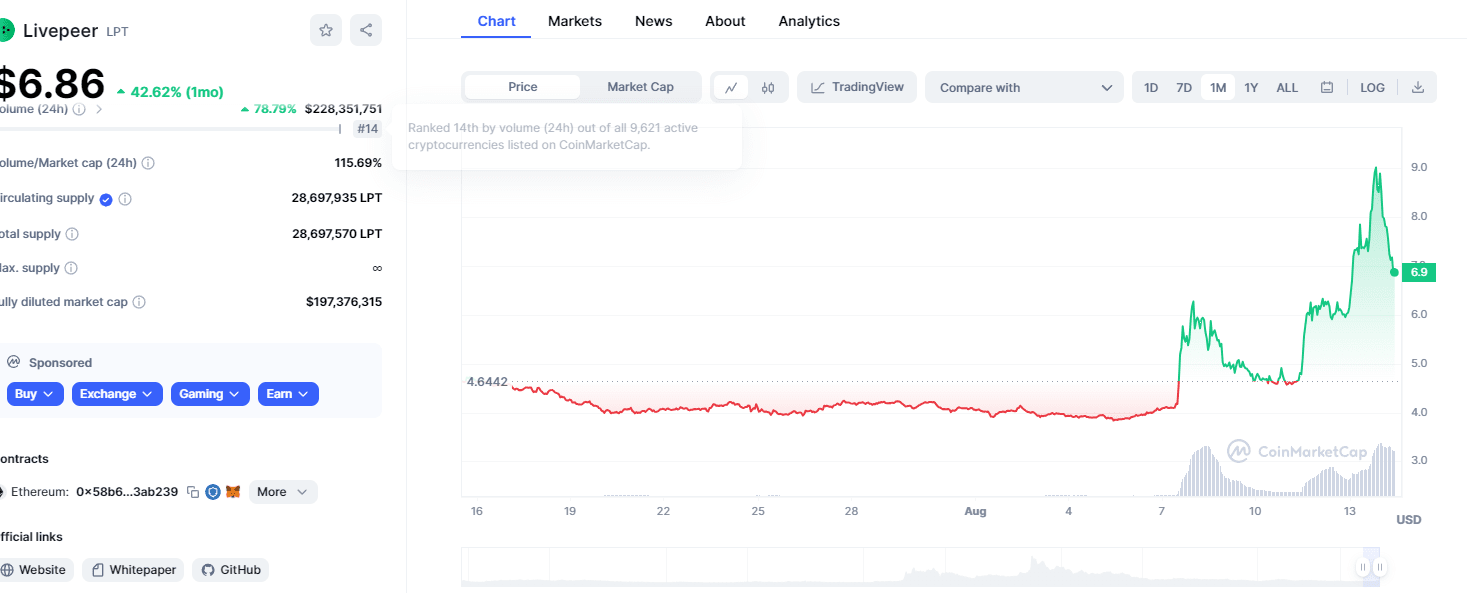
Today we continue to talk about an interesting project, which is also the first time I have seen this track. It is the real-time video network protocol-livepeer (LPT). The recent increase is still acceptable, from 4 on August 7 to 8 The 9 on the 13th has doubled in a week and is currently 6.9. The current market value of livepeer has reached 190 million US dollars, and the current market value ranking is around 150+. Today we will take a look at its origins.
Introduction
The Livepeer project aims to provide a fully decentralized, highly scalable, crypto token-incentivized live video streaming network protocol and produce a solution that can serve as the real-time media layer in a decentralized development (web3) stack. Additionally, Livepeer is designed to provide any existing broadcaster with a cost-effective centralized broadcast solution. Livepeer Protocol - A delegated stake-based protocol for incentivizing participants in a live video broadcast network in a game-theoretically secure manner. We propose solutions for decentralizing scalable verification of work, as well as preventing useless work, in an attempt to game token distribution in an inflationary system.
Livepeer is a decentralized video infrastructure network and an open video API designed for developers building at the intersection of video, Onchain platforms, and social protocols.
Project Vision
As LIVER peer-to-peer technology and protocols are delivered, it will enable users to participate in the following process: Capture video on a camera, phone, screen or webcam and send it to the Livepeer network. Nodes running in the network will encode it into all the necessary formats to reach every supported device. Users running these nodes will be incentivized through fees paid for broadcasting in ETH and have the opportunity to build reputation through protocol tokens to earn the right to perform more work in the future. Any user on the network can request to view a stream and it will be automatically distributed to them in near real time.
background
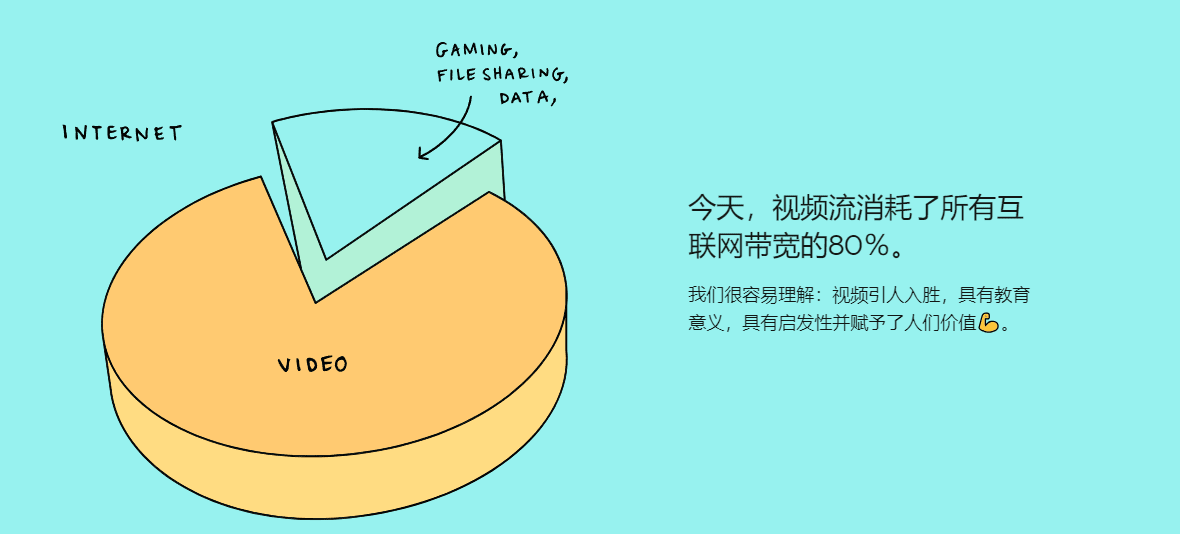
However, video streaming is extremely expensive for companies, and live streaming is even more expensive.
Why? Because broadcasters who want to distribute video on the internet need to transcode it first.
Transcoding is the process of taking the original video file and reformatting it so you can be sure of the best viewing experience, no matter what device you're using, whether you have 2G or 5G bandwidth.
Today, cloud services like Amazon cost $3 per hour to transcode each video, which translates to $4,500 per month for a media server and $1,500 per month for bandwidth for a content delivery network. That’s a lot.
With such high infrastructure costs, aspiring social video startups have to pay high costs to acquire users at launch, adding tens of thousands of users a month, ultimately racking up millions of dollars in bills that drain their capital. In order to find a viable business model, startups have been forced to tax users by selling their data, bombarding them with ads, or shutting down operations entirely.
With the advent of the internet, lots of 4k video, ultra-high definition, VR streaming and everything that moves broadcasting from traditional broadcasting to the internet, the demand for video services has grown exponentially in terms of infrastructure.
To keep pace with this growth, video infrastructure requires more scalable and cost-effective solutions.
What is LivePeer
Livepeer is a scalable platform-as-a-service for developers who want to add live or on-demand video to their projects. It is designed to improve the reliability of video streaming while reducing the costs associated with it by up to 50 times.
To achieve this, Livepeer is building a p2p infrastructure that interacts through a marketplace secured by the Ethereum blockchain.
Meet Alice
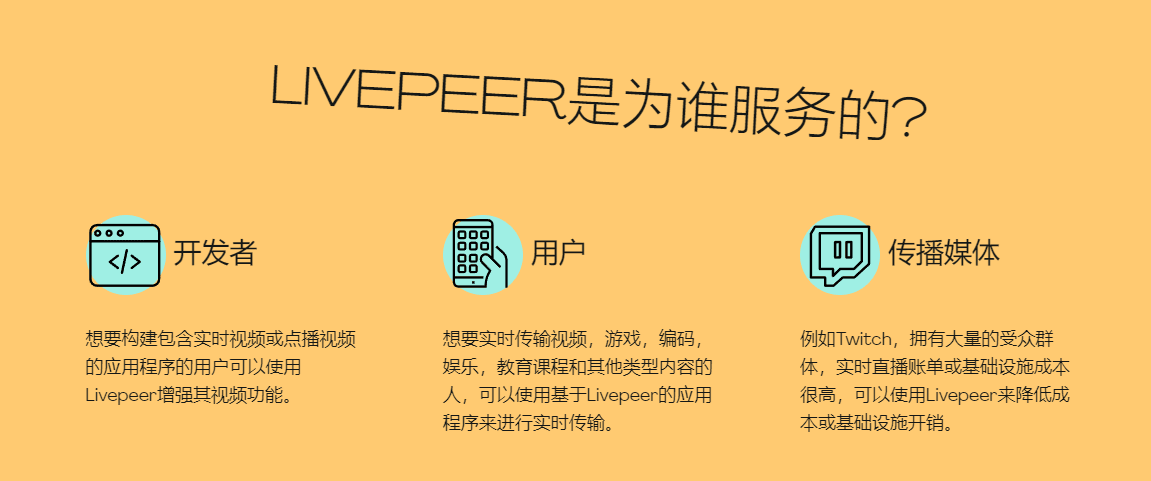
Alice is an app developer who is using Livepeer to add live video capabilities to her high school's sporting events.
Meet Bob
Bob is an events coordinator who is in charge of live streaming his high school's basketball games using Alice's app.
When Bob opens the app and taps "record" at the start of each game, the app sends the live video, along with the live stream fee, to the Livepeer network. Livepeer then transcodes the video into all the formats and bitrates that viewers can use.
Today is a very important live stream for Bob. It’s the championship game! How can Alice be sure that the live stream experience for Bob’s viewers is of high quality?
There are two main roles in the Livepeer network to ensure the quality of live streaming: Coordinators and Delegators.
ORCHESTRATORS
In Livepeer, anyone can join the network and become a so-called “coordinator” by running software that allows you to contribute computer resources (CPU, GPU, and bandwidth) to transcode and distribute video, thereby paying broadcasters and developers like Alice.
For this, you will earn fees in the form of cryptocurrencies like ETH or stablecoins (pegged to DAI).
LIVEPEER Token
The purpose of the Livepeer Token (LPT) is to coordinate, guide, and incentivize participants to ensure that the Livepeer network is as cheap, efficient, secure, reliable, and useful as possible. In the Livepeer protocol, LPT is required to perform the work of transcoding and distributing videos on the network. The more LPT you have, the more you can perform on the network in exchange for fees. As the network usage grows, so does the need for coordinators.
Of course, not everyone has the expertise required to run Orchestrator. It requires serious technical knowledge and can be a full-time job. What if you are a Livepeer token holder but don’t have the time or expertise to run the necessary infrastructure 24x7?
There is another group of participants in the Livepeer protocol who, although equally important in the protocol, play a less active role - Livepeer Delegators.
Delegator
Delegators are Livepeer token holders who participate in the network by "staking" their tokens to Orchestrators they believe are doing a good and honest job. You can think of staking like putting down a deposit. When you stake, your tokens are locked for a period of time, and then you can withdraw them or stake them to another Orchestrator. Doing this helps ensure that the network is more secure.
You might be wondering, why would token holders stake their tokens? What’s in it for them?
Rewards for participation
When broadcasters pay fees to the network, both coordinators and agents receive a portion of those fees as a reward for ensuring a high-quality and secure network.
In addition to earning fees, Livepeer also mints new tokens over time, which, like Bitcoin and Ethereum’s block rewards, are distributed to delegators and coordinators in proportion to their total stake relative to the rest of the network’s participants.
This has the effect of increasing network ownership among participating people and decreasing network ownership among non-participating people.
It also gives Orchestrators a strong economic advantage over traditional centralized video providers because the value of the token offsets what they need to charge broadcasters to break even. With traditional centralized video providers, they have to charge you for their service to transcode and distribute the video, plus a margin.
Rounds and inflation rates
round
In Livepeer, new tokens are minted in each so-called round. Rounds are measured in Ethereum blocks, where one round equals 5760 Ethereum blocks. In Ethereum, blocks are mined every 14 seconds on average, which means that one round of the Livepeer attack lasts about 22.4 hours. Assuming the coordinator you staked is doing its job, this is how often you can expect to receive reward tokens.
Next, let’s discuss Livepeer’s inflation rate, or in other words, the way the Livepeer protocol determines how many new tokens to mint each round.
The current inflation rate as of today is 0.0309%, with a total of 28,697,935.45 Livepeer tokens currently available. So if you do the math, the next round will reward a total of 8,867.66 newly minted Livepeer tokens to all participants.
The beauty of Livepeer is that the inflation rate automatically adjusts based on the number of tokens released from the total circulating supply. Currently, the total supply of Livepeer tokens is maintained at 28,697,935.45 and those, are all staked. Livepeer calls this ratio (44.33%) its “participation rate”.
Initial Release
On May 1, 2018, Livepeer released and started the MerkleMine token issuance method. After a three-month cold start period, starting from a certain Ethereum block height (July 26, 2018), anyone holding more than 0.1 ETH can submit a usable proof to the Livepeer MerkleMine contract to generate LPT, and only needs to pay the transfer fee. There is no limit to the number of usable proofs that participants can submit, until 2,598,071 proofs are submitted, and 6,343,700 LPT are distributed based on the proof submission.
The Livepeer MerkleMine ended in October 2018, completing the initial issuance and distribution of tokens.
consensus
Livepeer has a two-layer consensus system. The LPT ledger and transactions are secured by the underlying blockchain (such as Ethereum). Any transfer of LPT tokens or any transaction in the system can be considered to have the same security as the underlying proof-of-work or proof-of-stake blockchain. However, the second layer determines the distribution of newly generated LPT. This is managed by the Livepeer smart contracts and the participation of various participants in the protocol. While consensus is not required, in terms of the acceptance and validation of previous blocks, the protocol defines the rules of participation and the conditions under which participants are punished (slashed) for failing to fulfill their roles.
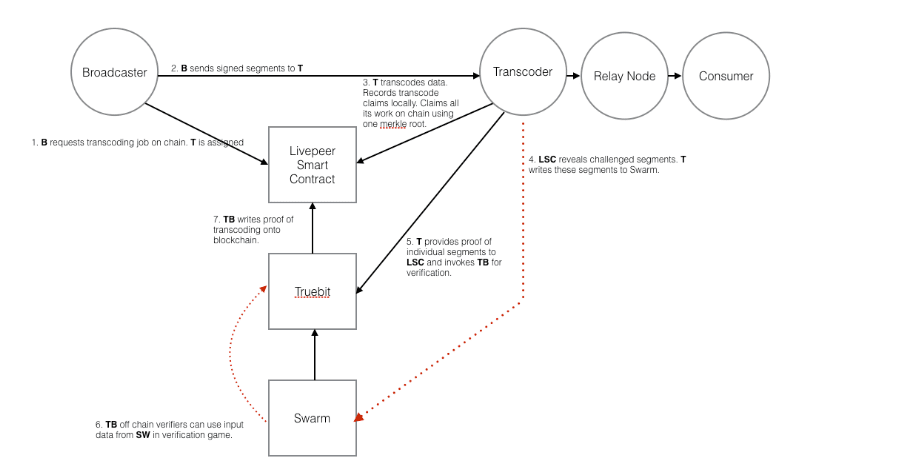
The second level of consensus that governs newly generated tokens is based on Delegated Proof of Stake (DPOS), inspired by systems such as Bitshares, Steem, Tendermint, and Casper. The role of validators in the network is played by transcoders. Any user can delegate their stake to a transcoder, who then needs to perform transcoding work in the network, participate in the work verification protocol, and call functions on the chain at specific intervals to verify this work. The protocol will distribute fees and newly generated tokens, and will slash the stake of participants who misbehave. The verification results will be recorded on-chain through Truebit after the verification is performed, so there is no room for dispute between broadcasters and transcoders.
Truebit is an off-chain technology that assists Ethereum in completing heavy computations, allowing Ethereum-based applications to do more complex things. If Livepeer's verification work is performed on the chain, it will cost more. Using Truebit can improve efficiency and save costs. After Truebit verifies the transcoding work, it will hand over the results to the Livepeer smart contract to perform subsequent work.
Livepeer assumes that a target rate of 50% is a healthy compromise between network security and token liquidity, so to reach this target the protocol incentivizes participation by increasing the inflation rate by 0.00005% for each round with a participation rate below 50%, and decreasing it by 0.00005% for each round with a participation rate above 50%.
Ecology
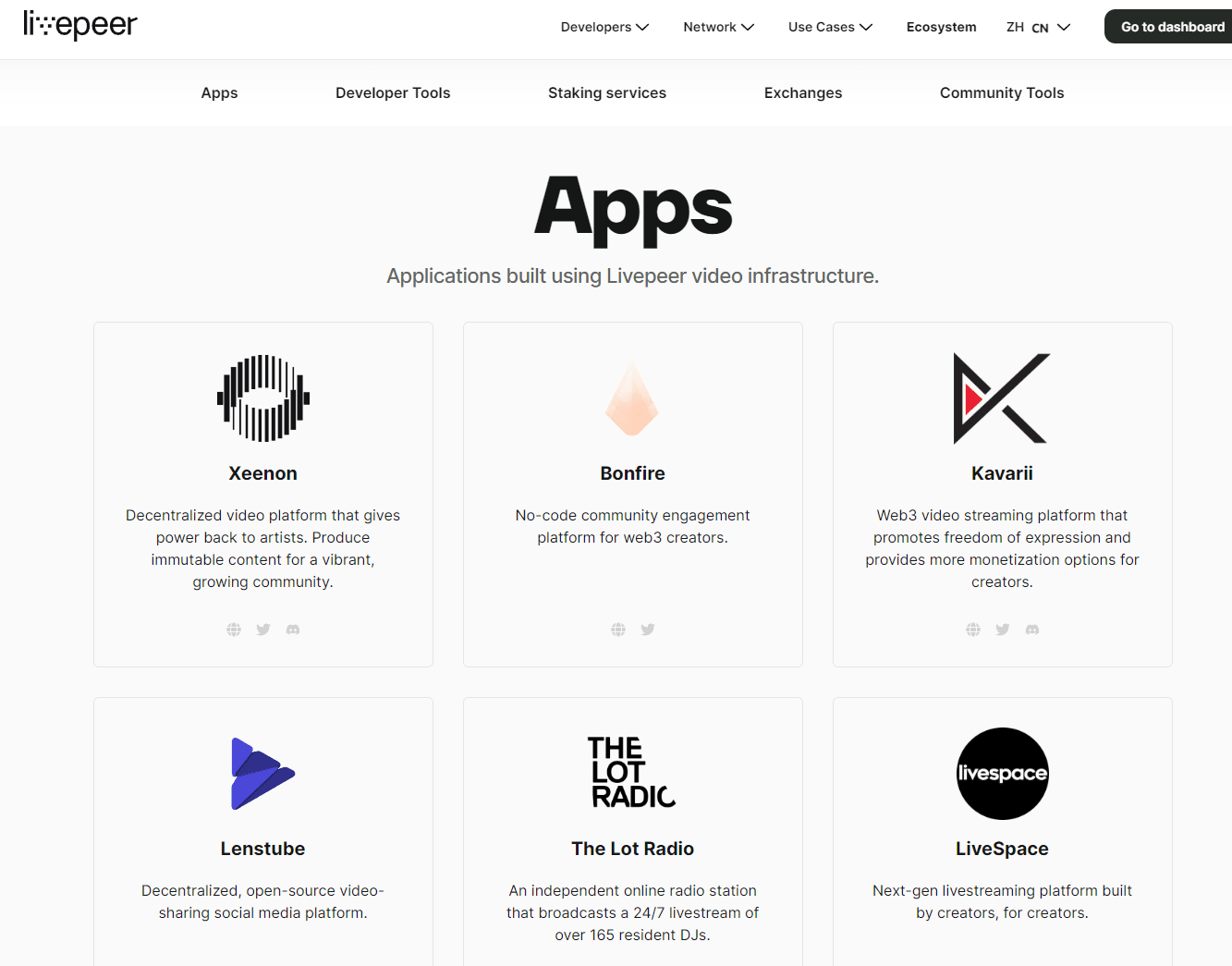
There are not many applications at present, only 12.
Finally, let's summarize. Does the current real-time video media really need the help of blockchain? It seems to be running well without blockchain. I think it's a bit of a rip-off of the concept of blockchain, but at least it has opened up a new field. The project is also made by Chinese people, and the founder Tang Xiao is also a Chinese. Then this project is also one of the currencies held by Grayscale Fund. The concept is a bit similar to the concept of RNDR. Then why did it soar? Look at the three conditions I mentioned yesterday. Does it meet all of them? Overall, the fundamentals of the project are still good, and it is currently in a relatively low market value range.